(Sunday Homily) Why I Liked “American Sniper”

american-sniper

Readings for 3rd Sunday in ordinary time: DT 18: 15-20; PS 95: 1-2, 6-9; I COR 7: 32-35; MK 1: 21-28

Today’s readings are about resistance to oppression. They invite us to side with the oppressed and poor in their fight against world-class bullies – to understand the world from the viewpoint of the “unclean.” Seen from that perspective, “American Sniper” is full of insight. It calls us to think critically about whose side we are on in the endless wars our country wages.

The need to see reality “from below” is a major point of today’s first reading. There the message of Moses announcing liberation of the oppressed is presented as the criterion of prophetic truth. Those who teach like Moses (on behalf of the enslaved) should be listened to. False prophets with another message will be punished. This first reading from the Jewish tradition goes on to promise the advent of another prophet like Moses.

By virtue of its inclusion in the liturgy of the word, today’s gospel selection from the Christian tradition identifies Jesus as fulfilling the Mosaic promise. He not only astounds people by his authoritative way of speaking. His action on behalf of a man considered “unclean” demonstrates Jesus’ prophetic authenticity.

That insight was on my mind last week when I decided to see “American Sniper” for myself. I had read the reviews. I knew the criticisms. But I wondered what it would look like if I followed the suggestions of today’s readings and viewed the film “from below,” from an Iraqi perspective.

What I discovered was surprising.

Viewed from the underside of history, “American Sniper” was a tribute to the world’s poor and oppressed – especially to the heroic people of Iraq. That’s because “American Sniper” was about resisting bullies the way the Iraqis have since 2003.

That bully theme is not farfetched. It was announced in one of the film’s opening scenes.

There an adolescent Chris Kyle is instructed by his father about three ways of being in the world. Kyle, of course, is the film’s central character – the most lethal sniper in the history of the American military. He is believed to have killed 255 Iraqis in his 4 tours of duty. Many, it is certain, had their heads blown right off.

“You can be a wolf, a sheep, or a sheepdog” Kyle’s father tells him (in my paraphrase). “Wolves are bullies; they are cowards preying on the weak. Sheep are the naïve who simply go along, following the herd; they do nothing about bullies. They too are cowards. The way to deal with bullies” says Kyle’s father,” is to be a sheepdog and protect those the bully preys upon.

“I want you to be sheepdogs!” the elder Kyle shouts at his sons, “Don’t let the bullies have their way.”

Ironically, the rest of “American Sniper” shows how Chris Kyle entirely rejected his father’s advice, but also how Iraqi patriots unconsciously heeded it. They emerge in the film as the sheepdogs Kyle’s father admired.

For his part, Kyle joins a gang that specifically preys upon the weak for no good reason – simply because it can and because (as Kyle writes) it’s fun. Chris Kyle became a gangster bully.

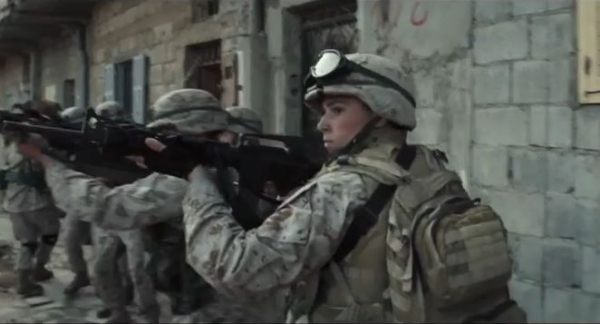
No, he didn’t join the “Crips” or “Bloods,” “Sharks” or “Jets.” He joined the “Seals.” And their destructive power was beyond belief. To begin with, their gang attire was fearful including matching helmets and boots, flak jackets, camouflage, wrap-around sunglasses, and night vision goggles. They had guns of all types, unlimited supplies of bullets, grenades, missile launchers, armored vehicles, helicopters, planes, and sophisticated communication devices. They prowled in menacing groups along the streets of Bagdad pointing guns at open windows and doors, pedestrians and drivers.

But it wasn’t easy for aspiring bullies to become Seals; doing so required absolute submission and humiliation. So as with all gangs, they had their initiation rites. These included merciless hazing and demeaning tests of endurance. Such rites of passage were accompanied by constant indoctrination that left initiates exhausted and absolutely malleable. In terms of today’s responsorial psalm, their hearts were sufficiently hardened for the inhuman tasks before them.

As a result, and with no knowledge whatever of their intended victims, Seals became convinced that anyone their superiors identified as “targets” were savages. They knew that because their indoctrinators told them so.  They knew nothing else about Iraq, Iraqis or their culture. And so, and like their Indian Fighter predecessors, Seals hated “savages” and wanted them all dead.

In other words, gang aspirants became servile and submissive sheep. They obeyed orders without question or understanding of context. (It’s the military way.) Seals stood ready to kill women, children, the elderly and disabled – anyone identified by their superiors or who threatened their mafia-like ethos of “family.” Protecting one’s “brothers” in crime became the justification of any slaughter. As a result of that brainwashing, Seals were entirely unable to see their “enemies” human beings.

Such identification was difficult for audiences of “American Sniper” as well. Nonetheless, Iraqi humanity inevitably surfaced for anyone remembering today’s readings about Moses and Jesus.  Those prophetic lenses revealed the Seals’ victims to be the successors of the poor and oppressed that both of those prophets came to rescue.

Think about the Iraqis for a minute.

Like their predecessors in Egypt, they were perfect targets for bullies. They had no army, no sophisticated weapons, no helicopters, planes or armored vehicles. They wore no uniforms or protective clothing. Apart from unemployed members of Iraq’s Republican Guard, almost none had formal military training.

Instead they were simple peasants, merchants, teachers, barbers and taxi drivers. They were fathers and mothers, children barely able to lift a grenade launcher, grandparents, friends and neighbors banding together as best they could to protect their homes, families from the ignorant, marauding invaders who proudly called themselves “The Seals.” Unable to show weapons in public (like their menacing occupiers), Iraqis hid them by day under floor boards in their homes.

Some were so desperate that they were willing to sacrifice themselves and their children to resist the Seal home-invaders. So they became suicide bombers. Others experimented with non-violent resistance. They were willing to share their tables with the barbarians from abroad, offering them food and shelter in hopes that kindness might win them over.

But no such luck.

So the majority resorted to defending themselves and each other with weapons – mostly captured or left over from previous Seal invasions (there have been many). What else were these brave patriots to do?

One of them became particularly admired. He had been a national hero, called Mustafa. In the story, this fictional character was an Olympic gold medal winner like the American’s Michael Phelps. But instead of resting on his laurels or using his status to protect himself from harm, he employed his skills as a sharp shooter to defend his people.

We can only imagine the pride that swelled the hearts of Iraqis when they heard how he inspired fear in the American bullies who constantly kicked in their doors, destroyed and looted their property, belittled their culture and faith, intimidated their children, frightened their elders, and demeaned their women.

In the end, Mustafa became a glorious martyr.

Again ironically, he was gunned down by his ignorant American counterpart. He was killed by the bully without a thought in his head who was in the game for fun, for the rush of battle, and to protect his relatively invulnerable “brothers” from the harm they deserved at the hands of the civilian victims they tormented.

In what can only be described as an act of self-loathing, that counterpart, Chris Kyle, takes careful aim and from a great and safe distance shoots a patriot he considers “savage,” because he mirrors so well his own bloody “work.”

It’s easy to vilify Chris Kyle. But he’s not to blame. He was no different from any other soldier serving in Iraq. He was no different from drone “pilots” operating from their air-conditioned “theaters” in Nevada or New Mexico. Sad to say, all of them are unwitting bullies and gangsters. They are brainwashed sheep.

Today’s readings are a reminder of all that. So is “American Sniper.”

Both call us to put ourselves in the shoes of those we are taught to hate.

Shockingly, they call us to change sides!

(Sunday Homily) Pope Francis’ Prophetic Warning on Climate Change: Repent or Else; the Time Is Short

Pope-in-Philippines

Readings for 2nd Sunday in Ordinary Time: JON 3: 1-5, 10; PS 25: 4-9; I COR 7: 29-31; MK 1: 4-20; http://usccb.org/bible/readings/012515.cfm

Last week, Pope Francis offered a preview of his eagerly anticipated encyclical on climate change – to be published next June or July. While visiting the Philippines, the country most devastated by climate chaos, it wasn’t that the pope merely joined the chorus of scientists, environmental activists, and those who heed them. He went much further, promising to transform the issue of climate change from a debate topic trivialized on Fox News into a matter of “faith and morals” (The phrase used by Catholics to define the area within which the pope has overriding authority.)

In doing so, Francis follows the traditions of prophets like Jonah and Jesus – each centralized in today’s liturgy of the word. Both prophets called for repentance (change of thought and action). However, the repentance they summoned pales in comparison to what the pope evidently has in mind.

Yes, the pope is a contemporary prophet. At this moment in history, he is arguably the most powerful ever in terms of his consciousness, courage, credibility and constituency. He literally embodies our best hope for “saving the world.” So it’s incumbent on progressives to heed, highlight and support his efforts.

With that in mind, consider today’s readings about prophetic warnings and how to respond.

The first recalls the message of the Bible’s fictional character Jonah. He’s a reluctant ethnocentric prophet forced by God to call Israel’s mortal enemy, Nineveh, to repentance. “Forty days more and Nineveh shall be destroyed” Jonah proclaimed with some delight.

Ultimately though, Jonah’s ethno-centricity is frustrated when against his desires, the Ninevites quickly and unexpectedly take his message to heart, change their ways, and God repents “of the evil he had planned.” In this way, the Divine One showed God’s character as depicted in today’s responsorial. There the psalmist says that (unlike Jonah) God is compassionate, loving, kind, good, and upright. God guides humble sinners on the path of truth – i.e. reality as it is, not as humans would like it to be.

Jesus’ proclamation was similar to Jonah’s, but without that prophet’s nationalist limitations. As depicted in today’s gospel reading, Jesus’ basic message was a call to profound change: “This is the time of fulfillment,” he said. “The Kingdom of God is at hand. Repent and believe in the gospel.” That notion of fulfillment and the nearness of God’s Kingdom introduces a profound element of hope to complement Jesus’ summons to repentance.

Like the Ninevites in the Jonah story, Peter and Andrew, James and John take Jesus’ words to heart profoundly altering their lives. They leave their former employment as fishermen abandoning their nets, their fathers’ boats and hired men. They follow instead a penniless itinerant preacher and community organizer, adopting his life of complete dependence on others for daily sustenance.

In today’s second reading, Paul shows that the early church embraced Jesus’ message. “Time is running out,” Paul warns. It’s time to prioritize the Kingdom even before family, emotional ups and downs, attachment to property — and to the world as it is. Paul is uncompromising in his perception of the profundity of change “repentance” calls for.

However the apostle’s perception is nothing like the lack of compromise called for by the historically unprecedented crisis of climate change. And this brings me back to Pope Francis and the promise of his prophetic consciousness, courage, credibility, and constituency.

Begin with Francis’ consciousness. He alone among our elected thought “leaders” recognizes contemporary historical patterns – the links between climate change, capitalism, its neo-liberal order, corporate power, income inequality, poverty, colonialism, and a host of other problems (including absence of universal education and health care). For Francis, climate change is not merely one issue among many. It is the frame which makes evident the solutions to those other issues.

More than this, the pope has the uncommon courage to identify without equivocation the cause of such problems – neo-liberal capitalism. He says what politicians like President Obama and other heads of state (with the exception of Raul Castro of Cuba) find impossible to say. Their dependence for survival on billionaires and plutocrats render them impotent before the ideologies of unfettered markets and their “trickle-down” theories. By contrast Pope Francis terms the latter homicidal (53), ineffective (54) and unjust at their roots (59). (Parenthetical numbers refer to sections of “The Joy of the Gospel.”)

Additionally while speaking the unspeakable, the pope enjoys tremendous credibility. With the exception of neo-liberalism’s intractable apologists, the world loves and embraces the man. His efforts to distance himself from the traditional luxurious papal lifestyle, his honesty in responding to difficult questions, his humility and genuine love for the poor make him our century’s most credible moral leader.

And finally, there’s the pope’s constituency. Unlike prophets before him (including Jesus of Nazareth) sheer numbers give Pope Francis unprecedented power to change the world. Jonah’s potential respondents to his calls for repentance were only inhabitants of the city of Nineveh. In today’s gospel reading Jesus’ respondents were four simple fishermen: Peter, Andrew, James and John. Eventually, only a minority of poor Palestinian peasants took to heart Jesus’ words. By contrast, and in virtue of his office, this pope’s constituency is trans-national and world-wide. There are 1.2 billion Catholics on the planet the pope calls “Mother” and “Sister.”

Evidently Francis’ plan is to use his credibility to courageously spread his consciousness and widen his constituency. He plans to do so in five steps. He will (1) publish an encyclical (the most authoritative form of communication at his disposal), (2) convoke an ecumenical meeting of world religious leaders, (3) presumably secure from them a statement paralleling his encyclical’s conclusions, (4) present that statement in his speech to the United Nations in September, and (5) attempt in doing all of that to influence the conclusions of this year’s Climate Summit in Paris two months later.

That’s prophetic activism unparalleled in the recent history of the papacy.

And what specifically is entailed in the repentance necessary to save our Mother? Of course, to share the pope’s vision, we await details in the forthcoming encyclical. However, today’s liturgy of the word points us in the general direction. In the meantime, secular prophets like Naomi Klein fill in the challenging details.

General directions include (as Paul says in today’s second reading) transcending emotions like fear-inspired denial. They include willingness to cut family ties (i.e. narrow nationalism), re-examining our career paths, attachments to property and neo-liberal dreams of unlimited consumption and getting rich.

Specific repentance is more radical than any of our politicians dare articulate. According to Klein, author of This Changes Everything, that’s because our planet has reached “decade zero.” Denialists have led us to squander the leeway we had twenty-five years ago. If we don’t decisively alter within the next ten years our path of production and consumption, the planet’s temperature is bound to rise 4 to 6 degrees Celsius. However, according to climate scientists, any rise beyond 2 degrees will make disastrous climate change irreversible. And that will result in disastrous droughts, water shortages, typhoons, flooding, wildfires, and crop losses with whole cities under water and Islands swallowed by the sea.

To avoid such disasters, required repentance includes:

  • Rejecting the neo-liberal myth that has shaped our world over the last 35 years.
  • Replacing it (the pope will say) with the biblical vision of the Kingdom (proclaimed by Jesus in today’s gospel reading). God’s Kingdom is characterized not by competition and privatization, but by cooperation, sharing, prioritizing the needs of the poor and respecting the earth as commons.
  • Setting aside neo-liberalism’s fetish about regulation, and setting bold national policies guided by clear goals, a strictly imposed time table, and severe penalties for non-compliance.
  • Implementing corresponding policies to cut annual emissions in the industrialized world by 8- 10%.
  • Recognizing that exchange of myths means rejection of market-driven models of untargeted economic growth.
  • Redesigning our cities and redistributing population to eliminate long commutes between home and work.
  • Investing massively in light rail and other means of public transportation so that commuters might travel efficiently and free of cost.
  • Similarly subsidizing renewable sources of energy – solar, wind, geothermal, and biomass.
  • Turning the roof of every available building into an energy plant.
  • Respecting the rights of indigenous people under whose lands so much carbon deposit remains.
  • Eliminating by law, controlling by strong regulation or penalizing by heavy taxation industries that are wasteful and/or destructive of the planet such as arms manufacturers, the fast-food industry, GMO firms, and middle-man industries like health insurance.
  • Dealing with climate impact and damage according to “the polluter pays” principle. This recognizes that the 500 million richest people on the planet are responsible for 50% of the world’s pollution and that the U.S. military is by some estimates the largest single consumer of petroleum in the world.
  • According to “the polluter pays” principle, withdrawing from foreign wars, cutting the military budget by at least 25% and making the rich 1% pay their fair share of taxes.
  • Tolerating as necessary increased taxes on everyone, except the poor.
  • Drastically reducing the amount of energy each of us consumes.

You get the idea. The agenda necessary to save our planet from “the evil Nature has planned” is challenging indeed. But it contains that surprising element of hope Jesus signaled when he termed “repentance” as “good news” and “fulfillment.”

After all, our destructive way of life is anything but fulfilling. On the other side of the repentance just described is a cleaner, healthier, less stressful life with full employment, more leisure, greater equality, and harmony with one another and our world.

That’s the vision behind the pope’s courageous prophetic work. It deserves our undivided attention and support.

(Sunday Homily) Pope Francis Calls for a Global Catholic Climate Movement

Italy Pope Epiphany

Readings for 1st Sunday in Ordinary Time: I SAM 3: 3B-10, 19; PS 40: 4, 7-10; I COR 6: 13C-15A, 17-20; JN 35-42

Recently Pope Francis has come in for some hard criticism from the U.S. right wing. It’s not just because of his rejection of free market capitalism, trickle-down theory, and huge income disparities between the rich and poor. It’s not just his openness to gays and divorcees, and his refusal to obsess about abortion and contraception.

Yes, all of these have undermined what conservatives have seen as a close alliance between the Catholic Church and their pet causes and thinking modes.

However, the straw breaking the back of reactionaries is the pope’s unequivocal warnings about climate change. They’ve gone apoplectic about his intention to publish an encyclical on the matter, and his plans to convoke a conference of religious leaders to address it. The pope’s expressed intention is to influence this year’s U.N. Paris Conference on Climate Change. All of that has raised the specter of a global Catholic climate change movement potentially mobilizing the world’s 1.2 billion members. Think about that for a minute!

In such context, Francis visit this week to the Philippines is extremely significant. The Philippines is not only the home of 80% Asia’s Catholics – more than 100 million. It is also the poster child for the devastation that climate change wreaks on the principal victims of global warming, the world’s poor. In 2013 the archipelago was raked by Typhoon Yolanda whose winds and floods killed more than 7000.

So the world listened when on his way to Manila Pope Francis was asked if climate change is “mostly due to the work of man and his lack of care for nature?” In reply, the pope said:

(F)or the greater part, it is man who gives a slap to nature continually, and we have to some degree become the owners of nature, of sister earth, of mother earth. I recall, and you have heard, what an old peasant once told me: God always forgives, we men forgive sometimes, but nature never forgives. If you give her a slap, she will give you one. I believe that we have exploited nature too much, deforestation, for example.

With words like those, the pope’s critics charge he is speaking beyond his expertise, which involves matters of “faith and morals.” But that’s just the point. The pope is making climate change a moral issue, a matter of ethics even more important than more “traditional” Catholic moral concerns about sex which after all presume the survival of the human species and the planet.

The pope’s critics also ignore, of course, that Francis bases his judgments not only on the testimony of 97% of all climate scientists, but on the research of the Pontifical Academy of Sciences. Its membership roster features the names of the world’s most respected scientists. These include Nobel laureates such as Ernest Rutherford, Max Planck, Otto Hahn, Niels Bohr, and Charles Hard Townes. The Academy’s current president is Werner Arber, himself a Nobel laureate, and the first Protestant to head the group.

But why such right-wing fury? It’s because like Naomi Klein, conservatives see the (for them) disastrous implications of addressing the issue. As announced in the title of Klein’s book, they sense that This Changes Everything. That is, taking on climate change as a moral issue undermines the political right’s program of market deregulation and continued extraction of non-renewable resources.

So pundits like First Things blogger, Maureen Mullarkey have given up on lip sticking the pope and are now in full attack mode. According to Mullarkey Pope Francis is simply “an ideologue and a meddlesome egoist. His clumsy intrusion into the Middle East and covert collusion with Obama over Cuba makes that clear. Megalomania sends him galloping into geopolitical—and now meteorological—thickets, sacralizing politics and bending theology to premature, intemperate policy endorsements.”

For Mullarkey, Pope Francis pretty much stinks.

And that brings me to today’s gospel reading. It’s all about stink – about what Pope Francis calls “the smell of the sheep.” Famously, you recall, the pontiff called on Catholic priests to live closer to the poor, to recognize them as God’s people and their welfare as the guideline for economic and social policy – to “take on,” he said, “the smell of the sheep.”

In other words, conservatives are suspicious of Pope Francis and are on the point of vilifying him because he smells too much like sheep — like the poor. He smells too much like Jesus.

Notice that in today’s gospel, John the Baptizer identifies Jesus as “the Lamb of God.” To begin with, the phrase reminds us of the tribal, Bedouin origin of the biblical “People of God.” Abraham, Isaac, and Jacob, and the great King David were all shepherds. They were primitive people close to the earth. They were tribalists. Jesus was a tribalist. According to John’s image, Jesus didn’t just smell like sheep; he was a sheep! He was in spades like his slave and Bedouin ancestors — like the poor people the pope is centralizing in his visit to the Philippines.

Pope Francis is a tribalist too. And he’s practicing what he preaches — both liberation theology’s “preferential option for the poor,” and the traditionally Catholic principle of subsidiarity. Once again, that means endorsing economic and environmental policy not on the basis of market dictates, but according to human decisions about values like the common good. Humane policy, the pope implies, originates not on Wall Street, but in places like the Philippines’ Tacloban City which was leveled by Typhoon Yolanda. It’s there that the pope’s itinerary reportedly has him dining in the shack of a hurricane victim. (Can you imagine a humble Catholic housewife setting her family table to include the pope?)

As our century’s most powerful illumined voice of conscience, Francis is using his bully pulpit to wake us up. We’re like Samuel in today’s first reading – fast asleep even before the Ark of the Covenant (a reminder of Israel’s enslaved and Bedouin past). But we fail to recognize the biblical tradition’s significance to our lives – its call to tribal values which unfailingly center on animals, human family, and Mother Earth. We fail to see the implications of Paul’s observation in today’s second reading that all human beings – especially the poor and outcast – are temples of God’s spirit. That’s our tradition! That same Spirit resides, the pope says, in the planet that he (like St. Francis himself) calls our Mother and Sister.

So what would a global Catholic climate movement look like? It would entail:

  • Waking up like the young prophet Samuel. Like him we’ve heard God’s call many times. But at last in Pope Francis, we have a thought-leader speaking in a voice the simplest of us can hear. It’s the voice of conscience. And like Eli it’s giving us the proper way to respond: “Speak Lord, for your servant is listening.”

A global Catholic climate movement further entails:

  • Rejection of corporation-based globalization which has us (over)consuming imported necessities that could be home-grown. (This involves lobbying against the Trans-Pacific Partnership.)
  • Joining the fight against fracking and projects like the XL Pipeline
  • Voting accordingly.
  • Urging the institutions we can influence (churches, universities, hospitals . . .) to divest from fossil fuel industries.
  • Adopting a “zero waste” policy in our homes and places of work.
  • Cultivating home gardens.
  • Adopting a vegetarian diet.
  • Educating ourselves about “green burial” and including plans for that in our “living wills.”

The list, of course, goes on. But you get the idea.

This stinkin’ pope is waking us up. He’s showing us the way. Thank God!

(Sunday Homily) The Torture Report: Cheney Channels King David in the Struggle over Historical Narrative

Cheney

Readings for 4th Sunday of Advent: 2nd SAM 7:1-5, 8-12, 14A, 16; PS 89: 2-5, 27-29; ROM 16: 25-27; LK 1: 21-38 http://usccb.org/bible/readings/122114.cfm

Strange that according to a poll last week, more than half the “American” people think torture is permissible. I say “strange” because nearly 80% of Americans consider themselves “Christian.” And Jesus himself was a victim of torture. On the other hand, can you imagine Jesus torturing anyone?

You’d think the similarities between the Romans’ treatment of Jesus and the “Americans’” treatment of countless innocent victims would make devout Christians less accepting of torture.  Maybe they’d oppose torture on principle, as a matter of faith.

Or perhaps it’s that they just agree with ex-VP, Dick Cheney. After all, he wouldn’t consider “torture” what the Romans’ enhanced interrogation techniques (EITs) did to  Jesus  – not the prolonged beating we all witnessed portrayed in Mel Gibson’s “The Passion of the Christ,” not the crowning with thorns, not forcing a beaten man to carry his own instrument of execution, not driving nails into his hands and feet, not leaving him for hours struggling for breath on a cross whose chief agony was bringing the victim to the point of asphyxiation (like waterboarding) and beyond.

According to Mr. Cheney, that punishment would have crossed the line to torture only at the point when death proved imminent. Unfortunately, as with untold (literally) victims of U.S. enhanced interrogation, that line was crossed in the case of Jesus.

But in the end, as supporters of U.S. Empire, “American” Christians probably understand and forgive what the Romans did. After all, like its U.S. counterpart, the Roman Empire was under siege on all sides. And the Jews were particularly rebellious. And Jesus (in Roman eyes) gave every indication of leading a rebellion. An empire’s got to do what an empire’s got to do – even if it means killing the innocent like Jesus.

I think however that there’s something more than compassion failure at work here.  The “more” is the power of propaganda. That’s something addressed in today’s liturgy of the word. There the author of 2nd Samuel whitewashes the brutal King David and turns him from something like a mafia don into a national hero. In today’s gospel selection, even the evangelist, Luke buys the distortion. He makes Jesus the successor of David.

I’ll get to that in a moment. But let me first finish with the torture document. You see, (as Glen Greenwald has pointed out) it’s no wonder that “Americans” can’t identify with the tortured much less connect them with Jesus.

That’s because since the Report’s release on December 9th, the mainstream media (MSM) has treated us to an endless parade of torturers and torture enablers explaining away the conclusions of the Senate’s years-long study.  We haven’t heard a word from the victims of torture or from the families of those whose sons and daughters were killed at the hands of sadistic representatives of our government.

The result of this one-sided silencing of the victims has been to rob them of their humanity – of their very existence.  Given the deafening silence, why would we feel compassion for people who don’t even exist? Out of sight, out of mind.

Imagine how better informed we’d be if on “Meet the Press” or somewhere Mr. Cheney had to defend his policies against his victims – many of whom, Greenwald reminds us (because he has interviewed them) are incredibly articulate. Perhaps the victims might suggest waterboarding the ex-VP to see if he really believes that practice doesn’t sink to the level of torture.

According to University of Wisconsin –Madison Professor Alfred McCoy (the author of Torture and Impunity) this erasure of victims is all part of a five-stage policy on the question of torture. After the Abu Ghraib scandal broke in 2004, the first step was identifying the low level perpetrators with “bad apples.” The second stage kept rumors of more widespread torture at bay in the name of national security. Thirdly, President Obama adopted the “let’s look forward, not backward” approach. Fourthly came the move to exonerate all those guilty of torture or enabling the practice. Finally we’ve reached the stage which emerged last week: vindication before the bar of history of all those connected with U.S. torture.

Again, that’s where the battle has been joined today; we’re struggling over historical narrative. This is the stage all empires come to eventually as their crimes inevitably come to light. It’s what we witness in today’s liturgy of the word and the white-washing of Israel’s King David. The example is instructive. It suggests practical responses to the Torture Report at both the level of faith and political action.

You see, there are really two separate king David traditions in the Bible. One presents the good David, the other, the bad. The good David is the one largely presented in I Chronicles 10:14-29:30. He also appears in today’s first reading from 2nd Samuel and in the responsorial psalm.

This David is pious, and wants to build a temple for God. According to the story, God is pleased, and rewards him with everything a king could want: victory over his enemies, immortal fame, prosperity for his people, thriving descendants, and a dynasty that will last forever.

Then there’s the bad David who begins to appear in I Samuel, chapter 16. This David is a murderous tyrant. He rebels against Saul, Israel’s first king. He’s a womanizer, a murderer and an object of popular hate.  Far from lasting forever, his dynasty ends with the death of his successor, Solomon. He’s the David whose death-bed instructions are worthy of any Mafia godfather. To Solomon he says, “Take care of my friends, Sol – and my enemies too (wink, wink). You know what I mean?” (IKGS 2: 1-9)

Besides that, the bad David bastardizes the Mosaic Covenant and its protection of widows, orphans, and resident aliens and turns it into a tool of the ruling classes – from Moses’ “I will be your God and you will be my people,” into David’s “You are my son, the king of Israel, and your dynasty will last forever.”

Of course, the bad David has been swallowed up by popular memory of its competing tradition. David is uniformly remembered by the majority of believers as the man “after God’s own heart.” As I said, in today’s familiar gospel selection, Luke falls into that trap. He makes Jesus (through his foster father, Joseph, no less) the successor of David. And this even though Jesus as portrayed by Luke is no friend of the Temple or of kings and emperors. Rather he is the friend of the beneficiaries of the Mosaic Covenant – the widows, orphans, aliens, prostitutes, tax collectors, lepers, Samaritans. His values do not include enemies (much less victory over them) or prosperity, fame, or everlasting dynasties.

Recognizing this struggle over which narrative will prevail sheds light on the Torture Report. It enables followers of the simple man from Nazareth to judge that the struggle even before the bar of biblical history has been won by the likes of Cheney and Bush. It has been won by the bad David.

Our conclusion: we must not allow that to happen as we fight over whose story should prevail concerning the latest revelations about the powerful organized crime syndicate known as the CIA.

So what should we do?  Our response should be at two levels.

At the level of faith believers should be exposed to the historical Jesus I’m attempting to present in these homilies. We neglect those powerful myths at our own peril. Even the uninformed can understand them.  This means that the Jesus’ story represents a powerful tool for raising consciousness about torture (and other issues of social justice).

It’s true that the MSM might not expose the story of the tortured to that 80% of “Americans” who claim to be Christian. However, if those with the responsibility for explaining the sacred texts assume that responsibility and do their homework, there’s no reason why those wishing to follow Jesus can’t understand that:

  • Jesus himself was a victim of torture at the hands of an empire very like the United States.
  • He taught universal love.
  • He was non-violent
  • He said he considers what’s done to the least of the human race as done to him.
  • He said we should love our enemies.

At the political level we should:

  • Urge outgoing senator Mark Udall (D Colorado) to use his senatorial privilege of unlimited free speech to release the entire unredacted torture document.
  • Pressure the media through phone calls and letters to the editor to present the other side of the torture story including interviews with torture victims and with the families of those whose sons and daughters, husbands and wives were killed under CIA torture.

(Sunday Homily) Usury More Clearly Contradicts God’s Law than Abortion!

Usury

Readings for 30th Sunday in ordinary time: EX 22: 20-26; PS 18: 2-4, 47, 51, I THES 1:5C-10; MT 22: 36-40. http://www.usccb.org/bible/readings/102614.cfm

Today’s readings raise the question of usury – a word we don’t often hear today, though its reality is part of the air we breathe.

Wikipedia defines usury as: “. . . the practice of making unethical or immoral monetary loans intended to unfairly enrich the lender. A loan may be considered usurious because of excessive or abusive interest rates or other factors, but according to some dictionaries, simply charging any interest at all can be considered usury.”

In the light of that definition, consider the following:

• Last Sunday’s New York Times editorial addressed President Obama’s proposal that interest rates on loans to veterans be capped at 36 percent. The editorial began by saying that “poor and working-class people across the country are being driven into poverty and default by deceptively packaged, usuriously priced loans.” The NYT editorial board argued that the 36 percent interest cap should be extended to all U.S. citizens. Thirty-six percent!

• The same editors reported a case where “. . . (A) South Carolina lender gave a service member a $1,615 title loan on a 13-year-old car and charged $15,613 in interest — an annual rate of 400 percent — without violating federal law.”

• Despite such surprises, Wednesday’s NYT edition ran another story headed “States Ease Interest Rate Laws that Protected Poor Borrowers.” It reported that lenders such as Citigroup, One Main, Springleaf, and the American Financial Services Association claim a need to increase interest rates on their poorest customers in order to keep their rates in line with their own increased business expenses for rent, electricity, and gasoline.

• Meanwhile the prime interest rate for bankers and corporate high rollers is 3.25 percent.

• Last June U.S. Senate Republicans shot down Elizabeth Warren’s Bank on Students Emergency Loan Refinancing Act. The bill would have allowed people with federal and private debt to refinance their loans at 3.86 percent. That would have given relief to more than 25 million borrowers owing $1.2 trillion in student loans. The GOP objected partly because the Refinancing Act would have created a new tax on millionaires to offset the lower interest rates.

The practices just described raise the question: how much interest can be charged before the rate becomes usurious? Today’s liturgy of the word suggests an answer.

Begin with a consideration of today’s gospel.

There Jesus is asked a question consistently addressed to rabbis and to wise persons in all traditions. “Which is the greatest of God’s commandments?”

The question is reminiscent of the familiar cartoon where the bedraggled seeker climbs up that mountain, confronts the guru sitting in front of his cave and asks him, “What’s the purpose of life?” That’s really the gist of the question presented to Jesus. What is life’s purpose?

Jesus’ response is not humorous as we’re always led to expect from those cartoons. His answer is not even surprising. Instead, it’s the standard one usually given by rabbis and wise people: “Look within,” he advises. “Find Ultimate Reality and devote yourself entirely to it. And then love that Reality’s every manifestation beginning with the people closest to you and finishing with the trees, soil, rocks, and cockroaches.”

That’s the meaning of Jesus’ response in today’s gospel. It mirrored perfectly the answer, for instance, of Rabbi Hillel, one of Jesus’ near contemporaries. Both of them said, “Love God with all your heart, mind, and spirit – and your neighbor as yourself. That’s the greatest commandment,” they agreed. “That’s the purpose of life. That summarizes all the content of humanity’s Holy Books. All the rest is commentary.”

We get a snippet of that commentary in today’s first reading from the Book of Exodus, which supplies practical content to the general answer about life’s purpose invariably given by the wise. (And it’s here that the business of interest enters the picture.) Today’s 16 line excerpt from Exodus focuses on two issues: (1) treatment of the most vulnerable in the community, and (2) prohibition of taking interest on loans. The two matters are intimately connected in a world where the poorest among us suffer from crushing debt as earlier described.

The reading says that loving God and neighbor means taking care of society’s most vulnerable – beginning with immigrants and including single mothers and street children. Reality decrees that mistreatment of people like that will bring karmic consequences and death by an invading enemy.

The reading goes on. When dealing with immigrants, remember you were once in their position. So treat them the way you would have liked your great-grandmother to have been treated when she arrived at Ellis Island from the Old Sod.

The second part of the Exodus reading addresses the most common instrument oppressors employ for mistreating society’s vulnerable. You guess it: it’s usury and debt.

You might have been surprised to read that God’s Covenantal Law as recorded in the Bible prohibits the taking of interest at all. The Law indicates that God considers usury (or any interest) sinful! It’s a form of “extortion,” Exodus says – meaning, as the dictionary explains, the “criminal offense of obtaining money, property, or services from a person, entity, or institution, through coercion.” The definition goes on to say that extortion is commonly practiced by organized crime.

For more than a millennium, moral theologians within the Church that developed following Jesus’ death agreed with our dictionary. Under pain of sin (as they put it), no interest could be charged on loans.

But then modern economists discovered the wonders of compound interest. That changed everything. Suddenly, charging interest became not only moral, but virtuous – including for Christians! Even the Vatican owns a bank whose underlying foundation is interest!

So times have indeed changed. Currently, moralists explain that the modern science of economics now understands what was not grasped in the ancient world of Exodus. So, morality had to change to keep up with the times and the advances of science. It’s a new world. (Hmm . . . . Does that same reasoning apply to matters such as homosexuality in relation to the insights of the modern science of psychology? And what about abortion and what modern medicine has disclosed about the beginnings of specifically personal life? After all, the Bible has this clear and strong teaching about prohibiting interest and says nothing at all about abortion.)

The suggestion here is that if we kept The Commandments as explained by Jesus and all the world’s great spiritual teachers:

• We’d prioritize concern for the welfare of immigrant children on our border, single moms in run-down neighborhoods, and street children everywhere. Their welfare, Jesus says, is identical with our own.

• We’d realize that the ability of immigrants, widows, and orphans to meet their transportation, rent and electricity bills is in God’s eyes more important than similar abilities on the part of Citigroup, One Main, Springleaf, or the American Financial Services Association.

• We probably wouldn’t support interest of any amount. (Certainly an interest rate of 36 percent would be out of the question, not to mention 400 percent.)

• At the very least, we’d demand that student loans would be refinanced at the prime rate.

• We probably wouldn’t support “capitalism” as we know it.

• We’d make usury as important a “Christian issue” as some make abortion.

• We’d hear about that from the pulpit, at least occasionally.

• We’d vote accordingly.

After all, an unmistakable critique of usury is actually found in the Bible. That’s not the case with abortion.

(Sunday Homily) U.S. Doublespeak Is More Threatening to the World than ISIS or Khorasan

uncle-sams-lies

Readings for 26th Sunday in ordinary time: EZ 18:25-28; PS 25: 4-5, 8-10, 14; PHIL 2: 1-11; MT 21: 28-32 http://www.usccb.org/bible/readings/092414.cfm

If I were you, I’d be careful about air travel. That’s because, as the President reminded us last week, the enemies we’ve so fiercely created over the last 13 years are plotting to blow U.S. commercial aircraft out of the skies. So one of these days Khorasan’s heat-seeking missiles will find the rear end of your plane, and that will be the end of you.

And, when you think about it, those firing the rockets will be justified in doing so. That is, if we allow them to apply the insane logic behind Mr. Obama’s latest justification for bombing his seventh Muslim country in six years.

In doing so the Nobel Peace Prize laureate said last week, “Once again, it must be clear to anyone who would plot against America and try to do Americans harm that we will not tolerate safe havens for terrorists who threaten our people.”

Wait a minute!

Our “leader’s” logic (if we universalize his pronouncement) has just endorsed an endless cycle of violence that should be completely unacceptable to any human being — not to say any Christian. His words mean that anyone who plots against another country trying to do their citizens harm can claim no safe haven. They will be subject to reprisal.

Tell that to drone victims and to Syrians who lost their children in last week’s bombings – or to similar casualties at weddings and funerals in Afghanistan, Iraq, Libya, Pakistan, Yemen, and Somalia. The President’s doublespeak logic allows them to say, “Once again it must be clear to the Americans plotting against us and trying to do our citizens harm that we will not tolerate safe havens for such terrorists who threaten our people. There will be reprisals.”

That means that the militants in the countries just mentioned can legitimately respond to the terrorism of drone and outright bombing attacks with similar assaults on American citizens in our own “homeland.”

So as I say, hold your breath on your next airline trip to Miami or New York. The blowback is coming – and the blowback to that blowback too.

Such are the realities of Eternal War.

It’s that sort of damned logic (I’m choosing my words) that is addressed in today’s liturgy of the word. It’s not at all comforting.

The first reading from the prophet Ezekiel sets the tone. It underlines what Easterners call the Law of Karma. Ezekiel says that people die because of their wicked deeds. He says, “When someone virtuous turns away from virtue to commit iniquity, and dies, it is because of the iniquity he committed that he must die.” That’s karma. It’s an inescapable law of the universe.

St. Paul put it this way, “Do not be deceived, God is not mocked; for whatever a man sows, this he will also reap.” (GAL 6:7-9). Relative to war, Jesus was even more pointed. He said all those who live by the sword will die by that same instrument (MT 26:52). It’s all karma.

As citizens of a nation that lives by the sword more than any other in world history, what then are we to do? Here, once again, today’s readings supply an answer. We must abandon the destructive path we’re on. That’s what Ezekiel says. Speaking of the potential recipient of negative karma, Ezekiel promises, “But if he turns from the wickedness he has committed, he does what is right and just, he shall preserve his life; since he has turned away from all the sins that he has committed, he shall surely live, he shall not die.” That too is karma.

In other words, to avoid the negative consequences of our actions, we must change course radically. More specifically today’s gospel selection addresses that imperative to political leaders. It calls them to make their actions correspond to their words.

Yes, today’s gospel is addressed to leaders like our president and congresspersons. There Jesus addresses those in power and tells the local rulers of his day (“the chief priests and elders”) a parable about lip service and the required change of direction. (Remember, in Jesus’ context there was no sharp distinction between religious and civil government.)

“A man had two sons,” the Great Teacher tells these government officials. “He came to the first and said, ‘Son, go out and work in the vineyard today.’ He said in reply, ‘I will not, ‘ but afterwards changed his mind and went. The man came to the other son and gave the same order. He said in reply, ‘Yes, sir,‘ but did not go. Which of the two,” Jesus asks, “did his father’s will?”

The chief priests and elders answer,”The first.”

Jesus said to them,”Amen, I say to you, tax collectors and prostitutes are entering the kingdom of God before you.”

I’m sure you see that Jesus’ parable is about governmental lip service and deception. The parable calls them to radical change in policy. Jesus implies that the leaders of his day were like the first son. They said the right things, but their actions belied their words. As a result, their deeds excluded them from the New Order (God’s Kingdom) which was always the focus of Jesus’ revolutionary discourse.

And that brings us back to our own leaders and the differences between what they say and do. Think of the events of recent weeks – even last week. During that time our leaders have:

• Paid lip service to national boundaries in the case of Russia and Ukraine, but then have claimed that national boundaries are irrelevant in their own “war on terrorism.”
• Paid lip service to international law – again in the case of Russia and Ukraine, but then ignored that law by going to war with ISIS without the required U.N. resolution.
• Paid lip service to civilization and decency in decrying ISIS’ brutal beheadings (by knife) of innocent civilians, but then beheaded literally untold others via drones and direct bombings. (Yes, drones and bombs inevitably blow heads off bodies.)
• Paid lip service to the human rights of civilians brutalized by ISIS, while ignoring the million and a half civilians their own armed forces have just as brutally killed in Iraq and Afghanistan.
• Paid lip service to nuclear non-proliferation in their demands upon Iran, but then have pledged billions to modernize their own overwhelming nuclear arsenal.
• Paid lip service to environmental protection (following last Sunday’s “People’s Climate March”), but the very next day implicitly embraced the possibility of “nuclear winter” through that same weapons modernization program.

Of course, there are many more examples of our leaders’ saying one thing and doing the opposite. In fact, their lies come so thick and fast that confusion and weariness results on the part of listeners. Our leaders’ honeyed words accompanied by unspeakably cruel acts paralyze us from taking action against or even recognizing in our own country a world force that is far more destructive than ISIS, Khorasan, or al-Qaeda. In the words of Noam Chomsky, the latter represent “retail terrorism,” while the U.S. “network of death” (with bases all over the world) embodies “wholesale terrorism” that is far more evil and destructive.

I believe that danger of confusion and consequent inaction is why Jesus shocked his opponents by saying simply, “Amen, I say to you, tax collectors and prostitutes are entering the kingdom of God before you.”

That would be as scandalous to Jesus’ audience as if he said to President Obama and John McCain, “Amen, I say to you, ISIS, Khorasan and al-Qaeda will enter God’s kingdom before you.”

What does that mean for us who are attempting to follow the Way of Jesus and are trying to be part of his Kingdom revolution? It means that we must realize that:

• Perpetual war contravenes the teachings of Jesus who taught us to love our enemies.
• Our “leaders” (just like the priests and elders of Jesus’ day) are liars to the core.
• The United States is (in the words of Dr. King) the “greatest purveyor of violence in the world.”
• That the retail terror and brutality of ISIS pales in comparison with the wholesale terror the United States inflicts on the world’s poor.
• That we must work and pray every day for the defeat of the United States in its endless, genocidal wars.

Believe me: that defeat is coming. Better yet, believe Ezekiel. It’s the law of karma.

(Sunday Homily) Listen to ISIS and Stop Committing Suicide!

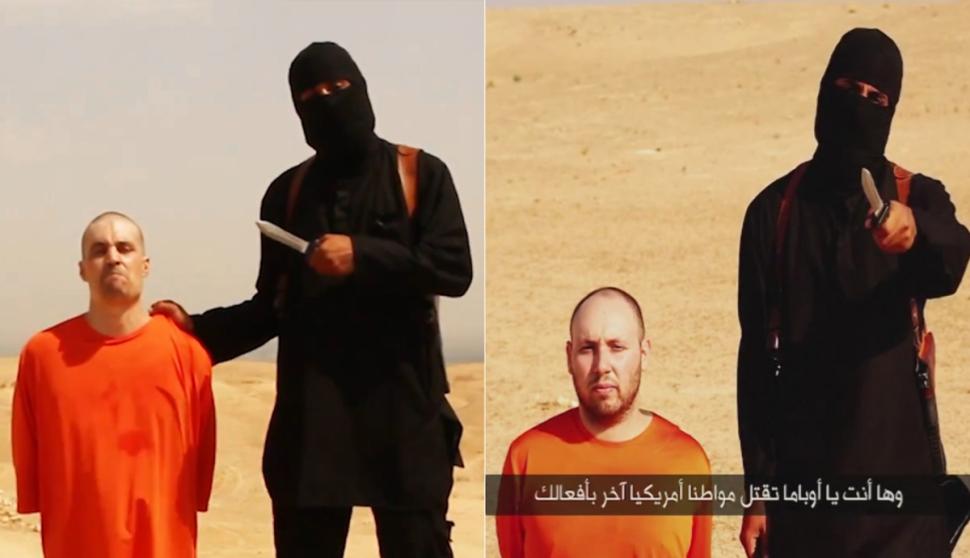
steven sotloff

Readings for 23rd Sunday in Ordinary Time: EZ 33: 7-9; PS 95: 1-2, 6-9; ROM 13: 8-10; MT 18: 15-20 http://usccb.org/bible/readings/090714.cfm.

We’ve met the enemy and it is us!

Indeed! Over the past number of weeks, we’ve been introduced to the Islamic State in Iraq and Syria (ISIS). Its militants seem to have somehow appeared from nowhere.

However, as Tom Engelhardt has pointed out, they actually represent the largely Sunni blowback from U.S. policies over the last 13 years. In fact, ISIS would not exist were it not for the United States.

Think about it. ISIS is the direct result of:

• The U.S. invasion of Afghanistan and its over-the-top, loosely-target response to 9/11.
• The 2003 criminal occupation and destruction of Iraq.
• The thoughtless dismantling of Saddam Hussein’s army with its largely Sunni command structure (which is now directing ISIS).
• The crimes of Abu Ghraib, Fallujah, Haditha, and other massacres perpetrated by barbaric elements in the U.S. military.
• The more than one million Iraqis who have lost their lost their lives as their country has been systematically pulverized by bombings, white phosphorous, and the nuclear waste called “depleted uranium.”
• Former President Bush and Vice President Cheney bragging about ordering the war crimes of water boarding and other forms of torture.
• U.S. soldiers urinating on the bodies of Iraqi insurgents and on copies of the Holy Koran.
• The horrors of the film clip, “Collateral Murder” released by Chelsey Manning.
• Drone strikes across the world in Afghanistan, Iraq, Pakistan, Somalia, Yemen and elsewhere routinely killing women and children, revelers at weddings and mourners at funerals.
• Blind U.S. support of Israel’s pogrom aimed at “the Jews’ Jews” concentrated in the world’s largest open-air prison camp called Gaza.

Such horrendous provocations make it entirely possible for ISIS leaders to echo the words solemnly intoned by President Obama last week in response to their movement’s brutal beheading of journalist Steven Sotloff. ISIS leaders might well have said:

“We will not be intimidated. Those who make the mistake of harming Muslims will learn that we will not forget and that our reach is long and that justice will be served . . . such horrific acts only unite us as movement. . . ISIS will continue to lead the battle against the kind of barbaric and empty vision that the United States represents. We will degrade their forces and destroy them completely.”

In fact, the whole ISIS phenomenon and the response it has evoked only illustrate the senselessness of any strategy of revenge and fatuous, doomed attempts to solve conflict by the unapologetic use of military first response to violence perpetrated against “Americans” or Muslims.

A different way of responding is outlined for followers of Jesus’ Way in today’s liturgy of the word. It might seem idealistic and perhaps even unrealistic in the face of ISIS. But give it a chance.

In today’s gospel reading, Matthew the Evangelist addresses the problem of conflict resolution. He emphasizes dialog not revenge and violence. In fact, he outlines four alternatives towards resolving disputes. He has Jesus say that if step one doesn’t work, move on to the subsequent strategies. The four alternatives include (1) healing conversation with one’s adversary, (2) arbitration with a mediator or two, (3) consultation with the entire community, and (4) shunning the offending party.

More specifically, Matthew has Jesus say, “If your brother sins against you, go and tell him his fault between you and him alone . . . If he does not listen, take one or two others along with you, so that ‘every fact may be established on the testimony of two or three witnesses.’ If he refuses to listen to them, tell the church. If he refuses to listen even to the church, then treat him as you would a Gentile or a tax collector.”

Obviously, these words did not come from Jesus himself. To begin with, there was no “church” at Jesus’ time. Jesus was thoroughly Jewish and a reformer of Judaism rather than the founder of some new religion or “church.”

It was different for Matthew who was writing for a community of specifically Jewish Christians some fifty years after Jesus’ death. By then, questions of community order within the emerging church had become prominent. So Matthew invents this saying of Jesus to deal with them.

Another reason for reaching this conclusion is the reference to treating a recalcitrant individual “as you would a Gentile or a tax collector.” This phrase reflects traditional Jewish avoidance of Gentiles and hatred of Roman collaborators. It runs counter to the practice of Jesus who time and again in the Gospels causes scandal by practicing table fellowship and community with the very people Matthew’s instruction indicates are outsiders to be shunned by believers.

Were Matthew following the Spirit of Jesus, the evangelist’s instructions for addressing conflict resolution might involve the following process: (1) private dialog with one’s adversary, (2) arbitration with a mediator or two, (3) consultation with the entire community, and (4) moving in with the offending party – or at least taking them out for dinner regularly.

In any case, the emphasis in Jesus’ own approach is communion, not shunning or refusal to talk. Nowhere does Jesus’ approach say that one should refuse meeting until the offending party stops offending. Much less does the process outlined include “if he refuses to listen, shoot him, cut his head off, or kill his family.”

“But,” you object, “The words attributed to Jesus in today’s gospel selection are about church order, not about international politics, much less the barbarity of a movement like ISIS. Jesus’ instruction, you might say, is about private disputes among Christians and are laughably impractical in the political sphere.

And that’s just my point. To repeat: Matthew’s account does not reflect the teaching or practice of Jesus. Jesus’ actual teaching was not confined to the private realm. His practice was highly political.

Eating with tax collectors, street walkers, lepers, Pharisees, Gentiles (including members of the Roman army) represented doing the unthinkable, the unexpected, the forbidden. . . . It meant crossing boundaries, breaking taboos, acting counter-culturally, and offending people on all sides of sizzling debates.

This is what the example of Jesus calls us to do even in the case of ISIS. Its emergence calls for departure from business as usual. It requires admission of guilt and responsibility on the part of the United States. It demands a complete reversal of “American” policy.

Today’s second reading from Paul’s letter to the Christian community at Rome puts a finer point on the reasons for such response on the part of those pretending to follow the teachings of Jesus.

Paul reminds us of Jesus’ summary of God’s law. He writes:

“Brothers and sisters: Owe nothing to anyone, except to love one another; for the one who loves another has fulfilled the law. The commandments, ‘You shall not commit adultery; you shall not kill; you shall not steal; you shall not covet,’ and whatever other commandment there may be, are summed up in this saying, namely, ‘You shall love your neighbor as yourself.’ Love does no evil to the neighbor;
hence, love is the fulfillment of the law.”

Emmanuel Levinas helps us understand that Jesus’ teaching on neighbor love is much more radical than commonly accepted. Loving your neighbor as yourself, Levinas says, does not mean “Love your neighbor because s/he is like you.” No, according to Levinas, it means, “Love your neighbor as yourself, because s/he is you.”

In other words, there is no meaningful distinction between you and any other human being you care to name – even if we call them “terrorists.” Moreover, if you shared the same history as your “enemy,” you would be doing exactly the same thing that currently enrages you. As a result, no killing can be justified. It is suicide. That’s the thrust of Jesus’ words: to kill the other is to kill yourself. Killing of any kind is suicide.

What does that mean for followers of Jesus’ way as we try to respond to the ISIS phenomenon? At least the following, I think:

• Facing the fact that the ONLY REASON for our Middle Eastern policy and wars is oil, and doing everything necessary to wean our lives away from dependence on fossil fuels.
• Realizing that we cannot expect politicians like President Obama to initiate any other policy than revenge as if the U.S. were principled, civilized, innocent, and pure before an enemy that is completely unlike us.
• Nonetheless demanding that our officials absolutely reverse course, recognize responsibility for the emergence of ISIS, and establish dialog with their leaders.
• Refusing to allow our children to serve in an armed force that commits ISIS-like crimes on a wholesale scale.
• Imagining what would happen if even a quarter of our country’s 160 million people who claim to be Christian refused the self-destruction the words of Jesus and Paul imply.

For Christ’s sake, do the unthinkable. Hard as it might be: listen to ISIS. Reverse course. Put a stop to our collective suicide!

Sunday Homily: The Ayatollah Was Correct: the U.S. IS “the Great Shaytan”

Ayatollah

During the 1979 Islamic revolution in Iran, the West became aware of Muslims’ profound mistrust of the United States. The Ayatollah Khomeini repeatedly referred to “America” as “the Great Satan.” Today’s liturgy of the word suggests that the Ayatollah’s reference was spot on. The United States is indeed the Great Satan leading the world astray with its beliefs for instance that limitless wealth brings happiness, that bombing can be a humanitarian act, and that “fearing for our lives” justifies killing others.

As we’ll see in today’s readings, such beliefs are ‘satanic” both in the eyes of Jesus and of the Great Prophet Mohammed. In the United States, their infernal results are on display in each morning’s headlines where:

• The rich and famous end their lives in despair
• The U.S. bombs and drones to save the Yazidis in Iraq (or Libyans in Libya, Afghans in Afghanistan, Ethiopians in Ethiopia . . .)
• Police killings are uniformly justified by the claim “I feared for my life.”

I raise the issue because the term “Satan” is prominent in today’s gospel reading. There Jesus uses it in contrast to his own beliefs about life’s divine purpose which turns out to be incompatible with dominant western beliefs. According to both Jesus and Mohammed, life’s purpose is not to accumulate riches. Nor is life rendered meaningful by killing others even to save one’s friends. Neither do Jesus’ followers have the mandate to protect their own lives at any cost. Quite the opposite!

What is life about then? Consider Jesus’ answer in this morning’s gospel reading.

There Jesus uses the epithet “Satan” to refer to the leader of his inner circle of twelve. In Jesus’ eyes, Peter merits the name because he misunderstands what life is for. That’s shown by the fisherman’s efforts to dissuade the Master from following his divine “prophetic script.” For Jesus, that pattern would require him to lose his life for speaking truth to power. As we’ll see, using such speech in an effort to change the world – to bring on God’s Kingdom – turns out to be central to Jesus’ understanding of life’s purpose.

In any case, like the prophet Jeremiah in today’s first reading, God’s spirit has put Jesus out of control. So, like Jeremiah, he feels compelled by an inner fire to speak the truth, whatever its cost. As the earlier prophet had put it, God’s truth “becomes like fire burning in my heart, imprisoned in my bones; I grow weary of holding it in; I cannot endure it.”

So in today’s reading Jesus “began to show his disciples that he must go to Jerusalem and suffer greatly from the elders, the chief priests and the scribes and be killed and on the third day be raised.”
Peter objects. “God forbid! This will never happen to you,” he says.

It’s then that Jesus replies: “Get behind me, Satan. You are an obstacle to me. You are thinking not as God does, but as human beings do.”

Hearing those words, most of us inevitably connect with images right out of Dante’s Divina Comedia – enhanced by subsequent satanic glosses to include a fire-red body, horns, cloven hooves, tail and pitchfork. But that wasn’t the image in Jesus’ mind.

Instead, Jesus was thinking in terms of the Hebrew tradition. There Satan was a member of God’s heavenly court. He was God’s prosecuting attorney who typically raised questions that Yahweh’s overwhelming goodness and generosity might otherwise obscure.

In Jewish tradition, Satan was a realist who believed that faith and prosperity go together. Take away prosperity and goodness and faith will disappear too.

That was the thrust of Satan’s bet with Yahweh that we find in the book of Job. Job is good and rich. God is proud of his servant’s devotion. Satan says, “Don’t be naïve. All of that will change if you simply remove your servant’s wealth, children, and health. Just watch and see.” The familiar story unfolds from there.

So when Jesus calls Peter “Satan,” he’s not really telling his friend to go to hell. No, he means what he says, “You are an obstacle to me. You are thinking not as God does, but as human beings do.” Human beings (like Satan) connect faith with prosperity. But in Jesus’ eyes, prosperity is not life’s overriding purpose. Neither is personal safety protected by violence.

But what does God really “think” about the purpose of life? Jesus words about saving and losing life provide a clue.

Jesus says, “Whoever wishes to come after me must deny himself, take up his cross, and follow me. For whoever wishes to save his life will lose it, but whoever loses his life for my sake will find it. What profit would there be for one to gain the whole world and forfeit his life? Or what can one give in exchange for his life?”

These are stunning words. They turn the world’s values upside down. They imply that God “thinks” that life’s purpose involves opposing empire. (Remember Rome reserved “taking up the cross” as a punishment for insurgents.) Life’s purpose entails self-denial, not self-gratification. It means holding life loosely, being prepared to surrender it “for justice’s sake” at any moment. It means preferring God’s Reign to possessing the entire world. It means returning kindness for evil, even if that means losing one’s own life as a result. Or as the psalmist puts it in today’s responsorial, “God’s kindness is a greater good than life itself.”

All such ideals run counter to the U.S. culture which Muslims find so threatening. They have become the ideals of the world which in today’s second reading Paul tells us to resist. “Do not conform yourselves to this age,” he writes, “But be transformed.” Only personal transformation, he adds, will enable your mind to discern what is good, pleasing and perfect in God’s eyes – even if it leads to the sacrifice of your own life.

As a Muslim who embraced the New Testament tradition, the Ayatollah Khomeini understood Jesus’ words. He saw that the order championed by the United States contradicts the basic values of Islam and the Judeo-Christian tradition about community, compassion and care for society’s most vulnerable.

So he viewed “America” as what Muslims call “Shaytan.” For Muslims Shaytan is not the devil either. Instead, he is “the Great Deceiver,” whose promises mislead, corrupt and immiserate those who believe them.

In fact, while promising peace, prosperity, and happiness, the West’s elevation of commercial values to a position of supremacy in the moral hierarchy could not be (in Muslim eyes) more deceptive and disastrous. Without care for society’s poor and vulnerable, commercial values lead to individualism, competition, war and unhappiness.

None of those represent God’s purposes for human beings.

Would that we Christians could embrace those teachings and stop our mindless pursuit of wealth, our belief that violence saves, and our cowardly conviction that anything is justified by “fear for our lives.”

As Paul says, the authentic teachings of Jesus challenge such conformity to “this age.” Who among us is willing to embrace such challenging truths?

(Sunday Homily) Jesus Comes Very Close to Rejecting a Palestinian Woman as a “B_tch”

Palestinian Woman

Readings for the 20th Sunday in Ordinary Time: IS 56:1, 6-7; PS 67: 2-3, 5, 6, 8; ROM 11: 13-15, 20-32; MT 15: 21-28. http://usccb.org/bible/readings/081714.cfm

“Have pity on me, Lord, Son of David! My daughter is tormented by a demon.” Those are the words that a woman remembered as “Syrophonecian” addressed to Jesus in today’s gospel reading.

Jesus responds by ignoring the woman at first and then by disrespectfully associating his petitioner with dogs – almost calling her a “b_tch.”

We’ll come back to that in a moment.

For now note that “Syrophonecian” meant the woman was not a Jew. She was a native or inhabitant of Phoenicia when it was part of the Roman province of Syria. She was living near the twin cities of Tyre and Sidon – a gentile or non-Jewish region of the Fertile Crescent where Matthew takes trouble to locate today’s episode.

That would have made Jesus’ petitioner what we call a “Palestinian” today. In other words, Matthew’s geographical note serves to remind us that the Jews never controlled all of their “Promised Land.” Instead, they always had to share it with “Palestinians” including Canaanites, Hittites, Amorites, Perizzites, Hivites, Jebusites, Geshurites, Maacaathites, and Philistines.

That in itself is significant in the light of Israel’s ongoing brutal war of extermination against Palestinians. There the State of Israel (with supporters often invoking biblical precedent) has adopted the one-state position that is bent claiming all of Palestine for itself. It relegates Palestinians to Bantustans in a particularly brutal Israeli version of apartheid and ethnic cleansing.

Were Jesus in Gaza today, millions of Palestinian parents could echo the poor mother’s petition in today’s’ gospel selection, “Have pity on me, Lord, Son of David! My daughter is tormented by a demon.” And the demon in Gaza’s case would be the State of Israel itself – the latest incarnation of the puppets of Empire whom Jesus opposed so strongly in his own day. [Recall that Palestine in Jesus day was controlled by Jewish puppets of Rome. (Jesus clashed with them again and again.) Today those who pull strings on the marionettes reside in Washington.]

The result is that in Gaza over the last five weeks, more than 2000 Palestinians have been slaughtered by the ones considering themselves God’s “chosen” – 25% of the victims being children, at least another 25%, women like the one called “Syrophoenician” and her demon-possessed daughter.

Daniel Ortega, the President of Nicaragua, recently applied the term “demon” appropriately. He said, “Prime Minister Netanyahu appears to be possessed by the devil, he needs Pope Francis to exorcise it, to become appeased.” Ortega wondered, “Why doesn’t anyone condemn or sanction the state of Israel?” In his opinion, Palestine is the victim of “madness” on the part of the Israeli leader, who seeks to “annihilate the Palestinian people.” Ortega meant that Israel is “committing genocide” in the Gaza Strip, a crime so “terrible that it is only comparable to the crimes of the Nazis,” he said.

You might have been surprised at Jesus’ response to the Syrophonecian woman. As I said, at first he gives no reply at all; he ignores the woman completely. If Matthew’s account is accurate, in his silence Jesus was showing himself to be captive to his own cultural norms. It was inconceivable in Hellenistic antiquity for a strange woman to directly approach a man the way the woman in this story did. Above all was it so for a gentile woman to directly address a Jewish man. In other words, Jesus’ silence was part of his “honor culture.”

But it gets worse. When the woman insists, Jesus implicitly calls her a “b_tch.” He says, “I have been sent for the lost children of Israel . . . it is not right to take the food of the children and throw it to the dogs.”

The reply seems out of character for Jesus, doesn’t it? In fact, such dissonance has led many to reject the saying as inauthentic. Whatever the case, Jesus’ reply only echoes the rabbinic saying of the time, “He who eats with idolaters is like one who eats with a dog.”

In other words, Jesus’ comparison stands in a long line of likening cultural outsiders to animals. Most recently, in the case of Gaza, Ayelet Shaked, a member of the Israeli Parliament, compared Palestinians like the woman in today’s gospel to snakes. She endorsed the killing of Palestinian women, like the petitioner in the story before us, calling their children not dogs, but “little snakes” worthy only of extermination.

Shaked said,

“Behind every terrorist stand dozens of men and women, without whom he could not engage in terrorism. They are all enemy combatants, and their blood shall be on all their heads. Now this also includes the mothers of the martyrs, who send them to hell with flowers and kisses. They should follow their sons, nothing would be more just. They should go, as should the physical homes in which they raised the snakes. Otherwise, more little snakes will be raised there.”

The woman in today’s gospel has a very different voice from Ayelet Shaked’s. She replies, “Please, Lord, for even the dogs eat the scraps that fall from the table of their masters.”

The witty reply astonishes Jesus. He exclaims, “O woman, great is your faith! Let it be done for you as you wish.” That is, the woman “converts” Jesus; he concedes her argument. The one the gospels present as the master of verbal riposte is vanquished by this simple Palestinian mom.

What does the interaction between Jesus and the woman called “Syrophonecian” mean for us today – in the context of Israel’s demonic attack on the Palestinian descendants of the woman in question? What does it mean for Gaza and for us who watch in helpless disgust?

I think it means that:

• The “faith” of the Syrophoenician woman was not “in Jesus” as the incarnation of God, but rather in the inclusivity of God’s love that extends beyond ethnic and religious differences.
• In that sense, she believed in the New Universal Order Jesus referred to as God’s Kingdom.
• More specifically, today’s gospel reading presents the woman as enlightening Jesus – as reminding him of the Kingdom’s complete inclusivity.
• In view of Jesus’ own “enlightenment” at the hands of this poor Palestinian woman, it is no longer possible to blindly identify “God’s People” with any particular state.
• I mean, the State of Israel as such does not represent the biblical God’s Chosen People.
• Today that honor (curse?) belongs to the Palestinians who, as good Muslims, share Jesus’ faith that God sides with the widows, orphans, immigrants and oppressed whatever nation they belong to.
• This means that in the case of Palestine, Jesus’ followers should be one the side of Palestinians rather than the Jewish State.
• Being on their side means petitioning the U.S. government to stop its demonic support of Israel which has moved even further from its identity as “People of God” than it had in Jesus’ day.

As always, this week’s readings invite us to break the chains of our cultural norms – just as Jesus was forced to by the Syrophonecian mother.

(Sunday Homily) Dear Pope Francis: Gaza Needed More than Tears; Next Time, Please “Walk on Water”

Walk on Water

Readings for 19th Sunday in ordinary time: I KGS 19: 9A, 11-13A; PS 85: 9-14; ROM 9: 1-5; MT 14: 22-23 http://www.usccb.org/bible/readings/081014.cfm

In today’s Gospel, we hear Matthew’s account of Jesus walking on water – or rather, of Peter’s refusal to follow Jesus’ example of walking on the waves.

The account is relevant to the man in the Vatican who believes he is Peter’s successor. Israel’s month-long siege of Gaza invited Pope Francis to “walk on water” – to follow the example of Jesus in confronting demons. However uncharacteristic timidity left the pope sinking below the waves, out of sight and ear shot, cowering before Monsters like Obama and Netanyahu.

Let me explain. First off, consider today’s Gospel reading.

The story goes that following Jesus’ feeding of the 5000 (last week’s Gospel episode), Jesus forces the apostles to get into their boat and row to the other side. [The text says, “Jesus made (emphasis added) the disciples get into a boat and precede him to the other side.” Perhaps these experienced fishermen (as opposed to the land lubber, Jesus) saw a storm was coming and were reluctant to set sail despite Jesus’ urgings.]

In any case, a storm does come up and the apostles fear they are about to drown. You can imagine them in helpless tears.

Then they see a figure walking on the water in the midst of high threatening waves. At first they think it’s a ghost. Then they realize that it’s Jesus. He’s walking on the raging waters.

Peter, the impetuous leader of the apostles, doubts what he sees. So he says, “Prove to me that it’s you, Jesus; let me walk on the waves just as you’re doing.” Jesus says, “Join me then over here.” So Peter gets out of the boat and, like Jesus actually walks on water for a few steps.

Then, despite the evidence, he begins to doubt. And as he does so, he starts sinking below the water line. “Save me, Lord,” he cries out again. Jesus stretches out his hand and saves Peter. Then he asks, “Where’s your faith, man? Why is it so weak? Why did you doubt?”

Of course, this whole story (like last week’s “Loaves and Fishes”) is one of the dramatic parables Matthew composed. If we get caught up in wondering whether we’re expected to believe that someone actually walked on water, we’ll miss the point of this powerful metaphor. It’s about Jesus’ followers doing the unexpected and irrational in the midst of life-threatening crisis.

You see, Matthew’s Jewish audience shared the belief du jour that the sea was inhabited by dangerous monsters – Leviathan being the most fearful. And fearlessly walking on water was a poetic way of expressing what Matthew’s community believed about Jesus, viz. that he embodied the courage and power to do the completely unexpected in the midst of crisis and subdue the most threatening forces imaginable – even the most lethal of all, the Roman Empire.

Jesus’ invitation to Peter communicates the truth that all of us have the power to confront monsters if we’ll just find the courage to leave safety concerns behind even in the most threatening conditions, to confront life’s monsters, and join Jesus in the midst of its upheavals.

Problem is we easily lose faith and courage. As a result, we’re overcome by life’s surging waves and by the monsters lurking underneath them.

And that brings me back to Pope Francis and his ambiguous response to the slaughter that took place in Gaza over the last month.

We expected more. Over the course of his still-young papacy, Francis has demonstrated wonderful courage attempting to join Jesus on the world’s dangerous waves.

• He’s adopted a comparatively simple lifestyle.
• He’s condemned neo-liberalism and growing income inequality.
• His apostolic exhortation, “The Joy of the Gospel” implicitly endorsed the liberation theology his two immediate predecessors had tried to kill.
• More specifically, he adopted liberation theology’s “preferential option for the poor” as the leitmotif of his papacy.
• In that spirit, his famous “Who am I to judge” gave hope to the LGBTQ community.
• He helped head off President Obama’s plans to bomb Syria.

That last precedent led me to expect more in the context of Gaza. I was in St. Peter’s Square for Francis’ hours-long vigil for peace. There the Pope did as much or more to head off U.S.’ insane plans to bomb Syria as did Russia’s President Putin. Along with Putin, Francis was the hero who subverted the monstrous plans of Obama and his State Department.

But there was no peace vigil for the Gazans. Instead two weeks ago the Pope broke down in tears as he delivered his Sunday remarks from the balcony over St. Peter’s Square. He said:

“Never war, never war! I am thinking, above all, of children who are deprived of the hope of a worthwhile life, a future. Dead children, wounded children, mutilated children, orphaned children, children whose toys are things left over from war, children who don’t know how to smile.” This was the moment when the tears came. “Please stop,” said Francis. “I ask you with all my heart, it’s time to stop. Stop, please!”

The words were powerful; the tears were powerful. But unlike the prayer vigil before a potential Syrian fiasco, they remained largely unreported. Nevertheless, for those with ears to hear, the Pope was lamenting Israel’s killing of Palestine’s innocent. (No Jewish children were killed during the Gaza massacre.) However, to overcome the Media’s deafening pro-Israel tilt, the Pope needed to be stronger and more specific.

Yes, his papacy has daringly left the safe harbor and courageously sailed into the storm. Yes, Francis clearly sees Jesus as his role model demanding courage in the face of today’s unprecedented winds and waves. Indeed Francis has gotten out of the boat to trample underfoot the beasts and monsters roiling the seas all around us. But in the case of Gaza, instead of walking confidently on the waters, he sunk in apparent timidity before the threatening monsters, Obama and Netanyahu.

But what more could he have done? What sort of miracle did I expect?

Well, he could have given courage to all of us who are far less daring than he; he could have performed a miracle more stupendous than actually “walking on water” by:

• Owning the fact that as the leader of 1.2 billion Roman Catholics, with far more power than Jesus had, he was truly able to end Gaza’s slaughter.
• Announcing plans to travel to Gaza in the midst of Israel’s monstrous campaign.
• Before leaving, specifically naming Israel’s assault on civilians as sinful.
• Identifying the U.S. as equally culpable with Israel for crimes against humanity.
• Actually traveling to Gaza in a white papal helicopter (even in defiance of Israel’s predictable prohibitions) and landing in the midst of Gaza’s devastation.
• Celebrating Mass in Gaza on a pile of rubble and refusing to leave till the Israelis stopped their slaughter.
• If the slaughter continued, traveling to the key sites of bombing and shelling.

“Impossible!” you say? Such an act would offend Israel and upset Israel-Vatican relations. Ditto for the U.S.

Hmm. Is the pope a politician or a prophetic religious leader? Please use your imagination and spin out what would have happened if the pope walked on water as just outlined. What do you think?

In any case, those much less courageous than Francis need his example so the rest of us might venture forth to walk on water in our own far less powerful ways.

Yes, in today’s Gospel, Jesus invites us all to do the impossible. Why are we doubting? Where is our faith?