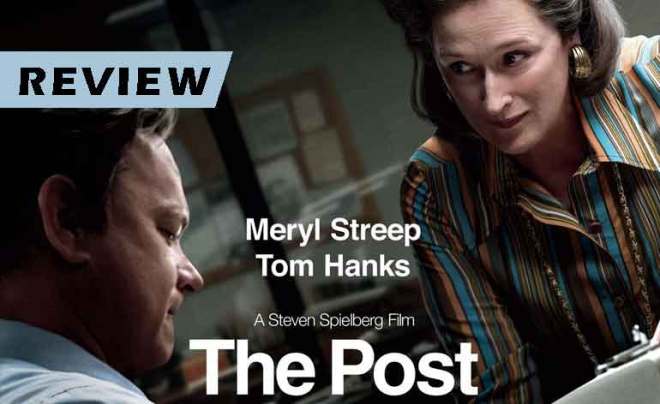
Last week some dear friends joined Peggy and me to see The Post. That’s the Steven Spielberg film detailing the story behind The Washington Post’s publication of the Pentagon Papers in 1971. It stars Meryl Streep as Katherine Graham, the Post’s chief executive, and Tom Hanks as the paper’s editor, Ben Bradlee.
Intentionally or otherwise, The Post ended up revealing a huge reason why readers have increasingly given up on large for-profit news organizations. They turn out to be run by ignorant people, who know far less than those they pretend to inform. The would-be informants are blinded by the profit motive. Moreover, their organizations top-down structures prevent them from even hearing those who work for them. Thankfully, however, The Post unwittingly suggests remedies for the dire situation it depicts – some of which are taking form before our very eyes.
The Post begins with a revealing vignette of the Vietnam War. It shows a world invisible to the newspaper’s sophisticated editors. There, U.S. infantry are seen executing one of their commanders’ signature “Search and Destroy” missions. The maneuver consisted in having poor, terrified disproportionately black and brown twenty-somethings make their way through rainforests they knew nothing about in search of Vietnamese farmers exquisitely familiar with the terrain. The idea was to find the farmers awaiting them in ambush and kill them. According to the strategy, if they did that enough times, the Americans would soon eliminate the peasants and win the war.
Brilliant, no?
Obviously not.
In fact, by 1971, when The Post begins, it was clear to nearly everyone outside the Beltway that the whole idea was stupid, crazy, doomed, and immoral. That was especially evident to those at the wrong end of Vietnamese rockets and machine guns, as well as of those with any shred of religious conscience. Buddhist monks called attention to the war’s immorality as they immolated themselves in Saigon as far back as 1963. So did the Baptist preacher, Martin Luther King when in 1967 he “Broke Silence” at New York’s Riverside Church. The Muslim, Malcolm X, knew it, as did the boxer, Mohammed Ali. The Catholic Berrigan Brothers and the Catonsville Nine knew.
Even Bob Dylan, Paul Simon, Jimi Hendrix, and Joan Baez were in the know. So were the college students demonstrating (with four of them murdered) at Kent State in 1970 – not to mention the throngs of young people brutalized by Mayor Daley’s riot police at the Chicago Democratic Convention in 1968.
Yet with straight faces, the enlightened and secular mainstream media continued to parrot the lies of the generals and politicians. “Great progress is being made,” the war-makers told the official stenographers. “There is light at the end of the tunnel.”
All such statements were about Southeast Asia were known to be false by the ones uttering them. They should have been known by Washington Post editors too. An early sequence in the film shows Truman lying about it, then Eisenhower, Kennedy, Johnson, and, of course, Richard Nixon.
And why did they lie? Was it for reasons of national security or to prevent countries in the region from falling to communism like so many dominoes? Again, no. According to Robert McNamara in the film, seventy percent of it was to prevent embarrassment on the part of the “leaders” responsible for the enterprise in the first place.
Or as Nixon himself put it when he described the ultimate impact of the Pentagon Papers revelations:
“To the ordinary guy, all this is a bunch of gobbledygook. But out of the gobbledygook comes a very clear thing…. You can’t trust the government; you can’t believe what they say; and you can’t rely on their judgment; and the — the implicit infallibility of presidents, which has been an accepted thing in America, is badly hurt by this, because It shows that people do things the president wants to do even though it’s wrong, and the president can be wrong.”
So, to prevent such irreparable damage to “national security,” the wholesale killing went on for years – long after those responsible for the disaster had concluded the war was genocidal and completely unwinnable. In the end, more than 58,000 U.S. soldiers and two million Vietnamese were sacrificed to the myth of Presidential Infallibility – to conceal the fact that OUR GOVERNMENT IS RUN ON LIES.
And (other than repeating government falsehoods) what was the press doing while all of this was going on? What were The Washington Post’s Katherine Graham and Ben Bradlee doing? According to the film, they were hobnobbing with the liars. They were dining with them in expensive DC restaurants, vacationing with them in Hyannis, posing with them for photo-ops, throwing parties for them, guarding their secrets, and attending meetings with Wall Street insiders and white men in dark suits.
Their big news item? Tricia Nixon’s wedding!
But then Daniel Ellsberg risked his life by releasing irrefutable proof of government duplicity. And all the Washington insiders are suddenly shocked and appalled. As if the idea had never previously occurred to them, they realize the people in the streets, the religious prophets, the boxing champion, the rock ‘n roll singers and the student demonstrators and martyrs were all right after all.
The newspaper magnates had to face the facts. Their hand was forced.
But what were their biggest concerns when faced with the prospect of publishing the truth? Was it informing the American people? No. It was:
- Selling more papers than their competitor
- The impact of publication on the stock market value of their product
- Fallout in the form of experiencing the ire of President Nixon
- Being excluded from his inner circle as a result
- And thus, losing market share.
Several conclusions suggest themselves from all of this – one particular, others more general. In addition, a basic remedy becomes apparent.
The particular conclusion is that the capitalist model of for-profit news publication is deeply flawed. Its power structure is entirely top-down. As depicted in the film, it empowered a tiny group of rich white mostly males to make decisions of extreme national import. Workers at the newspaper were treated with disdain.
That dismissal of underlings is portrayed at the film’s turning point. One of the paper’s staff far down the food chain obtains a copy The Pentagon Papers long sought by the paper’s editors. It had been delivered furtively to him by an even lesser nobody – a young woman in tie-dye obviously out-of-place in the newsroom. Shaking in his boots, the staffer tries to deliver his acquisition to Bradlee. However, he’s rudely waved off by his arrogant boss who initially refuses to even to acknowledge him. Then when he finally does get the editor’s attention, the staffer remains completely ignored as he tries to explain the information’s origin. That’s of no interest to his superior. Evidently for Mr. Bradlee, the idea was inconceivable and irrelevant that young hippies might be credible news sources.
That in itself represents a bleak commentary on capitalist workplace relationships.
Even more damningly however is the movie’s implied criticism of the system’s ownership structures. In fact, they placed the ultimate decision about whether or not to release The Pentagon Papers entirely in the hands of, Katherine Graham, a CEO presented in the film as singularly unprepared for such responsibility. She occupied her position of authority only because she inherited it from her deceased husband. At least within the confines of the film, she knew nothing of world affairs, much less about the Vietnam conflict or the inner workings of government – or those soldiers in the rainforest. True, she socialized with presidents and Wall Street high-rollers. But basically, she was ignorant. All her advisers (those white men in black suits) shared only one concern – the paper’s profitability.
Yet decisions of extreme national concern were entirely up to Ms. Graham. Only because of residual remnants of motherly conscience was she finally able to resist market pressures and do the right thing.
And so here come the general conclusions suggested by The Post:
- In terms of informing the public, white male patriarchy is extremely inefficient.
- Similarly, capitalist structures of inheritance, ownership, and commodification of information inhibit service of the truth.
- The closer you are to power, the less you are likely to know about the concerns of ordinary people.
- The richer you are, the less you are likely to know about the way the world really works for people in the street.
- The higher up in the military you find yourself, the less you probably know about the disastrous outcomes of your pet theories and tactics.
What to do about it all. . . As I earlier remarked, the solutions are unfolding before our eyes:
- Stop trusting the mainstream media as reliable sources of information.
- Realize that news sources can be co-operatives where all workers have meaningful input and respect, because they co-own the newspaper and need tremble before none of their peers.
- Trust only such non-profit outlets, like Democracy Now and OpEdNews that rely for funding on viewer and reader support. They deserve trust because they depend on street-level sources for all of their information and analysis of official misdeeds and legislation.
In the end, The Post is worth watching. But it’s not for the reasons Hanks, Streep and Spielberg advance in their promotional commentaries. It’s not because Ms. Graham or Mr. Bradlee were heroic and demonstrate that the system somehow works. In fact, it’s quite the opposite. The true heroes were far down the food chain. The Post merely unveils the system’s severe dysfunctions. It demonstrates the need to put news gathering and publication under the decentralized aegis of workers and activists who refuse to be governed by the venal corporate interests of the military-industrial complex.

 About Things That Matter