(Sunday Homily) Pope Francis’ Prophetic Warning on Climate Change: Repent or Else; the Time Is Short

Pope-in-Philippines

Readings for 2nd Sunday in Ordinary Time: JON 3: 1-5, 10; PS 25: 4-9; I COR 7: 29-31; MK 1: 4-20; http://usccb.org/bible/readings/012515.cfm

Last week, Pope Francis offered a preview of his eagerly anticipated encyclical on climate change – to be published next June or July. While visiting the Philippines, the country most devastated by climate chaos, it wasn’t that the pope merely joined the chorus of scientists, environmental activists, and those who heed them. He went much further, promising to transform the issue of climate change from a debate topic trivialized on Fox News into a matter of “faith and morals” (The phrase used by Catholics to define the area within which the pope has overriding authority.)

In doing so, Francis follows the traditions of prophets like Jonah and Jesus – each centralized in today’s liturgy of the word. Both prophets called for repentance (change of thought and action). However, the repentance they summoned pales in comparison to what the pope evidently has in mind.

Yes, the pope is a contemporary prophet. At this moment in history, he is arguably the most powerful ever in terms of his consciousness, courage, credibility and constituency. He literally embodies our best hope for “saving the world.” So it’s incumbent on progressives to heed, highlight and support his efforts.

With that in mind, consider today’s readings about prophetic warnings and how to respond.

The first recalls the message of the Bible’s fictional character Jonah. He’s a reluctant ethnocentric prophet forced by God to call Israel’s mortal enemy, Nineveh, to repentance. “Forty days more and Nineveh shall be destroyed” Jonah proclaimed with some delight.

Ultimately though, Jonah’s ethno-centricity is frustrated when against his desires, the Ninevites quickly and unexpectedly take his message to heart, change their ways, and God repents “of the evil he had planned.” In this way, the Divine One showed God’s character as depicted in today’s responsorial. There the psalmist says that (unlike Jonah) God is compassionate, loving, kind, good, and upright. God guides humble sinners on the path of truth – i.e. reality as it is, not as humans would like it to be.

Jesus’ proclamation was similar to Jonah’s, but without that prophet’s nationalist limitations. As depicted in today’s gospel reading, Jesus’ basic message was a call to profound change: “This is the time of fulfillment,” he said. “The Kingdom of God is at hand. Repent and believe in the gospel.” That notion of fulfillment and the nearness of God’s Kingdom introduces a profound element of hope to complement Jesus’ summons to repentance.

Like the Ninevites in the Jonah story, Peter and Andrew, James and John take Jesus’ words to heart profoundly altering their lives. They leave their former employment as fishermen abandoning their nets, their fathers’ boats and hired men. They follow instead a penniless itinerant preacher and community organizer, adopting his life of complete dependence on others for daily sustenance.

In today’s second reading, Paul shows that the early church embraced Jesus’ message. “Time is running out,” Paul warns. It’s time to prioritize the Kingdom even before family, emotional ups and downs, attachment to property — and to the world as it is. Paul is uncompromising in his perception of the profundity of change “repentance” calls for.

However the apostle’s perception is nothing like the lack of compromise called for by the historically unprecedented crisis of climate change. And this brings me back to Pope Francis and the promise of his prophetic consciousness, courage, credibility, and constituency.

Begin with Francis’ consciousness. He alone among our elected thought “leaders” recognizes contemporary historical patterns – the links between climate change, capitalism, its neo-liberal order, corporate power, income inequality, poverty, colonialism, and a host of other problems (including absence of universal education and health care). For Francis, climate change is not merely one issue among many. It is the frame which makes evident the solutions to those other issues.

More than this, the pope has the uncommon courage to identify without equivocation the cause of such problems – neo-liberal capitalism. He says what politicians like President Obama and other heads of state (with the exception of Raul Castro of Cuba) find impossible to say. Their dependence for survival on billionaires and plutocrats render them impotent before the ideologies of unfettered markets and their “trickle-down” theories. By contrast Pope Francis terms the latter homicidal (53), ineffective (54) and unjust at their roots (59). (Parenthetical numbers refer to sections of “The Joy of the Gospel.”)

Additionally while speaking the unspeakable, the pope enjoys tremendous credibility. With the exception of neo-liberalism’s intractable apologists, the world loves and embraces the man. His efforts to distance himself from the traditional luxurious papal lifestyle, his honesty in responding to difficult questions, his humility and genuine love for the poor make him our century’s most credible moral leader.

And finally, there’s the pope’s constituency. Unlike prophets before him (including Jesus of Nazareth) sheer numbers give Pope Francis unprecedented power to change the world. Jonah’s potential respondents to his calls for repentance were only inhabitants of the city of Nineveh. In today’s gospel reading Jesus’ respondents were four simple fishermen: Peter, Andrew, James and John. Eventually, only a minority of poor Palestinian peasants took to heart Jesus’ words. By contrast, and in virtue of his office, this pope’s constituency is trans-national and world-wide. There are 1.2 billion Catholics on the planet the pope calls “Mother” and “Sister.”

Evidently Francis’ plan is to use his credibility to courageously spread his consciousness and widen his constituency. He plans to do so in five steps. He will (1) publish an encyclical (the most authoritative form of communication at his disposal), (2) convoke an ecumenical meeting of world religious leaders, (3) presumably secure from them a statement paralleling his encyclical’s conclusions, (4) present that statement in his speech to the United Nations in September, and (5) attempt in doing all of that to influence the conclusions of this year’s Climate Summit in Paris two months later.

That’s prophetic activism unparalleled in the recent history of the papacy.

And what specifically is entailed in the repentance necessary to save our Mother? Of course, to share the pope’s vision, we await details in the forthcoming encyclical. However, today’s liturgy of the word points us in the general direction. In the meantime, secular prophets like Naomi Klein fill in the challenging details.

General directions include (as Paul says in today’s second reading) transcending emotions like fear-inspired denial. They include willingness to cut family ties (i.e. narrow nationalism), re-examining our career paths, attachments to property and neo-liberal dreams of unlimited consumption and getting rich.

Specific repentance is more radical than any of our politicians dare articulate. According to Klein, author of This Changes Everything, that’s because our planet has reached “decade zero.” Denialists have led us to squander the leeway we had twenty-five years ago. If we don’t decisively alter within the next ten years our path of production and consumption, the planet’s temperature is bound to rise 4 to 6 degrees Celsius. However, according to climate scientists, any rise beyond 2 degrees will make disastrous climate change irreversible. And that will result in disastrous droughts, water shortages, typhoons, flooding, wildfires, and crop losses with whole cities under water and Islands swallowed by the sea.

To avoid such disasters, required repentance includes:

  • Rejecting the neo-liberal myth that has shaped our world over the last 35 years.
  • Replacing it (the pope will say) with the biblical vision of the Kingdom (proclaimed by Jesus in today’s gospel reading). God’s Kingdom is characterized not by competition and privatization, but by cooperation, sharing, prioritizing the needs of the poor and respecting the earth as commons.
  • Setting aside neo-liberalism’s fetish about regulation, and setting bold national policies guided by clear goals, a strictly imposed time table, and severe penalties for non-compliance.
  • Implementing corresponding policies to cut annual emissions in the industrialized world by 8- 10%.
  • Recognizing that exchange of myths means rejection of market-driven models of untargeted economic growth.
  • Redesigning our cities and redistributing population to eliminate long commutes between home and work.
  • Investing massively in light rail and other means of public transportation so that commuters might travel efficiently and free of cost.
  • Similarly subsidizing renewable sources of energy – solar, wind, geothermal, and biomass.
  • Turning the roof of every available building into an energy plant.
  • Respecting the rights of indigenous people under whose lands so much carbon deposit remains.
  • Eliminating by law, controlling by strong regulation or penalizing by heavy taxation industries that are wasteful and/or destructive of the planet such as arms manufacturers, the fast-food industry, GMO firms, and middle-man industries like health insurance.
  • Dealing with climate impact and damage according to “the polluter pays” principle. This recognizes that the 500 million richest people on the planet are responsible for 50% of the world’s pollution and that the U.S. military is by some estimates the largest single consumer of petroleum in the world.
  • According to “the polluter pays” principle, withdrawing from foreign wars, cutting the military budget by at least 25% and making the rich 1% pay their fair share of taxes.
  • Tolerating as necessary increased taxes on everyone, except the poor.
  • Drastically reducing the amount of energy each of us consumes.

You get the idea. The agenda necessary to save our planet from “the evil Nature has planned” is challenging indeed. But it contains that surprising element of hope Jesus signaled when he termed “repentance” as “good news” and “fulfillment.”

After all, our destructive way of life is anything but fulfilling. On the other side of the repentance just described is a cleaner, healthier, less stressful life with full employment, more leisure, greater equality, and harmony with one another and our world.

That’s the vision behind the pope’s courageous prophetic work. It deserves our undivided attention and support.

(Sunday Homily) Pope Francis Calls for a Global Catholic Climate Movement

Italy Pope Epiphany

Readings for 1st Sunday in Ordinary Time: I SAM 3: 3B-10, 19; PS 40: 4, 7-10; I COR 6: 13C-15A, 17-20; JN 35-42

Recently Pope Francis has come in for some hard criticism from the U.S. right wing. It’s not just because of his rejection of free market capitalism, trickle-down theory, and huge income disparities between the rich and poor. It’s not just his openness to gays and divorcees, and his refusal to obsess about abortion and contraception.

Yes, all of these have undermined what conservatives have seen as a close alliance between the Catholic Church and their pet causes and thinking modes.

However, the straw breaking the back of reactionaries is the pope’s unequivocal warnings about climate change. They’ve gone apoplectic about his intention to publish an encyclical on the matter, and his plans to convoke a conference of religious leaders to address it. The pope’s expressed intention is to influence this year’s U.N. Paris Conference on Climate Change. All of that has raised the specter of a global Catholic climate change movement potentially mobilizing the world’s 1.2 billion members. Think about that for a minute!

In such context, Francis visit this week to the Philippines is extremely significant. The Philippines is not only the home of 80% Asia’s Catholics – more than 100 million. It is also the poster child for the devastation that climate change wreaks on the principal victims of global warming, the world’s poor. In 2013 the archipelago was raked by Typhoon Yolanda whose winds and floods killed more than 7000.

So the world listened when on his way to Manila Pope Francis was asked if climate change is “mostly due to the work of man and his lack of care for nature?” In reply, the pope said:

(F)or the greater part, it is man who gives a slap to nature continually, and we have to some degree become the owners of nature, of sister earth, of mother earth. I recall, and you have heard, what an old peasant once told me: God always forgives, we men forgive sometimes, but nature never forgives. If you give her a slap, she will give you one. I believe that we have exploited nature too much, deforestation, for example.

With words like those, the pope’s critics charge he is speaking beyond his expertise, which involves matters of “faith and morals.” But that’s just the point. The pope is making climate change a moral issue, a matter of ethics even more important than more “traditional” Catholic moral concerns about sex which after all presume the survival of the human species and the planet.

The pope’s critics also ignore, of course, that Francis bases his judgments not only on the testimony of 97% of all climate scientists, but on the research of the Pontifical Academy of Sciences. Its membership roster features the names of the world’s most respected scientists. These include Nobel laureates such as Ernest Rutherford, Max Planck, Otto Hahn, Niels Bohr, and Charles Hard Townes. The Academy’s current president is Werner Arber, himself a Nobel laureate, and the first Protestant to head the group.

But why such right-wing fury? It’s because like Naomi Klein, conservatives see the (for them) disastrous implications of addressing the issue. As announced in the title of Klein’s book, they sense that This Changes Everything. That is, taking on climate change as a moral issue undermines the political right’s program of market deregulation and continued extraction of non-renewable resources.

So pundits like First Things blogger, Maureen Mullarkey have given up on lip sticking the pope and are now in full attack mode. According to Mullarkey Pope Francis is simply “an ideologue and a meddlesome egoist. His clumsy intrusion into the Middle East and covert collusion with Obama over Cuba makes that clear. Megalomania sends him galloping into geopolitical—and now meteorological—thickets, sacralizing politics and bending theology to premature, intemperate policy endorsements.”

For Mullarkey, Pope Francis pretty much stinks.

And that brings me to today’s gospel reading. It’s all about stink – about what Pope Francis calls “the smell of the sheep.” Famously, you recall, the pontiff called on Catholic priests to live closer to the poor, to recognize them as God’s people and their welfare as the guideline for economic and social policy – to “take on,” he said, “the smell of the sheep.”

In other words, conservatives are suspicious of Pope Francis and are on the point of vilifying him because he smells too much like sheep — like the poor. He smells too much like Jesus.

Notice that in today’s gospel, John the Baptizer identifies Jesus as “the Lamb of God.” To begin with, the phrase reminds us of the tribal, Bedouin origin of the biblical “People of God.” Abraham, Isaac, and Jacob, and the great King David were all shepherds. They were primitive people close to the earth. They were tribalists. Jesus was a tribalist. According to John’s image, Jesus didn’t just smell like sheep; he was a sheep! He was in spades like his slave and Bedouin ancestors — like the poor people the pope is centralizing in his visit to the Philippines.

Pope Francis is a tribalist too. And he’s practicing what he preaches — both liberation theology’s “preferential option for the poor,” and the traditionally Catholic principle of subsidiarity. Once again, that means endorsing economic and environmental policy not on the basis of market dictates, but according to human decisions about values like the common good. Humane policy, the pope implies, originates not on Wall Street, but in places like the Philippines’ Tacloban City which was leveled by Typhoon Yolanda. It’s there that the pope’s itinerary reportedly has him dining in the shack of a hurricane victim. (Can you imagine a humble Catholic housewife setting her family table to include the pope?)

As our century’s most powerful illumined voice of conscience, Francis is using his bully pulpit to wake us up. We’re like Samuel in today’s first reading – fast asleep even before the Ark of the Covenant (a reminder of Israel’s enslaved and Bedouin past). But we fail to recognize the biblical tradition’s significance to our lives – its call to tribal values which unfailingly center on animals, human family, and Mother Earth. We fail to see the implications of Paul’s observation in today’s second reading that all human beings – especially the poor and outcast – are temples of God’s spirit. That’s our tradition! That same Spirit resides, the pope says, in the planet that he (like St. Francis himself) calls our Mother and Sister.

So what would a global Catholic climate movement look like? It would entail:

  • Waking up like the young prophet Samuel. Like him we’ve heard God’s call many times. But at last in Pope Francis, we have a thought-leader speaking in a voice the simplest of us can hear. It’s the voice of conscience. And like Eli it’s giving us the proper way to respond: “Speak Lord, for your servant is listening.”

A global Catholic climate movement further entails:

  • Rejection of corporation-based globalization which has us (over)consuming imported necessities that could be home-grown. (This involves lobbying against the Trans-Pacific Partnership.)
  • Joining the fight against fracking and projects like the XL Pipeline
  • Voting accordingly.
  • Urging the institutions we can influence (churches, universities, hospitals . . .) to divest from fossil fuel industries.
  • Adopting a “zero waste” policy in our homes and places of work.
  • Cultivating home gardens.
  • Adopting a vegetarian diet.
  • Educating ourselves about “green burial” and including plans for that in our “living wills.”

The list, of course, goes on. But you get the idea.

This stinkin’ pope is waking us up. He’s showing us the way. Thank God!

(Sunday Homily) The Parable of the Talents: Pope Francis as Drop-Out vs. Paul Ryan as Inside Investor

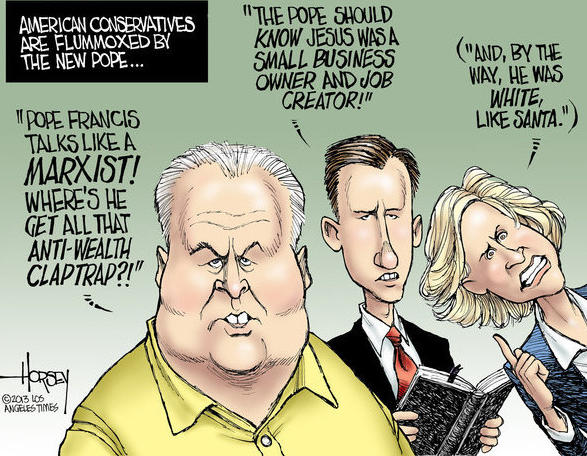
Pope & Rush

Readings for 33rd Sunday in Ordinary Time: PRV 31: 10-13, 19-20, 30-31, PS 128: 1-5; I THES 5: 1-8; MT 25: 14-30. http://www.usccb.org/bible/readings/111614.cfm

Today’s gospel story, the familiar “Parable of the Talents,” is about economics. It’s about the world of investment and profit-taking without real work. It’s also about dropping out and refusing to cooperate with the dynamics of finance, interest and exploitation of the working class.

The parable contrasts obedient conformists with a counter-cultural rebel. The former invest in an economic system embodied in their boss – “a demanding person harvesting where he did not plant and gathering where he did not scatter.” In other words, the boss is a hard-ass S.O.B. who lives off the work of others. The conformists go along with that system which to them has no acceptable alternative.

Meanwhile, the non-conformist hero of the parable refuses to go along. And he suffers the predictable consequences for doing so. Like Jesus and his mentor, John the Baptist, the non-conformist is marginalized into an exterior darkness which the rich see as bleak and tearful (a place of “weeping and grinding of teeth”). However, Jesus promises that exile from the system represents the very kingdom of God. It is filled with light and joy.

In contemporary terms, today’s gospel selection could hardly be more pertinent. It contrasts two current understandings of the contested terrain that is today’s Christianity. One understanding endorses our polarized economic system where “everyone who has is given more so that they grow rich, while the have-nots are robbed even of what they have.”

That concept is embodied today in a “devout Catholic” like House budget chair, Paul Ryan. The other finds its personification in Pope Francis, the head of the church Ryan’s party has all these years relied on for support.

In sharp contrast to Ryan’s faith in the capitalist system, Pope Francis himself is trying mightily to drop out of it. He’s like the servant in today’s parable who buried his talent in the ground refusing to invest it in a corrupt system that invariably widens the gap between the rich, like Ryan, and the poor the pope is attempting to champion.

A year ago Ryan seemed to recognize the contradiction. Then his first response to the pope’s criticism of capitalism (in the apostolic exhortation, “The Joy of the Gospel”) was defensive and dismissive. Referring to the pope as “the guy,” he said “The guy is from Argentina, they haven’t had real capitalism in Argentina.” Apparently Ryan meant that the pope doesn’t really understand the joys of the free market which the U.S.-backed generals shoved down Argentinian throats all during their infamous “dirty war” (1976-1983).

Lately though, a chastened Ryan has become more conciliatory. Last month he claimed that he and the pope are really on the same page. “I love this pope,” Ryan now says. “I’m a big fan of this pope. What he’s trying to do is he’s trying to invite lay Catholics into public policy, into a debate. He’s not trying to settle the debate. He’s trying to start the debate.”

More specifically, the congressman now reads the pope to be “down with a free market that means more participation. I think what he’s [against] is crony capitalism … where the powerful pick the winners and losers [and] influencing government gets to decide who wins and who loses in the marketplace.”

In other words, Ryan now holds that he and the pope are both “down with” the congressman’s own resistance to minimum wage increases, with his union-busting, and cuts to social security. All of these are proposed in Ryan’s “Roadmap for America’s Future.”

For his part, Pope Francis couldn’t be clearer about rejecting the elements of Ryan’s “Roadmap.” As recently as October 28th, Francis urged action to secure the basic entitlements the poor deserve. These include rights to land, housing and work as well as to higher wages, unions and social security – all of which are abhorrent to Republicans.

Francis even connected being Catholic with communism. “It’s strange,” the pope said, that “if I talk about this, there are those who think that the Pope is Communist. . . The fact that the love for the poor is in the center of the gospel is misunderstood.” Fighting for the poor, he added, doesn’t make me a communist; it makes me Catholic.

Obviously, the statement suggests significant overlap between Marx’s critique of free market capitalism and the social teachings of the church. The pope’s words certainly don’t sound like a ringing endorsement of the free market.

And how should Catholics express their love for the poor? Clearly not by endorsing the dynamics of the free market Ryan and his real mentor, Ayn Rand, lionize. In the “Joy of the Gospel” (JG) – published a year ago at this time – the pope identifies the unfettered markets so dear to Rand’s and Ryan’s hearts (along with their “trickle-down” ideologies) as homicidal (JG 53), ineffective (54) and unjust at their roots (59). He sees “each and every human right” (including education, health care, and “above all” employment and a just wage (192) as intimately connected with “defense of unborn life” (213).

And it gets worse for Ryan’s position. His party, of course, loves the free trade agreements that are at the heart of the corporate globalization the pope deplores. One wonders how the congressman reconciles his advocacy of, for instance, the Trans-Pacific Partnership (TPP) with the pope’s words at Cagliari, Sardinia on September 22 of 2013. Then the pope proclaimed, “We don’t want this globalized economic system which does us so much harm.”

These are not the statements of someone merely attempting to start a debate about capitalism as we know it. The debate is settled in the pope’s mind. He has condemned the system. And in doing so, Pope Francis has established himself (along with the Dali Lama) as the foremost moral leader of our time. He alone has the courage to call us away from the worship of Market and Money.

The alternative, he assures us, is not a world of darkness, weeping and grinding of teeth. It is a kingdom of light and joy.

It is time for Jesus’ would-be followers to join that conversation – about getting from here to there in the name of the gospel.

Pope Francis and the Revolutionary Significance of the Lateran Basilica

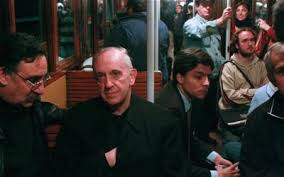
pope on subway

Yesterday the entire Roman Catholic Church celebrated the feast of the dedication of the Lateran Basilica in Rome. That’s right Roman Catholics everywhere turned their attention to a seemingly obscure building in Rome. Pastors from every pulpit, I’m sure, took the occasion to urge us all to explore the wonders of the basilica the next time we find ourselves in Rome. (I’ll try to remember that on my next visit to the Holy City.)

But there’s more to the commemoration than we’re led to believe. That’s because the arch-basilica of St. John Lateran (named for both John the Baptist and John the Evangelist) is actually the pope’s parish church. Yes, Pope Francis’ parish church is not St. Peter’s; it’s St. John Lateran. Pastors yesterday, no doubt, told us that too.

They also probably said that St. John Lateran has enjoyed such prominence since the arch-basilica was first built in the early 4th century. Its original site was a gift of the Emperor Constantine who awarded the Lateran Palace to the pope of the time. His name was probably Miltiades. The palace got its own name from the Laterani family, the citadel’s proprietors. They were trusted bureaucrats who faithfully served Roman emperors for many years.

And that’s the point I’d like to make here – the Constantine connection. St. John Lateran offers archeological evidence of the tragic moment in history when the would-be followers of the poor working man, Jesus of Nazareth, sold the soul of the church to the highest bidder. The buyer happened to be the Roman Empire – the very agency responsible for the execution of the one Christians pretend to follow. Constantine paid in the coin of land grants and palaces like the Lateran castle.

Can you spell “co-optation” in its most debilitating form?

The result was the nearly complete corruption of the church. Popes started to act like kings and emperors themselves.

In other words, the Church got into bed with Constantine in 313 (the Edict of Milan). Sadly, it didn’t escape till the second half of the 20th century with the development of liberation theology – which the current pastor of St. John Lateran, Pope Francis, has embraced.

That’s right. The pope has embraced the strain of theology repudiated by his two immediate predecessors, John Paul II and Benedict XVI. On this please check out the wonderful article by Newsweek’s Paul Vallely. He published it less than a month ago under the “The Crisis that Changed Pope Francis.”

The pope’s conversion is mirrored in his apostolic exhortation, “The Joy of the Gospel,” published last year at this time. The document calls for a “new chapter” in the history of the Catholic Church and for the church to embark on a “new path” (Joy of the Gospel 1, 25). On this new path, the pope says, things cannot be left as they presently are (25). Instead they must include new ways of relating to God according to new narratives and new paradigms (74) – including new customs, ways of doing things, times, schedules and language (27), and with emphasis on better prepared and delivered homilies (135-159). According to the pope the roles of women must be expanded, since women are generally more sensitive, intuitive, and otherwise skilled than men (103, 104).

All of this the pope said quite clearly. And he called for the laity to take the reins.

As far as I can see, NOTHING at the parish level has changed since last November.

As lay people called by Francis to exercise our power, what should we do about that?

The feast of the dedication of the pope’s parish church is a good occasion for answering that question.

(Sunday Homily) Dear Pope Francis: Gaza Needed More than Tears; Next Time, Please “Walk on Water”

Walk on Water

Readings for 19th Sunday in ordinary time: I KGS 19: 9A, 11-13A; PS 85: 9-14; ROM 9: 1-5; MT 14: 22-23 http://www.usccb.org/bible/readings/081014.cfm

In today’s Gospel, we hear Matthew’s account of Jesus walking on water – or rather, of Peter’s refusal to follow Jesus’ example of walking on the waves.

The account is relevant to the man in the Vatican who believes he is Peter’s successor. Israel’s month-long siege of Gaza invited Pope Francis to “walk on water” – to follow the example of Jesus in confronting demons. However uncharacteristic timidity left the pope sinking below the waves, out of sight and ear shot, cowering before Monsters like Obama and Netanyahu.

Let me explain. First off, consider today’s Gospel reading.

The story goes that following Jesus’ feeding of the 5000 (last week’s Gospel episode), Jesus forces the apostles to get into their boat and row to the other side. [The text says, “Jesus made (emphasis added) the disciples get into a boat and precede him to the other side.” Perhaps these experienced fishermen (as opposed to the land lubber, Jesus) saw a storm was coming and were reluctant to set sail despite Jesus’ urgings.]

In any case, a storm does come up and the apostles fear they are about to drown. You can imagine them in helpless tears.

Then they see a figure walking on the water in the midst of high threatening waves. At first they think it’s a ghost. Then they realize that it’s Jesus. He’s walking on the raging waters.

Peter, the impetuous leader of the apostles, doubts what he sees. So he says, “Prove to me that it’s you, Jesus; let me walk on the waves just as you’re doing.” Jesus says, “Join me then over here.” So Peter gets out of the boat and, like Jesus actually walks on water for a few steps.

Then, despite the evidence, he begins to doubt. And as he does so, he starts sinking below the water line. “Save me, Lord,” he cries out again. Jesus stretches out his hand and saves Peter. Then he asks, “Where’s your faith, man? Why is it so weak? Why did you doubt?”

Of course, this whole story (like last week’s “Loaves and Fishes”) is one of the dramatic parables Matthew composed. If we get caught up in wondering whether we’re expected to believe that someone actually walked on water, we’ll miss the point of this powerful metaphor. It’s about Jesus’ followers doing the unexpected and irrational in the midst of life-threatening crisis.

You see, Matthew’s Jewish audience shared the belief du jour that the sea was inhabited by dangerous monsters – Leviathan being the most fearful. And fearlessly walking on water was a poetic way of expressing what Matthew’s community believed about Jesus, viz. that he embodied the courage and power to do the completely unexpected in the midst of crisis and subdue the most threatening forces imaginable – even the most lethal of all, the Roman Empire.

Jesus’ invitation to Peter communicates the truth that all of us have the power to confront monsters if we’ll just find the courage to leave safety concerns behind even in the most threatening conditions, to confront life’s monsters, and join Jesus in the midst of its upheavals.

Problem is we easily lose faith and courage. As a result, we’re overcome by life’s surging waves and by the monsters lurking underneath them.

And that brings me back to Pope Francis and his ambiguous response to the slaughter that took place in Gaza over the last month.

We expected more. Over the course of his still-young papacy, Francis has demonstrated wonderful courage attempting to join Jesus on the world’s dangerous waves.

• He’s adopted a comparatively simple lifestyle.
• He’s condemned neo-liberalism and growing income inequality.
• His apostolic exhortation, “The Joy of the Gospel” implicitly endorsed the liberation theology his two immediate predecessors had tried to kill.
• More specifically, he adopted liberation theology’s “preferential option for the poor” as the leitmotif of his papacy.
• In that spirit, his famous “Who am I to judge” gave hope to the LGBTQ community.
• He helped head off President Obama’s plans to bomb Syria.

That last precedent led me to expect more in the context of Gaza. I was in St. Peter’s Square for Francis’ hours-long vigil for peace. There the Pope did as much or more to head off U.S.’ insane plans to bomb Syria as did Russia’s President Putin. Along with Putin, Francis was the hero who subverted the monstrous plans of Obama and his State Department.

But there was no peace vigil for the Gazans. Instead two weeks ago the Pope broke down in tears as he delivered his Sunday remarks from the balcony over St. Peter’s Square. He said:

“Never war, never war! I am thinking, above all, of children who are deprived of the hope of a worthwhile life, a future. Dead children, wounded children, mutilated children, orphaned children, children whose toys are things left over from war, children who don’t know how to smile.” This was the moment when the tears came. “Please stop,” said Francis. “I ask you with all my heart, it’s time to stop. Stop, please!”

The words were powerful; the tears were powerful. But unlike the prayer vigil before a potential Syrian fiasco, they remained largely unreported. Nevertheless, for those with ears to hear, the Pope was lamenting Israel’s killing of Palestine’s innocent. (No Jewish children were killed during the Gaza massacre.) However, to overcome the Media’s deafening pro-Israel tilt, the Pope needed to be stronger and more specific.

Yes, his papacy has daringly left the safe harbor and courageously sailed into the storm. Yes, Francis clearly sees Jesus as his role model demanding courage in the face of today’s unprecedented winds and waves. Indeed Francis has gotten out of the boat to trample underfoot the beasts and monsters roiling the seas all around us. But in the case of Gaza, instead of walking confidently on the waters, he sunk in apparent timidity before the threatening monsters, Obama and Netanyahu.

But what more could he have done? What sort of miracle did I expect?

Well, he could have given courage to all of us who are far less daring than he; he could have performed a miracle more stupendous than actually “walking on water” by:

• Owning the fact that as the leader of 1.2 billion Roman Catholics, with far more power than Jesus had, he was truly able to end Gaza’s slaughter.
• Announcing plans to travel to Gaza in the midst of Israel’s monstrous campaign.
• Before leaving, specifically naming Israel’s assault on civilians as sinful.
• Identifying the U.S. as equally culpable with Israel for crimes against humanity.
• Actually traveling to Gaza in a white papal helicopter (even in defiance of Israel’s predictable prohibitions) and landing in the midst of Gaza’s devastation.
• Celebrating Mass in Gaza on a pile of rubble and refusing to leave till the Israelis stopped their slaughter.
• If the slaughter continued, traveling to the key sites of bombing and shelling.

“Impossible!” you say? Such an act would offend Israel and upset Israel-Vatican relations. Ditto for the U.S.

Hmm. Is the pope a politician or a prophetic religious leader? Please use your imagination and spin out what would have happened if the pope walked on water as just outlined. What do you think?

In any case, those much less courageous than Francis need his example so the rest of us might venture forth to walk on water in our own far less powerful ways.

Yes, in today’s Gospel, Jesus invites us all to do the impossible. Why are we doubting? Where is our faith?

Sunday Homily: “Lazarus come forth!” Pope Francis Brings Jesus Back to Life

Lazarus

Readings for the Fifth Sunday of Lent: EZ 37: 12-14; PS 130: 1-8; ROM 8:8-11; JN 11: 1-45 http://usccb.org/bible/readings/040614.cfm

A few weeks ago, Fortune Magazine identified Pope Francis as first among the World’s “Fifty Best Leaders.” President Obama did not even make the list. Bono and President Clinton were among the top ten.

Whatever the magazine’s reasons for selecting the pope, it’s clear that the “Francis Effect,” is real. Seventy-seven percent of Catholics say they have increased their church donations since the new pope took office. Francis has brought the Catholic Church back from the dead. More importantly, he has returned to life the Jesus of the gospels whom conservatives have long since hijacked and buried – the very one our world’s poor majority needs as never before.

That’s relevant this fifth Sunday of Lent where our readings have Ezekiel coining the highly political metaphor of God’s “raising the dead” to refer to Israel’s impending liberation from its own despair during its Babylonian Captivity. Ezekiel’s metaphor reappears in today’s gospel reading where John the evangelist’s presents his familiar parable about Jesus raising Lazarus from the grave where Jesus’ friend lay moldering for more than three days.

Consider the hopelessness of Ezekiel’s Israel. His sixth century was the saddest of times – the era of his nation’s Great Exile. The Hebrews had been defeated and humiliated by Babylon (modern day Iraq). Its leaders and a large portion of its populace had been abducted to that enemy state. The exiles felt as if they had been slaughtered culturally. They were far from home, controlled by foreign masters, and apparently abandoned by God.

But the prophet Ezekiel did not share his people’s general despair. So in an effort to regenerate hope, he coined the idea of resurrection. Ezekiel loved that concept. [Recall his Vision of Dry Bones (EZ 7: 1-14).] For Ezekiel resurrection was a political metaphor that promised a new vital future despite appearances to the contrary. Israel, he said, would be liberated from Babylon, return home and experience rebirth. They would come back to life.

In his Apostolic Exhortation, The Joy of the Gospel (JG), Pope Francis embraces not only Ezekiel’s spirit, but that of Jesus raising Lazarus from the dead. To repeat, he actually revivifies Jesus and the Gospel. The pope does so by rescuing them both from conservative forces whose version of Christianity has held center stage for the last 35 years. It’s the version, the pope strongly implies, that has metaphorically killed the Jesus of the Gospels, who proclaimed the imminent arrival of God’s Kingdom which belongs to the poor, not to the rich whom the conservatives prioritize.

Like Ezekiel, Jesus made his proclamation when all appearances indicated that Israel was dead. It was entirely under the heel of Roman jackboots and there seemed no escape. Yet Jesus described a horizon of hope that enlivened the spirits of the poor who were crushed by the Romans and by their rich Jewish collaborators who headed the temple establishment.

In such dire straits, Jesus proclaimed a new future where everything would be turned upside down. He said audacious things. In God’s realm, he insisted, the poor would be in charge. The last would be first, and the first would be last. The rich would be poor and the poor would be well–fed and prosperous. The powerless and gentle would have the earth for their possession. Jesus’ unemployed and famished audiences couldn’t hear enough of that!

So he elaborated. He told parable after parable – all about the kingdom and its unstoppable power. It was like leaven in bread – unseen but universally active and transforming. It was like the mustard seed – a weed that sprouted up everywhere impervious to eradication efforts. It was like a precious pearl discovered in the ash bin – like a coin a poor woman loses and then rediscovers. His metaphors, similes and parables were powerful.

To repeat, Pope Francis strongly implies that socio-economic conservatism has murdered the Jesus I’ve just described. It has done so by its “preferential option for the rich.” It embraces free-market capitalism, trickle-down theory, and cut-backs in health care, education, and anti-poverty programs. Conservatives complement such horrors with huge tax-breaks for the country’s 1%. All of this is was chillingly represented last week by “devout Catholic,” Paul Ryan whose budget promised to sock it to the poor and middle class, while enriching military industrialists along with his affluent friends.

The Joy of the Gospel makes it clear that no one can support policies like Ryan’s and claim at the same time to be a follower of Jesus.

In other words, Ryan and the pope are on completely different pages. While conservatives have buried the Gospel Jesus, Pope Francis calls him back to life. He stands before Jesus’ grave and shouts “Come Forth!” Even Fortune Magazine recognizes the resulting miracle.

Consider the Pope’s anti-conservative incantation that brings Jesus back to life. It runs like this:

• Wealth does not belong to the rich, but to the world’s poor (JG 57, 184).

• But the world economy as now structured concentrates wealth among an ever-shrinking minority of the rich (56).

• Wealth must therefore be redistributed (189, 204,215).

• Such redistribution must take place by government intervention in the free market, which (in contradiction to failed “trickle-down” theory) cannot by itself eliminate poverty (54).

• The rich who are unwilling to redistribute wealth to its true owners (the poor) are thieves (57, 189).

• More than that, they are murderers, since the world economy as presently configured is homicidal (58).

• This is a question of being pro-life (213).

• Favoring life certainly includes concern for the unborn (213).

• But “. . . defense of the unborn is closely linked to the defense of each and every other human right” (213).

• Human rights include the right to food and shelter, education, health care, employment , and a just wage (191, 192)

• Respecting human rights involves renunciation of war and preparation for war (60).

• It also connects with environmental stewardship – defense of soil, insects, birds, fish, and the seas (215).

And so the tomb opens. And a Jesus who has been buried more than three decades stumbles out. And in doing so, he renews the faith of so many of us who had given up on the church.

Our faith is renewed because we recognize in Francis’ Jesus the embodiment of one of life’s fundamental truths: utopian visions of the good and true and beautiful can never be killed, even though they might appear lifeless and be pronounced dead by those who once loved them.

What should we do as a result of encountering the Jesus Francis has resurrected?

• Be bold in appropriating the vision of Pope Francis that is not at all idiosyncratic within the Catholic tradition. In fact, it represents the authentic teaching of the Catholic Church from Leo XIII to Vatican II and was even articulated by John Paul II and Benedict XVI.

• Accordingly and courageously incorporate into progressive political discourse the language and powerful ideas of the Judeo-Christian tradition. It can move people today just as it did in the times of Ezekiel and Jesus.

• Join Francis in refusing to cede the field of religion to the reactionary forces of neo-liberal conservatism.

• Expose that conservatism for the destructive fraud it is.

• More particularly, expose Paul Ryan and other Bible thumping Republicans as the heretics they are as they defend the interests of the rich and starve the poor in the name of the Gospel.

• Insist that our pastors get on board with Pope Francis in universalizing his pro-life vision to foreground issues of hunger, war and peace, capital punishment, full employment, universal health care, affordable housing, environmental protection. . . .

Francis reminds us that united with our neighbors, we too, the People of God, possess the power to raise the dead.

So as we stand before the grave of God, the church, and Jesus, let’s echo the pope’s cry: “Jesus, come forth!”

Sunday Homily: Pope Francis on Wealth Redistribution

85

Readings for 3rd Sunday in Ordinary Time: IS 8: 23-9:3; PS 27: 1, 4, 13-14; I COR 1: 10-13, 17; MT 4: 12=23 http://usccb.org/bible/readings/012614.cfm

According to an Oxfam report released last Monday (Jan. 20th), the 85 richest people in the world now have as much wealth as the world’s 3.6 billion poorest people – i.e. as much as half the planet’s entire population. Eighty-five people!

The report’s publication makes clear the importance of Pope Francis’ recent Apostolic Exhortation, “Evangelii Gaudium” (E.G.). That’s because the pope’s “Joy of the Gospel” specifically addresses the injustices of income inequalities.

The Oxfam report also reveals as fatuous a recently advanced defense of vast wealth differentials in the very terms the pope criticizes. (I’m referring to David Brooks’ New York Times column – see below.) Oxfam’s report also makes relevant the readings in today’s liturgy of the word. They address inequality by reflecting the mentality of the poor and Jesus’ commitment to the working class in first century Palestine’s social context of obscene differences in wealth between rich and poor.

Before looking at those readings, I wonder what you think of that Oxfam statistic. Once again, the richest 85 people in the world have as much wealth as the poorest 3.6 billion – the poorest half of our planet’s population.

Personally, I find that shocking and almost unfathomable. Yet the New York Times’ David Brooks says inequality is not the problem. As a powerful apologist for the rich, Brooks alleges that only those locked into a “primitive zero-sum mentality” would believe that the poor are poor because the rich have too much of the earth’s resources.

The economic pie is continually expanding, Brooks implies. So even though good jobs have been off-shored, and Wall Street bonuses are indefensible, the problem of inequality cannot be solved by wealth redistribution schemes or raises in the minimum wage. Instead, the real solution is to educate the poor – furnishing them with the cultural attitudes and job skills necessary to lift them from poverty caused by single parent families, school drop-outs, and the resulting generations-long culture of poverty.

Brooks’ argument is hackneyed. And in its familiarity, it illustrates the fallacies about poverty commonly subscribed to by the rich. Those approaches nearly always embrace a version of trickle-down theory. They find poverty’s solution in reforming the poor and educating them for the hi-tech jobs that will emancipate them from poverty. Mainstream intellectuals reject measures like minimum wage increases and higher taxes on the rich as “populist” and as introducing class-conflict themes that are dangerous and counterproductive.

It is such dodges by the rich that were specifically rejected by Pope Francis in Evangelii Gaudium. There the pope says unmistakably that extreme wealth on the one hand and abysmal poverty on the other are interconnected. In fact, he accuses the powerful of actually “feeding upon” the powerless (E.G. #53). They’re eating them up! Francis also rejects out of hand the trickle-down mentality behind Brooks’ observations. The pope classifies Brooks’ reference to a “primitive zero-sum mentality” as itself being “crude and naïve.”

In fact, what the pope actually says about trickle-down theories can’t be repeated too often. He writes: “In this context some people continue to defend trickle-down theories . . . This opinion which has never been confirmed by the facts, expresses a crude and naïve trust in the goodness of those wielding economic power . . . Meanwhile the excluded are still waiting.”

Pope Francis also scraps apologetics like those Brooks employs when he essentially blames the poor for their poverty and would save them by “education.” Here Francis’ specific words are: ”Some simply content themselves with blaming the poor and the poorer countries themselves for their troubles; indulging in unwarranted generalizations, they claim that the solution is an “education” that would tranquilize them, making them tame and harmless.”

Pope Francis’ words bring a startling reminder to would-be Christians that economic questions – considerations of social justice and equality – are central to Christian faith. Francis’ words sensitize us to a reality that presents itself to believers every Sunday if we’re attentive enough to perceive the socio-economic dimensions in each week’s readings.

Today’s readings once again offer a case in point. The first selection comes from the prophet Isaiah. It recalls a time when Israel had been released from painful exile and enslavement by ancient Babylon (modern day Iraq). According to Isaiah, exile was a time of anguish, darkness, gloom and distress – the pain inevitably experienced by the exploited then and now. Liberation from slavery’s “rod and yoke” changed all of that. Darkness and gloom were replaced by light, joy and rejoicing.

Significantly for the topic at hand (inequality and its remedies) the prophet uses two poor people’s images to describe the change. The joy of the liberated was like that of peasants reaping the fields at harvest time. Now, however, the harvested crop would belong to them, not to idle landlords. In this new situation reaping the fields presaged a time when hunger would be replaced by feasting.

Even more to the point, according to Isaiah, the joy of those liberated from Babylon was like the ecstasy of rebels dividing spoils after The Revolution – when the wealth of their oppressors was finally redistributed to those who had worked so long producing that wealth in exchange for nothing but “rod and yoke.”

In other words, the reading from Isaiah refers to a time of plenty and of wealth redistribution – always the dream of the poor and dispossessed – a dream, Pope Francis reminds us, that is also the Dream of God.

It was a dream shared by Jesus. He called his revolutionary vision the “Kingdom of God.” In today’s reading from Matthew, we see the working man from Nazareth recruiting those who would help organize the poor around that concept. Matthew presents Jesus as selecting comrades like himself – from the working class. His initial selections are the poor illiterate fishermen Simon, Andrew, James and John. They would accompany him and learn from him as he confronted his culture’s rich elite – the temple priests, rich landlords (again the temple priests), and collaborators with Roman occupation forces.

Reza Aslan tells us that Jesus did all of this in a context of extreme economic inequality. Aslan writes of “the chasm between the starving and indebted poor toiling in the countryside and the wealthy provincial class ruling in Jerusalem . . . .” He describes a Jesus who as a tekton (a Greek word meaning Jack of all trades) worked daily rebuilding the opulent city of Sepphoris, the capital of Galilee, an hour’s walk from his village of Nazareth. “Six days a week,” Aslan writes, “from sunup to sundown, Jesus would have toiled in the royal city, building palatial houses for the Jewish aristocracy during the day, returning to his crumbling mud-brick home at night. He would have witnessed for himself the rapidly expanding divide between the absurdly rich and the indebted poor.”

No doubt that experience sensitized Jesus to the plight of those who shared his social location. Like others he knew, Jesus was convinced that the situation was unsustainable. As Aslan puts it, “There was a feeling particularly among the peasants and pious poor, that the present order was coming to an end, that a new and divinely inspired order was about to reveal itself. The Kingdom of God was at hand. Everyone was talking about it.”

Jesus made it the point of his work as a community organizer par excellence to focus on the advent of God’s kingdom. In today’s Gospel, Matthew says, “Jesus went throughout Galilee, teaching in their synagogues and proclaiming the good news of the kingdom and curing every disease and every sickness among the people.”

And in proclaiming and working for the kingdom, Jesus did not shy away from statements that might be seen as engendering class conflict. “Blessed are you poor,” he said, “for yours is the Kingdom of God” (LK 6:20). “Woe to you rich, you have had your reward” (LK 6:24). “How hard it is for the rich to enter the kingdom of God” (MT 19: 16-24). All of these statements show consciousness of class struggle.

So what are we to do about income inequalities? In 1998, a UN Development Report called for a tax of 4% on the world’s richest 225 people. The report said that such a tax (6% less than the traditional tithe) would provide enough resources to feed, clothe, house, cure and educate the entire Third World.

To the wealthy, such taxation is unthinkable. As a result, 30,000 children die of absolutely preventable starvation each day.

In the eyes of Pope Francis – in the eyes of Jesus, I’m sure – tolerating such needless deaths is sinful and runs entirely contrary to any pretensions of those identifying themselves as “pro-life.”

No, Mr. Brooks, we can’t ignore the connections between extreme wealth and abysmal poverty. Wealth must somehow be redistributed. We have the word of Oxfam and the UN on that. We have the word of Pope Francis and of Jesus too.

Sunday Homily: Pope Francis’ “New Song” – Seven Points You May Have Missed in “Evangelii Gaudium”

Francis Singing

Readings for Second Sunday in Ordinary Time: IS 49: 3, 5-6; PS 40: 2, 4, 7-10; I COR 1: 1-3; JN 1: 29-34 http://usccb.org/bible/readings/011914.cfm

What will Pope Francis do next? Since his election nine month ago, he seems to be in the news on a daily basis.

We all know, for instance, that he was Time Magazine’s “Person of the Year.” And just last week, the New York Times ran two substantial articles on him. “He has already transformed the tone of the papacy,” one of those articles said, “confessing himself a sinner, declaring ‘Who am I to judge?’ when asked about gays, and kneeling to wash the feet of inmates, including Muslims.”

The article went on to describe the reforms the pope is making in the Vatican. He has disempowered influential conservatives favored by his predecessor, Benedict XVI. The demoted include American Cardinal Raymond L. Burke, and Italian Cardinal Mauro Piacenza, along with Archbishop Guido Pozzo. Such reactionaries have been replaced with Francis’ allies like Secretary of State Pietro Parolin whom the pope listed among those he will make a cardinal in February.

Even more broadly, the Times described the pope’s employment of six Jesuit “spies” to assess and report on various Vatican offices. That’s making Roman apparatchiks very nervous. As a result, job insecurity has become the order of the day in Vatican City, where clerical careerists , the Times said, have responded like sulking teenagers plugging in their headphones, retiring to their rooms, and hoping the storm will pass them by.

Another Times report last week detailed Pope Francis’ recent appointments to the College of Cardinals. The Parolin appointment notwithstanding, the nominations represent a departure from tradition in that the majority of the 19 new cardinals will come from Latin America, Africa, and Asia instead of Italy and Europe. The appointees promise to change the tone of the consistory the pope plans to convene at the end of next month where discussions will begin about decentralizing church decision-making processes and about pastoral responses to changes in family structure including questions of divorce and homosexuality.

Couple last week’s moves with last September’s hugely successful mass demonstration in St. Peter’s against the bombing of Syria, with his denunciation of free market capitalism, under-regulated financial speculation, and “murderous” world-wide income inequality, and you have a worthy successor to John XXIII, the soon-to-be-canonized Great Reformer who convened the Second Vatican Council (1962-’65).

Put otherwise, in a very short time, Pope Francis has made his own the words of today’s responsorial psalm, “The Lord has put a new song in my mouth.” The song the pope is singing takes the emphasis off formal religion – what the responsorial calls the “sacrifice and offerings.” That’s not what God wants, the psalmist says. Instead God’s desire is “a people that hear and obey” — specifically the law of justice that God has placed in the heart of all human beings whether they think of themselves as believers or not . So far, the pope’s actions show that he agrees.

In terms of today’s gospel reading – a continued reflection on last Sunday’s account of Jesus’ baptism – it’s as if we’re witnessing the descent of the Holy Spirit upon a man determined to follow in the footsteps of Jesus of Nazareth.

Like Jesus, Francis has made a “preferential option for the poor.” He’s signaled justice for the oppressed as the overriding theme of his papacy. He has completely rejected war as a solution to any of the world’s problems. This pope is no hawk or friend of hawks — or of the rich who advocate free market solutions to problems of poverty and its attendant hunger and disease. For him, terrorism is blowback for injustice.

As most of us know, all of this is clearly explained in Francis’ “Evangelii Gaudium” whose significance in terms of church reform cannot be overstated. But there are some important aspects of the pope’s exhortation that may have escaped notice. Let me name just seven that have special connection with today’s liturgical readings and their emphasis on peace, justice and the Spirit of God. (Parenthetical numbers refer to the relevant sections in the papal document.):

• “Evangelii Gaudium” is not trivial. The pope writes “In this exhortation my intention is to map out the path for the church to follow in the immediate future” (2).So the pope’s concern for the poor and rejection of war are not simply expressions of his idiosyncratic aspirations. They represent attitudes and actions he expects the church and Roman Catholics to adopt.

• As the Huffington Post has put it, “Evangelii Gaudium” also represents a “remarkable about-face” relative to liberation theology. Significantly, the pope met with Gustavo Gutierrez, the doyen of liberation theology, last September. Gutierrez’s themes are found throughout the pope’s Exhortation – the “preferential option for the poor” (198, 199), the affirmation of “popular piety” (122-126), the historical perspective (54), social analysis uncovering unfettered capitalism as homicidal (53, 57), and recognition of “structural sin” (59, 202). . . .

• The Exhortation’s position on private ownership is much more radical than many have acknowledged so far. The pope actually states that the goods of the earth belong to the poor, not simply to those who can pay for them. Quoting “an ancient sage,” the pope says “The goods we possess don’t really belong to us but to the poor” (57). Can you imagine a stronger rejection of capitalism’s understanding of private property?

• In general, the Papal Exhortation is friendly towards theologians. This also represents an about-face from his immediate predecessor who routinely investigated, warned, condemned and silenced theologians – 106 of them by Matthew Fox’s count. By contrast, Pope Francis values the role of theologians whatever categories of reason they might use – even, one might conclude, if the categories are Marxist. Consider the suggestion in these words: “When certain categories of reason and the sciences are taken up into the proclamation of the message, these categories then become tools of evangelization; water is changed into wine. Whatever is taken up is not just redeemed, but becomes an instrument of the Spirit for enlightening and renewing the world. . . The church . . . appreciates and encourages the charism of theologians.”

• The pope’s appreciation of theologians means that “Evangelii Gaudium” holds promise for women and the campaign for women’s ordination – despite its specific rejection of women priests (104). This is because virtually no theologians or scripture scholars find credible the reasons advanced for restricting ordination to males. Even the pope’s Exhortation suggests the contrary. No sooner does he reject women priests than he falls into the traditional language of “holy mother church” (e.g. 139). The pope writes “. . . the church is a mother, and . . . preaches in the same way that a mother speaks to her child.” Do you detect the dissonance here – of males alone being allowed to speak as women?? Sooner or later that penny will drop.

• The pope’s promotion of the “sensus fidei” (119) holds similar promise for changes in church teaching on contraception. According to the pope, “God furnishes the totality of the faithful with an instinct of faith – sensus fidei – which helps them to discern what is truly of God.” For theologians, sensus fidei means that when the bishops, theologians and laity agree on a matter of faith or morals, their agreement represents the work of the Holy Spirit. On the question of contraception, previous popes have cut the laity and theologians out of the equation entirely. In the spirit of Vatican II, the pope’s words promise to include them once again. Theologians and laity overwhelmingly agree that church prohibition of artificial contraception needs change.

• In his Exhortation, the pope shifts away from just war theory to complete pacifism (239). He devotes a whole section to the rejection of war (98-101). Moreover, he identifies inequality as the cause of violence and war. He writes, “Inequality eventually engenders a violence which recourse to arms cannot and never will be able to resolve . . . weapons and violence rather than providing solutions, create new and more serious conflicts” (60). What if the world’s 1.2 billion Roman Catholics took the pope’s words to heart?

All of this represents the work of the Holy Spirit – the same Spirit that today’s reading from John’s gospel describes as descending upon the just-baptized Jesus. John the Baptist describes Jesus as the gentle “Lamb of God.” The Spirit is pictured as a dove – the symbol of peace.

Like John the Baptist on Jordan’s banks, Pope Francis is calling the faithful to “Behold the Lamb of God” imitating Jesus’ identification with the poor and his gentle non-violence.

Taking Pope Francis to the Movies: “The Wolf of Wall Street” (Film Review)

Wolf of Wall Street

A friend of mine says that if a picture is worth a thousand words, a good documentary film is worth a million. I agree, and would add that a great Hollywood drama directed by someone like Martin Scorsese and starring headliners like Leonardo DiCaprio might be worth two million or more.

Consider “The Wolf of Wall Street” as a case in point. It’s worth a library of dissertations on the dead-end and destructive nature of consumerism so recently criticized by Pope Francis in his Papal Exhortation, Evangelii Gaudium – the document intended to keynote his still-emerging reign as head of the Roman Catholic Church.

The pontiff’s publication distanced the pope and his church from the destructive emptiness of lives depicted in Scorsese’s “Wolf.” Pope Francis criticized consumerism based on the obscene accumulation of wealth without concern for the poor or the common good. He condemned “structures” that encourage such behavior. He turned a disapproving eye on education intended to domesticate rather than liberate the poor.

Such features of unfettered markets find lurid depiction in Scorsese’s film. There the over-the-top excesses of the Stratton-Oakmont investment firm amount to a send-up of the American Way of Life in general. At one point the film’s main protagonist, Jordan Belfort (played brilliantly by Leonardo DiCaprio) correctly makes Scorsese’s point, “Stratton-Oakmont is America” he proclaims. By this Belfort means his firm represents a vehicle of salvation for the poor. The film’s narrative suggests contrary conclusions.

“Wolf’s” story is simple. Ne’er-do-wells and petty crooks (DiCaprio and his friends) quickly make millions in the Penny Stock Market. They then use their money to fund frenzied lives of meaningless “work” and ultimately of crime and absolute debauchery with prostitutes, drugs and liquor.

The firm’s “work” consists in selling worthless paper products – stocks (of whose content they are often totally ignorant) – to gullible clients anxious to make a quick buck.

The firm’s crimes include “pump and dump” schemes which have them artificially inflating stock prices and then selling them quickly while leaving their bilked customers holding bags-full of depreciated investments. These quick profits are then laundered and deposited in the Swiss bank accounts that Wall Street wolves have long provided themselves to escape any social obligation or criminal charges for their irresponsible depredations.

All of this eventually leads to arrests. However, as a white collar criminal, DiCaprio’s character gets treated with kid gloves. He serves a three year sentence in a minimum security “country club” prison playing tennis and getting lots of r ‘n r.

On his release, recidivist Belfort doesn’t miss a beat. He simply resumes the very career he was hawking in an infomercial the day he was arrested – as a teacher of yet more get-rich-quick aspirants. Presumably they too seek millions by mirroring Belfort’s life of parasitism, debauchery and crime. The life is attractive because of its huge short-term payoffs. And Belfort’s example shows such felonies involve little risk to their perpetrators and absolutely no responsibility to others.

Through it all DiCaprio’s gang ridicule law, ethics, the poor, and those not devious enough to take advantage of economic, political and legal structures that facilitate plunder. In fact, the poor are virtually absent from Scorsese’s three-hour long parody.

The one person who perhaps falls into that category is celebrated at one of Belfort’s lewd and rowdy “staff meetings.” She’s singled out because she was smart enough to enrich herself by joining the Stratton-Oakmont project of fraud and deceit. In so doing she landed herself on what her mentor sees as his re-creation of Ellis Island – a zone of hope and liberation for the poor. Tearfully grateful, she too now has her limousine, yacht, and vacations in the Bahamas. What more could anyone ask?

Pope Francis answers that question. So do the divorces, addictions, insecurities and instances of child abuse in Scorsese’s film. Along with Pope Francis, they show that life and happiness are not about such self-seeking. But the pope goes further than Scorsese, boldly insisting that human life is about the common good and service of the poor. To facilitate such service, he asks for (no: he demands) fundamental change in the world that makes possible the get-rich-quick schemes like those characteristic of Wall Street and embodied in Stratford-Oakmont. More specifically Pope Francis calls for:

• Rejection of the free market model of development for combating poverty. Contrary to Jordan Belfort’s vision of a new Ellis Island, Stratton-Oakmont is not the solution to world poverty, inequality or violence. Rather, according to the pope such firms with their “trickle-down” ideologies represent the root of the problems in question.

• Centralization of ethics in the business world. Though not enumerated by Francis, the principles here are simple: Don’t lie; don’t steal, don’t engage in sexual conduct harmful to others; treat others as you would like to be treated; recognize that one reaps what he or she sows. These mandates recognized in all great religious traditions are not only routinely violated by the Belfort gang; they are ridiculed and their abuses flaunted. This, according to Pope Francis is the way of the world dominated as it is by consumerism and loosely regulated markets.

• Incorporation of the viewpoints of the poor in policy discussions – instead of treating the “little people” as freaks, instruments, nobodies and fools as in the Stratton-Oakmont boardroom discussion about using “midgets” for staff entertainment.

• Recognition of “education” like that offered by Jordan Belfort for what it is – a means of tranquilizing and domesticating the marginalized and otherwise excluded.

• Reformation of legal structures that facilitate the quick capital accumulation responsible for huge gaps between the rich and the poor. Reformations suggested both by Scorsese and Pope Francis include not only tighter regulation of stock exchanges and financial markets, but elimination of instruments such as Swiss bank accounts, and laws that coddle white collar mega-criminals while placing victimless petty “criminals” of color (such as those caught possessing crack cocaine) in maximum security facilities.

These are just a few of the directions Francis calls the world to follow.

“The Wolf of Wall Street” supports his call by illustrating its need in a picture worth much more than a million words.

Pope Francis’ Compelling Revolutionary Vision: What Progressives Have Been Waiting for (Sunday Homily)

Pope Bergoglio

Readings for Second Sunday of Advent: IS 11: 1-10; PS 72: 1-2, 7-8, 12-13; ROM 15: 4-9; MT 3: 1-12 http://usccb.org/bible/readings/120813.cfm

Recently articles in OpEdNews (my favorite on-line news source) have been full of revolutionary themes. For instance, Chris Hedges informed us of an invisible revolution simmering and about to erupt. It will be driven, he said, by widespread discontent with wages, wealth disparities, militarism, and climate change denial.

Then in his viral BBC interview, comedian Russell Brand called for revolution stimulated by everyone’s recognition of the futility of politics as we know it. No one should vote, he said; the system is too broken to be improved at the ballot box.

On the other hand, Senator Bernie Sanders’ revolution would be based wider participation in political processes, with everyone voting. That would overcome reactionary moves that disenfranchise voters and empower moneyed interests to determine electoral outcomes against the popular will.

Calling us back to reality, Robert Becker advised that any revolution at all is highly unlikely, since no one on the left offers compelling direction or revolutionary vision.

At the time of its publication, that last remark seemed apt. No world leader capable of mobilizing millions had yet emerged.

However all of that changed two weeks ago. The compelling direction and revolutionary vision whose absence Mr. Becker correctly lamented indeed materialized in an ironically unlikely form – a pronouncement of the Roman Catholic papacy.

On Tuesday November 26th, Pope Francis published his Apostolic Exhortation, Evangelii Gaudium (The Joy of the Gospel). It represents the most articulate and detailed “vision” of a revolutionary future yet offered by anyone actually capable of producing results in the street and at the ballot box.

That is, as a member of the world’s super-elite, and virtually above reproach and easy dismissal by his fellow aristocrats, the pope’s pronouncement demands serious consideration. This is especially true on the parts of the bishops and clergy who weekly have before them captive audiences voluntarily come together to meditate upon, pray about, and attempt to internalize the gospel vision which the pope describes as focused on the poor, peace, social justice and on the structural causes of violence, war and terrorism. Moreover, these themes, the pope insists, should be driven home in homilies at Sunday Mass, since such leitmotifs represent the inescapable essence of the Judeo Christian tradition.

Today’s liturgy of the word provides a case in point. It articulates the revolutionary vision and compelling direction the pope finds throughout the Bible. It’s a utopian vision that courageously connects peace with social justice and environmental consciousness.

Consider the first selection from the prophet Isaiah. It directly links peace and social justice – for the poor and oppressed who in Isaiah’s day and our own are typically ignored. By way of contrast, Isaiah’s concept of justice consists precisely in judging the poor and oppressed fairly and not according to anti-poor prejudice – in Isaiah’s words, not by “appearance or hearsay.” (No room here for “Stop and Frisk,” or “Shop and Frisk!”)

Not only that, but according to the prophet, treating the poor justly is the key to peace between humans and with nature. It produces a utopian wonderland where all of us live in complete harmony with nature and with other human beings. In Isaiah’s poetic reality, lions, lambs, and calves play together. Leopards and goats, cows and bears, little babies and deadly snakes experience no threat from each other. Most surprising of all, even believers (Jews) and non-believers (gentiles) are at peace. (Today’s excerpt from Paul’s Letter to the Romans seconds this point. He tells his correspondents to “welcome one another” – including gentiles – i.e. those the Jewish community normally considered incapable of pleasing God.)

Today’s responsorial psalm reinforces the idea of peace flowing from justice meted out to the “least.” As Psalm 72 was sung, we all responded, “Justice shall flourish in his time, and fullness of peace forever.” And again, the justice in question has the poor as its object. The psalmist praises a God and a government (king) who “rescue the poor and afflicted when they cry out” – who “save the lives of the poor.”

In his own time, the lack of the justice celebrated in today’s first three readings infuriates Jesus’ cousin, John the Baptist. Today’s gospel reading has him excoriating the religious leaders of his day as a “brood of vipers.” Unmistakably clothed as a prophet – in garments that absolutely repudiate fashion and the pretenses of his effete opponents John reminds us of the simple lifestyle adopted by Francis I. John lambasts the Scribal Establishment which had identified with the occupation forces of Rome. As opposition high priest, John promises a religious renewal that will lead to a new Exodus – this time from the power of Rome and its religious collaborators.

As part of today’s revolutionary theme, it’s important to emphasize the Exodus dimensions of Matthew’s description of John. The Baptist is presented as preaching and baptizing specifically outside the temple and sphere of the priests. In fact, John appears in the wilderness – in the desert. For Jews, this would not only have evoked overtones of their great myth of national origin. It would also have signaled a subversive significance in John’s work. After all, the “desert” or “wilderness” was the place where contemporary resistance movements were spawned. (I imagine that if the Romans had the power, they would have “droned” John and his followers in a “signature strike.”)

Do you see what I mean about harnessing the revolutionary power of the Bible’s myth, poetry, utopian visions, and preferential option for the poor? It’s all there in Isaiah, Psalm 72, in Paul’s letter to the Romans, and in Matthew’s portrait of John. And if we look with the eyes of Pope Francis, we can find those themes every Sunday. It’s powerful stuff, I’m sure you agree. And the pope not only sees that himself, he has called 1.2 billion inhabitants of this planet to recognize it along with him and act accordingly.

The action Francis recommends is particular. It consists in combatting a form of capitalism that he describes as systematized murder. He rejects “trickle-down” theory, and demands interference in the out-workings of markets in the name of the common good. The pope calls Catholics and others of good will to recognize access to food, education, and healthcare as human rights.

And the pope does all of this without demanding sophisticated comprehension of history, economic theories, or detailed social analysis.

Instead he relies on the power of myth, poetry, God-talk, and biblical focus on a divine preferential option for the poor and Jesus’ vision of God as universal parent.

All of that is there in today’s liturgy of the word. For any with eyes to see, it’s there every Sunday to assuage our hunger for “vision” and “direction.”

It’s time for progressives to follow the lead of Pope Francis. He’s calling us to set aside our pseudo-sophistication that has intellectuals rejecting the Bible’s power to mobilize huge masses of people. That is, we must reclaim the powerful mythology of the Bible and lay aside our practical disdain for story, myth and symbol. That’s where we’ll find our missing “vision and direction.”

I find that promising, invigorating . . . and somehow ironic.