Pope Francis: Please Write That Encyclical against War!

Just War

Readings for 6th Sunday after Easter: Acts 15:1-2, 22-29; Ps. 57: 2-3, 5, 6, 8; Rev. 21: 10-14; 22-23; Jn. 14: 23-29.

Last week, David Swanson, the author of War is a Lie shared an interview with the great Jesuit peace activist, John Dear. The latter had just returned from Rome where he participated in a conference convoked by Ghanaian Cardinal Peter Turkson. Cardinal Turkson authored first versions of Laudato Si’, Pope Francis’ landmark encyclical on the environment. He is often mentioned as a possible future pope.

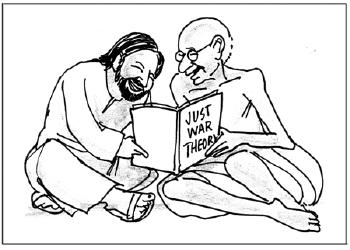
Father John (who doesn’t like to be called “Father Dear”) reported the conference as “unprecedented.” That’s because activists, theoreticians, and scholars of Peace Studies ended by recommending (in a document over the signature of Cardinal Turkson) that Pope Francis publish another encyclical – this one repudiating the Church’s centuries-long endorsement of Just War Theory.

That theory, of course, lays out principles for judging whether or not a given armed conflict might be justified.

The Turkson document repudiated the idea that modern warfare might ever be justified. This is not only because of the terrible destruction caused by modern weaponry, but because, in fact, 90% of casualties of today’s wars end up being innocent civilians. For those reasons, the conference in Rome recommended that Pope Francis not only repudiate war itself, but discourage Catholics from participating in modern military forces.

Imagine what would happen if Pope Francis were to accept those recommendations – especially on top of his denunciations of capitalism-as-we-know-it, his firm embrace of environmentalism, and his statements about homosexuality (“Who am I to judge?”). Catholic radicals would love it, liberals would be inspired. Conservatives who often identify faith and the military would be shocked and scandalized.

Where would you come down?

Think about that question in the light of today’s readings. Think about what “radical,” “conservative” and “liberal” mean for us as individuals and community members in our faith tradition. How would Jesus be classified? What about Paul? What would they say about entirely rejecting the idea of just wars?

Today’s Liturgy of the Word gives us a clue. It presents us first of all with an example of a key conflict between religious conservatives and radicals within the first century infant church. Paul, Barnabas, Silas and Barnabas lead the radical-to-liberal wing. Peter and Jesus’ brother, James are the leaders of the conservatives.

Paul and his friends come from the gentile world. Their concern is to make Jesus both understandable and acceptable to non-Jews. For their audience, circumcision and dietary restrictions (like not eating pork) represent great obstacles to accepting Jesus’ “Way.”

On the other hand, Peter and Jesus’ brother, James, are Jews through and through. They remember the importance of full observance of the law within the Jewish tradition. They recalled for instance that during the second century Seleucid persecution of the Jews under Antiochus IV Epiphanes, many Jews gave their lives rather than eat forbidden foods. Faced with Paul and his colleagues, the conservative faction wondered: were those lives sacrificed in vain? And besides, circumcision was the identifying mark of Jewish manhood. What good follower of the biblical God set that all-important commandment aside?

The issue is so serious that it provoked a meeting of church leaders – what scholars call the “Council of Jerusalem.” Like Vatican II (1962-’65) it called together church leadership to discuss burning issues of the day and to make changes that responded effectively to what Gaudium et Spes called the “signs of the times.”

Today’s gospel reading implies that leaders could come together with confidence because of Jesus’ promise that his Holy Spirit would continue teaching the church even after he is gone. The Spirit would remind the church of what Jesus himself taught – and more besides.

According to today’s readings, it was the “more besides” that the Jerusalem conservatives were resisting. They didn’t deny, of course, that Jesus himself was a Jewish prophet. (It was Jesus’ prophetic radicalism that angered the Scribes and high priests.) Jesus frequently placed love and compassion above God’s most important commandment, the Sabbath law; he associated with the “unclean;” he even befriended and worked miracles for gentiles. Jesus was never bound by the letter of the law as were his conservative opponents.

At the same time however, Jesus was Jewish to the end. He had no intention of founding a new religion. He was a Jewish reformer. No one could deny that. Jesus didn’t revoke the Law. He simply gave it an enlightened, more humane interpretation. He himself had been circumcised!

It was with these understandings that the Council of Jerusalem convened. And according to Luke, the author of Acts, it was a battle royal. Luke says the meeting was filled with “dissension and debate.”

What we find in today’s first reading is the final decree of the Council of Jerusalem. Concerning circumcision, it says “never mind.” As for dietary restrictions, they could be ignored. The Council was concerned with not placing unbearable burdens on converts. In other words, it couldn’t have been less conservative. The Holy Spirit was leading them in the opposite direction.

The Council of Jerusalem is reputed to have happened no more than 30 years after the death of Jesus. But by the time John of Patmos writes his book of Revelation at the end of the first century, look where his church had come. His vision of the “New Jerusalem” which we read about in today’s second reading doesn’t even have a temple. Jerusalem without a temple?! The city is founded not on the 12 patriarchs of Israel, but on the 12 apostles. How radical is that!?

I suppose what I’m saying is that Christians shouldn’t be afraid of radical change in matters of faith. It’s our tradition – right from the beginning.

In fact, in today’s gospel, John has Jesus say specifically that we should not be agitated or fearful. Rather, our hearts should be filled with peace because of our reliance on the Holy Spirit. John’s Jesus teaches that the Spirit’s presence guarantees the community is moving in the right direction, even when the Spirit’s teachings shock and scandalize – as long as it’s moving towards Jesus’ compassion, love, and ease of burden. The guarantee remains even when the Spirit’s guidance seems to dilute what many consider essential – like circumcision, dietary laws and the Jerusalem Temple.

What “essentials” is the church being called to set aside today? Priestly celibacy? An all-male priesthood? Prohibition of contraception? Are any of these really essential?

And what about just war? Are John Dear and Cardinal Turkson right about its absolute unacceptability to followers of Jesus? Could Jesus ever endorse atomic bombs, drone strikes, cluster bombs, or any of today’s wars that end up claiming mostly civilian victims?

If we fear to say “No” to any of those questions, we should keep Jesus’ words in mind: “Don’t be afraid or agitated; the Holy Spirit guides.”

The bottom line: today’s readings teach that there is no future in timid conservatism. Instead we are called to Christian radicalism (or going to the root of things). The Holy Spirit is that root.

And so we can pray with confidence: “Holy Spirit, in our world racked by war, inspire Francis to write another encyclical. Let him surprise and shock us one more time. Wake us up as a community of faith! Move us towards compassion, love and ease of burden as you did the Jerusalem Council.

We believe that under your guidance, we can never go wrong!”

Second Thoughts on Pope Francis & Family Issues

Confessional

Last week I posted a (mostly) tongue-in-cheek comment on Pope Francis’ Apostolic Exhortation, Amoris Laetitia. The document represented the pope’s reflections on the synod of bishops that met over the last two years to reformulate the Church’s teachings on marriage, sexuality and the family.

Obviously, all of those elements find themselves mired in profound crisis in the contemporary world. Given that fact, and despite the pope’s efforts to save the day in the face of the intransigence of the world’s episcopacy, the document proved to be highly disappointing.

Notwithstanding what I wrote last week, Amoris Laetitia left me wishing that the Church could bring itself to speak in plain language accessible to us all.

But no:  the encyclical was full of platitudes and written in opaque Vaticanese. It demonstrated the out-of-touchness of Church leadership, and its inability and/or unwillingness to help today’s women and men face up to their real problems in the light of a rich faith tradition perfectly capable of providing such assistance.

No wonder so many young people – so many couples – have long since dismissed the Church as irrelevant and counterproductive in terms of making sense of their lives in a globalized world!

[News flash to the Vatican: Outside of your little realm, the major problem facing couples today is not whether divorced people should be allowed to receive Holy Communion! It’s not even whether or not artificial birth control is morally acceptable. (Catholics have long since resolved that “problem;” they use contraceptives in the same percentage as everyone else.)]

Instead, think of the real problems we all face around the fraught matters Amoris Laetitia pretends to address, but which it only dances around, and in the end avoids. These problems were recently outlined by psychologist, Dr. Harriet Fraad, in an interview with economist, Richard Wolff. They include the following:

  • The introduction of the internet and easy birth control has changed the nature of dating and sexual relationships.
    • Increasingly, couples meet online instead of through family and friends.
    • It is no longer socially unacceptable for them to have sex before marriage.
    • In fact, hardly anyone waits till marriage.
    • This makes marriage less necessary and attractive as a means of achieving access to sex.
  • Divorce statistics (as well as witnessing the unhappiness of their parents) similarly discourage marriage. Fifty percent of first marriages end in divorce; 60% of second marriages and 70% of third marriages finish the same way. And after divorce women are usually left holding the bag in terms of child support.
  • Families are stressed when economic circumstances make it necessary for both parents to get jobs. That typically means women end up working a double shift – in the workplace and in the home.
  • The prospect of overwork eventual divorce leads more and more women to choose to remain single. Many become Sugar Babies to Sugar Daddies – older, well-established men who pay off their Baby’s overwhelming college loans or credit card debt.
  • Men, on the other hand, find themselves deprived of their traditional, male-defining role as bread-winners. Anger results – deflected towards guns, the military, sports addictions, evangelical religions (where women are subordinate) and pornography.
  • Children suffer the consequences of it all. They are left alone after school, when most of their problems emerge – not the least of which is obesity.
  • With all those realities in mind, marriage is increasingly viewed as an unnecessary hassle — a luxury good – accessible and desirable only for the well-to-do.
  • So young people end up postponing or rejecting it altogether.
  • They opt instead for serial cohabitations without commitment.
  • Or they become “Herbivore” men, “Dried Fish” women, or MGTOWS.

It’s not that Pope Francis doesn’t bring up many of these problems. Nor is he incapable of addressing them in ways helpful to struggling families. In fact, his three major publications (including Amoris Laetitia) provide clear principles for doing so.

  • His eco-encyclical, Laudato Si’, teaches clearly that all things are connected. The role of religion (which means “binding force”) is to make connections apparent.
  • Similarly that encyclical along with his Exhortation, “The Joy of the Gospel,” identifies capitalism-as-we-know-it as the connecting structural cause of contemporary problems. Its demands pits employers against their employees and men against women; it underpays them or deprives them of work; it requires them to work longer hours, drives both parents into double shifts, destroys families in the process, and then claims to represent “family values.”
  • And finally, in Amoris Laetitia itself the pope identifies conscience (informed by thoughtful consideration of the Christian tradition) as the most reliable guide humans have at their disposal.

Simply highlighting those principles and calling Catholics to adult dialog about their application to dating, marriage, divorce, contraception, abortion, and child-rearing would have done much more than the largely impenetrable document the Vatican actually produced.

Amoris Laetitia: Pope Francis’ Recent Publication is a Real Cliff-Hanger

Amoris Laetitia

It was like a cliff-hanger novel that had me on the edge of my seat. I’m talking about Pope Francis’ latest publication – his Apostolic Exhortation, Amoris Laetitia: On Love in the Family (AL). In it the pope purposed to gather the contributions of bishops at their extended Episcopal Synod which met over the last two years. The meetings were tasked with responding to the contemporary crises of the family and human sexuality including contraception, abortion, divorce, and same-sex marriages (AL 4).

The Exhortation read as if it were the plot of a Wild West thriller:

A backward town has been taken over by a gang of crooks, frauds and perverts. They’re well-entrenched. And the Black Hats have all the locals cowering behind locked doors. Unexpectedly however, a new sheriff shows up with his shiny star and white hat. The gangsters try to bribe him to join up with them. Sheriff Frank is clearly tempted throughout most of the book. But then in the final chapter, without warning he shows his true and familiar colors. In concluding scenes reminiscent of “OK Corral,” the sheriff utterly defeats the Black Hats calling on a secret weapon no one foresaw.

That’s roughly the tale of Pope Francis, his Vatican adversaries, the Episcopal Synod, and Amoris Laetitia.

Beforehand, observers knew that many of the Synod’s participants comprised a dark gang – patriarchal traditionalists stubbornly opposed to any changes in church doctrine. They would surely uphold moralist positions which Nancy Reagan expressed so well: “Just say No!” Reaffirm tradition and law, and expect the faithful meekly to obey.

At the same time, everyone was also aware that Pope Francis’ leanings were in the opposite direction. As new sheriff in town he had won the hearts of the world from the moment he uttered his first papal words identifying him with St. Francis of Assisi — the 13th century friar whose humble simplicity has rendered him the most beloved saint in all of Christian history.

The early chapters of Amoris Laetitia are like listening to the backroom argument between Sheriff Frank and those tempting him to cross over to their dark side. It’s a back-and-forth that has readers wondering which side the pope is really on.

The Black Hat Gang insists on doing things “the way they’ve always been done around here, Sheriff.” This means:

  • No change in the church’s position on contraception (AL 68, 80, 82, 222).
  • Same with abortion (42, 83).
  • Ditto for extra-marital sex (125)
  • And trans gender identifications (56)
  • “Marriage” between same sex partners has absolutely nothing to do with marriage as intended by God (52, 251,292).
  • The divorced and remarried are objectively living in conditions of sin (292).
  • Euthanasia and assisted suicide are strictly forbidden (48, 83).

Sheriff Frank seems confused at first. He retorts:

  • Remember, we’re all just wounded human beings prone to mistakes and recovering within the Church’s field hospital (291).
  • Poverty, immaturity and lack of education force people into apparently “sinful” choices only they can understand (201, 294, 295, 302).
  • Women in particular have a tough time in this “man’s world” (54, 156). Men need to listen to them (203).
  • And if we’re truly reject abortion and euthanasia, we must also firmly reject the death penalty (83).
  • Moreover, objectively speaking, second marriages following divorce are often more loving and healthier than first. The divorced and remarried are not living in sin (301).
  • As for same sex attractions and sexual transformations, remember we’re all male and female to some extent; it’s not simply a matter of biology (56, 286).
  • And none of us needs to answer everyone’s problem (2, 38). That’s what consciences are for (37).
  • Above all, remember square everything with the example of Jesus, his universal love and his prohibition about judging others (58, 79, and 250,296,308).

There’s much more to the argument. But you get the flavor.

What’s important is where the new sheriff comes down – how he defeats the Black Hat Gang in Amoris Laetitia’s happy ending. In short, he fires his “silver bullet” – MERCY. He makes an argument that can only be called a species of  “Situation Ethics.” In the end, he says, mercy dictates that:

  • Although the Black Hat Gang is correct that the objective demands of God’s law must be recognized as applying to everyone without exception (295),
  • Human beings only gradually integrate the law’s requirements over the course of their entire lives (295).
  • This means that circumstances such as immaturity, pace of moral development, lack of knowledge, appreciation of the law, along with a whole host of mitigating circumstances (302) often excuse subjects from the law’s requirements, at least temporarily (295).
  • In the end, conscience, love, and mercy [recognition of life’s “wonderful complications” (308)] are the most reliable guides we humans have (295).

That’s the pope’s final word on the contemporary crises of the family and human sexuality including contraception, abortion, divorce, and same-sex marriages.

That, after all, is about as much as Sheriff Frank or anyone can do for Catholics. The rest, as he says, is up to us – and the sovereignty of our consciences.

Did Jesus Really Rise from the Dead?

Resurrection

Readings for Easter Sunday:ACTS 10:34A, 37-43; PS 118: 1-2, 16=17, 22-23; COL 3:1-4; JN 20: 1-4.

Did Jesus really rise from the dead? Or is belief in his physical resurrection childish and equivalent to belief in the Easter Bunny or Santa Claus?

I suppose the answer to those questions depends on what you mean by “really.” Let’s look at what our tradition tells us.

Following Jesus’ death, his disciples gave up hope and went back to fishing and their other pre-Jesus pursuits. Then, according to the synoptic gospels, some women in the community reported an experience that came to be called Jesus’ “resurrection” (Mt. 28:1-10; Mk. 16: 1-8; Lk. 24:1-11). That is, the rabbi from Nazareth was somehow experienced as alive and as more intensely present among them than he was before his crucifixion.

That women were the first witnesses to the resurrection seems certain. According to Jewish law, female testimony was without value. It therefore seems unlikely that Jesus’ followers, anxious to convince others of the reality of Jesus’ resurrection, would have concocted a story dependent on women as primary witnesses. Ironically then, the story’s “incredible” origin itself lends credence to the authenticity of early belief in Jesus return to life in some way.

But what was the exact nature of the resurrection? Did it involve a resuscitated corpse? Or was it something more spiritual, psychic, metaphorical or visionary?

In Paul (the only 1st person report we have – written around 50 C.E.) the experience of resurrection is clearly visionary. Paul sees a light and hears a voice, but for him there is no embodiment of the risen Jesus. When Paul reports his experience (I Cor. 15: 3-8) he equates his vision with the resurrection manifestations to others claiming to have encountered the risen Christ. Paul writes “Last of all, as to one untimely born, he appeared also to me.”

In fact, even though Paul never met the historical Jesus, he claims that he too is an “apostle” specifically because his experience was equivalent to that of the companions of Jesus who were known by  name. This implies that the other resurrection appearances might also be accurately described as visionary rather than physical.

The earliest gospel account of a “resurrection” is found in Mark, Ch. 16. There a “young man” (not an angel) announces Jesus’ resurrection to a group of women (!) who had come to Jesus’ tomb to anoint him (16: 5-8). But there is no encounter with the risen Jesus.

In fact, Mark’s account actually ends without any narrations of resurrection appearances at all. (According to virtually all scholarly analysis, the “appearances” found in chapter 16 were added by a later editor.) In Mark’s original ending, the women are told by the young man to go back to Jerusalem and tell Peter and the others. But they fail to do so, because of their great fear (16: 8). This means that in Mark there are not only no resurrection appearances, but the resurrection itself goes unproclaimed. This makes one wonder: was Mark unacquainted with the appearance stories? Or did he (incredibly) not think them important enough to include?

Resurrection appearances finally make their own appearance in Matthew (writing about 80) and in Luke (about 85) with increasing detail. Always however there is some initial difficulty in recognizing Jesus. For instance Matthew 28:11-20 says, “Now the eleven disciples went to Galilee, to the mountain to which Jesus had directed them. And when they saw him they worshipped him; but some doubted.” So the disciples saw Jesus, but not everyone was sure they did. In Luke 24:13-53, two disciples walk seven miles with the risen Jesus without recognizing him until the three break bread together.

Even in John’s gospel (published about 90) Mary Magdalene (the woman with the most intimate relationship to Jesus) thinks she’s talking to a gardener when the risen Jesus appears to her (20: 11-18). In the same gospel, the apostle Thomas does not recognize the risen Jesus until he touches the wounds on Jesus’ body (Jn. 26-29). When Jesus appears to disciples at the Sea of Tiberius, they at first think he is a fishing kibitzer giving them instructions about where to find the most fish (Jn. 21: 4-8).

All of this raises questions about the nature of the “resurrection.” It doesn’t seem to have been resuscitation of a corpse. What then was it? Was it the community coming to realize the truth of Jesus’ words, “Whatever you do to the least of my brethren, you do to me” (Mt. 25:45) or “Wherever two or three are gathered together in my name, I am there in their midst” (Mt. 18:20)? Do the resurrection stories reveal a Lord’s Supper phenomenon where Jesus’ early followers experienced his intense presence “in the breaking of the bread” (Lk. 24:30-32)?

Some would say that this “more spiritual” interpretation of the resurrection threatens to destroy faith.

However, doesn’t such perception of threat reveal a quasi-magical understanding of faith? Does it risk limiting faith to belief in a God who operates outside the laws of nature and performs extraordinary physical feats that amaze and mystify? Doesn’t it flatten the significance of resurrection belief to simply one more “proof” of Jesus’ divinity?

But faith doesn’t seem to be principally about amazement, mystification and proof analogous to the scientific. It is about meaning.

And regardless of whether one believes in resurrection as resuscitation of a corpse or as a metaphor about the spiritual presence of God in communities serving the poor, the question must be answered, “What does resurrection mean?”

Surely it meant that Jesus’ original followers experienced a powerful continuity in their relationship Jesus even after his shameful execution. Their realm of experience had expanded. Both Jesus and his followers had entered broadened dimensions of time and space. They had crossed the threshold of another world where life was fuller and where physical and practical laws governing bodies and limiting spirits no longer applied. In other words, the resurrection was not originally about belief or dogma. It was about a realm of experience that had at the very least opened up in the context of sharing bread – in an experience of worship and prayer.

Resurrection meant that another world is possible — in the here and now! Yes, that other world was entered through baptism. But baptism meant participation in a community (another realm) where all things were held in common, and where the laws of market and “normal” society did not apply (Acts 2:44-45).

In order to talk about that realm, Jesus’ followers told exciting stories of encounters with a revivified being who possessed a spiritual body, that was difficult to recognize, needed food and drink, suddenly appeared in their midst, and which just as quickly disappeared. This body could sometimes be touched (Jn. 20:27); at others touching was forbidden (Jn. 20:17).

Resurrection and Easter represent an invitation offered each of us to enter the realm opened by the risen Lord however we understand the word “risen.” We enter that realm through a deepened life of prayer, worship, community and sharing.

We are called to live in the “other world” our faith tells us is possible – a world that is not defined by market, consumption, competition, technology, or war.

Pope Francis’ encyclical, Laudato Si’ supplies the details.

(Sunday Homily) The Pope’s Faith vs. The Donald’s


Fired

Readings for 2nd Sunday of Lent: Gn. 15:5-12, 17-18; Ps. 27:1, 7-9, 13-14; Phil. 3:17-4:1; Lk. M9:28B-36.

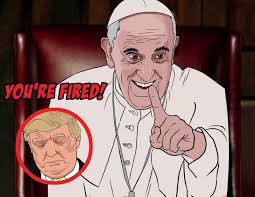
Is faith more about what we say or what we do? And who is more Christian, Donald Trump or Pope Francis?

Those questions were sharpened yesterday, when Pope Francis implied that Donald Trump is not a Christian. Responding to a reporter’s question, the pontiff lit up the internet when he said about Trump, “Anyone, whoever he is, who only wants to build walls and not bridges is not a Christian.” In other words, the pope was saying that actions speak louder than words.

The pope’s comment came at the end of his six-day trip to Mexico, where he celebrated Mass with 300,000 faithful in attendance near the Mexican-U.S. border. He used the occasion to decry the “human tragedy” of worldwide migrations of people fleeing violence, war and the effects of climate change. That analysis, of course, conflicts with Mr. Trump’s who sees immigrants as rapists, drug-dealers, and terrorists.

It’s not surprising then that the pope’s words drew a quick response from The Donald. He called the pope’s charges “disgraceful” and accused him of being a pawn of the Mexican government. His sentiments were mirrored mildly in the comments of Mr. Trump’s competitors for the Republican presidential nomination. They seemed to agree that faith and Christianity is a private matter, between the believer and God. About that no one – not even the pope – can or should judge. For instance, Jeb Bush said, “Christianity is between he and his creator. I don’t think we need to discuss that.”

Today’s liturgy of the word disagrees. It wants us to discuss the relationship between words and actions – even between God’s words and God’s actions. In fact, according to readings for this Second Sunday of Lent, actions constitute demonstrable proof of faith claims. Specifically, the first reading from Genesis presents the God of Israel as one who is willing to stop being God – to butcher himself – if God’s word does not match with God’s deeds.

Then today’s Gospel reading (the account of Jesus’ transfiguration) indicates the type of action of which Israel’s God approves in his People.  It is not action motivated by fear, but by courage – even in the face of failure, personal harm, or death itself. In other words, the Gospel call is to put aside our fearful little selves who rank personal safety and security above everything else.

First of all, consider that very strange first reading from the Book of Genesis. It’s about Abram, an ancient sheik – the Founding Father of the Jewish nation. He originally lived in ancient Babylon but felt called to move off to the west, to start over, find a new homeland, and start a new independent tribe. He somehow felt that God was calling him to do all these things. Problem was, Abram was already advanced in years and his wife, Sarah, was beyond menopause. Still, he felt that God was promising him a large family – a tribe whose people would be as numerous as the stars of the heavens.

In today’s readings, Abram evidently feels time is running out on God’s promise. The sheik is looking for reassurance. It comes in the form of a dream. The dream answers his question: how trustworthy is God? Can God be trusted to have God’s actions and words conform?

Abram’s question makes this tribal pastoralist dream of the most solemn human covenant he knew of – the “Covenant of Pieces.” According to tribal practice, when an inferior made an important agreement with a patron – say to transfer property, do work, fight a battle, or repay a debt – he had to go through an extremely graphic pledge ritual. The ceremony involved sacrificing animals from the client’s flock (in today’s reading a mature heifer, she goat and a ram along with a turtle dove and a pigeon). The inferior was to split the animals in two, and align the carcasses in rows so that they formed a path with one half the heifer’s carcass on the left and the other on the right, and the same with the she goat and ram. Then with the patron holding his hand, the client was to solemnly walk between the carcasses taking note of their dead rotting state, their putrid smell, and of the vultures flying overhead.

All of this was a reminder of the power the client was handing over to his patron. He was saying in effect, if I don’t keep my pledge, I’m giving you permission to do this to me and to my family. You can butcher us all and leave us to rot in the sun. That’s a pretty serious commitment. Sheik Abram could think of nothing more solemn, reassuring or binding.

So his dream which at first glance seems so strange and confusing to us was extremely comforting to him as a tribal pastoralist. It had God (in the form of fire and smoke) playing the role of client to Abram. God was performing the “pieces” ritual in Abram’s presence by running the gauntlet formed by rotting meat. That is if God did not keep his word, God was willing to be butchered! This, of course, could never happen. So the dream meant God could never not keep God’s word. A God willing to be butchered rather than break his word? Reassuring indeed!

That tells us something about the biblical attitude towards word and deed – faith and works. God’s word is God’s bond. The same should be true of those who profess to be God’s people.

But what type of action are believers bonded to? Today’s reading from Luke answers that question. They are called to courageous action against those who oppress the poor (immigrants, victims of war and “scorched earth”) including religious “leaders” cooperating with empire. And they must do so even at the risk of their own lives.

That’s the implication of today’s gospel reading. There the young carpenter from Nazareth is on his way to Jerusalem. He knows something extremely risky is about to happen there. Yet he’s determined to be part of it. The risky action has to do with the temple and the collaboration of its leaders with the Roman Empire.

The temple has become worse than irrelevant to the situation of Jesus’ people living under Roman oppression. What happens there not only ignores Jewish political reality. The temple leadership has become the most important Jewish ally of the oppressing power. And Jesus has decided to address that intolerable situation.

Everyone knows that a big demonstration against the Romans is planned in Jerusalem for the weekend of Passover. There’ll be chanting mobs. The slogans are already set. “Hosanna, hosanna, in the highest” will be one chant. Another will be “Hosanna to the Son of David!” “Hosanna” is the key word here. It means “save us!” The Romans won’t notice that the real meaning is “Save us from the Romans.” “Restore an independent Israel – like David’s kingdom!” It was all very political.

Jesus has heard that one of the main organizers of the demonstration is the guerrilla Zealot called Barabbas. Barabbas doesn’t call what’s planned a “demonstration.” He prefers the term “The Uprising” or “the Insurrection” (Mk. 15). Barabbas has a following as enthusiastic as that of Jesus. After all, Barabbas is a “sicarius” – a guerrilla whose solemn mission is to assassinate Roman soldiers. His courage has made him a hero to the crowds. (John Dominic Cross compares him to the Mel Gibson character in “The Patriot.”)

Jesus’ assigned part in the demonstration will be to attack the Temple and symbolically destroy it. He plans to enter the temple with his friends and disrupt business as usual. They’ll all shout at the money-changers whose business exploits the poor. They’ll turn over their tables. As a proponent of non-violence, they’re thinking not in Barabbas’ terms of “uprising,” but of forcing God’s hand to bring in the Lord’s “Kingdom” to replace Roman domination. Passover, the Jewish holiday of national independence could not be a more appropriate time for the planned event. Jesus is thinking in terms of “Exodus.”

And yet, this peasant from Galilee is troubled by it all. What if the plan doesn’t work and God’s Kingdom doesn’t dawn this Passover? What if the Romans succeed in doing what they’ve always done in response to uprisings and demonstrations? Pilate’s standing order to deal with lower class disturbances is simply to arrest everyone involved and crucify them all as terrorists. Why would it be different this time? Like Abram before him, Jesus has doubts.

So before setting out for Jerusalem, he takes his three closest friends and ascends a mountain for a long night of prayer. He’s seeking reassurance before the single most important act in his life. As usual, Peter, James and John soon fall fast asleep. True to form they are uncomprehending and dull.

However, while the lazy fall into unconsciousness, the ever-alert and thoughtful Jesus has a vision. Moses appears to him, and so does Elijah. (Together they represent the entire Jewish scriptural testament – the law and the prophets.) This means that on this mountain of prayer, Jesus considers his contemplated path in the light of his people’s entire tradition.

Last week, we saw in the reading from Deuteronomy 26, that tradition centered on the Exodus. Fittingly then, Jesus, Moses, and Elijah “discuss” what is about to take place in Jerusalem. Or as Luke puts it, “And behold, two men were conversing with him, Moses and Elijah, who appeared in glory and spoke of his exodus that he was going to accomplish in Jerusalem.” Jesus’ Exodus!

It is easy to imagine Moses’ part in the conversation. That would be to remind Jesus of the chances Moses took when he led the original Exodus from Egypt. That might have failed too. Elijah’s part was likely to recall for Jesus the “prophet script” that all prophets must follow. That script has God’s spokespersons speaking truth to power and suffering the inevitable consequences. Elijah reminds Jesus: So what if Barabbas and those following the path of violence are defeated again? So what if Jesus’ non-violent direct action in the temple fails to bring in the Kingdom? So what if Jesus is arrested and crucified? That’s just the cost of doing prophetic business. Despite appearances to the contrary, Abram’s faithful God will somehow triumph in the end.

Is there a message for us here as the pope and Donald Trump disagree over authentic Christian faith?

I think there is.

Today’s readings tell us that God’s People are not to be led by frightened little men who place security above compassion for the poor and oppressed. Faith is not primarily about words, thinking, written creeds, or feeling in one’s heart. Instead it’s about living God’s life – the One who before Abram was willing to self-immolate rather than “break faith.”

Being a follower of Jesus is not about “security above all.” Quite the opposite: it is about risk on behalf of God’s true people – the poor, immigrants, and victims of war, violence and scorched earth.

Yes, Mr. Trump, there are people who say they believe in God, but who cancel out that belief by their concern for self-preservation and fearful willingness to sacrifice others rather than themselves. Such people cannot claim to be followers of the prophetic Jesus of Nazareth.

Domesticating Laudato Si’: Our Milk Toast Diocesan Study Guide

Science-vs-BS

This week (Just in time for Lent) the Lexington Catholic diocese published a study guide for Laudato Si’, Pope Francis’ outspoken encyclical on the problems resulting from climate change. The guide called Discovering Laudato Si: A Small Group Study Guide.

Following two introductions – one to the social teachings of the church, the other to the booklet itself – Discovering Laudato Si’ consists of eight two-page chapters and a “Final Reflection.”  In each “chapter,” one page is devoted to excerpts from the pope’s encyclical. The second page lays out three or four questions related to the chapter’s selections.

That plan is indeed helpful for small group discussions in the parish settings for which it is intended. It means participants can avoid homework. They can actually read an assigned chapter during the relevant meeting itself.

That seems, perhaps, a positive contribution.

The booklet’s liabilities however overwhelm that modest asset. That’s because Discovering Laudato Si’ does exactly what Pope Francis refused to do in his authoritative letter to the entire church. The diocesan guide bends over backward attempting not to offend.

In his encyclical, the pope might well have said “The topic of climate change is controversial. Some see it as caused by humans and threatening to the very existence of the human race. Others say that climate variability is cyclical and natural, and can be remedied by human technology. Of course, such matters are too complex for non-experts and even for the Church to decide. So while the experts are resolving that “big picture,” let’s be practical. Let’s all take a deep breath, slow down, and avoid environmental crusades. Let’s determine the ‘small tasks’ that little people can do to mitigate the environmental damage our lifestyles may be causing. Let’s reduce, reuse, and recycle. You see, environmental crusading might offend those with opposite opinions. And remember, Christians must be nice. On these matters, the faithful should ‘bend to the pastor’s direction’.”

The pope avoided all of that. But it’s the actual argument the diocesan discussion guide makes!

True: it lets the pope’s encyclical speak for itself on the first page of each chapter. But the question page often subtly retracts what the pope’s overall document says. For instance, the questions at the end of Chapter One create a false equivalency between the 97% of scientists who recognize that climate change is caused by humans, and the 3% who deny human causality. “This debate will not be resolved anytime soon,” the study guide sagely observes!

The pope however did nothing of the kind. He was not concerned with possible offense to the 3%. Instead, he called for “a bold cultural revolution” (114). He denounced capitalism-as-we-know-it (190). He called for “radical change” (171). He identified climate deniers as “obstructionists” (14) He demanded “reparations” (wealth redistribution) for global south countries wounded by the climate crimes committed by their rich colonizers (30, 51, 52). He suggested a form of world governance (53, 173-‘75}

All of these are “big picture” items that the diocesan guide recommends we leave to the experts. In fact they are the very stuff of elections, political campaigns – and wars. For that reason, Francis’ document has evoked the wrath of Rush Limbaugh and the entire Republican establishment.

Limbaugh said, “Pope Francis attacked unfettered capitalism as ‘a new tyranny’ and beseeched global leaders to fight poverty and growing inequality . . . Francis went further than previous comments criticizing the global economic system, attacking the ‘idolatry of money’ . . . This is just pure Marxism coming out of the mouth of the pope.”

Why did the pope avoid the milk toast approach of the Lexington diocese?  It’s because he knows that we’re on a train that is speeding 200 mph down a track and headed for a precipice just a mile away.

In the face of such impending calamity telling people of faith to take our time, be “deliberate,” avoid “rash actions,” “ecological crusades,” and “headlong rush into the fray,” is misleading in a real and tragic sense of the word.

What if We Imagined God as a Woman?

mother-cradling-baby

Readings for 5th Sunday in Ordinary Time: Is. 6:1-2a, 3-8; Ps. 138: 1-5, 7-8; I Cor. 15: 1-11; Lk. 5: 1-11. 

Have you ever seen Eve Ensler’s Vagina Monologues?” A few years ago that series of dramatic readings was presented at Berea College where I taught for 40 years. The readings were as provocative as the play’s title. All of them reflect the unique experience of being woman that most of us Christian males find so difficult to understand, especially after so many years of brain-washing at the hands of predominantly male clergies.

I bring that up because today’s liturgy of the word is so obviously male-centered in a very misleading way. The readings of the day suggest that God is male and that Jesus’ and Paul’s closest collaborators were exclusively men. And that in turn explains why Christian pastors of so many denominations participate so enthusiastically in what has been called a 21st century “War on Women.” It explains why the Catholic Church is so afraid of women priests.

Significantly, Ensler refers to that particular male prejudice in the prologue to her Vagina Monologues text. There she quotes Gloria Steinem who recalls:

“In the sixties, while I was doing research in the Library of Congress, I found a little known treatise about the history of religious architecture which blithely stated a thesis, as it were known by everybody, to the effect that the traditional shape of most patriarchal buildings of worship imitates the female body. Thus, there is an external entrance and another internal one, the labia majora and the labia minora; there is a vaginal central nave, which leads to the altar; there are two curved ovarian structures on either side; and finally, in the sacred center is the altar or uterus, where the great miracle takes place: men give birth.

“Though this comparison was new for me, it opened my eyes with a shock. Of course, I thought. The central ceremony of the patriarchal religions is nothing else but the ceremony in which men take control of the “yoni” power of creation by giving birth symbolically. It is no wonder that male religious leaders state so often that we human beings are born in sin … because we are born from female tummies. Only by obeying the rules of the patriarchy can we be “reborn” through men. It is no wonder that priests and pastors decked out in long vestments sprinkle our heads with a fluid that mimics the waters of birth. It is no wonder that they give us new names and promise us we will be reborn in eternal life. It is no wonder that the male priesthood attempts to keep women far removed from the altar, just as we are kept far removed from control of our own powers of reproduction. Whether symbolic or real, everything is aimed at controlling the power that resides in the female body.”

Talk about provocative! Here Ms. Steinem is claiming that creative power is focused chiefly in the female body, though men obviously have an ancillary role in the begetting of life. Because their role is so obviously secondary, a primary patriarchal purpose in organized religion, Ms. Steinem says, is for men to alienate or steal the vastly superior womanly power of life and to control it – against women themselves.

Patriarchal religion accomplishes its task by dressing men up like women. It has them sprinkling their congregations with the waters of birth introducing them to “eternal life.” This form of life is held to be more important than physical life, and male pastors claim to control it to the exclusion of women. The prerequisite for women’s access to life eternal is that they adopt the rules of the exclusively male priesthood especially those connected with female powers of reproduction centered in the woman’s body whose architecture the male priestly domain of church actually mimics.

Ms. Steinem’s analysis suggests why someone even like our beloved Pope Francis seems skittish about women priests.

After all, female priests might inspire women to recognize their inherent superiority over men in terms of centrality to the life processes (both physical and spiritual) that the patriarchy struggles so mightily to control. If women were allowed the leadership that their biology suggests, what would become of the male-centered church – of the male-centered world?

Today’s liturgy of the word tries to keep us from asking such questions. It begins with a description of God in highly masculine terms centered in the macho realm of palace and court. God is depicted as “king.” He (sic!) is “Lord.” He inspires fear and awe. He dwells in a smoke-filled room surrounded by all the trappings of power and might. Like the prophet Isaiah, those who appear before him feel small and ashamed of the very words that come from their lips.

This, of course, is the image of God we’ve been offered from the cradle. (Can you imagine how different we’d feel personally, ecclesiastically, nationally and internationally if the familiar image of God were a mother nursing her child? Would you feel any different towards such a Mother God? – Remember, it’s all just symbolism. And the image of God that’s come to dominate arises from one of the most patriarchal traditions in the history of the world.)

The male-centeredness of today’s readings continues in the selection from Paul’s first letter to Christians living in Corinth. It’s a key passage because Paul is trying to establish his identity as an “apostle,” even though he never met Jesus personally. Paul bases his claim on the fact that Jesus appeared to him just as he did to the other apostles. So he says “Remember what I preached to you:” Christ died for our sins. He was buried and raised on the third day. He appeared to the 12, then to 500 “brothers” at once, then to all of the apostles, and finally to Paul himself.

There is so much interesting in this summary of Paul’s preaching. What, for instance, happened to Jesus’ words and deeds? Paul’s gospel begins with Jesus’ death! What about Jesus’ life which revealed the character of God as compassionate and “womb like?” (See Marcus BorgMeeting Jesus again for the First Time, chapter 3.)

However, even more to the point is Paul’s omission of the fact that according to ALL of the accounts of Jesus’ resurrection appearances in the canonical gospels, Jesus’ first appearances were to women, not to men!! (Remember Jesus’ appearance to Mary Magdalene in John 20:1-18?) Using Paul’s logic, doesn’t that establish the primacy of women in the church – and in the priesthood? The Paul of First Corinthians doesn’t want to go near that question. And neither do most church officials.

And then we have today’s gospel selection from Luke. It’s the call of the first apostles. According to Luke, Peter, James, and John are the first to follow Jesus. That leaves us with the usual impression that Jesus called only men.

Omitted from our vision is the fact that according to Luke himself (8:3) there were “many women” taking an active part in the Jesus Movement. Besides Jesus’ mother Mary, we know the names of some of them: Mary Magdalene, several other Marys, Suzanne, Salome, Martha and Mary of Bethany, Joanna. . And the roles of these women weren’t confined to preparing food and washing clothes.

In the first Christian communities, men and women met and worshiped together. Both men and women preached the message of Jesus with the same authority, and both men and women presided at the celebration in remembrance of their crucified Master. Like the men, the women had representation and decision-making power in the communities as priests and bishops.

That was even true of the communities of Paul. Paul himself taught that “In Christ there is no male or female” (Galatians 3,28). With this claim he legitimized the active participation of women in the first Christian communities. Also, he makes emphatic mention of many women in his letters and lavishly praises their work. For example, he mentions by name the deaconess Phoebe (Romans 16,1), Junia (Romans 16,7), Prisca, Julia, Evodia and Sintece, all of whom he called his “collaborators” (Philippians 4,2). He also mentions Claudia, Trifena, Trifosa, Prisca, Lyida, Tiatira and Nympha of Laodicea. Of the 28 persons to whom Paul accords special praise in his letters to the early churches, 10 are women!

All of that changed in the 4th century, when Christianity lost its soul and became the official religion of the Roman Empire. Then Christianity adopted for good the courtly vision today’s first reading affirmed: macho-kings, courts, palaces, smoke-filled rooms, men dressed like women, denigration of women’s bodies, men trying desperately to affirm their superiority against all the evidence – of biology, life’s processes, Jesus’ own example, and women’s traditional roles as nourishers, healers and spiritual counselors.

Let’s talk about how women might take back those roles both in church and in politics. How do we help transform people as closed as today’s church patriarchs – or as open as Pope Francis? How do we facilitate changes in our bishops and priests? How do we let go of our own acquiescence to the misogyny of our church and culture?
(Discussion follows)

Pope Francis’ Encyclical: My New Book and a Lenten Program

product_thumbnail

I must apologize for my absence from the blog site over the last couple of weeks. It’s that I’ve been putting the finishing touches on a new book I’ve written about Pope Francis’ eco-encyclical, Laudato Si’, which I consider the most important public document of the present century.

The 150 page book is called Understanding Laudato Si’: A Discussion Guide. (It is featured along with a “Buy Now” button on the right hand side of my blog homepage. The price is $8.15 per copy.) The book is aimed at people of faith who’d like to start or participate in discussion groups about climate change as the moral issue Pope Francis calls it.

(By the way, an “encyclical” is a general letter to the church as a whole. It represents the highest most solemn form of papal teaching.)

Laudato Si’ is unique in that it comes from the pen of history’s first Global South pope. So it is shaped by the experience of the former colonies (Latin America, Africa, and South Asia). It is heavily influenced by colonial and neo-colonial exploitation.

More particularly, Laudato Si’ was written by a priest who comes from country victimized by the U.S.-supported “Dirty War” that the Argentinian Army waged against the pope’s homeland from 1976-1983. That war took the lives of at least 30,000 Argentinians – at least one bishop, many priests, nuns, and lay catechists along with union organizers, teachers, social workers and those suspected of supporting the democratic resistance.

No other pope has had such “Third World” experience of aggression at the hands of the United States. No other pope has been influenced directly by liberation theology – which has centralized the concept of “preferential option for the poor” that marks Francis’ papacy.

Read in that light, Laudato Si’ presents the world with understandings of climate change, economics (especially capitalism), history, theology, and church that are uniquely “Global South” rather than the European understandings that shaped the visions of Francis’ predecessors. All the other commentaries I’ve seen have overlooked those differences.

I’ve shared drafts of the book with friends. One wrote: “Your book should be in the hands of every bishop and priest and parish, as well as to the pundits we daily read and hear in the mass media.”

The great African-American feminist scholar, bell hooks, commented: “You make difficult concepts and theories accessible. The work itself embodies the spirit of inclusion you write about so eloquently. Bravo!!!”

A priest-activist working in the Appalachian region wrote:  “Congratulations, this is a winner! . . . You wrote an amazing book.  I read it and I remembered.  I thought about it and I learned.  I critiqued it, and I grew. . . Let’s see how we can spread the analysis.”

I’m hoping that my book will be used this Lent as a discussion guide in parishes throughout the United States.  It is currently under review by my own diocese of Lexington, Kentucky.

In my own parish, St. Clare’s here in Berea, we’ve made the following proposal for dealing with Pope Francis’ call to action. Perhaps readers of this blog might implement something similar in their own parishes:

Lenten Program, St. Clare Church, Berea, Kentucky (Wed. Feb. 10- Sat. Mar. 26, 2016)

The St. Clare Peace and Social Justice Committee proposes a Lenten adult education program that will centralize the Papal Encyclical, Laudato Si’. Participants in the six week program will pursue the following goals:

  • Acquaintance and familiarity with the content and historical background of Laudato Si’.
  • In the light of that encyclical:
    • Sharpening awareness of the environmental crisis itself and of capitalism’s role in that predicament, as well as the parts played by U.S. policy, Global South theology, and the Catholic Church.
    • Rethinking the elements of each person’s Catholic faith including understandings of God, Jesus, church, and salvation.
    • Re-evaluating the relationship between a reconsidered Catholic faith and the environmental crisis.
    • Identifying practical ways of coping with the environmental crisis in the personal, familial, parochial, national and global dimensions of life.

To achieve these goals, each participant will:

  1. Adopt as a Lent 2016 practice, participation in six 90 minute group sessions discussing issues raised by  Laudato Si’.
  2. Sign up in advance for program participation. (Non-obligatory “interest cards” will be found in each pew on Ash Wednesday and on the First Sunday of Lent.)
  3. Before each meeting, read and reflect on the discussion guide adopted by the group (either the one to be provided by the diocese or Rivage-Seul’s Understanding Laudato Si’: A Discussion Guide).
  4. Actively participate in the discussions.

Program Organization

Feb 14:  View the first half of “Time to Choose” followed by a disciplined discussion. (“Time to Choose is a new 90 minute film by Oscar winner, Charles Ferguson. The film makes the case that we can combat climate change; that we have the tools and the knowledge to begin doing so right now.) (Assignment: Read Discussion Guide, pages 1-30)

Feb 21: View second half of “Time to Choose.” Discuss in the light of the Discussion Guide’s summary of Laudato Si’.  (Assignment: Read Discussion Guide, pages 31-50)

Feb 28: View lecture by economist, Richard Wolff on capitalism and the environment. Discuss the pope’s approach to economy facilitated by Chapter Two of the Discussion Guide.   (Assignment: Read Discussion Guide, pages 51-82).

Mar 6: View the first half of “This Changes Everything” (a new 90 minute film by Naomi Klein based on her book by the same name). Discuss in the light of Pope Francis’ “preferential option for the poor” as explained in Discussion Guide (Assignment: Read Discussion Guide, pages 83-100)

Mar 13: View second half of “This Changes Everything” in the light of liberation theology as explained in Discussion Guide. (Assignment: Read Discussion Guide, pages 101-140).

Mar 20: Discuss the Church as Caravan and practical responses to Laudato Si’.

Christmas Is Blasphemy: Take Jesus Out of Christmas!

Starbucks

Recently two very different religious leaders – one considered left of center, and the other a fundamentalist – converged in agreement about the meaninglessness of Christmas. And they both hit the nail on the head. Christmas is bunk. It’s blasphemous to associate Jesus with the holiday.

From the left, Pope Francis called the Christian world’s upcoming Christmas celebration a “charade.” He said there’d be parties, gift exchanges, and family gatherings in the name of celebrating Jesus’ birth, but it would all be absurd pretense.

That’s what charade means: an absurd pretense intended to create a pleasant or respectable appearance.

And the pope is right. Starting around Thanksgiving, so-called Christians pretend to honor “the Prince of Peace” – the one who took no one’s life, but sacrificed his own rather than take up arms – the one who was himself a political refugee, conceived out-of-wedlock, brown-skinned, poor, and living under imperial occupation – the one who would be a victim of torture and capital punishment – who was all the things that good Christian supporters of Donald Trump and of the U.S. War on Terror hate and despise.

That’s right. our culture hates Jesus and all he really stands for.

And that’s where the fundamentalist preacher comes in.  He agrees with the pope – well kind of . . .

About the same time Pope Francis was talking charade, Rev. Joshua Feuerstein, denounced Starbucks for hating Jesus. The good reverend was outraged by the coffee giant’s holiday cups which display no specific reference to Jesus. That’s a sign, Feuerstein said, that Starbucks agrees with the movement to remove Christ from Christmas. Starbucks hates Jesus. So let’s boycott Starbucks!

On the one hand, could anything be more absurd? The world is burning. Our way of life is destroying God’s creation. Our country is waging war against the poor everywhere – in Afghanistan, Iraq, Libya, Yemen, Somalia . . . . We supply weapons to all sides in the endless war our “leaders” have declared. And our man is worried about Starbucks’ plain red drinking cup! He denounces Starbucks for simply recognizing what is: Jesus has long since been removed from Christmas.

On the other hand, there’s wisdom in Rev. Feuerstein’s accusations. And it’s not just Starbucks that “hates Jesus;” it’s our entire culture – including our churches. In that sense, Feuerstein agrees with Francis. However hating Jesus has nothing to do with coffee cups. As I said, it means despising those Jesus identified with in the Gospel of Matthew (25:31-46) – the poor immigrant refugee from our endless bombing campaigns, the hungry street person, the homeless refugee, the imprisoned desperado, the coatless person we pass on our way into Starbucks.

That’s the one our culture hates – mostly led by “Christians.”

So what to do to avoid making this Christmas an empty charade? How avoid the blasphemy of pretending that Christmas has anything at all to do with Jesus?

I hardly know how to answer that question. I suppose we can start by recognizing that Christmas is a winter festival and nothing more.

But that’s not nothing. Winter festivals are great. They’re fun.  Every culture has them. They are times for ice sculptures, bright lights, reunions with family, for feasting, drinking, parties and exchanges of gifts. All of that distracts us from the oncoming season’s dark and cold.

That’s the way it was in ancient Rome too. Rome had its Saturnalia. In fact, December 25th was the birthday of the Sun God, Mithra, who was a favorite with Roman legionnaires. In that sense, Mithra’s birthday was a military holiday – a celebration of empire and its wars – the antithesis of everything Jesus stood for.

So let’s end the charade. Have fun.  Eat, drink, and be merry. That’s what winter festivals are about. And forget the blasphemy of associating Jesus with any of it.

Raise your red cup and toast a happy feast of Mithra!

Pope Francis on Misplaced Safety Concerns: Where’s the Caution on Climate Change?

pope-refugees-2

The chances of a U.S. citizen being killed by a terrorist are slimmer than being struck by lightning. That remains true even after the Paris massacre of last November 13th.  In fact, according to The Economist, the chances of dying at the hands of terrorists are actually one in twenty million. So you’re far more likely to die from a car accident, airplane crash, post-surgery complications, or from gun violence than from terrorism.

Meanwhile, the likelihood of millions dying from the effects of climate change is about 97 in 100. That figure refers to the percentage of climate scientists who tell us that human inaction on the climate front will result in disastrous, planet-wide catastrophe.  (By the way, 97% is about the same percentage as medical researchers who say that smoking causes cancer.)

And yet, in the wake of the recent Paris massacre, politicians call for absolute caution about the acceptance of refugees while siding with the 3% of scientists denying human responsibility for climate change.

On the refugee question, Governor Robert Bentley of Alabama put it this way, “If there’s even the slightest risk that they’re not the kind of people that we wish them to be,” we must exclude Iraqi and Syrian refugees from our state.

And Bentley is not alone. At least 31 governors (almost all of them Republican) have expressed similar determination to prevent refugees from entering their states. Governor Greg Abbot of Texas said, “I will not roll the dice and take the risk on allowing a few refugees in simply to expose Texans to that danger” of some refugee committing a terrorist act. “Better safe than sorry,” adds Republican Speaker of the House, Paul Ryan, who describes himself as “a devout Catholic.”

The Catholic reference is important, because the position of Pope Francis is exactly the reverse of the Republicans’ who overwhelmingly identify themselves as fervent Christians. The pope has called for opening doors to refugees from Syria and Iraq.  He has reminded believers that Jesus himself was a refugee from state violence and that his mother experienced the same terror suffered by Iraqis, Syrians, Somalians and others.

Meanwhile, in his landmark encyclical on climate change, Pope Francis urged extreme caution about climate change. There he quotes the 1992 Rio Declaration on the climate crisis:

“. . . (W)here there are threats of serious or irreversible damage, lack of full scientific certainty shall not be used as a pretext for postponing cost-effective measures” (186).

So who’s right, Paul Ryan and his Republican colleagues or Pope Francis?

That is, given the 1 in 20 million chance of being killed by a terrorist on the one hand, and the near certainty of millions dying from human-induced climate change on the other, is the pertinent popular phrase Ryan’s “Better safe than sorry?  Or is it “Penny wise and pound foolish?”

Perhaps it is both.

Think about that for a minute.