Bishop Stowe Is Sending Us a Message by Attending Oscar Romero Celebration

Stowe

(This is the first in a three-part series on our parish’s upcoming celebration of the beatification of San Oscar Romero which will take place on May 23rd. The event will be observed in St. Clare’s parish on June 3rd, when our new bishop, John Stowe, will join us.)

As one of the first acts of his new Episcopate, Bishop John Stowe will be visiting my parish, St. Clare’s in Berea, Kentucky, to celebrate the beatification of Oscar Romero, the Archbishop of San Salvador, who was gunned down at the altar on March 24, 1980.

In accepting the invitation to join the celebration, then bishop-elect Stowe wrote:

“Oscar Romero is a great inspiration in my life and I am thrilled to know of a community that wishes to celebrate his witness.”  

Bishop Stowe’s words and his decision to attend the celebration are freighted with meaning for Catholics of the Lexington Diocese. They speak volumes about Bishop Stowe’s overriding commitment to social justice. The bishop’s words call our attention not only to the person of Oscar Romero, but to the theology that informed his life, and to our vocation as followers of Jesus the Christ.

In today’s posting, think about Oscar Romero himself. (Subsequent blogs – next Wednesday and the following Monday – will focus on liberation theology as it relates to Romero, and then on practical responses to the archbishop’s beatification).

Oscar Romero was born in 1917. Like our present pope, Francis, he was a Jesuit. Monsignor Romero entered the seminary at the age of 13 and was ordained at 26. He studied in Rome, and received his doctorate in theology there from the Gregorian University. In 1977, he was appointed archbishop of San Salvador.

The monsignor was a bookish man – very traditional, both politically and religiously speaking. He was a conservative in every sense of the word.

However, a turning point came for Oscar Romero less than a month after his consecration as San Salvador’s 4th archbishop. A close friend of his – another Jesuit priest, Rutilio Grande – was assassinated by one of El Salvador’s right-wing death squads. Rutilio Grande was an advocate of the poor, an opponent of government oppression of the peasants and workers, and an advocate of radical theology. He saw Jesus as a prophet – the Son of God bringing good news to the poor.

Romero’s own words reveal the impact of Grande’s death. He said, “When I looked at Rutilio lying there dead, I thought, ‘if they have killed him for doing what he did, then I too have to walk the same path.'” The “they” Archbishop Romero referred to was his own government, its military, and their backers in the United States.

In other words, the penny had dropped for the archbishop. He realized that his country and all of Central America was at war. It was what Noam Chomsky called “the first religious war of the 21st century.” It pitted the United States of America and its right wing allies in Central America against the Catholic Church.

But as Romero said in a speech at the Universite Catholicque in Louvain, Belgium, just before his martyrdom, the U.S. war wasn’t against the entire Catholic Church.  Or as the archbishop himself put it,

“. . . (I)t is important to note why [the Church] has been persecuted. Not any and every priest has been persecuted, not any and every institution has been attacked. That part of the church has been attacked and persecuted that put itself on the side of the people and went to the people’s defense. Here again we find the same key to understanding the persecution of the church: the poor.”

In other words, the archbishop had put his finger on the problem: the Catholic Church was divided between the traditionalists who supported the rich, unfettered capitalism, and U.S. Empire on the one hand, and those who took the part of the poor on the other. Grande’s death convinced the archbishop that he had been on the wrong side. So he switched over and took the part of the poor. In doing so, he in effect signed his own death warrant.

Nevertheless, he began speaking out fearlessly each Sunday against his country’s government, its military, and their supporters in the United States. He railed against El Salvador’s endemic poverty, social injustice, assassinations and torture. He specifically criticized the United States for the military aid it gave to El Salvador’s repressive military government.

President Carter ignored the archbishop’s pleas to stop arming El Salvador’s military and death squads. And when he entered office, President Reagan doubled down on his predecessor’s policy.

Still, Archbishop Romero continued to follow faithfully Rutilio Grande’s path. His weekly radio programs became a sensation throughout El Salvador. He named names and listed the disappeared, tortured, murdered and much more. The archbishop’s broadcasts became the main source of trustworthy news for his oppressed people.

As a result, death threats from the White Hand death squad came to him every day. But such intimidation didn’t work on Oscar Romero.

Finally, though, on March 24, 1980, the chickens came home to roost. In a crime intellectually authored by Roberto D’aubuisson, a darling of U.S. Central American policy, the archbishop was assassinated while celebrating the Eucharist in a convent in San Salvador.

The country was plunged into mourning. 250,000 people attended Archbishop Romero’s funeral. However, only one of the country’s bishops attended his funeral. The others considered him too radical and politicized. They stayed home.

The Salvadoran army however did not. Death squad sharpshooters terrorized the funeral, dropping smoke bombs and killing anywhere from 30 to 50 people while wounding many others. It was a world-class scandal.

But it was by no means the end of the war against the Catholic Church. The White Hand death squad continued to follow its slogan, “Be a patriot; kill a priest.”

Less than a month after Archbishop Romero’s martyrdom, four U.S. women religious (all from Cleveland, Ohio) were brutally raped and murdered: Ita Ford, Maura Clarke, Dorothy Kazel, and Jean Donovan. Then in 1989, a team of six Jesuit liberation theologians at the Central American University along with their housekeep and her 15 year old daughter were slaughtered by Salvadoran soldiers trained at the School of the Americas in Fort Benning, Georgia.

By the war’s end, scores of priests were killed along with lay ministers of the word, teachers, social workers, and union organizers. In 1980 alone, more than 11,000 such activists fell victim to the death squads. By the war’s end, more than 70,000 Salvadorans had been killed by their own government. Imagine the impact of such numbers in a small country of just over 6 million people.


The Long Reach of Pope Francis: how he (and Oscar Romero) touched our diocese & our parish

Pope francis oscar romero


I once was once skeptical about Pope Francis.

When he was elected, my first thought was “Can anything good come out of an Electoral College of Cardinals packed so tightly with clones of the reactionaries, John Paul II and Benedict XVI? Bergoglio must be one of those carbon copies.”

But I was wrong.

Jorge Mario Bergoglio turned into Pope Francis. Far from a triplet brother of his immediate predecessors, the new pope has proven to be truly Latin American. That’s so even to the point of embodying the ideals of liberation theology, or reflection on the gospel from the viewpoint of the poor and oppressed. He has espoused the latter’s “preferential option for the poor,” its trenchant critique of corporate globalization, and its openness to marginalized people of all kinds. What a surprise!

My second thought was, “But he’s already old. His papacy will be short. He won’t be able to accomplish much of enduring impact.

Imagine then my further astonishment, when a mere three years into his papacy, Pope Francis’ touched  in remarkable ways our  tiny and remote diocese of Lexington, Kentucky. Even stranger to say, his reach extended to our little Kentucky parish of St. Clare’s in Berea. It made me wonder if this is happening all over Francis’ world. I hope so.

First of all, consider what’s happened in Lexington.

Our previous bishop was a canon lawyer – an appointee of John Paul II. Bishop Ronald Gainer distinguished himself by urging pro-choice politicians to refrain from receiving Holy Communion. He has since shown other overriding concerns by forbidding Catholic School girls in his new diocese from engaging in sports (such as wrestling, rugby, and football) “…that involve substantial and potentially immodest physical contact.” You get the idea.

After waiting for more than a year, Bishop Gainer’s replacement was at last named. It was John Stowe, a Conventual Franciscan. Father Stowe showed his colors in his introductory press conference. There was not a word about abortion, contraception, or gay marriage, much less about girls’ wrestling.

Instead he introduced himself as “a Franciscan educated by the Jesuits and appointed by a Jesuit Pope who has taken the name Francis.” “I love Pope Francis,” Father Stowe said, “and I will do whatever he asks.”

Turns out, the new appointee is not only a disciple of the pope; he is also a sharp critic of reactionary politics – especially as they affect immigrants. (Fr. Stowe, BTW, speaks fluent Spanish.)

For instance, in 2006, when Fr. Stowe addressed the Mayor’s Congress on Immigration Reform in El Paso, Texas, he criticized the U.S. Congress saying, “We shudder to imagine what the inscription on the Statue of Liberty might read if it had been erected by the current U.S. Congress.” Promising words indeed.

And that brings me to our parish, the long reach of Pope Francis and its connection with our new bishop.

You see, during this past Lent, for the second year in a row, a small group of us met each week to study the pope’s “The Joy of the Gospel” – the Apostolic Exhortation published in November 2013. In one of our concluding sessions, we were searching for something practical to connect the pope’s words with our community of St. Clare’s.

The calendar told us that the beatification of El Salvador’s Oscar Romero was coming up on the 23rd of May. (Beatification is a major step towards canonization or sainthood in the Catholic Church.)

Romero, you recall, was the martyred archbishop of San Salvador. In 1980, he was gunned down at the altar by an assassin connected with El Salvador’s Arena party which was supported by the Reagan administration. Because Romero is considered the patron saint of liberation theology (which the pope saw as too influenced by Marxism), John Paul refused to even call the archbishop a martyr. Instead, he referred to him merely as “a zealous pastor.”

Pope Francis has changed all of that. Romero, he says, was not only a martyr, but has advanced him on the way to official recognition as a saint of the entire Roman Catholic Church.

Well, our little discussion group thought: Why not have our parish celebrate Romero’s beatification?

“Great idea” we all agreed; “We could hire a Mariachi band, invite the Hispanic community and folks from Berea College’s Union Church” (a Church of Christ with whom people from St. Clare’s traveled to El Salvador on more than one occasion). “And then we could follow it all with a big fiesta.”

Someone else added, “And why not invite the new bishop?”

“Wouldn’t hurt to ask,” was the consensus — although we thought his acceptance would be unlikely, since by the end of May, he’d barely have been installed as bishop.

Well, guess what? He agreed to come. That sends a strong signal about his priorities.

So did his letter written immediately after receiving our invitation:

Thank you for your kind words of welcome and the excellent suggestion of celebrating the beatification of Archbishop Romero. I am so happy to know that St Clare’s and Union Church are in a relationship with the Church in El Salvador. That is exactly what Pope Francis is encouraging us to do!

I just returned last night from visiting our Central American Friars; we celebrated the 35th anniversary of Romero’s martyrdom although we were in Costa Rica. This past February 1st, I was able to celebrate mass in the hospital where Romero was killed—all this to say, Oscar Romero is a great inspiration in my life and I am thrilled to know of a community that wishes to celebrate his witness.

I will look for possible dates to celebrate the beatification with your community.

Your message is most welcomed!!

Bishop-elect Stowe’s acceptance of our invitation means that everyone in our parish and from parishes nearby will surely attend an event that might otherwise have been overlooked. Everyone will want to meet the new bishop.

He is sure to have some inspiring words to say about Romero, and hopefully about liberation theology, and U.S. policy in Central America during the 1980s. This will indeed be a teachable moment.

Do you see what I mean about Francis’ long reach? This is already far better than I anticipated three years ago.

(Sunday Homily) The Peace of the Risen Lord is Not Merely Interior; It Is about Absence of War! Refuse to Pay Military Taxes!

War Tax Resistance

Readings for Third Sunday of Easter: Acts 3: 15, 17-18; PS 4: 2, 4, 7-9; I JN 2: 1-5A; LK 34: 24-32; LK 24: 35-48

On April 4th, 1967, Martin Luther King infamously called the United States “the greatest purveyor of violence in the world.” That was in his “Beyond Vietnam: a Time to Break Silence.” Delivered at New York’s Riverside Church, it was perhaps his greatest, most courageous speech.  King’s words are worth reading again.

Time Magazine denounced him for it.

Despite the fact that U.S. soldiers had killed more than two million Vietnamese, (and would kill another million before the war’s end), King was excoriated as a traitor. Even the African-American community quickly distanced itself from their champion because of his strong words.

To this day, King’s speech is largely ignored as the daring truth-teller has been successfully transformed into a harmless dreamer – an achievement beyond the wildest dreams of the prophet’s arch-enemy, the FBI’s J. Edgar Hoover who considered King a communist.

One wonders what Rev. King would say about the U.S. today. For despite what the mainstream media tells us about ISIS, the U.S. remains exactly what Dr. King called it. It’s still the greatest purveyor of violence in the world – even more so. By comparison, ISIS is small potatoes.

Face it: absent the United States, the world would surely be a much better place. Even our sitting President has identified the rise of ISIS (our contemporary bete noire) as the direct result of the unlawful and mendacious invasion of Iraq in 2003. That act of supreme aggression (in the U.N.’s terms) is alone responsible for the deaths of well more than one million people.

And this is not even to mention the fact that our country is fighting poor people throughout the world – in Iraq, Afghanistan, Pakistan, Yemen, Bahrain, Somalia, Libya, Syria, and who knows where else?  “Americans” claim the right to assassinate without trial anyone anywhere – even U.S. citizens – simply on suspicion of falling into the amorphous category of “terrorist.”

Can you imagine the terror any of us would experience if enemy drones constantly hovered overhead poised to strike family members or friends because some “pilot” six thousand miles away might judge one of our weddings to be a terrorist gathering? Can you imagine picking up the severed heads and scorched bodies of little children and their mothers for purposes of identification following such terrorist attacks? This is the reality of our day. Again by comparison ISIS beheadings are completely overshadowed.

I bring all of this up because of the Risen Lord’s insistence on peace in today’s gospel reading.  As in last week‘s episode about Doubting Thomas, the Risen Christ’s first words to his disciples breathless from their meeting with him on the Road to Emmaus are “Peace be with you.”

Last week in their own homilies about that greeting, I’m sure that pastors everywhere throughout our Great Country were quick to point out that the peace of Christ is not merely absence of war; it is about the interior peace that passes understanding.

Their observation was, of course, correct. However, reality in the belly of the beast – the world’s greatest purveyor of violence – suggests that such comfort is out-of-place. We need to be reminded that inner tranquility is impossible for citizens of a terrorist nation. Rather than giving us comfort, pastors should be telling us that the peace of the risen Christ is not merely about peace of mind and spirit; IT IS ABOUT ABSENCE OF WAR.

So instead of comforting us, Jesus’ words of greeting should cut us to the heart. They should remind us of our obligation in faith to own our identity as the Peace Church Jesus’ words suggest. More specifically, as Christian tax payers (having performed the annual IRS ritual last week) we should be organizing a nation-wide tax resistance effort that refuses to pay the 40% of IRS levies that go to the military. While it is absolutely heroic for individuals to refuse, there is safety and strength in numbers.

So an ecumenical movement to transform Christian churches into a unified peace movement of tax resistance should start today. All of us need to write letters to Pope Francis begging him on this eve of his visit to the United State (with anticipated speeches to the U.N. and our Congress) to call his constituency to tax resistance – to call the UN and the U.S. Congress to stop the aggression.

Once again: there can be no interior peace for terrorists. And Dr. King was right: Americans remain the world’s greatest terrorists. We are traitors to the Risen Christ!

Focusing on a utopian interior peace while butchering children across the globe is simply obscene.

(Easter Homily) Pope Francis: Of Course Jesus Arose; Resurrection Is A Law of the Universe!

Francis Easter

Readings for Easter Sunday: ACTS 10: 34A, 37-43; PS 118 1-2, 16-17, 22-23, COL 3L 1-4; JN 20: 1-9. http://usccb.org/bible/readings/042014.cfm

On this Easter Sunday, it’s appropriate to address the reality of Jesus’ resurrection. Did he really rise from the dead? Or is that doctrine simply a remnant of childhood like belief in the Easter Bunny or Santa Claus? And for those of us concerned with social justice, what can the Bible’s resurrection stories possibly mean?

This reflection tries to address those questions.

In response to the one about the factuality of Jesus’ resurrection, let’s look at what the Christian tradition itself tells us. It indicates that the resurrection accounts are not based on the physical resuscitation of a corpse. The experiences portrayed in tradition were more visionary and likely metaphorical.

As for the sociopolitical meaning of Jesus’ rising from the dead, Pope Francis addresses that question quite meaningfully in his Apostolic Exhortation, Evangelii Gaudium.  Life is stronger than death, he reminds us. Despite appearances, vital forces will always triumph in the end. But we’ll get to that presently.

First however consider the nature of the resurrection traditions themselves. They were inspired by women and emerged from the bleakest depths of despair not unlike what many progressives might be feeling today as our fondest hopes appear further than ever from fulfillment – as a rogue U.S. empire wreaks havoc and its savage economy destroys the planet.

Think about it.

Following Jesus’ death, his disciples returned to business as usual – fishing most prominently. It was their darkest hour. Yeshua, the one on whom they had pinned their hopes for the liberation of Israel from Roman domination was dead. Their world had ended.

But then unexpectedly, women among them reported an experience which effectively raised Jesus back to life (MT 28:1-10; MK 16: 1-8; LK 24:1-11). He was more intensely present, they said, than before his execution. Their tales changed everything.

But what was the exact nature of the resurrection? Did it involve a resuscitated corpse? Or was it something more spiritual, visionary and prophetic?

In Paul (the only 1st person report we have – written around 50 C.E.) the experience of resurrection is clearly visionary. Paul sees a light and hears a voice, but for him there is no embodiment of the risen Jesus. When Paul reports his experience (I COR 15: 3-8) he equates his vision with the resurrection manifestations to others claiming to have encountered the risen Christ. Paul writes “Last of all, as to one untimely born, he appeared also to me.” In fact, even though Paul never met the historical Jesus, he claims that he too is an “apostle” specifically because he shared the same resurrection experience as the companions of Jesus who were known by that name. This implies that at best the other resurrection appearances might also be accurately described as visionary rather than as physical.

The earliest Gospel account of a “resurrection” is found in Mark, Ch. 16. There a “young man” (not an angel) announces Jesus’ resurrection to a group of women (!) who had come to Jesus’ tomb to anoint his body (16: 5-8). But there is no encounter with the risen Jesus. In fact, Mark’s account actually ends without any narrations of resurrection appearances at all. (According to virtually all scholarly analysis, the “appearances” found in chapter 16 were added by a later editor.)

In Mark’s original ending, the women are told by the young man to go back to Jerusalem and tell Peter and the others. But they fail to do so, because of their great fear (16: 8). This means that in Mark not only are there no resurrection appearances, but the resurrection itself goes un-proclaimed. This in turn indicates either that Mark didn’t know about such appearances or did not think them important enough to include!

Resurrection appearances make their own appearance in Matthew (writing about 80) and in Luke (about 85) with increasing detail. But always there is some initial difficulty in recognizing Jesus. For instance Matthew 28: 11-20 says, “Now the eleven disciples went to Galilee, to the mountain to which Jesus had directed them. And when they saw him they worshipped him; but some doubted.” So the disciples saw Jesus, but not everyone present was sure they did. In Luke 24: 13-53, two disciples walk seven miles with the risen Jesus without recognizing him until the three break bread together.

Even in John’s gospel (published about 90) Mary Magdalene (the woman with the most intimate relationship to Jesus) thinks she’s talking to a gardener when the risen Jesus appears to her (20: 11-18). In the same gospel, the apostle Thomas does not recognize the risen Jesus until he touches the wounds on Jesus’ body (JN 26-29). When Jesus appears to disciples at the Sea of Tiberius, they at first think he is a fishing kibitzer giving them instructions about where to find the most fish (JN 21: 4-8).

All of this raises questions about the nature of the “resurrection.” Once again, it doesn’t seem to have been resuscitation of a corpse. What then was it? Was it the community coming to realize the truth of Jesus’ words, “Whatever you do to the least of my brethren, you do to me” (MT 25:45) or “Wherever two or three are gathered together in my name, I am there in their midst” (MT 18:20)? Do the resurrection stories reveal a Lord’s Supper phenomenon where Jesus’ early followers experienced his intense presence “in the breaking of the bread” (LK 24:30-32)?

Regardless of whether one believes in resurrection as resuscitation of Jesus’ dead body or as a metaphor about the spiritual presence of God in communities resisting empire and serving the poor, the question must be answered, “What does resurrection mean?”

It’s here that Pope Francis helps us. In The Joy of the Gospel (JG), he relates the resurrection accounts, (whatever their factual basis) to our own despair – just as real and hopeless as that of Jesus’ bereft disciples. Francis writes to encourage us who might be worn down and hopeless in the face of a world:

  • Pervaded by consumerism and pleasure-seeking without conscience (JG 2)
  • Governed by merciless competition and social Darwinism (53)
  • Economically organized by failed “trickle-down” ideologies that idolize money (54, 55)
  • Controlled by murderers (53) and thieves (57, 189)
  • Torn apart by wars and violence (99)
  • Rooted in growing income inequality which is the root of all social ills (202), including destruction of the environment and its defenseless non-human animate life (215)

In the face of all that, here’s what Francis says:

“Christ’s resurrection is not an event of the past; it contains a vital power which has permeated this world. Where all seems to be dead, signs of the resurrection suddenly spring up. It is an irresistible force. Often it seems that God does not exist: all around us we see persistent injustice, evil, indifference and cruelty. But it is also true that in the midst of darkness something new always springs to life and sooner or later produces fruit. On razed land life breaks through, stubbornly yet invincibly. However dark things are, goodness always re-emerges and spreads. Each day in our world beauty is born anew, it rises transformed through the storms of history. Values always tend to reappear under new guises, and human beings have arisen time after time from situations that seemed doomed . . Christ’s resurrection everywhere calls forth seeds of that new world; even if they are cut back, they grow again, for the resurrection is already secretly woven into the fabric of this history . . . May we never remain on the sidelines of this march of living hope! (276, 277)

Here the pope says that the power and meaning of Jesus’ resurrection is not found in the past. Neither is there reference here to the resuscitation of the Lord’s body. Instead, the pope explains the resurrection in terms of a story that calls attention to the persistent power of Life itself:

* Of nature and spring after a long cold winter

* Of goodness in a world that seems governed by evil

* Of light where darkness reigns unabated

* Of justice where injustice is simply taken for granted

* Of beauty where ugliness is worshipped as its opposite

* Of hope over despair

* And of activists who refuse to stand on the sidelines

No need for despondency, the pope says. Despite appearances, Life and its irresistible forces are on our side! They will not – they cannot – be controlled even by imperial agents of death as powerful as the Rome that assassinated Jesus or the United States whose economic and military policies are butchering the planet.

Even post moderns, skeptics and agnostics can embrace a story with a message like that.

After all, it’s spring! Life goes on! Jesus has indeed risen!

Palm Sunday Homily: Parish Renewal Inspired by Pope Francis

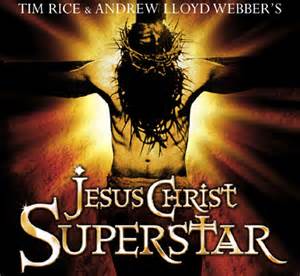
J.C. Superstar

Holy Week begins today with Palm Sunday.  Fittingly, last evening my wife and I listened again (as we do every year) to Webber and Rice’s “Jesus Christ Superstar.”  (You can listen to the 1970 version here; last year we attended the actual play.) The familiar score and story always have me tearing from the overture on.

Of course, “Jesus Christ Superstar” is a brilliant musical that captures the final events in Jesus’ life.  As in today’s liturgical readings, the play takes us from Jesus’ triumphant entry into Jerusalem, to his cleansing of the city’s Temple, his betrayal by Judas, his trials before the Sanhedrin, Pilate and Herod. It finishes with his death on the cross and a reprise of Judas’ questions about Jesus’ place in history and among the world’s other spiritual geniuses.

Through it all we agonize with Judas about accepting blood money and with Mary Magdalene about her unrequited love. We shake our heads at Jesus’ uncomprehending, self-interested and cowardly disciples. We’re amazed at the fickleness of the crowd and by Jesus’ compassion, indecision, fear of death, and forgiveness of his executioners.

The rock musical score is haunting. The lyrics are hip and inspiring. I find it amazing that the story though repeated so often retains the power to move its audiences. I feel grateful to Lloyd Webber and Tim Rice for their audacity in making the tale so accessible and meaningful to contemporaries.

Similar feelings have been evoked last year by Pope Francis’ Apostolic Exhortation, “The Joy of the Gospel.” That too was on my mind as I listened to “Jesus Christ Superstar” this year. That’s because during this year’s Lent, members of my parish community have been studying (for the second year in a row) the pope’s publication.

Through it, I think Pope Francis is calling us to do something like what Webber and Rice have done – make Jesus and the church once again relevant to a world that has long since dismissed them as quaint and detached from daily life.

As we’ve studied “The Joy of the Gospel,” all of us have marveled at Francis’ own courage, boldness and audacity. Almost from the beginning, our group has asked each other, “But what should we do in this parish in response to the pope’s general directions?” That same question surfaced last Lent, when I put forth a proposal published here.

Then it was well-received, but there was virtually no follow-through. Virtually nothing has changed in our church as a result of the pope’s exhortation. For us it’s still a question of “business as usual.” And our numbers of aging parishioners are dwindling as a result.

This year, things are different. Pope Francis’ planned visit to the United States next September has inspired our parish Peace and Social Justice Committee to reformulate the proposal in a way that honors his visit. And this time the formulation has legs. We’re actually might implement it.

Here’s a shortened summary of our revised plan (all parenthetical references are to sections in Francis’ exhortation) :

 “The Joy of the Gospel:” St. Clare Moving Forward

A Proposal for Parish Renewal Guided by the Pope’s Apostolic Exhortation

Rationale: The visit of Pope Francis to the United States provides St. Clare Parish with a unique opportunity to highlight and appropriate the pope’s directions for church renewal offered in his Apostolic Exhortation, The Joy of the Gospel (JG). Those directions called on the church to embark on a new chapter in its history and a new path, where things cannot be left as they presently are (25). Pope Francis urged Catholics to adopt new ways of relating to God, new narratives and new paradigms (74), along with new customs, ways of doing things, times, schedules, and language (27). Parishes were instructed to act boldly, and without inhibition or fear (33), in implementing processes of reform (30) adapted to particular churches (82).

With the above empowering directives and guidelines in mind, the Parish Peace and Social Justice Committee suggests adoption of the following plan towards beginning implementation of the renewal processes suggested by JG:

  • In preparation for the pope’s visit to the United States (September 22-27, 2015), the parish will be invited to read his forthcoming encyclical which is expected to be published this June. (Reading the encyclical is intended as a vehicle for revisiting and applying the pope’s vision found in “The Joy of the Gospel.”)
  • Copies of the encyclical will be purchased for each member of the parish over the age of 16 who wishes to receive a copy.
  • CCD teachers will be encouraged to develop study guides for younger children.
  • The encyclical will be discussed on the two Sundays preceding the pope’s visit, viz., September 13th and 20th.
  • To maximize participation and to experiment with on-going adult education (or “Sunday School”) discussions will be held from 9:00 to 10:00 on those Sundays and also on October 4th (see below).
  • Sunday School sessions will be followed by a half hour for coffee and snacks in the Friendship Hall and then by Mass in the church at 10:30.
  • On those days, (to highlight the unity of our parish) the 10:30 Mass will be the only Mass at St. Clare’s (“inconveniencing” everyone.) The 10:30 celebration will be bi-lingual incorporating both the Anglo and Hispanic communities and concelebrated by Fr. Michael and Padre Eulices (the clerical leader of our parish’s Hispanic community).
  • On Sunday, September 27th, there will be a viewing of the pope’s addresses to the U.S. Congress (9/24), and to the United Nations (9/25), as well as his homily delivered at the papal Mass concluding his U.S. visit.
  • The viewing of the pope’s addresses will take place in the parish Friendship Hall at 6:00 p.m. and will be preceded or accompanied by a special spaghetti dinner..
  • On their return from attendance at the papal visit, members of the St. Clare delegation will give formal reports during the “Sunday School” session of October 4th.

Follow Up

Following these events, an ad hoc committee (including the pastor) will review the entire experience outlined above.  It will formulate a strategic plan for the parish for later discussion. The plan will address issues such as:

  • Improved community outreach.
  • Closer relations between the Anglo and Hispanic communities.
  • Specifically how to better integrate the Saturday night and Sunday morning communities.
  • Prospects for institutionalizing adult education “Sunday School.”
  • Ways of improving Sunday liturgies taking advantage of the unique resources in our parish.
  • Revising the St. Clare Mission Statement to make its expression more inclusive.
  • Expanding roles for women (103, 104).
  • Specific plans for drawing young people back into the worshipping community.

So what do you think? Are we in tune with Jesus, Pope Francis, and Webber & Rice? Is this pointing the way to Easter Resurrection? What else might we do?

Discussion follows.

“Joy of the Gospel” Sparks Lively Discussion (and Resistance)

change

Last night, a small group of us meeting Sunday evenings during Lent to discuss Pope Francis’ “Joy of the Gospel” found the discussion more lively than usual. That’s because as Lent draws to a close, our group had decided to actually entertain minor changes in parish life as a result of the pope’s injunction to do so.

Resistance from our pastor and pastoral associate was evident. Nonetheless, while neither (perhaps understandably) was willing to exert leadership in this case, both showed faint signs of willingness to be led.

The mild suggestion sparking discussion was the following:

  • To celebrate the upcoming beatification of Oscar Romero (Saturday, May 23rd) with a special evening Mass and fiesta (featuring a mariachi band, salsa dancing, and food catered by our local Mexican restaurant).
  • To precede the Mass with an hour-long “adult education” session featuring a 15 minute talk on Oscar Romero and liberation theology along with a half-hour documentary on the Salvadoran martyr, and a 15 minute discussion.
  • To have the Mass concelebrated with the main celebrant and homilist being Padre Eulices, the clerical leader of our local Hispanic community.

According to the pastor and his associate, the suggestion was highly problematic. After all:

  • Didn’t we know that May 23rd is the Vigil of Pentecost? “And I, for one,” the pastor said, “am not willing to substitute something like this for the celebration of Pentecost, one of the greatest feasts of the liturgical year.”
  • On top of that, “I have Mass in Mt. Vernon (a congregation of fewer than 30 people btw) at 5:00, and I could never get back to Berea by the 6:00 starting time you have here on your schedule.”
  • And what about McKee (a congregation of perhaps 15-20 people)? “They surely wouldn’t show up for something like this. They’re very stuck in their ways.”
  • “And then there’s the Saturday night crowd! They expect Mass at 7:00. Changes like this would upset them.” (It turned out that the suggested event had taken this into account and had Mass beginning @ the usual 7:00 time).
  • “And what about the Hispanic group? They always celebrate Mass at 11:00 on Sunday morning. I’m sure they would resist coming to Mass Saturday evening as this change suggests.”
  • “And do you mean to say that there’d be no Sunday Mass at 9:00 – the way we’ve done it all these years?”
  • “And why would we spend all that money on a mariachi band? Our Sunday choir along with that of the Hispanic community would be better and would cost no money.”
  • “And wouldn’t it be better to have someone from the chancery come to speak to us about Oscar Romero rather than someone from the parish?”
  • “So let’s: (1) move the program to Sunday at the usual time, (2) shorten up the presentation about Romero, (3) forget the mariachi band, (4) emphasize Pentecost, and (5) see if we can get some speaker from Lexington to speak about Romero.”

Naturally, the lay group had responses to those clerical objections:

  • The themes of Pentecost and Romero’s beatification can quite easily be integrated. They actually complement one another.
  • If the pastor could not get back from Mt. Vernon at 6:00, we could move the event’s starting time to 6:30. Or maybe we could (this one time!) just have a single Mass instead of 5 (!) inviting the Mt. Vernon folks to come to this fun party. If they choose not to come, well, it’s a free country.
  • Same goes for the McKee community.
  • As previously noted, nothing would be changed for the Saturday night crowd in terms of the starting time for their evening Mass.
  • The Hispanic community is the most flexible of all. Its members are anxious to integrate with the Anglo community. And Romero is one of them! Surely it wouldn’t be hard to persuade them to come to a party a mariachi band, salsa dancing, and Mexican food.
  • If we must have a Sunday morning Mass at 9:00, no problem. On this particular Sunday, the congregation will, no doubt, be smaller (with most having satisfied their “Sunday obligation” the previous night). But is that a problem? In fact, nothing would be hurt by cancelling that Mass as well. (But, of course, cancelling the 9:00 Sunday Mass is not part of the plan.)
  • As for the mariachi band . . . We’re talking about a fiesta and illustrating “the joy of the Gospel!” For something worthwhile like that, people are willing to pony up. We could easily raise $1000 to cover an event like this. At least we could float the idea to see.
  • In this college community with so many professors and theologians, do we really need someone from the chancery to speak about Romero and liberation theology?
  • And why Saturday night instead of Sunday? Because Saturday night is a party night! And (again) we’re talking about the joy of the Gospel.

As you can see, it’s not easy for some to make even minor changes in “what we’ve always done.” For others, change is easy. For instance, Padre Eulices was unfazed when asked to consider altering his schedule for the Romero celebration. “Well,” he said, “I normally have Mass in Richmond at 6:00. But I’ll try to get a substitute. I’ll get back to you. Thanks for asking.”

However, the changes implied in this whole event go much deeper than resistance to a one-off Mass-and-fiesta. It all raises serious questions about parish organizations and the way priests in the new pope’s church spend their time. Among the questions to be addressed in our own community, the following seem most obvious:

  • Given the fact that we now have only one pastor (and not the 3 or 4 priests we had when our 3 parishes were founded about 50 years ago), does it really make sense to have 5 Masses (!) each weekend?
  • If we must maintain the dubious practice of “servicing” three parishes, why doesn’t our church sponsor the training and ordination of one or more deacons to provide more meaningful communion services (and preaching) at the churches in question? Our community could easily identify and invite good candidates (male & female) with a gift for preaching and pastoral work.
  • In fact, for some (the 3 or 4 ex-priests among us) additional training would not be necessary. They could start preaching and presiding over a communion service next Sunday!
  • In view of such considerations, shouldn’t we sit down with our pastor and help him brainstorm about less stressful use of his time?
  • Hasn’t the moment arrived for constructing a serious strategic plan for the parish involving input from all its members and taking advantage of their much-needed gifts?

As you can see, it’s been a productive Lenten discussion.

Lexington’s New Bishop Channels Pope Francis

Stowe

“A Jesuit pope by the name of Francis sends you a Franciscan bishop trained by the Jesuits.”

Those were the words of Lexington, Kentucky’s new bishop, John Stowe, as he introduced himself at his first press conference last week.

The words came as a breath of fresh air to progressive Catholics in the Lexington Diocese. As a resident of that diocese, they came as a refreshing breeze to me.

In his opening statement, there was not a word about abortion, contraception, or gay marriage – the dreary, unvarying drum beat of doctrinal rigidity that has (in the pope’s words) turned the lives of Catholics into an endless “Lent without Easter.”

Instead, bishop-elect Stowe follows the lead of his boss who emphasizes the “Good News” of the Christian faith, and not right-wing doom and gloom. While not ignoring those other matters, Pope Francis (and, it seems, bishop-elect Stowe) would have Catholics engage the big issues such as the failure of corporate capitalism and its resulting wealth inequalities, wars, climate chaos, and particularly exclusion of those conservatives consider “outsiders.”

In his progressive stances, however, Lexington’s new appointee is not merely a disciple of Pope Francis. He also has a long personal history social activism, community organization, and inter-faith cooperation.

In his earlier posts in Ohio and Texas, the bishop-elect has been a consistent peace and social justice leader, and a critic of reactionary politics – especially as they affect immigrants.

Father Stowe recognizes, for instance, the parallels between the experience of today’s undocumented workers and that of his Italian grandmother who along with her compatriots were routinely called “WOPS,” or immigrants without papers.

More specifically, in 2006, when Fr. Stowe addressed the Mayor’s Congress on Immigration Reform in El Paso, Texas, he rejected the “Minuteman” and vigilante approach to border security. He criticized the U.S. Congress saying, “We shudder to imagine what the inscription on the Statue of Liberty might read if it had been erected by the current U.S. Congress.”

The bishop-elect is fluent in Spanish. His introductory conference featured a long paragraph in perfectly delivered in that language. I’m sure that gladdened the hearts of the growing Hispanic community in the Lexington diocese. Hispanics, Stowe says, (along with his Franciscan emphasis on service to the poor) have formed him as a priest and pastor.

In summarizing his priorities and agenda, Rev. Stowe said he will focus on worship and the service that inevitably flows, he said, out of meaningful liturgy. But like his papal mentor, he would do lots of listening before acting.

In all things, he would take Pope Francis as his inspiration and guide, and would follow his example. “I love Pope Francis,” he said, and will do whatever he asks.“

That augurs well for progressive Catholics, for the Lexington diocese, and for the Commonwealth in general.

Poll: Why Have You (and/or your children) Left the Church?

quit-church-538x218

Our parish (St. Clare’s in Berea, Kentucky) continues to be inspired by Pope Francis’ “Joy of the Gospel” (JG).  Our pastor has embraced its letter and spirit.  So has the growing number of parishioners attending Sunday evening discussions of the document during Lent.

All of that is significant, because (as in the church as a whole) there is a lot of discontent among us. It’s like the pope says at the beginning of apostolic exhortation: there believers are described as often “resentful, angry and listless” (JG 2).

Those are the sentiments that surfaced during discussion of “The Joy of the Gospel” last Sunday evening.

The spark that caused them to rise came from an unexpected source, our pastor himself. At one point in the meeting, he said, “I have a question: Why is our church losing people?”

Our jaws dropped. A door had finally swung open to meaningful discussion.

Our pastor identified three causes for parish attrition: (1) parishioners have not felt invited to truly participate in parish life; (2) many have moved away from our town, and (3) we’re just not a welcoming enough community.

Parishioners around the table offered alternative analyses that probed a bit deeper. They said: (1) our community lacks effective leadership; (2) liturgies are boring, lifeless, and lacking the “joy” centralized in the pope’s exhortation; (3) homilies are disconnected from the world, our lives, and from the day’s burning issues. In general the church is out-of-touch.

In the midst of the conversation, someone said, “If we want to know why we’re losing people, we should ask our children. Most of us brought them up in the church the way we were supposed to. We took them to Mass every Sunday, sent them to catechism classes (and even taught some of them ourselves); we introduced them to the sacraments. And now virtually none of them go to church. We must be doing something wrong. We should ask them why they’ve left.”

So that’s what I’m doing here. I’m asking any young people who read this blog, why have you left the church. Just a sentence or two will do, though longer responses are welcome. I’m asking parents why they think their children no longer “practice” the faith.

In the meantime, here are a few of my own thoughts:

A Church in Crisis!

Our church has fallen into deep depression.

Even our pastor asks

“Where have all the children gone?

Why are the pews empty?”


His question admits that

We no longer appeal to young people.

We have lost touch with the world

And its problems

Of poverty, systemic dysfunction,

War, Michael Browns, misogyny, and abysmal income gaps.


A fearful church – the Ratzingers among us –

Defensively retreats to an imagined past

Where young people were “moral”

And still came to Mass

And confession!!

Where “reforms” meant rehabilitating words like

“Consubstantial,” “chalice,” and “under my roof.”

And where everyone cowered

In fear of the Lord

And of the Reverend “Father.”


Those days are gone

For good,

Francis says.

Thank God!

Instead,

He’d have us address

The real problems of the world.

Globalism does not work.

It’s destroying the planet.

“War never again,” he repeats

And “Who am I to say?”


This father

Does not pretend

To know best.

Instead,

He looks to the wise

Young carpenter from Nazareth

Who loved the “lazy” poor

(And was one of them!)

Who loved the whores and drunkards,

The lepers, fags and pimps.

Who cursed the rich

And blessed the ragged.

“The Kingdom is yours!”

He promised them all.


Our globe needs that Spirit today

More than ever!

But few find it

In our churches

Where we should.

That’s why the pews

Are empty!

(Sunday Homily) Pope Francis on Climate Change: Nature Never Forgives!

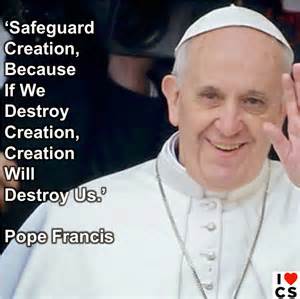
Francis creation

Readings for 1st Sunday of Lent: GN 9: 8-15; PS 25: 4-9; I PT 3: 18-22; MK 1: 12-15

Pope Francis is going to be a busy man this spring. In June he’ll publish his much-anticipated encyclical on climate change. He’ll then convoke a meeting of world religious leaders to discuss the topic. Presumably, they’ll endorse the encyclical’s main points.

Then in September, the pope will travel to New York to bring the message of those leaders to the United Nations. Afterwards, he’ll head off to D.C. to do the same before the U.S. Congress.

Clearly, the pope is a man on a mission. At the age of 78, he’s evidently experiencing a sense of urgency. He has a clear spiritual and practical vision for saving the world from impending disaster brought on by unregulated industrial capitalism and by a neo-liberal world order that he has rejected out of hand on more than one occasion during his brief reign as Supreme Pontiff.

The liturgy of the word for this first Sunday of Lent highlights the pope’s concern for the environment and calls us to become visionaries like him – and especially like the young prophet, Jesus of Nazareth, as depicted in today’s Gospel.

Take this morning’s first reading. Its focus, like the pope’s, is environmental destruction. Genesis, chapter nine gives the ending of the familiar story of Noah and his Ark.  There God makes a promise (3 times in fact) to Noah, his sons, their descendants, and (significantly) to the birds and animals, that he will never again destroy “all bodily creatures” by flood waters.

The Responsorial Psalm then reminds us that we can trust God’s word, because God, in the psalmist’s words, is compassionate, loving, kind, good, upright and just.

It’s that loving God whose Spirit in today’s gospel drives Jesus out to the desert for his “Lenten Retreat” – 40 days and nights of prayer and fasting. The Spirit sends him on a vision quest intimately connected with Pope Francis’ vision for the world’s future.

Recall the circumstances of Jesus’ quest. John the Baptizer has just baptized Jesus as one of his disciples. On emerging from the waters of the Jordan, Jesus receives a startling revelation about his true identity. A voice from heaven addresses him, “You are my beloved son,” it says.

Surprised and perhaps shaken by that revelation, Jesus retreats to the desert to determine what it all might mean. As I said, it’s a vision quest. And immediately the visions come – more heavenly voices, Satan, angels, and wild beasts.

All of these elements are important. They belong to Israel’s “apocalyptic” tradition – a highly political genre promising the overthrow of the nation’s imperial oppressors. Jesus’ visions call him to continue the work of John the Baptist, who, Mark informs us, has just been arrested. Jesus’ task is to announce the proximity of “God’s Kingdom.” It’s a world where God is king instead of Caesar. It’s a world like the one promised in the Book of Genesis.  There human beings live in complete harmony with their Heavenly Father/Mother, with one another, with animals, birds, fish, and plants.

That’s the vision Pope Francis will evoke in his upcoming encyclical. If his past statements are any guide, he’ll remind us that God may have promised not to destroy the earth by flood. But Mother Nature has given no such guarantee.

A month ago, on his flight to Manila, the pontiff told reporters, “God always forgives, we sometimes forgive, but when nature — creation — is mistreated, she never forgives!”

This Lent we would do well to ponder those words and to implement changes in our own spiritual, political and economic visions to prevent a disaster completely reminiscent of Noah’s familiar story.

What Lenten changes do you think most appropriate – for us as individuals and for our country?

Discussion follows

(Sunday Homily) Ten Reasons for Hope in a Time of Despair: Empire Is Crumbling before Our Eyes

Syriza (SYRIZA Poster: http://keithpp)

Readings for 4th Sunday in Ordinary Time: JB 7: 1-4, 6-7; PS 147: 1-6; I COR 9: 16-19; 22-23; MK 1: 29-39 http://www.usccb.org/bible/readings/020815.cfm

Today’s liturgy of the word is about hope in a world wracked by despair. All of us are starved for such hope. In fact, discouragement and apparent powerlessness describe not only our personal consciousness but the larger zeitgeist that is the constant focus of these Sunday reflections dedicated to confronting the world with the Bible in one hand and the newspaper in the other. Today’s confrontation should help progressives realize that our times are actually changing for the better.

Think of the most recent historical roots of today’s despair – the way the world was just 20 years ago. As described recently by Andre Vitchek, it was an unbelievably hard time for opponents of empire.

Then think of how things are different today. It’s the difference between the condition of Job in this Sunday’s first reading, and the healing Jesus brought to the poor in today’s gospel selection.

Twenty years ago Russia was controlled by Boris Yeltsin, a boozy western puppet who betrayed his own people. Like Yeltsin, other heads of state throughout Eastern Europe joined their western counterparts in a shameless surrender to imperial interests. They were largely “led” by the offspring of the elites who preceded them. China 20 years ago was still under the spell of the free market reforms introduced by Deng Xiaoping. Meanwhile, Latin America reeling from decades of dictatorships imposed by the West had turned its economies over to neo-liberals trained in the Chicago School of Economics. The same was largely true of the Middle East and Africa. In those cases, dictators and the one-percenters were firmly in control. Christian vision of a kingdom where the earth belonged to everyone had been completely hijacked by religious fundamentalists and reactionaries including in his own way, the pope of Rome. All of this was largely hidden by both local and international mainstream media (MSM) which applauded dictatorships and plutocracies as “emerging democracies.”

Those were indeed hard times for anti-imperialists. I remember the despair. We were like Job in today’s first reading sitting on a dung heap lamenting the loss of hope enkindled by the Civil Rights and Anti-War movements of the ‘60s and ‘70s.

Remember Job? He too was the victim of an incredible series of misfortunes. They reduced him to a condition worse than poverty. Without warning, he lost all his wealth; his children died; he became terribly sick; and his reputation went entirely south.

Job is the image of us all 20 years ago. Like Job, progressives couldn’t be blamed for wondering if our situation could ever change.

Perhaps believers among us had forgotten the general hope offered in today’s responsorial psalm. It reminds us of the goodness of Life – the divine energy in which we live and move and have our being. (Some call that Energy, “God.”) The psalmist reminds us that time and history itself have a way of healing broken hearts.  Life has a way of supporting even the most devastated.  And (as Job’s case illustrates) it eventually topples even those who appear to live on top of the world. God is good, the Psalmist reminds us. God is gracious and wise beyond our wildest imaginings. God unifies the poor, even when they’re hopelessly fragmented by elite strategies of “divide and rule.”

Today’s gospel reading offers more particular hope.  It recounts the first acts of a prophet from and imperial backwater, Israel – Jesus, the carpenter-preacher from Nazareth, a “Nowheresville” if there ever was one.

There he encourages the downtrodden every bit as crushed as Job. He heals with a touch, an embrace, a smile, a kiss of the foot, a word of encouragement as the afflicted assemble before him to find health and hope and relief from their demons.  In other words, today’s gospel locates hope outside the political structure of the day, outside the realm of priests, lawyers, kings and emperors. It finds hope on the margins of empire.

And when you think of it, that’s where hope is to be found today. It’s not grounded in American presidents, in our imperial army, in the European Union, or in “foreign aid.” As I said, it’s not even reported in the mainstream media.

And yet the world is changing for the better right before our eyes. And the locus of change is on the margins – in the 50% of the world that has almost invisibly (for Americans) broken free of the imperial order that has governed the world since the end of World War II. Eventually the gains of that 50% will change us too.

Think of the progress I’m referring to. To even perceive it you have to step outside the powerful system of propaganda that envelops us all. Here are 10 signs of hope emerging from the margins. They have for years been signaled by J.W. Smith and his Institute for Economic Democracy:

  1. World-wide people have lost faith in the western model of mainstream media (the Great Wurlitzer” as Smith terms it). Most have awakened to the fact that it’s all lies. In Latin America, Russia, China, and Iran, the new media is not even “alternative” any longer. Its mission is exposing the crimes of the West, its Empire and client states. Its message couldn’t be more straight-forward: No more torture, rape or genocide.
  2. Russia has risen from the ashes and is confronting the Empire on all fronts. Vladimir Putin has emerged as the world’s most effective international leader and practitioner of diplomacy and independence from Empire.
  3. Russia and China are both returning to their socialist roots advancing policies far more humane than their western counterparts.
  4. In Greece the overwhelming victory of SYRIZA has threatened the neo-liberal order in the heart of the European Union. The party’s anti-austerity message is already being spread to Italy, Spain, and France.
  5. Latin America has broken free of the shackles of the Monroe Doctrine. Cuba, Venezuela, Ecuador, Bolivia, Nicaragua, Chile, Argentina, Uruguay and Brazil are all forging their own paths while cooperating with and supporting one another. All are moving closer to Russia and China.
  6. The BRICS countries (Brazil, Russia, India, China, and South Africa) themselves represent at least half the planet’s population. They are trading with each other in their own currencies now making themselves immune from western sanctions.
  7. On June 17th of this year, under BRICS leadership, 133 of the world’s 196 countries declared their intention to “destroy the New World Order” championed by western Empire.
  8. For those paying attention, even the ISIS barbarians are unwittingly serving the cause of peace by demonstrating the horror of wars instigated by the West. They behead on YouTube videos, while U.S. moviegoers cheer American Snipers who blow the heads off unsuspecting Iraqis defending their homes from Seals. ISIS barbarians set fire to prisoners with matches, while their U.S. counterparts use napalm and white phosphorous. The clash of barbarisms highlighted by ISIS promises to make pacifists of anyone capable of seeing parallels. (It’s up to progressives to make them apparent.)
  9. Even the U.S. president (the first ever influenced by liberation theology) sees parallels like the ones just referenced. He has criticized American exceptionalism by challenging his people to “remember that during the Crusades and the Inquisition, people committed terrible deeds in the name of Christ. In our home country, slavery and Jim Crow all too often was justified in the name of Christ.”
  10. The pope of Rome is attempting mightily to defeat Catholic fundamentalism and to turn 1/7 of the world’s population (i.e. 1.2 billion Catholics) in the direction of social justice and environmental protection as advocated by liberation theology.

None of these are “pie in the sky” hopes. They are simply facts known to the world outside our borders but hidden from us by the MSM.

Along with today’s liturgical readings, such changes should be cause for hope and encouragement. More than half the world has left Job’s dung heap. The world’s poor whom Jesus served and embodied are leading the way. The rest of us will join them soon.