Ascension Sunday: What’s Christianity for Anyway? (Sunday Homily)

People attend the funeral mass for Cardinal Aloysius Ambrozic at St. Michael's Catholic Cathedral

Readings for Ascension Sunday: Acts 1: 1-11; Ps. 47: 2-3, 6-9; Eph. 1: 17-23; Lk. 24: 48-53 http://www.usccb.org/bible/readings/050913-ascension.cfm

This is Ascension Sunday. For us Catholics, it used to be “Ascension Thursday.” It was a “holy day of obligation.” That phrase meant that Catholics were obliged to attend Mass on Thursday just as they were on Sunday. To miss Mass on such a day was to commit a “mortal sin.” And that meant that if you died before “going to confession,” you would be condemned to hell for all eternity.

So until the years following the Second Vatican Council (1962-1965) Catholics would fill their churches on Ascension Thursday in the same numbers (and under the same threat) that made them come to Mass on Sundays. That’s hard to imagine today.

I suppose that difficulty is responsible for the transfer of the commemoration of Jesus’ “ascension into heaven” from Thursday to Sunday. I mean it wasn’t that the church changed its teaching about “holy days of obligation.” It didn’t. Catholics simply voted with their feet. They stopped believing that God would send them to hell for missing Mass on Ascension Thursday or the feast of the Blessed Virgin’s Assumption (August 15th), or All Saints Day (November 1st) or on any of the other “holy days.” Church once a week was about as much as the hierarchy could expect.

But even there, Catholics stopped believing that God would punish them for missing Mass on Sunday. So these days they more easily attend to other matters on Sunday too. They set up an early tee time or go for a hike in the woods. Afterwards they cut the lawn or go shopping at Wal-Mart. That kind of “servile work on Sundays” or shopping used to be forbidden “under pain of sin” as well. And once again, it isn’t church teaching that has changed. Catholics have just decided that the teachings don’t make sense anymore, and have stopped observing them.

And apparently they do so in good conscience. So you won’t find them running to confession after missing Mass or working and shopping on Sunday. In fact, that’s another way Catholics have voted with their feet. For all practical purposes, they’ve stopped believing in Confession – and largely in many of the mortal sins they were told would send them to hell – like practicing contraception or even getting a divorce.

I remember Saturday evenings when I was a kid (and later on when I was a priest). People would line up from 4:00-6:00, and then from 7:00 -9:00 to “go to Confession.” And the traffic would be steady; the lines were long. No more! In fact, I personally can’t remember the last time I went to confession. And no priests today sit in the confessional box on Saturday afternoons and evenings waiting for penitents to present themselves.

What I’m saying is that the last fifty years have witnessed a tremendous change in faith – at least among Catholics. Our old faith has gone the way of St. Christopher and St. Philomena and “limbo” all of which have been officially decertified since Vatican II.

In fact, since then the whole purpose of being a Catholic (Christianity) has become questioned at the grassroots level. More and more of our children abandon a faith that often seems fantastic, childish and out-of-touch. Was Jesus really about going to heaven and avoiding hell? Or is faith about trying to follow the “Way” of Jesus in this life with a view to making the world more habitable for and hospitable to actually living human beings?

That question is centralized in today’s liturgy of the word. There the attentive reader can discern a conflict brewing. On the one side there’s textual evidence of belief within the early church that following Jesus entails focus on justice in this world – on the kingdom. And on the other side there are the seeds of those ideas that it’s all about the promise of “heaven” with the threat of hell at least implicit. The problem is that the narrative in today’s liturgy of the word mixes each view with its alternative.

According to the story about following Jesus as a matter of this-worldly justice, the risen Master spent the 40 days following his resurrection instructing his disciples specifically about “the Kingdom.” For Jews that meant discourse about what the world would be like if God were king instead of Caesar. Jesus’ teaching must have been strong. I mean why else in Jesus’ final minutes with his friends, and after 40 days of instruction about the kingdom would they pose the question, “Is it now that you’ll restore the kingdom to Israel?” That’s a political and revolutionary question about driving the Romans out of the country.

Moreover Jesus doesn’t disabuse his friends of their notion as though they didn’t get his point. Instead he replies in effect, “Don’t ask about precise times; just go back to Jerusalem and wait for my Spirit to come.” That Spirit will “clothe you in justice,” he tells them. Then he takes his leave.

Presently two men clothed in white (the color of martyrdom) tell the disciples to stop looking up to heaven as if Jesus were there. He’s not to be found “up there,” they seem to say. Jesus will soon be found “down here.” There’s going to be a Second Coming. Jesus will complete the project his crucifixion cut short – restoring Israel’s kingdom. So the disciples who are Jews who think they’ve found the Messiah in Jesus return in joy to Jerusalem and (as good Jews) spend most of their time in the Temple praising God, and waiting to be “clothed in Jesus’ Spirit” of liberation from Roman rule.

The other story (which historically has swallowed up the first) emphasizes God “up there,” and our going to him after death. It’s woven into the fabric of today’s readings too. Here Jesus doesn’t finally discourse about God’s kingdom, but about “the forgiveness of sin.” After doing so, he’s lifted up into the sky. There Paul tells his readers in Ephesus, he’s enthroned at the Father’s right hand surrounded by angelic “Thrones” and “Dominions.” This Jesus has founded a “church,” – a new religion; and he is the head of the church, which is his body.

This is the story that emerged when Paul tried to make Jesus relevant to gentiles – to non-Jews who were part of the Roman Empire, and who couldn’t relate to a messiah bent on replacing Rome with a world order characterized by God’s justice for a captive people. So it gradually turned Jesus into a “salvation messiah” familiar to Romans. This messiah offered happiness beyond the grave rather than liberation from empire. It centralized a Jesus whose morality reflected the ethic of empire: “obey or be punished.” That’s the ethic we Catholics grew up with, that sent some of us to weekly “confession,” and that former and would-be believers find increasingly incredible, and increasingly irrelevant to our 21st century world.

Would all of that incredibility and irrelevance change if the world’s 2.1 billion Christians (about 1/3 of the world’s total population) adopted the this-worldly Jesus as its own instead of the Jesus “up there?” That is, would it change if Christians stopped looking up to heaven and focused instead on the historical Jesus so concerned with God’s New World Order of justice for the poor and rejection of empire?

Imagine if believers uncompromisingly opposed empire and its excesses – if what set them apart was their refusal to fight in empires wars or serve its interests. How different – and more peaceful – our world would be!

A sensitive discerning reading of today’s liturgy of the word, a sensitive and critical understanding of Jesus’ “ascension” presents us with that challenge. How should we respond?

(Discussion follows.)

Saving Jesus from Paul and John (Sunday Homily)

rebel_jesus2

Readings for the 4th Sunday after Easter: Acts 13:14; Ps. 100: 1-2, 3-5; Rev. 7:9, 14B-17; Jn. 10: 27-30. http://www.usccb.org/bible/readings/042113.cfm

As I’ve been reporting here, a group of about 25 people met weekly during Lent for an intensely rewarding study of “The Historical Jesus.” The group included members of our local Catholic church in Berea, Kentucky along with an equal number from our Ecumenical Table in nearby Richmond. In the aftermath of that experience, I find it impossible to read selections like those in today’s liturgy of the word without making connections with our little seminar.

For instance, today’s readings remind me that would-be followers of Jesus might more accurately call ourselves “Paulists” rather than “Christians.” That observation is sparked by the tension between Paul and “the Jews” in this morning’s selection from Acts. The tension reminds us that our belief system has been shaped more by Paul of Tarsus than by Jesus of Nazareth who was himself a Jew. The same holds true for the gospel selection from John the Evangelist with its emphasis on Jesus’ divinity (“I and the Father are one”). As a result of the influence of Paul and John, our faith tends to be other-worldly and de-politicized. Our Jesus tends to be one-dimensionally divine rather than the enlightened very human rabbi who graced the Palestinian landscape 2000 years ago. Let me explain.

To begin with it’s important to point out that we know more about Paul than we do about the historical Jesus. And we know more about the historical Jesus than did the rabbi from Tarsus. The reasons why are simple. On the one hand, most of the Christian Testament is written by or heavily influenced by Paul. The New Testament, then, is more Pauline than Christian.

On the other, Paul never met the historical Jesus and shows almost no knowledge of Jesus’ words and deeds in his epistles. Meanwhile, scholarship based on manuscript discoveries at Nag Hammadi in Upper Egypt in 1945 and at the Dead Sea in 1947 (the famous Dead Sea Scrolls) has yielded unprecedented knowledge of the historical Jesus. That means we know more about the rabbi from Nazareth than did Paul.

Think about the Pauline nature of the faith we’ve inherited. There are 27 books in the “New Testament.” Thirteen of those 27 are letters written by Paul. Then there’s the “Acts of the Apostles” which really is a travelogue about the mission and adventures of Paul written by Paul’s companion, Luke the evangelist. Luke also wrote his own Gospel, which, of course, was heavily influenced by his mentor. Finally, as the earliest entries in the New Testament, Paul’s epistles (written from about 50 to 64 CE) evidently exercised great influence on the other evangelists Mark, Matthew and John who wrote much later.

That means that nearly half of the New Testament (13 of 27 entries) is comprised of letters attributed to Paul. Fifty-five percent (15 of 27 entries) was written by Paul or Luke. And more than 66% (18 of 27 entries) was arguably more influenced by Paul than by Jesus.

I say “more influenced by Paul than by Jesus” because what we have in Paul’s letters, the Acts of the Apostles and in the gospels themselves are proclamations about Jesus rather than the proclamation of Jesus. Remember, Jesus’ proclamation was about the Kingdom of God, “Repent, the Kingdom of God is at hand.” In contrast, the New Testament’s proclamations about Jesus are “Jesus is Lord.”

The differences between these two “gospels” are enormous and they are, as I indicated, illustrated in today’s readings on this fourth Sunday after Easter. Today’s selection from John’s Gospel (written about 70 years after the crucifixion of the Enlightened Yeshua) has Jesus discoursing about himself. He speaks of himself as a “shepherd” leading his sheep and about offering them “eternal life.” He concludes by claiming to be God’s Son equal to the Father. “I and the Father are one,” he says. (The historical Jesus could never have made such statements without being stoned by his fiercely monotheistic Jewish audience.)

However, Jesus’ discourse as reported in John’s gospel is completely coherent with the gospel of Paul. Paul, I repeat, never met the historical Jesus. In fact, as we all know, before his famous conversion on the road to Damascus, he was a persecutor of Christians. He pursued them on behalf of the Sanhedrin, the Jewish high court, which worked hand-in-glove with the Romans.

The Romans were hunting down Christians for the same reason they arrested and executed Jesus – because he was perceived as the Jewish Messiah whose overriding responsibility was the overthrow the Roman occupation of Palestine. With good reason, the Romans considered Jesus’ followers to be subversives.

In other words, the Romans, their Sanhedrin collaborators, and their point-man, Saulous (Paul’s name before his conversion) were cooperating in a counter-revolutionary program that targeted Jesus’ nationalistic followers.
Those followers had actually lived with Jesus. They were Jews primarily – members of a Jerusalem community gathered around Jesus’ brother, James, the apostles, and Jesus’ “inner circle” of followers including many women and numbering perhaps 120 people or more. Together they constituted a group of reformed Jews. Many of them had been eye-witnesses of Jesus’ deeds and followers of his teachings.

Those teachings centralized a new understanding of “the Law” which Yeshuaists called “the Way.” It emphasized love and forgiveness over fear, punishment and a purity code that divided people into “clean” and “unclean.” It emphasized justice for the poor and oppressed and freedom from foreign domination. The Jerusalem community of The Way recognized Jesus as the True Prophet predicted in their scriptures – a wonder-working Messiah and liberator who would usher in an era reminiscent of the Exodus from Egypt under the great rebel Moses. This Jewish messiah was human (the Son of Man) not a divine Son of God.

Paul, as I said, had never met the Son of Man. His writings show neither knowledge of Jesus’ deeds nor of specific teachings which were so important to the Jewish Yeshuaist community. Instead, Paul preached a kind of mythological Jesus who was entirely recognizable to the gentile audiences which interested him. Paul’s Jesus was born, crucified, risen and ascended to heaven. Evidently, Paul considered nothing between Jesus’ birth and death worth reporting.

For Paul’s gentile audience, any wonder-working “messiah” had to be a divine incarnation like the gods Romans and Egyptians worshipped — Mithra, Isis, Osiris, the Great Mother God. These “dying and rising gods” descended from heaven, lived for a while on earth, died, and then rose from the dead. Typically, they offered “eternal life” beyond the grave to believers who ate sacred meals together sharing the gods’ body and blood in the form of bread and wine. These are the terms Paul used to explain Jesus to his gentile audiences.

As reformed Jews, the Jerusalem community along with most unreformed (non-Yeshuaist) Jews had trouble with such explanations which offended their strictly monotheistic beliefs. How could Jesus be uniquely “one with the Father?” That sounded like two Gods and was entirely offensive and unacceptable.

Moreover, Paul’s version of the gospel seemed to remove the Kingdom of God to an other-worldly heaven. It left the Romans in charge of Palestine ruled by a god (the Roman emperor) who was a rival of Yahweh, who, for good Jews, alone was God and who alone was the legitimate ruler of the Palestinian homeland. Such a gospel along with Paul’s background of cooperation with the Romans made all Jews (Yeshuaist and orthodox) deeply suspect of Paul. They remained adamant in their hope of the “Second Coming” of Jesus who would finally defeat the Romans and introduce God’s Reign to replace Caesar’s.

We pick up the tension between Paul’s message aimed at gentiles and the anti-imperial faith of Jews (including Yeshuaists) in today’s readings. In the selection from Acts, Paul proclaims his version of Jesus. And “the Jews” respond as expected. To them Paul’s (and John’s) understanding of Jesus as God’s only Son, his understanding of salvation as “eternal life” rather than messianic liberation from foreign domination was completely blasphemous. So Paul and Barnabas end up “shaking the dust” of Antioch’s streets from their feet against “the Jews.”

Eventually, Paul’s gospel (with the deeply engrained seeds of anti-Semitism) ends up triumphing completely. This is because the base of the Jerusalem Yeshuaist community (the inner circle referenced earlier) was completely destroyed during the Jewish war with Rome (64-73). In the absence of strong Yeshuaist leadership, the way was thus opened for the triumph of a divine Jesus proclaiming himself (rather than God’s Kingdom) and offering an other-worldly “eternal life” rather than a new revolutionary social order characterized by love, forgiveness, justice, and room for everyone.

That other-worldly “Christianity” was finally canonized by Constantine in the fourth century (325 at Nicaea). Afterwards, in his zeal for uniformity of belief, the emperor and his church accomplices ordered the destruction of documents reflecting anything other than the Pauline and Johannine understandings of Jesus. The rest is history. The historical Jesus was lost. We’ve been worshipping a Roman Mithra instead of a prophetic Enlightened Jewish Jesus ever since.

Luckily disobedient monks ignored Constantine’s order to destroy manuscripts reflecting understandings of Jesus other than Paul’s. That happened at the Dead Sea and at Nag Hammadi.

Thank God for their crime! At this late date it has directed our focus away from the Gospel about Jesus to the Gospel of Jesus. It calls us to work not for an after-life heaven, but for God’s Kingdom in the here and now.

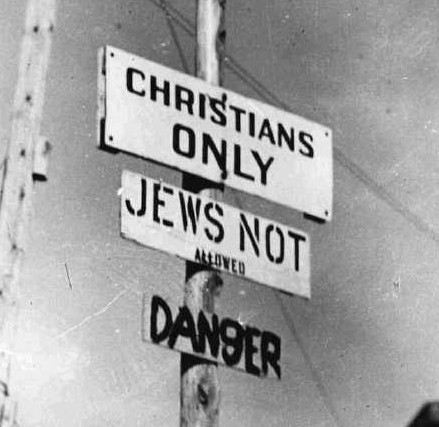
Reading the Passion Narrative again for the First Time: The Origins of Submission to Authority and Anti-Semitism

no-jews-allowed

Readings for Palm Sunday: http://www.usccb.org/bible/readings/032413.cfm

Since the beginning of Lent, I’ve been teaching a seminar on the historical Jesus. About twenty-five of us have come together each week to get closer to the Jesus who taught and served the poor in Palestine two millennia ago.

In that context, it’s nearly impossible for me not to read this Sunday’s Passion Narrative from Luke without applying what we’ve been learning at our group’s Wednesday night meetings. Doing so provides a fresh set of ears for understanding a familiar story as if hearing it for the first time. The result can in turn cause us to re-vision and re-conceptualize our lives as Jesus’ followers living under the sway of U.S. Empire.

As part of our seminar’s study, we’ve been watching excerpts the PBS video series “From Jesus to Christ.” It has helped us see that Jesus and his audiences were first and foremost Jews whose lives were shaped more than anything else by the Roman occupation of their homeland. As such, they weren’t waiting for a Roman-Greco “messiah” who, like the Sun God Mithra, would die and lead them to heaven. They were awaiting a Davidic messiah who would liberate them from the Romans.

Roman rule was especially odious for Jews. After all, they believed they had been given the land of Palestine by their God, Yahweh, whom Jews regarded as their land’s rightful sovereign. And yet, at the time of Jesus, Roman occupiers claimed that their emperor was god. In other words, the Palestine of Jesus’ day was blasphemously controlled by a foreign god. That was intolerable for Jews in general and for Jesus of Nazareth in particular.

So on this Palm Sunday, what do you think was on the minds of the crowds who Luke tells us lined the streets of Jerusalem to acclaim Jesus the Nazarene? Were they shouting “Hosanna! Hosanna!” (Save us! Save us!) because they thought Jesus was about to die and by his sacrificial death open the gates of heaven closed since Adam’s sin by a petulant God? Of course not. They were shouting for Jesus to save them from the Romans. They looked to him to play a key role in the Great Rebellion everyone knew about to take place against the hated Roman occupiers.

And what do you suppose was on Jesus’ mind? He was probably intending to take part in the rebellion just mentioned. It had been plotted by the Jews’ Zealot insurgency. Jesus words at the “Last Supper” show his anticipation that the events planned for Jerusalem might cause God’s Kingdom to dawn that very weekend.

At least Jesus’ Passover words show that something big was brewing for him – something on a par with the liberation from Egypt that had occurred more than 1000 years earlier. So over bread and wine he speaks of a “new covenant” to replace the old one the rebel Moses had mediated from Yahweh. After spending three years preaching about it, God’s Reign seemed so immediate to Jesus that he evidently thought it might dawn even before their next meal. He says “I will not drink wine with you again before the kingdom comes.”

So Jesus issues new and mysterious tactical orders. The advocate of simple living says “Whereas once I sent you out without money or a change of clothes, I’m telling you now to fill your wallet and pack a suitcase.” The non-violent one tells his friends to arm themselves. The courageous teacher of “the Twelve” warns darkly about intrigue, betrayal and denial by members of his innermost circle. Anticipation of all that causes such stress that Jesus eventually sweats blood over it.

Clearly Jesus had his differences with the Zealots. They were nationalists; he was inter-nationalist who was open to gentiles. The Zealots were violent; Jesus was not. And yet the Zealots and Jesus came together on their abhorrence of Roman presence in the Holy Land. They found common ground on the issues of debt forgiveness, non-payment of taxes to the occupiers, and of land reform. Within Jesus’ inner circle there was at least one Zealot (Simon). Indications might also implicate Peter, Judas, James, and John. And Jesus’ friends were armed when he is arrested. Whoever cut off the right ear of the high priest’s servant was used to wielding a sword – perhaps as a “sicarius” (the violent wing of the Zealots who specialized in knifing Roman soldiers).

But we’re getting ahead of our story. . . Following his triumphant entry into Jerusalem, Jesus soon found himself and his disciples inside the temple participating in what we’d call a “direct action” protest. They were demonstrating against the collaborative role the temple and its priesthood were fulfilling on behalf of the Romans.

As collaborators, the temple priests were serving a foreign god within the temple precincts. For Jesus that delegitimized the entire system. So, as John Dominic Crossan puts it, Jesus’ direct action was not so much a “cleansing” of the temple as the symbolic destruction of an institution that had completely lost its way.
It was this demonstration that represented the immediate cause of Jesus’ arrest and execution described so poignantly in today’s long gospel reading.

Following the temple demonstration, Jesus and his disciples became “wanted” men (Lk. 19:47). At first Jesus’ popularity affords him protection from the authorities (19:47-48). The people constantly surround him eager to hear Jesus’ words denouncing their treasonous “leaders” (20:9-19), about the issue of Roman taxation (20:20-25), the destruction of the temple (21:1-6), the coming war (21:20-24) and the imminence of God’s Kingdom (21:29-33). By night Jesus and his friends repair to their Garden of Olives hideout (21:37).

Eventually however, Jesus has to go underground. On Passover eve he sends out Peter and John to arrange for a safe-house to celebrate the feast I described earlier. The two disciples are to locate the “upper room.” They do so by exchanging a set of secret signs and passwords with a local comrade.

Then comes Jesus’ arrest. Judas has betrayed Jesus to collect the reward on Jesus’ head – 30 pieces of silver. The arrest is followed by a series of “trials” before the Jewish Council (the Sanhedrin), before Pilate and Herod. Eventually, Jesus is brought back to Pilate. There he’s tortured, condemned and executed between two other insurgents.

The trials point up an interesting and important difference between the Jesus of history and the political project of the author of Luke’s Gospel. In the past, we’ve been told the real charge against Jesus was blasphemy; the Jewish authorities were offended because Jesus claimed to be God. However, under Roman law, the Jewish leaders lacked authority to execute criminals. So they were forced to trump up political charges and involve the Romans who alone had the power to inflict capital punishment.

Clearly, however, this was not the case. As we saw last week with the woman taken in adultery, the Jews had the authority to execute people for religious crimes such as adultery or (in Jesus’ case, blasphemy). If Jesus had committed blasphemy, they could have stoned him using the Jewish form of execution.

Instead, Luke presents Jesus as hauled off to Pilate. And completely out-of-character, and after the presentation of clear-cut evidence that the Nazarene rabbi was “stirring up the people,” and despite Jesus’ own admission to crimes against the state (claiming to be a rival king), Pilate insists three times that the carpenter is innocent of capital crime. Such tolerance of rebellion contradicts what we know of Pilate as described for example by the Jewish historian Josephus.

Contradicting all of this as well, Crossan insists that Pilate had standing orders to execute anyone associated with lower class rebellion during the extremely volatile Passover festivities. In other words, there would have been no drawn-out trial.

What’s going on here? Two things.

First of all, like everyone else, Luke knew that Jesus had been crucified by the Romans. That was an inconvenient truth for Luke’s audience who around the year 85 CE (when Luke was writing) was desperately trying to reconcile with the Roman Empire which lumped the emerging Christian community with the Jews whom the Romans despised.

Luke’s account represents an attempt to create distance between Christians and Jews. So he creates an account that exonerates Pilate (and the Romans) from guilt for Jesus’ execution. Simultaneously, he lays the burden of blame for Jesus’ execution at the doorstep of Jewish authorities.

In this way, Luke made overtures of friendship towards Rome. He wasn’t worried about the Jews, since by the year 70 the Romans had destroyed Jerusalem and its temple along with more than a million of its inhabitants. After 70 Jewish Christians no longer represented the important factor they once were. Their leadership had been decapitated with the destruction of Jerusalem.

Relatedly, Jesus’ crucifixion would have meant that Rome perceived him as a rebel against the Empire. Luke is anxious to make the case that such perception was false. Rome had nothing to fear from Christians.
As we have seen in today’s readings, that assurance itself was untrue. It domesticated the Jesus of history who shines through even in Luke’s account when it is viewed contextually. That’s the vision we’ve been attempting grasp in the Historical Jesus Seminar.

And so what?

Well, if you wonder why Christians have lost their edge . . . if you wonder why they so easily succumb to empires (Roman, Nazi, U.S.) you’ve got your answer. It all starts here – in the gospels themselves – with the great cover-up of the rebel Jesus.

And if you wonder where the West’s and Hitler’s anti-Semitism came from . . .

Christians Have Been Worshipping the Devil for Millennia: Lent calls us to change Gods

Empires[1]

Readings for First Sunday of Lent: Dt. 26: 4-10; Ps. 91: 1-2; 10-15; Rom. 10: 8-13; Lk. 4: 1-13. http://www.usccb.org/bible/readings/021713.cfm

Today is the first Sunday of Lent. Lent is a time of renewal – of getting back to basics – to asking questions about what we really believe and what God we truly worship. Today’s liturgy of the word helps us to do both. Deuteronomy 26 directs us to the authentic faith of Jesus – in the God who liberates the enslaved. Today’s reading from Luke’s Gospel calls us to worship that God rather than devil – the evil one that our culture and church (!) have been worshipping for centuries – ever since they first embraced imperialism in the 4th century C.E. Let me explain.

Start with that reading from Deuteronomy 26. It’s a key text if we want to understand the God in whom Jesus placed his faith. Jesus, remember, was a Jew, not a Christian. And Deuteronomy 26 provides us with the creedal statement that the Jewish Jesus accepted as did all Jews of his time. I mean, for them, Deuteronomy 26 functioned much like our Nicene Creed does for us each Sunday. It was a reminder of their basic belief. As such, it can be summarized in the passage’s seven points:

1. Our father (Abraham) was a wandering Aramean (a Syrian).
2. “Abraham” (i.e. his descendents) went down into Egypt.
3. There we became a great people.
4. But the Egyptians enslaved us.
5. We cried out to our God, Yahweh, who raised up the rebel prophet, Moses.
6. He led us out of Egypt, across the sea, through the desert, and to this land “flowing with milk and honey.”
7. This land is our gift from Yahweh; Thanks be to God!

That’s it! That was the faith that Jesus, the Jewish prophet, inherited from his ancestors. It was a tribal faith centered on the ownership of a God-given piece of land (Palestine) which (despite its dryness and desert character) the descendents of Jacob saw as rich and productive (flowing with milk and honey).

Notice that this Jewish faith had nothing to do with an afterlife, heaven or hell. (In fact, belief in the afterlife was a very late development among the Jews; it didn’t emerge even for debate until about 200 years before Jesus’ birth.) Instead, as among all hunter-gatherers, herds people and agriculturalists, Jewish faith was centered on land. Obviously then, it had little tolerance for colonial military forces like the Assyrians, Babylonians, Persians, Greeks or Romans all of whom at various times occupied Palestine. Colonialism and foreign occupation contradicted Jewish faith in a fundamental way. It was intolerable.

That was true for Jesus too. As a prophet, his fundamental proclamation was not about himself or about a new religion. Much less was it about the after-life or “going to heaven.” Instead, Jesus proclaimed the “Kingdom of God.” That phrase referred to what the world would be like without empire – if Yahweh were king instead of Rome’s Caesar. In other words, “Kingdom of God” was a political image among a people unable and unwilling to distinguish between politics and religion.

In God’s Kingdom, everything would be reversed and guiding principles would be changed. The first would be last; the last would be first. The rich would weep, and the poor would laugh. Prostitutes and tax collectors would enter the Kingdom, while the priests and “holy people” – all of them collaborators with Rome – would find themselves excluded. The world would belong not to the powerful, but to the “meek,” i.e. to the gentle, humble and non-violent. It would be governed not by force and “power over” but by compassion and gift (i.e. sharing).

The creedal account of Deuteronomy 26 sets the stage for today’s gospel narrative about Jesus’ temptations in the desert. (And it’s here that the devil-worship connected with empire enters the picture. Listen closely.) In a context of Roman occupation, Luke’s account raises the question of whom to worship. The choice he presents is stark: one can worship the devil the author of empire or Yahweh, the opponent of imperial power of all types.

That clear choice becomes apparent in Luke’s version of Jesus’ second temptation. From a high vantage point, the devil shows Jesus all the kingdoms of the earth. Then he says,

“I shall give to you all this power and glory;
for it has been handed over to me,
and I may give it to whomever I wish.
All this will be yours, if you worship me.”

Notice what’s happening here. The devil shows Jesus an empire infinitely larger than Rome’s – “all the kingdoms of the world.” Such empire, the devil claims, belongs to him: “It has been handed over to me.” This means that those who exercise imperial power do so because the devil has chosen to share his possession with them: “I may give it to whomever I wish.” The implication here is that Rome (and whoever exercises empire) is the devil’s agent. Finally, the tempter underlines what all of this means: devil-worship is the single prerequisite for empire’s possession and exercise: “All this will be yours, if you worship me.”

But Jesus responds,
“It is written:
You shall worship the Lord, your God,
and him alone shall you serve.”

Here Jesus quotes the Mosaic tradition summarized in Deuteronomy 26 to insist that empire and worship of Yahweh are incompatible. Put otherwise, at the beginning of his public life, Jesus declares his anti-imperial position in the strongest possible (i.e. scriptural) terms.

Now fast forward to the 4th century – 381 CE to be exact. In 313 Constantine’s Edict of Milan had removed from Christianity the stigma of being a forbidden cult. From 313 on, it was legal. By 325 Constantine had become so involved in the life of the Christian church that he himself convoked the Council of Nicaea to determine the identity of Jesus. Who was Jesus after all – merely a man, or was he a God pretending to be a man, or perhaps a man who became a God? Was he equal to Yahweh or subordinate to him? If he was God, did he have to defecate and urinate? These were the questions.

However, my point is that by the early 4th century the emperor had a strong hand in determining the content of Christian theology. And as time passed, the imperial hand grew more influential by the day. In fact, by 381 under the emperor Theodosius Christianity had become not just legal, but the official religion of the Roman Empire. As such its job was to attest that God (not the devil) had given empire to Rome in exchange for worshipping him (not the devil)!

Do you get my point here? It’s the claim that in the 4th century, Rome presented church fathers with the same temptation that Jesus experienced in the desert. But whereas Jesus had refused empire as diabolical, the prevailing faction of 4th century church leadership embraced it as a gift from God. In so doing they also said “yes” to the devil worship as the necessary prerequisite to aspirations to control “all the kingdoms of the world.” Christians have been worshipping the devil ever since, while calling him “God.”

No, today’s readings insist: all the kingdoms of the world belong only to God. They are God’s Kingdom to be governed not by “power over,” not by dominion and taking, but by love and gift which leave people like the liberated daughters and sons of Abraham free to live in control of their own God-given piece of earth. Or in the words of Jesus, the earth is meant to belong to those “meek” I mentioned – the gentle, humble, and non-violent.

All of this has implications for us as would-be followers of Jesus and as citizens of a country whose “leaders” (supported by their “Christian” counterparts) increasingly embrace empire as the inevitable and fitting destiny of the United States.

In fact, in 2003, then vice-president, Dick Cheney sent out a Christmas card on which was inscribed the words, “And if a sparrow cannot fall to the ground without His notice, is it probable that an empire can rise without His aid?” Cheney’s implication was that the United States is God’s new chosen people. Empire as practiced by the United States represents God’s will.

Instead, today’s Liturgy of the Word tells us the opposite. Empires arise only with the devil’s aid.

Does this mean that faithful followers of Jesus must pray for the defeat of the United States in its imperial conquests? Must we discourage our sons and daughters from joining the military?
(Discussion follows)

Jesus Decides to Redeem His Wasted Life (Sunday’s Homily)

Readings for Feast of Baptism of the Lord: http://www.usccb.org/bible/readings/011313.cfm

Today is the Feast of the Baptism of the Lord. In that context, let’s think about baptism and the differences between the understandings we’ve inherited and those reflected in the practice of John the Baptist and Jesus of Nazareth. Those differences hold practical implications for our own lives as we wrestle with a faith that may have lost meaning for us, and as we struggle with the relative smallness and insignificance of our lives.

To begin with, think about traditional beliefs about baptism. If you’re like me, you may find them hard to swallow. A friend of mine, theologian Tony Equale, has recently pointed out that theology doesn’t really determine worship patterns. Instead superstitious temple and church rituals have shaped our beliefs. Practice determines belief, not the other way around. (See http://tonyequale.wordpress.com/2013/01/03/the-religiosity-of-the-people/)

What my friend means is that theology’s job has traditionally been to rationalize what people actually do in their efforts to tame life and achieve contact with the numinous, the mysterious, and the transcendent. They sacrifice chickens, behead bullocks, or vivisect lambs and then burn the animals’ carcasses. The smoke thus ‘feeds’ the Gods who are believed to need nourishment, placation, and cajoling in order to do the will of the people and their priests. Those congregations actually turn out to be more intelligent than the God who must be informed of their needs and what is best for their welfare. That’s superstition.

Catholic beliefs around baptism and the “sacrifice of the Mass” are cases in point. They were actually formed by the People’s credulous practice of baptism which was informed more by ancient ideas of all-powerful angry Gods than by Jesus’ radical teaching that God is Love. I mean early on, in a time of very high rates of infant mortality, popular belief came to see infant baptism as necessary to somehow save deceased children from a hell created by a threatening God.

This practice of the people rather than reflection on the words and deeds of Jesus led St. Augustine at the beginning of the 5th century to theorize that people have been born guilty – at enmity with God. Augustine thought that since children were condemned even before any personal sin on their parts, they must be born in sin. And that must be, Augustine reasoned, because they had inherited sin from their forebears and ultimately from the first human beings, Adam and Eve. Because of that “original sin,” God is justly angry with humans.

Now, as I said, the ancients believed that sacrifice was necessary to placate an angry God like that. So, in the Roman world, where sacrifice was understood in the terms I’ve just explained, Jesus’ death eventually became to be seen as a sacrifice whose primary purpose was to secure God’s approval of the Roman state. In this way, the “Mass” was transformed from a memorial meal to a re-enactment of Jesus’ sacrificial death. It was moved from a table with friends gathered around sharing food, to a “sacrifice” performed at an “altar” by a priest with his back turned to the people who watched the show from afar.

This Mass differed very little from what Romans were used to before Christianity became the state’s official religion in 381. In fact, it is entirely possible that ordinary people saw no difference between the “Mass” and the religious ritual they had been accustomed to when Jupiter or Mithra were worshipped as the official Gods of Rome. In other words, Christianity was transformed by the Roman Empire rather the empire being transformed by Christianity. There was a “theogony,” a battle of the Gods, between Jupiter and the Bible’s Yahweh; and Jupiter won. We’ve been worshipping him ever since.

How different all this is from what happens to Jesus at the baptism which today’s liturgy of the word celebrates! (And that brings me to my point about meaning in our seemingly wasted lives.) In today’s gospel, there is nothing suggesting “original sin.” Nor is Jesus presented as the incarnation of a God who needs to be mollified by sacrifice. Rather, Jesus comes as a disciple of John. (Scripture scholars tell us that John’s words about his inferiority before Jesus were inventions of the early church in a Jewish context where many still believed that John rather than Jesus was the long-awaited Messiah.)

So at the age of 30 or so, this young peasant from Nazareth presents himself for a ritual washing at the prophet’s hands in the legendary Jordan River. In Israel’s idealized past, that river had been crossed by slaves escaped from Egypt who on the river’s opposite shore found the “Promised Land” that became their national home. Eventually that crossing came to be understood as transforming a motley horde of renegade slaves into a unified nation of free people at the service of the God who had liberated them from demeaning servitude.

John’s practice of baptism in the Jordan (far from the corruption of the priests’ Temple and its endless sacrifices) summoned his Jewish contemporaries to reclaim their ancient identity that had been lost by the priests and scribes who had sold out to Roman re-enslavement of a once proud and liberated people.

John’s was a revivalist movement of Jewish reform. Those presenting themselves for baptism were expressing a desire to return to their religious roots and to alter their lives in a profound way.

Evidently, that’s why Jesus came to be baptized too. This country boy who (according to Luke’s “infancy narratives”) had begun his life with such promise is now about 30 years old. Perhaps in view of his parents’ expectations of him, his life so far seemed wasted. Perhaps he had resolved to finally make a difference. In any case, by approaching John in the Jordan’s waters, he expresses an intense need for change in his life. He wants to be John’s follower.

So John performs his baptismal ritual. And the miraculous happens. An epiphany occurs for Jesus. He hears a voice. It informs him that he is a child of God. Immediately he sets out on a vision quest to discover what those words might mean. Forty days of prayer and fasting bring on the visions – of angels and devils, of temptations, dangers and possibilities.

In the light of his desert experience, Jesus chooses not only to follow John as the leader of a reform movement. He chooses as well to follow Moses as the liberator of an enslaved people. He has truly crossed the Jordan. So he brings his message to the captive poor. Like him, they too are children of God — God’s specially chosen people. God’s kingdom belongs to them, he says, not to their rich oppressors. The poor must not allow themselves to be misled by the stultifying and domesticating doctrines of the priests and scribes. That was the thrust of Jesus’ teaching.

Coherent acts follow Jesus’ words. He discovers wondrous healing powers within himself. By touch, by faith, by his friendship, he cures stinking lepers, dirty beggars, street walkers who have lost their self-respect, the deaf, the dumb, the blind and lame. Jesus eats food with the social outcasts and street people of his day, sharing nourishment the way God does – without cost or expectation of reciprocation. Jesus finds himself explaining the mysterious, transcendent and ineffable in unforgettable stories that capture the imaginations of simple people hungry for the spiritual sustenance that he offers – that he embodies. No wonder his early followers tried to imitate Jesus by choosing John’s baptism as a sign of membership in their community and by following the Master’s example of sharing food the way God does in their re-enactment of the Lord’s Supper.

That was the understanding of baptism and Lord’s Supper that the first generations of Christians embraced. But it didn’t last long. Within a few generations (and especially after Christianity became the official religion of the Roman Empire at the end of the 4th century) the superstitions I referenced earlier had replaced the understanding and practice of Jesus and the Baptist. Soon baptism became an instrument for saving babies from original sin and hell. Soon the Lord’s Supper became the “Holy Sacrifice of the Mass” differing very little in ritual and spirit from offerings to Jupiter and Mithra.

Today’s liturgy of the word calls us beyond all of that. It summons us to follow Jesus who shows us the way to truly change our lives. Change comes by leaving behind the superstitious faith that supports empires past and present. Transformation comes when we share our food with each other and with the poor. It happens by committing ourselves to the “other world” represented by God’s Kingdom that has room for everyone, not just for the 1% served by our own churches, priests, scribes and their superstitious rituals.

Today’s liturgy of the word summons us to the banks of the Jordan to stand with Jesus and to hear God’s voice calling us from what has been so far wasted in our lives. Like Jesus, we are daughters and sons of God. We are beloved by the God of Love. Jesus’ example reminds us that It’s not too late to change our commitments and way of life.

After all (if we take our tradition literally) Jesus redeemed the insignificance of his own life in a single meaningful year – or maybe it was three.

Urinating on Corpses and Burning Holy Books

Readings for 33rd Sunday in Ordinary Time : Dn. 12: 1-3; Ps. 16:5, 8-11; Heb. 10:11-14; Mk. 13:24-3 http://usccb.org/bible/readings/111812.cfm

In January of this year six U.S. soldiers had themselves videotaped while they urinated on Taliban corpses in Afghanistan. In a separate incident three other soldiers started widespread riots after they publicly burned copies of the Holy Koran. Then in September the posting of an on-line film depicting the Prophet Mohammed as a deviant terrorist was blamed for other anti-US protests throughout the Muslim world costing the lives of a U.S. ambassador and three staff workers.

_____

In the year 168 C.E., the Greek emperor, Antiochus IV Epiphanes  invaded Palestine and devastated Jerusalem. He hated Judaism and defiled the Jerusalem Temple by offering a pig on its altar. He also erected an altar to Jupiter in the Temple.  Patriotic Jews called it “the abomination of desolation.” While occupying Palestine, Antiochus also destroyed all the copies of Scripture he could find, and made it a capital offense to possess such manuscripts. It was against Antiochus IV and the Greek occupation of Palestine that the Bible’s Book of Daniel (excerpted in today’s first reading) was written.

­_____

On September 8th of the year 70 of the Common Era, after a six-month siege, the Roman Emperor Titus, with four Roman legions finally captured the city of Jerusalem from its Zealot defenders. Moving from house to house, the Romans destroyed everything within reach, including the City’s Temple. Palestine would not again belong to the Jews until 1947. It was the destruction of Jerusalem by the Romans that Jesus predicts in today’s Gospel excerpt from Mark.

_____

Today’s liturgy of the word is shaped by apocalyptical writings – from the Book of Daniel in the first instance, and from Mark, chapter 13 in the second. The writings speak of wars and rumors of wars, of unprecedented suffering for all of humankind, of false messiahs and false prophets, and of the “Son of Man” coming on clouds of glory to render a final judgment.

Most of us think of such writing as describing the end of the world. And why not? That thinking is fostered and exploited by a whole industry of evangelical preachers like John Hagee who appear regularly on our television screens. The approach is foundational to the publishing success of the Left Behind series of books by Tim LaHaye and Jerry B. Jenkins.

A unifying thread throughout all such understandings of apocalypse is their idea of God, who turns out to be a pathological killer. That is, the mayhem and disaster depicted in apocalypse becomes something God does to the world and the human race to bring history to a close. According to the preachers and books I’ve just mentioned, apocalypse describes a final battle between Good and Evil. The battle will be fought in the Middle East on the Plain of Armageddon. Two billion people will die as a result – including 2/3 of the Jewish people.  The remaining 1/3 will be converted to Christianity because God’s final violent revelation will be so awe-inspiring and convincing. A “Rapture” will then occur, taking all faithful followers of Christ into heaven, while leaving behind the rest of humanity for a period of “tribulation.” In all of this, God is the principal actor. As an angry father, he is finally taking his revenge for the disobedience and lack of faith of his ungrateful children – whom he loves!

Problem is: all of that is dead wrong and blasphemous in  terms of the God of love revealed by Jesus. The Rapture story, for instance, appeared for the first time only in the 19th century. In fact, apocalypse is not about the end of the world. It is about the end of empire – the Greek Empire of Antiochus IV Epiphanes in the case of Daniel, and the Roman Empire in the case of Mark. The mayhem and unprecedented suffering referenced in both readings is not something God does to the world, but what empire routinely does to people, their bodies, souls and spirits, as well as to the natural environment.

Because it has ever been so with empire, today’s excerpt from Mark calls for a complete end to the politics of violence and domination. That meant obeying the command of Jesus to reject empire, but also to refuse alignment with Zealot nationalists. As the Romans under Titus approached Jerusalem between 66 and 70, Zealot recruiters traveled throughout Palestine calling on Jewish patriots to defend their homeland by joining guerrilla forces. Jesus’ counsel instead was for his followers to flee to the mountains (Mark 13:14-16). They were to do so not out of cowardice, but from apocalyptic conviction that God’s order of justice could not be established by the sword. Obeying Jesus’ direction meant that Christians were not only threatened by Romans but by Jews who accused Jesus’ followers of treason.

How should those readings affect us today whose Commanders-in-Chief repeat the crimes of the Seleucid Antiochus IV and the Roman Titus – both of whom thought of themselves as doing God’s work in destroying what they despised as a superstitious, primitive, tribal, and terrorist religion? (Yes, that’s what they thought of Judaism!) How should the readings affect us whose soldiers destroy holy sites, burn holy books and desecrate corpses just as their Roman counterparts did?

Today’s readings recommend that we adopt an apocalyptic vision. That means refusing to defend the present order and allowing it to collapse. It means total rejection of U.S. imperial ambitions and practices. It means refusing to treat as heroes those who advance the policies of destruction and desecration inevitably intertwined with imperial ambition. It means letting go of the privileges and way of life that depends on foreign conquest and vilification as “terrorists” of patriots defending their countries from invasion by U.S. forces. It means determining what all of that might signify in terms of our consumption patterns and lifestyles, and supporting one another in the counter-cultural decisions such brainstorming will evoke.

So in a sense, apocalypse is about the end of the world. The entire Jewish universe was anchored in the temple. Its defilement by the Greek Antiochus IV, its complete destruction by the Roman Titus seemed like the end of the world to the Jews. The threat of westernizing the Arab world might seem that way to the occupied Muslim world today.  And the end of the American Way of Life premised on resource wars under cover of a “war on terrorism” might strike us as the end of everything we hold dear.

However, the apocalyptic message of hope is that the passage of empire and nationalism is not really the end. Instead it represents an opportunity for a new beginning. In the words Mark put in Jesus’ mouth this morning, “Do not be alarmed . . . This is but the beginning of the birth-pangs.”

How might we support one another in letting go of imperialism, nationalism and the lifestyles dependent on them?

(Discussion follows)

Hating THE SIN, but Loving the Sinners (Twenty-Fourth Sunday in Ordinary Time)

Today’s readings: Is. 50:5-9a; Ps. 116: 1-6, 8-9; Jas. 2: 14-18; Mk. 8:27-35

I often have spirited political debates with my grown children. My contributions to such debates have often been critical of the U.S. So my sons half in jest often accuse me of “hating America.”

Really though, I love the United States. It’s my home; it’s the country I know best; it’s simply beautiful; its people, its artists, its inventors have given so much to the world. Its Civil Rights Movement and Women’s Liberation Movement have set examples for emancipation campaigns throughout the entire world. As the song says, it all makes me feel “Proud to be an American.”

And yet there is some truth in what my sons say. While I love America, I have trouble with “Amerikkka.”  That, I suppose, is like saying “I love the sinner, but hate the sin.” I say that because in this case “Amerikkka” stands for the imperial United States. And here I’m referring to the nation described in the following film clip by John Stockwell. He’s the former and much-decorated CIA station chief in Angola who has “gone public” with his story about what the United States has actually done in the world for the last forty years. He describes a “Third World War” against the poor – a war responsible for the death of more than 6 million of the world’s poor. Listen to what he has to say; its information is what I have in mind in those conversations with my sons.

What Stockwell says is quite shocking, isn’t it? I’ve shared it with you today, because the liturgy’s Gospel selection is about empire and Jesus’ non-violent resistance to it. It’s about his hating the sin of empire, while refusing to do harm to the sinners who support it.  That’s the real focus of today’s Gospel. Its key elements are (1) Jesus’ harsh words to Simon Peter, (2) his self-identification as the “Son of Man,” and (3) his insistence that his followers must oppose empire no matter what the cost.

For starters, take Jesus’ harsh words to Simon Peter. He’s impatient with Peter, and in effect tells him to go to hell. (That’s the meaning of his words, “Get behind me, Satan.”) Why does he speak to Peter like that? To answer that question, you have to understand who Peter is.

Simon was likely a Zealot. Zealots were fighters in the Jewish resistance movement against the Roman occupation of Palestine. They were committed to expelling the Roman occupiers from Palestine by force of arms. Scholars strongly suspect that Simon Peter was a Zealot. For one thing, he was armed when Jesus was arrested. His armed status (even after three years in Jesus’ company!) also raises the possibility that he may have been a sicarius (knifer) – one among the Zealots who specialized in assassinating Roman soldiers. Notice how quick Simon was to actually use his sword; he was evidently used to knife-fighting. In John 18:10, he tries to split the head of one of those who had come to arrest Jesus. However his blow misses only slicing off the intended victim’s ear.  Put that together with Simon’s nom de guerre, “Peter” which arguably meant “rock-thrower,” and you have a strong case for Peter’s zealotry.

In any case, when Jesus asks Peter “Who do you say that I am?” Peter’s response, “You are the Messiah” means “You’re the one who will lead us in expelling the hated Romans from this country by force of arms.”

Now consider where Jesus is coming from. (This is the second key element of today’s Gospel.) Because his primary identity is not being Jewish but being human, he forbids Peter to call him “Messiah.” In effect he says “Look,” “like the “Human One” (Son of Man) Daniel wrote about, I’m as much an enemy of foreign occupation as you are.  But unlike you, I’m not going to be part of killing the brothers and sisters who share my humanity. Yes, I’m saying that the Romans and ‘our’ Temple collaborators are our brothers and sisters! Killing them is like killing ourselves. It’s even like trying to kill God. So, I won’t be introducing the glorious Israel you’re thinking about. It’s just the opposite; the Romans are actually end up torturing and killing me! And I’m willing to accept that.”

All of that was too much for Peter. To stand by and let the Romans torture and kill Jesus seemed crazy to him – especially when Jesus’ following was so strong and militant. [Recall that two chapters earlier in Mark, Jesus had met all day with 5000 men in the desert. (Can you imagine how the ever-watchful Romans would have viewed such a meeting? Today what kind of drone strikes would be unleashed in Afghanistan against participants gathered like that?) Recall too that (according to John 6:15) at the end of that day’s meeting a resolution was passed to make Jesus king by force. Of course, Jesus had rejected that proposal and had walked out on the meeting. But evidently Simon here still wasn’t getting it; there was still hope that Jesus might change his mind.

But no, here was Jesus reiterating that his resistance to Rome and its Temple collaborators was to be uncompromisingly non-violent. For the Rock Thrower, the equation “Messiah” plus “non-violence” simply couldn’t compute.  So he blurts out his own “Don’t say things like that!”

And this brings me to that third point I indicated at the outset – Jesus’ invitation to each of us to follow him to the cross. In today’s reading he says that those wishing to follow him must take up crosses. Now the cross was the special form of execution the Romans reserved for insurgents. So Jesus words seem to mean that his followers must be anti-imperial and run the risks that go along with insurgency.

What can that mean for us today – for those of us who have chosen to join this emerging ecumenical Christian Base Community meeting here in Richmond, Kentucky? Jesus’ words, I think, call us to a “paradigm shift” concerning the United States, ourselves, and this emerging Christian Base Community.

Jesus teaching means first of all that we have to recognize our own situation as “Americans.”  We’re not living in the greatest country in the world. We are indeed living in the belly of the brutal imperial beast.  While loving our fellow Americans, we have to (as they say) “hate THE SIN” – of being imperialists, of being  Amerikkka.

Secondly, Jesus’ words about embracing the cross challenge us as individuals to figure out how closely we really want to follow the Jesus of Mark’s Gospel. If we agree that Jesus is Daniel’s “Human One” destined to live out the “prophetic script,” then our claim to follow him has consequences. It means each of us is called to follow not only Jesus but Daniel, John the Baptist, Gandhi, King, Romero, Rachel Corrie and the impoverished people the United States kills each day in the many countries it occupies. Jesus’ words this morning leave little room for escape or denial. It’s not, of course, that we seek martyrdom. However, we must live the prophetic script those others followed and be ready for arrest – and even torture and execution – should it come to that.

Thirdly, all of these considerations have implications for the Christian Base Community we’re attempting to form here in the belly of the beast. In our community’s attempt to follow Jesus more closely, can we determine a prophetic project that we can all support? What might the project be? The question has particular importance in the context of the approaching General Election. Should our little community become directly involved in the campaign?  Should we bring the Occupy Movement to Madison County or take on the Climate Change issue? What about Mountain Top Removal?  Should we join forces with Kentuckians for the Commonwealth, with Sustainable Berea, with the Central Kentucky Council for Peace and Justice? Today’s Gospel implicitly calls us to a serious conversation about all of that.

In answering such questions, we must realize that circumstances have changed here over the last eleven years. We’re losing our rights to protest. It’s much more dangerous than it once was. When we resist state terrorism, we now risk arrest, being tazed, peppers sprayed, or tear gassed. We risk going to jail and all that suggests. Are we up to that challenge? Do we really want to follow a Jesus who says we must take up crosses?

No doubt, these are hard words and challenges. And surely we’re tempted with Peter to take Jesus aside and tell him to be more reasonable. Like Peter, we find denial comfortable.

Inevitably though I think we’ll hear Jesus say as he did to Peter: “Take it or leave it. Follow me to the cross. There’s no other way into the Kingdom.”

(Discussion follows.)

Don’t miss Monday’s posting on Mary Magdalene as Egyptian priestess and consort of Jesus

Most Christians Hate People like Jesus: 14th Sunday in Ordinary Time

Sunday’s Readings: Ps. 123; Ez. 2:2-5; 2 Cor. 12:7-10; Mk. 6:1-6

Today’s liturgy is about prophecy, and about how difficult it is to be a prophet. Prophets are usually vilified and hated. That was the case with Ezekiel whose vocation story we find in today’s first reading. There he is warned that many will reject what God tells him to say. After all, his message was so shocking and blasphemous. At the beginning of the 6th century B.C.E., Ezekiel said that God’s People had strayed so far from Yahweh that the Babylonians would come and destroy the Temple – the very dwelling place of God. That was like predicting the death of God. In modern terms, it was atheistic.

Jesus of Nazareth was also hated right from the start. Today’s second reading shows that. There Jesus finds himself a “prophet without honor” in his home town and even among his own family members. Nazareth saw him as a hometown boy who (as they say in Kentucky where I come from) had “gotten above his raisin’s.”

Who did he think he was trying to teach them anything? He was that kid whose nose they had wiped growing up. He wasn’t a scholar. In fact, he could barely read. He was just a working stiff carpenter. He was the son of that woman, Mary. Who knows who his father was?  (By the way, identifying Jesus by his mother’s name and not by his father’s was extremely insulting. It indicated that his father was unknown. It was like calling him a bastard or S.O.B.) So Jesus was rejected by his neighbors and relatives in no uncertain terms. It is told that following his first sermon in Nazareth, they actually tried to kill him.  

And it got worse from there. Like Ezekiel, Jesus too predicted the destruction of the Temple – a successor to the one that was rebuilt after the Babylonians did what Ezekiel said they would – level it to the ground. When they heard Jesus’ prophecy about God’s dwelling place, everyone who mattered scorned him – the scribes, Pharisees, Sadducees, the Temple high priests, the Romans. In their eyes, Jesus had turned against religion. Even his disreputable mother and the brothers and sisters mentioned in today’s Gospel accused Jesus of losing his mind. They thought he had gone absolutely crazy.

As far as the powerful were concerned, Jesus had not only gotten above his raisin’s; he was not merely (in modern terms) atheistic; he was an agent of the devil himself. Jesus was possessed. That was the worst insult anyone in Jesus’ culture could deliver. It would be like calling him a terrorist or Communist today. In fact, the Romans did consider Jesus a terrorist. That’s indicated by the form of execution they used on him. Crucifixion was reserved for insurgents and terrorists. Politically and historically, it speaks volumes to say that Jesus was crucified. (What did he do to make the Romans classify him as they did?)

And yet Jesus was wildly popular among the poor and powerless outside of Nazareth. He was one of them. He looked like them. He was unimposing – probably about 5’10” and weighing about 110 pounds (if we are to believe forensic archeologists). His skin was brown. His hands were calloused. And his message was tailored especially for the poor. His initial sermon in Nazareth began: “The Spirit of the Lord is on me, because he has anointed me to preach good news to the poor. He has sent me to proclaim freedom for the prisoners and recovery of sight for the blind, to release the oppressed.” That was Jesus’ program – a message of liberation for the poor.

Jesus’ message then was not about himself. It centralized what he called “the Kingdom of God.” His was a utopian vision of what the world would be like if God were king instead of Caesar. In that realm everything would be turned upside down. The poor would be rich; the rich would be poor; the last would be first, and the first would be last. Prostitutes would enter the kingdom; the religious leaders would trail after them. No wonder Jesus’ message resonated so well among the downtrodden, the poor and sex workers. No wonder, he was feared and vilified by the rich, powerful and respectable.

And no wonder that kind of Jesus is virtually unknown today. The fact is, he continues to be hated even by those who call themselves “Christian.” I mean, we still don’t like scruffy or poor. We don’t like small, brown, working class or barely literate. We don’t like prostitutes. We don’t like utopian. And we don’t believe, as Jesus did, that another world is possible. So if Jesus came among us, we’d probably respond like his hometown crowd. We’d be like Ezekiel’s audience described in our first reading – “rebellious,” “obstinate,” and “stubborn.” We’re not only unreceptive to people like Jesus. We’re positively hostile – ironically in the name of Christianity itself.

Why is that? It’s because Christianity was hijacked way back in the 4th century. At that point and for various reasons too complicated to rehearse now, it became the official religion of the Roman Empire. To achieve that status, the scandalous prophetic faith of Jesus had to be domesticated beginning with Jesus himself. So the champion of the poor was transformed from a counter-cultural outlaw to a “King” – and yes, to a “God” resembling quite closely those war-deities the Romans worshipped like Jupiter and Mithras.

Jesus’ message then became not about God’s Kingdom, not about the “other world” that is possible here and now, but about himself and that familiar “other world” up in the sky to be inherited when we die. Being Christian became about “accepting Jesus as your personal savior,” about being a Good American, and supporting a military whose chief task, by the way, is to keep people like Jesus in their place. That kind of Jesus, that kind of message was acceptable to the Romans and their successors as well as to the equivalents of the scribes, Pharisees, Sadducees, and High Priests. It was acceptable because it was anti-Kingdom as Jesus understood it. Christians don’t like that Kingdom.

Such considerations are not trivial. They are necessary not only for rescuing Christianity from its centuries-long perversions; they are required for saving our very world. I mean Christianity has been turned upside-down and its ship needs to be righted. Ever since the 4th century, Jesus and the church have been used by the forces of conservatism (those who would keep the world as it is) to subdue the weak and support the wars of the powerful against those without public power. It’s happening now before our very eyes.

But who can believe that? We are so brainwashed! Believing that would mean honoring the poor and turning against the rich and against empire. It would mean loving and honoring scruffy, small, poor, brown, working class, utopian, disreputable, illegitimate, and illiterate. It would mean seeing the prostitutes as holier than the pope! In Paul’s terms in today’s second reading, following the Jesus rejected by his townspeople entails finding salvation in what the world rejects as weak and without honor. And which of us can do that in the “most powerful country in the world,” where “pride” is not the leader in the list of Seven Deadly Sins, but an honored boast? “U.S.A.! U.S.A.!”

No, we just don’t like people like Jesus. Repentance  (for me at least) means reversing all of that. What would such reversal entail? And what does repentance mean for you in the light of today’s readings? (Discussion follows)