
Poor Jerry Jones! The owner of the Dallas Cowboys complains that his NFL football business is being hurt by his workers’ non-violent protests. So he and other white billionaires respond as only capitalists can and typically do. “Either stop threatening our huge fortunes,” they bully, “or we’ll deprive you and your dependents of your livelihood — forever. We’ll fire you!” (This, of course, is what capitalism empowers bosses everywhere to do against all of us.)
Simultaneously, from their ivory towers, the same rich whites attempt to change the subject. Sheltering in the last refuge of scoundrels, they patriotically wrap themselves in the flag claiming that protests against poverty and police violence somehow dishonor country, flag, and the military.
Note to Mr. Jones: THIS ISN’T ABOUT PATRIOTISM; IT’S ABOUT POLICE BRUTALITY!! IT’S ABOUT POVERTY!!
Let’s talk specifics. The underlying cause of player protests is the huge difference between law enforcement in rich and poor communities respectively. As recently described by Christ Hedges, the difference is exemplified in the infamous “broken windows” policy first implemented in New York City. It enabled law enforcement to send young, mostly black and Hispanic men and women to jail for relatively minor infractions mostly connected with a failed “War on Drugs.” Despite its 40-years of effort, that war leaves narcotics today more widely available, cheaper, and of higher quality than ever before. All of our high school children know where to get them.
Meanwhile, across the tracks, bankers, hedge fund speculators, real estate moguls, and their political enablers remain above the law. And this, despite the fact that their fraudulent practices were responsible for crashing the entire world economy and the financial, personal, and social ruin of millions across the planet. Yet virtually none of them has gone to jail, have they? Instead, many have reaped huge profits from the crash. Moreover, their unconscionable practices are again being deregulated by the legislators they’ve purchased through the legalized system of bribery called “campaign financing.”
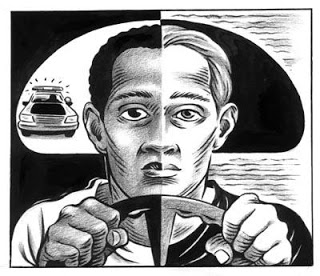
All of this amounts to a two-tiered legal system supporting a two-tiered economy. It criminalizes poverty unremedied by government whose main domestic function has become the imprisonment of the poor, and the extra-judicial execution of “criminals” accused of petty offenses like Eric Garner’s selling loose cigarettes, or of Sandra Bland’s failure to signal a lane change. That’s what’s ticking off black heroes like Colin Kaepernick and Michael Bennett.
Again, as Hedges points out, the scale of the resulting police lynchings is no exaggeration. So far in the U.S. this year, there have been 782 police killings of mostly poor people – many shot in the back while offering no immediate threat to cops involved. (By contrast, police in England and Wales have killed 62 people over the last 27 years!) Still, such legalized thuggery is granted near-universal impunity. Badge-wearing murders almost never go to jail.
In fact, far from being punished, local police forces are routinely rewarded by government grants of tanks and grenade launchers which further militarize their cadres. The unspoken intention of such armaments is to enable cops to quash rebellions of citizens incensed by the disparities just described. For instance, here in Kentucky, legislators want to empower motorists to run over protestors exercising their First Amendment rights on public thoroughfares. They want to extend impunity to white supremacists like the killer of Heather Heyer in Charlottesville last August. They want to militarily suppress the Black Lives Matter (BLM) movement.
But the footballers on their knees and the marchers in the street are only demanding sensible economic reform. The want well-paying jobs, affordable housing; safe and inspiring public schools; Medicare for all; and community-based policing where most officials are unarmed.
Imagine if Jerry Jones, the billionaire, forgot petty financial losses, and used the bully pulpit his status affords to campaign for such humane measures instead of misrepresenting his workers’ demands.
Don’t hold your breath though. That’s not the way our super-rich bosses operate.
 About Things That Matter