On Joining John the Baptist in Rebellion against the Religious Establishment – and Trumpism (Sunday Homily)

dangerous

Readings for Second Sunday of Advent: IS 11: 1-10; PS 72: 1-2, 7-8, 12-13; ROM 15: 4-9; MT 3: 1-12

“The meaning of the Incarnation is this: In Jesus Christ, God hits the streets. And preparing for that is the meaning of Advent.” (Jim Wallis. “Advent in 2016: Not Normal, Not Now, Not to Come.”)

__________

A few days ago I published a review of James Patterson’s novel, Woman of God. It’s the story of Brigid Fitzgerald, a medical doctor who though female, becomes a priest and candidate for the papacy.

Brigid and her husband (also a dissident priest) decide to form their own Catholic parish. They do so because of the studied irrelevance of the Catholic Church to pressing problems of the real world. The two call their congregation the “Jesus, Mary and Joseph (JMJ) Church.” They insist on remaining Catholics not allowing their opponents to drum them out of the church as just another break-away Protestant sect.

The JMJ Church spreads rapidly, largely because it connects Jesus’ Gospel with issues of peace and social justice. And though vilified by her local bishop and physically threatened by right wing Catholics, Brigid eventually becomes widely celebrated and is summoned to Rome not for condemnation, but papal approval.

I couldn’t help thinking of Woman of God as I read today’s liturgy of the word this Second Sunday of Advent. Like the JMJ Church, the first two readings along with the responsorial psalm emphasize the connection between faith and social justice.

Then in today’s Gospel, the prophet, John the Baptist, like Brigid Fitzgerald, initiates an alternative community of faith far from the temple in the desert wilderness. John’s credibility leads “all Jerusalem and Judea” to see him as a prophet. In fact, (as John Dominic Crossan has pointed out) John becomes for the Jewish grassroots their de facto alternative “High Priest.”

To see what I mean, consider that first selection from the prophet Isaiah. It directly links faith with justice for the poor, oppressed and marginalized. In Isaiah’s day (like our own) they were typically ignored. By way of contrast, Isaiah’s concept of justice consists precisely in judging the poor and oppressed fairly and not according to anti-poor prejudice – in Isaiah’s words, not by “appearance or hearsay.”  (A clearer statement against contemporary police and/or government profiling can hardly be imagined.)

Not only that, but according to the prophet, treating the poor justly is the key to peace between humans and with nature. Centralizing their needs rather than those of the rich produces a utopian wonderland where all of us live in complete harmony with nature and with other human beings. In Isaiah’s poetic reality, lions, lambs, and calves play together. Leopards and goats, cows and bears, little babies and deadly snakes experience no threat from each other. (This is the prophetic vision of the relationship between humans and nature – not exploitation and destruction, but harmony and mutual respect.)

Most surprising of all, even believers (Jews) and non-believers (gentiles) are at peace. Today’s excerpt from Paul’s Letter to the Romans seconds this point. He tells his correspondents to “welcome one another” – including gentiles – i.e. those the Jewish community normally considered enemies. (That would be like telling us today to welcome Muslims as brothers and sisters whom God loves as much as any of us.)

Today’s responsorial psalm reinforces the idea of peace flowing from justice meted out to the “least.” As Psalm 72 was sung, we all responded, “Justice shall flourish in his time, and fullness of peace forever.” And again, the justice in question has the poor as its object. The psalmist praises a God and a government (king) who “rescue the poor and afflicted when they cry out” – who “save the lives of the poor.”

In his own time, the lack of the justice celebrated in today’s first three readings infuriates Jesus’ cousin, John the Baptist. His disgust forces him out of the temple and into the desert. It has him excoriating the religious leaders of his day as a “brood of vipers.”

Unmistakably clothed as a prophet – in garments that absolutely repudiate the “sacred garb” of his effete opponents – John lambasts the Scribal Establishment which had normalized relationships with the brutal occupation forces of Rome. As opposition high priest, John promises a religious renewal that will lead to a new Exodus – this time from the power of Rome and its religious collaborators.

I hope you can see as I do the parallels between the context of John’s preaching and our own. We live in a culture where those in charge contravene our faith by openly slandering the poor and marginalized celebrated in today’s readings as especially dear to God. I mean since November 8th, all the levers of power (the presidency, the Supreme Court, the House and Senate) find themselves in the hands of billionaires and their friends – the 1% that the Occupy Movement identified so accurately five years ago. Ironically that richest 1% has succeeded in scapegoating the country’s poorest 1% (immigrants) as a major cause of our country’s problems. Moreover, they equally vilify other poor and marginalized people: the impoverished in general, brown and black-skinned people, women, the LGBTQ community, environmentalists, protestors and anyone who exposes the crimes of the billionaire class.

As a result, we are about to enter a period of unprecedented national darkness that promises to rival that of Germany, 1933-1945. For at least the next four years our country will be controlled by an organization Noam Chomsky calls “the most dangerous in the history of the world.”

More dangerous than the Nazis? Yes, Chomsky insists. Hitler did not have the power to destroy the planet by nuclear war. Hitler ruled Germany before climate change threatened innumerable species, Mother Earth herself, and continued human existence. And yet the entire Republican Party denies that the problem even exists! Yes, it is the most dangerous organization in the history of the world.

And despite all of that, there’s not a peep about it from the pulpit. People keep going to Mass as though the most important upcoming event is the arrival of St. Nicholas at the parish potluck – or the Christmas bazaar.

So what should we do in the face of such disconnect?

How about following the example of John the Baptist, Brigid Fitzgerald and her husband?

This would entail:

  • Admitting that present forms of church are hopelessly disconnected from the unprecedented tragedy and threat represented by the accession to power of anti-poor climate change deniers.
  • Publicly moving out of our local church building.
  • Perhaps, opening a store front JMJ Catholic church on the Main Street Jim Wallis referred to in his article referenced above.
  • Inviting former Catholics, college students, and other disaffected church members to join.
  • Publishing the invitation in local newspapers.
  • Meeting in the store front for Eucharist each Sunday at the very times the local church celebrates Mass.
  • Empowering faithful women in the JMJ community to preach and celebrate the Eucharist.
  • Gathering in the storefront on Wednesday evenings for prayer and to plan the week’s acts of resistance to Trumpism in all of its manifestations.
  • Using those premises as a sanctuary for the bottom 1% threatened by ICE and police.

Objectors will say:

  • We have no authority to do this.
  • It’s better to continue our reform efforts from within.
  • This will only cause division in our church.
  • The status quo really doesn’t bother me, because I use the quiet provided by Sunday Mass to facilitate my own prayer life.
  • (If, like me, you’re of a certain age) I’m too old for such radical disruption of my life.

To such objections John the Baptist might reply:

  • “I had no official authority to start my desert community of resistance and reform. In fact, I was identified by the authorities as an enemy of the state. Eventually they cut off my head. So don’t expect approval.”
  • Reform from within? “I gave up on that early on. So did my cousin, Jesus. Both of us operated outside the temple system which we criticized harshly.”
  • Division in our faith communities? “That didn’t bother me either. Can you get much more divisive or polarizing than calling religious leaders a ‘brood of vipers’?”
  • Withdrawing into personal prayer? “The spiritual masters in my Essene community convinced me that prayer and meditation are essential elements undergirding prophetic action. However, pietism is useless unless it leads to the kind of witness I gave and risk I took on the banks of the Jordan.”
  • Too old? “Again, my Essene mysticism would not permit me to identify with the physical as if I were primarily a body with a soul. The truth is that we are first of all ageless spirits who happen to inhabit temporary bodies. The imperative for action is no less incumbent on older people than on the young. Hell, the elders criticized me for being too young to oppose them. I was barely 30 when they killed me.”

Again, as Jim Wallis has intimated, the specter of John the Baptist should haunt us this second Sunday of Advent, and drive our faith communities onto Main Street. These unprecedented times call for radical response outside the sacred precincts and independent of the sleepwalkers awaiting the arrival of St. Nicholas.
(Sunday Homily) Black Lives, Muslim Lives Matter: Obama’s as Guilty as Wilson & Pantaleo

awlaki-killing-of-american

Readings for Second Sunday of Advent: IS 40:1-5, 9-11; PS 85: 9-14; 2 PT 3: 8-14; MK 1: 1-8. http://usccb.org/bible/readings/120714.cfm

Michael Brown, Eric Garner, and 12-year-old Tamir Rice. . . .

The very mention of those names calls to mind the protests that have filled our nation’s streets over the past week – in Ferguson Missouri, New York, Chicago, Los Angeles and places in between. The teenager, the father of six, and the sixth grade child represent deeply racist and unjust social structures where criminals and thugs masquerading as law enforcement officers have implicitly been granted a license to kill with impunity.

The nation-wide demonstrations on behalf of black and brown victims of the resulting “American” police state remind us that our country is decidedly on the wrong track. Like John the Baptist in today’s gospel excerpt, statements by New York’s Mayor de Blasio, Eric Holder, President Obama, and the U.N. special rapporteur on torture call us all to what the Greeks called metanoia – a drastic change of direction.

Ironically however that call to repentance is especially addressed to Messrs. Holder and Obama themselves. They, after all, find themselves in charge of a national and world-wide police state of which Mike Brown’s Ferguson and Eric Garner’s Staten Island represent merely the tip of an iceberg. The call to repentance invites all of us to apply pressure for profound systemic reform that far surpasses anything those “leaders” have in mind.

Today’s liturgical readings inspire such thoughts. Listen to the prophet Isaiah as he cries out for repentance and a restructuring of reality so intense that he imagines mountains being levelled and valleys filled. The point is to smooth the way for the advent of a profoundly non-violent God in our midst. The peace-filled change Isaiah envisions is not trivial.

Listen to Jesus’ mentor, John the Baptizer, as he echoes Isaiah word-for-word. (Needless to say, neither Isaiah’s nor John’s words have anything to do with the artificially excited anticipation of our culture’s Winter Festival and its orgy of selling, buying, and conspicuous consumption – even though “Christmas” deceptively continues to somehow associate itself with the homeless child from Nazareth.)

As a matter of fact, the cult of materialism and “Christmas cheer” couldn’t be more antithetical to sincere recollection of the birth of Jesus who had more in common with Mike Brown and Eric Garner than with the white middle-class culture Christmas celebrates.

More specifically, Jesus was the embodiment of nearly everything “good Christians” (presumably) like Officers Wilson and Pantaleo (the executioners of Brown and Garner) give evidence of despising.  After all, the working man from Nazareth was not only the poor son of an unwed teenage mother. He was an immigrant whose family took refuge in Egypt, the penniless friend of prostitutes and drunkards, and the prophet drummed out of his faith community as villain possessed by demons. He was the victim of torture and capital punishment who was treated as a terrorist by the reigning imperial power.

To the authorities of their day, both the Baptizer and Jesus even looked like Eric Garner and Michael Brown. Both were dark-skinned, either black or brown; they were not white men. Today’s gospel emphasizes how poorly John was dressed.

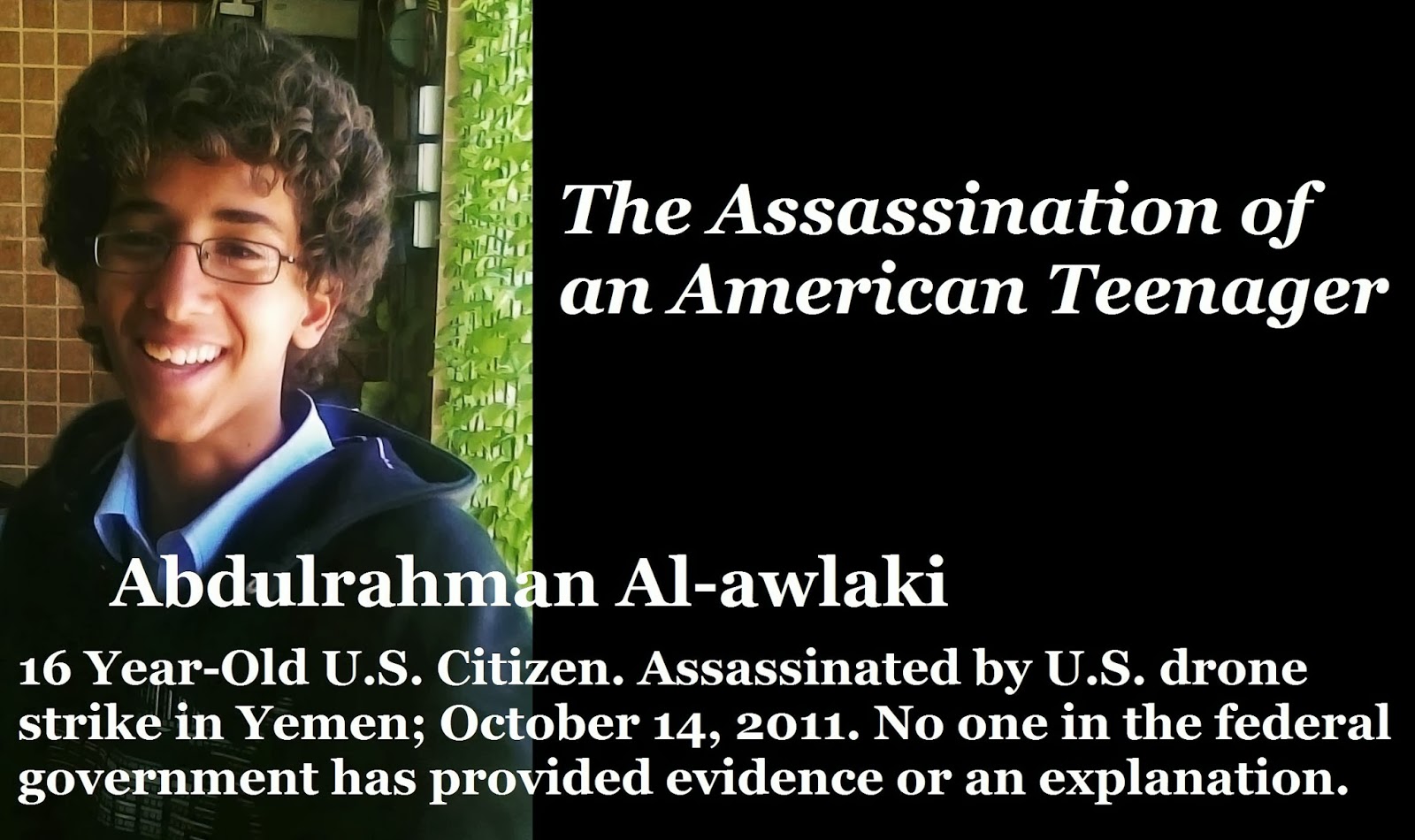
To repeat: during his life Jesus was impoverished, homeless, unemployed, accused of being subversive, placed on death row, and ultimately executed. As a Jew, he was considered as “other” and worthless to Roman authorities as Mike Brown was to Darren Wilson or Eric Garner to Daniel Pantaleo. He was as worthless as Abdulrahman Al-awlaki (pictured above) was to Barack Obama.

And that brings me to today’s real call to repentance.

It can’t merely be:

  • A superficial call to “trust” – an echo of Rodney King’s “Can’t we all get along?”
  • A reform of police culture
  • A de-militarization of police arsenals
  • A mandating of special independent prosecutors to handle incidents like those in Ferguson and Staten Island
  • Or even prosecution and conviction of police thugs like Wilson and Pantaleo

Instead, our nation has to address the root of the problem which is a world-wide policy of extra-judicial killings of racially-profiled Muslims and dark-skinned poor people. (That’s what a “signature strike” means as executed by drone “pilots.”)

Put otherwise, President Obama, Eric Holder and their minions are as guilty as Wilson and Pantaleo. All of them place themselves above the law. They kill with impunity those “others” they consider expendable. They answer to no one. They refuse to investigate much less prosecute such crimes.

John the Baptizer’s call to repentance summons us to publicize such guilt and completely withdraw support from the policies of the thug leaders of the world-wide U.S. police state.

That, I think, is what metanoia and repentance mean for “Americans” this particular advent.

Pope Francis’ Compelling Revolutionary Vision: What Progressives Have Been Waiting for (Sunday Homily)

Pope Bergoglio

Readings for Second Sunday of Advent: IS 11: 1-10; PS 72: 1-2, 7-8, 12-13; ROM 15: 4-9; MT 3: 1-12 http://usccb.org/bible/readings/120813.cfm

Recently articles in OpEdNews (my favorite on-line news source) have been full of revolutionary themes. For instance, Chris Hedges informed us of an invisible revolution simmering and about to erupt. It will be driven, he said, by widespread discontent with wages, wealth disparities, militarism, and climate change denial.

Then in his viral BBC interview, comedian Russell Brand called for revolution stimulated by everyone’s recognition of the futility of politics as we know it. No one should vote, he said; the system is too broken to be improved at the ballot box.

On the other hand, Senator Bernie Sanders’ revolution would be based wider participation in political processes, with everyone voting. That would overcome reactionary moves that disenfranchise voters and empower moneyed interests to determine electoral outcomes against the popular will.

Calling us back to reality, Robert Becker advised that any revolution at all is highly unlikely, since no one on the left offers compelling direction or revolutionary vision.

At the time of its publication, that last remark seemed apt. No world leader capable of mobilizing millions had yet emerged.

However all of that changed two weeks ago. The compelling direction and revolutionary vision whose absence Mr. Becker correctly lamented indeed materialized in an ironically unlikely form – a pronouncement of the Roman Catholic papacy.

On Tuesday November 26th, Pope Francis published his Apostolic Exhortation, Evangelii Gaudium (The Joy of the Gospel). It represents the most articulate and detailed “vision” of a revolutionary future yet offered by anyone actually capable of producing results in the street and at the ballot box.

That is, as a member of the world’s super-elite, and virtually above reproach and easy dismissal by his fellow aristocrats, the pope’s pronouncement demands serious consideration. This is especially true on the parts of the bishops and clergy who weekly have before them captive audiences voluntarily come together to meditate upon, pray about, and attempt to internalize the gospel vision which the pope describes as focused on the poor, peace, social justice and on the structural causes of violence, war and terrorism. Moreover, these themes, the pope insists, should be driven home in homilies at Sunday Mass, since such leitmotifs represent the inescapable essence of the Judeo Christian tradition.

Today’s liturgy of the word provides a case in point. It articulates the revolutionary vision and compelling direction the pope finds throughout the Bible. It’s a utopian vision that courageously connects peace with social justice and environmental consciousness.

Consider the first selection from the prophet Isaiah. It directly links peace and social justice – for the poor and oppressed who in Isaiah’s day and our own are typically ignored. By way of contrast, Isaiah’s concept of justice consists precisely in judging the poor and oppressed fairly and not according to anti-poor prejudice – in Isaiah’s words, not by “appearance or hearsay.” (No room here for “Stop and Frisk,” or “Shop and Frisk!”)

Not only that, but according to the prophet, treating the poor justly is the key to peace between humans and with nature. It produces a utopian wonderland where all of us live in complete harmony with nature and with other human beings. In Isaiah’s poetic reality, lions, lambs, and calves play together. Leopards and goats, cows and bears, little babies and deadly snakes experience no threat from each other. Most surprising of all, even believers (Jews) and non-believers (gentiles) are at peace. (Today’s excerpt from Paul’s Letter to the Romans seconds this point. He tells his correspondents to “welcome one another” – including gentiles – i.e. those the Jewish community normally considered incapable of pleasing God.)

Today’s responsorial psalm reinforces the idea of peace flowing from justice meted out to the “least.” As Psalm 72 was sung, we all responded, “Justice shall flourish in his time, and fullness of peace forever.” And again, the justice in question has the poor as its object. The psalmist praises a God and a government (king) who “rescue the poor and afflicted when they cry out” – who “save the lives of the poor.”

In his own time, the lack of the justice celebrated in today’s first three readings infuriates Jesus’ cousin, John the Baptist. Today’s gospel reading has him excoriating the religious leaders of his day as a “brood of vipers.” Unmistakably clothed as a prophet – in garments that absolutely repudiate fashion and the pretenses of his effete opponents John reminds us of the simple lifestyle adopted by Francis I. John lambasts the Scribal Establishment which had identified with the occupation forces of Rome. As opposition high priest, John promises a religious renewal that will lead to a new Exodus – this time from the power of Rome and its religious collaborators.

As part of today’s revolutionary theme, it’s important to emphasize the Exodus dimensions of Matthew’s description of John. The Baptist is presented as preaching and baptizing specifically outside the temple and sphere of the priests. In fact, John appears in the wilderness – in the desert. For Jews, this would not only have evoked overtones of their great myth of national origin. It would also have signaled a subversive significance in John’s work. After all, the “desert” or “wilderness” was the place where contemporary resistance movements were spawned. (I imagine that if the Romans had the power, they would have “droned” John and his followers in a “signature strike.”)

Do you see what I mean about harnessing the revolutionary power of the Bible’s myth, poetry, utopian visions, and preferential option for the poor? It’s all there in Isaiah, Psalm 72, in Paul’s letter to the Romans, and in Matthew’s portrait of John. And if we look with the eyes of Pope Francis, we can find those themes every Sunday. It’s powerful stuff, I’m sure you agree. And the pope not only sees that himself, he has called 1.2 billion inhabitants of this planet to recognize it along with him and act accordingly.

The action Francis recommends is particular. It consists in combatting a form of capitalism that he describes as systematized murder. He rejects “trickle-down” theory, and demands interference in the out-workings of markets in the name of the common good. The pope calls Catholics and others of good will to recognize access to food, education, and healthcare as human rights.

And the pope does all of this without demanding sophisticated comprehension of history, economic theories, or detailed social analysis.

Instead he relies on the power of myth, poetry, God-talk, and biblical focus on a divine preferential option for the poor and Jesus’ vision of God as universal parent.

All of that is there in today’s liturgy of the word. For any with eyes to see, it’s there every Sunday to assuage our hunger for “vision” and “direction.”

It’s time for progressives to follow the lead of Pope Francis. He’s calling us to set aside our pseudo-sophistication that has intellectuals rejecting the Bible’s power to mobilize huge masses of people. That is, we must reclaim the powerful mythology of the Bible and lay aside our practical disdain for story, myth and symbol. That’s where we’ll find our missing “vision and direction.”

I find that promising, invigorating . . . and somehow ironic.