80th Birthday Reflections Part 5: The Priesthood & Disordered Celibacy

My first year in Rome, James Kavanaugh wrote a national best seller called A Modern Priest Looks at His Outdated Church. It was a general critique of the Catholic hierarchy for not going far enough with the Vatican II reforms. For Kavanaugh, the church was still too priest and hierarchy centered. It needed more democracy. 

However, what most of us remember about A Modern Priest was its rejection of celibacy as a prerequisite for ordination. The book sparked many discussions at the dinner and supper table where our community of 12-15 young priests took our meals each noon and evening.

There, debates about scripture, theology, politics were the liveliest and best-informed that I’ve ever experienced. And I took part with great enthusiasm. My studies at the Anselmo were radicalizing me. They took me beyond post-Vatican II positions I had previously never dreamed of regarding church reform, the inspiration of the Bible, Jesus’ divinity, Mary’s virginity, the Reformation, papal infallibility, the priesthood itself, and, of course, celibacy.

Reluctant Celibates   

Intense debates about that latter issue were influenced not only by Kavanaugh, but by the more general sexual revolution that was a central part of the ‘60s and ‘70s. The contraceptive pill had been introduced in 1960. And with the fear of unintended pregnancy largely shelved, sexual freedom became the watchword of the day. Priests were not immune from any of that.

Previously, I mentioned earlier my own concerns about “reluctant celibacy.” Every priest I knew shared them. In fact, as I traveled (on motor scooter) and worked with priests in Austria, Germany, France, Spain, England, Ireland, Scotland, Belgium, Poland and elsewhere during my summers in Europe, I couldn’t help but notice that some priests had openly set aside their reluctance. For all practical purposes, they had become married priests. (Later, in Brazil, Costa Rica and elsewhere in Latin America, Africa and India I came across evidence of the same phenomenon.)

That was one aspect of the priesthood and the sexual revolution; priests were voting with their feet against mandatory celibacy; mostly informally some were getting married. Another aspect was that priests in general were leaving in droves in order to marry; they were seeking Vatican dispensations from their vows – including 3/4 of those who had entered the high school seminary with me back in 1954. In fact, thousands upon thousands of priests worldwide were abandoning their vocations.

In between those two categories were priests I knew who had girlfriends – something totally unheard of in the church I had grown up in. There, particular female companionship was absolutely forbidden. Even more, it was entirely scandalous for ordained men to seek dispensation from their vows. And no one (at least in the U.S. church) would live openly with a female partner. At least, that was the church I knew.

The Big Ed Factor

The girlfriend phenomenon showed up with a vengeance on Corso Trieste with the arrival of a character called “Big Ed.” He was a bullshitter; there’s no other way of saying it. And he changed the atmosphere in our house. Not that he lived there, but he was greatly admired by a whole clique of my friends who did.

Big Ed claimed he was a priest. But I’m not sure about that. That’s because (as I said) he was an inveterate liar. His shtick was to tell the girls that he was Tom McNeely, the 1960s heavyweight prizefighter whom he apparently resembled. (He’d tell them that as he mixed, shared and downed pitchers of boilermakers.) I suspect the ruse worked with many women. But who knows if he was telling the truth about being a priest?

What I do know is that his shtick worked with that clique I mentioned. Not that they believed him about being McNeely. But they all thought he was very cool. And they certainly admired his savoir faire with the women. For a while there, it seemed that they went out clubbing with him almost every night. All of a sudden, every conversation the next morning at breakfast was about Big Ed this and Big Ed that. Suddenly the man was a legend; he could do no wrong.

I bring him up because Big Ed epitomized the changes I’m describing here around the issue of priestly celibacy. As the years lengthened following Vatican II, we all found ourselves loosening up in relation to the restrictions that were so much a part of our seminary lives. We were drinking more, clubbing more, and interacting more with women. Eventually, I was no exception – except in my doubts, suspicions, and reservations about Big Ed. Even according to my own more relaxed standards, he seemed over the top.

My Own Crisis

Yes, eventually, I succumbed – or rather, I would say I finally appropriated my own sexual identity and acceptance of close female friends. I made the decision to do so at the age of 30. I won’t go into detail about the resulting discoveries, relationships and repercussions – things that all of us have gone through, but at ages much earlier than 30.

Before any of that, my own decision was hastened by those lively discussions mentioned earlier. I mean my growing “radicalism” had not passed unnoticed by the rector of our house on Corso Trieste. So, one morning just before my 30th birthday, he said he wanted a word with me. I remember our walking together in our residence garden ‘round and ‘round the house in deep discussion.

The rector informed me that he had written a letter about me to the Columban Superior General. Because of what he heard me saying at table, the rector had identified me to our Society’s leadership as “dangerous” and unfit to teach in the seminary after the attainment of my doctoral degree. Moreover, the rector said, he was disturbed by the fact that some young females from a high school on our street had been seeking me out for spiritual guidance. He thought that was inappropriate and suspect.

I was completely shocked. First of all, I was amazed that the letter had been written before discussing it with me. But secondly, there was absolutely nothing inappropriate about those meetings with the girls in question. I was actually proud that my Italian was good enough to do something “pastoral” other than simply offering Mass at local churches and convents. (At this point, I was involved in an alternative, lay-led church connected with the high school. In the middle of each week, its members met to discuss and prepare the following Sunday’s liturgy. It was extremely inspiring). Thirdly, I knew that unlike others in our community, I was studiously avoiding relationships I still considered ill advised.

Processing It All

I remember subsequently writing such reflections in my diary. They drove me to think more deeply not only about celibacy, but about decision-making in the religious group I had joined and generally in the church. The celibacy obligation, I knew hadn’t been imposed on priests till about the 12th century. And it had largely originated from the desire on the part of church officials to protect ecclesiastical property from inheritance by the offspring of priests.

I now allowed myself to recognize that such avaricious motivation had created an entirely patriarchal, basically misogynist and hypocritical subculture. It inflicted guilt on young people for following the dictates of the second most powerful human drive (after self-preservation) viz. their sexual instinct (or as Darwin might put it, propagation of the species). The church did that in general. Practically speaking, it reduced faith to obsession with sex. It had in the process put unbearable burdens on unsuspecting young boys like me at the age of 14. In retrospect, all of that seemed like an unwitting form of abusing children too young to give informed consent. And then by the time age of consent was achieved, we were all too indoctrinated (not to say brainwashed) to escape.

With all of that more or less unconsciously in mind, the priests I was increasingly encountering were exercising what theologians called the “sensus fidelium” about celibacy. (Something similar had happened more widely regarding contraception and divorce.) As I was coming to understand it, that theologically recognized “sense of the faithful” referred to near unanimous agreement on the part of lay believers about a matter of faith or morals regardless of what the hierarchy might say. That implicit unanimity, I saw, had already been achieved among priests across the Catholic Church; they no longer believed in celibacy. Among other Christians, that consensus had long since been reached following the Protestant Reformation in the 16th century. Regardless of what the hierarchy might say, the people had spoken. In short, I concluded that celibacy was no longer a priestly obligation.

Conclusion

As I write these words, I’m not even sure I should be sharing their revelations. It would be very easy for readers to get the wrong idea judging harshly the young priests I’ve described (including myself) as hypocrites cynically unfaithful to a vow we had freely taken. It would be very easy to be shocked, repelled and (for Catholics) to feel somehow misled and even betrayed.

In retrospect however, I see it quite differently. As I knew them, the men in question had in no way abandoned their faith. They remained very good priests – compassionate, understanding, idealistic and kind. We were simply products of our time characterized by a sexual revolution that touched everyone.

Even more (as the great German theologian Karl Rahner put it) the young men in question were not sinners; rather, we had been sinned against. And the offending party was an ecclesiastical institution whose stubborn regulations had laid a nearly unbearable and certainly unnecessary burden on the shoulders of good willed, highly motivated youths who had accepted obligatory celibacy with little notion of its implications outside the seminary’s protective walls. We simply wanted to be priests, not celibates.

I’d go even further. The priests I’m talking about were implicitly or explicitly influenced by the very theological studies I’ve been celebrating here. Following Vatican II those studies affirmed the insights of secular disciplines such as history, sociology and psychology. Freud, Jung, and their successors had shown that the celibate decision involved much more than just saying no. And yet, no one was there to help priests figure out what that “more” entailed. In other words, many of us had moved from Rohr’s first “order” box into inevitable “disorder” around our celibacy. It would take most of us a long time and many errors before we could get to “reorder.”

(Next time: Political disorder)  
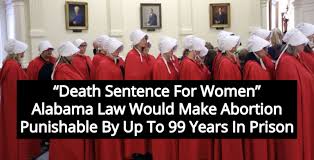
Why Not Kill Them All: Abortionists, Soccer Moms and God?

Anti-abortion extremism is in the news again. (Does it ever disappear?) As everyone knows by now, it’s because right-wing lawmakers in Alabama have advanced a law banning abortion at every stage of pregnancy – from the moment that sperm fertilizes egg. The law makes no exceptions for rape or incest.

In terms of logic, the law can easily be debunked as literally absurd. In terms of theology (and remember, the question of abortion has been shaped by theology, regardless of what we might think about that fact) the law makes God himself (sic) deserving of capital punishment. Finally, in terms of the U.S. Constitution, criminalizing abortion contradicts the First Amendment which explicitly states that “Congress shall make no law respecting an establishment of religion or prohibiting the free exercise thereof.”

To clear the air of confusion and to clarify the concept of pro-life itself, let’s consider each one of those points.

Logic

To begin with, consider the law’s logical inconsistency. It begins by holding that abortionists are killers deserving capital punishment. Its reasoning runs as follows: (1) Abortion is murder, (2) But all murders are capital crimes; deserving capital punishment; (3) Therefore abortion-providers should be punished by execution or life imprisonment.

Strangely, the woman who seeks an abortion finds no place in that logic. I say “strangely,” because her exclusion doesn’t make sense according the syllogism just referenced. Murder is murder. And legally speaking, employing a hit-man to kill another person makes the employer guilty of conspiracy to commit murder regardless of who actually pulled the trigger. Both contractor and contractee deserve the same punishment. Since it’s the woman who employs the murderer, why not execute her or imprison her for life, the same as the abortionist?

The answer is because doing so would be absurd. It would be politically untenable.

Virtually no one in the electorate would support it – especially in the light of polls showing that 80% of Americans believe abortion should be legal. Seventy-one percent oppose overturning Roe v. Wade – including 52% of Republicans.

Imprisoning abortion-providers might be one thing. But imagine, if legislators proposed filling jail cells with all the soccer moms among those responsible for the at least 45.7 million abortions performed since 1973 and the passage of Roe. Hundreds of thousands of moms in prison for life wouldn’t make sense. It is patently absurd.  It wouldn’t be acceptable to anyone.

But think a little further about those numbers. They are familiar to us, because “pro-birthers” usually employ them to train focus on the zygotes and fetuses in question. However, the numbers can also suggest something else.

Exchange the viewpoint of zygotes and fetuses for that of our mothers, wives, daughters and sisters who’ve undergone the procedure. If the fundamentalists are right, the sheer numbers mean that millions of the women we love are actually murderers. Millions of them over the last nearly 50 years have committed murder and, according to fundamentalist logic, deserve capital punishment – no less than the others on death row. Again, murder is murder. And in the case of abortion, the scale of the slaughter collectively perpetrated by the women we sleep with is beyond compare. It means that American women – women throughout the world – women in general – cooperate in mass murderers dwarfing the crimes of Hitler!

Logically speaking, all of that – treating abortion as murder, punishing abortion providers as capital criminals, refusing to do the same for the women employing them, and identifying millions of women throughout the world as evil murderers (while saying not a word about the men who impregnate them) – reduces to the absurd the position that abortion is murder.

In fact, it constitutes the very definition of logic’s reductio ad absurdum that proves the falsity of an argument by demonstrating that its conclusion is completely untenable. In other words, when you put words to it and draw the logical conclusions, the contentions of the pro-birthers sound absolutely crazy to almost everyone. Case closed.

Theology

And that brings us into the field of theology.

For Catholic moralists, commonly shared perception like that just referenced is called the “sensus fidelium.” Sensus fidelium refers to ordinary people’s conclusions about matters of faith and morals (such as abortion). It refers to conclusions based on common sense rather than the arguments of the experts including theologians. Catholic doctrine regards such agreement as infallible.

But here I’m suggesting a unique kind of sensus fidelium – one accessible primarily to women and their special ways of knowing. After all, male legislators cannot possibly understand women’s physiology, biological processes, psychology, or moral sensitivities in the same way as women.

In other words, women are a uniquely privileged reference group. However, because of the domination of theology (and politics!) by men, the latter act as if they know better than women. As a result, women are treated in effect as pre-rational children in need of direction by the culture’s patriarchs. (This, perhaps, offers another explanation of the disparate treatment of abortion-providers and women seeking abortion. The women in question are not truly responsible moral agents.)

To correct such imbalance, women of all faiths (and none) and not just Christian men should be in charge of any reasoning about and regulations of abortion. At the very least, such women deserve a decisive place at the table where theologians, ethicists and legislators discuss the question. If that were the case, another reductio ad absurdum would soon come to light – this one specifically theological. It would be that God Himself (sic) is the world’s abortionist-in-chief responsible for filling sewers with aborted babies.

What I mean is that according to medical researchers spontaneous abortion is the “predominant outcome of fertilization.” At least half of fertilized eggs are simply flushed down the toilet without their “mothers” even aware of their presence. They never knew they were pregnant in the first place.

If (as pro-birthers maintain) God is responsible for and cares about every fertilized egg, the conclusion is inevitable. God is a wholesale abortionist. Like all abortionists, he deserves the fate that death-of-God theologians declared fifty years ago.

(As a matter of fact, understanding God according to the absurdities just described might well be responsible for the rejection of his existence by rational adults. The fundamentalists themselves may have unwittingly but effectively executed him!)

Constitutional Considerations

What all of this means is that the recently passed Alabama law is unconstitutional, since imposes on Christians and non-Christians alike a particular religious (and therefore unproveable) theory about God’s role in the initiation of specifically personal life.

As we’ve seen, the particular theory arbitrarily holds that each fertilized egg is a unique human person with an immortal soul wedded exclusively to that particular fertilized ovum. The theory further holds that when the ovum in question dies, the soul’s God-intended purpose is forever frustrated. The world is forever deprived of the aborted-one’s unique gifts, which God cannot or will not supply through another person.

The idiosyncrasy of that position is unmistakable. As is the case with other faiths, one could easily understand early abortion as not that important in God’s grand scheme of things. A soul prevented from incarnating in one form could just as easily be imagined as appearing in another – when its time is right.

In other words, and more specifically, the theory that life begins when sperm fertilizes egg is not at all generally shared even across religions, much less by agnostics and atheists. For instance, some locate the beginning of personal life at the moment of “quickening” (when the mother first feels her baby move), others identify it with viability outside the womb, still others with actual emergence from the womb, or (as with some Native Americans) with the “painting” of the emergent child to distinguish it from animals.

Given such differences, it seems clearly unconstitutional to impose the view of one religion on an entire culture. We might expect such preference of one religious view over others from the Taliban. But it has no place in a governed by a constitution with the First Amendment quoted earlier in this essay.

Conclusion

The bottom line here is that in a diverse country like our own, some form of legislation like Roe v. Wade might be the best we can do. There it was determined that the pregnant woman as moral agent can decide about abortion on her own during the first trimester and in consultation with her physician during the second. In the third trimester, however, the state asserts its interest and can make laws restricting abortion to protect the woman’s health and the potentiality of human life.

However, a Roe v. Wade approach can never be sufficient for genuine pro-life advocates. For them, abortion law must be complemented by social programs that provide a welcoming atmosphere for all life forms. These would provide free counselling and pre- natal care for pregnant mothers along with post-natal services for their newborns. Job provisions would be available for new mothers along with free daycare for their pre-school children. Programs would also include low cost housing and (where necessary) help paying grocery bills. All such measures are genuinely pro-life. They not only discourage abortion; they also create a welcoming environment for new life.

However, don’t expect Alabama politicians to endorse such measures. For them, pro-life concern ends at birth. Afterwards, the burden must be assumed entirely by the mothers in question.

Benedictine Sister Joan Chittister has called such typically male attempts to evade responsibility by its true name. She wrote:

“I do not believe that just because you’re opposed to abortion, that that makes you pro-life. In fact, I think in many cases, your morality is deeply lacking if all you want is a child born but not a child fed, not a child educated, not a child housed. And why would I think that you don’t? Because you don’t want any tax money to go there. That’s not pro-life. That’s pro-birth. We need a much broader conversation on what the morality of pro-life is.”

Face It: Donald Trump Is Right about Abortion!

Trump Abortion

Let me get this straight. Republicans in general argue that abortion is MURDER. Isn’t that so?

In fact, don’t Tea Party extremists sometimes rationalize attacking and even killing abortion providers because the latter are murderers pure and simple? Or have I been somehow misreading those pro-life posters along Interstate 75?  “ABORTION IS MURDER,” the signs announce all the way to Florida.

Yet, when Donald Trump argues that such criminality should be punished in the usual ways, the entire Republican establishment is suddenly shocked and appalled.  Of course (they’re now saying) abortion shouldn’t be treated as murder. Who could possibly make such an insensitive misogynist argument?

Say what? Am I hearing that correctly? Or is there an acoustical problem in here?  Doesn’t all of that sound suspiciously “pro-choice?”  Have Republicans suddenly found Feminist Religion?

To give my questions a finer point: Donald Trump seems merely to be drawing the logical conclusion from the continuously reiterated Republican position on abortion. Though no one (not even The Donald) is crazy enough to say it like this, the argument’s syllogism runs as follows: (1) Abortion is murder, (2).But all murders are capital crimes;  deserving capital punishment; (3) Therefore abortion should be punished by execution or life imprisonment.

Though an inevitable conclusion from the standard Republican position, such logic is scary as hell. So even crazies like Ted Cruz are running away from it.

What is the justification for the Establishment’s sudden shift?

Here’s why: the Republican Party leadership doesn’t want Donald Trump to be the GOP standard bearer next fall. He’s not electable, they think. And he’s not orthodox enough on signature Tea Party issues like well . . . abortion. (Historically, he has waffled on the topic.) So they’ll do anything to prevent his advance – even if it means fudging on one of their signature positions. They evidently hope no one will notice the hypocrisy.

However, the fact that no Republican (except for Mr. Trump) is daring or logical enough to say out loud what Republicans have insinuated all along tells us that something is drastically wrong with not with The Donald, but with the “pro-life” position itself.

In Logic the sequence is called a reductio ad absurdum – a method of proving the falsity of an argument (for instance that abortion is murder) by demonstrating that its conclusion is absurd or untenable.

In other words, when you put words to it and draw the logical conclusion, the contention of the pro-lifers that abortion is murder sounds absolutely crazy to everyone.  Few in the electorate – especially women — will support it. Case closed.

In theology, we call such agreement the “sensus fidelium.” It refers to people’s conclusions about matters of faith and morals (such as abortion) based on common sense rather than the arguments of the experts. Catholic doctrine regards such agreement as infallible.

So Mr. Trump has done it again. Until his arrival, the electorate simply hasn’t heard the absurdity of Republican positions expressed so clearly.

As with other matters (immigration, racism, free speech, torture) Donald Trump in no way deviates from standard Republican craziness. His sin (and contribution) is to expose its absolute insanity for all to see.

Thank God for Donald Trump’s logic and candor! Somehow he’s a better thinker than many of us thought.