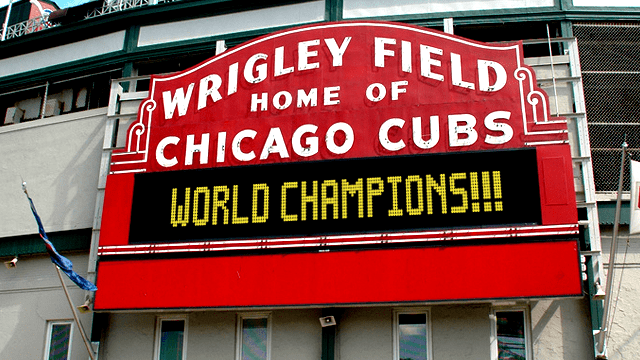
Cubs Win! Cubs Win! Now Anything Is Possible!

cubs

(Here’s a piece I wrote at the beginning of November — before the disaster of November 8th. Because the reflection is so upbeat, I hesitate to publish it now. Optimism somehow seems inappropriate after the recent election. But for what it’s worth, this is what I reported before Trump’s election.)

The worm has turned. Now anything is possible.

It’s the dawning of the Age of Aquarius. The 2012 New Era of the Mayan Calendar has begun. And along with those new beginnings, Theo Epstein’s arrival as President of the Chicago Cubs has changed everything there in just five (albeit painful) years.

Now the Chicago Cubs have won their first pennant in 46 seasons – their first World Series championship in 108 years!!

Count ‘em: one hundred and eight years!! (As they say, “Anyone can have a bad century.”)

Look, I know that in the end sports don’t really mean anything. I know that my colleagues on the left would tell me that it’s all part of the scam. It’s a distraction from what’s really important – love, peace, social justice and the struggle for their practical realization.

Professional sports are one of the ways working stiffs like me are tricked into channeling our energies towards false identities, superficial causes, and corporate celebrations. It’s a narcotic; a dope more powerful than religion. It keeps us asleep and tranquilized, when we should be out in the street throwing Molotov Cocktails.

I know. I know.

But I have to admit that I’ve happily allowed myself to be scammed like that for all of my 76 years – or at least for 66. I mean I’ve been a Cub fan ever since my family on Chicago’s North Side got their first television around 1950, when I was 10 years old. Since then every summer afternoon from April through October (and at night when they were on the road), the Cubbies have broken my heart and the hearts of all their fans (as Steve Goodman put it) “year after year, after year– after year, after year, after year.”

Who among us can forget 1969, when they blew a 9 ½ game lead in August and finished 8 games behind the Miracle Mets? What about the horrendous turn of events in 2003 when they wasted a 3-1 series lead against the Miami Marlins and missed going to the World Series by just 5 outs?  (Thanks, Steve Bartman!)

All that time, I’ve lived and died with the Cubs – mostly died. Ernie Banks was my boyhood hero. I imitated his batting stance. Yet, the “lovable losers” have disappointed with unbelievable consistency . As I said, they’ve been doing it to us all for those 108 miserable years!

All that time, at seasons’ end, we’ve been forced to say “Wait until next year.”

Well, the wait is over. Next year has arrived! The Chicago Cubs won their first World Series. And (I blush to admit) it made me very happy.

Thanks to the generosity of my daughter and son-in-law, I was in Wrigley Field’s “friendly confines” for game four of this year’s wrangle with the Cleveland Indians. The atmosphere inside and outside the park was absolutely electric. And when the Cubs scored first, the din made me think I was about to lose my hearing. It was delightfully excruciating. “Go, Cubs, go. Go, Cubs, go!”

My euphoria however soon turned to déjà vu. The Indians came back and turned that early lead into a 7-2 rout against my home team. We left the park tired and cold with a distinct feeling of “here we go again.” The Indians had a nearly insurmountable 3-1 series lead. The feeling was sooo familiar.

Next year, anyone?

But the Cubs came back! They won their final game in Chicago, and then two more on the road in Cleveland. Three in a row!

The final contest was a rain-delayed, extra inning thriller that no one with my Cub history will ever forget. Even there the Cubs blew what had been a 4 run lead in the 8th inning when their best un-hittable relief pitcher (Aroldis Chapman) gave up a 2-run homer. It was heart-stopping. But the Cubs went on to win.

So what do I take away from it all.

Sports are transcendent. They’re better than church – more fun. They give us a chance to identify and commune with people of all stripes and identities recognizing our common humanity despite those differences. It is possible to overcome it all.

Sports give us hope. They help us realize the truth of Mother Jones’ observation: “You lose, you lose, you lose, you lose, and then you win.”

Triumph is inevitable. It’s the way the Universe is constructed. At least that’s what the great spiritual Masters – and sports fans all over the world – tell us.

Now if we can just transfer those convictions and realizations to what’s really meaningful, we might be able to turn our entire battered world into friendly confines.


Democracy at Work and in Play: Capitalist Rams vs. Socialist Packers

On Tuesday , Stan Kroenke, the owner of the NFL Rams franchise decided to move operations from St. Louis to Los Angeles.

The decision brought sorrow and a bitter sense of betrayal fans in St. Louis who have supported “their” football team through thick and thin. For them the penny dropped: their Rams were not theirs at all.

The obvious injustice prompted them to chant “Kroenke Sucks!” when the move was announced during a St. Louis Blues –New Jersey Devils hockey game.

The chant showed that people intuitively recognize the problem. It’s the problem of capitalism: a single owner backed by a small group of similar wealthy stockholders can override the interests of an entire local community for one reason and one reason only — MONEY!

With capitalism, it happens all the time. A small board of directors (15-20 people) can decide to override the interests of entire communities — Detroit, Youngstown, Camden New Jersey — and move operations offshore to Mexico, China, Taiwan, and who knows where else? In doing so, the private owners devastate the abandoned communities. Yet they bear no responsibility for their actions.

They simply leave. They leave without reimbursing the community for roads built to service their facilities, for tax breaks granted, for plants constructed with community subsidies, for families destroyed by loss of employment.

And, once again, it’s done for one reason and for one reason only — MONEY! It’s the logic of capitalism.

It doesn’t have to be that way.

As economist Richard Wolff has indicated, there can actually be democracy at work. Democracy at work means that if workers shared ownership of their factories, they’d never vote to offshore their jobs.

Following Wolff’s logic, there can also be democracy in play — even in the NFL.

The case of the St. Louis Rams contrasted with that of the Green Bay Packers illustrates the possibility. Unlike the NFL Rams, Packers’ owners could never vote to move their franchise. That’s because the owners are the club’s fans themselves. So moving from Green Bay (pop. 104,000) even to Los Angeles (pop. 4.8 million) is out of the question.

More specifically, according to the Packers’ 1923 Articles of Incorporation, no single person can control more than 4% of the club’s stock. So these spiritual descendants of workers — the Green Bay Meatpackers’ Union — have no one like Kroenke to deal with.

Moreover, Incorporation Articles stipulate that profit from any (unimaginable) transfer of ownership must go not to individuals but to the Green Bay Packer Foundation which benefits community education, civic affairs, health and human services and youth programs.

There are lessons in all of this:

– Democracy at work and in play is possible.

– It is preferable to capitalism’s oligarchical tyranny.

– The traditional name for such democracy is “socialism.”

– Socialism can be successful. (The Packers have won more championships than any of their capitalist competitors).

– Maybe workers should be rooting for the Packers in Saturday’s matchup with the Arizona Cardinals.

– Bernie Sanders is a socialist. Hmm . . .

Golfing for Enlightenment: An autobiographical review of Chopra’s book (in three parts)

It’s summertime. And although it may seem out of character to many of my friends – and somehow misplaced in these pages – I must confess I am a golfer. My son, Brendan, gave me a new set of sticks (Adams “Speedline Fast 10”) for Christmas. I love the clubs, and have been breaking them in all summer. So golfing is on my mind.

Let me begin by correcting that opening line. I said I’m a golfer. To phrase it more accurately, my life has been cursed by golf! Yes, I love the game. The beauty of golf courses truly brings me back to the Garden.  When Tiger’s playing, I feel compelled to monitor his every shot. When he’s “on,” his game reminds me of the near perfection that’s possible in life itself.

And yet, I hate the game too. I wonder about a sport that’s so white, so elitist, that uses so much water, and that’s so chemical-dependent in terms of fertilizers and pesticides. In those respects, it’s like the world in general. As for the game itself, whoever called it “a good walk spoiled” was right. For me its downs are so frustrating; its ups so few by comparison. I guess that’s like life too.

In Golf for Enlightenment: the seven lessons of the game of life, Deepak Chopra agrees. He shows how the two – golf and life – are deeply interrelated and connected with the spirituality that none of us can escape. Reading it caused me to reflect on my own experiences of all three – golf, life, and spirituality.

Let’s begin with golf. . . . I inherited the game. All the men on my father’s side of the family were avid golfers. And when I was in grade school, my dad often took my brother Jim and me to a course near our home on the northwest side of Chicago to introduce us to the game.

That doesn’t mean that I come from the country club set. I don’t. My background was working class. I grew up in the 1940s. My father was a truck driver. His three brothers (he also had four sisters) were brick layers, bar tenders, and construction workers; one was a sometime bookie. But they all started out as caddies at Butterfield Country Club just west of Chicago. And that’s where my father, Ray, and his brothers, John, Leonard, and George learned the game – as caddies.

That’s where I learned the game too. In my early teens, I caddied at Bryn Mawr Country Club in Lincolnwood, just north of Chicago. I was Caddie # 339, when the best caddies would be #1 or #2. Somehow though the caddie master, Jack Malatesta, took a shine to me, and throughout my years at Bryn Mawr, Jack kept calling me “339,” even though he ended up giving me some of the best “loops.”  Later, beginning in high school, I worked on the grounds crew at Arrowhead Country Club in Wheaton, Illinois. I remained there for fifteen years. As I said, golf’s in my veins.

In fact, I’ve been swinging a club since I was seven or eight. And by the time I got to Bryn Mawr, older caddies were telling me that I had one of the best swings they’d seen. That made me feel good. Little did I know such compliments would represent the high point of my golfing life. Problem was, my swing looked great, but it never got me straight shots or low scores.

Let me put it this way:  it wasn’t till my 21st birthday that I broke 100 for the first time! And it’s pretty much stayed like that till about the age of 30 when I walked away from the game.  Its frustrations along with my work and family obligations (not to mention the high cost of playing golf) made me stop.

Next week: How my sons brought me back to the game (of life)