Readings for 20th Sunday in Ordinary Time: ISAIAH 56: 1, 6-7; PSALMS 67: 2-8; ROMANS 11: 13-15, 29-32; MATTHEW 15: 21-28
Today’s readings return us to the idea explored here a few weeks ago – Big God faith vs. small god beliefs. Today’s selections point to the latter as the root of diabolically deep divides like those separating Jews from Palestinians – as well as the rest of us from those we despise as somehow “foreign.”
This time however, the vehicle for making the Big God point is mildly sarcastic humor. And it comes from a completely unexpected source – a presumably uneducated Palestinian woman schooling a specifically Jewish prophet about his small god beliefs. It’s the only place in the early Christian tradition where Jesus is out bantered and rendered speechless in what can only be described as a contest of repartee. The joke is that the Great Teacher loses!
The woman in question is a Palestinian mom seeking a cure for here mentally disturbed daughter whom the reigning culture considered demon possessed. Within the story’s context, the demon in question seems to be a product of the dominant Jewish culture’s belief in a small nationalistic god who favors Jews over Palestinians. No wonder the child was disturbed; she had been told since birth that she was worthless. That, of course is the same demon that today not merely causes Palestinian children (and a whole list of others in our world) mental anxiety; too often, it costs them and/or their parents and siblings their very lives.
The woman is remembered by Matthew as “Syrophonician.” That meant she was not a Jew. She was a native or inhabitant of Phoenicia when it was part of the Roman province of Syria. She was living near the twin cities of Tyre and Sidon — a gentile or non-Jewish region of the Fertile Crescent where Matthew takes trouble to locate today’s episode. As I said, that would have made Jesus’ petitioner what we call a “Palestinian” today.
(By the way, Matthew’s geographical note serves to remind us that the Jews never controlled all of their “Promised Land.” Instead, they always had to share it with “Palestinians” including Canaanites, Hittites, Amorites, Perizzites, Hivites, Jebusites, Geshurites, Maacaathites, and Philistines.)
In any case, the woman’s daughter is troubled apparently by this culturally imposed anxiety.
So, identifying Jesus as specifically Jewish, the woman petitions: “Have pity on me, Lord, Son of David! My daughter is tormented by a demon.”
Jesus responds by ignoring his petitioner at first and then by disrespectfully associating his petitioner with dogs — almost calling her a b*tch. Disdainfully, he says, “I have been sent for the lost children of Israel . . . it is not right to take the food of the children and throw it to the dogs.”
The reply seems out of character for Jesus, doesn’t it? In fact, such dissonance has led many to reject the saying as inauthentic. (On the contrary, I would say that the negative light in which this tale presents Jesus argues for its authenticity. After all, the evangelists were anxious to present him as favorably as possible. Why would they make up a story like this?) Whatever the case, Jesus’ reply only echoes the rabbinic saying of the time, “He who eats with idolaters is like one who eats with a dog.”
In other words, Jesus’ comparison stands in a long line of small godders likening cultural outsiders to animals. If Matthew’s account is accurate, in his initial silence and then in his harsh response, Jesus was showing himself to be captive to his people’s traditional norms.
However, the brave woman in today’s gospel doesn’t take no for an answer. She drolly replies, “Please, Lord, for even the dogs eat the scraps that fall from the table of their masters.”
The witty answer evidently astonishes Jesus. We can almost hear him laughing as he shakes his head and exclaims, “O woman, great is your faith! Let it be done for you as you wish.” In other words, the woman “converts” Jesus; he concedes her argument. The one the gospels present as the master of verbal riposte is vanquished by this simple Palestinian mom.
Even more importantly, the woman’s daughter is cured. The demon that possessed her leaves. That is, by overcoming his reluctance and expanding his own nationalistic understanding of God, that broadened awareness was somehow communicated to the woman’s daughter. No more possession.
The lesson? Transcending small god religious convictions can vanquish even demons with supernatural powers. By comparison, overcoming more pedestrian foes is easy. Small god beliefs are diabolical. Setting them aside heals even at a cosmic level.
Today’s Readings
Notice how that encouraging Big God understanding is communicated by this Sunday’s entirely expansive vision communicated in all four readings. Here are my “translations” of their content. Please read them yourself here to see if I’ve got them right.
ISAIAH 56: 1, 6-7: What separates God’s People from the rest is not nationality, but their embrace of social justice towards everyone else. That’s what unites “foreigners” to our Great Mother. Doing justice makes their landscapes as holy as our own. It renders their altars sacred and their offerings meaningful. It designates their houses of worship as centers of joy.
PSALMS 67: 2-8: Yes, according to their own customs, all people everywhere (implicitly or explicitly) recognize and worship the same Holy Mother. She is compassionate towards them all, guides them, and showers each with abundant blessings. That’s simply the divine way. All of us can be happy about such universal inclusion.
ROMANS 11: 13-15, 29-32: So, for our Mother there are no “foreigners.” There shouldn’t be for us either. Otherwise, we’re like petty jealous children vying for parental love and “telling on” each other for supposed disobedience. Accepting everyone as God’s gifted and forgiven children challenges every one of us to embrace a new form of living based on God’s universal love.
MATTHEW 15: 21-28: Even Yeshua had to learn this lesson. When a Palestinian woman approached him as a specifically Jewish prophet, he at first ignored her and then nearly called her an unworthy “b*tch. He did! But she outsmarted him with a clever reply that made him laugh and melt. The demons of religious nationalism recoiled in disappointed disgust.
Conclusion
Off hand, I can think of about 10 conclusions to draw from today’s remarkably “Immense God” readings – and especially from today’s especially noteworthy story about the humbling of Jesus and the forced shift in his small god convictions. Here they are organized into two groups, one particular (i.e. related to our Gospel narrative) and the other a bit more general:
Particular
- Small gods are seductive: Even Yeshua succumbed.
- They are bad for mental health: Small god religion can drive people crazy as it did the daughter in the story at hand. (No religion at all seems preferable.)
- Mother power is unstoppable: Very few need convincing here. Mamma bears will defend their cubs no matter what. Like most mothers, this Palestinian mom wouldn’t take no for an answer.
- In general, women have much to teach even the wisest of men: To this day under patriarchy, it remains difficult for many to accept that mother usually knows best.
- Change in consciousness can be miraculous and contagious: Who knows when this schooling of Jesus occurred in his life? If it happened, it probably came at the beginning. If so, it represented a radical and transformative shift in his approach to God.
More General
And that leads me to more general conclusions about Jesus’ conversion. Following the Big God insight that he learned from the Palestinian mom, Jesus’ revised understanding evidently led his most universally admired followers to conclude that:
- Borders are arbitrary: They were not part of the original divine plan. As the universe comes from the hand of God, there are no borders. (And anyway, they keep changing all the time.) Human beings should be free to roam the earth as they wish.
- Nationalities are random too: Even in the Jewish Testament, it’s only gradually that humans “fall” from their original unity into the sin of national distinctions. In the divine order, there are no Jews, gentiles, Syrophonicians, or Palestinians, blacks or whites.
- Laws are entirely questionable: For the sake of human welfare, Jesus easily set aside even the “holiest” of laws (such as Sabbath Law). He recognized love’s law as supreme relativizing all others (Matthew 22:37-40). Those other regulations usually exist only to protect the rich and powerful. That’s who made them!
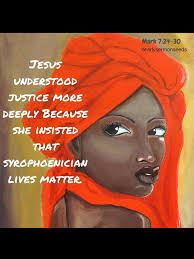
- Racial distinctions are equally meaningless: What could be more relevant for us today? Syrophoenician lives matter. Palestinian lives matter. Black lives matter.
- Bold humor conquers all: This is perhaps the most important point driven home by today’s readings. Getting us to laugh at ourselves and our petty beliefs can melt hearts, overcome deep-seated prejudice, and restore sanity for everyone.
 About Things That Matter