(Sunday Homily) Pentecost: the Spirit of Jesus in Pope Francis & Oscar Romero!

Romero poverty

Today is Pentecost Sunday, sometimes called the “Birthday of the Church.”

Significantly, Pentecost’s vigil (yesterday) is the day the church has chosen to “beatify” Oscar Romero, the martyred archbishop of San Salvador, who was assassinated in El Salvador on March 24th, 1980. His beatification (the final state before canonization or sainthood) took place there yesterday.

The co-incidence of the two anniversaries is full of meaning for a community of faith desperately in need of rebirth.

Politically speaking, the unblocking of San Romero’s beatification process by Pope Francis represents the pope’s call to appropriate Jesus’ Spirit of Life and leave behind all traces of the political conservatism that characterized most of the archbishop’s life. Pope Francis calls us to boldness, radicalism and outspoken partisanship on behalf of the world’s poor. That’s the Spirit of Jesus, he says. It’s the Spirit Oscar Romero eventually embraced.

To get what I mean, please join me in reflecting on (1) Roman Catholic conservatism – at least as I currently experience it, (2) the conversion of Oscar Romero to the radicalism of liberation theology’s “preferential option for the poor,” and (3) the directions for similar change given by Pope Francis in his “Joy of the Gospel.” Following those directions, I argue, promises his church a New Pentecost.

I The Irrelevance of the Catholicism I Experience

To begin with, consider the Catholic Church I experience each week. Its present form is a construction of the reactionary popes, John Paul II (1978-2005) and Benedict XVI (2005-2013). I consider their papal reigns disastrous.

Because of their counter-reforms, my local parish not only ignores the progressive initiatives of the Second Vatican Council, it gives every indication of attempting to reverse them in the minds of my fellow parishioners.

In fact, the documents of Vatican II are rarely referenced in our church. Their place has been taken by the conservative invention, The Catechism of the Catholic Church.

“Masses” from one week to the next show almost no variation or planning. Everything seems rote. Sermons are full of clichés about heaven and churchy bromides. Not a word connects the Radical Jesus with Ferguson, Baltimore, Iraq, drone warfare, torture, the LGBTQQ struggles, or climate chaos. To introduce such topics might “upset” some people, so they’re completely ignored.

No such sensitivity, however, is displayed regarding conservative issues concerning abortion, gay marriage or climate change. The latter is almost never mentioned, while the former issues (abortion and gay marriage) are highlighted at every opportunity. Our diocesan newspaper, The Crossroads, communicates the distinct impression that good Catholics are good Republicans and vote accordingly.

II Oscar Romero’s Pentecost

For most of his life, Oscar Romero would have been comfortable in my local church.

Remember, Monsignor Romero started out conservative in every sense of the word. To a large extent, that’s why he was appointed archbishop in 1977. Romero was considered safe. He was patriotic. He unquestioningly supported his country’s military. He looked on the widespread rebellion of the poor in El Salvador with great suspicion. He considered the would-be revolutionaries communist subversives.

And yet, the archbishop had this close friend on the opposite end of the political spectrum. He helped Romero grow. That friend was Rutilio Grande. Grande was a Jesuit who took seriously his vow of poverty.

So Father Grande moved out of the parish rectory and lived with the poor. He knew first-hand their struggles, their family break-downs, their unemployment, hunger, low wages, and harassment by local police.

Worse still, Grande knew the Salvadoran military’s strategy for defeating the country’s impoverished insurgents. It was simply this: kill everyone who might possibly be sympathetic to rebel forces. That meant most of the country’s non-elite. It meant many of their parish priests. For Rutilio Grande, the slogan of the White Hand death squad represented an everyday reality and threat: “Be a patriot; kill a priest.”

Eventually, of course, the White Hand killed Rutilio Grande himself.

It was his martyrdom that pushed Oscar Romero over the edge and radicalized him. He utterly abandoned his conservatism. He would later say, “When I looked at Rutilio lying there dead, I thought, ‘if they have killed him for doing what he did, then I too have to walk the same path.’” (The “they” Archbishop Romero referred to was his own government, its military, and their backers in the United States.)

So Archbishop Romero started listening to the poor. He attended their “biblical circles,” where peasants shared their thoughts about Sunday gospel readings.

Once after listening to simple farmers sharing thoughts about “The Parable of the Sower,” the archbishop stood up without comment and walked away from the group. The local priest followed him and asked anxiously, “What’s the matter, Monsignor, did something offend you?”

“No,” the archbishop responded, “quite the opposite. It’s just that I think I’ve heard the Gospel of Jesus today for the first time.”

In other words, the archbishop discovered that when poor people read the Bible, they see things that remain invisible for conservatives comfortable with whiteness, patriarchy, and empire.

Jesus was none of those things, the archbishop realized. He was brown or black, poor, a victim of empire, and counter-culturally open to the viewpoints and experience of women. Those were the Master’s viewpoints. They deeply influenced how he saw the world.

More specifically, Jesus stood on the same ground as El Salvador’s poor (and the poor of the Global South). He was born out-of-wedlock to a teenage mother. He was an immigrant in Egypt for a while. He was a working man with calloused hands and sweat-stained clothes. He loved fiestas. His friends, people said, were drunkards and prostitutes. Rabbis expelled Jesus from the synagogue, and thought he was diabolically possessed. Even his family questioned his sanity. Jesus became a vagrant without visible means of support. He lived under an oppressive empire. Imperial authorities saw him as an insurgent and terrorist. He ended up on death row, a victim of torture and of capital punishment.

All those characteristics, Archbishop Romero realized, described Another Jesus that to him was far more compelling, inspiring and faithful to the gospels than the abstract and other-worldly Jesus elaborated in the theological texts that guided his doctoral studies in Rome.

So Romero concluded that the poor knew Jesus more deeply and authentically than he ever could. (They had what scholars called a “hermeneutical privilege.”)

Even more, the Jesus of the Poor revealed Another God who alone can save our world from the path to destruction we’ve embarked upon. (And this is where Pope Francis’ continuity with Romero’s vision comes in.)

III Pope Francis’ Pentecost

Like the converted, Spirit-led Oscar Romero, Pope Francis does not shy away from radicalism, controversy or partisanship in the name of social justice. In fact, the pope identifies the struggle for social justice and participation in political life as “a moral obligation” that is “inescapable” [“Joy of the Gospel” (JG) 220, 258].

And the pope walks his talk. Think about his:

  • Part in negotiating an end to U.S. policy towards Cuba, despite what Miami Cubans might think.
  • Recognition of the Palestinian state in the face of objections from Israel and its supporters.
  • Identification of the Palestinian Authority’s Mahmoud Abbas as an “angel of peace” over the same objections.
  • Famous “who am I to judge” statement about homosexuality.
  • Unblocking of canonization procedures for Oscar Romero, the patron saint of liberation theology.
  • Embrace of liberation theology’s “preferential option for the poor.”
  • Planned encyclical on climate chaos, even over objections by U.S. Republicans and their think tanks like the Heartland Institute.
  • Stated intention to influence the Paris Climate Summit next December.

Yes, (in U.S. terms) the pope has not been afraid to alienate Republicans and give the distinct impression that their agenda is largely incompatible with Christian faith.

I’d even go so far as to say that “The Joy of the Gospel” is like a manifesto against Republican approaches to social issues. I mean, JG:

  • Condemns wide disparities in income (188).
  • Advocates redistribution of wealth (189)
  • Rejects trickle-down economic theory as illusionary and entirely dysfunctional (54).
  • Sees unfettered markets as homicidal (53), ineffective (54), and unjust at their roots (59).
  • Demands market regulation as indispensable (56).
  • Views “each and every human right” [including education, health care, and “above all” employment and a just wage (192)] as intimately connected with “defense of unborn life” (213).
  • Presents environmental protection as a moral imperative (215, 216).
  • Dismisses war as incapable of combatting violence which the pope sees as caused by “exclusion and inequality in society and between peoples” (59).

Conclusion

It will no doubt offend some in my parish to read these words. But that’s the point of Pentecost, isn’t it – to shake us up?

After all, Jesus offended the conservative members of his parish-equivalent. Romero offended conservative Salvadorans and conservative U.S. “Americans.” Pope Francis makes no bones about offending Jewish Zionists, Miami Cubans, U.S. Republicans and climate change deniers.

The Spirit of Life is not conservative. It is not imperial. It wants everyone to survive and thrive – especially the ones the dominant order rejects as unworthy.

In those senses, It makes a preferential option for the poor.
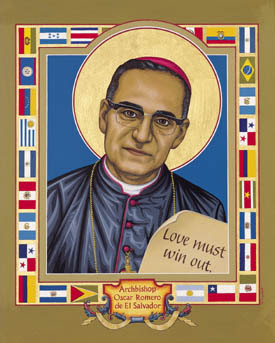
Oscar Romero’s Message: Another God Is Possible; Another God Is Necessary!

PROMO9
PROMO9

(This is the second in a three-part series on our parish’s upcoming celebration of the beatification of San Oscar Romero which will take place on May 23rd. The event will be observed in Berea’s St. Clare’s parish on June 3rd, when our new bishop, John Stowe, will join us.)

In the previous installment of this mini-series inspired by the upcoming beatification of El Salvador’s Oscar Romero, I offered a thumb-nail sketch of the great archbishop’s life. Romero’s witness has been inspiring for many, including Lexington’s new bishop, John Stowe. (As I said, think of the thoughts that must have coursed through the bishop’s mind as he celebrated Mass recently at the very altar where Oscar Romero was shot. We look forward to his sharing those thoughts on June 3rd when he joins our local church to celebrate Monsignor Romero’s beatification.)

In fact, Monsignor Romero’s story should be encouraging to each of us because of its life-changing implications. It connects perfectly with the message of Pope Francis in his “Joy of .the Gospel.” Both tell us that political and spiritual transformation is not only possible; it is necessary to save our world.

First of all consider the example of Oscar Romero. His change was profound both politically and religiously. In both dimensions, he became a radical, like Jesus of Nazareth.

Remember, Monsignor Romero started out conservative in every sense of the word. To a large extent, that’s why he was appointed archbishop in 1977. Romero was considered safe. He was patriotic. He unquestioningly supported his country’s military. He looked on the widespread rebellion of the poor in El Salvador with great suspicion. He considered the would-be revolutionaries communist subversives.

And yet, the archbishop had this close friend on the opposite side of the political fence. He helped Romero grow. That friend was Rutilio Grande. Grande was a Jesuit who took very seriously his vow of poverty.

So the priest moved out of the parish rectory and lived with the poor in their barrio slums. He knew first-hand their struggles, their family break-downs, their unemployment, hunger, low wages, and harassment by local police. Those became his issues, his context for interpreting the Gospel of Jesus.

Even more, Grande knew the Salvadoran military’s strategy for defeating the country’s impoverished insurgents. It was simply this: kill everyone who might possibly be sympathetic to rebel forces. That meant targeting most of the country’s non-elite. It meant butchering many of their parish priests. For Rutilio Grande, the slogan of the White Hand death squad represented an everyday reality and threat: “Be a patriot; kill a priest.”

Eventually, of course, the White Hand killed Father Grande himself. It was his martyrdom that pushed Oscar Romero over the edge and radicalized him. He utterly abandoned his conservatism. He would later say, “When I looked at Rutilio lying there dead, I thought, ‘if they have killed him for doing what he did, then I too have to walk the same path.’” (The “they” Archbishop Romero referred to was his own government, its military, and their backers in the United States.)

So Archbishop Romero started listening to the poor. He attended their “biblical circles,” where peasants shared their thoughts about Sunday gospel readings. Once after listening to simple farmers sharing thoughts about “The Parable of the Sower,” the archbishop stood up without comment and walked away from the group. The local priest followed him and asked anxiously, “What’s the matter, Monsignor, did something offend you?”

“No,” the archbishop responded, “quite the opposite. It’s just that I think I’ve heard the Gospel of Jesus today for the first time.”

This is where Romero’s Other Gospel, Other Jesus, Other God comes in. The archbishop discovered that when poor people read the Bible, they see things that remain invisible for people like us who tend to be white, comfortable, patriarchal, and supportive of empire.

Jesus was none of those things, the archbishop realized. He was brown or black, poor, a victim of empire, and counter-culturally open to the viewpoints and experience of women. Those factors constituted the Master’s standpoint. They deeply influenced how he saw the world.

More specifically, Jesus stood on the same ground as El Salvador’s poor (and by extension, the poor of today’s Global South). He was conceived out of wedlock by a teenage mother. He was an immigrant in Egypt for a while. He was a working man with calloused hands and sweat-stained clothes. His friends, people said, were drunkards and prostitutes. Rabbis expelled Jesus from the synagogue, and thought he was diabolically possessed. Even his family thought he was insane. Jesus became a vagrant without visible means of support. He lived under an oppressive empire. Imperial authorities saw him as an insurgent and terrorist. He ended up a victim of torture and of capital punishment.

All those characteristics, Archbishop Romero realized, described Another Jesus that to him was far more compelling, inspiring and faithful to the gospels than the abstract and other-worldly Jesus elaborated in the theological texts that guided his doctoral studies in Rome.

So San Romero concluded that the poor knew Jesus more deeply and authentically than he ever could. (They had what scholars called a “hermeneutical privilege.”)

The Jesus of the Poor revealed that Other God who alone could save El Salvador. Fidelity to that same Jesus can save our world from the path to destruction we’ve embarked upon. (And this is where Pope Francis’ continuity with Romero’s vision comes in.)

Francis too has chosen to prioritize the experience and understanding of the world that belong to its poor. In doing so, he challenges our very idea of God. He evokes the Other God who alone can save us from the abyss.. For the pope, God is not neutral, but stands with the poor in their struggles against oppression. What does it mean, he asks implicitly, that God chose the poor, oppressed and despised as the primary site of his Self-revelation?

It means the poor of the world are God’s Chosen People. That answer has led Pope Francis to be the voice of the voiceless. And he does so even at risk of being called a communist. In this, he’s like Dom Helder Camara the late and sainted bishop of Recife in Brazil. Dom Helder said, “When I give food to the hungry, they call me a saint. When I ask why the hungry have no food, they call me a communist.”

Pope Francis does more than ask Dom Helder’s question. In his Apostolic Exhortation, “The Joy of the Gospel” (J.G.), he answers it. I’ll tell you what causes poverty, he says. It’s the reigning economic system that is homicidal (J.G. 53), and unjust at its roots (59). It’s allegiance to the “trickle down” ideology of the rich – a theory that has never worked (53). The world really belongs to the poor, the pope insists (57). The rich who refuse to return to the impoverished what is rightfully theirs are robbers and thieves (57). The rights of the poor take precedence over those of private property (189).

The pope’s choice to be the voice of the voiceless extends to the environment as well to impoverished humans. Watch for his encyclical on climate change to be published sometime next month. There he’ll surely give voice to the planet’s animals, plants, mountains, forests, rivers, and oceans. In the face of climate change, he warns us, “God always forgives. Human beings sometimes forgive. But nature never forgives.” So what’s the proper response to the challenges of Oscar Romero, Pope Francis, and (we hope) Bishop Stowe? As I see it, proper response entails:

  • Leaving behind the safety of contemporary Christianity’s conservative ways.
  • Committing to a path of parish renewal and personal faith development intent on acquainting ourselves with the biblical God of the poor.
  • Viewing the world and its conflicts from below – from the viewpoint of the Other Jesus embraced by Monsignor Romero – from that of unwed mothers like Miryam of Nazareth, of immigrants, the mentally unbalanced, sex workers, the homeless, insurgents, terrorists and those being water-boarded and executed by the state.
  • Recognizing that with 1.2 billion members world-wide, a Catholic Church attuned to the spirits of Oscar Romero and Pope Francis has unlimited potential for changing the world.
  • Embracing that change as our collective vocation.
  • Abandoning pet convictions that national allegiance, military action, and trickle-down theories will solve our world’s problems.
  • Embracing the Other Jesus of the poor
  • His Other God
  • And the Other World that Oscar Romero, Pope Francis, and Jesus proclaim as the very essence of God’s Kingdom.

Bishop Stowe Is Sending Us a Message by Attending Oscar Romero Celebration

Stowe

(This is the first in a three-part series on our parish’s upcoming celebration of the beatification of San Oscar Romero which will take place on May 23rd. The event will be observed in St. Clare’s parish on June 3rd, when our new bishop, John Stowe, will join us.)

As one of the first acts of his new Episcopate, Bishop John Stowe will be visiting my parish, St. Clare’s in Berea, Kentucky, to celebrate the beatification of Oscar Romero, the Archbishop of San Salvador, who was gunned down at the altar on March 24, 1980.

In accepting the invitation to join the celebration, then bishop-elect Stowe wrote:

“Oscar Romero is a great inspiration in my life and I am thrilled to know of a community that wishes to celebrate his witness.”  

Bishop Stowe’s words and his decision to attend the celebration are freighted with meaning for Catholics of the Lexington Diocese. They speak volumes about Bishop Stowe’s overriding commitment to social justice. The bishop’s words call our attention not only to the person of Oscar Romero, but to the theology that informed his life, and to our vocation as followers of Jesus the Christ.

In today’s posting, think about Oscar Romero himself. (Subsequent blogs – next Wednesday and the following Monday – will focus on liberation theology as it relates to Romero, and then on practical responses to the archbishop’s beatification).

Oscar Romero was born in 1917. Like our present pope, Francis, he was a Jesuit. Monsignor Romero entered the seminary at the age of 13 and was ordained at 26. He studied in Rome, and received his doctorate in theology there from the Gregorian University. In 1977, he was appointed archbishop of San Salvador.

The monsignor was a bookish man – very traditional, both politically and religiously speaking. He was a conservative in every sense of the word.

However, a turning point came for Oscar Romero less than a month after his consecration as San Salvador’s 4th archbishop. A close friend of his – another Jesuit priest, Rutilio Grande – was assassinated by one of El Salvador’s right-wing death squads. Rutilio Grande was an advocate of the poor, an opponent of government oppression of the peasants and workers, and an advocate of radical theology. He saw Jesus as a prophet – the Son of God bringing good news to the poor.

Romero’s own words reveal the impact of Grande’s death. He said, “When I looked at Rutilio lying there dead, I thought, ‘if they have killed him for doing what he did, then I too have to walk the same path.'” The “they” Archbishop Romero referred to was his own government, its military, and their backers in the United States.

In other words, the penny had dropped for the archbishop. He realized that his country and all of Central America was at war. It was what Noam Chomsky called “the first religious war of the 21st century.” It pitted the United States of America and its right wing allies in Central America against the Catholic Church.

But as Romero said in a speech at the Universite Catholicque in Louvain, Belgium, just before his martyrdom, the U.S. war wasn’t against the entire Catholic Church.  Or as the archbishop himself put it,

“. . . (I)t is important to note why [the Church] has been persecuted. Not any and every priest has been persecuted, not any and every institution has been attacked. That part of the church has been attacked and persecuted that put itself on the side of the people and went to the people’s defense. Here again we find the same key to understanding the persecution of the church: the poor.”

In other words, the archbishop had put his finger on the problem: the Catholic Church was divided between the traditionalists who supported the rich, unfettered capitalism, and U.S. Empire on the one hand, and those who took the part of the poor on the other. Grande’s death convinced the archbishop that he had been on the wrong side. So he switched over and took the part of the poor. In doing so, he in effect signed his own death warrant.

Nevertheless, he began speaking out fearlessly each Sunday against his country’s government, its military, and their supporters in the United States. He railed against El Salvador’s endemic poverty, social injustice, assassinations and torture. He specifically criticized the United States for the military aid it gave to El Salvador’s repressive military government.

President Carter ignored the archbishop’s pleas to stop arming El Salvador’s military and death squads. And when he entered office, President Reagan doubled down on his predecessor’s policy.

Still, Archbishop Romero continued to follow faithfully Rutilio Grande’s path. His weekly radio programs became a sensation throughout El Salvador. He named names and listed the disappeared, tortured, murdered and much more. The archbishop’s broadcasts became the main source of trustworthy news for his oppressed people.

As a result, death threats from the White Hand death squad came to him every day. But such intimidation didn’t work on Oscar Romero.

Finally, though, on March 24, 1980, the chickens came home to roost. In a crime intellectually authored by Roberto D’aubuisson, a darling of U.S. Central American policy, the archbishop was assassinated while celebrating the Eucharist in a convent in San Salvador.

The country was plunged into mourning. 250,000 people attended Archbishop Romero’s funeral. However, only one of the country’s bishops attended his funeral. The others considered him too radical and politicized. They stayed home.

The Salvadoran army however did not. Death squad sharpshooters terrorized the funeral, dropping smoke bombs and killing anywhere from 30 to 50 people while wounding many others. It was a world-class scandal.

But it was by no means the end of the war against the Catholic Church. The White Hand death squad continued to follow its slogan, “Be a patriot; kill a priest.”

Less than a month after Archbishop Romero’s martyrdom, four U.S. women religious (all from Cleveland, Ohio) were brutally raped and murdered: Ita Ford, Maura Clarke, Dorothy Kazel, and Jean Donovan. Then in 1989, a team of six Jesuit liberation theologians at the Central American University along with their housekeep and her 15 year old daughter were slaughtered by Salvadoran soldiers trained at the School of the Americas in Fort Benning, Georgia.

By the war’s end, scores of priests were killed along with lay ministers of the word, teachers, social workers, and union organizers. In 1980 alone, more than 11,000 such activists fell victim to the death squads. By the war’s end, more than 70,000 Salvadorans had been killed by their own government. Imagine the impact of such numbers in a small country of just over 6 million people.

(Easter Homily) Pope Francis: Of Course Jesus Arose; Resurrection Is A Law of the Universe!

Francis Easter

Readings for Easter Sunday: ACTS 10: 34A, 37-43; PS 118 1-2, 16-17, 22-23, COL 3L 1-4; JN 20: 1-9. http://usccb.org/bible/readings/042014.cfm

On this Easter Sunday, it’s appropriate to address the reality of Jesus’ resurrection. Did he really rise from the dead? Or is that doctrine simply a remnant of childhood like belief in the Easter Bunny or Santa Claus? And for those of us concerned with social justice, what can the Bible’s resurrection stories possibly mean?

This reflection tries to address those questions.

In response to the one about the factuality of Jesus’ resurrection, let’s look at what the Christian tradition itself tells us. It indicates that the resurrection accounts are not based on the physical resuscitation of a corpse. The experiences portrayed in tradition were more visionary and likely metaphorical.

As for the sociopolitical meaning of Jesus’ rising from the dead, Pope Francis addresses that question quite meaningfully in his Apostolic Exhortation, Evangelii Gaudium.  Life is stronger than death, he reminds us. Despite appearances, vital forces will always triumph in the end. But we’ll get to that presently.

First however consider the nature of the resurrection traditions themselves. They were inspired by women and emerged from the bleakest depths of despair not unlike what many progressives might be feeling today as our fondest hopes appear further than ever from fulfillment – as a rogue U.S. empire wreaks havoc and its savage economy destroys the planet.

Think about it.

Following Jesus’ death, his disciples returned to business as usual – fishing most prominently. It was their darkest hour. Yeshua, the one on whom they had pinned their hopes for the liberation of Israel from Roman domination was dead. Their world had ended.

But then unexpectedly, women among them reported an experience which effectively raised Jesus back to life (MT 28:1-10; MK 16: 1-8; LK 24:1-11). He was more intensely present, they said, than before his execution. Their tales changed everything.

But what was the exact nature of the resurrection? Did it involve a resuscitated corpse? Or was it something more spiritual, visionary and prophetic?

In Paul (the only 1st person report we have – written around 50 C.E.) the experience of resurrection is clearly visionary. Paul sees a light and hears a voice, but for him there is no embodiment of the risen Jesus. When Paul reports his experience (I COR 15: 3-8) he equates his vision with the resurrection manifestations to others claiming to have encountered the risen Christ. Paul writes “Last of all, as to one untimely born, he appeared also to me.” In fact, even though Paul never met the historical Jesus, he claims that he too is an “apostle” specifically because he shared the same resurrection experience as the companions of Jesus who were known by that name. This implies that at best the other resurrection appearances might also be accurately described as visionary rather than as physical.

The earliest Gospel account of a “resurrection” is found in Mark, Ch. 16. There a “young man” (not an angel) announces Jesus’ resurrection to a group of women (!) who had come to Jesus’ tomb to anoint his body (16: 5-8). But there is no encounter with the risen Jesus. In fact, Mark’s account actually ends without any narrations of resurrection appearances at all. (According to virtually all scholarly analysis, the “appearances” found in chapter 16 were added by a later editor.)

In Mark’s original ending, the women are told by the young man to go back to Jerusalem and tell Peter and the others. But they fail to do so, because of their great fear (16: 8). This means that in Mark not only are there no resurrection appearances, but the resurrection itself goes un-proclaimed. This in turn indicates either that Mark didn’t know about such appearances or did not think them important enough to include!

Resurrection appearances make their own appearance in Matthew (writing about 80) and in Luke (about 85) with increasing detail. But always there is some initial difficulty in recognizing Jesus. For instance Matthew 28: 11-20 says, “Now the eleven disciples went to Galilee, to the mountain to which Jesus had directed them. And when they saw him they worshipped him; but some doubted.” So the disciples saw Jesus, but not everyone present was sure they did. In Luke 24: 13-53, two disciples walk seven miles with the risen Jesus without recognizing him until the three break bread together.

Even in John’s gospel (published about 90) Mary Magdalene (the woman with the most intimate relationship to Jesus) thinks she’s talking to a gardener when the risen Jesus appears to her (20: 11-18). In the same gospel, the apostle Thomas does not recognize the risen Jesus until he touches the wounds on Jesus’ body (JN 26-29). When Jesus appears to disciples at the Sea of Tiberius, they at first think he is a fishing kibitzer giving them instructions about where to find the most fish (JN 21: 4-8).

All of this raises questions about the nature of the “resurrection.” Once again, it doesn’t seem to have been resuscitation of a corpse. What then was it? Was it the community coming to realize the truth of Jesus’ words, “Whatever you do to the least of my brethren, you do to me” (MT 25:45) or “Wherever two or three are gathered together in my name, I am there in their midst” (MT 18:20)? Do the resurrection stories reveal a Lord’s Supper phenomenon where Jesus’ early followers experienced his intense presence “in the breaking of the bread” (LK 24:30-32)?

Regardless of whether one believes in resurrection as resuscitation of Jesus’ dead body or as a metaphor about the spiritual presence of God in communities resisting empire and serving the poor, the question must be answered, “What does resurrection mean?”

It’s here that Pope Francis helps us. In The Joy of the Gospel (JG), he relates the resurrection accounts, (whatever their factual basis) to our own despair – just as real and hopeless as that of Jesus’ bereft disciples. Francis writes to encourage us who might be worn down and hopeless in the face of a world:

  • Pervaded by consumerism and pleasure-seeking without conscience (JG 2)
  • Governed by merciless competition and social Darwinism (53)
  • Economically organized by failed “trickle-down” ideologies that idolize money (54, 55)
  • Controlled by murderers (53) and thieves (57, 189)
  • Torn apart by wars and violence (99)
  • Rooted in growing income inequality which is the root of all social ills (202), including destruction of the environment and its defenseless non-human animate life (215)

In the face of all that, here’s what Francis says:

“Christ’s resurrection is not an event of the past; it contains a vital power which has permeated this world. Where all seems to be dead, signs of the resurrection suddenly spring up. It is an irresistible force. Often it seems that God does not exist: all around us we see persistent injustice, evil, indifference and cruelty. But it is also true that in the midst of darkness something new always springs to life and sooner or later produces fruit. On razed land life breaks through, stubbornly yet invincibly. However dark things are, goodness always re-emerges and spreads. Each day in our world beauty is born anew, it rises transformed through the storms of history. Values always tend to reappear under new guises, and human beings have arisen time after time from situations that seemed doomed . . Christ’s resurrection everywhere calls forth seeds of that new world; even if they are cut back, they grow again, for the resurrection is already secretly woven into the fabric of this history . . . May we never remain on the sidelines of this march of living hope! (276, 277)

Here the pope says that the power and meaning of Jesus’ resurrection is not found in the past. Neither is there reference here to the resuscitation of the Lord’s body. Instead, the pope explains the resurrection in terms of a story that calls attention to the persistent power of Life itself:

* Of nature and spring after a long cold winter

* Of goodness in a world that seems governed by evil

* Of light where darkness reigns unabated

* Of justice where injustice is simply taken for granted

* Of beauty where ugliness is worshipped as its opposite

* Of hope over despair

* And of activists who refuse to stand on the sidelines

No need for despondency, the pope says. Despite appearances, Life and its irresistible forces are on our side! They will not – they cannot – be controlled even by imperial agents of death as powerful as the Rome that assassinated Jesus or the United States whose economic and military policies are butchering the planet.

Even post moderns, skeptics and agnostics can embrace a story with a message like that.

After all, it’s spring! Life goes on! Jesus has indeed risen!

(Sunday Homily) The Parable of the Talents: Pope Francis as Drop-Out vs. Paul Ryan as Inside Investor

Pope & Rush

Readings for 33rd Sunday in Ordinary Time: PRV 31: 10-13, 19-20, 30-31, PS 128: 1-5; I THES 5: 1-8; MT 25: 14-30. http://www.usccb.org/bible/readings/111614.cfm

Today’s gospel story, the familiar “Parable of the Talents,” is about economics. It’s about the world of investment and profit-taking without real work. It’s also about dropping out and refusing to cooperate with the dynamics of finance, interest and exploitation of the working class.

The parable contrasts obedient conformists with a counter-cultural rebel. The former invest in an economic system embodied in their boss – “a demanding person harvesting where he did not plant and gathering where he did not scatter.” In other words, the boss is a hard-ass S.O.B. who lives off the work of others. The conformists go along with that system which to them has no acceptable alternative.

Meanwhile, the non-conformist hero of the parable refuses to go along. And he suffers the predictable consequences for doing so. Like Jesus and his mentor, John the Baptist, the non-conformist is marginalized into an exterior darkness which the rich see as bleak and tearful (a place of “weeping and grinding of teeth”). However, Jesus promises that exile from the system represents the very kingdom of God. It is filled with light and joy.

In contemporary terms, today’s gospel selection could hardly be more pertinent. It contrasts two current understandings of the contested terrain that is today’s Christianity. One understanding endorses our polarized economic system where “everyone who has is given more so that they grow rich, while the have-nots are robbed even of what they have.”

That concept is embodied today in a “devout Catholic” like House budget chair, Paul Ryan. The other finds its personification in Pope Francis, the head of the church Ryan’s party has all these years relied on for support.

In sharp contrast to Ryan’s faith in the capitalist system, Pope Francis himself is trying mightily to drop out of it. He’s like the servant in today’s parable who buried his talent in the ground refusing to invest it in a corrupt system that invariably widens the gap between the rich, like Ryan, and the poor the pope is attempting to champion.

A year ago Ryan seemed to recognize the contradiction. Then his first response to the pope’s criticism of capitalism (in the apostolic exhortation, “The Joy of the Gospel”) was defensive and dismissive. Referring to the pope as “the guy,” he said “The guy is from Argentina, they haven’t had real capitalism in Argentina.” Apparently Ryan meant that the pope doesn’t really understand the joys of the free market which the U.S.-backed generals shoved down Argentinian throats all during their infamous “dirty war” (1976-1983).

Lately though, a chastened Ryan has become more conciliatory. Last month he claimed that he and the pope are really on the same page. “I love this pope,” Ryan now says. “I’m a big fan of this pope. What he’s trying to do is he’s trying to invite lay Catholics into public policy, into a debate. He’s not trying to settle the debate. He’s trying to start the debate.”

More specifically, the congressman now reads the pope to be “down with a free market that means more participation. I think what he’s [against] is crony capitalism … where the powerful pick the winners and losers [and] influencing government gets to decide who wins and who loses in the marketplace.”

In other words, Ryan now holds that he and the pope are both “down with” the congressman’s own resistance to minimum wage increases, with his union-busting, and cuts to social security. All of these are proposed in Ryan’s “Roadmap for America’s Future.”

For his part, Pope Francis couldn’t be clearer about rejecting the elements of Ryan’s “Roadmap.” As recently as October 28th, Francis urged action to secure the basic entitlements the poor deserve. These include rights to land, housing and work as well as to higher wages, unions and social security – all of which are abhorrent to Republicans.

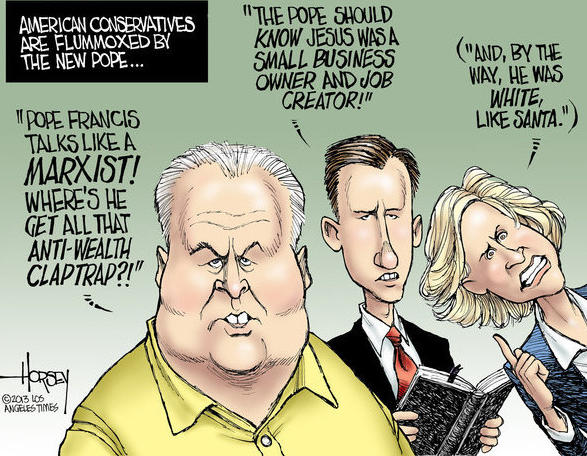
Francis even connected being Catholic with communism. “It’s strange,” the pope said, that “if I talk about this, there are those who think that the Pope is Communist. . . The fact that the love for the poor is in the center of the gospel is misunderstood.” Fighting for the poor, he added, doesn’t make me a communist; it makes me Catholic.

Obviously, the statement suggests significant overlap between Marx’s critique of free market capitalism and the social teachings of the church. The pope’s words certainly don’t sound like a ringing endorsement of the free market.

And how should Catholics express their love for the poor? Clearly not by endorsing the dynamics of the free market Ryan and his real mentor, Ayn Rand, lionize. In the “Joy of the Gospel” (JG) – published a year ago at this time – the pope identifies the unfettered markets so dear to Rand’s and Ryan’s hearts (along with their “trickle-down” ideologies) as homicidal (JG 53), ineffective (54) and unjust at their roots (59). He sees “each and every human right” (including education, health care, and “above all” employment and a just wage (192) as intimately connected with “defense of unborn life” (213).

And it gets worse for Ryan’s position. His party, of course, loves the free trade agreements that are at the heart of the corporate globalization the pope deplores. One wonders how the congressman reconciles his advocacy of, for instance, the Trans-Pacific Partnership (TPP) with the pope’s words at Cagliari, Sardinia on September 22 of 2013. Then the pope proclaimed, “We don’t want this globalized economic system which does us so much harm.”

These are not the statements of someone merely attempting to start a debate about capitalism as we know it. The debate is settled in the pope’s mind. He has condemned the system. And in doing so, Pope Francis has established himself (along with the Dali Lama) as the foremost moral leader of our time. He alone has the courage to call us away from the worship of Market and Money.

The alternative, he assures us, is not a world of darkness, weeping and grinding of teeth. It is a kingdom of light and joy.

It is time for Jesus’ would-be followers to join that conversation – about getting from here to there in the name of the gospel.

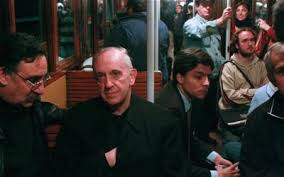
Pope Francis and the Revolutionary Significance of the Lateran Basilica

pope on subway

Yesterday the entire Roman Catholic Church celebrated the feast of the dedication of the Lateran Basilica in Rome. That’s right Roman Catholics everywhere turned their attention to a seemingly obscure building in Rome. Pastors from every pulpit, I’m sure, took the occasion to urge us all to explore the wonders of the basilica the next time we find ourselves in Rome. (I’ll try to remember that on my next visit to the Holy City.)

But there’s more to the commemoration than we’re led to believe. That’s because the arch-basilica of St. John Lateran (named for both John the Baptist and John the Evangelist) is actually the pope’s parish church. Yes, Pope Francis’ parish church is not St. Peter’s; it’s St. John Lateran. Pastors yesterday, no doubt, told us that too.

They also probably said that St. John Lateran has enjoyed such prominence since the arch-basilica was first built in the early 4th century. Its original site was a gift of the Emperor Constantine who awarded the Lateran Palace to the pope of the time. His name was probably Miltiades. The palace got its own name from the Laterani family, the citadel’s proprietors. They were trusted bureaucrats who faithfully served Roman emperors for many years.

And that’s the point I’d like to make here – the Constantine connection. St. John Lateran offers archeological evidence of the tragic moment in history when the would-be followers of the poor working man, Jesus of Nazareth, sold the soul of the church to the highest bidder. The buyer happened to be the Roman Empire – the very agency responsible for the execution of the one Christians pretend to follow. Constantine paid in the coin of land grants and palaces like the Lateran castle.

Can you spell “co-optation” in its most debilitating form?

The result was the nearly complete corruption of the church. Popes started to act like kings and emperors themselves.

In other words, the Church got into bed with Constantine in 313 (the Edict of Milan). Sadly, it didn’t escape till the second half of the 20th century with the development of liberation theology – which the current pastor of St. John Lateran, Pope Francis, has embraced.

That’s right. The pope has embraced the strain of theology repudiated by his two immediate predecessors, John Paul II and Benedict XVI. On this please check out the wonderful article by Newsweek’s Paul Vallely. He published it less than a month ago under the “The Crisis that Changed Pope Francis.”

The pope’s conversion is mirrored in his apostolic exhortation, “The Joy of the Gospel,” published last year at this time. The document calls for a “new chapter” in the history of the Catholic Church and for the church to embark on a “new path” (Joy of the Gospel 1, 25). On this new path, the pope says, things cannot be left as they presently are (25). Instead they must include new ways of relating to God according to new narratives and new paradigms (74) – including new customs, ways of doing things, times, schedules and language (27), and with emphasis on better prepared and delivered homilies (135-159). According to the pope the roles of women must be expanded, since women are generally more sensitive, intuitive, and otherwise skilled than men (103, 104).

All of this the pope said quite clearly. And he called for the laity to take the reins.

As far as I can see, NOTHING at the parish level has changed since last November.

As lay people called by Francis to exercise our power, what should we do about that?

The feast of the dedication of the pope’s parish church is a good occasion for answering that question.

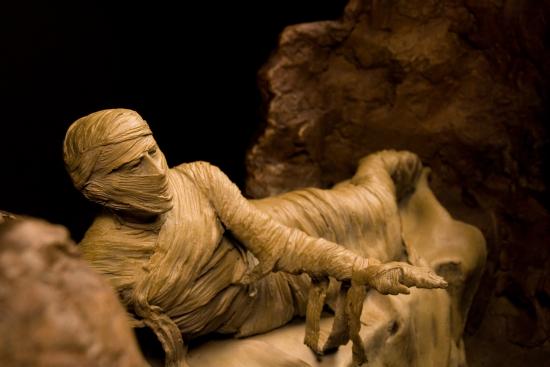
Sunday Homily: “Lazarus come forth!” Pope Francis Brings Jesus Back to Life

Lazarus

Readings for the Fifth Sunday of Lent: EZ 37: 12-14; PS 130: 1-8; ROM 8:8-11; JN 11: 1-45 http://usccb.org/bible/readings/040614.cfm

A few weeks ago, Fortune Magazine identified Pope Francis as first among the World’s “Fifty Best Leaders.” President Obama did not even make the list. Bono and President Clinton were among the top ten.

Whatever the magazine’s reasons for selecting the pope, it’s clear that the “Francis Effect,” is real. Seventy-seven percent of Catholics say they have increased their church donations since the new pope took office. Francis has brought the Catholic Church back from the dead. More importantly, he has returned to life the Jesus of the gospels whom conservatives have long since hijacked and buried – the very one our world’s poor majority needs as never before.

That’s relevant this fifth Sunday of Lent where our readings have Ezekiel coining the highly political metaphor of God’s “raising the dead” to refer to Israel’s impending liberation from its own despair during its Babylonian Captivity. Ezekiel’s metaphor reappears in today’s gospel reading where John the evangelist’s presents his familiar parable about Jesus raising Lazarus from the grave where Jesus’ friend lay moldering for more than three days.

Consider the hopelessness of Ezekiel’s Israel. His sixth century was the saddest of times – the era of his nation’s Great Exile. The Hebrews had been defeated and humiliated by Babylon (modern day Iraq). Its leaders and a large portion of its populace had been abducted to that enemy state. The exiles felt as if they had been slaughtered culturally. They were far from home, controlled by foreign masters, and apparently abandoned by God.

But the prophet Ezekiel did not share his people’s general despair. So in an effort to regenerate hope, he coined the idea of resurrection. Ezekiel loved that concept. [Recall his Vision of Dry Bones (EZ 7: 1-14).] For Ezekiel resurrection was a political metaphor that promised a new vital future despite appearances to the contrary. Israel, he said, would be liberated from Babylon, return home and experience rebirth. They would come back to life.

In his Apostolic Exhortation, The Joy of the Gospel (JG), Pope Francis embraces not only Ezekiel’s spirit, but that of Jesus raising Lazarus from the dead. To repeat, he actually revivifies Jesus and the Gospel. The pope does so by rescuing them both from conservative forces whose version of Christianity has held center stage for the last 35 years. It’s the version, the pope strongly implies, that has metaphorically killed the Jesus of the Gospels, who proclaimed the imminent arrival of God’s Kingdom which belongs to the poor, not to the rich whom the conservatives prioritize.

Like Ezekiel, Jesus made his proclamation when all appearances indicated that Israel was dead. It was entirely under the heel of Roman jackboots and there seemed no escape. Yet Jesus described a horizon of hope that enlivened the spirits of the poor who were crushed by the Romans and by their rich Jewish collaborators who headed the temple establishment.

In such dire straits, Jesus proclaimed a new future where everything would be turned upside down. He said audacious things. In God’s realm, he insisted, the poor would be in charge. The last would be first, and the first would be last. The rich would be poor and the poor would be well–fed and prosperous. The powerless and gentle would have the earth for their possession. Jesus’ unemployed and famished audiences couldn’t hear enough of that!

So he elaborated. He told parable after parable – all about the kingdom and its unstoppable power. It was like leaven in bread – unseen but universally active and transforming. It was like the mustard seed – a weed that sprouted up everywhere impervious to eradication efforts. It was like a precious pearl discovered in the ash bin – like a coin a poor woman loses and then rediscovers. His metaphors, similes and parables were powerful.

To repeat, Pope Francis strongly implies that socio-economic conservatism has murdered the Jesus I’ve just described. It has done so by its “preferential option for the rich.” It embraces free-market capitalism, trickle-down theory, and cut-backs in health care, education, and anti-poverty programs. Conservatives complement such horrors with huge tax-breaks for the country’s 1%. All of this is was chillingly represented last week by “devout Catholic,” Paul Ryan whose budget promised to sock it to the poor and middle class, while enriching military industrialists along with his affluent friends.

The Joy of the Gospel makes it clear that no one can support policies like Ryan’s and claim at the same time to be a follower of Jesus.

In other words, Ryan and the pope are on completely different pages. While conservatives have buried the Gospel Jesus, Pope Francis calls him back to life. He stands before Jesus’ grave and shouts “Come Forth!” Even Fortune Magazine recognizes the resulting miracle.

Consider the Pope’s anti-conservative incantation that brings Jesus back to life. It runs like this:

• Wealth does not belong to the rich, but to the world’s poor (JG 57, 184).

• But the world economy as now structured concentrates wealth among an ever-shrinking minority of the rich (56).

• Wealth must therefore be redistributed (189, 204,215).

• Such redistribution must take place by government intervention in the free market, which (in contradiction to failed “trickle-down” theory) cannot by itself eliminate poverty (54).

• The rich who are unwilling to redistribute wealth to its true owners (the poor) are thieves (57, 189).

• More than that, they are murderers, since the world economy as presently configured is homicidal (58).

• This is a question of being pro-life (213).

• Favoring life certainly includes concern for the unborn (213).

• But “. . . defense of the unborn is closely linked to the defense of each and every other human right” (213).

• Human rights include the right to food and shelter, education, health care, employment , and a just wage (191, 192)

• Respecting human rights involves renunciation of war and preparation for war (60).

• It also connects with environmental stewardship – defense of soil, insects, birds, fish, and the seas (215).

And so the tomb opens. And a Jesus who has been buried more than three decades stumbles out. And in doing so, he renews the faith of so many of us who had given up on the church.

Our faith is renewed because we recognize in Francis’ Jesus the embodiment of one of life’s fundamental truths: utopian visions of the good and true and beautiful can never be killed, even though they might appear lifeless and be pronounced dead by those who once loved them.

What should we do as a result of encountering the Jesus Francis has resurrected?

• Be bold in appropriating the vision of Pope Francis that is not at all idiosyncratic within the Catholic tradition. In fact, it represents the authentic teaching of the Catholic Church from Leo XIII to Vatican II and was even articulated by John Paul II and Benedict XVI.

• Accordingly and courageously incorporate into progressive political discourse the language and powerful ideas of the Judeo-Christian tradition. It can move people today just as it did in the times of Ezekiel and Jesus.

• Join Francis in refusing to cede the field of religion to the reactionary forces of neo-liberal conservatism.

• Expose that conservatism for the destructive fraud it is.

• More particularly, expose Paul Ryan and other Bible thumping Republicans as the heretics they are as they defend the interests of the rich and starve the poor in the name of the Gospel.

• Insist that our pastors get on board with Pope Francis in universalizing his pro-life vision to foreground issues of hunger, war and peace, capital punishment, full employment, universal health care, affordable housing, environmental protection. . . .

Francis reminds us that united with our neighbors, we too, the People of God, possess the power to raise the dead.

So as we stand before the grave of God, the church, and Jesus, let’s echo the pope’s cry: “Jesus, come forth!”