GOP Attacks on Higher Learning: What’s Education for Anyway? And How about Religion?

Readings for the Third Sunday of Advent:Isaiah 61: 1-2A, 10-11; Luke 1: 46-48, 49-50, 53-54; 1 Thessalonians 5: 16-24; John 1: 6-8, 19-28.

Last week, Americans were treated to a high-level display of hypocrisy, double standards, and pure ignorance regarding higher learning. The spectacle occurred during a House Education Committee hearing about on-campus demonstrations supporting Palestinians in Gaza.

The procedure raised questions not only about alleged anti-Semitism and Islamophobia, but also about the very purpose of higher education.

For me in the context of biblical readings for this third Sunday of Advent, the hearing also touched issues of faith and its dictates regarding the conflict in Gaza. As we’ll see, today’s readings suggest that Christians should stand with Palestinians in their conflict with an Apartheid state turned genocidal – and against the United States now unquestionably revealed (in the words of Scott Ritter) as “the world’s bad guy.”

Let me deal with each of those points successively.

The Hearing & Anti-Semitism 

During the hearing just referenced, rightwing congress member Elise Stefanik (R NY) grilled Harvard president Claudine Gay, her MIT counterpart Sally Kornbluth, and University of Pennsylvania president Liz Magill about allowing pro-Palestinian demonstrations on their campuses.

According to Ms. Stefanik, the demonstrations ran the danger of threatening pro-Zionist students.

Ignoring her own history of alleged anti-Semitic positions as well as her votes funding the Zionist genocide of Gazans, the congresswoman’s questioning deceptively linked the term “intifada” to advocacy of extermination of Jews.

Similarly ignoring Zionist claims to “Greater Israel” extending from the Jordan River to the Mediterranean Sea, the congresswoman’s questioning implied that any use of the phrase “from the River to the Sea” uniquely threatened Jewish students. Clearly, Congresswoman Stefanik, along with many Democrats, was anxious to restrict pro-Palestinian speech on Campus.

For their part, the university presidents at last week’s hearing were correspondingly anxious to protect first amendment guarantees on their campuses in today’s context where any talk of Palestinian rights is interpreted as anti-Semitic.   

The whole affair had commentators like Omer Bartov, a professor of Holocaust and genocide studies at Brown University, viewing the presidents’ grilling and its fallout as an attempt by champions of Zionism to distract from actual genocide (of Palestinians in Gaza) while centralizing highly marginal hypothetical speech about repeating Hitler’s horrendous genocide of Jews.

Meanwhile, right-wing commentators on Fox News offered outright condemnation of the three women presidents’ unwillingness to give a simple “yes” or “no” answer to loaded questions about a complex constitutional issue of free speech.

According to Bill Bennett, the former Secretary of Education under Ronald Reagan, the whole affair illustrated, how American education at all levels has declined into what some have called “cesspools of liberal propaganda.”  

Education’s Purpose

All this raises questions about the purpose of education in general and of higher education in particular. What is it for?

What do you think?

The relatively new prevailing answer equates the university’s function with pre-professional training. If courses don’t directly prepare students for “the world of work,” they’re a waste of time.

That approach, of course, discards traditional approaches to learning in general as preparation for living meaningful lives that transcend considerations of jobs and income in favor of free discussion and representation of all points of view – even those advocating genocide.

This more traditional approach unabashedly believes that free speech and debate will broaden students’ horizons. And doing so will inevitably challenge students to move from positions of egocentrism and ethnocentrism, from narrow tribalism and patriotism to something like world-centrism and even to cosmic consciousness.

In fact, many educators (like me) would say that’s the whole purpose of education – to help students and professors grow beyond egocentrism and ethnocentrism towards world centrism (where all humans are seen as brothers and sisters) and even to the mystical viewpoint that concludes “there is really only one of us here.”

In fact, reaching that cosmic vision is arguably the whole purpose of life. At least that seemed to be the position of all the world’s great religious traditions including their Judeo-Christian branch. Reaching that point of course would automatically exclude wars of any kind on the grounds that they are all suicidal.

Today’s Readings

And that brings me to the biblical selections for this third Sunday of Advent. Transcending even academic “objectivity,” today’s passages call us to take sides. They call us to side with the Palestinians against their apartheid colonial butchers.

For the readings reveal what scripture scholars call our Great Mother-Father God’s “preferential option for the poor.” They reveal that the Great Spirits themselves take sides. They demand justice for the poor (like the children of Gaza and their mothers) in their struggle against the rich [like the Apartheid Zionists and their genocidal IDF with its (U.S.-supplied) planes, bombs, missiles, and tanks].

Let me show you what I mean by “translating” today’s liturgical selections. Please read the originals here to see if I got them right.

Isaiah 61: 1-2A, 10-11

If you’re possessed by the Holy Spirit, if you have Christ consciousness, you must imitate the Great Mother herself. You must make a “preferential option for the poor.” It prioritizes healing hearts broken by imperial powers. Begin by recognizing the fact that poverty and debt render the poor hostages and prisoners of the rich. However, just like the wealthy, poor husbands and their brides deserve their own sparkling jewels. Put otherwise, wealth redistribution is a simple matter of divine justice which imitates the abundance and generosity of Nature herself.     

Luke 1: 46-48, 49-50, 53-54

Yeshua’s mother recognized all this. Myriam was a poor peasant herself. And yet she, rather than some rich woman, was chosen as the mother of the long-awaited Messiah. So, she militantly praised the Divine One for feeding the hungry while specifically rejecting the rich. She glorified the Great Source for standing with Myriam’s people when they were unjustly occupied by imperial Rome.

1 Thessalonians 5: 16-24

Paul of Tarsus experienced Myriam’s consciousness as well. It expressed, he said, the Spirit of Yeshua himself whose prophetic program was identical with Isaiah’s (Luke 4:18). Yes, Paul said, Yeshua’s “preferential option for the poor” represents the criterion separating authentic interpretations of the Lord’s message from those of deceptive charlatans. The latter “solve” problems by war, rather than by peace which respects soul, body, spirit, and the absolute integrity of human community.    

Isaiah 61:1

Lest you forget, we repeat: Christ’s Good News is addressed primarily to the poor, not the rich.

John 1: 6-8, 19-28

That’s what John the Baptizer recognized too. He was poor people’s alternative High Priest. His Temple was the Jordan’s wilderness, not Herod’s urban Temple. Yet, neither John, nor Elijah before him, nor any of the great prophets was anywhere near as radical as Yeshua. John merely baptized with water; Yeshua, his disciple, would administer a baptism that conferred the very Spirit of God – the fiery Spirit that preferred the poor to the rich.

Conclusion

Like secular universities, religious people within the Judeo-Christian tradition should never censor free speech. That’s because good-willed people hold all kinds of opinions. Even advocates of genocide deserve places at the table, in congressional hearings, at teach-ins, discussion groups, and bull sessions. Our Constitution’s First Amendment (every bit as important as the Second) demands that.

But today’s readings invite subscribers to the Judeo-Christian tradition to go further still. They summon followers of Isaiah, Myriam, Paul, and Yeshua to stand with the poor and powerless – with victims of empire and colonialism. The readings urge adoption of the divine “preferential option for the poor” by imagining what today is impossible, but as our aspirational North Star. And that means standing with Gazans against their genocidal oppressors.

To me at least, that further means:

  • Getting informed about the tragedy unfolding before our eyes.
  • Recognizing and naming the crime of genocide even when its perpetrators were once victims of genocide themselves.
  • Denouncing all violations of international law as such including indiscriminate attacks upon and wholesale slaughter of children, women, and the elderly.
  • Also including policies of collective punishment, carpet bombing, destructions of medical facilities, use of chemical weapons (such as white phosphorous) and assassinations of teachers, doctors, and members of the press.
  • Identifying “national leaders” like Israel’s Netanyahu and U.S. “Genocide Joe Biden” as international criminals.
  • Calling for the latter’s arrest and trial by the international court. (If that can be done for Russia’s President Putin for much lesser crimes, why not for Netanyahu and “Genocide Joe?”)
  • Similarly identifying Apartheid Israel and its enabler the United States of America as criminal nations.
  • Calling for their expulsion from a restructured United Nations that strips a nation representing 4.2% of the world’s population from overriding the will of the overwhelming majority of the U.N.’s membership.

Debt Amnesty Now: The Heart of Jesus’ Good News

Readings for the third Sunday of Advent: Isaiah 61: 1-2A, 10-11; Luke 1: 46-48, 49-50, 53-54;       I Thessalonians 5: 16-24; John 1: 6-8, 19-28

As most are aware, U.S. students currently owe bankers and creditors more than $1.5 trillion. Progressives like Bernie Sanders and Elizabeth Warren want that debt written off. Their opponents however wonder what would be the economic impact of such debt forgiveness? Wouldn’t it spell disaster for the nation’s economy and for banks “too big to fail?”

Economic historian and ex-Chase Manhattan analyst, Michael Hudson answers those questions in ways intimately connected with the readings for this Second Sunday of Advent. He does so in his magisterial study, …and Forgive Them Their Debts: lending, foreclosure and redemption from Bronze Age finance to the jubilee year.

Written in the face of massive worldwide indebtedness far beyond that of U.S. students, the book’s basic thesis is that debts that can’t be paid won’t be paid. So, the only solution is to write off those obligations.

Far from spelling disaster for the world’s economies, Hudson says such amnesty would rejuvenate them. completely.

How does he know?

Because debt amnesties were standard procedure throughout the history of the ancient Near East from 2500 BC in Sumer to 1600 BC in Babylonia and its neighbors. During that long period, it was the common practice for new rulers to proclaim debt jubilee on the day of their ascension to the royal throne. As seen in the Bible’s Book of Leviticus 25, Israel adopted that practice when its ruling class returned from their “Babylonian Captivity” in the 6th century BCE.

And the result?

Uniformly, Hudson says, it was shared prosperity and the prevention of huge wealth differentials between rich and poor. According to Hudson, the same result can be expected if debts were forgiven today.

The Bible & Debt Forgiveness

And that brings us to our readings for this Third Sunday of Advent. They’re all about a central pillar of Jewish social organization and profound spirituality. I’m referring to debt forgiveness and its “preferential option for the poor.”

As seen in Leviticus 25 and in the words of the prophet Isaiah in today’s first reading, the very word “gospel” (“good news” in Isaiah’s words) is assigned to the proclamation of “Jubilee” – the Jewish Testament term for the periodic practice of wiping debt slates clean every 50 years. That custom borrowed from the Babylonians (and others) prevented oligarchies from using debt as a lever to pry land ownership and other forms of wealth away from impoverished debtors.

In other words, Jubilee was an expression of a divinely structured economy whose ideal (unlike our own) prioritized the welfare of widows, orphans, and resident foreigners. That bottom-up arrangement is what I mean by “preferential option for the poor.”

Yeshua & Debt    

Such preference constituted the emphasis in the work of the prophet, Yeshua of Nazareth as well. As a populist leader in the 1st century CE, he made debt amnesty (Jubilee) a central focus of his public platform. Mainstream scripture scholarship has identified such focus in what it terms Yeshua’s “programmatic” declaration in the Gospel of Luke 4:16-30. Quoting our first reading directly, he is remembered as saying:

18 “The Spirit of the Lord is on me,
             because he has anointed me
            to proclaim good news to the poor.
He has sent me to proclaim freedom for the prisoners
    and recovery of sight for the blind,
to set the oppressed free,
19     to proclaim the year of the Lord’s favor. . .”[a]
 20 “Today this scripture is fulfilled in your hearing.” 

Yes, the Master’s principal concern was about the economic and social welfare of the poor. The words “the year of the Lord’s favor” are synonymous with Jubilee.

Today’s Readings

To get a better idea of what I’m saying, please read today’s liturgical selections directly as found here. My “translations” run as follows:

Isaiah 61: 1-2A, 10-11: A Jubilee year! Debts forgiven! Interest payments written off! Here is good news for the poor whose captive hearts are broken in their miserable debtors’ prisons – reminiscent of their ancestors’ captivity In Babylon. It is all a matter of divine justice, salvation and overwhelming joy – like a wedding celebration where both bride and groom, once poor, are now adorned with splendid jewels.

Luke 1: 46-48, 49-50, 53-54: Jesus’ mother shared that nuptial joy. Though dirt poor like her husband and son, she thirsted for the promised Great Reversal. There the hungry would be well fed, while the rich would at last experience a well-deserved famine. What happiness for the vindicated poor in God’s New Order of justice!

I Thessalonians 5: 16-24: Paul shared Mary’s happiness revealed in her son and by the prophets before him. While the rich despise prophetic proclamations of God’s reckoning, the poor cherish them word for word. They know the prophetic arc of justice bends in their direction.

John 1: 6-8, 19-28: Such was the message of John the Baptist too. Justice at last, jubilee for the poor! The light surrounding the man was so bright that even corrupt religious leaders mistook him for the reincarnation of Elijah himself –or maybe the promised messiah. But no, said John; he was merely a voice proclaiming God’s just path that all are called to trod. His baptism of mere water would be displaced by Yeshua’s social and spiritual revolution of raging fire. Jubilee for the poor at last!!

Conclusion

All of this might seem like ancient history. However, it’s really common sense that is extremely relevant to the issue of writing off the world’s unpayable debts in general and student loans in particular. These considerations also tell us a lot about distortions of Christianity to the point of complete irrelevance.

Regarding loans, Hudson teaches that periodic debt forgiveness (as in Jubilee) is absolutely necessary to correct the dynamics of borrowing and lending. It’s a matter of simple math. Compound interest grows exponentially; incomes increase linearly. As a result, debt will always outrun income.

Consequently too, debts that can’t be paid won’t be paid. Requiring the impossible hamstrings any economy. It robs consumers of spending power. They can’t buy homes and other goods that keep markets humming.

(This was demonstrated in post-WWII Germany. There, in contrast to the aftermath of WWI, German debts were for all practical purposes forgiven. An economic “miracle” followed.)

As for Christianity in relation to all of this . . .  Scripture scholars tell us that the lives and concerns of Yeshua’s people were principally three: (1) foreign (Roman) occupation, (2) land reform, and (3) debt forgiveness. That the Master addressed all of these problems directly in accord with the divine “preferential option for the poor” accounts for his wild popularity among the peasant farmers who constituted his audience of focus.

In this he separated himself from Rabbi Hillel and the Pharisees who rejected wealth redistribution through Jubilee. His separation eventually led to his arrest, torture, and submission to a form of capital punishment reserved for rebels against the Roman Empire.

This, however, is not the picture the Christ that most of us carry around in our minds. There, as Hudson points out, Jesus’ resonance with the material concerns of his people has been transformed into insipid spiritual platitudes that would never have made him a threat to the religious leaders of his day, much less to the Roman Empire.

Restoring any relevance to Christianity in our contemporary world hinges on recovering the radical Jesus of history and his connection with issues like debt forgiveness of student loans. It also hinges on our willingness to stand up for the debt-impoverished (ourselves!!) – despite empire’s vile threats.    

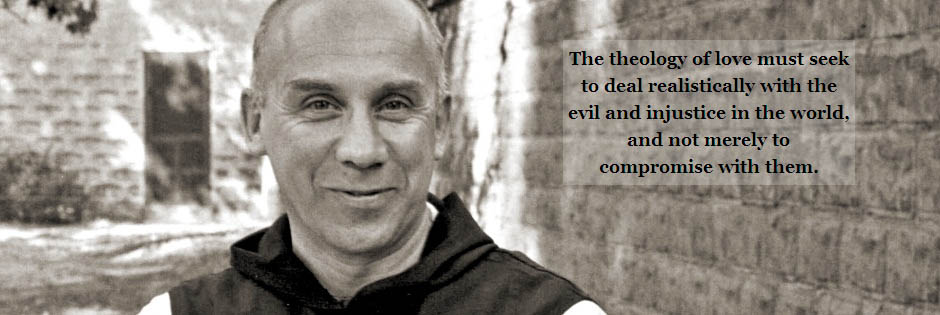
Towards Christmas in the Spirit of Thomas Merton

Merton

Readings for Third Sunday in Advent: IS 61:1-2A, 10-11; LK 1: 46-50; 53-54; I THES 5: 16-24; JN 1: 6-8, 19-28.

Five years ago, I had an important spiritual experience that’s relevant to today’s liturgy of the word. I had the privilege of visiting the hermitage of St. Thomas Merton, the great Trappist mystic. (See my reflections here.)

It all happened in New Haven, Kentucky, just down the road from the Maker’s Mark distillery – far from any great urban centers and nearer to places with names like Bardstown, Paint Lick, and Gravel Switch. The experience inspired counter-cultural thoughts about Christmas. It made me struggle with the question (still unresolved for me): is it possible to once and for all break with this annual orgy of consumerism so counter to the gospel’s commitment to the poor?

At Fr. Louis’ Gethsemane, twenty of us sat in a circle in his living room absorbing the Life Force that still hovers over his simple cinderblock cabin. Trappist Brother Paul, the convener of the Merton Study Group responsible for the event, marvelously channeled “Louie’s” spirit by reading Brother Paul’s own poetic reflection on Matthew’s words, “Blessed are the poor in spirit.”

Paul’s thoughts connected nicely not only with Merton, but with this morning’s readings for this third Sunday of Advent. There, John the Baptizer, his predecessor Isaiah, and Jesus’ own mother Mary reiterate the essential connection between Jesus’ gospel and standing in solidarity with the poor not only in spirit, but in actual fact. As Christmas approaches, the sentiments of the Baptizer, Isaiah and Mary suggest counter-cultural ways of commemorating the birth of the prophet from Nazareth.  I wish I and my family were strong enough to entertain them seriously.

For me those culturally eccentric suggestions began emerging when in the course of his remarks, Brother Paul recalled Sister Emily Dickinson’s words that reflect the mystical dimension of Matthew’s (and presumably Jesus’) understanding of both spiritual and physical poverty. As for the former, Brother Paul defined spiritual poverty as the emptiness reflected in Monk Dickinson’s words,

“I am nobody.

Who are you?

Are you nobody too?

. . . How dreary to be somebody.”

Those words almost paraphrase what John the Baptist says in today’s Gospel selection. When asked who he is, the one identified by Jesus as the greatest man who ever lived (MT 11:11) says in effect, I am a poor man in Emily Dickinson’s sense. I’m a nobody – merely a voice out of nowhere. I am “a voice crying out in the wilderness.”  Only an empty vessel can be filled with the Holy Spirit.

So forget about me, John says, and focus on the one who is to come. His words will set you on fire that will sear everything in you that is not of the Spirit Jesus embodies – everything that separates you from your brothers and sisters, especially material wealth. That kind of self-denial and openness to Jesus’ Holy Spirit is the very definition of Matthew’s spiritual poverty.

And the specific message of the One to come?  (And here’s where material poverty enters the picture.)  Jesus announces the Divine Spirit’s preferential option for the actually poor and its rejection of the materially rich. That bias towards the actually poor is reflected in today’s first reading. As remembered by Luke in Jesus’ preview of his own career, the words of the prophet Isaiah read:

The Spirit of the Lord is upon me, because he has anointed me to bring good news to the poor. He has sent me to proclaim release to the captives and recovery of sight to the blind, to let the oppressed go free, to proclaim the year of the Lord’s favor.” (LK 4: 16-22)

Here Jesus’ focus is real poverty and people subject to captivity and oppression.

As for the Holy Spirit’s rejection of the rich, that is clearly stated in the revolutionary poem attributed to Jesus’ mother and read today as our responsorial hymn. Mary describes her understanding of God with the following words:

“The Mighty One . . . has shown strength with his arm; he has scattered the proud in the thoughts of their hearts. He has brought down the powerful from their thrones, and lifted up the lowly; he has filled the hungry with good things, and sent the rich away empty.”

These are truly revolutionary words about dissolving the ideological mind-sets that unify the rich (“the thoughts of their hearts”), about overthrowing the powers that be (removing them from their thrones), about ending hunger, and rejecting wealth on principle.

The class consciousness reflected in this categorical rejection the rich as such reminds us that in the eyes of Jesus’ mother and (the record shows) of her son, there is something intrinsically wrong with any wealth that differentiates rich from poor. This implies that for Mary and Jesus, poverty is not the opposite of wealth.  Rather, the opposite of wealth is God’s justice – a new order possible in this here and now, in this “year of the Lord’s favor,” as Jesus puts it. There, the rich will be necessarily unseated and the poor will have their fill.

If all of this is true – if God’s salvation means eliminating differences between rich and poor – what are we to do in this world of income gaps, torture, racism and militarized police?  The question is particularly apt at this Christmas season. And Thomas Merton’s monastic spirit along with the testimony of his ascetic counterpart, John the Baptizer, implies answers.  It suggests that at the Christmas season we might do well to:

  • Generally withdraw our allegiance from the cultures of New York and Los Angeles and in spirit draw closer to Paint Lick, Gravel Switch – and Merton’s Gethsemane.
  • Consciously simplify our Christmas celebration this year.
  • On the feast commemorating the birth of a homeless child whose mother saw so clearly the opposition between wealth and justice, imitate John’s simple vestment (and that of the Trappists) by giving our gifts of clothes not to the already well-attired, but to the poor.
  • Imagine what would happen if we took those gifts so carefully wrapped and placed beneath our tree and simply gave them away unopened and at random to poor people and their children as we meet them on the street.
  • In the spirit of John the Baptizer, located far from Jerusalem’s temple, boycott church this Christmas, especially if your community (after distributing its de rigueur Christmas baskets) ignores Mary’s summons to social revolution in favor of “Christmas as usual.”
  • Instead make up our own liturgy (around the Christmas tree) to replace the normal orgy of material gift-exchange.
  • Boycott entirely this year’s “white Christmas” and (in the light of the Black Lives Matter movement) celebrate Kwanzaa instead – telling our children why this year is different.
  • Make a Christmas resolution to at last get serious about changing our lives in 2021 by beginning (or intensifying) the regular practice of prayer (or meditation) in the spirit of John the Baptist, Jesus, his mother and Thomas Merton.
  • Realize that inevitably the cultivation of spiritual emptiness (“nobodiness”) resulting from such regular spiritual practice will lead us to serve others in a way that will address the seemingly intractable problems of poverty (both spiritual and material), hunger, captivity and oppression.

I’m not suggesting that any of this would be easy. Going counter-cultural, especially around an event like Christmas, involves a certain self-emptying. It involves detaching from cultural expectations (not to mention those of our children and other family members). In some sense, it means becoming nobody in front of those who expect us to do what everyone else is doing. In other words, going counter-cultural at Christmas conflicts with what Sister Emily calls our dreary attempts to be somebody.

In fact, the cultural pressures are so strong, that it might be impossible for most of us to withdraw cold-turkey from Christmas as we’ve known it. Still, if we desire to be change agents like John the Baptist, Isaiah, Mary, Jesus and Thomas Merton, we’ve got to start somewhere.

I’m still trying to inch towards something like I’ve just described. Do you have any suggestions that can help me move more quickly?

If You Think Jesus Approves of GOP Policies towards the Poor, Here Are Two Riddles for You . . . (Sunday Homily)

trump-christian

Readings for Third Sunday of Advent: IS 35: 1-6A, 10; PS 146: 6-10; JAS 5: 7-10; MT 11: 2-11

If Trump cabinet nominations are any indication, the president-elect will continue pursuing what have long been the GOP’s two main domestic goals. They are eliminating labor unions and cutting social services such as Food Stamps and Medicaid. Even Trump Republicans (led by their groper-in-chief) will do so while at the same time invoking values they call “Christian.”

Today’s liturgy of the word shows that the GOP position flies in the face of the entire Judeo-Christian tradition expressing (as it does) God’s special concern for the poor and oppressed.

More specifically, the readings demonstrate that the anti-poor policies of the Christian right are actually a slap in the face to Jesus himself. That’s because (once again) in today’s selections, the recipients of God’s special concern turn out to be (in Jesus’ words in our gospel reading) not just “the least.” Rather, in their collectivity, they are identified with the very person whom our sisters and brothers on the right aspire to accept as their personal Lord and Savior.

The vehicle for today’s version emphasizing Jesus’ identification with the poor is a riddle. It’s found at the very end of that reading from Matthew. Matthew has Jesus posing it by saying:

  1. John the Baptist is the greatest person ever born.
  2. Yet the least in the Kingdom of God is greater than John.

That leaves us with the question: How can this be? How can “the least” be greater than the one identified by Jesus himself not only as the foremost prophet of the Jewish Testament, but the greatest human being who ever lived?

In the context of Matthew’s gospel, the answer is the following:
1. Jesus is the one far greater than John. (As the Baptist admitted in last week’s reading from Matthew, John was not even worthy to loosen the straps on Jesus’ sandals.)
2. But Jesus identified himself with “the least.” Recall that in his parable of the last judgment (Matthew 25), Jesus says, “Whatever you did to the least of my brethren, you did to me.”
3. Therefore the “least” as identified with “the greatest” (Jesus) is greater than John and should be treated that way – as Jesus himself.

Riddle solved. The rest of today’s liturgy adds the details as it develops the theme: recognize the least as God’s favorites – as Jesus himself – and treat them as the most important people in the world.

And who are these “least?” According to Isaiah in today’s first reading, they are the blind, deaf, lame, and mute. They are ex-pats living in exile. The psalmist in today’s responsorial, widens the list by adding the oppressed, hungry, imprisoned, and immigrants. He includes single moms (widows) and their children.

In today’s gospel selection, Jesus recapitulates the list. For him “the least” (who are greater than John) include the imprisoned (like John himself sitting on Herod’s death row). They are (once again) the lame, the deaf, the mute, and lepers. They even include the dead who are raised to life by Jesus.

Do we need any more evidence to support the biblical authenticity of what Pope Francis continually references as God’s “preferential option for the poor?”

Does the Christian Right believe the teaching contained in Jesus’ riddle?

Well, maybe not. I mean, here’s another riddle for you: How can Christians oppose labor unions and eliminate Food Stamps and Medicaid, while still calling themselves followers of Jesus?

Sorry: I can’t solve that one.

(Sunday Homily) Towards a Counter-Cultural Christmas: Becoming Nobody

Santa garbage

Readings for Third Sunday in Advent: IS 61:1-2A, 10-11; LK 1: 46-50; 53-54; I THES 5: 16-24; JN 1: 6-8, 19-28. http://usccb.org/bible/readings/121414.cfm

As I mentioned in my previous blog, I had an important spiritual experience last Sunday. It was the privilege of visiting the hermitage of St. Thomas Merton, the great Trappist mystic. It all happened in New Haven, Kentucky, just down the road from the Maker’s Mark distillery – far from any great urban centers and nearer to places with names like Bardstown, Paint Lick, and Gravel Switch. The experience inspired counter-cultural thoughts about Christmas. It made me struggle with the question (still unresolved for me): is it possible to once and for all break with this annual orgy of consumerism so counter to the gospel’s commitment to the poor?

At Fr. Louis’ Gethsemane, twenty of us sat in a circle in his living room absorbing the Life Force that still hovers over his simple cinderblock cabin. Trappist Brother Paul, the convener of the Merton Study Group responsible for the event, marvelously channeled “Louie’s” spirit by reading Brother Paul’s own poetic reflection on Matthew’s words, “Blessed are the poor in spirit.”

Paul’s thoughts connected nicely not only with Merton, but with this morning’s liturgy of the word on this third Sunday of Advent. After all, in today’s readings, John the Baptizer, his predecessor Isaiah, and Jesus’ own mother Mary reiterate the essential connection between Jesus’ gospel and standing in solidarity with the poor not only in spirit, but in actual fact. As Christmas approaches, the sentiments of the Baptizer, Isaiah and Mary suggest counter-cultural ways of commemorating the birth of the prophet from Nazareth.  I wonder if I and my family are strong enough to entertain them.

For me those culturally eccentric suggestions began emerging when in the course of his remarks, Brother Paul recalled Sister Emily Dickinson’s words that reflect the mystical dimension of Matthew’s (and presumably Jesus’) understanding of both spiritual and physical poverty. As for the former, Brother Paul defined spiritual poverty as the emptiness reflected in Monk Dickinson’s words,

“I am nobody.

Who are you?

Are you nobody too?

. . . How dreary to be somebody.”

Those words almost paraphrase what John the Baptist says in today’s Gospel selection. When asked who he is, the one identified by Jesus as the greatest man who ever lived (MT 11:11) says in effect, I am a poor man in Emily Dickinson’s sense. I’m a nobody – merely a voice out of nowhere. I am “a voice crying out in the wilderness.”  Only an empty vessel can be filled with the Holy Spirit.

So forget about me, John says, and focus on the one who is to come. His words will set you on fire that will sear everything in you that is not of the Spirit Jesus embodies – everything that separates you from your brothers and sisters, especially material wealth. That kind of self-denial and openness to Jesus’ Holy Spirit is the very definition of Matthew’s spiritual poverty.

And the specific message of the One to come?  (And here’s where material poverty enters the picture.)  Jesus announces the Divine Spirit’s preferential option for the actually poor and its rejection of the materially rich. That bias towards the actually poor is reflected in today’s first reading. As remembered by Luke in Jesus’ preview of his own career, the words of the prophet Isaiah read:

The Spirit of the Lord is upon me, because he has anointed me to bring good news to the poor. He has sent me to proclaim release to the captives and recovery of sight to the blind, to let the oppressed go free, to proclaim the year of the Lord’s favor.” (LK 4: 16-22)

Here Jesus’ focus is real poverty and people subject to captivity and oppression.

As for the Holy Spirit’s rejection of the rich, that is clearly stated in the revolutionary poem attributed to Jesus’ mother and read today as our responsorial hymn. Mary describes her understanding of God with the following words:

“The Mighty One . . . has shown strength with his arm; he has scattered the proud in the thoughts of their hearts. He has brought down the powerful from their thrones, and lifted up the lowly; he has filled the hungry with good things, and sent the rich away empty.”

These are truly revolutionary words about dissolving the ideological mind-sets that unify the rich (“the thoughts of their hearts”), about overthrowing the powers that be (removing them from their thrones), about ending hunger, and rejecting wealth on principle.

The class consciousness reflected in this categorical rejection the rich as such reminds us that in the eyes of Jesus’ mother and (the record shows) of her son, there is something intrinsically wrong with any wealth that differentiates rich from poor. This implies that for Mary and Jesus, poverty is not the opposite of wealth.  Rather, the opposite of wealth is God’s justice – a new order possible in this here and now, in this “year of the Lord’s favor,” as Jesus puts it. There, the rich will be necessarily unseated and the poor will have their fill.

If all of this is true – if God’s salvation means eliminating differences between rich and poor – what are we to do in this world of income gaps, torture, racism and militarized police?  The question is particularly apt at this Christmas season. And Thomas Merton’s monastic spirit along with the testimony of his ascetic counterpart, John the Baptizer, implies answers.  It suggests that at the Christmas season we might do well to:

  • Generally withdraw our allegiance from the cultures of New York and Los Angeles and in spirit draw closer to Paint Lick, Gravel Switch – and Merton’s Gethsemane.
  • Consciously simplify our Christmas celebration this year.
  • On the feast commemorating the birth of a homeless child whose mother saw so clearly the opposition between wealth and justice, imitate John’s simple vestment (and that of the Trappists) by giving our gifts of clothes not to the already well-attired, but to the poor.
  • Imagine what would happen if we took those gifts so carefully wrapped and placed beneath our tree and simply gave them away unopened and at random to poor people and their children as we meet them on the street.
  • In the spirit of John the Baptizer, located far from Jerusalem’s temple, boycott church this Christmas, especially if your community (after distributing its de rigueur Christmas baskets) ignores Mary’s summons to social revolution in favor of “Christmas as usual.”
  • Instead make up our own liturgy (around the Christmas tree) to replace the normal orgy of material gift-exchange. (More about this in a later posting.)
  • Boycott entirely this year’s “white Christmas” and (in the light of Mike Brown, Eric Brown and Tamir Rice) celebrate Kwanzaa instead – telling our children why this year is different.
  • Make a Christmas resolution to at last get serious about changing our lives in 2015 by beginning (or intensifying) the regular practice of prayer (or meditation) in the spirit of John the Baptist, Jesus, his mother and Thomas Merton.
  • Realize that inevitably the cultivation of spiritual emptiness (“nobodiness”) resulting from such regular spiritual practice will lead us to serve others in a way that will address the seemingly intractable problems of poverty (both spiritual and material), hunger, captivity and oppression.

I’m not suggesting that any of this would be easy. Going counter-cultural, especially around an event like Christmas, involves a certain self-emptying. It involves detaching from cultural expectations (not to mention those of our children and other family members). In some sense, it means becoming nobody in front of those who expect us to do what everyone else is doing. In other words, going counter-cultural at Christmas conflicts with what Sister Emily calls our dreary attempts to be somebody.

In fact, the cultural pressures are so strong, that it might be impossible for most of us to withdraw cold-turkey from Christmas as we’ve known it. Still, if we desire to be change agents like John the Baptist, Isaiah, Mary, Jesus and Thomas Merton, we’ve got to start somewhere.

Do you have other ideas about where or how to start? If so, please share them. And what about that alternative Christmas celebration involving the whole family on Christmas morning? Can you help with any suggestions there?

The Hypocrisy of Treating Jesus with “Tough Love”: Here’s a Riddle for You . . . (Sunday Homily)

the least

Readings for Third Sunday of Advent: IS 35: 1-6A, 10; PS 146: 6-10; JAS 5: 7-10; MT 11: 2-11 http://usccb.org/bible/readings/121513.cfm

Recently, Mary Shaw contributed a well-received article to the pages if OpEdNews (my favorite online news source). The article was called “American Hunger and the Christian Right.” There Ms. Shaw pointed to the irony of predominant elements within the GOP adopting as their two main goals cutting social services such as Food Stamps and eliminating labor unions while at the same time calling themselves “Christian.” In Ms, Shaw’s analysis, such inconsistency does not jibe with the personal poverty of Jesus himself, or his concern for the poor manifested in mass feedings on more than one occasion.

In the light of today’s liturgy of the word, I would go even further and argue that the GOP position flies in the face of the entire Judeo-Christian tradition expressing (as it does) God’s special concern for the poor and oppressed.

In that macro-context, the “tough love” concept of the Christian right is actually a slap in the face to Jesus himself. That’s because (once again) in today’s readings, the recipients of God’s special concern turn out to be (in Jesus’ words in our gospel reading) not only “the least,” but in their collectivity, the very Jesus whom our sisters and brothers on the right aspire to accept as their personal Lord and Savior.

The vehicle for today’s version emphasizing Jesus’ identification with the poor is a riddle. It’s found at the very end of that reading from Matthew. Matthew has Jesus posing it by saying:
1. John the Baptist is the greatest person ever born.
2. Yet the least in the Kingdom of God is greater than John.

That leaves us with the question: How can this be? How can “the least” be greater than the one identified by Jesus himself not only as the foremost prophet of the Jewish Testament, but the greatest human being who ever lived?

In the context of Matthew’s gospel, the answer is the following:
1. Jesus is the one far greater than John. (As the Baptist admitted in last week’s reading from Matthew, John was not even worthy to loosen the straps on Jesus’ sandals.)
2. But Jesus identified himself with “the least.” Recall that in his parable of the last judgment (Matthew 25), Jesus says, “Whatever you did to the least of my brethren, you did to me.”
3. Therefore the “least” as identified with “the greatest” (Jesus) is greater than John and should be treated that way – as Jesus himself.

Riddle solved. The rest of today’s liturgy adds the details as it develops the theme: recognize the least as God’s favorites – as Jesus himself – and treat them as the most important people in the world.

And who are these “least?” According to Isaiah in today’s first reading, they are the blind, deaf, lame, and mute. They are foreigners living in exile. The psalmist in today’s responsorial, widens the list by adding the oppressed, hungry, imprisoned, and immigrants. He includes single moms (widows) and their children.

In today’s gospel selection, Jesus recapitulates the list. For him “the least” (who are greater than John) include the imprisoned (like John himself sitting on Herod’s death row). They are (once again) the lame, the deaf, the mute, and lepers. They even include the dead who are raised to life by Jesus.

Do we need any more evidence to support the claim of God’s “preferential option for the poor?”

Does the Christian Right believe the teaching contained in Jesus’ riddle? Do they really advocate treating him with “tough love?”

Not when you put it that way, Jesus!