Jesus’ Healing Action Tells Women To Disobey Men: Control Your Own Bodies

Readings for 13th Sunday in Ordinary Time: Wisdom 1:13-16, 2:23-24; Ps. 30:2, 4-6, 11-13; 2Cor. 8:7, 9, 13-16; Mk. 5:21-43

Last month my brilliant 15-year-old granddaughter shocked students in her high school freshman class by giving a speech about menstruation. Yes, menstruation! She called her talk “Bleeding in Silence: The Hidden Epidemic of Period Poverty.” (For those interested, I’ve pasted Eva’s words to the bottom of this posting.)

Eva’s speech was about how the patriarchal system fundamentally misunderstands how women’s bodies function. And in our man’s world, it’s women who pay the price for such ignorance. For instance, it influences the cost of “feminine hygiene products” and their availability while imposing unspoken prohibitions about even mentioning menstrual periods much less openly discussing and coping with them.

Eva’s presentation began with a video of interviews of male family members during a party over her school’s Easter break.  On camera, she simply asked us “What do you understand by the word ‘menstruation?” It was surprising how quickly inarticulate, seemingly embarrassed, and (let’s face it) ignorant our responses were, even by those who (like me) should know better.

A principal conclusion of Eva’s speech was that lamentably, men know very little about how female bodies work. Women, of course know much more. Moreover, this disparity has major social repercussions when overwhelmingly male state administrators in a completely patriarchal system impose legislation about what they barely understand. e.g., about abortion, contraception sex education, and easy and cheap access to those hygiene products.

For instance, relative to abortion, the legislation ignores the fact that 70-75% of fertilized eggs end up aborting spontaneously. They’re unceremoniously flushed down toilets across the world in the menstrual period immediately following fertilization. Yet, a recent decision by the Alabama Supreme Court holds that all those unknown and unrecognized embryos are somehow “children.” At least that’s the implication of the court’s determination that frozen embryos are babies. How offensive to common sense is that? How contrary to what every woman implicitly knows.

I bring all of that up on this Thirteenth Sunday in Ordinary Time because today’s selection from the Gospel of Mark centralizes a woman with a menstrual problem. It implies criticism of ignorant patriarchal laws regulating it, while strongly affirming a particular woman’s courageous decision to transgress those restrictions in favor of her own faith and common sense.

Jesus & Menstruation       

In short, today’s reading uses the issue of menstruation to show how Jesus favored women who spoke for themselves and courageously exercised their own initiative even in the face of specific patriarchal legislation forbidding such agency. It has him even curing and praising a woman who disobeys precisely misogynistic laws. He ends up prioritizing her needs over those of a young female who was a passive captive to the religious patriarchy. 

To make those points, Mark the evangelist creates what might be termed a “literary sandwich” – a “story within a story.” The device focuses on two kinds of females within the Jewish faith of Jesus’ day. In fact, Mark’s gospel is liberally sprinkled with doublets like the one just described. When they appear, both stories are meant to play off one another and illuminate each other.

In today’s doublet, we find two women. One is just entering puberty at the age of 12; the other has had a menstrual problem for the entire life span of the adolescent girl. (Today we’d call her condition a kind of menorrhagia.)

So, to begin with the number 12 is centralized. It’s a literary “marker” suggesting that the narrative has something to do with the twelve tribes of Israel – and in the early church, with the apostolic leadership of “the twelve.” The connection with Israel is confirmed by the fact that the 12-year-old in the story is the daughter of a synagogue official. As a man in a patriarchal culture, he can approach Jesus directly and speak for his daughter.

The other woman in the doublet has no man to speak for her; she must approach Jesus covertly and on her own. She comes from the opposite end of the socio-economic spectrum from the 12-year- old daughter of the synagogue leader.

The older woman is without honor. She is poor and penniless. Her menstrual problem has rendered her sterile, and so she’s considered technically dead by her faith community. Her condition has also excluded her from the synagogue. In the eyes of community leaders like Jairus (the petitioning father in the story) she is “unclean.” (Remember that according to Jewish law, all women were considered unclean during their monthly period. So, the woman in today’s drama is exceedingly unclean. She and all menstruating women were not to be touched.)  

All that means that Jairus as a synagogue leader is in effect the oppressor of the second woman. On top of that the older woman in the story has been humiliated and exploited by the male medical profession which has been ineffective in addressing her condition. In other words, the second woman is the victim of a misogynist religious system which saw the sacrificial blood of animals as valuable and pleasing in God’s eyes, but the blood of women as repulsively unclean.

Nonetheless, it is the bleeding woman who turns out to be the hero of the story. Her confidence in Jesus is so strong that she believes a mere touch of his garment will suffice to restore her to health, and that her action won’t even be noticed.

So, she reaches out and touches the Master. Doing so was extremely bold and highly disobedient to Jewish law, since her touch would have rendered Jesus himself unclean. She refuses to believe that.

So instead of being made unclean by the woman’s touch, Jesus’ being responds by exuding healing power, apparently without his even being aware. The woman is cured. Jesus asks, “Who touched me?” The disciples object, “What do you mean? Everybody’s touching you,” they say.

Finally, the unclean woman is identified. Jesus praises her faith and (significantly!) calls her “daughter.” So, what we end up finding in this literary doublet are two Jewish “daughters” – yet another point of comparison.

While Jesus is attending to the bleeding woman, the first daughter in the story apparently dies. Jesus insists on seeing her anyhow. When he observes that she is merely asleep, the bystanders laugh him to scorn. But Jesus is right. When he speaks to her in Aramaic, the girl awakens and is hungry. Everyone is astonished, and Jesus must remind them to feed her.

Mark’s Message for Us

What does all the comparison mean? The doublet represented in today’s Gospel addresses issues that couldn’t be more female – more feminist. The message here is that bold and active women unafraid of disobeying the religious or civil patriarchy in matters that women understand better than men. “Prioritize and act like the bleeding woman” is the message of today’s Gospel.

Could today’s gospel be telling us that bold and specifically feminist faith that sides with the poor and oppressed (like the hero of today’s Gospel) will be the salvation of us all who are moribund? Are women precisely as women today’s real faith leaders, rather than the elderly, white, out-of-touch men who overwhelmingly claim to lead in every sphere even those where women know far more.

Conclusion

Today’s Gospel suggests that it’s time for men to stop telling women how to be women – to stop pronouncing on issues of female sexuality whether it be menstruation, abortion, contraception, same-sex attractions, or whether women are called by God to the priesthood. Correspondingly, it’s time for women to disobey such male pronouncements, and to exercise leadership in accord with their common sense – in accord with women’s ways of knowing. Only that will save our national community which is currently sick unto death.

_______

Bleeding in Silence: The Hidden Epidemic of Period Poverty

By Eva Lehnerd Reilly

Whether they know the term or not, all women are necessarily aware of the realities of “Period Poverty.” Nonetheless, the concept remains completely foreign and even incomprehensible to most men. As a result, little is done to eliminate the problems the phrase represents. The phrase “Period Poverty” is defined as the lack of access to safe and hygienic menstrual products during monthly periods and accessibility to basic sanitation services or facilities as well as menstrual hygiene education.

Additionally, period poverty has social dimensions that include the stigmas surrounding this natural female process. To explain the problem, what follows will explore international dimensions of this issue, connect the phrase with patriarchy, misogyny and human rights and make recommendations for its elimination. This essay is arguing “Period Poverty” is a world health issue thus by refusing to acknowledge it we are proving that we still live in a society that is patriarchal, misogynist, and locked in an aggressive denial of the rights of women.

An International Problem 

This issue affects billions of people worldwide in ways including stigma, dependence on transnational companies producing the necessary hygienic products, and the lack of understanding and acknowledgement of the problem. Stigma is one of the largest problems surrounding period poverty. Many countries and people believe wildly untrue period-related information. According to the Korean Journal of Family Medicine, Nepal “continues to believe in dangerous, incorrect ideas, for example, using tampons causes women to lose their virginity, or handling food while menstruating causes it to spoil the food.

Social stigma on menstruation remains even in more advanced nations: in the United States, 58% of women are ashamed of having a period, and 51% of men believe that it is improper to discuss periods at work.” (Jaafar, Hafiz, et al., 2023). The fact that stigma is so present in all different circles around the world shows how grand an issue this is and how many people are affected by it.

This is also an economic issue because women are dependent on transnational companies. Global Research and Consulting Group Insights explains that: “Multiple countries in the world impose the ‘tampon tax’ on menstrual products, frequently targeted as ‘luxury goods.’ This categorization enhances the chances that economic disparities, limit access to period products, and perpetuates the view that they are not a ‘necessity.’”(Ricardo da Costa, 2023). This tax is implemented often in particularly lower-income, less developed countries but it is far from unique to developing countries. In fact, GRC found that the elimination of the “tampon tax” in California would likely reduce government revenue by 55 million dollars. This shows how women’s reliance on companies to provide basic hygiene products is problematic because the government is trying to make financial gains by providing resources that should never be charged for in the first place.

Probably the largest problem of them all is the lack of awareness and understanding surrounding period poverty and the menstrual cycle in general. A Plan International study found that one in five boys and young men think that periods should be kept a secret. Furthermore, they associate this term with words like ‘messy,’ ‘gross,’ and ‘embarrassing.’ This tells us that the taboos set in place by society are greatly affecting young people and discouraging them from learning and understanding this issue. This is leading to the rise of a new wave of sexism.

Periods and Patriarchy

The term “patriarchy” refers to social conditions ruled by fathers–or more generally by men. In 

The Creation of Patriarchy, Gerda Lerner determines that this comes from lessons taught in childhood. She says that the “absolute authority of a father over his children provided men with a conceptual dominance of dependency, due to the helplessness of youth.” (Lerner, 90). Relative to period poverty, this fundamental condition has led some women to joke that if male biology included menstruation, they would likely be excused from work days before and during the entire menses process, plus they would be given a week off to recover. Additionally, menstrual hygiene products would be low or no cost, not subject to taxation, and as available as toilet paper and paper hand towels in every washroom.

In our patriarchal society no such accommodations are available for more than half our nation’s population. That’s period poverty. However, this goes farther than just the patriarchy. The issue is also affected greatly by misogyny, a term meaning hatred of women. This is revealed in attitudes surrounding mood swings, jokes about periods and even dates back to religious texts calling women ‘unclean’ during this time.

Particularly, in the third Book of the Pentateuch or Torah, known as Leviticus, it states that a woman undergoing menstruation is perceived as unclean for seven days and whoever touches her shall be unclean until evening (Leviticus 15:19). This is simply outrageous and goes to show how our society is so deeply rooted in these feelings of hatred towards women and disgust towards natural occurrences.

Finally, access to period products is a human right. A human right is what belongs to human beings simply because of being human; it does not have to be earned, it is an entitlement. All women, simply because of being women, have menstrual periods. They therefore have rights connected with their inevitable circumstances. These include rights to free or very low-cost feminine hygiene products, widespread availability of such products and freedom from blame, ridicule, or penalty for time off for personal care during their periods. Now that we have established this, how can we fix this?

Practical Recommendations

The Journal of Global Health Reports found that 500 million people lack access to menstrual products and hygiene facilities and since half the population is female and over half of university students are female, this issue can no longer be ignored. Men need to be part of the solution. We need to all work together to ensure a positive and supportive environment that allows menstruating people to participate in all aspects of life (e.g., going to school/work, and sport). In a Plan International study of over 300 men, 49% said their education on periods was poor or non-existent and just under one third (32%) said that talking about periods made them feel uncomfortable, increasing to 53% in the youngest respondents aged 16-18 years. This shows that many people (men in particular) are not receiving adequate education leading to misinformation and increased stigma associated with menstruation.

The takeaway is that we are in desperate need of a far greater and earlier education about periods in schools. There are three things to note surrounding this being a world health issue: 1) Poor menstrual hygiene often causes physical health risks, 2) globally, 1.7 billion people live without basic sanitation services, 3) girls with disabilities disproportionately do not have access to the facilities and resources they need for proper menstrual hygiene. The former Chief of Water, Sanitation and Hygiene at UNICEF said it best: “Meeting the hygiene needs of all adolescent girls is a fundamental issue of human rights, dignity, and public health.” (Rodriguez, Global Citizen). With all that in mind, allow me to conclude my argument.
What the Unclothed Female Form Reveals about the Great Cosmic Mother – And Ourselves

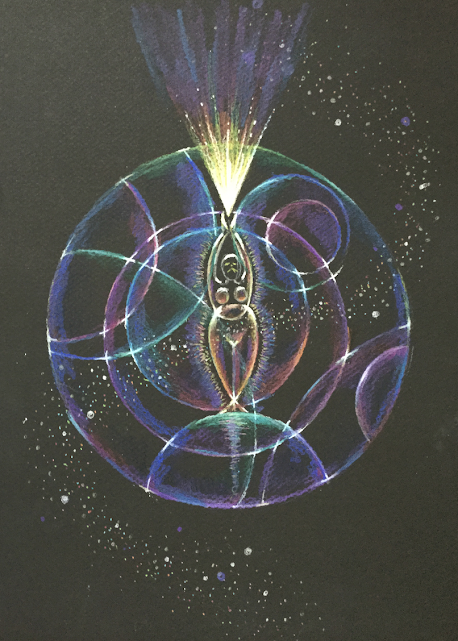
“Mother of the World” by my colleague, Meryl Ann Butler, Managing Editor of OpEdNews

I’m taking a chance here. At 82 years of age, I’m going to risk embarrassing myself by reconsidering the message and significance of what some consider to be “pornography,” i.e., the images of ordinary mature women found on the internet.

I’m going to propose that like their prehistoric, sculptured counterparts found throughout the ancient world, the images in question can lead us to more fully understand life and its purposes. Moreover, they can help liberate men especially from the toxic patriarchy that is responsible for our wars and the environmental omnicide produced by our economic systems.

I write as a man more deeply embedded in patriarchy than most. I was once a Roman Catholic priest who entered the seminary to embrace a life of celibacy at the age of 14. As such, I became profoundly integrated into perhaps the world’s most patriarchal system characterized by a largely unconscious misogyny and fear of women.

It was an exaggerated embodiment of the metasystem that afflicts the world in general. Like that overarching social arrangement, it told me that viewing the unclothed female form was somehow dangerous and sinful. Post-priesthood married life and reading feminist scholars has shown me it is not.

Here I’m not talking about Playboy or Penthouse, much less about degrading portrayals of young women and girls forced into the pornography trade, perhaps for the profit of others and/or for their own career advancement.

Still less am I referring to snuff films or misogynist portrayals of women in bondage, degrading situations or pain. All of those represent hideous abuses and exploitation of women for purposes of pleasing leering men devoid of appreciation or affection for women outside the pleasure the latter’s objectifications afford.

No, what I’m presenting as culturally and even theologically liberating are the willing displays of the female form by mothers and grandmothers of mature ages from middle age through the 90s. (Perhaps surprisingly to some, these can be accessed by the hundreds on the world-wide web.)

I’m going to suggest that these depictions may be seen as representing modern day equivalents of the oldest goddess images found virtually everywhere in the world’s most ancient archeological digs. Those representations with their prominent breasts, vulvas, and ochre paint (along with occasional inscriptions and accompanying mythology) call attention to what since prehistoric times have been recognized as mostly wordless texts revealing humankind’s fundamental relationship to the feminine aspect of the Divine.

Venus of Willendorf, Austria
(Tinted in red ochre, ca. 30,000 BCE)

What I present here is inspired by the work of Monica Sjöö and Barbara Mor and their classic 1987 workThe Great Cosmic Mother: rediscovering the religion of the earth. Granted, the two authors often rail against pornography in the negative senses noted above (196, 328, 411, 383, 391-92). However, their treatment of the deep meanings revealed in specifically female processes associated with their unique physical characteristics suggest what I’m about to share.

The Central Significance of the Clitoris

Undoubtedly, the most unique of the characteristics in question is the clitoris. As such, it is a fitting starting point for any reverent search for divine revelations contained in the wondrous feminine form. Beginning with the clitoris also obviates criticisms by some who might find here no more than transparent rationalization of the sexual pleasure that willingly unclothed female bodies inevitably provide.

Such suspicions, Sjöö and Mor suggest, reflect the traditional vilification of sexual pleasure fostered by the patriarchy which sees erotic sensations and the women who elicit them as dangerous threats to the “surplus repression” necessitated by the reigning economic system’s need to control an otherwise delightfully distracted workforce (as indicated by Marcuse in Eros and Civilization).

So, traditionally patriarchal repression has found it necessary to reject as unnatural any sexual pleasure outside the marriage context. Moreover, even within marital relations, sexual pleasure not open to conception of new life has been deemed sinful. Judgments like those require women to hide from all but their husbands their defining physical characteristics from their hair to their entire bodies in some extreme cases.

All of that is contradicted by the clitoris. As Sjöö and Mor emphasize, the clitoris is the only organ in the human anatomy whose exclusive function is the provision of sexual pleasure (4-5). This strongly suggests that sexual pleasure is built into the foundations of life itself. 

Sjöö and Mor explain: “. . . there is profound psychological and institutional reluctance to face the repercussions of the fact that the female clitoris is the only organ in the human body whose purpose is exclusively that of erotic stimulation and release. What does this mean? It means that for the human female, alone among all earth’s life-forms, sexuality and reproduction are not inseparable” (4-5).

Yes, the clitoris reveals that sexual pleasure is not only natural and part of the cosmic order; it is to be welcomed and treasured. Despite what we’ve been taught by mainline churches and Puritan culture, sexual pleasure is a fundamental human right. It need not relate to reproduction of the species. This means, for example, that contraception makes perfect sense.  

Other Female Revelations

Now consider further the rich text of the sacred female form as revealed in ancient statuary – and in what might be seen as their contemporary counterparts. Both media convey central disclosures by the Great Cosmic Mother about aspects of human life that patriarchy tragically ignores. 

·      Abundant Hair: For the ancients, hair was a symbol of cosmic power and clairvoyance (183). Famously in Greek mythology, Medusa‘s locks took the form of snakes, the ancient world’s symbol of surpassing female wisdom and divinity (57-62). Female tresses, much fuller than men’s, remind us of women’s correspondingly deeper wisdom and insights.

·      Soft Flesh: The softer physical character of women’s bodies, usually less obviously muscular than those of men, directs attention away from externals to the true source of human strength – away from bulging muscles to something interior and unseen, which is perceived in all spiritual traditions as more sacred than externals. Put otherwise, while the tendency of patriarchal religion is to separate spirit and matter, matricentric worship of the Cosmic Mother does not (172). Feminine softness reveals women’s surpassing inner strength.

·      Breasts: In virtually all cultures, female breasts have been a symbol of beauty, motherhood, and vitality. They were somehow considered the source of female identity. An inscription on an ancient goddess statue of dynastic Egypt even proclaims, “I have breasts, therefore I am” (161). As for displaying them, Sjöö and Mor observe, “In Crete, the uncovering of the breasts was a sacred gesture, symbolizing the nourishing lifestream of the mother” (213).

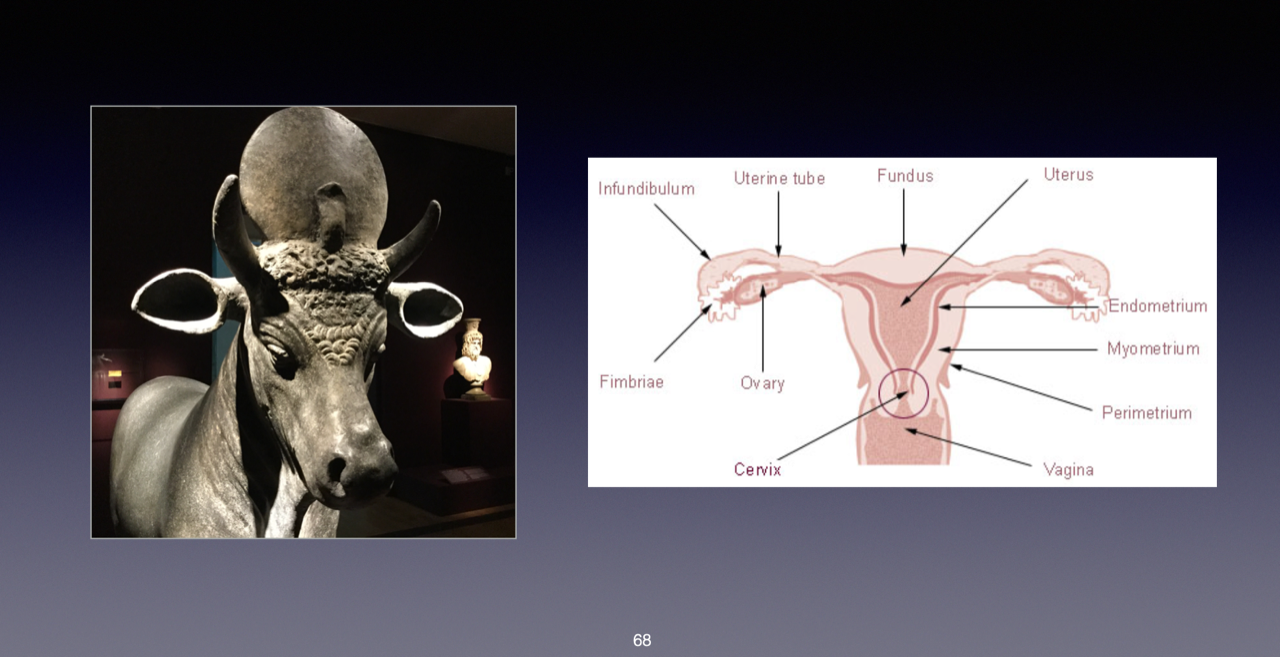
·      Milk and Food: Astoundingly, female bodies are sources of food for the most vulnerable of the species. Sources of food! Milk, sacred cows, and bovine horns were always associated with women whose sharing of food symbolized the primordial act that makes all of us human (408). (The image below shows why.) It is no wonder then that for millennia women were regarded as incarnating the nourishment provided by Mother Earth herself.

Diagram public domain via wiki: https://en.wikipedia.org/wiki/Perimetrium#/media/File:llu_cervix.svg

Vulva: This female organ is especially hallowed because of its connection with first experiences of all five senses. As everyone’s gateway to the external world, it represents our first tactile experiences, the drawing of first breath, the initial experience of fragrance, and the birthed organism’s first taste (of blood). The vulva is also intimately associated with primal experiences of one’s own voice and that of one’s godlike mother. Additionally, the vulva’s appearance reminds every one of the paradisal pre-birth state of unity with Source where all needs were satisfied without effort or pain. No wonder the vulva’s attraction!

·      Menses: In all ancient goddess cultures women’s monthly periods were honored as sacrosanct. They were times of withdrawal in the company of other women to menstrual huts where, relieved of their duties and the demands of husbands and children, women could meditate, pray together, sing, dance, and simply converse (186). More specifically, such periods provided time to celebrate the great mystery that women’s blood is liquid flesh (189).  It is the very substance from which all human bodies are made. This makes women co-creators with the Great Cosmic Mother in ways that men can never be. Nothing in human creation could be more basic, holy, feminine, or divine than female menses.

·      Connection with Lunar Cycles: Menstruation connects women with Mother Nature and her most basic processes in conscious and unconscious ways that are simply closed to men (189). Like the ocean and its tides, women’s bodies are governed by the moon and its phases. This means that women possess innate mostly intuitive wisdom inaccessible to men (183). For those paying attention, such knowledge of natural processes makes women especially sensitive to violations of the Divine Mother, because those transgressions deeply affect all women and mothers. When the Cosmic Mother is raped and despoiled, when the ocean is polluted, all women suffer the same fates whether or not they can articulately identify the transgressions involved. This suggests that women’s voices about environmental destruction should be given priority over men’s.   

·      Womb and Ovaries: These miraculous unseen organs speak volumes in special need of reading in an American culture that refuses to acknowledge what the female body expresses so clearly about questions of abortion. Wombs and ovaries tell us that life does not begin when sperm fertilizes egg. Instead, it is part of a 3.7-billion-year process that erupts continuously and prolifically in countless and infinite forms (including human varieties) most of which never reach full development recognizable as flowers, plants, specific animals, or human beings. The fact that worldwide billions of eggs go down the drain unfertilized each month, and that up to 50% of fertilized ova end up in miscarriages during the first 20 weeks of pregnancy reveals that creations of the Great Cosmic Mother are far more generous, abundant, plentiful, profligate and lavish than non-females can imagine. Women intuitively attuned to these facts, recognize the significance of this tremendous profligacy in ways inconceivable to men who can never experience ovulation, menstruation, conception, miscarriage – or abortion. It exposes the absurdity of the patriarchal approach to the beginning of personal life that, if taken seriously, turns the God of patriarchy into the abortionist par excellence!

Conclusion

The prehistoric images of the unclothed Great Cosmic Mother surely represent humanity’s first volumes of theology “written” for our preliterate ancestors. Wordlessly, the statues proclaim: “In this image you’ll find all you need to know about the divine. She is beautiful, wise (her hair), strong with inner strength beyond belief (soft flesh), the liquid source of our very bodies (menses), the producer of our first meals (her breasts), our way into the world and back to paradise (her vulva), the one who shows how to live harmoniously with nature (connection to the lunar cycles), and a cosmic co-creator.

Beyond that, men’s quasi-magic reaction to the very sight of the unclothed goddesses and the sexual interaction that sometimes follows provides evidence of the Cosmic Mother’s idea of human fulfillment and purpose – not consumption and accumulation, but ecstatic pleasure and joy simply from what the earth and human relationships provide.”

What could be more beautiful, simple — and salvific in a world obsessed with materialism and consumerism that is driving the species to omnicide? We need to return to the Great Cosmic Mother.

But what about the images of mature cyberspace women? Aren’t they pornographic?

It depends on how they’re viewed. If seen appreciatively as the acts of proud subjects rather than as demeaned objects, they can edify as representing sexually independent mothers and grandmothers acting for themselves and not primarily for men, profit, or in the service of cultural misogyny, and sexism. They communicate the same message as the statues found in Çatal Huyuk (in Turkey), in ancient Egypt and throughout the African continent.

They can be seen as proudly “bodying forth” the overlooked teachings of the Great Cosmic Mother viz., that:

  • “Pornography” is a construct of the twisted perspectives of toxic patriarchy. It does not even occur in more sane societal configurations. 
  • Ordinary women owning and claiming their sexual power and independence are indeed goddesses, beautiful and inspiring.
  • Sexual pleasure is good. It is one of Life’s greatest gifts. It is everyone’s right to enjoy it in all its forms – including that provided and elicited by mature women subjects.
  • As incorporating spirit and flesh, the guidance of female wisdom is more grounded in Life and Nature than men’s. Female wisdom represents the leading edge of human consciousness.
  • Since the Great Cosmic Mother’s nourishment embodied in life’s original food producer (i.e., our mother) feeds us without charge or need to earn that gift, human economies would be more harmonious with the cosmic Design if they were similarly gift-based.
  • Nature’s cycles are mirrored in our sisters who remind us each month of the unity shared by all with the moon, ocean, tides, and seasons.
  • Life is so abundant, prolific, and lavish, that all of us (and women especially) are truly co-creators with our Great Source. Like the Cosmic Mother herself, women can choose which fertilized eggs to bring to term and which to terminate. 
  • None of us (especially men) is ultimately in charge of Life’s super-generous processes which thankfully are beyond everyone’s understanding and control but are more fully understood by women.
  • Women deserve special honor as the gateway to life that points us back home to paradise lost.
  • Our world would be a better place if women as embodiments of the Great Cosmic Mother were in charge.

With all this in mind, it is possible to approach proudly unrobed mothers and grandmothers in the following spirit of appreciation and gratitude quite foreign to the unconscious misogyny which indoctrinated me so many years ago. I express that liberation in the verses I offer here with the hope that others might share the freedom they attempt to express:

Divine Images Lost and Found

Goddesses all
They are
Unfailing springs of rapt delight
Virgins, Mothers, wizened Crones
With tresses
Surpassing even
Samson’s might,
Sweet gentle eyes
Playful, smoldering, and mischievous,
Sensuous lips
Smiling wordlessly
While wondrously expressing
Our Mother’s cosmic purpose
Through soft flesh
Fulsome breasts,
And the Great Divide
Enticing
Between extended thighs
Calling
Vagrant children’s return
To origins lost
While inviting contemplation
Of her
And our (!)
Unfathomable mysteries within.


(Special thanks to Meryl Ann Butler, OpEdNews managing editor, for her marvelous editorial guidance in helping me formulate these thoughts whose shortcomings, of course, are mine, not hers.)