Jesus (& Mary Magdalen) Rejects the American Work Ethic (Sunday Homily)

Readings for the 16th Sunday in Ordinary Time: Gn. 18: 1-10A; Ps. 15: 2-5; Col. 1: 24-28; Lk. 10: 38-42. 

This week’s Gospel reading is fun. It’s about work and relaxation. It contains Good News for workers that contrasts sharply with the attitude of their employers.

The reading has Jesus and his closest companion, Mary Magdalen, exemplifying the Master’s habitual attitude towards work which is exactly what American capitalists condemn as laziness. Its take-away: forget Martha’s overwork. Instead, be more like Jester Jesus and Lazy Mary.

I’ll explain that in a minute. But before I do, let me offer an amusing reminder of our culture’s deification of work. It came a couple weeks ago in a Fox News interview with Donald Luskin, the CEO of Trend Macrolytics, a prominent Wall Street consulting firm. As such, it’s his job to forecast market trends and offer stock market advice to institutional investors. I imagine he spends his day making phone calls, having three-martini luncheon meetings with clients, or maybe advising them on the golf course or in a luxury suite at the local baseball stadium. For him, that’s work. It ultimately ends in pressing computer keys to implement his momentous decisions to “buy” or “sell.” Whew!

In any case, Luskin was asked on Fox about a recent report showing that retirement is becoming a thing of the past. In fact, nearly one in four Americans will never have enough money to quit the daily grind. When asked if he found the trend worrisome, Luskin said it didn’t concern him personally. On the contrary, and employing theological language, the man actually called it a “blessing” and a “miracle” that people have been relieved of the burden of retirement that workers had to endure in less fortunate times.

He said:

“It doesn’t worry me personally. I guess I’m one of those people who plans never to retire. I mean, I’ve got to tell you, what do people do when they retire? You know, how do you spend a day? I mean, is bowling that interesting? Is fishing that interesting? I mean, I happen to love my work. Why do I want to stop it? You know, it’s not like it hurts. Why would I stop it? This is great. What a great country where we have the opportunity to keep working. What a miracle where our lives are long enough and we’re healthy enough and mentally alert enough, so we don’t have to retire like generations before us. This is a great blessing. You should embrace it.”

Such words need very little comment. What do retired people do? Are you serious? How about: what you always wanted to do but couldn’t while working two or three meaningless jobs involving physical activity, danger, heavy lifting or boring repetitious tasks for clueless employers like Luskin himself. How about: volunteering for Habitat, working for Marianne Williamson‘s campaign (with its commitment to changed political consciousness); how about spending time with your spouse and grandchildren? How about traveling, reading, writing poetry, listening to or playing music, making love, taking naps, meditating, playing checkers or chess, hiking, learning a new skill, painting – and yes, bowling or fishing.

What Luskin reflects is our entire culture that locates “real life” in the shop or market place. In fact, we’re taught to prize overwork. This is especially true of “American” culture where unlike our European counterparts, we spend an average of three hours per week more on the job. That adds up to something like a month more of work each year than our European sisters and brothers. Most important, Americans take fewer (and shorter) vacations. The average American takes off fewer than six weeks a year; the average Frenchman almost 12. Swedes take the longest vacations – 16 ½ weeks per year.

Today’s gospel reading from Luke urges us to correct our tendency to overwork before it’s too late. In doing so, it directs our attention to the counter-cultural nature of Jesus’ teachings about how we should spend our days.

Yes, Jesus was extremely counter-cultural even about work. We shouldn’t forget that. As Deepak Chopra points out (in his The Third Jesus), the Sermon on the Mount, which captures the essence of Jesus’ wisdom, has him explicitly telling his disciples not to earn a living, save money, plan ahead or worry about the future. He actually does! Read it for yourself.

And did you notice the description of the “Just Person” in today’s responsorial psalm? Man or woman, they harm no one, do not slander, speak ill of no one, and refuse to accept bribes. All of that raises no eyebrow. We yawn: none of that seems particularly counter-cultural.

But how about, “They lend not money at usury?” Could anything be further from the work Mr. Luskin idealizes? Yes, lending at interest is considered robbery and is forbidden in the Bible. [What if all Christians (and Jews) kept that commandment? Our world with its economy based on credit and interest, would be entirely different.]

More to the day’s point: the world would also be different – our lives would not be the same – if we acted like Mary instead of Martha.

The misdirection of traditional sermons obscures that possibility. Customarily homilists understand the story of Martha and Mary in a strictly spiritual sense. Their commentaries use the two sisters to compare the active and the contemplative lives – as though poor Martha stood for lay people having to wait on others with no time for prayer like the more otherworldly Mary. Martha’s sister “choses the better part” like a contemplative “religious” eschewing “the world of work” and spending their time pondering the spiritual teachings of Jesus and living a life rapt in prayer and contemplation.

I used to think that too – until I read Un Tal Jesus (“A Certain Jesus”) written by Maria Lopez Vigil and her brother, Jose Ignacio. (The book has been translated into English under the title Just Jesus.) The authors are Cuban and now live in Nicaragua. Maria is a former nun; Jose Ignacio, a former priest.

Together the Lopez-Vigils created a series of radio programs broadcast all over Latin America. The shows dramatized the four gospels and presented a very human Jesus – the one who emerges from recent scholarship on the historical Jesus.

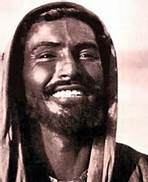
In Un Tal Jesus, Jesus is black, has a winning smile, and a very down-to-earth sense of humor. (The photo at the top of this blog entry shows Jesus as depicted in the Lopez-Vigil’s book.) The human Jesus portrayed in that radio series scandalized many and inspired even more throughout the Latin world and beyond.

As the Lopez-Vigils envision it, today’s episode takes place in a Bethany tavern owned by Lazarus, the brother of Martha and Mary. It’s a place of eating, drinking and lodging for travelers. It’s a place of laughter, joking, over-eating and drunkenness. And Jesus is right there in the middle of it all.

Passover is approaching, and the inn is full of pilgrims. It’s steamy, noisy, and loud. Martha is on the job, waiting on tables and controlling the rest of the staff. Meanwhile Mary (whom scholars increasingly identify with Mary Magdalene, Jesus closest female companion) is distracted by conversation with Jesus, who is bantering with his friends.

And what are they talking about? Religion? God? Spirituality? No, they’re joking. Jesus is posing riddle after riddle. And Mary finds it completely entertaining. In part, their dialog goes like this:

Jesus: What’s as small as a mouse but it guards the house like a lion. One, two, three: Guess what it is!
Mary: Small as a rat…and…it’s a key! I guessed it, I guessed it!
Jesus: Listen to this one: It’s as small as a nut, has no feet but can climb a mountain.
Mary: Wait… a nut going up the mountain…a snail!…Ha, ha, ha, tell me another one!
Jesus: You won’t guess this one right. Listen well: It has no bones, it is never quiet, with edges sharper than scissors.
Mary: It has no bones… I don’t know…
Jesus: It’s your tongue, Mary, which never rests!

Well, Mary and Jesus might have found that sort of patter entertaining, but Martha did not. She’s in charge of the inn and is worried about her guests waiting impatiently for their food while bread is burning in the oven. So, she makes her complaint to Jesus: “Stop your chatter and let my sister do her job!” It’s then that Jesus makes that remark about Mary’s choosing the better part. She’s chosen socializing and play over work.

Does that scandalize you – Jesus distancing himself from work? Well, it seems completely consistent with what I said about Jesus earlier. It coincides with his general approach to work, money, profit, saving, and anxiety about the future.

What difference would it make in our own lives if we accepted that message: socializing, community, and fun are more important than the work people like Donald Luskin would have us devote our entire lives to?

What difference would it make in our culture if, in a context of underpaid labor and long hours on the job we elected candidates advocating “spreading the work around,” spreading the money around, shortening the work week, and affording us more time with friends and family, eating, drinking, joking, and playing?

That’s the message of today’s Gospel reading: we need more free time, more vacations, and assured dignified retirement.

Wake up, Mr. Luskin! Wake up, American workers: You have nothing to lose but your chains.

P.S. Here’s the actual interview with Donald Luskin along with commentary by TYT‘s John Iadarola

Trumpocalypse: America Just Voted for the End of the World (Sunday Homily)

trumpocalypse

Readings for 33rd Sunday in Ordinary Time: MAL 3: 19-20A; Ps. 98: 5-9; 2 THES 3: 7-12; LK 21: 5-9.

We’re still reeling from the astounding results of the November 8th U.S. elections, aren’t we?

For many – especially immigrants, people of color, Muslims, progressives and followers of Jesus – what some have called the “Trumpocalypse” nearly seems like the end of the world as we know it.

Even the Republican Establishment is not completely happy. Mr. Trump is not really one of them.  In effect, (like socialist Bernie Sanders for the Democrats) the Donald was a third (Fascist) party candidate. His election shows that both major parties are disintegrating before our eyes. Powerful third and fourth parties are proliferating alongside Greens and Libertarians. In reality six relevant parties contended in the recently concluded election cycle.

At the moment however, it’s the anti-Gospel political right that is enjoying its moment in the sun.

All of that makes today’s readings disturbingly relevant. They appear to centralize “the end of the world.” And on top of that Paul’s dictum from Second Thessalonians seems eerily to confirm right wing tendencies towards “tough love.” There Paul says “. . . if anyone is unwilling to work, neither should that one eat.”

But don’t be misled. There’s not a trace of “tough love” in Jesus’ treatment of the poor. And “apocalypse” is not about the end of the world. It’s about unsustainability. The word apocalypse means “unveiling.” It’s about “revelation” in that sense – making evident what’s hidden about the world and who’s in charge. Apocalypse affirms the unsustainability of empire. Radical change is inevitable.

Apocalypse emerged a few centuries before the birth of Jesus. To convey its message of impending radical change, it employed stock images of natural catastrophe, plagues, wars, earthquakes, and portents involving the sun, moon, and stars. The change would be cosmic.

The audience of this strange literary form was empire’s victims. It was meant to encourage the poor and dispossessed, the unemployed, sick, widowed and orphaned – not the rich and well-off. Apocalypse assured the poor that all systems of oppression end in flames whether they’re Egyptian, Assyrian, Babylonian, Persian, Greek, or Roman. (Those are the global giants that oppressed Israel at one time or another in its history.) Where are they today? They’ve been swept away by the tide of history. And the apologists for “Eternal Rome” find themselves somewhere in antiquity’s dustbin.

So it’s ironic that apocalypse should be embraced by conservatives and their rich patrons – by those who want to keep things as they are. Things do not have to be that way. And “by God,” they won’t be! That’s the message of apocalypse. A new era is dawning, and you’d better be on the right side of history or you’ll lose out. Being “left behind” means supporting the old order that’s doomed.

The problem is that right from the beginning, believers took literally the cosmic and highly poetic symbolism of apocalypse. (We always get in trouble for being too literal.) That’s the attitude that caused Paul to tear his hair out in today’s second reading. Some in the early Christian community took the imminence of this expectation so seriously that they even stopped working.

What was the point of work, they reasoned? Everything was about to change profoundly by God’s intervention. That made human work meaningless. All believers had to do was sit back and wait for Jesus’ triumphant arrival. Eat, drink, be merry, and whistle past the graveyard in the meantime.

Those are the people Paul addresses in this morning’s excerpt from Second Thessalonians. He’s clearly exasperated. He says, “Look I’m working. And I’m the one responsible for your believing in Jesus’ Second Coming! Get real, people. Go back to work. Stop sponging off the community. Instead, be like me and do your part to bring about the new order we all expect. “

Paul’s words bring to mind the people who refuse to work today because they deem apocalyptic expectations divinely ordained or “natural.” And I’m certainly not referring to welfare queens.

Instead, I’m talking about people so committed to the old order that (with Margaret Thatcher) they’re convinced that “There is no alternative,” even though the “inevitable order” they support threatens the very survival of their own grandchildren. So they do what must be done to perpetuate what in God’s eyes is unsustainable.

Such “busy-bodies” refer to their endeavors as “work,” but in reality, their occupations represent a refusal to work. That is, if we identify that term with what contributes to life and the establishment of the Kingdom community Jesus proclaimed.

On this understanding, involvement in the military and the military-industrial complex is certainly not work. Neither is labor in financial market casinos or in the health-insurance and fossil fuel industries and their nuclear power counterparts. Advertising, fashion, professional sports, or much of what we refer to as “education” and journalism might also qualify as anti-work. Such occupations are not only highly questionable in terms of building up human community and protecting the planet. They are often positively destructive. Their purpose is to ward off or distract from the impending Big Change promised by the great unveiling.

Do I mean followers of Jesus should renounce such “work?” Yes I do. Or at least, we need to work to bring about a world where such occupations are not rewarded with pay – i.e. with a ticket to overconsumption even in terms of food and drink. And, to quote St. Paul, if arms manufacturers want to continue their anti-work as inevitable, let them starve! The world will be better off.

What about the unemployment caused by such radical change? It’s simple: share the remaining work. Make sure everyone is working – say for four hours each day, or three days a week, or six months each year. Get everyone to work building or rebuilding infrastructure, paving highways and covering rooftops with solar cells, and cleaning up the dump sites where all our toxic waste has been buried.

Think of the freedom such changes would create for building up God’s kingdom – to play, to garden, write, converse, make love, raise our children, and do all the things that make us human!

“Totally unrealistic” you say? Precisely! Apocalypse is by nature unrealistic. It calls us to work for an entirely different order we can hardly imagine. It calls us to reclaim our humanity from the insanity of destructive anti-work.

So maybe the election of Donald Trump is exactly what we needed. After all, “America” is just another of those oppressive empires God’s People have always suffered from. It is doomed and will soon disintegrate like Babylon, Rome – and the Soviet Union.

Our apocalyptic readings tell us the present order must end. Second Thessalonians helps us discern directions for a new one

The destruction of both the Democratic and Republican Parties portended by Mr. Trump’s election is a very good start.

Sunday Homily: Jesus Rejects Money and Work: He Embraces ‘Back to Nature’ Abundance

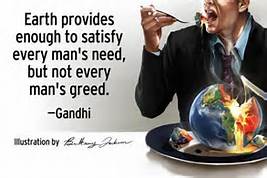
Gandhi Greed

Readings for 8th Sunday in Ordinary Time: IS 49:14-15; PS 62: 2-3, 6-9; I COR 4: 1-5; MT 6: 24-34. http://usccb.org/bible/readings/030214.cfm

Today’s liturgy of the word raises the question of work and money – always two difficult elements of life for those claiming to follow Jesus’ Way. They’re difficult because both occupy so much of our attention and lives that they can distract us from what’s really important – what Jesus calls “the kingdom of God.” Consequently, in this morning’s Gospel selection, Jesus tells us to back off from both money and work while opening ourselves to the abundance of God’s Kingdom.

For American workaholics, that’s surprising. It’s especially challenging for those who love to attack “the undeserving poor” – that is, workers empowered by government programs even like the Affordable Health Care Act. (I’ll get to that in a minute.)

About money Jesus directly compares the worship of God with the common attitude Americans adopt towards money – or as Jesus puts it, “Mammon” (the name for an idol). It’s impossible, Jesus says, to make money the focus of your life while claiming to serve God. In fact money can make us hate God. But that’s not the surprising part.

What is surprising is that Jesus’ claim comes very close to saying that loving God should make us hate money. That seems to be the meaning of his words recorded in today’s selection from Matthew. Jesus says, “No one can serve two masters. He will either hate one and love the other, or be devoted to one and despise the other. You cannot serve God and mammon.”

In other words, there’s a choice to be made here: serve God or money; hate and despise money or hate and despise God. No one can have it both ways. The text seems to bear that reading, don’t you think?

Of course Jesus’ pronouncement will lead many to “clarify” his words to mean don’t be attached to money. It’s the service of money – it’s making money your master – they would explain, that causes hatred of God.

Okay. But who among us (even financiers, banksters and hedge fund managers) would claim to serve money even though they spend all their waking hours scheming about it. Who would admit that they’re attached to money, or have made it their master? Even those 85 individuals proud of owning as much as half the human race would probably deny that they “serve” money or that it’s their master. (And if they’re right, we can stop our discussion right here!)

On the other hand, those wishing to have it both ways might go further. They might invoke “nature.” They might point out we obviously can’t do without money; it’s a product of nature (human nature) they might say. Some might even argue we can’t even do without capitalism and its drive to “maximize profit.” Capitalism and profit maximization simply represent the inescapable way the world works. They are reflections of the natural order. If they allow 85 people to own more than half the world, so be it. That’s simply natural. (Please hold that thought.)

Such talk about nature brings us to my second point – Jesus’ attitude towards work and those who choose not to. Here he definitely has a “back to nature” approach. And once again, it’s surprising. Jesus is not talking about the naturalness of competition or of the law of supply and demand.

In today’s reading from Matthew’s version of the Sermon on the Mount, Jesus says clearly that the natural order not only minimizes the importance of money (at the very least); it also minimizes the importance of work. “Look at the birds of the air,” Jesus says, “they don’t sow or reap or store food in barns.” Or “Consider the lilies of the field. They neither toil nor spin.” Learn from them both. Follow their example.

Say what? Is Jesus intention here to discourage work itself? (Talk about contradicting “American” values!) It’s easy to draw that conclusion, I think. After all, he seems to be saying don’t sow or reap or store products in warehouses. Don’t toil or spin. It’s a short step from there to saying, “Don’t work!”

Besides that, Jesus seems to have lived out that latter implication. I mean as an able-bodied 30-something, he left his job as a carpenter to wander from village to village in Palestine philosophizing and apparently living on hand-outs. On the road, he had no home and must have sought shelter from friends. Moreover, he got rough fishermen to leave their nets and follow his example of what appears to be idleness as far as economic productivity is concerned.

In fact, Republicans today would clearly regard Jesus and his apostles as examples of the idle undeserving poor – not to say bums – living off the donations of hard working people. I mean, does that contradict our Protestant Work Ethic, or what?

And that brings me to that Obamacare business.

Did you follow last month’s flap over the Congressional Budget Office’s Report on jobs and President Obama’s Affordable Health Care Act (ACA)? It said that the ACA would induce 2.5 million people to leave work. They’d escape “job lock” – i.e. the inability to leave employment because doing so would lose them health coverage.

All hell broke loose.

When Paul Ryan (R-Wis) heard that, hypocrisy demanded that he and his Republican cronies reverse their position on “job lock.” Formerly they were against it. In fact a couple of years ago, Ryan said,”[The] key question that ought to be addressed in any healthcare reform legislation is, are we going to continue job-lock or are we going to allow individuals more choice and portability to fit the 21st century workforce?”

Now, however, since freedom from “job lock” represented a boon of the ACA, Ryan and the Republicans had changed their tune. They quickly became opponents of “more choice and portability.” Having realized that Obamacare will not eliminate jobs, but increase worker freedom to change jobs or leave the workforce altogether, GOP spokespersons were forced to readopt their familiar tack of demonizing empowered workers and the poor.

This meant that mothers and fathers leaving coveted jobs at McDonalds or as greeters in Wal-Mart to spend more time with their families were characterized as slackers and lazy. According to Ryan, such people lose respect for “the dignity of work.” They were worthy of their traditional rank among Republicans’ favorite target, the undeserving poor. (Never mind that Ryan has done everything he can to undermine labor’s dignity – but that’s another story.)

The point is that Jesus and his sainted friends were not only among the undeserving poor, they flaunted it. They recognized that according to God’s natural order, the world belongs to all creatures including the birds and flowers. If its resources were shared according to Jesus’ Kingdom values, there’d be enough for everyone – just as there was for birds and flowers in Jesus’ day.

So in minimizing the importance of money and praising freedom from work, Jesus was not being unrealistic or some starry-eyed hippy. Instead (as always) he was proclaiming the Kingdom of God. In God’s order, he insisted, there is abundance for everyone – or as Gandhi said enough for everyone’s need, but not for their greed.

Realizing the reality of God’s and nature’s abundance – and not giving in to the world’s myth of scarcity, overwork, and focus on money – should give workers and those not belonging to Ryan’s 1% courage to demand what is their birthright.

That natural condition is a life without worry about making ends meet and with enough leisure to enjoy life just like the birds and flowers.