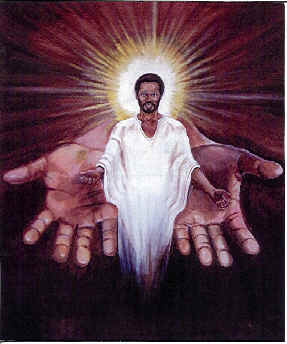
Doubting Thomas: Our Twin (Jesus’ Twin!) in Denial (Sunday Homily)

jesus-black-love

Readings for 1st Sunday after Easter: Acts 5:12-16; Ps. 118: 2-4, 13-15, 22-24; Rev. 1: 9-11A, 12-13, 17-19; Jn. 20: 19-31. http://www.usccb.org/bible/readings/040713.cfm

The picture painted in today’s gospel story should be familiar to all of us. I say that not only because we have heard it again and again, but because it’s our story. It’s about a man in denial, the original doubting Thomas. Thomas’ nickname was “the twin.”

Whatever that meant originally, Thomas is undoubtedly our fraternal double in that he depicts our condition as would-be followers of Yeshua. Like Thomas we live in practical denial concerning the reality of Yeshua’s resurrection – about the possibility of a radically transformed life. Recall our twin’s story. Pray that it can be ours as well.

The disciples are there in the Upper Room where they had so recently broken bread with Yeshua the night before he died. And they are all afraid. John says they are afraid of “the Jews.” However it seems they fear death more than anything else. They dread it because they are convinced that death spells the end of everything they hold dear – their ego-selves, families, friends, culture, and their small pleasures. Besides that, they are afraid of the pain that will accompany arrest – the isolation cells, the beatings, torture, the unending pain, and the final blow that will bring it all to a close. Surely they were questioning their stupidity in following that failed radical from Galilee.

So they lock the doors, huddle together and turn in on themselves.

Nevertheless, the very fears of the disciples and recent experience make them rehearse the events of their past few days. They recall the details: how Yeshua so bravely faced up to death and refused to divulge their names even after undergoing “the third degree” – beatings followed by the dreaded thorn crown, and finally by crucifixion. All the while, he remained silent refusing to name the names his Roman interrogators were looking for. He died protecting his friends. Yeshua was brave and loyal.

His students are overwhelmingly grateful for such a Teacher. . . .

Then suddenly, the tortured one materializes there in their midst. Locks and fears were powerless to keep him out. They all see him. They speak with him. He addresses their fears directly. “Peace be with you,” he repeats three times. Yeshua eats with them just as he had the previous week. Suddenly his friends realize that death was not the end for the Teacher. He makes them understand that it is not the end for them either – nor for anyone else who risks life and limb for the kingdom of God. No doubt everyone present is overwhelmed with relief and intense joy.

“Too bad Thomas is missing this,” they must have said to one another.

Later on, Thomas arrives – our fraternal double in unfaith. His absence remains unexplained. Something had evidently called him away when the others evoked Jesus’ presence by their prayer, recollections, and sharing of bread and wine. Like us he hasn’t met the risen Lord.

“Jesus is alive,” they tell the Twin. “He’s alive in the realm of God. He took us all with him to that space for just a moment, and it was wonderful. Too bad you missed it, Thomas. None of the rules of this world apply where Yeshua took us. It was just like it was before he died. Don’t you remember? Yeshua brought us to a realm full of life and joy. Fear no longer seems as reasonable as it once did. He was here with us!”

However, Thomas remains unmoved. Like so many of us, he’s is a literalist, a downer. He’s an empiricist looking for the certainty of physical proof. Thomas is also a fatalist; he evidently believes that what you see is what you get. And for him there has been no indication that life can be any different from what his senses have always told him. Life is tragic. Death is stronger than life; it ends everything. And that means that Yeshua is gone forever. Who could be so naïve as to deny that?

Our twin in unfaith protests, “In the absence of physical proof to the contrary, I simply cannot bring myself to share your faith that another life is possible. And make no mistake: Yeshua’s enemies haven’t yet completed their bloody work. They’re after us too.”

Can’t you see Thomas glancing nervously behind him? “Are you sure those doors are locked?”

Then lightning strikes again. Yeshua suddenly materializes a second time in the same place. Locks and bolts, fear and terror – death itself – again prove powerless before him.

Yeshua is smiling. “Thomas, I missed you,” he says. “Look at my wounds. It’s me!”

Thomas’ face is bright red. Everyone’s looking at him. “My God, it is you,” he blurts out. “I’m so sorry I doubted.”

“Don’t worry about it,” Yeshua assures. “You’re only human, and I know what that’s like, believe me. I too knew overwhelming doubt. Faith is hard. On death row, my senses told me that my Abba had abandoned me too. I almost gave up hope. It’s like I’m your twin.

“But then I decided to surrender. And I’m happy I did. My heart goes out to you, Thomas. My heart goes out to all doubters. I’ve been there.

“However, it’s those who can commit themselves to God’s promised future in the absence of physical proof that truly amaze and delight me. Imagine trusting life’s goodness and an unseen future with room for everyone when all the evidence tells you you’re wrong! Imagine trusting my word that much, when I almost caved in myself? That’s what I really admire!

“My prayer for you, Thomas, and for everyone else is that you’ll someday experience the joy that kind of faith brings.

Working for God’s Kingdom – for fullness of life for everyone – even in the face of contrary evidence – that’s what faith is all about. May it be yours.”

May it be ours!

What Is Retirement (and Life) for Anyway?

retirement

Last night Peggy and I had some dear friends over for drinks and conversation. Our friends retired two years ago – about a year after I did so myself. So more or less naturally, our conversation turned to retirement and its ups and downs – and to Florida and warmer climes.

The ups of retirement are obvious. They include not having to show up at the office any more. They entail being free each day to decide what to do. Travel, movies, hobbies like golf and tennis can be pursued freely in retirement. There’s more time to spend with children and grandchildren. And there’s space to think, write, study and pray. All of that is what people dream about doing in their golden years.

And so far, even though Peggy has not yet retired (and probably won’t for 3 or 4 years), my first years of retirement have been filled to overflowing with more of the expected ups than I can count. I’ve spent parts of 3 semesters in Costa Rica teaching in a Latin American Studies Program that was completely enjoyable and fun. The program served North American students from a large number of Christian colleges and universities. It was their “term abroad.” And it introduced them to the realities of the underdeveloped world, taking them to impoverished parts of Costa Rica, living with local families in Nicaragua and investigating first-hand the successes and shortcomings of socialist revolution in Cuba.

My part in the program was to introduce our Evangelical (and Republican) students to liberation theology. On the whole, the students were surprisingly open and receptive. And though I’ve always loved teaching, I’ve never found it as enjoyable as in Costa Rica.

Then last spring Peggy and I used her sabbatical to spend five months in Cape Town, South Africa – or, as they say, in the heart of “whitest Africa.” We were completely captivated by Cape Town which we agreed is the most beautiful city we’ve ever seen. We loved Table Mountain and the beautiful sea vistas everywhere we traveled. We also learned a great deal in South Africa, not only about politics and history, but about African spirituality and the powerful energy of rock formations subtly transformed by the San and Koi-Koi Peoples to track the movements of the heavens.

We traveled South Africa’s “Wine Route” and visited game parks with our grandchildren and their parents. I played golf with my son Brendan on a few of South Africa’s best courses. We passed a day on Robben Island, where Nelson Mandela was imprisoned for 17 of his 28 years of punishment in South African jails. We also spent weeks with Ann Hope and Sally Timmel, colleagues of Steve Biko with a life-long commitment to activism and the struggle against apartheid. We compared notes with them about common experiences, shared friendships, theology and spirituality. What a privilege that was!

With South Africa behind us, we’re now looking forward to five months in India. Can you imagine that? My Peggy has won her second Fulbright Fellowship (the other having brought us to Zimbabwe for a year back in ’97-’98). During this Fulbright term, Peggy will be teaching in Mysore. This will be our second trip to India. In 2004 we attended the World Social Forum in Mumbai.

This time we’ll be living in India with our daughter Maggie, our son-in-law, Kerry, and their three small children, Eva (4), Oscar (2), and Orlando (10 months). Kerry is taking his own sabbatical from his work in finance. So this will be an extraordinary opportunity not only to learn from a deeply spiritual culture, but to bond deeply with our grandchildren.

And then there’s this blog. It’s been unexpectedly fulfilling. I’ve never written as much as I have over these past three years, not only on my blog site, but on OpEdNews and in our local newspaper. Writing a homily each week has kept me grappling with my life-long commitment to spirituality, faith and theology. It’s all helped me think more clearly about life and its purpose.

Actually I’ve thought of the blog as a vehicle for reclaiming the formal priesthood I left more than 36 years ago – as has my involvement in the planning committee of a local Ecumenical Table Fellowship. I’ve seen this new work as a demonstration of the fact that Christian faith isn’t synonymous with fundamentalism. Approaching faith historically and contextually can recover the authentic teaching of Yeshua the Nazarene (the opposite of fundamentalism) and engage and animate radicals and progressives in the process.

How are those for retirement ups? At some level, I couldn’t ask for more.

But then there have been unexpected downs. With retirement comes a loss of identity. With my particular work as a college teacher, I had one of the best jobs I could think of. Imagine getting paid to read, study, write, and travel – all so that you might have hours of interesting conversations with young people?

Yes there was drudgery involved – papers to grade, committees, endless meetings, “administrivia.” But there was no heavy lifting. And there were those long vacations – three weeks at Christmas, three months in the summer, and mid-term breaks fall and spring. The “pay” for teaching went way beyond a monthly check. It involved those conversations I mentioned, but also the resulting life-long friendships, “turning on” students to life’s big questions, seeing that “light” go on, and watching students take their places as agents of transformation in the world.

Most of that (except the now-endless vacation) disappeared with retirement. And whereas previously I could walk across Berea’s campus and meet my students and former students at virtually every turn, I now find students (and myself!) largely anonymous. I miss the interactions with young people. I even have to show my identity card when I enter the Seabury Athletic Center to do my morning exercises. “Mike who. . .?”

On the one hand I find the question liberating, but also a little depressing. It means my identity is gradually slipping away. It all reminds me of the inevitable: the final slipping away, and the complete loss of identity and of any conscious trace of having been here at all. That’s not a morbid thought. It’s simply a fact. Following our deaths and within a generation or less, virtually anyone I know will disappear entirely from everyone’s memory.

And that brings me to my question: what is life for anyway? Truth is: I don’t know for sure.

And that’s where faith comes in. I’ve come to understand faith as taking a leap into what we don’t know for sure. I mean life might be just about family, travel, good food and drink, getting strokes from grateful students, breaking par or watching movies. However, I don’t think it is.

Instead, I’ve come to agree with the great mystics of all traditions – Hindu, Buddhist, Muslim, and Christian. At their highest peak, all of those traditions come together on the following points:

1. There’s a spark of the divine within each of us – our deepest identity.
2. Each human being is called to live from that divine place – to actualize God’s love in the world.
3. And that’s the purpose of life.
4. Gradually, as one strives for such actualization, s/he begins to see divine presence in everything, in all of creation.

So that’s what life is about for me – seeing God everywhere and responding accordingly. That’s what retirement is about. Sixteen years ago I decided to leap in that direction. My jump has involved the daily practice of meditation, repetition of my mantram, training the senses, spiritual reading from the mystics, spiritual companionship, slowing down, and one-pointed attention – the eight-point program of Eknath Easwaran, the great meditation teacher from Kerala state in India. In retirement I finally have time to follow Easwaran’s program more wholeheartedly than ever.

None of this excludes the other activities I’ve mentioned. Peggy and I will still travel, and spend time with our children and grandchildren. I’ll still hack around on the golf course, study, write, and give the occasional class. And I’ll continue learning to grapple with and mostly enjoy my anonymity and nobody-ness.

But meditation and its allied disciplines puts all those things in perspective. And it gets me ready for my next incarnation. [Oh yes, I’ve come to agree with the mystics (including Yeshua) that life won’t end for me or anyone else when those last memories fade . . . .]

Do you agree?

Did Jesus Really Rise from the Dead?

resurrection

Did Jesus really rise from the dead? Or is belief in his physical resurrection childish and equivalent to belief in the Easter Bunny or Santa Claus?

I suppose the answer to those questions depends on what you mean by “really.” Let’s look at what our tradition tells us.

Following Jesus’ death, his disciples gave up hope and went back to fishing and their other pre-Jesus pursuits. Then, according to the synoptic tradition, some women in the community reported an experience that came to be called Jesus’ “resurrection” (Mt. 28:1-10; Mk. 16: 1-8; Lk. 24:1-11). That is, the rabbi from Nazareth was somehow experienced as alive and as more intensely present among them than he was before his crucifixion.

That women were the first witnesses to the resurrection seems certain. According to Jewish law, female testimony was without value. It therefore seems unlikely that Jesus’ followers, anxious to convince others of the reality of Jesus’ resurrection, would have concocted a story dependent on women as primary witnesses. Ironically then, the story’s “incredible” origin itself lends credence to the authenticity of early belief in Jesus return to life in some way.

But what was the exact nature of the resurrection? Did it involve a resuscitated corpse? Or was it something more spiritual, psychic, metaphorical or visionary?

In Paul (the only 1st person report we have – written around 50 C.E.) the experience of resurrection is clearly visionary. Paul sees a light and hears a voice, but for him there is no embodiment of the risen Jesus. When Paul reports his experience (I Cor. 15: 3-8) he equates his vision with the resurrection manifestations to others claiming to have encountered the risen Christ. Paul writes “Last of all, as to one untimely born, he appeared also to me.” In fact, even though Paul never met the historical Jesus, he claims that he too is an “apostle” specifically because he shared the same resurrection experience as the companions of Jesus who were known by that name. This implies that the other resurrection appearances might also be accurately described as visionary rather than physical.

The earliest Gospel account of a “resurrection” is found in Mark, Ch. 16. There a “young man” (not an angel) announces Jesus’ resurrection to a group of women (!) who had come to Jesus’ tomb to anoint him (16: 5-8). But there is no encounter with the risen Jesus. In fact, Mark’s account actually ends without any narrations of resurrection appearances at all. (According to virtually all scholarly analysis, the “appearances” found in chapter 16 were added by a later editor.) In Mark’s original ending, the women are told by the young man to go back to Jerusalem and tell Peter and the others. But they fail to do so, because of their great fear (16: 8). This means that in Mark there are not only no resurrection appearances, but the resurrection itself goes unproclaimed. This makes one wonder: was Mark unacquainted with the appearance stories? Or did he simply not think them important enough to include?

Resurrection appearances finally make their own appearance in Matthew (writing about 80) and in Luke (about 85) with increasing detail. Always however there is some initial difficulty in recognizing Jesus. For instance Matthew 28: 11-20 says, “Now the eleven disciples went to Galilee, to the mountain to which Jesus had directed them. And when they saw him they worshipped him; but some doubted.” So the disciples saw Jesus, but not everyone was sure they did. In Luke 24: 13-53, two disciples walk seven miles with the risen Jesus without recognizing him until the three break bread together.

Even in John’s gospel (published about 90) Mary Magdalene (the woman with the most intimate relationship to Jesus) thinks she’s talking to a gardener when the risen Jesus appears to her (20: 11-18). In the same gospel, the apostle Thomas does not recognize the risen Jesus until he touches the wounds on Jesus’ body (Jn. 26-29). When Jesus appears to disciples at the Sea of Tiberius, they at first think he is a fishing kibitzer giving them instructions about where to find the most fish (Jn. 21: 4-8).

All of this raises questions about the nature of the “resurrection.” It doesn’t seem to have been resuscitation of a corpse. What then was it? Was it the community coming to realize the truth of Jesus’ words, “Whatever you do to the least of my brethren, you do to me” (Mt. 25:45) or “Wherever two or three are gathered together in my name, I am there in their midst” (Mt. 18:20)? Do the resurrection stories reveal a Lord’s Supper phenomenon where Jesus’ early followers experienced his intense presence “in the breaking of the bread” (Lk. 24:30-32)?

Some would say that this “more spiritual” interpretation of the resurrection threatens to destroy faith.
However, doesn’t such perception of threat reveal a quasi-magical understanding of faith? Does it risk limiting faith to belief in a God who operates outside the laws of nature and performs extraordinary physical feats that amaze and mystify? Doesn’t it reduce the significance of resurrection belief to simply another “proof” of Jesus’ divinity?

But faith doesn’t seem to be principally about amazement, mystification and proof analogous to the scientific. It is about meaning.

And regardless of whether one believes in resurrection as resuscitation of a corpse or as a metaphor about the spiritual presence of God in communities serving the poor, the question must be answered, “What does resurrection mean?”

Surely it meant that Jesus’ original followers experienced a powerful continuity in their relationship Jesus even after his shameful execution. Their realm of experience had expanded. Both Jesus and his followers had entered broadened dimensions of time and space. They had crossed the threshold of another world where life was fuller and where physical and practical laws governing bodies and limiting spirits no longer applied. In other words, the resurrection was not originally about belief or dogma. It was about a realm of experience that had at the very least opened in the context of sharing bread – in an experience of worship and prayer.

Resurrection meant that another world is possible — in the here and now! Yes, that other world was entered through baptism. But baptism meant participation in a community (another realm) where all things were held in common, and where the laws of market and “normal” society did not apply (Acts 2:44-45).

In order to talk about that realm, Jesus’ followers told exciting stories of encounters with a revivified being who possessed a spiritual body, that was difficult to recognize, needed food and drink, suddenly appeared in their midst, and which just as quickly disappeared. This body could sometimes be touched (Jn. 20:27); at others touching was forbidden (Jn. 20:17).

Resurrection and Easter represent an invitation offered each of us to enter the realm opened by the risen Lord however we understand the word “risen.” We enter that realm through a deepened life of prayer, worship, community and sharing.

I for one feel a need to think together about practical responses to an Easter invitation understood in this way.