Jesus’ Healing Action Tells Women To Disobey Men: Control Your Own Bodies

Readings for 13th Sunday in Ordinary Time: Wisdom 1:13-16, 2:23-24; Ps. 30:2, 4-6, 11-13; 2Cor. 8:7, 9, 13-16; Mk. 5:21-43

Last month my brilliant 15-year-old granddaughter shocked students in her high school freshman class by giving a speech about menstruation. Yes, menstruation! She called her talk “Bleeding in Silence: The Hidden Epidemic of Period Poverty.” (For those interested, I’ve pasted Eva’s words to the bottom of this posting.)

Eva’s speech was about how the patriarchal system fundamentally misunderstands how women’s bodies function. And in our man’s world, it’s women who pay the price for such ignorance. For instance, it influences the cost of “feminine hygiene products” and their availability while imposing unspoken prohibitions about even mentioning menstrual periods much less openly discussing and coping with them.

Eva’s presentation began with a video of interviews of male family members during a party over her school’s Easter break.  On camera, she simply asked us “What do you understand by the word ‘menstruation?” It was surprising how quickly inarticulate, seemingly embarrassed, and (let’s face it) ignorant our responses were, even by those who (like me) should know better.

A principal conclusion of Eva’s speech was that lamentably, men know very little about how female bodies work. Women, of course know much more. Moreover, this disparity has major social repercussions when overwhelmingly male state administrators in a completely patriarchal system impose legislation about what they barely understand. e.g., about abortion, contraception sex education, and easy and cheap access to those hygiene products.

For instance, relative to abortion, the legislation ignores the fact that 70-75% of fertilized eggs end up aborting spontaneously. They’re unceremoniously flushed down toilets across the world in the menstrual period immediately following fertilization. Yet, a recent decision by the Alabama Supreme Court holds that all those unknown and unrecognized embryos are somehow “children.” At least that’s the implication of the court’s determination that frozen embryos are babies. How offensive to common sense is that? How contrary to what every woman implicitly knows.

I bring all of that up on this Thirteenth Sunday in Ordinary Time because today’s selection from the Gospel of Mark centralizes a woman with a menstrual problem. It implies criticism of ignorant patriarchal laws regulating it, while strongly affirming a particular woman’s courageous decision to transgress those restrictions in favor of her own faith and common sense.

Jesus & Menstruation       

In short, today’s reading uses the issue of menstruation to show how Jesus favored women who spoke for themselves and courageously exercised their own initiative even in the face of specific patriarchal legislation forbidding such agency. It has him even curing and praising a woman who disobeys precisely misogynistic laws. He ends up prioritizing her needs over those of a young female who was a passive captive to the religious patriarchy. 

To make those points, Mark the evangelist creates what might be termed a “literary sandwich” – a “story within a story.” The device focuses on two kinds of females within the Jewish faith of Jesus’ day. In fact, Mark’s gospel is liberally sprinkled with doublets like the one just described. When they appear, both stories are meant to play off one another and illuminate each other.

In today’s doublet, we find two women. One is just entering puberty at the age of 12; the other has had a menstrual problem for the entire life span of the adolescent girl. (Today we’d call her condition a kind of menorrhagia.)

So, to begin with the number 12 is centralized. It’s a literary “marker” suggesting that the narrative has something to do with the twelve tribes of Israel – and in the early church, with the apostolic leadership of “the twelve.” The connection with Israel is confirmed by the fact that the 12-year-old in the story is the daughter of a synagogue official. As a man in a patriarchal culture, he can approach Jesus directly and speak for his daughter.

The other woman in the doublet has no man to speak for her; she must approach Jesus covertly and on her own. She comes from the opposite end of the socio-economic spectrum from the 12-year- old daughter of the synagogue leader.

The older woman is without honor. She is poor and penniless. Her menstrual problem has rendered her sterile, and so she’s considered technically dead by her faith community. Her condition has also excluded her from the synagogue. In the eyes of community leaders like Jairus (the petitioning father in the story) she is “unclean.” (Remember that according to Jewish law, all women were considered unclean during their monthly period. So, the woman in today’s drama is exceedingly unclean. She and all menstruating women were not to be touched.)  

All that means that Jairus as a synagogue leader is in effect the oppressor of the second woman. On top of that the older woman in the story has been humiliated and exploited by the male medical profession which has been ineffective in addressing her condition. In other words, the second woman is the victim of a misogynist religious system which saw the sacrificial blood of animals as valuable and pleasing in God’s eyes, but the blood of women as repulsively unclean.

Nonetheless, it is the bleeding woman who turns out to be the hero of the story. Her confidence in Jesus is so strong that she believes a mere touch of his garment will suffice to restore her to health, and that her action won’t even be noticed.

So, she reaches out and touches the Master. Doing so was extremely bold and highly disobedient to Jewish law, since her touch would have rendered Jesus himself unclean. She refuses to believe that.

So instead of being made unclean by the woman’s touch, Jesus’ being responds by exuding healing power, apparently without his even being aware. The woman is cured. Jesus asks, “Who touched me?” The disciples object, “What do you mean? Everybody’s touching you,” they say.

Finally, the unclean woman is identified. Jesus praises her faith and (significantly!) calls her “daughter.” So, what we end up finding in this literary doublet are two Jewish “daughters” – yet another point of comparison.

While Jesus is attending to the bleeding woman, the first daughter in the story apparently dies. Jesus insists on seeing her anyhow. When he observes that she is merely asleep, the bystanders laugh him to scorn. But Jesus is right. When he speaks to her in Aramaic, the girl awakens and is hungry. Everyone is astonished, and Jesus must remind them to feed her.

Mark’s Message for Us

What does all the comparison mean? The doublet represented in today’s Gospel addresses issues that couldn’t be more female – more feminist. The message here is that bold and active women unafraid of disobeying the religious or civil patriarchy in matters that women understand better than men. “Prioritize and act like the bleeding woman” is the message of today’s Gospel.

Could today’s gospel be telling us that bold and specifically feminist faith that sides with the poor and oppressed (like the hero of today’s Gospel) will be the salvation of us all who are moribund? Are women precisely as women today’s real faith leaders, rather than the elderly, white, out-of-touch men who overwhelmingly claim to lead in every sphere even those where women know far more.

Conclusion

Today’s Gospel suggests that it’s time for men to stop telling women how to be women – to stop pronouncing on issues of female sexuality whether it be menstruation, abortion, contraception, same-sex attractions, or whether women are called by God to the priesthood. Correspondingly, it’s time for women to disobey such male pronouncements, and to exercise leadership in accord with their common sense – in accord with women’s ways of knowing. Only that will save our national community which is currently sick unto death.

_______

Bleeding in Silence: The Hidden Epidemic of Period Poverty

By Eva Lehnerd Reilly

Whether they know the term or not, all women are necessarily aware of the realities of “Period Poverty.” Nonetheless, the concept remains completely foreign and even incomprehensible to most men. As a result, little is done to eliminate the problems the phrase represents. The phrase “Period Poverty” is defined as the lack of access to safe and hygienic menstrual products during monthly periods and accessibility to basic sanitation services or facilities as well as menstrual hygiene education.

Additionally, period poverty has social dimensions that include the stigmas surrounding this natural female process. To explain the problem, what follows will explore international dimensions of this issue, connect the phrase with patriarchy, misogyny and human rights and make recommendations for its elimination. This essay is arguing “Period Poverty” is a world health issue thus by refusing to acknowledge it we are proving that we still live in a society that is patriarchal, misogynist, and locked in an aggressive denial of the rights of women.

An International Problem 

This issue affects billions of people worldwide in ways including stigma, dependence on transnational companies producing the necessary hygienic products, and the lack of understanding and acknowledgement of the problem. Stigma is one of the largest problems surrounding period poverty. Many countries and people believe wildly untrue period-related information. According to the Korean Journal of Family Medicine, Nepal “continues to believe in dangerous, incorrect ideas, for example, using tampons causes women to lose their virginity, or handling food while menstruating causes it to spoil the food.

Social stigma on menstruation remains even in more advanced nations: in the United States, 58% of women are ashamed of having a period, and 51% of men believe that it is improper to discuss periods at work.” (Jaafar, Hafiz, et al., 2023). The fact that stigma is so present in all different circles around the world shows how grand an issue this is and how many people are affected by it.

This is also an economic issue because women are dependent on transnational companies. Global Research and Consulting Group Insights explains that: “Multiple countries in the world impose the ‘tampon tax’ on menstrual products, frequently targeted as ‘luxury goods.’ This categorization enhances the chances that economic disparities, limit access to period products, and perpetuates the view that they are not a ‘necessity.’”(Ricardo da Costa, 2023). This tax is implemented often in particularly lower-income, less developed countries but it is far from unique to developing countries. In fact, GRC found that the elimination of the “tampon tax” in California would likely reduce government revenue by 55 million dollars. This shows how women’s reliance on companies to provide basic hygiene products is problematic because the government is trying to make financial gains by providing resources that should never be charged for in the first place.

Probably the largest problem of them all is the lack of awareness and understanding surrounding period poverty and the menstrual cycle in general. A Plan International study found that one in five boys and young men think that periods should be kept a secret. Furthermore, they associate this term with words like ‘messy,’ ‘gross,’ and ‘embarrassing.’ This tells us that the taboos set in place by society are greatly affecting young people and discouraging them from learning and understanding this issue. This is leading to the rise of a new wave of sexism.

Periods and Patriarchy

The term “patriarchy” refers to social conditions ruled by fathers–or more generally by men. In 

The Creation of Patriarchy, Gerda Lerner determines that this comes from lessons taught in childhood. She says that the “absolute authority of a father over his children provided men with a conceptual dominance of dependency, due to the helplessness of youth.” (Lerner, 90). Relative to period poverty, this fundamental condition has led some women to joke that if male biology included menstruation, they would likely be excused from work days before and during the entire menses process, plus they would be given a week off to recover. Additionally, menstrual hygiene products would be low or no cost, not subject to taxation, and as available as toilet paper and paper hand towels in every washroom.

In our patriarchal society no such accommodations are available for more than half our nation’s population. That’s period poverty. However, this goes farther than just the patriarchy. The issue is also affected greatly by misogyny, a term meaning hatred of women. This is revealed in attitudes surrounding mood swings, jokes about periods and even dates back to religious texts calling women ‘unclean’ during this time.

Particularly, in the third Book of the Pentateuch or Torah, known as Leviticus, it states that a woman undergoing menstruation is perceived as unclean for seven days and whoever touches her shall be unclean until evening (Leviticus 15:19). This is simply outrageous and goes to show how our society is so deeply rooted in these feelings of hatred towards women and disgust towards natural occurrences.

Finally, access to period products is a human right. A human right is what belongs to human beings simply because of being human; it does not have to be earned, it is an entitlement. All women, simply because of being women, have menstrual periods. They therefore have rights connected with their inevitable circumstances. These include rights to free or very low-cost feminine hygiene products, widespread availability of such products and freedom from blame, ridicule, or penalty for time off for personal care during their periods. Now that we have established this, how can we fix this?

Practical Recommendations

The Journal of Global Health Reports found that 500 million people lack access to menstrual products and hygiene facilities and since half the population is female and over half of university students are female, this issue can no longer be ignored. Men need to be part of the solution. We need to all work together to ensure a positive and supportive environment that allows menstruating people to participate in all aspects of life (e.g., going to school/work, and sport). In a Plan International study of over 300 men, 49% said their education on periods was poor or non-existent and just under one third (32%) said that talking about periods made them feel uncomfortable, increasing to 53% in the youngest respondents aged 16-18 years. This shows that many people (men in particular) are not receiving adequate education leading to misinformation and increased stigma associated with menstruation.

The takeaway is that we are in desperate need of a far greater and earlier education about periods in schools. There are three things to note surrounding this being a world health issue: 1) Poor menstrual hygiene often causes physical health risks, 2) globally, 1.7 billion people live without basic sanitation services, 3) girls with disabilities disproportionately do not have access to the facilities and resources they need for proper menstrual hygiene. The former Chief of Water, Sanitation and Hygiene at UNICEF said it best: “Meeting the hygiene needs of all adolescent girls is a fundamental issue of human rights, dignity, and public health.” (Rodriguez, Global Citizen). With all that in mind, allow me to conclude my argument.

Here’s What I’d Say If President Biden Asked for a Tarot Card Reading about Gaza

Recently, Rob Kall, the editor-in-chief of OpEdNews (where I’m a senior editor) asked me, “But what does one of your Tarot card readings look like?” It was a fair question. So I’ve decided to give an example of what I do according to the following procedure: (1) The querent (seeker) asks for a reading; (2) I do a spread with her questions in mind; (3) I write up the reading as fully as possible; (4) I email the reading to the querent; (5) we establish a SKYPE appointment where (6) we discuss the reading for an hour or so, (7) supplementing it whenever necessary with “clarifying cards” chosen by the querent in real time; (8) I send a final email summary of the entire interaction.

To show you what I mean, you’ll find below an example of one of my readings — this a fictitious one on behalf of President Joe Biden. It’s a spread responding to questions I imagine him asking about Gaza.

Dear Mr. President,

Thank you for your request for a Tarot reading about your dilemma in Gaza. I know you seek an answer from the cards hoping that they have access to the will of the Great Spirit that grounds all our lives. I for one am sure they do.

With that in mind, I take your question to be “What do I need to know about myself in relation to the ongoing conflict in Gaza? And what should I do?”

Seeking a response and using the World Spirit Tarot deck (based on the standard Rider-Waite-Smith deck, but much more dramatic) I did a “Celtic Cross” 10-card spread (see immediately below). Before beginning, I held the cards close to my heart. I reminded myself that the cards represent a marvelous packet of divine energy and light – and that you do as well, and so do I. Grounded in those convictions, I made the following invocation: “O, Great Spirit of Life, our Divine Mother and Father, let President Biden’s energy and light (channeled through me) meld with the energy and light of these cards so that the images chosen might reveal his current life’s situation and choices relative to Gaza. Let them show the deep unconscious source of the circumstances that concern him. Let them also reveal their more proximate and probably conscious source along with Mr. Biden’s present motivation, his immediate future, the relevant image he has of himself, the external influences on his life, his hopes and fears, and finally his destiny should he continue his present path.”

I then shuffled your questions into the cards and drew ten of them. This is the way they fell:

Before proceeding, please enlarge the spread and take a careful look at it to see what it says to you.

Now let me examine each card one-by-one. Before reading my interpretations, try to understand their meanings on your own.

  1. President Biden’s Present Situation in Gaza

What do you see in this card? It is the five of pentacles. Pentacles are concerned with material reality, with work, health, poverty, and wealth. Here I see you out in the cold.  You are isolated, and in a fetal position that contradicts your advanced age. Does your posture represent your deep desire to be born again – to change your position? In any case, you continue crouching outside a barred door with a golden handle you seem afraid to turn. The stained-glass pentacles behind you are arranged in a way that suggests spirituality and Kabbalah’s Tree of Life. It represents a summons to higher consciousness that contradicts the death and destruction so rampant in Gaza. Yet you seem to be shielding yourself from the Tree’s invitation. In fact, you’ve turned your back on it. Does the dark shadow behind the door represent your true self inviting you towards the golden horizon you fear to confront? Tell me, on which side of the barred door is freedom found? Who’s in prison here — you or the figure behind the door?

2, Challenges to the President’s Situation in Gaza

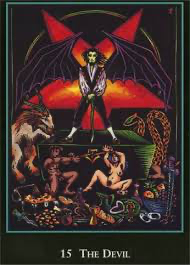
This is the 13th card in the Tarot’s collection of 22 Major Arcana (mystery) cards. The major arcana speak not merely of life’s changing circumstances, but of one’s character, one’s archetype. Sadly, this card suggests that an Evil Spirit has gotten hold of you, Mr. Biden. It may be what prevents you from opening the door to new life pictured in the previous card. The spirit in question is governed by base impulses (indicated by the serpent, goat, and the card’s inverted pentagram). It all supports a patriarchy that keep men and women frozen in hostile and defensive positions relative to one another. The reference may be to the IDF’s attacks on mothers and grandmothers deprived of their murdered children for the sake of power and the riches that lie strewn at the bottom of the card. The Evil Spirit depicted here is profoundly anti-woman. Does its appearance suggest a summons to honor the specifically female wisdom of martyred Gazan mothers, grandmothers and their children?

3. The Deep (probably unconscious) Roots of Mr. Biden’s Problem in Gaza

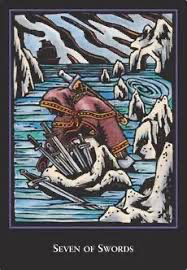
This is the Seven of Swords. Swords are about ideas and ideologies that control us. Sevens are about causal energies. This Seven of Swords shows you again isolated and out in the cold – this time waist deep in a freezing body of water with its dangerous whirlpools. Water, of course, is a feminine element. Swords are masculine. This card has you withdrawing your masculine swords from the feminine element. Relative to Gaza, the Seven of Swords asks you to recognize that ultimately (and unconsciously, I’m sure) the genocide you’re supporting there represents a war on women and their children. The card says, “Remove the swords (in the form of weapons and the ideologies behind their provision) from the hearts of Gazan mothers, grandmothers, their babies and children.” Such extraction means changing your ideas and the approach to Gaza your ideas support. There’s a suggestion of swapping military force for diplomacy here. Finally, this card communicates a sense of urgency. Do you see the dark ship in the card’s upper left corner? Your ship is coming in, Mr. Biden, but you’re ignoring it. The ship says your remaining time on earth is short. Drop the old ideas, change horizons, do what right despite ultimately irrelevant masculine concerns conditioned by false perceptions of “a man’s world.” Ultimately, it’s just the opposite. You’re waist deep in feminine energy!  

4. The Proximate Roots of Mr. Biden’s Gaza Dilemma

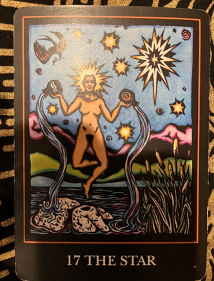
Another Major Arcana card. It is a card of hope and healing. Its female image dancing on the water reiterates the call to lift your head from the frigid waters of the previous card and scan the night skies for transcendent guidance. Miracles (like walking or dancing on water) are possible and within your grasp. The answer to your Gazan dilemma is mirrored in the sky’s celestial order – in healing rather than continuing support of war and destruction. Follow Bethlehem’s star of peace, not war.  

5. Mr. Biden’s Motivation vis a vis Gaza

Yet another Major Arcana card addressing your essence. This one is about a coming Judgement regarding your policies in Gaza. The card centralizes the Egyptian Hermanubis (god of judgment) weighing your destiny against the Feather of Truth. Surely it refers to history’s judgment of your presidency which by all accounts is being importantly and negatively shaped by your policy in Gaza. Will you be remembered as “Genocide Joe?” Surely, you don’t want that. The card also anticipates a more proximate judgment coming on November 5th.  If your driving motivation comes from your desire to be re-elected, the card suggests you must change policy in Gaza.  

6. President Biden’s Proximate Future Relative to Gaza

This card suggests that young people will determine your immediate future (in November). It is a “court card” that refers to important “Seekers” (young 20-somethings) among us. In the context of your Gaza dilemma, this card inevitably recalls the pro-Palestinian demonstrators on campuses throughout our country. They are determined to play a determinative part in your proximate destiny. Their attire in this card suggests Native American sensitivities to the ways of nature. It recalls peace pipes, and diplomatic discussions around a campfire. This is a call to diplomacy and dialog, to listening to your young constituents. Heed what young people are saying or else! That seems to be the message here. [BTW, please note that horse of the card’s Seeker has its hooves firmly rooted in the feminine element of water. The Seeker is calling attention to a mysterious Cup suspended above him. Cups are not about confrontations but about the creative relationships that women typically pursue more than men. Do you see a unifying theme here?]

7. Mr. Biden’s Image of Himself in This Situation

Here you are with your sword again, Mr. President. Surprisingly, the card says that despite your status as an octogenarian, you imagine yourself as somehow a contemporary of the Seekers pictured in the previous card. With sword aloft you’re riding a horse raring to charge into the future (framed by two rough pillars) despite the storm on the horizon. In the Gaza context, this card seems to say, “Take heed of that storm. Act your age. Back off from the trouble that inevitably lies ahead should you continue your sword-led charge.”   

8. The Context of Mr. Biden’s Gaza Situation

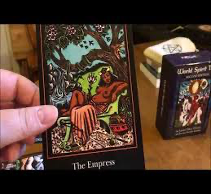
Another Major Arcana card – the Empress. Another reminder to change from male-led policies to those guided by feminine beauty and principles that should form the context of any Gazan policy – of any beneficially imperial order. And what might those principles be? The card says they are based on harmony with nature (signified by the Tree of Life sheltering above the empress). Similarly, the snake that appeared as a force of evil in the Devil Card now appears transformed into its traditional goddess meaning as a perpetual life force (since it repeatedly sheds its skin). The Empress’s own skin color reminds us that the world should be governed by its non-white majority rather than by white European colonialists. Her large breasts also signify a different kind of governance – this one by nurture, not destruction. This theme is continued in her shepherds crook and the unthreatening whip in the card’s foreground. Together, they suggest deemphasis of force in favor of gentle correction. And of course, the beautiful flowers and soaring birds, as well as the abundance of fruit all connect with sharing the earth’s cornucopia regulated by the scale of justice at the Empress’s feet. All of this relates to the ultimate feminine signified by flowing water. In summary, this card calls for a planet-wide change of context from masculine force to feminine gentleness, joy, and harmony with nature. What would that change of context look like in Gaza? The answer is largely up to you, Mr. President.  

9. Mr. Biden’s Hopes & Fears Relative to Gaza

This entire reading could hardly be more feminine. In Tarot all aces are about new beginnings and about unperceived potential. In the World Spirit Tarot deck we’re using, its aces consistently present us with the feminine yoni as a portal to life and new beginnings. And that’s what we have here. A feminine yoni, a portal to a new reality, where relationships (the essence of the suit of cups) are overflowing with life (water), not death (the reality in Gaza). I know, Mr. President, you’re hoping for something like that in Palestine. However, this card suggests you’re on the wrong track. What you’re doing is too male, too much based on force. This card calls you elsewhere. Enter its gentle female portal to New Life. Doing so will help you transcend your fears and offer hope to all of us.  

10. President Biden’s Destiny Relative to Gaza

Do you see what I meant about the feminine character of this entire Tarot reading? Look where we finish. Again, a yoni frame. Again, a fruitful goddess centralized. Again, a call to harmony with the world’s elements – fire in the lion, air in the eagle, water in the dolphin, and earth in the ox. This card asks you, Mr. President, to adopt a universal (rather than a narrow national) perspective. It says align with the forces of nature and the universe. Doing so will help you see beyond distorted views of “American Exceptionalism” and the destruction of the earth’s elements by use of modern weapons of war.  

Summary

Surely, I don’t need to again call attention to the female thrust of this reading. The cards are calling away from patriarchal, violent, and outdated thinking and action. The cards summon you away from a white colonial world towards one governed by the world’s non-white majority. They call you to empathy with Gazan mothers, grandmothers and their babies, children, and grandchildren. Another world is possible, Mr. Biden. And with your incoming ship on the horizon (along with the fast-approaching November elections) you haven’t much time left to change course. But (according to the cards) change course you must!

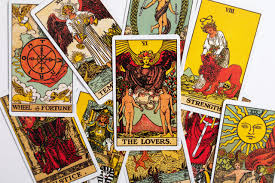
Tarot and Catholic Spirituality: Let Me Read Your Cards!

Believe it or not, even though I’m a Catholic liberation theologian, I’ve also become Tarot card reader. And this despite the teachings of my beloved meditation mentor, Eknath Easwaran, who always characterized Tarot as “Terror Cards.”

In fact (pace Sri Easwaran), it’s much more focused than that. I’m now using my ability to read Tarot as a fund-raising project for an impoverished women’s cooperative in Guanacaste, Costa Rica.

Let me address all that by first explaining my understanding of Tarot cards. Then I’ll show you how Tarot fits in with Catholic theology and my fund-raising project. Finally, I’ll issue an invitation to read your cards.     

My Introduction to Tarot

To begin with, I was introduced to Tarot during a year-long sabbatical that my family spent in Spain. There in Andalusia, I unexpectedly fell in with a group of street musicians and gypsies. Most of them made only five or ten dollars a day as buskers. As self-described troglodytes, they lived in caves without running water or electricity. They explained the cards and their interpretations to me in ways that made me drop my preconceptions and defensiveness.  If you’re interested, you can read about all that hereherehereherehere, and here.

In any case, I learned that Tarot cards represent a divinatory tool usually understood as helping “querents” (seekers) answer existential questions connected with work, relationships, anxieties, and what the future might hold. As expressed by Tarot master Joe Monteleone, those consulting the cards typically want to know about getting paid, getting laid, and staying unafraid, so they might reach a happy conclusion of their parade through life.

But as Monteleone insists, Tarot cards are about much more than getting paid, laid, overcoming what makes us afraid. In fact, the 78 cards of the Tarot deck represent a dynamic book about you, me, and anyone who opens the “book.” Tarot cards are dynamic because as packets of the universal energy filling the universe, they meld, tap into and blend with the energy packets of those reading and seeking guidance from the Tarot cards. Put otherwise, like the cards themselves, each of us is a bundle of energy that can select from the deck individual cards addressing our true identities and the granular circumstances of our lives.

Accordingly, the Tarot book is divided into chapters addressing the archetypes just mentioned, as well as spirit, relationships, thoughts, and our physical circumstances such as work, money, and health. All those elements come to light in suits of wands (for spirit and creativity), cups (for relationships), swords (for ideas), and coins (for physical circumstances). Additionally, a final chapter (called “court cards”) explores relationships with important others in our lives under images of pages, knights, kings, and queens.

As those images indicate, the relevant cards are replete with references to history, mythologies, sacred scriptures, astrology, and akashic records.     

Relative to all that, I’ve discovered that my background in the classics, history, poetry, and theology has prepared me well for reading Tarot cards. So, I’ve done it for family members and friends who have recognized (and have helped me see) my ability to interpret card meanings.

In fact, while still in Spain, I did so for two professional readers, who subsequently encouraged me to “go professional.” Since returning home, I’ve even read for my therapist (whom I consider my spiritual director), and she has very generously sent my way several “clients” for whom I’ve read on ZOOM and SKYPE.

[Oh, and recently during a three-month stay in Florida I read for many absolute strangers poolside at the Regatta Beach Club in Clearwater Beach. (Subsequently, however, I was informed by the Club’s authorities that such activity “for monetary gain” was forbidden.)]

What the authorities in Florida didn’t understand is that I’m forwarding ALL “monetary gain” to a women’s cooperative in Costa Rica. For clarification, here’ a flyer I’ve made to explain my project: https://acrobat.adobe.com/id/urn:aaid:sc:US:173ab9ae-7e78-406a-87e0-d8b16002fe46

As the flyer indicates, our (very poor) Costa Rican friends manufacture simple solar ovens and instruct their neighbors how to make them. They also maintain a large organic garden that provides food for themselves and their neighbors. (By the way, our friends in the co-op find themselves amused that I as a deinstitutionalized priest and theologian should be delving into the occult on their behalf.)

Theological Connections

It turns out, however, that no one should see any contradiction between Tarot cards, priesthood, and/or theology. That was brought home to me several months ago when I came across a book called Meditations on the Tarot: a journey into Christian Hermeticism. The book was published anonymously in 1985.

[By the way, the word “Hermeticism” refers to the teachings of Hermes Trismegistus, a reputed contemporary of Moses who lived 1600 years before Christ. Hermes explored the relations between human experience and the divine. Many have seen him as the wisest man who ever lived. It turns out that ancient Fathers (and Mothers) of the Christian Church have long explored connections between Hermes and the Judeo-Christian tradition. They are the Christian Hermeticists referred to in the title of Meditations on the Tarot.]

In any case, I found the enthusiastic endorsements on the book’s cover to be astounding.

They came from the Trappist abbot Thomas Keating (the colleague of Ken Wilber of Spiral Dynamics fame), from another Trappist Basil Pennington, as well as from the mystic and leader of the Christian ashram movement, Bede Griffiths. Even more surprisingly, the book’s afterword was penned by the great Catholic theologian and cardinal of the church, Hans Urs Von Balthasar.

The endorsements from all four men contained superlatives such as “the most extraordinary work I have ever read” (Pennington); “simply astonishing” (Griffiths), and “the greatest contribution to date toward the rediscovery and renewal of the Christian contemplative tradition of the Fathers of the Church and the High Middle Ages” (Keating). Cardinal Von Balthasar’s afterword praises the “formidable power of his (i.e. the anonymous author’s) spiritual vision.”

What surprised me about such testimony was not only that monks, mystics, theologians, and even a cardinal knew anything about Tarot cards at all, but that they knew them well and saw them as tools for spiritual growth.  My interest in reading cards had put me in good company indeed.

My Work as a Tarotista

So, I decided to become a card reader — a Tarotista. Here’s how I do it:

  • I receive a reading request in which the querent identifies the session’s focus (e.g., a relationship, a question about work, income, children, about a fork in life’s road, etc.)
  • We set a time to meet on SKYPE.
  • I ask the querent to hold her hand to her heart, while I press the tarot cards against my own heart and pray something like this: “O, Great Mother-Father let my sister’s energy and light (channeled through me) meld with the energy and light of these cards. Let the cards chosen reveal her current life’s situation, the deep unconscious source of her circumstances, the more proximate and probably conscious source, her present motivation, her immediate future, the image that she has of herself, the external influences on her life, her hopes and fears, and finally her destiny if she continues on her present path.”
  • I typically do a 10-card reading and we discuss it for an hour.
  • As suggested above and depending on the “spread” I use, the 10 cards in question usually identify (1) the querent’s present situation, (2) the challenges to that situation, (3) the situation’s deep (usually unconscious) roots, (4) it’s more proximate origins, (5) the querent’s true motivations for presenting the question, (6) what the immediate future holds, (7) the querent’s present image of herself, (8) the context influencing her question, (9) the querent’s hopes and fears, and (10) the outcome to be expected if the querent stays on her present path.
  • Finally, I write up a detailed summary and email it to the querent.

With good success, I’ve also simply:

  • Received a request with identification of the area of inquiry.
  • Done the prayerful reading ahead of time.
  • Emailed the reading to the querent.
  • Met with the querent online for a one-hour discussion.
  • Wrote up a summary of the entire process.

Conclusion

The summaries I’ve just mentioned are important, so that the querent might recall, review, and meditate upon the outcome of the Tarot reading.

The amount of time I invest in the process just described is approximately three hours. For this, I ask a donation of $100 for that women’s co-op. So far, I’ve been able to help them substantially.

So that’s my new endeavor. In future postings here. Next time I’ll give an example of my reading style by imagining that Joe Biden asked for a reading about Gaza.

The Fundamental Difference between the U.S. and China

Why is the United States so anti-Chinese? Why all this Sinophobia?   

It’s because of the basic difference between China and the U.S. that virtually none of our basically ignorant “leaders” — much less the mainstream media — seems to understand. Let me explain.

On the one hand, you have the United States. It’s leading a coalition of overwhelmingly white European colonialists who with less than 25% of the world’s population think they somehow have the right to control the entire world. In this context, the U.S. with 4.2% of the population considers itself the leader that can dictate terms to the other 95.8% of the world, including those Europeans whom it has successfully and surprisingly reduced to the status of obedient and subservient vassals.

In its position as world hegemon that alone emerged unscathed from the ravages of World War II (aka the second Intercapitalist war) the U.S. has decided to maintain control the world militarily. As a result, it annually invests more of its national treasure in war and preparation for war than the next nine countries combined (including China and Russia). A huge proportion of that treasure is spent on maintaining more than 750 military bases in more than 80 countries across the planet.

U.S. bases represent a key element in our country’s neo-colonial strategy aimed at controlling the Global Majority (i.e. former colonies) by regime-change interventions. These interventions have the United States removing from office any governments seeking to directly improve the lives of their citizens by redistributing income, or by providing healthcare, education, or other benefits and laws directly benefitting working classes rather than the wealthy and corporate interests. Since the 1950s, the world has witnessed such interventions in Iran, Guatemala, Korea, Vietnam, Cuba, Nicaragua, Iraq, Venezuela, Libya, and other locations too numerous to list here.

Yes, regime changes benefit the rich and powerful. However, in terms of directly benefitting you and me, those operations and the bases that support them contribute virtually nothing. Yes, they keep millions of military personnel off the streets as well as providing jobs for those working in weapons manufacturing plants. However, the bases and forever wars they stimulate are otherwise completely counterproductive.

For instance, over the past two years, Washington has spent $175 billion on its proxy war in Ukraine which according to Lloyd Austin is aimed at regime change in Russia. That means $175 billion not spent on universal healthcare, not funding college tuition, not providing improvements in infrastructure, not spent on highspeed rail or on mitigating the effects of climate change. All of us can see the results in our decaying urban centers with homeless beggars sleeping on sidewalks and in tents under our bridges.

In other words, overseas military bases are completely parasitic. They live off the rest of us devouring the nutrients that would otherwise sustain and improve our quality of life. Internationally, their purpose is to maintain “stability” in a world where power and wealth have since WWII been concentrated in the U.S. and Europe – the imperial countries that have controlled the world for the past half-millennium. It’s a world of billionaires on the one hand and grinding poverty on the other – especially in the former colonies.

Contrast this U.S. parasitism with the policies of China. As indicated above, China spends far less than the United States on its military. China maintains but a single military base outside its borders. It hasn’t fired a bullet beyond those confines over the last 40 years.

Instead of investing in bloodsucking military bases, China maintains what might be described as development nodes across the planet. Over the past decade and more, its “Belt and Road Initiative” has constructed highways, ports, electrical grids, and highspeed rail systems across Asia, Europe, Africa, and Latin America from Beijing to Tierra del Fuego. And those installations have vastly improved the lives of ordinary people wherever they appear – including those of the Chinese people themselves. As everyone knows, China was recently recognized by the United Nations as successfully raising more than 800,000 of its own citizens from extreme poverty.

What I’m describing here is the rebalancing of the world. Led by China, the planet’s majority is asserting the power that belongs to it in terms of population, which by the way is not white. China has about 18.5% of the world’s population; Africa has about the same; India has slightly more. All those non-white people are rebelling against the humiliation of control by the whites who have drawn completely arbitrary borders. That’s legendary in Africa and the Mid-East where colonizers in their tents drew lines on maps arbitrarily cutting up Africa and all that Mid-East desert land floating on a sea of oil. And they did so with virtually no knowledge of the countries, cultures, and populations they were dividing.

Accordingly, the non-white victims of such ignorance are currently refusing to honor such geographical restrictions. Under pressures from climate change (induced by the colonizers) and by the absolute decimation of western regime-change wars, the victims of such policies are relocating massively. And they won’t be stopped by walls, laws, or border patrols – and much less by ignorant nativist arguments. Yes, people of color are here to stay. Get used to it. Trump or no Trump, they will not be denied.

 It’s a new multi-polar world. It’s time has come. It is long overdue. My only fear is that the “leaders” of the collective west might find the loss of hegemony so threatening that they’ll decide to end the world by initiating a nuclear war. They’ve thought about this before. Remember “It’s better to be dead than red?”

Their new line seems to be: “It’s better to be dead than not in complete control.”

God help us!