China’s Example and the Need to Rethink Democracy Itself

More than a year ago, OpEdNews’ visionary editor-in-chief, Rob Kall, started a project called the Arc of Justice Alliance (AJA). Its original intent was to offer a progressive alternative to the Republican Project 2025. The latter’s goal is to reduce the federal government to a size (in the words of Republican operative Grover Norquist) that could be drowned in a bathtub.

The AJA agenda would rescue democracy from Norquist’s tub.

But what exactly might that mean in a political environment where the old slogans no longer persuade anyone. Frankly put, “defending democracy” sounds hollow when millions increasingly suspect that what we call democracy has already been purchased, managed, and stage-directed by forces far beyond ordinary citizens’ control.

What I intend to argue here is that if the AJA hopes to become more than another mildly progressive pressure group orbiting around a dying Democratic Party, it must become far more radical in addressing the fact that in terms of “democracy,” the United States is a failed state. It must reform to a system more closely resembling China’s “whole process democracy.”

A Failed Epstein State  

Facing America’s failure might be uncomfortable. However, the facts speak for themselves.  “Our” country is not governed primarily by its voters. Instead, it is run by what might best be called the Epstein Class.

By that phrase I do not mean only the disgraced financier Jeffrey Epstein himself. Epstein has become symbolic of something much larger — a transnational ruling network of billionaires, intelligence operatives, media owners, financiers, weapons contractors, corporate monopolists, and political fixers whose power transcends elections and party labels.

Others call this network the “Deep State.” But that term can become too vague or conspiratorial. “Epstein Class” points more directly to the fusion of wealth, secrecy, sexual compromise, surveillance, and political immunity characterizing elite power in late capitalism.

The point is not that every billionaire belongs to a secret cabal meeting in underground bunkers. The point is structural. Wealth itself has become sovereign. Under contemporary capitalism, money no longer merely influences politics. It governs politics.

This is why elections change so little.

Wars continue regardless of campaign promises. Wall Street remains untouchable. Pharmaceutical corporations write healthcare policy. Silicon Valley harvests personal data with almost no restraint. Intelligence agencies operate beyond meaningful democratic oversight. Billionaires evade taxes while homelessness explodes beneath the skyscrapers they own.

And yet we are constantly told we live in “the world’s greatest democracy.”

The AJA should challenge that phrase directly.

Because what if the central political issue of our time is not “democracy versus dictatorship,” but rather which class exercises dictatorship?

That was, of course, the insight of Karl Marx. Marx argued that every state ultimately serves one ruling class or another. Under capitalism, democratic institutions often mask what is essentially the dictatorship of wealth. We live under the dictatorship of the Epstein Class.

In America today that dictatorship increasingly stands exposed.

China’s Democracy

Ironically, this is where China enters the conversation in ways many Western progressives still fear to acknowledge.

Western media constantly portrays China as authoritarian. And certainly, the Chinese Communist Party exercises centralized authority in ways foreign to American political culture. But the deeper question is rarely asked: centralized authority on behalf of whom?

China’s defenders argue that the CCP, whatever its flaws, governs primarily in the interests of long-term national and collective development rather than in the interests of an unrestrained billionaire oligarchy.

One need not romanticize China to recognize the force of that claim.

Over the last forty years China has lifted hundreds of millions out of poverty, constructed immense infrastructure systems, expanded public transportation, modernized entire regions, and maintained long-range national planning capacities almost unimaginable in the contemporary United States.

Meanwhile America’s political system appears increasingly incapable of governing at all.

Bridges collapse. Infrastructure decays. Healthcare bankrupts families. Universities drown students in debt. Entire cities become unaffordable. And yet the billionaire class accumulates wealth on a scale previously unimaginable in human history.

This is why the AJA must begin questioning not simply particular policies, but the very definition of democracy itself.

China’s political system offers at least one important conceptual challenge through its notion of “whole-process democracy.”

Whole Process Democracy

To Western ears the phrase often sounds like propaganda. But its underlying critique of Western liberal democracy deserves serious attention.

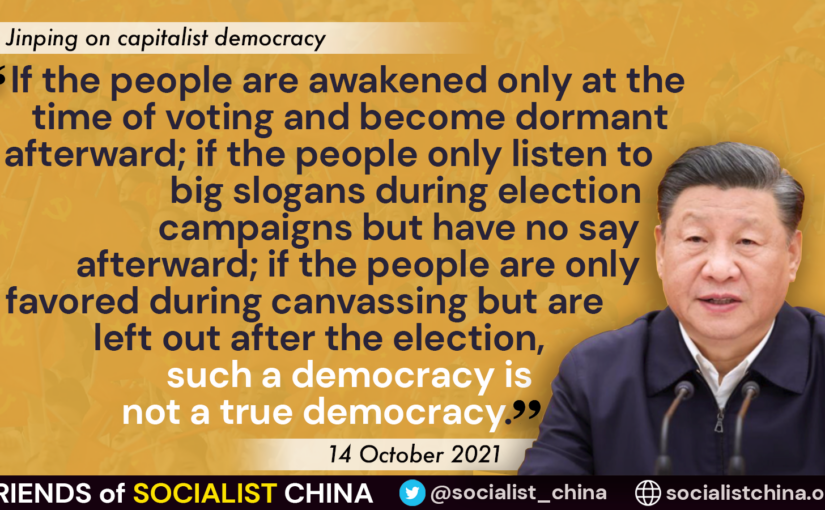
Western democracies generally define democracy procedurally: elections, competing parties, free speech, and formal civil rights. Chinese political theory argues that such democracy is incomplete because it leaves economic power largely untouched.

What good is voting, Chinese critics ask, if billionaires own the media, shape public consciousness, finance political campaigns, dominate economic life, and effectively dictate policy no matter which party wins office?

Chinese “whole-process democracy” proposes that democracy should involve continuous public participation throughout governance — consultation, planning, implementation, supervision, and evaluation — not merely occasional voting rituals.

Equally important, Chinese theorists insist democracy must be evaluated not only by procedures but by outcomes: poverty reduction, healthcare, infrastructure, education, housing, stability, and collective well-being. In other words, Chinese democracy is not procedural; it is consequentialist.

Again, one need not idealize China to recognize how devastating this critique becomes when applied to the United States.

Because by those standards, America’s democratic system increasingly looks dysfunctional and oligarchic.

The AJA should say this openly.

Practical Goals

Indeed, the Alliance should become one of the few organizations in the United States willing to demand a redefinition of democracy itself.

That redefinition would begin by acknowledging at least four realities.

  1. Democracy cannot exist where billionaires dominate the economy, media, intelligence structures, and political system simultaneously.
  2. The “free market” has evolved into a form of private tyranny insulated from democratic accountability.
  3. What Americans call “freedom” increasingly means freedom for oligarchs to exploit, speculate, surveil, monopolize, and destabilize society itself.
  4. A functioning democracy requires some form of permanent public authority strong enough to restrain oligarchic power.

This last point is especially difficult for Americans because our political culture has long distrusted centralized authority. Yet history increasingly suggests that Norquist’s bathtub and Project 2025 did not eliminate concentrated power. It merely transferred power into private hands.

Democracy w/ Chinese Characteristics

China’s concept of “socialism with Chinese characteristics” emerged precisely from this recognition. The “Chinese characteristics” refer not only to economics but to China’s deep civilizational traditions emphasizing social harmony, collective responsibility, long-term planning, and state obligation toward public welfare.

Influenced by centuries of Confucius and Confucian political philosophy, Chinese political culture traditionally viewed government not as a neutral referee between competing private interests, but as guardian of social balance and national continuity.

That outlook was reinforced by China’s traumatic “Century of Humiliation,” when foreign powers fragmented, occupied, and exploited the country. From the Chinese perspective, weak government invited chaos, colonization, and national disintegration.

Consequently, modern China developed a system combining market activity with strong state direction over finance, infrastructure, industrial policy, and long-term development.

In this, western critics see authoritarianism. Many Chinese citizens see protection against billionaire fragmentation and social collapse.

Conclusion

The AJA need not endorse every aspect of the Chinese model. But it should have the courage to learn from it.

At minimum, the Alliance should recognize that what presently exists in the United States is not genuine democracy but governance by the Epstein Class — a billionaire oligarchy shielded by intelligence systems, media control, campaign financing, and corporate monopolization.

And once that truth is acknowledged, new political possibilities emerge. Those possibilities include:

  1. Recognition that the real enemy of democracy is the Epstein Class that must be controlled and directed towards serving the rest of us.
  2. This means that democracy should no longer mean merely choosing between competing representatives of the same donor class every four years.
  3. Instead, it should mean collective power over finance, healthcare, media, technology, housing, infrastructure, and long-term social priorities.
  4. In summary, democracy should mean subordinating wealth to human need rather than subordinating human beings to wealth.

The bottom line here is that the central struggle of our century will not be between democracy and dictatorship at all. It is a contest between the dictatorship of billionaire capital and some new democratic form of collective public authority capable of restraining it.

If the Arc of Justice Alliance truly hopes to change America, it must become bold enough to say so. It must directly confront anti-Chinese propaganda and be willing to learn from Chinese experience.

Presidential Assassination? Only Shocking When It Happens Here

The reports came in the usual way—breaking news, partial details, a lot of urgency and not much clarity. Another alleged attempt on the life of Donald Trump. Another moment where we’re all supposed to stop and say, “How could this possibly happen here?”

But that’s the part that rings hollow.

Because if we’re honest—even just a little honest—the real question isn’t “How could this happen?” It’s “Why are we surprised?”

We live in a country that has, for a very long time, accepted the idea that it’s OK to eliminate leaders we don’t like—as long as they’re somewhere else. Iran. Cuba. Iraq. Libya. You name it. We don’t always call it assassination. We have cleaner words for it—“operations,” “interventions,” “defensive measures.” But the result is the same. People in power get targeted and killed because they’re seen as a threat to our interests.

And somehow, we’ve convinced ourselves that what’s normal over there should be unthinkable over here.

That’s a hard line to maintain.

There’s an old phrase about chickens coming home to roost. It’s not about revenge. It’s about consequences. If violence becomes part of the way a country operates in the world, it doesn’t just stay neatly contained. It seeps back. It shapes how people think—about power, about enemies, about what’s acceptable. In biblical terms, you reap what you sow.

So when something like this happens—or is alleged to have happened—we act shocked. But maybe the shock is the least believable part of the whole story.

What’s even harder to ignore is how this fits into the broader American experience of violence. Because, frankly, this kind of threat isn’t new. It’s just new for the people at the very top.

Schoolchildren in this country grow up with it.

They practice lockdown drills. They’re told what to do if someone comes into their classroom with a gun. Parents send them off in the morning with a quiet, unspoken fear in the back of their minds. And when something does happen—yet another shooting—it dominates the news for a few days and then fades, replaced by the next story.

We’ve gotten used to it. That’s the truth.

So when a president or former president faces danger, there’s a strange kind of leveling going on. For once, the risk isn’t limited to ordinary people. It touches the most protected individual in the country. And suddenly it’s a national crisis.

But for a lot of families, that crisis has been going on for years.

There’s another detail here that’s worth noticing. In the coverage of this latest incident, even readers of The Washington Post—not exactly a fringe outlet—responded with a lot of skepticism. Comment after comment questioned what really happened, suggesting it might be staged or exaggerated, wondering who benefits politically from the story.

That kind of reaction would have been unthinkable not so long ago. Now it’s almost expected.

And that says something important too. People don’t trust what they’re being told anymore. Not from politicians. Not from the media. Not from anyone, really. Everything is filtered through suspicion.

That may or may not be justified in any particular case. But the overall effect is clear. We no longer share a common sense of reality. And when that goes, everything becomes unstable. If you can’t agree on what’s true, it’s much easier for fear, anger, and even violence to take hold.

None of this is to say that an attempt on anyone’s life—Trump’s or anyone else’s—should be taken lightly. It shouldn’t. That’s not the point.

The point is that we don’t seem to apply the same level of concern across the board.

Violence against powerful people shocks us. Violence against ordinary people, especially kids, barely slows us down anymore. Violence carried out in our name overseas is explained away, justified, or simply ignored.

And then, every once in a while, something happens here at home that reminds us of the world we’ve helped create.

When that happens, we call it shocking. We call it unprecedented. We treat it as something that doesn’t belong.

But maybe it does belong. Maybe it’s part of the same pattern we’ve been living with for a long time—only now it’s harder to look away.

That’s the uncomfortable thought.

Not that something like this could happen—but that, given everything else, it almost had to.

When Leaders Become School Shooters

I’m sure you noticed that on the very first day of the current U.S. war with Iran, American missiles struck a school compound. In that single horrendous attack 165 people (most of them little girls between the ages of 7 and 12) were slaughtered. Their classrooms became rubble. Their playground became a graveyard.

There’s no “fog of war” here. This was a first strike presumably meticulously planned before hostilities began. Put plainly: Trump’s and Netanyahu’s first targets in their completely illegal and immoral war were school children – little girls.

A War of Aggression

Even before considering the victims, let’s underline the war’s undeniable illegality. It was completely unprovoked. That makes it a war of aggression. In international law, initiating such a conflict is considered the gravest of crimes. The judges at the Nuremberg Trials famously declared that to launch a war of aggression “is not only an international crime; it is the supreme international crime, because it contains within itself the accumulated evil of the whole.” That principle was meant to ensure that powerful states would never again unleash violence against another country simply because they could.

Yet here we are.

Targeting Civilians

As I said, the opening strike on that Iranian school could hardly have been accidental. Moreover, it followed a pattern already well-established by Israel’s war in Gaza under Prime Minister Benjamin Netanyahu. Again and again, the world has seen images of bombed schools—places that had become shelters for displaced civilians, classrooms for children, or simply the last fragile spaces where families tried to survive. Critics have begun to describe this tactic grimly: the “Gaza-ing” of cities—systematic bombing of densely populated areas where civilians inevitably live.

Now that same logic appears in Tehran.

In this context, be reminded that dense urban neighborhoods are not empty landscapes. They contain apartment buildings, schools, hospitals, and nursing homes. They house women, children, the elderly, and the disabled — people who cannot easily flee when bombs begin to fall. When such areas are targeted, civilian casualties are not accidents. They are predictable consequences. They are intentional.

An Epstein War

And here the moral horror becomes even sharper. That fact that most of the victims of that first strike in Teheran were girls between the ages of seven and twelve, connects it unmistakably with Jeffrey Epstein scandal from which the Iran War seems anxious to distract us. (Some are even calling it “The Epstein War.”)

Once again, young girls are the victims. Once again, power stands on one side and vulnerability on the other.

No one is claiming that the dynamics of sexual exploitation and the Trump and Netanyahu school shootings are identical. But the pattern is deeply unsettling. Powerful men act with near-complete impunity; little girls suffer the consequences. When this happens repeatedly—whether in elite abuse scandals or in the conduct of war—it raises questions that go far beyond ordinary sexism. It points toward a culture in which the suffering of the most defenseless becomes politically invisible.

“Leaders” As School Shooters

Meanwhile, Americans continue to express horror at school shootings at home. The 2007 massacre at Virginia Tech where 32 people were killed shocked the nation and remains the deadliest school shooting in U.S. history. Americans rightly consider such crimes monstrous.

But what should we call it when a government destroys a school killing pupils and teachers with missiles?

I’ll tell you what I call it. It’s a school shooting. And Donald Trump and Benjamin Netanyahu are the most lethal school shooters on earth. The phrase shocks precisely because it strips away the language of strategy and exposes the reality for what it is.

And when national leaders behave this way, they do more than destroy buildings and lives. They set an example. Leadership shapes moral culture. If governments normalize violence against children abroad—bombing schools, flattening neighborhoods, “Gaza-ing” cities —why should we be surprised when violence seeps back into our own societies?

Conclusion

There I’ve said it: the two men just referenced are far worse school shooters than the worst we’ve seen. The moral logic in all cases is nonetheless frighteningly similar. They murder because they can. If we truly believe that children’s lives are sacred, that principle cannot stop at national borders. It reveals the slogan “pro-life” for the grotesque instrument it has become: a banner raised in defense of unborn life at home while bombs fall on little girls sitting in classrooms abroad.

A Failure Already? Bill Maher Declares Zohran Mamdani “A Straight Up Communist”

How respectable liberalism helps defend systems it claims to oppose.

One of the earliest dynamics I imagined in my recent novella (Against All Odds: How Zohran Mamdani Became President & Changed America Forever) was not triumph, but backlash. The story assumes that the moment entrenched systems are seriously challenged, the response will not be curiosity or patience, but immediate verdicts of failure — long before structural change has even had time to begin. That reflex is not accidental. It is part of how power protects itself.

Which is why the speed with which Zohran Mamdani has been declared a disappointment is not surprising at all. Three weeks into office and New York’s housing crisis remains. Imagine that — after three whole weeks!! Rents are still unaffordable. Shelters are still crowded. Families are still doubling up, and young people are still leaving the city they love because they cannot imagine building a stable future there.

But what has been just as revealing as the impatience is the source of much of the outrage. Some of the loudest denunciations of Mamdani have come not only from the right, but from television personalities who still market themselves as liberals — most notably Bill Maher — who appear genuinely appalled that a major American city might elect someone who does not instinctively genuflect before market solutions.

Forgetting about our nation’s history of racially segregated neighborhoods and ghettoes, ignoring real estate and banking redlining, gated communities, white flight, and the exclusionary practices of the Trump family itself, Maher ridicules the obvious fact that home ownership in the U.S. has been and remains racist and an instrument of white supremacy. Think about it. Think about the racial impact of using property taxes to determine the quality of public schools. Yes, Mr. Maher, home ownership in America is racist.

However, by the standards of contemporary political commentary, such amnesia and willful ignorance has apparently provided enough time to declare defeat.

What is more striking still however is how little these attacks have to do with actual housing policy. They are not debates about zoning law, construction finance, or tenant protections. They are ideological rituals. Mamdani is denounced not only as a “socialist,” but as (in Maher’s words) “a straight-up communist,” as if these were self-explanatory epithets rather than political terms with long and very specific histories.

Red-baiting, once a reliable weapon of the right, has now become comfortable entertainment for liberal audiences.

One might reasonably expect professional commentators to understand the vocabulary they deploy so confidently. However, they evidently do not. Instead, we are offered ideological pantomime: capitalism good, socialism bad; privatization efficient, public ownership corrupt; taxes theft, regardless of what they fund or whom they protect. These slogans are not arguments. They are incantations — repeated not to clarify reality, but to prevent serious discussion of alternatives that might threaten existing concentrations of wealth and power.

Yet after just a few dinner-table conversations, even my own middle school grandchildren could explain what Maher and others seem either not to know or not to care to acknowledge. My grandkids knew that socialism refers to public ownership of the means of production, the use of regulated markets, and limits on extreme wealth through progressive taxation. They knew that communism, in classical political theory, is not a description of any society that exists or has ever existed, but a hopeful vision of a future. It’s a North Star goal in which abundance is shared, class divisions disappear, and even the state itself — always a structure used to enforce class hierarchy — withers away.

My little grandchildren also knew what most economists acknowledge without controversy: that every functioning economy in the world today is a mixed economy. They all combine public and private ownership, regulated and freer markets, and redistribution through taxation. To repeat, they are “mixed economies” — every one of them. The question is however, in whose favor are they mixed — in favor of the rich or of the poor? In the U.S., it’s the rich. In China, it’s the working class.

Moreover, what Maher and others call “communism” has already proven to work in the United States. They called it the New Deal. They called it Keynesianism, and it gave us workers Social Security, minimum wage laws, unemployment insurance, workers’ compensation for injury on the job, and a 40 hour work week. It made unions legal and provided jobs, income, and socially valuable work for millions of impoverished Americans when the government stepped in as employer of last resort. Its creation of the national park system made the U.S. government the country’s biggest land owner — the master of the planet’s most important “means of production.”

None of this is radical. It is introductory political economy.

What is radical, apparently, is saying any of this out loud on American television without first wrapping it in nervous apologies.

Housing policy then becomes not a question of long-term public investment and institutional redesign, but a morality play in which reformers are expected to perform miracles on cue — and are mocked when they cannot.

Yet the truly unrealistic position is believing that deregulated housing markets will somehow, after decades of failure, suddenly begin producing widespread affordability. The evidence is overwhelming that they will not. Left to themselves, housing markets maximize return on investment, not human stability. Luxury construction thrives; low-income units stagnate. Rent rises faster than wages. Speculation accelerates displacement. Public housing deteriorates under chronic underfunding while private capital flows freely into high-yield developments.

To call this “natural” is to mistake policy choices for inevitability.

If anything, the realistic position is the one Mamdani actually represents: that reversing these dynamics will take sustained political will, public investment, and institutional rebuilding — none of which can be accomplished by executive decree or cable-news bravado.

This is why ideological labels matter less than practical institutional policies. Passing tenant protections may not make headlines, but it changes lives. Securing funding streams for public housing repair may not trend on social media, but it prevents future crises. Rewriting zoning laws to allow denser, community-controlled development may not satisfy the appetite for spectacle, but it reshapes what becomes possible over time.

In other words, housing reform requires democracy — not performance.

In Against All Odds, accountability is not about scapegoats. It is about public reckoning with systems that were allowed to persist because they benefited the powerful and numbed the rest of us into acceptance. That kind of reckoning, whether in fiction or in real cities, cannot happen instantly. It unfolds through institutions slowly being repurposed for the common good rather than private extraction.

What Mamdani’s first weeks in office really reveal is not failure, but the size of the inheritance: decades of bipartisan accommodation to a housing system that treats insecurity as an acceptable cost of growth.

If we are honest, the scandal is not that housing has not been fixed in three weeks. The scandal is that it was allowed to deteriorate for thirty years while political leadership congratulated itself on “vibrant markets” and “urban renewal.”

Progressive politics, if it is to mean anything beyond branding, must be judged not by speed alone but by direction: by whether public institutions are being rebuilt rather than hollowed out, by whether power is shifting toward those who have long been excluded from shaping their own living conditions, and by whether economic life is being reorganized around human needs rather than speculative return.

Those metrics take time to register.

The Arc of Justice Alliance grew out of this same realization: that without new public imagination — and new public institutions to match it — we will remain trapped in systems that treat structural injustice as unfortunate but inevitable. Stories, movements, and policies must reinforce one another if democratic repair is to be more than a slogan.

That is why I write fiction alongside essays like this one. Not because stories replace politics, but because they can help us picture futures that our current institutions make difficult to imagine — and therefore difficult to fight for.

Three weeks is not a verdict. It is barely the opening scene.

The real question is not whether Zohran Mamdani has solved housing yet, but whether liberal America is willing to stop mistaking ideological comfort for political realism — and to admit that serious reform will always look dangerous to those who have grown accustomed to a system that works, more or less, for them.

How Even the American Left Keeps Falling for Regime-Change Narratives

Just when public attention is turning—once again—to unanswered questions about Jeffrey Epstein, his powerful associates, and the long history of elite impunity in the United States, we are suddenly confronted with a new foreign-policy emergency. Once again, we are told that events abroad demand our immediate moral outrage, our emotional investment, and our political alignment with the very leaders who are most eager to change the subject at home.

This is not coincidence. It is political deflection.

The Trump administration has every incentive to flood the media with international crisis narratives that redirect attention away from institutional corruption, judicial failures, and the uncomfortable truth that powerful men rarely face consequences in this country. And nothing serves that purpose more reliably than the familiar spectacle of righteous outrage against a designated foreign villain.

So here we go again.

We are being told—urgently and with manufactured moral certainty—that we must side with Benjamin Netanyahu’s Israel and Donald Trump’s America in condemning alleged mass killings by Iranian security forces. We are invited to clutch our pearls over reports that “thousands” may have died in Iran in the past week alone, while the credibility of those numbers goes largely unquestioned and the geopolitical context goes mostly unmentioned.

The timing is convenient. The narrative is familiar. And the political utility is obvious.

It all ignores the fact that for more than two years, Israel, with full political and military backing from the United States, has devastated Gaza. Tens of thousands of Palestinians—mostly women and children—have been killed. Hospitals, schools, and water systems have been systematically destroyed. Starvation has been used as a weapon. Yet U.S. officials have either remained silent or have actively shielded Israel from accountability in international forums.

Now those same officials present themselves as guardians of human rights, suddenly appalled by civilian deaths.

Fortunately however, moral authority is not something that can be turned on and off like that at political convenience. By enabling mass slaughter in Gaza, Israel and the United States have forfeited any claim to be neutral or trustworthy narrators of human rights abuses elsewhere. When they point the finger at Iran, they do so with blood soaked hands.

What is most troubling, however, is that much of what passes for the American “left” appears ready—once again—to follow their lead.

Even progressive outlets that have long criticized U.S. imperialism are amplifying claims about Iran with little scrutiny, as if we have learned nothing from Iraq, Libya, or Syria. The familiar script is rolled out: heroic protesters, savage security forces, and a population yearning for Western-style liberation.

But we have seen this movie before. And we know how it ends.

Consider a striking example from just this week. On Democracy Now, Amy Goodman interviewed the acclaimed Iranian filmmaker Jafar Panahi. During the interview, Panahi acknowledged something crucial: because of internet shutdowns and information blackouts, he said, “I do not have any trustworthy news from inside Iran. I don’t know what is happening. I don’t know where my colleagues are, where my family is. It is only the bits and pieces that you hear.”

And yet moments later, he spoke confidently of thousands—perhaps 2,000, perhaps even 20,000—killed by Iranian security forces. The interviewer did not challenge the figures, ask for sourcing, or remind viewers that casualty estimates in politicized conflicts are often wildly inflated during the early stages of unrest.

This is not serious journalism. It is narrative reinforcement.

None of this is to deny that Iran represses dissent or that many Iranians have legitimate grievances. It is simply to insist that repression alone does not explain why certain countries suddenly dominate Western headlines, while others—such as Israel—are insulated from scrutiny even when their actions are far more destructive.

The difference is not morality. It’s the way imperialism works.

Recall that immediately after 9/11, General Wesley Clark publicly revealed that the Pentagon had drawn up plans for regime change in seven countries: Iraq, Syria, Lebanon, Somalia, Libya, Sudan, and Iran. While the timeline shifted, the strategic objective did not. Iran has remained a top target of U.S. and Israeli policy for decades, regardless of which party occupies the White House.

Political scientists such as John Mearsheimer have described how these operations tend to follow a consistent pattern:
First, economic sanctions that cripple daily life and undermine public confidence in the government;
Second, support for opposition movements, often including covert funding and the use of provocateurs to escalate unrest;
Third, aggressive information warfare, in which unverified or exaggerated claims are circulated internationally to delegitimize the targeted regime;
Fourth, threats of military intervention—or actual intervention—once instability has been sufficiently inflamed.

This is not speculation. It is documented policy history. Libya followed this script. Syria followed this script. Iraq followed this script with catastrophic results.

Sanctions, in particular, deserve far more attention than they receive in Western reporting. They are not “smart” tools that surgically target political elites. They are blunt-force attacks on entire populations, restricting access to medicine, banking systems, and basic imports. They produce precisely the social desperation that then gets cited as proof of governmental illegitimacy.

In effect, we help create the crisis, then point to the crisis as justification for further intervention.

And after Gaza, skepticism about Western moral posturing is not cynicism. It is responsibility.

What is perhaps most disheartening is how easily even progressive voices are drawn into amplifying the early stages of these campaigns. Figures who would never have accepted Pentagon talking points about Latin America or Vietnam routinely accept them uncritically when the target is Iran. Good intentions do not prevent anyone from becoming useful to empire.

True solidarity with the Iranian people would start by opposing both domestic repression and foreign destabilization. It would recognize that sanctions are not neutral policy tools but instruments of social punishment, designed to fracture societies and manufacture crisis. And it would reject the deadly illusion that U.S.-backed regime change delivers democracy rather than collapsed states and endless violence.

We know this because we have already seen it—in Iraq, in Libya, in Syria. These were not humanitarian successes. They were geopolitical experiments whose costs were paid by ordinary people.

The lesson should be obvious by now: when governments that have just enabled mass civilian slaughter suddenly rediscover their concern for human rights, we should ask what strategic objective that concern is meant to serve.

After Gaza, Western outrage over Iran cannot be separated from Western impunity in Israel. One exposes the hypocrisy of the other. The crucial fact is simple: the U.S. does not fund uprisings, enforce sanctions, and manipulate media narratives out of compassion.

It does so to maintain empire. To keep its hegemony.

Those who truly care about the future of Iran should resist becoming foot soldiers in yet another regime-change campaign. They should demand diplomacy, economic normalization, and international accountability that applies to allies as well as adversaries.

Above all, they should remember that justice does not arrive on the wings of bombers or through the quiet work of covert operations.

It never has.

And if the past quarter-century has taught us anything, it is this: the loudest voices claiming to defend human rights are too often the ones preparing the ground for the next war.


Author’s Note

This essay connects to themes explored in the author’s recent ChatGPT-assisted political novella, Against All Odds: How Zohran Mamdani Became President and Changed America Forever, which uses storytelling to examine how media narratives, economic coercion, and permanent war distort democracy at home and abroad. Both the novella and the Arc of Justice Alliance / Project 2029 project argue that real security comes not from regime change or military dominance, but from building a “Republic of Care” grounded in democratic accountability and human dignity.

How Zohran Mamdani Can Become President: (An Excerpt from My “Arc of Justice Alliance” Novella)

Most people do not read policy papers; they’d rather read stories That is not a failure of intelligence; it simply a description of how human beings learn, imagine, and change.

My novella, Against All Odds: How Zohran Mamdani Became President and Changed America Forever was written to complement the policy statements of the emerging Arc of Justice Alliance (AJA). The book is not a prediction, nor a legislative blueprint. It is a story — a civic fable — meant to explore how democratic renewal might feel, sound, and unfold if ordinary people followed the lead of politicians such as Zohran Mamdani.

The book grew out of decades of political reflection, organizing experience, and moral concern, and was developed in conversation with AI. That collaboration does not replace human judgment; it sharpens it, forcing questions of coherence, plausibility, and ethical consistency that policy language often evades.

What follows is the book’s opening chapter. It is offered here not as entertainment, but as an invitation: to introduce the book’s exploration of how power operates, how legitimacy erodes, and how moral imagination may be a prerequisite for democratic repair.


Excerpt from Against All Odds

Chapter One – The Bronx Spring

“Every revolution begins as a local rumor — until someone believes it might be true.”
— AJA Field Notes, 2025

The winter had been long in Queens. Gray salt crusted the curbs. Trains screamed overhead like mechanical prayers. And yet, beneath the cold concrete, some-thing was stirring — quiet, electric, alive.

They called it the Bronx Spring.

It began with a tenants’ strike in a decaying building off 31st Avenue — the kind of place where the rent doubled every two years while the heat failed every January. Young organizers — Somali, Bangladeshi, Dominican — went door to door with clipboards and conviction. And at the center of it all stood Zohran Mamdani, a man whose voice carried both the warmth of Queens and the cadence of Kampala, equal parts poetry and fire.

He wasn’t a mayor yet, or even thinking that far ahead. He was a state assembly-man still riding the E train to Albany twice a week, still sending midnight texts that began, “Comrades, one more thing…” But something in him — and around him — had shifted.

The city was tired of promises. And the Bronx, like the chorus of an old labor hymn, began to hum again. The night it truly began, the wind sliced through the corridors of the Queensbridge Houses.

Zohran was there, coat collar turned up, hands full of coffee and flyers. A woman named Amina opened her door just wide enough to see his face. Behind her, a child slept under a mural of the Virgin and Malcolm X.

“Another politician?” she asked.

“Not exactly,” he said. “I’m your neighbor.”

It wasn’t a line; it was true. He lived two blocks away.

That night, fifty tenants gathered in the laundry room to write what they called The People’s Demands: rent rollbacks, energy audits, legal aid for evictions. No one expected much. Not in a city where real estate and police unions ran the show. But when Zohran spoke, he didn’t sound like a candidate. He sounded like a possibility.

“Power,” he said, “isn’t what they hold in City Hall. It’s what we hold when we stop believing we’re alone.”

Days later, things began to move. Heat returned to the buildings. Landlords called emergency meetings. A city inspector — one who’d ignored complaints for years — appeared, clipboard trembling.

Something had changed.

Zohran’s small Astoria office became a nerve center — whiteboards, coffee cups, volunteers working until dawn. They mapped block-by-block networks of resistance.

They called it Reclaim the City. But within the movement, a quieter name began to circulate — The Arc of Justice Alliance.

It meant different things to different people: a moral trajectory, a bridge to something better, a plan for what democracy might still become. Late at night, Zoran wrote in his notebook: “If we can build one just block, we can build one just city. If we can build one just city, we can build one just nation.”

Power, even moral power, never goes unnoticed. In City Hall, consultants scoffed. The Post ran a headline: “Socialist Slum Preacher.” Developers whispered to their lobbyists. And in Washington, analysts began filing quiet memos about a charismatic legislator organizing “urban solidarity experiments” in Queens.

The movement was becoming visible. And visibility, in America, is a dangerous form of faith.

Spring came late that year. The cherry trees bloomed unevenly along Roosevelt Avenue, the air thick with rain and ambition. At a rally in Bryant Park, Mamdani stood beside bus drivers, sanitation workers, and students. The crowd wasn’t large, but it was awake — eyes bright, faces lifted toward something unseen but undeniable.

“Every generation,” he said, “faces a choice between cynicism and renewal. We stand tonight at the threshold of both.”

The words landed like prophecy.

By summer, the rumor would become a movement, the movement a campaign, and the campaign a city reborn in defiance of empire. But for now — on that cold evening in Queens, with the wind off the East River and the trains moaning overhead — it was still only a whisper, shared among the hopeful.

The Bronx Spring had begun.

Yet, even then, before anyone could name it, an odd tremor ran beneath the surface of public life — small bureaucratic stumbles, missing records, a strange silence from federal monitors who normally hovered over tenant disputes. It was as if the machinery of the old republic were developing hairline fractures no one yet saw.

Reflection

Stories do not replace policy.
But they often make policy thinkable.

If this excerpt resonates, it may be because it names something many people already sense: that power rests in an awakened electorate and that politicians like Zohran Mamdani can represent the future of our nation as the “Republic of Care” proposed by the Arc of Justice Alliance (AJA).

As noted above, Against All Odds is part of the broader work of the AJA, an effort dedicated to imagining and building democratic institutions rooted in care, accountability, and human dignity.

If you find value in this work, you are invited — never pressured — to support that effort. Purchasing the full book or donating helps sustain writing, organizing, and public education aimed at turning moral imagination into lived reality.

Why China Governs—and America Can’t


Democracy isn’t about elections every four years. It’s about serving the majority—and by that standard, the U.S. is failing while China succeeds.

The ongoing dismantling of the American state under the Trump regime and the Republican blueprint known as Project 2025 does not represent an aberration or a temporary descent into madness. It represents the logical fruition of a political system structurally incapable of governing itself for the long term.

Trump merely makes visible what has long been true: the United States lacks the institutional continuity, political discipline, and moral orientation required to compete with societies capable of sustained planning. In that sense, America is not “falling behind.” It is revealing its nature and vulnerabilities . And that identity increasingly resembles what we once condescendingly labeled the Third World.

To grasp why, we must abandon the illusion that the United States is governed by a coherent state. It is not. It is governed by a revolving door of factions, donors, ideologues, lobbyists, and media spectacles that swing wildly every four to eight years, undoing whatever fragile policy coherence preceded them. Distrust of government is elevated to a civic virtue; sabotage is rebranded as freedom; long-term planning is treated as a threat rather than a necessity.

China operates on the opposite principle. It is governed by a permanent coordinating institution—the Chinese Communist Party—that does not dissolve after elections or permit private plutocrats to hollow out the state when their profits are threatened. One may object to its ideology or criticize its methods, but one cannot deny its structural advantage: it governs continuously. It plans in ten-, fifteen-, and twenty-five-year increments. It treats infrastructure, education, energy, and industrial policy as matters of national survival, not ideological fashion.

That single fact—the presence or absence of a permanent governing authority capable of subordinating private wealth to public purpose—explains nearly everything that follows.

Project 2025 throws the American contrast into stark relief. Its animating impulse is not reform but eradication. Get rid of government. Gut regulatory agencies. Purge the civil service. Replace professional competence with ideological loyalty. Distrust science. Abandon climate research. Defund education and public health. Criminalize critical thought—especially Black, feminist, Indigenous, or Hispanic history—on the grounds that such inquiry undermines patriotism. Schools, in this vision, are meant to produce obedience, not understanding.

Energy policy under this regime borders on parody. Halt solar and wind development. Dismiss climate science as a hoax. Revive “beautiful clean coal,” as if atmospheric chemistry were a branding exercise. Withdraw from international climate agreements.

Meanwhile, China dominates global solar manufacturing, battery technology, rare-earth processing, and electric transportation—not because it is morally superior, but because it decided decades ago that energy transition was inevitable and acted accordingly.

The same pattern appears elsewhere. Arms-control treaties painstakingly negotiated over generations are abandoned on impulse. Nuclear safeguards are weakened. Diplomacy gives way to bullying. Alliances are treated as protection rackets. Institutions created after World War II to stabilize a fragile global order are mocked, hollowed out, or discarded.

Then the pendulum swings. Democrats return to power and timidly attempt to repair the damage. Agencies are restaffed. Climate policy is resurrected. Treaties are reentered. Education funding is restored.

But everyone knows the clock is already ticking. In four or eight years, the reversal will be reversed again. Businesses hesitate. Allies hedge. Long-term investment stalls. Why plan for a future that may be ideologically illegal after the next election?

This is paralysis disguised as democracy.

The only policies that survive these oscillations are those serving the rich and powerful: permanent war, regime change abroad, an ever-expanding military budget, corporate bailouts, and surveillance systems untouched by austerity. On these matters there is bipartisan consensus, because these are the interests of the class that actually governs the United States.

China, meanwhile, continues to move forward—not because it is benevolent, but because it is coherent. High-speed rail networks span the country. Ports, airports, and logistics hubs are built in record time. Universities expand. Technical education is prioritized. Poverty is treated as a social problem to be solved, not a moral failing to be punished.

The results are not theoretical. China has earned repeated recognition from the United Nations for lifting roughly 800 million people out of extreme poverty since the late 1970s—an achievement without historical precedent. This figure appears consistently in UN Development Programme and World Bank assessments. No amount of ideological hostility can erase that record.

Equally striking is the question of legitimacy. Contrary to Western assumptions, governance in China does not rely solely on repression. Long-running surveys conducted by Harvard University’s Ash Center for Democratic Governance—tracking Chinese public opinion over more than a decade—show consistently high and rising levels of public satisfaction with the national government, often exceeding 90 percent approval.

Compare this with the United States. Pew Research Center and Gallup polling over the past two decades reveal historic lows in trust toward the federal government, with confidence often hovering below 25 percent. Majorities of Americans report believing that elected officials do not care what people like them think, that government serves special interests, and that the political system is fundamentally broken. Decreasing numbers of Americans vote regularly, yet feel powerless. Chinese citizens vote for local officials and report that the permanent national system works.

This forces an uncomfortable question: what do we actually mean by democracy?

If democracy is reduced to the ritual of elections every two to four years—elections dominated by money, media manipulation, and structural exclusion—then the United States qualifies. But if democracy is understood more substantively, as governance that serves the material needs and long-term well-being of the majority, then the American claim collapses. By the testimony of citizens themselves—the people most closely involved—the United States fails at this task. China, by the same measure, succeeds.

This does not mean China is socialist in any classical sense. “Socialism with Chinese characteristics” might more accurately be described as capitalism with Chinese characteristics: a hybrid system that tolerates markets while refusing to surrender political authority to them. The crucial word is authority. The Chinese state asserts the right to govern. The American state apologizes for its existence.

Ironically, the United States would need something like its own version of “socialism with American characteristics” to survive: a system that subordinates finance to production, treats health care and education as public goods, plans energy transitions over decades, and insulates core institutions from electoral whiplash. But such a transformation would require exactly what the American system cannot produce: permanent and irreversible investments in national health care, education, climate measures, nuclear disarmament, rent control, day care, labor unions, and wages that keep up with inflation.

Project 2025 is not the cause of American decline. It is the confession. It openly declares that the American right no longer believes in governing—only in dismantling. And because the system permits such nihilism to recur endlessly, because it contains no mechanism for enforcing continuity in the public interest, decline is not merely possible. It is inevitable.

The tragedy is not that China may surpass the United States. Civilizations rise and fall. That is history. The tragedy is that America is choosing decline in the name of freedom while hollowing out the very capacities that make freedom meaningful. A society that cannot plan, cannot remember, and cannot serve its people is not free.

It is merely ungoverned.

And ungoverned societies, no matter how wealthy they once were, eventually come to resemble the Third World they once presumed to lecture.

What Yet Another U.S. Surrender Looks Like — This Time in Ukraine

Since February 2022, Americans have been fed a fairy tale about the war in Ukraine — a story so uniform across NPR, PBS, the New York Times, the Washington Post, Time, CNN, MSNBC, and even Democracy Now that it reveals less about Russian aggression and more about the collapse of critical journalism in the United States.

In that fairy tale, Russia “unprovoked” invaded an innocent neighbor. Ukraine, noble and outgunned, somehow fought the Russian behemoth to a heroic standstill while inflicting catastrophic losses on Moscow. The United States, we are told, has been the grown-up in the room — always seeking peace — while a stubborn, irrational Vladimir Putin refuses compromise.

None of that matches what has actually happened.

I don’t come to that conclusion lightly. Since the start of Russia’s “Special Military Operation,” I’ve written more than a dozen articles on Ukraine — most of them here and for OpEdNews. (See below.) Across those pieces, I’ve argued five things:

  1. By long-established U.S. standards and precedents, Russia had ample cause to defend itself against NATO’s relentless march to its borders.
  2. The war has never been simply Russia vs. Ukraine; it has always been a proxy war between Moscow and the United States/NATO.
  3. Despite the vast imbalance in money, weaponry, and propaganda, Russia has prevailed militarily and strategically at nearly every turn.
  4. Moscow has largely refrained from U.S.-style “Shock and Awe” tactics that deliberately terrorize civilian populations.
  5. Whether one admires him or not, Putin has been the most restrained and predictable major leader in this war.

Those are strong claims. So let me explain how I arrived at them — and what they mean now that Washington and NATO are quietly negotiating terms of capitulation they once declared impossible.


Rejecting Scripted Narratives

From day one, I made a conscious decision to eschew mainstream narratives about Ukraine. I’ve watched this movie too many times: Vietnam, Iraq, Afghanistan, Libya, Syria. In each case, official “experts” and prestige media gave us a clean story of good intentions and necessary wars — until reality, corpses, and classified documents told another story.

Instead of relying on that machinery, I turned to analysts with actual experience and memory:

  • Realist scholars like John Mearsheimer and Jeffrey Sachs,
  • Former intelligence and security professionals like Ray McGovern and Scott Ritter,
  • Military strategists like Col. Douglas MacGregor,
  • Independent geopolitical commentators like Alexander Mercouris, Alex Christoforou, Brian Berletic, Garland Nixon, Jimmy Dore, and Robert Barnes.

These aren’t saints. They disagree with one another. But they share three qualities utterly missing from mainstream coverage:

  • They know how wars actually work.
  • They remember U.S. foreign-policy history.
  • They are willing to analyze “designated enemies” rather than demonize them.

In particular, I’ve followed Alexander Mercouris’ daily 90-minute briefings, where he methodically tracks changes along the 1,000-kilometer line of contact. Through that lens I watched:

  • The slow, grinding fall of key Ukrainian strongholds,
  • The complete failure of Ukraine’s much-hyped 2023 “summer offensive,”
  • The steady Russian advance westward in an attrition campaign the mainstream never honestly described.

On paper, NATO’s side had nearly everything: money, high-tech weapons, satellites, intelligence, media power. Russia had geography, industrial capacity, and patience. Patience won.


NATO Expansion: The Forgotten Red Line

To understand why this war happened and why Russia was prepared to fight it, we have to step back.

For decades, Russian leaders of every stripe — including those favored in the West — warned that NATO expansion to Russia’s border was a red line. This wasn’t just Putin’s obsession. It was echoed by George Kennan (the architect of containment), Henry Kissinger, Jack Matlock (Reagan’s ambassador to Moscow), and even CIA Director William Burns.

From the 1990s onward, successive U.S. administrations broke informal and formal assurances, pushed NATO eastward, armed and trained Ukrainian forces, and treated Russia as a defeated colony rather than a major power. The 2014 Maidan coup, the subsequent civil war in the Donbass, and eight years of Ukrainian shelling of Russian-speaking regions only deepened the crisis.

By the time Moscow launched its operation in 2022, Russia believed — rightly or wrongly — that it was fighting not for “land,” but for survival as a sovereign state.

That doesn’t make everything Russia has done morally pure. But it does make the word “unprovoked” dishonest.


De-Nazification: Propaganda or Inconvenient Fact?

One of Moscow’s stated objectives was “de-Nazification.” Western commentators mocked this as propaganda. Yet the facts are not really in dispute.

Units like the Azov Battalion, Aidar Battalion, and Right Sector have been documented — by Western journalists, Israeli media, and human rights organizations — as harboring neo-Nazi symbols, ideologies, and networks. After 2014, these formations were incorporated into Ukraine’s security structures and presented to the West as heroic defenders.

To acknowledge this is not to demonize all Ukrainians or deny their suffering. It is simply to say that Russia’s reference to Nazi influence was not conjured from thin air. It was rooted in something Western media chose to minimize or forget.


What Surrender Looks Like in a Suit

Today, the battlefield reality is grim for Kyiv:

  • Ukraine’s pre-war army has been largely destroyed.
  • Manpower is so depleted that men well into their 50s and 60s are being conscripted.
  • Western arsenals are drained.
  • Russia controls key logistical hubs and enjoys overwhelming artillery superiority.

In such a context, the word “stalemate” is a euphemism. Ukraine is no longer capable of decisive offensive action. NATO has no credible conventional path to “defeating” Russia in Ukraine.

So we hear whispers of “peace plans,” “ceasefires,” and “negotiations” — often framed as Donald Trump inexplicably “giving in” to Putin, as though Putin “has something on him.” That story continues the tired Russiagate myth and saves face for a Washington establishment that promised victory.

The truth is less dramatic and more humiliating: Washington and NATO lost their proxy war. The winner, as always, sets conditions.

And here is the irony: those “outrageous” conditions widely described as Putin’s “maximalist demands” are essentially the same objectives Russia articulated before the war began:

  1. Ukrainian neutrality — no NATO membership.
  2. Demilitarization — no NATO missile systems on Russia’s border.
  3. De-Nazification — removal of Nazi-linked formations from state structures.
  4. Recognition of Crimea and breakaway regions as Russian.
  5. Security guarantees that NATO expansion stops.

In April 2022, at Istanbul, Russian and Ukrainian negotiators initialed a draft agreement along those lines. The war could have ended then. Instead, British Prime Minister Boris Johnson rushed to Kyiv and reportedly urged Zelensky to abandon the deal and “fight on” with Western backing.

Tens of thousands of Ukrainian lives were sacrificed on the altar of that decision.

Now, after two and a half years of bloodshed, we are back to those same basic terms — except Russia controls more territory, Ukraine is weaker, and NATO is more divided.

This is what surrender looks like in a suit: euphemisms in press conferences, face-saving language in communiqués, and the quiet acceptance of terms from a side the West swore it would defeat.


The fairy tale said Russia was isolated, collapsing, and on the brink of defeat.
Reality shows something else: NATO marched to Russia’s border, lit a proxy war in Ukraine, and lost.


The Pattern: Who’s Been Right All Along?

Ukraine is not a one-off mistake. It is part of a pattern.

Time and again, the voices that proved right were not the Pentagon spokespersons or network generals. They were the dissidents, the whistleblowers, the realists, the people willing to challenge the mythology of American innocence:

  • On Vietnam, they were right.
  • On Iraq’s non-existent WMD, they were right.
  • On Afghanistan as an unwinnable quagmire, they were right.
  • On Libya and Syria, they were right.
  • On Gaza today, they are right again.

And on Ukraine, the “alternative” analysts I’ve followed — Sachs, Mearsheimer, McGovern, Ritter, MacGregor, Mercouris, and others — have been consistently correct where mainstream pundits have repeatedly failed.

That doesn’t make them infallible. It does mean that those who analyze “designated enemies” instead of demonizing them gain access to reality sooner.


Conclusion: A Chance for Humility

The war in Ukraine is ending as sober observers said it would: not with a triumphant Ukrainian flag over Crimea, but with Washington and Brussels quietly negotiating limits they once called unimaginable.

Ukraine did not “stand up” to Russia and win.
NATO did not “stop Putin.”
The West lost its proxy war and is searching for a way to disguise capitulation as diplomacy.

The deeper question now is not whether Russia learns humility, but whether we do. Will we continue to wage unwinnable wars, believe narratives nobody questions, and call that “defending democracy”? Or will we finally listen to the voices who have been right all along — not because they are smarter, but because they refused to confuse propaganda with truth?

For my part, I know where I stand. I stand with those who insist on seeing clearly, even — especially — when it’s our own leaders and our own narratives that must be questioned.


My Previous OpEdNews Articles on Ukraine (Chronological Order)

(2/26/22)
“20 Reasons Why The United States and Europe Bear Ultimate Responsibility for the Ukrainian Crisis”

(3/4/22)
“12 Potentially Good Outcomes of the Ukraine War”

(3/7/22)
“20 Principles for Making Sense of the Ukraine War”

(3/26/22)
“In Ukraine the ‘Gangsters of Capitalism’ Have Gone to the Matrasses Again”

(5/8/22)
“O.K. I’m A Putin Apologist: Here’s Why”

(7/15/22)
“Russia in Ukraine: Champion and Proxy for the World’s Oppressed”

(2/26/23)
“About Ukraine Even Marianne Williamson Has Sold Out to Imperialism and Conventional Thinking”

(4/23/23)
“Are We Meeting the Risen Christ in Russia and China?”

(8/24/23)
“Putin’s a Killer Who’s Guilty Until (Impossibly) Proven Innocent”

(3/26/24)
“Even for ‘Democracy Now,’ Putin’s to Blame for the Rock Concert Massacre”

(12/5/24)
“Neocons Quake as Trump Threatens Peace in Ukraine”

The Mamdani Lesson: Break Completely with the Billionaire Model

Over the past few months, I’ve found myself sitting at a rather surprising table — the Arc of Justice Alliance (AJA) planning committee. We’re charged with two enormous tasks: first, to craft a meaningful progressive response to the Right’s authoritarian blueprint, Project 2025. Second we’re to draft a counter-vision called Project 2029. It’s to be a path toward a People’s Republic grounded not in domination, but in justice, compassion, and democratic renewal.

For months now, we’ve been wrestling with the same dilemma: If the Republican establishment built a sprawling ecosystem of think tanks, media outlets, university programs, and religious platforms—funded by billionaires and designed to engineer public consciousness—shouldn’t we build a progressive version of the same? At one meeting after another, we even floated ideas about recruiting famous people to our cause and even of courting “friendly” billionaires like George Soros to bankroll a left-liberal infrastructure capable of matching the Right blow-for-blow.

But then something happened that, for me at least, broke the spell: Zohran Mamdani won the New York City mayoral race.

Let me underline what his victory represents. Here was a young candidate with 1% name recognition only a year ago. He faced opponents backed by unlimited money — super PACs, corporate donors, real-estate tycoons, the whole constellation of elite power determined to smother anything resembling a genuine democracy. And yet, he didn’t just challenge them; he defeated them. How? By mobilizing more than 100,000 volunteers, by conducting leadership trainings in living rooms and union halls, by knocking on one million doors, and by rallying ordinary New Yorkers around the elemental theme of affordability — the right of human beings to live with dignity in the communities they love.

Nothing flashy. Nothing overly intellectualized. No backroom deals.
Just democracy in its most radical, ancient sense: people talking to people.

His victory provided me with a moral awakening of sorts.

Because suddenly the entire strategy we’ve been discussing — building our own version of the Powell Memo machine — began to look not simply inadequate but morally compromised. If the way forward is through people, why would we imitate a model designed to sideline them? Why mimic the very structure that has delivered us a national government increasingly controlled by ignorant, degenerate, mafia types whose only qualifications seem to be cruelty, ignorance, and a willingness to auction off the country to the highest bidder?

If the fruit of the Right’s model is authoritarianism, why would we plant the same tree?

No. The Mamdani movement reveals the deeper truth:
Power does not flow down from billionaires or elites. It flows up from human beings who discover their own agency. As OpEdNews editor Rob Kall would say, “It’s Bottom-up.”

And so, I find myself convinced that Project 2029 cannot — must not — follow anything resembling the Republican strategy. We cannot organize a progressive future by begging for crumbs from oligarchs. Even “friendly” billionaires are not our allies; their worldview is too shaped by wealth to understand the soul of a democratic movement. Instead, what we need is a politics that speaks directly to the pain and hope of ordinary people:

  • Affordability
  • Green New Deal
  • Free college
  • Downsizing the military
  • Nuclear disarmament
  • Closing foreign military bases
  • High-speed rail
  • Universal healthcare

And this, not as technocratic bullet points, but as expressions of a moral vision rooted in the human right to live, learn, breathe, rest, and dream.

But this raises a practical question, the one our committee keeps circling back to: How do we build a movement capable of achieving such sweeping change without billionaire patrons? Here’s the blueprint that for me emerges when we take Mamdani’s victory seriously:

1. The Movement Must Be Member-Funded — Not Billionaire-Funded

If our goal is democratic empowerment, then our funding must come from the demos.
We need a dues-paying membership, millions strong, each giving what they can — $3, $5, $27. This is not naïve idealism. It is what built the civil rights movement, what sustained labor unions at their peak, and what fueled Bernie Sanders’ campaigns. Money raised from below transforms supporters into co-owners of the movement.

2. Build Leadership Schools, Not Think Tanks

The Right built think tanks to create obedient foot soldiers for oligarchy.
We need leadership academies to create authors of democracy.

Neighborhood leadership circles, online organizing schools, campus institutes for justice work, training hubs in churches and mosques — if Mamdani could train 100,000 volunteers in a single city, imagine what a nationwide network could accomplish.

3. Replace Media Propaganda with Relational Organizing

Fox News and right-wing radio work by isolating individuals and filling the void with fear.
Mamdani’s movement worked by connecting individuals — neighbor to neighbor.

Project 2029 should build a national relational organizing platform that links:

  • congregations,
  • tenant unions,
  • mutual aid groups,
  • environmental coalitions,
  • arts collectives,
  • campuses,
  • worker centers.

Democracy spreads best not through algorithms but through relationships.

4. Tell One Simple, Moral Story

Republicans have mastered messaging not because they are clever but because they are consistent. Mamdani was consistent too. His message didn’t wander through policy white papers; it hit the heart: “Everyone deserves to live here.”

Our message must be equally direct:
A nation where every person can live, learn, heal, and thrive without fear or exploitation.
Every program — healthcare, demilitarization, free college — reinforces that story.

5. The Ten-Thousand-Door Strategy, Scaled Nationally

If the Mamdani campaign knocked on a million doors in one city, Project 2029 should commit to knocking on fifty million nationwide. But these should not be transactional campaign knocks; they should be ongoing democratic conversations about housing, work, health, and climate.

Block by block, precinct by precinct, the country’s political imagination changes one kitchen-table talk at a time.

6. Activate the Spiritual and Artistic Imagination

As a theologian, teacher and former priest, I’ve spent my whole life insisting that politics has a spiritual dimension. The Right weaponized faith to defend hierarchy. We must reclaim it to defend justice. And we must bring artists into the center of our movement. The imagination is political terrain.

If we want new possibilities, we need new parables, new hymns, new murals, new metaphors of liberation.

7. Build Institutions That Answer to the Grassroots

To accomplish all this, we’ll need training centers, media platforms, and policy shops — but they must be governed by the movement itself, not by plutocratic trustees. Our institutions must function like worker cooperatives: democratic, transparent, and accountable to the base.

Conclusion: The Republic Is Waiting for Us

Zohran Mamdani’s victory is not an isolated event. It is a sign — a living reminder that ordinary people, organized, can defeat moneyed power. In that sense, his mayoral race is more than a political upset. It is a prophetic warning: if we cling to billionaire strategies, we will lose not only elections but our moral compass. But if we follow the path of radical democracy, we may yet redeem the American experiment.

Project 2029 must not be a mirror of Project 2025; it must be its antidote.

The future will not be built by oligarchs. It will be built by us — the many — knocking on doors, telling the truth, and refusing to surrender the idea that another world is possible. If 100,000 volunteers can change New York City, then millions can surely change America. And that is the real beginning of Project 2029.