Stop the Drug War: “Chasing the Scream” by Johann Hari

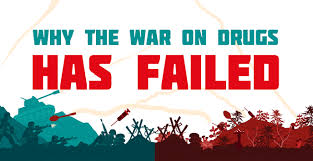
We’ve been fighting the War on Drugs for more than 100 years. And we’re no closer to “winning” it than we were a century ago. That’s the unsurprising message of Johann Hari’s well-written, insightful and even gripping account of the Drug War called Chasing the Scream.

It is, however, the book’s surprising message that likely made Noam Chomsky find the book “wonderful” and impossible to lay aside. It’s probably what made “Democracy Now’s” Amy Goodman call it “astounding.”  British comedian, ex-addict and social commentator, Russell Brand said Chasing the Scream was “intoxicatingly thrilling as crack, without destroying your teeth.” He added that “It will change the drug debate forever.”

In fact, that’s what Hari’s book did for me personally; it changed entirely the way I think about drugs of all kinds from marijuana to heroin, crack and Oxycontin. It made me realize (and this is the surprising part) that most drug consumers, even of those last three just mentioned substances, are not addicts. More than 90% of them, even if they get high every weekend (and maybe on Wednesdays too), continue to hold responsible jobs, are good family members and serve their communities just as well as most of the rest of us.

That’s because drug addiction is not caused by principally by chemical hooks. Contrary to what we’ve been told ever since “Reefer Madness,” merely smoking marijuana or injecting heroin or crack – merely consuming Oxycontin as a pain reliever or even just to get high – won’t ipso facto hook you.

No, it’s the underlying loneliness you might be experiencing; it’s the emptiness of your life or the breakdown of your key relationships that drives one to compensate by seeking relief in drugs. Moreover, the drug you’ll probably turn to for coping with such human problems will not be found on that list of prohibited controlled substances. Yet it’s the one that’s proven most destructive of all. It’s alcohol.

And alcohol is legal, and government controlled. Its taxation is a major source of revenue for the state. Additionally, alcoholism is not generally treated as a crime, but as a disease. It is treated most effectively by offering its victims community support and counselling of the type they find in Alcoholics Anonymous.

That was among the hard lessons learned here in the United States during the era of Prohibition. Then it was found that declaring alcohol illegal gave rise to a black market controlled by the worst elements of society that eventually burgeoned into gangs headed by super-criminals like Al Capone. Removing prohibition and treating alcoholics with understanding and compassion ended most of that.

After travelling the world from the streets of New York to Mexico, Switzerland, Uruguay and points between, a skeptical Johann Hari gradually came to the conclusion that treating drugs similarly, i.e. by removing prohibition, would have a similar effect in terms of fighting the scourge of gang violence and drug addiction.

The gangs would disappear or be greatly reduced in number and power. And the 10% of drug takers whose use of now controlled substances has become problematic would have their addictions taken care of with counselling and psychiatric help intended to assist their recovery process, and if necessary, find them employment and housing.  

More specifically, the success of parallel programs in countries as disparate as Switzerland (where drugs were decriminalized, but their sale not legalized) and Uruguay (whose project has been to both decriminalize and legalize drug use) shows that the relatively small percentage of problematic addicts are not best served by imprisonment. Instead, best practices achieve superior results by making drugs readily available to patients in dignified and controlled settings staffed by trained medical personnel including counsellors and life coaches. Such treatment continues as long as needed – until affected patients decide they no longer need drugs. And most do eventually come to that decision.

The distinction between decriminalization and legalization is important. To decriminalize drug use means that users will no longer be treated as delinquents. They can, for instance possess a supply of opiates sufficient to meet their needs for as many as ten days.

Switzerland has adopted policy of this nature. It treats addicts like hospital outpatients, offers them their drug of choice in circumstances supervised by medical personnel, and makes counselling available as well. However, as Hari points out, failure to legalize sale of drugs means that drug distribution outside government facilities remains in the hands of drug gangs. Nonetheless, Switzerland’s decriminalization procedures have greatly reduced problematic drug use which so often involves theft, robbery, prostitution, and violence.

Uruguay’s approach aspires to be more comprehensive. It has moved towards both decriminalizing and legalizing drug use of all kinds. This means a reversion to something like the situation in the United States before 1914, when heroin was first outlawed. This all-inclusive approach includes treating less potent drugs like marijuana in the same way as tobacco and liquor here in the United States. Heroin, crack, opiates and amphetamines on the other hand, would be treated like prescription drugs, with the state offering all sorts of programs to help stop usage. Unsurprisingly, legalization slightly increases drug use. Significantly, however, it reduces the already mentioned street crime and bankrupts drug gangs.     

This is a key point in Hari’s book, viz. that the prohibition of drugs – the War on Drugs itself – represents the equivalent of underwriting the illicit drug industry. It makes it possible. The War on Drugs guarantees the emergence of a whole economic sector controlled only by smugglers and illicit drug pushers. The industry also includes peasant farmers who grow marijuana and poppies as well as other workers who process, pack, and load the contraband on ships, planes, and trucks.

By design or not, the drug industry is also responsible for spawning a hugely lucrative counter-commerce. This includes government officials, detective agencies, police across the planet, and enormous prison staffs. Their participation in the drug war is funded by billions of taxpayer dollars and is responsible for the employment of millions. Consequently, threatened elimination of these anti-narcotic agencies represents a mortal threat to all those jobs. If drugs were legalized, many would be profoundly disappointed at the loss of their livelihoods.

The point is that none of the parties – certainly not the drug lords and their employees, but also not the anti-drug warriors – wants to see the end of anti-drug campaigns. Hence, the Drug War has no prospect of ending. It’s a key part of the world economy.

Yet, the legalization of drugs and the treatment of addicts as patients rather than as criminals is the only proven way of lessening problematic drug use while eliminating the power of drug cartels and gangs.  

In the end, as Johann Hari points out, what’s required is a complete change of attitude towards drug consumption and the consequent cessation of the Drug War. Societies everywhere must realize that overcoming addiction means overcoming its social causes. It means rechanneling the billions of dollars now wasted on the failed century-long Drug War into restructuring society to make it more caring, loving, and supportive. It entails shaping a culture where happiness is sought in family connections, loving friendships, and in enriched community relationships rather than in endless, pointless and unsatisfying consumption. It means making it possible for people to have stable homes, well-rewarded employment, caring neighborhoods.

Reading Chasing the Scream invites readers to imagine a world without the Drug War. It would be a world:

  • With greatly reduced crime and a shrunken prison system
  • Where police forces could be downsized and rehabilitated in the eyes of poorer communities as a welcome rather than a threatening presence
  • Where countries like Mexico would be freed from control by drug cartels
  • Where refugees from those countries would be dramatically reduced or eliminated, thus greatly impacting immigration problems and the perceived need for expensive border walls.
  • Where the billions upon billions of dollars currently spent in a clearly unsuccessful war on drugs including those huge police forces, overcrowded prisons, and enormous bureaucracies intended to administer it all could be rechanneled to help the merely 10% percent of drug users whose usage is problematic.

In short, cessation of the Drug War, decriminalization and legalization of drugs of all kinds, would reshape our world in ways that would reduce and/or eliminate many of its most vexing problems.

Money for Nothin’: Why Pay Federal Taxes?

The do-nothing approach of the know-nothing Trump administration to the COVID-19 crisis has raised a fundamental question for me. Why are we paying federal taxes?

I mean, if (unlike countries even such as South Korea and China) “the greatest country in the world” can’t even make sure that its citizens have enough cotton swabs for coronavirus tests, what is it doing for us? Why am I paying taxes?

And I’m just talking cotton swabs – not to mention low-tech items like test kits themselves or plastic gloves, protective clothing for nurses and doctors, face masks for the rest of us, hospital beds, or ventilators. Cotton swabs!

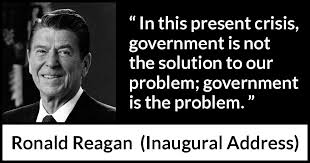
Of course, the answer is that we’ve somehow bought in to Reaganism. To use his words, it somehow convinced us that “Government is not the solution to our problem; government is the problem.”

Remember that? I do.

It was Reagan’s version of the Edmund Burke quote: “That government is best which governs least. . .” Or as Republican operative, Grover Norquist, put it, “I’m not in favor of abolishing the government. I just want to shrink it down to the size where we can drown it in the bathtub.”

Whatever the phrasing, its bottom line over the last 40 years has the government doing less and less for its citizens – and we end up paying more and more.

It’s as if we had two choices: (1) pay taxes those who provide us with the services we need (like healthcare, education, affordable housing, serviceable roads and bridges) or (2) pay them to those who on principle do nothing for us. Pay for something or pay for nothing! By electing Republicans (and many Democrats too), we’ve been making the latter choice.

Is that crazy or what?

And what’s the government doing with my tax dollars – and yours? It’s like we’re paying protection money — to our representatives — to protect us from the services we’re paying for.

I thought government’s first duty was to keep us safe. Right now, though, in the face of the biggest threat to our safety in the last 75 years, our “representatives” are doing nothing – absolutely nothing to that end.

And they’re proud of it.

In fact, we’re on track to re-elect the lot of them again next November.

Go figure.

No Room for Hunger or Homelessness in Our Great Mother’s “House of Spirits”

Readings for the 5th Sunday of Easter: ACTS 6: 1-7; PSALMS 33: 1-2, 4-5, 18-19; 1 PETER 2: 4-9; JOHN 14: 1-12

Although it might not be apparent at first glance, the readings for this Fifth Sunday of Easter address homelessness. During this COVOD-19 pandemic, it’s an exceptionally vexing problem that finds many Americans unable to pay their rent or mortgages. In New York City, for example, many of those rendered homeless end up seeking shelter and the possibility of social distancing within the city’s subway cars

As if in response to such developments, today’s selections centralize the concern of the Great Cosmic Mother for her children in similar situations of powerlessness and abandonment.

These, the readings tell us, were also the concern of Yeshua’s Jewish followers immediately following his death and the mysterious experience they came to call his “resurrection.” For those reformers of Judaism, social problems like hunger and homelessness were not to be solved by force or organized abandonment, but by compassion, sharing, service, and loving kindness.

Homeless in America

But before I get to that, think for a moment about homelessness in America. It’s deeply connected with the U.S. prison system which has actually become the de facto form that low-income housing assumes here.

That point was made last week on “Democracy Now,” when Amy Goodman interviewed Dr. Ruth Wilson Gilmore. She’s the co-founder of California Prison Moratorium Project (CPMP). CPMP represents an abolitionist decarceration movement in the United States which houses approximately one in four prisoners in the entire world. (Perhaps coincidently, the U.S. has also produced the same proportion of COVID-19 deaths.)

To begin with, Wilson Gilmore contrasted the U.S. approach to crime with those of other industrialized countries. Within our borders the emphasis is on deprivation, isolation, punishment, pain and force. By contrast, many other systems emphasize rehabilitation.

Of their “Reformative Justice” dispensations the interviewee said “Where life is precious, life is precious. In places where the state, the government, municipalities, social justice organizations, faith communities, labor unions work together to lift up human life, the incidence of crime and punishment, including incidents of interpersonal harm, are less likely to occur. . . We also see that in places where inequality is the deepest, the use of prison and punishment is the greatest.”

In the same interview, Wilson Gilmore went on to specifically address the problem of homelessness here and what she called our country’s strategy of “organized abandonment.” By that she meant urban organization like New York City’s, where working class neighborhoods are routinely razed to make room for gentrified condos and exotic shopping experiences.

There, displaced lower-class renters are left on their own. Some, of course, are welcome to return to their old neighborhoods as waitpersons, delivery personnel, janitors, nannies and caregivers. That’s bad enough, but others are excluded altogether. They’re left homeless and find themselves with nowhere to seek shelter and social distancing but in those MTA subway cars I just mentioned.

Nevertheless, instead of dealing with the real problem of homelessness, NYC’s mayor and the state’s governor have justified increased deployment of transit police who apply to the systemically abandoned the same sort of force that their counterparts use in American prisons.

In the U.S., Wilson Gilmore observed, force and violence turn out to be the default strategy employed to address most problems.

Today’s Readings

All of that contrasts sharply with the approach to homelessness depicted in today’s readings. They describe the first Christian community of Jewish Reformers. After all, they were followers of the great Hebrew prophet from Nazareth whose family found itself without shelter at the time of his birth. He later promised the poor that in God’s New Order (what he called God’s “Kingdom”) far from being displaced, they would inherit the earth itself.

What follows immediately are my “translations” of the readings in question. Please look at the originals here to see if I’ve captured their spirit in relation to hunger and homelessness.

ACTS 6: 1-7: Soon after Jesus died, a cultural social justice rift surfaced among members of his Jewish Reform Movement. Some (called “Hellenists”) were not Jewish enough for the rest of Jesus’ followers. Hellenists were too Greek – too like the despised goyim. So, in the daily distribution of food, Hellenized widows were neglected. In response, Jesus’ apostles appointed “deacons” precisely to provide daily bread for those women and their children. As a result, the Jesus Movement grew spectacularly among the Hellenists. Even many Jewish priests joined up.

PSALMS 33: 1-2, 4-5, 18-19: It is this sort of concern with fairness and justice that mirrors the love, trustworthiness, kindness, and generosity of our Great Mother Goddess. Even in times of severe famine, it is her will that no one starve or go homeless. She is merciful, and we place our trust in her.

1 PETER 2: 4-9: Jesus’ nickname for his friend Simon was “Rocky” (perhaps because he was especially good at throwing stones at Roman soldiers during the first recorded Intifada). In any case, Rocky (Peter) called early members of Jesus’ Reform Movement “living stones” in a divine House of Spirits. Jesus himself, Peter said, was its “corner-stone.” (Speaking from experience, Peter knew what stones can do to confuse enemies and bring them down.)

JOHN 14: 1-12: More than three generations after Jesus’ death, John the Evangelist, recalled Jesus as continuing the House of Spirits imagery. He has Jesus say: “In God’s GREAT HOUSE there are no homeless or hungry people. When you shelter the homeless, you are really sheltering me. That is the way of the Great Mother; it is my way too – the one I’ve manifested time and again by my concern for and identification with the unhoused, hungry, sick, blind, widowed, mistreated and despised. Follow my example. Even exceed it,” Jesus urged.

Conclusion

Taking seriously the centralization of housing as expressed in today’s readings should lead believers to dissent from our culture’s treatment of the incarcerated and homeless. Imprisonment and organized abandonment are no way to treat those left without shelter by policies favoring the wealthy instead of God’s favorites – those unhoused, hungry, sick, blind, widowed, mistreated and despised just referenced.  

The readings also suggest the need for new policy initiatives. Such measures will include not merely taking care of food needs of single moms and their children (as depicted in today’s episode from the Acts of the Apostles) but also support for :

  • Outlawing evictions and foreclosures
  • Widespread cancelling of rents and mortgages
  • Building 12 million green housing units over the next 12 years
  • Massive investment in public housing under community control.
  • Rent freezes, rent control, tenant protections, and anti-displacement measures across the nation.

Of course, the chances of those measures taking legislative shape under the current political dispensation are about nil.

But that in itself shows how far Christians have strayed from actually following Yeshua.

Instead, we’re more like those among early Christians who looked down upon the culturally diverse Hellenists and neglected their widows and children.

So, today’s readings issue a special call to us to from Jesus, his main man, Rocky and the entire cadre of Jesus’ surviving apostles to become deacons – service workers at the disposal of the hungry and homeless.

After all, it’s the way of the Great Cosmic Goddess. 

“Murder Most Foul”: My Translation of Bob Dylan’s New Song

I found “Murder Most Foul” intriguing. Its retelling of the assassination of JFK was provocative as it attributed it to Deep State forces. But the lack of melody was disappointing. It was also difficult to understand the connections between Dylan’s narrative and the over-long list of songs he centralized. It seemed mostly random and unconnected. Along with references to his story, my own “translation” tries to subtly connect as many of those song titles as I could to Dylan’s well-told tale. I’ve referenced “Only the Good Die Young,” “I’d Rather Go Blind,” “Scratch My Back,” “Please Don’t Let Me Be Misunderstood,” “Twilight Time,” “Another One Bites the Dust,” “The Old Rugged Cross,” “In God We Trust,” “Cry Me A River,” “That Old Devil Moon,” “One Night of Sin,” “Misty,” “Anything Goes,” “Blue Sky,” “Deep in a Dream,” and “The Blood-Stained Banner.”

Near the Ides of last March
The Seer from Duluth
Sang a swan’s song
To all
About murder and truth.
 
He sang to a world
Sick and under arrest
In a globe-wide pandemic
And put to the test
By an earth in decay
In the Antichrist’s age
When faith, hope and love
Disappeared from the page
(Of our nation’s own book).
 
It all began
(He said)
On a Dallas dark day
In the blinding-bright sun
Which brought hell to pay
To an Aquarian Age
Shaped by spinning magicians
With a shot that all heard
But nobody listened.
They exploded the head,
They blew the brains out
Of the King JFK
(But we’re all left in doubt)
 
He was a sacrificed lamb
Put down like a dog
Mocked and shocked
By the killers
While spreading a fog
Yes, everyone watched
But few can recall
What our own eyes revealed
We saw nothing at all.
 
It was carefully planned
During nights filled with sin
And carefully timed  
With LBJ in
Standing prepared
To step forward and take
The place of late Claudius
At 2:38.
 
The message was sharp:
We forbid New Frontier
Segregation will stay
With everyone here
With ghettoes in ruins
Illumined at night
By red lights and crime
It’s all such a fright
Ruled by cops on the beat
To enforce
Elm Street’s nightmare
For the sake of elite
For the sake of what’s right for
Cash on the barrelhead
(After all, business is business).
 
We’ve seen this crime’s movie
Again and again
But frankly, Miss Scarlet,
We don’t give a damn
We’re distracted by Woodstocks
Beatles, acid and flags
We’re forbidden to ask
As if mouths filled with gags
Prevented owl’s questions
Beyond what we’re told
About Oswald and Ruby
We’re left out in the cold
With mouths firmly shut
With those questions so old
All left unanswered
(And subject to scold).
 
It’s all unfair to Jackie
And Marilyn too
It’s unfair to us
To me and to you
We’re blind by our choice
To back-scratchers all
Who refuse to take questions
Whenever we call.
They kill all the young
The brave and the good
They make us all fearful
That we’ll be misunderstood
At this twilight time
As rivers we cry
Watching our heroes
All bite dust and die
As we sing about crosses
And the God who’s a lie.
 
So, we’re all feeling misty
Lonely but brave
Under the old devil’s moon
As in Plato’s dank Cave
We wander in mystery
Where anything goes
We’re deep in a dream
When we’ll wake
No one knows.
We’re surrounded by darkness
Nightfall and death
Under a banner
That’s blood-stained
With nothing that's left
But music and jazz
And that prophet
In howl
Who shakes us to wake us
About murderS most foul.

Doubling-Down on Not Voting

I recently wrote a piece here and for OpEdNews entitled “Why I Won’t Vote in November.” It evoked passionate response from readers I greatly respect. They saw it as conceding the reelection of Donald Trump. It was an exercise, I was told, in elitism. It ignored the plight of children in cages at our border as well as Trump’s mishandling of the COVID-19 crisis. It overlooked what should be the main goal of progressives – the defeat of Donald J. Trump at all costs.

My point however was that the goal of defeating Donald Trump is indeed not enough. It won’t cure what’s wrong in America. And that’s because it’s the entire system we live under that must be replaced. It’s entirely corrupted. Democracy has already been all but exterminated in our country. And I deceive myself if I think otherwise.

The whole system (from the executive office to the Congress to the Supreme Court) is anti-worker, anti-people, and pro-corporation. It must be allowed to fall and be replaced. More specifically, the nation’s voting system is corrupt beyond recall, Democratic candidates (like Biden) are perennially pathetic – only marginally different from the Republicans – and Joe Biden epitomizes the pathos and systemic failure as few have before him. 

A Corrupt Voting System

Begin with the voting system.

They don’t even want us to vote! They’re quite clear about that. And I’m not just talking about the Republicans. No one – Republican or Democrat – is  taking serious steps towards eliminating the Electoral College, instituting public funding of all campaigns, creating a voting holiday, establishing same-day voting registration, eliminating hackable voting machines, or turning over the electoral process to a bi-partisan centralized commission to eliminate gerrymandering and ensure that the same rules apply to every state. That’s how bad it is.

As a result of all that, voting has become a complete sham. It contradicts the received wisdom insisting that “every vote counts.” That’s a lie. Look at all the electoral shenanigans in Wisconsin, North Carolina, Georgia and elsewhere. The whole point is to remove partisan-threatening voters from the rosters. No wonder fewer than 60% of eligible voters participate. Consciously or unconsciously, the dropouts know the system’s rigged. They have no dog in the fight.

And let’s be clear, it’s not the “elites” that aren’t voting. It’s the poor, minorities, and working classes who long ago came to the conclusion that their votes don’t matter. To begin with, their ballots might not be counted. But even if they are, those elected won’t attend to the concerns of wage workers, the unemployed, homeless and uninsured.

Still, our overseers (and others) want to shame the rest of us into voting, even when the “lesser of two evils” brings us the same tired polices that serve no one but themselves and their rich employers. What I’m saying is that despite those efforts at shaming, I more and more see the point of working-class non-voters. And if nothing fundamental changes, I’m going to join them.

Perennially Weak Candidates

As for the position of the Democratic National Committee (DNC) that my not voting equals a vote for Donald Trump. . . How about huge VOTE that the DNC itself has cast for Trump by its absurd choice of yet another milk toast candidate – this one far weaker than their last? She couldn’t beat Trump; so, how can he? He’s weaker than Hillary, Gore, Kerry, Dukakis, or Mondale. And how did those centrists work out for us? No, it’s the Democratic Party that’s voting for Donald Trump. They love Republican policies. In fact, they’d rather have Trump than Bernie Sanders. They are champions of the status quo.

That’s shown by the fact that their “victors” like Clinton and Obama came to represent nothing more than Republican Lite. What disappointments both of them turned out to be! Big promises followed by the same neo-liberalism, the same trickle-down nonsense, the same wars, the same destruction of the planet. Despite Obama’s slogan, there was no hope, no change.

It all makes me wonder why the Democratic Party keeps giving us such uninspiring, self-defeating choices? That’s on them. It’s on them for giving us a candidate this time who, even in the midst of the present pandemic, insists that he’d veto Medicare for All – which the majority of Americans desperately need. He’s also like Trump in wanting us all to go back to work even if it means that many will die as a result – for the sake of the economy and Wall Street profits. And don’t even talk about his positions on the Green New Deal, free college tuition, forgiveness of debt, or Social Security.

The Case of Joe Biden

In fact, have you ever heard Mr. Biden offer a single defining policy initiative of any kind? Even one? I haven’t.  And that’s because (Correct me if I’m wrong) he hasn’t given us any. His only claim is that he’s not Donald Trump. That’s it.

I’m asking then: do citizens deserve blame for perceiving that the fight is fixed in favor of the donor class of both parties? Both candidates are their champions not ours. So, are we blameworthy for realizing that we’ve seen this movie before? Should we be ashamed for demanding that Biden actually earn our votes – that he take action to convince voters that he’s worth voting for as someone other than a leering old man marginally nicer than the other imbecile?

In fact, Biden’s not that much better. Like Trump he’s a pathological liar. He’s also a worse mass murderer. Remember, Biden promoted the Iraq war. (It was no mistake. Anyone paying attention could see right through his justifications and those of Colin Powell.) That war has killed more than a million Iraqis. Even Trump hasn’t gone that far.

Moreover, the immigration policy Biden cooperated with was overseen by a president who quickly became known as the “Deporter-in-Chief.” Additionally, with the cooperation of the mass media, Biden has managed to evade addressing credible charges of sexual assault.

As I said, the system’s rigged. The Democratic Party is as bought-off as the Republicans. Neither the reigning system of political economy nor the Democratic Party is worth supporting. We’ve got to let them fall and be replaced. And the sooner we all realize that, the better.

Conclusion

Yes, I agree that it might make one feel heroic (in a quixotic sort of way) to pledge standing for hours in a driving rain to vote for a near corpse to save us all from Donald Trump. Still, those in soaking sneakers will surely know that their votes very literally might not count. And even if, by some miracle they do, voting for the geezer in question won’t significantly inhibit the inexorable process of climate change. Neither will it lessen the prospect of nuclear war. (After all, it was the Obama administration that decided to modernize the nuclear arsenal.) And it won’t bring us Medicare for All, forgiveness of student debt, or even guarantee the salvation of Social Security.

But you can bet it will mean millions, billions and trillions for the donor class.

Remember, our savior from Mr. Trump has promised those all-important constituents that “Nothing fundamental will change.” Take him at his word. What’s the point?

Easter in the Time of COVID-19

It was a miracle
No one thought possible
Before Ash Wednesday.
Suddenly,
Traffic stopped,
Stores closed,
Schools shuttered,
Even churches.
Focus shifted
To health, family,
Leisure,
Jokes, stories,
Children, grandchildren
Lovemaking,
Reading, studying,
Conversing, writing,
Napping, dreaming,
Cooking and eating
Together.
Houses never cleaner –
Or messier (Your call).
Finally knowing
That Special Other,
And our very selves.
Imagining and living
Without hated jobs
And nosey bosses.
 
With cards freshly reshuffled.
The New Deal came
They said couldn’t be.
Hearts opened
Skies cleared
People sang
From porches
And open windows.
Eyes smiled
With other masks
Dropped and replaced.
Could you tell?
 
And now it’s Easter
Sad tears for the dead
Clear eyes
To see that their passing
Was no Act of God
Or preordained,
That New Life,
Another way
Is possible NOW
(It always was)
Where no one
Dies like that,
And no one’s work
Brings tears,
Where all finally
Get that recompense
Guidance and well-being
Each child deserves.
 
So, no matter what
Wall Street’s
Wolves and vultures
Might howl and screech,
From behind
Presidential Podia,
Tell them:
There’ll be no return
To the tombs we knew
Before Good Friday,
Ash Wednesday
And our cleansing
Lenten fast.
Seize the day:
It’s Easter
NOW
Like never before!

The Great Health Market Crash of 2019: Are the Bread Lines Coming Too?

Remember as a child reading about the “Great Stock Market Crash of 1929?” Well, in the same way our grandchildren will read about the “Great Health Market Crash of 2019.” And the latter will impress them as more devastating than the former.

Yes, the present crisis is much more revelatory and potentially devastating than the infamous crash of ’29. And President Trump’s mismanagement of the disaster will be recalled as even more out-of-touch than Mr. Hoover’s. However, Franklin Roosevelt’s analog may surprise us. It’s not Bernie Sanders.

To begin with, what we’re currently witnessing is a U.S. health market failure; make no mistake about that. It’s no unforeseen act of God before which any leader worthy of the name can claim “I take no responsibility for it at all.”  Rather, what we’re facing is a completely predictable crash of a public good (health and healthcare) that has been stupidly marketized. The failure of the health market has caused all related systems (i.e. everything) to grind to a halt.

Privatized health markets now stand unmistakably shown to be completely shortsighted and fatuous. They have proven entirely incapable of responding to anything but the bottom line and short-term quarterly reports.

Such limitation and uncoordinated focus come from the fact that there’s no money to be made in stockpiling face masks, ventilators, available hospital beds or in maintaining reserve armies of doctors and healthcare workers who might be needed well after the publication of next month’s statement of profit and loss. Yet those standing armies with ample supplies of ordnance for fighting disease are now proving more vital than their make-work military counterparts stationed in more than 300 bases across the planet. And for what?

Additionally, we’re also witnessing a complete collapse of national leadership. For the first three months of the impending crash, Mr. Trump actually made fun of the virus and called it a “hoax.” He promised that it would “miraculously” disappear if people only continued their normal lives and work habits without paying attention to the medical experts. Then, finally, three months into the emergency, he claimed he always knew it was a pandemic – even before anyone else. So much for his leadership.

Moreover, Trump’s preparation for this foreseeable plague took the incredible form of funding reduction for the Center for Disease Control and his disbanding of the Pandemic Response Team established precisely for eventualities like the current epidemic. Now, that in itself is prima facie cause for resignation or impeachment.

It’s also enough to make the unperceptive despair and throw up their hands in helpless disgust especially after the apparent demise of Bernie Sanders’ presidential campaign. Without Bernie, who’s going to assume political leadership on a par with Mr. Roosevelt’s. (And it’s here that FDR’s surprising equivalent emerges.)

The sad truth is that he’s on the other side of the globe. He’s in China in the person of Xi Jin Ping. He heads a centrally planned system which for all its limitations is proving to be the only kind capable of responding efficiently to crises like COVID-19.

For example, did you know that the Chinese system enabled Wuhan authorities to build a large state of the art hospital in just ten days? The emergency medical facility is two stories tall and is complete with several isolation wards and 30 intensive care units. It can hold up to 1,000 patients. Under the U.S. form of capitalism, it would take years just to obtain property rights for such an undertaking – not to mention waging the court battles that would ensue. The Chinese did it in a week and a half.

In other words, only our culture’s endemic ethnocentrism prevents us from seeing the limitations of capitalism-as-we-know it. Our blindness locks us in despair and keeps us from recognizing that the world no longer depends on U.S. leadership for anything. What we’re witnessing instead is the collapse of the United States into the status of failed state and embarrassing underdevelopment. We’re beholding instead the passing of the baton of world leadership to China.

This brings to mind the sudden collapse of the Soviet Union exactly 30 years ago.

Put otherwise and bluntly, the COVID-19 disaster understood as a Great Health Market Crash:

  • Involves a market failure just as devastating as the one in ’29.
  • It has consequently brought the world economy to a depression-like standstill with overwhelming unemployment, resulting poverty and disastrous loss of life and the possibility of long breadlines
  • The crisis is worldwide in scope and as such puts on display varying national responses that can easily be compared and evaluated
  • It shows clearly that countries like South Korea, China, and even Cuba (with its army of doctors), all of which used to be considered “underdeveloped” countries, have surpassed the United States in categories much more important than stock market averages and military strength. In fact, all those nations and others as well take better care of their people who enjoy superior health care, longer lives, and more flexible and efficient economies.
  • The entire complex of events definitively demonstrates the passing of the baton of world leadership to China

Or as Nicholas Kristoff recently put it so gently:  “The United States is in a weaker position than some other countries to confront the virus because it is the only advanced country that doesn’t have universal health coverage, and the only one that does not guarantee paid sick leave. With chronic diseases, the burden of these gaps is felt primarily by the poor; with infectious diseases, the burden will be shared by all Americans.”

I can think of no better description of a failed state and underdeveloped country brought to its knees by “The Great Crash of ’19.”

COVID-19: The Great Social Equalizer and Liberator from Unnecessary Work

The Coronavirus plague should be putting everything in perspective for us all. It should make us ask what life’s really about, no matter if we’re rich or middle class. (The poor are another story.) That’s because COVID-19 has forced everyone who’s solvent into something like the same boat. It’s made us realize that the vessel has just sprung a huge leak that threatens to take us all down collectively and personally – unless we make some fundamental changes on both fronts. The possibilities for change are endless, hopeful and encouraging.

Our Shared Reality

First of all, think about our shared boat. All of us have been born into a consumerist culture that tells us life’s about money, beautiful clothes, luxury automobiles, travel to exotic places, entertainment, and eating in fine restaurants.

Suddenly though, none of that has much meaning.

In my own case, since the springing of the Coronavirus leak, I don’t even have anywhere to spend the money I already have. My two old Volvos have been parked in our driveway for 2 weeks; I haven’t used a drop of gasoline; there’s no place for us to go. I can spend all day in my pajamas, and nobody will know the difference. I live a 70-minute train ride from Broadway, but it’s all been shut down. I can’t even watch March Madness or Lebron on TV. There’s no spring training or the prospect of a baseball season. And as for fine restaurants, I can’t even buy a donut and java at “Coffee An’,” our local hangout, or even at Starbucks.

And I imagine it’s like that for billionaires too. I mean, what do they do all day? Like me, they’re confined as they shelter in place. Like me, they get up in the morning, read the newspaper or some online source, eat breakfast, maybe go for a run, take a shower, eat lunch, nap for a while, talk with some friends or associates on the phone, read a chapter or two in a book or an article in a magazine, have a drink for happy hour, eat supper with family, watch a Netflix movie, have a nightcap, and go to bed. That’s it.

And tomorrow will be the same. What else can they do? What more can their money buy them? I mean, it’s pretty much the same for all of us who are lucky enough not to be homeless or in prison. Under the Coronavirus regime, Jeff Bezos’ life can’t be that much different from my own.

So, as I watch financiers thrilled at the prospect of a surging stock market stimulated by a number I can’t even imagine, I wonder what for? Where are they going to spend the profits they anticipate? Who’s going to buy the stuff they imagine will be produced? Their situation is the same as mine.

And where did all that money come from anyway? (They didn’t have it for Bernie’s Medicare for All.) What does it mean? Why is green paper – or fiat numbers someone decided to put on investors’ computer screens – so powerful? And what did any of those Wall Streeters do to earn it? In present circumstances, how does it make their lives better than mine?

It all seems somehow made up. And in a very real sense, so does the rest of the stuff I’ve mentioned so far.

Solutions

And then there’s Mr. Trump’s solution to this health crisis. In a word, it’s DENIAL. Of course, that’s one way of dealing with our sinking ship. Just ignore the problem and get back to normal. Or as Trump puts it: “Open the country for business again. Right now! Start driving those cars and buying that junk. Eat up those Big Macs and put some fat on those bones of yours. Fire up those plants and darken the skies with smoke again. Bury those pipelines and frack like fu*k. (I’m sure he puts it that way.) Cut down some more rainforests. Fill up those plastic shopping bags and throw them in the ocean. Get on with the business of poisoning the planet. Above all, produce those bombs, planes, tanks, and missiles. And be sure to use them. There are so many sh*t-hole countries to destroy and so little time.

“And, by the way, be sure to ignore the scientists (again!). Hell, if we left it up to the doctors and their hypochondriacal tendencies, the stores, stadiums, shows and showrooms would be shuttered for two years. And then what?

“So, damn the torpedoes, full speed ahead, and for the sake of our grandchildren, let the old people and other weaklings die – even if millions expire prematurely. Who cares? With the market in the tank, there’s nothing for them to live for anyway. Better dead than bored and broke.”

That’s the Trump many of us know and loathe. Thankfully however, his denial’s not the only way of dealing with the problem – although (disappointingly) the congressional bail-out package shows that ALL of our politicians (including Sandberg and Warren) pretty much agree with the president!

For the rest of us however, it’s high time to move in another direction – to reassess what we take as “normal,” cut our losses, and get back to the basics that lockdown has forced upon our awareness. In fact, COVID-19 might be the Process of Life, it might be Mother Nature, it might even be God (!) telling us to review and revise our entire way of life – the way environmentalists have been suggesting since Francis of Assisi, Henry David Thoreau, and Jacques Cousteau.  

But our world has gone beyond them too. I mean, given the beneficial developments unforeseen by those proto-ecologists, we might finally be able to transcend their insights and pressure our politicians to move towards the prospects that futurists described for us in the 1960s and ‘70s. Remember their speculations about “the leisure society” that computers and “cybernation” would make inevitable? What will we do, they asked, with all that free time?

Now’s the time to stop and answer their question. Despite our dear leader’s recommendations, it would clearly be insane to return to the suicidal “normal” that seemed inescapable just two weeks ago. We have to make everyone understand that.

New Directions

So, if not in Trump’s and our senators’ direction, where should we go? How about:

  • For sure, nationalizing health care into a single payer system. If nothing else, the present pandemic has revealed the absolute inadequacy and intolerability of the healthcare status quo. Medicare for All needs to be the sine qua non element of effective response.
  • Break up any business that’s “too big to fail.” (Aren’t you tired of bailing out the rich?) Breaking up corporate giants makes sense even according to strict free market principles. Adam Smith himself saw monopolies as counterproductive. If businesses make inadvisable decisions, they should be allowed to crash, burn and be replaced by more efficient firms.
  • Mimic the success of FDR by implementing a Green New Deal (GND) to absolutely restructure our economy in ways that take seriously the crisis of climate chaos. Besides redirecting production away from carbon and towards green technology, the GND would provide enhanced unemployment insurance, forgiveness of college loans, paid maternity leave, free childcare, higher minimum wages. . .
  • Almost as certainly, our country also needs some form of Universal Basic Income (UBI). As we’ll see immediately below, the work furloughs forced upon us by COVID-19 have made it clear that many of our jobs are pretty close to busywork. So many of those jobs can be safely eliminated.

Yes, when you think about it, so much of the work we do is unnecessary. Do we really need advertising, health insurance companies, defense contractors, malls and retail outlets, oil giants, and businesses that destroy our health and environment? Do we really need McDonalds and Burger King?

What we’re learning now is that we can get along without any of them.

And certainly, we don’t have to do all that traveling – the hours upon hours spent in morning and evening rush hour traffic. And then there’s all that time that road warriors waste in airports traveling to meetings that might just as well take place via Skype or Zoom.

The same is true for a lot of our schooling. Do we really need to maintain all those expensive campus plants, when present experience teaches us that remote learning is quite effective, inexpensive and time saving?

And above all, worldwide focus on real national security problems like pandemics and lack of adequate medical care has put in perspective those other completely manufactured problems connected with our endless wars. Is our national security really served by them? Or is that make-work – is it busywork too?

So, how about eliminating those 300 foreign military bases and the millions of soldiers, independent contractors, and related jobs as well? Again, it’s busywork – make-work that’s completely unnecessary and wasteful of taxpayer money.

Additionally, the release of non-violent inmates from Rikers and other prisons brings to light the fact that if we’d legalize drugs and treat addiction as the health problem it is, we wouldn’t need all those penal institutions either.

Conclusion

So, the present pandemic, at least in some respects, might be the proverbial blessing in disguise.

It’s suggesting that we eliminate all the jobs now revealed as unnecessary. Doing so will suddenly make it possible for us to reduce the time we all spend trying to “look busy.”  Suddenly, it becomes possible for us to share the decreasing number of jobs that can’t be done cybernetically. We could share the remaining jobs working just 4 hours each day, or 3 days a week. We could work 6 months each year and have 6 months off. Or we could spend 1 year on the job and take 2 off.

The list of changes suggested by our current crisis is endless. And I’m sure any of us could add to the list of labor-saving discoveries the current lockdown has brought to light.  

In summary, our forced retreat invites us to realize that we’re all in the same boat and (and as someone else said) once our basic needs have been met, the best things in life are free.

Trump Has Not Out-lefted the Left: It's What Fascists Do

So now the word in the mainstream media (MSM) is that Donald Trump has successfully co-opted the so-called “American left.” After all, they tell us, he’s implemented Universal Basic Income (UBI); he’s promised to set up government hospitals to treat COVID-19 patients; he’s proposed delayed foreclosures and evictions and has strengthened unemployment measures for laid-off workers. Unwittingly, we’re told, he has become a “socialist.” And worst of all (for his opponents) under that new identification, his approval ratings have risen.

Does this mean he’ll be reelected next fall even though his handling of the coronavirus crisis has been abysmal? Remember: he mocked it at first. The testing kits he promised still haven’t materialized. And, as usual, his pathological duplicity makes it impossible for anyone to know what’s really going on in the man’s little head. Do his promises mean anything, or will they be rescinded tomorrow?

Nonetheless, there’s a grain of truth in his latest manifestation as socialism’s champion.

Additionally, if we understand fascism as “capitalism in crisis”, Trump’s co-optations can be unmasked as mirroring faithfully those of his forebears in that system. And finally, there’s hope to be found in the president’s rising numbers.

Trump’s Socialism

To begin with, it must be acknowledged that all of the above (UBI, government-sponsored healthcare, policies preventing homelessness, and unemployment insurance) are indeed key planks in any socialist platform.

At the same time, it is also true to say that the president has very little choice in the matter. History has shown that in circumstances like these, heads of state interested in self-preservation and regardless of their ideological propensities, best serve their interests by intervening in the marketplace on behalf of their official constituents.

Put otherwise, the crisis at hand has once again exposed the fact that capitalism’s regular-as-clockwork systemic dysfunctions can only be remedied by socialist programs. (There are no exceptions to that rule.) That’s because government-coordinated socialism is far more efficient in addressing pressing crises than the necessarily disjointed, atomized and uncoordinated capitalist responses. This has been demonstrated most recently by China’s quick success in dealing with COVID-19.

In reality, however, Trump’s proposals are far from genuinely socialist. To begin with, ALL of them are emphatically temporary. His version of UBI are intended to last a month or two; his government hospitals are narrowly targeted at coronavirus patients (all others are still on their own and at the mercy of giant health insurance and pharmaceutical conglomerates); the evictions and foreclosures will resume when the current crisis has passed. Republicans will also reprise their attacks on unemployment insurance (and Social Security) when and if we return to “normal.”

By way of contrast, socialism’s remedies are permanent; they represent once-and-for-all transformations of the reigning economic system. Socialism is about Medicare for All, affordable housing, rent-control, job guarantees and adequate wages.

Moreover, socialism is an international movement of working-class people. Its philosophers — those who favor the working classes instead of their exploiters — are the ones our educational system of indoctrination has taught us to hate. We’ve been taught to despise Karl Marx, but to love Milton Friedman. Despite our ironic distaste for them, our class’ philosophers have always addressed themselves to “the workers of the world.”

Today’s socialists recognize what the coronavirus crisis has laid bare, viz. that even apart from present circumstances, we’re all in this together. Socialists also see clearly that our common enemy is the greed and self-centeredness that globalized capitalism itself has forced on our employers. Without heartless devotion to the “bottom line,” virtually none of those we work for would ever survive under free enterprise competition that rewards and necessitates starvation wages for so many and environmental devastation for us all. The system has made our employers our mortal but largely unrecognized enemies.

Trump’s Fascism

As opposed to socialism’s internationalism, Trump is a nationalist. Recall his inaugural proclamation, “From now on it’s only going to be America First, America First.” Nothing could be further from the ideals of citizens of the world. That is, insofar as circumstances have forced socialism upon him, Herr Trump is a National Socialist.

And that’s exactly what the fascists who came to power in the 1930s were. They were National Socialists in contrast to the international socialists and communists they hated so fiercely. In fact, Trump’s nationalism and his attempts at co-opting socialist policies to mollify a rebellious populace represents his tearing a page right out of Mein Kampf.

Think about it. As already mentioned, fascism is best defined as “capitalism in crisis.” Or as Benito Mussolini described it more exactly, fascism is corporate capitalism united with state power. In ultimate form, it enforces its order through a police state armed against its traditional enemies, viz. communists, socialists, labor organizers, Jews, non-whites, the disabled, immigrants, gypsies, etc. All those scapegoats receive blame for the inescapable inefficiencies and dysfunctions of the newly christened old system. All of them found places in fascism’s death camps.

Why then the name-change in the 1930s? Why the “National Socialist German Workers’ Party?” It’s because the Great Stock Market Crash of 1929 and the depression that followed had completely discredited capitalism. No one wanted to be associated with it any more than (until recently) people wanted to be associated with socialism and Marxism after the fall of the Berlin Wall. Following the Crash everyone, left and right, claimed to be some kind of socialist.

It’s similar today, even though the name itself is not yet so much in fashion. Still, socialist policies are much in favor among the American people. A solid majority wants Medicare for All. The Fight for $15.00 minimum wage is extremely popular among wage workers. In this age of climate chaos, environmental protection laws receive widespread approval. The same is true for free college education and forgiveness of student loans. And Social Security remains the most popular program ever instituted by the federal government.

More particularly, at this time of corona crisis, people need money to pay their bills. They want those monthly checks. Under the threat of COVID-19, they don’t want to worry about deductibles and co-pays. They need rent relief.

Hope behind Trump’s Ratings

All of that is hopeful. Any rise in Trump’s approval ratings because of the policies just reviewed reveal that Americans favor what the Republican Party is ideologically incapacitated to provide. Republicans will never permanentize the programs we all want.

And if they do, that’s o.k. too. Whether a red administration or a blue one meets genuinely human needs is beside the point.

More likely, however, the temporary programs currently receiving approval simply describe for true socialists (whether they embrace the name or not) the policy trajectories they must follow, propose, fight for and finally implement. Now’s the time to insist on a Green New Deal.

Sanders’ Real Plan: As Much Market as Possible/As Much Planning as Necessary

Last Tuesday (March 10th), opinion columnist, Thomas Friedman published and OpEd In the New York Times. It was entitled “Joe Biden, Not Bernie Sanders Is the True Scandinavian.”

There, Friedman argued that despite Mr. Sanders’ frequent references to Denmark as the standard for “democratic socialism,” the country is actually a hotbed of free market capitalism. Hence, Biden’s more balanced views on trade, corporations and unions make him more “Scandinavian” than his rival. Hence too, Biden’s free market capitalism is vastly preferable to Sanders’ socialism with its proposal of a totally planned economy.

To prove his point, Friedman’s crucial focus was not so much on Denmark as on three well-worn rhetorical questions addressed to the senator from Vermont:

  1. Does money grow on trees or does it come from heroic capitalist risk-takers who deserve their profits because of the jobs they provide? And shouldn’t they be rewarded accordingly?
  2. Aren’t at least some capitalist entrepreneurs admirable, or are they all examples, as Sanders would have it, of “corporate greed and corruption?”  
  3. What’s better at producing jobs and prosperity, a free enterprise economy or one based on central planning? (It was here that the question of Denmark came sharply to the fore.)

All three questions were entirely disingenuous and misleading. Let me explain.

In Praise of Risk Takers

To begin with (and to answer Friedman’s first question) money obviously doesn’t grow on trees and capitalist risk-takers do, of course, play an important role in the provision of jobs and prosperity. And risk deserves corresponding reward. All true.

However, what Friedman neglects to mention is that capitalists aren’t alone in highly productive risk-taking. No, far from being passive beneficiaries of entrepreneurial courage and largesse, workers and the risks they take clearly confer huge benefits on their employers. Hence, if their employers’ gambles deserve reward, so do their own.

By this I mean not only the obvious – viz. that capitalist enterprises would never succeed without workers. I mean as well that the capitalist system actually forces employees to be more adventuresome risk-takers than their employers. While the latter typically risk only their money, workers within the system risk their very lives and the existential welfare of their families.

Think about it. In preparing themselves to enter the world of work, college students bet four years or more of their lives as well as thousands of dollars in borrowed money on the wager that their “major” (be it Economics, Business, English, Math, Science, Pre-Med, etc.) will actually someday land them a job. That’s a gamble that benefits not only employers, but the rest of us as well.

Moreover, if they’re fortunate enough to land a job, the graduates’ work often forces them to change location to places far from their families and friends. That too involves leave-takings, courage and high-stakes risk.

And if their gamble does not pay off (unlike their employers) there’s no Chapter 11 for them to invoke. Thanks to politicians like Joe Biden, they still have to pay back those college loans, and/or live far from the support of their extended families.

It’s similar for those who do not go to college. Every day, countless numbers of them risk their very lives in jobs whose dangers are far more threatening than losing money in a failed business venture. So, if roofers fall from a great height, if fishermen are swept overboard, or if carpenters cut off a finger or hand, they often have no benefits to sustain them while recovering or to insure their eventual return to the workforce. All of that represents acceptance of risk that benefits employers.  It contributes far more to economic prosperity than dangers involved in the process of securing loans in the comfort of a banker’s office or in a simple telephone call.

So, no, Mr. Friedman, money does not grow on trees. It comes from employers risking their money. However, in at least equal measure it derives from the risks taken by their employees. The latter deserve guaranteed reward that can fittingly come from government’s repaying them with as much abundance as it currently extends to their employers.

A Corrupt System

As for Friedman’s question about greed and corruption. . .  Is Sanders correct in saying that all capitalists are somehow consumed by avarice?

Of course not. And it’s clearly deceptive to accuse Mr. Sanders of saying so. And this even though we have ample evidence that many capitalists (including our current president) are indeed wildly greedy and deeply unethical.

The truth is that many more of them are no more acquisitive and dishonest than the rest of us.

However, the capitalist system itself is indeed corrupt. That’s because it rewards immorality in the form of underpaying workers, environmental destruction, and acceptance of huge income inequalities in the face of widespread hunger and poverty.

For starters, consider how the dynamics of an unregulated wage market forces workers to accept the lowest remuneration possible. This is especially true in job categories deemed “unskilled.” Because of such classification, and absent minimum wage guarantees, capitalist theory rewards such occupations (belonging to waitpersons, cleaners, grocery clerks, vegetable pickers, etc.) with wages as close as possible to what’s absolutely necessary to keep body and soul together. (It’s why, for instance, Wal-Mart workers often end up qualifying for food stamps – a form of socialism, as Mr. Sanders rightly observes.)

Generous employers who decide to exceed the market-determined minimum will typically find themselves undersold by competitors who more obediently follow the dictates of unfettered markets. Because of wage differentials with their rivals, the generous ones will soon find themselves shuttering their enterprises and witnessing from afar the success of their more tight-fisted counterparts.

It’s similar with the environment. Competitive market forces reward producers who choose to externalize their costs. Meanwhile, market forces penalize conscientious manufacturers who for example, put scrubbers on their smokestacks or filters on corrosive effluents otherwise polluting nearby bodies of water.

This is because the use of environmentally friendly technologies cost money. They necessarily raise costs of production. They disadvantage those who implement them as they compete with their marketplace opponents who lack environmental conscience. Such destructive outcomes result not from personal greed and corruption, but from systemic failure.

And finally, in an unregulated market, the underpayment of workers along with the externalization of environmental costs (as well as colonial theft of resources) inevitably and historically results in wide income gaps that can only be described as unconscionable.

To illustrate this point, it suffices to cite a single now-familiar statistic that Mr. Sanders often does call out: three American entrepreneurs own as much wealth at the bottom half of U.S. wage earners. And this in a context where an estimated 48.8 million Americans, including 16.2 million children, live in households that lack the means to feed themselves on a regular basis.

Almost anyone with a conscience would be justified in calling such a system “greedy and corrupt.” However, the application of those epithets is justified not principally by the shortcomings of entrepreneurs, but by the capitalist system itself.  

Capitalism vs. Socialism    

And that brings us to Thomas Friedman’s final question to Bernie Sanders. Despite its acknowledged shortcomings, isn’t capitalism the best we can do? Is Sanders really claiming that planned economies are more productive than their free market alternatives?

Of course, Mr. Sanders says no such thing. This is because despite their rhetoric of “democratic socialism” and “free market economy,” the senator from Vermont no more champions an entirely planned economy than Friedman does an economy without any regulation at all.

In reality, both have no alternative but to advocate some form of mixed economy. That’s because mixed economies are the only game in town. Except for black markets (which almost everyone recognizes as criminal), no economy in the world can function without heavy regulation. And Mr. Sanders’ version of “democratic socialism” is nothing more than Rooseveltian New Dealism, which ironically was required during the 1930s to save capitalism itself.

More specifically, the New York Times columnist praises Denmark’s “broad social safety net” its “expanded welfare state, high level of taxation, as well as its spirit of cooperation between all stakeholders. All these taken together with free markets explain for him the country’s enviable living standards.

For his part, what Sanders demands repeatedly is not the dissolution of corporations, but that they play by the rules and pay their fair share of taxes.       

None of this implies however that Friedman and Sanders want the same mixed economies.

Instead, they differ in argument about whom the economies they favor should be mixed in favor of. Friedman wants an economy mixed in favor of the opulent risk-takers he lionizes along with the rest of mainstream media and education. Ignoring worker risk-taking, he evidently believes in shopworn trickle-down theory.

Nevertheless, Friedman’s economic class has shown again and again that it is not averse to socialism when the stock markets crash, when their opulent sea-side homes are destroyed by natural disasters, or when national survival demands “war socialism” complete with ration cards and patriotic slogans about sharing.

Sanders on the other hand, wants an economy mixed directly in favor of working classes and the impoverished. Rather than trickle-down, his ideal might be called percolate-up. It’s a theory that (in watered-down form) has actually worked throughout Europe in the form of post-WWII welfare states, in Denmark, and (yes!) in the United States under FDR.

Conclusion

So, what’s the formula that might deliver the world from the ills of low wages, environmental destruction, and huge income gaps between rich and poor?

In the light of the inevitability of mixed economy, any answer to that question must strike a compromise between economies mixed in favor of the rich and those mixed in favor of working classes and the poor.

The formulation of that compromise would run as follows: “As much market as possible with as much planning as necessary.”

Yes, maximize incentives that might motivate capitalists to innovate, produce, and create jobs. That’s what Thomas Friedman, Joe Biden, and Denmark’s entrepreneurial classes seek.

But also recognize and implement the interventions in the marketplace necessary to ensure the emergence of a world with room for everyone. That’s really all Bernie Sanders is after: As much market as possible, with as much planning as necessary to ensure that kind of capacious planet.

In the end, this is not a debate about who or what is more Scandinavian. It’s about recovering what experience under FDR and Europe’s welfare states have shown is entirely feasible.