Pope Francis Tells Kim Davis to “Stay Strong” and Nullifies His Entire U.S. Trip!

Pope & Kim

Since Pope Francis’ historic visit to the U.S., states have executed three death row inmates. The White House has promised further arms sales to Egypt and Saudi Arabia. Our military has continued daily airstrikes in Syria. It has bombed a Doctors without Borders hospital in Afghanistan. Yet another mass shooting facilitated by out-of-control arms manufacturers and their government servants has shocked us all. At the same time, preliminary work on the Keystone XL pipeline has continued unabated.

In his congressional address, the pope condemned all such actions in no uncertain terms.

Meanwhile, defying all expectations, the pontiff chose not to address specifically abortion, contraception and gay marriage. Those matters, he has said, have been over-emphasized while the essence of Jesus’ Gospel (Good News to the poor) has been correspondingly downplayed. In fact, Francis has described the Church’s pelvic concerns as “obsessions.”

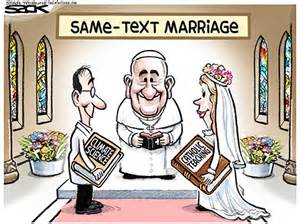
Nonetheless, since the pope’s departure virtually the only lasting conversation has circled around two words spoken to Kim Davis, the county clerk from Kentucky, who has refused to issue marriage licenses to gay couples.

Apparently at the invitation of the conservative Vatican Nuncio (ambassador), Ms. Davis appeared in a reception line, had her case briefly explained to the pope, shook his hand, and heard two words: “stay strong.” Those two words have overshadowed the thousands of sentences spoken by the pope in Washington, New York, and Philadelphia.

“Stay strong” was enthusiastically embraced by the mainstream media (MSM) as if it were the most significant papal utterance between September 22nd and September 25th. Apparently, it relocated commentators on familiar, comfortable ground far from the decidedly annoying “bold cultural revolution” advocated by the gentle visitor from the Vatican.

Later while on the plane back to Rome, the pope was pointedly asked about government officials who refuse to discharge a duty if they feel it violates conscience. In keeping with church tradition, the pope replied, “Conscientious objection must enter into every juridical structure because it is a right.”

The MSM seized upon that pronouncement as a further expression of papal support for Kim Davis.

Only a few applied the pronouncement’s logic to Kim Davis herself, who has been divorced three times and married four. Following the logic of “conscientious objection,” it would be much more consistent for Christian administrators in Rowan County to refuse all of Ms. Davis’ petitions for divorce which Jesus condemned as adulterous. (He said absolutely nothing about homosexuality.)

Much less did the MSM bother to apply the pope’s words about conscientious objection to whistle blowers in general or in particular to Chelsea Manning, Edward Snowden, the work of WikiLeaks, or to military personnel refusing orders. Once again, that would have moved the discussion into decidedly uncomfortable territory. It would have been too “political.”

In the meantime, national leaders, led by the United States, largely refuse to “become strong,” much less “stay strong” on matters of capital punishment, and weapons of mass destruction.  They’ve continued our headlong plunge towards the abyss represented by climate chaos – the lion in the room that threatens to devour us all.

According to Pope Francis, it’s towards taming that lion that focus and concern should be directed — instead of towards meaningless sideshows.

Pope Francis Criticizes Capitalism as a “Putrid, Rotten System”

filthy system

In a recent interview, Chris Hedges criticized Pope Francis for not being radical enough in his criticism of capitalism. He said that in the end, the pope was merely advocating charity and not real systemic change.

Hedges is an award-winning journalist, activist, author, and Presbyterian minister. He is one of our culture’s most courageous writers and prophetic critics. He is always worth listening to. So I was surprised by his remarks.

The interview gave the impression that the pope not only should have been stronger in his criticism of capitalism; he should have denounced it as such, and offered some alternative.

My personal response is that the pope actually has done all three – during his six-day trip to the United States, and especially in his landmark encyclical, Laudato Si’. During his visit here, he offered an extremely harsh denunciation capitalism. He scathingly criticized its “American” embodiment as violent and a form of gangsterism. And finally, in Laudato Si’, he offered a workable alternative.

Think about the pope’s criticism of capitalism-as-we-know-it.

Begin by understanding that it is historically short-sighted to argue that something called “capitalism” actually exists and needs reformation. The system has long since been reformed. In the midst of the Great Depression, it became clear to everyone that capitalism in its pure form (private ownership of the means of production, free and open markets, and unlimited earnings) was simply not workable.

So under the influence of John Maynard Keynes and others, the New Deal in the U.S. and the more extensive welfare states of Europe incorporated elements of socialism (public ownership of the means of production, controlled markets, and limited earnings). In other words, economies became mixed (some private ownership and some public, some controlled markets and some free, and earnings limited by progressive income tax).

The problem is that the new mixed economy was blended in favor of the rich. The theory was “trickle-down.” If the rich prospered, the rising tide of their prosperity would lift all boats.

Another problem surfaced with the Reagan and Thatcher counter-revolutions during the 1980s. Reagan called the New Deal a “fifty-year mistake.” So he focused on eliminating or shrinking the elements of socialism that had crept into economies everywhere since the emergence of the welfare state. It’s that counter-reformation that Pope Francis has criticized in polite terms as the excrement of evil personified.

He elaborated his point during his address to the U.S. Congress on September 24th when he referred to economic system we know as “filthy,” “rotten,” and “putrid.” He called the Wall Street speculators “hypocrites.” Moreover, the pope directly confronted the members of his audience by calling the system they represented “the greatest purveyor of violence” in the world today. And he called the politicians seated before him a bunch of gangsters.

Yes he did.

Of course the polite, soft-spoken, and gentle pontiff was a gracious enough guest to do none of those things directly. He did so instead by offering Dorothy Day, Martin Luther King and Thomas Merton as embodiments of our country’s greatest values.

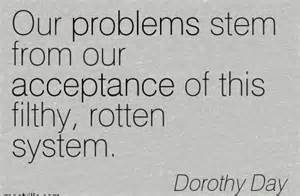
It was Dorothy Day who is remembered as saying, “We need to overthrow . . . this rotten, decadent, putrid industrial capitalist system which breeds such suffering in the whited sepulcher of New York.”

It was King who called the United States itself, “the greatest purveyor of violence in the world today.”

And it was Thomas Merton, the apostle of non-violence, who classified U.S. politicians and military leaders among the world’s gangsters when he said, “The world is full of great criminals with enormous power, and they are in a death struggle with each other. It is a huge gang battle . . .”

Moreover, Pope Francis did not leave his audience merely reeling from such heavy blows un-complemented by clear systemic alternatives to the filthy rotten arrangement he addressed. Instead, the pontiff called for a deep restructuring of capitalism-as-we-know-it. This would involve turning the present system’s preferential option for the rich precisely on its head, replacing it with his favorite guideline, the “preferential option for the poor.” Even more particularly, restructuring would require a central international legislative body endowed with power to override national economic practices judged to be environmentally unsound.

Both recommendations are found in Laudato Si’ which the pope cited in his congressional address. Both have already been implemented world-wide.

To begin with, the New Deal, the Great Society and (even more so) Europe’s introduction of the welfare state already represent arrangements which forefronted the needs of the working classes and poor. The reform measures were at the very least strong gestures towards economies mixed in favor of the poor rather than of the Wall Street rich. Such reforms demonstrated that another economic order is indeed possible.

As for the world body with power to enforce environmental legislation, the World Trade Organization (WTO) already has it, though perversely in its present form. According to the provisions of the North American Free Trade Agreement (and of the proposed Trans-Pacific Partnership), multinational corporations (MNCs) now have the power to sue before the WTO and invalidate U.S. environmental protection standards if those laws can be shown to diminish a corporation’s expected profits.

What the pope is proposing is an international body that turns the WTOs mandate upside-down.  The body the pope proposes would have binding power to protect the environment from the depredations of MNCs – i.e. is to eliminate their profits if they result from environmental destruction.

So I respectfully suggest that Chris Hedges is mistaken when he says Pope Francis pulled punches in his address before the U.S. Congress. And the pontiff has offered an alternative. As an honored guest, he gently delivered knock-out blows clearly observable to attentive listeners.

It remains for prophets like Hedges and others to highlight and reinforce them and in this way to advance us towards the Other World Pope Francis would convince skeptics is possible.

The Pope’s Address to Congress: First Impressions

Pope Congress 2

It was a fabulous speech by the world’s leading spiritual and thought-leader, who has just produced our century’s most important public document, Laudato Si’, the papal encyclical on the environment.

Pope Francis addressed not just the dignitaries in the Senate chambers, but all of us – parents struggling to support families, social activists, the elderly and the young.

The pope emphasized communitarian values: dialog, the common good, solidarity, cooperation, sharing, and the Golden Rule.

He held up for emulation four counter-cultural heroes he understood as embodying the most admirable of “American” values. They weren’t Rockefeller, Reagan, Jobs, or even FDR. Instead they were:

  1. Abraham Lincoln: the champion of liberty for the oppressed
  2. Martin Luther King: the advocate of pluralism and non-exclusion
  3. Dorothy Day: the apostle of social justice and the rights of the poor
  4. Thomas Merton: the Cistercian monk who embodied openness to God and the capacity for inter-faith dialog.

Of course, Lincoln and King were victims of assassination for championing the rights of African Americans.

Day and Merton vigorously resisted what Dorothy Day called “this filthy, rotten system.” (As is well-known, she was also an unwed mother whose first pregnancy ended in abortion.)

Following the examples of The Four, the pope called for the end of:

  • Fundamentalisms of every kind – including economic fundamentalisms
  • Political polarizations that prevent opposing parties from dialog and cooperation
  • Exclusion of immigrants by a nation of immigrant descendants
  • Capital punishment and its replacement by programs of rehabilitation
  • The global arms trade and arms sales in general along with the wars and violence they stimulate
  • Violent conflict and its replacement by difficult but essentially diplomatic process of dialog
  • The human roots of climate chaos and the related problems of poverty
  • Unlimited and directionless development of technology

Throughout this gentle but radical speech, the audience seemed to be waiting for the other shoe to drop – i.e. for the pope to mollify his conservative critics by addressing their favorite “religious issues” contraception, abortion, gay marriage. But the shoe never hit the floor.

At two points the pope about to untie his footwear. In mid-speech, he stated that we must protect and defend human life at every stage of its development. This lured his audience into a standing ovation.

However, the illustration of his point was not abortion, but capital punishment. Punishment for crime, Francis said, must never exclude hope and rehabilitation. We must end the death penalty, he asserted, since every life is sacred.

Then towards the end of his address, Francis spoke of his anticipated presence at this weekend’s Philadelphia Conference on the family. Families, he said, are threatened as never before, both from within and without.

But then, instead of addressing gay marriage, the pope spoke of the “most vulnerable” in this context – not the unborn, but “the young” threatened by violence, abuse and despair. Many of them hesitate to even start families, he lamented – some because of their own lack of possibilities. Others demur because they have too many possibilities. “Their problems are our problems,” the pope said. We must address them and solve their underlying causes.

It was a masterful speech. It continually lured conservatives into standing ovations for issues they constantly oppose: the end of the capital punishment, protection of the environment, openness to immigrants, the end of arms sales of all kinds. The address summoned legislators to their real responsibility – pursuing the common good, the chief aim, the pope said, of all politics.

The pope’s basic message was be daring and courageous – like the counter-cultural activists, Lincoln, King, Day, Merton, and (I would add) Pope Francis!

Pope Urges Catholic Parishes to Take in Refugees

pope-refugees-2

I woke up this morning to a promising Washington Post headline. It read: “Pope Urges Europe’s Catholics to take in Syrian refugees.” There he goes again, I thought.

The article described how Pope Francis “has called on ‘every’ parish, religious community, monastery and sanctuary to take in one refugee family – an appeal that, if honored, would offer shelter to tens of thousands.”

Of course the vast majority of such migrants are “illegal” in the eyes of governments where the invited parishes, etc. are located.

The pope implied that Jesus’ attitude towards “the stranger” overrides such legislation. The Master’s words in MT 25:35 have him identifying with immigrants (and the hungry, naked, homeless, and imprisoned) and basing the entire final judgment on the way we treat such people. He says: “. . . I was hungry and you gave me something to eat, I was thirsty and you gave me something to drink, I was a stranger and you invited me in,”

The pope’s appeal comes at a time when immigration along with climate change is a hotly contested issue not only in Europe, but here in the United States.

Of course, the entire panoply of Republican candidates (including the six of them who claim to be “devout Catholics”) consists not only of climate change deniers, but of candidates trying to outdo one another on the issue of excluding immigrants from our borders. Catholic candidates include Jeb Bush, Chris Christie, Bobby Jindal, Rick Santorum, Marco Rubio and George Pataki. Now they specifically diverge from the Pope not just on climate change, but on immigration as well.

Just yesterday, another ardent Christian, Sarah Palin, brought climate change and immigration together in typical GOP fashion. She told CNN that refugees from Mexico not only “better be legal,” but should be made to speak “American,” rather than “Mexican.” She sides with Donald Trump’s plan to build an exclusionary wall along the border. She also aspires to be Mr. Trump’s Secretary of Energy – a position she would embrace enthusiastically “because energy is my baby – oil and gas and minerals, those things that God has dumped on this part of the Earth for mankind’s use. . .”

Of course, Pope Francis words yesterday put him on the side of immigrants and against exclusionists. He invites his flock of 1.2 billion to follow suit. He also expressly rejects Palin’s reading of God’s mind about why the Creator “dumped” gas, oil, and minerals on Earth.

According to his eco-encyclical, Laudato Si’, using the narratives of Genesis to encourage “the unbridled exploitation of nature” is an incorrect interpretation of the Bible (67). “Clearly,” the pope adds, the Bible has no place for a tyrannical anthropocentrism that would encourage the “drill, baby, drill” approach regardless of its effects on the planet (68).

But the pope’s words about welcoming immigrants struck even closer to home.  For years I’ve been wondering what it might take to awaken Catholics to the revolutionary power of the Gospel.

In my own Catholic parish, we find ourselves mired in a detached, decontextualized version of faith that ignores the world’s real problems.

Pope Francis represents the exact opposite trend. Yet despite his invitation to “change everything” issued in The Joy of the Gospel nearly two years ago, and in spite of the urgency of Laudato Si’, nothing at our local level changes.

Yesterday’s papal invitation shows us how to get off the dime. He suggests something practical for every parish to do: welcome at least one immigrant family from the detention centers on our own borders. House and feed them. Be a prophetic example to the exclusionists. Join with other (non-Catholic) churches to do the same.

The infrastructure is there: churches that are used for just a few hours each week, parish basements and halls that are similarly idle most of the time. Also, many of us have space in our own homes – or own second houses – that might similarly provide housing for Jesus presenting himself to us as an immigrant.

Our little parish of St. Clare in Berea, Kentucky has a Peace and Social Justice Committee of 20 highly committed people. We’re meeting next Sunday to plan our gala “Watch Party” on September 27th to see the Pope’s address our Congress and the U.N.

Now in the light of the pope’s invitation to open our buildings to immigrant families, we have something else to discuss and act upon.

Accepting Pope Francis’ invitation could move our parish to truly begin “changing everything.”

Can you imagine what would happen, if the families we accepted were Muslim instead of Christian?

Thank you, Pope Francis.

The Conversion of Pope Francis and “Why the New Pope Must Resign”

Francis Capitalism

“Why the New Pope Must Resign.” That was the title of an article I wrote just after the election of Pope Francis in 2013. In it I joined Argentina’s Horacio Verbitsky and others questioning the role of Jorge Bergoglio (aka Pope Francis) in Argentina’s “Dirty War” (1976-’83).

Since then, friends have asked me about that. “What do you think now – in the light of the fresh spirit of reform the pope has introduced – in the light of his tremendous popularity?  Surely you were mistaken in your original, hasty judgment.”

That’s the typical question and observation.

My answer has been that I’m delighted with Pope Francis and the direction his papacy has taken. Both his Apostolic Exhortation, The Joy of the Gospel, and especially his new eco-encyclical, Laudato Si’ are magnificent. Their criticisms of capitalism-as-we-know-it as the structural cause of world poverty and environmental destruction couldn’t be a clearer endorsement of a form of liberation theology that is both spiritually moving and politically engaged.

I’m glad the pope didn’t resign. Pope Francis is great.

But in response to my friends, I also add that the issue of Father Bergoglio’s involvement with the Dirty War is not resolved. Nor should it be ignored. Recalling its elements holds lessons for us – about the Roman Church’s history of supporting oppression, about whitewashed historiography, and most importantly, about the possibility of repentance and deep personal change.

Consider the first point, the Church supporting fascist oppression. It happened in Argentina during the Dirty War as it happened in Germany under Adolf Hitler.

When Bergoglio was Jesuit Provincial, he was accused of turning over to the army two of his Jesuit colleagues and former teachers, Fathers Orlando Yorio and Franz Jalics. Both had been pro-socialist clerics and members of the Third World Priests’ Movement (MSTM). Such membership was considered a capital crime by the country’s ruling junta.

Yorio and Jalics had been embroiled in a long-standing feud with their Provincial not so much about their MSTM affiliation, but about their activities in a slum community the two priests served and lived in. Bergoglio didn’t have much time for Jesuits in his province being associated with left-wing causes – nor for versions of liberation theology tainted with Marxist analysis.

Like John Paul II and his chief advisor Josef Ratzinger (later Benedict XVI), he preferred a strain of liberation theology that prioritized the poor, but apolitically without revolutionary aspirations. Bergoglio liked to call that strain the “Theology of the People.” It prioritized their reflections on the gospel, and popular devotion to images, novenas, etc. Other versions of liberation theology were too “ideological.”

After being arrested and tortured, both Yorio and Jalics accused Bergoglio of fingering them to the army.

Father Yorio died without retracting his accusation. Fr. Jalics at first didn’t want to discuss the matter, saying that he and Bergoglio had reconciled.

Beyond the case of Yorio and Jalics, there was that of Father Christian Von Wernich. He had been a police chaplain during the Dirty War. After its conclusion, during the process of national reconciliation, Von Wernich came under investigation for his direct roles in police tortures and murders.

In response, while Bergoglio was a member, the Argentine Bishops’ Conference protected Von Wernich by transferring him to Chile under an assumed name. That is, the Bishops Conference treated accusations of torture and murder in exactly the same way bishops throughout the world had often dealt with allegations of sexual abuse of children: transfer the offender and cover up the past.

So, the question becomes, was Jesuit Provincial Bergoglio, like the predominant leadership of the Argentine Catholic Church, somehow cooperative with the ruling junta?

This brings us to my second point about historiography.

In defense of the future Pope Francis (and of the church hierarchy in general), his biographer, Austen Ivereigh, offers explanations that end up sounding much like the defense of Pius XII vis-à-vis the Nazis and his failure intervene against the Holocaust. Ivereigh argues:

  1. When the military took over in 1976, Argentina (like Weimar Germany) was in a state of political and economic chaos.
  2. So virtually all segments of society welcomed the military take-over (as Germans and the German Catholic Church welcomed Adolf Hitler).
  3. The military’s brutal Dirty War was secretive about the extremity of its measures. (Fr. Bergoglio testified that it took him some time to realize what was happening.)
  4. So people like Bergoglio didn’t really know what was going on (just as Germans claim they didn’t know about the concentration camps and ovens).
  5. When he did find out (like Pius XII) Bergoglio “worked quietly” to help potential victims escape – while fulfilling his primary duty of protecting the Jesuits from suspicion, investigation and reprisals from the ruling junta.

As with Germany such reasons end up sounding like excuses that raise suspicions of cover-up and historical obscurantism. They evoke the following observations and questions:

  1. Bergoglio gives every indication of being on the same page with John Paul II and Josef Ratzinger who also largely “looked the other way” when confronted with evidence of government brutality in dealing with left-wing elements of the clergy and faithful, e.g. in Central America in general and in El Salvador and Nicaragua in particular.
  2. Bergoglio clearly shared their disdain for priests involved in politics.
  3. If (as Ivereigh suggests) Father Bergoglio was so well-connected and friendly with all factions (including government officials and military leaders on the one hand, and their opponents including MSTM members on the other) how could he not have at least suspected what was really happening?
  4. If Jalics had forgiven Bergoglio (as he originally had said) what had he forgiven?
  5. Why did Jalics apparently change his story a few days after Pope Francis’ election? On being repeatedly contacted by the media about the issue, Jalics said, “The fact is: Orlando Yorio and I were not denounced by Father Bergoglio.”
  6. Father Yorio offered no deathbed recantation of his charges against Bergoglio.

And that brings me to my final point about repentance and its significance for Catholics today.

As Ivereigh indicates, the prevailing method of dealing with such contradictions is to  reluctantly argue that Father Bergoglio perhaps did cooperate with the military – as did so many other churchmen in positions of authority during the Dirty War. However, in Bergoglio’s case, he also courageously helped many escape – at some risk to himself.

But then at some point, he underwent a kind of conversion and is now a progressive. At least at the administrative level, Bergoglio’s own testimony indicates that he experienced a profound conversion. He confesses that as a young Jesuit Provincial (he was only 36 when appointed), he was too headstrong, uncompromising and authoritarian.

Indications are, however, that the about-face went far beyond managerial style.

The exact turning point in the process remains unclear. It could have come after Bergoglio was virtually drummed out of the Jesuits by progressive elements which saw him as an impediment to the Society’s reform in the spirit of Vatican II.

Afterwards he spent two years in a kind of exile and deep introspection. Ivereigh reports that Bergoglio passed days hearing the confessions of simple shantytown poor people. He also spent hours in semi-depression, simply staring out his window. Colleagues worried that he was sick. Was it some type of breakdown?

Whatever the case, clear evidence reveals a subsequently changed man. Previously he was criticized by more liberal fellow Jesuits and others for failing to ask important questions about poverty. As they put it, “He’s great at ministering to the poor. But he never asks why they are poor.” (The criticism evoked the famous comment of Dom Helder Camara, the archbishop of Olinda and Recife in Brazil who said, “When I give food to the poor, they call me a saint. When I ask why the poor have no food, they call me a communist.”)

But as pope in Laudato Si’ Francis makes no bones about why the poor have no food, or jobs, or homes, or education. With observations worthy of the MSTM members he rejected, the pope says, all of those problems are connected by the invisible thread called deregulated capitalism. His encyclical says that poverty, environmental destruction and a whole host of other problems are caused by capitalism-as-we-know-it. (So, predictably and true to Dom Helder’s words, Rush Limbaugh and others call Pope Francis a communist.)

Evidence of radical theological change goes much further. Consider, for instance, that Francis has:

  • Surrounded himself with liberation theologian advisers concerned with history and structural analysis.
  • Rehabilitated and consulted pro-socialist theologians blacklisted by his two predecessors – most prominently among them Brazil’s Leonardo Boff.
  • Identified Marxism as similar to the teachings of the early church fathers, claimed Marxists as his friends, and referred to them as “closet Christians.”
  • Echoed Latin America’s liberation theology speaking of Christian faith as “revolutionary,” because it challenges “the tyranny of Mammon.”
  • Peppered both The Joy of the Gospel and Laudato Si’ with frequent uses of the loaded word “liberation” contrasting the deleterious effects of “liberation” of markets (from government control) with the liberation of peoples proclaimed in the Judeo-Christian tradition.
  • Has similarly made Medellin’s phrase “preferential option for the poor” the watchword of his papacy, even going so far as to identify it with “the gospel itself.”
  • Beatified the martyred Archbishop of El Salvador, Oscar Romero, who is considered the patron saint of liberation theology. (Romero did, by the way, confront the ruling military and lost his life as a result.)
  • Described the world’s dominant economic system as running “counter to the plan of Jesus.” He said the system now in place and Jesus’ hoped-for Kingdom of God have different aims.
  • Worked with the Obama administration to open doors to Cuba which for more than 50 years has struggled to construct an economic alternative to capitalism-as-we-know-it.
  • In keeping with the insights of liberation theology, the pope has turned working against capitalism-as-we-know-it into a moral issue. In Laudato Si’ he wrote: “working for just distribution of the fruits of the earth and human labor” – is a “moral obligation.” For Christians, he said, “it is a commandment.” Here the pope echoed what he said in The Joy of the Gospel where he identified the struggle for social justice and participation in political life as “a moral obligation that is “inescapable.”

All of this represents not only a personal conversion for Pope Francis, but a summons to his Church to follow in his footsteps.

What he has written in “The Joy of the Gospel” indicates that he recognizes in a Church the same crisis he underwent. It is out-of-touch and in need of a complete overhaul. “Everything must change,” he has said.

For too long, he has written, the Church has been mired in an authoritarian judgmental paradigm and in viewpoint-narrowness that has focused on important but non-essential matters foreign to the focus of Jesus’ proclamation of God’s Kingdom. So-called “pelvic issues” were of little concern to Christianity’s Great Master.

The pope implicitly calls Catholics resembling his former conservative, apolitical self to engage in the process of political, economic, and ideological change before it’s too late. Stop staring out the window at a world falling apart, he tells us. Emerge from denial and obstructionism and come to grips with climate chaos and changing the economic system that causes not only environmental destruction, but world hunger, poverty, high infant mortality, and war.

Those are statements Fathers Yorio and Jalics could fully endorse.

How to Be Pro-Life and Not Just Pro-Birth

Joan Chittister

Recently, Benedictine Sister, Joan Chittister, grabbed some headlines when she took on the hypocrisy of the “pro-life” crowd.

She wrote,

“I do not believe that just because you’re opposed to abortion, that that makes you pro-life. In fact, I think in many cases, your morality is deeply lacking if all you want is a child born but not a child fed, not a child educated, not a child housed. And why would I think that you don’t? Because you don’t want any tax money to go there. That’s not pro-life. That’s pro-birth. We need a much broader conversation on what the morality of pro-life is.”

Sister Chittister’s point is well-taken. Being truly pro-life means joining reluctant mothers in the sacrifices they routinely make to see that their children are fed, properly housed and educated. So claiming to be pro-life while campaigning against food stamps, universal health care, Head Start, and subsidized housing is disingenuous to say the least. It also seems incompatible with defunding Planned Parenthood, our nation’s largest provider of sex education – probably the most effective, non-intrusive birth control measure of all.

And it’s significant that such reminders come from a woman. Women after all are the ones who primarily bear the burden imposed by the narrow pro-birth demands made mostly by men. Women alone are capable of bringing unwanted pregnancies to term. They are the ones who usually end up raising children as single parents.

Meanwhile, it is primarily men who insist that women fulfill responsibilities men themselves cannot fulfill on the one hand, and can easily evade on the other. The men include most prominently celibate Catholic clergy and an overwhelmingly male U.S. Congress. In biblical terms they are (to use Jesus’ words) “experts in the law” who “load people down with burdens they can hardly carry” and which the “experts” themselves “will not lift one finger” to lighten (LK 11:46). It’s no wonder so many women see pro-birthers as militants in a war against women.

But it’s even worse than that. If abortion is the crime they allege, pro-birthers are criminal accessories. They are co-abortionists. This is because their anti-life policies which deny reluctant mothers sex education, good jobs, decent wages, maternity leave, free child care, programs like Head Start, and subsidized food and housing create an anti-life culture. And that in turn drives desperate women to terminate unwanted pregnancies that will effectively impoverish them.

If lawmakers and religious leaders really care about life and want fewer abortions, they need to create a pro-life culture that invites bringing pregnancies to term. Most obviously, this means that it’s unjust for women to be left holding the bag. In particular it means:

  • Recognizing that the absolute prohibition of abortion endorsed by many Christians is not universally accepted.
  • Realizing that abortion as already restricted (to the first two trimesters) by the Roe v. Wade decision is about as much restriction as possible in such a pluralistic context.
  • In that light, having Christians adopt a prophetic, persuasive approach to limiting abortions rather than a legal coercive one.
  • This means that committed Christians would themselves refuse to abort unwanted fetuses, that they would support others in following suit, and (above all) that they’d promote pro-life measures across the board including anti-poverty legislation, but also advocating war resistance, elimination of capital punishment, and strict environmental protection legislation.
  • Supporting sex education programs like those offered by Planned Parenthood.
  • Changing the patriarchal teaching of the Catholic Church about birth control.

St. Francis or Donald Trump? Pope Francis or the Frackers? You Decide.

donald trump

The lineaments of right-wing criticisms of Pope Francis’ new encyclical “Laudato Si’” are becoming clearer by the day. A critique by Ross Douthat’s appeared in the June 21st edition of the New York Times.

Two days later, David Brooks took his stab in the same newspaper, writing a column called “Fracking and the Franciscans.” The title of Brooks’ article introduced specifically spiritual note into the rebuttal of the pope’s letter. In effect, it asks us to decide between St. Francis’ approach to nature (the pope’s ideal) and that of the fracking industry. Brooks clearly prefers the latter.

More specifically, Brooks’ op-ed makes clear the exact point of diversion between the pope and his conservative critics. On the one hand, the pope is calling for a “bold cultural revolution” – a spiritual revolution – based on love and compassion for the earth and on a “preferential option for the poor.”

On the other hand, Francis’ critics see that as “unrealistic” (in Brooks’ words). They prefer working within the given political and economic framework. For them, a society based on “harnessed” greed and self-interest is better than one based on love and compassion for the poor. There is no need for spiritual change. In short, greed is good. As David Brooks says, “in the end, purity of heart backfires.”

Douthat had earlier moved in the same direction by disparaging what he saw as excessive negativity in the pope’s letter.  He accused the pope of overlooking the unprecedented reduction in global poverty that characterizes our era. Things are not as bad for the poor as the Holy Father would have it. No need to prioritize the interests of the world’s poor majority.

In arguing that way, the columnist overlooked not only the deceptive reasoning behind World Bank poverty measurements. He also ignored the pope’s broadened definition of poverty to include unparalleled impoverishment of the natural environment.

In Douthat’s eyes, the pontiff also errs by downplaying and even rejecting the remedial capabilities of market dynamics and technological innovation. Who knows, he argues, they might be sufficient to solve what the pope describes as an unprecedented crisis. Let’s wait and see.

That’s the conservative position: keep doing what we’re doing; things aren’t as bad as they say; who knows, they might work out in the end.

In his own column, David Brooks takes up that thread not only reiterating that the pope’s negativity overlooks the unprecedented reduction in poverty brought about by market forces, but adding that countries made rich by those same forces are less polluted than their poorer counterparts.

If we followed the pope’s reasoning, Brooks says, we’d all aspire to be poor like St. Francis. And where would that leave us? There’d be no “Asian Miracle,” no technology-based American energy revolution as exemplified in fracking. And don’t worry about fracking, Brooks assures us: the government EPA and the conservative Breakthrough Institute have certified that it produces no widespread harm to water supplies and actually represents “a net environmental plus.”

Face it, Brooks contends: history shows that short-term pollution leads to long-term growth and affluence. Again, the best social programs are based on harnessed greed and self-interest. In the end Franciscan purity of heart stifles progress and wealth accumulation.

So which is better a society based on love and compassion or one based on greed and self-interest? Who should be our guide – someone like St. Francis or Donald Trump? That is the question. At root it is a spiritual question.

Pope Francis has his answer. New York Times and its columnists have theirs.

Each of us as individuals and all of us as a community must decide.

(Sunday Homily) Dylann Roof Will Surely Go to Heaven

Dylan Roof

Readings for 13th Sunday in Ordinary Time: WIS 1:13-15; 2: 23-24; PS 30: 2, 4-6, 11-13; 2COR 8: 7, 9, 11-13-15; 2 TM 1: 10; MK 5: 21-43.

Today’s readings are about death. They contain claims that are absolutely astounding, challenging, and almost too good to be true – especially in the light of last week’s massacre of nine black church goers during a Bible Study class at the historic Emanuel AME church in Charleston, South Carolina.

There the twenty-one year old perpetrator, Dylann Roof, slaughtered the people with whom he had been discussing the Bible just moments before. He had to kill them, he told a survivor, because “You rape our women and you’re taking over our country. And you have to go.”

Immediately, the entire country responded with horror. Many vilified the shooter as they found out about his racist Facebook postings, his easy access to firearms, and his flaunting of the Confederate Battle Flag. They argued about whether he should be executed as a terrorist or as a hate crime killer.

South Carolina, Alabama and other states flying the Confederate Battle Flag talked about removing it from their State Houses. Some discussed honoring the victims by passing omnibus legislation to address South Carolina’s racist structures involving health care, voting rights, housing and education.

President Obama got more personal. He said racism is in our DNA – an inheritance from our past that is difficult to erase.

Surviving families went deeper still. They forgave Dylann Roof choking as they did so through their tears of mourning.

Others asked, “What have we become as a nation?”

All of these reactions are familiar. We witnessed similar phenomena after Sandy Hook and Columbine.

It’s what human beings do in the face of brutality, violence and massacre. We blame; we soul-search. And sometimes forgive. Sometimes we even recognize complicity in the crime and resolve to change.

Those last reactions – forgiveness, soul-searching, and conversion – are justified by today’s readings. As I say, they address the astounding Judeo-Christian belief about death. Few of us can truly accept them. Once again: they seem too good to be true.

The first reading from the Jewish Testament’s Book of Wisdom startles us immediately by proclaiming: “God did not make death.” Instead he fashioned all things to have being. Specifically, human beings were formed imperishable by God. Death is experienced only by those who believe in the devil.

What? God did not make death? We are imperishable? Belief in death comes from the devil? Hold on; there’s more.

Today’s Alleluia verse becomes more specific still. It tells us to cheer up because “Christ has destroyed death” entirely. It has no reality at all.

Then in today’s Gospel, Jesus illustrates that truth. He equates death with mere sleep. There is nothing to cry about he tells those mourning the “tragic,” “premature” death of a 12 year old girl. She is merely sleeping. And then he grabs her by the hand and shows he’s right.

Do we really believe such statements? Is that Jesus story a child’s tale? Do we really believe that God did not make death? Do we believe that Christ has destroyed it?  Is death no more than sleep? Is death a mere illusion – moving from one room to another?

Those who are Christians routinely claim say yes. We even go further. Our belief says that “death” is not the end. Instead it is the greatest, happiest moment in life. For with it, life does not end. It goes on in ways so magnificent, so full of peace and wisdom and joy as to make it difficult to describe and impossible to comprehend.

That’s the faith we claim. Again, it seems too good to be true.

But if that’s what we believe, our faith has practical consequences regarding Dylann Roof and others like Dzhokhar Tsarnaev, Richard Speck, and even Adolf Hitler. The conclusions are these (as inspired by Neale Donald Walsch’s Conversations with God):

  • All those killers did no harm or damage to the ones whose deaths they caused. The souls of those they killed were released from earthly bondage, like butterflies emerging from a cocoon.
  • Their deaths are thought to be “untimely” only by those who believe that anything in God’s universe can happen when it is not supposed to. Given who God is, nothing can possibly be untimely.
  • The people left behind mourn the dead only because they do not know the joy into which those souls entered.
  • The killers themselves remain loved by God and will go to heaven, whatever that means. (There is no other place for them to go. Dante’s inferno was his creation, not God’s. To repeat the metaphor: death itself is the “devil’s” creation.)
  • Their actions were mistakes, those of unevolved human beings. The proper faith-inspired response to them is not punishment, but God’s response: forgiveness, healing, correction, re-education, and eventual reintegration back into the fullness of life.
  • None of them acted alone. Germany produced Adolf Hitler; millions thought he was right. South Carolina and the United States created Dylan Roof; many sympathize with his racism. We all bear responsibility for his actions. In a sense, we are all Dylann Roof. Killing innocents is killing innocents whether it’s in Charleston, Baghdad, Ferguson, or Guantanamo.
  • In God’s perfect universe, the function of Dylann Roof, Dzhokhar Tsamaev, Richard Speck, and even Adolf Hitler is to force us to face who we are and what we want to become. We claim we live in the land of the free, home of the brave, in a democracy where all are equal. Some even hold that we are a Christian nation. Few of us admit subscribing to racism. But then a Dylan Roof forces us to look in the mirror and reassess. Suddenly Confederate Battle Flags come down and politicians are discussing omnibus legislation.

From a faith perspective, Dylann Roof has become our teacher.  His lesson is the reverse of what Jesus, the Buddha, Krishna and Pope Francis have taught. The latter all reveal to us the splendid human beings every one  of us (even Dylann Roof) can become. The former shows us where we are headed if we refuse to change course.

NYT Criticism of Pope Francis’ Encyclical: an Early Right Wing Response

Limbaugh

In Sunday’s New York Times, Ross Douthat offered a critique of Pope Francis’ new encyclical, “Laudato Si’.”  His piece was entitled “Pope Francis’ Call to Action Goes beyond the Environment.”

The op-ed is valuable since it offers a preview of the right-wing critiques of “Laudato Si’” (LS) that we’re likely to hear over the next few months. Let’s consider them one-by-one.

To begin with, the author is correct. Pope Francis’ encyclical does go far beyond climate change. It is brilliantly overwhelming in its breadth of scope which sees climate chaos as but one symptom indicating that the present world system is fundamentally unsustainable.

Other symptoms include deforestation and loss of wetlands (8), “water poverty” and infant mortality (28), species extinction (33), over-fishing (40), destruction of coral reefs (41), uncontrolled urbanization (44), food waste (50), the north’s “ecological debt” to the global south (51), debt crises in general (52), war (57), information manipulation (54), desertification (89), cruelty to animals (92), economic domination by unproductive financial interests (109), resource depletion (111), dangerous market-driven production of GMOs (134), secret negotiations of trade deals (135) and human anxiety, loss of purpose and of human community (110).

Additionally there are related problems of  human trafficking, organized crime, the drug trade, commerce in blood diamonds, and the fur of endangered species . . . buying and selling of organs of the poor for resale or use in experimentation. . . and the elimination of children because they are not what their parents wanted (123).

In the pope’s vision, all of these problems are interconnected. In fact, that’s the basic thesis underlying the Francis tour de force: EVERYTHING IS INTERCONNECTED (42, 117, 120, 137, etc.). At root what causes the problems are the unregulated nature of free markets, blind reliance on technological development, and excessive anthropocentrism (LS Chapter 3). Causes are rooted in “the lie” which denies that there are any limits to economic growth (106).

What are needed to combat such manifestations are radical changes in the ways humans live, produce and consume (23). Francis says we need a “bold cultural revolution” – a recovery of values and great goals that have been swept away by human “delusions of grandeur” (114).

Not surprisingly, the pope finds such values and goals embodied in the Judeo-Christian tradition, its teachings about divine ownership of creation, human stewardship of the same, and its unswerving reverence for all forms of life, from the least to the greatest (Chapter Two). All life forms, the pope teaches, from algae to human embryos and the planet itself have intrinsic worth. None of them should be treated as insensate instruments put on earth for human profit and pleasure.

On Douthat’s analysis, such reflections might be all well and good. However, they represent only one viewpoint. And this brings us to the right-wing arguments against the pope’s analysis that we can anticipate over the next months. They have to do with papal negativism, the success of the market in eliminating poverty, the Catholic approach to overpopulation, and the capacity of future technological development to solve the planet’s problems.

For starters, Douthat calls the pope’s approach “catastrophism.” The other viewpoint – evidently Douthat’s own – he terms “dynamism.”

Dynamists are far more optimistic than the pope. They believe that the market and technological advances will possibly head off what the pope sees as inevitable catastrophe especially for the world’s poor absent that earlier-mentioned bold Cultural Revolution.

Coming from his dynamic perspective, Douthat argues that (1) poverty is diminishing world-wide, (2) overpopulation (spurred by the Catholic vision of marriage and fecundity) plays an important role in the problems the pope enumerates, and (3) who knows, the pope could be wrong: technology and the market just might automatically solve the world’s problems.

On the pope’s holistic analysis, each of such conservative arguments fails miserably.

The first (that world poverty is diminishing) is questionable on two counts.

First off, Douthat’s thesis is based on a World Bank study showing that “extreme poverty” as opposed to normal poverty is diminishing. (Normal poverty is defined as an income of $2.00 per day.)

While it’s true that incomes among the world’s poorest have risen from .87 cents per day in 1981 to $1.25 in 2005, the number of people living in normal poverty has remained unchanged over that same period. Moreover, the number of humans living in the “unspeakable conditions” of normal poverty would actually have risen sharply over the same period were it not for the economic development of China, whose improvement cannot be explained by unfettered markets as championed by neo-liberal apologists.

Secondly, Douthat’s approach to poverty misses the pope’s point about including the devastation of the natural environment in definitions of poverty. Given the earlier cited list of problems addressed in the pope’s encyclical, it is impossible to argue that world poverty is diminishing. As he puts it so delicately, humans are turning the planet into a pile of filth (21). Impoverishing nature means growth in world poverty.

Douthat’s second defense of the “dynamic” vs. the “catastrophic” approach – the one about population – is similarly short-sighted. The pope addresses it head-on. In effect he admits that there are too many people in the world – but not the ones Douthat has in mind.

Douthat is thinking about the masses in the global south. By contrast, Pope Francis’ focus is on the global north – the United States and Europe. His implication is that there are indeed too many people. But they are Americans and Europeans whose ecological footprint is far more devastating than the footprint of the poor living in Latin America, Africa and South Asia. The world cannot sustain people living the lifestyle of Americans and Europeans.

The pope writes: “To blame population growth instead of extreme and selective consumerism on the part of some, is one way of refusing to face the issues. It is an attempt to legitimize the present model of distribution, where a minority believes that it has the right to consume in a way which can never be universalized, since the planet could not even contain the waste products of such consumption” (50).

Additionally, Douthat does not address the good economic reasons the world’s impoverished have for contributing to the population pressures the columnist finds so disturbing. Simply put, those reasons center around the absence of social services and benefits Americans and Europeans take for granted, but which conservatives continually rail against.

The impoverished need large families because their economies remain largely agrarian, and each additional child represents another field hand. They need children to provide additional income where jobs provide no government-mandated living wage. They need many children to insure that at least one will survive to care for them in their waning years. They need family members to replace them as income-earners where the government provides no workers’ compensation for injuries sustained on the job, or where there is no government-provided health care.

In short, Americans and Europeans have small families because of urbanization and the government “programs” representing their countries’ “social wage.” Absent income supplements like adequate minimum wages, social security, and health care, large families make complete sense. Or as Barry Commoner put it in 1976, poverty breeds overpopulation and not the other way around.

As for Douthat’s final Pollyanna expression of faith in undirected markets and technology, they are just that “Pollyanna.” Surprisingly (especially for a Republican), they represent a refusal to accept Pope Francis’ call for what GOP members claim to prize so highly – personal responsibility.

Like the interconnectedness of all reality, the call to responsibility is a recurring theme in “Laudato Si’” (e.g. 64, 67, 78, 105, 118).

Moreover, Douthat’s simplistic approach to technology fails to deal with Pope Francis’ key point that technologies are not neutral. Their development and use is largely controlled by the world’s rich and powerful. Francis writes: “We have to accept that technological products are not neutral for they create a framework . . . dictated by the interests of certain powerful groups” (107).

In effect, then, placing hopes in technological development equates with naïve surrender to the very people principally responsible for our planet’s “unprecedented situation” (17).

In the end, Ross Douthat’s loaded categories “Catastrophists” vs. “Dynamists” are misleading. More accurate classifications would be “Ecologists” vs. “Atomists.” Pope Francis is an ecologist. He sees the interrelatedness of all reality and the interrelatedness of all reality with Ultimate Reality. His approach is holistic.

Meanwhile, Douthat is an atomist. In his op-ed nothing seems to be connected.  He can’t see the relative meaninglessness of the categories “extreme poverty” contrasted with the unspeakable conditions of normal poverty. He’s oblivious to the fact that Americans and Europeans represent the planet’s true excess population. His faith in blind markets and future technological developments are slices of pie in the sky.

Pope Francis would say it is out of line with our culture’s best insights and values. It is entirely irresponsible.