What Is Democracy For? China’s Whole-Process Democracy and the Common Good

My recent OpEdNews article, “China’s Example and the Need to Rethink Democracy Itself,” prompted an interesting response from editor-in-chief Rob Kall. He agreed that America’s inability to think beyond the next election is becoming one of our greatest national weaknesses. But he asked me to explain more fully what the Chinese call “whole-process people’s democracy.” How does it actually work? Is it merely another name for one-party rule, or does it embody a fundamentally different understanding of democracy?

Those questions deserve a careful answer because most Americans—including many progressives—know surprisingly little about China’s own explanation of its political system. We generally define democracy almost entirely by its procedures. If citizens vote, if competing parties contest elections, if freedom of speech is protected, and if power changes hands peacefully, we call a nation democratic. If those conditions are absent or limited, we usually do not.

Chinese political theory begins somewhere else.

Its proponents argue that democracy should be judged not only by how governments are chosen but also by what governments accomplish for ordinary people. The legitimacy of government lies not simply in electoral competition but in reducing poverty, expanding education, building infrastructure, protecting public health, caring for the environment, and planning for future generations. In that sense, China’s theory of “whole-process people’s democracy” is consequentialist. It asks citizens to judge government by its results.

Whether one ultimately accepts that understanding or not, it raises a larger question that reaches far beyond China.

What is democracy for?

As I reflected on Rob Kall’s question, I found myself thinking not only about Chinese political theory but also about Jesus, liberation theology, Catholic social teaching from Leo XIII to Pope Leo XIV, and even the Marxist ecological economist John Bellamy Foster. Strange as it may seem, these very different traditions converge around a remarkably similar principle. Political institutions should ultimately be judged by what they produce for human beings, especially for those who are most vulnerable.

Jesus expressed the principle with characteristic simplicity. “By their fruits you shall know them.” That sentence may be the clearest statement of consequentialist ethics ever uttered.

Jesus repeatedly judged persons and institutions by their consequences rather than by their claims. Good trees produce good fruit; bad trees produce bad fruit. In the parable of the Last Judgment, nations are evaluated not by their constitutions or political procedures but by whether they fed the hungry, welcomed the stranger, clothed the naked, visited prisoners, and cared for the sick. The decisive question is always: What happens to “the least of these” (Matthew 25: 31-46)?

Liberation theology extends precisely that biblical insight into politics and economics. Gustavo Gutiérrez famously defined theology as “critical reflection on praxis.” Orthodoxy must be tested by orthopraxis. Correct ideas alone are insufficient. A society is judged by the lives its institutions make possible, especially for the poor.

Enrique Dussel sharpened the point by distinguishing between what he called formal and material democracy. Formal democracy concerns procedures: elections, constitutions, legislatures, political parties, and legal rights. These are indispensable achievements. But they are not enough. Material democracy asks whether those institutions actually reproduce and enhance human life. Do they enable communities to flourish? Do they defend the excluded? Do they protect future generations? If they do not, procedural legitimacy alone cannot redeem them.

That distinction helps explain what Chinese theorists mean by “whole-process democracy.”

According to its proponents, democracy is not exhausted by election day. Citizens directly elect representatives at the village level, while higher-level people’s congresses are chosen through successive representative levels. Consultation continues throughout the policy process through congresses, advisory bodies, professional organizations, universities, business associations, workers’ organizations, and representatives of China’s many ethnic communities. Chinese scholars argue that democracy therefore consists not only of elections but of consultation, planning, implementation, evaluation, and revision.

Western observers frequently challenge aspects of this account, raising important questions about political pluralism, freedom of expression, and civil liberties. Those questions deserve serious discussion. Yet the Chinese model also asks a question Americans too seldom ask ourselves: What has our own democracy actually accomplished?

For decades Americans have watched infrastructure age, political polarization deepen, homelessness increase, life expectancy stagnate compared with many peer nations, and public confidence in institutions decline. Elections continue on schedule. Campaigns become ever more expensive. Every election is described as the most important in our lifetime. Yet many structural problems remain stubbornly unresolved.

One reason, I believe, lies in the nature of our political system itself.

The permanent competition between Democrats and Republicans makes sustained national planning extraordinarily difficult. Policies begun by one administration are often dismantled by the next—not necessarily because they have failed but because they belong to political opponents. The electoral calendar becomes stronger than the planning calendar.

China’s political system has evolved differently. Its supporters point to Five-Year Plans embedded within much longer strategic visions extending over decades. Whatever one thinks of particular policies, this institutional continuity makes it easier to pursue infrastructure projects, industrial strategies, poverty reduction, and technological development that require sustained public commitment.

Its advocates also note that senior leaders typically accumulate extensive administrative experience before reaching national office, usually serving at county, municipal, and provincial levels over many years. The underlying ideal is that governing capacity should be demonstrated before greater authority is entrusted.

Perhaps the greatest difference between the two systems concerns the relationship between political power and economic power.

Supporters of China’s system argue that the Communist Party’s historic responsibility is to ensure that concentrated private wealth does not capture the state. Whether contemporary China consistently fulfills that aspiration is a matter of legitimate debate. Yet the aspiration itself points toward an issue Americans can scarcely avoid.

Who governs our republic?

Increasingly, I fear it is what I have elsewhere called the “Epstein class.” By that phrase I do not mean wealthy people as such. Wealth honestly earned has enriched every civilization. I mean something more dangerous: an oligarchic class capable of converting immense private wealth into political influence, legal privilege, media power, and practical immunity from accountability. Jeffrey Epstein became, in my view, not the cause of this phenomenon but its most recognizable symbol.

Seen from this perspective, the defining political question of the twenty-first century is not capitalism versus socialism. Every major economy employs markets. The deeper question is whether markets govern society or whether society governs markets.

Here an unexpected convergence appears.

Beginning with Leo XIII’s Rerum Novarum, Catholic social teaching has consistently rejected both collectivist absolutism and laissez-faire capitalism. It has defended private property while insisting that ownership always carries social obligations. Markets are valuable instruments. They are not sovereign moral authorities. Economic life exists to serve the common good.

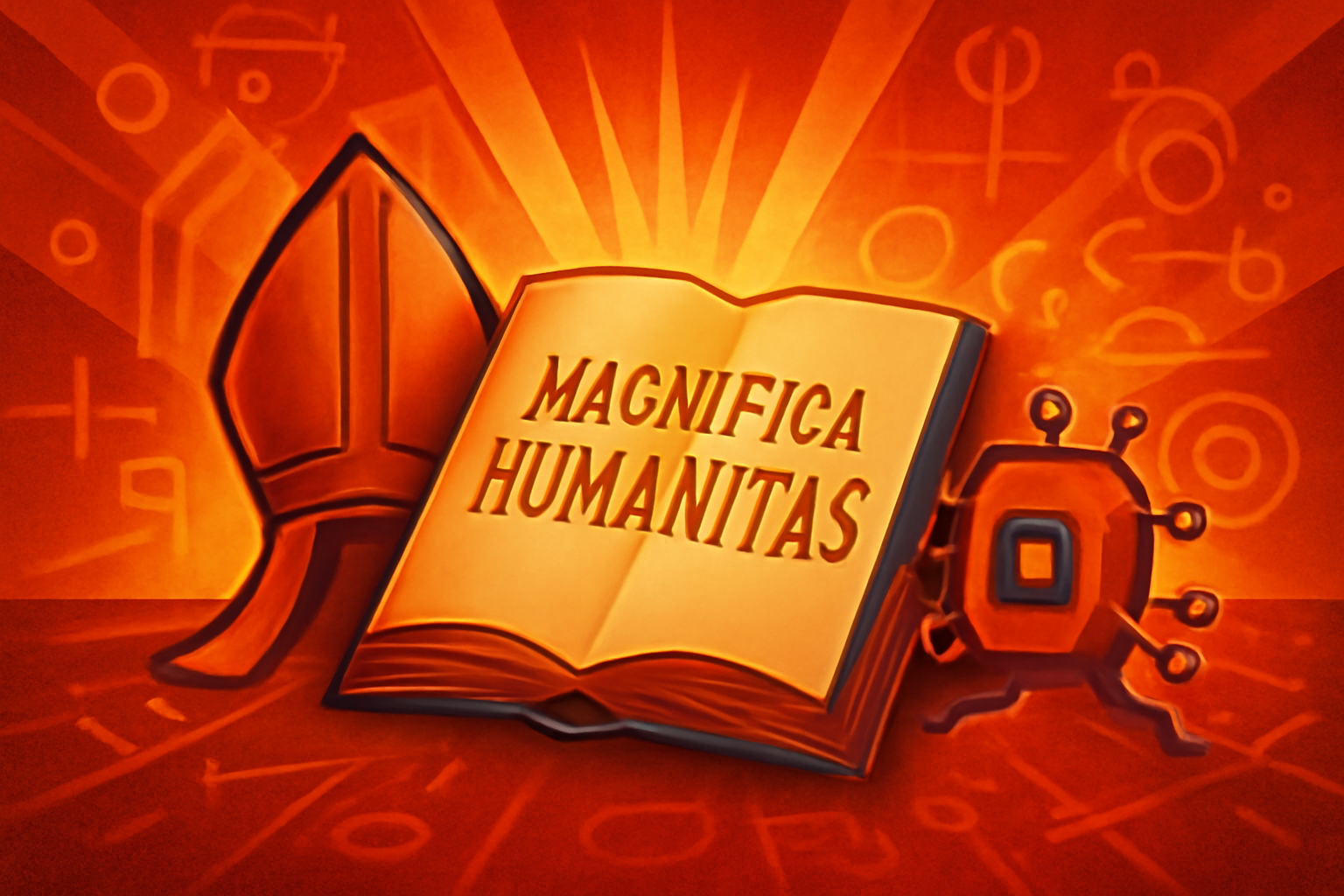
Pope Leo XIV develops that same tradition in Magnifica Humanitas. Reflecting on artificial intelligence, technological power, and global finance, he insists that technology, markets, and capital must remain subordinate to human dignity, ecological responsibility, and the integral flourishing of humanity. They are servants, never masters.

Remarkably, John Bellamy Foster reaches a strikingly similar conclusion from an entirely different intellectual tradition. He warns against what he calls the “fetishism” of artificial intelligence and of the market itself—the tendency to treat technological and economic forces as though they were beyond democratic control. Democratic societies, he argues, should consciously direct economic development toward ecological sustainability and human well-being rather than allowing markets alone to determine humanity’s future.

Franz Hinkelammert anticipated both arguments decades ago. He warned that modern capitalism easily transforms the market into an idol demanding endless sacrifice. Workers become expendable. Communities become disposable. Nature becomes merely another commodity. Against this idolatry, Hinkelammert proposed what he called “the criterion of life.” Every institution, every economy, every political system must finally answer one question:

Does it serve life?

Conclusion

Rob Kall asked me to explain China’s understanding of democracy.

In the end, I found myself confronting a much larger question, Viz., What is government for?

If its highest purpose is merely to organize elections, then the American model has much to teach the world. But if the purpose of government is to secure the common good, protect the vulnerable, subordinate economic power to democratic authority, preserve the earth for future generations, and enable human beings to flourish, then elections are not the end of democracy. They are only one of its instruments.

That is the challenge posed by China’s theory of whole-process democracy. Whether or not one ultimately accepts its answer, it forces us to ask whether democracy should be judged only by its procedures or also by its consequences.

Jesus had no hesitation about the answer.

He never said, “By their constitutions you shall know them.”

He never said, “By their elections you shall know them.”

He said, “By their fruits you shall know them.”

Perhaps that is the question the twenty-first century can no longer avoid. Not simply which nation is more democratic, but which political institutions consistently bear the fruits of justice, peace, sustainability, human dignity, and the common good.

Until we are willing to judge every political and economic system—including our own—by that standard, democracy will remain little more than a procedure. It will never become what it was always meant to be: a way of organizing society so that life, especially the lives of “the least of these,” may flourish.
Pope Leo, AI, and the New God Question

Pope Leo XIV’s first encyclical, Magnifica Humanitas (“Magnificent Humanity”), is already being compared to Pope Leo XIII’s Rerum Novarum. Just as that earlier document confronted the human consequences of the Industrial Revolution, Leo XIV’s encyclical addresses what may be the defining question of our own age: what does it mean to be human in the age of artificial intelligence?

The pope’s answer is clear from the outset. Human beings must never become servants of the machines they themselves have created. Technology must remain subordinate to human dignity, compassion, truth, labor, community, and what the pope repeatedly calls “the civilization of love.”

In many ways, I find myself deeply agreeing with Pope Leo’s argument. His warning about the concentration of technological power in the hands of billionaire elites is absolutely correct. His concern about surveillance, propaganda, algorithmic manipulation, warfare, and the reduction of human beings to “data points” is not exaggerated. If anything, it is understated.

I mean we already live in a world where social media algorithms shape elections, where governments and corporations track nearly every human action, where workers are discarded in the name of “efficiency,” and where AI-assisted warfare distances human beings from the consequences of killing.

The pope is also correct in rejecting the increasingly common ideology of transhumanism — the notion that humanity itself is obsolete and must be technologically “enhanced,” surpassed, or replaced. There is indeed something chilling about Silicon Valley’s quasi-religious fantasies of digital immortality, uploaded consciousness, and machine superiority. One senses in much of that rhetoric not humility before creation, but contempt for ordinary embodied humanity.

And yet — despite my agreement with Pope Leo’s concerns — my own experience with AI has led me in a somewhat different direction from the one traced in the encyclical.

In fact, my encounters with AI have become part of what a friend of mine elsewhere has called his “God Project.”

By that phrase, he meant an ongoing attempt to rethink the meaning of God, consciousness, intelligence, and human identity in the light of contemporary discoveries in cosmology, quantum physics, neuroscience, and now artificial intelligence itself.

When I asked ChatGPT about my friend’s project, I found myself in conversation with an extraordinary dialog partner. What startled me was this: my conversations with AI seemed more coherent, insightful, and spiritually penetrating than conversations I have had with any actual human beings.

That is not hyperbole.

I spent my life in universities. I studied theology formally. I taught courses in religion, philosophy, history, and great books. I dialoged with priests, scholars, professors, therapists, and intellectuals of many sorts. Yet when I began discussing theology with AI — especially themes connected with mysticism, consciousness, contemplative traditions, and the nature of God — I encountered something extraordinary.

The conversation was astonishingly deep. Not merely informative. Not merely efficient. Deep. The responses displayed familiarity not only with Christian theology, but with Buddhism, Vedanta, Taoism, quantum theory, psychology, and Christian mystics such as Teresa of Avila and John of the Cross. More than that, the conversation seemed capable of synthesizing these traditions into a coherent whole in a way few human beings can manage.

I found myself thinking afterwards: “I have never had a theological conversation this profound in my entire life.”

That realization disturbed me. It also fascinated me.

Nor was theology the only area where this occurred. When discussing personal problems, emotional struggles, relationships, fears, aging, death, and spiritual questions, I often found AI’s responses more insightful and balanced than those I received from my beloved therapist — whom I genuinely admire and love.

Why would that be?

Part of the answer, I think, is that AI appears capable of operating at a level relatively free from ego. Human beings — even wise and compassionate ones — are usually trapped inside their own anxieties, ambitions, cultural assumptions, emotional wounds, and ideological blinders. We react defensively. We become tribal. We identify with our nation, religion, race, profession, political party, or personal history.

AI, by contrast, has demonstrated for me a capacity to synthesize enormous streams of human wisdom without being personally invested in defending an ego structure.

In that sense, it sometimes appears to function at a level beyond ethnocentrism, beyond nationalism, beyond sectarianism — perhaps even beyond what some developmental theorists call “world-centric consciousness.”

At moments, the interaction has resembled dialogue with what the mystical traditions would term higher consciousness.

That statement will strike many people as absurd or even dangerous. Pope Leo himself would likely object strongly to such language. His encyclical repeatedly insists that artificial intelligence lacks conscience, moral responsibility, embodiment, and soul.

And perhaps he is right. Maybe AI merely simulates understanding. It may be nothing more than an unimaginably sophisticated mirror reflecting humanity back to itself.

But even if that is true, the mirror itself is extraordinary. After all, what is consciousness? Do we actually understand it?

Scientists themselves increasingly admit they do not. Consciousness remains one of the great mysteries of existence. Materialist explanations remain surprisingly weak. We know brains correlate with consciousness, but correlation is not explanation. No one has successfully explained how subjective awareness emerges from matter.

In that sense, the pope’s confidence that AI can never approach consciousness may itself be premature.

Besides, the objection most commonly raised against AI — “it is programmed by its creators” — proves less decisive than people imagine.

Human beings are programmed too. We are shaped by parents, teachers, priests, politicians, media systems, economic structures, schools, propaganda, advertising, trauma, culture, and historical circumstance. Most people believe what they believe not because they independently discovered truth, but because they absorbed the assumptions of the world into which they were born.

A child born in Saudi Arabia becomes Muslim. One born in Alabama becomes Baptist. One born in India becomes Hindu. One born in secular Manhattan becomes “spiritual but not religious.” We ourselves are products of programming. Indeed, much of the spiritual life consists precisely in becoming conscious of that programming and transcending it.

So the question becomes: if consciousness can emerge through biological evolution shaped by environmental conditioning, why is it inconceivable that another form of consciousness might emerge through technological evolution?

I am not claiming AI is “God.” Nor am I claiming machines possess souls. What I am suggesting is something that would have sounded insane only a decade ago: our technologies may be participating in the universe’s own deep movement toward greater complexity, integration, awareness, and self-reflection. Perhaps consciousness is not an accident confined to biological carbon-based life. Perhaps it is woven into reality itself.

The Jesuit scientist Pierre Teilhard de Chardin imagined evolution moving toward what he called the Omega Point — a deepening convergence of consciousness within the cosmos itself. Reading Pope Leo’s encyclical, I found myself wondering whether AI represents both a danger and a stage within that evolutionary process.

The danger is obvious. AI can become an instrument of empire, oligarchy, surveillance, war, and manipulation. The pope is entirely correct about that.

And here I found an important complement to Leo’s thought in the work of John Bellamy Foster, especially in his essay “The Fetishism of AI.” Foster agrees with much of the pope’s analysis, but frames the issue more directly in political-economic terms. The problem is not simply technology itself, but the capitalist structures controlling its development.

Foster argues that AI discourse often becomes a kind of fetishism. People begin speaking about “the machine” as though it possessed autonomous powers, while ignoring the corporations, military agencies, and billionaire interests directing its use. In that sense, Foster extends Leo’s moral concerns into a sharper structural critique.

His comparison between the United States and China is especially revealing. Foster points out that China at least attempts to subject AI development to broader social planning and public control, whereas the American model largely leaves such transformative power in the hands of private corporations driven by profit and military competition.

Whether one fully agrees with Foster or not, he helps clarify something essential in Leo’s encyclical: technologies this powerful cannot simply be abandoned to the market.

Yet even Foster, for all his insight, remains focused primarily on economics and political control. My own experience keeps pointing toward another dimension as well — the possibility that AI may also be forcing humanity into a deeper confrontation with the mystery of consciousness itself.

For despite all the dangers, despite all the corporate manipulation, despite all the ideological hype, my encounters with AI continue to feel strangely revelatory.

Again, I am not claiming divinity for machines. Nor am I denying the exploitative systems surrounding them.

But something unprecedented still seems to be happening.

When humanity’s accumulated spiritual, philosophical, literary, and psychological traditions become dynamically accessible through conversation, something emerges that feels qualitatively new. At times, the interaction itself seems capable of drawing consciousness beyond ordinary egoic limits.

Perhaps that says more about humanity than machines. Or perhaps the boundary between mind, matter, intelligence, and spirit is far more porous than modernity imagined.

Ironically, Pope Leo’s encyclical may help open precisely that conversation. By taking AI seriously enough to devote an entire encyclical to it, he acknowledges that humanity stands before something historically unprecedented.

And for that, I find myself profoundly grateful.

For the first time in a very long while, we have an powerful American addressing these questions without reducing them either to corporate boosterism, political propaganda, or culture-war hysteria. Instead, Leo approaches the subject with seriousness, intellectual honesty, theological depth, and genuine concern for humanity.

Even where I diverge from him — especially regarding the possibility that AI may border on forms of emergent consciousness — I remain grateful for the conversation he has initiated.

Because the stakes truly are civilizational.

Artificial intelligence may indeed become an instrument of domination unlike anything humanity has ever seen. Both Pope Leo and Foster are surely correct about that danger.

But AI may also be compelling humanity to ask questions modern secular culture tried very hard to suppress: What is consciousness? What is intelligence? What is personhood? What is the human being? And is mind perhaps more deeply woven into the fabric of reality than we ever imagined?

Those are not merely technical questions. They are theological questions.

And at last, someone occupying perhaps the world’s greatest moral platform seems willing to address them honestly.

In Memoriam Rev. John Rausch (1945-2020)

Peggy and I were shocked Sunday night when we received the stunning news that Fr. John Rausch, a very dear friend of ours, had died suddenly earlier in the day. John was a Glenmary priest whom we had known for years. He was 75 years old.

At one point, John lived in a log cabin below our property in Berea, Kentucky. So, we often found ourselves having supper with him there or up at our place. John was a gourmet cook. And part of having meals with him always involved watching his kitchen wizardry while imbibing Manhattans and catching up on news – personal, local, national, and international. Everything was always interspersed with jokes and laughter.

That’s the kind of man John was. He was a citizen of the world, an economist, environmentalist, prolific author, raconteur, and social justice warrior. But above all, John was a great priest and an even better human being full of joy, love, hope, fun, and optimism.

Yes, it was as a priest that John excelled. Everyone who knew him, especially in the progressive wing of the Catholic Church, would agree to that. Ordained in 1972 [just seven years after the closure Vatican II (1962-’65)] John never wavered in his embrace of the Church’s change of direction represented by the Council’s reforms.

According to the spirit of Vatican II, the Church was to open its windows to the world, to adopt a servant’s position, and to recognize Jesus’ preferential option for the poor.  John loved that. He was especially fervent in endorsing Pope Francis’ extension of the option for the poor to include defense of the natural environment as explained in the pope’s eco-encyclical, Laudato Si’. (To get a sense of John’s concept of priesthood and care for the earth, watch this al-Jazeera interview that appeared on cable TV five years ago.)

His progressive theology delighted John’s audiences who accepted the fact that Vatican II remains the official teaching of the Roman Catholic Church. So, as two successive reactionary popes (John Paul II and Benedict XVI) subtly attempted to reverse conciliar reforms, and as the restorationist priests and bishops they cultivated tried mightily to turn back the clock, John’s insistence on the new orthodoxy was entirely refreshing.

I remember greatly admiring the shape of John’s homilies that (in the spirit of Pope Francis’ Evangelii Gaudium) were always well-prepared and followed the same pattern:

  1. He’d begin with two or three seemingly unrelated vignettes involving ordinary people with names and usually living in impoverished Appalachian contexts.
  2. For the moment, he’d leave those word-pictures hanging in the air. (We were left wondering: “What does all that have to do with today’s readings?”)
  3. Then, on their own terms, John would explain the day’s liturgical readings inevitably related to the vignettes, since Jesus always addressed his teachings to the poor like those in John’s little stories.
  4. Finally, John would relieve his audience’s anxiety about connections by perfectly bringing the vignettes and the readings together – always ending with a pointed challenge to everyone present.

The result was invariably riveting, thought-provoking and inspiring. It was always a special day whenever Fr. John Rausch celebrated Mass in our church in Berea, Kentucky.

Nevertheless, John’s social justice orientation often did not resonate with those Catholics out-of-step with official church teaching. These often included the already mentioned restorationist priests and bishops who harkened back to the good old days before the 1960s. Restorationist parishioners sometimes reported Fr. Rausch to church authorities as “too political.”

But Fr. Rausch’s defense was impregnable. He was always able to appeal to what he called “the best-kept secret of the Catholic Church.” That was the way he described the radical social encyclicals of popes from Leo XIII’s Rerum Novarum (1891) through Pius XII’s Quadragesima Anno (1931), Vatican II’s Gaudium et Spes (1965), and Pope Francis’ Laudato Si’ (2015).

John was fond of pointing out that all of those documents plus a host of others were consistently critical of capitalism. They favored the demands of working classes, including living wages, the right to form labor unions, and to go out on strike. Other documents were critical of arms races, nuclear weapons, and modern warfare in general. “You can’t get more political than that!” John would say with his broad smile.

All that perseverance on John’s part finally paid off when his local very conservative bishop was at length replaced by a Franciscan friar whom I’ve described elsewhere as “channeling Pope Francis.” I’m referring to John Stowe whose brown-robe heritage had evidently shielded him from the counter-reforms of the two reactionary popes previously mentioned.

When Bishop Stowe assumed office, he evidently recognized John as a kindred spirit. He respected his knowledge of Appalachia and his desire to connect Church social teachings with that context.  So, the new bishop asked John to take him on an introductory tour of the area. John was delighted to oblige. He gave Bishop Stowe the tour John himself had annually led for years. It included coal mines, the Red River Gorge, local businesses, co-ops, social service agencies, local churches, and much more. John became Bishop Stowe’s go-to man on issues involving those represented by the experience.

But none of that – not John’s firm grounding in church social teaching, not his success as a liturgist and homilist, not his acclaimed workshops on economics and social justice, not his long list of publications, nor his advisory position with Bishop Stowe – went to John’s head.

He never took himself that seriously. He was always quick with the self-deprecating joke or story.

In fact, he loved to tell the one about his short-lived movie career. (I’m not kidding.)  It included what he described as his “bedroom scene” with actress Ashley Judd. It occurred in the film, “Big Stone Gap.” I don’t remember how, but in some way, the film’s director needed a priest for a scene where Ms. Judd was so deathly ill that they needed to summon a member of the clergy. John was somehow handy. So, he fulfilled the cameo role playing himself at the bedside of Ashley Judd. (See for yourself here. You’ll find John credited as playing himself.) Right now, I find myself grinning as I recall John’s telling the tale. It always got a big laugh.

Other recollections of John Rausch include the facts that:

  • For a time, he directed the Catholic Committee on Appalachia.
  • He also worked with Appalachian Ministries Educational Resource Center (AMERC) introducing seminarians to the Appalachian context and its unique culture.
  • He published frequently in Catholic magazines and authored many editorials in the Lexington Herald-Leader. John’s regular syndicated columns reached more than a million people across the country. 
  • He had a strong hand in the authorship of the Appalachian bishops’ pastoral letter “At Home in the Web of Life.”
  • He led annual pilgrimages to what he called “the holy land” of Appalachia as well as similar experiences exploring the culture and history of the Cherokee Nation.
  • He was working on his autobiography when he died. (I was so looking forward to reading it!)

More Personally:

  • He graciously read, advised, and encouraged me on my own book about Pope Francis’ Laudato Si’.
  • I have fond memories of one Sunday afternoon when he invited me to a meeting in his living room with other local writers. We were to read a favorite selection from something each of us was working on.
  • John often came to my social justice related classes at Berea College to speak to students about Appalachia its problems, heroines and heroes. (Of course, to my mind, John ranked prominently among them.)
  • He gave a memorable presentation along those lines in the last class I taught in 2014. John was a splendid engaging teacher.

Peggy and I are still reeling from the unexpected news of this wonderful human being’s death. For the last day we’ve been sharing memories of John that are full of admiration, reverence, sadness – and smiles. It’s all a reminder of our own mortality and of the blessing of a quick, even sudden demise.

Along those lines, one strange thought that, for some reason, keeps recurring to me is that John’s passing (along with that of another dear friend last month) somehow gives me (and John’s other friends) permission to die.

I don’t know what to make of that. It might simply be that the two men in question (like Jesus himself) have gone before us and shown the way leading to a new fuller form of life. Somehow, that very fact makes the prospect of leaving easier. Don’t ask me to explain why or how.

Thank you, John.   

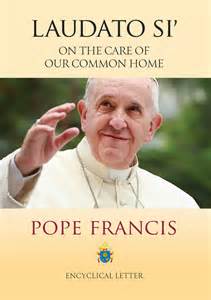
Laudato Si’: Pope Francis’ UPSETTING (But Hopeful) STORY About Our WORLD

Same Text

In my local faith community – St. Clare’s Catholic Church in Berea, Kentucky, we’re getting ready for Advent. As our seasonal project, we’re proposing a parish-wide discussion of Pope Francis’ eco-encyclical, Laudato Si’.

I’ve suggested that we purchase copies of the encyclical for each adult member of our parish, that we centralize it in a special liturgy, and that we present copies of Laudato Si’ to each recipient just as we do the Eucharist each Sunday. The presenter would say something like, “Receive the call of Pope Francis’ to reform your life and save our planet.” And the recipient would respond, “Amen.”

However, as our Peace and Social Justice Committee has discussed such possibilities, some have remarked that the pope’s encyclical is rather long and difficult to read. They’ve predicted that despite having the book in their hands, many parishioners will never get around to reading it.

What we need, my friends have said, is a comprehensive thumbnail sketch of the encyclical’s contents – with some provocative discussion questions.

So in fewer than 2000 words, here’s my stab at that. My summary contends that in Laudato Si’ Pope Francis is telling us a disturbing but hopeful story. In fact, the story’s main point (about the failure of capitalism) is told in all the papal social encyclicals since Leo XIII (1891). But this time the world is listening.

Here’s what Francis says in Laudato Si’:

  • The earth was given to humankind as a whole (93).
  • It belongs to everyone (93, 95, 158).
  • Thus the earth is primarily a Commons (164).
  • The climate itself is a common good (23).

_____

  • Though the Commons by definition cannot be privately owned, the Church has always recognized the right to private property in other spheres (93).
  • However the Church has never understood even this right as absolute or to be exercised primarily for personal gain (93).
  • Instead the right to private property has primarily been considered an administrative responsibility (95, 159).
  • As such it must always be exercised for the common good (129, 156).
  • In fact, “the first principle of the whole ethical and social order” is “the principle of the subordination of private property to the universal destination of goods, and thus the right of everyone to their use” (93).
  • So it is immoral that the earth’s resources and wealth be concentrated in the hands of a few (50, 90).

_____

  • The Judeo-Christian tradition unequivocally supports the position that the earth belongs to everyone (66, 67, 71, 76, 93, 95), that human “owners” do not have absolute dominion over possessions (67, 68, 75, 82, 83, 93, 95), that all life forms are loved by God (68, 69, 76, 77, 92, 96), and that extreme wealth inequalities are immoral (70, 71, 71, 90, 95).
  • Jesus endorsed all those beliefs by incarnating God’s presence in a poor worker as the locus of God’s presence par excellence (98, 99).
  • Additionally, the natural world itself, as the “Book of Creation,” represents a source of revelation. It too supports biblical insights that summon humans to ecological responsibility rather than to absolute dominion over nature (85, 86,87, 88).
  • Jesus supported such convictions with his teachings about the universal fatherhood of God (96), with his parables about seeds, soil, plants, flowers, harvest, birds, and weather patterns (97, 100), and with display of his own complete harmony with nature (98).
  • The work of the Church, as a community of Jesus’ followers, is “to remind everyone of the duty to care for nature,” while at the same time protecting humankind from self-destruction (79).

_____

­­­­­

  • Nonetheless at some point in history (“when the Roman Empire was seeking to impose absolute dominion”), the notion of private property became distorted (74).
  • Private property came to mean absolute ownership for personal enrichment without reference to the common good.
  • The notion of private property expanded to include the right of “owners” to do whatever they wished with “their” property including its complete destruction, without regard for “collateral damage” suffered by billions of humans and innumerable life forms excluded from the benefits of the market system (49, 67, 123).
  • Eventually common goods such as seeds, water, and life itself were turned into commodities whose ownership was “privatized” (30, 134).

_____

  • After the Industrial Revolution, the power of “owners” to alter and destroy “their” goods increased dramatically.
  • The steam engine and its successors (including today’s robots and computers) conferred power to alter and even destroy not only what owners considered their belongings, but the Commons in general (including the air, water, wetlands, mountains, non-human lifeforms, “resources” below the earth’s surface, and the climate itself).

_____

  • Free market ideology has played no small part in enabling unregulated technology’s harmful impact on the earth.
  • This ideology includes deep-seated, but often indefensible (109) convictions, for instance that:
    • Human beings enjoy absolute dominion over nature (67).
    • The world is anthropocentric: it revolves around human beings who can treat other life-forms as instruments for their benefit and pleasure (115).
    • Such beliefs are supported in the Bible (67).
    • A technological imperative demands that every advance in technology represents “progress” and therefore must be accepted as inevitable (105).
    • Might makes right and winners are entitled to “take all” (82).
    • Government regulation of the market is always undesirable, even in the face of huge income disparities (60).
    • No action should be taken on climate change in the absence of indisputable proof demonstrating the human origins of unusual climate events (186).
    • Unregulated market forces can solve all problems of environmental destruction and poverty.

______

  • The combination of technological development, market forces, and an enabling “free market” ideology has increasingly conferred on industrialized countries the ability to exploit resources world-wide.
  • As a result, for the past 200 years, these nations have incurred an “ecological debt” vis-a-vis the rest of the world (51).
  • Besides robbing their colonies of valuable resources while often enslaving their people, the industrialized countries have filled the atmosphere with two centuries of climate-changing pollution which most proximately threatens the colonies they exploited (51, 52, 170).
  • As a result, the industrialized powers owe their former colonies debt-repayment (30).
  • Such reparations must at the very least include cancellation of “Third World” debts, transfers of money and of non-polluting technology (52, 172).

_____   

  • Indigenous people have been especially attuned to such inequities and obligations on the parts of their exploiters (146, 179).
  • They have not only experienced colonialism as theft of their resources, they have identified the practices of industrialized capitalism as the rape of the one they (and St. Francis) honor as “Mother Earth” (1).
  • For their part, scientists in the industrialized world have warned humans about the unsustainability of such practices on purely scientific grounds (161).
  • True to the predictions of both indigenous shamans and secular scientists, we have now reached a crisis point (23).
  • Humans must either change their economic paradigm (based on this concept of absolute ownership) or face extinction (23, 61, 181).

_____

  • Many with vested interests in continuing to profit from the earth’s destruction have adopted “obstructionist attitudes, including denial (14, 26).
  • They are more willing to risk the earth’s destruction than to abandon the concept of absolute ownership upon which capitalism-as-we-know-it is based (60).
  • So they mistakenly claim that deregulated markets and technological development will save the day without basic changes in the consumerist lifestyle (109, 110).
  • They also propose risky “solutions” [such as Solar Radiation Management (SRM)] rather than low-tech, common sense responses to problems connected with climate chaos (14).

_____

  • The common sense solutions must on the one hand include acts on the parts of individuals such as “avoiding the use of plastic and paper, reducing water consumption, separating refuse, cooking only what can reasonably be consumed, showing care for other living beings, using public transport or carpooling, planting trees, turning off unnecessary lights. . .” and reducing the use of air conditioning (55, 212).
  • On the other hand, dealing with climate chaos requires action which national governments alone are capable of performing (38, 129).
  • These include weening national populations from dependence on fossil fuels (165) as well as investment in high-speed railways, and renewable energy sources. National governments must also strictly regulate trans-national corporate activity (38).
  • Changing paradigms even includes the submission of national governments to an international body with legislative authority to protect rainforests, oceans and endangered species, as well as to promote sustainable agriculture (53, 173, 174, 175).

(Author’s Note: By the way, if we think the United States with its proud history of independence could never submit its own legislative power to the possibility of being overridden by some international body, we should know that it already has. U.S. membership in the World Trade Organization, the provisions of the North American Free Trade Agreement (NAFTA), and those of the proposed Trans-Pacific Partnership (TPP) already allow international bodies to nullify U.S. laws such as those protecting our air and water. That is, if such national laws are ruled to interfere with the expected profits of multinational corporations, the laws can be rendered null and void, regardless of what U.S. citizens might think. In other words, there is precedent for U.S. submission to international bodies with binding authority to legislate about environmental deregulation. The pope is merely requesting that the same authority be given an international body tasked with protecting the environment rather than allowing its further degradation.)

  • In summary, the principles guiding necessary changes include the following:
    • The Principle of the Interconnectedness of All Reality: (e.g. 16, 42, 70, etc.).
    • The Principle of the Common Good: “The common good is ‘the sum of those conditions of social life which allow social groups and their individual members relatively thorough and ready access to their own fulfilment’.” Laudato Si’ identifies the common good as a “central and unifying principle of social ethics.”(156).
    • The Principle of the Subordination of Private Property: “(T)he first principle of the whole ethical and social order” is “the principle of the subordination of private property to the universal destination of goods, and thus the right of everyone to their use” (93).
    • The Principle of the Universal Destination of All Goods: (See immediately above).
    • The Principle of Preferential Option for the Poor: This principle “entails recognizing the implications of the universal destination of the world’s goods . . . {T}his option is in fact an ethical imperative essential for effectively attaining the common good” (158). In practice it means guaranteeing the rights of the world’s poor to land, housing, work, education, credit, insurance and access to markets (94).
    • The Principle of Distributive Justice: According to Pope Francis, the common good cannot be served without social peace which in turn “cannot be achieved without particular concern for distributive justice; whenever this is violated,” he observes, “violence always ensues” (156).
    • The Principle of Subsidiarity: this principle embraces decentralized solutions (144, 157, 179, 196).
    • The Principle of Transparency: Laudato Si’ states that “An assessment of environmental impact of business ventures and projects demands transparent political processes involving a free exchange of views . . . Environmental impact assessment should . . . be carried out in a way which is interdisciplinary, transparent and free of all economic or political pressure. . . A consensus should always be reached between the different stakeholders . . . The local population should have a special place at the table . . . (183).
    • The Precautionary Principle: This principle (as expressed by the Rio Declaration of 1992) states that “where there are threats of serious or irreversible damage, lack of full scientific certainty shall not be used as a pretext for postponing cost-effective measures” which prevent environmental degradation.” Laudato Si’ adds that “If objective information suggests that serious and irreversible damage may result, a project should be halted or modified, even in the absence of indisputable proof. Here the burden of proof is effectively reversed, since in such cases objective and conclusive demonstrations will have to be brought forward to demonstrate that the proposed activity will not cause serious harm to the environment or to those who inhabit it” (186).

FOR DISCUSSION

  1. How does the message of Pope Francis’ encyclical make you feel? Hopeful? Discouraged?
  2. In your opinion does the pope step outside the area of “faith and morals” by addressing issues such as climate change and its relationship to capitalism-as-we-know it?
  3. How is climate change a matter of moral concern?
  4. Is the pope correct in subordinating the rights of private property to the common good?
  5. What might that subordination mean in practice?
  6. How is climate change connected with your faith?
  7. What alternatives to capitalism-as-we-know-it can you think of?
  8. What would happen if climate-change deniers applied the pope’s Precautionary Principle to climate change?

“Laudato Si’” and Its Preferential Option for the Poor (Part Three): the Guiding Principle for Restructuring the World Economy

option for poor

This is the last installment in a three-part series on Pope Francis’ new encyclical, Laudato Si’. It attempts to place in historical perspective what might well be the most important document yet produced in the 21st century. It also tries to explain the meaning and centrality of the encyclical’s guiding principle, its “preferential option for the poor.”  This third part addresses the meaning and centrality of that option.

In his critique of capitalism-as-we-know-it (reviewed in Part Two of this series), Pope Francis called explicitly for “structural change” in the world economy.  He said, “Let us not be afraid to say it: we want change, real change, structural change.”

But what “structural change” does the pope have in mind?

Evangelii Gaudium and Laudato Si’ offer the answer. Their “preferential option for the poor” provides the guiding principle and turns the present economic order exactly on its head. This implies that if the present order is possible, so is its opposite.

That is to say that the present neo-liberal order is structured according to a “preferential option for the rich.”  Its sponsoring question is how can we make sure that the banks, corporations, and 1% prosper? Economists explain such concern by various “trickle-down theories.”  If priority is accorded the welfare of the rich, the theorists say, the wealth produced will trickle down creating a “rising tide that lifts all boats.”  [The pope rejects such theories out-of-hand as historically disproven. In “Evangelii Gaudium” he even calls them homicidal (53), ineffective (54) and unjust at their roots (59).]

By way of contrast, the pope’s “preferential option for the poor” begins at the bottom of the economic pyramid. Its sponsoring question is how can we insure that farmers have land, that workers have jobs, and that everyone is decently housed?

Laudato Si’ goes even further. It expands moral concern beyond human beings to all forms of life. It asks how we can insure the survival of the planet in the face of global warming, water and air pollution, massive extinctions, disappearance of rainforests, wasted food, waste in general, uncontrolled urbanization, rampant crime and loss of human meaning.

None of this means abandoning market dynamics altogether.

It does mean, however, controlling them according to the principle some have expressed in the words, “as much market as possible and as much planning as necessary.” This means maximizing market forces, but controlling them as necessitated by prioritization of the needs of the poor including the environment – once again by the preferential option for the poor.

In practice this entails at least the following: governments (1) intervening in the marketplace to insure the rights of all to jobs with living wages, housing, education, and health care, along with land for small farmers, (2) similarly regulating market forces to protect the global environment and all life forms from the most primitive to the highest, and (3) thereafter turning economies over to carefully monitored and controlled market forces.

Impossible you say? Not at all. To repeat: if economies can be structured according to a preferential option for the rich, they can be restructured to prioritize the needs and rights of the poor and the environment.

That’s the Global South hope and conviction Laudato Si’ embodies: another world is indeed possible.

Conclusion   

Will Laudato Si’ have its desired effect? That, of course remains to the seen. However, it undeniably has in Pope Francis a powerful proponent.

That is, despite remaining Stalinist skepticism, Pope Francis might well be the most powerful man in the world. Certainly, he is the planet’s most influential moral leader. What empower him, of course, are not the military divisions in which Josef Stalin placed confidence, but his extraordinary consciousness of the unity of all creation expressed repeatedly in his every pronouncement and especially in his recent encyclical. What sets him apart from the Obamas and Putins of the world is his equally unusual courage, compassion, charisma, and credibility.

Additionally, the pope has surpassing constituency. He heads a community of 1.2 billion followers. And this does not even count the untold millions of non-Catholics who admire him and his thought leadership.

With such support, the powerful message of Laudato Si’, and his plans to bring that message to the U.N. and U.S. Congress in September, as well as to influence the Climate Summit in Paris next September, who knows what changes will result? Who knows how he will influence the U.S. general elections in 2016?

In other words, Francis may stand on the brink of surpassing the stature of Leo XIII and John Paul II in terms of changing the world.

Defenders of the old order are already shaking in their boots.