When a Prophet Visits: Matthew Fox Sweeps through Berea

Matthew Fox came through my hometown, Berea Kentucky, a few weeks ago. I’m still energized by the experience. It showed me what happens when a prophet drops by.

Matt’s the ex-Dominican theologian and spiritual teacher who was hounded out of his Order by Pope Ratzinger (aka Benedict XVI). His offense? The same as that of the 101 theologians and pastoral leaders that Fox has posted on his “Wailing Wall of Silenced, Expelled, or Banished Theologians and Pastoral Leaders under Ratzinger.” (The names appear at the end of Fox’s book The Pope’s War: Why Ratzinger’s Secret Crusade Has Imperiled the Church and How It Can Be Saved.)  The names include giants like Karl Rahner, Ivone Gebara, Edward Schillebeeckx, and my former teacher in Rome, the great moral theologian Bernard Haring.

As Matt’s more than 30 books show, he, like the others, was censured by Pope Benedict XVI for being too good a theologian and spiritual guide; he tried too hard to implement the directives of the Second Vatican Council; he was too successful in connecting the Christian Tradition to our post-modern world. All of that our ex-Hitler Youth Pope finds extremely threatening to his overriding pre-Vatican II values: order and Group Think directed from above.

My wife, Peggy, had instigated Matthew Fox’s visit to Berea College. As Director of Women’s Studies she had invited him for her “Peanut Butter and Gender” series of luncheons. Over the years, the twice-monthly event has paralleled the College’s convocation program of speakers and artists.  At “PB&G,” Matt gave a dynamite talk on men’s spirituality. Later on in the afternoon, he spoke to the entire student body wowing everyone in the process.

Of course, I attended both events. But I was even more privileged because Fox visited our home the night before. Over Manhattans he, Peggy and I compared notes, were surprised by friendships we share with others, and spoke of the dismal state the Catholic Church has reached under the “leadership” of the last two and a half popes (Ratzinger, John Paul II, and the last half of Paul VI’s term in office). Additionally, I had an hour or so in the car with Matt as I drove him to the Lexington Blue Grass Airport the morning after his visit. We spoke of Ratzinger’s 1968 “conversion” to the Catholic rendition of religious fundamentalism, and of Matt’s work with the witch, Starhawk (whom he identified with evident admiration as a “genuine liberation theologian”).

However, the highlight of the entire experience was a potluck supper at our home. Peggy had organized that too – for members of our Berea parish, St. Clare’s. The idea was for the Peace and Justice Committee and other progressives to meet with Fox and discuss how to respond to the drabness and irrelevancy of what passes for worship and Christian community in our church.

After an extraordinary potluck supper, about twenty-five of us sat in a big circle in our living room. Everyone joined in with comments, complaints, questions and concerns. Matt took it all in, responded when appropriate, and then shared his insights.

His most telling observation was to reverse the common perception shared by most in the room. That’s the opinion that progressive Vatican II Catholics have somehow been marginalized by the church. Fox turned that notion on its head. He held instead that we are the ones who are orthodox, while the last two (anti-Vatican II) popes are actually schismatic. They and their Vatican Curia are the outsiders, while we are the faithful ones adhering to the official teaching of the Catholic Church which remains the doctrine of Vatican II.

What to do about it all? Fox was helpful there as well. In fact, at the end of The Pope’s War, he lists “Twenty-Five Concrete Steps to Take Christianity into the Future.”  All of those steps were thought- provoking. However in terms of Fox’s “schism” observation, here’s the one that hit hardest for me:

“Instead of ‘Vatican III’ or a so-called lay synod that is gerrymandered by clerical curialists, let the various lay leadership groups hold national and then international gatherings among themselves – synods that are worthy of the name. Let them give marching orders to church officials instead of the other way around. Let the church officials listen to the laity for a change. Let the laity choose the theologians they wish to be their periti at such synods (if any).”

Along those lines, next month the “Call to Action” Conference will be meeting in Cincinnati. A group from our parish will be attending that convocation of progressive Catholics. Matthew Fox will speak there. I’ll be in attendance with my friends.

Expect a report in this blog.

The Highly Dispensable Nation (And Whom to Vote for in Two Weeks)

I watched the third debate the night before last, and at first came away thoroughly discouraged. What’s the use? I thought. These guys are both the same. I almost cancelled my plans to host a “Ten Days to Win” phone call party at my home next Saturday. But while it’s true that the third debate revealed remarkable similarity between the candidates on foreign policy, their differences on domestic policy kept me from cancelling. Even more so did consideration of the candidates’ diverse bases of support, and the hope that Obama’s base offers (in contrast to the man himself).  Let me explain.

To begin with, the third debate displayed two candidates converging around at least 10 highly destructive myths:

  1. The U.S. is the one indispensable nation in the world.
  2. U.S. foreign policy is aimed at fostering “a peaceful planet.”
  3. Those same policies favor democracy, free elections, international law, and human rights – especially those of women.
  4. Terrorism, whose causes remain mysterious, must be stopped at all costs.
  5. To that end, drone strikes anywhere in the world are good and necessary.
  6. Iran is a major threat to us, so sanctions against it are reasonable and moral.
  7. Nuclear capability is a crime.
  8. Dollars spent on the military are a valid measure of commitment to national security.
  9. Israel’s policies must be supported as if they were our own.
  10. Climate change is irrelevant to foreign policy.

Of course none of those ten myths is true. What is true is that:

  1. In terms of “a peaceful planet,” democracy, free elections, international law, human rights (especially those of women) the world would be better off if the current incarnation of the U.S. dropped off the planet. (Please think about that. I am serious here.)
  2. Terrorism’s causes are not at all mysterious and almost all are connected with U.S. foreign policy. In fact, as Noam Chomsky and Edward Herman pointed out long ago, the U.S. is the most prominent purveyor of “wholesale terrorism” – state terrorism – in the world. What it has declared war against are expressions of “retail terrorism” which are small potatoes (even 9/11) by comparison – basically “blowback” to U.S. state terrorism.
  3. Extrajudicial killings even by remote control contravene the “international law” both presidential candidates so solemnly invoked. (By the way, according to Islamic scholar Tariq Ramadan, the Benghazi debacle was in direct response to the June 4th 2012 drone killing of the insurgent theologian, Abu Ayahya al Libi. At 49, he was a hero of the Libyan Revolution and one of the most senior members of the Libyan Islamic Fighting Group. Revenge was sworn at his death and postponed till the anniversary of 9/11. This has received no mention I’m aware of in the mainstream press – certainly none in the presidential debates.)
  4. As Joe Biden pointed out, Iran poses no threat at all to the United States. On the contrary, for the past three years and more Iran has been the one threatened on a daily basis by Israel which has itself covertly developed deliverable nuclear weapons. So if any nation has reason to launch a preemptive attack, it would be Iran against Israel. But no such threat has been made.
  5. What does “nuclear capability” mean anyway?
  6. Absolute security is a goal impossible to attain. Its pursuit via already astronomical military spending benefits no one but the military-industrial complex.
  7. Israel has been an international outlaw at least since November 22, 1967, when the U.N. unanimously adopted Resolution 242 forbidding the occupation of Palestinian territories annexed in the Six Day War. Israel’s assault on Gaza, its secret development of nuclear weapons, and its crimes on the high seas interdicting ships bringing aid to Palestinians interned in Gaza have only compounded Israel’s fundamental crime of illegal occupation. Hence U.S. support of the outlaw nation of Israel not only contradicts U.S. national interests but amounts to aiding and abetting criminal activity.
  8. Given its importance to the future of the planet, climate change should have been the focus not only of this “foreign policy” debate, but of the entire presidential campaign. It was mentioned not once in any of the debates.

How should awareness of these myths and their evident contradictions influence us in the general elections just two weeks off? Here’s what I’m thinking:

  1. There is no doubt that the presidential candidates have adopted almost identical approaches to foreign policy.
  2. However they differ on domestic policy in non-trivial ways:

a)      Romney wants to retain tax breaks for the 1% while Obama does not.

b)      Romney intends to further deregulate the market undoing the mild reforms introduced after the crash of 2008. Obama will resist such measures.

c)       Following the lead of Paul Ryan’s “economic plan,” Romney will drastically cut domestic programs for the country’s most vulnerable. He will attempt to privatize Social Security, make Medicare a voucher program, and do something similar with Medicaid. Meanwhile, Obama’s austerity measures will be less drastic though also basically unfair – because austerity for the 99% is unnecessary in the face of the nation’s unprecedented concentration of wealth.

d)      Romney will appoint more neo-conservatives to the Supreme Court when the opportunity arrives.

e)      On social policy, life with Romney will be harder on women, gays, the poor and labor unions.

To repeat, while such differences are not as wide as some of us might desire, they are not at all unimportant. However one really important difference remains for me and is determinative for my voting.

That difference is the one between Romney’s base of support and that of Obama. Romney’s base is made up of Tea Party folks. They are basically white, religious literalists, evolution and climate science deniers; they are corporate-friendly, male-dominated, less educated, and angry about the ascendency of minorities. Obama’s base is more diverse. Blacks and Hispanics overwhelmingly support him. So do union members, liberal Christians, gays, atheists, and those with university educations. Women tend to be more Democratic than men.

In an evolving world, history is on the side of the Obama’s base rather than the Romney’s. Simple population trends kicking in as I write, are running swift and fast against the Republican base. As someone has said, they’re running out of angry white guys. So even the passage of four more years without GOP control of the White House (not to mention the Congress) will buy Obama’s base and their interests more time. That means the political conversation is likely to shift in a more liberal direction even over the next quadrennial.

Elizabeth Warren’s candidacy is on the horizon.

That’s why I’m going through with that party next Saturday. That’s why I’m voting for Obama (while firmly holding my nose). I’m buying time.

Thanks Amy Goodman For Breaking the Sound Barrier

Like 69 million other Americans, I watched the second presidential debate from Hofstra University last night. And I must confess I was pleased to see President Obama “win.” This was the Obama so notably absent from the first debate. He came out swinging, was feisty, incisive and smart. He clearly won, and was the more able of the two debaters. That made me feel better – but only because President Obama is the lesser of two evils and only because the parameters of debate were so narrowly set.

My point is that there were only two candidates on stage.  As a result, there was a remarkable convergence of assumptions and positions between the two. That convergence might have been avoided had other candidates been allowed onstage with the two corporate spokespersons now posturing before us as candidates presenting us with “stark differences.”

Amy Goodman’s “Democracy Now” has tried to remedy the situation in a series of debates she calls “Breaking the Sound-Barrier” (http://www.democracynow.org/).  The title’s reference is to her show’s inclusion of opinion beyond that endorsed by the corporate interests that shape public debate – that set the “limits of perception” more effectively than blinders on horses.

So this morning on Ms. Goodman’s program, she added three other candidates’ voices to the debate mix: Jill Stein of the Green Party, Virgil Goode of the Constitution Party, and Rocky Anderson of the Justice Party. The three took part just as if Candy Crowley’s questions had been presented not only to Messrs Obama and Romney, but to them as well. Each candidate was given two minutes to answer. And by the way, Ms. Goodman was far more successful at imposing time limits than Jim Lehrer, Martha Radatz or Candy Crowley.

The upshot of breaking the system-imposed “sound barrier” was to remarkably soften the differences between candidates Romney and Obama.

For instance, both candidates sparred with each other over who was more the champion of dirty energy, drilling, and pipe lines. Yes, they mentioned “green technologies.” But with both Romney and Obama it always seemed an afterthought. Mr. Romney evoked “drill, baby, drill” memories with his emphasis on more drilling and on the XL Pipeline. Apparently, Mr. Obama was afraid to even mention that while reserving his decision on the XL Pipeline till after the elections, he’s very quietly allowed construction of the U.S. portion to actually begin.

Had Ms. Stein been admitted to the Hofstra debate, Americans would have been reminded of the impact of fossil fuel consumption not only on prices at the gas pump, but on the environment and global warming. (In fact, the notion of climate change received not a single mention in last night’s contest. And this even though it certainly represents the greatest threat to not only U.S. national security, but to life as we know it.) Ms. Stein’s presence would have made Obama and Romney define their positions on the topic, as she would have had the chance to make her case for a “Green New Deal” which draws connections between the consumption of fossil fuel and environmental deterioration, oil wars, and healthcare.

Rocky Anderson’s presence on stage would have brought front and center the concerns of his Justice Party. Without him the words “poverty” and “poor” crossed no one’s lips, even though poverty rates in the United States are at their highest rate since 1965. Similarly, Mr. Anderson would have raised questions of breaking up the “too big to fail” banks and the prosecution of fraudulent bankers not one of whom has yet been brought to trial.

Mr. Anderson would also have made the Republicans, Democrats and public at large reframe the “jobs debate.” Without him, both Mr. Obama and Mr. Romney could avoid facing the fact that the digital revolution of the last twenty-five years has rendered obsolete conventional ways of thinking about work. Robots have displaced people. As a result, it’s imperative to reframe questions of employment. Available jobs must be shared; it’s as simple as that. Work days, weeks, months, and years need shortening. Vacations need extensions. And the wealth the new technology is currently concentrating in the 1% needs redistribution.

Perhaps no question in last night’s debate more highlighted the need for “breaking the sound barrier” than the one about the differences between Mr. Romney, Mr. Obama, and George W. Bush. In his answer, candidate Romney talked about differences in personality and context, championing small businesses, and cracking down on China. Mercifully for him, Mr. Obama did not have to answer the question.

Neither Ms. Stein nor Mr. Anderson would have allowed such question-dodging to pass. The fact is, both Stein and Anderson agree, there is very little important difference between either the Romney or Obama positions or that of former President Bush. In fact under Obama, Bush policies have been exacerbated, and they promise to get even worse under Romney. The list of policy similarities is long: use of torture, promotion of free trade agreements, spying on U.S. citizens, detention of “terrorist” suspects with charge or trial, extra-judicial (drone) executions, championing dirty energy, off-shoring of jobs, misleading agreement that Social Security and Medicare are in crisis, refusal to prosecute Bush era war crimes . . .

Yes, Mr. Obama rose to the occasion last night. And I’m happy that he won. I’ll vote for him in November. But my vote is only a stop-gap measure. During the next four years I’m going to devote my political energies to working for the Justice and Green Parties so that in 2014 they won’t be excluded from presidential debates.

Even if their winning the presidency might remain a remote possibility, their inclusion in the debates will serve us all. Thanks, Amy Goodman!

The First Debate: Was He Ill?

I had high hopes for last night’s first presidential debate and the signals it would send for a second Obama term that looked more assured every day. I was looking for signs that the president had learned from his “Why can’t we all just get along?” bipartisan failure, and come out swinging.

He’d use his gift of eloquence to truly take full advantage of the bully pulpit the debate format provided. He’d confront Mitt Romney over his chameleon conversion to Tea Party extremism. He’d ask him about Bain Capital and the policy it represents of sending U.S. jobs overseas and sheltering money in the Cayman Islands. Mr. Obama would ask for clarification about the governor’s “47%” gaffe and the signal it sent to Middle Americans.

He’d call Republicans on their lies and for being the “Party of “No,'” and for thwarting his valiant efforts at bipartisanship. He’d ask Mr. Romney why they’ve filibustered specific programs that would help Main Street and  war veterans

He’d have a clear narrative of exactly how deregulation, tax cuts, and Republican disregard for deficits have gotten the country into its present mess. He’d tell a story of American healthcare as clearly as Michael Moore’s “Sicko.” Naming the fundamental deceit of the phrase “clean coal,” he’d make a clear and unambiguous case for green energy to protect the environment from corporate predators. He’d force his opponent to explain his party’s denial of the reality and threat of global warming.

President Obama’s victory in the first debate would once and for all set a tone for (what before last night) seemed to be the likelihood of a second Obama presidential term.

But none of that happened.

Instead the president allowed Governor Romney to appear more presidential than he did. Romney looked Obama in the eye throughout the entire debate. Meanwhile, the president constantly looked down at his notes or at the debate moderator Jim Lehrer. When he did face his opponent, it was fleetingly– almost as if he didn’t belong on the same stage with the man.

And the president talked too much — a full four minutes and change more than Governor Romney. But the extra time was counter-productive. He seemed hesitant and lacking in confidence. He was rambling, unfocused, often incoherent and general. He had to apologize to Mr. Lehrer more than once for exceeding his time limit. For his part, Romney seemed confident and crisp. He had the “facts”at his fingertips ticking off points and itemizing them in groups of fives and threes. He gave the impression that he was the man with a plan, while the president was constantly on the defensive.

And there was no forceful challenge to Romney’s discredited “trickle down” narrative. Obama actually allowed Romney without counter-comment about public ownership of the airwaves to call for the end of Public Broadcasting and to twice denigrate “green energy.” It was Romney who faulted Obama for not being entitled to his own facts. And all of that without any clear response from the incumbent.

It all made me wonder if Mr. Obama was well — or if he had seriously prepared for the debate.

For the first time, I’m thinking we may have to get used to the phrase “President Romney.” Help!

“Everyone’s Talking about Mary Magdalene” (First in a Monday Series on Mary Magdalene)

Not long ago a friend asked me about Mary Magdalene. Yes, Mary Magdalene. Thanks to Dan Brown and others, she’s been cropping into conversations lately much more than she used to. In any case, the observation had been made in this particular exchange that there existed animosity between the Magdalene and Peter the apostle. From there it was a short step to sharing opinions about Mary’s relationship to Jesus. Were they married? Were they lovers?

After a while, my friend asked in apparent frustration. “But how do they know these things?” The Gospel of Mary Magdalene was mentioned, and then the conversation trailed off into more mundane topics. As a theologian, I was left wishing I was more informed about the Magdalene part of the discussion. I knew there were plenty of recently published books on the topic, but I hadn’t read them. Shortly afterwards, almost by sheer chance one of those books dropped into my lap. It was written by esoteric researcher Lynn Picknett and called The Secret History of Mary Magdalene: Christianity’s Hidden Goddess.  I devoured the volume immediately finding it every bit as interesting and just as much a page-turner as The da Vinci Code.

Unlike Daniel Brown’s work however, Picknett’s work is a largely successful effort at serious scholarship. Though not writing for academicians, she uses non-canonical gospels and heretical sources as well as their biblical counterparts to substantiate her surprising conclusions. Basically, they are that far from being a reformed and eternally penitent prostitute and sinner, Mary Magdalene was actually the spouse or lover of Jesus, possibly an Egyptian priestess, and very likely black.  She is the one whom Jesus often “kissed upon the mouth,” and whose intimate relationship with the Christ enraged Jesus’ male companions, especially Peter who actually threatened to kill her. Even more, in words attributed to Jesus in that Gnostic Gospel of Mary (Magdalene), she was “the All,” “The Woman who knows all,” the “apostle of apostles.” Such apostolic primacy makes the Magdalene the true founder of the church and rightful possessor of Peter’s throne. In fact, as the anointer of Jesus, Mary Magdalene may have been his equal – a true Egyptian goddess, an incarnation of Isis. Possibly, she was even Jesus’ superior.

According to Picknett, such pre-eminence even over Jesus should not astonish, for a close reading of the Synoptics and John show that even those Christian propagandists present a Jesus with feet of clay. He was often self-promoting, petulant, irrational, vindictive, and generally unpleasant. The Jesus hidden in those “sacred texts” was a bitter rival of John the Baptist, and may even have been part of a plot which ended in the Baptist’s beheading. In any case, on Picknett’s analysis, Jesus was not the Messiah; John was. And although branded as heretics, John’s followers survive to this day as bitter  opponents of the Jesus Movement. Most prominent among them was Leonardo da Vinci.

Even readers of The da Vinci Code would find such positions not only surprising but shocking. But how does Picknett arrive at such conclusions, what are the details of her argument, and how is one to evaluate the evidence she marshals?

Tune in next week to find out. . . .

Next Monday: “The Methodology of Magdalene Scholarship” 

What if the Catholic Church Responded to Its Sex Scandal the Way the NCAA Did to Theirs?


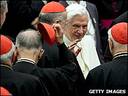
Pope Ratzinger confers with his Cardinal colleagues

Many were pleasantly surprised by the severity of the sanctions the National Collegiate Athletic Association placed on Penn State following its investigation of the Jerry Sandusky child abuse scandal. The NCAA’s measures evidenced an appropriately serious approach to unspeakable crimes.  At the same time, however, the athletic association’s aggressive sanctions contrasted sharply with the lack of appropriate response to much greater crimes on the part of Roman Catholic clergy.  It made some wonder what it might look like if the Catholic Church handled its infinitely larger scandal in a fashion similar to that of the NCAA.  

Of course, the Penn State’s board of trustees had initially tried to defuse its shameful situation by having the institution’s president resign and by firing Joe Paterno, the football program’s legendary coach. Eventually, they even removed “Joepa’s” statue that (dis)graced the entrance way to the football stadium in Happy Valley.   

But the NCAA went far beyond that – even further than most had expected.  It appointed high profile Independent Counsel, Louis Freeh, to investigate responsibility for Sandusky’s crimes and the cover-up that followed. Then in the wake of Freeh’s damning final report, it fined the University $60 million dollars – the amount the football program takes in annually. It ordered the program to vacate its winnings since 1998 (thus depriving Paterno of his legacy as the winningest coach in NCAA football history). It forbade the program to extend any football scholarships for the next four years, and released all of its current players from their ties to Penn State, making them immediately eligible to play elsewhere. The football program will be devastated for years to come.

The NCAA’s bold sanctions couldn’t be further from the response of the Roman Catholic hierarchy to its child abuse scandal. There instead the “old boy” defense of the institution and the members of its all male club kicked in just as it did at first inside Penn State’s football program when the Sandusky crimes initially came to light. At Penn State, the wagons were circled, Sandusky was mildly chided while everyone in charge from the University president and Joe Paterno on down denied any knowledge or responsibility. The attitude that “boys will be boys” threatened to carry the day.

The equivalent of that attitude and (non)response still prevails within the Holy City despite the shameful involvement of priests in raping and otherwise sexually abusing children on a worldwide scale that absolutely dwarfs anything that happened in Happy Valley. In the face of thorough investigations by independent groups (e.g. the absolutely devastating indictment published last year in Ireland) the Cardinal of New York invoked the “bad apples” defense, and protested that “only” a small portion of the clergy was tainted.

But what would it have looked like (impossibly!) if the Catholic Church had responded like the NCAA?

If it had done so:

–          Pope Ratzinger would have resigned immediately.

–          All cardinals and bishops who had covered up the scandal would have been removed from office.

–          The canonization process for John Paul II would have been terminated, because of the way he played down the sex scandal. This would be the equivalent of removing Joepa’s statue.

–          An investigation independent of the Vatican would have been launched headed by an unimpeachable figure – say the Dali Lama, perhaps joined by Sr. Pat Farrell, President of the Leadership Conference of Women Religious (LCWR) which is currently being investigated by the Vatican.

–          Upon completion of its investigation (assuming it would have reached conclusions similar to the one in Ireland), the commission would have:

  • Fined the Catholic Church $500 billion – the equivalent of one year of the R.C. church income. The money would be used world-wide to aid victims of sex abuse and to institute programs to educate clergy about human sexuality using the best insights of current sociology and psychology.
  • Removed from the list of genuine popes all those whose public crimes made them unworthy of the title “Vicars of Christ.” Here the Borgia popes come to mind, as well as Pope Pius XII for his silence about the Jewish Holocaust. (Obviously, the process of his canonization would be abruptly ended.) This would be the rough equivalent of Penn State’s vacating its football wins since 1998.
  • The exclusion of women from the priesthood would be reversed, and seminary scholarships would be extended world-wide to women desiring to receive Holy Orders.
  • Mandatory celibacy would be set aside as a requirement of the priesthood.
  • A reforming Church Council (Vatican III?) would be ordered to deal with the sex abuse and related problems – to be attended only by bishops not involved in the abuse scandal and subsequent cover-up. Their places would be taken by women elected by national bodies equivalent to the LCWR in the United States.

Of course, nothing like the results just described is remotely possible. Roman Catholic insulation from the external processes necessary to achieve such outcomes prevents that eventuality. The only external source capable of moving the church in the desired direction belongs to the Catholic faithful itself. It alone has the authority to withhold church attendance and contributions till the desired decisions of reform are taken.

Such pressure from the faithful will eventually be applied willy-nilly. That is, the faithful will either wage a purposeful campaign of withholding attendance and financial support in the light of failed church leadership. Or alternatively (and more likely) the once-faithful will be driven away from the church as the realization dawns that a college sports organization possesses sounder moral character than what pretends to be the “Mystical Body of Christ.”

The New York Times on Drones: In Defense of Mafia Face-to-Face Hits

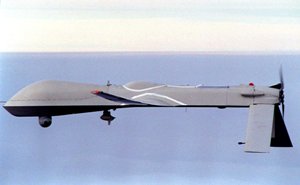
One of the unmanned drones in the growing U.S. arsenal

The New York Times recently  published an article called “The Moral Case for Drones.” It was authored by one if its national security reporters, Scott Shane. As the title indicates, the piece’s intention was to argue that U.S. drone policy is indeed morally defensible. However the article refused to address the really difficult moral issues. It concentrated instead on providing a rather obvious response to the question whether the use of drones avoids the wholesale slaughter of civilians that has been associated with modern warfare since the U.S. Civil War.

Of course it does! Is there anyone who would argue that carefully calibrated drone use would be worse than the direct targeting of civilians that occurred in Dresden, Hiroshima and Nagasaki? However by focusing on the “lesser of two evils” approach and resolving it in favor of drones, Mr. Shane’s article leaves inattentive readers with the impression that drone policy is somehow moral and humane.

But what about those other questions?

For instance, nowhere in the article does Mr. Shane even gesture towards the basic moral issue (not to mention its constitutional counterpart) of whether or not the President of the United States actually possesses the authority to order extrajudicial assassinations by drone or any other means. If the President claims that authority, do we accord that same right to any head of state — even if he or she decides that Mr. Obama himself is an international outlaw?

But that’s not the only issue the Times article chooses to ignore. In fact, it begins by bracketing a whole host of moral questions about drone use. Mr. Shane opens by saying:
 

“For streamlined, unmanned aircraft, drones carry a lot of baggage these days, along with their Hellfire missiles. Some people find the very notion of killer robots deeply disturbing. Their lethal operations inside sovereign countries that are not at war with the United States raise contentious legal questions. They have become a radicalizing force in some Muslim countries. And proliferation will inevitably put them in the hands of odious regimes.”

At the outset, then, the Times author mentions some of the real issues only to set them aside. What about remote control assassinations? What are the moral implications of human agents making life and death decisions safely sequestered in air conditioned locations thousands of miles from the kill zone? Does it make a moral difference that justification comes from questionable sources, or that such justification is frequently circumstantial, based on hearsay, and often amounts to guilt by association? Is it a moral issue that the executioners’ decisions might be erroneously or casually made since they are immediately based on information provided by devices resembling video game screens?

Similarly removed from moral analysis is the fact that lethal operations inside sovereign countries not at war with the United States are not only “contentious” (as the article admits), but clearly contravene international law, not to mention the U.N. Charter. Is it possible to make a “moral case” in such a context? Wouldn’t that be like waxing eloquent about the moral case for face-to-face Mafia hits rather than spraying restaurants with machine gun fire? Like their drone equivalents, such hits successfully avoid all that messy collateral damage. However both types of extra-judicial killings are the work of “professionals” who immorally place themselves above the law.

Moreover, in an essay that will make that argument that drones diminish civilian casualties, Mr. Shane’s piece from the beginning chooses not to consider whether in the final tally, drones actually increase civilian casualties. Are the civilian deaths caused by such terrorists not to be calculated? Similarly what about the casualties caused by making drone technology available to those “odious regimes?” Their leaders find the United States similarly “odious.” Will the civilian casualties they cause seem thankfully minor when representatives of those particular agents fly their drones into the Sears Tower in Chicago?

Choosing not to consider such questions is like asking Mrs. Lincoln, “Apart from the assassination, what did you think of the play?”

However such incomplete and inconsiderate “moral analysis” also leads to the conclusion that United States drone policy is (as one of the article’s quoted experts says) “not only ethically permissible but might also be ethically obligatory because of their advantages in identifying targets and striking with precision.”

It’s the type of incomplete and deceptive moral analysis that would do Mafia ethicists proud.

At Last: An Interesting Post on Mike’s Blog!!

Good news! Our daughter, Maggie, and her husband, Kerry just delivered their third child. Orlando Peter arrived on June 30th weighing in at 9.5 lbs. He joins his sister, Eva (3.8 yrs.) and Oscar (1.5 yrs.). Mother and child are doing fine.

The delivery was captured on “Good Morning America.” They decided to do a feature on birth photography, so they did one on Maggie, Orlando, and their photographer, Nicole. You can watch the video here:

http://gma.yahoo.com/video/celebs-26594247/birth-photographers-in-the-delivery-room-29960350.html

The Impact of Wikileaks on Imperial Conspiracies (Third & Final Installment on the Demise of U.S. Empire)

Having examined the demise of the Catholic Church and of economies based on Jurassic Age fuel deposits, we turn now to the role of information communication technologies (ICT) in exposing government conspiracies and by doing so helping to bring down U.S. Empire. The topic here is Julian Assange and Wikileaks.

Assange and his Wikileaks colleagues are conspiracy theorists and proud of it.  For them (as for lawyers everywhere), “conspiracy” describes the secret planning of two or more people to commit a crime and/ or bring harm to a third party. Conspiracy is a legal category. By its definition, Assange contends, multinational corporations and their mainly U.S. political enablers have been and are conspirators worldwide. They are criminals who in the name of justice must be brought to heel.

The undeniable evidence of conspiracy is there for all to see.  The vetoing of planet-saving climate change agreements by itself constitutes a crime whose predictable consequences dwarf by orders of magnitude even the Nazi Holocaust. But then there are the other less monumental, but still heinous felonies: the overthrow of foreign governments, the use of torture in general and water-boarding in particular, widespread extra-judicial killings, preemptive wars forbidden by international law,  Abu Ghraib, Guantanamo Bay,  a vast U.S. secret prison system, international renditions, the repudiation of habeas corpus, unconstitutional spying on U.S. citizens, death squads, the use of drones in countries with which the United States is not at war, the  “unintentional” but predictable killing of innocent civilians, the imprisonment (in horrific conditions) of disproportionate numbers of black people on U.S. soil, and much, much more. All of these are indications of conspiracy and national criminal activity on the part of the United States, a rogue state if ever there was one. Imperialism itself represents a criminal conspiracy – the control of one nation by another for the benefit of the controllers.

On the basis of such evidence, Assange and his group have taken it upon themselves to do what the empire’s journalists are afraid to do – to publish the unvarnished and undeniable truth about the crimes of empire. Their method is to publicize the secret internal communications on which any criminal conspiracy depends.  Their sources are whistleblowers who for various reasons desire anonymously to “out” conspiratorial activity in question. The means for doing so are, once again, the informational technologies developed over the last 15 years.  Simply put, Wikileaks provides a highly encrypted website depository to insure source anonymity and take full advantage of distributed digital media power which lies essentially in the hands of the people instead of being centrally controlled by the elite.

How does it work? Assange explains it this way: understand for starters how the U.S. itself describes the conspiratorial network at the heart of the War on Terrorism. The conspirators are widely dispersed across many countries. As a result, they depend on secret communications to coordinate their activities. Picture a wooden board with nails driven in at randomly chosen points. That represents a world map with conspirators unpredictably located across its surface. Now take a thread and wind it around the nails connecting one to the other. The thread represents the lines of secret communication necessary for any conspiracy to succeed. It’s the task of counter-terrorism (counter-conspiracy) to cut those threads.

That’s what Assange aspires to do relative to the international conspiracy represented by secret U.S. and E.U. policy. He wants to make it impossible for that form of secret, terrorist conspiratorial communications to take place. In other words, he’s trying to bring empire to its knees. 

No wonder the U.S. government is panicking. Media personalities have called for classifying Wikileaks as an international terrorist organization. Senators have called for Assange’s   arrest. Some have even suggested his assassination. But understand this: Wikileaks is no more subject to U.S. law than it is to Chinese, Korean or Iranian law. Julian Assange is an Australian. Wikileaks is headquartered in Sweden whose very constitution protects freedom of the press by absolutely protecting journalists from forcibly divulging the sources of their information. Moreover, U.S. officials applauded Wikileaks when it revealed state secrets of its competitors. Hillary Clinton did so in the name of freedom of information.  It is unlikely then that Washington would have supported efforts to extradite Assange or his associates for trial before Chinese, Korean, or Iranian courts on charges of illegally divulging state secrets. Contradicting such posturing by demanding Assange’s extradition to the United States is making Washington (once again!) the laughingstock of the world.

Assange couldn’t be happier. All of this is part of the plan – to rescue the traditional role of journalism from its distortion by outlets such as Fox News. Assange notes the irony: Fox can disseminate what everyone knows are outright lies and be protected under invocations of press freedom. It can allege that President Obama is a communist, a Muslim, not American. It can ridicule climate change as a liberal plot to undermine capitalism. No one in authority advocates shutting Fox down for spreading such disinformation. But let whistleblowers expose the undeniable truth about their criminal employers, and “important people” suddenly find their voices and begin calling for arrest and worse. 

Of course, it remains to be seen whether or not Wikileaks’ disclosures will achieve their utterly radical intended goals. Minimally, they will surely make diplomats, politicians, the CIA, FBI, as well as the business concerns that fund those agents and institutions, more circumspect in their secret communications. In other words, the disclosures have made the business of imperial conspiracy vastly more difficult.

Additionally, Wikileaks has already powerfully impacted the news industry. Not only have its revelations provided a welcome and unimpeachable counterpoint to media misinformation and cooption by the very authorities the media should be scrutinizing. Wikileaks disclosures have become as well the focus of bloggers and the new internet news sources.  It has forced mainstream media to deal with issues they would not otherwise have addressed. Without Assange and his colleagues, many of the front page stories of the last year would never have seen the light of day.  We would not have been sure, for instance, that the U.S. was really behind those assassinations in Yemen. Finally, it will be interesting to see what happens when the torture-related photos and films that President Obama decided to withhold finally hit the fan. Equally fascinating will be responses to future releases of internal communications from within leading financial institutions and multinational corporations. All such information releases threaten the corporatist conspiracies Wikileaks is targeting. In summary, Wikileaks promises to change the news industry, and clearly threatens empire.

Series Conclusion

                It’s easy to become discouraged or depressed by a world falling apart. However the point here has been that the death of the Church, the disintegration of the world economy, and the decline and imminent fall of the “American” Empire by no means constitute entirely bad news. On the contrary, they are all to be welcomed as part of an evolutionary process that finds the new ICT and promising distributed forms of energy at its center. If the process is allowed to reach its promised conclusion before the threatened foreclosure of the human prospect by criminally unaddressed climate change, the process suggests a healthier, saner planet controlled more by people than by corporations and their political servants.  Towards that end, dispersed, distributed popular power in information and energy is at least weakening and at most threatening to bring to their knees the pillars of the world as we know it. The church has already been mortally wounded by it.  The world’s economy will be profoundly and forever changed by it. Governmental and corporate conspiracies will be crippled and possibly ruined by it.

This is what answers to the prayers of progressives and radicals looks like.

This Is What the End of Empire Looks Like: The Role of the New Economy

This is the second in a Monday series on the decline of U.S. hegemony.

Last Monday I began this series by connecting the demise of the Catholic Church with that of U.S. Empire. This week’s posting turns to economy. Just as changes in the way people store, access, and communicate information has affected religion, so has it affected the market.

Though that observation may appear axiomatic, even business people have been slow to grasp its implications. For example, the music industry didn’t see file sharing coming; whole companies went under as a result. Encyclopedia Britannica was similarly blindsided by Wikipedia. Newspapers didn’t understand the enormous importance of the blogosphere; consequently, they’re failing at unprecedented rates. Skype threatens huge telephone companies. The computer gives free access to the sports events, movies, and programming cable companies are still trying to peddle.  Colleges and Universities continue to invest in huge unsustainable physical plants even as online courses steal their students. (And why not: distance learning, as J.W. Smith points out, enables students to sit at the feet of the world’s best professors for a fraction of the cost required to maintain those buildings soon to become white elephants.)  

But it doesn’t stop there – not nearly. In The  Empathic Civilization Jeremy Rifkin  argues that a dispersed, decentralized digital revolution together with dispersed, decentralized energy provision equals an entirely new economic era – a third industrial revolution as he calls it. The first industrial revolution, of course, connected the information revolution spawned by the printing press with coal and steam power. Huge factories, the high speed printing necessary for their organization, the eventual emergence of worldwide proletariat, and a previously unimaginable scale of production resulted. 

The second industrial revolution united energy provided by oil with intensified product and information exchange facilitated by telephone, radio, television, cinema, automobile and air travel. Oil was at the heart of it all. An entire civilization was built on Jurassic Age deposits which eventually became the basis of food production, and the manufacture of buildings, clothing, and virtually every product one might care to name. If it wasn’t made from a fossil fuel base, it was packaged and delivered by it. The second industrial revolution gave birth to the consumer society and corporate globalization.

The third industrial revolution is currently emerging from a combination of new information technology coupled with new forms of energy production. The new form of energy production is necessitated by the phenomenon of “Peak Oil Per Capita” as well as by the “carbon-entropy bill” resulting from a global economy relying on oil to support the productive cycle that has emerged over the last 200 years.

Peak oil per capita is different, Rifkin reminds us, from “Peak Oil,” which is controversial. Peak oil per capita is not. It refers to the maximum amount of oil equitably distributed to every human being on earth. It reached its zenith in 1979. Since then though more oil has been discovered, population growth has outrun those discoveries. As a result, less and less oil has been available per capita ever since. Moreover, the relatively recent industrial aspirations of China and India (representing fully 1/3 of humankind) have further lowered the per capita availability of non-renewable Jurassic Age resources. On a per capita scale, we will never have more oil than we do now.

As Rifkin explains, the results of such pressures were seen In July of 2008, when petroleum reached the level of $147 per barrel.  Worldwide economic chaos resulted. Prices of everything skyrocketed. There were food riots in 40 countries. In Rifkin’s terms, that was an economic earthquake. The financial meltdown which occurred 60 days later was the after-shock from which the world has still not recovered. In other words, $147 dollars per barrel seems to be the wall beyond which the current form of corporate globalization cannot pass. We’ve reached “peak globalization.”

And that’s not all. Besides the diminished per capital availability of oil, there’s the “carbon-entropy bill” that must be paid for 200 years’ profligate consumption of fossil fuels. “Carbon-entropy” refers to the negative feedback loop associated with burning oil and gas.   Here’s where global warming comes in. 

However, even those politicians who are not in climate change denial cannot bring themselves to address the problem that threatens the very extinction of human life as we know it.  Rifkin speculates that outdated Enlightenment concepts of human nature formulated by Locke, Smith, Bentham, Darwin, and Freud prevent them from doing so.  Enlightenment and late 19th century thinkers imbedded the mistaken notions that humans are basically individualistic, competitive, utilitarian, materialistic and pleasure-driven. Rifkin suggests instead that humans are instead “empathic.” (But that’s another story.) The point here is that business cannot continue as usual without inevitable economic chaos and threatening the extinction of the human species. The problem is not abstract; we’re talking about a threat our grandchildren will experience as immediate within their lifetimes.

What can be done about it all? Rifkin answers: copy the Europeans. They’ve taken his warnings seriously and have decided to exploit the confluence of the new distributed informational technology and new distributed energy sources to begin shaping an entirely new post-carbon economy. More specifically, they’re betting that the currently available combination of distributed technology and distributed energy can supply 20% of the E.U.’s energy needs by 2020. That’s the goal the E.U. has actually adopted. 

By way of definition, Rifkin contrasts “distributed energy sources” with their “elite” counterparts. Elite energy sources are those found exclusively in “privileged” parts of the world like the Mid-East. They are necessarily centralized, call for long lines of transportation, and must be protected by enormous military expenditures. Distributed technologies are those available to everyone everywhere on earth. They are supplied by the sun, wind, and the earth’s molten core. They include energy available from ocean tides and biomass supplied by so-called “waste products.”

But aren’t these sources precisely too dispersed – not concentrated enough – to satisfy the energy needs of a third industrial revolution worthy of the name? Not so – at least not when coupled with a technology that mimics the model provided by the information revolution that has taken those quantum leaps over the last 15 years. There we’ve found that individual PCs distributed among two billion users are vastly more powerful and adaptable than centralized mainframes. In the digital world 1 + 1 comes out to far more than 2.

The same is true, Rifkin suggests, in the world of distributed energy. If every building in Europe or the United States is turned into a power plant taking advantage of the wind, solar, and geothermal energy sources around it, those mini- power plants end up generating much more than the sum of their individual contributions. The energy can then be stored in hydrogen depots and transmitted to an “inter-grid” modeled on the internet. From there it can be shared freely across continents just as information is currently shared among two billion internet users. Put otherwise, when many small energy producers pool their production a multiplier effect kicks in that far surpasses the capabilities of the single individual.

“Impossible,” you say? Again, Rifkin responds “not so.” In fact, it’s already being done. There are currently office complexes in Spain that produce more energy than they use. To repeat, Europeans have bought into this concept and intend to derive 20% of their energy from its implementation less than 10 years from now.

Think of what all of this means for the topic at hand – the collapse of the corporately globalized economy now unfolding before our eyes. The combination of new informational technologies and new energy sources will affect every facet of life now touched by fossil fuel consumption – i.e. every facet of life, period. It will change the way we eat, travel, house and clothe ourselves. It will affect our cost of living and how and where we work and live. It promises to drastically reduce the size of military budgets that so deplete national treasuries – that is, if the transition can be made before the effects of global climate change take their fatal toll. And that in turn is largely dependent on thwarting the short term planning of the corporatists and their (largely U.S.) political enablers whose criminal strategies of denial and misinformation threaten the very survival of the human race.

This is where Julian Assange and Wikileaks come in. They will be the focus of next week’s posting.