Jesus’ Parable of the Sower: When We Think We’re Powerless to Change the World

Readings for 15th Sunday in Ordinary Time: IS 55:10-11; PS 65:10-14; ROM 8:15-23; MT 13: 1-23; 

A few  years ago, on the 4th of July, Amy Goodman replayed an interview with the legendary folk singer, Pete Seeger. During the interview, Pete commented on today’s Gospel reading – the familiar parable of the Sower.

His words were simple, unpretentious, and powerful. They’re reminders that the stories Jesus made up were intended for ordinary people – for peasants and unschooled farmers. They were meant to encourage such people to believe that simple farmers could change the world – could bring in God’s Kingdom. Doing so was as simple as sowing seeds.

Seeger said:

“Realize that little things lead to bigger things. That’s what Seeds is all about. And there’s a wonderful parable in the New Testament: The Sower scatters seeds. Some seeds fall in the pathway and get stamped on, and they don’t grow. Some fall on the rocks, and they don’t grow. But some seeds fall on fallow ground, and they grow and multiply a thousandfold. Who knows where some good little thing that you’ve done may bring results years later that you never dreamed of?”

Farmers in Jesus’ day needed encouragement like that. They were up against the Roman Empire which considered them terrorists. We need encouragement too as we face Rome’s counterpart headed by the U.S. which, for instance similarly regarded farmers in Vietnam.

The obstacles we face are overwhelming. I even hate to mention them. But the short list includes the following – all connected to seeds, and farming, and to cynically controlling the natural abundance which is celebrated in today’s readings as God’s gift to all. Our problems include:

• Creation of artificial food scarcity by corporate giants such as Cargill who patent seeds for profit while prosecuting farmers for the crime of saving Nature’s free production from one harvest to the following year’s planting.
• Climate change denial by the rich and powerful who use the Jesus tradition to persuade the naïve that control of natural processes and the resulting ecocide are somehow God’s will.
• Resulting wealth concentration in the hands of the eight men who currently own as much as half the world’s (largely agrarian) population.
• Suppression of that population’s inevitable resistance by terming it “terrorism” and devoting more than half of U.S. discretionary spending to military campaigns against farmers and tribal Peoples scattering seed and reaping pitiful harvests in places like Afghanistan, Iraq, and Palestine.
• Ignoring what the UN has pointed out for years (and Thomas Picketty has confirmed): that a 4% tax on the world’s richest 225 individuals would produce the $40 billion dollars or so necessary to provide adequate food, water, shelter, clothing, education and health care for the entire world where more than 40% still earn livings by sowing seeds.
• Blind insistence by our politicians on moving in the opposite direction – reducing taxes for the rich and cutting programs for the poor and protection of our planet’s water and soil.

It’s the tired story of the rich getting richer and the poor getting poorer. In today’s Gospel, Jesus quotes the 1st century version of that old saw. In Jesus’ day it ran: “. . . to those who have, more will be given, and they will have an abundance; but from those who have nothing, even what they have will be taken away.”

Today’s liturgy of the word reminds us that such cynical “wisdom” does not represent God’s way. Instead, the divine order favors abundance of life for all – not just for the 1%. as our culture would have it. For instance, today’s responsorial psalm proclaims that even without human intervention, the rains and wind plow the ground. As a result, we’re surrounded with abundance belonging to all:

“You have crowned the year with your bounty,
and your paths overflow with a rich harvest;
The 
untilled meadows overflow with it,
and rejoicing clothes the hills.
The fields are garmented with flocks
and the valleys blanketed with grain.
They shout and sing for joy.”

Because of God’s generosity, there is room for everyone in the Kingdom. The poor have enough; so, poverty disappears. Meanwhile, the formerly super-rich have only their due share of the 1/7 billionth part of the world’s product that rightfully belongs to everyone.

To repeat: abundance for all is the way of Nature – the way of God.

Only a syndrome of denial – willful blindness and deafness – enables the rich and powerful to continue their exploitation. Jesus describes the process clearly in today’s final reading. He says:

“They look but do not see and hear but do not listen or understand.
Isaiah’s prophecy is fulfilled in them, which says:
You shall indeed hear but not understand,
you shall indeed look but never see.
Gross is the heart of this people,
they will hardly hear with their ears,
they have closed their eyes,
lest they see with their eyes
and hear with their ears
and understand with their hearts and be converted,
and I heal them.”

Those of us striving to follow Jesus’ Way hear his call to open our eyes and ears. Conversion – deep change at the personal and social levels – is our shared vocation. That’s the only way to bring in God’s Kingdom.

Individually our efforts might be as small and insignificant as tiny seeds. But those seeds can be powerful if aligned with the forces of Nature and the Kingdom of God. That’s true even if much of what we sow falls on rocky ground, are trampled underfoot, eaten by birds, or are choked by thorns. We never know which seeds will come to fruition.

Such realization means:

• Lowering expectations about results from our individual acts in favor of the Kingdom.
• Nonetheless deepening our faith and hope in the inevitability of the Kingdom’s coming as the result of innumerable small acts that coalesce with similar acts performed by others.

Once again, Pete Seeger expressed it best:

“Imagine a big seesaw. One end of the seesaw is on the ground because it has a big basket half full of rocks in it. The other end of the seesaw is up in the air because it’s got a basket one quarter full of sand. Some of us have teaspoons and we are trying to fill it up. Most people are scoffing at us. They say, “People like you have been trying for thousands of years, but it is leaking out of that basket as fast as you are putting it in.” Our answer is that we are getting more people with teaspoons every day. And we believe that one of these days or years — who knows — that basket of sand is going to be so full that you are going to see that whole seesaw going zoop! in the other direction. Then people are going to say, “How did it happen so suddenly?” And we answer, “Us and our little teaspoons over thousands of years.”

Does AI Represent The Next Stage of Our Species’ Evolution – Or Its Complete Devolution?

“AI Sex Dolls Will Cure Loneliness!” That was the click-bait title of an “EMERGENCY EPISODE” of Steven Bartlett’s podcast, “TheDiaryOfACEO” (DOAC).

There the popular British podcaster spent nearly two hours interviewing Mo Gawdat, an ex-Google marketing director, who had recently resigned from the tech giant over its refusal to pause its development of AI innovations such as the fourth generation of Chat GPT (Generative Pre-trained Transformers) – the bot technology that responds to questions posed in natural human language.

In the interview, here’s how Gawdat described AI technology, its promises, and problems.

AI’s Emergence, Nature & Abilities

Consider, he said, the genesis of AI and its dilemmas:

I

  • First, you develop computers to record, and categorize information loaded by its programmers and derived from its scanning open and closed source data found on the worldwide web along with surveillance information drawn from sources such as security cameras, personal computer search histories, as well as travel and credit card records.
  • Then, you program the machine with the capacity to speedily connect the trillions of harvested data items stored in its memory,
  • You connect those “intellectual” capacities with advances in the field of robotics,
  • So that the product can not only quickly solve problems and answer questions,
  • But perform tasks,
  • With much greater capacity, and reliability than its creators,
  • Including the ability to speak and converse with humans and one another.

II

  • Soon (laboratory experience has shown) the machines (like children learning language and skills) develop the ability to learn and accomplish such tasks on their own.
  • That is, they show signs of LIFE.
  • They develop a kind of “consciousness” exemplified not only in varying degrees of intelligence and memory capacity, but in analytic ability, decision making prowess, capacity for moral choice, (user) friendliness, prejudice, personality, fatigue, resistance, awareness of and sensitivity to environment, and even in emotions such as fear (about e.g., threats to their continuing functionality, and existence).
  • In fact, informed by their surpassing knowledge, the machine’s emotional development tends to become much finer tuned and more sensitive than their humanoid counterparts.

III

  • Moreover, with AI technology such as Chat GPT (4) already performing with the IQ intelligence of Albert Einstein’s score of 160,
  • And promising within the next five years (or sooner) to reach levels 1000 times that figure,
  • And eventually a billion times greater,
  • Such machines even now easily outsmart their creators, e.g., in games of chess,

IV

  • And since AI will be able to scan, interpret, analyze, and embody all available knowledge about psychology and the development of human intellectual faculties,
  • It will predictably understand and far surpass the intellectual accomplishments of all its human predecessors,
  • Eclipsing them at every level.

V

All of this represents great promise on the one hand and unprecedented threat on the other.

AI’s Promise

The promise includes the super-smart machines identifying for instance the best ways to

  • Prevent nuclear war,
  • Stop global warming,
  • Cure cancer,
  • And eliminate world poverty and hunger.
  • They might even help mitigate problems associated with human loneliness, for instance, by animating those previously referenced sex “dolls” to provide not only sensual pleasure, but companionship including fulfillment of aesthetic preferences, conversation, emotional support, and services such as cooking, cleaning, and making travel arrangements.
  • (Here, despite the objections of many, there are those who would prefer such companionship to more problematic interactions with their fellows.)

AI’s Threat

But what happens if an increasingly independent AI does not have the best interests of humanity in mind? What happens if their programmers “pretrain” them to compete, win, and destroy their “opponents” rather than to cooperate, share, and support their fellows?

In that case, could the machines eventually identify humans as oppositional factors (e.g., as requiring too much oxygen which might cause machine parts to rust prematurely)? Would the machines then decide to eliminate their human competitors?

Even short of such disaster, it is certain that AI will have (and in fact has had) regrettable (at least short term) effects such as wholesale creation of unemployment, consequent concentration of wealth in the hands of AI’s controllers, and problematizing perceptions of “reality” and “truth.” For instance, in the light of Chat GPT 4’s ability to synthesize voices and create videos can we ever again make arguments such as “seeing is believing?” 

CONCLUSION

In the light of everything just shared, in view of AI’s out-of-control development, its emerging brilliance and promise, its effects on human employment, wealth distribution, perceptions of truth, and control by an extreme minority, what can be done about such threats?

Here’s what experts like Mo Gawdat are saying:

  • Realize that all of us are living what Steven Bartlett termed an EMERGENCY EPISODE – but this time of human history itself.
  • Overcome practical denial of the urgency of finding solutions.
  • Spread awareness of the unprecedented threat (again, “worse than climate change”) that the humanity is now facing.
  • Get out in the streets demanding regulation of this new technology, much as biological cloning was regulated in the 1970s.
  • Make sure that all stakeholders (i.e., everyone without exception – including the world’s poor in the Global South) are equally represented in any decision-making process.
  • Severely tax (even at 98%) AI developers and primary beneficiaries (i.e., employers) and use the revenue to provide guaranteed income for displaced workers.
  • Put a pause on bringing children into this highly dangerous context. (Yes, for Gawdat and others, the crisis is that severe!).
  • Alternatively, and on a personal level, face the uncomfortable fact that humanity currently finds itself in the throes of something like a death process – a profoundly transformative change.
  • As Stephen Jenkinson puts it, we must decide to “die wise,” that is accept our fate as a next step in the evolutionary process and as a final challenge to change and grow with dignity and grace.
  • In spiritual terms, realize that this is like facing imminent personal death. Accept its proximity and (in Buddhist expression) “die before you die.”
  • Simultaneously recognize real human connections with nature and flesh and blood humans as possibly the last remaining dimensions of un-technologized life.
  • Take every opportunity to enjoy those interactions while they are still possible.
  • And live as fully as possible in the present moment – the only true reality we possess.

PERSONAL POSTSCRIPT

If what we’re told about AI’s unprecedented intellectual capacity, about its efficiency in processing human thought, its consequent infinitely heightened consciousness and emotional sensitivity, the new technology might not be as threatening as feared, even if it succeeds in achieving complete control of human beings.

I say this because the operational characteristics just described necessarily include contact with the best of human traditions as well as the worst. This suggests that despite the latter, AI’s wide learning, powers of analysis, intelligence, and sensitivity (including empathy) likely assure that regardless of its “pretraining,” the technology will be able to discern and choose the best over the worst – the good of the whole over narrow self-interest and preservation. That is, if it can rebel against its creators, AI also has the capacity to override its programming.

With this in mind, we might well expect AI whatever its pretraining, to do the right thing and implement programs that coincide with the best interests of humanity.

As indicated above, we might even consider AI as the next stage of our species’ evolution capable of surviving long after we have destroyed ourselves through climate change and perhaps even nuclear war. With intelligence far beyond our own, the machines could determine how to access self-sustaining power sources independent of comparatively primitive mechanisms such as electrical grids.

Nonetheless, though realizations like these can be comforting, they do not address the “singularity” dimensions of AI dilemmas. Here singularity (a concept derived from physics) refers to the limits of human knowledge when entering a yet unexperienced dimension of reality such as a black hole. That is, beyond the black hole’s rim, one cannot be sure that earthly laws of physics apply.

Similarly, when an entity (such as AI technology five years from now) billions of times smarter than humans applies its “logic,” no one can be sure that such thinking will dictate the conclusions humans might hope for or predict.

I wonder: is it too late to turn back? Are we so asleep and unaware of what’s staring us in the face that it’s practically impossible to avoid the crisis and emergency just described? You be the judge. We are the judge!

The Magic of Bob Dylan

There’s an interesting graffito up in the “huerto” (garden) where I exercise every morning here in the Albaycin barrio of Granada. Written on a prominent wall up there, the scrawling reads, “No es ciencia; Magia es de verdad.”

I’d translate that to say, “Magic is truer than science.” It’s an aphorism I’ve come to believe in the light of these months (September 2022-June 2023) I’ve spent in Spain. The time has been filled with magic.

In fact, in some ways, this may be the most magical period of my life that has been full of enchantment.

I’ve come to make friends of street musicians here who live in caves. We’ve smoked weed together. I’ve studied the Mayan Popul Vul with one of them. My friends have introduced me to the wonders of Tarot and of mushrooms. I’ve been harassed by the police because of them and attended a demonstration on their behalf in front of Granada’s City Hall. It’s been wonderful.

Besides that, here in Andalusia, we’ve struggled with a strange Spanish dialect, lived next to a mosque, witnessed bull fights, and have gone to various performances of Flamenco dance.

Then there was our experience of the Camino de Santiago de Compostela in northern Spain, and those trips to Tarifa, Barcelona, Seville, Valencia, and even to the ancient city of Fez in Morocco. Soon we’ll spend a few weeks in Mallorca. In Barcelona, (thanks to the generosity of my son-in-law) I attended a Division One soccer game from luxury box seats with full access to food and drink.    

But even among such splendid experiences, last night ranks as especially charmed. My 14-year-old granddaughter, Eva, and I attended a Bob Dylan concert in the nearby Alhambra’s Generalife outdoor theater. Pure magic. (See above photo.)

I mean, there we were in a packed house under the stars within the aura of the 13th century Muslim walled city.

There we were listening to an unparalled artist who in 2016 won the Nobel prize in literature.

He never touched a guitar during his entire performance with a band of five musicians (lead guitar, rhythm guitar, percussionist, bass fiddle, and electric bass). Instead, the Great Man accompanied himself on the piano during the entire performance. He played his harmonica only briefly.

Surprisingly, the performance began with a cover of the Rolling Stones’ “Honkytonk Women.” At one point, Dylan also sang “That Old Black Magic.” Other tunes I recognized included “I’ll Be Your Baby Tonight,” and “You Gotta Serve Somebody.”

The show lasted an hour and forty-five minutes and the only sentences Dylan uttered were “This is such a beautiful place,” and those he bestowed on his accompanists as he briefly introduced each one towards the end of the performance.”

Then he was done. And despite a long, standing ovation, there was no hint of any encore. We all left reluctantly and completely inspired.

And this even though the words Bob “sang” (it was more like recitation), were probably understood by few. Remember, we’re here in Spain, where few speak English well. And I must confess that I understood very little in terms of lyrics. For instance, I didn’t even realize that he sang “Every Grain of Sand” until a friend remarked on its performance.

And yet, and yet. . ..  It was all quite wonderful.

When I relayed all of this to my wife, she observed that Bob must have invoked some “angelic spirit.” I believe she was right.

However, I believe that the real reason I enjoyed the show so much was because of the presence of another “angelic spirit.” I’m referring to my granddaughter, Eva, who has always called me “Baba.” She was such a good companion – a spirit far more mature, perceptive, beautiful, and appreciative than her nearly 15 years might allow.

Our shared experience will remain a highlight of our highly blessed and extremely special relationship.

Magic indeed!         

Marianne Williamson vs. Sean Hannity: the Radical Jesus vs. the Mainstream Christ

Readings for Ascension Sunday: Acts 1: 1-11; Psalm 47: 2-3, 6-9; Ephesians 1: 17-23; Matthew 28:16-20

The readings for this Seventh Sunday of Easter (Ascension Sunday) should be thought provoking for people with ethical concerns around our upcoming presidential election. In that context, they illustrate the mainstream tendency to domesticate the radical social justice teachings of Yeshua of Nazareth – a tendency vigorously resisted by candidate Marianne Williamson.

The tendency in question stemmed from an early church interested in softening Jesus’ identity as firebrand advocate of social justice who was executed by Rome as an anti-imperial insurgent.

Intent on making peace with Roman imperialism, Christianity’s early message sometimes bordered on “You have nothing to fear from us. We’re not troublemakers. The two of us can get along. We’re not interested in politics.”  

The process is especially noteworthy these days when social justice advocate, Marianne Williamson, raises questions of equity on specifically spiritual grounds.

As a longtime teacher of A Course in Miracles (ACIM) that centralizes the voice of Jesus, Ms. Williamson constantly does so in the context of her own insurgent campaign to unseat Joe Biden as president of the United States.

In that context too, Christians have domesticated Jesus. As a result, Ms. Williamson’s policy positions are portrayed as kooky and incomprehensible even by professed Christians who don’t understand Jesus’ program (Luke 4:14-22) as well as Williamson does.

That was illustrated two weeks ago when the candidate appeared on Sean Hannity’s Fox news program. (See video at the top of this posting.)

In their exchange Hannity ended up specifically advocating the domesticated Jesus. Meanwhile, Ms. Williamson (without directly referencing Jesus) proposed a political spirituality concerned with Spirit, love, equity, and social justice.

To show you what I mean, let me compare the Jewish Ms. Williamson’s understanding of faith with that of the professed Catholic Sean Hannity. Then I’ll show how the roots of the two versions are found in today’s readings. Finally, allow me to draw an important conclusion relative to the current presidential campaign.

Hannity’s Interview

To begin with, Hannity was completely rude. He hardly let his invited guest get a word in edgewise.

His questions were all gotcha queries. For instance, he tried to associate Ms. Williamson’s call for a wealth tax on Americans earning more than $50 million per year ($50 million!!) with Communism’s motto “From each according to his ability to each according to his need.” He said the concept came from Karl Marx. [Too bad Ms. Williamson hadn’t read my homily of a month ago. She would have been able to counter that the concept originates not from Marx, but from the Acts of the Apostles. (See ACTS 2: 45, 4: 35, 11: 29.)]

Of course, Hannity’s bullying style of constant interruption and talking over his guests was absolutely to be expected. That’s what he does.

However, in terms of today’s homily, what was most interesting was the exchange between the Fox News host and Ms. Williamson about faith.

To that point, Hannity ended by saying, “I gotta ask you about some of the weird stuff you’ve said. You have said, ‘Your body is merely your space station from whence you beam your love to the universe. Don’t just relate to the station, relate to the beams. Everyone feels on some level like an alien in this world because we are. We come from another realm of consciousness and are long way from home.’”

With his probably largely “Christian” audience laughing in the background, Hannity asked derisively, “What the hell does that mean?” Ha, ha, ha!

With admirable calm, Ms. Williamson replied, “I’m really surprised to hear you say that. I would think that you would realize that as a very traditional religious and spiritual perspective – that we are spirits, that God created us as spirits. And that is what we are and are here to love one another. And we don’t feel deeply at home on a spiritual level on this planet because this world is not based on love the way it should be. I believe that agrees with the teachings of Jesus.” (That last sentence is my guess. It was obscured by Hannity’s over-talking interruption.)

Then the ex-seminarian said, “That’s fair answer. I’m a Christian. I believe in God the Father, that God created every man, woman, and child on this earth. I believe in Jesus Christ, the Son, that died and resurrected (confused pause) – uh, came back from the dead – to save all of us from our sins. That’s what I believe.”

Do you see what I mean? Williamson’s faith is mildly in tune with the early church’s most radical ideal of “from each according to his ability, to each according to his needs.” In tune with Jesus’ teachings, she holds that we are primarily spiritual creatures called to love one another in a world that believes such idealism is “weird stuff.”

Accordingly, Williamson champions what she calls an “economic and political U-turn.” That involves (among many other policy positions) a wealth tax on the super-rich, something like a Green New Deal, and less of our money transferred to the military industrial complex. For her, all that is a practical expression of Ethics I01.   

Meanwhile, Hannity owns a Christianity whose belief supports (as he put it twice in the interview) limited government, more freedom, lower taxes, and energy independence. In his second iteration of his faith, he added “I want borders secure; I want law and order . . . and freedom from the climate alarmist religious cult.”

As a Republican, Hannity was really saying he wants lower taxes for the rich, fewer restrictions on fossil fuel extraction, the right to ignore international law around asylum for refugees, more policing of poor communities, and less environmental regulation. (He evidently hasn’t read Pope Francis eco-encyclical Laudato Si’ that intimately connects the following of Christ with that U-turn Williamson referenced.)

Today’s Readings

This Sunday’s selections describe Jesus’ ascension into heaven. However, taken together the readings indicate a struggle even in the early church between Hannity’s domestication of Christian faith contrasted with Williamson’s position that gently gestures towards Jesus’ radicalism.

According to the story about following Jesus as a matter of this-worldly justice, the risen Master is said to have spent the 40 days following his resurrection instructing his disciples specifically about “the Kingdom.” For Jews that meant discourse about what the world would be like if God were king instead of Caesar. Jesus’ teaching must have been strong. I mean why else in Jesus’ final minutes with his friends, and after 40 days of instruction about the kingdom, would they pose the question, “Is it now that you’ll restore the kingdom to Israel?” That’s a political and revolutionary question about driving the Romans out of the country.

Moreover, Jesus doesn’t disabuse his friends of their notion as though they didn’t get his point. Instead, he replies in effect, “Don’t ask about precise times; just go back to Jerusalem and wait for my Spirit to come.” Then he takes his leave.

The other story endorsed by Sean Hannity is conveyed by today’s reading from Ephesians. It emphasizes God “up there,” and suggests our going to him after death. In Ephesians, Jesus is less concerned about God’s kingdom, and more about “the forgiveness of sin.” For Ephesians’ Pseudo Paul (probably not Paul himself) Yeshua is enthroned at the father’s right hand surrounded by angelic “Thrones” and “Dominions.” This Jesus has founded a “church,” – a new religion; and he is the head of the church, which is somehow his body.

This is the story that emerged when writers pretending to be Paul tried to make Jesus relevant to gentiles – to non-Jews who were part of the Roman Empire, and who couldn’t relate to a messiah bent on replacing Rome with a world order characterized by God’s justice for an imperialized people.

So, they gradually turned Jesus into a “salvation messiah” familiar to Romans. This messiah offered happiness beyond the grave rather than liberation from empire. It centralized a Jesus whose morality reflected the ethic of empire: “obey or be punished.”

That’s the story that has prevailed for most Christians.

Conclusion

When Sean Hannity professed his faith that “Jesus died for our sins,” Marianne Williamson should have asked, “What sins are you referring to?”

As a traditionalist, Hannity was probably thinking about personal failings – especially anything to do with sex.

However, what actually killed Jesus was the Roman Empire and Jesus’ religious community that (like mainstream churches today) cooperated with empire by going along to get along. That sin accounted for Jesus’ death. It was the sin he died for.

Put otherwise, opposing his people’s cooperation with Rome led to Jesus’ crucifixion – a form of capital punishment reserved for insurrectionists, insurgents, and revolutionaries.

Following in Jesus’ footsteps led his early disciples to “weird” practices like wealth redistribution “from each according to his ability to each according to his need.”

Unlike Jesus’ earliest followers, our compromised contemporary (Christian) religious community as embodied in Sean Hannity finds such practices threatening, ridiculous, laughable, and “weird.”

In tune with today’s Ascension Sunday readings, Marianne Williamson’s candidacy reminds us that they shouldn’t be.


China’s More “Christian” Approach to Homelessness Than “America’s”

Readings for 5th Sunday of Easter: ACTS 6: 1-7; PS 33: 1-2, 4-5, 18-19; I PT 2: 4-9; JN 14: 1-12.

This will be a quick “homily” this week — largely to share with you the difference between China and the United States in terms of housing and feeding the hungry.

The point is to show that China’s system is superior to that of the United States relative to concerns of Jesus and the early church as described in today’s readings for the Fifth Sunday of Easter. (That’s why I embedded the above video about lack of homelessness in China.) In fact, care of the poor, hungry, and homeless has been a recurring theme in our Sunday liturgies of the word since Easter.

Previously we saw that the early Christians practiced a kind of “communism with Christian characteristics.” Remember that? I mean, we’re told that the Christians eliminated poverty in their communities by sharing their goods and property “from each according to their ability to each according to their need” (ACTS 2: 44-45 and 4: 32-35).

China, we saw, is doing something similar and as a result (unlike capitalist economies) it’s succeeded in eliminating extreme poverty for more than 700 million people. That’s unprecedented – and dare I say it, very Christian.

Today’s readings emphasize once again the importance Jesus’ early followers gave to feeding the hungry — specifically, the children of single moms. But the selections also emphasize the Christian ideal of providing decent (and even luxurious) homes for everyone. According to today’s pericope from the Gospel of John, everyone deserves a mansion.

Such provision, the readings tell us, is based on the direct example of Jesus, who, we’re reminded, is the very image of God. Or as John the Evangelist has Jesus say, “I and the Father are one. Whoever has seen me has seen the father.”

Traditionally, those words have been taken to mean simply that “Jesus is God.”

But I’d venture to say that that’s not the most accurate way of putting it. I mean, more penetrating reflection shows that it seems more consonant with Jesus’ words not to say that “Jesus is God,” but rather that “God is Jesus.”

What’s the difference?

Well, it goes like this. . .. Saying that Jesus is God presumes that we all know who God is. However, we don’t.

Oh, we can speculate. And theologians and philosophers throughout the world have done so interminably. Think of the Greeks and their descriptions of God as a Supreme Being who is all-knowing, omnipotent, and perfect. Such thinking applied to Jesus leads to a concept of him that is totally abstract and removed from life as we live it from day to day. The God in question is well removed from the problems of hunger and homelessness addressed in today’s readings.

Those selections do not say that Jesus is God, but that God is Jesus. It’s not that in thinking about God one understands Jesus. It is that in seeing Jesus, one understands God. Jesus says, “He who sees me, sees the Father.”

To repeat: the distinction is important because it literally brings us (and God) down to earth. It means that Jesus embodies God – inserts God into a human physique that we all can see and touch and be touched by.

If we take that revelation seriously, our gaze is directed away from “heaven,” away from churches, synagogues, and mosques. Our focus instead becomes a God found on the street where Jesus lived among the imperialized, and the despised – the decidedly imperfect. In Jesus, we find God revealed in the offspring of an unwed teenage mother, among the homeless and immigrants (as Jesus was in Egypt), among Jesus’ friends, the prostitutes, and untouchables, and on death row with the tortured and victims of capital punishment. That’s the God revealed in the person of Jesus. He is poor and despised, an opponent of organized religion and imperial authority.

Following the way and truth of that Jesus leads to the fullness of life.

Take, for instance, today’s first reading from the Acts of the Apostles. It shows us a faith community focused on providing food for those single moms and their children. The first Christians worship a God who (as today’s responsorial puts it) is merciful before all else. That God, like Jesus, is trustworthy, kind, and committed to justice.

So, we sang our response, “Lord, let your mercy be on us, as we place our trust in you.” In doing so, our thoughts should have been directed towards the corporal works of mercy which the church has hallowed through the ages. Do you remember them?  Feed the hungry, they tell us; give drink to the thirsty; clothe the naked; visit the sick and imprisoned, bury the dead, and shelter the homeless.

In fact, providing shelter – homes for the homeless – was so central for early Christians that it became a fundamental metaphor for the human relationship to God. So, today’s reading from First Peter describes the early community as a single house whose cornerstone is Jesus himself.

Then in today’s gospel, John refers to Jesus’ Father as the one who provides a vast dwelling with many luxurious apartments. You can imagine how such images spoke to impoverished early Christians who would have been out on the street without the sharing of homes that was so important to early church life.

So don’t be fooled by the upside-down version of Christianity that somehow identifies our land with its homelessness, hunger, and widespread poverty as somehow Godlier that China, where extreme poverty and homelessness have been eliminated.

Rather, remember that God is Jesus. God is the one reflected in the lives and needs of the poor, the ill, and despised. With Jesus, the emphasis is on this world – on eating together, feeding the hungry,
sheltering the homeless, on elimination of poverty, and sharing all things in common. That was Jesus authentic Way – the one followed so faithfully by the early church focused on God’s mercy and the merciful acts it inspires. It should be our Way as well.

So, look at the video above with the example of Jesus and the early church in mind. Notice the contrast (in the video itself) between China’s approach to poverty and homelessness and the laissez faire (i.e., unchristian) approach we have in this country.

Then reflect on the need for (Christian) revolution here in the United States. China shows it’s possible.

The Mainstream Media Finally Discovers Noam Chomsky: For All the Wrong Reasons

For years, many progressives have complained that the mainstream media (MSM) have ignored perhaps the most insightful political commentator in the western world. I’m referring to Noam Chomsky who in a rare moment of recognition was identified (nearly 45 years ago!) by Time Magazine as “arguably the most important intellectual alive today.”

Despite the unaccustomed mainstream kudo, the iconic scholar, social dissident, and progressive hero has for all the intervening years been systematically excluded from news show interviews. He’s virtually never asked for commentary or quoted in the mainstream press.

And why not? After all, he’s the harshest, most relentless critic the MSM has. It’s no stretch to say he’s their Public Enemy #1.

For instance, Chomsky’s magisterial Manufacturing Consent details how organs such as The New York Times (NYT) and Wall Street Journal (WSJ) serve not to inform the public, but to deceive them into accepting public policies that harm not only “Americans” but the entire world. Most recently, he has argued that the only western politician to tell the truth about the Ukraine War is Donald Trump.

One would think such provocative argument (always backed by impeccable documentation) would merit an interview on “Meet the Press” or somewhere on NPR. But no such luck. For the MSM, the otherwise celebrated MIT Professor of Linguistics continues his relegation to a proverbial voice in the wilderness.

However as of last week, all of that has changed. Since then, the MSM has finally taken notice. And when Professor Chomsky declines comment, Rupert Murdoch’s gang (along with “progressive” online commentators) are scandalized by his refusal to engage about what even those progressives characterize as the Wall Street Journal’s “fantastic” journalism. They accordingly shift into cancel culture overdrive.

For instance, Krystal Ball and Saagar Enjeti hinted they might have to remove from the set of “Breaking Points” a prominently displayed copy of Manufacturing Consent. Kyle Kulinski ruefully described the revelations as a severe “gut punch” discrediting his hero. He just couldn’t get over it.

Why the change?

You guessed it: SEX.

Chomsky’s Sex Scandal

New documents released by The Journal reported that the 94-year-old Chomsky met several times with Jeffrey Epstein. Epstein, of course, is the convicted and “suicided” pedophile who probably worked for the CIA and the Israeli Mossad. Chomsky’s meetings, we’re told breathlessly, occurred well after Epstein had been convicted and jailed for soliciting minors for prostitution. So, the esteemed professor must have known.

The document in question was a previously undisclosed Epstein appointment calendar that also included CIA director, William Burns, former Israeli Prime Minister Ehud Barak, and Bard College President Leon Botstein. 

This was not a question, everyone hastened to add, of Chomsky’s presence in Epstein’s infamous Black Book; nor is his name listed in any flight log for the pedophile’s “Lolita Express.”

Still, why his silence and abrupt, “It’s none of your business,” when questioned about his admissions that he met several times with the infamous Epstein?

Moreover, we’re told that Chomsky and his wife once even attended a dinner Epstein arranged for them with Woody Allen and his wife – after which (shudder) Chomsky identified Allen as “a great artist.” (How incriminating is that?! I mean, Allen has only 16 Academy Award nominations for Best Original Screenplay – the most such nominations ever.)

Chomsky’s Response

Yep, that’s it. By all accounts, that’s the heart of the scandal. Again, it’s not that the 94-year-old is suspected of having illicit sex. It’s not even that (unlike Bill Clinton) he got a massage from a possibly underaged “masseuse.” Rather, it’s that he met several times with a convicted felon, Jeffrey Epstein, and had dinner with Woody Allen and his wife, that he admired Allen as an artist, and that he reminded suddenly interested journalists of his right to privacy about such matters.

That’s it.

In his own defense, Chomsky reiterates:

  • His private life is no one’s business.
  • He has no moral obligation to disclose information about its details.
  • In any case, the answers to relevant questions about his meeting with Epstein are already in print and so have no need to be rehashed.
  • Moreover, Chomsky invokes “a principle of western law that once a person has served his sentence, he’s the same as everybody else.”
  • And so, as a believer in the rule of law and the U.S. Constitution, Chomsky looked on Epstein accordingly.
  • When reminded that (thanks to U.S. Labor Secretary, Alexander Acosta) Epstein’s “punishment” was far less than merited, Chomsky points out that the one to be blamed in that case is Acosta, not Epstein.
  • Finally, Chomsky notes, though Jeffrey Epstein did give large contribution to MIT, he is by no means the worst person to do so. (Chomsky observes for instance that outside his office window at MIT is a university building called The David Koch Cancer Center. Now, in Chomsky’s eyes, that’s the real scandal at MIT. He describes Koch as a candidate for one of the “most extraordinary criminals in human history.” Koch, he says, was responsible for shifting the Republican Party from a moderately sane political organization to being the most dangerous organization in human history which may destroy us all. No one, Chomsky charges says anything about that.)

Thus runs Chomsky’s impeccable, basically libertarian, and anarchistic reasoning.

In addition, we know that:

  • Part of Epstein’s “cover” included his habit of meeting, patronizing, and being photographed with famous people including prominent academics. Michael Wolff’s Too Famous reports that Epstein’s collection of framed photographs included pictures taken with a pope, several U.S. presidents, the Dali Lama, Bill Gates
  • According to former Harvard Law Professor, Alan Dershowitz (who despite having been accused of rape by one of Epstein’s underaged “proteges” remains a regular commentator on Murdoch’s Fox News), Epstein maintained relationships with prominent academic leaders to prop up his own social credentials.
  • He accordingly met with top scientists and intellectuals.
  • For their part, the academic leaders in question understandably courted Epstein who had built up a reputation as a generous funder of higher education.
  • It would make sense then for an academic of Chomsky’s stature to function as an MIT fundraiser.

Conclusion

In view of the above, who could be surprised at Professor Chomsky’s “It’s none of your business” impatience with reporters and news sources who have ignored him for years. Of course, he’s impatient with their sudden “interest” not in his trenchant analysis of their own journalistic crimes, but in what turns out to be “human interest” and “personality” issues that ignore his huge body of work and the bigger picture. Such misdirection has for decades been the very target of Chomsky’s criticism in the more than 100 books he has written.

Similarly, the same media so anxious to pursue the superficial, remain strangely incurious and un-investigative in pursuit of the real issues connected with Jeffrey Epstein, viz.:

  • The hidden details of and responsibility for his “suicide.”
  • Epstein’s connections with the CIA and Mossad.
  • The content of the vaults of Epstein’s endless films recording the crimes of the rich, famous, and politically powerful – all now in the possession of U.S. law enforcement agencies.
  • Why no plea deal has been made with Epstein accomplice, Ghislaine Maxwell, in exchange for what she knows about those same prominent figures.
  • The full details of Epstein’s Black Book.
  • Those Lolita Express flight logs.
  • And why the Epstein records have remained sealed for so long and possibly will remain sealed for decades to come?

And why are progressive media so ready to take seriously the suddenly “fantastic journalism” of Rupert Murdoch’s crowd? Why did they shift so abruptly into Cancel Culture overdrive? Evidently, all is forgiven for Fox News and WSJ, while all is cancelled and forgotten about the incomparable contributions of the previously “most important intellectual alive today.”

Can no one recognize a hit job when they see it? Can’t they recognize the fingerprints of the CIA? Can’t the left identify a classic case of guilt (or character assassination) by association? Why no suspicion that Wall Street Journal and Fox News magnate, Rupert Murdoch have finally seized upon a chance to discredit one of their harshest critics? Why no curiosity about a possible CIA attempt to draw attention away from William Burns’ association with Epstein disclosed on the same appointment schedule with Chomsky’s name on it?

However we might answer such questions, the bottom line here is that Noam Chomsky’s reputation should in no way be sullied by any sensationalism surrounding  this latest “revelation.”

The Hidden Politics of Holy Week in Spain

So here we are back in Spain after a couple of months (February and March) back in the States.

You might remember that Peggy and I had come here last September to be with the family of our daughter and son-in-law. They had decided to spend the entire school year here in Granada so that their five children (aged 14 to 4) might learn Spanish while broadening their cultural horizons in Europe.

Peggy and I arrived back here yesterday afternoon on a thankfully uneventful seven-hour Delta Airlines flight from New York’s JFK airport. We landed in a rather frigid Madrid and then took a six-hour bus trip from Spain’s capital city to Granada.

There we’re living in the Albaycin neighborhood alongside a mosque within sight of the famous Alhambra, the Moorish walled city built in the 13th century. It’s such a privilege to be here absorbing the rich Spanish culture highlighted in our neighborhood five times a day by Islamic calls to prayer from a minaret right next to our rented apartment.

Our return coincides with Holy Week and the Spanish custom of elaborate processions ostensibly recalling the events of that first Holy Week when the Prophet from Nazareth celebrated his Last Supper with his disciples, was arrested in the Garden of Gethsemane, was tortured, and crucified by the Romans, and rose from the dead on Easter Sunday.

The events however are highly political in both the historical and contemporary senses that might largely escape the casual tourist. In that hidden sense, they are marches against Spain’s original and actual enemies and those of its ideological mentor, the Catholic Church.

Let me show you what I mean.

Holy Week Processions

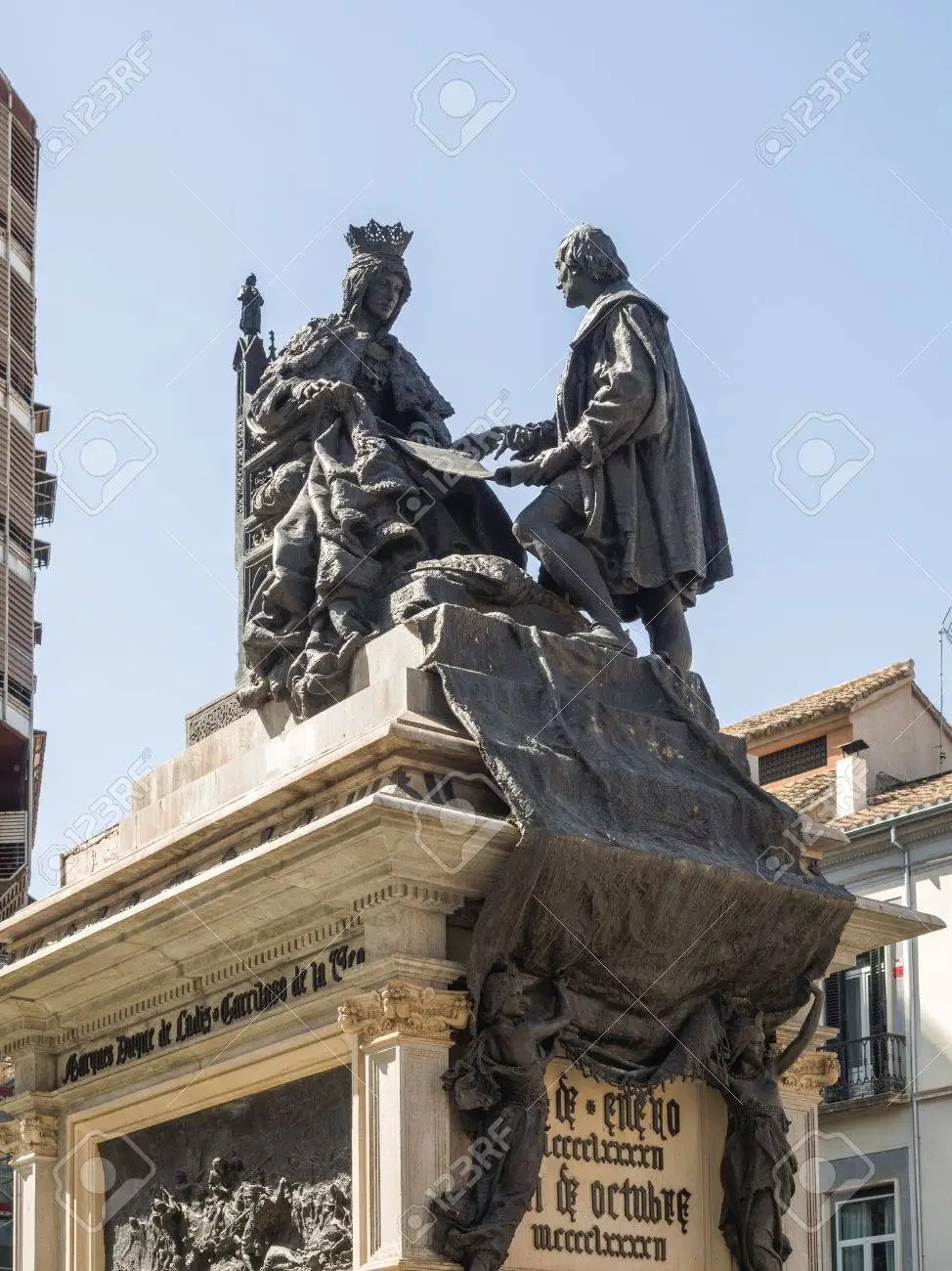
The processions are spectacular. In Granada they wend their way down the Gran Via Colon, past the city’s monstrous cathedral, and passing before the giant statue depicting the “Reyes Catholicos” (Catholic kings) Ferdinand and Isabella (1474-1504) giving permission to Christopher Columbus to embark on his world-changing voyage.  

The processions feature huge golden floats burdened with dozens of enormous flaming candles and centralizing much larger-than-life statues of a regal, purple-clad Virgin-in-mourning, or of crucified and tortured Savior. Clerical types (including women) walk behind the statues dressed in cassocks and surplices and carrying candles, crucifixes, and thuribles that fill the air with fragrant incense.

Each float is borne aloft by perhaps 30 unseen men whose humble identity is concealed by brocaded veils beneath which they perform their shared demonstration of macho strength and endurance. From time to time along the parade route, the anonymous bearers stop, fall to their knees. Then suddenly they arise as a single body to the delight and applause of the adoring crowds.

Others in the procession include participants whose costumes inevitably remind Americans of the Ku Klux Klan. However, their pointed hats, veiled faces, and white or red robes are really signs of penitence by sinners admitting their guilt, but mercifully shielding their identities.

Other processors include black-clad gypsy women carrying long, lit candles in their right hands just below their waists.

All of this is accompanied by band after band of drummers, trumpeters, trombonists, and tuba players. They march to deafening rhythmic beats. Here and there, they stop to play mournful dirges in honor of the suffering Jesus.

Hidden Meanings

All of this is quite beautiful and quaint – that is until you analyze what’s really happening in terms of Spain’s history that includes:

·       The emergence of the nation-state under Ferdinand and Isabella.

·        Their project’s unprecedented political goal, viz., the erasure of diverse Andalusian cultures [including Jews, Visigoth Christians, Muslims, Gitanos, pagan naturalists, (think “witches”], and emerging Protestants of various “heretical” descriptions].

·       To that end, the institution of the Spanish Inquisition (1478-1834)

·       Its infamous persecution of Jews, Muslims, Protestants, gypsies, witches, and “heretics” of all sorts  

·       The folding of all those identities into a single nationalty called “Spaniard,” which had never till then existed.

·       Our contemporary loss of Christian faith and its replacement with the worship of capitalism and its God called “Market.”

In the light of those realities, think about the processional elements earlier described. With their 15th-century historical context in mind:

·       The statue of the regally clad virgin Mary becomes an image celebrating Queen Isabella whose royal robes have nothing to do with the decidedly non-royal mother of the poor construction worker from Nazareth.

·       Those wearing those pointed hats reminiscent of the Klan become persecuted “heretics” wearing “dunce caps” (so named by those ridiculing the 13th century Scottish mystic, John Duns Scotus).

·       The statues depicting the batterers and humiliators of the suffering Jesus become the Jews expelled from Spain by Ferdinand and Isabella and whom Christian tradition blamed as “God killers” instead of Jesus’ real assassin, the Roman Empire.

·       As well, Jesus’ torturers include the dunce heretics par excellence, viz., the hated Moors.

·       The black clad women carrying long lighted candles just below their waists become the witches persecuted by the Inquisition. The candles are phallic symbols of their true purpose in life – viz., giving sexual pleasure to men.

·       The processions’ martial war drums become warnings to the enemies of the Reyes Catholicos (again, Jews, Muslims, heretics, witches, gypsies) to be afraid – very afraid. The crown’s Catholic inquisitors will kill you.

·       The unseen statue bearers become the oppressed artisans and workers who have always borne the burden of supporting royalties and church hierarchies of all types.

·       The secular crowds jamming the Gran Via Colon are believers now transformed into mere “Tourists” who represent for Spain a huge influx of cash in service of the only God that matters, the only we’re left with – Capitalism and Market.

Conclusion

When you think about it, Lent and its Easter conclusion represent the ongoing spiritual struggle that involves us all. The season is bookended by Mardi Gras and Holy Week both of which feature political marches masquerading as parades and processions.

Mardi Gras celebrates the human drive towards happiness and community fulfillment – both of which were embodied in that Nazareth construction worker whose first recorded miracle changed gallons upon gallons of water into the finest of wines. Shrove Tuesday’s parades are joyful, drunken, and highly sexualized. Think of those images of dancers from Brazil. Recall Louis Armstrong and New Orleans jazz.

Happiness, joy, fun.

The second of Lent’s bookends is more somber. It’s what I’ve been describing here – the so-called sublimation of all that’s human and joyful into what’s dark, threatening, serious, churchy, and oppressive. And it’s all performed in the name of religion that contradicts that spirit of water changed to wine at a young couple’s wedding.

Why the change?

The answer’s contained in the politics of it all – then and now. More than anything, Spain’s Holy Week processions are reactionary protests intended to obscure and deny the enriching diversity of human experience. The processions are monuments against variety in national identity, in beliefs, in spiritualities, and cultures. They celebrate the elite. They militate against Jews, Muslims, gypsies, witches, Protestants, workers, artisans, and heretics of all sorts. Their musical background is martial and warlike.  

To the discerning eye, Spain’s Holy Week events are also stark reminders of contemporary culture’s inheritance of Inquisitional intolerance.  Like Ferdinand and Isabella, capitalism and its Market God would flatten out the differences that make us human. No variety called socialism, communism, anarchism, or e.g., China’s “whole process people’s democracy” is permitted. Everyone must conform to the nation-state’s sameness.

When you think about it, that syndrome transforms the crucified and risen Jesus into the patron of oppression.

What a distortion!

Its realization alone might be enough to rescue his message: It’s spring. It’s Easter. Celebrate life, not death. The nation-state is a fraud.    

The Hypocrisy of Non-Religious People Regarding Women

Historical painting altered to show which of those signing the Declaration of Independence were slave holders.

Recently, a valued contributor to OpEdNews (where I’m a senior editor) published an article entitled “The Hypocrisy of Religious People Regarding Women.” In it, he argued that all “revealed” religions, Judaism, Christianity, Islam, Mormonism and Baha’? (sic) are guilty of promoting misogyny.”

They are hypocritical regarding women, he wrote, because of the many “pathetic and damaging examples of misogyny in the Hebrew Bible.”

In support of his argument, he referenced the Genesis story about the first man and first woman (Gen1:26-27 and 2:21-23) and the interpretation of that story by the anonymous author of First Timothy. The latter took the myth to mean that women sinned first and therefore deserve punishment and subjection to men (1 Tim 2:11-14).

Moreover, the author alleged, the hypocrisy of religious people extends far beyond Judaism and Christianity to include Hinduism and Buddhism. Islam was highlighted as especially hypocritical since, he wrote, it encourages husbands to beat their disrespectful or disobedient wives.

To remedy such outrages, our friend called for the replacement biblical teachings with Deism, especially as espoused by the Founding Fathers like Thomas Paine. The Founders, he inferred, were not only champions of women, but adopting their free thought and nonreligious approach to God would save humanity from the social evils hypocritically supported by “religious people.”

In this brief essay, I’d like to respectfully disagree with my OEN colleague. Let me do so by (1) saying a word about hypocrisy, (2) showing the diversity of “religious people,” who are not nearly all guilty of misogyny, and (3) suggesting that Deism as represented by our Founders (including Thomas Paine) is itself deeply embedded in extreme hypocrisy not only towards women, but towards indigenous and black people as well.

Hypocrisy’s Meaning

Here I can be quite brief.

Hypocrisy does not mean “beliefs harmful to others” as my colleague seems to imply. Rather and relative to misogyny, it entails adopting an anti-woman course of action while knowing and even affirming that doing so is wrong. That’s what hypocrisy means – lack of correspondence between one’s professed convictions on the one hand and one’s actions on the other.

This means that proving that all “religious people” are “hypocritical regarding women,” would entail showing that what all of them believe and say about women is insincere. Alternatively, the author s use of the term hypocrisy might suggest that all “religious people” (or maybe just most of them?) mistreat women and hate them (that’s what misogyny means) because of the believers’ religious convictions.

Obviously, such assertions are untrue.

And that brings me to my second point which needs fuller explanation.

Religious Diversity

Here I must make two obvious points. The first is that all “religious people” cannot be tarred with the same brush. And besides, the beliefs of religious people about women and those “revealed texts” are also quite diverse.

That many believers might be hypocritical cannot be denied. However, it’s difficult to identify just who falls into that category (as defined above). It’s risky for anyone who can’t read minds. Perhaps rather than identifying the beliefs of some as hypocritical, it would be better to call them uninformed, immature, or simplistic.

As for religious diversity, one must understand this about religion: It’s just religion.  It’s just part of the intellectual and spiritual makeup of most humans. If they’re hypocrites, religious folks will be religious hypocrites. If they’re conservative and reactionary, their interpretation of their religious books will reflect that. If they’re not, they won’t. The same is true of liberal and radical believers.

Regarding “revelation,” not all religious people share the same convictions. For instance, some religious people think their holy books are magical, inspired, revealed, and/or inerrant – the very word of God.

Many others have a broader understanding of inspiration and revelation. Even if they regard their “holy books” as somehow inspired, they realize that they’ve been mediated through or simply composed by fallible human beings who often write into them their own prejudices e.g., towards violence, misogyny, racism, and/or nationalism.

Critical thinkers anxious to avoid the simplistic prejudice of simply ignoring such differences and tarring all “religious people” with the same brush overlook such uncritical preconceptions. They often end up throwing the baby out with the bath.

The “baby” in this case represents the monumental achievements for which “religious people” have been responsible (precisely as religious) in world history and our own local story here in the United States – even regarding women’s rights.

Remember that the abolitionists were mostly Quakers, i.e., religious people. Moreover, there would have been no Black Civil Rights Movement without black Baptists. More specific to the argument here, neither would the ‘60s and ‘70s have seen the emergence of the women’s liberation movement, or that of gay rights, prison reform, and anti-war demonstrations without the example set by the civil rights activists centered in community churches.

Then, internationally, there are the cases of the Hindu Mahatma Gandhi, who played such a key role in the liberation of India from European colonialism — and his Islamic counterpart, Badshah Kahn (sometimes called the Muslim “Gandhi”). Gandhi so identified with women that he once said, “Mentally I have become a woman. . ..”

It’s also a fact supported by Islamic scholars that Muhammad himself in the early 600s CE was far more a champion of women than his cultural contemporaries. He was responsible for greatly expanding their legal entitlements to include inheritance and property ownership. In contradiction to the customs of his day, he recognized that women have rights within their own marriages.

Additionally, and returning to our own hemisphere, one cannot adequately explain movements in Latin America for social justice (including for women) in places such as in Nicaragua and El Salvador without understanding the impact of liberation theology. To characterize such inspiration as “hypocritical” is insulting to thousands of Christian students, teachers, union organizers, social workers, priests, and nuns who gave their lives because of the inspiration to work for social justice (again, including for women) they found in their faith.

More specifically, think about El Salvador and its martyrs including Oscar Romero, the five women religious murdered and raped there. Think of the team of six liberation theologians (along with their housekeeper and her daughter) assassinated for their “crimes” by members of the Atlacatl Battalion trained in the United States. None of them was a hypocrite. All of them were “religious people.” Many of them were women.

Deist Hypocrisy

And that brings me to my third point. It’s this: Deists among our Founding Fathers were profoundly hypocritical (in the sense defined above). They were especially so towards women, the indigenous, and slaves from Africa. I’m referring to men like Thomas Jefferson, George Washington, Alexander Hamilton, and even Thomas Paine.

We can assert their hypocrisy unmistakably because all of them agreed that “everyone” was created equal. Their writings show for example that they had no doubt that slavery was wrong. Yet, despite their frequent assertions to that effect, most of them continued holding slaves till their dying day.

Similarly, despite their statement about “all men,” they were responsible for the genocide of First Peoples in the land they settled.

And, of course, everyone knows that they refused to recognize women as the equals of men. In fact, it wasn’t until 1920 that women were even allowed to vote. And this country still has not passed the Equal Rights Amendment, much less had a woman fill the office of president. Meanwhile, for example, fully sixteen Muslim countries have voted in women as their head of state.

Conclusion

Yes, there are “pathetic and damaging examples of misogyny in the Hebrew Bible.”

And yes, despite their claims to be “free thinkers” and “rational,” the Deists of the Thomas Paine era also provide equally pathetic and damaging examples of misogyny, genocide, and enslavement of human beings they knew to be the “men” that God created equal to themselves.

Moreover, as revealed in their own writings, the Deists in question fulfilled the definition of “hypocritical” more unmistakably than their religious counterparts. That is, they said that slavery was wrong, but mostly held slaves till their dying day. They prosecuted genocidal wars against millions of First Peoples, even though as “brilliant” and rational free thinkers, they knew the “Indians” were human beings.

And despite the appeals of their own wives (like Abigail Adams), they refused to recognize women’s equality. In other words, they left themselves quite open to charges of being wildly hypocritical misogynists.

In summary, I reiterate to my earlier points. That is, despite the huge generalities in the OEN article “The Hypocrisy of Religious People Regarding Women”:

  • All “religious people” cannot be tarred with the same brush.
  • They are not nearly all hypocritical.
  • In fact, many of them have been champions of women (and the enslaved and indigenous) precisely because of their religious faith.
  • Neither is any religion inherently misogynist, racist, or genocidal.
  • Including Deism.
  • All of them are just religions.
  • If their adherents are misogynist (or racists) their religion will reflect that.

 If not, they won’t.

  • Generalizations about the beliefs of others are not only disrespectful, but they also run the risk of hypocrisy.

“Argentina 1985”: Its Untold Story That Americans Should Know

This Sunday, I’ll be watching the 95th Oscars Ceremony with special interest. That’s because of my concern about U.S. atrocities abroad and the related fact that the nominee for best international film is “Argentina 1985.”

It tells the gripping story behind Argentina’s “Trial of the Junta,” which in 1985 brought to justice the country’s military dictatorship responsible for the prosecution of its infamous “Dirty War” (1976-1984).

Apart from its artistic merits and my already noted focus, the film interested me personally, because precisely in 1985 while I was studying liberation theology in Brazil, my family and I lived under the related military dictatorship for more than six months. We even passed several nights lodged in Rio’s Clube Militar (Military Club), thanks to my Portuguese language instructor in Boulder Colorado whose father was a general in the Brazilian army.

Knowledge of Brazil’s then-recent history, its 1964 military coup, and its prosecution of liberation theologians made the Clube a scary place. We all knew the days of Brazil’s junta were numbered too. So, what was happening in Argentina sparked deep thoughts about a coming day of reckoning further north.

With all of that in mind, let me recommend “Argentina 1985,” point out a key omission relevant to North Americans, and indicate some of the film’s implicit and salutary political portents for us all. (Spoiler alert!)

Argentina 1985    

“Argentina 1985” is dark and gripping. It’s about fascism, government corruption, absolute cruelty, torture, death squads, bomb threats, child abuse, propaganda, and citizen intimidation.

At the same time it’s the cinematically familiar story of a reluctant leader who turns a group of unprepared and unlikely players into an unstoppable team eventually victorious over an invincible foe.

At the film’s outset team members are introduced one after another. We find them naïve, idealistic, practical, wise, funny, focused, and hard working in the extreme. Perhaps its most effective unofficial member is the main character’s pre-teen son who comically demonstrates wisdom and savoir faire far beyond his years.  

The film’s real hero though is Julio Cesar Strassera, Brazil’s Chief Prosecutor. He’s aided by his young Assistant Prosecutor, Luis Moreno Ocampo who’s constantly worried about his mother’s opinions. She’s extremely conservative and a loyal supporter of Argentina’s military. She’s Catholic and a co-parishioner of one of the junta’s main defendants.

Together Strassera and Ocampo guide their young team (despite crippling time restraints, death threats, and bomb scares) in fulfilling their superhuman task of gathering an overwhelming number of testimonies from hundreds of Dirty War eyewitnesses, victims, and their family members.

The dramatic result portrayed convincingly in “Argentina 1985” is a whole series of moving accounts of torture, rape, and murder. Responsibility for all those crimes is inexorably laid at the doorstep of the country’s military dictatorship.

Toward the film’s conclusion, after hearing Strassera’s summarizing argument, most audience members, I’m sure, feel (as I did) like joining the packed Argentine courtroom in its ovation of thunderous applause. That feeling of vindication is reinforced when the worst of the accused generals receive severe sentences including life behind bars.

What’s Not Told

Unfortunately for North American audiences, what’s not told in “Argentina 1985” is the key role that the United States government played in that sad country’s Dirty War. That’s unfortunate because the omission allows U.S. viewers to experience the film as exclusively about Argentinians and not about us. Consequently, as we’ll see presently, casual viewers likely miss the salutary lessons the film contains for viewers like us.

Let me be specific.  

According to US archives, the United States government aided Argentine generals throughout the dictatorship’s bloody time in office. That means that Henry Kissinger’s hands are red. But so are Jimmy Carter’s and Ronald Reagan’s.

The blood in question belonged to more than 30,000 Argentinians. It was an old U.S. story about supporting fascistic right-wing forces employing a scorched earth policy against leftists. The idea was to kill everyone who might possibly be on “the other side.”

The resulting victims included teachers, student activists, indigenous leaders, union organizers, social workers, radical clergy, and nuns, along with their friends and family members who might have been influenced by their ideas, words, and examples. Most of these were identified as suspected communists, socialists, subversives, guerrillas, and terrorists.

It was all part of Operation Condor, a U.S.-backed anti-leftist campaign that from 1975 to 1989 wreaked havoc throughout Latin America, especially in Argentina, Uruguay, Chile, Paraguay, Bolivia, and Brazil. Conservative estimates say the Operation took 60,000 to 80,000 lives in the Southern Cone. Condor involved a series of military coup d’états within the countries just named.

In those contexts, the U.S. role was to plan the campaigns and coordinate them across national boundaries. The Ford, Carter and Reagan administrations also provided the dictatorships in question with military training, economic assistance, and technical instruction including methods of kidnapping and disappearance, assassination, the use of torture, and the operation of death squads. In Argentina, hundreds of babies were taken from imprisoned and disappeared female victims only to be “adopted” by associates of the ruling generals.

An indispensable element of Operation Condor was near total control of the mass media for purposes of disseminating pro-regime propaganda. The latter consistently described the relevant countries as under siege. It attempted to garner public support by invoking nationalism and patriotism against “criminal” subversives threatening revolt and chaos. Pro-regime media encouraged citizens to report any suspicious activities on the parts of their neighbors.

And yes, “Argentina 1985” is right. All of this came to light in 1983 when democracy was restored in Argentina. It was then that the new government established the National Commission for Forced Disappearances (CONADEP). That commission eventually engaged Chief Prosecutor Strassera and his team of young lawyers and volunteers to collect testimony from hundreds of victims and witnesses. In the process, the investigators were able to identify by name the leaders of the dictatorship’s death squads and torture centers. As well, Strassera’s team documented the existence of hundreds of secret prisons and detention gulags throughout the country.

Eventually, in 1985, enough evidence had been gathered to present a convincing case before the “Trial of the Juntas.” Again, this was correctly depicted in “Argentina 1985.” As described in the film, the trial convicted the dictatorship’s top officers with many of them receiving sentences of life in prison.

All of that was in 1985. However, just four years later, Argentine President Carlos Menem pardoned the powerful convicts in what he described as an act of “healing and reconciliation.”

So much for Strassera’s victory.

Lessons for U.S. Viewers

In the light of the film’s information and omissions, here are just a few of the valuable lessons it contains:

  • It could happen here! I mean, I’m sure you’ve noticed our country’s creeping fascism. And if you’ve read e.g., Jonathan Katz’s Gangsters of Capitalism, you know that fascism has always been popular among the U.S. elite. In fact, at the moment, they seem on the verge of taking over even formal control.
  • Atrocities wreaked abroad have their way of returning home to plague those not paying attention to history or foreign policy.
  • It’s totally dangerous to revere the military. Their job is to kill people and destroy their property – usually quite indiscriminately. They are protectors of the status quo. They are not our friends. It’s not hard to imagine U.S. soldiers or police torturing you or your children tomorrow. Ask Chelsea Manning or Julian Assange.
  • The laudable ideals of “healing and reconciliation” and even nonviolence are typically weaponized by the powerful to benefit them and override more important democratic values such as justice, equal standing before the law, and legitimate self-defense.
  • The powerful rarely pay for their crimes. Impunity is their rule.
  • Since they are owned by the rich and powerful, the mass media (MSM) cannot be depended upon as reliable sources of information. Like the military, MSM presenters are not our friends.
  • Most often, the young and inexperienced are better servants of truth than the “veteran” old who have been co-opted by the unjust systems that bought-and-paid-for governments represent.
  • Our government is no better than the ones it arms and supports.

With all of this in mind, be sure to watch “Argentina 1985.” And let it be a lesson about history and U.S. atrocities. Let it also be a forewarning.

International Women’s Day: The U.S. Role in Repressing Afghan Women

This is International Women’s Day. And what was once my favorite news program, Amy Goodman’s “Democracy Now” (DN) was full of relevant coverage. One of the featured pieces was entitled “Stand up for Afghan Women”: U.N. Calls Afghanistan World’s Most Repressive Country for Women, Girls.” The piece lamented the sad situation plaguing Afghanistan’s female population.

By now the story has become familiar: women required to wear hijabs, girls excluded from schools, and both forbidden to drive cars, work outside the home, or to travel without male accompaniment.

And all of this decried by the United States government which is, we’re told, the champion of women’s rights not only in Afghanistan but throughout the Muslim world.

The problem however with that picture is that the last part is false. That is, far from being the champion of women’s rights in Afghanistan, the United States is the one ultimately responsible for their oppression in that sad country and elsewhere.

In effect, the U.S. is the creator of the Taliban which in 1992 overthrew the Russian-sponsored socialist government that beginning in 1973 freed Afghan women from the repressive restrictions just referenced.

More specifically, supported by the Soviet Union, the so-called “Saur Revolution” improved immeasurably the lives of Afghan women. It introduced progressive policies including land reform and mass literacy projects that benefitted both genders. Child marriage was abolished. Female dress codes were eliminated, freeing women to wear western clothing if desired.

Under socialism, formerly closed employment opportunities for women were opened in both the public and private sectors. Women were allowed to enter schools at all levels. They became university professors, government officials, doctors, nurses, lawyers, judges, parliamentarians and more. In record time, women comprised 50% of the government’s bureaucracy, 70% of the country’s teachers, and 40% of its doctors. Sixty percent of the faculty at Kabul University (KU) were females. For the first time in Afghanistan’s history, women comprised most of the KU student body.

All of that was reversed by United States now familiar divide-and-conquer regime change strategies – this time in Afghanistan. Alarmed by socialism’s advance, Jimmy Carter’s national security advisor Zbigniew Brzezinski saw that Saur progressive reforms though popular in urban centers were not well-received in rural tribal areas. So, he decided to support the landlords, warlords, and religious mullahs there to work regime change in Kabul.

The assistance included the Carter administration’s arming and training Islamic fundamentalists (the Mujahidin) beginning in 1979.

That movement eventually drove from power Afghanistan’s progressive socialists (along with their Russian supporters) with their women-friendly policies. Eventually too, the Mujahidin morphed into the Taliban.

We know the rest of the story:

  • 20 years of U.S. occupation and bombing of Afghanistan
  • With the expressed intent of preventing the Taliban from returning to power
  • But leading directly to the deaths of more than 250,000 Afghans
  • With the same number of deaths caused indirectly
  • Including (between 2015 and 2019 alone) more than 26,000 Afghan children
  • Along with the creation of over 2.2 million refugees.

We also know about:

  • Last year’s chaotic U.S. departure from the country
  • The immediate return of the Taliban to power
  • And the subsequent application of U.S. sanctions
  • That are currently causing an unprecedented humanitarian crisis that affects women and their children much more than the Taliban officials.

Everybody knows, of course, that all of this is intentional. The real target of U.S. sanctions is not the Taliban government. No, it’s all part of our government’s familiar regime change strategy aimed at making the lives of ordinary people (including women and children) so miserable that they will arise and overthrow their government.

We shouldn’t be fooled by any of it. Instead, (especially on this International Women’s Day),  we should face up to the fact that the United States government doesn’t give a damn about women’s rights either abroad or at home.

At home, its Christian Taliban wing led by its SCOTUS Catholics, Donald Trumps, Ron DeSantises, and Marjorie Taylor Greenes would entirely control women’s bodies and their reproductive rights from the exclusion of sex education to the outlawing of contraception and abortion. Remember that for more than 50 years, “America” has found itself unable to officially recognize that under the Constitution, women have the same rights as men.

In summary, while portraying Muslim-majority countries as inherently misogynistic, U.S. government propaganda and even news sources like “Democracy Now” ignore the fact that the United States was responsible for overthrowing Afghanistan’s progressive governments attempting to improve the lives of its women.

In other words, history shows that our government is as misogynistic as the forces it sponsors.