Marianne Williamson & the Immigration Crisis (Sunday Homily)

Readings for 14th Sunday in Ordinary Time: IS 66:10-14C; PS 66: 1-7, 16, 20; GAL 6: 14-18; LK 10: 1-12, 17-20.

The theme of today’s liturgy of the word is exile and deliverance from captivity. In its light, I can’t help thinking of all those refugees at our southern border and of Marianne Williamson’s wise and unique response in last week’s second Democratic Debate.

According to our readings, the immigrants and refugees our politicians want us to hate are exiles like the ancient Hebrews in Babylon. They are the victims of the rich and powerful as were the Jews in Jesus’ day, when Rome occupied his homeland aided and abetted by the Temple clergy. That is, today’s biblical selections say that the poorest and most vulnerable among us are God’s own people.

Yet incredibly, the richest and most invulnerable at the top of our contemporary social order – the very ones who crashed our economy, looted our common treasury, and escaped unscathed with the handouts we ourselves provided – somehow want us to believe that the poor exiles from their beloved homes in Central America are the cause of all our problems.

But remember: the home lands of these exiles from Honduras, El Salvador, Guatemala, and Nicaragua are the very countries whose economies our government purposely and permanently crashed in the 1980s. Then, the Reagan and Bush I administrations used drug money to finance illegal wars that ended up killing hundreds of thousands and replacing governments and social movements whose primary beneficiaries would have been the parents of those at our borders today. The latter are victims of the drug lords we established and supported during the ‘80s and who today are doing the same things they did 40 years ago – marketing drugs while terrorizing and murdering the innocent. I’m talking about the generals and other military officers who are now the drug kingpins.

That’s the point Marianne Williamson tried to make at the first Democratic debate. But no one picked it up. None of the other candidates elaborated on Ms. Williamson’s observation that today’s immigration “crisis” amounts to our government’s reaping what it sowed. The other candidates still haven’t seconded Marianne’s point. Instead, they and their interlocutors remain stuck in the same old, same old. They mouth the standard political platitudes while ignoring the shameful history that explains today’s headlines.

It’s been that way from biblical times and before – rich foreigners oppressing poor locals. Listen to today’s readings. Or, rather, read them for yourself. Here are my “translations.”

IS 66:10-14c

These are the words
Of Isaiah’s prophecy
To all in captivity
By Powers
Foreign and domestic:
“Your time of desperation
Is nearly over.
You will soon
Return home
Like starving infants
To Mother-Jerusalem.
With hunger satisfied
And prosperity
Incredible
Along with joy
And comfort, comfort, comfort
At last!”
 
PS 66: 1-7, 16, 20
 
Our liberator
From exile
So kind and powerful
Is the answer
To the prayers
Of captive people
And a source of joy
For the whole
Human race
And all of creation.
No obstacle
Can impede
God’s destiny
Of liberation
Joy and freedom
From oppression.
 
GAL 6: 14-18

Yes, our destiny
Is an entirely
New World!
Where the world’s distinctions
Are meaningless.
Acting accordingly
Now
Will bring
Everyone
Compassion and peace.
However,
The World
Crucifies us
For this belief.
Nonetheless,
We’re called to
Bear its torture
And scars
Gladly
As Jesus did.
 
LK 10: 1-12, 17-20

Paul’s words
Agree with Jesus
Who sent
Thirty-six pairs
Of “advance men”
And women
To announce
(Like Isaiah)
Liberation
From oppression
By powers imperial.
Like lambs among wolves
Like monks
With begging bowls,
They healed and proclaimed
God’s Great Cleanup
Of a world
Infested by demonic
Imperial oppressors.
And it worked!
Every one of those 72
Cast out evil spirits
Just like Jesus.
(Despite powerful opposition
And crucifixion.)
Some have ridiculed Marianne's debate performance. However, that only shows how our country thought-leaders have become tone-deaf to biblical values. They consider them ludicrous.

For me, that only signals the necessity of doubling-down on support for the only one in the crowded Democratic field who courageously insists on the values embedded in today's readings which identify the keys for solving the problems caused by "experienced" politicians. As Marianne says, those keys are love and forgiveness precisely for and of those the rich and powerful vilify.

Marianne Williamson Speaks for Herself

Just for fun, here’s an interview with Marianne Williamson whose candidacy for POTUS I’ve been trying to promote. I’m doing that because I think Marianne offers the national presidential debate a refreshing, deeply spiritual dimension that it sorely needs. She makes that contribution in a way helpful to believers, non-believers, and those who consider themselves “spiritual but not religious.” In any case, give this little interview a look and listen and see what you think.

Mike Pompeo’s Cynicism vs. Marianne Williamson’s Politics of Love

Readings for 2nd Sunday of Easter: Acts 5:12-16; Ps. 118: 2-4, 13-15, 22-24; Rev. 1: 9-11A, 12-13, 17-19; Jn. 20: 19-31.

By the time you see this, many of you will have been yet again outraged by the crude cynicism of Mike Pompeo, America’s Secretary of State and former head of the CIA. This time, I’m referring to his embarrassing throw-away line following a speech at Texas A&M last week. Secretary Pompeo said:

“. . . When I was a cadet, what’s the first – what’s the cadet motto at West Point? You will not lie, cheat, or steal, or tolerate those who do. I was the CIA director. We lied, we cheated, we stole. (Laughter.) It’s – it was like – we had entire training courses . . . (Applause.) It reminds you of the glory of the American experiment.”

In this election season, Pompeo’s arrogant disregard for the disastrous effects of the actions he described (in terms of governments overthrown, innocents slaughtered, and our own democracy discredited) offers an instructive foil to recommend the contrasting approach of Marianne Williamson, whose presidential campaign is based on what she terms a “politics of love.” The contrast between Pompeo and Williamson is further illumined by the familiar story of Doubting Thomas which is the focus of today’s liturgy of the word. It locates divine presence precisely in a victim of the imperial double-dealing and cruelty Pompeo finds so amusing and that Williamson finds abhorrent.

But before I get to that, please watch the secretary’s remark for yourselves:

What I found noteworthy in what you just saw was not so much what Pompeo said. (Anyone who knows anything about the CIA would not find that surprising.) What I found amazing was the audience laughter and applause. Both suggested not only rejection of U.S. ideals, but of the faith Americans commonly claim. Pompeo’s words absolutely contradict the Jewish tradition’s Ten Commandments.  The laughter and applause also suggested that Pompeo’s audience recognized that lying, cheating, and stealing somehow have more power than the teachings of Jesus about the primacy of love and doing to others what we would have them do to us. (Let’s face it: that’s the underlying reservation many have about Marianne Williamson’s candidacy as well.) Even more, the audience’s approval cynically endorsed Pompeo’s position that such actions constitute something glorious about Americans and their country!

I suppose the secretary would hasten to explain that we’re living in a dangerous world, where enemies lie, cheat, and steal all the time; so, we must do the same. But just imagine if Vladimir Putin or Venezuela’s Nicolas Maduro had uttered Pompeo’s words! We’d never hear the end of it.

It’s principled response to such cynicism that fuels Marianne Williamson’s campaign for president. And in the light of today’s Gospel reading, which endorses miracles over “realism,” she should be taken seriously. More directly, and at a far deeper level than any of the other 20 (so far!) Democratic candidates, Williamson actually believes in a “Politics of Love,” and says so openly.

In fact, Williamson is running on a platform that holds that there is no distinction between personal and public morality. As she points out, the world and our country have a long history of acknowledging that fact. Jesus himself embodied that teaching. So did Gandhi. Abolitionists were Quakers, as were many of the suffragettes. Martin Luther King was a Baptist preacher. The Berrigan brothers were Catholic priests; so was Thomas Merton. None saw any distinction between the personal and political.

However, it’s not that Ms. Williamson is any less aware of our world’s evils than Mr. Pompeo. She doesn’t claim that the Judeo-Christian tradition invites anyone to ignore immorality and violence. Quite the contrary. As she points out, the entire Jewish tradition stems from rebellion precisely against the horror of slavery (in Moses’ Egypt). And the Christian tradition is founded on the teachings of a prophet who was tortured and executed by one of history’s most brutal empires. To ignore such evils, Williamson says, is not transcendence; it’s denial.

And that thought brings us to today’s Gospel reading.  It’s the familiar story of Doubting Thomas, whom in today’s context we might call “Realistic Thomas.” That’s because the story is finally about Christ’s call to recognize his own presence in the tortured victims of the kind of empire Pompeo’s audience applauded. It’s a parable told 80 years after Jesus’ death to encourage believers who, unlike Thomas, had not seen the risen Christ, yet believed anyway. The story is about the early Christian community coming to realize the truth of Jesus’ words, “Whatever is done to the least of my brethren, is done to me” (MT 25). Williamson recognizes all those truths. Evidently, Pompeo does not. 

Recall the parable.

The disciples are in the Upper Room where they had so recently broken bread with Jesus the night before he died. But Thomas is not present. Then suddenly, the tortured one materializes there in their midst.

“Too bad Thomas is missing this,” they must have said to one another.

Later on, Thomas arrives. Like the believers for whom the story was written (at the end of the first century) he hasn’t met the risen Lord.

“Jesus is alive,” they tell him.

However, Thomas remains unmoved. He protests, “I simply cannot bring myself to share your faith. Things like that don’t happen in the real world.”

The words are hardly out of his mouth, when lightning strikes again. Jesus suddenly materializes a second time in the same place. He tells the realistic one to examine his wounds – to actually probe them with his fingers. It’s then that Thomas recognizes his risen Lord. Yes, he realizes, Jesus is present in the tortured and victims of capital punishment – in those crucified by empire. The story invites hearers to join in Thomas prayer before such victims, “My Lord and my God.”

And that brings me back to Marianne Williamson . . . Let’s be honest: when we heard Williamson’s phrase, “politics of love,” did any of us find ourselves rolling our eyes? If so, that probably means we’ve somehow joined Secretary Pompeo in his cynical realism – in his implicit denial of the power of today’s parable. It suggests that we too believe that lies are more powerful than truth, that cheating is more rewarding than acting justly, that might makes right, that violence represents a more effective strategy than love.

In summary, we’re in denial about the truth of Jesus’ teaching – and that of virtually all of history’s sages. Williamson asks: “How’s that been working out for you – and for the world?” It’s time for a change of heart and soul like that of “Realistic” Thomas and like that represented by the campaign of Marianne Williamson.

She needs about 10,000 more individual contributions to qualify for appearance on the debate stage with the other candidates. If you want to see her there, contribute $1.00 or more right now!

Jesus Was Not Preoccupied with Sex: Neither Should the Church Be!

Readings for 5th Sunday of Lent: Is. 43:16-21; Ps. 126:1-6; Phil. 3: 8-14; Jn. 8: 1-11.

Not long ago, Catholic journalist and historian, Gary Wills coined an insightful phrase, “The Big Crazy.”  Yes, he was talking about the pedophilia scandal. But his point was more general than that. Wills was referring to the Church’s insane obsession with a long list of cringe-worthy and curious topics that for him included “masturbation, artificial insemination, contraception, sex before marriage, oral sex, vasectomy, homosexuality, gender choice, abortion, divorce, priestly celibacy, male-only priests.”

The list is curious because today’s Gospel reading shows that Jesus didn’t share such prudish concern. And this despite the fact that the religious leaders of his day leaned in that direction – at least regarding women and adultery. Consequently, in the eyes of the priests and scribes of his day, Jesus would have been far too liberal, understanding and forgiving of sexual frailty – far too feminist. His attitude seemed to be: “What’s good for the goose is good for the gander.”

Here’s what I mean: Jewish law punished adultery with death by stoning. That was a biblical requirement. However, the Jewish patriarchy applied that law differently to men and women. A man, they said, committed adultery only when he slept with a married woman. But if he slept with a single woman, a widow, a divorced woman, a prostitute or a slave, he remained innocent. A woman, on the other hand committed adultery if she slept with anyone other than her husband.

Jesus calls attention to such hypocrisy and double standards in today’s gospel episode. All the elements of last week’s very long parable of the Prodigal Son are here. Jesus is teaching in the temple surrounded by “the people” – the same outcasts, we presume, that habitually hung on his every word.

Meanwhile, the Scribes and Pharisees are standing on the crowd’s edge wondering how to incriminate such a man?

As if ordained by heaven, an answer comes to them out of the blue. A woman is hustled into the temple. She’s just been caught in flagrante – in the very act of adultery. What luck for Jesus’ opponents!

“Master,” they say, “This woman has just been caught in the act of adultery. As you know, the Bible says we should stone her. But what do you say?” Here Jesus’ enemies suspect he will incriminate himself by recommending disobedience of the Bible’s clear injunction. After all, he is the Compassionate One. He is especially known for his kindness towards women – and others among his culture’s most vulnerable. He is the friend of prostitutes and drunkards.

But instead of falling into their trap, Jesus simply preaches a silent parable. He first scribbles on the ground. Only subsequently does he speak — but only 18 words, “Let the one among you who is without sin be the first to throw a stone at her.”

A wordless parable . . .  

What do you suppose Jesus was scribbling on the ground? Was he writing the names of the guilty hypocrites who had cheated on their wives? Was he writing the laws the Scribes and Pharisees were violating? Some say he was simply drawing figures in the dust while considering how to reply to his opponents?

The first two possibilities seem unlikely. How would this poor country peasant from Galilee know the names of the learned and citified Scribes and Pharisees? It is even unlikely that Jesus knew how to write at all. That too was the province of the Scribes. The third possibility – that Jesus was absent-mindedly drawing figures in the dust – is probably closer to the mark.

However, it seems likely that there was more to it than that. It seems Jesus was performing some kind of symbolic action – that mimed parable I mentioned. By scribbling in the dust, he was wordlessly bringing his questioners down to earth. He was reminding them of the common origin of men and women?

Both came from the dust, Jesus seems to say without words. The creation stories in Genesis say both men and women were created from dust and in God’s image – equal in the eyes of God. “In God’s image God created them. Man and woman created he them,” says the first creation account (Genesis 1:27). By scribbling in the dust, Jesus was symbolically moving the earth under the feet of the Scribes and Pharisees. He was asserting that they had no ground to stand on. They were hypocrites.

Then his 18-word pronouncement offers Jesus’ own standard for judging the guilt of others even in the fraught field of sexuality. According to that standard, one may judge and execute only if he himself is without sin. This, of course, means that no one may judge and execute another.

And that brings us back to Gary Will’s “Big Crazy.” Jesus’ silent rearranging of “ground” along with his 18 words seem to call into question the very foundation of the bishops’ right to authoritatively pronounce on any sexual matters. They, after all, are the guilty ones who denied, covered-up, and excused sexual deviance on the part of the clergy they were responsible for overseeing – and whose overriding (public) concern has centered on sexual purity. Does that not dictate that the bishops and their priests have no ground to stand upon in the field of sexual morality? Isn’t it time for them to silently slink away along with their Scribe and Pharisee counterparts, and to replace judgmentalism with Jesus’ relative silence, forgiveness and compassion?

Jesus’ mime also directs all of us to reconsider our double standards and preconceptions about men and women in general. It reverses a prayer every first century Jewish man was to recite each morning. The prayer went, “Blessed are you, Lord, for making me a Jew and not a Gentile, for making me free and not a slave, and for making me a man and not a woman.”

Certainly, Jesus was taught that prayer by his pious father, Joseph. Perhaps for most of his life, Jesus recited that prayer on a daily basis. But something must have happened to him to change his faith. We’ll never know what that “something” or someone was.

After all, if Jesus thought like the Catholic bishops I mentioned, he would have thrown the first stone. He alone in that group was without sin. He would have thought, “Forgiving this woman will seem like condoning adultery. And condoning adultery might lead to abortions of the pregnancies that result. Not throwing the first stone will also lessen the authority of the Bible which clearly justifies punishing women for adultery. I’ve got to do it.”

Luckily for the woman taken in adultery (and for the rest of us), Jesus wasn’t a fundamentalist – or a Roman Catholic bishop. He recognized the equality of men and women. He recognized that what’s good for the goose is good for the gander.

That proverb has incredibly wide application, doesn’t it?

President Marianne Williamson?? Yes, That Miracle Can Happen!

Readings for 5th Sunday in Ordinary Time: IS 6:1-2A, 3-8; PS 138: 1-8; ICOR 15: 1-11; LK 5: 1-8

In today’s Gospel reading, we encounter Jesus’ radical message of social justice and of the abundance-for-all that results from accepting his insights. Significantly for this series on the presidential candidacy of Marianne Williamson, her program parallels that of the Master whose miraculous teaching has constituted the center of her own career for the last 30 years and more.

Before I get to that, however, allow me a word about miracles and Marianne’s presidential campaign.  

For starters, she herself is very clear about one thing: without a miracle, our country (and the world) is doomed. But that doesn’t mean her thinking is negative or pessimistic.

That’s because (and this is crucial) Marianne’s use of the term “miracle” does not reference marvels contrary to the laws of nature. Instead, her understanding of the word is something more significant even than the “miraculous” catch of fish reported in today’s Gospel reading. By miracle she means a profound change in consciousness. It’s a change in attitude from one governed by fear and guilt to an outlook inspired by love and forgiveness. As I said, without that change, we’re all finished.

Think about it. Isn’t it true that fear and guilt absolutely govern our lives? We’re taught to be very afraid of the Russians, Iranians, the Taliban, ISIS, Muslims, immigrants, climate change, nuclear holocaust, poverty, the police, gun violence, and death. And standard answers to such threats always include denial and violence in the form of war, more guns, sanctions, walls, prisons, weapons-modernization-programs, and an unlimited consumerism that has us drowning in our own waste.

In fact, it’s precisely that fearful thinking that continues to inform the candidacies of our country’s political classes (Democrats as well as Republicans). All of them except Marianne Williamson are imprisoned in old thought patterns. All of them are locked into political group think which typically dismisses Marianne’s approach as “unrealistic,” “impractical,” “inexperienced,” too idealistic.

Ignored is the fact that their own “realistic” thinking has brought us to the brink of extinction. Their “practical” consciousness has given us the war in Iraq and at least six other countries, the resulting uptick in terrorism, a planet on fire, world hunger in the face of enormous food waste, homeless populations freezing to death outside abandoned buildings, huge wealth disparities, the threat of nuclear war, more prisoners than anywhere else in the word, and a whole host of other problems.

All of those catastrophes, Marianne tells us, will remain without solution absent the miracle – absent the change in consciousness – that her campaign represents. She’s fond of quoting Einstein who said that the same kind of thinking that brought us into a crisis cannot extricate us from its predicament.

Now get ready: For Marianne, the answer to all those perceived threats is love and forgiveness. Yes, she actually dares to say that – to say what Jesus said!  But for Williamson, both love and forgiveness are understood in terms of realizing the unity of all human beings. In other words, only a switch in consciousness from seeing others as separate to envisioning humankind’s underlying unity can save us.

Can you imagine seeing ISIS, the Taliban, Muslims, immigrants, refugees, people of all races, religions and skin colors – and Mother Earth Herself – as truly related to us at an intimate level?

Actually, it’s more than that. As Marianne tells us repeatedly, “There is really only one of us here.” All those demonized groups are us. That’s the meaning of Jesus’ teaching about loving our neighbor as ourselves. Our neighbor is our self. When we hate and kill him or her, we’re hating ourselves. We’re committing suicide!

Radicality like Marianne’s is precisely what today’s liturgical readings call us to. They remind us that followers of Jesus (and about 75% of Americans claim to be that) should not shy away from love and forgiveness in the form of wealth redistribution and reparations to exploited classes. No, it’s the heart of our faith. It’s the only realistic solution to our problems, both personal and political.

Consider today’s Gospel story. According to Luke, the crowds of those following Jesus are so thick that he has to get into a boat, a little bit from shore to address the people.

Thanks to what we read from Luke two weeks ago, we know who was in the crowd and why they were so enthusiastic. They were poor people responding to Jesus’ proclamation of a Jubilee Year. (For Jews, Jubilee, “the year of the Lord’s favor,” was good news for the poor. That’s because every 50 years it called for radical wealth redistribution in Israel. Debts were forgiven, slaves were set free, harvests were left un-gleaned and land was returned to its original owners.)  

Recall that using the words of Isaiah, Luke had Jesus summarize his Jubilee message like this: “The Spirit of the Lord is upon me, because he has anointed me to bring good news to the poor. He has sent me to proclaim release to the captives and recovery of sight to the blind, to let the oppressed go free, and to proclaim the year of the Lord’s favor.”  

Yes, Jubilee represented biblical law. But it was honored more in the breach than in the observance. Astoundingly, Jesus was calling for its revival. Hence the overwhelming crowd. 

Not accidentally, Isaiah’s words are a description not only of Jesus’ highly popular program, but of Marianne Williamson’s presidential agenda. It embodies Jubilee Spirit by advocating:

  • Concern for our society’s and the world’s dispossessed (Good News to the poor)
  • Prison reform (Release of captives)
  • Health care (Recovery of sight to the blind)
  • An end to neocolonial wars (Letting the oppressed go free)
  • Reparations to descendants of African slaves (Jubilee)
  • Wealth redistribution that has the rich paying their fair share (Jubilee)
  • Forgiveness of student loans (Jubilee)

Next Jesus demonstrates the counter-intuitive abundance-for-all that inevitably results when his program is implemented. He tells his friends to go out into deeper waters and cast their nets despite the fact that their previous efforts had yielded no results. [Marianne constantly stresses the need for us to “go deeper” if we’re ever to go about Healing the Soul of America (the title of the 20th anniversary edition of her 1997 book.)]

Following Jesus’ instruction, the fishermen net a catch so great that it threatens to tear their nets apart and sink both of their boats. The message: abundance is the result of following Jesus’ program prioritizing “good news to the poor.” Abundance doesn’t trickle down from the elite; it percolates up from the poor.

And, of course, that latter point is underlined by Jesus’ final words in today’s reading, “Do not be afraid. From now on you will be catching men.” In other words, Jesus confirms his “preferential option for the poor” by selecting working class fishermen – not the rich and elite – as his first disciples.

Like Marianne Williamson (and all who miraculously overcome the fear Jesus references), Peter, James, and John leave everything (including evidently the fish they’ve just caught) and follow Jesus into the unknown.

Their audacious act, their detachment from fear, possessions, the past, and the relative wealth they’ve just attained all demonstrate their readiness for further expansions of consciousness – for further miracles.

In our own day, Marianne Williamson’s unusual presidential candidacy summons us to similar changes – to similar miracles.

Yes, it’s true: it may take a miracle to get her elected. But that’s her point. It will also take a profound change in consciousness to save our world.

Let’s work for both wonders. Let’s expect both. We desperately need to change our minds. We desperately need a woman like Marianne Williams as president.

Ruth Butwell: In Memoriam

I had an apparition the other day. I saw my recently deceased dear friend and mentor, Ruth Butwell. She spoke to me.

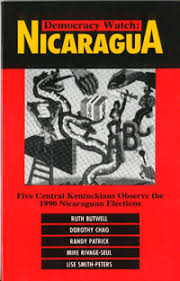
Her medium was a book we both contributed to in 1990. It was called Democracy Watch, Nicaragua: Five Central Kentuckians Observe the 1990 Nicaraguan Elections. The book recorded the journals of Ruth and four others of us who in 1990 officially observed the presidential elections in Nicaragua. Those elections had the U.S.-favored, Violetta Chamorro, defeating Daniel Ortega, the leader of the Sandinista National Liberation Front (FSLN). To this day, in some sense, I’m still reeling from the disappointment.

As I re-read Ruth’s sparkling diary and paged through the pictures in the book, vivid memories of her friendship and guidance came flooding in. There we were taking Spanish classes together, living with our working-class families, walking Managua’s dusty streets, visiting the offices of the Sandinistas and their opponents, touring farming co-ops and a prison, interviewing people on the streets, attending political rallies, talking with U.S. officials, and watching Nicaraguans vote in polling place after polling place. It was all as if she were there in the room with me as I read. And there was more. I recalled her not only as my traveling companion, but as my boss, the match-maker who brought me together with my bride of 40+ years, and as the dearest of friends.

I met Ruth Butwell in 1974, my first year at Berea College, where I ended up teaching for 40 years. Ruth was the Dean of Students at the college and therefore became my boss as I took a part-time job as the director of Dana Hall, a men’s residence there. (I also was hired to teach a section of a freshman course called “Issues and Values.”) Ruth played a big part in orienting me towards the Berea College ethos — “the Berea way.”

Very significantly, that same year, Peggy DuRivage also arrived on the Berea campus. Like Ruth, Peggy was a Michigander. The two of them hit it off immediately. In fact, the day that Ruth hired Peggy, she told her (with that twinkle in her eye) of this other Catholic who had just been hired – a former priest – whom Peggy might find interesting. (At the time, it was still unusual for Berea to hire Catholics – and even more so, a former priest.)

Of course, Peggy and I hit it off too. We got to know each other at the weekly meeting of residence hall directors chaired by Ruth in her office just off of Fairchild Hall. Ruth and her secretary and dear friend, Gloria Vanwinkle, saw what was developing between Peggy and me. (We both felt that they along with the rest of the residence hall faculty were watching us closely. Naturally, they were – and all smilingly cheering us on.)

And so, two years later, Ruth found herself generously hosting a wedding-day breakfast for Peggy and me and our guests at her home on Pinnacle Street. I remember that feast so well – a wonderful fruit salad, omelets, breads, sweet rolls, juices, coffee and teas. Ruth presided regally. Her mother was there too – and her children, John and Ann. (Then in 2016, Ruth reprised the event to help us celebrate our milestone 40th anniversary.)

But the wedding breakfast was only half the story. With the students gone in early June, Ruth allowed my mother and other members of my family, along with some friends to stay two nights free-of-charge in Dana Hall.

The night before the wedding, we threw a big party right there. The campus minister, Henry Parker, showed up. (He’d help us tie the knot the next day.) There was wine and homemade lasagna. My mother played the piano. Her signature rendition of “Bumble-Bee Boogie” was a big hit. Everybody was dancing. Peggy’s mom and dad showed everyone how to jitterbug.

No wonder Peggy and I remained close friends with Ruth even after she retired from the college around 1996. She was an important part of our life. To this day, we lovingly treasure her friendship.

All of that was great.

However, I got to know and love Ruth Butwell even more during our trip to Nicaragua. Throughout the 1980s, that tiny Central American country was in the news every day. President Reagan tried to persuade Americans that the FSLN was the incarnation of evil and and a direct agent of the Soviet Union. He said that Daniel Ortega and the Sandinistas in general were “Marxist-Leninist-totalitarian-Communist-dictators.” They were about to invade the United States through Harlingen, Texas. Reagan called the U.S.-supported counter-revolutionaries (the “Contras”) “the moral equivalent of our Founding Fathers.” Many of us who had already traveled to Nicaragua knew better. The Contras were terrorists pure and simple. The Sandinistas were champions of the country’s poor.

Ruth suspected all of that. So, when I asked her to join a fact-finding delegation that would double as election observers, she gave the invitation serious consideration. We would fund the trip, I said, by selling in advance copies of a book of the journals we’d keep during our 10-day stay in the country. And as soon as I could persuade her that the book would be of sufficiently high quality, she agreed to go. I was so grateful. Ruth enjoyed unquestioned credibility on campus as a smart, fair-minded, highly principled educator. Her contribution would help our book’s readers correct Reagan’s lies.

But those weren’t even Ruth’s main qualities. She was absolutely full of grace. She was extremely kind, optimistic, funny, and possessed of a wonderfully grounded sense of empathy and fairness – especially towards impoverished women like those we met at every turn in Nicaragua.

Her journal entries (nearly 50 pages in our book) also revealed her as a brilliant extremely perceptive writer with a gift for colorful description worthy of a wonderful novelist.

Here, for example, is the way she depicted buying a Coca-Cola on a Managua street:

“There are vendors of all kinds selling ice cream bars, Cokes, and water. We stop to get a Coke. Bottles are scarce, so the vendor is not going to part with the bottle. Instead, he has a large wooden wheelbarrow with a truck or box full of drinks perched above the wheel part. Down in the barrel is a 100-pound chunk of ice. The vendor has a metal shaving plane used at home in my dad’s shop for planning wood, but here used to shave up curls of ice from the big block. He scoops these curls up with his hand into a small plastic bag and pours a bottle of Coke or Pepsi (bottled in Nicaragua) into the bag. He deftly ties a knot in the plastic bag, collects 25,000 cordobas (about 50 cents) and hands me a brown balloon with two corners sticking up. Soon I see how to manage. I, like the others, bite off a corner of the bag with my teeth and suck the Coke out of the hole. At the same time, I push the liquid with my hands – sort of a liquid bagpipe. In the process, quite a bit escapes and trickles down my chin and shoots up my nose. Never mind. I am hot and dry and the stuff is cold and wet.”

After the Nicaragua trip, my bond with Ruth deepened through her daughter, Ann, and her son-in-law John Wright-Rios. During her sophomore year, Ann, was an outstanding student in my section of a “Great Books” course required of all second-year students. It was called “Religious and Historical Perspectives.” Subsequently, I asked Ann to be my teaching associate in the same course. And, again she excelled in that role. 

Ann’s sense of social justice and the deeply-informed “preferential option” for the world’s poor are themselves testimonies to Ruth’s own global awareness, sense of justice, and commitment to on-going growth and development. Ruth was a wonderful mother.

Yes, my life (like the lives of countless others) has been and continues to be blessed by Ruth Butwell. Again, I consider her a mentor and shining example of the best traditions Berea College has to offer the world. Neither Peggy nor I will ever forget her brightness, intelligence, sense of humor, rock-solid integrity, and deep commitment to justice and peace.

I am so grateful for her apparition in my life — and in my memory.

Yemen’s Apocalypse: The Threat (and Promise) It Conceals

western imperialism

Readings for 33rd Sunday in Ordinary Time : Dn. 12: 1-3; Ps. 16:5, 8-11; Heb. 10:11-14; Mk. 13:24-32

I hope you’re all watching what’s unfolding in Yemen.

Over the past three years, a Saudi-led coalition there, with complete endorsement and logistical support from the United States has created hell on earth. It’s the world’s worst humanitarian crisis described as absolutely “apocalyptic” by Mark Lowcock, the UN Undersecretary-General for Humanitarian Affairs and Emergency Relief Coordinator.

The reference to apocalypse is relevant to today’s liturgy of the word which features two apocalyptic readings – one from the Book of Daniel and the other from the Gospel of Mark. Your priest or minister will tell you that the excerpts are about the end of the world. But they’re not. They’re both about the end of empire.

Consequently, we who live in the belly of the world’s current imperial beast should take heed. With the affliction our government is causing in Yemen, the readings should make us tremble at the prospect of our inevitable fate.
Before we get to that, think about what’s happening in the poorest country in the Middle East.

Since 2016, bombings by the U.S.-Saudi coalition have killed more than 57,000 people in Yemen. Water supplies, and sewage treatment plants have been destroyed. Epidemics of cholera and diphtheria have resulted. Bombings of the port city of Hodeida have made it impossible for emergency relief to enter the country. And that has pushed 14 million Yemenis to the brink of famine. Fourteen million!! More specifically, 500,000 children currently face death by starvation. As a result of it all, a Yemeni child dies every 10 minutes.

Last week, House Republicans blocked Democrats from forcing a vote on the U.S. role in Yemen under the War Powers Act. Why would those who portray themselves as “pro-life” want to continue killing so many children?

The answer, of course, is: because that’s what empires do. It’s what empire’s victims have always contended with. By their very nature, empires create apocalypses.

And that brings us to today’s readings. The literary form apocalypse first appeared about two centuries before the birth of Jesus. The context for its emergence was Israel’s struggle against the Seleucid (Greek) dynasty headed by Antiochus IV Epiphanes.

In the year 168 C.E., Seleucid troops invaded Palestine and devastated Jerusalem. Antiochus hated Judaism and defiled the Jerusalem Temple by offering a pig on its altar. He also erected an altar to Jupiter in the Temple. Patriotic Jews called it “the abomination of desolation.” While occupying Palestine, Antiochus also destroyed all the copies of Scripture he could find and made it a capital offense to possess such manuscripts. It was against Antiochus IV and the Greek occupation of Palestine that the Bible’s Book of Daniel (excerpted in today’s first reading) was written. Its thrust is to predict the destruction of Antiochus’ imperialist empire. Apocalypse is resistance literature.

Writing nearly two centuries later, Mark adopts Daniel’s resistance form to describe the absolute destruction of Jerusalem that he accurately foresaw. It was very like what’s happening in Yemen. After a six-month siege, the Roman Emperor Titus, with four Roman legions finally captured the city of Jerusalem from its Zealot defenders. Moving from house to house, the Romans destroyed everything within reach, including the City’s Temple. Palestine would not again belong to the Jews until 1947. It was the destruction of Jerusalem by the Romans that Mark has Jesus predicting in today’s Gospel excerpt. It’s that sort of thing that empires have always done.

Years later – sometime in the 90s of our era – John of Patmos penned his Book of Revelation. It employed apocalypse to predict the fall of Rome – the bloody whore seated on her seven hills drinking the blood of martyrs (REV 17:6). John’s context was the persecution of Christians under the Roman emperor, Domitian. John’s prediction about Rome? Absolute devastation! Its leaders, legions and ideologues will be “thrown alive into the lake of fire that burns with sulfur” (REV 19:17-21). That inevitable fate of empires should scare the hell out of us.

However, as I’ve indicated, most of us have been led to think of such writing as describing the end of the world. And why not? It keeps us from facing what our country is doing in the world and the fate that awaits us.

The false connection between apocalypse and the end of the world has been fostered and exploited by a whole industry of empire-friendly evangelical preachers like John Hagee who appear regularly on our television screens. Their domesticated approach to apocalypse is foundational to the publishing success of the Left Behind series of books by Tim LaHaye and Jerry B. Jenkins. It is also foundational to numbing us to scriptural warnings about empire.

According to the preachers and books I’ve just mentioned, apocalypse describes a final battle between Good and Evil. The battle will be fought in the Middle East on the Plain of Armageddon. Two billion people will die as a result – including 2/3 of the Jewish people. The remaining 1/3 will be converted to Christianity because God’s final violent revelation will be so awe-inspiring and convincing. A “Rapture” will then take place, taking all faithful followers of Christ into heaven, while leaving behind the rest of humanity for a period of “tribulation.” In all of this, God is the principal actor. As an angry father, he is finally taking his revenge for the disobedience and lack of faith of his ungrateful children – whom he loves!

Problem is: all of that is dead wrong and blasphemous in terms of the God of love revealed by Jesus. The Rapture story, for instance, appeared for the first time only in the 19th century. In fact, apocalypse is not about the end of the world. It is about the end of empire – the Greek Empire of Antiochus IV Epiphanes in the case of Daniel, and the Roman Empire in the case of the Book of Revelation. The mayhem and unprecedented suffering referenced in all three sources is not something God does to the world, but what empire routinely does to people, their bodies, souls and spirits, as well as to the natural environment.

Because it has ever been so with empire, today’s excerpt from Mark called for a complete end to the politics of violence and domination. That meant obeying the command of Jesus to reject empire, but also to refuse alignment with Zealot nationalists.

As the Romans under Titus approached Jerusalem between 66 and 70, Zealot recruiters traveled throughout Palestine calling on Jewish patriots to defend their homeland by joining guerrilla forces. Instead, the words Mark put in Jesus’ mouth warned the Master’s followers to flee to the mountains (Mark 13:14-16). They were absent themselves not out of cowardice, but from apocalyptic conviction that God’s order of justice could not be established by the sword. Obeying Jesus’ direction meant that Christians were not only threatened by Romans but by Jews who accused Jesus’ followers of treason.

How should those readings affect us today whose Commanders-in-Chief repeat the crimes of the Seleucid Antiochus IV and the Romans Titus and Domitian – all of whom thought of themselves as doing God’s work in destroying what they despised as a superstitious, primitive, tribal, and terrorist religion? (Yes, that’s what they thought of Judaism!)

Today’s readings recommend that we adopt an apocalyptic vision. That means refusing to defend the present order and allowing it to collapse of its own weight. It means total rejection of U.S. imperial ambitions and practices. It means supporting cease-fire measures in Yemen, calling for total U.S. withdrawal of support from the Saudis, and refusing to treat as heroes those who advance the policies of destruction and desecration inevitably intertwined with imperial ambition. It means letting go of the privileges and way of life that depends on foreign conquest and vilification as “terrorists” of patriots defending their countries from invasion by U.S. forces. It means determining what all of that might signify in terms of our consumption patterns and lifestyles and supporting one another in the counter-cultural decisions such brainstorming will evoke.

So, in a sense, apocalypse is after all about the end of the world. The entire Jewish universe was anchored in the temple. Its defilement by the Greek Antiochus IV, its complete destruction by the Roman Titus seemed like the end of the world to the Jews. The threat of westernizing the Arab world might seem that way to the occupied Muslim world today. And the end of the American Way of Life premised on resource wars under cover of a “war on terrorism” might strike us as the end of everything we hold dear.

However, the apocalyptic message of hope is that the passage of empire and nationalism is not really the end. Instead it represents an opportunity for a new beginning. In the words that Mark has Jesus say this morning, “Do not be alarmed . . . This is but the beginning of the birth-pangs.”

How might we support one another in letting go of imperialism, nationalism and the lifestyles dependent on them?
(Discussion follows)

A Reunion of Former Priests Underlines Deep Paradigm Shifts in the World, the Catholic Church – and in Myself

Columbans

Last weekend, I experienced an event that made me realize yet again how much the world, my Catholic faith – and I – have changed over the last 50 years. All at once, I realized that my prayers had been answered: a new age has indeed dawned for us all. It’s all quite revolutionary. Paradigms that once guided me and my contemporaries both religiously and politically have dissolved before my very eyes.

The clarifying event in question was a reunion of Catholic priests most of whom were ordained in the late 1960s and early ‘70s. I was in attendance since I too had been a priest. I was ordained in 1966 – after entering training for the priesthood in 1954 at the age of 14. Unbelievably to me now, at that tender age – as a high school freshman – I had enrolled in St. Columban’s Seminary in Silver Creek, New York. With virtually no experience of the adult world, I decided to give it all up to become a priest.

I changed my mind 22 years later. I left the priesthood in 1976, 10 years after ordination (for reasons I’ve explained here, here, here, here, and here). But it all means that I had spent more than 20 years in the religious life. I don’t regret a minute of it.

The Reunion

However, with all of that baggage, I found myself at this reunion at a former seminary in Bristol, Rhode Island – a place where, in 1960, I passed the “spiritual year” that candidates for the priesthood were required to experience. There, we had made our 30-day Ignatian retreat. We learned to meditate, fast, pray and discern God’s will. Today the seminary is a residence for retired priests.

Everyone at the reunion shared such experiences, though unlike me, few had begun their training as high schoolers. But all present are or had once been members of the Society of St. Columban – an Irish missionary organization founded to convert the Chinese in pre-revolutionary China. Though originally founded for China, Columbans were expelled from the mainland after Mao Tse Tung’s revolution in 1949. Thereafter, they moved on to work in 17 different countries, including Korea, the Philippines, Myanmar, Fiji, Pakistan, and various Latin American venues. Only relatively recently have they returned to resume work in China.

About 30 priests attended last week’s event – about a third of them still active priests, while about 2/3, like me, had long since left the clergy. Many of the “formers” came with their spouses.

Every three or four years, Columbans have held such reunions since the mid 1970s. This one, however, was special, since it marked the 100th anniversary of the Society’s founding in 1918.

Like all Columban gatherings of this type, the centennial version was characterized by reminiscences, jokes, laughter, plenty to eat and drink, along with questions and answers about what we and our families have been up to over the last 50 years or so since ordination. Name tags, of course were de rigueur. Nearly all of us have changed beyond recognition.

Religious Changes

But history was in the air. And a century of work called for placing the event in that wider context. Fr. Tim Mulroy, the Society’s U.S. regional director, obliged on the meeting’s second day. His remarks connected world events over the past 100 years with profound changes not only in the Society of St. Columban, but in its umbrella institution, the Catholic Church – and in everyone’s understanding of God, priesthood, and life itself.

The changes in question were provoked more than anything by the Second Vatican Council (1962-’65), when Pope John XXIII called a meeting of all the world’s bishops for purposes of aggiornamento – for updating and modernizing the Catholic Church – for bringing it into dialog with the contemporary world. That meant embracing modern scripture scholarship and honestly coming to terms with the scientific revolution, evolution, and developments in history, psychology, economics, political theory, and related fields.

Judging by conversations with my reunion colleagues, more than a half century of living with the resulting reforms has rendered our faith as unrecognizable as our wizened and deeply lined faces.

As outlined by Fr. Mulroy, here are some examples of what I’m talking about:

• China has changed drastically; it is now part of the global village. More than ½ million Chinese students are currently studying in the United States. Nothing like that was happening in 1918. To put a finer point on the phenomenon: China is waxing as a world power; the U.S. and Europe are waning.
• Ireland has similarly transformed. Many now even speak of that famously Catholic country as a post-Christian society. The clerical pedophilia scandals are largely responsible for Ireland’s loss of faith, though the transition from a basically rural culture to a more urban, globally-integrated one bears at least equal responsibility. It has introduced a level of materialism never before seen in Ireland.
• The teachings of Vatican II about the salvific value of other religions has called into question the very purpose of missionary endeavor. If, as the Council taught, Buddhists, Muslims, Hindus and tribal peoples all have valid understandings of God and can be “saved” (whatever that means), there doesn’t seem to be much point in trying to convert them.
• The internet has underlined that same point. Moreover, the new atmosphere created by social media means that a strong on-line presence for groups like the Columbans has become even more important than preaching effective Sunday homilies.
• The priesthood has also changed. Again, pedophilia along with Vatican II’s revised theology emphasizing a “priesthood of the laity” has taken priests off the pedestal they once occupied. In the Society of St. Columban, there hasn’t been an ordination either in Ireland or the United States since the year 2000.
• Of necessity then, Columbans have become less western. In fact, there are now two classes of Columban priests: the over-fifties and the under-fifties. The over-fifties are found in Ireland, the United States and in Australia. Most of them are either in or about to enter nursing homes. Meanwhile, the under-fifties typically come from Korea, the Philippines, Peru, Fiji and Brazil. Gradually, they find themselves working in the United States and Ireland evangelizing the now-secularized countries whose priests once evangelized them! Global South clergy working in the U.S. bring with them understandings of mission, life, and family very different from what their new audiences have grown to expect.
• All of the changes just listed have meant that English-speaking Columbans (for reasons of self-preservation) are gradually transitioning towards membership in a lay missionary organization. And fully 80% of its new members are female. One can only imagine what this means in terms of altering the extremely macho, patriarchal culture I experienced growing up in a Columban seminary!

In sum, the centennial celebration of our clerical group caused all of us to face the undeniable fact that our world has been drastically transformed. The Catholic Church has changed along with it. So has the Missionary Society of St. Columban along with all of its members and former members. The last 100 years (and especially the last 60 or so) have altered our understandings of God and the meaning of life.

Spiritual Changes

Take my own case.

When I began my priestly odyssey, my faith was simple. I was certain that God was “up there.” His word was revealed in the Bible whose truths were infallible and valid for all time. I knew for a fact that the Catholic Church was in sole possession that book’s true meaning. My purpose as a missionary-in-training was to get others to see that truth, so, like me, they might get to heaven.

The “holy sacrifice of the Mass” was all important then. I believed that the words of a priest could call Jesus down to enter a piece of bread and a cup of wine. I believed in Jesus actual presence in the tabernacle of every Catholic church where I might literally sit before him and “visit” as I would an intimate friend. Similarly, a priest’s words of absolution spoken in the confessional could open the gates of heaven to sinners previously on the road to hell.

Sin, judgment, heaven and hell were inescapable preoccupations for me. My focus was on the after-life. The priesthood was a divine calling that would make me “another Christ.” What a singular privilege!

Today, I can believe none of those things with the simplicity of faith I once enjoyed. Instead, my idea of God has become belief in the universal presence of a creative Life Force in whom (as St. Paul put it) we live and move and have our being (ACTS 17:28). Other religions are just as valid and questionable as Christianity. I have no idea what happens after death. Heaven and hell are this-worldly realities shaped either by love on the one hand, or fear on the other. Like almost all other Catholics, I’ve given up going to confession. And my commitment to daily meditation has replaced the importance I once gave the Eucharist. I’ve been driven away from the latter by priests still promulgating a vision I can no longer endorse.

Political Changes

All of this, I believe, represents not only a profound paradigm shift, but a kind of liberation. Its process has been a gradual coming of age that is paralleled by a similar shift in the political realm.

During the reunion, that political change was reflected in conversations with my former colleagues in the seminary and priesthood. Almost to a person (there were a few exceptions), everyone was completely scandalized by Donald Trump and his politics that have impacted so negatively the migrant communities to whose welfare (according to Fr. Mulroy) all Columbans are committed. I mean, political remarks at our gathering were more critical and negative about the United States than I’ve ever heard before at similar gatherings.

It all suggested that at least many of my Columban friends had gone through political paradigm shifts like my own. Again, without speaking for others, let me admit my own swing from right to left. My friends may have experienced something similar.

Growing up, of course, and at least till my late twenties, I was a good American and quite conservative. That shouldn’t be surprising, since the pre-Vatican II American church responsible for my seminary education was so conservative, anti-communist and patriotic. As a result, I believed that the United States was a force for good in the world and that it had always been so.

Only afterwards, did events and study correct such misperceptions. For me, the catalyzing elements included:

• The Vietnam War
• The Civil Rights Movement
• Women’s liberation movements
• Study of Global South, post-colonial theologies
• Travel and study in Rome (and across Europe), Brazil, Nicaragua, Guatemala, Costa Rica, Mexico, Cuba, South Africa, Zimbabwe, Israel, and India.

All such experiences gradually revealed to me the truth of Martin Luther King’s identification of the United States as the greatest purveyor of violence in the world – and (I still find it shocking to write this for a polite audience) the challenge of the Nicaraguan Sandinista meme that the United States is “the enemy of mankind.”

Conclusion

A sad highlight of the reunion I’ve just recounted was a meeting with a former mentor of mine. Fr. Dan remains a Columban priest and at the age of 92 resides in the Society’s nursing home in Bristol. For the past few years, dementia has robbed him of his memory to the extent that in our meeting last week, he was unable to remember me or the time we shared in Rome, where we both completed our formal studies. (There, Dan had given me sound advice as I contemplated leaving the priesthood for which I had prepared since the age of 14. I remain extremely grateful for his wise counsel.)

In any case, Dan was always a maverick and I loved him for that. One time, he announced that if he ever made the rank of bishop (fat chance!) the slogan on his coat of arms would be “No more bullshit!”

As I left our reunion last week with the reflections and insights just shared, I couldn’t help thinking of the relevance of Dan’s motto. It applies to church and state as I’ve experienced them over my 78 years. Over those years, both the Catholic Church and the U.S. government have exposed us all to great quantities of b.s.

Thankfully, the events of the past hundred years (especially since Vatican II) have empowered us to leave much of that behind while retaining the friendships and quasi-family ties that have characterized the Society of St. Columban. The evidence I encountered in Bristol last week shows that (despite the ancillary uncertainties) we’re all better off for the process.

I’m grateful to my Columban brothers (and sisters) for the experience of last week, and for the continued friendship and support that have enabled us all to more or less approximate Dan’s ideal.

The Triumph of Socialism: Is My Family Squabble Like Yours?

Socialist Programs

Whenever I’m with my liberal Gen-X sons, the conversation inevitably turns towards the topic: capitalism vs. socialism. They see me as a socialist – a product of my times rooted in the post-depression era and in the 1960s.

Similarly embedded in the Reagan counter-revolution, they argue that socialism is hopelessly impractical. Their arguments echo Margaret Thatcher’s famous dictum about capitalism, “There is no alternative.”

“Just give me one example of any country in the world where socialism has worked,” they demand. . . “See, you can’t,” they continue triumphantly, “because socialism might be great in theory, but it never works in practice.”

Well, I’m tired of that conversation. My dear partners never listen when I mention Sweden, Norway, Denmark, or Iceland. They don’t hear me out when I cite the wildly successful Mondragon workers’ cooperative in Spain. “Never heard of it,” they say.

Even more: they can’t even entertain the possibility that Cuba in comparison to other former colonies is actually the envy of most peers in Africa, Latin America, South Asia – and yes, Puerto Rico, which is part of the capitalist United States. People in Puerto Rico are far worse off than in Cuba. Of course, that’s because of the latter’s socialist system of education, health care, environmental protection, centrally-planned hurricane measures, efficient first-responders, and housing. And this despite decades-long, extremely active efforts by the United States and CIA to make the island’s economy scream.

So, in my argument here that socialism actually does work, I promise to minimize mention of those tired examples. Let me instead take the bull by the horns and simply say: socialism has worked in Russia, China – and (get ready) here in the United States.

There, I’ve said it. Now let me make my case.

[Before I get into that, however, allow me a word of clarification about capitalism and socialism themselves.

Neither system exists in any pure form. I mean, if we understand the three basic elements of capitalism to be (1) private ownership of the means of production, (2) free and open markets, and (3) unlimited earnings, we must conclude that the system exists nowhere outside the world’s black markets. (And everyone considers those to be somehow criminal.)

Instead, especially since the Great Depression, all we have are mixed economies – i.e. blends of capitalism and its opposite on every point, viz. socialism. More specifically, I’m referring to capitalism’s inclusion of socialism’s own three basic elements: (1) public ownership of the means of production, (2) controlled markets, and (3) earnings limited by income ceilings or redistributive taxes. This means that Sweden has a mixed economy, so does Russia, China, Cuba – and the United States.

That is, at least since the 1930s, the world has agreed that capitalism cannot succeed without incorporating elements of socialism. And so, we have the U.S. government filling the role of the country’s largest land-owner; we find ourselves cherishing the Social Security System; and then there’s the IRS. . . Similarly, socialism cannot make it without absorbing the capitalist components of private ownership, markets, and incentivized incomes.

Does this mean that all economies are the same? Obviously, not.

No, what distinguishes the mixed economy of Cuba, for example, from our own, is that Cuba’s is mixed in favor of the working classes, while our economy in the U.S. is mixed in favor of the rich (on the familiar theory that the wealth they “create” will eventually trickle down to the rest of us).

In other words, what my debate with my sons is really about is this: can I offer an example of economies mixed in favor of the poor that have actually worked?

My answer is, of course, that I can.]

So, let me proceed.

Begin with Russia. Yes, Russia. When its revolution triumphed in 1917, it was the most backward country in Europe. Moreover, after the revolution, it faced not only its own civil war but invasions by anti-socialist forces including troops from the United States, Great Britain, France, Japan, Italy, Romania, Greece, Poland, China, and Serbia. At the time, Winston Churchill said that the point of such incursion was to “strangle the baby in its crib.”

Add to that the fact that following World War II, Russia lay in ruins from Hitler’s devastating invasion. Nonetheless, the country’s heroic resistance to Nazism not only was the key element in defeating the Third Reich; it had cost Russia 20 million lives. Greater devastation can hardly be imagined, especially for a country attempting to emerge from cruel Czarist feudalism and to implement a system never before tried on a national scale.

However, despite such overwhelming set-backs, after only 40 years of “socialism,” the USSR assumed the position of the world’s second leading super-power. It was treated as a peer and rival by the United States, Japan and the rest of Europe. That is to say: in purely economic terms, Russia enjoyed success that was historically unprecedented.

In fact, the rapidity of its development remained unsurpassed anywhere in the less developed world – until the emergence of “socialist” China whose largely controlled economy today dwarfs that of the U.S. and Europe in terms of annual growth percentage.

None of this is to say that huge mistakes were not made by both Russia and China. Like the victims of capitalism, for instance in Dickensian Manchester and Liverpool, labor paid a huge price as an emergent system’s leaders attempted to develop a new economic form – industrial capitalism in Manchester, socialism in Leningrad and Peking.

The reason for such failures is obvious. All economic systems develop by trial and error. For instance, in Russia, socialist theoreticians had thought that the root of worker exploitation was found in greedy captains of industry. Replacing them with government officials would solve that problem. It didn’t. Instead, workers soon awoke to find that they had merely exchanged one set of oppressors for another. Very little had changed for them on the factory floor. After Stalin, Nikita Khrushchev was about changing that. So was Mikhail Gorbachev. In the end, though, it was all too little, too late.

In spite of that, however, the rapid economic successes of both Russia and China must be acknowledged. In this country, they never are.

But even more importantly, what is never acknowledged here in the U.S. is the success of those elements of socialism that were incorporated into our economic system with Roosevelt’s New Deal.

Recall that after the Great Stock Market Crash of 1929, capitalism was in its death throes.

Emboldened by the collapse, the U.S. Communist Party along with the country’s two strong socialist parties and powerful trade unionists led by the CIO (Congress of Industrial Workers)pressured F.D.R. with the following proposition: “Either you persuade your fellow upper-class Wall-Streeters to meet our (socialist) demands or you’ll be forced to accept a revolution here like the one in Russia.”

Roosevelt and most (though by no means all) in his economic class, found the argument distasteful, but persuasive. The result was the New Deal with all its socialist programs including Social Security, legalized unions, minimum wages, consumer and worker protections, universal public schooling, environmental protection, government-sponsored jobs programs, and eventually a G.I. Bill that provided free university education and healthcare for veterans.

The New Deal created a large middle class with an unprecedentedly high standard of living. That represented a triumph not principally for the capitalist component of the U.S. mixed economy, but for its socialist elements.

In other words, the U.S. provides a shining example of a place where socialism has worked.

But there’s more.

During times of extreme crisis represented by a truly threatening war such as WWI and WWII, even the most ardent defenders of “capitalism” in our country have chosen to implement “war socialism.” That is, they chose military conscription, wage and price controls, rationing, and direction of privately owned productive facilities away from luxury goods towards military manufacture. They chose to do so evidently because the central planning embodied in such measures is far more efficient than laissez-faire “capitalism.”

And finally, even Wall Street bankers, when it’s a question of their own survival, will opt for socialist programs every time. That was illustrated during the Great Recession of 2008. With the capitalist economy in its worse condition since the Great Depression, the Wall-Streeters all came to the government with hat-in-hand. They wanted a bailout that completely contradicted capitalist theory. The latter would have the inefficient among them fail only to be replaced by something better. That’s capitalist theory.

Behind the bankers’ socialist begging, however, was the implied recognition that such theory really doesn’t work. In fact, their petitions for bailout suggested that the actual implementation of capitalist principles would do irreparable harm to the world’s economy. It would ruin us all!

Keep all of this in mind the next time you get into an argument about capitalism vs. socialism:
• Neither system exists in its pure form.
• It is questionable whether either ever did exist.
• All the world has are mixed economies.
• The question is: will a particular economy be mixed in favor of the rich or the poor.
• Economies mixed in favor of the poor have historically proven more efficient in times of national crisis,
• And in raising the tide that lifts all boats.
• That’s been demonstrated in Russia, China, Cuba – and even in the United States.

I’m hoping my Gen-X sons (who btw have unsubscribed from my blog) may one day transcend their unconscious Reaganite roots to read and ponder this particular entry. At the very least, it supplies context for our interminable debate.

The ‘80s War in Central America Never Ended: Today’s Refugees Are the Result

CIA Drugs

Yesterday, on Amy Goodman’s “Democracy Now!” I heard an interview with Jennifer Harbury. She’s a lawyer and human rights activist whose husband was tortured and murdered by the Guatemalan military during its 1980s war against that country’s own population. In that U.S.-supported conflict, more than 200,000 mostly Mayan indigenous were slaughtered. In 1999, President Clinton apologized to the world for what has been described as U.S. support of genocide.

In the clearest of terms, Ms. Harbury described not only her husband’s torture and the Guatemalan catastrophe. Even more importantly, she explained in the clearest of terms, the connections between our current refugee and immigrant crisis on the one hand and the war against the drug trade on the other.

The story goes like this.

During the 1980s the Reagan administration followed by the Clintons waged illegal wars against Guatemala, El Salvador, Nicaragua, and Honduras. The ostensible idea was to stop the spread of communism in tiny countries whose brutal military dictatorships the U.S. had supported for decades. Atrocities by the Guatemalan army prevented starving poor people from trying a way other than obeisance to dictatorships in order to feed, nourish and educate their children.

To fund those illegal wars, the CIA sold drugs. They got them from places like Colombia, Costa Rica, and Mexico. They peddled them through street gangs located in the United States. In the process, Central American military intelligence officers – “assets” trained in the School of the Americas and equipped by the CIA – got very rich.

When the 1980s wars in Central America officially ended, the now-unemployed CIA assets wondered how to continue raking in their money. The obvious solution was to keep doing what they had done as long as they could remember – to terrorize, torture and slaughter their own people. But this time they did it without the benefit of the anti-communism fig leaf. They committed mayhem without lofty pretense – just for the money and to protect the drug trade. The profits remained huge.

In other words, the former CIA assets never finished their U.S.-funded wars against their own. They just formed drug cartels – brutal gangs exquisitely trained in torture and armed to the teeth by the United States. And the kicker was, they enjoyed virtual immunity from prosecution by the U.S. government and its celebrated “War on Drugs.” That’s because the latter’s policy is always (when possible) to protect assets who in the past have served it well.

That’s right: contrary to what Attorney General Sessions tells us, the cartels are not apolitical “street gangs.” They’re not super-predator kids. They are business men with military training and friends in very high places. Their identities are well-known and documented in U.S. government files. But those records remain closed to the public.

So, instead of prosecuting the legally invulnerable drug king-pins, the United States has decided to prosecute their victims – the Central American and Mexican refugees stuck on the border between Mexico and the United States. These include farmers who refuse to grow drugs, young men opting out of membership in drug gangs, businesses owners choosing not to cooperate, people who “know too much,” social-justice activists, women who object to their husbands’ or sons’ involvement, reporters documenting the cartels’ atrocities, academics and researchers – and all the consequently endangered families, along with those “tender age” children stuck in border concentration camps, black sites, and baby jails.

All of them should be protected by laws shielding such refugees. The United States is signatory to many such provisions.

So, what should be done in the face of these clear facts? It’s not as hopeless as you think:

• Begin by observing the law: take in those refugees as stipulated by U.S.-sanctioned international law.
• Release the documents identifying the CIA assets-turned-cartel-gangsters.
• Arrest, try and imprison them.
• Using the same documents, identify the CIA and other government officials responsible for funding the 1980s Genocide Wars with drug money.
• Arrest, try and imprison them as well even if they once held (or even now hold) the highest of offices.
• Defund the drug war.
• Instead, spend its plenty on rebuilding the countries the United States has destroyed by more than a century of supporting dictators, genocidal wars, and by its tolerance and protection of drug cartels and lords.
• In so doing, remove the cause of the current “refugee and immigrant crisis.”