Mary’s “Virginity”: Its Warning about Donald Trump and Sexual Assault by the Military (Sunday Homily)

sexual-assault

 Readings for 4th Sunday in Advent: IS 7:10-14; PS 24 1-6; ROM 1: 1-7; MT 1: 18-24.

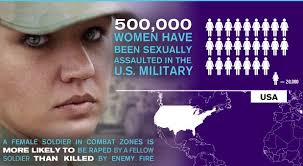
Do you ever wonder what effect Donald Trump’s proclivity for sexual assault might have on the problem of military rape? After all, his racist, sexist, and xenophobic comments along with his personal behavior have already emboldened copycat words and actions by many of his followers including schoolchildren. Will Mr. Trump similarly embolden enlisted men and officers to follow the example of their Commander-in-Chief?

That question becomes relevant on this Fourth Sunday of Advent because the readings for today emphasize Jesus’ “virgin birth.” Such emphasis resurrects a persistent tradition identifying Mary’s “miracle” as the result of military rape.

If that tradition were true, what light would it shed on the problem of rape in the military in connection with the example of its Commander-in-Chief?

Let me put that question in context by offering some background for today’s reading from Matthew along with a reference to the selection from Isaiah traditionally seen as a prophecy of Jesus’ virginal conception.

To get from here to there, try to understand the situation of Joseph and Mary as young marrieds in a context of imperial aggression. They’re a teenage couple; they are poor and living in an occupied country. Joseph is a jack-of-all-trades – that’s what the Greek word we translate as “carpenter” meant in first century Palestine. Like everyone from his class, he was unemployed most of the time. But he’d fix your leaking roof if you hired him. When he could, he’d harvest grapes and wheat for local landlords.

And he was probably deeply involved with the local insurgency against Roman occupation. (Nearly every impoverished patriot is in such situations.) Additionally, the only commentary we have on Joseph’s character is Matthew’s single word “just.” He was a just man. (By the way, his son, James – the one who headed the Jerusalem church following his brother’s death – was also known as “James the just.”) In the Hebrew culture of Jesus’ day, justice meant taking the side of the powerless. It appears to have been a central value Joseph passed on to his children.

As resisters, Joseph’s kind would have been considered terrorists by the Romans. In fact, the very year in which Jesus was likely born (6 BCE) Galilee’s countryside would have been crawling with Roman soldiers fighting against people like Jesus’ supposed father. The occupiers were busy laying siege to the city of Sepphoris, the capital of Galilee – a mere hour’s walk from Joseph’s village.

There the insurgency had taken a decisive stand against Rome’s puppet, King Herod. And like Americans in Iraq’s Fallujah under “Mad Dog” Mattis, the Romans were determined to make an example of the city by laying it waste utterly. Before their final offensive, that involved night raids, kicking in doors, and raping young Jewish girls. (All forces of occupation – including our own today – know the drill.)

In any case, according to that persistent tradition about her “virginity,” that’s where Mary came in. She was a young teenager about 12 or 14. Although she eventually became Joseph’s “dream girl” (MT 1:18-25), she was probably linked with him by the village matchmaker perhaps when they were both still toddlers. They had not yet begun to live together, because they were probably waiting for Mary to come officially “of age” – able to bear children.

Be that as it may, Mary suddenly finds herself pregnant out of wedlock. Can you imagine her worry? Innumerable teenage girls can relate to her panic – and disgrace. Obviously, Mary did not want to be just another of her community’s “virgins.” [Matthew’s term “parthenos” (virgin) to refer to Mary was often connected with children of unknown paternity. Such offspring were disparagingly called “virgins’ kids.” “Virgin” is what (behind their hands) local matrons called an unwed mother.]

According to the story, Joseph too shared Mary’s disgrace and embarrassment. He wanted a divorce (i.e. release from his commitment to marry). And he probably demanded it with the anger and recrimination that are inevitably associated with the dreaded “d” word.

Joseph’s anger, suspicion, and thoughts about divorce may also have come from his hatred of the Romans. (And here comes that persistent tradition about Mary’s “virginity.”) It even remembers the rapist’s name. According to Celsus’ “True Doctrines” written about 178 C.E., the rapist was called “Panthera.” That was also the name of one of the Roman legions involved in that siege of Sepphoris.

Such suspicious circumstances around Jesus’ questionable conception also find some support in John’s gospel, where Jesus is called a “Samaritan” (8:48). That was a harsh term equivalent to our “bastard.” Additionally, Mark refers to Jesus simply as “Son of Mary” (6:3) – a quite unusual reference in a culture where children were identified by their father’s name.

With all of that in mind, and if Celsus’ tradition has merit, it’s easy to understand how the thought of taking up with a girl defiled by a Roman “pig” (what Jews called the occupiers) probably turned Joseph’s stomach. No wonder he wanted a divorce.

That is, if the tradition has merit . . .  You see, we can take our pick here. And that brings me to the point about the historical veracity of the stories around Jesus’ birth: all of the traditions are entirely questionable as far as historical fact is concerned.

For instance, the familiar account of Jesus’ virgin birth is found only in two of the canonical gospels (Matthew and Luke). Mark and John make no mention of it. That means that they either didn’t know about the tradition, or Mark and John didn’t think it important enough to include. (By the way, if Jesus’ conception was as miraculous as we’ve always been taught, how likely is either of those alternatives?)

And then there’s that business – recounted in today’s first reading – about Isaiah’s supposed prediction of Jesus’ virginal conception. Matthew takes Isaiah’s words completely out of context.

Actually, Isaiah’s not referring to Jesus at all, but to his own time more than 500 years earlier. And the Hebrew term he uses is not the equivalent of “virgin.” That’s a mistranslation. The word the prophet employs simply means “young girl.” Isaiah’s prediction is that a “young girl” of his own time will conceive. The prophet’s words had nothing to do with Jesus or virgin birth.

The point here is we’re not dealing with “history” in the story of Jesus’ virgin birth. Instead we’re confronted with a miraculous “birth story,” – a literary genre that characterizes accounts of virtually all “Great Men” in the ancient world. Its point is that God’s Spirit entered into Jesus from the very outset – long, long before his actual birth.

In that light, historically speaking, rape is a much more likely explanation of Jesus’ conception than intervention by the Holy Spirit. Think about it. That’s simply a fact.

How then was Jesus begotten? If Joseph was his father, we understand how Jesus was so concerned with social justice. And through this pre-birth story we can hear (once again!) a summons to learn from Joseph the way Jesus and his brother James did. It’s also a reason for re-evaluating our culture’s drumbeat of indoctrination against “terrorists.” Jesus came from a family the Romans would have considered terrorist.

If Panthera humiliated Jesus’ mother (and Joseph), and Jesus was the product of rape – and if rape is an inevitable strategy of war – then that’s an additional reason for pressuring the U.S. military to aggressively investigate and punish perpetrators of military rape. It’s also a reason for refusing to honor the U.S. military in general, for opposing war, working for peace, and appreciating Jesus’ solidarity with the poorest of the poor.

Finally, it’s yet another cause for reflection on the unsuitability of Mr. Trump as Commander-in-Chief. Predictably, his example will embolden soldiers to objectify, demean and rape the ones the president-elect termed“fat pigs, dogs, slobs, and disgusting animals.” It is certain that the Roman military made similar characterizations of Jewish girls like Jesus’ mother.

The bottom line here is that (as Pope Francis would have it) if we’re not resisting war, military culture in general, its Commander-in-Chief and working for peace, our observation of this Christmas season is pure theater and sham.

If You Think Jesus Approves of GOP Policies towards the Poor, Here Are Two Riddles for You . . . (Sunday Homily)

trump-christian

Readings for Third Sunday of Advent: IS 35: 1-6A, 10; PS 146: 6-10; JAS 5: 7-10; MT 11: 2-11

If Trump cabinet nominations are any indication, the president-elect will continue pursuing what have long been the GOP’s two main domestic goals. They are eliminating labor unions and cutting social services such as Food Stamps and Medicaid. Even Trump Republicans (led by their groper-in-chief) will do so while at the same time invoking values they call “Christian.”

Today’s liturgy of the word shows that the GOP position flies in the face of the entire Judeo-Christian tradition expressing (as it does) God’s special concern for the poor and oppressed.

More specifically, the readings demonstrate that the anti-poor policies of the Christian right are actually a slap in the face to Jesus himself. That’s because (once again) in today’s selections, the recipients of God’s special concern turn out to be (in Jesus’ words in our gospel reading) not just “the least.” Rather, in their collectivity, they are identified with the very person whom our sisters and brothers on the right aspire to accept as their personal Lord and Savior.

The vehicle for today’s version emphasizing Jesus’ identification with the poor is a riddle. It’s found at the very end of that reading from Matthew. Matthew has Jesus posing it by saying:

  1. John the Baptist is the greatest person ever born.
  2. Yet the least in the Kingdom of God is greater than John.

That leaves us with the question: How can this be? How can “the least” be greater than the one identified by Jesus himself not only as the foremost prophet of the Jewish Testament, but the greatest human being who ever lived?

In the context of Matthew’s gospel, the answer is the following:
1. Jesus is the one far greater than John. (As the Baptist admitted in last week’s reading from Matthew, John was not even worthy to loosen the straps on Jesus’ sandals.)
2. But Jesus identified himself with “the least.” Recall that in his parable of the last judgment (Matthew 25), Jesus says, “Whatever you did to the least of my brethren, you did to me.”
3. Therefore the “least” as identified with “the greatest” (Jesus) is greater than John and should be treated that way – as Jesus himself.

Riddle solved. The rest of today’s liturgy adds the details as it develops the theme: recognize the least as God’s favorites – as Jesus himself – and treat them as the most important people in the world.

And who are these “least?” According to Isaiah in today’s first reading, they are the blind, deaf, lame, and mute. They are ex-pats living in exile. The psalmist in today’s responsorial, widens the list by adding the oppressed, hungry, imprisoned, and immigrants. He includes single moms (widows) and their children.

In today’s gospel selection, Jesus recapitulates the list. For him “the least” (who are greater than John) include the imprisoned (like John himself sitting on Herod’s death row). They are (once again) the lame, the deaf, the mute, and lepers. They even include the dead who are raised to life by Jesus.

Do we need any more evidence to support the biblical authenticity of what Pope Francis continually references as God’s “preferential option for the poor?”

Does the Christian Right believe the teaching contained in Jesus’ riddle?

Well, maybe not. I mean, here’s another riddle for you: How can Christians oppose labor unions and eliminate Food Stamps and Medicaid, while still calling themselves followers of Jesus?

Sorry: I can’t solve that one.

On Joining John the Baptist in Rebellion against the Religious Establishment – and Trumpism (Sunday Homily)

dangerous

Readings for Second Sunday of Advent: IS 11: 1-10; PS 72: 1-2, 7-8, 12-13; ROM 15: 4-9; MT 3: 1-12

“The meaning of the Incarnation is this: In Jesus Christ, God hits the streets. And preparing for that is the meaning of Advent.” (Jim Wallis. “Advent in 2016: Not Normal, Not Now, Not to Come.”)

__________

A few days ago I published a review of James Patterson’s novel, Woman of God. It’s the story of Brigid Fitzgerald, a medical doctor who though female, becomes a priest and candidate for the papacy.

Brigid and her husband (also a dissident priest) decide to form their own Catholic parish. They do so because of the studied irrelevance of the Catholic Church to pressing problems of the real world. The two call their congregation the “Jesus, Mary and Joseph (JMJ) Church.” They insist on remaining Catholics not allowing their opponents to drum them out of the church as just another break-away Protestant sect.

The JMJ Church spreads rapidly, largely because it connects Jesus’ Gospel with issues of peace and social justice. And though vilified by her local bishop and physically threatened by right wing Catholics, Brigid eventually becomes widely celebrated and is summoned to Rome not for condemnation, but papal approval.

I couldn’t help thinking of Woman of God as I read today’s liturgy of the word this Second Sunday of Advent. Like the JMJ Church, the first two readings along with the responsorial psalm emphasize the connection between faith and social justice.

Then in today’s Gospel, the prophet, John the Baptist, like Brigid Fitzgerald, initiates an alternative community of faith far from the temple in the desert wilderness. John’s credibility leads “all Jerusalem and Judea” to see him as a prophet. In fact, (as John Dominic Crossan has pointed out) John becomes for the Jewish grassroots their de facto alternative “High Priest.”

To see what I mean, consider that first selection from the prophet Isaiah. It directly links faith with justice for the poor, oppressed and marginalized. In Isaiah’s day (like our own) they were typically ignored. By way of contrast, Isaiah’s concept of justice consists precisely in judging the poor and oppressed fairly and not according to anti-poor prejudice – in Isaiah’s words, not by “appearance or hearsay.”  (A clearer statement against contemporary police and/or government profiling can hardly be imagined.)

Not only that, but according to the prophet, treating the poor justly is the key to peace between humans and with nature. Centralizing their needs rather than those of the rich produces a utopian wonderland where all of us live in complete harmony with nature and with other human beings. In Isaiah’s poetic reality, lions, lambs, and calves play together. Leopards and goats, cows and bears, little babies and deadly snakes experience no threat from each other. (This is the prophetic vision of the relationship between humans and nature – not exploitation and destruction, but harmony and mutual respect.)

Most surprising of all, even believers (Jews) and non-believers (gentiles) are at peace. Today’s excerpt from Paul’s Letter to the Romans seconds this point. He tells his correspondents to “welcome one another” – including gentiles – i.e. those the Jewish community normally considered enemies. (That would be like telling us today to welcome Muslims as brothers and sisters whom God loves as much as any of us.)

Today’s responsorial psalm reinforces the idea of peace flowing from justice meted out to the “least.” As Psalm 72 was sung, we all responded, “Justice shall flourish in his time, and fullness of peace forever.” And again, the justice in question has the poor as its object. The psalmist praises a God and a government (king) who “rescue the poor and afflicted when they cry out” – who “save the lives of the poor.”

In his own time, the lack of the justice celebrated in today’s first three readings infuriates Jesus’ cousin, John the Baptist. His disgust forces him out of the temple and into the desert. It has him excoriating the religious leaders of his day as a “brood of vipers.”

Unmistakably clothed as a prophet – in garments that absolutely repudiate the “sacred garb” of his effete opponents – John lambasts the Scribal Establishment which had normalized relationships with the brutal occupation forces of Rome. As opposition high priest, John promises a religious renewal that will lead to a new Exodus – this time from the power of Rome and its religious collaborators.

I hope you can see as I do the parallels between the context of John’s preaching and our own. We live in a culture where those in charge contravene our faith by openly slandering the poor and marginalized celebrated in today’s readings as especially dear to God. I mean since November 8th, all the levers of power (the presidency, the Supreme Court, the House and Senate) find themselves in the hands of billionaires and their friends – the 1% that the Occupy Movement identified so accurately five years ago. Ironically that richest 1% has succeeded in scapegoating the country’s poorest 1% (immigrants) as a major cause of our country’s problems. Moreover, they equally vilify other poor and marginalized people: the impoverished in general, brown and black-skinned people, women, the LGBTQ community, environmentalists, protestors and anyone who exposes the crimes of the billionaire class.

As a result, we are about to enter a period of unprecedented national darkness that promises to rival that of Germany, 1933-1945. For at least the next four years our country will be controlled by an organization Noam Chomsky calls “the most dangerous in the history of the world.”

More dangerous than the Nazis? Yes, Chomsky insists. Hitler did not have the power to destroy the planet by nuclear war. Hitler ruled Germany before climate change threatened innumerable species, Mother Earth herself, and continued human existence. And yet the entire Republican Party denies that the problem even exists! Yes, it is the most dangerous organization in the history of the world.

And despite all of that, there’s not a peep about it from the pulpit. People keep going to Mass as though the most important upcoming event is the arrival of St. Nicholas at the parish potluck – or the Christmas bazaar.

So what should we do in the face of such disconnect?

How about following the example of John the Baptist, Brigid Fitzgerald and her husband?

This would entail:

  • Admitting that present forms of church are hopelessly disconnected from the unprecedented tragedy and threat represented by the accession to power of anti-poor climate change deniers.
  • Publicly moving out of our local church building.
  • Perhaps, opening a store front JMJ Catholic church on the Main Street Jim Wallis referred to in his article referenced above.
  • Inviting former Catholics, college students, and other disaffected church members to join.
  • Publishing the invitation in local newspapers.
  • Meeting in the store front for Eucharist each Sunday at the very times the local church celebrates Mass.
  • Empowering faithful women in the JMJ community to preach and celebrate the Eucharist.
  • Gathering in the storefront on Wednesday evenings for prayer and to plan the week’s acts of resistance to Trumpism in all of its manifestations.
  • Using those premises as a sanctuary for the bottom 1% threatened by ICE and police.

Objectors will say:

  • We have no authority to do this.
  • It’s better to continue our reform efforts from within.
  • This will only cause division in our church.
  • The status quo really doesn’t bother me, because I use the quiet provided by Sunday Mass to facilitate my own prayer life.
  • (If, like me, you’re of a certain age) I’m too old for such radical disruption of my life.

To such objections John the Baptist might reply:

  • “I had no official authority to start my desert community of resistance and reform. In fact, I was identified by the authorities as an enemy of the state. Eventually they cut off my head. So don’t expect approval.”
  • Reform from within? “I gave up on that early on. So did my cousin, Jesus. Both of us operated outside the temple system which we criticized harshly.”
  • Division in our faith communities? “That didn’t bother me either. Can you get much more divisive or polarizing than calling religious leaders a ‘brood of vipers’?”
  • Withdrawing into personal prayer? “The spiritual masters in my Essene community convinced me that prayer and meditation are essential elements undergirding prophetic action. However, pietism is useless unless it leads to the kind of witness I gave and risk I took on the banks of the Jordan.”
  • Too old? “Again, my Essene mysticism would not permit me to identify with the physical as if I were primarily a body with a soul. The truth is that we are first of all ageless spirits who happen to inhabit temporary bodies. The imperative for action is no less incumbent on older people than on the young. Hell, the elders criticized me for being too young to oppose them. I was barely 30 when they killed me.”

Again, as Jim Wallis has intimated, the specter of John the Baptist should haunt us this second Sunday of Advent, and drive our faith communities onto Main Street. These unprecedented times call for radical response outside the sacred precincts and independent of the sleepwalkers awaiting the arrival of St. Nicholas.

Trump’s Republicans Are “The Most Dangerous Organization in the History of the World” (Sunday Homily)

climate-change

Readings for First Sunday in Advent: IS 2: 1-5; PS 122: 1-9; ROM 13: 11-14; MT 24: 37-44

It’s impossible for thoughtful homilists not to be stopped dead in their tracks by the opening words of today’s Gospel selection.

Jesus said to his disciples:
“As it was in the days of Noah,
so it will be at the coming of the Son of Man.                                                                                       In those days before the flood,
they were eating and drinking,
marrying and giving in marriage,
up to the day that Noah entered the ark.
They did not know until the flood came and carried them all away.
So will it be also at the coming of the Son of Man. . .”

Of course, everyone knows the Noah tale. There God warned the great patriarch that a huge flood was coming to destroy the earth, because its inhabitants had become so violent.

Presumably, Noah shared such forewarnings with his contemporaries – or at least with those wondering why he was constructing so mammoth a vessel. Apparently no one listened. You might even say they were in denial about the coming deluge. But the disaster came anyway and swept them all away.

Jesus’ words seem unmistakably pertinent to themes of climate change today — particularly in a context where USians have just elected a climate change denier to the White House and have given control of all branches of government to a party of “representatives” who refuse to recognize that humans can or should do anything about predicted natural disasters that threaten to completely replicate the catastrophe recounted in the legend of Noah and his Ark.

Such denial has rendered the Trump-led Republican Party (in the words of Noam Chomsky) “the most dangerous organization in the history of the world.”  And that includes Hitler’s Nazis. Even aside from their not possessing nuclear weapons, the Nazis did not have the power to destroy all of human life even if they wanted to. The Republicans do.

And they are completely dedicated to that project. They are racing as fast as possible towards the destruction of organized human life. In the meantime, their allegiance to the fossil fuel industry and unwillingness to fund alternative sources of energy will undoubtedly produce millions of refugees from low-lying coastal regions throughout the world. The resulting influx of refugees from sea-level rise will render any exclusionary “walls” impotent and useless.

Jesus’ words in today’s Gospel reading become even more pointed since they connect the Noah story with imperialism — another great producer of refugees. The device for doing so is the Master’s reference to “the Son of Man.” That’s the character that the Book of Daniel invokes as the judge of all the empires that had conquered Israel – from Egypt to the Greeks. In his own day, Jesus apparently identified himself with that judge in relation to his people’s imperial enemy in first century Palestine, viz. the Roman Empire. Colonial violence, Jesus promises, will be Rome’s downfall.

Besides their suicidal climate change denial, Republicans , of course (like their Democratic counterparts), are champions of empire and U.S military supremacy.

Today because of their denial and dedication to empire, Trump and his party have taken Rome’s place as an even more dangerous Enemy of Humankind. Jesus words call us to “wake up” and recognize that danger.

All of us, the Noah reference suggests, must awaken and pray for a holy insomnia that refuses to accept as somehow “normal” the most dangerous organization in the history of the world.

If we don’t take to the streets and refuse to join Republicans’ rush to the precipice, there will surely come. . . LA DELUGE!

Donald Trump and His Christian Supporters Hate Jesus (Sunday Homily)

trump-jesus

Readings for the feast of “Our Lord Jesus Christ, King of the Universe”: 2 SM 5: 1-3, PS 122: 1-5; COL 1: 12-20; LK 23: 35-43.

How on earth were USian Christians able to elect a man like Donald Trump?

After all, Trump represents the polar opposite of the values embodied in Jesus of Nazareth. In fact, Jesus was the kind of person Donald Trump and his supporters actually hate.

I mean, the Nazarene was poor, dark skinned, the son of an unwed teenage mother, and an immigrant in Egypt. Jesus was viscerally opposed to an empire very like the United States. And that empire (Rome) executed him as a terrorist. Jesus ended up on death row and finished as a victim of torture and capital punishment. To repeat, Trump and the Republicans hate people like that. They want Middle Easterners like Jesus out of their country at best, and dead at worst.

Again, how could followers of Jesus elect his sworn enemy?

The readings for today’s feast of “Our Lord Jesus Christ, King of the Universe” provide the answer. They explain what might be termed the great “makeover” of Jesus of Nazareth changing him from the leader of an anti-imperial revolutionary movement into a pillar supporting the very institutions that assassinated him.

In other words: through 4th century sleight of hand, the Jesus who sided with the poor and those oppressed by empire was made to switch sides. He was co-opted and domesticated – kicked upstairs into the royal class. He became not only a patron of the Roman Empire, but a “king” complete with crown, purple robes, scepter and fawning courtiers.

Reza Aslan’s best-seller, Zealot, explains the process in detail. The book centralizes today’s account of Jesus’ crucifixion in Luke, Chapter 23. There Aslan pays particular attention to:

  • Jesus’ cross,
  • to the Roman inscription identifying Jesus as “King of the Jews,”
  • and to the dialog between Jesus and the two “thieves” presented as sharing his fate.

Take the cross first. It was the mode of execution reserved primarily for insurrectionists against the Roman occupation of Palestine. The fact that Jesus was crucified indicates that the Romans believed him to be a revolutionary terrorist. Aslan asks, how could it have been otherwise?  After all, Jesus was widely considered the “messiah” – i.e. as the one, like David in today’s first reading, expected to lead “The War” against Israel’s oppressors.

Moreover, Jesus proclaimed the “Kingdom of God,” a highly politicized metaphor which could only be understood as an alternative to Roman rule. It would return Israel, Jesus himself promised, to Yahweh’s governance and accord primacy to the poor and marginalized. The Romans drew logical conclusions. Put otherwise, the Roman cross itself provides bloody testimony to the radical threat the empire saw personified in Jesus.

That threat was made specific in the inscription the Romans placed over the head of the crucified Jesus. It read, “King of the Jews.”

Typically, those words are interpreted as a cruel joke by the Roman procurator, Pontius Pilate – as if he were simply poking fun at those who saw Jesus as the worthy successor of Israel’s beloved King David.

However, according to Reza Aslan, nothing humorous was intended by the inscription. Instead it was a titulus. Every victim of crucifixion had one – a statement of the reason for his execution. The motive for Jesus’ crucifixion was the same as for the many others among his contemporaries who were executed for the same crime: aspiring to replace Roman rule with home rule – with an Israel governed by Jews instead of Romans. The titulus on Jesus’ cross, along with the cross itself identify him as the antithesis of what he eventually became, a Roman tool.

And then there are those two thieves. Aslan says they weren’t “thieves” at all. That’s a mistranslation, he points out. A better translation of the Greek word, lestai , would be “bandits” – the common designation in the first century for insurrectionists. And there probably weren’t just two others crucified the day Jesus was assassinated. There may have been a dozen or more.

In this context the dialog between Jesus and two of the terrorists crucified with him takes on great significance. Actually, it documents the beginning of the process I described of changing Jesus’ image from insurrectionist to depoliticized teacher.

Think about it. Luke’s account of Jesus’ words and deeds was first penned about the year 85 or 90 – 20 years or so after the Roman-Jewish War (66-70 C.E.) that utterly destroyed Jerusalem and its temple. In the war’s aftermath, defeated Christians became anxious to show the Roman world that it had nothing to fear from their presence in empire.

One way of doing that was to distance the dying Jesus from the Jewish insurgents and their terrorist actions against their oppressors. So in Luke’s death-bed dialog among three crucified revolutionaries, one of the terrorists admits that Jesus is “under the same sentence” as he and his comrade in arms. Given what Aslan said about crucifixion, that fact was undeniable. All three had been sentenced as insurrectionists.

But now comes the distancing between Jesus and Israel’s liberation movements. Luke has the “good thief” (read good terrorist) say, “. . . indeed we have been condemned justly, for the sentence we received corresponds to our crimes, but this man has done nothing criminal.”

In other words, Luke (writing for a post-war Roman audience) dismisses insurrection as “criminal,” and removes Jesus from association with such crime – a fact endorsed, Luke asserts, by insiders like the honest lestai crucified with Jesus. Luke’s message to Rome: the killing of Jesus was a terrible mistake; he meant no harm to Rome. And neither do we, his followers.

After the 4th century, Luke’s message became the official position of the Catholic Church – adopted subsequently by Protestantism. The message transformed the poor, brown, bastard, revolutionary martyr from a tortured and executed criminal into “Our Lord Jesus Christ, King of the Universe.”

So by now in 2016 Jesus has changed color and class. He is the white, rich, bigoted “American” champion of U.S. empire. Those pretending to follow the one-time immigrant from the Middle East show they want to keep riffraff like Jesus, Mary and Joseph out of their land of the free and home of the brave. They want enemies of empire like the Nazarene tortured and executed the way Rome tortured and killed the historical Jesus. Their president-elect even wants to go after Jesus’ parents while he’s at it.

We’ve come a long way, baby! Or have we?

The truth is that only by rescuing the historical Jesus – the antithesis of his Republican version – can we be saved from Jesus-hating Trumpism.

Trumpocalypse: America Just Voted for the End of the World (Sunday Homily)

trumpocalypse

Readings for 33rd Sunday in Ordinary Time: MAL 3: 19-20A; Ps. 98: 5-9; 2 THES 3: 7-12; LK 21: 5-9.

We’re still reeling from the astounding results of the November 8th U.S. elections, aren’t we?

For many – especially immigrants, people of color, Muslims, progressives and followers of Jesus – what some have called the “Trumpocalypse” nearly seems like the end of the world as we know it.

Even the Republican Establishment is not completely happy. Mr. Trump is not really one of them.  In effect, (like socialist Bernie Sanders for the Democrats) the Donald was a third (Fascist) party candidate. His election shows that both major parties are disintegrating before our eyes. Powerful third and fourth parties are proliferating alongside Greens and Libertarians. In reality six relevant parties contended in the recently concluded election cycle.

At the moment however, it’s the anti-Gospel political right that is enjoying its moment in the sun.

All of that makes today’s readings disturbingly relevant. They appear to centralize “the end of the world.” And on top of that Paul’s dictum from Second Thessalonians seems eerily to confirm right wing tendencies towards “tough love.” There Paul says “. . . if anyone is unwilling to work, neither should that one eat.”

But don’t be misled. There’s not a trace of “tough love” in Jesus’ treatment of the poor. And “apocalypse” is not about the end of the world. It’s about unsustainability. The word apocalypse means “unveiling.” It’s about “revelation” in that sense – making evident what’s hidden about the world and who’s in charge. Apocalypse affirms the unsustainability of empire. Radical change is inevitable.

Apocalypse emerged a few centuries before the birth of Jesus. To convey its message of impending radical change, it employed stock images of natural catastrophe, plagues, wars, earthquakes, and portents involving the sun, moon, and stars. The change would be cosmic.

The audience of this strange literary form was empire’s victims. It was meant to encourage the poor and dispossessed, the unemployed, sick, widowed and orphaned – not the rich and well-off. Apocalypse assured the poor that all systems of oppression end in flames whether they’re Egyptian, Assyrian, Babylonian, Persian, Greek, or Roman. (Those are the global giants that oppressed Israel at one time or another in its history.) Where are they today? They’ve been swept away by the tide of history. And the apologists for “Eternal Rome” find themselves somewhere in antiquity’s dustbin.

So it’s ironic that apocalypse should be embraced by conservatives and their rich patrons – by those who want to keep things as they are. Things do not have to be that way. And “by God,” they won’t be! That’s the message of apocalypse. A new era is dawning, and you’d better be on the right side of history or you’ll lose out. Being “left behind” means supporting the old order that’s doomed.

The problem is that right from the beginning, believers took literally the cosmic and highly poetic symbolism of apocalypse. (We always get in trouble for being too literal.) That’s the attitude that caused Paul to tear his hair out in today’s second reading. Some in the early Christian community took the imminence of this expectation so seriously that they even stopped working.

What was the point of work, they reasoned? Everything was about to change profoundly by God’s intervention. That made human work meaningless. All believers had to do was sit back and wait for Jesus’ triumphant arrival. Eat, drink, be merry, and whistle past the graveyard in the meantime.

Those are the people Paul addresses in this morning’s excerpt from Second Thessalonians. He’s clearly exasperated. He says, “Look I’m working. And I’m the one responsible for your believing in Jesus’ Second Coming! Get real, people. Go back to work. Stop sponging off the community. Instead, be like me and do your part to bring about the new order we all expect. “

Paul’s words bring to mind the people who refuse to work today because they deem apocalyptic expectations divinely ordained or “natural.” And I’m certainly not referring to welfare queens.

Instead, I’m talking about people so committed to the old order that (with Margaret Thatcher) they’re convinced that “There is no alternative,” even though the “inevitable order” they support threatens the very survival of their own grandchildren. So they do what must be done to perpetuate what in God’s eyes is unsustainable.

Such “busy-bodies” refer to their endeavors as “work,” but in reality, their occupations represent a refusal to work. That is, if we identify that term with what contributes to life and the establishment of the Kingdom community Jesus proclaimed.

On this understanding, involvement in the military and the military-industrial complex is certainly not work. Neither is labor in financial market casinos or in the health-insurance and fossil fuel industries and their nuclear power counterparts. Advertising, fashion, professional sports, or much of what we refer to as “education” and journalism might also qualify as anti-work. Such occupations are not only highly questionable in terms of building up human community and protecting the planet. They are often positively destructive. Their purpose is to ward off or distract from the impending Big Change promised by the great unveiling.

Do I mean followers of Jesus should renounce such “work?” Yes I do. Or at least, we need to work to bring about a world where such occupations are not rewarded with pay – i.e. with a ticket to overconsumption even in terms of food and drink. And, to quote St. Paul, if arms manufacturers want to continue their anti-work as inevitable, let them starve! The world will be better off.

What about the unemployment caused by such radical change? It’s simple: share the remaining work. Make sure everyone is working – say for four hours each day, or three days a week, or six months each year. Get everyone to work building or rebuilding infrastructure, paving highways and covering rooftops with solar cells, and cleaning up the dump sites where all our toxic waste has been buried.

Think of the freedom such changes would create for building up God’s kingdom – to play, to garden, write, converse, make love, raise our children, and do all the things that make us human!

“Totally unrealistic” you say? Precisely! Apocalypse is by nature unrealistic. It calls us to work for an entirely different order we can hardly imagine. It calls us to reclaim our humanity from the insanity of destructive anti-work.

So maybe the election of Donald Trump is exactly what we needed. After all, “America” is just another of those oppressive empires God’s People have always suffered from. It is doomed and will soon disintegrate like Babylon, Rome – and the Soviet Union.

Our apocalyptic readings tell us the present order must end. Second Thessalonians helps us discern directions for a new one

The destruction of both the Democratic and Republican Parties portended by Mr. Trump’s election is a very good start.

Donald Trump and Torture (Sunday Homily)

torture-trump

Readings for 32nd Sunday in Ordinary Time: 2 MC 7: 1-12, 9-14; PS 17:1, 5-6, 3, 15; 2 THES 2:11-3:5; LK 20: 27-38.

One of the wonderful aspects of the Judeo-Christian tradition is how so much of it reflects the consciousness of the poor and oppressed, while at the same time giving expression to a “preferential option for the poor.” That’s a gift for us in a culture that generally despises poor people, oppresses the world’s impoverished majority, and spins the news in ways that ignore the poor and reflect a decided “preferential option for the rich.”

This morning’s first reading is especially valuable for us who live in a system where a candidate for president, Donald Trump, advocates torturing poor people who rebel against American imperialism. He has promised, to bring back water boarding.  He’s said, “I would bring back water boarding, And I would bring back a hell of a lot worse than water boarding.”

Before Abu Grahib, a statement like that would have been unthinkable. Torture is against international law. It contradicts Article 5 of the UN Declaration of Human Rights which identified the right not to be tortured as a fundamental human right. At least since the end of World War II, torture has been considered one of those intrinsic evils about which there simply could be no debate.

However, ever since Abu Ghraib gave the lie to George W. Bush’s famous prevarication, “The United States doesn’t do torture” – ever since our government redefined the word to exclude even waterboarding – it has become apparent that Bush (and so many others of our “thought-leaders”) was lying. So today, it’s possible for a presidential candidate to propose measures worse than water boarding – perhaps cutting out of tongues and removal of limbs – as measures Americans admire and advocate..

But what do tortured terrorists actually think about while having limbs removed and tongues cut out? Read today’s selection about the Maccabee brothers and find out.

The Maccabees were members of a heroic family of guerrilla fighters who in the mid- 2nd century BCE terrorized the invading Greek forces of Antiochus IV Epiphanes. (Actually, “Maccabee” wasn’t the family’s name; it was more a nom de guerre for an entire resistance movement. The word meant “Hammer” – the Hammer Gang – so-called because of its delight in pounding to mincemeat the invaders of their beloved homeland. The term “Maccabee” was similar to “al Qaeda,” when it simply meant “the list” – a reference to the Rolodex of assets the CIA used when it employed al Qaeda back when they were “freedom fighters” against the Russians in Afghanistan.)

For his part, the Seleucid king, Antiochus, was fiercely anti-Semitic. He considered the Jews historically and culturally backward. For him and his empire’s advancement, Jews had to be brought into the 2nd century BCE even if it meant their kicking and screaming the whole way.

Today we might understand Antiochus’ project as “modernizing” the Jews – as Hellenizing them for purposes of imperial control. Evidently the Seleucid king subscribed to the position that if empire can persuade conquered peoples to adopt its patterns of thinking and especially of imagining God, the task of imperial administrators is made that much easier.

Many Jews agreed with the program of Antiochus. After all, the Greeks’ empire seemed invincible. If the empire couldn’t be beat, it was better to join it willingly. So these “Hellenized Jews” stopped circumcising their sons, and changed their diets even to include eating pork. They became more Greek than the Greeks.

They also became the targets of Maccabee “terrorist” attacks. In today’s terms, such Hellenized Jews would be the targets blown up by Maccabee suicide bombers in marketplaces located in Jewish but Greek-loving neighborhoods. (Even if the Maccabee targeting may have been more selective than that, it is certain that Hellenized Jews were as much the objects of Maccabee terror as were the Seleucid forces themselves.)

In countering such extremism, Antiochus IV proscribed the Jewish religion as itself criminal and illegitimate. This was very similar to the way many “Americans” consider Islam. So Greek troops burnt and otherwise desecrated copies of the Torah in much the same way as our “Christian” troops are frequently caught burning or urinating on the Holy Koran and on corpses of Muslim resistance fighters.

Though the Greeks considered the Maccabean forces to be terrorist, faithful Jews admired them as national heroes and servants of God. They understood that the Maccabees were fighting a Holy War against the much more powerful Seleucids. It was David against Goliath all over again.

In any case, according to today’s selection from Second Maccabees, seven brothers of the gang’s leadership were finally arrested (along with their mother) by the Greek invaders. (This would have been reported to Greeks “back home” as a great triumph – “Senior Leaders” captured making “our troops” and “our world” much safer.)

Then the torture and the screaming start.

According to today’s reading, all eight are beaten with whips and instruments designed to tear open their flesh. Then following standard operating procedures still practiced today, other enhanced interrogation techniques were used to torture the brothers one after the other in the presence of their blood-drenched mother, herself near death. The purpose here, of course, was to induce the woman to divulge names, places, and plans that she was privy to as the wife of the one who started the Jewish resistance to the Seleucids.

But what does she do? And what about her sons?

In a word, they are all – mother as well as her sons – completely defiant.

“What do you expect to achieve by questioning us” one of the brothers shouts? “We are ready to die rather than transgress the laws of our ancestors.”

Even at the point of death he spits out the words: “You accursed fiend” (I wonder what expletive he really used!), “you are depriving us of this present life, but the King of the world will raise us up to live again forever. It is for his laws that we are dying.”

Another of the brothers sees that his torturers are actually enjoying their work. (The text refers to cutting out his tongue and amputating his hands as “cruel sport.” Does that remind you of Abu Ghraib?) So he sticks out his tongue and stretches out his hands inviting them to do their work. “It was from Heaven that I received these,” he says. “I’d rather lose them than offend Yahweh” (read Allah).

“Even the king and his attendants marveled at the young man’s courage,” the text says. Far from being intimidated, the freedom-fighter “regarded his suffering as nothing.”

Just before dying, another of the tortured brothers undergoing the very same cruelties says: “It is my choice to die at the hands of men with the hope God gives of being raised up by him; but for you, there will be no resurrection to life.” As indicated by those words, conviction of a happy eternity moved these guerrilla fighters to embrace death willingly. (Seventy-two virgins, anyone?)

So what goes on in the heads of the tortured? Disdain for their torturers. Defiance. Show of courage. Love for the motherland. Hope.

And what is the response from the people they die for? Admiration. Elevation of martyrs and the tortured to sainthood. Motivation to follow their example.

And ultimately victory for the tortured and assassinated. . .  I mean, against all odds, the Jewish resistance – the Hammer Terrorists – did succeed in evicting the Greeks from their homeland.

As I was saying, this reading should cause us to reevaluate our attitude towards terrorism, terrorists, and the scandal of debating the pros and cons of torture. It should cause us to reevaluate any thoughts of voting next Tuesday for the would-be torturer-in-chief, Donald Trump.

(Sunday Homily) Zacchaeus, White People, and the Case for Reparations to African Americans

reparations

Readings for the 31st Sunday in Ordinary Time: WIS 11: 22-12: 2; PS 145: 1-2, 8-11, 13-14; 2 THES 1: 11- 2: 2; LK 19: 1-10.

In the June 2014 issue of the Atlantic Monthly, Ta-Nehisi Coates wrote an article called “The Case for Reparations.” There he argued that the United States owes a huge debt to African Americans. It’s a debt compounded by 250 years of slavery, 90 years of Jim Crow, 60 years of separate but equal and 35 years of racist housing policy. Until those debts are paid, Coates wrote, America will never be whole.

Today’s gospel story about Zacchaeus, the tax collector, relates to Coates’ concern.  It addresses the problem of unjustly acquired wealth and reparation. As such the reading opens a question very much on the minds of our country’s African American community as described in Coates’ Atlantic piece.

White people probably disagree. Surveys show that nearly 75% of us oppose reparations. Slavery happened so long ago, the dissenters argue. They deny that slavery constitutes a factor contributing to the contemporary wealth gap between blacks and whites. At any rate, they think reparations are impractical and even impossible. Needless to say, Christians in that group see no connection between their faith and the reparations Coates was writing about.

Today’s Gospel reading calls such convictions into question.

There Jesus invites himself for dinner to the home of Zacchaeus, a tax collector. The latter is so overjoyed by the invitation that his very first reaction is to divest himself of his wealth and to make reparations for his ill-gotten affluence. He exclaims, “Behold, half of my possessions, Lord, I shall give to the poor, and if I have extorted anything from anyone I shall repay it four times over.”

The first part of Zacchaeus’ promise (“Behold, half of my possessions, Lord, I shall give to the poor”) represents recognition on the tax collector’s part that his extorted wealth constitutes a crime against poor people in general. So it calls for general divestment on his part. He’s going to give away half of his property – half to the poor of Jericho where he’s been overseeing tax collection for years!

The second part of Zacchaeus’ promise (“And if I have extorted anything from anyone, I shall repay it four times over”) is directed specifically to identifiable victims of his extortion. He’ll return to them four times what he defrauded – four times!

Luke’s remembering and repeating a story where wealth divestment and reparation are the very first reactions of a rich person to Jesus’ offer of table fellowship is significant. It seems to suggest that such rectifications are not only recommended for those deciding to join “The Way” of Jesus; they constitute a requirement of discipleship.

All of this suggests that in today’s Gospel we find an invitation to open our eyes to the fact that, far from impractical, reparations are not only possible but required from people of faith. In fact, they have already been proven to work. For instance, in 1988, President Reagan signed the Civil Liberties Act that recognized the need to redress the wrongs suffered by Japanese-Americans unjustly interned in World War II concentration camps. Cash payments were made to survivors.

But slavery and its aftermath have been far more hurtful than that particular instance of wrongful imprisonment. Consequently, much more than one-time payments seem due to the descendants of the millions of slaves whose unpaid labor contributed so mightily to the building of America.

Reparations are also due for Jim Crow, low wages, glass ceilings, denial of loans, and segregation’s practices of red-lining. All such measures have prevented the descendants of slaves from participating in the American Way of Life that has remained largely closed to blacks.

As shown by police killings from Ferguson to Baltimore and the resulting Black Lives Matter movement, as shown by the resistance of heroes like Colin Kaepernick, by the brave example of the Black Panthers (whose 50th anniversary we celebrate this year), it’s time for a national conversation on race – for a Peace and Reconciliation Commission to consider the form that long-overdue reparations might take.

Suggestions for spending the estimated $14.2 trillion owed the descendants of slaves include:

  • A federal employment program offering well-paid jobs to all our country’s poor.
  • The provision of state-of-the-art day care centers to help newly-employed parents.
  • A housing program providing decent dwellings for African Americans in urban centers now being gentrified.
  • Major upgrading of public schools attended by black children – to make them equal to those in affluent white suburbs.
  • De-militarization of urban police forces and the introduction of community controlled policing.
  • Release of non-violent offenders from prison and the restoration of their voting rights.
  • Transformation of prisons from places of punishment and degradation to centers of education and personal reform.

All such reparations are clearly possible. They will not happen without the national conversation just mentioned and without a Peace and Reconciliation Commission.

However, as Ta-Nehisi Coates says, absent such measures our country will never be whole.

Today’s Gospel reading seems to endorse his observation. It invites Jesus’ followers to lead the way.

(Sunday Homily) Amy Goodman Shows Us How to “Pray Always”

dog-standing-rock

Readings for 29th Sunday in Ordinary Time: EX 17: 8-13; PS 121: 1-8; 2 TM 3:14-4:2; LK 18: 1-8;

Amy Goodman is in trouble. She’s the television journalist my wife and I had dinner with last summer. She’s the host of “Democracy Now: the War and Peace Report” – a daily news hour on the Pacifica Radio and Television network.

In the face of mainstream media’s refusal to cover significant grassroots events and issues, Ms. Goodman’s program has been called “probably the most significant progressive news institution that has come around in some time” (by professor and media critic Robert McChesney.) In addition to sources such as OpEdNews, Information Clearing House, and Alternet, “Democracy Now” is an invaluable fountain of information about issues that touch all of our lives.   Amy’s program is an example of what can be accomplished for peace and social justice in the face of overwhelming odds.

Anyway, Amy is in trouble. Or should I say that judges in the North Dakota legal system are in trouble. I mean the court’s black robes there are about to tangle with a woman who is stronger and more committed than all of them put together.

The issue at hand is a charge of criminal trespassing against Ms. Goodman. It stems from her coverage of Native American protests against the Dakota Access Pipeline – a nearly 2000 mile, multi-billion dollar construction stretching through North and South Dakota, Iowa, and Illinois. The pipeline cuts across Sioux Tribe sacred sites and burial grounds at their Standing Rock Reservation. Defense of those holy grounds has brought together thousands of Native Americans from across the country and Latin America, as well as indigenous peoples from around the world.

On Labor Day weekend this year, while Amy was covering that resistance, security forces of Energy Transfer Partners (ETP), the pipeline’s builders, set dogs on the Standing Rock “Protectors” (they refuse the name ” protestors”). She filmed a dog whose mouth was dripping with Protectors’ blood.

Amy’s honest reporting (protected by our Constitution’s First Amendment) proved offensive to ETP, their security forces, and to the local police. Hence the charges.

_____

Please keep all of that in mind as we attempt to understand today’s liturgy of the word. In the context of an unjust legal system, our readings raise the question of what it means to “pray always.” Jesus says it means persistently demanding justice. Amy embodies that meaning.

Actually, the readings compare what might be termed men’s intermittent way of praying with women’s unrelenting persistence. For instance, in today’s readings, men shockingly pray that God might intervene to slaughter their enemies.

In contrast, the woman in today’s gospel is in it for the long haul. She indefatigably confronts the power structure of her day as her way of “praying always.” That is, like Amy Goodman, she persistently works to bring her world into harmony with God’s justice. According to Jesus, that’s what prayer means.

Take that first reading from Exodus. . .  Did it make you raise your eyebrows? It should have. It’s about God facilitating mass slaughter. It tells the story of Moses praying during a battle against the King of Amalek. It’s a classic etiology evidently meant to explain a chair-like rock formation near a site remembered as an early Hebrew battleground.

“What means this formation?” would have been the question inspiring this explanatory folk tale. “Well,” came the answer, “Long ago when our enemy Amelek attacked our people, Moses told Joshua to raise an elite corps of fighters. During the course of the ensuing battle, Moses watched from this very place where we are standing accompanied by his brother Aaron and another assistant called Hur.

Moses raised his hands in prayer during the day-long battle. And as long as he did so, Joshua’s troops got the better of Amalek’s. But Moses would get tired from time to time; so he’d lower his hands. When he did so, Amalek’s troops got the better of Joshua’s.

“To solve the problem, Aaron and Hur sat Moses down on this stone you see before us. They held up his arms during the entire battle. That strategy saved the day. Joshua won his battle “mowing down Amelek and his people.”

So here we have a God who responds to ad hoc prayers and reverses history so that one group of his children might “mow down” another group of people he supposedly loves. That’s a pretty primitive concept of prayer (and of God), don’t you agree?

In today’s gospel, Jesus has another approach to prayer. For him, prayer is not an ad hoc affair – about changing God’s mind. Rather, “praying always” represents the adoption of an attitude — a way of life — that consistently seeks justice for the oppressed. Praying always means living from a place that won’t let go of justice concerns like those that drive Amy Goodman.

To illustrate that point for his own time, Jesus tells a comic parable about a persistent woman. (Remember, he’s speaking to people who have no power in a legal system, which, like ours favors the wealthy and powerful.)

“Imagine a judge,” Jesus said. “He’s like most of the judges we know. He doesn’t give a damn about the God of the poor, and he doesn’t care what people like us think of him.” (Already Jesus’ audience is smiling seeing a funny story coming.)

“But then along comes this widow-woman. Like all of us, she’s poor, and as usual, the judge pays no attention to her.” (Jesus’ audience recognizes the syndrome; they nod to each other.)

“But this woman’s a nagger,” Jesus says. (Now his audience is snickering and chuckling.)

“She just won’t let go. And she’s strong and aggressive besides. She comes back day after day insisting that she get justice against her adversary. And as the days go by, she gets more and more insistent – and threatening. So much so that the judge starts getting worried about his own safety.

(Laughter from the crowd . . .)

“’While it is true,’ the judge says to himself, ‘that I neither fear God nor respect any human being, because this widow keeps bothering me I shall deliver a just decision for her lest she finally come and strike me.’”

In other words, this macho judge is afraid of this poor widow; he’s afraid she’ll come and beat him up!

Can you imagine Jesus saying that without smiling broadly – and without the crowd roaring in laughter?

Anyway, here’s Jesus point: “If an unjust judge responds to the prayer of the poor like that, how do you suppose the All-Parent will respond when we ask for justice? The All-Parent will respond swiftly, Jesus says, because that’s who God is – the one who (as Martin Luther King put it) has established an arc of history that bends towards justice.

Prayer, then, is about reminding ourselves of that fact, trusting and having faith that in the long run justice and truth will prevail. Taking that position and acting upon it in the face of overwhelming evidence to the contrary, takes great faith that’s harder and harder to find.

So Jesus ends his parable with the rhetorical question, “When the Son of Man returns, do you think he’ll find that kind of faith anywhere?”

What I’m suggesting here is that today we’re more likely to find that kind of faith, that kind of prayer, that kind of persistence in women rather than men. The example of Amy Goodman and her “War and Peace Report” inspires us to renounce ideas of a God who calls us to “mow our enemies down.” It inspires us to view prayer not as a now-and-then petition, but as a lifestyle based on a struggle for justice.

In any case, Amy Goodman seems even more determined than the widow in Jesus’ parable. In prosecuting her, the pro-ETP justice system has bitten off more than it can chew.

Thank God for persistent women! We men have so much to learn from them. A good start towards doing so would be to watch “Democracy Now” every day. It’s on line. Check it out.

God’s Answer U.S. Imperial Madness: Defeat Is Only a Matter of Time (Sunday Homily)

beware-of-america-1366x768

Readings for 27th Sunday in Ordinary Time: HAB 1:2-3, 2:2-4; PS 95 1-2, 6-7, 8-9; 2TM 1: 6-8, 13-14, LK 17:5-10.

The United States is an imperial country. That’s beyond question. The title is proudly owned by our presidents, military leaders, public intellectuals and academics. Our country is intent on world conquest beyond anything Adolf Hitler imagined. According to the Defense Planning Guidance for the 1994–99 fiscal years, the United States will brook no military rival as it seeks to maintain and expand U.S. control of the entire world. That’s the so-called Wolfowitz Doctrine.

Having fulfilled its expansive intention in countries formerly belonging to the Soviet Union, the U.S. is now concentrating on the Middle East. According to General Wesley Clark, not two weeks after 9/11, the United States decided to invade seven countries over the next five years: Iraq, Syria, Lebanon, Libya, Somalia, Sudan, and Iran.

The goal is resources – especially oil and natural gas – as well as strategic locations for military bases, not to mention the profits from massive arms sales necessary for such conquest. So far, “America” has reduced Iraq and Libya to chaos. It is now working mightily on Syria and is accomplishing the same chaotic results. (In Syria the immediate intent is to secure corridors for natural gas pipelines from Qatar to service the EU.) According to many, ultimate focus for the U.S. is control of Russia and China.

For people of faith, such plans (unfolding before our very eyes) are shocking, especially in view of the wanton destruction of human life and the environmental catastrophe wreaked by such misuse of resources and power. It is enough to make us wonder where is God? Why does he not intervene to destroy this new Evil Empire which happens to be our home? Isn’t God on the side of empire’s victims? Isn’t God on the side of peace and justice?

Today’s liturgy of the word shows that such questions are long standing. The day’s readings are about faith and miracles, and about what we mean by those terms in situations of occupation by predecessors of the United States in the bloody business of empire. More specifically, the readings call us to revise our understandings of God – from the “Man Upstairs” micromanaging the world and intervening to prevent wars and suffering caused by brutal empires like Babylon, Rome – and the United States.

Instead, the readings invite us to see God as the One who empowers us to be miracle workers – to figuratively transplant trees and relocate mountains by simply saying “Move from here to there.” Since miracles are fundamentally changes of perception, the call here might be for us to change our benign perception of the United States. Without that, it will just continue to do what it’s doing – destroying nation after nation and the natural environment with it.

On the other hand, our readings call us to be slow, patient, persevering and trustful in the face of our desires for instant solutions to imperial madness like the insanity I’ve just described.

In today’s first reading, the prophet Habakkuk apparently believes in the Man Upstairs. Faced by imperial hubris, he openly and impatiently questions that God.

Towards the beginning of the 6th century BCE, the prophet was witnessing the rise to power of the Chaldeans (or Babylonians). Like the U.S. today, that particular empire ruled by means of a sickening and genocidal violence.

“Are you blind to their wanton destruction?” Habakkuk cries out to God. “Why don’t you do something?”

And then comes the unexpected divine response: “Don’t worry, Habakkuk; things will get a lot worse before they get better!”

What kind of response was that? God seems to be answering Habakkuk’s challenge with one of his own. Change your idea of God, s/he seems to be saying. “I’m not the Man Upstairs. My modus operandi is not to eliminate the Babylonians according to your time table. Be patient. Change your idea of God.

The reading from Habakkuk is complemented by the discussion of faith in Luke. At the beginning, the apostles say to Jesus, “Increase our faith.” What do you suppose they meant by that? What do we mean when from the bottom of our hearts we echo their request relative to the defeat of Evil Empires close to home?

Is it our desire – was it that of the apostles – to have fewer questions about the virgin birth, Jesus’ divinity, the existence of God, or papal infallibility? Is it our prayer that we become more convinced that God can prevent and stop wars like the slaughter in Syria? Is that what we mean by faith – believing things about God, Jesus, or the doctrines of the church? Does faith mean believing that God will defeat the apparent omnipotence of the rich and powerful who themselves would occupy God’s throne?

Or is faith the power we achieve when, like Jesus, we realize that the divine dwells within us – that we are in effect God? That faith would lead us to act like Jesus and to share in his unshakeable commitment to God’s Kingdom of peace, forgiveness, and reconciliation despite setbacks and complete failure before the might of the Romans who killed him.

Yes, that’s the kind of faith Jesus had. As Paul says today in 2nd Timothy, such faith is synonymous with courage. It is identical with the power of God as revealed in Jesus – a human being who could cure the sick, drive out evil spirits and even raise the dead.

Problem is, Jesus didn’t use that power to dismantle the Roman Empire, block its destruction of Jerusalem, or even prevent his own death by Roman decree. Despite the miraculous powers the gospels attribute to him, he seemed impotent before imperial Rome, even though like the rest of his contemporary Jews he struggled for its replacement with the Kingdom of God. To repeat: in the end, he was empire’s victim and died an apparent failure overwhelmed by realpolitik.

What does that tell us about Jesus-inspired faith? At least the following:

  • Faith is not about believing doctrines or things about God and Jesus.
    • Rather, it’s about commitment to the Kingdom of God – to a world ruled by love, community values, justice, and peace, despite the apparent futility of our best efforts before empire governed by power-lust, greed, and violence.
    • The prayer “Increase our faith” is about deepening commitment to God’s Kingdom in terms of patience with God’s time table without reducing our efforts to thwart imperial ambitions in the here and now.
    • In other words, faith is about the long haul, about God’s time, compared with which our notions of time are laughably brief and insignificant. (In God’s time, empire of Babylon, the Roman Empire, the British Empire, and the American Empire are mere blips on the screen of evolution and eternity.)
    • We should take comfort in realizing that in the divine long haul, God’s law of karma (“We reap what we sow”) is at work to answer our prayers for peace and the defeat of empire.
    • According to that law, the U.S. will ultimately reap the harvest of violence and destruction its policies so consistently disseminate. Beware!
    • The world will see the humiliation of the United States for which its majority so ardently longs.
    • No, for followers of Jesus, God is not impotent before U.S. violence, destruction, brutality and hypocrisy.
    • It’s simply a matter of time.

God’s time. Evolutionary time. Kingdom time.