(Sunday Homily) The Islamic Caliphate and the Final Judgment of “America”

Caliphate

Readings for the Solemnity of Our Lord Jesus Christ, King of the Universe: EZ 34: 11-12, 15-17; PS 23: 1-3, 5-6; I COR 15: 20-26, 28; MT 25: 31-46. http://www.usccb.org/bible/readings/112314.cfm

At the moment, I’m teaching a wonderful course at Berea College, REL 126. It’s called “Poverty and Social Justice” and qualifies as part of the “Religion Requirement” all Berea students must fulfill. The course is populated by 19 very smart and engaged, (mostly third and fourth year) students.

Part of our goal is to become literate about the problems of poverty and justice in our very confusing world. And that has us tuning in to “Democracy Now” each day. We’re getting involved with a powerful group of local activists, “Kentuckians for the Commonwealth” (KFTC). We attend the group’s meetings each month and have volunteered for KFTC activities like voter registration and mobilization.

Additionally, students have been researching burning issues including the war in Ukraine, the conflict in Palestine, voter suppression, police militarization, and the philosophy of Ayn Rand.

All of that has discussing the purpose of government. In that connection, students are finally getting clarity about what I consider THE fundamental political debate in our country: is the government’s role simply to provide infrastructure for commerce and to protect private property? Or is it to sponsor programs to directly help the poor who (unlike their rich counterparts) cannot on their own afford adequate food, shelter, clothing, health care, and education – even if they are working full-time?

For the last thirty-five years or so, the former view has carried the day in the U.S. So it has become fashionable and politically correct even (especially?) for Christians to advocate depriving the poor of health care to help them achieve the American Dream, “ennobling” the unemployed by removing their benefits, criminalizing sharing food with the poor, and “punishing” perpetrators of victimless crimes by routinely placing them in solitary confinement.

Today’s readings reject all of that. And they do so on a specifically political liturgical day – the commemoration of the “Solemnity of Our Lord Jesus Christ, King of the Universe.” Yes, this is a political liturgy if ever there was one. It’s all about “Lords” and “Kings” and how they should govern in favor of the poor. It’s about a new political order presided over by an unlikely monarch – a king who was executed as a terrorist by the imperial power of his day. I’m referring, of course, to the worker-rebel, Jesus the poor carpenter from Nazareth.

Today’s readings promise that the rebel – the “terrorist” – Jesus will institute an order utterly different from Rome’s. That order recognizes the divine nature of immigrants, dumpster-divers, those whose water has been ruined by fracking and pipe lines, the ragged, imprisoned, sick, homeless, and those (like Jesus) on death row. Jesus called it the “Kingdom of God.” It’s what we celebrate on this “Solemnity of Jesus Christ King of the Universe.”

(Btw: in the eyes of Jesus’ executioners, today’s commemoration would be as unlikely as some future world celebrating the “Solemnity of Osama bin Laden, King of the Universe.” Think about that for a minute!)

In any case, today’s readings delineate the parameters of God’s new universal political order. To get from here to there, they call governments to prioritize the needs of the poor and those without public power. Failing to do so will bring destruction for the selfish leaders themselves and for the self-serving political mess they inevitably cultivate.

Today’s first reading gets quite specific about that mess. There the prophet Ezekiel addresses the political corruption Lord Acton saw as inevitable for leaders with absolute power. Ezekiel’s context is the southern kingdom of Judah in the 6th century BCE. It found itself under immediate threat from neighboring Babylon (Iraq). In those circumstances, the prophet words use a powerful traditional image (God as shepherd) to inveigh against Israel’s pretentious potentates. In God’s eyes, they were supposed to be shepherds caring for their country’s least well-off.  Instead, they cared only for themselves. Here’s what Ezekiel says in the lines immediately preceding today’s first lesson:

“Woe to you shepherds of Israel who only take care of yourselves! . . . But you do not take care of the flock. You have not strengthened the weak or healed the sick or bound up the injured. You have not brought back the strays or searched for the lost. You have ruled them harshly and brutally.”

In other words, according to Ezekiel’s biblical vision, government’s job is to address the needs of the weak, the sick and the injured. It is to tenderly and gently bring back the wayward instead of punishing them harshly and brutally.

A great reversal is coming, Ezekiel warns. The leaders’ selfishness will bring about their utter destruction at the hands of Babylon.

On the other hand, Judah’s poor will be saved. That’s because God is on their side, not that of their greedy rulers. This is the message of today’s responsorial psalm – the familiar and beloved Psalm 23 (“The Lord is my shepherd. . . “)  It reminds us that the poor (not their sleek and fat overlords) are God’s “sheep.”  To the poor God offers what biblical government should: nothing but goodness and kindness each and every day. Completely fulfilling their needs, the divine shepherd provides guidance, shelter, rest, refreshing water, and abundant food. Over and over today’s refrain had us singing “There is nothing I shall want.” In the psalmist’s eyes, that’s God’s will for everyone – elimination of want. And so the task of government leaders (as shepherds of God’s flock) is to eradicate poverty and need.

The over-all goal is fullness of life for everyone. That’s Paul’s message in today’s second reading.  It’s as if all of humanity were reborn in Jesus. And that means, Paul says, the destruction of “every sovereignty, every authority, every power” that supports the old necrophiliac order of empire and its love affair with plutocracy, war and death instead of life for God’s poor.

And that brings us to today’s culminating and absolutely transcendent gospel reading. It’s shocking – the most articulate vision Jesus offers us of the basis for judging whether our lives have been worthwhile – whether we have “saved our souls.” The determining point is not whether we’ve accepted Jesus as our personal savior. In fact, the saved in the scene Jesus creates are confused, because their salvific acts had nothing to do with Jesus. So they ask innocently, “Lord, when did we see you hungry and feed you, or thirsty and give you drink?  When did we see you a stranger and welcome you, or naked and clothe you?  When did we see you ill or in prison, and visit you?”

Jesus’ response? “Amen, I say to you, whatever you did for one of the least brothers of mine, you did for me.”

But more than personal salvation is addressed here. Jesus homage to Ezekiel’s sheep and shepherd imagery reminds us of judgment’s political dimension. So does Jesus’ reference to the judge (presumably himself) as “king.” And then there’s the church itself which centralizes this climactic scene precisely on this Solemnity of Jesus Christ King of the Universe. All three elements say quite clearly that “final judgment” is not simply a question of personal salvation, but of judgment upon nations and kingdoms as well. To reiterate: in Matthew’s account, the final judgment centralizes the political.

And what’s the basis for the judgment on both scores? How are we judged as persons and societies? The answer: on the basis of how we treated the immigrants, the hungry, ill-clad, sick, and imprisoned.

On that basis, Jesus’ attitude towards the United States as earlier described ought to be quite clear. It’s the same as Ezekiel’s when he predicted the destruction of Israel at the hands of Iraq:

“Depart from me, you accursed, into the eternal fire prepared for the devil and his angels. For I was hungry and you gave me no food, I was thirsty and you gave me no drink, a stranger and you gave me no welcome, naked and you gave me no clothing, ill and in prison, and you did not care for me.”

Ironically enough that “fire prepared for the devil and his angels” is today being stoked in Iraq just as it was in the days of Ezekiel. This time the Babylonians call themselves the Islāmic Caliphate.

As Ezekiel might say, “You read it here first.”

(Sunday Homily) The Parable of the Talents: Pope Francis as Drop-Out vs. Paul Ryan as Inside Investor

Pope & Rush

Readings for 33rd Sunday in Ordinary Time: PRV 31: 10-13, 19-20, 30-31, PS 128: 1-5; I THES 5: 1-8; MT 25: 14-30. http://www.usccb.org/bible/readings/111614.cfm

Today’s gospel story, the familiar “Parable of the Talents,” is about economics. It’s about the world of investment and profit-taking without real work. It’s also about dropping out and refusing to cooperate with the dynamics of finance, interest and exploitation of the working class.

The parable contrasts obedient conformists with a counter-cultural rebel. The former invest in an economic system embodied in their boss – “a demanding person harvesting where he did not plant and gathering where he did not scatter.” In other words, the boss is a hard-ass S.O.B. who lives off the work of others. The conformists go along with that system which to them has no acceptable alternative.

Meanwhile, the non-conformist hero of the parable refuses to go along. And he suffers the predictable consequences for doing so. Like Jesus and his mentor, John the Baptist, the non-conformist is marginalized into an exterior darkness which the rich see as bleak and tearful (a place of “weeping and grinding of teeth”). However, Jesus promises that exile from the system represents the very kingdom of God. It is filled with light and joy.

In contemporary terms, today’s gospel selection could hardly be more pertinent. It contrasts two current understandings of the contested terrain that is today’s Christianity. One understanding endorses our polarized economic system where “everyone who has is given more so that they grow rich, while the have-nots are robbed even of what they have.”

That concept is embodied today in a “devout Catholic” like House budget chair, Paul Ryan. The other finds its personification in Pope Francis, the head of the church Ryan’s party has all these years relied on for support.

In sharp contrast to Ryan’s faith in the capitalist system, Pope Francis himself is trying mightily to drop out of it. He’s like the servant in today’s parable who buried his talent in the ground refusing to invest it in a corrupt system that invariably widens the gap between the rich, like Ryan, and the poor the pope is attempting to champion.

A year ago Ryan seemed to recognize the contradiction. Then his first response to the pope’s criticism of capitalism (in the apostolic exhortation, “The Joy of the Gospel”) was defensive and dismissive. Referring to the pope as “the guy,” he said “The guy is from Argentina, they haven’t had real capitalism in Argentina.” Apparently Ryan meant that the pope doesn’t really understand the joys of the free market which the U.S.-backed generals shoved down Argentinian throats all during their infamous “dirty war” (1976-1983).

Lately though, a chastened Ryan has become more conciliatory. Last month he claimed that he and the pope are really on the same page. “I love this pope,” Ryan now says. “I’m a big fan of this pope. What he’s trying to do is he’s trying to invite lay Catholics into public policy, into a debate. He’s not trying to settle the debate. He’s trying to start the debate.”

More specifically, the congressman now reads the pope to be “down with a free market that means more participation. I think what he’s [against] is crony capitalism … where the powerful pick the winners and losers [and] influencing government gets to decide who wins and who loses in the marketplace.”

In other words, Ryan now holds that he and the pope are both “down with” the congressman’s own resistance to minimum wage increases, with his union-busting, and cuts to social security. All of these are proposed in Ryan’s “Roadmap for America’s Future.”

For his part, Pope Francis couldn’t be clearer about rejecting the elements of Ryan’s “Roadmap.” As recently as October 28th, Francis urged action to secure the basic entitlements the poor deserve. These include rights to land, housing and work as well as to higher wages, unions and social security – all of which are abhorrent to Republicans.

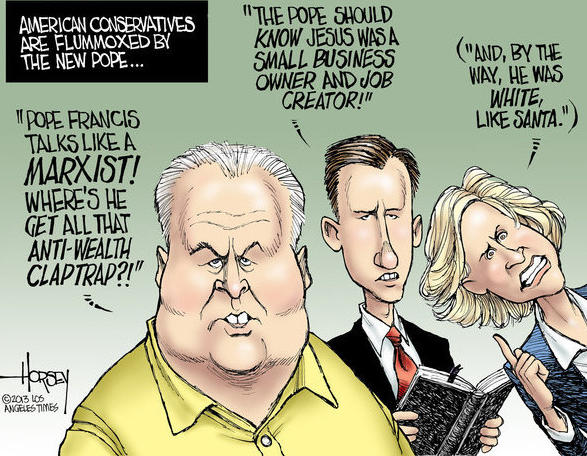
Francis even connected being Catholic with communism. “It’s strange,” the pope said, that “if I talk about this, there are those who think that the Pope is Communist. . . The fact that the love for the poor is in the center of the gospel is misunderstood.” Fighting for the poor, he added, doesn’t make me a communist; it makes me Catholic.

Obviously, the statement suggests significant overlap between Marx’s critique of free market capitalism and the social teachings of the church. The pope’s words certainly don’t sound like a ringing endorsement of the free market.

And how should Catholics express their love for the poor? Clearly not by endorsing the dynamics of the free market Ryan and his real mentor, Ayn Rand, lionize. In the “Joy of the Gospel” (JG) – published a year ago at this time – the pope identifies the unfettered markets so dear to Rand’s and Ryan’s hearts (along with their “trickle-down” ideologies) as homicidal (JG 53), ineffective (54) and unjust at their roots (59). He sees “each and every human right” (including education, health care, and “above all” employment and a just wage (192) as intimately connected with “defense of unborn life” (213).

And it gets worse for Ryan’s position. His party, of course, loves the free trade agreements that are at the heart of the corporate globalization the pope deplores. One wonders how the congressman reconciles his advocacy of, for instance, the Trans-Pacific Partnership (TPP) with the pope’s words at Cagliari, Sardinia on September 22 of 2013. Then the pope proclaimed, “We don’t want this globalized economic system which does us so much harm.”

These are not the statements of someone merely attempting to start a debate about capitalism as we know it. The debate is settled in the pope’s mind. He has condemned the system. And in doing so, Pope Francis has established himself (along with the Dali Lama) as the foremost moral leader of our time. He alone has the courage to call us away from the worship of Market and Money.

The alternative, he assures us, is not a world of darkness, weeping and grinding of teeth. It is a kingdom of light and joy.

It is time for Jesus’ would-be followers to join that conversation – about getting from here to there in the name of the gospel.

(Sunday Homily) Why Do They Hate Us? Jesus’ “9/11 Assault” on the Temple

Hate Us

Readings for the Feast of the Dedication of the Lateran Basilica in Rome: EZ 47: 1-2, 8-9, 12; I COR 3: 9c-11, 16-17; JN 2: 13-22. http://www.usccb.org/bible/readings/110914.cfm

On Thursday, September 20th 2001, President George W. Bush addressed the nation and a joint session of Congress following the horrendous attacks of September 11th. He explained the tragedy in the following words:

“Americans are asking ‘Why do they hate us?’ They hate what they see right here in this chamber: a democratically elected government. Their leaders are self-appointed. They hate our freedoms: our freedom of religion, our freedom of speech, our freedom to vote and assemble and disagree with each other.”

Surprisingly, that explanation stood without contradiction. And it did so with virtually none of our political or thought leaders in the mainstream questioning its validity. Not even our poets or religious leaders who should be sensitized to reading symbol found voices strong enough to redirect the response so everyone could hear.

Why do they hate us?

The answer should have been: Look at the targets and their symbolism. They were carefully chosen – the World Trade Center, the Pentagon, and (probably) the White House. The targets said: they hate our unjust economic system which since the fall of the Ottoman Empire has oppressed the poor of the Islamic world and robbed them of their resources. They hate our military that enforces the system’s injustice even to the point of blasphemously stationing goyim troops near the holy sites of Mecca and Medina. Above all, they hate the political system that cooperates unquestioningly with Israel in its oppression of Palestinians and whose sanctions against Saddam Hussein killed more than half a million Iraqi children without remorse.

Hence the targets – the center of world trade, of military planning, and of anti-Muslim political conspiracy.

The religious and political leaders of Jesus’ day also probably wondered about the origin of his apparent hate for them and their religion. Why would a good Jew symbolically “raze” the temple and predict with apparent prophetic delight its actual destruction? “Why does he hate us?” I’m sure they wondered.

The answer: consider the temple’s symbolism and the violence of Jesus’ attack.

First of all the symbolism . . .

All of today’s readings describe the temple’s intended meaning. For Ezekiel, the temple is the very source of life. It’s as though all the earth’s life-giving waters flowed from it, so that “every sort of living creature can multiply and live” including sea creatures, fruit trees and health-giving medicinal plants. Today’s psalm responsorial calls the temple the very home of God who is the refuge of his favorites – the widows, orphans, and undocumented aliens. In today’s second reading, Paul says the temple represents what human beings should actually be – the very home of God’s Holy Spirit of love and compassion.

All of that Jesus found contradicted by the sociopolitical reality of his day. Here’s what he saw and wanted “cleansed”:

Economically, the temple had become the principal “means of production” in all of Palestine. Its reconstruction and renovation had begun 46 years before under Herod the Great. It continued until 63 CE – just seven years before the Romans finally razed it to the ground. You can imagine then the day laborers, brick layers, stone masons, and artists employed in that very long process. As a public work, the rebuilding of the temple stimulated the Jewish economy.

While that wasn’t bad in itself, the temple primarily served the interests of the elite. It was the banking center of Jerusalem. To it flowed the taxes and tithes from all over the Jewish world – the equivalent of billions of dollars. So it represented the corruption that always accompanies great wealth. The temple’s overseers were infamously avaricious. Even the conservative Jewish historian Josephus called high priest, Ananias (47-58 CE) “the great procurer of money.”

Most damningly, the Temple was the ideological center of the Jewish faith. As such it embodied the whole “purity code” that was so oppressive to simple people such as Jesus’ own parents. You recall how temple authorities were especially hard on the long list of “impure” poor people who were particularly close to Jesus’ heart – the prostitutes, lepers, Samaritans, undocumented aliens, sick and starving. Temple authorities despised those people. They saw them all as being punished by God for their well-deserved afflictions. Such “unclean” people had to offer sacrifices of pigeons and doves to make reparation for their second class social status.

Jesus rejected all of that. So along with his friends he attacked it symbolically. John the Evangelist describes Jesus’ bringing temple business to a screeching halt – driving out those “who sold oxen, sheep, and doves, as well as the money-changers seated there. He made a whip out of cords and drove them all out of the temple area, with the sheep and oxen, and spilled the coins of the money-changers and overturned their tables, and to those who sold doves he said, ‘Take these out of here, and stop making my Father’s house a marketplace.’” It’s hard to imagine Jesus accomplishing such disruption by himself; he must have been part of a much larger demonstration.

Worse yet, Jesus predicted with prophetic delight the actual destruction of the temple which would have been even more shocking to Jews than the destruction of the Twin Towers. Jesus’ action, he implied, was merely a pantomime version of a real destruction to come. In Mark’s version of the event, he says, “Do you see these great buildings? Not one stone will be left here upon another; all will be thrown down.” (MK 13:2). Does that sound like 9/11? What blasphemy! For Jesus’ contemporaries, his actions coupled with those words predicted a catastrophe like none other.

His words actually came true in the year 70 when the Romans leveled the entire city of Jerusalem. No wonder the Romans and their Jewish collaborators saw Jesus as a terrorist worse than Osama bin Laden!

You get the idea. Jesus’ direct action in the temple represented an attack on the status quo politically, economically, and ideologically. It might even be true to say that Jesus’ choice of targets followed the same lines as the 9/11 terrorists when they attacked the World Trade Center and Pentagon, and probably intended to do the same with the White House. All of those symbolize what’s wrong with the world in the eyes of those who consider themselves oppressed by empire.

And the lessons from all of this? I’d be interested in what you think. For me it means that we must:

• Be attuned to the “signs of the times.”
• And to the repercussions of cooperating with actions and policies based on greed, empire, and vilification of the poor and powerless.
• Think poetically embracing the explicative power of symbolic language as more powerful than the merely descriptive.
• Interpret that symbolism for others – in the name of the Christian faith we ostensibly share.
• Be willing to be thought of as terrorists and atheists ourselves,
• Entailing a willingness to participate in bold, public actions against the prevailing power structure.
• Be willing to suffer the painful consequences of such actions – as Jesus did.
• Admit that we deserve the hate of those working to destroy the system that oppresses them.
• And pray for the defeat of U.S. policies based on false explanations of opposition to imperial oppression.

(Sunday Homily) Usury More Clearly Contradicts God’s Law than Abortion!

Usury

Readings for 30th Sunday in ordinary time: EX 22: 20-26; PS 18: 2-4, 47, 51, I THES 1:5C-10; MT 22: 36-40. http://www.usccb.org/bible/readings/102614.cfm

Today’s readings raise the question of usury – a word we don’t often hear today, though its reality is part of the air we breathe.

Wikipedia defines usury as: “. . . the practice of making unethical or immoral monetary loans intended to unfairly enrich the lender. A loan may be considered usurious because of excessive or abusive interest rates or other factors, but according to some dictionaries, simply charging any interest at all can be considered usury.”

In the light of that definition, consider the following:

• Last Sunday’s New York Times editorial addressed President Obama’s proposal that interest rates on loans to veterans be capped at 36 percent. The editorial began by saying that “poor and working-class people across the country are being driven into poverty and default by deceptively packaged, usuriously priced loans.” The NYT editorial board argued that the 36 percent interest cap should be extended to all U.S. citizens. Thirty-six percent!

• The same editors reported a case where “. . . (A) South Carolina lender gave a service member a $1,615 title loan on a 13-year-old car and charged $15,613 in interest — an annual rate of 400 percent — without violating federal law.”

• Despite such surprises, Wednesday’s NYT edition ran another story headed “States Ease Interest Rate Laws that Protected Poor Borrowers.” It reported that lenders such as Citigroup, One Main, Springleaf, and the American Financial Services Association claim a need to increase interest rates on their poorest customers in order to keep their rates in line with their own increased business expenses for rent, electricity, and gasoline.

• Meanwhile the prime interest rate for bankers and corporate high rollers is 3.25 percent.

• Last June U.S. Senate Republicans shot down Elizabeth Warren’s Bank on Students Emergency Loan Refinancing Act. The bill would have allowed people with federal and private debt to refinance their loans at 3.86 percent. That would have given relief to more than 25 million borrowers owing $1.2 trillion in student loans. The GOP objected partly because the Refinancing Act would have created a new tax on millionaires to offset the lower interest rates.

The practices just described raise the question: how much interest can be charged before the rate becomes usurious? Today’s liturgy of the word suggests an answer.

Begin with a consideration of today’s gospel.

There Jesus is asked a question consistently addressed to rabbis and to wise persons in all traditions. “Which is the greatest of God’s commandments?”

The question is reminiscent of the familiar cartoon where the bedraggled seeker climbs up that mountain, confronts the guru sitting in front of his cave and asks him, “What’s the purpose of life?” That’s really the gist of the question presented to Jesus. What is life’s purpose?

Jesus’ response is not humorous as we’re always led to expect from those cartoons. His answer is not even surprising. Instead, it’s the standard one usually given by rabbis and wise people: “Look within,” he advises. “Find Ultimate Reality and devote yourself entirely to it. And then love that Reality’s every manifestation beginning with the people closest to you and finishing with the trees, soil, rocks, and cockroaches.”

That’s the meaning of Jesus’ response in today’s gospel. It mirrored perfectly the answer, for instance, of Rabbi Hillel, one of Jesus’ near contemporaries. Both of them said, “Love God with all your heart, mind, and spirit – and your neighbor as yourself. That’s the greatest commandment,” they agreed. “That’s the purpose of life. That summarizes all the content of humanity’s Holy Books. All the rest is commentary.”

We get a snippet of that commentary in today’s first reading from the Book of Exodus, which supplies practical content to the general answer about life’s purpose invariably given by the wise. (And it’s here that the business of interest enters the picture.) Today’s 16 line excerpt from Exodus focuses on two issues: (1) treatment of the most vulnerable in the community, and (2) prohibition of taking interest on loans. The two matters are intimately connected in a world where the poorest among us suffer from crushing debt as earlier described.

The reading says that loving God and neighbor means taking care of society’s most vulnerable – beginning with immigrants and including single mothers and street children. Reality decrees that mistreatment of people like that will bring karmic consequences and death by an invading enemy.

The reading goes on. When dealing with immigrants, remember you were once in their position. So treat them the way you would have liked your great-grandmother to have been treated when she arrived at Ellis Island from the Old Sod.

The second part of the Exodus reading addresses the most common instrument oppressors employ for mistreating society’s vulnerable. You guess it: it’s usury and debt.

You might have been surprised to read that God’s Covenantal Law as recorded in the Bible prohibits the taking of interest at all. The Law indicates that God considers usury (or any interest) sinful! It’s a form of “extortion,” Exodus says – meaning, as the dictionary explains, the “criminal offense of obtaining money, property, or services from a person, entity, or institution, through coercion.” The definition goes on to say that extortion is commonly practiced by organized crime.

For more than a millennium, moral theologians within the Church that developed following Jesus’ death agreed with our dictionary. Under pain of sin (as they put it), no interest could be charged on loans.

But then modern economists discovered the wonders of compound interest. That changed everything. Suddenly, charging interest became not only moral, but virtuous – including for Christians! Even the Vatican owns a bank whose underlying foundation is interest!

So times have indeed changed. Currently, moralists explain that the modern science of economics now understands what was not grasped in the ancient world of Exodus. So, morality had to change to keep up with the times and the advances of science. It’s a new world. (Hmm . . . . Does that same reasoning apply to matters such as homosexuality in relation to the insights of the modern science of psychology? And what about abortion and what modern medicine has disclosed about the beginnings of specifically personal life? After all, the Bible has this clear and strong teaching about prohibiting interest and says nothing at all about abortion.)

The suggestion here is that if we kept The Commandments as explained by Jesus and all the world’s great spiritual teachers:

• We’d prioritize concern for the welfare of immigrant children on our border, single moms in run-down neighborhoods, and street children everywhere. Their welfare, Jesus says, is identical with our own.

• We’d realize that the ability of immigrants, widows, and orphans to meet their transportation, rent and electricity bills is in God’s eyes more important than similar abilities on the part of Citigroup, One Main, Springleaf, or the American Financial Services Association.

• We probably wouldn’t support interest of any amount. (Certainly an interest rate of 36 percent would be out of the question, not to mention 400 percent.)

• At the very least, we’d demand that student loans would be refinanced at the prime rate.

• We probably wouldn’t support “capitalism” as we know it.

• We’d make usury as important a “Christian issue” as some make abortion.

• We’d hear about that from the pulpit, at least occasionally.

• We’d vote accordingly.

After all, an unmistakable critique of usury is actually found in the Bible. That’s not the case with abortion.

(Instead of a Sunday Homily) War Mongering at the New York Times: There’s always a “Why”

Urinating soldiers

Today The New York Times published an inflammatory editorial called “The Fundamental Horror of ISIS.” The evident but unstated purpose of the piece was to strengthen support for the latest waste of our tax-payer dollars on the most recent phase of the so-called “war on terror.” Like its predecessors, that phase has nothing to do with protecting our “homeland.” Rather as Dennis Kucinich has observed, it’s yet another phase of the (by-now) 25 year long war against the impoverished masses who have the misfortune of finding their homes floating on top of a vast sea of oil controlled by foreign outsiders.

To help the White House justify its consequent greed-based aggression, the NYT editorial trotted out the well-worn thesis that ISIS represents unmitigated, irrational evil entirely foreign to the sensitive minds of its gentle readers. So it rehearsed “the beheadings, crucifixions, tortures, rapes and slaughter of captives, children, women, Christians, Shiites.”

This, of course, represents a highly familiar litany relative to our state’s designated enemies. The “presstitutes” made similar allegations against “the Russians” during the Cold War as well as the Chinese Communists. It was also the case with the Sandinistas, the PLO, Hezbollah, and Hamas. Similarly, Manual Noriega, Slobodan Milosevic, Saddam Hussein, Osama bin Laden, Muammar Kaddafi, and (until recently) Bashar al-Assad all represented unmitigated evil. Now it’s the turn of ISIS and (as of last Tuesday) Khorasan.

In all of these cases the designated enemies in question have represented pure evil without any legitimate grievance other than sadism that strangely and inexplicably has (according to the Times in the case of ISIS) “attracted hundreds of willing followers — yes, also from Europe and America.”

Times editors put it succinctly in today’s rant: “Comparisons are meaningless at this level of evil, as are attempts to explain the horror by delving into the psychology or rationale of the perpetrators. . . as Roger Cohen, the New York Times columnist, wrote in a recent piece about ISIS, there is no “why” in the heart of darkness.”

To repeat, this level of evil is entirely foreign to the civilized westerners.

Really?

Try explaining that to the victims of the 25 year war in Iraq and Afghanistan.

They remember:

• The million and a half civilian deaths in Iraq caused by the U.S.’s naked “war of aggression” against that country – the “supreme international crime” in the eyes of the United Nations.
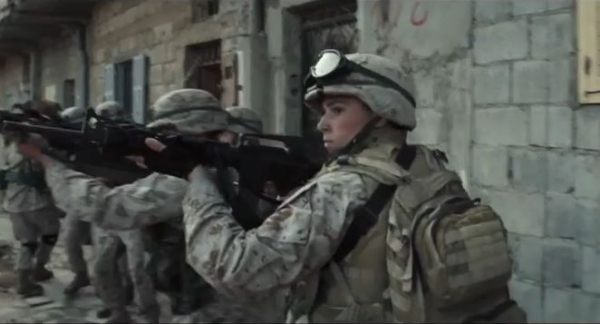
• YouTube films of U.S. military personnel urinating on the bodies of dead Iraqi patriots defending their “homeland” from barbarous Marines, Special Forces, and Navy Seals.
• Abu Ghraib and its broadly smiling heroes (from next door) sexually assaulting their victims and proudly posing with thumbs up over bodies of those they’ve just tortured to death.
• President Bush and Dick Cheney not only ordering the war crimes of water-boarding and other acts of torture, but joking about it.
• Fallujah and the use of illegal white phosphorous.
• Haditha and the heartlessness of U.S. soldiers systematically slaughtering entire families there.
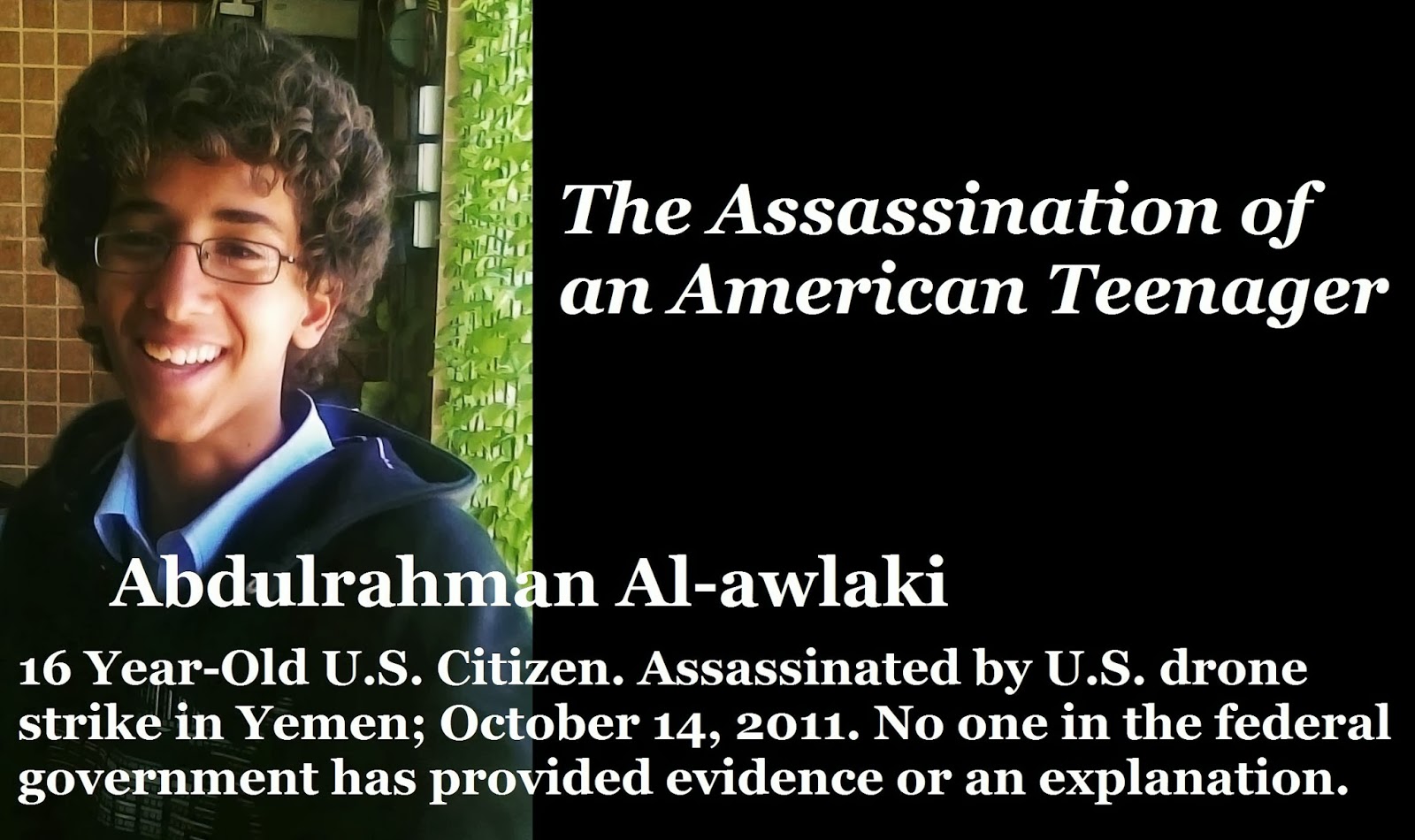
• The frequent reports of wedding parties and funerals routinely devastated by drones in Afghanistan, Iraq, Libya, Somalia, Bahrain, Yemen, Pakistan, and who knows where else?
• Chelsea Manning’s release of the film “Collateral Murder,” where U.S. “pilots” joke about “wasting” international journalists and the civilians who came to their aid.
• U.S. insistence on using cluster bombs whose known effect is to blow arms and heads off children attracted to explosives disguised as toys.
• Secretary of State Madeleine Albright’s justification of the effects of U.S. sanctions on Iraq, which she admitted killed 500,000 Iraqi children. “Yes, Leslie,” Ms. Albright said to interviewer Leslie Stahl, “we think it was worth it.”
• U.S. supply of arms enabling Israel’s “Operation Protective Edge” which wantonly slaughtered more than 2500 Palestinians in direct attacks on civilians and the infrastructure of Gaza.
• U.S. stated intent to adopt similar policy of “relaxed rules” around tolerance of civilian deaths in its latest attacks on Iraq and now Syria.

All of that would easily inspire Al-Jazeera editors to write:

“Comparisons are meaningless at this level of evil, as are attempts to explain the horror by delving into the psychology or rationale of the perpetrators. . . as one of our reporters wrote in a recent piece about the United States, there is no “why” in the heart of darkness.”

But of course, there’s always a “why.”

The difference is that the “why” in the U.S. heart of darkness is greed for oil and the protection of an oil economy that will predictably destroy our planet.

Meanwhile the unexamined “why” of ISIS and the thousands attracted to its cause is intimately connected with response in kind to the Original Aggression of colonialism’s systematic rape of the Middle East. ISIS is responding in kind to U.S. crimes. It’s all blowback.

And the gentle editors of the New York Times (speaking for their employers in the military-industrial complex) can’t stand what they see when they look into the mirror.

(Sunday Homily) U.S. Doublespeak Is More Threatening to the World than ISIS or Khorasan

uncle-sams-lies

Readings for 26th Sunday in ordinary time: EZ 18:25-28; PS 25: 4-5, 8-10, 14; PHIL 2: 1-11; MT 21: 28-32 http://www.usccb.org/bible/readings/092414.cfm

If I were you, I’d be careful about air travel. That’s because, as the President reminded us last week, the enemies we’ve so fiercely created over the last 13 years are plotting to blow U.S. commercial aircraft out of the skies. So one of these days Khorasan’s heat-seeking missiles will find the rear end of your plane, and that will be the end of you.

And, when you think about it, those firing the rockets will be justified in doing so. That is, if we allow them to apply the insane logic behind Mr. Obama’s latest justification for bombing his seventh Muslim country in six years.

In doing so the Nobel Peace Prize laureate said last week, “Once again, it must be clear to anyone who would plot against America and try to do Americans harm that we will not tolerate safe havens for terrorists who threaten our people.”

Wait a minute!

Our “leader’s” logic (if we universalize his pronouncement) has just endorsed an endless cycle of violence that should be completely unacceptable to any human being — not to say any Christian. His words mean that anyone who plots against another country trying to do their citizens harm can claim no safe haven. They will be subject to reprisal.

Tell that to drone victims and to Syrians who lost their children in last week’s bombings – or to similar casualties at weddings and funerals in Afghanistan, Iraq, Libya, Pakistan, Yemen, and Somalia. The President’s doublespeak logic allows them to say, “Once again it must be clear to the Americans plotting against us and trying to do our citizens harm that we will not tolerate safe havens for such terrorists who threaten our people. There will be reprisals.”

That means that the militants in the countries just mentioned can legitimately respond to the terrorism of drone and outright bombing attacks with similar assaults on American citizens in our own “homeland.”

So as I say, hold your breath on your next airline trip to Miami or New York. The blowback is coming – and the blowback to that blowback too.

Such are the realities of Eternal War.

It’s that sort of damned logic (I’m choosing my words) that is addressed in today’s liturgy of the word. It’s not at all comforting.

The first reading from the prophet Ezekiel sets the tone. It underlines what Easterners call the Law of Karma. Ezekiel says that people die because of their wicked deeds. He says, “When someone virtuous turns away from virtue to commit iniquity, and dies, it is because of the iniquity he committed that he must die.” That’s karma. It’s an inescapable law of the universe.

St. Paul put it this way, “Do not be deceived, God is not mocked; for whatever a man sows, this he will also reap.” (GAL 6:7-9). Relative to war, Jesus was even more pointed. He said all those who live by the sword will die by that same instrument (MT 26:52). It’s all karma.

As citizens of a nation that lives by the sword more than any other in world history, what then are we to do? Here, once again, today’s readings supply an answer. We must abandon the destructive path we’re on. That’s what Ezekiel says. Speaking of the potential recipient of negative karma, Ezekiel promises, “But if he turns from the wickedness he has committed, he does what is right and just, he shall preserve his life; since he has turned away from all the sins that he has committed, he shall surely live, he shall not die.” That too is karma.

In other words, to avoid the negative consequences of our actions, we must change course radically. More specifically today’s gospel selection addresses that imperative to political leaders. It calls them to make their actions correspond to their words.

Yes, today’s gospel is addressed to leaders like our president and congresspersons. There Jesus addresses those in power and tells the local rulers of his day (“the chief priests and elders”) a parable about lip service and the required change of direction. (Remember, in Jesus’ context there was no sharp distinction between religious and civil government.)

“A man had two sons,” the Great Teacher tells these government officials. “He came to the first and said, ‘Son, go out and work in the vineyard today.’ He said in reply, ‘I will not, ‘ but afterwards changed his mind and went. The man came to the other son and gave the same order. He said in reply, ‘Yes, sir,‘ but did not go. Which of the two,” Jesus asks, “did his father’s will?”

The chief priests and elders answer,”The first.”

Jesus said to them,”Amen, I say to you, tax collectors and prostitutes are entering the kingdom of God before you.”

I’m sure you see that Jesus’ parable is about governmental lip service and deception. The parable calls them to radical change in policy. Jesus implies that the leaders of his day were like the first son. They said the right things, but their actions belied their words. As a result, their deeds excluded them from the New Order (God’s Kingdom) which was always the focus of Jesus’ revolutionary discourse.

And that brings us back to our own leaders and the differences between what they say and do. Think of the events of recent weeks – even last week. During that time our leaders have:

• Paid lip service to national boundaries in the case of Russia and Ukraine, but then have claimed that national boundaries are irrelevant in their own “war on terrorism.”
• Paid lip service to international law – again in the case of Russia and Ukraine, but then ignored that law by going to war with ISIS without the required U.N. resolution.
• Paid lip service to civilization and decency in decrying ISIS’ brutal beheadings (by knife) of innocent civilians, but then beheaded literally untold others via drones and direct bombings. (Yes, drones and bombs inevitably blow heads off bodies.)
• Paid lip service to the human rights of civilians brutalized by ISIS, while ignoring the million and a half civilians their own armed forces have just as brutally killed in Iraq and Afghanistan.
• Paid lip service to nuclear non-proliferation in their demands upon Iran, but then have pledged billions to modernize their own overwhelming nuclear arsenal.
• Paid lip service to environmental protection (following last Sunday’s “People’s Climate March”), but the very next day implicitly embraced the possibility of “nuclear winter” through that same weapons modernization program.

Of course, there are many more examples of our leaders’ saying one thing and doing the opposite. In fact, their lies come so thick and fast that confusion and weariness results on the part of listeners. Our leaders’ honeyed words accompanied by unspeakably cruel acts paralyze us from taking action against or even recognizing in our own country a world force that is far more destructive than ISIS, Khorasan, or al-Qaeda. In the words of Noam Chomsky, the latter represent “retail terrorism,” while the U.S. “network of death” (with bases all over the world) embodies “wholesale terrorism” that is far more evil and destructive.

I believe that danger of confusion and consequent inaction is why Jesus shocked his opponents by saying simply, “Amen, I say to you, tax collectors and prostitutes are entering the kingdom of God before you.”

That would be as scandalous to Jesus’ audience as if he said to President Obama and John McCain, “Amen, I say to you, ISIS, Khorasan and al-Qaeda will enter God’s kingdom before you.”

What does that mean for us who are attempting to follow the Way of Jesus and are trying to be part of his Kingdom revolution? It means that we must realize that:

• Perpetual war contravenes the teachings of Jesus who taught us to love our enemies.
• Our “leaders” (just like the priests and elders of Jesus’ day) are liars to the core.
• The United States is (in the words of Dr. King) the “greatest purveyor of violence in the world.”
• That the retail terror and brutality of ISIS pales in comparison with the wholesale terror the United States inflicts on the world’s poor.
• That we must work and pray every day for the defeat of the United States in its endless, genocidal wars.

Believe me: that defeat is coming. Better yet, believe Ezekiel. It’s the law of karma.

(Sunday Homily) Jesus Advocates a $58.00 per Hour Minimum Wage!

living wage

Readings for 25th Sunday in Ordinary Time: IS 55: 6-9; PS 145: 2-3, 8-9; 17-18; PHIL 1: 20c-24, 27A; MT 20: 1-16A. http://usccb.org/bible/readings/092114.cfm

What will the Kingdom of Heaven be like for minimum wage workers? Ask the poor people Jesus speaks to in today’s gospel. There the Great Teacher tells them a story about a character every employee – all of us, I’m sure – encounters at some point in her or his life. He’s the skinflint boss who imagines himself a great humanitarian, despises his workers as lazy, and treats them with complete arbitrariness. He takes great delight in disappointing them – simply because he can.

The familiarity of this comic book character must have set Jesus’ audience laughing. And it probably started a long animated conversation about bosses, wages and employment.

Anyway, the story goes like this . . . It’s late in the harvest season and this big fat landowner goes to the town square to hire fruit pickers who are shaping up there. (You can imagine him coming by in his pick-up truck, smoking his cigar, pointing at the strongest workers, and shouting, “Hey, you guys, get off your lazy duffs and jump in the back. I haven’t got all day. There’s work to be done!”)

In the story, you can tell the owner’s a cheap skate because he’s careful to hire just the minimum number of workers he thinks can get the job done – if he pushes them really hard.

But he miscalculates. So he has to return at noon for more pickers. But instead of blaming his own stupidity, he blames the workers. He calls them “lazy” for “standing around idle.” He shouts at them, “Get in the truck, you lazy no-goods! You should be working!” (What does he expect? They’re waiting for someone to hire them, for God’s sake! But then coupon-clippers, like the boss in the story, always despise calloused hands.)

Now it’s almost quitting time. With only an hour’s daylight left, and with his fruit ready to rot in the fields, the skinflint owner finds himself back in the square hiring more workers. Again, he blames them for being lazy. But off they go to finish the day’s work.

Then the punch line comes. The completely capricious landowner suddenly decides to play the generous humanitarian. So with great flair he gives a full day’s wage to those last hired – my guess is: just a few workers.

Naturally, the other pickers rub their hands together, drooling with expectation that they’ll be paid more generously too. But of course old Scrooge disappoints them. (These kinds of bosses always do! They love it.) He decides instead to turn legalistic and teach these lazy good-for-nothings a lesson – about power.

“What do you mean: ‘MORE?’” he shouts like the beadle in Oliver Twist. “Have you forgotten our contract? And besides, I’m the boss. I can do what I want, and you can’t do a thing about it!”

By this time, Jesus’ audience surely had stopped laughing. They were probably grumbling and rehearsing their own similar experiences with cheap legalistic bosses who love to play the generous philanthropist.

But then Jesus gets everyone smiling again by adding with a wink: “And so it will be when the revolution comes (or as he put it – “in the Kingdom of God”) where “the first will be last and the last will be first – you know what I mean?” He winks again.

It takes a while for the message to sink in. Not everyone “gets it.” The audience scratches its collective head. Finally the penny drops.

“Oh, I see what you’re saying, Jesus,” someone says. She looks around at the others. “Don’t you get it?” she asks. “All of the workers in the story are ‘the last;’ it’s the boss who’s ‘first’.” In the final judgment, Uncle Scrooge will be last and all of us will be first!”

The audience starts to cop on.

“Yeah,” someone else says doing a quick calculation. “And do you know what that means for us, doncha?”

“What?”

“It means we’ll all be on Easy Street; that’s what it means. Think about it; in the Kingdom, we’ll all be making a hundred grand a year!”

Everyone laughs.

“No, I mean it. Do the math: minimum wage is $7.25 an hour, right? That means that those guys who worked only one hour earned $58. That’s $464 dollars a day, if they had worked all day – or $2320 per week, or $9280 per month, or $111,360 per year! Now that’s a just wage for bustin’ our butts. Whaddaya think? Talk about a workers’ paradise!”

By this time, everyone’s laughing so hard, they’re in tears.

Hmm . . . Kingdom economics. Kingdom pay for minimum wage workers: $58.00 an hour. . . . First/last; last/first . . . .

The Waltons should take note!

(Sunday Homily) Jesus Has More in Common with ISIS than with the United States

King Purveyor

Readings for Feast of Exaltation of the Holy Cross: NM 21:48-49; PS 78: 1BC-2, 34-38; PHIL 2: 6-11; JN 3: 13-17 http://www.usccb.org/bible/readings/091414.cfm

Today is the feast of “The Exaltation of the Holy Cross.” It might as well be called the feast of “The Exaltation of the Electric Chair” or of the exaltation of death row or of torture or terrorist martyrs. For relevance’s sake, we might today call the feast “The Exaltation of ISIS or Al Qaeda.”

That’s because the cross on which Jesus died was not only empire’s instrument of unspeakable torture and capital punishment. It was also the punishment the Romans reserved for terrorist insurgents against their empire. Among many others, biblical scholar, Reza Aslan underlines that point in his best-selling study, Zealot. (I recommend the book.)

All of that indicates that the Romans thought of Jesus as a terrorist – just as “Americans” do its enemy du jour whether we call them ISiS, ISIL, or al Qaeda. Let me repeat, Christians worship someone whom the quintessential empire (Rome) and its hangers-on vilified as much as President Obama vilified ISIS last Wednesday night in his address to the nation announcing yet another war. In the eyes of Rome and its Jewish collaborators, Jesus was a terrorist. They said he was stirring up the people and trying to take Caesar’s throne by force (LK 23:5, JN 19:15).

And yet, in today’s liturgy of the word, Jesus himself tells us to follow his example. You might say that he urges us to do what’s necessary to merit the charge of “terrorism” and even its punishment. That’s right. He says, “You cannot be my disciple unless you too take up your cross and follow me to Golgotha – or as we might put it, to Abu Ghraib, Guantanamo, death row, and ultimately to the electric chair or gurney to be lethally injected. That is, following Jesus means all of us should be traitors and rebels and enemies of the murderous state the U.S. has become. This is particularly true since our “leaders” have chosen the path of war without end.

However, (if we’re to believe the polls) instead of taking up our crosses, those calling themselves “Christians” have identified with another of the empires in the long line that has succeeded Rome. In other words, we’ve refused the project of Jesus who had more in common with ISIS than with the United States.

Think about it. Jesus’ “gang” was filled with insurgents. How could it be otherwise – poor working class men coming from the hotbed of rebellion in Galilee? They followed a man proclaiming “God’s Kingdom” as a world where Yahweh is king instead of Caesar. In fact, there were many points of convergence between Jesus’ program and that of Zealot terrorists. Like them he favored land reform, cancellation of debts, and justice for the poor. Both the terrorists of his day and Jesus opposed the Jewish leaders who collaborated with Rome. Both detested Roman occupation of God’s lands.

Even more, one member of Jesus’ inner circle was specifically called “the Zealot” (the 1st century equivalent of ISIS). Another’s nom de guerre was “Iscariot” [quite possibly a “sicarius” or assassin of occupation forces). Peter’s nickname was “Rock Thrower.” And James and John were fierce enough to merit the name “Sons of Thunder.” Recall that one of Jesus’ closest friends tried to cut off the head of one of Jesus’ arresters. Yes, cut off his head! Luckily for the militarized cop in question, Peter narrowly missed and only cut off the man’s ear.

But it was at that point, though traveling with an armed group (Think about that for a minute!) that Jesus made the pronouncement that separated him from his band of patriotic resisters to imperial occupation. It’s here that he departs from ISIS as well. He rebukes Peter for drawing his sword. Jesus said, “Put away your sword. All those who live by the sword will perish by it” (MT 26:52).

Those words should astound would-be Christians so ready to bomb, kill and live by the sword to an extent unsurpassed in all of human history. You’d think that if there’s ever been justification for using weapons, it would be to defend the life of a man like Jesus. But no, Jesus insisted that the way to liberation is not by taking life, but by giving one’s own life in non-violent surrender – an insistence echoed by Martin Luther King Jr. and Mahatma Gandhi.

Last Thursday, the day following President Obama’s war speech, Amy Goodman ran a segment on “Democracy Now” asking the question, “What would Martin King do in the face of ISIS?” The segment recalled for viewers Dr. King’s 1967 speech at the Riverside Church in New York City. There he memorably called our beloved country ”the greatest purveyor of violence in the world today.” http://www.hartford-hwp.com/archives/45a/058.html

King, of course, was right in 1967 when he spoke those words. They ring even truer today. Without the U.S. there would be no ISIS, no al-Qaeda. We’ve trained many of their troops; they’re using weapons the United States military has poured into the region. Without “America,” there would be no crisis in Ukraine evoking threats of World War III. Without U.S. unconditional support of Israel, there would be no “Operation Protective Edge” with more than 2500 Palestinians dead – mostly women and children. Libya would still be intact and so, of course, would Iraq. More than a million people our brutal military has slaughtered in Iraq would still be alive.

(Talk about transubstantiation! Everything our country touches is transformed into the crucified body of Christ. Wine people share at droned weddings and funerals in a sense becomes Jesus’ blood.)

So what would King do? According to Tavis Smiley who has just published Death of a King: the Real Story of Dr. Martin Luther King Jr.’s Final Year, King would urge a sharp turn in U.S. policy. Such repentance would entail:

• Confessing our nation’s responsibility for the crises in Afghanistan, Iraq, Israel-Palestine, Libya, Assyria, Yemen, Somalia, Bahrain, Egypt, Ukraine. . . .
• Paying reparations to all those countries.
• Redirecting the billions (and trillions) wasted in war to health care, education, and infrastructure reconstruction in our own United States.
• Using presidential speeches not to announce further wars, but to lay out emergency plans for addressing the genuine crises that face us, viz. climate chaos world-wide and the Ebola outbreak in Africa.
• Announcing expedited plans to wean the U.S. from the oil consumption that drives our country’s perpetual war policy.

In today’s second reading St. Paul quotes an ancient Christian hymn which scholars universally recognize as encapsulating the belief of the earliest Christians. It’s a song about the Divine One choosing to appear in history not as an exalted king, but as a human being, a slave, and an executed criminal.

If we wish to find God, the hymn suggests, we should look and listen not to our presidents, but to “the other – those the Empire hates – and make their cause our own. It’s in the ranks of the oppressed that God’s Son is found – among empire’s designated enemies, among the enslaved, the tortured and those our “leaders” identify as terrorists.

Does this mean we are being called to somehow recognize Jesus in ISIS?

Yes it does. ISIS has legitimate demands. We need to talk with them, not bomb them. Followers of Jesus should be demanding that – even if it means being branded “terrorists” ourselves.

(Sunday Homily) Listen to ISIS and Stop Committing Suicide!

steven sotloff

Readings for 23rd Sunday in Ordinary Time: EZ 33: 7-9; PS 95: 1-2, 6-9; ROM 13: 8-10; MT 18: 15-20 http://usccb.org/bible/readings/090714.cfm.

We’ve met the enemy and it is us!

Indeed! Over the past number of weeks, we’ve been introduced to the Islamic State in Iraq and Syria (ISIS). Its militants seem to have somehow appeared from nowhere.

However, as Tom Engelhardt has pointed out, they actually represent the largely Sunni blowback from U.S. policies over the last 13 years. In fact, ISIS would not exist were it not for the United States.

Think about it. ISIS is the direct result of:

• The U.S. invasion of Afghanistan and its over-the-top, loosely-target response to 9/11.
• The 2003 criminal occupation and destruction of Iraq.
• The thoughtless dismantling of Saddam Hussein’s army with its largely Sunni command structure (which is now directing ISIS).
• The crimes of Abu Ghraib, Fallujah, Haditha, and other massacres perpetrated by barbaric elements in the U.S. military.
• The more than one million Iraqis who have lost their lost their lives as their country has been systematically pulverized by bombings, white phosphorous, and the nuclear waste called “depleted uranium.”
• Former President Bush and Vice President Cheney bragging about ordering the war crimes of water boarding and other forms of torture.
• U.S. soldiers urinating on the bodies of Iraqi insurgents and on copies of the Holy Koran.
• The horrors of the film clip, “Collateral Murder” released by Chelsey Manning.
• Drone strikes across the world in Afghanistan, Iraq, Pakistan, Somalia, Yemen and elsewhere routinely killing women and children, revelers at weddings and mourners at funerals.
• Blind U.S. support of Israel’s pogrom aimed at “the Jews’ Jews” concentrated in the world’s largest open-air prison camp called Gaza.

Such horrendous provocations make it entirely possible for ISIS leaders to echo the words solemnly intoned by President Obama last week in response to their movement’s brutal beheading of journalist Steven Sotloff. ISIS leaders might well have said:

“We will not be intimidated. Those who make the mistake of harming Muslims will learn that we will not forget and that our reach is long and that justice will be served . . . such horrific acts only unite us as movement. . . ISIS will continue to lead the battle against the kind of barbaric and empty vision that the United States represents. We will degrade their forces and destroy them completely.”

In fact, the whole ISIS phenomenon and the response it has evoked only illustrate the senselessness of any strategy of revenge and fatuous, doomed attempts to solve conflict by the unapologetic use of military first response to violence perpetrated against “Americans” or Muslims.

A different way of responding is outlined for followers of Jesus’ Way in today’s liturgy of the word. It might seem idealistic and perhaps even unrealistic in the face of ISIS. But give it a chance.

In today’s gospel reading, Matthew the Evangelist addresses the problem of conflict resolution. He emphasizes dialog not revenge and violence. In fact, he outlines four alternatives towards resolving disputes. He has Jesus say that if step one doesn’t work, move on to the subsequent strategies. The four alternatives include (1) healing conversation with one’s adversary, (2) arbitration with a mediator or two, (3) consultation with the entire community, and (4) shunning the offending party.

More specifically, Matthew has Jesus say, “If your brother sins against you, go and tell him his fault between you and him alone . . . If he does not listen, take one or two others along with you, so that ‘every fact may be established on the testimony of two or three witnesses.’ If he refuses to listen to them, tell the church. If he refuses to listen even to the church, then treat him as you would a Gentile or a tax collector.”

Obviously, these words did not come from Jesus himself. To begin with, there was no “church” at Jesus’ time. Jesus was thoroughly Jewish and a reformer of Judaism rather than the founder of some new religion or “church.”

It was different for Matthew who was writing for a community of specifically Jewish Christians some fifty years after Jesus’ death. By then, questions of community order within the emerging church had become prominent. So Matthew invents this saying of Jesus to deal with them.

Another reason for reaching this conclusion is the reference to treating a recalcitrant individual “as you would a Gentile or a tax collector.” This phrase reflects traditional Jewish avoidance of Gentiles and hatred of Roman collaborators. It runs counter to the practice of Jesus who time and again in the Gospels causes scandal by practicing table fellowship and community with the very people Matthew’s instruction indicates are outsiders to be shunned by believers.

Were Matthew following the Spirit of Jesus, the evangelist’s instructions for addressing conflict resolution might involve the following process: (1) private dialog with one’s adversary, (2) arbitration with a mediator or two, (3) consultation with the entire community, and (4) moving in with the offending party – or at least taking them out for dinner regularly.

In any case, the emphasis in Jesus’ own approach is communion, not shunning or refusal to talk. Nowhere does Jesus’ approach say that one should refuse meeting until the offending party stops offending. Much less does the process outlined include “if he refuses to listen, shoot him, cut his head off, or kill his family.”

“But,” you object, “The words attributed to Jesus in today’s gospel selection are about church order, not about international politics, much less the barbarity of a movement like ISIS. Jesus’ instruction, you might say, is about private disputes among Christians and are laughably impractical in the political sphere.

And that’s just my point. To repeat: Matthew’s account does not reflect the teaching or practice of Jesus. Jesus’ actual teaching was not confined to the private realm. His practice was highly political.

Eating with tax collectors, street walkers, lepers, Pharisees, Gentiles (including members of the Roman army) represented doing the unthinkable, the unexpected, the forbidden. . . . It meant crossing boundaries, breaking taboos, acting counter-culturally, and offending people on all sides of sizzling debates.

This is what the example of Jesus calls us to do even in the case of ISIS. Its emergence calls for departure from business as usual. It requires admission of guilt and responsibility on the part of the United States. It demands a complete reversal of “American” policy.

Today’s second reading from Paul’s letter to the Christian community at Rome puts a finer point on the reasons for such response on the part of those pretending to follow the teachings of Jesus.

Paul reminds us of Jesus’ summary of God’s law. He writes:

“Brothers and sisters: Owe nothing to anyone, except to love one another; for the one who loves another has fulfilled the law. The commandments, ‘You shall not commit adultery; you shall not kill; you shall not steal; you shall not covet,’ and whatever other commandment there may be, are summed up in this saying, namely, ‘You shall love your neighbor as yourself.’ Love does no evil to the neighbor;
hence, love is the fulfillment of the law.”

Emmanuel Levinas helps us understand that Jesus’ teaching on neighbor love is much more radical than commonly accepted. Loving your neighbor as yourself, Levinas says, does not mean “Love your neighbor because s/he is like you.” No, according to Levinas, it means, “Love your neighbor as yourself, because s/he is you.”

In other words, there is no meaningful distinction between you and any other human being you care to name – even if we call them “terrorists.” Moreover, if you shared the same history as your “enemy,” you would be doing exactly the same thing that currently enrages you. As a result, no killing can be justified. It is suicide. That’s the thrust of Jesus’ words: to kill the other is to kill yourself. Killing of any kind is suicide.

What does that mean for followers of Jesus’ way as we try to respond to the ISIS phenomenon? At least the following, I think:

• Facing the fact that the ONLY REASON for our Middle Eastern policy and wars is oil, and doing everything necessary to wean our lives away from dependence on fossil fuels.
• Realizing that we cannot expect politicians like President Obama to initiate any other policy than revenge as if the U.S. were principled, civilized, innocent, and pure before an enemy that is completely unlike us.
• Nonetheless demanding that our officials absolutely reverse course, recognize responsibility for the emergence of ISIS, and establish dialog with their leaders.
• Refusing to allow our children to serve in an armed force that commits ISIS-like crimes on a wholesale scale.
• Imagining what would happen if even a quarter of our country’s 160 million people who claim to be Christian refused the self-destruction the words of Jesus and Paul imply.

For Christ’s sake, do the unthinkable. Hard as it might be: listen to ISIS. Reverse course. Put a stop to our collective suicide!

Sunday Homily: The Ayatollah Was Correct: the U.S. IS “the Great Shaytan”

Ayatollah

During the 1979 Islamic revolution in Iran, the West became aware of Muslims’ profound mistrust of the United States. The Ayatollah Khomeini repeatedly referred to “America” as “the Great Satan.” Today’s liturgy of the word suggests that the Ayatollah’s reference was spot on. The United States is indeed the Great Satan leading the world astray with its beliefs for instance that limitless wealth brings happiness, that bombing can be a humanitarian act, and that “fearing for our lives” justifies killing others.

As we’ll see in today’s readings, such beliefs are ‘satanic” both in the eyes of Jesus and of the Great Prophet Mohammed. In the United States, their infernal results are on display in each morning’s headlines where:

• The rich and famous end their lives in despair
• The U.S. bombs and drones to save the Yazidis in Iraq (or Libyans in Libya, Afghans in Afghanistan, Ethiopians in Ethiopia . . .)
• Police killings are uniformly justified by the claim “I feared for my life.”

I raise the issue because the term “Satan” is prominent in today’s gospel reading. There Jesus uses it in contrast to his own beliefs about life’s divine purpose which turns out to be incompatible with dominant western beliefs. According to both Jesus and Mohammed, life’s purpose is not to accumulate riches. Nor is life rendered meaningful by killing others even to save one’s friends. Neither do Jesus’ followers have the mandate to protect their own lives at any cost. Quite the opposite!

What is life about then? Consider Jesus’ answer in this morning’s gospel reading.

There Jesus uses the epithet “Satan” to refer to the leader of his inner circle of twelve. In Jesus’ eyes, Peter merits the name because he misunderstands what life is for. That’s shown by the fisherman’s efforts to dissuade the Master from following his divine “prophetic script.” For Jesus, that pattern would require him to lose his life for speaking truth to power. As we’ll see, using such speech in an effort to change the world – to bring on God’s Kingdom – turns out to be central to Jesus’ understanding of life’s purpose.

In any case, like the prophet Jeremiah in today’s first reading, God’s spirit has put Jesus out of control. So, like Jeremiah, he feels compelled by an inner fire to speak the truth, whatever its cost. As the earlier prophet had put it, God’s truth “becomes like fire burning in my heart, imprisoned in my bones; I grow weary of holding it in; I cannot endure it.”

So in today’s reading Jesus “began to show his disciples that he must go to Jerusalem and suffer greatly from the elders, the chief priests and the scribes and be killed and on the third day be raised.”
Peter objects. “God forbid! This will never happen to you,” he says.

It’s then that Jesus replies: “Get behind me, Satan. You are an obstacle to me. You are thinking not as God does, but as human beings do.”

Hearing those words, most of us inevitably connect with images right out of Dante’s Divina Comedia – enhanced by subsequent satanic glosses to include a fire-red body, horns, cloven hooves, tail and pitchfork. But that wasn’t the image in Jesus’ mind.

Instead, Jesus was thinking in terms of the Hebrew tradition. There Satan was a member of God’s heavenly court. He was God’s prosecuting attorney who typically raised questions that Yahweh’s overwhelming goodness and generosity might otherwise obscure.

In Jewish tradition, Satan was a realist who believed that faith and prosperity go together. Take away prosperity and goodness and faith will disappear too.

That was the thrust of Satan’s bet with Yahweh that we find in the book of Job. Job is good and rich. God is proud of his servant’s devotion. Satan says, “Don’t be naïve. All of that will change if you simply remove your servant’s wealth, children, and health. Just watch and see.” The familiar story unfolds from there.

So when Jesus calls Peter “Satan,” he’s not really telling his friend to go to hell. No, he means what he says, “You are an obstacle to me. You are thinking not as God does, but as human beings do.” Human beings (like Satan) connect faith with prosperity. But in Jesus’ eyes, prosperity is not life’s overriding purpose. Neither is personal safety protected by violence.

But what does God really “think” about the purpose of life? Jesus words about saving and losing life provide a clue.

Jesus says, “Whoever wishes to come after me must deny himself, take up his cross, and follow me. For whoever wishes to save his life will lose it, but whoever loses his life for my sake will find it. What profit would there be for one to gain the whole world and forfeit his life? Or what can one give in exchange for his life?”

These are stunning words. They turn the world’s values upside down. They imply that God “thinks” that life’s purpose involves opposing empire. (Remember Rome reserved “taking up the cross” as a punishment for insurgents.) Life’s purpose entails self-denial, not self-gratification. It means holding life loosely, being prepared to surrender it “for justice’s sake” at any moment. It means preferring God’s Reign to possessing the entire world. It means returning kindness for evil, even if that means losing one’s own life as a result. Or as the psalmist puts it in today’s responsorial, “God’s kindness is a greater good than life itself.”

All such ideals run counter to the U.S. culture which Muslims find so threatening. They have become the ideals of the world which in today’s second reading Paul tells us to resist. “Do not conform yourselves to this age,” he writes, “But be transformed.” Only personal transformation, he adds, will enable your mind to discern what is good, pleasing and perfect in God’s eyes – even if it leads to the sacrifice of your own life.

As a Muslim who embraced the New Testament tradition, the Ayatollah Khomeini understood Jesus’ words. He saw that the order championed by the United States contradicts the basic values of Islam and the Judeo-Christian tradition about community, compassion and care for society’s most vulnerable.

So he viewed “America” as what Muslims call “Shaytan.” For Muslims Shaytan is not the devil either. Instead, he is “the Great Deceiver,” whose promises mislead, corrupt and immiserate those who believe them.

In fact, while promising peace, prosperity, and happiness, the West’s elevation of commercial values to a position of supremacy in the moral hierarchy could not be (in Muslim eyes) more deceptive and disastrous. Without care for society’s poor and vulnerable, commercial values lead to individualism, competition, war and unhappiness.

None of those represent God’s purposes for human beings.

Would that we Christians could embrace those teachings and stop our mindless pursuit of wealth, our belief that violence saves, and our cowardly conviction that anything is justified by “fear for our lives.”

As Paul says, the authentic teachings of Jesus challenge such conformity to “this age.” Who among us is willing to embrace such challenging truths?