Guest Column: Where are we today?

(Here are some timely thoughts written by my life’s partner, Peggy Rivage-Seul. She is professor emerita of Women and Gender Studies at Berea College, where she taught for more than 30 years.)

The Zapatistas in Chiapas, Mexico warned us long ago that “another world is necessary.” To make this happen we must exit from the development paradigm of the neoliberal new world order and return to a future of non-violent relationships between ourselves and the planet we call home.  Another world has indeed arrived, and perhaps it will soon lead to the vision the Zapatistas have articulated over the past twenty-five years.  

Where are we exactly? We are in a globalized moment of social isolation. Unless we are living with our closest relatives, we have lost physical contact with those we love—our children, our grandchildren, our friends, our church, our colleagues, our neighbors. We can no longer break bread with our communities.  

How do we make sense of this new social isolation in the world? There are many explanations, undergirded by ideologies that shape the way we perceive our global circumstances. Perhaps most popular is the notion that a virus has either escaped a laboratory created for bio-weaponry against humanity or it has evolved on its own in response to our poor stewardship of our natural resources. Mother Earth has to do some house cleaning because the “developed countries” have not heeded the call to slow down its demands on the earth. The planet warned us through climate changes and catastrophes, but the wealthy among us have prevailed in their global denial of the need to change the way we live. 

 We are all vulnerable—some of us more than others.   Those of us who believe in Adam Smith’s idea that the environment and laborers are expendable  can accept that the earth is purging the global population of its poor and  elderly who no longer serve the capitalist enterprise.  And  the earth has been given a respite to re-gather her energies for even more domination and exploitation in the new world to come.  There are many sub-scenarios about the “deep state” trying to wrest control of the entire world population, and the “fake news” that there really is a virus at work in our bodies.  These are the tales that fill our days. 

But there is another story. Eight years ago began a  movement in the cosmos: our solar system  passed through a portal that leads to another dimension of living much closer to the Zapatista vision for world happiness. This passage is from the third dimension of the  material world of capitalist growth to the fourth and fifth dimensions where humans behave at much higher frequencies with strong spiritual values of love and cooperation.

Like the change from pony express mail to cell phone texting, our collective crossing over to these higher  dimensions  creates an exponential change in our thinking and actions. In the fifth dimension, we can  process information with much more efficiency. Working a higher vibrations,   both problems and solutions occur at much greater speed. In this new world, the  cultural values of the 20th century no longer serve us.  

Wars are passe and violence toward one another is not tolerated. Co-creation for the good of everyone replaces capitalism for the privileged few, oppression gives way to liberation, etc. Most importantly, the mindset of globalized industrialism no longer functions and those unable to make the leap in consciousness will wither on the vine in the third dimension, unable to meet the requirements for living on the new earth.  

Underlying this vision of a fifth dimension is a belief in the capacity of humans to claim their direct connection to a divine reality and to live the values of love and justice, cooperation and sharing, joy and sorrow. These values have  been alive (and ignored by the developed world) in the ancient traditions of indigenous communities the world over.

The transition from the astrological Piscean Age to the new Aquarian era is made easier as we go back to the future by reclaiming the lessons of Zapatismo.  There, we understand that as our consciousness changes and our frequencies rise,   we see each other as one family moving into a world where there is room for everyone. 

We are no longer individuals   competing for scarce resources to survive. We are in this together. “I” becomes “We” as we make instantaneous connection to the source of life that is Spirit. We belong to the earth as much as earth belongs to us. My community becomes the entire world population. We all have a place at the table of life.  

Which story will you choose? 

Money for Nothin’: Why Pay Federal Taxes?

The do-nothing approach of the know-nothing Trump administration to the COVID-19 crisis has raised a fundamental question for me. Why are we paying federal taxes?

I mean, if (unlike countries even such as South Korea and China) “the greatest country in the world” can’t even make sure that its citizens have enough cotton swabs for coronavirus tests, what is it doing for us? Why am I paying taxes?

And I’m just talking cotton swabs – not to mention low-tech items like test kits themselves or plastic gloves, protective clothing for nurses and doctors, face masks for the rest of us, hospital beds, or ventilators. Cotton swabs!

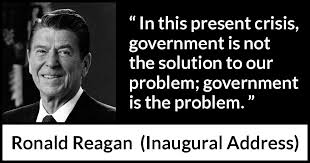
Of course, the answer is that we’ve somehow bought in to Reaganism. To use his words, it somehow convinced us that “Government is not the solution to our problem; government is the problem.”

Remember that? I do.

It was Reagan’s version of the Edmund Burke quote: “That government is best which governs least. . .” Or as Republican operative, Grover Norquist, put it, “I’m not in favor of abolishing the government. I just want to shrink it down to the size where we can drown it in the bathtub.”

Whatever the phrasing, its bottom line over the last 40 years has the government doing less and less for its citizens – and we end up paying more and more.

It’s as if we had two choices: (1) pay taxes those who provide us with the services we need (like healthcare, education, affordable housing, serviceable roads and bridges) or (2) pay them to those who on principle do nothing for us. Pay for something or pay for nothing! By electing Republicans (and many Democrats too), we’ve been making the latter choice.

Is that crazy or what?

And what’s the government doing with my tax dollars – and yours? It’s like we’re paying protection money — to our representatives — to protect us from the services we’re paying for.

I thought government’s first duty was to keep us safe. Right now, though, in the face of the biggest threat to our safety in the last 75 years, our “representatives” are doing nothing – absolutely nothing to that end.

And they’re proud of it.

In fact, we’re on track to re-elect the lot of them again next November.

Go figure.

Easter in the Time of COVID-19

It was a miracle
No one thought possible
Before Ash Wednesday.
Suddenly,
Traffic stopped,
Stores closed,
Schools shuttered,
Even churches.
Focus shifted
To health, family,
Leisure,
Jokes, stories,
Children, grandchildren
Lovemaking,
Reading, studying,
Conversing, writing,
Napping, dreaming,
Cooking and eating
Together.
Houses never cleaner –
Or messier (Your call).
Finally knowing
That Special Other,
And our very selves.
Imagining and living
Without hated jobs
And nosey bosses.
 
With cards freshly reshuffled.
The New Deal came
They said couldn’t be.
Hearts opened
Skies cleared
People sang
From porches
And open windows.
Eyes smiled
With other masks
Dropped and replaced.
Could you tell?
 
And now it’s Easter
Sad tears for the dead
Clear eyes
To see that their passing
Was no Act of God
Or preordained,
That New Life,
Another way
Is possible NOW
(It always was)
Where no one
Dies like that,
And no one’s work
Brings tears,
Where all finally
Get that recompense
Guidance and well-being
Each child deserves.
 
So, no matter what
Wall Street’s
Wolves and vultures
Might howl and screech,
From behind
Presidential Podia,
Tell them:
There’ll be no return
To the tombs we knew
Before Good Friday,
Ash Wednesday
And our cleansing
Lenten fast.
Seize the day:
It’s Easter
NOW
Like never before!

Why I Won’t Vote in November

As things stand now, I’m not going to vote in the general election in November 2020. What choice do I have?

Now that Bernie’s dropped out, It’s between two mentally impaired dirty old men – Donald Trump on the one hand, and Joe Biden on the other. Both are showing clear signs of dementia.

Trump stands accused of sexual assault by multiple women. Biden has a still unanswered but very credible similar charge outstanding. And no one in Biden’s party or in the press will even raise that accusation for discussion. (Trust me: Trump will! So, goodbye, Uncle Joe.)

And both men are serial liars. With Trump, that is a foregone conclusion. But Biden’s a liar too.

In one of his previous candidacies, his history of plagiarism made him surrender his bid. He’s lied about his education and his achievements in law school. Then there are those lies about his civil rights activism, about his history with Nelson Mandela, and about his attacks on Social Security. He just makes stuff up.

And neither one of them – neither Trump nor Biden – can put two sentences together without confirming their dementia. Every time he opens his mouth, Trump sounds like the doddering Mafia Don he is. He slurs his words, repeats himself, and can’t even remember what he just said. He hasn’t a worthwhile thought in his head. Never has.

Biden’s even worse! His sentences wander; he forgets what he’s talking about; he constantly leaves his audiences wondering, “What?” Or “That’s (to put it nicely) simply embarrassing!”

In a country of more than 350 million people, is this the best we can do? Are these our best and our brightest?

(However, I have to say that debate between these buffoons will make great television. It will be highly amusing and comical. But that’s what politics in this country has come to. It’s all Kabuki theater; it’s a cruel joke.)

That’s another reason I’ll not vote in November. The political system in general is completely broken. The politicians that are supposed to represent me have nothing to do with my concerns. They’ve completely sold out. They represent no one but their rich cronies. (Now I know how people in the Soviet Union must have felt in the late ‘80s.) The system just isn’t worth my participation.

And that goes for AOC, Ilhan Omar, the rest of the so-called “squad “(and Bernie too). In the most recent bailout, they all caved. They gave grandstanding speeches about the injustice of it all. But in the end, they voted against us, didn’t they? Their loyalties are to party and career, not to me or to you. We have NO ONE to represent us.

Democracy in this country is dead. The system is completely rigged. They don’t even want us to vote. The obstacles they’ve set in terms of the electoral college, gerrymandering, disenfranchisement, crooked voting machines, interminable lines, and Citizens United make a mockery of the entire process.

And please don’t try to shame me into voting because of the Supreme Court. That body is totally corrupt as well – completely politicized. No justice there – not even a glimmer of hope. Only clowns like the sexual predator Clarence Thomas (whom Biden ended up supporting over Anita Hill), the accused rapist Brett Kavanaugh, and a coward like John Roberts (who, remember hardly spoke a word while presiding over the recent sham impeachment hearings). The SCOTUS has no credibility at all. It’s irreformable. So, dear Ruth, you may go in peace.

The hell of it is that we don’t have any time for reform. Mother Nature won’t allow it. Climate change is breathing down our necks. What are the scientists giving us – 10 more years – or is it 8? You can now subtract 4 from that number. Neither Trump nor Biden will do what needs to be done. (Remember, Joe told his corporate friends, “Nothing fundamental will change.”)

And no one cares. I mean, with COVID-19, we can make the entire world stop. But with the far worse threat of climate change: not so much. It’s all business as usual. And it’s all nuts.

But in a way, maybe that’s the only ray of hope we have – from Mother Nature. While our system won’t object to climate destruction, maybe Our Great Mother just won’t allow this madness to go on. In any case, it’s now up to her. She will have her way.  

It’s all so discouraging on this morning after Bernie’s surrender. In the face of it all, and as things stand now, that’s why I’ll boycott this election in November.

“Lockdown”

This came in yesterday’s e-mail from a good friend.

Yes there is fear.
Yes there is isolation.
Yes there is panic buying.
Yes there is sickness.
Yes there is even death.

But,
They say that in Wuhan after so many years of noise
You can hear the birds again.
They say that after just a few weeks of quiet
The sky is no longer thick with fumes
But blue and grey and clear.

They say that in the streets of Assisi
People are singing to each other
across the empty squares,
keeping their windows open
so that those who are alone
may hear the sounds of family around them.

They say that a hotel in the West of Ireland
Is offering free meals and delivery to the housebound.
Today a young woman I know
is busy spreading fliers with her number
through the neighborhood
So that the elders may have someone to call on.

Today Churches, Synagogues, Mosques and Temples
are preparing to welcome
and shelter the homeless, the sick, the weary
All over the world people are slowing down and reflecting
All over the world people are looking at their neighbors in a new way
All over the world people are waking up to a new reality
To how big we really are.
To how little control we really have.
To what really matters.
To Love.

So we pray and we remember that
Yes there is fear.
But there does not have to be hate.
Yes there is isolation.
But there does not have to be loneliness.
Yes there is panic buying.
But there does not have to be meanness.
Yes there is sickness.
But there does not have to be disease of the soul
Yes there is even death.
But there can always be a rebirth of love.

Wake to the choices you make as to how to live now
Today, breathe.
Listen, behind the factory noises of your panic
The birds are singing again
The sky is clearing,
Spring is coming,
And we are always encompassed by Love.
Open the windows of your soul
And though you may not be able
to touch across the empty square,
Sing.

Fr. Richard Hendrick, OFM
March 13th 2020”

Ash Wednesday Reflection

Lent begins tomorrow. March 6th is Ash Wednesday.

But what does that mean for activists who are aspiring to follow in the footsteps of the great prophet, dissident, teacher of unconventional wisdom, story-teller, mystic, and movement founder, Yeshua of Nazareth?

The question is obscured by long centuries of covering up those identities in favor of Jesus’ overwhelming identification as “Son of God.” Son of God swallows up all the rest and makes it difficult, if not impossible to engage in what Thomas a Kempis called “The Imitation of Christ.”

But for the moment, suppose we set aside “Jesus the Christ,” and concentrate on that man his mother named Yeshua. He lived in a time not unlike our own, in a province occupied by an empire similar to ours. He found those conditions unbearable and devoted his public life to replacing the “Pax Romana” with what he called the “Kingdom of God.” There the world would be governed not by those wearing Roman jackboots, or by the law of the strongest, but by compassion and gift – even towards those his culture saw as undeserving.

The latter was “Good News” for the poor and oppressed among whom he found himself and his friends – laborers, working girls, beggars, lepers infected with a disease not unlike AIDS, and those fortunate enough to have government work as toll gatherers. He ate with such people. He drank wine with them. Some said he got drunk with them (MT11:19). He defended such friends in public. And he harshly criticized their oppressors, beginning with his religion’s equivalents of popes, bishops, priests, ministers, and TV evangelists. “Woe to you rich!” he said. “White-washed tombs!” he called the religious “leaders” (LK 6:24, MT 23:27).

What does it mean to follow such an activist and champion of the poor this Ash Wednesday March 6th, 2019?

I would say it means first of all to ask that question and to pray humbly for an answer.

Other questions for this Lent: Does following Jesus mean taking a public stance against empire and “church” as he did? Does it mean praying for the defeat of U.S. imperial forces wherever they wage their wars of expansion and aggression? Does it mean discouraging our daughters and sons from participating in a disgrace-full military? Does it mean leaving our churches which have become the white-washed tombs of a God who through failed church leadership has lost credibility and the vital capacity to effectively summon us beyond our nationalism, militarism, and addiction to guns and violence? Does it mean lobbying, making phone calls on behalf of and generally supporting those our culture finds undeserving and “unclean?”

Does it mean for Catholics that we somehow make our voices heard all the way to Rome demanding that Pope Francis save the church from itself by healing the wounds of the pedophilia crisis, reversing the disaster of “Humanae Vitae’s” prohibition of contraception, allowing women to become priests, and eliminating mandatory celibacy as a prerequisite for ordination?

Yes, I think, it means all of those things. But Lent also calls for self-purification from the spirit that arrogantly locates all the world’s evils “out there” in “those people.” In its wisdom, the grassroots church of Hildegard of Bingen, Francis of Assisi, of Daniel and Phil Berrigan, Dorothy Day, Martin Luther King, Oscar Romero, Ignacio Ellacuria, Jean Donovan, and Matthew Fox calls us to deepen our interior lives for purposes of sharpening our discernment about how to contribute towards replacing empire with God’s Kingdom. All of those saints, remember, were condemned by the hierarchy just the way Yeshua was in his own day.

Six weeks is a relatively long time for the purification necessary to eliminate undesirable patterns in our lives and to replace them with habits exemplified in the lives of the saints just mentioned. It’s plenty of time for working on our addictions to the pursuit of pleasure, profit, power, and prestige. Each of us knows what behaviors in our own lives are associated with those categories. So, it’s time to get to work.

As for myself . . . besides using this period for training my senses, I intend to recommit myself with renewed fervor to my daily practice of meditation, my mantram (“Yeshua, Yeshua”), spiritual reading, slowing down, one-pointed attention, spiritual companionship, and putting the needs of others first – the eight-point program outlined by Eknath Easwaran in his book Passage Meditation. Over the past two years, I’ve been keeping a spiritual journal to make sure I stay focused.

For the past two years, I’ve also been taking A Course in Miracles (ACIM) as explained by now-presidential candidate, Marianne Williamson. I’m going through the manual’s 365 lessons for a second time and find it absolutely challenging. It’s helping me distance myself further from the world’s shadows projected in our Plato’s-Cave-world. It’s giving me, what I described in another context, a set of “magic glasses” that confer a world-vision 180 degrees opposite the one that reigns here in the United States.

During Lent, I’ll continue my ACIM work – including redoubled efforts on behalf of Marianne Williamson’s candidacy. Regardless of what one might think of her chances of success, her message needs to be taken seriously. In the end, it’s about replacing politics driven by fear with policy shaped by the compassion of Jesus and the most admirable people in history. (Marianne’s candidacy forces the question on believers: Do we really believe Jesus’ words? Do we?)

I hope anyone reading this will feel free to offer other suggestions. I’m sure you agree that these are extraordinary times. They call for extraordinary political and spiritual commitment. In the spirit of Yeshua and all those saints I mentioned, we need to pool our resources.  

Scott Anderson’s “How the Arab World Came Apart:” It’s Not Islam; It’s the Economy, Genius!

fractured-lands-lead-image

Last Sunday, the New York Times (NYT) devoted its entire Sunday Magazine to a five-part article by Scott Anderson. It was called “Fractured Lands: How the Arab World Came Apart.” The epic piece traced the lives of six Arabs from Egypt, Iraq, Libya, Syria, and Iraqi Kurdistan as each struggled to live through and make sense of the disintegration of the Arab World since the U.S. invasion of Iraq in 2003. In so doing, Anderson attempted to put compelling faces on a longer historical narrative that begs for clarification, order and humanization.

The author succeeds admirably in the human interest portion of his project. More importantly, he supplies invaluable detail about a 100 year-long history of political decisions and processes responsible for the crumbling of the Arab world.

But perhaps his most stunning insight is that “Arabia” has been fractured not principally by internecine religious radicalism, but by a long-standing anti-socialist policy on the part of the United States and its allies. Ever since the conclusion of World War II, that policy has blocked economic reform not only in the Arab world and the Middle East, but also in Latin America, Africa, and South Asia – in other words in the former colonies. In the Middle East, the resulting conflict has only recently taken on heavy religious overtones.

Specifically, in that troubled region, the result of U.S. policy has been warfare and economic sanctions imposed on socialist movements involving both Arab and non-Arab countries – on peoples most of whom happen to be Muslims. As a result, those Muslims have experienced extreme poverty, joblessness, and loss of hope. Consequently, many have gravitated towards a brutal gang of reactive terrorists (ISIS) offering employment, a sense of identity, pride, short-lived hope – and the power that comes from a uniform and a gun. The grunts in this gang know very little about Islam.

In an August 12th interview with Scott Anderson on “Democracy Now,” Juan Gonzalez led the Times correspondent to make that very point. He asked Anderson what he had learned from his 18 months of research that included interviews with 20 ISIS fighters all of whom are now imprisoned in Iraq or in Kurdistan. Anderson responded:

“There was an amazing pattern. . . (T)hey were all young men, kind of with very bleak futures, either unemployed or underemployed, from working-class families, and not religious at all. . . (T)hey were not from religious families. They did not know the Qur’an very well. In a couple of cases, I knew the Qur’an better than they did. . . And I think it was this kind of decision that young men make, that better to live large for a couple of years, and, you know, the power and the so-called glamour. . . that comes of carrying a gun . . . they had more akin to why somebody might join like an inner-city gang or why in Mexico they might join a narco gang. It’s this kind of despair at seeing any sort of future. But it’s not political, it’s not religious. It’s just this impulse to—you know, to have some sort of—I mean, it’s awful to say, in terms of ISIS, but adventure.”

Juan Gonzales then observes, “But that’s a quite different perspective from what we get here . . .  that these are religious zealots who are willing to die for Islam.”

“Yes,” Anderson agrees.

With that astounding exchange in mind, it’s informative to reread the NYT article and the long-term history it reviews to detect the pattern underlying what Anderson uncovers as an economic rebellion with a recent and thick religious overlay that obscures what’s really behind ISIS and the fracturing of the Arab world. For as Anderson implies, the rebellion there is not about religion, but about economy. It is about the conflict between capitalism and socialism that has been raging at least since the 1848 publication of The Communist Manifesto. Far from ending with the fall of the USSR in 1990, the conflict has only intensified, when the West took the Soviet demise as a signal that it could subsequently increase pressure and even overthrow socialist governments everywhere – from Cuba and Venezuela to Yugoslavia and Iraq –  without fear of reprisal.

 To understand, we need to examine the underlying historical pattern responsible not only for the fracturing of the Arab world, but for relations between the developed world (principally the United States) and impoverished nations generally.

That pattern (identified specifically by J.W. Smith and implicitly by John Perkins) runs as follows:

  • Any Western colony that attempts to “break for freedom” (from capitalism and colonial control)
  • By instituting a “socialist” economy prioritizing the needs of its own people, especially its majority poor
  • Will have its leaders accused of being undemocratic dictators – communist, totalitarian, or terrorist.
  • Those countries will find themselves undermined (with Western support) by local dissidents – usually drawn from those privileged under the old colonial order or from those marginalized by the new socialist order.
  • This will cause the governments in question to institute severe national security measures that Western enemies will vilify as dictatorial, thus justifying further measures to overthrow the “repressive” regime.
  • If such methods do not result in the desired regime change, the country in question will ultimately be subjected to direct invasion or other military action on the parts of its former colonial masters.
  • Interventionist military action will be met with resistance and retaliation on the part of imperialism’s victims. (This explains the origins of ISIS.)

To reiterate, this pattern lays the blame for Middle East conflict at the feet of colonialism.  It suggests that since the dissolution of the Ottoman Empire, capitalism’s real enemy in Arab countries and throughout the Middle East has been anti-imperialist socialism not primarily Islam. More precisely, the conflicts in Egypt, Iraq, Libya, Syria, Iran, and Afghanistan have been spawned not by religion, but by resistance to colonialism and by economic policies resistant to free market capitalism.

To grasp that point, let’s think first of all about imperialism or colonialism. Then connect resistance to such foreign adventurism with socialism and the birth of ISIS.

In essence, colonialism is a system of robbery. It has foreign armies invading, conquering militarily weak, resource-rich countries, and then controlling them either through occupying armies or through local militaries armed by the invaders and headed by indigenous collaborators working hand in glove with the colonists. The chief goal of such invasion is resource extraction – wealth transfers for purposes of enriching the colonizers.

Western colonization of Arabia began in earnest after World War I. Up until then (and from the end of the 13th century), what Westerners called the “Middle East” was the center of the Ottoman (i.e. the Turkish) Empire controlled by Muslim sultans.

The Ottoman Empire was the Islamic State of its day and at its height comprised central Hungary, the Balkan Peninsula, Anatolia, Mesopotamia, Syria and Palestine, Egypt, the Caucasus and western Iran. As the Anderson essay shows, the Sultans did not impose their religion or Sharia Law on those they colonized. Instead, they allowed Christians, Jews and others to practice their faiths with no interference. As long as they paid their taxes, tribes and clans throughout the region were allowed a great deal of freedom and self-determination.

After the Ottoman Empire broke down in 1920, the British, French, Italians, and the United States stepped in to fill the void. To control their newly annexed territories (and their oil), they instituted a divide and conquer strategy. This entailed creating small client states that never existed before. These new “nations” included entities such as Jordan, Lebanon, and Yemen. Each was run by local collaborators (royal monarchs and their families) who could be counted on to transfer Arabia’s patrimony at confiscatory prices.

Such divisions were immediately resisted by tribes and clans throughout the region. Their loyalty was (and remains) to local chiefs, not to prime ministers or presidents. Together tribal leaders and their people wanted foreigners out. Many wished to unite all Arabs in a “Pan Arab” movement to restore the unity of the Arab world that had existed under the Islamic State and Caliphate for more than 600 years. The operative sentiment was “Arabia for Arabs.”

Pan Arabism took two main forms, one secular and socialist, the other (much later) religious and Muslim.

It helps to keep Smith’s historical pattern in mind: (1) break for socialist freedom, (2) vilification of socialism’s leaders, (3) empowerment of their natural enemies (secular or religious), (4) repressive measures by the threatened government, (5) (as a last resort) U.S. military action, and (6) insurgent response.

To verify the pattern, let’s begin with Egypt as Anderson does. Then let’s join him in considering the cases of Iraq, Libya, and Syria. Add in the non-Arab examples of Iran and Afghanistan to complete the regional picture. All the while, note the elements of the six-point historical pattern. To repeat, they illustrate that capitalism’s enemy has not changed since 9/11. It remains socialism, not Islam.

The most prominent secular and socialist anti-colonial movement began emerging in 1952, when Gamal Abdel Nasser led a revolution that overthrew the Egyptian monarchy that had cooperated closely with the West. Nasser was an outspoken socialist. His first act as Prime Minister was to institute a wide-ranging land reform program benefitting peasant farmers.

In addition, Nasser was critical of the West in general. He was also anti-imperial and hostile to Israel, which he and his constituents saw as another Western colonial beachhead in the Arab world. Nasser and his supporters saw Jews returning to their “homeland” as opportunistic European invaders whose ancestors hadn’t thought about living in Palestine for well over a millennium.

Nasser was succeeded by Anwar Sadat in 1970. As Anderson shows, Sadat alienated Pan-Arabs by moving closer to a client-patron relationship with the United States. He cooperated with the Carter administration in negotiating a separate Peace Treaty with Israel in 1979, without prior consultation with the other Arab states. For such betrayal, Sadat was assassinated. He was succeeded by Hosni Mubarak, an even more compliant client of the United States who remained in power till he was driven from office by the Arab Spring movement in 2011.

Nasser’s vision was shared by Hafez al-Assad, who came to power in Syria in 1970. Like Nasser, Assad had participated in a revolution against a Western-compliant monarchy. That revolution brought his Pan-Arab Ba’athist Party to power in 1963. The Ba’ath Party derived its name from the Arabic word for “renaissance” or “resurrection.” It envisioned the eventual restoration of a single Arab state. It espoused Arab nationalism and Pan-Arabism – again, Arabia for the Arabs. Besides being anti-imperial and anti-West, Ba’athism was also socialist. Since 2011, the United States and Syria’s former colonial master, France, have taken both indirect and direct action for regime change in Syria.

In 1969 Ba’athism spread to Iraq, where revolutionary forces led by Saddam Hussein toppled the monarchy established and supported by the West. Of course, following the dissolution of the Soviet Union in 1990, Desert Storm (1991) and the invasion of Iraq (2003) involved elaborate military measures by the United States to remove Saddam from office.

The same year Saddam Hussein came to power (1969), the Pan Arab socialist movement spread to Libya under Muammar Gaddafi who also led a revolution against a monarchy supported by the Western colonial powers. Gaddafi gradually moved away from the Ba’athist Pan Arab ideal and embraced Pan Africanism instead. His Third International Theory (published in his Green Book) championed socialism and anti-colonialism for the entire African continent. U.S. military action deposed Gaddafi in 2011.

Besides its links to the six-point pattern indicated above, what socialism in Egypt, Iraq, Syria, and Libya had in common was the fact that it worked. It lifted masses of people from poverty and modernized the relevant countries in a relatively short time. For example, before the 1991 invasion, Iraq boasted the highest standard of living in the Arab world. Similar statements can be made about Nasser’s Egypt, Assad’s Syria, and Gaddafi’s Libya.

Regional resistance to control by Western capitalists also emerged prominently in non-Arab Iran and in Afghanistan – two other artificial countries which came into being at the end of the 19th century. It was in these countries that (with major U.S. implication) opposition to Western imperialism eventually took on the decidedly religious turn that most mistakenly identify today as the root cause of conflict in the Middle East.

However, to begin with (as was the case in Egypt, Iraq, Syria, and Libya), post-World War II Iran experienced a highly secular grassroots rebellion against foreign control of their region following the dissolution of the Ottoman Empire. The rebellion caused the democratic election of Mohammad Mossaddegh to displace the U.S. client, Reza Pahlavi, the Shah of Iran.

Upon his succession to office, the enormously popular Mossaddegh instituted social and economic reforms of the type championed by socialists all over the world: social security, land reform, abolition of forced labor, rent control, agricultural regulation, compensation for workers injured on the job, public housing, and public works – all with the intent (as he said) to “combat disease, poverty, and backwardness.”

Above all, Mossaddegh nationalized Iran’s oil industry. This outraged Great Britain (who controlled Iran’s oil) the United States. So the CIA instituted a coup that removed Mossaddegh from office and replaced him, restoring to office Reza Pahlavi who returned from exile to administer an extremely repressive Western-friendly regime for the next quarter century.

In 1979, the Shah was overthrown in a rebellion. However, this time the uprising was not inspired by socialism, but by an anti-Western, anti-imperial movement organized “in the name of God.” It is here that Islam begins to take over as the face of the perennial regional resistance to Western imperialism that had roiled above and below the surface since 1920.

Something similar happened in Afghanistan. There too a secular socialist movement against the West morphed into a rebellion in the name of God.

In Afghanistan, the secular People’s Democratic Party of Afghanistan took control of the country in 1973 under Nur Muhammad Taraki. It offered equal rights for women, universal education, and land reform. To oppose such reforms and the intervention of the Soviet Union to uphold them, the CIA identified and supported internal opposition, the Mujahedeen – Islamic jihadists who from their founding had adopted as their goal the expulsion of foreigner rulers (viz. the British) from the Middle East. The CIA now empowered them to expel the Soviet invaders and establish an Islamic State to replace socialism.

But Mujahedeen goals were not reached with the expulsion of the Soviets. The jihadists wanted all foreigners out of the region. That meant the expulsion of U.S. troops from Islamic holy centers in Medina and Mecca. The troops had taken up residence there following the 1991 defeat of Saddam Hussein in Operation Desert Storm. That defeat was followed by 12 years of economic sanctions that ended up taking the lives of half a million Iraqi children. Osama bin Laden would later identify those murders, along with the previous 80 years of European control of Arabia, and the stationing of troops in Mecca and Medina as the specific motives for the infamous attacks of 9/11. His rationale was hardly reported in the U.S. mainstream media (MSM).

Since 9/11those media and Western politicians have shifted blame for the dissolution of the Arab world away from neo-colonial capitalist depredations and the interventionist pattern Scott Anderson implicitly reviews. Instead of blaming a failed capitalist system and its related foreign policy, they locate the cause of Middle Eastern chaos in Islam and in Hitler-like tactics of egregiously evil dictators such as Saddam Hussein and Bashar Assad. The problems thus become personalized, cultural and religious. Thankfully for those responsible, they also become largely insoluble thus necessitating permanent war. Thus the grateful include Israel, Saudi Arabia and other “American” client states. They include as well the oil and arms industries, and the corporate-controlled MSM all of whom profit from a chaotic Middle East and from misidentifying the true culprit in the region.

If all of this is true, what then must be done about Anderson’s “Fractured Arab World?”  If the cause of the fissures there is not religion nor Hitler Redivivus, but capitalism itself, its 150-year war against socialism and its six-point pattern of colonial intervention, what policies might replace the failed, counter-productive measures of war, incessant bombing, and drone attacks? If the foot soldiers in the war are not religious zealots, but unemployed and underemployed young people without prospect or hope, what will give them hope and meaning beyond a black uniform, ski mask and gun?

Here’s where we might start:

  • Abandon imperial pretensions and allow nations everywhere to experiment with alternatives to a capitalist system that clearly does not serve them.
  • Stop all vilification of Islam and Muslims.
  • Completely transform the U.S. economy from its fossil fuel dependency, thus removing the major reason for “American” interest in the Middle East.
  • Nationalize the U.S. arms industry, thus severing the connection between war and profit.
  • Cut off all aid to Israel until it complies with repeated U.N. mandates to withdraw from the Palestinian territories it has illegally occupied. This would take seriously bin Laden’s claim that solving the Palestinian problem would also solve the problem of terrorism.
  • As a good-will measure and for the sake of justice, indict, try, and punish George Bush, Tony Blair, Dick Cheney, Donald Rumsfeld, and others responsible for the Iraq War that gave rise to ISIS.
  • Divert the billions now invested in failed wars against terrorism into reconstruction of Afghanistan, Iraq, Libya, Yemen, and other countries devastated by Western wars.
  • Similarly use those billions to provide constructive employment not only for ISIS fighters, but for U.S. soldiers who find themselves armed and in uniform for reasons similar to the young militants referenced in Scott Anderson’s essay.
  • With good will demonstrated in these ways, summon a Peace and Reconciliation Conference to include all stake holders in Middle East conflicts including ISIS..
  • Comply with the decisions of the conference.

That such common sense measures probably seem impossible and completely off the table for most of our diplomats (and readers of this essay!) represents a sad comment on our limits of perception. It exhibits a lack of genuine will on the parts of our “leaders” to solve the problem of global terrorism. It also demonstrates the need for a revolution of our own.



How to Be Pro-Life and Not Just Pro-Birth

Joan Chittister

Recently, Benedictine Sister, Joan Chittister, grabbed some headlines when she took on the hypocrisy of the “pro-life” crowd.

She wrote,

“I do not believe that just because you’re opposed to abortion, that that makes you pro-life. In fact, I think in many cases, your morality is deeply lacking if all you want is a child born but not a child fed, not a child educated, not a child housed. And why would I think that you don’t? Because you don’t want any tax money to go there. That’s not pro-life. That’s pro-birth. We need a much broader conversation on what the morality of pro-life is.”

Sister Chittister’s point is well-taken. Being truly pro-life means joining reluctant mothers in the sacrifices they routinely make to see that their children are fed, properly housed and educated. So claiming to be pro-life while campaigning against food stamps, universal health care, Head Start, and subsidized housing is disingenuous to say the least. It also seems incompatible with defunding Planned Parenthood, our nation’s largest provider of sex education – probably the most effective, non-intrusive birth control measure of all.

And it’s significant that such reminders come from a woman. Women after all are the ones who primarily bear the burden imposed by the narrow pro-birth demands made mostly by men. Women alone are capable of bringing unwanted pregnancies to term. They are the ones who usually end up raising children as single parents.

Meanwhile, it is primarily men who insist that women fulfill responsibilities men themselves cannot fulfill on the one hand, and can easily evade on the other. The men include most prominently celibate Catholic clergy and an overwhelmingly male U.S. Congress. In biblical terms they are (to use Jesus’ words) “experts in the law” who “load people down with burdens they can hardly carry” and which the “experts” themselves “will not lift one finger” to lighten (LK 11:46). It’s no wonder so many women see pro-birthers as militants in a war against women.

But it’s even worse than that. If abortion is the crime they allege, pro-birthers are criminal accessories. They are co-abortionists. This is because their anti-life policies which deny reluctant mothers sex education, good jobs, decent wages, maternity leave, free child care, programs like Head Start, and subsidized food and housing create an anti-life culture. And that in turn drives desperate women to terminate unwanted pregnancies that will effectively impoverish them.

If lawmakers and religious leaders really care about life and want fewer abortions, they need to create a pro-life culture that invites bringing pregnancies to term. Most obviously, this means that it’s unjust for women to be left holding the bag. In particular it means:

  • Recognizing that the absolute prohibition of abortion endorsed by many Christians is not universally accepted.
  • Realizing that abortion as already restricted (to the first two trimesters) by the Roe v. Wade decision is about as much restriction as possible in such a pluralistic context.
  • In that light, having Christians adopt a prophetic, persuasive approach to limiting abortions rather than a legal coercive one.
  • This means that committed Christians would themselves refuse to abort unwanted fetuses, that they would support others in following suit, and (above all) that they’d promote pro-life measures across the board including anti-poverty legislation, but also advocating war resistance, elimination of capital punishment, and strict environmental protection legislation.
  • Supporting sex education programs like those offered by Planned Parenthood.
  • Changing the patriarchal teaching of the Catholic Church about birth control.

What Ordinary People Can Do for World Peace

nobel-women

This morning I watched “Democracy Now” as I do each day. All this week, the best news program on air will be broadcast from the Netherlands. There the show’s host, Amy Goodman, will be at the Hague, where she’s attending a World Forum celebrating the 100th anniversary of the Women’s League for Peace and Freedom.

Today’s program featured interviews with three women peace activists and Nobel Peace laureates: Mairead Maguire of Northern Ireland, Leymah Gbowee of Liberia, and Jody Williams of the U.S.  Mairead Maguire received her prize for her actions to end the conflict in her country. Leymah Gbowee was given the Nobel award for her leadership in a women’s movement that brought down dictator, Charles Taylor in Liberia, and saw him sentenced to 50 years in prison. Jody Williams’ prize resulted from her work in an international campaign to ban landmines.

All three women were entirely inspiring as they showed how ordinary people like you and me can change the world if we organize and stay for the long haul  in the struggle for peace.

Their interviews led me to think:

What is Peace?

I recently heard repeated

(In a sermon)

The bromide that

Peace is “not just absence of war.”

That’s right (I suppose) as far as it goes,

But peace is more than that.

It is indeed “not just the absence of war.”

But absence of war without its causes,

Injustice and inequality.

Peace is absence of war

With obscene poverty and income gaps

Outlawed.

_____

That’s the goal.

The question is

What will I do

For peace, justice, and equality

Today?