About Ukraine, Even Marianne Williamson Has Sold Out To Imperialism & Conventional Thinking 

Readings for the first Sunday of Lent: Genesis 2:7-9, 3:1-7; Psalm 51: 3-17; Romans 5: 12-19; Matthew 4: 1-11

This is the first Sunday of Lent. It’s that miraculous time of year when followers of Yeshua call into question their ways of life – the way they eat, drink, read, and think.

It’s also an intense time for questioning convention – the way the culture reasons, its values, its tales, and narratives. It’s a time for facing the fact that the world’s key perceptions stand 180 degrees opposite those of the Master.

That’s how Marianne Williamson describes miracles. Remember her?  She’s the best-known exponent of the modern handbook on Christian mysticism called A Course in Miracles (ACIM). She ran for president in 2020 and hints that she’ll run again in 2024. She describes miracles as changes in perception that completely contradict the world’s “wisdom.”  

I bring up Marianne Williamson, today not only for the Lenten and political reasons just mentioned, but because her recently articulated position on the Ukraine war contradicts the spirit of Lent just described. More to the point, it contradicts Marianne herself as well as A Course in Miracles.

As such, it reminds us of the seductive power of American culture based on arms manufacture, war, and deception. Ironically, what I’ll describe as Williamson’s fall from grace and from her own ideals represents a wake-up call not only for her, but for those who would take Lent seriously.

Accordingly, what follows will share Ms. Williamson’s recent thoughts about Ukraine as utterly conventional and (in her terms) completely un-miraculous. I’ll contrast them with the example of Yeshua found in today’s readings for the first Sunday of Lent. There, in the spirit of ACIM, he completely rejects as intrinsically evil any possibility of endorsing empire of the type embodied in the United States’ and NATO’s policy in Ukraine.

My hope is that in the name of the gospel and even ACIM, my words might lead readers to reject the conventionality of the world’s “wisdom” as found in the official narrative Williamson so shockingly endorses.

Marianne Williamson     

Let me begin by saying that I feel I know Marianne Williamson. I like her. I used to think of her as a lone prophetic voice in an American political context dominated by warmongers and short-term thinkers with no historical perspective. In fact:

  • I’ve been a longtime student of A Course in Miracles and have started a podcast called “A Course in Miracles for Social Justice Warriors.”
  • I once had dinner with Marianne and a few colleagues when she came to speak at Berea College where I taught for 40 years.
  • Afterwards, we spent two hours in personal conversation as my wife and I drove her and Marianne’s secretary to the Cincinnati airport.
  • Subsequently, we even exchanged ideas entertaining the possibility of a shared writing project connecting the teachings of Jesus (my focus as a liberation theologian) and A Course in Miracles.
  • I actively supported Marianne’s candidacy during her 2020 run for president,
  • Attending rallies, campaign speeches, and a debate in her support,
  • And publishing 9 articles on OpEdNews to that effect.

You can imagine, then, my disappointment when I read a piece she published last week called “The Tragic Conundrum of Ukraine.” My disappointment stemmed from the fact that the brief essay uncritically parroted the liberal, neocon, U.S. party line about Ukraine. – anything but the “miraculous” thinking she describes and advocates.

Marianne’s words reflected the ambition of a woman intent again on running for president in 2024 and therefore in need of assuring the public: Don’t worry, I won’t be reluctant to kill designated enemies like the Russians. Or as Williamson herself put it, “As president I would always seek to avoid the use of military force, yet I would not shy away from it if I felt it necessary.” (Emphasis added)

You can’t get more conventional than that.

More specifically, here’s what she said:

  • Despite her support for the creation of a U.S. Department of Peace to counterbalance the egregious influence of America’s military industrial complex,
  • And despite the U.S. track record in Vietnam, Afghanistan, Iraq, and elsewhere,
  • The U.S. still retains moral authority to condemn Russia and conduct what she evidently judges as its “surgical” interventions in Ukraine.
  • After all, countless U.S. interventions (often halfway across the world) were “misadventures” and “mistakes” (not crimes) while Russia’s special military operations on its own borders are cynically illegal and therefore subject to unequivocal condemnation — even by those living in glass houses.
  • Russia must therefore be stopped by “the Western World” (i.e., the predominantly white 20% that includes the traditional colonial powers like the U.S., EU, Canada, Australia, and New Zealand).
  • While ignoring (she omits saying) the reluctance or downright refusal of 80% of the (colonized, mostly non-white) world to go along – including China, India, Iran, Saudi Arabia, Argentina, South Africa, Indonesia, Brazil, Mexico, Columbia – virtually the entire Global South.

In Williamson’s pro-war position, there was no mention of historical context. Nothing about the facts that:

  • By all accounts Ukraine’s government is one of the most corrupt in the world and prominently includes Nazis and Nazi sympathizers.
  • The war in Ukraine did not begin on February 24th, 2022, but with a U.S. sponsored Ukrainian coup in 2014 that ended up with Kyiv killing more than 13,000 civilians in the country’s Russia-friendly Donbass region.
  • The stated objectives of U.S. policy in Ukraine have long been regime change in Moscow and the weakening and even balkanization of Russia.
  • In pursuit of those aims (according to the current German Minister of Foreign Affairs, Analena Baerbock) the war is NATO’s. In other words, NATO is using Ukrainians as proxies for the alliance’s war against Russia.
  • According to former German Chancellor, Angela Merkel, NATO had no intention of observing the Minsk Peace Agreements that would have prevented the conflict.
  • The U.S. ignored Russia’s diplomatic overtures in the runup to its special military operation.
  • Similarly, (according to Israel’s former prime minister Naftali Bennett) a month into the war, Moscow and Kyiv had achieved progress towards a negotiated settlement to the conflict only to be overruled by NATO.
  • U.S. history, its Monroe Doctrine, and constant violent interventions in its hemisphere show that America would act no differently from Russia in the case of similar circumstances in its “backyard.”

How disappointing is all of that coming from an advocate of miraculous, non-conventional, re-conceptualizations?

Today’s Readings

Moreover, Williamson’s reasoning (or its lack) amounts to a contradiction of Yeshua’s own example in today’s featured selection from the Gospel of Matthew. There, the Master rejects empire and its endemic wars out of hand as the invention of the world’s Evil Spirit.

Recall the scene. It’s the famous story of Yeshua’s temptations in the desert. With variations, it is contained in all four of the canonical gospels.

Jesus has just been baptized by John. In Luke’s version, a voice has told him that he is somehow the “Son of God.” He goes out to the desert to discover what that might mean. Yeshua is on a vision quest. He prays and fasts for 40 days.

Afterwards come the visions of devils, angels, and of his own life’s possibilities. Satan tests him. In Matthew’s account, the culminating enticement is unmistakably imperial. It occurs on a high mountain. Satan shows Jesus all the kingdoms of the earth – an empire much vaster than Rome’s. The tempter says, “All of this can be yours, if only you bow down and worship me.” Jesus refuses. He says, “Be gone, Satan! It is written, the Lord God only shall you adore; him only shall you serve.”

In other words, Matthew endorses a tradition that has Yeshua rejecting empire in no uncertain terms. The story at the beginning of the accounts of Jesus words and deeds establishes him as fiercely anti-imperial. Empire belongs to Satan and has nothing to do with Life’s Source.

No hint of such thinking is found in Williamson’s piece about Ukraine. Instead, she supports “the west’s” right to determine the trajectory of world history even in the face of its rejection of diplomacy and the reluctance and/or refusal of 80% of the world to condemn what it evidently sees as none of its business.

And why does she abandon “miraculous thinking” when it’s needed more than ever? I must confess that I can’t answer that question for sure.

My guess is that it comes from realization on her part that miraculously contradicting conventional thinking would not serve her presidential ambitions. Empire on the one hand versus Christianity and miracles on the other prove simply incompatible.

Put otherwise, it seems that for Williamson, in the choice between presidential aspirations and A Course in Miracles practicality wins out. ACIM loses.   

Conclusion

I still like Marianne Williamson. She is a nice lady and an effective spiritual teacher. Her explanations of A Course in Miracles have helped millions (including me) to improve our lives.

However, her essay shows that the world’s wisdom is a difficult beast to tame. Attempting to do so will likely get one cancelled. It will certainly eliminate you as a viable presidential candidate.

That means to get along in our culture and certainly to run for president, one must:

  • Lie.
  • Stop thinking contextually.
  • Or historically.
  • Or unconventionally.
  • Critically
  • Or miraculously

I regret to say that I expected more from Marianne Williamson. Lent expects more from all of us.

Tarot: Last Six Cards of Major Arcana

In this final posting on the last six cards of the 22 Major Arcana (including Card # 0, the Fool’s) we’ll look at the remaining portrayals of the classic stages of spiritual growth. Remember, the first of those seven cards was The Devil reviewed at the end of my last blog entry. The Devil represented the Fool’s realization that something is deeply wrong within himself and in the world.

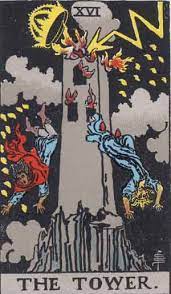
16. The Tower: With that realization, the Fool’s inner world comes crashing down. Discouraged and devastated, s/he sees that structural change and rebuilding (both inner and outer) is required, because his or her “tower” though apparently founded on rock is crumbling nonetheless. S/he looks to the stars for help. [This is a highly symbol-rich card. To begin with, its number, 16 = 1+6= 7; and that connects with#7 of the Major Arcana, viz., the Chariot card which is all about movement and finding control and mastery over opposing forces. Here the movement is downward and deconstructive as symbolized by the card’s black background and prominent gray clouds. Also centralized in the card is the couple we’ve already met in card #6 (the lovers) and in card #15 (the devil). We’re evidently watching the downfall of the basically masculine (phallic symbolled) ivory tower which has been struck by a bolt of lightning and is on fire. There are two crowns in this image, one at the top of the tower signifying the dissolution of some imperious order and the other on the head of the female figure who is falling upside down (i.e., in the hanged man position) on the card’s right. Her crown remains fixed firmly on her royal head. However, her spiritual viewpoint (designated by the color blue) is in complete transition. The same is true for the male figure whose accompanying passions are signified by the color red. This card suggests radical change.]

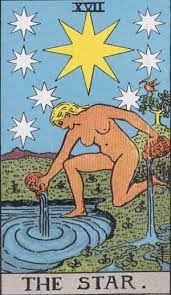
17. Star: The priestess’ star reappears when the Fool needs it most. The new, healthier ideas the stars represent guide the Fool into the future. “Follow your star” is the message here. [As opposed to the previous card, # 17 is calm and encouraging. This card is about cosmic order, hope, peace, ease, relaxation, persevering, and hanging on. The unclothed female figure has dropped all the pretense of royal robes, crowns, and symbols of power. She is concerned only with heavenly order, purifying water, connecting with the collective unconscious (symbolized by the pool) and with the earth itself (shown by her left-side intuitional knee kneeling on the earth’s surface). There are seven prominent but minor stars in the card’s image referring to the body’s seven chakras — as well as a large and bright golden central star that connects with the golden hair of the card’s central figure. The card’s protagonist is enlightened and following her star. Though her weight is on her forward foot, that foot is not submerged. The figure can walk on water. In some sense, she is the card’s star. In the background perched in something like the Tree of Life, a scarlet Ibis bird is about to take flight. In Egyptian mythology, the scarlet Ibis was considered the earthly manifestation of Thoth, the god of wisdom.]

18. Moon: The mystic moon provides relief from darkness. But it is mysterious and uncontrollable. The sleep suggested by the moon generates insights and clarity, but also nightmares, anxieties, and fears. [The moon card represents the 4th stage of spiritual unfolding (after the Devil, the Tower, and the Star). It evokes reflection on sleep and the insights that occur during that inevitable process. Sleep provides time for personal repair and reorganization at physical, psychological, and spiritual levels. In fact, this card means “Sleep Brings Counsel.” Its background mountains remind the querent not to be deceived by the highs and lows of any day or by the past itself. Instead, s/he’s called to advance steadily towards the uplifting mountainous horizons towards which a moon-illuminated golden path wends its way. The card is also about evolution. A dog and its evolutionary predecessor, a wolf, join together to bay at the moon. The dog, of course, has evolved from wolves to become the “best friend” nature has provided human beings. Similarly, the crayfish-like creature arising from the pool of the collective unconscious recalls our mind’s origins from that pool where both imagination and confusion reside. The twin towers that frame the card invite the querent to pursue wisdom beyond the boundaries of the known. The moon itself profiled in this 18th card reminds the attentive reader of the ninth (Hermit) card in the Major Arcana (1+8=9). Like the profiled hermit with his lamp, the profiled moon comes each night to teach us (through dreams and our especially precious thoughts just before sleep arrives) what we have learned during the day as well as during our entire lives.]

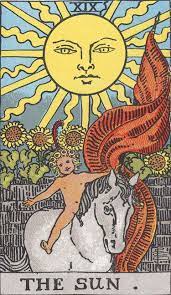
19. Sun: But the night doesn’t last forever. The sun shines brightly with a promise of homecoming and return. The Fool can now answer his child’s questions with joy, love, and positivity. At last s/he is at peace enjoying the good, the true, and the beautiful. [This card is about rebirth, happiness, and illumination. The haloed, reborn, and unclothed child finds her/his place bathing in the sun’s illuminating rays and seated on a white horse amid sunflowers. This is a triumphant card evoking joy and new beginnings.]

20. Judgment: The Fool has now returned to his interior ancestral castle. S/he is ready to share with others all that has been learned during a life of wandering, trial, and triumph. The Fool’s inner work has been completed. S/he is at peace with the past. [This card is about a journey completed. Its message is “Forgive yourself; lay your past to rest; let go of all past selves.” It is about resurrection and release. Note that the familiar man and woman from the Lovers’, Devil, and Tower cards have changed sides. The man now stands on the left, the woman on the right. This suggests that they have successfully appropriated their complementary animus or anima. The flag pictured below the angel’s right elbow is that of St. George noted for the bravery and chivalry it has taken to complete the Fool’s journey.]

21. The World: As a final step, the Fool embraces the world while knowing that the whole cycle is about to begin once again in life’s endless circle. However, this time his/her journey will not be foolish, but that of an evolved Page, Knight or Female Warrior — all to be centralized in Tarot’s Minor Arcana [Here notable symbols include those for the four Christian Gospels which we already saw on the corners of the Wheel of Fortune card (#10). Matthew is portrayed as an angel, Mark as a lion, Luke as an ox, and John as an eagle. Their appearance here indicates that the gospels’ overriding concern is Life here below not principally life al di la in the heavens. The same goes for the unclothed woman at the card’s center. We met her most recently as the Star in card #17. Here her presence and the card’s number 21 (2+1=3) suggests the High Priestess (the real 3rd card of the Tarot deck — when including the Fool’s “number,” 0) and the Empress card actually numbered as 3. The reference suggests that women, their mysteries, intuition, and closeness to nature are at the center of Life’s circle portrayed in this last card of the Major Arcana. Note that the circle is actually a green astrological ellipse tied together above and below with red ribbons. Their color symbolizes passion, energy, and fire. That same symbolism is conveyed by the Magician’s wands the card’s central figure grasps in her hands. In this last card the previously unconscious Magician and High Priestess are at last consciously integrated. It is interesting to see which figure attains most prominence at the end.]

Cave Dwellers and Cops in Granada’s Albaicin

Protestors gather at Granada’s City Hall to protest evictions of cave dwellers from their homes. The sign on the left reads “San Miguel Hill is a neighborhood.” The big black and white banner says “The Caves Resist.” One of the chants during the protest had us all shouting “La Cueva, Mi Techo, Es Mi Derecho” i.e., “The Cave, My Roof Is My Right!”

As everyone who follows this blog knows by now, Peggy and I have been living in Granada for the past five months. We’ve been in Spain with our daughter, Maggie, our son-in-law, Kerry, and their five children Eva (14 years of age), Oscar (12), Orlando (10), Markandeya (7), and Sebastian (3).

Maggie’s family has been here on sabbatical so that our grandchildren might learn Spanish by attending school where only that language is spoken. It has been a wonderful experience for all of us.

Now Peggy and I are about to return to the States for February and March. We’ll spend most of that time in Florida, and then come back to Spain in April. Our plan is to remain here till the end of June. We’ll then fly on to Rome, where we’ll spend a month or so with our son Brendan’s family. (Brendan State Department assignment will have him living there for the next three years.)

In the meantime, very unexpected things have happened to me in Granada. Here we’ve been living in its Albaicin barrio overlooking the famous 13th century Islamic city, the Alhambra. We’ve walked part of the Camino de Santiago, along with traveling to Madrid (and its Prado Museum), to Bilbao (and its Guggenheim Museum), as well as driving to Tarifa (with its nearby Roman ruins), to Valencia, and Cadiz (which so reminded us both of Havana).

However, most unexpected of all have been some friendships I’ve made with cave dwellers and street musicians here in the Albaicin. I’ve already written about that here and here. My new friendships have introduced me to a way of life that I truly admire. With one cave dweller I’ve studied the “Mayan Bible” (the Popol Vuh) and have been introduced to Tarot (which I never thought I’d study, but which now greatly fascinates and benefits me).

The cave dwellers are constantly harassed by the police — or as they call them, “the puta policia” (or effing cops). Last week, those harassers once again invaded the caves, cut off their access to water, and destroyed the property of my friends and their neighbors — all in the name of “protecting” those concerned from their unhealthy way of life.

The other day, I attended a rally by about 200 cave dwellers and sympathizers in front of Granada’s City Hall (pictured above). Some have taken to wearing black nail polish on their left hands as a sign of solidarity with the Cuevistas. I surprised (and maybe scandalized) my family members by doing so myself.

In any case, immediately below, you’ll find an account of all this in another of my poor attempts at poetry. I wrote the “poem” so I’d never forget these people I’ve come to cherish and treasure.

Cave Dwellers and Cops 
in the Albaicin’s Plaza Larga
(Jan. 27, 2023)

Since coming to the Albaicin
In Granada five months ago,
Its Plaza Larga has drawn me in,
Its cave dwellers have helped me grow.

Yes, they all live in Cuevas
Dug by gypsies and Moors
They’re troglodytes and drifters
Rebels all to their very pores.

They’re committed to music
Painting, poetry, and Life
Smoking hash and drinking cervezas
To peace and not the knife. 
.
Yes, the Larga’s a place
For outsiders like me
They’re poor, ill-clad
But happy
Living NOW as all can see.

One of them there
Wears a jellabiya on Fridays
And yells in a voice
Much too loud.

But no one’s upset by his antics
Or his shouting at the crowd
Instead, they roll eyes or support him.
Ridicule’s never allowed. 

I’ve met a man there called Simon
A street busker and shaman indeed
He helps me with my Spanish
Oblivious to any need

Because he’s rich, you see
Not with money, playthings, or goods
But with time, wisdom, and kindness
And absolute freedom from “shoulds.”

There’s another Simon
(I’ve met him).
Much younger and from France
There’s Ida from Denmark
And Ramon from north Spain
And Juan whose Traveler ancestors
Set the Cuevas as their reign. 

There’s a girl from Somalia called Filas
She’s dark, skinny, and profane.
She’s friendly and kissy and cheerful
Eats mushrooms and smokes in a chain.

And I’ve met 
A young man they call ‘Cesco’
He’s moving here this fall
From his home far away in Italia
(Perhaps he’s the wisest of all).

He’s a Bob Dylan scholar and tarotista
(He did my Tarot today)
He knows everything about Dylan
“Desolation Row,” and what his cards say.

So, I’m grateful to Andalusia
For giving me a gift so unexpected, and so fine
Of friendships with the Chusma
It’s been like draughting aged wine. 

Yes, I love crossing borders 
With campaneros like these
I’m grateful to Simon and the drifters
Who do whatever they please.

That is. . ..

If not for the “Puta Policia” . . ..
Anxious to show my friends who’s boss
They harass them and fine them. 
They smash their guitars
Understanding nothing about them
As if coming from Mars

They sack their poor Cuevas
Burn their goods and possessions
Interrupt their love making,
Their meditation sessions.

They render them homeless.
As if that were good
Can you imagine
Cops destroying their food?

But that’s the lot of drifters
Living everywhere it seems.
Of dropouts whose simple existence
Challenges our bourgeois dreams.

The system just can’t stand them
Detesting their sight and smell
So, it robs the poor of the little they have
And sends them all to hell.

I’d know nothing about this
If not for Simon and friends
If not for the Plaza Larga,
Where singing never ends.

If not for my new friendships
If not for Tarot and song
If not for gypsies and buskers
If not for my stay here so long.

So, despite the puta policia,
I’m grateful to be here
Learning from friends in the Plaza Larga
May God remove their fear.

Jesus: “Blessed are YOU Poor” Vs. Matthew: “Blessed are the Poor in Spirit

Readings for Fourth Sunday in Ordinary Time: ZEPHANIAH 2:3, 3:12-15; PSALM 146:6-7, 8-10; I CORINTHIANS 1: 25-31; MATTHEW 5: 1-12A.

So we’re a Christian nation, right? At least that’s what right wingers would have us believe, despite the presence of millions of Jews, Muslims, Hindus, Buddhists (and atheists!) among us.

Well, if we’re so Christian, here’s an idea for you. How about posting the Beatitudes in front of U.S. courthouses instead of the Ten Commandments? How about posting them on the walls of our schools, and in front of the White House? Doesn’t that seem more appropriate? I mean the Beatitudes come from the specifically Christian Testament. The Ten Commandments, on the other hand, come from the Jewish Testament.

I predict that will never happen. In fact, I’ll bet you anything there’d be a hue and cry (on the part of Christians, mind you) that would prevent the move. And do you know why? Because the Beatitudes centralized in today’s liturgy of the word are too radical and un-American for the “Christian” right. The Beatitudes make sweeping judgments about classes. They indicate that the rich (evidently no matter how they got their money) are at odds with God’s plan, while the poor (regardless of why they’re poor) are his favorites.

No, I’m not so much talking about the version of the Beatitudes found in the Gospel of Matthew which were read in today’s Gospel excerpt. In Matthew, Jesus’ words are already softened. Instead, my reference is to Luke’s probably earlier version that expresses harsher judgments.

Here’s the way, Luke phrases Jesus’ words in Chapter 6 of his Gospel:

20 And he lifted up his eyes on his disciples, and said:
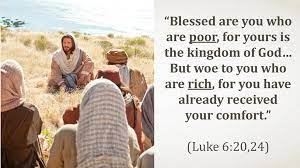
“Blessed are you who are poor, for yours is the kingdom of God.
21 “Blessed are you who are hungry now, for you shall be satisfied.
“Blessed are you who weep now, for you shall laugh. . .
24 “But woe to you who are rich, for you have received your consolation.
25 “Woe to you who are full now, for you shall be hungry.
“Woe to you who laugh now, for you shall mourn and weep.
26 “Woe to you, when all people speak well of you, for so their fathers did to the false prophets.

Do you see what I mean? Luke’s version doesn’t spiritualize poverty the way Matthew does. Matthew changes Jesus’ second-person statement about poverty (“Blessed are you who are poor”) to a third-person generalized and spiritualized “Blessed are the poor in spirit.”

Similarly, Luke’s “Blessed are you who are hungry now” becomes “Blessed are those who hunger and thirst for justice” in Matthew.  In this way physical hunger is turned into something spiritual or psychological. Obviously, Matthew’s community was not as poor as Luke’s – or as the people Jesus habitually addressed.

In fact, the entire Judeo-Christian tradition is so valuable exactly because – unlike most of ancient literature – it represents the lore of poor people about their relationship with God.

Granted, that tradition became the object of class struggle about 1000 years before Jesus’ time, with the contested emergence of a royal class.

That is, starting with King Saul, the royalty of Judah and Israel tried mightily to turn a poor people’s faith into an ideology supporting the country’s elite. More particularly, under King David, palace oligarchs distorted the divine promise to slaves escaped from Egypt. That promise had been “I will be your God and you will be my people.” David turned it into a promise of a permanent dynasty for himself and his descendants. In other words, the country’s royalty transformed the Mosaic Covenant into a Davidic Covenant serving the elite rather than the poor.

However, the people’s prophets resisted them at every step. We find examples of that in all of today’s readings. For instance, in our first selection, the seventh century (BCE) prophet, Zephaniah, addresses the world’s (not simply Israel’s) poor. With his country’s aristocrats and priests in mind, he denounces their lies and “deceitful tongues” and urges them to treat the “humble and lowly” with justice as was prescribed by Moses.

Then with the responsorial Psalm 146 (probably written in the late sixth century) we all found ourselves chanting the words Matthew attributes to Jesus: “Blessed are the poor in spirit; the Kingdom of God is theirs.” The “Kingdom of God,” of course, is shorthand for what the world would be like if God were king instead of those corrupt royal classes. The psalmist says that change would bring justice for the oppressed, hungry, imprisoned, physically handicapped, the fatherless, the widow, and the resident alien. All of these were specific beneficiaries of the Mosaic Covenant.

Today’s third reading from I Corinthians promises a connected Great Reversal. There Paul of Tarsus (in modern day Turkey) identifies Jesus’ earliest followers as those who “count for nothing” in the eyes of the world. (Do you see the return to the Mosaic Covenant?)  Jesus followers are riffraff. Paul identifies them as unwise, foolish, and weak. They are lowly and despised. Yet in reality, Paul assures his audience, the despised will finally be proven wise and holy. Ominously for their betters, Paul promises that those who count for nothing will reduce to zero those who in the world’s eyes are considered something.

Jesus, of course, appears in Zephaniah’s and Paul’s prophetic tradition as defender of the poor and the Mosaic Covenant. Matthew makes that point unmistakably by changing the location of Luke’s parallel discourse. In Luke, Jesus announces the Beatitudes “on a level place” (LK 6:17). Matthew puts Jesus “on a mount” for the same sermon. His point is that Jesus is the New Moses who also received the Old Covenant on a mount (Sinai). Put otherwise: the so-called Beatitudes represent the New Law of God.

That’s why it makes more sense to place the Beatitudes on a plaque in front of our courthouses, on the walls of our schools, and in front of the White House.

But as I said, don’t hold your breath. Can you imagine our super-wealthy politicians (not to mention their donors) having to read Luke’s words every day?

“Woe to you who are rich, for you have received your consolation.
25 “Woe to you who are full now, for you shall be hungry.
“Woe to you who laugh now, for you shall mourn and weep.
26 “Woe to you, when all people speak well of you, 
for so their fathers did to the false prophets.

No, in its essence, the Judeo-Christian tradition belongs precisely to poor people. It belongs to those whom Americans in general think “count for nothing.” As Paul intimates, those are the very ones who will rise up and reduce to zero those who in the world’s eyes are considered something.

That message is no more welcome today than it was 2000 years ago.

.

Tarot: Cards 11-15

This is the third in my series on Tarot. I’ve been pleasantly surprised to discover for myself how helpful the cards have become for making sense of my spiritual and material life.

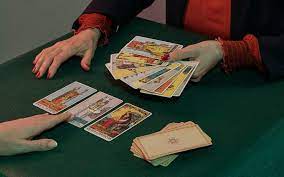
Each morning, first thing, I do a Tarot reading. As previously mentioned, I “throw” three cards. The first yields a preview of the coming day, since it is meant to express the hidden “energy” of what lies before me. The second card is about gratitude; it reminds me of what I’m particularly grateful for in my long life. The final card (which I place between the other two) suggests what or whom I should incarnate during the coming day. For instance, this morning the latter was Card 14 as pictured below. I took it as a call to incarnate my patron saint, Michael the Archangel. (Look below for the explanation.)

During the day, I leave the cards out. I glance at them as the day unfolds. Their meaning deepens as I do so.

As I’ve said before, Tarot is like a 78 page book. It’s living, dynamic, and interactive — and uncanny in its practical inspiration.

What follows are the cards of focus today. Remember, the Major Arcana outline everyone’s story of passage from status as a naive “Fool” (card zero) to deeper levels of awareness.

So far the Fool we’ve been following is unaware of his/her true inner Self, a blended Magician and mysterious Priestess. The Fool has received instruction from the mother figure in his/her life (the Empress), and from a father figure (the Emperor). The Fool has also gone to school and church, where s/he’s learned community traditions and rules from representatives of a Hierophant or Pope. Then came Love, Conflict, and the early dawning of some kind of critical awareness that imparted a kind of inner Strength to think autonomously. This drove the Fool to introspection in his/her Hermit phase which brought wisdom about the nature of life as a spin of the Wheel of Fortune with an accompanying need for self-forgiveness.

The story unfolds from there in the following 5 cards:

11. Justice: From introspection and the wisdom it imparts, the Fool realizes that justice – i.e., balance between worldly achievement and care for others – is necessary to start a new chapter in life. [Here Lady Justice is pictured as a royal figure. She holds the sword of clear thinking in her right hand and the scale of justice in her left (the side closest to her heart and its intuition). The red hue of Lady Justice’s robes indicates her passion for fairness. Her golden crown and corresponding cape as well as the “halo” above the violet background drape call attention to her connection with Life’s Great Source of enlightenment and illumination. Violet is the color of integration of masculine and feminine characteristics. Achieving justice is a highly spiritual affair that combines the best of both genders. The closed-in pillars on either side of Lady Justice indicate a commitment to a path that is “straight and narrow.”]

12. Hanged Man: Since the world is committed to injustice, the Fool now finds herself/himself suspended between two contradictory worlds. As a result, s/he feels called to adopt a new upside-down perspective on life. Though uncomfortable, s/he realizes that former perceptions of “truth” were nothing but simple repetitions of “teachers’” opinions. [Notice the golden halo around the upside-down figure. This is a stage of enlightenment that is highly spiritual (indicated by the Fool’s blue tunic). Enlightenment also includes coming to grips with the passion of the Fool’s root and sacral chakras (indicated by the figure’s red tights).

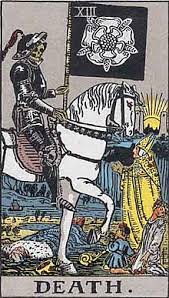
13. Death: Seeing the world upside-down makes the Fool realize that spiritual growth will demand “dying” to the inherited opinions which do not belong to the inner Magician/Priestess, but to the Empress, Emperor, Hierophant, and other lesser authority figures. The Fool is now ready for rebirth, improvement, and transformation. S/he is wiser and more confident – ready to begin Life’s next chapter. [Virtually everyone who has ever heard of Tarot know of the Death Card. Close examination, however, reveals nothing to fear. Though the card can be about impending physical illness and/or death, 99.9% of the time, it’s about change — death to old ways of thinking and acting and imminent new beginnings (indicated by the sun rising in the “eastern” part of this card framed by two “Towers of Hermes” — the ancient symbol for the boundaries of the known.) That the card is about spiritual death to the past and subsequent transformation is indicated by the very prominent white horse and the white rose adorning the the black flag. The skeleton riding the horse directs attention to the most lasting part of our physical form. The dead and crownless royal figure beside the horse tells the truth that death is the great leveller; it comes to everyone regardless of positions attained during life. Then there’s the young girl turned away from the approaching horse; she seems to be in denial. Meanwhile, the small child holding out a bouquet seems to be more open to death’s approach (as young children often are). The bishop in golden robes is facing the horse directly. Is he bargaining with death? Notice the river (Styx) in the background with a small boat floating down this traditional image for life’s journey. In summary, the Death Card represents the void between death and rebirth.

14. Temperance:  Preparing to enter that void involves living temperately – in peace, patience, balance, and harmony. It invites us to choose the middle path between extremes. [The powerful symbolism of this card is undeniable — especially for someone blessed with the name Michael. Notice the angel’s powerful wings tinged with red, the color of passion, energy, and activity. The angel is pouring water (the symbol of life itself) from one cup to another in a motion of giving and receiving (from the left, heart-centered hand, to the right, intellect-centered hand). Note that the angel has one foot on dry land and the other dipped in the water attempting to balance the mystical and physical realities of life. That same message of balance is indicated by the middle path behind the angel as it wends its way towards the sun. The flowers on the card are irises named after the Greek messenger-goddess. They are symbolic of hope, valor, trust and wisdom. The angel’s golden third eye under a head of golden hair also symbolize enlightenment and illumination. The gold triangle (spiritual energy) over “Michael’s” heart chakra is hemmed in by a black square (earth) again speaking of balance or temperance.

15. The Devil: But transformation and transfiguration also mean confronting the world and its extreme values of pride, covetousness, lust, anger, envy, sloth, and gluttony. It means confronting the devil, evil itself along with addictions and destructive impulses. The Fool now knows that s/he has a choice. S/he does not have to live like everyone else. [This is a very intense card – very dark (the background is entirely black). However, it signifies one’s desire to make a change. This 15th card is the first of the Major Arcana’s final seven cards that depict the seven stages of spiritual enlightenment. This initial stage is about “Consciousness of Bondage.” (If we don’t know we’re bound, we can never achieve freedom.) When the card comes up, it indicates that one is yearning for freedom. This devil card is about addictions, unhelpful habits, and giving our power away. Note that the man and woman pictured here are the same figures that appeared in card # 6, the Lovers’ Card. Here however they are bestialized with horns on their heads and now wearing long tails. The man’s tail is on fire signifying sexual passion. The woman’s tail relates to grapes perhaps connecting this picture with wine and alcohol. (As we all know, sex and alcohol are major human addictions.) Key to understanding the card is the hand gesture of the pictured devil. It is an ancient mudra that signifies “What you see is all there is.” That of course is the devil’s basic assertion – a denial of the unseen spiritual realm. It has the devil seated on a half-cube signifying his connection with half-knowledge rather than whole. This denial makes it easier for humans to sell their souls and make Faustian bargains. Unlike the Hermit’s lamp in card # 9, the devil’s torch is turned upside down setting aflame the man’s tail (passions?). In terms of escaping the devil’s thrall, it is interesting to note that the chains around the man and woman are very loose and could easily be removed. This suggests that the bondage in question is purely illusionary. Think of this card as the inverse of Tarot Card #1, the Magician, whose right hand was fully extended upward pointing to the reality of the spiritual realm. Questions suggested by this card include:

  • What am I addicted to?
  • What primal need are my addictions attempting to meet?
  • How can I meet them in a more constructive way?
  • Which addiction am I ready to break free from?
  • To whom or what am I giving my freedom away?
  • What fears relate to my addictions and/or unhelpful habits?

Stay tuned for my next installment on Tarot. It will address the final six cards of the Major Arcana.

“Indecent” Women Doing Liberation Theology Without Underwear: Saints Tina Turner & Chuck Berry

What is the connection between liberation theology and its feminist theologians refusing to wear underwear while writing their articles and books? That’s right: no underwear.

And what is the connection of their resulting theology with the poor lemon vendors in Buenos Aires who, also without underwear, squat defiantly in their full skirts and urinate on the sidewalks in front of watchful and disapproving city police? (Meanwhile, the lemon sellers complain about their “shi*ty priests”, “mafia politicians” and those “puta policia” – fu*kin’ cops).

And what about the mothers, grandmothers, and great-grandmothers, who proudly display their completely unrobed bodies on so many contemporary internet sites? Presumably many of them identify as Christians. But by religious standards, isn’t such display “indecent?”

And finally, is there any relationship between feminist theologians and those Argentine lemon sellers, on the one hand, and rock ‘n’ roll music, Tina Turner, and Chuck Berry on the other.

The late liberation theologian Marcela Althaus-Reid (1952-2009) provocatively raised and addressed questions like those during her brief career as Senior Lecturer in Christian Ethics, Practical Theology, and Systematic Theology at the University of Edinburgh in Scotland. In doing so, she shed light on women’s rebellions against oppressive patriarchal norms across the planet.

You know what I mean. Think about the reaction to the effective repeal of Roe v. Wade by the U.S. Supreme Court. Think of those Muslim women in Iran who cut their hair in public and refuse to obey the “morality police.” Even consider, if you can, the unspoken meaning behind those mature women around the world who provocatively display their unclothed bodies online for all to see.

Althaus-Reid argued that the above are all doing what she called “Indecent Theology.” Here the reference is to her thesis from her 2004 theological potboiler, From Feminist Theology to Indecent Theology: Readings on Poverty, Sexual Identity, and God.

Because of the important light the book sheds on the feminist rebellions just referenced, as well as on liberation theology itself, please consider with me what Althaus-Reid means. Consider the relevance of indecency to liberation theology and to issues like abortion, the morality police, what some might call “pornography,” as well as to patriarchy in general. Consider its connection to rock ‘n’ roll and to popular “saints” like the recently deceased Tina Turner (1939-2023) and Chuck Berry (1926-2017).

Female Indecency

Althaus-Reid begins by reminding readers that Christianity itself is a highly sexualized affair. It is claustrophobically decent. (In what follows, all references in parentheses are to the book just cited.)

She says it’s not that the morality of the Bible in any way endorses Victorian sexual standards. It does not. Instead, its main concerns are liberation in all the senses (economic, political, and spiritual) that the word “liberation” connotes.

That’s because the Biblical tradition was based on the freeing of slaves from Egypt. Its resulting concern was for the welfare of widows, orphans, and resident aliens. Its prophetic tradition boldly spoke radical truth to priests, kings, and other bosses who legislated against, ignored, and/or exploited the poor.

In general, the biblical tradition promised the latter a new and brighter future. The prophet Yeshua called that future the “Kingdom of God.” By that he meant what the world would be like if God were king instead of the world’s oppressive “Caesars.” Such a world would be turned upside down. Its standards of decency would be transgressed at every turn.

Yet despite such a clear emphasis on social justice, it was the biblical tradition itself that ended up doing a headstand instead of the imperial world order. The revolutionary thrust of “The Book’s” pivotal story was tamed by the kings, princes, and popes of the world (27, 28). Far from being scandalous and revolutionary, the Judeo-Christian tradition thus became the defender of the status quo. Its point became the social control of the revolutionary lower classes, with oppressive standards of decency, especially for women.

And why so much attention to women? It is because of their embodiment of the revolutionary energy that the Greeks called eros. As psychologists and philosophers such as Sigmund Freud and Herbert Marcuse have pointed out, eros represents the basic creative energy of the universe.

In a capitalist patriarchal order dependent on overwork, the powers of patriarchy identify eros in the form of female sexuality as the fundamental factor threatening to undermine their entire project. Hence the powers-that-be covertly vilify women for deliciously “tempting” men to find meaning, fulfillment, happiness, and joy in human (and sexual) relationships that undermine the system’s requirement of “surplus repression” in the form of overwork.

And so, repressive concepts of decency in general and of theological decency in particular emerge to dominate women and, by extension, their potential partners. Theological decency decrees that:

• The woman’s body is a source of temptation

• Therefore, it should be covered by layers of clothing.

• Women need men to regulate female bodies and behavior through special rules written by men and (depending on culture and historical period) governing the integrity of women’s sexual organs, their menstrual periods, and issues surrounding marriage, birth control, abortion, divorce, voting and the ability to own property.

• To do theology (i.e., to speak authoritatively about God even in relation to themselves and their bodily processes), women must earn professional degrees grudgingly bestowed by the patriarchal establishment of academia.

• Therefore, the “degrees” informally awarded by the “School of Life” with its deviant and indecent logic are invalid (14, 32, 137). So is the spirituality resulting from lemon vendors engaging in “witchcraft,” in the informal healing arts, working as midwives, abortionists, and spiritual guides.

Theological Indecency

With all this in mind, feminist liberation theologians like Althaus Reid insist on transgressing the limits of theological decency. They insist that:

• Doing theology is a profoundly sexual act (4, 76). To repeat: this is not because sex was central to Jesus’ preaching. Rather it is because the church has for centuries distorted the teachings of Jesus in the service of the empire, acting in the process as an instrument of social control as explained above. Therefore, theologians are forced to write endless pages refuting such distortions.

• Poor women provide the most radical view of theology (16). Their enforced “otherness” teaches us something new about life and about the Greater Queer that some still insist on calling “God” (19).

• Yes, God is Queer (9, 146) in the sense of exceeding all categories and definitions (175) while subverting decent bourgeois concepts like family. [For those who live on the peripheries of society – under bridges, in slums, favelas and shanty towns, “family” ends up being an oppressive category. It arrogantly invalidates alternative basic social groupings that are just as valid, functional (and dysfunctional) as their bourgeois counterparts (159, 160, 164).]

• Far from being a liberating model for Latin American women, the cult of the Virgin Mary ends up functioning as another instrument of social control, this one aimed directly at women (13, 23, 39, 55). After all, Mary is presented as “a gadget” (88) having sex with God without any pre-coital romantic relationship (85). She does not experience sexual pleasure or orgasm from the union (88). And then afterwards she enjoys no meaningful sex life with her husband, Joseph. Such factors are supposed to set an example for all Christian women.

• Similarly, Jesus himself is strangely asexual: a young Hebrew man with no compañera and no unambiguous sexual interests. He also serves as a model of sexual abstinence (45).

• Thus, Jesus was queer in the sense indicated above: an outcast who rejected and was rejected even by his own family. They thought he was crazy (Mark 3:21). He spent a lot of time in the desert. At least once he was tempted to commit suicide by jumping from the pinnacle of Jerusalem’s Temple itself (170).

• In addition, the evangelical representations of Jesus show him as a victim of the machismo of his own culture (45, 48, 51, 80). Yes, he comes to the aid of a woman considered “impure” because of a menstrual problem (Lk 8, 43-48); and yes, he rejects the male executioners of a woman sentenced to death for adultery (John 8: 1-11). However, Jesus never questions the misogynistic patriarchal laws that govern those situations. He does not reject the laws regarding the stoning of women caught in adultery, nor those that classified menstruating women as “unclean” (6, 13).

• In summary, if liberationists take Jesus’ poverty and otherness seriously along with Paul’s dictum that in Christ there is neither male nor female (Galatians 3:28), perhaps the best contemporary identification of “the Master” would be a twelve-year-old girl prostituted by two men in a public toilet in Buenos Aires (84).

Unclothed Theology in the U.S.

Those are just some of the reflections of Althaus-Reid operating as a professional theologian. Meanwhile, she points out, her less academically prepared Latinx sisters do their theology based on popular beliefs and practices. Their well-earned degrees come from the school of very hard knocks. Their insights, Althaus-Reid suggests, are no less valid than their sisters’ teaching in places like the University of Edinburgh.  

So, they defiantly continue to honor Santa Evita Perón. She, after all, secured voting rights for Argentine women over the objections of Argentine bishops (79). They also pray to Santo La Muerte (St. Death), Jesús Bandito, and local popular “gangster saints” who are seen as robbing and stealing from the real thieves and criminals who support those who run the government (161). They have “canonized” deceased popular singers like Rodrigo and Gilda offering them prayers and novenas in chapels dedicated to El Angel Rodrigo and La Santa Gilda (157). Those who honor such avatars kneel in church like Althaus-Reid herself without underwear, engulfed, she says, in the fragrance of female sex, and offering fervent prayers to rock stars no doubt considered “indecent” by church authorities.

All of which brings me to rock ‘n’ roll, Tina Turner, Chuck Berry, and those unclothed grandmas.

Take the grandmas first. Althaus-Reid I think would see them as doing a kind of negative theology protesting the false church-supported Victorian standards earlier referenced. They take indecency to the extreme not just rejecting underwear, but displaying their bodies completely unclothed — not for personal gain like strippers or aspiring models, but just for the hell of it.     

Their wordless indecency is consistent with Althaus-Reid’s identification of the female body as a privileged locus of rebellion against patriarchal systems of power (45). Such rebellion echoes the status of their sisters in the Global South as “single women” with no visible men (35).

After all, under patriarchy, the skirts that once signified femininity and even priesthood (37), now only convey a deep alienation (20). Set them all aside!

“Do you want indecency?” rebellious women seem to say. “Well, take a look at this! The patriarchs will not tell us how to behave and what to do with our bodies!”

As for rock ‘n’ roll, Tina Turner, and Chuck Berry. . ..  How much saintlier can you get?

During their lives, their music performed the basically feminine function of distracting millions from the overwork mandated by the reigning system denounced by Marcuse. In the process, they brought joy, fun, and happiness to millions of people who ended up attending and participating in the huge liturgies we call “concerts” – even over the protests and askance gazes of uptight Victorians and clergy.  

By the standards of Althaus-Reid nothing could be more constructively indecent and therefore holy. Thank you, Saint Tina! Thank you, holy Chuck! Thank you, dear Marcella.

Tarot Cards 6-10: Love, Conflict, Strength, Withdrawal, & Luck

1864, Gustave Moreau “Riddle of the Sphinx”

Here is the second installment reflecting my recent initiation into the wonders of Tarot cards.

Under the influence of Ruth Rodriguez Sotomayor, the author of The Precursors of Printing, and of the great Chilean filmmaker and tarotista, Alejandro Jodorowsky, I’ve come to see tarot cards as a living, dynamic, interactive book. It has 78 pages that are absolutely fascinating because their subject is YOU and I, the overall direction of our lives, and the most intimate details of our personal relationships and worldly endeavors.

Tarot originated in various parts of Europe during the 15th century when most people were illiterate. No matter. Under the guidance of a master reader, the cards can yield pages and pages of engrossing information of the most practical kind.

Lately, I’ve taken to beginning my day with a tarot reading. After shuffling the cards and offering a prayer for light, I select three of them. One represents the energy of the day. A second card reminds me of what I’m grateful for. The third selection suggests who or what I’m asked to incarnate during the coming hours.

Recall, that in dealing with Tarot’s “Major Arcana,” (major secrets) we’ve been tracing the Fool’s Journey.” It’s the pilgrimage each of us must make from a child’s ignorance to the degree of enlightenment we finally achieve in this lifetime.

In the first five cards we met the image of the fool (ourselves); we were introduced to her (i.e. our) innermost self — a combination of (1) an all powerful Magician and (2) a beautiful, mysterious, and intuitive Priestess; we met the fool’s earthly embodiment of the Magician in the traveler’s (3) Emperor (his father figure) and (4) Empress (her mother figure); and finally we encountered his/her initial teacher and moral guide in (5) the Hierophant.

In reviewing today’s five cards, we’ll see the Fool beginning to transcend the guidance he received from those sources.

6. Lovers: Within the collective, the Fool meets his or her lover and has life’s first meaningful sexual experience connecting him or her with a gender opposite. (This card is very rich. Notice its references to the Biblical myth of the first man and the first woman. That’s a snake wrapped around an apple tree with four (the number of fullness and stability) apples. For his part, the card’s male figure is backed by a tree with 12 flame-like leaves. Fire is the symbol of passion; 12 is the number of enlightenment. A huge, beautiful, and passionate (red-winged) angel oversees and blesses the whole interaction whose trajectory is suggested by the reddish background mountain.)

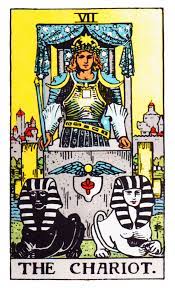
7. The Chariot: After a honeymoon period, the Fool experiences some form of conflict and separation. It teaches belief in oneself and to be assertive in pursuing one’s goals. [Whereas the traditional reference in the Lovers’ card was to the Bible, the allusion here is to the Bhagavad Gita. The Gita teaches that our bodies are like chariots pulled by horses representing the senses, and controlled by the “reins” of the mind. Note here that the Chariot card has replaced the horses with sphinxes (a reference to Egyptian wisdom and to Sophocles‘ “Riddle of the Sphinx). The white and black colors of the sphinxes remind the reader of the “yes” and the “no” connected with choosing the direction one’s life will take at its various crossroads. Note too that the chariot’s driver has no reins in his hands; he has surrendered guidance to his Inner Self — his true identity. Finally, the chariot is leaving the city; it has crossed the river where the charioteer seeks quiet and repose.]

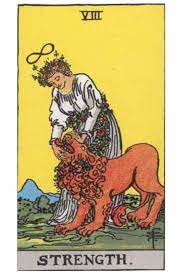
8. Strength: Reflection offered by leaving the city makes the Fool stronger. S/he learns the lesson of mind over matter and that true strength comes not from brute force, but from kindness, warmth, and inner quiet. (The female embodiment of true strength speaks volumes here as does the infinity symbol serving as a halo for the virtue’s embodiment.)

9. The Hermit: With such lessons learned, the Fool now retreats into the Hermit’s introspective world, removed from externals to answer all remaining questions. S/he searches for Self in a cave-like darkness with knapsack replaced by a lantern shedding light in that obscurity.

10. Wheel of Fortune: The Fool eventually realizes the nature of life as determined by a combination of fate and free will. Life has its ups and downs. It is all a cycle with consequences tied to every decision. Faced with his past mistakes, the Fool manages to forgive himself or herself. [Here the source of inspiration are the four canonical gospels, Matthew (the angel), Mark (the lion), Luke (the ox) and John (the eagle). All are connected with the Egyptian wisdom again (as in card 7) signified by the sphinx whose color this time is blue, the hue of heavenly spirituality. The sphinx is holding a sword (symbolizing new ideas) pointing towards the mystical gospel of John. The salamander underlying the wheel is the traditional symbol of fire and life’s energy.

Stay tuned for the next five cards of the Major Arcana. Coming soon.

Tarot: the Fool’s Journey & Relationship with God, Humans, Intellect, & Employment

It may surprise readers of this blog to find out that I’m currently studying Tarot. Yes, I am. My busker friend, Simon, here in Andalusia got me interested by introducing me to the work of Ruth Rodriguez Sotomayor, the great Ecuadorian scholar of “The Precursors of Printing.”

Sotomayor’s work calls us to value “texts” that preserve the wisdom, philosophies and worldvisions of humans before the invention of the printing press — and of those after its invention who had not yet learned to read.

Tarot cards (which first appeared in the 15th century) fall into the latter category. They form a kind of book expressing a profound spirituality of preliterate people in the various cultures which produced them. In Joseph Campbell’s terms, the book in question describes a hero’s journey from ignorance to complete self-consciousness.

And that’s a story we all need in this post-religious age. Please take time to view the video at the top of this posting. Then read the comments that follow. They reveal the absolute hunger that our American contemporaries experience for deep spirituality and how sincerely those who have rejected organized religion respond to the message of the Tarot book.

What I’m claiming is that Tarot cards remain an invaluable tool for navigating the mysteries of one’s life. The 21 “Major Arcana” (Magician, Priestess, Empress, Emperor, Hierophant, Lovers, Charioteer, Justice, Hermit, Wheel of Fortune, Strength, Hanged Man, Death, Temperance, Devil, Tower, Stars, Moon, Sun, Judgment, and World) represent that life in general as stages in “The Fool’s Journey.”

Here, the Fool represents every man and woman. We are all fools, the cards disclose, in the process of discovering our deepest Self as a blend of divine characteristics embodied in the Magician and Priestess. That’s what the Fool discovers in his/her paradigmatic trek. At the end, s/he stops being a fool and assumes a more evolved identity as a Knight or Female Warrior continuing an evolutionary journey beginning with his/her cyclical return to the castle of the King-Father and Queen-Mother.

The 58 “Minor Arcana” depict that subsequent evolution as the Female Warrior and/or Knight secure deeper understandings of their relationships to Source, other human beings, to ideas and to work. In the end, they employ their inherent Divine Energy to establish dominion in those more specific realms while appropriating their unconscious identity as royal kings and queens.

Let’s review the entire process card by card. Here are the first six. I’ll survey the rest in subsequent postings.

Fool’s Journey

According to Tarot’s numerology, the Fool has no number. He is a zero, a clean slate. He is naïve, over-confident, daring, and bordering on stupid. He starts out confidently on his life’s path completely unaware of his True Identity as a blended Magician and Priestess. Notice how confidently he is about to step off a cliff’s edge despite the warnings of his dog:

  1. His/Her Unconscious Magician: This second card represents the Fool’s true (but unconscious) masculine identity – dynamic, muscular, gifted, capable, and commanding. The Magician understands and creatively harmonizes himself with Life’s four elements of fire, water, air, and earth, along with its fifth element (its quintessence) of God’s Enabling Energy (or “grace”).

2. Her/His Unconscious Priestess: This third card expresses the Fool’s true (also unconscious) female identity – pure feminine energy seated at the gates of Solomon’s Temple guarding the secrets of divine power. She is receptive and listening. Like the Magician, she is the Fool’s mentor and teacher. She gives the Fool ancient scrolls to explain how to use the Magician’s gifts of fire, water, air, and earth. Above all, she teaches the Fool how to use his or her intuition

3. The Empress (the external expression of the Fool’s inner Priestess): She embodies the Fool’s experience of earthly mother (or mother figure). She is nurturing, unconditionally loving, generous, and giving.

4. The Emperor (the external expression of the Fool’s inner Magician): He depicts the Fool’s experience of earthly father (or father figure). He guides, directs, and sets boundaries.

5. The Hierophant (Pope): The Fool eventually leaves home and encounters the Hierophant from whom s/he seeks guidance in a first encounter with formal education and organized religion. Under this influence, the Fool learns what it’s like to be part of a collective.

As I said, subsequent postings will review the remaining Tarot cards.

Tarot as Liberating Practice

Recently, my friend Simon the street musician (who is acting as my Spanish coach) loaned me a book called El Gran Libro Practico del Tarot (The Great Book of Tarot Practice). It offers a detailed introduction to the use of Tarot cards as sources of popular wisdom and prediction of future events.

Simon himself is trying to become expert in tarot – as an alternative source of employment should what he calls the “puta policia” (the effing cops) confiscate his guitar (again!) or should he otherwise be deprived of his current livelihood.

Of course, I was skeptical of the entire project.

Instead, however, I found Simon’s book fascinating. My thought quickly connected it with the work of Franz Hinkelammert, my teacher and colleague at Costa Rica’s Departamento Ecumenico de Investigaciones – the liberation theology think tank where Peggy and I studied off and on since 1992. I thought particularly of Franz’s book called The Critique of Mythological Reason.

In its light, I saw tarot cards as representing valuable attempts to draw together common mythological elements found in religions across the planet (e.g., in Egypt, India, China, among indigenous peoples and in the European west) and in various historical periods, for purposes of making sense of shared human experience. That in itself made the cards precious.

More than that however, I perceived their power to lead practitioners to either surrender to (political and spiritual) forces beyond their control or as empowering them to resist those forces precisely as subjects challenging control by concepts of “normality,” by scientific determinism, or by narrow moralities, legal restrictions, emperors, or popes.

In the latter (Hinkelammertian) sense, Tarot cards can lead practitioners to own the fact that their nonconformity is not “crazy,” and that:

  • Their mythological and religious traditions commonly rejected by “enlightened” post-moderns are instead highly valuable and liberating.
  • Practitioners are themselves “magicians” empowered to change “reality” itself so that it benefits human beings and their desire to live and to live well.
  • They (not those ruling by some fictitious “divine right”) are royalty – empresses and emperors empowered to create a world with room for everyone not just the ruling elite.
  • They are similarly priestesses and popes “infallibly” empowered to determine their own spirituality independent of ecclesiastical officials
  • Particularly when precisely as conscious subjects combining feminine and masculine loving energies, they join their complementary powers
  • To create a world shaped by faith, hope, love, prudence, justice, fortitude, and temperance
  • And not by “establishment” (capitalist) values of pride, covetousness, lust, anger, envy, sloth, and gluttony.
  • Such creation entails doing battle with internalized cultural values and with powers and principalities determined to squash holy nonconformity.

To communicate these simple truths, Tarot cards employ images expressing popular understandings of geography, physics, astronomy, astrology, psychology, and (above all) religion and spirituality with their complex interpretations of numerology and color. The cards invite heightened sensitivity to history, poetry, art, music, image, metaphor, simile, the invisible, unpredictable, and ineffable. Each tarot card yields a meaning that corresponds to the degree of sensitivity to such elements attained by its reader.

With all of this in mind, practitioners find the western world of tarot populated by allusions to Greek Gods, the underworld, heaven, angels, devils, saints, and familiar biblical stories such as the Garden of Eden, the Tower of Babel, the crucifixion and resurrection of Jesus, and the Final Judgment. Here for instance, white refers to purity, black to death, blue to spirituality, green to earth, red to passion, yellow to illumination, gold to the (masculine) sun, and silver to the (feminine) moon.

As for personal revelations occurring when cards are “dealt” for the benefit of a particular individual . . .. Here I must claim a kind of agnosticism.

However, given what quantum physics has revealed about everything consisting of energy and light, who’s to say that the energies of the personal subject in question do not influence the way cards fall and what their falling reveals to a skilled reader?

I must give all of this further consideration (and will in future postings). I’m grateful to Simon though for further opening my mind to the relevant possibilities.

Christmas: When Religion Is Capitalism and Market Is Our God

Recently I got involved in a debate about the relevance of religion. A fellow contributor to OpEdNews took the position that because its myths can be interpreted to support either right or left-wing political positions, the myths themselves are meaningless and so is religion itself.

Accordingly, the latter, he said, should be rejected entirely in favor of 18th century rationalism like that expressed by Thomas Paine. For my debate partner, a world without myth is a richer, more peaceful (!), less problematic one.

I can’t get that argument out of my mind especially at this Christmas season.

The position in question ignores the fact of class struggle and that any document worth its salt be it the Bible, the Declaration of Independence, the Constitution, or the writings of Paine himself will be subject to conflicting interpretations by forces of the left and right. Far from rendering meaningless the documents just referenced, the conflicts only underline their importance and power.  

Nowhere does that become clearer than in the cases of mythology, poetry, and art. No holiday better underlines the power of myth and the battle over its interpretation than Christmas.

Capitalism’s Christmas

Of course, right-wing interpretations of Christmas have carried the day in America for well more than a century – perhaps always. I’m talking about the holiday’s commercialization. It unveils the true religion of America. It discloses the fact that ours is perhaps the world’s most prominent religious fundamentalist culture.

That’s hard for many to see because America’s religion is a masked capitalism that pretends to be secular. However, capitalism’s God is real and all powerful. It’s called Market. In the Freudian sense, it’s a fetish – a human creation treated like a conscious subject with an infallible mind and will of its own. Market decrees who’s rich, who’s poor, who lives, and who dies. It directs our holy wars. For true believers to transgress its decrees for instance by advocating socialism is heretical and punishable by war, death, and excommunication in the form of economic sanctions. (Cuba is a case in point.) 

Market’s accompanying supporting myths are powerful too. All of them, of course are unprovable and unfalsifiable. They involve tales of a guiding “Invisible Hand,” Natural Order, a basically competitive Human Nature, Bulls, and Bears, free markets, trickle-down, democracy, the richest country in the world, and “America as leader of the free world.” No amount of contrary evidence can disprove such fairy tale convictions for Market’s faithful. That means that despite protests to the contrary, it’s all religion. It’s all myth.

Even those who insist on “the reason for the season” routinely reduce the religious meaning of Christmas to maudlin reflections on cute babies, mangers, shepherds in bathrobes, and church services that do nothing to challenge capitalism, commercialization, and the God called Market. Popular Christianity’s silence on the point ends up endorsing the whole embarrassing mess and its entrenched superstitions.

And so, Christmas is dominated by Market’s epiphanies such as Black Friday, “shopping days till Christmas,” special sales, plastic toys, meaningless gifts, and the deity’s final decree whether the season was economically successful or a flop. It’s all about Santa Baby, Rudolf, and Jingle Bells. Not a mention here of the Jesus Myth and its fundamental challenge to all of that.

(By the way, that the Bible’s Christmas story is a myth says nothing about its truth. In fact, from time immemorial, humans everywhere have employed myth to express the deepest truths about life that would otherwise remain ineffable – arguably the most important ones that escape our five senses. They’ve used mythological markers like those appearing in the Christmas story – divine signs, virgins conceiving, angel appearing, special stars shining, sorcerers perceiving hidden meanings, symbol-laden gifts, dreams, evil kings, and narrow escapes.)

Christmas Truth

And so, what’s the truth of Christmas? For those of us who recognize class struggle, as well as the truth and power of mythology, it’s about:

  • A houseless working-class family
  • Living in an insignificant country (maybe like Yemen)
  • Under a hated occupying empire (certainly like the United States)

It’s about:

  • An unwed teenage mother
  • Driven by state violence to seek refugee status in Egypt
  • Whose son grows up to become a poor street preacher
  • Without home or visible means of support
  • Announcing a Kingdom without Caesar
  • Where the poor will and rich will exchange positions
  • And all debts are forgiven

It’s about:

  • The child growing up to be an enemy of the state
  • And of its supporting religious establishment
  • To become a victim of torture
  • And capital punishment
  • But the founder of a renewed Jewish community
  • Where there are no poor
  • Or private property
  • But where everyone holds all things in common
  • Until that community too is destroyed
  • By the reigning imperial state (in 70 CE)
  • Only to be co-opted by that empire (in 325)
  • To become its most enthusiastic supporter
  • Down to our own day.

Conclusion

Sometimes I feel myself almost hating Christmas. Even within my own family, I can’t mention the meanings just listed without eyes rolling in my adult children’s heads – without being accused of negativity and politicizing an otherwise happy holiday. Let’s keep Christmas meaningless is the unspoken injunction.

It’s like the debate I mentioned at the outset. There the unspoken imperative is to close our eyes to the reality of class struggle. It is to surrender the most meaningful language we have – that of myth, poetry, image, art, and history – to the forces of the right to support their own capitalist religion, their own Market God, and their hideous distortion of one of mythology’s most powerful stories.

But I’m reluctant to do so. Like the entire Jesus story, Christmas is about a new political reality (the Kingdom of God). It’s about a coming Great Reversal where the rich will be poor and the poor rich. It’s about debt forgiveness, and about living a communal ideal that is far closer to what capitalism treats as the heresy of communism than to the masked religious creed supporting the destructive idolatry of the Great God Market.