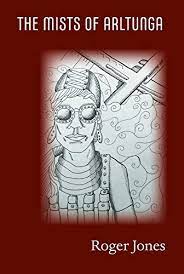
Two years ago, my good friend from Berea, Kentucky, Roger Jones published a thought-provoking extended parable about the current human condition shaped by post-modern capitalism. It’s a wonderfully insightful and artistically composed novel called The Mists of Arltunga. I highly recommend it.
Set In a mining camp (Arltunga) in central Australia 100 years ago, the story presciently portrays a world so polluted by chemical industries that the companies in question mine the foul-smelling air itself. They do so with glider air ships that draw behind them fine nets to capture jelly-like discharges from the open-pit mines below.
Of course, the putrid mists are also ingested by the mine workers whose nostrils and lungs end up hosting the foul emissions. They suffer and die accordingly.
But none of this matters to the chemical company’s absentee owner, nor to the mine overseer. The overriding concern of both is meeting production goals. To achieve those ends, the overseer browbeats his workers, alternatively threatens and sweet-talks them, punishes their shortcomings, and offers meaningless incentives. Worse still, he proves willing to kill troublemakers directly by using his pistol and covertly by provoking a fatal landslide by means of dynamite. He colludes with a competitor for purposes of controlling the workforces of both companies and of mutually enriching themselves.
In short, The Mists of Arltunga presents its mesmerized readers with a tale of unfettered capitalism that is both cautionary and actual.
But of course, (as in the real world) the most rebellious among the story’s exploited mineworkers take none of this lying down. Though they find themselves caught in a web of exploitation, they cannot initially free themselves. They’re impotent because employment in the mine represents their only source of sustenance without which they’d starve to death. Though the mine’s glider pilots can soar above it all for hours each day, they must eventually return to earth to eat the camp’s miserable gruel, turnips and thin soup. Eagles by day (an important metaphor in the book), they’re reduced to precariat slaves when they return to earth.
All of this holds true till one day a zeppelin from Perth crash lands with a deafening explosion and searing ball of flame near the mine site. All the vessel’s crew and passengers perish, except for the burnt and wounded daughter of Arltunga’s absentee owner. She’s saved by one of the mine’s glider-pilots who works in Arltunga alongside his father and younger brother. Unaware of the “sheila’s” true identity, both brothers immediately fall in love with her.
The girl, however, maintains a friendly but aloof distance from the pair. Under threat from the mine overseer, she is forced to conceal her true identity. She blends into the working community proving herself to be invaluable as a gardener and infirmary caregiver. Most surprisingly of all, she reveals herself as a competent glider pilot capable of flying with the best of the men.
A turning point comes when the camp overseer’s collusions with a competing mine operation come to light. It all involves the earlier-mentioned landslide, the resulting near-death experience of the mine owner’s daughter, and her abduction according to the plan of Arltunga’s mine overseer – again, the only character aware of the girl’s real name.
All of this catalyzes worker rebellion led by the story’s love-struck brothers. The climax involves a thrilling glider chase, another crash landing, and a surprising disclosure of hidden identities.
In the end, the revelations concluding The Mists of Arltunga point towards a mythic, parable-like and robust affirmation of the unity of the entire human family. They offer hope that acknowledgment of that single household can unite bosses and workers even altering the behavior of greedy absentee proprietors.
Do yourself a favor. Read Roger Jones’ splendid, hopeful and critical parable. Be inspired accordingly.
Readings for the 19th Sunday in Ordinary Time: I Kgs. 19:4-8; Eph. 4:30-5:2; Jn. 6:41-51
This Sunday’s readings are about prophets and bread. Somehow that seems fitting since last week the world lost an artist whose work centralized both prophecy and the staff of life.
I’m talking about Elka Schumann, the co-founder of Vermont’s Bread and Puppet Theater Company. She died a week ago today at the age of 85.
Elka’s Puppets
Elka was born in the Soviet Union and came to the United States at the age of 6. She was the grandchild of Scott and Helen Nearing, the revered back-to-nature sages and activists. Elka and her husband Peter founded Bread and Puppet in 1963 originally to protest poor housing conditions in New York City. Since then, their giant puppets – some more than 20 feet high – have made spectacular appearances at protests and demonstrations everywhere.
Over those years, the Schumanns’ focus expanded to include the Vietnam War, climate change, Nicaragua and the Contras, El Salvador, Archbishop Romero, liberation theology, and the general failure of capitalism. Every summer hundreds of volunteers participated in their elaborate outdoor pageants highlighting issues like those.
(My wife, Peggy, was once a puppet horse in a Bread and Puppet portrayal of a circus. And a couple of years ago, she and I visited the company’s Museum in Glover, Vermont. Reviewing the various puppet collections was like reliving the great issues of the past half century. It was all such an inspiring display of insight, creativity, commitment, joy, and courage. The Schumanns’ giant puppets have provided a truly prophetic deepening our collective consciousness.)
Elka’s Bread
However, the mammoth puppets were so stunning and arresting that it’s easy to forget the part that bread played in their work. After all, the name of their company is Bread and Puppet.” (And homemade bread was served at all their performances.) Elka Schumann herself made the connection in a 2001 film about her work. The documentary was produced by her daughter Tamar and DeeDee Halleck. Elka said:
“We have a grinder over there, and we grind the grain ourselves. And the bread is not at all like your supermarket bread. You really have to chew it. You really have to put some work into it. But then you get something very good for that. And when our theater is successful, we feel it’s the same way. You’ve got to think about — it doesn’t like tell you everything. It’s not like Wonder Bread: It’s just like there it is, here’s the story, this is what it means. You’ve got to do some figuring yourself in the theater, in our theater. And if the play is successful, then at the end you probably feel it was worth the work.”
Elka’s words underline the essentials of good theater, good art, good religion. They don’t tell you everything. You must put in some work trying to figure out the message, to unpack it all. Good theater, good religion is not like eating white bread from Piggly Wiggly.
Jesus’ Bread
As mentioned earlier, that aspect of theater and faith is important to note this particular Sunday, since the day’s readings highlight the connections between bread, prophets, and the teachings of Yeshua, the giant, larger-than-life (!) construction worker from Nazareth.
What Jesus taught in his illustrative parables – in fact, what’s found throughout the Bible – challenges us to think and question our own lives, the values of our culture, and our too easy “understandings” of life and “God.” That’s what the Schumanns were doing too
Think about the prodigal son, Jesus’ response to the woman about to be stoned for adultery, his dialog with Pontius Pilate about the nature of truth, and the issues raised by the fact that Jesus was executed as a rebel against Rome. Think about the prophet’s dying prayer for his enemies, his injunction to treat others as we would like to be treated, his “beatitudes’” centralizing purity of intention, poverty, gentleness, bereavement, imprisonment, mercy, peacemaking, and passion for justice. At every turn his words and deeds are challenging and (if you puzzle over them) difficult but rewarding to digest.
Understood in terms of rejecting Wonder Bread’s superficiality, all of those elements in the accounts of Jesus’ words and deeds should give “Americans” pause. They should call into question the very notion of patriarchy, our worship of the rich, our wars against the world’s poor, our attitudes towards empire and capital punishment, as well as our very denial of truth’s possibility (which Gandhi boldly identified with God).
That sort of hard-to-chew bread forms the backdrop implied in today’s readings. See for yourself. Here are my “translations.” You could find the originals here to tell if I got them right.
I Kings 19: 4-8

Prophets are lonely people
Living on the edge of
Death and despair.
Elijah was no different.
He even prayed for death
On his way to Mt. Sinai.
Instead, a generous Spirit
Fed him with bread and water
Twice!
He didn’t have to eat again
For the remaining 40 days
Of his journey
To God’s holy mountain.

Psalm 34: 2-9

Elijah’s miraculous bread
Gave him a taste of
Life’s Supreme Goodness
Directed especially
Towards the threatened
And afflicted poor.
The taste of bread
Replaces their shame
And distress
With joy and confidence
In Life’s protective Source.

Ephesians 4: 30-5:2

So, Elijah
Should never have been sad.
In fact,
For those filled with God’s Spirit
(And bread!)
There can be no room for sadness
Bitterness, fury, anger,
Shouting, reviling or malice.
There is room only for
Kindness, compassion,
Forgiveness and love
That mirror
Life’s own abundance
And inherent generosity.

John 6: 42-51

John’s community of faith
Identified Jesus’ teaching
With the bread
That fed Elijah.
In fact,
They called Jesus himself
“The Bread of Heaven”
Whose consumption
Would strengthen them
For “the journey without distance”
(From heart to head).
This still upsets outsiders
Unable to overcome
Fundamentalist literalism
That yet confuses
Spiritual nourishment
With fairy tales
And gross cannibalism.
Conclusion
When I was a kid, I actually liked Wonder Bread. In fact, I still kind of do. Don’t you? I mean it’s a bit sweet; it’s easy to chew; it’s a nice base for peanut butter and jelly, and it goes down easy. My well-intentioned mother fed it to me and my three siblings without a second thought. I ate it the same way.
But then most of us got more conscientious about what we put into our bodies. With Elka Schumann, we realized that Wonder Bread didn’t really nourish us. So, we turned to bread that (initially at least) was less familiar and that required more chewing and changing of taste-preferences – a bit more work – maybe not as strong as Elka’s bread, but more substantial nonetheless.
For many of us who have stuck with faith as a source of meaning, it’s been the same. We outgrew the beliefs that no longer nourished. We woke up to the fact that Jesus’ teachings need adult interpretation that demands thought and decision about those issues I mentioned earlier — patriarchy, grossly unequal wealth distribution, perpetual wars precisely against the world’s poor, empire, capital punishment, and about agnosticism concerning the Truth that parallels our denial of what we know to be genuine relative to the great issues of our day.
Instead, we’ve reduced “faith” to childish fairy tales that none of us can believe. We’ve made it into Wonder Bread. And this at a time in history when acceptance of life’s essential unity – proclaimed not only by Elijah and Jesus, but by all the world’s great religious traditions – is necessary for our species’ very survival.
In the words of John, the Evangelist, I’m trying to say we need the Bread of Heaven, the Bread of Life now more than ever.
Thank you, Elka Schumann for using your puppets and bread to drive home that truth.
Readings for the 19th Sunday in Ordinary Time: I Kgs. 19:4-8; Eph. 4:30-5:2; Jn. 6:41-51
Recently, I had a long talk with one of my dearest friends in the world. After reading a book I recommended, he found himself in crisis.
“I don’t know what to believe now,” he lamented. “I have no idea who Jesus was or is.
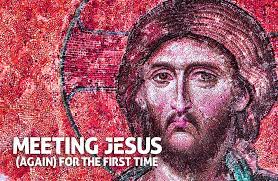
I could sympathize with my friend. I even felt a little guilty that I had recommended that he read the book in question – Marcus Borg’s Meeting Jesus Again for the First Time. In laypersons’ terms, it acquaints readers with the search for the historical Jesus that has been in full swing for more than 100 years.
Borg concludes that the 4th century Council of Nicaea was correct in its assessment that Jesus was a divine person who was fully God and fully human. It just doesn’t say how that’s possible.
Borg’s own explanation is that Jesus was fully human before his resurrection and fully God in the faith of his bereft disciples after the event, whatever its exact nature might have been. That means that the pre-resurrection Jesus was in important respects very like the rest of us. He too shared our spiritual journey and grew (as the Gospel of Luke says) “in age, and wisdom and grace” (LK 2:52).
“Why wasn’t I told any of this before,” my friend complained.
Well, today’s liturgy of the word addresses my friend’s frustration. It highlights the faith quest that all of us share – even with Jesus.
For starters, think about Elijah from I Kings. At first glance, it seems like a child’s tale. I mean: angels, miraculous bread . . .
And then there are those words attributed to Jesus in the reading from John the Evangelist. There, Jesus claims that he is bread, and we’re supposed to eat his flesh?
It all seems so (excuse me) absurd. We’re told Jesus was talking about the Eucharist or something. But, many of us find it harder and harder to believe even what we’ve been taught about that. God in a piece of bread? It’s easy to understand how faith is threatened rather than strengthened by such readings. Spiritually it can be rather discouraging.
But my friend shouldn’t be discouraged by such thoughts. Neither should any of us. On the contrary, they can be seen as signs we’re growing up spiritually. Painful as it is, perhaps it’s time for reassessing our faith.
I mean (if we’re lucky) there comes a point in everyone’s life where faith has to be reevaluated – where what we were taught and believed as children no longer meets our adult needs. At those times discouragement (despondency is the term used in today’s first reading) is actually a good sign. It can mean we’ve outgrown old ways of thinking and are being called to growth which is always difficult. So, we shouldn’t give up in the face of discouragement, but embrace it with hope.
With that in mind, please realize that today’s readings are about the spiritual journey, the search for God and the discouragement that comes along with it. They are about finding God’s presence hidden in plain sight – within our own flesh (as Jesus put it) – closer to us than our jugular vein.
That theme of spiritual journey is announced in the first reading – the story about the prophet Elijah fed by angels under a juniper tree. Elijah did his work in the Northern Kingdom of Israel about 800 years before the birth of Jesus. He is remembered as one of the great, great prophets of the Jewish Testament. In fact, he was so powerful that Jesus’ followers thought Jesus to be the prophet’s reincarnation. John the Baptist’s followers thought the same about him. (Btw: does that mean that Jesus and his contemporaries believed in reincarnation?) So, Elijah is a key figure in our tradition.
In any case, today’s story about Elijah describes the classic stages of the spiritual journey that we’re all called to – from immature believing things about God and Jesus to something more holistic that finds and honors God’s manifestations everywhere.
As we join him in today’s first reading, Elijah is described as beginning a literal journey. He’s traveling to Mt. Horeb (or Sinai) – the place where Moses and the slaves who had escaped from Egypt made their Covenant with their God, Yahweh. Elijah is confused about God (“despondent”), and evidently thinks that by returning to the origins of his faith, he’ll get some clarity.
At this stage of his spiritual growth, Elijah’s faith is less mature. He has a very ethnocentric idea about God. And he’s being called to move beyond that stage of development. The ethnocentric idea has it that God is all about us – our people, our nation, our wars, our prosperity. God is our God and we are his chosen people – truly exceptional. In passages from the Book of Kings just before today’s reading Elijah manifested that understanding of God in a contest with the priests of Baal – a Phoenician God that the King of Israel, Achab and his wife Jezebel had flirted with.
You remember the story. Elijah challenged forty priests to a contest – your sacrifices against ours. Call on your gods to light your sacrificial fires, and I’ll call on Yahweh, and then we’ll see who’s really God. Of course, the priests of Baal can’t get their gods to come through. They chant, and dance, and sing. But the sacrificial wood remains cold. However, Yahweh comes through for his prophet; he lights Elijah’s fire even though in a display of bravado, the prophet had the wood doused with water. Not only that, but Yahweh kills the forty priests for good measure.
That’s the ethnocentric idea: “Our God is better than your god. He has more magic power.” And he’s (this is almost always a male concept) very violent and vindictive. He’ll turn on you and go off on you at the drop of a hat. That’s the God that no longer seems to be working for Elijah. It has made him a wanted man. Queen Jezebel is after him and wants his head. Life is not worth living, the prophet concludes. He wants it all to end – there under the juniper tree.
But two people (whom Elijah later understands as messengers from God) feed him, and on the strength of food provided by strangers he completes his journey and arrives at a cave high on Mt. Sinai. And there, God reveals his true nature not as an ethnocentric God belonging to a single “chosen” people. Neither does God reveal Godself in nature’s elements – not in earth (an earthquake), not in air (a whirlwind), nor in fire (lightning). Instead God (definitely not predominantly male) is disclosed as a “still small voice” within the prophet himself.
And what is a “still” voice, a “small” voice? It seems to me that it’s a communication without sound – one that can be hardly heard – a far cry from the deity who magically lights sacrificial fires and slays Phoenician priests. That magical violent understanding of God seems frankly childish – a God who enters into competition with other “worthy opponents” over whom he has greater magical powers.
No, the revelation to Elijah discloses a God who is much subtler and who resides within all persons be they Hebrew or Phoenician. By traditional standards, it is a “weak” unspectacular God. God is found within; God is small and quiet and belongs to everyone. Or rather, everyone belongs to God regardless of their nationality or race. And in Elijah’s story, it’s not clear that the prophet even grasps the point.
Elijah might not have gotten the point. But it’s evident that his reincarnation in Jesus of Nazareth did – or at least that John the Evangelist writing 60-90 years after Jesus’ death got the point. By then it was possible to put words in Jesus’ mouth that the construction worker from Nazareth could never have said – especially about eating his flesh and above all drinking his blood. Jews, of course, were forbidden from imbibing the blood of any living thing, let alone human blood. However, by John’s time Jesus’ followers had increasingly left behind their Jewish origins. They had become friendly with Gnosticism and were coming to terms with Roman “mystery cults.” Both worshipped “dying and rising gods” who offered “eternal life” to those who ate the god’s body and drank the god’s blood under the forms of bread and wine.
Evidently, John the Evangelist and others like John’s contemporary who wrote “The Gospel of Thomas” recognized an affinity between the teachings of Jesus and the beliefs of the Gnostics who found God’s presence in all of creation. The Gospel of Thomas has Jesus say “Split a block of wood and I am there; lift up a rock and find me there.
In other words, by the end of the first century, Christians were developing an ecumenical understanding of God that went far beyond the Jewish ethnocentrism of Elijah. By that time Christians could see that Jesus was not only a prophet, not only a movement founder of reform within Judaism, not only an insightful story teller and extraordinary healer, but a “Spirit Person” who like the Gnostics found God’s presence in every element of creation – principally in that “still, small voice” revealed to Elijah.
So, Jesus found God’s presence in wood, under rocks, in the breaking of bread, in the sharing of wine, within his self, here and now (not in some afterlife) but in his very flesh and blood. In other words, shared divine presence lent a unity and sameness to everything. Bread and flesh, wine and blood turn out to be the same across time and space. John has Jesus say all of that quite shockingly: “When you eat bread you are eating my flesh; when you drink wine, you are imbibing my blood. We, all of creation, are all one!”
What I’m saying here is that faith changes and grows. Discouragement with old models and paradigms is a hopeful sign. Think of today’s readings and the distance traveled from Elijah’s Magical Killer God to the Still Small Voice to the God present in bread, wine, and in every cell of Jesus’ and our own bodies.
If your own spiritual journey has you longing for further exploration of such adult themes, I can’t do better than to recommend the book I urged that friend of mine to read. I’m referring to Marcus Borg’s Meeting Jesus again for the First Time. His The Heart of Christianity is similarly helpful.
Like my friend, you might find them initially disturbing. But they will deepen your faith and help make it more worthy of a mature adult.
On Saturday, Peggy and I returned from our week on Bustin’s Island in Maine. It was a marvelous time spent not only together, but with our daughter, Maggie, and two of her five children — Markandeya (6 yrs.) and Sebastian (2 yrs.). [Her other three children (Eva 12 yrs., Oscar 10 yrs., and Orlando 8 yrs.) are all away at summer camps.] A dear friend from Berea, Joan Moore, also visited for three days. By way of a report on our collective experience, what follows is a letter to my granddaughter, Eva, who (as I started to say) is spending the last of six weeks at her summer camp (Fernwood) also in Maine.
August 1, 2001
My dearest Eva Maria,
Thanks so much for your two recent letters. It was such a nice surprise to return from Maine to find them waiting for me here — along with the beautiful pin you made for me with our favorite colors, yellow and green. As you suggested, I’ll wear that on my walking duds.
I’m so glad you’re doing the reading you mentioned from Howard Zinn and An Indigenous People’s History. Your comments make me think you’d very much like a four-part film series I’ve just watched (twice!). It’s called “Exterminate All the Brutes.” It’s by Raul Peck (a Haitian born director). He’s the narrator of the series as well. He too loves Zinn and the author of An Indigenous People’s History.
Peck says that all of history can be summarized in three words: civilization (i.e., white supremacy), colonialism, and extermination. The film details the evils of the Native American holocaust and of enslavement of Africans. Grandma Gaga started watching it with me. However, she left after about ten minutes saying that she thought the story and graphics were too violent. So, maybe it’s inappropriate for your viewing at this stage of your life. We can talk about that.
Last night, Gaga and I returned from our week on Bustin’s Island near Freeport, Maine (the home of LL Bean). It was a wonderful experience. It was like going back more than 100 years in a time machine. No cars, internet, plumbing or running water. We fetched our water supply from a town pump, used the outhouse, and boiled all our water including what we used for rinsing dishes. The whole experience was an exercise in simple living. We loved it.
What I liked most about Bustin’s Island was the community of people there. It was formed mainly of families that have been going there each summer for generations. Lots of young people about your age and somewhat older. They were all so enthusiastic about the privilege of living there. I’m sure you’d love it too.
Your mom, Markandeya, and Sebastian shared our experience. Markandeya was especially enthusiastic. Sebastian was fun too. I spent a good amount of time pulling him around in a wagon that belonged to the cottage. Marku loved pumping water and pulling the wagon loaded with more than 100 pounds (including two five-gallon water containers and his brother). Gaga joined the Monopoly enthusiasts. Others of us played Hearts and a bit of Yahtzee. Markandeya’s a fierce Monopoly competitor. (I know you know that quite well!).
Joan Moore, a friend of ours from Berea also spent three days with us. She was a very easy presence – very willing to do her part cleaning, playing with the kids, and generally offering a helping hand. She’s a friend of your grandma Momo’s too and will visit her this week. On her way home, Joan says she may stop off in Westport for a visit. Both Gaga and I love Joan.
Weather at Bustin’s was mixed. But it was never hot. As a matter of fact, at night it was often a bit too cold. Our house was located right on Casco Bay that offered wonderful moments for quiet contemplation.
One morning your great uncle and great aunt, Jerry and Liz (whose summer cottage was nearby on Birch Island), came over and took us by boat to their place. They love it there too. Their house had running water and an indoor composting toilet. I enjoyed talking with both of them.
On the way to Birch Island, we passed some of the Calendar Islands (there are 365 of them) with names like “Sow and Pigs,” “Upper Goose, Lower Goose, and Their Three Goslins.” We passed eagles’ nests that sat like huge card tables on top of giant pine trees. One island that evoked interest from my hermit’s heart was called Moshier. It had only a single house on it. I can imagine living there quite happily.
Your mother and I also had some time together – just one-on-one. We talked over our relationship and other such matters. We both promised to continue the conversation now that we’re back in Westport.
One of these nights all of us here are going to watch the film “NomadLand” on your folks’ outdoor screen. It won this year’s Academy Award as the best film of the year. It’s about people who have left the “rat race” of American life and have returned to simple living of the kind that we experienced last week in Maine. Only, the film’s characters are living on the road in campers, mobile homes, and trailers. I find that stuff fascinating. (Although your mom has hastened to tell me quite emphatically, “Don’t get any ideas, Dad. You are NOT going to end up living that way.”)
I know your regimen at Fernwood doesn’t allow you to watch “Democracy Now” each day as you’re accustomed to do. And maybe that’s for the best. I mean, the reports on the pandemic, on suppression of voting rights (especially for black people), and on the U.S. support of wars everywhere all border on depressing. Nonetheless, when you get back here, I know you’ll take pains to catch up. I’ll help you with that on our walks together.
Of course, Eva, I’m very much looking forward to your return (next Saturday!). It goes without saying that I’ve missed you a great deal. I’m looking forward to your account of this summer’s experience at camp. I’m sure you learned a lot and made many new friends. I’m proud of your rock-climbing achievements. As I always tell you, you’re a much better athlete than you give yourself credit for.
So, until Saturday, let me assure you that you’re never far from my thoughts and (yes!) my prayers. I love you so much and am very, very proud of you – especially for your making the best of Fernwood.
Peggy and I will take off for Bustin’s Island, Maine, tomorrow morning. We’ll be gone for a week to a place reachable only by ferry. No electricity; no cars; no internet; outhouse toilet; all water must be boiled. On Tuesday, our daughter, Maggie, and her two youngest (of five) children will join us. (The other three are away at summer camp, also in Maine.) This should be fun and interesting. So, there’ll be no postings here till next week. But I’ll give a report when I get back.
Since April 28th, the people of Colombia have virtually shut down the nation with repeated general strikes. For nearly three months, thousands have been in the streets all over the country demanding that its right- wing president, Ivan Duque, step down. They also want economic reforms, including higher wages, and increased taxes on the rich. Their demands include reduction in transportation fares and better health care.
And the response of the Colombian government? Absolute repression from its police and military including sexual assault, use of live ammunition (with 42 killed so far), deployment of tear gas, bashing in the heads of peaceful protestors, and even the criminalization of those who supply medical assistance to the wounded and food to activists in the street.
And what about the response of the U.S mainstream media (MSM), the president and “our” representatives in Congress? Given their outrage over comparatively minor protests in Cuba, surely, they’d express support for Colombians battered in the streets.
But no, there hasn’t been a peep out of them – no word of solidarity with demonstrators nor criticism of the hugely unpopular Colombian administration. No calls for regime change or U.S. intervention. Not even the beginnings of public conversation led by our intrepid MSM.
And then there’s the involvement of Colombian paramilitaries in the assassination of Haiti’s president just last week. Turns out that several of the well-financed assassins were from Colombia and had actually trained in the United States with ties to the CIA, DEA and U.S. military establishment.
Just imagine if the Haitian assassination had involved Cuba and Cubans. Imagine if the paramilitaries implicated had been trained in Russia or China?
What do you suppose would have been the response of our “leaders”?
Go even further . . . Ask yourself how the United States would have responded had a Washington Post reporter been killed and dismembered in Cuba as Jamal Khashoggi was in the Saudi Arabian embassy less than three years ago.
What if such a crime had occurred in a government office in Havana with the proven direct involvement of Cuban President Miguel Diaz Canel? Would the White House and Congress have responded as they did when Mohammed bin Salman (MBS), the Saudi Crown Prince (no democrat he), was shown to be directly responsible for Khashoggi’s butchering? Would our officials with their heart-wrenching concern for democracy and human rights in Cuba have thrown up their hands in helpless impotence as they did in the case of MBS?
We need no more than considerations like those to reveal the hypocrisy of the United States government, academic establishment and “free press.” They care not a whit about human rights, basic freedoms, democracy, or government repression – unless the alleged violations can be connected to a government that refuses to fulfill its expected role as vassal of the United States in service of its country’s rich and powerful strongly allied to their counterparts in “America.”
The exact opposite happens when any government (like Vietnam’s, Cuba’s, Venezuela’s, Nicaragua’s or China’s) shows concern for ordinary people – mothers and children, the houseless, the hungry, the sick, workers, and the elderly. Ditto when governments in question assert ownership and control over their own resources.
Such “regimes” are quickly marked for change. Regardless of their accomplishments, they’re dismissed as “socialists,” or “communists,” subversives or terrorists. So, the United States routinely interferes in their elections, finances demonstrations of the well-off (which are publicized by the media those same elite control), organizes paramilitaries as “freedom fighters,” and (if push comes to shove) invades the country to finish the job.
Until “Americans” are willing to recognize that shameful pattern, till we can look in the mirror and recognize that the United States is indeed the world’s greatest force for evil and the cause behind most of its conflicts, we’ll continue to naively buy “official stories” about the designated enemies of the rich and powerful. We’ll continue in our delusions about our country’s exceptional virtue, about U.S. consistency in supporting democracy, rights and freedoms.
In other words, we’ll continue to be patriotic. But we’ll have morphed into oppressors ourselves! Maybe we’re already there. I suspect we are.
A few days ago, I received a disturbing email blast from Lyle Roelofs, the president of Berea College (where I taught for 40 years). It was about recent “Events in Cuba.” The notice was upsetting because it reflected the one-sided narrative of the U.S. government and its subservient mass media.
This is not to vilify Berea’s president who is sincere and well-intentioned. It is however to demonstrate the effectiveness of U.S. anti-Cuban propaganda that would have even academicians think that “our” government has a leg to stand on in its denunciation of anti-democratic measures anywhere, of intolerance of any dissent, or of police attacks on peaceful protestors.
See for yourself. In his characteristic spirit of compassion, the president had written:
Dear Bereans
Many of you are aware of the ongoing unrest in Cuba as the country struggles with severe blackouts, a food shortage, high prices, lack of access to COVID-19 vaccinations as outbreaks increase, and an unstable economy. Residents of the island nation have taken to the streets to protest, filming conditions to share with the world. In response, the repressive government shut down the internet.
While we all care about the people of Cuba as our fellow human beings, a number of members of our immediate community have family ties there, as well, so our concern extends particularly to them in this worrisome time.
President Biden addressed the situation on Monday urging Cuban leaders to hear the people and address their needs rather than enriching themselves or trying to repress their human rights.
At Berea College, where one of our eight Great Commitments calls for us to create a democratic society, we align ourselves with the people of Cuba and echo the President’s sentiments. In a democratic society, organizations and the government can cooperate to address the sorts of critical problems currently being faced by Cubans, but which are found to a lesser extent elsewhere as well. For example, at Berea College our Grow Appalachia program combats food insecurity in Appalachia working to ensure community members have enough to eat and teaching them how to grow their own food.
Globally, the U.S. and Cuba are among the countries that signed the United Nations Declaration of Human Rights, a list of 30 rights that every human being is entitled to. The right to free speech and health are most relevant to the current events in Cuba. It is our hope that tensions will ease soon, the leadership there will work to provide food, access to vaccines, and make improvements to stabilize the country’s economy, and that this crisis will be an opportunity for improved relations with other countries, including our own, allowing urgently needed assistance to flow to the people of Cuba.
In solidarity with Cubans and Cuban-Americans,
Lyle Roelofs
What follows is my response in hopes that it might help Dr. Roelofs and the rest of us to be more cautious in accepting party lines about “official enemies” such as Cuba, Venezuela, Nicaragua, China, Russia. . .
Dear Lyle,
It was with rather eager anticipation that I opened your recently emailed note entitled “Events in Cuba.” Because of Berea’s commitment black, brown and impoverished communities, I thought your notice would express solidarity with virtually the entire world in its yearly demand that the United States lift the Cuban embargo (Cubans call it a “blockade”) especially in view of the COVID-19 pandemic.
Instead, I found your comments quite incomplete and misleading. Together they gave the erroneous impression that:
All Cubans (“residents of the island nation”) endorse the anti-government street demonstrations
That Cuban leadership is ignoring the COVID-19 pandemic
That the same leadership is resisting improved relations with other countries including the United States
That Cuba should combat the island’s food insecurity by teaching people “how to grow their own food”
That Cuba is out-of-step with the United Nations and its “Declaration of Human Rights” by specifically depriving its people of health care
That President Biden has satisfactorily “addressed the situation on Monday urging Cuban leaders to hear the people and address their needs rather than enriching themselves or trying to repress their human rights.”
Such commentary appears to simply repeat the U.S. official story about Cuba without even once mentioning:
Its development (unique in the former colonies) of several WHO-approved COVID-19 vaccines
The U.S. policy of blockading sale of syringes to Cuba thereby preventing the country from administering its own COVID-19 remedies
Cuba’s long-standing attempts to feed its own people by extensive, government sanctioned urban gardening projects and by environmental policies that make it arguably the greenest country in the hemisphere
The fact that similar demonstrations are happening all over the world including U.S. allies such as Brazil, South Africa, Haiti, Lebanon, Colombia, India, Ethiopia, Israel, Iraq, and Afghanistan (not to mention Black Lives Matter in the U.S. and the January 6th assault on the Capitol) — without comment on your part or emphasis in the mainstream media at large
The allied fact that “a number of members of our immediate community have family ties” in the countries just mentioned.
I am making these observations as a longtime friend of Cuba and (of course) Berea College. I have visited the island many times, never as a tourist, but always as an educator and researcher. In fact, the last course I taught at Berea (Summer 2014) had my wife Peggy and me leading another study tour of Cuba.
I have published many articles on Cuba including here and here about the country’s vaccine research and development. My daughter was treated for appendicitis while visiting Cuba two years ago. After spending five days in the hospital there, she was released virtually free of charge.
With Jose Gomariz (a Cubanist scholar, Jose Marti specialist, and former Berea College professor of Spanish) I once taught a Berea Short Term course at Havana’s Instituto de Historia de Cuba. The course was entitled “The African Diaspora in Cuba.” When I visited Cuba with the Greater Cincinnati Council of World Affairs, I was befriended by a family outspokenly and fearlessly critical of the Castro government. And in my many stints with the Latin American Studies Program of the Council for Christian Colleges and Universities, we took students to Cuba each semester to meet government officials, opposition forces, and diplomats at the U.S. Interests Section in Havana. In all, I’ve been there around a dozen times.
During the Fidel Castro years, I vividly recall a U.S. Interests Section spokeswoman revealingly lamenting the fact that Cuba (as she put it) did not hold presidential elections (thereby demonstrating her misunderstanding of Cuba’s electoral system). “As everybody knows,” she admitted, “he’d win hands down.”
What I’m suggesting is that there is much more to the Cuban story than we’re led to believe by United States propaganda against that beleaguered country.
By simply rehearsing the U.S. official story, Lyle, I suggest that (uncharacteristically) you are not helping the Berea community understand Cuba, its history, and the role of the U.S. in creating misery there, or what our government could do this very day to relieve it – namely lift the embargo and allow the import of syringes into the country.
Readings for 15th Sunday in ordinary time: Am. 7:12-15; Ps. 85:9-10, 11-2, 13-14; Eph. 1:3-14; Mk. 6:7-13
Do any of you remember the HBO series “Newsroom?” It lasted only a couple of seasons. However, I found it interesting and watched it faithfully.
As far as I’m concerned, the series’ highlight came when lead actor, Jeff Daniels, delivered a speech about then-current dismal state of our country. I’m sure many of you have seen it. It seems more relevant today than it did in 2012.
As a news anchorman of the stature and credibility of Walter Cronkite, Daniels’ character is badgered into answering the question “Can you say why America is the greatest country in the world?” Here’s how he answered:
Whew! That’s hard for most of us to hear, isn’t it? It’s almost as if the speaker were viewing the United States the way foreigners often do – or at least as someone highly sympathetic to the uneducated, infants, the poor, sick, imprisoned, and the victims of imperialistic wars. He seems to be saying that the experience of such people represents the measure of greatness.
I raise the “Newsroom” speech today because of today’s first reading from the Book of Amos. He was a prophet whose most famous speech was very like the one we just saw.
I mean his words were similar in that they were offensive to patriotic ears and centralized the experience of the poor. And they were delivered by an outsider. As we saw in today’s first reading, Amos’ words also evoked such negative response that they led the chief priest of Israel to lobby for the deportation of the prophet.
And what did Amos say?
Well, he was a very clever speaker. He did his prophetic work towards the end of the 8th century B.C.E. That was after the death of Solomon, when the Hebrew people had split into two kingdoms. The northern one was “Israel;” the southern one was “Judah.” Often the two were at war with one another. Yes, the “People of God” were that deeply divided even then.
Amos came from Judah, the southern kingdom. He went up north, to Israel, and confronted the people there. And he tricked his audience into agreeing with him that all their official enemies were really bad – the Aramites, Philistines, Moabites, and especially Judah, that kingdom to the south. God is extremely angry with these people, Amos promised. They would all be soundly thrashed.
“And they all deserve it!” his audience would have agreed.
And then the prophet turned the tables on his listeners. “But you know the nation that will be punished more harshly than all of them put together, don’t you? You know who the worst of all is, I’m sure.” (By now he now had his audience in the palm of his hand.)
“Who?” they asked eagerly.
“YOU!” the prophet shouted. “The nation of Israel has been the worst of all because of your treatment of the poor. You have shorted them on their wages. You have sold them into slavery. Your rich have feasted and lived in luxury, while those closest to God’s heart, the poor, have languished in hunger and poverty. In punishment, the Assyrians will invade your country and reduce all of you to the level of the lowest among you.
Of course, the prophet lost his audience at that point. They didn’t want to hear it.
It was almost as if the Daniels character in “Newsroom” had responded like this to the question “Can you say why America is the greatest country?” No, I take that back. It’s almost as if some foreigner – one of our designated enemies, say from Iraq or Afghanistan, answered the question by saying:
“Well, America surely isn’t Nazi Germany, and it’s not the Soviet Union. Those places were hell on earth, weren’t they? They caused havoc in the world; I’m sure we’d all agree. Those countries were truly the enemies of humankind. Neither is America Saddam’s Iraq, or Kaddafi’s Libya. It’s none of those. But you know what? AMERICA IS A LOT WORSE! And that’s because of the way it treats not only its own poor, but the way it savages the poor of other countries. Treatment of the poor is God’s criterion for greatness. And America falls flat before it!”
My point is that it sometimes takes someone who doesn’t share our cultural values and especially our class loyalties to help us see ourselves in something like the way God sees us. Those outside our culture often perceive us more clearly than we see ourselves.
Do you think Amos’ concern for the poor (the Bible’s real People of God) might be also centralized in today’s Gospel? I think it is. Mark seems to be reminding his audience (40 years after Jesus’ death) that the poor represent the touchstone for Christian authenticity.
In the Gospel reading, Jesus sends off his 12 apostles two by two as his emissaries. They are to drive out unclean spirits and demons and to cure the sick. Can you even imagine them doing that? They were just fishermen, maybe a traveling merchant or two, a former tax collector – all of them likely illiterate – not public speakers at all. Who would ever listen to such people?
And yet Mark pictures Jesus sending them off in pairs to preach his message: “Repent; the Kingdom of God is at hand.” These are the same disciples who Mark tells us later never really grasped what Jesus was all about. And yet here they are preaching, curing the sick and driving out demons.
Such considerations lead scripture scholars to conclude that these words were probably never spoken by the historical Jesus. Instead they were added later by a more developed church. (Early Christians evidently believed so strongly in Jesus’ post-resurrection presence that they thought the risen Christ continued addressing their problems even though those difficulties were unknown to him and his immediate followers while he walked the earth. So they made up stories like this one.)
And what was the message to those later followers? It seems to have been this: “Remember where we came from. We’re followers of that poor man from Nazareth. So, stay close to the poor as Jesus did: walk; don’t ride. Steer clear of money. Don’t even worry about food. The clothes on your back are enough for anyone. Others will give you shelter for the night.” (This passage from Mark almost pictures Jesus’ followers like Buddhist monks with their saffron robes and begging bowls.)
Mark’s message to his community 40 years after Jesus — and to us today — seems to be: “Only by staying close to the poor can you even recognize the world’s unclean spirits. So concealed and disguised are they by material concerns and by things like patriotism and religious loyalties. Therefore, don’t be seduced by identification with the rich, your own culture, and what they value — sleek transportation, money, luxurious food, clothes and homes.”
Surrendering to such seductions, Mark seems to be saying, is to depart from the instructions of Jesus. We’d say it is a recipe for loss of soul on both the individual and national levels as described by Amos and “Newsroom’s” Jeff Daniels.
But identification with the poor is hard, isn’t it? It’s hard to be the voice of the voiceless as both Amos and Jesus were. It’s difficult to walk instead of ride, to have less money, to share food and housing with others. It’s hard to make political and economic choices on the basis of policy’s impact on the poor rather than the rich.
For that reason, Jesus sends his apostles off not as individuals, but in pairs. The message here is that we need one another for support. This is also true because adopting counter-cultural viewpoints like those of Amos, Jesus, and the “Newsroom” anchorman evoke such negative response.
What do you think? Are we Christians really called to centralize concern for the poor, to simplify our lifestyles, and run the risk of being judged enemies of the state as Amos, Jesus and early Christians were?
If so, how can we support one another in doing that? (Discussion follows.)
Readings for the 14th Sunday in Ordinary Time: Ezekiel 2: 2-5; Psalm 123: 1-4; 2nd Corinthians 12: 7-10; Luke 4: 18; Mark 6: 1-6
I can’t believe that we’re still expected to believe that the United States and Great Britain are concerned about human rights or press freedom or that either has any leg to stand on in such posturing.
I mean, how can any of us still believe after the lies about Iraq, Abu Ghraib, the refusal to punish Saudi Arabia for the murder of Washington Post journalist Jamal Khashoggi, the imprisonment of Julian Assange, the demonization of Wikileaks, and the cooperation of the mainstream media (MSM) with all of it.
You’re telling me that either London or Washington has the right to pronounce on press freedom? On human rights? Please!
Demonization of China
Nonetheless, they’re at it again in relation to China and the desperate campaign of both Great Britain and America to demonize Beijing and its implied invocation of an Asian version of The Monroe Doctrine in relation to Hong Kong [which, by the way, (unlike the U.S. relationship to Nicaragua, Honduras, Cuba, or Venezuela) is actually part of China.]
More specifically, we’re supposed to join the MSM and “our” government as well as England’s in worrying about the recent shutdown of the Apple Daily newspaper in Hong Kong – a publication that sounds a lot like The National Inquirer.
Judge for yourself. A recent cover story in The Guardian describes the paper as a tabloid-style publication that has “a chequered history including cheque-book journalism, muckraking and sometimes unethical reporting alongside fearless investigation into government corruption and police brutality.”
What? Chequered history? Paying sources for information (probably with money from the CIA or the National Endowment for Democracy) and unethical reporting?
Oh, and the paper is owned by billionaire Jimmy Lai who has been imprisoned (according to The Guardian) “on protest-related convictions and national security charges.”
So, now it’s “Hands across the Planet” for poor Jimmy and his yellow journalism.
Meanwhile Julian Assange wastes away precisely in a British prison for publishing government secrets exactly about U.S. war crimes in Wikileaks – a source that publishes the Washington’s own unquestionably true confessions of the criminal acts it desperately wants kept secret from the rest of us.
So let me get this straight: Jimmy Lai’s a hero. And we’re all supposed to get misty-eyed about the Hong Inquirer’s brave reporters. But Julian Assange is a criminal. And Wikileaks doesn’t even qualify as journalism.
And, by the way, we’re supposed to forget that there was absolutely no press freedom all those years the Brits controlled Hong Kong.
Does anyone else sense the irony?
Today’s Readings
Such considerations are especially relevant this July 4th as we celebrate our supposed “freedoms” and the tarnished ideals of the United States. Significantly, this month marks as well the 100thanniversary of the founding of China’s Communist Party (CCP) whose good example (in drastically reducing world poverty and extending foreign aid) our country so fears.
Besides being July 4th, today also happens to be Sunday, time for a weekly “Homily for Progressives” where the theme of the day is prophecy in the sense of social criticism in the name of all that’s holy.
The first reading from the prophet Ezekiel implicitly reminds us that there were two kinds of prophets among the ancient Hebrews. Both are still with us today.
One type was a “court prophet” telling the king and power structure what they wanted to hear – justifying their oppression of the poor. (On this Independence Day you’ll hear a lot of their drivel as they praise “America” as though it were not – as Martin King put it – “the world’s greatest purveyor of violence.”) Think about The Apple Daily, Jimmy Lai and our MSM as court prophets.
The other type of prophet spoke for the Truth that was commonly referred to as “God.” The words of such men and women were routinely dismissed by the powers that happened to be. Some prophets (as is the case with Jesus in today’s final reading) were even rejected by the very oppressed people they were trying to champion. Their words were thought too dangerous and, in some cases, too good to be true. Think about Julian Assange as a prophet in the mold of Ezekiel or the Nazareth construction worker many of us claim to follow.
In any case, here are my “translations” of today’s selections. You should really check them out here to see if I got them right. As you read, think of Julian Assange.
Ezekiel 2: 2-5

I was startled
When God’s Spirit
Demanded that
I criticize my own people
As ungodly and stubborn
Telling me
To make them uncomfortably
Aware
That a fearless prophet
Was at work
Among them.

Psalm 123: 1-4

Great and holy Parent
We invoke your compassion
On your prophetic
Servants and handmaids
So eager to serve you
Despite contemptuous mistreatment
At the hands
Of our so-called “leaders”
With their pride and arrogance
Directed
Against your beloved poor.

2 Corinthians 12: 7-10

Neither do prophets
Have to be perfect.
Even Paul of Tarsus
Despite his many gifts
Suffered under
“An angel of Satan”
And “a thorn in the flesh"
To keep him humble
Lest he take credit
For the work
Of the Holy Spirit
Within him.

Mark 6: 1-6

But like Ezekiel
Jesus was rejected
By his own townsfolk
Who complained that
He had gotten “above his raisin’s”
They didn’t even
Call him by
His father’s name
(Implying he was a bastard)
While dismissing
His brothers and sisters
As quite unremarkable.
There’d be
No mighty deeds
For such whiners.
Only cures for
A few ailing beggars.
Conclusion
In a recent New York Timeseditorial, another court prophet, Yi-Zheng Lian, the former chief editor of The Hong Kong Economic Journal, joined the chorus of warnings about China’s grave threat to the West.
To an audience acquainted with the revelations of Edward Snowden Lian decried China’s surveillance system. To those whose country has bombed and killed Muslims by the scores and thousands every day over the last 20 years, he complained about treatment of Uyghurs in Xinjiang. To Americans who have lived through a Trump presidency, he criticized Chinese governance by lies. (His example? President Xi Jinping actually claimed that China seeks an international image that is “trustworthy,” “respectable” and “lovable.”) The horror of it all!
Nonetheless, Lian also pointed out the fact that the Chinese Communist Party retains high popularity among a vast majority of its people. In fact, the party has grown by 20% annually since its foundation 100 years ago. There are no refugees from China. Travelers and students come and go at will and usually return home.
For Lian, the bottom line is that China is showing no evident signs of decline. This means that it will remain a formidable force continuing to threaten the United States and Western allies for years to come. This will be true, he said, not just militarily and ideologically, but also technologically and economically.
So, the West, Lian concludes, had better get used to the CCP’s threatening presence “at its front door.”
Of course, all this talk of threat and menace from a country that (unlike the United States and Great Britain) has bombed no one in the last 40 years – all this imperial identification of a country more than 7000 miles away as at “our front door” is nonsense.
So is any continued posturing about “our” championing of human rights and press freedom. July 4th in the context of faith reflection is a good time for reminders of such home truths.
It seems the U.S. Conference of Catholic Bishops (USCCB) can’t stop embarrassing itself.
No, I’m not referring this time to its incompetent mishandling and scandalous coverups of priest pedophiles. (By rights, those disgraces should themselves deprive the Conference of ALL claims to speak authoritatively on ANY matter having to do with sex.)
instead, I’m talking about the latest manifestation of the USCCB’s obsession with abortion.
As if we needed a reminder, its fixation with the matter came under harsh spotlight on June 18th when an overwhelming majority of the Bishops’ Conference decided to proceed with drafting a document whose bottom line would have them refusing communion to Joe Biden (and by extension to other pro-choice Catholic politicians).
The whole affair made evident first of all that the bishops are pronouncing on an issue far beyond their ken. Secondly, their action flies in the face of position adopted by Pope Francis himself. Thirdly, it aligns the bishops with the most extreme faction of the Republican Party. And finally, it is quite unbiblical and contradicts the teachings of Jesus and his expression of the Judeo-Christian prophetic tradition.
For thinking Catholics, all four points should be quite embarrassing. For others, it’s just one more reason to write off the Church as completely irrelevant.
Unsubstantiated Obsession with Abortion
The evident purpose of the Conference’s strategy is to advance repeal of Roe v Wade as if it were morally self-evident that (as they say) “abortion is murder.”
Of course, no such self-evidence exists. This is because the question of abortion’s morality turns on the issue of when specifically personal human life begins. And NO ONE knows for sure the answer to that question. Even the seminal Catholic theologian Thomas Aquinas (1225-1274) thought that personal life (“ensoulment”) for males began 40 days after conception and for females 80 days after conception. The church operated on that assumption for centuries.
Moreover, other religions variously identify the beginnings of personal life with the moment of quickening (usually 17-20 weeks after conception), with viability outside the womb, with actual emergence from the womb, or even (as with some Native Americans) with the “painting” of the child to distinguish it from the animals.
In view of such variation, to impose a single religion’s answer to the crucial question about the beginning of personal life disrespects those of other faiths and of no faith at all. It is therefore to violate the Constitution’s First Amendment which states that “Congress shall make no law respecting an establishment of religion or prohibiting the free exercise thereof. . .”
(And, by the way, the USCCB’s extreme position that specifically personal life begins when sperm fertilizes egg contradicts the “practice” of Nature itself. It ignores the fact that literally countless such fertilizations end in spontaneous abortions – suggesting that Nature itself (God?) is unconcerned with the issue.)
A Rejection of Pope Francis
The Catholic Bishops’ ham-handed power play also flies in the face of gentle advice from Pope Francis. Instead of confrontation and effective excommunication, the Pope urged “extensive and serene dialogue.”
The Conference position also contrasted sharply with Francis’ allies like Chicago’s Cardinal Blase Cupich and San Diego Bishop Robert McElroy. Both urged adoption of the pope’s approach, which McElroy described as speaking to Mr. Biden “in his humanity” and as “a man of Catholic faith striving to serve his nation and his God.” McElroy recommended encouragement of “our new President: by entering into a relationship of dialogue, not judgment; collaboration, not isolation; truth in charity, not harshness.”
However, USCCB disagreement with Francis goes much further. It is not simply an internecine squabble about arcane Catholic issues. Identifying abortion as “the preeminent priority” of the bishops’ conference highlights disagreement at the highest level of the Catholic Church about the essence of the faith. For Francis, the Church’s preeminent priority is social justice and a radical concern for “the lives of the poor, those already born, the destitute, the abandoned and the underprivileged.” His pro-life commitments extend far beyond abortion to climate justice, elimination of capital punishment, renunciation of war, and welcoming of immigrants.
Of course, all such concerns are rejected by Republican extremists with whom the USCCB ends up aligning itself.
Alignment with Extremists
Such alignment was noted recently by Washington Post opinion columnist E.J. Dionne Jr. Dionne pointed to a relevant Pew Research survey of last spring. It showed that even 44% of Republican Catholics agree with the 67% of American Catholics in general that Biden should be allowed to receive communion.
This means that in adopting their position on weaponizing communion, the U.S. bishops are identifying themselves with the most conservative elements of the Republican Party which, of course, has also made abortion a key culture wars issue.
This alignment means supporting election of Republicans whose climate change denial ends up favoring omnicide while claiming to prioritize unborn human life.
Moreover, Dionne correctly observes that the bishops’ position is an outlier in the Catholic world itself. Almost nowhere else is the abortion issue given the preeminence claimed by the USCCB. Its position would be unthinkable in most of Europe and Latin America.
UnbiblicalObsession with Abortion
Even though women have always practiced abortion, the Bible shows no concern for the issue; it is mentioned nowhere in its pages. Therefore, to make it the church’s “preeminent priority” over those articulated by the pope is questionable at the very least.
Moreover, seeking to remedy the practice of abortion by imposition of law flies in the face of the habitual antinomian postures of both Jesus and St. Paul. Neither was friendly towards legal statutes and their enforcers. Jesus routinely disobeyed Judaism’s most sacred (Sabbath) law. He famously asserted his indisputably humanist position that “The sabbath was made for human beings; human beings were not made for the sabbath” (Mark 2: 27).
For his part, Paul was so liberal in his interpretation of Jewish Testament law that he set it aside entirely – including dietary restrictions and even circumcision. It was futile, he said, to seek salvation in law – even in God’s law (e.g., Romans 7: 13-24).
By adopting such positions, both Jesus and Paul seemed to recognize that complicated issues of personal morality cannot be effectively imposed by law, force, or sanctions. Thus, the two most prominent foci of Christian Testament texts implicitly acknowledged the truism that human laws generally favor those who made them, viz., the wealthy and powerful – usually elderly males (and in our case, specifically white old men). Meanwhile, they militate against the interests of those without power or wealth and (in the case of abortion) seem to represent one more way of controlling women.
This is especially vexing for women, since the planet’s female citizens have had virtually no determining input regarding the content of laws that govern their reproductive processes.
The bottom line here is that law has no salvific power for friends of women or followers of Jesus.
Conclusion
Does any of this mean that church leaders should abandon the abortion issue? Not really.
It does however mean that leadership should recognize the fact that Roe v. Wade represents a reasonable resolution of the abortion question in a pluralistic society. It is an imperfect but even-handed compromise in a culture divided on fundamental questions concerning the beginnings of personal human life. It is reasonable that during the first trimester of pregnancy, the pregnant woman may herself decide about the termination of her pregnancy without legal consultation; that during the second trimester the state may regulate abortion to protect the health of its pregnant citizens, and that during the final three months of pregnancy, the state (in recognition of its obligation to protect the unborn) can accordingly forbid or otherwise condition pregnancy termination.
Meanwhile, the bishops and others seeking to lessen the number of abortions should use their influence to foster a welcoming atmosphere for all children. This would entail supporting measures that (among others) provide otherwise reluctant parents with:
The good example of Catholic practice
Preemptive sex education
Extensive prenatal care
Postpartum parental leave
Affordable childcare
Adequately paid jobs
Dignified housing
Safe abortion facilities
Only by adopting such pro-life positions can the USCCB hope to overcome the embarrassment that its patriarchal, legalistic and unbiblical alignment with the Republican Party has brought upon it and upon all Roman Catholics.







 About Things That Matter