China’s Example and the Need to Rethink Democracy Itself

More than a year ago, OpEdNews’ visionary editor-in-chief, Rob Kall, started a project called the Arc of Justice Alliance (AJA). Its original intent was to offer a progressive alternative to the Republican Project 2025. The latter’s goal is to reduce the federal government to a size (in the words of Republican operative Grover Norquist) that could be drowned in a bathtub.

The AJA agenda would rescue democracy from Norquist’s tub.

But what exactly might that mean in a political environment where the old slogans no longer persuade anyone. Frankly put, “defending democracy” sounds hollow when millions increasingly suspect that what we call democracy has already been purchased, managed, and stage-directed by forces far beyond ordinary citizens’ control.

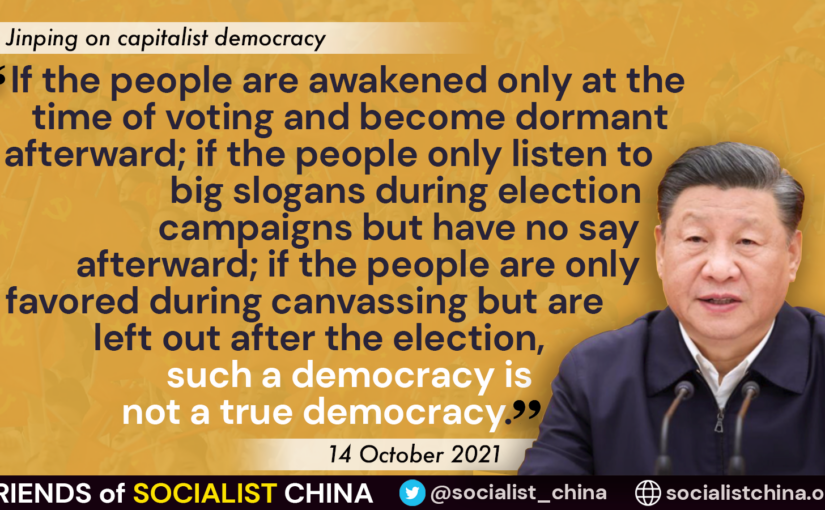
What I intend to argue here is that if the AJA hopes to become more than another mildly progressive pressure group orbiting around a dying Democratic Party, it must become far more radical in addressing the fact that in terms of “democracy,” the United States is a failed state. It must reform to a system more closely resembling China’s “whole process democracy.”

A Failed Epstein State  

Facing America’s failure might be uncomfortable. However, the facts speak for themselves.  “Our” country is not governed primarily by its voters. Instead, it is run by what might best be called the Epstein Class.

By that phrase I do not mean only the disgraced financier Jeffrey Epstein himself. Epstein has become symbolic of something much larger — a transnational ruling network of billionaires, intelligence operatives, media owners, financiers, weapons contractors, corporate monopolists, and political fixers whose power transcends elections and party labels.

Others call this network the “Deep State.” But that term can become too vague or conspiratorial. “Epstein Class” points more directly to the fusion of wealth, secrecy, sexual compromise, surveillance, and political immunity characterizing elite power in late capitalism.

The point is not that every billionaire belongs to a secret cabal meeting in underground bunkers. The point is structural. Wealth itself has become sovereign. Under contemporary capitalism, money no longer merely influences politics. It governs politics.

This is why elections change so little.

Wars continue regardless of campaign promises. Wall Street remains untouchable. Pharmaceutical corporations write healthcare policy. Silicon Valley harvests personal data with almost no restraint. Intelligence agencies operate beyond meaningful democratic oversight. Billionaires evade taxes while homelessness explodes beneath the skyscrapers they own.

And yet we are constantly told we live in “the world’s greatest democracy.”

The AJA should challenge that phrase directly.

Because what if the central political issue of our time is not “democracy versus dictatorship,” but rather which class exercises dictatorship?

That was, of course, the insight of Karl Marx. Marx argued that every state ultimately serves one ruling class or another. Under capitalism, democratic institutions often mask what is essentially the dictatorship of wealth. We live under the dictatorship of the Epstein Class.

In America today that dictatorship increasingly stands exposed.

China’s Democracy

Ironically, this is where China enters the conversation in ways many Western progressives still fear to acknowledge.

Western media constantly portrays China as authoritarian. And certainly, the Chinese Communist Party exercises centralized authority in ways foreign to American political culture. But the deeper question is rarely asked: centralized authority on behalf of whom?

China’s defenders argue that the CCP, whatever its flaws, governs primarily in the interests of long-term national and collective development rather than in the interests of an unrestrained billionaire oligarchy.

One need not romanticize China to recognize the force of that claim.

Over the last forty years China has lifted hundreds of millions out of poverty, constructed immense infrastructure systems, expanded public transportation, modernized entire regions, and maintained long-range national planning capacities almost unimaginable in the contemporary United States.

Meanwhile America’s political system appears increasingly incapable of governing at all.

Bridges collapse. Infrastructure decays. Healthcare bankrupts families. Universities drown students in debt. Entire cities become unaffordable. And yet the billionaire class accumulates wealth on a scale previously unimaginable in human history.

This is why the AJA must begin questioning not simply particular policies, but the very definition of democracy itself.

China’s political system offers at least one important conceptual challenge through its notion of “whole-process democracy.”

Whole Process Democracy

To Western ears the phrase often sounds like propaganda. But its underlying critique of Western liberal democracy deserves serious attention.

Western democracies generally define democracy procedurally: elections, competing parties, free speech, and formal civil rights. Chinese political theory argues that such democracy is incomplete because it leaves economic power largely untouched.

What good is voting, Chinese critics ask, if billionaires own the media, shape public consciousness, finance political campaigns, dominate economic life, and effectively dictate policy no matter which party wins office?

Chinese “whole-process democracy” proposes that democracy should involve continuous public participation throughout governance — consultation, planning, implementation, supervision, and evaluation — not merely occasional voting rituals.

Equally important, Chinese theorists insist democracy must be evaluated not only by procedures but by outcomes: poverty reduction, healthcare, infrastructure, education, housing, stability, and collective well-being. In other words, Chinese democracy is not procedural; it is consequentialist.

Again, one need not idealize China to recognize how devastating this critique becomes when applied to the United States.

Because by those standards, America’s democratic system increasingly looks dysfunctional and oligarchic.

The AJA should say this openly.

Practical Goals

Indeed, the Alliance should become one of the few organizations in the United States willing to demand a redefinition of democracy itself.

That redefinition would begin by acknowledging at least four realities.

  1. Democracy cannot exist where billionaires dominate the economy, media, intelligence structures, and political system simultaneously.
  2. The “free market” has evolved into a form of private tyranny insulated from democratic accountability.
  3. What Americans call “freedom” increasingly means freedom for oligarchs to exploit, speculate, surveil, monopolize, and destabilize society itself.
  4. A functioning democracy requires some form of permanent public authority strong enough to restrain oligarchic power.

This last point is especially difficult for Americans because our political culture has long distrusted centralized authority. Yet history increasingly suggests that Norquist’s bathtub and Project 2025 did not eliminate concentrated power. It merely transferred power into private hands.

Democracy w/ Chinese Characteristics

China’s concept of “socialism with Chinese characteristics” emerged precisely from this recognition. The “Chinese characteristics” refer not only to economics but to China’s deep civilizational traditions emphasizing social harmony, collective responsibility, long-term planning, and state obligation toward public welfare.

Influenced by centuries of Confucius and Confucian political philosophy, Chinese political culture traditionally viewed government not as a neutral referee between competing private interests, but as guardian of social balance and national continuity.

That outlook was reinforced by China’s traumatic “Century of Humiliation,” when foreign powers fragmented, occupied, and exploited the country. From the Chinese perspective, weak government invited chaos, colonization, and national disintegration.

Consequently, modern China developed a system combining market activity with strong state direction over finance, infrastructure, industrial policy, and long-term development.

In this, western critics see authoritarianism. Many Chinese citizens see protection against billionaire fragmentation and social collapse.

Conclusion

The AJA need not endorse every aspect of the Chinese model. But it should have the courage to learn from it.

At minimum, the Alliance should recognize that what presently exists in the United States is not genuine democracy but governance by the Epstein Class — a billionaire oligarchy shielded by intelligence systems, media control, campaign financing, and corporate monopolization.

And once that truth is acknowledged, new political possibilities emerge. Those possibilities include:

  1. Recognition that the real enemy of democracy is the Epstein Class that must be controlled and directed towards serving the rest of us.
  2. This means that democracy should no longer mean merely choosing between competing representatives of the same donor class every four years.
  3. Instead, it should mean collective power over finance, healthcare, media, technology, housing, infrastructure, and long-term social priorities.
  4. In summary, democracy should mean subordinating wealth to human need rather than subordinating human beings to wealth.

The bottom line here is that the central struggle of our century will not be between democracy and dictatorship at all. It is a contest between the dictatorship of billionaire capital and some new democratic form of collective public authority capable of restraining it.

If the Arc of Justice Alliance truly hopes to change America, it must become bold enough to say so. It must directly confront anti-Chinese propaganda and be willing to learn from Chinese experience.

U.S. Divide & Rule Strategy vs. China’s Unifying Belt & Road Initiative

Readings for Pentecost Sunday: Genesis 11: 1-9; Psalm 104: 1-2, 24, 35, 27-30; Romans 8: 22-27; Acts 2: 1-11.

Last week Russia’s Vladimir Putin got the red-carpet treatment when he and virtually his entire government leadership met with Xi Jingping and his governing counterparts for a two-day summit in Beijing.

The collective west was apoplectic in response.

What were these two villains up to? Surely, they’re conspiring to take over the world.

The Washington Post fretted about connections between Russia and China on the one hand and with Iran and North Korea on the other.

But of course, what transpired last week in China is far bigger than any of that. It’s not just a worrisome alliance between the countries just mentioned. Ultimately, it’s a question of pacts between China, Russia, and the entire Global South (aka the Global Majority) that’s now taking practical form in BRICS+. And the threat there is not primarily military. It’s economic.

It’s the fearful (to the west) specter of a world order of cooperation, mutual benefit, and majority rule replacing that of western neocolonial empire with its ancient “divide and rule” tactics.

In the context of this Pentecost Sunday homily, you might even call such replacement “spiritual,” “biblical,” or (yes) “Pentecostal.”

Let me show you what I mean by elucidating what the west can’t understand about Russia and China’s shared project, about the difference between that project and the one favored by the collective west, and finally about the connections between all of that and today’s readings for this Pentecost Sunday.

The Project of the Collective West 

What the collective west cannot understand about China is that its worldview is radically different from its own.

Especially since the Reagan-Thatcher era, the west has returned to the Hobbesian and social Darwinian superstition that human beings are primarily individuals constantly at one another’s throats.

They’ve become convinced that humans are basically selfish and locked in a “war of all against all.” Hence, “forever wars” are normal and the best we can do.

Westerners have also come to believe that government is somehow the enemy, that its size must be reduced to such an extent that it (as Grover Norquist said) can be drowned in a bathtub. This means that market regulation and taxation must be reduced to a minimum.

Even more importantly, the prevailing western belief system holds that its somehow natural and divinely ordained that just 4.2% of the world’s population (i.e. the United States) should run the world. White people are exceptional. In traditional terms, the DICTATORSHIP of the collective west’s bourgeoisie (of the G7) is part of the natural order.

As a result, any threat to such hegemony must be crushed.

Westerners take all that as self-evident truth forgetting that IT’S JUST A POINT OF VIEW – that btw happens to perfectly support huge wealth disparities and favorable profit margins of the military industrial complex. They forget that there are alternatives – other viewpoints that happen to be working far better than the positions just listed.

The Project of Russia and China

And that brings us back to Beijing.

China, Russia, and the Global Majority have a different approach to political economy. And virtually no one in the west gets it.    

And it is here that China leads the way. It is led by a workers’ party that as such seeks to replace the “divide and rule” dictatorship of the bourgeoisie with the leadership of working classes and their political representatives.

This simply means that the Chinese Communist Party (CCP} aspires to walk a fine line that prioritizes the welfare of the majority over that of corporations, billionaires, and of a state entirely beholden to their interests.  The CCP has the final word. It protects local currency. Without stifling private enterprise, it protects its majority from the dictatorship of the bourgeoisie.

Accordingly, the CCP for example easily exercises eminent domain to advance projects (e.g. high-speed rail) deemed necessary to serve the common good. The CCP recognizes and suppresses as “corruption” egregious exercise of power on the part of the billionaire classes.

In short, Chinese political theory rejects “divide and rule” in favor of common good, multi-polarity, national sovereignties, and international cooperation. It seeks a world with room for everyone, with abundance for all, and where independent nations trade freely for mutual benefit. It is a world governed by international law directed by the United Nations. That’s the vision of “socialism with Chinese characteristics.”

Pie in the sky, you say?

Not really. Witness China’s success in eliminating extreme poverty in record time. Witness the success of its Belt and Road initiative. Witness all the countries lining up to join BRICS +.

For China, the west’s “divide and rule” gives way to multipolarity and cooperation. In contrast to the United States’ forever wars and its 700 military bases throughout the world, China hasn’t fired a shot outside its borders in more than 40 years and has only one military base outside its borders.

Today’s Readings
And that brings us to the readings for this Pentecost Sunday. They too contrast “divide and rule” strategies with those of mutual understanding.

What follows are my “translations” of the readings. Check out the originals here to see if I’ve got them right.

Genesis 11: 1-9: So, you think the “divide and rule” principle came from the Romans? If so, you’re wrong. “Divide and rule” came from the mysterious “Powerful Ones” (the biblical Elohim) who once ruled this earth. Where they came from no one knows. Perhaps from another planet or from all those leagues under the sea. In any case, they were terribly threatened by the humans they needed to supply them with the beef, gold and young virgins. (Powerful Ones always seem to require those.) So, when the Elohim saw humans cooperating to build cities with skyscrapers reaching to the heavens, the Powerful Ones intervened. They somehow made it impossible for people to understand each other. Suddenly they were divided into incomprehensible language groups. Ever since, other Powerful Ones (yes, like the Romans and the “Americans”) have aggressively adopted their own “divide and rule” strategies. They invent borders along with cultural, religious, and racial identities to keep humans apart lest they discover the immense power of universal cooperation.

Psalm 104: 1-2, 24, 35, 27-30: Far from dividing humans, Yahweh’s Great Spirit wills a New Earth whose creatures share the same breath and live in complete harmony, not division. Yahweh’s earth provides abundance for all including food and every good thing imaginable. Everything belongs to humans as a gift from Yahweh. She is indeed to be praised.

Romans 8: 22-27: This abundant Spirit of God is on our side as we earthlings struggle to replace the results of the Powerful Ones’ “divide and rule” strategies with God’s New Earth and its abundance for all. That shared plenty is what we’re all hoping for even though it’s hard to see in this purposely divided world. Resist! Be strong! Believe! Hope! God’s New Earth is possible! Another world is on the horizon. It is necessary.

Acts 2: 1-11: Fifty days after Yeshua’s assassination, his Spirit of community replaced the Elohim’s “divide and rule” scheme. With the descent of Yeshua’s Spirit, all language barriers vanished. Parthians, Medes, and Elamites, inhabitants of Mesopotamia, Judea and Cappadocia, Pontus and Asia, Phrygia and Pamphylia, Egypt and the districts of Libya near Cyrene, as well as travelers from Rome, both Jews and converts to Judaism, Cretans and Arabs, all understood that they shared a single Spirit uniting them all. They vowed to resume building the City of God –TOGETHER.

Conclusion

Yes, today’s readings suggest that China, Russia, and the Global Majority represented by BRICS + are on the right track. The United States and the collective West are not.

If Planet Earth is to survive, something like China’s approach to government, national sovereignty, common good, abundance for all, international cooperation, and multipolarity must replace Hobbes, social darwinism, forever wars, minority dominance, and divide and rule.

Ironically, the CCP is closer to the spirit of Pentecost than the “Christian” west.

Jimmy Lai vs. Julian Assange: Prophets without Honor (A July 4th Sunday Reflection)

Readings for the 14th Sunday in Ordinary Time: Ezekiel 2: 2-5; Psalm 123: 1-4; 2nd Corinthians 12: 7-10; Luke 4: 18; Mark 6: 1-6

I can’t believe that we’re still expected to believe that the United States and Great Britain are concerned about human rights or press freedom or that either has any leg to stand on in such posturing.

I mean, how can any of us still believe after the lies about Iraq, Abu Ghraib, the refusal to punish Saudi Arabia for the murder of Washington Post journalist Jamal Khashoggi, the imprisonment of Julian Assange, the demonization of Wikileaks, and the cooperation of the mainstream media (MSM) with all of it.

You’re telling me that either London or Washington has the right to pronounce on press freedom? On human rights? Please!

Demonization of China

Nonetheless, they’re at it again in relation to China and the desperate campaign of both Great Britain and America to demonize Beijing and its implied invocation of an Asian version of The Monroe Doctrine in relation to Hong Kong [which, by the way, (unlike the U.S. relationship to Nicaragua, Honduras, Cuba, or Venezuela) is actually part of China.]

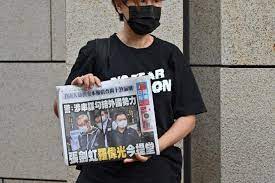
More specifically, we’re supposed to join the MSM and “our” government as well as England’s in worrying about the recent shutdown of the Apple Daily newspaper in Hong Kong – a publication that sounds a lot like The National Inquirer.

Judge for yourself. A recent cover story in The Guardian describes the paper as a tabloid-style publication that has “a chequered history including cheque-book journalism, muckraking and sometimes unethical reporting alongside fearless investigation into government corruption and police brutality.”

What? Chequered history? Paying sources for information (probably with money from the CIA or the National Endowment for Democracy) and unethical reporting?

Oh, and the paper is owned by billionaire Jimmy Lai who has been imprisoned (according to The Guardian) “on protest-related convictions and national security charges.”

So, now it’s “Hands across the Planet” for poor Jimmy and his yellow journalism.

Meanwhile Julian Assange wastes away precisely in a British prison for publishing government secrets exactly about U.S. war crimes in Wikileaks – a source that publishes the Washington’s own unquestionably true confessions of the criminal acts it desperately wants kept secret from the rest of us.

So let me get this straight: Jimmy Lai’s a hero. And we’re all supposed to get misty-eyed about the Hong Inquirer’s brave reporters. But Julian Assange is a criminal. And Wikileaks doesn’t even qualify as journalism.

And, by the way, we’re supposed to forget that there was absolutely no press freedom all those years the Brits controlled Hong Kong.

Does anyone else sense the irony?

Today’s Readings

Such considerations are especially relevant this July 4th as we celebrate our supposed “freedoms” and the tarnished ideals of the United States. Significantly, this month marks as well the 100th anniversary of the founding of China’s Communist Party (CCP) whose good example (in drastically reducing world poverty and extending foreign aid) our country so fears.  

Besides being July 4th, today also happens to be Sunday, time for a weekly “Homily for Progressives” where the theme of the day is prophecy in the sense of social criticism in the name of all that’s holy.

The first reading from the prophet Ezekiel implicitly reminds us that there were two kinds of prophets among the ancient Hebrews. Both are still with us today.

One type was a “court prophet” telling the king and power structure what they wanted to hear – justifying their oppression of the poor. (On this Independence Day you’ll hear a lot of their drivel as they praise “America” as though it were not – as Martin King put it – “the world’s greatest purveyor of violence.”) Think about The Apple Daily, Jimmy Lai and our MSM as court prophets.

The other type of prophet spoke for the Truth that was commonly referred to as “God.” The words of such men and women were routinely dismissed by the powers that happened to be. Some prophets (as is the case with Jesus in today’s final reading) were even rejected by the very oppressed people they were trying to champion. Their words were thought too dangerous and, in some cases, too good to be true. Think about Julian Assange as a prophet in the mold of Ezekiel or the Nazareth construction worker many of us claim to follow.

In any case, here are my “translations” of today’s selections. You should really check them out here to see if I got them right. As you read, think of Julian Assange.

Ezekiel 2: 2-5

I was startled
When God’s Spirit
Demanded that
I criticize my own people
As ungodly and stubborn
Telling me 
To make them uncomfortably
Aware
That a fearless prophet
Was at work
Among them.

Psalm 123: 1-4

Great and holy Parent
We invoke your compassion
On your prophetic
Servants and handmaids
So eager to serve you
Despite contemptuous mistreatment
At the hands 
Of our so-called “leaders”
With their pride and arrogance
Directed 
Against your beloved poor.

2 Corinthians 12: 7-10

Neither do prophets 
Have to be perfect.
Even Paul of Tarsus
Despite his many gifts
Suffered under
“An angel of Satan”
And “a thorn in the flesh"
To keep him humble
Lest he take credit
For the work
Of the Holy Spirit
Within him.

Mark 6: 1-6

But like Ezekiel
Jesus was rejected 
By his own townsfolk
Who complained that
He had gotten “above his raisin’s”
They didn’t even
Call him by  
His father’s name
(Implying he was a bastard)
While dismissing
His brothers and sisters
As quite unremarkable.
There’d be
No mighty deeds
For such whiners.
Only cures for
A few ailing beggars.

Conclusion

In a recent New York Times editorial, another court prophet, Yi-Zheng Lian, the former chief editor of The Hong Kong Economic Journal, joined the chorus of warnings about China’s grave threat to the West.

To an audience acquainted with the revelations of Edward Snowden Lian decried China’s surveillance system. To those whose country has bombed and killed Muslims by the scores and thousands every day over the last 20 years, he complained about treatment of Uyghurs in Xinjiang. To Americans who have lived through a Trump presidency, he criticized Chinese governance by lies. (His example? President Xi Jinping actually claimed that China seeks an international image that is “trustworthy,” “respectable” and “lovable.”) The horror of it all!   

Nonetheless, Lian also pointed out the fact that the Chinese Communist Party retains high popularity among a vast majority of its people. In fact, the party has grown by 20% annually since its foundation 100 years ago. There are no refugees from China. Travelers and students come and go at will and usually return home.

For Lian, the bottom line is that China is showing no evident signs of decline. This means that it will remain a formidable force continuing to threaten the United States and Western allies for years to come. This will be true, he said, not just militarily and ideologically, but also technologically and economically.

So, the West, Lian concludes, had better get used to the CCP’s threatening presence “at its front door.”

Of course, all this talk of threat and menace from a country that (unlike the United States and Great Britain) has bombed no one in the last 40 years – all this imperial identification of a country more than 7000 miles away as at “our front door” is nonsense.

So is any continued posturing about “our” championing of human rights and press freedom. July 4th in the context of faith reflection is a good time for reminders of such home truths.