Jesus Was against Machismo Not Divorce

Today’s readings: Gn. 2:18-24; Ps. 128:1-6; Heb. 2:9-11; Mk 10:2-16 http://www.usccb.org/bible/readings/100718.cfm

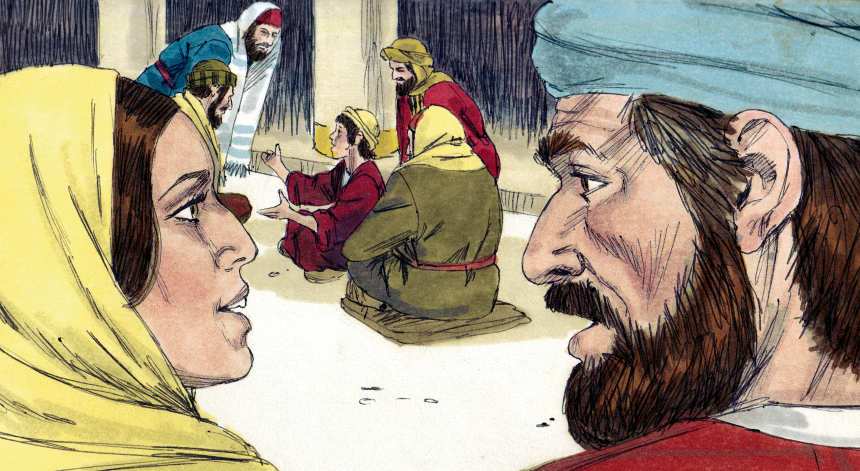
I shared Tammy Wynette’s award-winning song “D-I-V-O-R-C-E” because it captures the pain that more than half of married people go through when they decide to divorce. Tammy’s opening words, “I want to sing you a song that I didn’t write, but I should have,” as well as the way she sings capture the very sad experience that divorce is for couples who all started out so full of love and hope. As all of us know, divorce is often characterized by regret and feelings of failure especially relative to the children involved. The irony is that many divorced people will come to church this morning and find their pain compounded by today’s readings and no doubt by sermons they will hear.

However today’s liturgy of the word is surprising for what it says about Jesus and his teachings about divorce. The readings tell us that Jesus wasn’t really against divorce as we know it. Instead as the embodiment of compassion, he must have been sympathetic to the pain and abuse that often precede divorce. As a champion of women, he must have been especially sensitive to the abandonment of divorced women in his highly patriarchal culture.

What I’m suggesting is that a sensitive reading shows that what Jesus stands against in today’s Gospel is machismo not divorce as such. Relative to failed marriages, he implicitly invites us to follow his compassionate example in putting the welfare of people – in his day women specifically – ahead of abstract principles or laws. Doing so will make us more understanding and supportive of couples who decide to divorce in the best interests of all.

By the way, the gospel reading also tells us something important about scripture scholarship and its contributions towards understanding the kind of person Jesus was and what he taught on this topic.

First of all consider that scholarship and its importance relative to the topic at hand.

To begin with, it would have been very unlikely that Jesus actually said “let no one” or (as our translation went this morning) “let no human being” put asunder what God has joined together. That’s because in Jesus’ Palestine, only men had the right to initiate a divorce. So in prohibiting divorce, Jesus was addressing men.  The “no one” or “no human being” attribution comes from Mark who wanted Jesus’ pronouncement on divorce to address situations outside of Palestine more than 40 years after Jesus’ death. By the time Mark wrote his Gospel, the church had spread outside of Palestine to Rome and the Hellenistic world.  In some of those communities, women could initiate divorce proceedings as well as men.

Similarly, Jesus probably did not say, “and if she divorces her husband and marries another, she commits adultery.” Such a statement would have been incomprehensible to Jesus’ immediate audience. Once again, in Palestine no woman could divorce her husband. Divorce was strictly a male right. Women could only be divorced; they couldn’t divorce their husbands.

So what did Jesus say? He probably said (as today’s first reading from Genesis puts it) “What God has joined together let no man put asunder. “ His was a statement against the anti-woman, male-centered practice of divorce that characterized the Judaism of his time.

And what was that practice?

In a word, it was highly patriarchal. Until they entered puberty, female children were “owned” by their father. From then on the father’s ownership could be transferred to another male generally chosen by the father as the daughter’s husband. The marriage ceremony made the ownership-transfer legal. After marriage, the husband was bound to support his wife. For her part however the wife’s obedience to her husband became her religious duty.

Meanwhile, even after marriage, the husband could retain as many lovers as he wanted provided he also able to support them. Additionally the husband enjoyed the unilateral right to demand divorce not only for adultery (as some rabbis held), but also according to the majority of rabbinical scholars for reasons that included burning his food, or spending too much time talking with the neighbors. Even after divorce, a man’s former wife needed his permission to remarry. As a result of all this, divorced women were often left totally abandoned. Their only way out was to become once again dependent on another man.

In their book Another God Is Possible, Maria and Ignacio Lopes Vigil put it this way: “Jesus’ saying, ‘What God has joined together, let no man put asunder’ is not the expression of an abstract principle about the indissolubility of marriage. Instead, Jesus’ words were directed against the highly patriarchal marriage practices of his time. ‘Men,’ he said, should not divide what God has joined together. This meant that the family should not be at the mercy of the whimsies of its male head, nor should the woman be left defenseless before her husband’s inflexibility. Jesus cut straight through the tangle of legal interpretations that existed in Israel about divorce, all of which favored the man, and returned to the origins: he reminded his listeners that in the beginning God made man and woman in his own image, equal in dignity, rights, and opportunities. Jesus was not pronouncing against divorce, but against machismo.”

Here it should be noted that Mark’s alteration of Jesus’ words is far less radical than what Jesus said. Mark makes the point of the Master’s utterance divorce rather than machismo. Ironically, in doing so and by treating women the same as men, Mark’s words also offer a scriptural basis for legalists who place the “bond of marriage” ahead of the happiness (and even safety) of those who find themselves in relationships which have become destructive to partners and to children.

Traditionally that emphasis on the inviolability of the marriage bond has represented the position of the Roman Catholic hierarchy. It is very unlikely that the historical Jesus with his extremely liberal attitude towards law and his concern for women would have endorsed it.

Instead however, it never was Jesus position that any law should take precedence over the welfare of people. In fact, his refusal to endorse that precedence – his breaking of religious laws (even the Sabbath law) in favor of human welfare – was the main reason for his excommunication by the religious leaders of his own day. In other words, Jesus was the one who kept God’s law by breaking human law.

So instead of “Anti-Divorce Sunday,” this should be “Anti-Machismo Sunday.” It should remind us all of what a champion women have in Jesus.

Sometimes feminists complain that Christian faith finds its “fullness of revelation” in a man. But as one Latin American feminist theologian put it recently, the point of complaint shouldn’t be that Jesus was a man, but that most of us men are not like Jesus. Today’s Gospel calls us men to take steps towards nullifying that particular objection.

The Real Election Interference Threatening Our Democracy

Voting Machine

Ever since the 2016 election, our non-stop news cycles have focused on Russian meddling in our (supposedly) otherwise well-functioning electoral system.

And just lately, President Trump, who denies that such interference helped get him elected, has warned that the Chinese are also about to intervene – this time, he fears, against the interests of his party.

The President’s double standards aside, all such scapegoating ignores the fact that the real interference threatening our democracy comes from within. In fact, it largely originates with Republicans, whose policies have rendered the system entirely dysfunctional and unreliable.

To begin with, I’m referring to their sponsorship of the Citizens United lawsuit. It opened the door to the corrupting influence of campaign contributions from wealthy donors to Republicans and Democrats alike. I’m also referencing The Supreme Court’s striking down Section 4 of the Voting Rights Act. The Court’s (Republican-led) 5-4 decision opened the door for laws intended to disenfranchise Democrat-leaning minorities.

Add to this the practice of gerrymandering that renders GOP congressional seats virtually invulnerable, along with widespread voter suppression that discounts thousands of votes in each state and millions nation-wide in each election cycle, and you get an idea of just how corrupt our system has become.

And I haven’t even mentioned refusal to eliminate the Electoral College that has overridden the popular electoral will in favor of our last two Republican presidents – or the entirely hackable voting machines controlled by GOP-friendly operatives like Diebold Election Systems.

And then there’s the most fundamental voter-suppression measure of all – holding elections on Tuesdays precisely during the hours when working-class voters are on the job or traveling to the workplace.

All of this suggests that we must face up to the facts that:

• G.O.P. operative, Paul Weyrich, meant what he said in 1980 about Republicans not wanting everyone to vote (because if everyone did cast a ballot, a Republican president would never again darken the White House door).
• Computerized voting machines overwhelmingly favor that minority otherwise unelectable party by potentially miscounting and/or flipping millions of votes that end up completely unverifiable.

Addressing the problem will entail:

• Getting private money out of the electoral process in favor of public funding.
• Eliminating the electoral college in favor of direct popular vote.
• Abolishing gerrymandering by making redistricting a bi-partisan process subject to the approval of a reformed Federal Election Commission whose goal would be to maximize voter turn-out as well as to increase voter confidence by a transparent certification process.
• Outlawing completely highly hackable voting machines.
• More specifically, implementing a system of universal, automatic and verifiable voter registration and reverting to employment of hand-counted paper ballots.
• Changing Election Day from Tuesday to Sunday, or even establishing a national voting holiday (e.g. from Saturday to Tuesday), with ballots hand-counted by unimpeachable young people like senior Boy Scouts and Girl Scouts on Wednesday.

Failure to enact such changes, especially following the debacles of the presidential elections of 2000 and 2016 is not the fault of foreign interference in our electoral process. It’s the fault of a fundamentally broken system intended to discourage grassroots participation in favor of a minority party. Fixing it will require great commitment and work by us all.

Despite the obstacles placed in our paths, a first act towards repairing the systemic dysfunctions just described will present itself to us on November 6th.

In other words, that first reparative step is to vote the Republicans out of office replacing them with progressive democrats who refuse to take corporate money.

A Judicious Wise Woman Shames an Emotional Muddle-Headed Man: Blasey-Ford for SCOTUS!

Kavanaugh

Did you watch the Brent Kavanaugh confirmation hearings yesterday? I couldn’t help myself. I watched much more than I at first intended. I found it all quite fascinating and very conclusive in terms of filling the Supreme Court post left open by the resignation of Anthony Kennedy.

Surprisingly, I decided that if presented with the improbable choice, I’d vote to approve Christine Blasey-Ford, not Brent Kavanaugh, for the vacant post. Her testimony yesterday exhibited the qualities I expect in a judge. She also evidenced a sharper legal mind than the actual nominee.

Let me explain.

At issue, of course, was Dr. Blasey-Ford’s accusation that 36 years ago, when she was 15 and he was 17, Kavanaugh attempted to rape her at a drunken high school party. Perhaps even more importantly, the issue has become whether or not Judge Kavanaugh is lying about the event in question.

Dr. Blasé-Ford’s couples-therapist has notes to prove that the alleged crime remained a disturbing issue long after the alleged event and well before Kavanaugh’s nomination to fill the soon-to-be-vacant SCOTUS position. Blasey-Ford says she is “100% sure” that Kavanaugh was her attacker. She has also taken and passed a lie detector test to that effect.

Her request is that the F.B.I. investigate her allegations – specifically that they take a deposition from the only witness to the crime, one Mark Judge who, she says, was at least an accessory to the crime, if not an active accomplice of the young Kavanaugh she describes. Blasey-Ford alleges that Judge egged Kavanaugh on and that he ended up jumping on top of the pair as the future SCOTUS nominee attempted to disrobe her.

Throughout her testimony, I found Dr. Blasey-Ford’s testimony low-key, measured, open, matter-of-fact, and un-defensive.

For his part, Judge Kavanaugh denies the whole thing. His testimony was loud, aggressive, angry, extremely emotional, tear-filled, defensive, and punctuated by snorting, huffing, puffing and frequent pauses for long gulps of water. With raised voice, he repeatedly talked over his inquisitors. At points, it appeared that he was having a nervous breakdown.

Along with his Republican male colleagues, the judge painted himself as the innocent victim of a calculated smear campaign. Though Dr. Blasey-Ford may well have endured the horrific attack she describes, Kavanaugh maintained that she had mistaken the identity of her attacker.

He further argued that there was no need to depose Mark Judge. It was good enough, Kavanaugh said, that the one Dr. Blasey-Ford had identified as his accomplice or accessory had submitted a statement swearing to the innocence of Kavanaugh (and, naturally, of Judge himself).

Similarly, for Kavanaugh, further F.B.I. investigation would be pointless. Much less would it help for him to take a lie-detector test. He intimated that his detailed calendar from 36 years ago, along with his own interpretation of its meaning was more credible than any such testing might ever be.

And that brings me to the conclusion I mentioned earlier. I thought of the whole spectacle in terms of a job interview. After all, that’s the bottom line here. Regardless of his guilt or innocence, Brent Kavanaugh is interviewing for a position on the highest court in the land. The real question here is not about the alleged event of 36 years ago, but about hiring him for a life-long job with iron-clad tenure.

To help answer that question, I recalled my years of work at Berea College in Kentucky and of the innumerable job candidates I interviewed there. What if Dr. Ford and Judge Kavanaugh were applying for a job there? How would I and my colleagues evaluate their performances? Who would be most the most effective candidate.

It would not be Kavanaugh.

To begin with, measured, thoughtful, humble and articulate would be judged far more favorably than strident, defensive, accusatory and accompaniment by snorting, huffing and puffing. That contrast alone would disqualify Kavanaugh from serious consideration.

But then there’s the more serious question of professional competence. I and my colleagues would wonder who exhibited more . . . well, judiciousness? Who gave evidence of a better legal mind?

Clearly, it was Blasey-Ford. She called for full investigation of new charges. She requested deposition, cross-examination, and judgment based on eye-witness testimony. Meanwhile, he preferred reliance on investigations prior to recent charges. For him, testimony of the accused, endorsements by his friends, and trusting the written self-exoneration of an alleged accomplice or accessory were good enough.

I’m sure I and my colleagues would see such reasoning as sloppy and . . . well, injudicious.

In the words of a Great Man, I’m certain we’d conclude in effect: “Judge, Kavanaugh, you’re fired!”

Improbably, we’d offer the position to Dr. Blasey-Ford instead.

White American Evangelicals and Catholics Hate Children: They Hate Jesus!

babyjail

Readings for 25th Sunday in Ordinary Time

What’s the worst thing you can do to a child? What’s the worst form of child abuse?

No, it’s not abusing them sexually, though that’s bad enough. Of course, pedophilia is the horrendous crime so many Catholic priests have committed from time immemorial. It is nearly unspeakable in its selfish cruelty. It deserves absolute contempt and condemnation.

However, the worst crime is not sexual abuse. No, it’s separating children from their parents. A little introspection about your own children or grandchildren might tell you that. Picture them deprived of your presence and love — forever. Can you imagine having your child snatched from your paternal arms or from your nurturing breast?

Incredibly, that’s the crime committed by white Evangelicals who represent the largest constituency of Present Donald J. Trump. They commit it by their unconditional support of the one who has actually created baby jails. Yes, baby jails that permanently separate the most innocent creatures we can imagine from the ones that love them dearly. This crime tortures not only the babies, but their mothers and fathers too.

Of course, both Catholics and Evangelicals camouflage their misopedia by pretending to care about unborn embryos and fetuses – creatures for whom they cannot possibly exercise practical responsibility and whose parents tend to be “those others:” blacks and browns, immigrants and the poor in general. Opposing abortion represents what Dietrich Bonhoeffer called “cheap grace.” It’s costs the opponents absolutely nothing.

Yet, once the unborn come to term – once the newly born and young might cost taxpayers a few dollars – erstwhile Christian child-defenders disappear. They wash their hands of the whole affair. They effectively tell parents “Now you’re on your own, good luck.” They even oppose “Big Government” programs like SNAP and TANF that have proven in other countries to reduce abortions by significantly relieving the financial worries of new parents.

Worse still, patriotic Christians support killing the young by the hundreds of thousands and without a second thought. They do so in places like Yemen, Palestine, Iraq, Syria, Afghanistan, and Ethiopia. That’s the short list of killing fields where children are slaughtered mercilessly and on an hourly basis by “American” bombs effectively blessed by the “Christians” I’m referencing. (Secretary of State and devout Christian, Mike Pompeo, nakedly supports such slaughter because it’s good for the U.S. arms industry.)

All of this conflicts with the portrayal of Jesus in today’s Gospel reading. There, Jesus embraces a real child of the kind Trump-supporters show little concern about once the creatures advance beyond fetal status.

This is how Mark describes the episode: “Taking a child, he placed it in their midst, and putting his arms around it, he said to them, ‘Whoever receives one child such as this in my name, receives me; and whoever receives me, receives not me but the One who sent me.’”

In fact, Jesus uttered not a word about abortion. But Mark’s portrayal speaks volumes about Jesus’ attitude towards the kind of children Catholics and Evangelicals tend to hate. He could not have been clearer In his absolute identification with them: “Whoever welcomes one such child in my name welcomes me.”

To repeat, in doing that Jesus is not embracing a fetus, but an actual living child about whose human status there can be no debate. Moreover, the child in question was probably of the type many opponents of abortion have little use for or sympathy with. After all today’s gospel scene takes place in Capernaum, the urban center that Jesus adopted as his home town after he was thrown out of Nazareth precisely because of his programmatic concern for the poor.

Remember: Jesus spent his time among the poor who represented his own origins. So, the child Jesus embraces was probably a smelly street kid with matted hair and a dirty face. He or she was probably not unlike the street kids found in any city today – the ones hooked on sniffing glue and who have learned to sell their bodies to dirty old men from way across town, and often from across the world.

I make all this supposition because the reason Jesus embraces the child in question is to present his disciples with a living example of “the lowest of the low” – God’s truly chosen people. In Jesus’ world, all children were at the bottom of the pecking order whose rabbinical description ended with “idiots, deaf-mutes and the young.” And among the young, street children without father or mother would indeed represent scraping the bottom of the barrel.

Embracing children like that doesn’t mean practicing “tough love,” nor forcing impoverished mothers to bring their children to term and then telling them “You’re on your own.” Rather, embracing poor children – truly being pro-life – means creating a welcoming atmosphere that receives children as we would receive the Jesus who identifies with them in today’s gospel.

Yes, it suggests supporting those “Big Government” programs that work so well elsewhere – the programs Donald Trump and his supporters are hell-bent on eliminating.

Remember all of that when you hear your pastor’s sermon on abortion this Sunday. Remember it when you cast your vote on November 6th.

Following Jesus Means Resisting U.S. Empire: It Means Risking Jail, Torture & Execution

Imperial Bombs

Readings for the 24th Sunday in Ordinary Time: Is. 50:5-9a; Ps. 116: 1-6, 8-9; Jas. 2: 14-18; Mk. 8:27-35

Presently, I’m reading again John Dominic Crossan’s brilliant book on Jesus’ resistance to empire. It’s called God & Empire: Jesus Against Rome, Then and Now. As described on its jacket, the book’s thesis is that “at the heart of the bible is a moral and ethical call to fight unjust superpowers, whether they are Babylon, Rome, or even America.”

Since it is about empire, this Sunday’s Gospel selection is directly related to Crossan’s thesis. In fact, the selection addresses Jesus’ non-violent and hugely ignored resistance to Rome. It includes his call for us to join him in resisting empire’s inherent evil, while nevertheless refusing to employ violence in doing so.

Though most who preach this week probably won’t say so, that’s the real focus of today’s Gospel. Its key elements are (1) Jesus’ harsh words to Simon Peter, (2) his self-identification as the anti-imperial “Son of Man,” and (3) his insistence that his followers oppose empire non-violently no matter what the cost.

For starters, take Jesus’ harsh words to Simon Peter. He’s impatient with the man, and in effect tells Peter to go to hell. (That’s the meaning of his words, “Get behind me, Satan.”)

Why does he speak to Peter like that? To answer that question, you have to understand on the one hand who Peter is, and on the other the claimed identity of Jesus.

Simon was likely a Zealot. Zealots were fighters in the Jewish resistance movement against the Roman occupation of Palestine. They were committed to expelling the Roman occupiers from Palestine by force of armed violence.

What I’m pointing out is that many scholars strongly suspect that Simon Peter was a Zealot. For one thing, he was armed when Jesus was arrested. His armed status (even after three years in Jesus’ company!) also raises the possibility that he may have been a sicarius (knifer) – one among the Zealots who specialized in assassinating Roman soldiers.

Notice how quick Simon was to actually use his sword; he was evidently used to knife-fighting. In John 18:10, he tries to split the head of one of those who had come to arrest Jesus. However, his blow misses only slicing off the intended victim’s ear. Put that together with Simon’s nom de guerre, “Peter” which arguably meant “rock-thrower,” and you have a strong case for Peter’s zealotry.

In any case, when Jesus asks Peter “Who do you say that I am?” Peter’s response, “You are the Messiah” means “You’re the one who will lead us in expelling the hated Romans from this country by force of arms.” (That’s what “messiah” meant for first century Jews.)

Now consider where Jesus is coming from. (This is the second key element of today’s Gospel.) As today’s text shows, his primary identification was not with “messiah,” but with a particular understanding of the “Son of Man.” The latter is a figure taken from the Book of Daniel which was written in resistance to the Seleucid empire of Antiochus IV Epiphanes, the Greek sovereign who oppressed the Jews in the 2nd century BCE.

Daniel presents the Son of Man (or the Human One as some translate it) as the opponent and conqueror of all Israel’s oppressors from the Babylonians, through the Medes, Persians and Greeks. However, as Crossan and others show, Jesus’ opposition to empire remained non-violent.

Jesus reveals this crucial distinction, for instance, in the full form of his famous declaration before Pilate, “My kingdom is not of this world” (JN 18:36). In its complete form, the quotation runs, “My kingdom is not of this world. If my kingdom were of this world, then would my servants fight, that I should not be delivered” up to execution. These words contrast the nature of Jesus’ non-violent kingdom founded on justice with that of Pilate’s extremely violent Rome founded on injustice.

So, Jesus’ rebuke to Peter might be translated: “Look, like you and the Human One Daniel wrote about, I’m as much an enemy of foreign occupation as any good Jew. However, unlike you, I’m not going to be part of killing my Roman brothers and sisters who share our humanity. Yes, I’m saying that the Romans and ‘our’ Temple collaborators are our brothers and sisters! Killing them is like killing ourselves. It’s even like trying to kill God. So, I won’t be introducing the glorious Israel you’re thinking about. It’s just the opposite; the Romans will actually end up torturing and killing me! But I’m willing to accept that.”

All of that was too much for Peter. To stand by and let the Romans torture and kill Jesus seemed crazy to him – especially when Jesus’ following was so strong and militant.

[Recall that two chapters earlier in Mark, Jesus had met all day with 5000 men in the desert. (Can you imagine how the ever-watchful Romans would have viewed such a meeting? Today what kind of drone strikes would be unleashed in Afghanistan against participants gathered like that?) Recall too that (according to John 6:15) at the end of that day’s meeting a resolution was passed to make Jesus king by force. Of course, Jesus had rejected that proposal and had walked out on the meeting. But evidently Simon here still wasn’t getting it; there was still hope that Jesus might change his mind.]

But no, here was Jesus reiterating that his resistance to Rome and its Temple collaborators was to be uncompromisingly non-violent. For the Rock Thrower, the equation “Messiah” plus “non-violence” simply couldn’t compute. So, he blurts out his own “Don’t say things like that!”

And this brings me to that third point I indicated at the outset – Jesus’ invitation to each of us to join him in non-violent resistance to empire. Despite Peter’s remonstrances, the Master doubles down on his call to such activism. He says unequivocally that those wishing to follow him must take up crosses. (Remember that the cross was the special form of execution the Romans reserved for insurgents. So, Jesus words seem to mean that his followers must be anti-imperial and run the risks that go along with insurgency.)

What can that mean for us today, when so many of our politicians and their cheerleaders proudly embrace U.S. identity as the latest most powerful incarnation of Roman dominance?

Jesus’ words, I think, call us to a “paradigm shift” concerning the United States, ourselves, and our church communities.

Jesus teaching means first of all that we have to recognize our own situation as “Americans.” Simply put: we’re not living in the greatest country in the world. Instead, we are living in the belly of a brutal imperial beast.

Secondly, Jesus’ words about embracing the cross challenge us as individuals to figure out how closely we really want to follow the Jesus of Mark’s Gospel. If we agree that Jesus is Daniel’s “Human One” destined to live out the inevitable “prophetic script” that Jesus foresees, then our claim to follow him has consequences.

It means each of us is called to follow not only Jesus but Daniel, John the Baptist, Gandhi, King, Romero, Rachel Corrie, Berta Cáceres and the impoverished people the United States kills each day in the many countries it occupies. Jesus’ words this morning leave little room for escape or denial. It’s not, of course, that we seek martyrdom. However, we too must live the prophetic script those others followed and be ready for arrest – and even torture and execution – should it come to that.

Thirdly, all of these considerations have implications for our church communities here in the beast’s belly. They mean we must come to terms with the fact that circumstances have changed here over the last 17 years. We’re losing our rights to protest. It’s much more dangerous than it once was. When we resist state terrorism, we now risk arrest, being tazed, pepper sprayed, tear gassed, jailed, or even (especially if we are not white) murdered by out-of-control police forces. We risk going to jail and all that suggests.

The question is, are we up to that challenge? Do we really want to follow a Jesus who says we must take up crosses?

No doubt, these are hard questions and challenges. And surely, we’re tempted with Peter to take Jesus aside and tell him to be more reasonable. Like Peter, we find denial comfortable.

Inevitably though, I think we’ll hear Jesus say as he did to Peter: “Take it or leave it. Follow me to the cross. There’s no other way into the Kingdom of God.”

You probably won’t hear that from the pulpit this morning.

Ephphata: Jesus Challenges Our Culture’s Silence about Poverty

Readings for the 23rd Sunday in Ordinary Time: Is. 35:4-7a; Ps. 146:7-10; Jas. 2:1-5; Mk. 7:31-37

Poverty is an uncomfortable topic for Americans. So, we ignore it at home and abroad. When was the last time you heard a politician even refer to the poverty as a pressing problem in the United States or in the world at large?

Today’s liturgy of the word forces us to face God’s quite divergent attitude on the subject.

But before we get to that. Think about our culture’s attitude. For instance, rather than recognize poverty as human-caused, our politicians go in the opposite direction. They actually blame the world’s problems on the poor. They ask us to believe that impoverished immigrants and war refugees rather than the politicians themselves (and their rich sponsors) are responsible for our nation’s problems.

The reality, however, is that the refugees are the product of U.S. wars against the poor in our own hemisphere and beyond. Throughout the 1980s, we fought the poor in Guatemala, Nicaragua, El Salvador, and Honduras. Besides those causes, refugees and immigrants are the direct result of trade policies like the North American Free Trade Agreement. They come from our current bombing campaigns in Iraq, Afghanistan, Libya, Somalia, Syria, and Yemen.

Take the case of Yemen. It’s the poorest country in the Middle East. And yet we’re cooperating with the Saudis, the richest people in the region, in their genocidal attack on Yemenis. Together we and the Saudis are starving to death people who were already barely hanging on to life. We’ve started a cholera epidemic among them that the World Health Organization says has already claimed 1.1 million lives.

And then there’s the poor among us here in the United States. The numbers of U.S. poor are actually growing by leaps and bounds. According to the federal government, a family of four making less than $28,800 is considered poor. The number of Americans at or below that level has reached more than 50 million. And yet, while reducing taxes on the super-rich, our current government is bent on cutting unemployment benefits, further restricting food stamps, eliminating Medicaid as we know it, and “reforming” Social Security to the point of cancelling its effectiveness.

And it’s worse than that as well. The poorest people in the world live on less than $1.90 per day. Incredibly (according to a recent report from the UN) there are 5.3 million such people in the United States. They’re living in poverty like that usually associated with Bangladesh!

Yet most of us remain completely unaware of such conditions. To repeat: our politicians ignore them at best and deny them at worst. So do our media. Consequently, we pay no attention to the poor and to U.S. aggression directed against them — customarialy masked as a “war on terror.”

Today’s liturgy of the word addresses the question of blindness to poverty, of deafness to the voices of the poor, and the inability to speak with or about them. Taken together, our readings implicitly and explicitly call us to open our eyes and ears and to be the voice of the voiceless. Jesus’ healing Aramaic word “Ephphata” (be opened) is central here. We’re called to open ourselves to the poor.

The first reading from 2nd Isaiah addresses the captives in Babylonia in the 6th century before the Common Era. Following their defeat in 581 the cream of Israel’s society were held captives by their Babylonian conquerors. Speaking as one of them, and acting as a prophet of hope, Isaiah promises that the “Babylonian Exile” will soon come to an end. Then everything will be wonderful, he assures his readers. The desert will bloom. The blind will see; the deaf will hear, and the mute will speak. The inclusion of this reading in today’s liturgy implies that Jesus and his works of healing on behalf of the poor is the fulfillment of Isaiah’s prophecy.

Isaiah’s sentiments are reinforced by the responsorial psalm. To Isaiah’s insight it adds the specific identification of Yahweh as the God of the poor and oppressed. According to the psalm, Yahweh sets captives free, secures justice for the oppressed, feeds the hungry, and protects immigrants, widows and orphans. Yahweh is on the side of the poor, the psalmist says. Hard as the words might sound to us, God prefers the poor to the self-satisfied rich – to people like us.

Today’s second reading – from the Letter of James continues the theme of the responsorial psalm. James warns against showing partiality for the rich. “Don’t be judgmental about the poor,” he warns. They after all are the ones God is partial towards. “God chose the poor,” James says, “to be heirs of the kingdom.”

All of this celebration of the poor as the People of God reaches its zenith in today’s Gospel selection. There Jesus cures a poor man who is deaf and who cannot speak. There are at least three noteworthy elements to this cure. Considered as a whole, all three are connected with the topic of poverty and its absence from public perception and discourse.

The first thing to note is that this episode is almost certainly an accurate reflection of something Jesus actually did. The detail about Jesus’ curing ritual – his use of spit, his loud sigh, and the quasi-magical Aramaic word he used (ephphatha) to effect the cure indicate the account’s authenticity. In this passage, the healer Jesus is acting like what indigenous Mayans in Guatemala call a “curandero” – a traditional healer, or what unsympathetic outsiders might term a “witch doctor.”

The second noteworthy element of today’s story is where it occurred – in the Gentile region of Palestine. Here we have Jesus (and this is one of the recurring themes of Mark’s Gospel) treating non-believers – people outside the Jewish community – the same as those inside. Jesus constantly crossed such boundaries. And he usually got in trouble for doing so. But he continued those boundary-crossings because he found more receptivity among non-believers than among would-be people of faith.

The third noteworthy element of this story goes along with the previous one. It’s the response of the non-believers to the Jesus’ cure of the deaf-mute. Tremendous enthusiasm. Despite his best efforts, Jesus couldn’t keep quiet the people who witnessed the cure. Once again, this reaction stands in sharp contrast to Jesus’ own disciples who in Mark’s account never quite “get it.”

The rich liturgical context for the account of Jesus cure of the deaf-mute including Isaiah’s promise to the exiles and James’ words about God’s preferential option for the poor directs our attention towards the social meaning of Jesus healing action in chapter 7 of Mark’s Gospel. It indicates what curing blindness, deafness and impediments to speech might mean for us today.

We are called, the liturgy suggests, to be opened to the invisible poor among us and to cross forbidden boundaries to meet them. We are summoned not only to see them, but to hear what they are saying. They, after all, possess what theologians call a “hermeneutical privilege,” i.e. the most reliable and accurate insight into what really ails our society, our culture, the world.

This means that if we truly listen, we can learn more about the world from the homeless person on the street than from all the learned tomes in our libraries or from the pop-sociology we find on the New York Times best-seller list – or for that matter from our politicians, bishops and popes. [Isn’t it ironic that Christians today should be the ones downgrading the poor implying (with atheist Ayn Rand, the hero of the religious right) that they are “lazy,” “moochers,” and “useless eaters?”]

On top of that, the suggestion today is that as followers of Jesus, we have to recognize poverty and God’s poor as specifically biblical categories. Following Jesus means putting our priorities aside so the poor may be served. This means trying to be the voice of the poor in the places from which they are excluded, but to which we have access. We are being directed to overcome our reluctance (inability?) to break the silence about poverty. Here I’m not just talking about letters to the editor, attending public meetings, phoning our President, senators and congressional representatives. I’m also speaking about conversations around our family dinner tables, at the water cooler, in the locker room, and in our schools.

Following Jesus, we can’t allow the enemies of the poor and those who are indifferent to them to twist the Gospel. We can’t allow them to carry the day as if Jesus and the Biblical tradition so well reflected in today’s liturgy shared our culture’s prejudice against the poor.

Today in response to our biblical readings let our prayer be “Ephphatha! Lord, open our eyes, our ears, and our hearts. Loosen our tongues” — not only to speak the truth about poverty, but to act on that truth ourselves and stimulate our elected leaders to do their part.

Please consider these thoughts as you listen again to the beautiful prayer-song, “Ephphatha.”

It’s Time for Catholics to Employ the Shock Doctrine: Set Up Alternative Storefront Churches Everywhere

Storefront

“Never let a good crisis go to waste.”

As described by Naomi Kline, that’s been the motto of reactionary politicians forever. In her book by the same title, she calls it “the shock doctrine.” It highlights the fact that when disasters occur, it becomes possible for politicians to ram through policies that otherwise wouldn’t have a snowball’s chance in hell of gaining approval.

9/11 provides the most obvious case in point. Its aftermath saw Congress gain quick endorsement of policies that its neo-fascist members have impotently lusted after for decades. I’m referring to the institution of a police state, to widespread surveillance of U.S. citizens, to the use of torture, to wars against oil and mineral-rich Muslims in Iraq, Libya, and elsewhere, and to the mass expulsions of foreigners from U.S. soil.

It was similar with Hurricane Katrina. Following its devastation, public schools were privatized, government programs of aid to the impoverished were shredded, and black neighborhoods were gentrified on behalf of wealthy real estate moguls and their clients. All of those were prominent among the “impossible” desiderata of Washington’s elite.

And without 9/11 and Katrina, they would have forever languished beyond the pale of prospect.

The argument here is that the mega-crisis of clerical pedophilia has opened the way for ordinary Catholics to apply Klein’s shock doctrine to an institution that has otherwise remained immobile even in the face of the urgent call of Pope Francis (in “The Joy of the Gospel”) for radical change at almost all ecclesiastical levels.

I say “almost all,” because even in his otherwise brilliant Apostolic Exhortation, the pope specifically ruled out the ordination of women. (He did not even mention abolishing the requirement of priestly celibacy.)

However, my point here is that the horrendous pedophilic crisis has cardinals, bishops, priests, and even the pope himself on the run. Consequently, the door has swung wide for those outside the clerical establishment to take matters in their own hands. It’s time for us to demand changes that would otherwise remain unthinkable for the fossilized ecclesiastical establishment.

First on the list should be the re-examination of all church teachings about sex from masturbation to abortion. And here the laity should be in charge. For it has become evident that a celibate clergy has NOTHING at all to teach us about sex. In the light of clerical pedophilia and its coverup, they should forever remain silent on the subject.

Put otherwise: precisely as celibates, the Catholic clergy’s knowledge of sex can only be either entirely theoretical (usually based on a medieval understanding of the topic) or gathered from illicit, guilt-ridden practice. As such it is invalid and should be ignored on principle.

Second on the list should be the elimination of mandatory clerical celibacy itself. Common sense tells us that it is connected with the perversions of sex-starved priests.

Thirdly, it’s time to admit the obvious, viz. that pedophilia would never have flourished under the leadership of women. In other words, the door has swung open to the otherwise unthinkable for the clerical boys’ club – to the ordination of women.

With all of this in mind, Catholics should take advantage of this crisis by:

• Refusing to let the pope and others to get away with mere apologies and discussions about what to do with pedophilic offenders.
• Insisting instead that as a good faith measure, the pope immediately declare his intention to phase out mandatory celibacy and to open the way for women to serve the church at all levels from priest to pope.
• Demanding the convocation of a General Council (under lay leadership) to re-examine the entire corpus of church teaching on human sexuality.

But how apply pressure to bring about such changes? (And it’s here that the Shock Doctrine applies to a heretofore immobile laity as well as the clergy.)

Let me put it in terms of my own experience.

For years, it has been evident to me and other progressives within my local church in Kentucky that restorationist priests coming out of the reactionary papacies of Pope John Paul II and Benedict XVI were not meeting the needs of local parishioners shaped by the teachings of the Second Vatican Council (1962-65). Those teachings, I reminded my friends, remain the official doctrine of the Catholic Church.

With that in mind, I counseled repeatedly that without abandoning our identity as Catholics, we should leave the local church building and open a storefront, lay-led Catholic Church down the street. We would become a “shadow church” with its own lay pastor, its Eucharistic celebrations, its on-going education programs, and its outreach programs to the local poor. I recommended that we publicly invite our entire congregation to join us, and that we notify the local bishop of our intentions. We would continue meeting in this way, I recommended, until changes were instituted that met our needs.

Our model would be the Jesus, Mary, and Joseph (JMJ) Catholic Church centralized in James Patterson’s novel, Woman of God (which I reviewed here).

No one in our group of 20-25 proved ready to do any of that.

What I’m suggesting here is that the pedophilia crisis may have so shocked my sisters and brothers within my own community that they may now be open to follow the example of Brigid Fitzgerald, the priest hero of Patterson’s novel. She and her ex-priest husband opened a storefront church of the type I’m suggesting here.

I’m betting that following that example across the country and world would move local bishops, Pope Francis and the Catholic establishment to adopt something like the reforms I’ve suggested here.

So, let’s form our own JMJ churches. What have we got to lose?

A Reunion of Former Priests Underlines Deep Paradigm Shifts in the World, the Catholic Church – and in Myself

Columbans

Last weekend, I experienced an event that made me realize yet again how much the world, my Catholic faith – and I – have changed over the last 50 years. All at once, I realized that my prayers had been answered: a new age has indeed dawned for us all. It’s all quite revolutionary. Paradigms that once guided me and my contemporaries both religiously and politically have dissolved before my very eyes.

The clarifying event in question was a reunion of Catholic priests most of whom were ordained in the late 1960s and early ‘70s. I was in attendance since I too had been a priest. I was ordained in 1966 – after entering training for the priesthood in 1954 at the age of 14. Unbelievably to me now, at that tender age – as a high school freshman – I had enrolled in St. Columban’s Seminary in Silver Creek, New York. With virtually no experience of the adult world, I decided to give it all up to become a priest.

I changed my mind 22 years later. I left the priesthood in 1976, 10 years after ordination (for reasons I’ve explained here, here, here, here, and here). But it all means that I had spent more than 20 years in the religious life. I don’t regret a minute of it.

The Reunion

However, with all of that baggage, I found myself at this reunion at a former seminary in Bristol, Rhode Island – a place where, in 1960, I passed the “spiritual year” that candidates for the priesthood were required to experience. There, we had made our 30-day Ignatian retreat. We learned to meditate, fast, pray and discern God’s will. Today the seminary is a residence for retired priests.

Everyone at the reunion shared such experiences, though unlike me, few had begun their training as high schoolers. But all present are or had once been members of the Society of St. Columban – an Irish missionary organization founded to convert the Chinese in pre-revolutionary China. Though originally founded for China, Columbans were expelled from the mainland after Mao Tse Tung’s revolution in 1949. Thereafter, they moved on to work in 17 different countries, including Korea, the Philippines, Myanmar, Fiji, Pakistan, and various Latin American venues. Only relatively recently have they returned to resume work in China.

About 30 priests attended last week’s event – about a third of them still active priests, while about 2/3, like me, had long since left the clergy. Many of the “formers” came with their spouses.

Every three or four years, Columbans have held such reunions since the mid 1970s. This one, however, was special, since it marked the 100th anniversary of the Society’s founding in 1918.

Like all Columban gatherings of this type, the centennial version was characterized by reminiscences, jokes, laughter, plenty to eat and drink, along with questions and answers about what we and our families have been up to over the last 50 years or so since ordination. Name tags, of course were de rigueur. Nearly all of us have changed beyond recognition.

Religious Changes

But history was in the air. And a century of work called for placing the event in that wider context. Fr. Tim Mulroy, the Society’s U.S. regional director, obliged on the meeting’s second day. His remarks connected world events over the past 100 years with profound changes not only in the Society of St. Columban, but in its umbrella institution, the Catholic Church – and in everyone’s understanding of God, priesthood, and life itself.

The changes in question were provoked more than anything by the Second Vatican Council (1962-’65), when Pope John XXIII called a meeting of all the world’s bishops for purposes of aggiornamento – for updating and modernizing the Catholic Church – for bringing it into dialog with the contemporary world. That meant embracing modern scripture scholarship and honestly coming to terms with the scientific revolution, evolution, and developments in history, psychology, economics, political theory, and related fields.

Judging by conversations with my reunion colleagues, more than a half century of living with the resulting reforms has rendered our faith as unrecognizable as our wizened and deeply lined faces.

As outlined by Fr. Mulroy, here are some examples of what I’m talking about:

• China has changed drastically; it is now part of the global village. More than ½ million Chinese students are currently studying in the United States. Nothing like that was happening in 1918. To put a finer point on the phenomenon: China is waxing as a world power; the U.S. and Europe are waning.
• Ireland has similarly transformed. Many now even speak of that famously Catholic country as a post-Christian society. The clerical pedophilia scandals are largely responsible for Ireland’s loss of faith, though the transition from a basically rural culture to a more urban, globally-integrated one bears at least equal responsibility. It has introduced a level of materialism never before seen in Ireland.
• The teachings of Vatican II about the salvific value of other religions has called into question the very purpose of missionary endeavor. If, as the Council taught, Buddhists, Muslims, Hindus and tribal peoples all have valid understandings of God and can be “saved” (whatever that means), there doesn’t seem to be much point in trying to convert them.
• The internet has underlined that same point. Moreover, the new atmosphere created by social media means that a strong on-line presence for groups like the Columbans has become even more important than preaching effective Sunday homilies.
• The priesthood has also changed. Again, pedophilia along with Vatican II’s revised theology emphasizing a “priesthood of the laity” has taken priests off the pedestal they once occupied. In the Society of St. Columban, there hasn’t been an ordination either in Ireland or the United States since the year 2000.
• Of necessity then, Columbans have become less western. In fact, there are now two classes of Columban priests: the over-fifties and the under-fifties. The over-fifties are found in Ireland, the United States and in Australia. Most of them are either in or about to enter nursing homes. Meanwhile, the under-fifties typically come from Korea, the Philippines, Peru, Fiji and Brazil. Gradually, they find themselves working in the United States and Ireland evangelizing the now-secularized countries whose priests once evangelized them! Global South clergy working in the U.S. bring with them understandings of mission, life, and family very different from what their new audiences have grown to expect.
• All of the changes just listed have meant that English-speaking Columbans (for reasons of self-preservation) are gradually transitioning towards membership in a lay missionary organization. And fully 80% of its new members are female. One can only imagine what this means in terms of altering the extremely macho, patriarchal culture I experienced growing up in a Columban seminary!

In sum, the centennial celebration of our clerical group caused all of us to face the undeniable fact that our world has been drastically transformed. The Catholic Church has changed along with it. So has the Missionary Society of St. Columban along with all of its members and former members. The last 100 years (and especially the last 60 or so) have altered our understandings of God and the meaning of life.

Spiritual Changes

Take my own case.

When I began my priestly odyssey, my faith was simple. I was certain that God was “up there.” His word was revealed in the Bible whose truths were infallible and valid for all time. I knew for a fact that the Catholic Church was in sole possession that book’s true meaning. My purpose as a missionary-in-training was to get others to see that truth, so, like me, they might get to heaven.

The “holy sacrifice of the Mass” was all important then. I believed that the words of a priest could call Jesus down to enter a piece of bread and a cup of wine. I believed in Jesus actual presence in the tabernacle of every Catholic church where I might literally sit before him and “visit” as I would an intimate friend. Similarly, a priest’s words of absolution spoken in the confessional could open the gates of heaven to sinners previously on the road to hell.

Sin, judgment, heaven and hell were inescapable preoccupations for me. My focus was on the after-life. The priesthood was a divine calling that would make me “another Christ.” What a singular privilege!

Today, I can believe none of those things with the simplicity of faith I once enjoyed. Instead, my idea of God has become belief in the universal presence of a creative Life Force in whom (as St. Paul put it) we live and move and have our being (ACTS 17:28). Other religions are just as valid and questionable as Christianity. I have no idea what happens after death. Heaven and hell are this-worldly realities shaped either by love on the one hand, or fear on the other. Like almost all other Catholics, I’ve given up going to confession. And my commitment to daily meditation has replaced the importance I once gave the Eucharist. I’ve been driven away from the latter by priests still promulgating a vision I can no longer endorse.

Political Changes

All of this, I believe, represents not only a profound paradigm shift, but a kind of liberation. Its process has been a gradual coming of age that is paralleled by a similar shift in the political realm.

During the reunion, that political change was reflected in conversations with my former colleagues in the seminary and priesthood. Almost to a person (there were a few exceptions), everyone was completely scandalized by Donald Trump and his politics that have impacted so negatively the migrant communities to whose welfare (according to Fr. Mulroy) all Columbans are committed. I mean, political remarks at our gathering were more critical and negative about the United States than I’ve ever heard before at similar gatherings.

It all suggested that at least many of my Columban friends had gone through political paradigm shifts like my own. Again, without speaking for others, let me admit my own swing from right to left. My friends may have experienced something similar.

Growing up, of course, and at least till my late twenties, I was a good American and quite conservative. That shouldn’t be surprising, since the pre-Vatican II American church responsible for my seminary education was so conservative, anti-communist and patriotic. As a result, I believed that the United States was a force for good in the world and that it had always been so.

Only afterwards, did events and study correct such misperceptions. For me, the catalyzing elements included:

• The Vietnam War
• The Civil Rights Movement
• Women’s liberation movements
• Study of Global South, post-colonial theologies
• Travel and study in Rome (and across Europe), Brazil, Nicaragua, Guatemala, Costa Rica, Mexico, Cuba, South Africa, Zimbabwe, Israel, and India.

All such experiences gradually revealed to me the truth of Martin Luther King’s identification of the United States as the greatest purveyor of violence in the world – and (I still find it shocking to write this for a polite audience) the challenge of the Nicaraguan Sandinista meme that the United States is “the enemy of mankind.”

Conclusion

A sad highlight of the reunion I’ve just recounted was a meeting with a former mentor of mine. Fr. Dan remains a Columban priest and at the age of 92 resides in the Society’s nursing home in Bristol. For the past few years, dementia has robbed him of his memory to the extent that in our meeting last week, he was unable to remember me or the time we shared in Rome, where we both completed our formal studies. (There, Dan had given me sound advice as I contemplated leaving the priesthood for which I had prepared since the age of 14. I remain extremely grateful for his wise counsel.)

In any case, Dan was always a maverick and I loved him for that. One time, he announced that if he ever made the rank of bishop (fat chance!) the slogan on his coat of arms would be “No more bullshit!”

As I left our reunion last week with the reflections and insights just shared, I couldn’t help thinking of the relevance of Dan’s motto. It applies to church and state as I’ve experienced them over my 78 years. Over those years, both the Catholic Church and the U.S. government have exposed us all to great quantities of b.s.

Thankfully, the events of the past hundred years (especially since Vatican II) have empowered us to leave much of that behind while retaining the friendships and quasi-family ties that have characterized the Society of St. Columban. The evidence I encountered in Bristol last week shows that (despite the ancillary uncertainties) we’re all better off for the process.

I’m grateful to my Columban brothers (and sisters) for the experience of last week, and for the continued friendship and support that have enabled us all to more or less approximate Dan’s ideal.

This Just in: Both U.S. Government & Catholic Church Confirmed as Crime Syndicates

Wafer

Readings for 20th Sunday in Ordinary Time: PRV 9:1-6; PS 34:2-7; EPH 5: 15-20; JN 6:56

Ironically, I felt some relief at last week’s horrendous revelations about the 300 Pennsylvania priests who sexually victimized more than 1000 children and young people over the last 70 years. The relief was similar to what I feel each day now as President Trump spews his venomous lies and implements his cruel policies to restore “America” to its good old days before the post-World II achievements of blacks, women, gays, immigrants, and social justice advocates.

I mean, the veils have finally been pulled back in both politics and religion. In this Sunday homily, though, it’s the latter that will be my focus, since I want to connect today’s Gospel reading with the priesthood and pedophilia.

Let me begin, however, with politics and its scandals that mirror and illuminate those of the church.

Politically, the deceits of Donald Trump have done us all a huge favor. They’ve forced us to face undeniably what our presidents, teachers, and media enablers have been doing for centuries. The revelations cannot be denied. What Mr. Trump is doing, they all have done. The only difference is that Trump’s predecessors didn’t admit it all so openly. But they’ve all lied to us about wars, elections, American ideals, and about their personal lives.

For instance, in the light of Mr. Trump, it’s now indisputable that the entire Republican Party is corrupt just like him. (The Democrats are not far behind.) By endorsing his racism, they reveal their own racism. They all routinely lie; they enrich themselves at public expense; they practice nepotism; they break laws, dishonor the Constitution, care only about their rich donors, and don’t give a damn about the rest of us.

The voting system is rigged against us. Republicans don’t even want everyone to vote. Mitch McConnell’s refusal to follow the Constitution after the death of Antonin Scalia, illegally stacked the Supreme Court in favor of corporations. For that reason, the Court’s decisions should all be considered invalid.

In other words, every branch of government – including the Fourth Estate – has been corrupted. As a result, we’re living in something like the Soviet Union, where NOTHING the government or media says can be taken at face value. (In fact, it never should have been.) Thank you, Donald Trump, for making all of that indisputable! It frees us up to work for outright revolution.

It’s the same with the Catholic Church, with Protestants not far behind. The widespread pedophilia among the clergy reveals that the faithful have been duped by the very people we were taught to trust as God’s representatives. (If there were at least 300 pedophilic priests in one state, how many have there been in the other 49?) All priests and former priests are now under suspicion.

And the hell of it is that these were the very teachers whose principal moral obsessions centered on sexual morality! They worried us about impure thoughts, pornography, masturbation, homosexuality, petting, fornication, adultery, birth control, abortion, and divorce. Since Augustine, they made us all feel guilty about the second strongest drive (after self-preservation) that humans possess (i.e. propagation of the species). In the confessional, we told them of our most intimate failings in that area. And they shared their sage advice on how to overcome them. These sex-obsessed “celibates” even advised couples about their married lives.

Could we have been more deceived? And what made all of that possible?

Those questions bring me to today’s Gospel whose content has traditionally be used by the Catholic Church to persuade the faithful that priests have quasi-magical powers. According to Catholic teaching, priests can change little wafers into the actual body of Christ. They can change wine into his blood. Similarly, in the confessional, their words can remove sin and open the gates of heavenly after-life to those who would otherwise be condemned to eternity in hell.

Can you imagine anything more powerful than that? No wonder priests were revered, and their faults, sins, and crimes overlooked!

More specifically, in today’s third reading, John the Evangelist has Jesus say

“Amen, amen, I say to you . . my flesh is true food, and my blood is true drink. Whoever eats my flesh and drinks my blood remains in me and I in him.”

However, as I noted in last week’s reflections, the words John invents about eating Jesus’ flesh and drinking his blood could not possibly have been spoken by the Jewish Jesus to a Jewish audience. After all, drinking any kind of blood – not to mention human blood – was expressly forbidden by the Mosaic Law.

Nonetheless, by the time John wrote his Gospel (anywhere between about 90 C.E. and 110) the evangelist’s audience (predominantly non-Jews) was highly influenced by Gnostic beliefs. Gnostics – and John’s audience – were all quite familiar with “dying and rising Gods” and with the ritual practice of metaphorically eating the Gods’ flesh and drinking the Gods’ blood by sharing bread and wine. So, to them, Jesus could be explained in precisely those terms, even if it meant putting into the mouth of Jesus words that he could never have spoken.

Yet, the “real presence” that even John was concerned about had nothing to do with the containment of an infinite God within a wafer or sip of wine. John’s audience was worried about connecting with the long-dead Master from Galilee. How might they do this? That was their question. John’s response was “Do what Jesus did: share food and drink.” And he wasn’t talking about “the Mass.” Sharing of bread with the hungry is what makes Jesus present. In fact, “bread” and Jesus’ “flesh,” “wine” and Jesus’ “blood” are all interchangeable terms. It’s the breaking of the bread and the sharing of the cup with the poor that makes Jesus present.

Catholic fundamentalism and literalist reading of scripture denied such understandings as heresy. And that enabled priests to masquerade as magicians and eventually gave them the power to determine the eternal destinies of their charges. It gave them immunity in their own eyes and even in the eyes of their victims.

After the pedophilia revelations, who can believe any of that?

However, we shouldn’t be discouraged. I mean, realizing our deception frees us up, doesn’t it? Just as in the field of politics, it can help liberate us from the childish beliefs that ignorant, hypocritical liars have foisted upon us. I mean, what can we believe that either our politicians or our clergy have told us about ANYTHING?

What I’m suggesting is that it’s all up for grabs now. We have to think for ourselves, not only about our presidents, but even about God.

And that’s true freedom.

So, what should Catholics who still care do about the latest expositions of duplicity? For starters, here are some suggestions:

• Admit that the Catholic Church has been generally corrupted by the pedophilic scandal; like the U.S. government, it is a crime syndicate
• More specifically, recognize that the priesthood along with bishops, cardinals, and the papacy itself have been perverted
• In that light, boycott the church until it calls a General Council to institute reforms from the top-down
• Realizing that the pedophilic scandal would not have occurred under the aegis of women, demand not only their ordination, but their empowerment to replace men in roles of church leadership including at the highest level
• Similarly, demand the abolition of required clerical celibacy for Catholic priests

Yes: It is undeniable that the lies of Mr. Trump and the sins of our clergy have initiated a new era in our country and in the world. That shouldn’t depress us. Rather, it should inspire us to completely throw off the old and embrace new possibilities both politically and in the realm of faith.

The Missing Faith Dimension of the Capitalism vs. Socialism Debate

Jesus Communist

Democracy Now recently reported surprising results from a new Gallup poll about evolving attitudes in this country about socialism. The poll concluded that by a 57-47% majority, U.S. Democrats currently view socialism more positively than capitalism.

Let me offer some reflections sparked by those poll results. I offer them in the light of some pushback I received over my related blog posting about the capitalism vs. socialism debate. These current reflections will emphasize the faith perspective that has not only shaped my own world vision, but that should mobilize Christians to be more sympathetic to socialist ideals.

To begin with, the Gallup poll results are themselves astounding in view of the fact that since after World War II all of us have been subjected to non-stop vilification of socialism. As economist and historian, Richard Wolff, continually observes Americans’ overcoming such programming is nothing less than breath-taking. It means that something new is afoot in our culture.

On the other hand, the Gallup results should not be that shocking. That’s because since 2016, we’ve become used to an avowed socialist, Senator Bernie Sanders of Vermont, being the most popular politician in the country.

On top of that the recent 14-point victory of another socialist, Alexandria Ocasio Cortez, grabbed everyone’s attention. Recall that Ms. Cortez defeated 10-term congressional incumbent, Joe Crowley, in her NYC race for the Bronx and Queens seat in the House of Representatives.

Socialist candidates seem to be sprouting up everywhere. They advocate a $15 an hour minimum wage, Medicare for all, and tuition free college education.

Such promises seem to be somehow awakening Americans (at least subconsciously) to the reality that at least since WWII, similar socialist programs have become quite familiar. We’ve all experienced their efficacy since Roosevelt’s New Deal. We expect the government to intervene in the market to make our lives better.

In fact, since the second Great War, there have been no real capitalist or socialist economies anywhere in the world. Instead, all we’ve experienced are mixed economies with huge elements of socialism that we’ve all taken for granted.

Put otherwise, economies across the globe (however they’ve identified themselves) have all combined the three elements of capitalism: (1) private ownership of the means of production, (2) free and open markets, and (3) unlimited earnings, with the corresponding and opposite elements of socialism: (1) public ownership of the means of production, (2) controlled markets, and (3) limited earnings. The result has been what economists everywhere call “mixed economies”: (1) some private ownership and some public ownership of the means of production (exemplified in the post office and national parks), (2) some free markets and some controlled markets (e.g. laws governing alcohol, tobacco and fire arms), and (3) earnings typically limited by progressive income taxes.

What has distinguished e.g. the mixed economy of the United States from the mixed economy, e.g. in Cuba is that the former is mixed in favor of the rich (on some version of trickle-down theory), while the latter is mixed in favor of the poor to ensure that the latter have direct and immediate access to food, housing, education and healthcare.

My article also went on to argue that the socialist elements just mentioned have enjoyed huge successes in the mixed economies across the globe – yes, even in Russia, China and the United States.

“All of that may be true,” one of my readers asked “but how can you ignore the tremendous human rights abuses that have accompanied the “accomplishments” you enumerate in Russia and China? And why do you so consistently admire socialism over capitalism which has proven so successful here at home?”

Let me answer that second question first. Afterwards, I’ll try to clarify an important point made in my recent posting’s argument about the successes I alleged in Russia and China. That point was in no way to defend the horrendous human rights abuses there any more than those associated with the successes of the U.S. economy which are similarly horrific. But we’ll get to that shortly.

In the meantime, let me lead off with a that basic point about faith that I want to centralize here. Here my admission is that more than anything, I’m coming from a believer’s perspective.

That is, without trying to persuade anyone of its truth, I admit that my Judeo-Christian faith dictates that the earth belongs to everyone. So, boundaries and borders are fictions – not part of the divine order. Moreover, for some to consume obscenely while others have little or nothing is an abomination in the eyes of God. (See Jesus’ parable about the rich man and Lazarus (LK 16:19-31).

Even more to the point of the discussion at hand, it is evident that the idea of communism (or communalism) comes from the Bible itself. I’m thinking of two descriptions of life in the early Christian community that we find in the Acts of the Apostles. For instance,

Acts 2:44-45 says:

“All who believed were together and had all things in common; they would sell their possessions and goods and distribute the proceeds to all, as any had need.”

Acts 4:32–35 reads:

“All the believers were one in heart and mind. No one claimed that any of their possessions was their own, but they shared everything they had . . . And God’s grace was so powerfully at work in them all that there were no needy persons among them. For from time to time those who owned land or houses sold them, brought the money from the sales and put it at the apostles’ feet, and it was distributed to anyone who had need.”

Jesus’ identification with the poor and oppressed is also important for me. He said that whatever we do to the hungry, sick, ill-clad, thirsty, homeless, and imprisoned, we do to him. The words Matthew attributes to Jesus (in the only biblical description we have of the last judgment) are:

“The King will reply, ‘Truly I tell you, whatever you did for one of the least of these brothers and sisters of mine, you did for me.’ “Then he will say to those on his left, ‘Depart from me, you who are cursed, into the eternal fire prepared for the devil and his angels. For I was hungry, and you gave me nothing to eat, I was thirsty and you gave me nothing to drink, I was a stranger and you did not invite me in, I needed clothes and you did not clothe me, I was sick and in prison and you did not look after me.’ “They also will answer, ‘Lord, when did we see you hungry or thirsty or a stranger or needing clothes or sick or in prison, and did not help you?’ “He will reply, ‘Truly I tell you, whatever you did not do for one of the least of these, you did not do for me.’
There is much, much more to be said about this basic faith perspective. But for now, let that suffice.

Now for the second point about human rights:

• To repeat: no one can defend the obvious human rights abuses of Russia or China. They are clearly indefensible.
• In fact, they are as inexcusable as the similar abuses by the United States in countries which are or have been U.S. client states. I’m referring to Israel, Iraq, Afghanistan, Yemen, Vietnam, and countries throughout Latin America and Africa. In all the latter, it has not been unusual for freedom of press to be violated, for elections to be rigged (think Honduras just recently), for summary executions to be common, for journalists to be assassinated in large numbers, and for dissenters to be routinely imprisoned and tortured. Christians advocating social justice have been persecuted without mercy. (Recall that infamous Salvadoran right-wing slogan, “Be a patriot; kill a priest.”)
• Moreover, while we have been relatively free from such outrages on U.S. soil, the events of 9/11/01 have been used to justify restrictions of freedoms we have historically enjoyed. Here the reference is to wiretappings, e-mail confiscations, neighbors spying on neighbors, and other unconstitutional invasions of privacy that seem to violate the 4th Amendment of the Constitution. It is now even permissible for the nation’s head of state to identify the press as “the enemy of the people.”
• 9/11 has also been used to justify the clearly illegal invasion of at least one sovereign country under false pretenses (Iraq) with the resultant deaths of well over a million people (mostly civilians). Other countries have also been illegally attacked, e.g. Libya, Yemen and Somalia without due congressional authorization. 9/11 has further “justified” the establishment of “black sites” throughout the world, the “rendition” of prisoners to third countries for purposes of torture, innumerable (literally) arrests without charges and imprisonments without trial. It has even led to extrajudicial killings of U.S. citizens.

Such observations make the general point that when countries perceive themselves to be under attack, they implement policies both domestically and abroad that defenders of human rights correctly identify as repressive, cruel, criminal and even homicidal. Russia, China, and Cuba have been guilty of such policies. But so has the United States in supporting friendly regimes throughout the world and by implementing increasingly repressive policies here at home.

Now consider the pressures that led Russia, for example, to implement its own indefensible repression:

• As the most backward country in Europe, its people had suffered enormously under an extremely repressive Czarist regime. [Czarism, in fact, was the model of government that most Russians (including criminals like Stalin) had internalized.]
• Following its revolution, Russia was invaded by a vast coalition of forces (including the United States). It was forced to fight not only the invaders, but Czarist sympathizers and anti-communists within its own population.
• The country had twice been invaded by Germany through Poland and saw itself as needing a buffer from its implacable enemies to the west.
• Its people had fought heroically against German invaders and though suffering 20 million deaths and incredible infrastructure destruction, it managed to defeat the German army and largely be responsible for winning World War II.
• During the Cold War, Russia found itself under constant threat from western powers and especially from the United States, its CIA, and from NATO – as well as from internal enemies allied with the latter.

My only point in making such observations was not to defend Russia’s indefensible violations of human rights (nor China’s, nor Cuba’s); it was, rather, to make my central point about the efficiency of economies mixed in favor of the poor vs. those mixed in favor of the rich.

As shown by Russia (and even more evidently by China), economies mixed in favor of the poor develop much more quickly and efficiently than economies mixed in favor of the rich. While both Russia and China became superpowers in a very short time, the former European and U.S. colonies in Latin America, Africa, and South Asia have remained mired in colonial underdevelopment. The latter’s organizing principle of “comparative advantage” has proven ineffective in enriching them, since it locks them into positions of mere suppliers of raw materials to industrialized countries. No country has ever reached “developed” status by following such principle. In other words, Global South countries are still waiting for that wealth to “trickle down.”

So, readers shouldn’t mistake the argument made by Wolff and others. It was not to defend the indefensible. (Even Khrushchev and Gorbachev recognized and denounced the crimes of Josef Stalin.) The relevant point is about capitalism vs. socialism. It was to indicate that the vilification of socialism overlooks the achievements of that system despite (not because of) restrictions on human rights that are common to both systems in egregious ways that no humanist or follower of Jesus should be able to countenance.

My conclusion remains, then, that it is up to people of conscience (and especially people of faith) to oppose such restrictions and violations wherever we encounter them – but especially in our own system where our voices can be much more powerful than denunciations of the crimes attributable to “those others.”