A Boisterous Meeting with Republican Congressman, Andy Barr

Andy Barr

On Saturday, I attended a raucous meeting with Andy Barr – the Republican lawmaker who represents Kentucky’s 6th congressional district. About 300 people were there, and were loaded for bear.

In the hubbub before the meeting, a friend told me that Barr had scheduled the Richmond gathering to avoid an even bigger assembly in Lexington. According to my friend, Barr’s original intention was to meet his constituents there at the Kentucky Theater. However, anticipation of a huge angry crowd led the congressman to relocate to Richmond’s smaller community, where he evidently thought fewer would be in attendance. (I’m sure he was surprised that so many people showed up anyway – no less angry, it’s certain, than Lexingtonians.)

Meanwhile back in Lexington, the meeting went on as planned. However, audience questions were addressed to empty chairs representing the “empty suits” who declined their constituents’ invitation, viz. Mr. Barr, Mitch McConnell, and Rand Paul.

The Richmond meeting began with everyone standing, hands over heart reciting the “Pledge of Allegiance.” For me it was the Colin Kaepernick moment I’ve been long promising myself. I remained seated to protest the Neo-fascism increasingly associated with the national banner so profoundly dishonored by our current “leadership.”

Then Barr gave a tedious presentation on Trumpcare. He described it in terms of a “liberation” from the Obamacare that, he said, all of us hate. [The remark drew boos and cries of dissent from the crowd that gave no evidence of Trump supporters other than Mr. Barr’s staffers. (And I found myself even wondering about them!)]

Barr’s Power Point presentation on the American Health Care Act (aka Trumpcare) was full of jargon and blah-blah. The crowd’s jeers showed it was clearly anxious to have its own voice heard. The representative and others from the audience had to repeatedly remind interrupters that they were only prolonging the congressman’s painful monologue, and needed to allow him to finish. Mercifully, he did after about 20 minutes. As one woman later scolded, “You have to learn to do less talking and more listening.”

Some of the questions that followed focused on Donald Trump:

  • “What is it like to work for a bat-poop (sic) crazy idiot like Donald Trump?” one woman asked.
  • “Lyin’ DJT has you Republicans looking like fools,” another commenter added.
  • “As a respecter of the Constitution, what are you going to do about Trump’s obvious breaches of the emoluments clause?” (Art. 1, section 9, clause 8)

However, most questions addressed wider-ranging issues. All of them showed that their posers had done their homework. The questions addressed health care, climate change, discrimination against Muslims, provisions for persons with disabilities, taxes, the defense budget, and defunding of the arts and public radio. Nearly all of the questions were highly charged with emotion.

Responses from the congressman were what you’d expect:

  • Trumpcare offers you choice and saves money.
  • There are many opinions about the extent of human causes of climate change, so we don’t want to act in haste. (This response prompted the questioner to reply, “Sir, your stunning ignorance on this question represents a failure in your solemn responsibility as our representative to be better informed.”)
  • During his speech to congress (9/24/15) even Pope Francis didn’t call for more government laws. (Clearly, Mr. Barr was unfamiliar with the pope’s eco-encyclical Laudato Si’ (LS). There Pope Francis calls on national governments to submit to an international body with legislative authority to protect rainforests, oceans and endangered species, as well as to promote sustainable agriculture (LS 53, 173-175).
  • Radical Islamic terrorism is the number one threat facing our country. (Evoking laughter, boos and general dissention from the audience)
  • The budget deficit means we have to cut back on public spending. (Provoking a person beside me to yell out, “How about taxing the rich?”)
  • Defense of the country is my number one responsibility.

Recently, on “Democracy Now,” Ralph Nader reminded viewers of the importance of attending meetings like the one in Richmond. It’s the principal place, Nader said, where citizens can exercise direct power over government officials scared-to-death of losing their jobs in 2018. Until Trump’s election, “Coffee with the Congressman” meetings had more staffers than constituents in attendance. Now across the country, the order of the day features standing room only audiences as loaded for bear as the Richmond crowd.

It’s up to us to keep the pressure on. Let’s make the next meeting even more uncomfortable for our government employees from the insulated Beltway.

(Sunday Homily) Pope Francis’ Suggests a Woman Pope!

Woman Pope

Readings for 3rd Sunday of Lent: EX 17:3-7; PS 95: 1-2, 6-9; ROM 5: 1-3, 5-8; JN 4: 5-42.  (Parenthetical numbers in today’s homily refer to Pope Francis’ Apostolic Exhortation, The Joy of the Gospel.)

Three years ago, I published a homily inspired by Pope Francis’ Apostolic Exhortation, The Joy of the Gospel (JG). I noted that what the pope said about women there was surprising and hopeful. In fact, I said, it suggested that women should run the church from top to bottom!

I still hold that opinion, even though The Joy of the Gospel and the pope’s even more important eco-encyclical, Laudato Si’, have virtually passed into oblivion. Neither is referenced much by the Church’s mostly backward-looking clergy educated under the reactionary pontiffs, John Paul II and Benedict XVI. They would rather talk about abortion and gay marriage.

My observations of three years ago remain relevant to today’s gospel reading – the familiar story of Jesus and the Samaritan woman at the well. The narrative says a lot about Jesus and his “preferential option” for women. It also exemplifies once again how the women in Jesus’ life were more perceptive and courageous leaders than the rather dull, timorous men with whom he surrounded himself.

Pope Francis, if not exactly on the same page as Jesus, remains only a few paragraphs behind. He might even lag a sentence or two behind his own reasoning processes.

Before I explain, recall today’s gospel episode.

There, Jesus finds himself in Samaria among “those people” the Jews hated. Since the reasons for the hatred were located in Israel’s distant past, many Jews probably remained foggy about the exact reasons for their anti-Samaritanism. No matter: they had no doubts that Samaritans were despicable. [Just to remind you: Samaritans were the ones in Israel’s Northern Kingdom who seven centuries earlier had intermarried with Assyrian occupiers. Like “collaborators” everywhere, Samaritans were considered unpatriotic traitors. Religiously they were seen as enemies of God – apostates who had accommodated their religious beliefs to those of foreign occupation forces. (Grudges connected with foreign occupation and religion die hard.)]

In any case, in today’s gospel we have the counter-cultural Jesus once again on the social margins transgressing his people’s most cherished taboos. It’s not bad enough that he is in Samaria at all. He’s there conversing alone with a woman, and a Samaritan woman at that! (What kind of self-respecting rabbi would do either?) And besides, it’s a loose woman who’s his partner in conversation. She has a shady past that continues to darken her life. She’s been married five times and is currently living with a man without benefit of wedlock.

Yet the compassionate Jesus eschews moralism and instead of scolding chooses this marginal woman to reveal his identity in ways more direct than to his male disciples. With no word of reproach, he tells her clearly, “I am the Messiah, the source of ‘living water’ that quenches thirst forever.” After her literalist failures to grasp Jesus’ spiritual imagery, the woman finally “gets it.” She calls her neighbors and shares the good news: “Come see a man who told me everything I have done. Could he possibly be the Christ?”

In sharing her good news, the Samaritan woman not only illustrates the privileged position of women in early Christian traditions (like the Gospel of John), she epitomizes as well the corresponding “missionary” role that Pope Francis centralizes in the Apostolic Exhortation that my friends and I have been discussing during Lent. There we find that, following Jesus, Pope Francis expresses a “preferential option” for women. He even suggests that women should be in charge before male priests and bishops.

I know; I know . . . You’re probably thinking, “But aren’t women the weak point of the pope’s ‘Exhortation?’”

True: that’s what everyone said immediately following its publication in 2013. Commentators said that Francis simply endorsed the position of his two conservative predecessors and excluded women from the priesthood. That said it all, they declared. It’s right there in black and white: the exclusively male priesthood is not open to discussion (104).

But there was more – lots more.

That is, while Francis’ rather wishful (and, of course, impossible) thinking clearly says “the reservation of the priesthood to males . . . is not a question open to discussion” (104), his prohibition actually downgrades the priesthood and bishops in the process, while raising to unprecedented heights the position of women precisely as women.

The pope’s reasoning runs like this:

  1. Why should women consider the priesthood so important? After all, it’s just one ecclesiastical function among others. That function is simply to “administer the sacrament of the Eucharist.” Apart from that, the priest has no real power or special dignity (104).
  2. Real Christian power and dignity come from baptism, not from ordination – or in the pope’s words: “The ministerial priesthood is one means employed by Jesus for the service of his people, yet our great dignity derives from baptism, which is accessible to all.” These words pull priests off their traditional pedestals and return them to the rank and file of “the People of God” along with other servants of their peers.
  3. Even more, according to the pope, women enjoy a dignity above bishops simply in virtue of their gender. The pope sets the stage for this conclusion by stating, “Indeed, a woman, Mary, is more important than the bishops” (104).
  4. Moreover, Mary “is the icon of womanhood” itself (285). That is, by looking at her, we see the idealized position that women should occupy – above both priests and bishops.
  5. According to Francis, this realization opens the door to women assuming unprecedentedly powerful positions in the church.
  6. He writes, “. . . we need to create still broader opportunities for more incisive female presence in the church (103). So he urges “pastors and theologians . . . to recognize more fully what this entails with regard to the possible role of women in decision-making in different areas of the Church’s life” (104).

As one of those theologians the pope references, I suggest that his words in other parts of his Exhortation direct us to put women in charge of the church as a whole – including the papacy itself. After all:

  • “The church is a mother, and . . . she preaches in the same way that a mother speaks to her child” (139). (Why then expect men to preach like a woman?)
  • The faith of the church is like Mary’s womb (285). (This means that faith nourishes Christians in a uniquely feminine way.)
  • “. . . (E)very Christian is . . . a bride of God’s word, a mother of Christ, his daughter and sister . . .” (285). (“Every Christian!” Is it possible to issue a clearer invitation to men – including the hierarchy – to recognize their own feminine qualities so essential to Christian identity? And who can better exemplify and evoke those qualities than women leaders?)
  • The “female genius” (with its “sensitivity, intuition and other distinctive skill sets”) equips women more than men to be the out-going missionaries the pope’s Exhortation centralizes (103).
  • And since “missionary outreach is paradigmatic for all the Church’s activity” (15), it seems that women “more than men” are uniquely equipped to embody the essence of what the church should be doing in the world.

My conclusion from all of this is simple. Regarding women, Pope Francis is far more radical than most realize (perhaps including himself). In fact, Francis’ “preferential option for women” actually mirrors Jesus’ choice expressed so fully in today’s gospel. There Jesus chooses a woman as an apostle (“one sent”) and preacher. Her simple words referencing her own uniquely feminine experience (“everything I’ve ever done”) persuade her village neighbors to meet Jesus and spend time with him. They then draw their own conclusions. They say, “We no longer believe because of your word; for we have heard for ourselves . . .”

All of this indicates that truly following the rabbi from Nazareth means thinking for ourselves and moving even beyond the pope’s perception of his words’ implications. Those words imply that the church and its mission are more feminine than masculine. They suggest that if only men (because of their physical resemblance to Jesus) can perform the newly demoted function of priest, then women’s physical resemblance to Mary uniquely qualifies them for offices “more important than the bishops.”

In the church hierarchy, what’s above a bishop? A cardinal, of course. And the pope is always drawn from the College of Cardinals. Hmm . . . .

Move over, Francis, make way for Pope FrancEs THE FIRST!

Plato’s Allegory of the Cave: Fake News in a Fake World (4th in Series on Critical Thinking)

Plato's Cave

One might easily argue that fake news antedates our modern world altogether. Back in the 4rd century BCE, Plato of Athens described something like it in his “Allegory of the Cave,” which has always played a central part in my own teaching.

In the context of critical thinking, it is pertinent to recall its details, and to compare them with a more contemporary version of Plato’s tale suggested by Noam Chomsky’s Necessary Illusions. Recall that in effect, Chomsky argues that most of what we read in the mainstream media flirts, at the very least, with fake news.

Here’s the way I’ve told the story to my students.

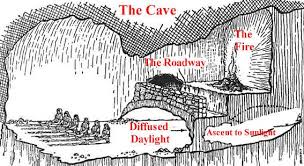
In Book VII of The Republic, Plato says that those trapped in ethnocentrism are like prisoners confined from birth to a cave. Within its confines, they live within a shadow world.

That’s because the prisoners pass their entire lives chained alongside one another, unable to move or even turn their heads to see companions seated alongside them similarly constricted. Instead, everyone confined to the cave faces the cavern’s back wall. Upon that surface, what the prisoners take for themselves and life itself are imaged before them in the form of shadows.

The shadows appear because behind the prisoners’ backs a fire is burning. It acts like a movie camera in a dark theater, causing the shadows of those before it to be projected on the cave’s blank wall. So the prisoners see themselves and those beside them only in specter form. They think the sentences they themselves utter are coming from those relatively distant dark figures. In other words, the prisoners are completely alienated from their true selves.

But there’s more.

Behind the prisoner’s back, and between them and the fire there stretches what Plato calls a parapet. It’s a long elevated pathway that runs the width of the cave. Shielded by the parapet’s wall, men walk unseen, each carrying a statue overhead. There are statues of everything you might think of: flowers, trees, animals, buildings, gods and goddesses … As they pass before the fire, the statues, but not their bearers, appear as shadows on the cave’s wall.

The prisoners watching the parade, imagine that life is unfolding before them, even though, in reality, their perception is artificial to say the least.

Still however, the “wise ones” among the cave’s prisoners become adept at identifying and naming the shadows and at predicting the order of their appearance. Such “teachers” are held in high esteem, though their reality, like the others, is limited to shadows of objects made of stone and wood.

Then one day everything changes. One of the prisoners (we’re not told how) has his chains struck. Slowly, and with great discomfort, he manages to stand. In the fire’s light, he observes the actual bodies of those chained alongside him. He turns and though the fire’s light stabs his eyes, his vision gradually adjusts allowing him to see the blaze and the parapet running before it. He sees the statues for what they are and eventually even the ones carrying them.

“And what’s that beyond the fire?” he asks himself. Why, it’s a pathway leading who knows where. The freed prisoner decides to follow the path. Stumbling and falling, he’s swallowed up in the darkness of the cave’s elongated entrance tunnel. Finally, however, things brighten as he approaches the cave’s entrance.

Then all at once, he’s there. He emerges into the real world, blinded by the terrible brightness of the sun. His eyes adjust and the panorama before him is stunning. For the first time, he sees real flowers, real trees, animals, birds, buildings, and people walking freely about. Finally, he’s able to look fleetingly at the source enabling such wonderful visions, the sun itself. He has entered the real world and is free at last.

But then he remembers his fellow prisoners left behind in the dark cave. He pities their bereft condition, and resolves to set them free.

Back to the cave he goes, this time feeling the cavern’s darkness more oppressive than before.

He stumbles back to the fire and presents himself before the prisoners with his good news.

“This is not reality!” he exclaims. “There’s a whole world outside this cave more wonderful than anything you can imagine. I have only to strike your chains, so you might leave here and enjoy an unimaginably fuller life. Let me set you free!”

Plato asks, how do you suppose the prisoners will receive the escapee’s message? Will they welcome him and follow his lead to freedom?

Far from it, Plato replies. On the contrary, if they could, they would rise up and kill him for disturbing their comfortable tranquility.

Such is the fate of all great teachers, Plato observes. It’s what happened to his beloved Socrates whom the citizens of Athens executed for “corrupting the youth.” Socrates’ crime was teaching the young to think critically. Plato’s allegory describes the journey of critical thinking – from acceptance of shadow-reality through facing the hard truth of having been tricked, to a thrilling sense of liberation followed in many cases by rejection and hostility from friends, relatives, and strangers content with being duped.

Plato’s message seems to be that we are all prisoners by choice. We’re locked in our cultural cave whose world vision is so profoundly distorted that it deprives us of life itself. In fact, we love the chains that bind us. And that love has created a drab, stultifying reality. Our chains’ links are forged from fear of the unknown – of life itself – and of our own freedom and power. We’re afraid of what might happen to us if we embrace life without illusion. We’re wedded to our comfort with what we’ve always known. From that perspective, liberation strikes us as threatening and insane. Nonetheless, our prison cell’s door stands open before us. We have only to replace fear with courage, love of life, and willingness to change. The reward is new vision – another way of looking at things, and fullness of life itself.

(Next week: Plato Updated: Chomsky’s Necessary Illusions)

Our Lenten Call to Mysticism (Sunday Homily)

Enlightened Jesus

Readings for 2nd Sunday of Lent: GN 12:1-4A; PS 33: 4-5, 18-19, 20, 22; 2 TM 1: 8B-10; MT 17: 1-9

Last week my homily centered on the stages of human development as described by Ken Wilber. His analysis is relevant again on this Second Sunday of Lent, which centralizes Jesus’ Transfiguration. Matthew’s account presents a literally enlightened Jesus. The Master is suddenly filled with brightness. His face shines like the sun; his garments become white as snow.

Jesus’ transfiguration is a call to an engaged Christian mysticism that is both deeply spiritual and ferociously active on behalf of the poor and oppressed among us. Given our world’s current crisis, that connection between the spiritual and activist dimensions of our faith could not be more timely.

Begin with Ken Wilber. You might recall that he understands the evolutionary process we are all called to traverse as starting with egocentrism, passing through ethnocentrism, advancing to world-centrism, and possibly arriving at Cosmo-centrism.

The world of the egocentric is that of children and childish adults. It is governed by magic and expresses itself in a pre-conventional morality. Before the age of seven or so, children believe in Santa Claus and the Tooth Fairy; they have little sense of morality.  Some have accused President Trump of inhabiting this space.

For their parts, and politically speaking, the ethnocentric identify with their national and/or religious tribe. Their world is governed by myth and exhibits a conventional morality. The morality of the ethnocentric is dictated by custom, and cultural expectations. Perhaps 40 to 70 percent of the world is ethnocentric.

In fact, many of us get stuck at ethnocentric stage – or even at egocentrism. Politically, socially, and economically, we’re pretty conventional people, and cannot understand those at more advanced stages of development.

The politics of world-centric people have moved beyond tribe and its religion. Their world is governed by reason, rather than by magic or myth. Their morality is post-conventional. For them, self-interest, national laws and religious prohibitions can be transcended by the demands of a larger sense of justice and love. All the great prophets (secular as well as religious) had no trouble breaking laws they considered inhumane. They were boundary-crossers who (in Jesus’ words) recognized that the Sabbath was made for human beings, not the reverse.

The cosmic-centered have entered the realm of Enlightened Masters like the Buddha or Jesus as depicted in today’s gospel. They embody the four basic insights of mysticism found in all the world’s Great Religions: (1) There resides a spark of the divine within every human being, (2) That spark can be realized (i.e. make a real difference in daily life), (3) It is the purpose of life to do so, and (4) Once that happens, the enlightened one begins to see the same spark in every other human being and in all of creation.

Cosmic-centered mystics are governed by compassion. They empathize with the egocentric, ethnocentric, and world-centric. They realize that they themselves have passed through those more primitive stages. They know that those behind them cannot even fathom the realities, joys, and ecstasies experienced by those at higher stages. They forgive rather than blame.

Wilber estimates that possibly 7% of humans today have reached Cosmo-centric consciousness. Only 10% is necessary, he says, for reaching a tipping point where cosmic-centered realities will be generally accepted as the leading edge of evolution.

In today’s gospel selection, Jesus enters that mystical realm, but he does so in a way that recognizes the need for action on behalf of God’s chosen people – the poor and oppressed. Jesus escapes the realm of time, where only the NOW exists and the illusions of past and future disappear. As a result, he’s able to converse with like-minded mystics (Moses and Elijah) from his people’s ancient past. Both of them emphasize the social justice imperative.

Moses, remember, was the great liberator who led a slave rebellion against Egypt’s pharaoh 1200 years before the birth of Jesus. Like Jesus and his companions, Moses ascended a mountain to receive God’s revelation. Elijah was the 9th century BCE prophet who specialized in speaking truth to power. Both Jesus and his mentor, John the Baptist, were considered reincarnations of Elijah.

Jesus “conversing” with Moses and Elijah represents the conviction of the early church that a strong continuity existed between the Jewish Testament’s “old story” and the new one embodied in the Enlightened Jesus.

Accordingly, Jesus was the new liberating Moses. His law of love and compassion epitomized the fulfillment of Sinai’s covenant. Jesus was the new courageous Elijah – uncompromising in his siding with the poor – the widows, orphans, and immigrants.

As both the new Moses and Elijah reincarnated, the transfigured and enlightened Jesus insists on the indispensability of activism informed by transforming spirituality. And he does so in the face of acute knowledge about his fast-approaching premature death. (Jesus references that in the concluding words in today’s gospel episode: “Tell no one of this vision until the Son of Man has been raised from the dead.”)

What can all of that mean for us today – on this second Sunday in Lent? I think it means:

  • It is an essential Christian calling to seek enlightenment through cultivation of the interior life. The Enlightened Jesus calls us to daily meditation this Lent. There’s no other way to mystical consciousness.
  • At the same time, Jesus’ conversation with Moses and Elijah highlights Christianity’s imperative to side with the poor – to take on their cause as our own. This suggests our doing what we can (by way of phone calls, demonstrations, contributions, lobbying, and teaching) to stop the deportation of immigrants, to restore health care and unemployment benefits for the sick and jobless – to see the world from the margins and periphery.
  • Finally, Jesus’ ever-present awareness of “the prophet script” requiring his own early death reminds us that the work of following our Master can never stop – there’s no retirement from it. The proximity or remoteness of death offers no excuse to relax.

Working without ceasing to change ourselves and the world is the very purpose of life –and of Lent. Jesus’ transfiguration, I believe, suggests all of that.

“Magic Glasses:” The Marginalized Know Better (Pt. 3 in a series on critical thinking)

magic glasses March

These past two weeks (see here and here), I’ve been addressing the question of critical thinking in a post-fact age of “fake news.”

So far, my argument has invited readers to recognize a hierarchy of truths, viz. that ethnocentrism is superior to egocentrism, world-centrism is superior to ethnocentrism, and cosmic-centrism ranks above world-centrism. Most academics are reluctant to recognize that hierarchy. As thorough post-moderns, they advocate what Ken Wilber calls “aperspectival madness.” It holds that every perspective is as good as any other.

By rejecting such insanity, the task of critical education becomes helping people move from one stage of awareness to a higher one – specifically from ethnocentrism and its invalid dominator hierarchies to world-centrism with its more valid growth hierarchy, and to (at least) acquaintance with the notion of cosmic-centrism.

And it’s here that I find the concept of “magic glasses” (which will figure in the title of my book) relevant to the task at hand. Baba Dick Gregory uses the phrase to refer to the perspective conferred by movement from ethnocentrism to world-centrism. According to Gregory, such advance is like donning special eyewear that enables one to perceive what is invisible or absurd to those without them.

Magic glasses, the Baba warns, are both a blessing and a curse. The blessing is that eyesight through magic glasses is fuller, and more evolved – more worthy of human beings. The curse is that those without the glasses will consider their wearers insane or worse. The hell of it is that glassless folk cannot be persuaded unless their independent growth cycle enables them to do so.

So, Gregory points out, the magic glasses come with three inviolable rules: (1) once you put them on, you may never take them off, (2) afterwards, you can never see things as your tribe says they’re supposed to be, but only as they truly are, and (3) you can never force anyone else to wear them.

My own experience confirms Gregory’s insight. It suggests that our lives’ journeys, our lived experiences, achieving critical distance from families and cultures, along with our encounters with great teachers, can all help us gain higher levels of consciousness better able to grasp more evolved levels of critical thinking.

In my own case, exposure to critical thought as explained, practiced and stimulated outside the U.S. during my graduate studies in Rome and across Europe helped me gain distance from U.S.-fostered ethnocentrism.

But so did what I learned in former European colonies like Brazil, Nicaragua, Guatemala, Costa Rica, Honduras, Zimbabwe, South Africa, Israel, and India. Thinkers and activists there gradually raised my critical awareness that the Global South’s “alternative facts” about economics and history underpin any critical thought worthy of the name. I was actually privileged to meet directly with people like  Paulo Freire, Desmond Tutu, Maria Lopez Vigil, Dom Helder Camara, Miguel D’Escoto, bell hooks, Franz Hinkelammert, Helio Gallardo, and Enrique Dussel, and Rubem Alvez.

All of them taught me that the Global South and impoverished perspective tends to be fuller than its developed world counterpart.

Think about that for a moment. Those of us who are rich and/or comfortable actually have very limited experience and awareness.  Our communities are pretty much siloed and gated. As a result, we can live without consciousness of the poor at all. Wall Street executives rarely really see them. The poor are located in other parts of town. Most even in the middle class never enter their homes or schools. The comfortable have no immediate experience of hunger, coping with rats, imminent street crime, living on minimum wage, or cashing in Food Stamps. Even if they notice the poor occasionally, the comfortable can quickly dismiss them from their minds. If they never considered the poor again, the rich and middle class would continue their lives without much change. In sum, they have very little idea of the lived experience of the world’s majority.

That becomes more evident still by thinking of the poor outside the confines of the developed world who live on two dollars a day or less. Most in the industrialized West know nothing of such people’s languages, cultures, history, or living conditions, whose numbers include designated “enemies” living in Syria, Iraq, Somalia or Yemen.  Even though our governments drop bombs on the latter every day, they can remain mere abstractions. None of us knows what it really means to live under threat of Hellfire missiles, phosphorous bombs or drones. Similarly, we know little of the actual motives for “their terrorism.” Syria could drop off the map tomorrow and nothing for most of us would change.

None of this can be said for the poor and the victims of bombing. They have to be aware not only of their own life’s circumstances, but of the mostly white people who employ them, shape their lives, or drop bombs on their homes. The poor serve the rich in restaurants. They clean their homes. They cut their lawns. They beg from them on the streets. The police arrest, beat, torture and murder their children.

If the U.S., for example, dropped off the planet tomorrow, the lives of the poor would be drastically altered – mostly for the better. In other words, the poor and oppressed must have dual awareness. For survival’s sake, they must know what the rich minority values, how it thinks and operates. They must know more about the world than the rich and/or comfortable.

Even in practical spheres of daily living, the marginalized and poor know more. They typically can grow their own food, repair their machines, take care of animals, and just “make do” and survive in ways that would soon become apparent to all of us if the electricity stopped working for a few days.

That’s why when the poor develop “critical consciousness,” their analysis is typically more comprehensive, inclusive, credible, and full. They have vivid awareness not only of life circumstances that “make no difference” to their comfortable counterparts; they also have lived experience of life on the other side of the tracks.

For me, benefitting from the perspective of the world’s conscientized majority, and reading their philosophers, theologians, activists, and social analysts has turned my own perspective upside-down. It has changed my understanding of history, economics, politics – and especially of theology and God-talk.

Such upside-down vision will be the heart of my book on critical thinking. It has suggested the following truth criteria: (1) Reflect Systemically, (2) Expect Challenge, (3) Reject Neutrality, (4) Suspect Ideology, (5) Respect History, (6) Inspect Scientifically, (7) Quadra-sect Violence, (8) Connect with your deepest self, (9) Detect Silences, and (10) Collect Conclusions.

Over the next weeks, I’ll try and develop each of those “rules for critical thinking.” But before I get there, I want to tell you more about “fake news” and my own journey.

(Next week: Plato’s Fake World)

(Sunday Homily) Everybody’s Right (Even Donald Trump) and Is Doing the Best S/he Can

trump-crowd

Readings for First Sunday in Lent: GN 2:7-9, 3:1-7; PS 51: 3-6, 12-13, 17; ROM 5: 12-19; MT 4: 1-11.

Today is the first Sunday of Lent. Its liturgy of the word reminds me of what’s been on my mind these days as I’m working on my critical thinking book. For the last two weeks, I’ve shared some of those thoughts here on my blog.

So, I wrote a week ago about the stages of human development – from egocentric to ethnocentric, to world-centric and cosmic-centric. It probably reminded some of the work of Abraham Maslow and Jean Piaget. Actually, though, my principal reference was to Ken Wilber who, in his A Theory of Everything and elsewhere attempts to integrate and transcend those more familiar works. I recommend Wilber very strongly.

In any case, it strikes me, on this first Sunday of Lent that the season’s challenge is to expand our awareness to something approaching what Jesus manifests in today’s Gospel selection. There, the carpenter from Nazareth is depicted as passing forty days in the desert enduring temptation the whole time.

The story not only recalls the history of Israel’s forty years in the desert; it tracks Jesus’ growth through the stages of human development that all of us must pass through. No one can skip any of them. And the limits of our particular stage of growth make it very difficult and even impossible for us to understand stages beyond our own. Thus, for instance, a person like Donald Trump cannot begin to understand someone like Pope Francis.

This means that when we were children at the egocentric stage, we couldn’t really understand ethnocentrism, much less world-centrism or cosmic-centrism. Similarly, those at the ethnocentric stage cannot understand the evolutionary stages beyond their own. To them it all seems like nonsense and even dangerous.

No one is to blame for any of that. It’s perfectly natural. However, the fear of moving forward can freeze some at lower stages of development. Some remain egocentric all their lives. And it’s the same with ethnocentrism and world-centrism. Nonetheless, we’re all called to the fullness of being human as embodied in avatars like Jesus of Nazareth. In his fullness of human development, he recognized the unity of all creation and everyone’s essential innocence. So as the Compassionate Christ, he saw that (given their stage of development) everyone’s right and is doing the best s/he can. As a result, he could even forgive his executioners who (as he said) “know not what they do.”

Jesus was committed, however, to moving human consciousness forward. He called that stage “the Kingdom of God” — a this-worldly reality. To get there, Jesus recognized that it is not at all necessary for everyone to advance to Kingdom-consciousness or even world-centrism. A small group embodying such awareness would be sufficient to move the entire world forward. [In Wilber’s terms, there’s a tipping point at about 10% of the world’s population. He estimates that at present about 40-60% of the world is fixated at the ethnocentric stage. About 25% are at world-centrism, and about 7% stand at cosmic-centrism. Only a 3% growth in the latter would reach the tipping point.]

Notice Jesus growth as depicted in this morning’s highly condensed symbolic story. Jesus’ first temptation is ego-centric – to feed himself by turning stones into bread. His second temptation is ethnocentric – connected with his nation’s temple and the quasi-magical attributes accorded the structure by his Jewish contemporaries. Jesus’ final temptation is world-centric – to exercise dominion of “all the nations of the world.” By rejecting all three (including the imperial, dominator hierarchy implied in the final temptation), Jesus symbolically achieves the cosmic-consciousness we’re all summoned to. The story ends with his being ministered to by angels. (Thus the divine growth hierarchy I’m trying to explain here is affirmed.)

The bottom line is that Jesus’ vision quest in the desert maps out our Lenten path. It leads from self-centeredness to cosmic consciousness of unity with the One in whom we live and move and have our being. There egoism no longer makes sense, nor does nationalism. Instead all the thinking and values of this world are turned on their heads. God alone matters. Forgiveness of everyone – compassion towards all — is natural.

If that sounds excessively utopian, the point is made about the inability of those at lower stages of development to understand and accept the Christ-consciousness towards which we’re all summoned to stretch. Those who claim to be Christians must simply take Jesus at his word, and pray for further growth.

In other words, the Christ-consciousness that Jesus attained can look at those whom we at lower stages of development might be tempted to vilify and despise and simply forgive them. Our forgiveness recognizes that we too passed through the stages at which they might be frozen. Put still otherwise, we can recognize that the childish, the greedy, the nationalists, and others seduced by the thinking of our world – and we ourselves – are right (given our respective stages of growth) and are doing the best we can.

So Lent challenges us all. Our path this season cannot be traveled without struggle. Its goal cannot be achieved without breaking free from selfishness, xenophobia, and the arrogance of life in an imperial center whose ways are unsustainable and far removed from its evolutionary roots. That’s the point of Lent’s prayerfulness, penance, fasting, and abstinence.

Practically speaking realizing our True Self this Lent – being transformed like Jesus – moving the world’s consciousness forward — might mean:

  • Renewing our prayer life. Even unbelievers can do this. How? I recommend reading Eknath Easwaran’s Passage Meditation to find out. Yes, meditate each day during Lent. It will bring you into contact with your True Self. (And, I predict, you won’t stop at the end of 40 days – it’s that life-transforming.)
    • Abstaining from fast food and reclaiming the kitchen. Leave behind for forty days the typically chemicalized, fatty, sugar-hyped American diet, and perhaps experiment with vegetarianism. That seems far more beneficial than traditional “fast and abstinence.”
    • Shopping locally and refusing to set foot in any of the Big Boxes during Lent’s 40 days. Think of it as homage to Jesus’ counter-cultural resort to the desert.
    • Escaping ethnocentrism and imperial sway, by adopting as your news source OpEdNews and/or Al Jazzera rather than the New York Times.
    • Resolving each day to actually respond to one of those many appeals we all receive to make phone calls and write letters to our “representatives” in Congress.

In the “Comment” space below, please share other suggestions.

Yes, it’s Lent once again. We faced up to our origins in dust last Ash Wednesday. A good Lent which leaves behind selfishness, ethnocentrism and allegiance to empire will also challenge us to move the world forward towards the Christ-consciousness that Jesus embodies.

There Really Are Alternative Facts (2nd in a Series on Critical Thinking)

wilbers-stages

Clearly our culture and the world have entered uncharted territory with the announcement from multiple sources that we’ve entered a post-fact world of fake news. Nowadays, it seems, one person’s truth is another’s propaganda. In such a world, critical thinking is either essential or irrelevant.

I hold for the former.

I believe that truth is relevant, that facts exist, and that the facts of some are truer than those of others. At the same time, however, I recognize that my own understanding of “fact” has changed drastically over the course of my life. What I once fervently embraced as truth, I no longer accept. Something similar, I think, is true for all of us. As Paul of Tarsus put it in his letter to Christians in Corinth 2000 years ago: “When I was a child, I talked like a child, I thought like a child, I reasoned like a child. When I became a man, I put the ways of childhood behind me.” (ICOR 13:11)

Paul’s insight holds for western culture as well, including the scientific community. It readily admits that facts change. For instance, scientists once universally accepted as absolute fact that the earth was the center of the universe. Galileo changed all of that.

And that brings me to what I wrote last week about those essential elements of critical thinking: world-centrism, evidence, comprehensiveness, and commitment.

As for world-centrism, the argument here begins by noting that truth is largely relative. Our perception of it often depends on our stage of personal development – on the degree of evolution we’ve attained. What’s true for children (think Santa Claus and the Tooth Fairy) is not true for adults. This by no means invalidates what children think. Their insights are often more acute than grownups’.

On the other hand, however, there are hierarchies of truth. While honoring children’s perceptions, adults cannot generally operate on the basis of what youngsters believe about the world. Neither do all (even very sincere) adults enjoy the same credibility. Some of them are more mature than others – more highly evolved at least in their chosen fields. Einstein, for instance, enjoyed high credibility in the field of physics. He also played the violin. However, his credibility in the field of music didn’t begin to approach that of Jascha Heifetz. It’s the same with other endeavors. Expertise matters.

Recognizing such relativity makes us realize that we do actually inhabit a world of “alternative facts.” But not all fact-claims have the same value. To separate true from less true and truth from falsehood, we must exercise extreme care. Recognizing the previously mentioned truth-hierarchies associated with universal stages of personal development is part of that process.

Philosopher Ken Wilber identifies four major stages of personal development or evolution. The perceptions of higher stages are superior to their lower-stage counterparts. Children, Wilber notes, tend to be egocentric. As such, their world and judgments tend to revolve around themselves, their feelings, needs and naïve beliefs.

In early adolescence or sooner, their scope of concern begins to widen towards group identification or ethnocentrism. They identify with their family, church, school, town, teams, and country. Relative to nation, the attitude here can be as narrow as “My country, right or wrong.” Many people never move beyond ethnocentrism. And in practice, their tribal superiority complex often leads to what Wilber calls “dominator hierarchies,” where control extends beyond the abstract realm of “truth” and “facts” to the politics of imperialism, war, and even slavery.

Those who move beyond ethnocentrism advance to the next evolutionary stage, world-centrism. Here allegiance shifts from my tribe and country to the world and human race. At this stage it becomes possible to criticize even habitually one’s tribe and country from the viewpoint of outsiders, “foreigners,” and independently verifiable data. Dominator hierarchies become less acceptable.

A final (as far as we can tell) stage of development is cosmic-centrism or what Wilber terms “integral thinking.” The cosmic-centric thinker is a mystic, who realizes the unity of all reality, animate and inanimate. (S)he holds that separation between human beings and their environment is only apparent. As many of them put it, “There is really only one of us here.”

The crucial point to note in this context, is that each of these developmental stages has its set of “alternative facts.”

Take the question of Donald Trump’s inauguration audience. According to many observers, Mr. Trump has largely been fixated at the stage of egocentrism (with, no doubt, ethnocentrism rising). Accordingly, he evidently thinks that because of his exceptionality, brilliance, and importance, his crowd must have been larger than that of President Obama, because the latter isn’t nearly as important or smart as Mr. Trump. At Trump’s stage of development, his perception constitutes a fact, pure and simple. Those who disagree are disseminating fake news.

For their parts, the dissenters – reporters, for instance – are usually ethnocentric. In the United States, they typically report from an “American” point of view. They regard Mr. Trump’s statements about crowd size as lies, since his assertions do not agree with readily available independent data information. As previously noted, the D.C. police, for instance, say that Mr. Obama’s crowd was four times larger than Mr. Trump’s. Moreover, ethnocentric reporters regard Mr. Trump’s lies as particularly egregious, because the falsehoods bring discredit and shame on the United States, which they consider the greatest and most virtuous country in the world.

Those with world-centric consciousness subscribe to yet another set of alternative facts. While agreeing that independent data is important for “fact checking,” they emphatically disagree with the premise that the United States is exceptional in its greatness or virtue. Simply put, it is not the greatest country in the world. Instead, for many (especially in the Global South with its history of U.S.-supported regime changes, wars, and dictatorships), fact-checked data show that the United States is the cause of most of the world’s problems. In the words of world-centric Martin Luther King, it is the planet’s “greatest purveyor of violence.” That recognition shapes and relativizes every other judgment of fact.

Cosmic-centered thinkers profoundly disagree with the so-called “facts” of all three previous stages of development. Nonetheless, they recognize that all human beings – and they themselves – must pass through the stages of egocentrism, ethnocentrism, and world-centrism before arriving at cosmic-centrism. That is, though most humans do not surpass ethnocentrism, no stage can be skipped. One cannot become world-centric without having previously been ethnocentric. One cannot adopt a cosmic-centered viewpoint, without first having traversed the world-centric stage. So, instead of anger, those with cosmic consciousness experience great compassion, for instance, towards Donald Trump and his critics both patriotic and more cosmopolitan.

Nonetheless, mystics approaching “facts” from their particular altitude insist that antecedent stages of awareness, though true in ways appropriate for those phases, are at best incomplete. All of them are incapable of discerning the Universe’s single most important truth that renders all else highly misleading. And that’s the fact is that all consciousness of separation is itself an illusion. Hence the size of Donald Trump’s inauguration audience is completely irrelevant. But so are questions about “the greatest country in the world.” No country is greater than any other. In the end, the only truth is God and divine love. Nationalist separation, fear, war, hatred, and associated attitudes are all false. They remain without factual support.

What I’m saying here is that ethnocentrism is superior to egocentrism, world-centrism is superior to ethnocentrism, and cosmic-centrism ranks above world-centrism. In that light, the ultimate task of critical thinking is to help practitioners move from one stage of awareness to a higher one – specifically from ethnocentrism and its invalid dominator hierarchies to world-centrism with its more valid growth hierarchy, and to at least acquaint them with the notion of cosmic-centrism.

In the terms just explained, what stage of evolutionary development are you?  Where do you think most of your friends are located?

(Next week: Why the world’s impoverished know more than Americans)

(Sunday Homily) Jesus & His Friends: Slackers All

hippie-jesus

Readings for 8th Sunday in Ordinary Time: IS 49:14-15; PS 62: 2-3, 6-9; I COR 4: 1-5; MT 6: 24-34.

Today’s liturgy of the word raises the question of work and money – always two difficult elements of life for those claiming to follow Jesus’ Way. They’re difficult because both occupy so much of our attention and lives that they can distract us from what’s really important – what Jesus calls “the kingdom of God.” Consequently, in this morning’s Gospel selection, Jesus tells us to back off from both money and work while opening ourselves to the abundance of God’s Kingdom.

For American workaholics, that’s surprising. It’s especially challenging for those who love to attack “the undeserving poor” – that is, workers empowered by government programs even like the Affordable Health Care Act.

About money Jesus directly compares the worship of God with the common attitude Americans adopt towards money – or as Jesus puts it, “Mammon” (the name for an idol). It’s impossible, Jesus says, to make money the focus of your life while claiming to serve God. In fact money can make us hate God. But that’s not the surprising part.

What is surprising is that Jesus’ claim comes very close to saying that loving God should make us hate money. That seems to be the meaning of his words recorded in today’s selection from Matthew. Jesus says, “No one can serve two masters. He will either hate one and love the other, or be devoted to one and despise the other. You cannot serve God and mammon.”

In other words, there’s a choice to be made here: serve God or money; hate and despise money or hate and despise God. No one can have it both ways. The text seems to bear that reading, don’t you think?

Of course Jesus’ pronouncement will lead many to “clarify” his words to mean don’t be attached to money. It’s the service of money – it’s making money your master – they would explain, that causes hatred of God.

Okay. But who among us (even financiers, banksters and hedge fund managers) would claim to serve money even though they spend all their waking hours scheming about it. Who would admit that they’re attached to money, or have made it their master? Even those 85 individuals proud of owning as much as half the human race would probably deny that they “serve” money or that it’s their master. (And if they’re right, we can stop our discussion right here!)

On the other hand, those wishing to have it both ways might go further. They might invoke “nature.” They might point out we obviously can’t do without money; it’s a product of nature (human nature) they might say. Some might even argue we can’t even do without capitalism and its drive to “maximize profit.” Capitalism and profit maximization simply represent the inescapable way the world works. They are reflections of the natural order. If they allow 85 people to own more than half the world, so be it. That’s simply natural.

Such talk about nature brings us to my second point – Jesus’ attitude towards work and those who choose not to. Here he definitely has a “back to nature” approach. And once again, it’s surprising. Jesus is not talking about the naturalness of competition or of the law of supply and demand.

In today’s reading from Matthew’s version of the Sermon on the Mount, Jesus says clearly that the natural order not only minimizes the importance of money (at the very least); it also minimizes the importance of work. “Look at the birds of the air,” Jesus says, “they don’t sow or reap or store food in barns.” Or “Consider the lilies of the field. They neither toil nor spin.” Learn from them both. Follow their example.

Say what? Is Jesus intention here to discourage work itself? (Talk about contradicting “American” values!) It’s easy to draw that conclusion, I think. After all, he seems to be saying don’t sow or reap or store products in warehouses. Don’t toil or spin. It’s a short step from there to saying, “Don’t work!”

Besides that, Jesus seems to have lived out that latter implication. I mean as an able-bodied 30-something, he left his job as a carpenter to wander from village to village in Palestine philosophizing and apparently living on hand-outs. On the road, he had no home and must have sought shelter from friends. Moreover, he got rough fishermen to leave their nets and follow his example of what appears to be idleness as far as economic productivity is concerned.

In fact, Republicans today would clearly regard Jesus and his apostles as examples of the idle undeserving poor – not to say bums – living off the donations of hard working people. I mean, does that contradict our Protestant Work Ethic, or what?

The point is that Jesus and his sainted friends were not only among the undeserving poor, they flaunted it. They recognized that according to God’s natural order, the world belongs to all creatures including the birds and flowers. If its resources were shared according to Jesus’ Kingdom values, there’d be enough for everyone – just as there was for birds and flowers in Jesus’ day.

So in minimizing the importance of money and praising freedom from work, Jesus was not being unrealistic or some starry-eyed hippy. Instead (as always) he was proclaiming the Kingdom of God. In God’s order, he insisted, there is abundance for everyone – or as Gandhi said enough for everyone’s need, but not for their greed.

Realizing the reality of God’s and nature’s abundance – and not giving in to the world’s myth of scarcity, overwork, and focus on money – should give workers rather than those belonging to the 1% courage to demand what is their birthright.

That natural condition is a life without worry about making ends meet and with enough leisure to enjoy life just like the birds and flowers.

Critical Thinking & Fake News (1st in a series)

fake-news

I’m currently writing a book on critical thinking. A first draft is being reviewed by Peter Lang Publishers. Peer reviewers are giving it the once-over. In this series, I’d like to expose some of the book’s key ideas. What I share immediately below tries to set the stage for  the analysis that will follow in subsequent postings, usually on Tuesdays.

_____

By all accounts, we’re living in a post-fact age, where it’s increasingly difficult to tell truth from falsehood. That’s why in our culture, contemporary debate rages over terms such as “post-truth,” “truthiness,” “alternative facts,” “fake news,” outright “bullshit,” and “propaganda.”

In fact, according to the Oxford Dictionary, the 2016 Word of the Year (WOTY) was “post-truth.” That same year, the Australian Macquarie Dictionary identified “fake news” as its own WOTY. The trend is unmistakable – signaled as far back as 2006, when “truthiness,” a term coined by Stephen Colbert, took the Oxford Dictionary honor. The Colbert term synthesized the trend’s direction. “Truthiness” was defined as “The quality of seeming or being felt to be true, even if not necessarily true.”

That’s what the post-truth era centralized: feelings over analysis. “Trust your gut and not your brain,” as Beppe Grillo put it while urging Italians to vote with his conservative Five Star Party against constitutional reforms.

Shortly after being elected, Donald Trump’s team took the trend a step further. Republican strategist Kellyanne Conway, introduced the phrase “alternative facts.” She was debating “Meet the Press” host, Chuck Todd about the size of Trump’s 2017 inauguration audience.

Conway defended the position expressed by Sean Spicer, President Trump’s Press Secretary. He had described the crowd was the largest in inauguration history. Todd disagreed citing D.C. police estimates that it was four times smaller than the number attending Barack Obama’s second inauguration. Conway responded, “. . . Our press secretary, gave alternative facts to that. . .” Todd answered, “Look, alternative facts are not facts. They’re falsehoods.”

Philosopher Harry G. Frankfurt would put Todd’s point in even starker terms. Drawing on the title of his best-selling book, Frankfurt would say it’s simply “B.S.”  In On Bullshit the professor contrasts liars and bullshitters. The Liar, Frankfurt writes, cares about truth and attempts to hide it; bullshitters don’t care if what they say is true or false. Their only concern is whether or not their listeners are persuaded.

According to another philosopher, Ken Wilber, polls taken during the 2016 election cycle showed that truthiness was valued more highly by a majority of voters than researched facts. Day after day, Wilber writes, newspapers would keep count of questionable statements made by Donald Trump the previous day. Reporters would write things like, “Our fact checkers have found that Mr. Trump told 17 lies on the campaign trail yesterday.” To a lesser extent, they criticized Ms. Clinton’s statements. And yet, when asked who is more truthful, Donald Trump or Hillary Clinton? the polls consistently ranked Trump first. This signified, Wilber says, that poll respondents valued persuasiveness more highly than what news reporters called truth.

Truthiness, alternative facts, and bullshit have given rise to widespread concern about “fake news.” During the 2016 presidential campaign, the phrase received prominence when it was discovered that Eastern European bloggers had concocted from whole cloth wild stories about Hillary Clinton and Barack Obama. The stories were directed towards supporters of Donald Trump, and the concoctions’ only purpose was to have the tales go viral – while earning thousands of dollars for their authors. So, readers were treated to headlines such as: “JUST IN: Obama Illegally Transferred DOJ Money to Clinton Campaign!” and “BREAKING: Obama Confirms Refusal to Leave White House, He Will Stay in Power!”

Such headlines might make one laugh. However, Noam Chomsky reminds us that “fake news” is by no means a trivial matter. However, its principal perpetrators are not Macedonian teenagers trolling for cash. They are the C.I.A., the NSA, and the White House (under any president). Their messages are communicated to the rest of us through the mainstream media (MSM) whose function is the dissemination of propaganda. In Necessary Illusions, Chomsky and Edward Herman put it this way:

“The mass media serve as a system for communicating messages and symbols to the general populace. It is their function to amuse, entertain, and inform, and to inculcate individuals with the values, beliefs, and codes of behavior that will integrate them into the institutional structures of the larger society. In a world of concentrated wealth and major conflicts of class interest, to fulfill this role requires systematic propaganda.”

In other words, at least according to Chomsky and Herman, fake news has long been with us. It is the official policy of the country’s ruling elites.

Now that’s the “fake news” that should really concern us. It’s just about all we get from the mainstream media in this country. And it’s been that way at least since the end of the Second Inter-Capitalist War. In that sense, Donald Trump’s continual lambasting of the press is right on target. (Next week: There Really Are Alternative Facts!)

Sunday Homily: U.S. Christians Shouldn’t Be the World’s Most Violent People (But We Are!)

christian-violence

Readings for 7th Sunday in Ordinary Time: LV 19: 1-2, 17-18; PS 103: 1-4, 8, 10, 12-13; I COR 3: 16-23; MT 5: 38-48.

We’re living at a time characterized by military crisis; wouldn’t you agree? I mean we’re still in Afghanistan (our country’s longest war ever). Can you tell me why? We’re also fighting in Iraq and have been doing that one way or another since at least 1990. Then there’s Syria and Yemen – not to mention droning in Libya, Somalia, and who knows where else? And on top of that there’s saber-rattling about what Russia does in its backyard, and even about “our” rights to float battleships in the South China Sea – more than 7000 miles away from our shores. We spend more on war than all the other nations of the world combined, and are in the process of modernizing our nuclear weapons arsenal that our “leaders” once pledged to abolish.

And what has it all accomplished? Can you tell me that? Well, while it may make arms manufacturers richer and happier, here’s a short list of its downsides:

  • It kills millions of people – yes more than a million in Iraq alone since 2003!
  • It threatens the very future of the human race.
  • It contributes mightily to environmental destruction,
  • And to global warming as the U.S. military remains the largest institutional consumer of oil in the world
  • As well as to the creation of an unprecedented refugee problem,
  • It appears to motivate terrorists to respond in kind.
  • All of which seems to make us less safe rather than more so.

Doesn’t that seem crazy? Why do we put up with it? I mean to spend more than a billion dollars each day on war and to have absolutely nothing positive to show for it? NOTHING! And then instead of facing that colossal failure, to pledge to do even more of the same – forever and ever?

I’m hard put to think of anything crazier. And scandalously, it’s a nation that claims to be Christian that’s doing all of that – in the name of God and even of Jesus. The Muslims would have a hard time even remotely approaching that level of religiously-motivated violence!

Say, here’s an idea: why don’t we try following the actual teachings of Jesus as found in today’s Liturgy of the Word? I didn’t say “the teachings of the Bible” in general, but the teachings of Jesus.

I mean, in today’s Gospel, the Master takes pains to distinguish between the Bible’s warlike vengeful God and its Compassionate One. Jesus specifically rejects the one and endorses the other. For Matthew that rejection and endorsement was momentous – as significant as Moses reception of the Ten Commandments from his God, Yahweh. That’s why Matthew [in contrast to Luke’s equivalent “Sermon on the Plain” (LK 6:17-49)] has Jesus deliver his “sermon” on a mountain (5:1-7:27). The evangelist is implicitly comparing Moses on Mt. Sinai and Jesus on “the Mount.”

In any case, through a series of antitheses (“You have heard . .. but I say to you . . .”), Jesus contrasts his understanding of the Law with more traditional interpretations. The Mosaic Law demanded an eye for an eye and a tooth for a tooth, but Jesus’ Law commands:

  • Turning the other cheek
    • Going the extra mile
    • Generosity with adversaries
    • Open-handedness to beggars
    • Lending without charging interest
    • Love of enemies

Matthew concludes that if we want to be followers of Jesus, we must also be merciful and compassionate ourselves. As today’s reading from Leviticus says, we are called to be holy as God is holy. Or as Jesus puts it, perfect as God is perfect.

And how perfect is that? It’s the perfection of nature where the sun shines on good and bad alike – where rain falls on all fields regardless of who owns them. It’s the perfection of the God described in this morning’s responsorial. According to the psalmist, the Divine One pardons all placing an infinite distance (“as far as east is from west”) between sinners and their guilt. God heals all ills and as a loving parent is the very source of human goodness and compassion. That’s the perfection that Jesus’ followers are called to emulate.

All of that is contrasted with what Paul calls “the wisdom of the world” in today’s excerpt from his first letter to the Christian community in Corinth. The world regards turning the other cheek as weakness. Going the extra mile only invites exploitation. Generosity towards legal adversaries will lose you your case in court. Open-handedness towards beggars encourages laziness. Lending without interest is simply bad business. And loving one’s enemies is a recipe for military defeat and enslavement.

Yet Paul insists. And he bases his insistence on the conviction that we encounter God in every human individual whether they be our abusers, exploiters, or legal adversaries – whether they be beggars or debtors unlikely to repay our interest-free loans.

All of those people, Paul points out are “temples of God.” God dwells in each of them just as God does in us. In the end, that’s the basis of the command we heard in the Leviticus reading, “You shall love your neighbor as yourself.”

Normally, our self-centered culture interprets that dictum to mean: (1) we clearly love ourselves more above all; so (2) we should love our neighbors as much as we love ourselves.

But in the light of Paul’s mystical teaching that God dwells within every human being, the command about neighbor-love takes on much deeper implication. That is, Paul the mystic teaches that our deepest Self is the very God who dwells within each of us as in the Temple. We should therefore love our neighbor (and our enemy, debtor, adversary, and those who beg and borrow from us) because God dwells within them — because they ARE ourselves. They ARE us! To bomb them, to fight wars against them is therefore suicidal.

No wonder, then, that Paul predicts the destruction of the person who fails to recognize others as temples of God and harms them. Paul means that by destroying others we ipso facto destroy ourselves, because in the end, the God-Self dwelling within us is identical with the Self present in the ones we shoot, bomb and drone. That is a very high mystical teaching. It should be the faith of those pretending to follow Jesus. It should make all of them (all of us!) pacifists.

If we owned that truth, that would be the end of wars. Imagine if the world’s 2.2 billion Christians gave up our addiction to violence and simply refused to destroy our fellow human beings because we recognized in them the indwelling presence of God. Imagine if we stopped worshipping the God Jesus rejects – the “eye for an eye and tooth for a tooth” War God – and embraced Jesus’ compassionate and loving All-Parent.

The resources freed up would be sufficient to literally transform this world into a paradise.