“No Priests” Is the Remedy for the Priest Shortage: Notes for a Home Church (Pt. 4 of 4)

helpwanted

A friend of mine recently told me, “If you’re trying to initiate something new (like reclaiming my priesthood) and the response isn’t ‘Hell yeah!’ you’re probably on the wrong track.”

Well, I haven’t yet heard many “Hell yeahs!” in response to my efforts to (as I said here) re-appropriate my priesthood and start a house church in Berea, Kentucky.

Oh, my very good and generous friends have humored me by showing up on Saturday evenings. But even the closest of them have made it clear that they were doing so out of a sense of duty, rather than enthusiasm.

On top of that, my own reflection on our gatherings has been less than “Hell yeah!” And that’s led me to think that perhaps the whole form of Eucharistic gathering (Mass) might be passé. Certainly, as Garry Wills has pointed out in his book Why Priests? “priesthood” as we’ve known it is beyond recall.

That’s not surprising, since the office of priest turns out to be foreign in the experience of the early church. In fact, no “priest” is mentioned In the accounts of Eucharistic meals found in the first two centuries of Christianity [e.g. in the Dialog with Typho and First Apology of Justin Martyr (100-165)]

Instead, we find mention of a presider – a proestos in Greek – whose function was to stand in front of the congregation, call it to order, and keep the meeting on track. That’s what proestos (the Greek word for the presider at the Eucharist) literally means – the “stander-in-front.”

“Priests” came in much later – and definitively after Christianity became the official religion of Rome. Then, as mentioned earlier, the Christian Eucharist took on the trappings of Roman “mystery cults,” like for instance the cult of the Sun God, Mithra, a favorite of the Roman army, whose birthday was celebrated each year on December 25th.

Mystery cults worshipped gods and goddesses like Mithra, Isis, Osiris, and the Great Mother. All of them descended from heaven, lived on earth for a while, and then ascended back to heaven. From there they offered eternal life to followers who in at least one cult ate the divine one’s body under the form of bread and drank his blood under the form of wine to attain eternal life.

Does that sound familiar?

Of course, it does, because that’s what Jesus became under the aegis of Rome. And priests were part of the syndrome. The new Christian Holy Men dressed up like their mystery cult counterparts, and performed a liturgy so similar to the pagan sacred meal rituals that most Romans probably couldn’t tell the difference.

Nonetheless, the pagan cults were eventually swallowed up entirely by Christianity, and believers were left with a ritual that resembled neither Jesus’ “Lord’s Supper” nor a blood sacrifice. Even the bread stopped looking like bread, but more like a plastic wafer.

But the priests remained, accompanied by an ideological lore that justified their existence by claiming that:

  • Jesus was a priest.
  • His apostles were the first Christian priests.
  • In fact, Jesus’ right-hand man, Peter, was the first pope.
  • Priests were necessary to forgive sin.
  • And to offer what was now called “the holy sacrifice of the Mass.”

Such convictions meant that priests became separated from ordinary Christians. The cleric’s alleged power to miraculously change bread and wine into the body and blood of Christ did that. Performing the miracle seemed to be something between priests and God. Mass was often “celebrated” by the priest alone accompanied by an altar boy.  Even in public, Mass rubrics had the priest facing away from the congregation in a sanctuary fenced off from the congregation by a “communion railing.” There priests completed their duties more or less in secret and using a language (Latin) that few besides the clergy could understand.

Mandatory celibacy also contributed to the otherness of priests. Largely to protect church property from priests’ heirs, the requirement became de rigueur for all priests in the Roman dispensation after the 12th century. Priests were so special that contrary to Jesus’ specific teaching about calling no man “Father” (MT 23:9), they could assume that title for themselves (as in referencing the pope as “Holy Father.”).

Priests signified their specialness by even dressing differently from other Christians – with the pope assuming all the trappings of the Roman Emperor.  Eventually, ecclesiastical life revolved entirely around the “clergy.” They alone were allowed to preach and even touch the sacred elements.

In all of this, the “faithful” were reduced to the role of spectators at priestly cultic events. All such rituals centered on the “Host” consecrated at Mass, and afterwards taking on a life of its own in its “tabernacle,” or displayed for “benediction” in a monstrance, which was sometimes carried ceremoniously in Eucharistic processions.

All of that changed with the Second Vatican Council (1962-’65), when the Church of Rome finally caught up with the Protestant Reformation. The Council recognized the “priesthood of the faithful” that Martin Luther had celebrated. Vatican II also described the Eucharist as a “sacred meal,” rather than simply as a “holy sacrifice.” The altar became a “table” and was turned around and moved closer to the people. More and more frequently, liturgical periti (experts) at the Council described the priest as a “presider.” Lay people were allowed to touch and distribute the sacred elements. Council fathers recognized Jesus’ “real presence” not simply in the Eucharist, but also in Sacred Scripture and in the community they referred to as the “Pilgrim People of God.”

Meanwhile the “search for the historical Jesus” that had begun in earnest with the work of Albert Schweitzer in 1906 took a giant leap forward with the emergence of liberation theology and its adoption by CELAM (the Latin American Bishops’ Conference). Liberation theology was reflection on the following of Christ from the viewpoint of the poor and oppressed, especially in the former colonial world.  It recognized Jesus as a poor peasant like his Third World counterparts. He was seen as thoroughly Jewish and as a resister to Roman Imperialism.

Far from being a priest himself, he was a foe of priests and all they stood for.

Such developments – Vatican II, its theological and liturgical reforms, new insights about the historical Jesus, and re-evaluations of the priesthood itself –  brought priests down from their pedestals; their office became déclassé. With their own baptismal priesthood affirmed, the faithful felt empowered. They spontaneously stopped “going to confession.” Priests everywhere experienced identity crises. Mandatory celibacy entered full debate. As a result, thousands of priests worldwide left the priesthood to marry.

In response, the hierarchical church tried to backpedal. While recognizing the teaching of Vatican II as its own official teaching, the long reign of Pope John Paul II (1978-2005) followed by that of Benedict XVI (2006-2013) gave Vatican II Catholics the feeling that the hierarchy’s honoring of the Council was mostly lip-service.

John Paul II and Benedict systematically replaced cardinals and bishops who had taken to heart the Second Vatican Council’s reforms. The reactionary popes also packed the College of Cardinals (who would elect future popes) with conservatives, made it more difficult for priests to “return to the lay state,” suppressed liberation theology, silenced and removed creative theologians from teaching posts, returned Latinisms to the Eucharistic liturgy, cooperated with neoliberal political regimes, and were generally backward-looking.

Perhaps most importantly, formation programs in Catholic seminaries took a sharp turn to the right. The priests who emerged from them showed little sympathy for conciliar reforms. They displayed ignorance of modern scripture scholarship or awareness of ecumenical theology, as well as any inclination to connect the Gospel with contemporary issues other than abortion or gay marriage.

Such rightward drift came to a sudden and unexpected halt with the election of Pope Francis, an Argentinian, and the first Global South pope in the history of the church. Ordained in 1969, Francis is a product of the Second Vatican Council and inevitably influenced by liberation theology, which was largely a product of Latin America.

His Apostolic Exhortation, “The Joy of the Gospel” (JG, 2013) was seen as his manifesto announcing an acceleration of Vatican II reforms. It called for a “new chapter” in the history of the Catholic Church and for the church to embark on a “new path” on which things could not be left unchanged (JG 25). Preaching had to improve, he said (135-159). The roles of women needed expansion (103-4). Outreach was necessary to Christians of other denominations who share unity with Catholics on many fronts (246). And the struggle for social justice and participation in political life was an inescapable “moral obligation” (220,258).

As for priests, Francis’ Exhortation continued the clerical downgrading implied in Vatican II reforms. The priesthood, the pope taught, represents simply a church function. It is a service not necessarily distinguished in dignity, holiness, or superiority from those rendered by other baptized Christians (204).

And there’s more. Recently, Leonardo Boff (a Brazilian liberation theologian silenced under John Paul II, but reinstated by Pope Francis) spoke glowingly of the current pope. “He is one of us,” Boff said – presumably referring to liberationist Catholics. In any case, Boff went on to speculate that Francis is about to address the Brazilian priest shortage by making possible the reinstatement of the country’s thousands of laicized priests. Boff also conjectured that the pope might be on the brink of allowing women to become deacons. Both changes would represent giant steps towards eliminating mandatory celibacy for priests and towards ordination of women.

CONCLUSION

But is any of those measures sufficient for resolving the priest shortage – or for addressing the irrelevance of the church noted at the beginning of this series of four essays? I doubt it.

That’s because the very bases of priestly powers are in practice no longer believable. I’m referring to the quasi-magic ability to turn bread and wine into the body and blood of Christ, and the authority to forgive sins in the sacrament of Penance. On these two functions, hangs all priestly authority and the entire special identity of the Catholic clergy.

And like the Protestant Reformers before them, many adult, thinking Catholics can no longer accept either. As we have seen, scripture scholars have shown that neither power enjoys biblical endorsement. They are inheritances from post-first century fundamentalists who lacked sensitivity to the rich symbolism of the words attributed to Jesus in the Christian Testament.

As explained earlier, that rich symbolism finds in a loaf of bread a wonderful image of the human condition. Its single reality summarizes it all. Bread is the product of seed, earth, sun, rain, and human labor. When shared it miraculously creates and sustains human community. Wine is similar. Throughout his life, Jesus celebrated the community that such simple elements manifest. His teachings reinforced that basic insight. He was a prophet, a spiritual master, and a religious reformer who preferred rough illiterate fishermen over pretentious, exclusive priests. That was a radical and liberating message.

The Protestant reformers saw all of that quite clearly. And so they did away with priests who insisted on being separate and special, while being honored with titles Jesus forbade.

All of this means that the reforms of Vatican II didn’t go nearly far enough. Pope Francis is correct. To survive, the church must embark on that “new path” he called for.  There nothing can be left unchanged (JG 25). The roles of women need expansion (103-4). Ecumenical cooperation with other denominations and religions must be centralized as well as the struggle for social justice (220, 258). Until all Christians in close cooperation with Muslims, Buddhists, Hindus, New Agers, and atheists cooperate to attack injustice, the survival of the world itself is in doubt.

Evidently, Pope Francis himself has not perceived the implications of his brave words. Certainly, church leaders have not. It remains for the rest of us to take the lead.

Taking that lead was the thought behind my initial “Hell yeah!” to the idea of house church.  


The Ten Commandments: God’s and The Donald’s (Sunday Homily)

trump-commandments
Readings for 6th Sunday in Ordinary Time: SIR 15: 15-20; PS 119: 1-2, 4-5, 17-18, 33-34; I Cor 2: 6-10; MT 5: 17-37.
The emphasis in today’s liturgy of the word is on the wonders of God’s law. “Keep the commandments; no one has a license to sin,” the first reading from Sirach intones. “Walk blamelessly in God’s law; observe its decrees; delight in its wonder,” sings the psalmist in today’s responsorial. And then in the Gospel reading Jesus presents himself as the defender of even the least of the commandments. Break the least, he says, and you’ll be least in God’s Kingdom.
On hearing all of this, I couldn’t but squirm on behalf of Christian Trump supporters who respect what they consider God’s Word. After all, The Donald seems to live by his own rules. And those guidelines don’t seem to have much to do with the Bible’s Ten and the delight, joy, and fulfillment today’s readings suggest infallibly result from observance of the Decalogue. Or as comedian, Bill Maher put it during the campaign season, “It’s hard to bring up the Ten Commandments when your candidate has spent most his life breaking all of them.”
On the other hand, Richard Dawkins, a sworn enemy of Christianity has formulated his own Ten Commandments. Ironically, Dawkins’ rules are more in harmony with today’s delight-full estimation of God’s Law. In fact, they seem more worthy of Christian support than the one’s Mr. Trump apparently lives by.
So just for fun, in the light of today’s readings, let’s contrast the two sets of commandments, and see what we can learn. It might be that Dawkins’ natural law commandments are more promising in terms of Nature’s delight, joy and peace than what we hear implicitly proclaimed by casino king Donald Trump and his Christian followers.

Begin with Mr. Trump. Here’s how humorist Neel Ingram compared the Bible’s Ten Commandments with what seems to be their Trumpian counterparts. (Ingram hosts a website called Chewing The Fat With God). Using Trump’s own words, Ingram writes:

Commandment 1: You shall have no other gods before Me.

Commandment 1 (Trump Edition): I won the popular vote… I’m really smart. I have the best words. Best words. Believe me.

=-=-=-=-=-=-=-=

Commandment 2: You shall not make for yourself a carved image of Me.

Commandment 2 (Trump Edition): You shall not publish unflattering photos. Giant portraits are okay if they’re of Me. For Me.

=-=-=-=-=-=-=-=

Commandment 3: You shall not take the name of the Lord your God in vain.

Commandment 3 (Trump Edition): You shall not mock me, the ratings machine, Donald J. Trump, or I will declare you boring and unfunny. Bigly.

=-=-=-=-=-=-=-=

Commandment 4: Remember the Sabbath day, to keep it holy.

Commandment 4 (Trump Edition): I proclaim a National Day of Patriotic Devotion in my honor. A great day. Best day.

=-=-=-=-=-=-=-=

Commandment 5: Honor your father and your mother.

Commandment 5 (Trump Edition): My parents… great people… truly great… great, unbelievable parents. I’m a really good father. My children really like me — love me — a lot.

=-=-=-=-=-=-=-=

Commandment 6: You shall not murder.

Commandment 6 (Trump Edition): Murder is a terrible crime. Don’t murder. Murder’s not good. Bad!

=-=-=-=-=-=-=-=

Commandment 7: You shall not commit adultery.

Commandment 7 (Trump Edition): Adultery — I don’t think it should be done. Don’t screw around unless she’s hot as sh*t and you think you’ll get away with it.

=-=-=-=-=-=-=-=

Commandment 8: You shall not steal.

Commandment 8 (Trump Edition): Don’t steal. Do a deal. My whole life I’ve been greedy, greedy, greedy. I’ve grabbed all the money I could get. I’m so greedy.

=-=-=-=-=-=-=-=

Commandment 9: You shall not bear false witness against your neighbor.

Commandment 9 (Trump Edition): False witnesses are like fake news. Media can’t be trusted. Serious bias — big problem! Sad.

=-=-=-=-=-=-=-=

Commandment 10: You shall not covet anything that is your neighbor’s.

Commandment 10 (Trump Edition): Don’t covet. I’m really rich. When you’re really rich there’s nothing to covet. Except p*ssy. When you’re a star you can do anything. Grab them by the p*ssy. It’s amazing. Terrific.

=-=-=-=-=-=-=-=

Mr. Trump’s outrageous profanity aside, now take a look at what today’s readings have to say about God’s law. All of them (and especially Jesus’ words) suggest that “God’s Law” has nothing to do with Mr. Trump’s guiding principles. Neither is it written in stone. Instead, God’s commandments are enshrined deep in the human heart. And human happiness is impossible without observing that law which in its essence is no different from nature’s law.

That’s the line Richard Dawkins takes. Beginning with The Golden Rule, he lists his Ten Commandments in the following words:

  1. Do not do to others what you would not want them to do to you
    2. In all things, strive to cause no harm
    3. Treat your fellow human beings, your fellow living things, and the world in general with love, honesty, faithfulness and respect.
    4. Do not overlook evil or shrink from administering justice, but always be ready to forgive wrongdoing freely admitted and honestly regretted.
    5. Live life with a sense of joy and wonder
    6. Always seek to be learning something new
    7. Test all things; always check your ideas against the facts, and be ready to discard even a cherished belief if it does not conform to them.
    8. Never seek to censor or cut yourself off from dissent; always respect the right of others to disagree with you.
    9. Form independent opinions on the basis of your own reason and experience; do not allow yourself to be led blindly by others.
    10. Question everything

Dawkins also has something to say about that fraught area of sexuality which evidently so concerns D.T. and his Christian friends. But whereas The Donald emphasizes power and exploitation while his friends emphasize prohibition and suppression, Mr. Dawkins’ commandments stress the joy and freedom centralized in today’s readings. Dawkins writes:

  1. Enjoy your own sexual life (as long as it does not harm to others), and let others enjoy their sexual lives in private according to their own inclinations which in any case are none of your business.
    2. Don’t discriminate against or oppress anyone because of their sex, race or (insofar as possible) species.
    3. Don’t indoctrinate your children. Teach them to think for themselves, how to weigh evidence, and how to disagree with you.
    4. Respect the future beyond the temporal limits of your own life.

Now those laws are “delightful,” wouldn’t you agree? They seem to make sense because they reflect human nature and nature’s laws. Their observance could bring the world together rather than tearing it apart on the basis of supposedly revealed religious dogmas.

That’s what Roman Catholic (but suspended) theologian, Hans Kung thinks. He says that such a “global ethic” is necessary to finally end the armed conflicts that characterize our age. Towards that end, Kung has articulated four principles: (1) International peace is impossible without peace between religions; (2) there can be no inter-religious peace without inter-religious dialog; (3) there can be no inter-religious dialog without agreement about a global ethic, and (4) our world cannot survive without such an ethic that is universally accepted.

The United Nations seconds Dr. Kung. It boils down his desired global ethic to just four basic “commandments”: (1) Don’t kill; (2) Don’t rape; (3) Don’t lie, and (4) Don’t steal.

Could it be that Christians have more to learn about God’s law from an atheist than from the authoritarian so many Christians and Christian pastors evidently support?

In any case, while the latter promises eternal conflict, the former holds hope of dialog, mutual understanding, and cessation of hostilities.

The choice is ours: Trump’s self-serving law or God’s law written in our hearts.

Sister Giant: The Higher Consciousness Community Meets Liberation Theology

giant-pic

It had to happen. I mean you can’t establish dictators and despots throughout the world and not have it eventually come home. And it has in Donald Trump. His election has brought the spirits of U.S. darlings Pinochet, Somoza, Marcos, and Duvalier to our shores. We should all be terrified.

By the same token, you can’t inflict such despotism on people of faith without their eventually discovering in their traditions a God who stands on the side of the poor and oppressed rather than with their wealthy oppressors. That happened with the emergence of liberation theology over the last 50 years among Christians in Chile, Nicaragua, the Philippines, Haiti and elsewhere. In 1979 it happened in Iran with the first Islamic revolution that has since spread across the Middle East. (I’ve written about that here, here, here, and here.)

And now it’s happening in the United States. Of course, awareness of the connection between Christian faith and release from oppression dawned most prominently with the Civil Rights Movement and the Southern Christian Leadership Conference. Then during the ‘70s and ‘80s Catholics joined in as they observed (often first-hand as I did) U.S oppression throughout Latin America. During the ‘90s and the first decade of the current century, I could even see it emerging among the white U.S. Evangelical students I taught during their term abroad in Central America. As a result, I increasingly witnessed them reading and referencing non-fundamentalists and liberationists like Rob Bell, Shane Claiborne, Brian McLaren, Jim Wallis, and others.

And now with the arrival of Trump, a highly political form of liberation theology has hit the “Higher Consciousness Community.” I’m referring to followers of Marianne Williamson, Neale Donald Walsch, Eckhart Tolle, Louise Hay, Abraham Hicks, and other teachers of the “spiritual, but not religious” seekers proliferating throughout the United States and the world.

Just last week, I personally witnessed unmistakable signs of the latter awakening in Washington, DC during the best three-day conference I’ve experienced in more than 40 years of attending such events. It was Marianne Williamson’s Sister Giant Conference. And judging by the standing ovations nearly all the speakers received from the 2000 attendees, they had similar experiences. (There were also 4000 live-streamers listening and watching.)

As you might judge from the conference title, Sister Giant attendees were mostly women.

Many of them, two weeks earlier, had attended the DC Women’s March. And it was evident that their enthusiasm from that event carried over.

Both the march and the conference empowered women, who at Sister Giant were urged to own their power by speakers like Bernie Sanders, Karenna Gore (Daughter of Al Gore), Jean Houston, Rabbi Michael Lerner, Congresswoman Pramila Jayapal, Dennis Kucinich, William J. Barbour, Opal Tometi (co-founder of Black Lives Matter), and Zephyr Teachout. Each of them recognized women as the de facto leaders of the anti-Trump Movement.

Many other speakers presented as well including stand-up comic, John Fugelsang who actually told liberation theology jokes. For instance, he pointed out that the Vatican is ahead of the White House on science. Referring to the Bible’s Adam’s Rib Story, he observed that “The very first woman transitioned to a woman from a man.”

Meanwhile conference-organizer, Marianne Williamson, supplied her own transitions and highlighted points made. Between speakers, she kept us all focused with her insightful reflections on relevant passages in A Course on Miracles, and spontaneous, unself-conscious prayers like those found in her book Illuminata. She was wonderful. (And unbelievably, she will be coming to speak here in Berea at the end of March.)

From all of this, randomly organized thoughts worth sharing here include:

  • This country (the U.S.A.) was never meant to work for people like me.
  • The U.S. government has lost all legitimacy.
  • Our economic system (capitalism) contradicts Jesus’ teaching and universal religious values in general; it is based on greed, competition, inequality, racism, violence, and environmental destruction.
  • Donald Trump has shown everyone that he is absolutely unqualified for office.
  • In fact, most people in the Sister Giant audience were better qualified than D.T.
  • The world was not born fair; we have to make it that way.
  • Large groups of desperate people do desperate things.
  • No serious religious path gives anyone a pass allowing them to ignore the suffering of other sentient beings.
  • If Jesus finds injustice intolerable, so must his would-be followers.
  • Native Americans (e.g. at Standing Rock) talk to God, not about God.
  • Neutrality always serves the oppressor, never the victim.
  • In view of Donald Trump’s election, it might be time to make America Great Britain again!
  • The main axis of social change is vertical rather than horizontal.
  • American Muslims are the canaries in our coal mine.
  • You are either a feminist or a masochist.
  • It’s time for a Pro-Democracy Movement in the United States.
  • My calendar and my checkbook proclaim infallibly what my values are.
  • America needs a new bottom line (not a measure of efficiency and power, but of how loving and generous we are as we stand responsibly before the grandeur of the universe.)
  • We must begin planning for the day when we have to take to the streets — net neutrality and Social Security will be the issues.

Such liberationist thoughts only palely reflect the richness of thoughts shared at the Sister Giant conference. But I hope they give you some idea of what’s needed to exorcise the despotic spirits of Pinochet, Somoza, Marcos, Duvalier – and of Donald Trump.

The U.S. Is Not Reagan’s “Shining City upon a Hill” (Sunday Homily)

reagan

Readings for the 5th Sunday in Ordinary Time: IS 58: 7-10; PS 112: 4-9; I COR 2: 1-5; MT 5: 13-16.

Today’s readings are about the nature of the light emanating from a shining “City on a Hill.” Jesus introduces that imagery specifically in today’s Gospel selection. In doing so, he alludes to the words of the prophet Isaiah (today’s first reading) which describe the City’s characteristics.

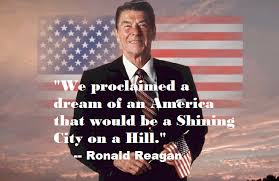
However most Americans don’t primarily associate the City on a Hill image with Jesus, much less with Isaiah. In fact, most cannot hear the phrase without thinking of former U.S. President Ronald Reagan. In Reagan’s mouth, “City on a Hill” became a quintessential expression of American Exceptionalism. As such Reagan’s usage exemplifies how Republicans have hijacked and distorted Christian discourse.

Reagan however didn’t coin the City’s connection to “America.” John Winthrop, the Puritan leader of the Massachusetts Bay Colony, had already done that in 1630. Standing on the deck of the flagship Arbella Winthrop told his shipmates, “We must always consider that we shall be as a city upon a hill—the eyes of all people are upon us.”

Then in 1961 J.F. Kennedy quoted Winthrop’s words specifically as the new president addressed the General Court of Massachusetts. Kennedy added “. . . (W)e are setting out upon a voyage in 1961 no less hazardous than that undertaken by the Arbella in 1630. We are committing ourselves to tasks of statecraft no less fantastic than that of governing the Massachusetts Bay Colony, beset as it was then by terror without and disorder within.”

After Reagan, Gary Bauer, the president of the Family Research Council, attempted to borrow some of the Reagan thunder by using his idol’s words. Bauer repeatedly used the “City on a Hill” metaphor as he attempted unsuccessfully to secure the Republican presidential nomination in 1999. Before him in 1997, Reagan’s adopted son, Michael, had already written a book about his father entitled The City on a Hill: Fulfilling Ronald Reagan’s Vision for America.

As for Reagan himself, here’s what he said about the image in his farewell speech to the nation in 1989:

“…I’ve spoken of the shining city all my political life, but I don’t know if I ever quite communicated what I saw when I said it. But in my mind it was a tall proud city built on rocks stronger than oceans, wind-swept, God-blessed, and teeming with people of all kinds living in harmony and peace, a city with free ports that hummed with commerce and creativity, and if there had to be city walls, the walls had doors and the doors were open to anyone with the will and the heart to get here. That’s how I saw it and see it still . . .”

These words show that Reagan’s image of the “City on the Hill” is one of pride, strength, harmony, peace, open markets and free immigration – all of it specially blessed by God. Noble ideals all. . . .

Nonetheless President Reagan’s policies proved questionably coincident with his words and especially with the biblical ideals expressed in today’s readings.

Think about those ideals.

In the selection from Isaiah, the prophet says the City on the Hill shines because its inhabitants:
• Share bread with the hungry.
• Protect the oppressed and remove oppression from their midst.
• Shelter the homeless.
• Clothe the naked.
• Remove from their midst accusation and malicious speech.

The Responsorial psalm seconds all of that, adding that the hilltop city’s just citizens:
• Lend (without interest).
• Give lavishly to the poor.

In today’s selection from Paul’s letter to the church in Corinth, the apostle himself identifies with the weak and fearful, not those who are “wise” according to the standards of the world. Paul goes on to contrast the world’s logic with what elsewhere he calls the foolishness of Jesus’ Spirit – which chose to identify with those on death row (I COR 1:23).

Finally, today’s Gospel reading has Jesus refer specifically to the “City on a hill” and the light that causes it to shine. Once again, it’s the “light” described by Isaiah – sharing bread, shelter, clothing, and money with the hungry, homeless, naked, impoverished and oppressed.

All of this has little to do with President Reagan’s version of an exceptionally blessed America. In fact, during his term in office Reagan:

• Consistently stigmatized the poor. (Reagan often told the story of a “welfare queen” in Chicago who turned out to be a figment of his speech writers’ imaginations. According to the story, she drove a Cadillac and had cheated the government of $150,000 using 80 aliases, 30 addresses, a dozen social security cards and four fictional dead husbands. Once again, all of that was a lie.)
• Halved the budget for public housing.
• Closed shelters for the mentally ill.
• In so doing, created an epidemic of homelessness virtually unknown since the Great Depression.
• Spent the entire decade of the 1980s supporting oppressive governments Central America – specifically in Nicaragua, El Salvador, Guatemala, and Honduras.
• Oversaw the repeal of the Fairness Doctrine in 1987, thus opening the publicly owned radio airwaves to dominance by privately financed right wing programs whose bread and butter soon became the “false accusations” and “malicious speech” Isaiah saw as incongruous with the light Jesus subsequently saw as characterizing the City on the Hill.
• Inspired his self-proclaimed acolytes (in our own day) to introduce savage reductions in Food Stamp programs for the hungry, and elimination of unemployment benefits.

And that’s the short list of the horrors of the “Reagan Revolution.” None of it has anything to do with Jesus’ vision of a City on a Hill. Rather Reagan policies fly directly in the face of that vision.

The point is that the right wing in this country (personified in Ronald Reagan) has hypocritically identified itself as somehow “Christian” while turning that tradition squarely on its head.

Progressives are missing the boat by surrendering to that hijacking of Jesus’ meaning and message, when in reality that message supports their cause, not that of their reactionary opponents.

It’s high time for progressives to go on the offensive by recognizing and employing the power of myth and image so successfully manipulated by the religious right.

Trump’s Anti-Catholic Persecution: My Personal Response

trump-immigrants

Last Saturday night we had our first meeting of a house church a number of us are trying to get off the ground. Ten people showed up. At least half of them admitted being there principally to humor me – because they’re such good friends. For that I remain extremely grateful.

By their very presence and participation, those good friends helped me clarify my own calling in these troubled times. They helped me realize that these are times of anti-Catholic persecution, and that the renewed oppression calls for thoughtful response. Please allow me to explain.

To begin with, at Saturday’s meeting, there was plenty of talk about Donald Trump. Everyone spoke of a sense of foreboding and depression at the events of the preceding week – the president’s first in office. There was all that xenophobia about Mexicans described as criminals and rapists – all that talk of The Wall.

One good friend described his impression of standing on a track in the face of an onrushing train with no power to stop it.

But another invoked the term metanoia – the Greek word for repentance in the sense of complete change of mind and action. He implied that as people of faith, we have to change profoundly. We need to man-up, woman-up and act like subjects rather than as powerless objects moved about by the tweets of the Bully-in-Chief. (His words made me reconsider my own immobility and resistance to change.)

Well, we finished our discussion, broke bread and shared wine around our dining room table. Afterwards, as we ate our potluck meal, we spoke of possible action during the coming week. There was talk of boycotting Trump products and services, writing letters, making phone calls, and even traveling to Standing Rock.

Following our liturgy, I felt a sense of profound gratitude for the generosity and good will my friends had shown. (They even stayed beyond the allotted time.) All the same, I worried that our suggested actions might never touch, for example, conservatives who voted for Mr. Trump or send ripples beyond our emerging little church.

I wondered what I might do personally to change that.

In the middle of that night, around 4:00 in the morning, I awoke suddenly with a possible response. It involves confronting the fact that a new government-sponsored persecution of Catholics is breaking out in our midst.

I’m not exaggerating. I mean, if I consider attacks on predominantly Muslim countries as veiled attacks on Islam, I should also consider attacks on predominantly Catholic countries as attacks on Catholicism.

Such antagonism has long and bloody precedent. In fact, all during the 1980s the United States fought what Noam Chomsky calls “the first religious war of the 21st century. On Chomsky’s analysis, it raged against the Catholic Church in Latin America whose bishops had together dared to affirm a “preferential option for the poor” as their official position. The conflict created chaos particularly in Central America, took the lives of hundreds of thousands of Latin American Catholics. Today its aftermath remains a principal cause behind the stream of refugees entering the U.S. through Mexico.

Donald Trump’s policies against refugees represents an extension of that 1980s religious war. In its current form, it vilifies and excludes Catholics as devoid of the moral standards the Church prides itself on teaching.

Think about it, Donald Trump has identified Mexicans and Central Americans (again, most of them Catholic) as morally deficient. The president said:

“When Mexico sends its people, they’re not sending their best. They’re not sending you. They’re not sending you. They’re sending people that have lots of problems, and they’re bringing those problems with us. They’re bringing drugs. They’re bringing crime. They’re rapists. And some, I assume, are good people.”

Here Mr. Trump identifies good Mexican Catholics among us as the exception, not the rule. The vast majority, he claims, are drug dealers, criminals, and rapists.

However, my own specifically Catholic experience gives the lie to his words. He’s demonizing my fellow parishioners –  people I consider my brothers and sisters in Christ. I know them by name: Amelia, Carlos, Ana, Isidro, Graciela, Ramon. . .  Criminals? Rapists? Drug dealers?

There are at least 100 such people in my Berea Kentucky church of 200 families. And that doesn’t even count the DACA students in our local Berea College. Under Trump, all of these people and their families stand accused not only by the president, but by those he emboldens to harass them. In other words, our fellow Catholics are in danger, so are their sources of income, their health and well-being.

Recently after church, I spoke with some of the endangered. They all agreed; they feel threatened and quite frightened. Moreover, they would appreciate more evident solidarity and support from Anglo parishioners who, in the case of our Berea church attend a separate Mass (at 9:00 a.m.) while Hispanics attend either a Spanish language Mass at 11:00, or both the 9:00 and 11:00 Masses.

How then might I respond to the plight of their Hispanic brothers and sisters in Christ? Here’s what I’m thinking: I might

  • Clearly identify in my own mind President Trump’s policies as anti-Catholic and specifically threatening to my fellow parishioners.
  • Lobby my senators and congressional representative to vote against Mr. Trump’s immigration policies.
  • Use the term “anti-Catholic” in my phone messages to those politicians.
  • Use similar language in writing to Speaker of the House, Paul Ryan, who describes himself as a “devout Catholic.”
  • Try to persuade the parish council in my local church to declare our parish a sanctuary for the refugees and immigrants among us.
  • In general, show solidarity with my fellow undocumented parishioners.
  • Begin participating in the 11:00 “Hispanic Mass” instead of the 9:00 mostly Anglo ceremony.
  • Be undeterred by my diffidence about not speaking Spanish well enough, realizing instead that my good will goes a long way towards establishing the sense of solidarity and support that our Hispanic brothers and sisters need.
  • Pair up with new friends and offer to spend time with them in conversation to help them learn English.

I suspect that actions like those, if adopted more generally, would start parish-wide conversations about Mr. Trump’s policies that affect “brothers and sisters in Christ.” They might raise the awareness of conservative parishioners – and possibly even of our church leadership. Such actions hold the promise of mobilizing many against the Trump administration’s fearful xenophobic juggernaut that, as I’ve said, is quite anti-Catholic.

I smile as Imagine what might happen across the country if Catholics responded in these ways.

Thank you, my good friends for helping me see the possibilities. Now it’s time for me to get to work.

It’s Time To Post Luke’s Beatitudes in Front of the White House (Sunday Homily)

davidic-covenant

Readings for Fourth Sunday in Ordinary Time (Second in the Extraordinary Time of Donald Trump) ZEP 2:3, 3:12-15; PS 146:6-7, 8-10; ICOR 1: 25-31; MT 5: 1-12A.

So we’re a Christian nation, right? At least that’s what right wingers would have us believe, despite the presence of millions of Jews, Muslims, Hindus, Buddhists – and atheists – among us.

Well, if we’re so Christian, here’s an idea for you. How about posting the Beatitudes in front of U.S. courthouses instead of the Ten Commandments? How about posting them on the walls of our schools, and in front of the White House? Doesn’t that seem more appropriate? I mean the Beatitudes come from the specifically Christian Testament. The Ten Commandments, on the other hand, come from the Jewish Testament.

I predict that will never happen. In fact, I’ll bet dollars to donuts, there’d be a hue and cry (on the part of Christians, mind you) that would prevent the move. And do you know why? Because the Beatitudes centralized in today’s liturgy of the word are too radical and un-American for the “Christian” right. They make sweeping judgments about classes. They indicate that the rich (evidently no matter how they got their money) are at odds with God’s plan, while the poor (regardless of why they’re poor) are his favorites.

No, I’m not so much talking about the version of the Beatitudes found in the Gospel of Matthew which were read in today’s Gospel excerpt. In Matthew, Jesus’ words are already softened. Instead, my reference is to Luke’s probably earlier version that expresses harsher judgments.

Here’s the way, Luke phrases Jesus’ words in Chapter 6 of his Gospel:

20 And he lifted up his eyes on his disciples, and said:

“Blessed are you who are poor, for yours is the kingdom of God.

21 “Blessed are you who are hungry now, for you shall be satisfied.

“Blessed are you who weep now, for you shall laugh. . .

24 “But woe to you who are rich, for you have received your consolation.

25 “Woe to you who are full now, for you shall be hungry.

“Woe to you who laugh now, for you shall mourn and weep.

26 “Woe to you, when all people speak well of you, for so their fathers did to the false prophets.

Do you see what I mean? Luke’s version doesn’t spiritualize poverty the way Matthew does. Matthew changes Jesus’ second-person statement about poverty (“Blessed are you who are poor”) to a third-person generalized and spiritualized “Blessed are the poor in spirit.” Similarly, Luke’s “Blessed are you who are hungry now” becomes “Blessed are those who hunger and thirst for justice” in Matthew.  In this way physical hunger is turned into something spiritual or psychological. Obviously, Matthew’s community was not as poor as Luke’s – or as the people Jesus habitually addressed.

In fact, the entire Judeo-Christian tradition is so valuable exactly because – unlike most of ancient literature – it represents the lore of poor people about their relationship with God.

Granted, that tradition became the object of class struggle about 1000 years before Jesus’ time, with the contested emergence of a royal class.

That is, starting with King Saul, the royalty of Judah and Israel tried mightily to turn a poor people’s faith into an ideology supporting the country’s elite. More particularly, under King David, palace oligarchs distorted the divine promise to slaves escaped from Egypt. That promise had been “I will be your God and you will be my people.” David turned it into a promise of a permanent dynasty for himself and his descendants. In other words, the country’s royalty transformed the Mosaic Covenant into a Davidic Covenant serving the elite rather than the poor.

However, the people’s prophets resisted them at every step. We find examples of that in all of today’s readings. For instance, in our first selection, the seventh century (BCE) prophet, Zephaniah, addresses the world’s (not simply Israel’s) poor. With his country’s aristocrats and priests in mind, he denounces their lies and “deceitful tongues” and urges them to treat the “humble and lowly” with justice as was prescribed by Moses.

Then with the responsorial Psalm 146 (probably written in the late sixth century) we all found ourselves chanting the words Matthew attributes to Jesus: “Blessed are the poor in spirit; the Kingdom of God is theirs.” The “Kingdom of God,” of course, is shorthand for what the world would be like if God were king instead of those corrupt royal classes. The psalmist says that change would bring justice for the oppressed, hungry, imprisoned, physically handicapped, the fatherless, the widow, and the resident alien. All of these were specific beneficiaries of the Mosaic Covenant.

Today’s third reading from I Corinthians promises a Great Reversal. There Paul of Tarsus (in modern day Turkey) identifies Jesus’ earliest followers as those who “count for nothing” in the eyes of the world. (Do you see the return to the Mosaic Covenant?)  Jesus followers are riffraff. Paul identifies them as unwise, foolish, and weak. They are lowly and despised. Yet in reality, Paul assures his audience, the despised will finally be proven wise and holy. Ominously for their betters, Paul promises that those who count for nothing will reduce to zero those who in the world’s eyes are considered something.

Jesus, of course, appears in Zephaniah’s and Paul’s prophetic tradition as defender of the poor and the Mosaic Covenant. Matthew makes that point unmistakably by changing the location of Luke’s parallel discourse. In Luke, Jesus announces the Beatitudes “on a level place” (LK 6:17). Matthew puts Jesus “on a mount” for the same sermon. His point is that Jesus is the New Moses who also received the Old Covenant on a mount (Sinai). Put otherwise: the so-called Beatitudes represent the New Law of God.

That’s why it makes more sense to place the Beatitudes on a plaque in front of our courthouses, on the walls of our schools, and in front of the White House.

But as I said, don’t hold your breath. Can you imagine Donald Trump and his super-wealthy cabinet members (and their constituents) having to read Luke’s words every day?

“Woe to you who are rich, for you have received your consolation.

25 “Woe to you who are full now, for you shall be hungry.

“Woe to you who laugh now, for you shall mourn and weep.

26 “Woe to you, when all people speak well of you, for so their fathers did to the false prophets.

No, in its essence, the Judeo-Christian tradition belongs precisely to poor people. It belongs to those whom the Trump administration (and perhaps Americans in general) think “count for nothing.” As Paul intimates, those are the very ones who will rise up and reduce to zero those who in the world’s eyes are considered something.

That message is no more welcome today than it was 2000 years ago.

Notes for a Home Church: The Eucharist Is Not a Sacrifice or a Magic Show, But a Shared Meal (Pt. 3 of 4)

magic-show 

My beloved eight-year-old granddaughter is getting ready to receive her First Holy Communion in May, and it’s got me worried. I mean her Sunday School teachers are filling her head with “Catholic” fundamentalist and literalist notions of Jesus’ “Real Presence” in the “Blessed Sacrament” that even St. Augustine rejected. In the 4th century he wrote: “Can Christ’s limbs be digested? Of course, not!”

Eventually, my granddaughter, I predict, will come to the same conclusion. And rather than see the beautiful symbolism of the Eucharist’s Shared Bread, she’ll probably follow the example of so many young people I know and reject the ideas of “Holy Sacrifice” and “Real Presence” as childhood fantasy akin to belief in Santa Claus and the Tooth Fairy.

To my mind, that’s tragic. That’s because it represents a rejection of Jesus’ insightful and salvific teaching about the unity of all creation. In an era of constant global war, that teaching is needed more than ever. It’s contained in the Master’s words, “This is my body . . . this is my blood . . . Do this in remembrance of me?”

Let me explain.

To begin with, according to contemporary historical theologians like Hans Kung, the Great Reformers of the 16th century had it right: The Eucharist of the early church was no sacrifice. It was a commemoration of “The Lord’s Supper.” The phrase however does not refer to “The Last Supper” alone. Instead it references all the meals Jesus shared with friends as he made meal-sharing rather than Temple sacrifice the center of his reform movement, From the wedding feast at Cana (JN2:1-12), through his feeding of 5000 (MK 6:31-44) and then of 4000 (MK 8: 1-9), through his supper at the Pharisee’s home (LK 7:36-50), and with the tax collector Zacchaeus (LK 19:1-10), through the Last Supper (MK 14:12-26), and Emmaus (LK 24:13-35), and his post-resurrection breakfast with his apostles (JN 21:12). Jesus treated shared meals as an anticipatory here-and-now experience of God’s Kingdom.

But why? What’s the connection between breaking bread together and the “salvation” Jesus offers? Think about it like this:

Besides being a prophet, Jesus was a mystic. Like all mystics, he taught the unity of all life.

“Salvation” is the realization of that unity. In fact, if we might sum up the central insight of the great spiritual masters and avatars down through the ages, it would be ALL LIFE IS ONE. That was Jesus’ fundamental teaching as well. It was something uneducated fishermen could grasp. It’s a teaching accessible to any child: All of us are sons (and daughters) of God just as Jesus was. Differences between us are only apparent. In the final analysis, THERE IS REALLY ONLY ONE OF US HERE. In a sense, then we are all Jesus. The Christ-Self (or Krishna-Self or Buddha-Self) is our True Self. God has only one Son and it is us. When we use violence against one another, we are attacking no one but ourselves. What we do to and for others we literally do to and for ourselves. That’s a profound teaching. It’s easy to grasp, but extremely difficult to live out.

Buddhists sometimes express this same insight in terms of waves on the ocean. In some sense, they say, human beings are like those waves which appear to be individual and identifiable as such. Like us, if they had consciousness, the waves might easily forget that they are part of an infinitely larger reality. Their amnesia would lead to great anxiety about the prospect of ceasing to be. They might even see other waves as competitors or enemies. However, recollection that they are really one with the ocean and all its waves would remove that anxiety. It would enable “individual” waves to relax into their unity with the ocean, their larger, more powerful Self. All competition, defensiveness, and individuality would then become meaningless.

Something similar happens to humans, Buddhist masters tell us, when we realize our unity with our True Self which is identical with the True Self of every other human being. In the light of that realization, all fear, defensiveness and violence melt away. We are saved from our own self-destructiveness.

Similarly, Buddhists use the imagery of the sun. As its individual beams pass through clouds, they might get the idea that they are individuals somehow separate from their source and from other sunbeams which (again) they might see as competitors or enemies. But all of that is illusory. All are really manifestations emanating from the same source. It’s like that with human beings too. To repeat: our individuality is only apparent. THERE IS REALLY ONLY ONE OF US HERE.

In his own down-to-earth way, Jesus expressed the same classic mystical insight not in terms of waves or sunbeams, but of bread. Human beings are like a loaf of bread, he taught. The loaf is made up of many grains, but each grain is part of the one loaf. Recognizing the loaf’s unity, then breaking it up, and consuming those morsels together is a powerful reminder that all of life — all of us – are really one. In a sense, that conscious act of eating a single loaf strengthens awareness of the unity that otherwise might go unnoticed and uncelebrated.

Paul took Jesus’ insight a step further. In his writings (the earliest we have in the New Testament) he identifies Christ as the True Self uniting us all. Our True Self is the Christ within. In other words, what Jesus called “the one loaf” Paul referred to as the one Body of Christ.

All of Jesus’ followers, the apostle taught, make up that body.

Evidently, the early church conflated Jesus’ insight with Paul’s. So their liturgies identified Jesus’ One Loaf image with Paul’s Body of Christ metaphor. In this way, the loaf of bread becomes the body of Christ. Jesus is thus presented as blessing a single loaf, breaking it up, and saying, “Take and eat. This is my body.”

And there’s more – the remembrance part of Jesus’ “words of institution.” They are connected with Paul’s teaching about “The Mystical Body of Christ.” His instruction (found in I COR: 12-12-27) is worth quoting at length:

12 There is one body, but it has many parts. But all its many parts make up one body. It is the same with Christ. 13 We were all baptized by one Holy Spirit. And so we are formed into one body. It didn’t matter whether we were Jews or Gentiles, slaves or free people. We were all given the same Spirit to drink. 14 So the body is not made up of just one part. It has many parts.

15 Suppose the foot says, “I am not a hand. So I don’t belong to the body.” By saying this, it cannot stop being part of the body. 16 And suppose the ear says, “I am not an eye. So I don’t belong to the body.” By saying this, it cannot stop being part of the body. 17 If the whole body were an eye, how could it hear? If the whole body were an ear, how could it smell? 18 God has placed each part in the body just as he wanted it to be. 19 If all the parts were the same, how could there be a body? 20 As it is, there are many parts. But there is only one body.

21 The eye can’t say to the hand, “I don’t need you!” The head can’t say to the feet, “I don’t need you!” 22 In fact, it is just the opposite. The parts of the body that seem to be weaker are the ones we can’t do without. 23 The parts that we think are less important we treat with special honor. The private parts aren’t shown. But they are treated with special care. 24 The parts that can be shown don’t need special care. But God has put together all the parts of the body. And he has given more honor to the parts that didn’t have any. 25 In that way, the parts of the body will not take sides. All of them will take care of one another. 26 If one part suffers, every part suffers with it. If one part is honored, every part shares in its joy.

27 You are the body of Christ. Each one of you is a part of it.”

Here it’s easy to see the beauty of Paul’s image. We are all members of Christ’s body (Paul’s fundamental metaphor for that human unity insight I explained). As individual members, we each have our functions – as eye, ear, nose, foot, or private parts. However, the fact that we live separately can lead us to forget that we are all members of the same body. So it helps to RE-MEMBER ourselves occasionally – to symbolically bring our separate members together. That’s what “re-membering” means in this context.  That’s what the Eucharist is: an occasion for getting ourselves together – for recalling that we are the way Christ lives and works in the world today.

In the final analysis, that’s the meaning of Jesus’ injunction: “Do this to RE-MEMBER me.  And then afterwards – as a re-membered Christ, act together as I would.”

Do you see how rich, how poetic, how complex and mysterious all of that is – ocean waves, sunbeams, bread, Christ’s body, re-membering?

It’s powerful. The Eucharist is not a magic show. It’s a meal where the many and separate members of Christ’s body are re-membered so they might subsequently act in a concerted way in imitation of Christ.

That’s why it’s important to recover and make apparent the table fellowship character of The Lord’s Supper. It is not a Jewish or Roman sacrifice; it is a shared meal.

My granddaughter and the world she’ll inherit need everything that signifies. The Eucharist is not childish fantasy. It’s a counter-cultural challenge to our era’s individualism, ethnocentrism, and perpetual war.

(Next Week: How priests fit into the Eucharistic picture of the early church)

To Make a Nation Great Again: Trump’s Cabinet vs. Jesus’ (Sunday Homily)

fishermen

Readings for 3rd Sunday in Ordinary Time: IS 8: 23-9:3; PS 27: 1, 4, 13-14; I COR 1: 10-13, 17; MT 4: 12=23

Well, it’s happened. Donald Trump is our new president. We saw the know-nothing real estate magnate, casino king, reality show star, and unrepentant assailant of women sworn in last Friday at noon. Many of us are still in shock.

As everyone knows, the new president’s announced program is to make America great again. His cabinet picks evidence his strategy. It’s to run the country “like a business.”

Look at them all. Every one sitting around the table where decisions will be made about our lives and the fate of the planet comes from the 1%. They are all billionaires, multi-millionaires, generals and Christian fundamentalists. (One of them boasts that killing is fun.) Ironically, they claim to prefer biblical science to what our world’s finest minds (including Pope Francis) tell us about the errors of “the American Way.” Evidently, for Mr. Trump the best and the brightest are the richest, most venal, and violent.

The new president’s cabinet picks reveal his underlying philosophy. It’s austerity for the poor (and the planet) complemented by welfare for the rich. They want to defund public schools, Medicare, Medicaid, and the EPA. They oppose raising the minimum wage. Meanwhile, they want to drastically lower tax rates for themselves. It’s the tired old “trickle-down” theory revisited with a vengeance, even though it’s been completely discredited. In his apostolic exhortation, “The Joy of the Gospel,” Pope Francis called the ideology homicidal (53), ineffective (54), and unjust at its root (59).

Yet many Christians (even Catholics) voted for Trump and see him as somehow the instrument of God!

Providentially, all of that is extremely relevant to the readings for this Third Sunday in Ordinary Time (and first in the Extraordinary Time of the Donald).  That’s because today’s Gospel reading in effect records Jesus’ selection of his own “cabinet picks” as he begins his campaign to make his country great again. Today’s reading from Matthew records his selection of the first of his twelve apostles – the successors to the great patriarchs of Israel.

It’s no stretch to say that Jesus’ program was to “Make Israel Great Again.” In his day, the country could have no such pretensions. (In fact, it probably never was great.) It was a poor backwater – an obscure province of the Roman Empire.

Yet its prophets remembered days of prosperity, when God seemed to be on Israel’s side.

Those were all times of liberation from oppression specifically by the rich and powerful – the ancient analogs of Mr. Trump’s cabinet. The first glorious period followed after Yahweh freed slaves from Egypt under the leadership of Moses and Joshua. Another came in the 6th century, when the Persian monarch, Cyrus the Great, released captives from the long Babylonian Captivity of 70 years.

A third time of liberation and joy is the one Isaiah references in today’s first reading. The ecstasy he describes came in the 8th century BCE, when leaders from Israel’s Northern Kingdom returned home after a captivity (under Assyria) of some 20 years. Then, he says, bitterness and sorrow were turned to joy – specifically, for orphans, widows and resident aliens.

The bitterness began, Isaiah notes, in the regions where the tribes of Zebulun and Naphtali lived.  That was in the region that by Jesus’ time became known as Capernaum – the city in the Galilee that Jesus adopted as his own (MT 9:1). Significantly, in today’s Gospel excerpt, Matthew has Jesus beginning his public career in the very place where Israel had first become oppressed – in that region of Zebulun and Naphtali.

Matthew’s point is hard to miss: Jesus has come to end all (especially foreign) forms of oppression with his announcement of the advent of God’s Kingdom. It would be a reality mirroring what the world would be like if God were king instead of Caesar. Prostitutes and beggars, n’er do wells, the halt and the lame would enter that kingdom, Jesus promised, before the rich and professionally holy (MT 21:31).

The Kingdom would represent a system that favored workers rather than rich landlords, bankers, and oligarchs. “Blessed are you poor,” Jesus would say, “for yours is the Kingdom of God” (LK 6:20). “Woe to you rich, you have had your reward” (LK 6:24). “How hard it is for the rich to enter the kingdom of God” (MT 19: 16-24). All of these statements betray an approach that might be described as “percolate-up” rather than “trickle-down.”

So does Jesus’ selection of the New Israel’s 12 patriarchs. From the viewpoint of the world, it’s almost comic. In today’s reading, Jesus chooses ignorant, illiterate working men as successors to Old Testament saints like Joseph and Benjamin, Zebulun, Naphtali, and their eight revered brothers. In their place, Jesus installs smelly fishermen Peter, James, and John. Later he’ll add a reformed tax collector, and at least one insurgent against the Roman occupiers. Women who had no political power at all would be central in his band of followers.

All of that gives us a God’s eye view of how to make Israel, America – the world – great. Apparently, according to the divine order, it’s not by making the rich richer. To repeat: unlike Donald Trump, Jesus doesn’t begin by enlisting the services of his country’s great landlords, its generals, or its bankers. (As a poor peasant himself, the carpenter from Nazareth didn’t even have that option!) Instead, he starts from below, where all truly effective social change must start.

All such reflections give direction to those attempting to follow the Master from Capernaum today. Our readings call us to join Pope Francis and other critical thinkers in rejecting all forms of trickle-down theory. As the pope reminds us, history and common sense lead to that rejection.

Today’s Gospel supplies a more profound reason for doing so: trickle-down is not the way of the Jesus’ God whose universe is not run like a business, but is a gift system. The world itself is an expression of God’s generosity to all of us. And something is drastically wrong when workers and their children go hungry, when people are forced into prostitution to make ends meet, and when beggars cannot find work.

Something is also profoundly out-of-order when would-be followers of Jesus support politicians convinced that the way to make a country great is by giving even more wealth to the obscenely rich, while forcing austerity measures on the poor.

Notes for a Home Church: Why The Church as We Know It Is Dead (Pt 2 in series of 4)

dead-church

In my last posting, I announced the first meeting of a house catholic (i.e. open to all) church. It will take place this Saturday, the day after Donald Trump’s inauguration, at 5:00 in Peggy’s and my home, 404 Jackson St.

I also mentioned that friends of mine wondered why, noting that the church as we know it is dead.

To be honest, I find their point hard to deny. As already noted, the institutional church is pretty much in extremis. If it disappeared entirely, most of our lives would be little affected. There’s good reason for that. The church has little to do with the historical Jesus, who (in contrast to the one worshipped in our churches) remains extremely relevant to this age of Donald Trump and its ushering in of fascism.

Let me explain

Jesus never intended to found a church. As James Carroll has pointed out recently in his Christ Actually, the Master was a prophetic reformer of Judaism. He remained a Jew to the end of his life. It was beyond his purview even to conceive of belonging to or persuading others to embrace a religion other than a reformed Judaism.

The same was true for his immediate followers. As shown in the Acts of the Apostles, they met in their homes to “break bread” [as was the signature practice of Jesus himself (see below)]. However, they also continued to congregate in the Temple and in local synagogues. Even Paul remained a good Jew. His work with “Gentiles” was with non-Jewish converts to Judaism. His concern was not to burden them by requiring circumcision and kosher diet of such “God-Fearers” wishing to embrace the Jesus Wing of Judaism. John Dominic Crossan and Marcus J. Borg have argued persuasively about this in The First Paul.

As I’ve indicated in my own book, The Emperor’s God, the Jewish Jesus-Community at Jerusalem was led by Jesus’ brother James the Just. Its members were effectively wiped out or driven into exile in the year 70, when the Romans utterly destroyed Jerusalem and its Temple. The resulting Jewish diaspora (refugee Christians among them) spread throughout the Roman Empire. There Christian concern for the poor drew numerous (typically impoverished) non-Jews into their orbit. Largely variant interpretations of Jesus’ identity subsequently emerged – some strictly Jewish, other gentile, some pro-Empire, others Empire-resistant.

In fact, four basic understandings of Jesus  came out of the hodgepodge: (1) Jesus was a completely human prophet like John the Baptist, (2) he was a human being who eventually became divine, (3) he was from the beginning a God who pretended to be human, and (4) Jesus was from the outset somehow fully God and fully human.

It was the latter interpretation that eventually prevailed as “orthodox.” The other three interpretations (along with additional opinions) were labeled “heretical” and suppressed, often quite violently.

In the early 4th century, the non-Jewish, “orthodox,” and pro-empire factions within Christianity rose to prominence. That was after Constantine issued his Edict of Milan in 313. It made Christianity legal in the Roman Empire. Then in 325 Constantine himself convened the Council of Nicaea. Its Nicene Creed effectively transformed Jesus into a Roman God – above history, thoroughly Roman, and no longer Jewish. As such, he was not a threat to Rome or any other regime willing to dispense rich favors on the church. By 381, under the Emperor Theodosius, Christianity had become the official religion of the Roman Empire. As the pro-empire faction of Christian leaders consolidated their power, the historical Jesus and his specifically Jewish concerns were lost forever.

Even more tragically, following the collapse of the Roman Empire in the early 5th century, the Church gradually stepped into the breach and took over its functions. Increasingly, popes resembled emperors, cardinals became “princes of the church,” bishops aspired to princely rank, and priests often fell into the role of religious hucksters hawking spiritual favors such as forgiveness of sins and “indulgences” in exchange for money.

Throughout the process, what gave priests their authority was the power the church claimed for them to “transubstantiate” bread and wine into the body and blood of Christ. Their ability to forgive sin in the sacrament of penance consolidated their influence. It rendered them indispensable for those wishing to get to heaven after death – which was for Catholics the whole point of life. Without such powers, priestly authority would have vanished.

None of that is to say that the Church sold its soul to empire entirely. Over the centuries, there were plenty of reform movements. Beginning around the 3rd century, the Desert Fathers rejected the growing worldliness of the Church. Franciscans in the 13th century followed in that tradition. Then came the great Protestant Reformation in the 16th century.

Key to the latter was the denial of priestly status or authority. Luther, Calvin, Zwingli and others undercut the priestly class by correctly recognizing that neither Jesus nor the apostles were priests. In fact, the reformers said, any special priesthood was a compete aberration for Christians. If anything, in virtue of baptism, all Christians are priests. They were empowered to forgive one another’s sins. There was no need for the sacrament of penance. Moreover, all the reformers agreed with St. Augustine who taught that belief that a priest’s words could change bread and wine into the literal body and blood of Christ was absurd and cannibalistically repugnant.

Modern biblical scholarship has proven the Reformers correct on most counts. As Garry Wills has argued in Why Priests?, outside the obscure Epistle to the Hebrews, Jesus is nowhere in the New Testament identified as a priest. Instead he is consistently portrayed as a lay person – a prophet extremely critical of priests and their work. When St. Paul lists the charisms, gifts or offices found within the Christian community, nowhere on his list of 16 separate categories does he mention “priest” – much less of a power to change bread and wine into Christ’s body and blood or to forgive sins in “confession.”

Well, if the Eucharist is not a ritual intended to miraculously render Jesus present in the host and chalice, what is it? And what is the meaning of Jesus’ words at the Last Supper: “This is my body . . . this is my blood . . . Do this in remembrance of me?”

We’ll take that up in next Tuesday’s posting – Part 3 in this series.

Starting a House Church: A Faith-Inspired Response to Trumpism (First in a series of four)

barth

Recently, I surprised friends and readers of this blog by announcing plans to “re-appropriate my priesthood” and start a house church. It would be a faith-based response, I said, to Trumpism and its planetary threat. The community, I hoped, would mobilize the spiritual power that in fact dwarfs the U.S. presidency and the president’s capacity as Commander-in-Chief of the mightiest military in the history of the world.

Some of my former priest-colleagues wondered, “Why on earth would you want to do that?”

After all, the church is for all practical purposes dead and the priesthood along with it.

And good riddance. By and large, the church remains sexist, religiously fundamentalist, and arguably the most conservative force on the face of the earth.

“And there’s more,” they said.  “Virtually no one believes in priestly powers any more. According to Catholic faith, it all hangs on two quasi-magical endowments that priests alone allegedly have to: (1) transform bread and wine into the literal body and blood of Christ, and (2) forgive mortal sins that would otherwise send their perpetrators to hell. Few who think about it take such beliefs seriously any more. The others are just coasting along in thoughtless denial. Their children however perceive the nonsense and are jumping the sinking ship in droves. That’s why if ‘former Catholics’ were an actual denomination, they would constitute the third largest church in the United States.

“Moreover, Catholics are virtually indistinguishable from Protestants (or non-believers for that matter) in their life-styles and political positions. They even practice birth control in exactly the same percentages as other Americans. It’s a similar case with divorce and same-sex relationships. And many Catholics vote Republican, despite papal social teachings on social justice, the environment, and war.

“So what’s the point of the Catholic Church with its anachronistic priesthood? It has become a mere social club – good for keeping old friendships alive, but little more. Most of its committees, sodalities, youth and men’s groups are self-serving. Do-gooders could easily find other organizations elsewhere to satisfy their passion for social change – without having to fight resistant Catholic fundamentalists in the process.”

To be frank, I find such objections persuasive.  Despite the best efforts of Pope Francis, the church seems more dead than alive. For all practical purposes, it whistles past the crises that characterize our age. The Sunday Masses I attend completely ignore the unprecedented contemporary context of threats from nuclear war, climate change, racism and sexism.

And yet, I remain firm in my intention to proceed with the house church. That’s because despite the institutional church’s having lost its way, I still find in my faith a source of spiritual strength and political resistance that for me is irreplaceable.

I intend to start a house church also because the objections just mentioned overlook the fact that Catholic Church pews also seat resisters like me. There are people whose faith has been shaped by the reforms of the Second Vatican Council. In the spirit of the conciliar document, “The Church in the Modern World,” their faith engages them not only with world events, but with one another.

For instance, in my own community, a group of more than 20 has met regularly over the past two or three decades as our church’s Peace and Social Justice Committee. Our gatherings often find us reflecting on liturgical readings. Discussions connect them with political organizing, welcoming refugees, war-resistance, the environmental crisis, and with the needs of local unemployed and impoverished families. Work with Habitat for Humanity has been a constant commitment.

I’m loathe to let such relationships and commitments go. At the same time, I’m convinced there has to be a better, more focused, more regular and consistent way of harnessing the deep faith the 20 or so of us share, especially in the face of Trumpism. To repeat: we’re in an unprecedented situation that calls for an unprecedented response.

I’m convinced that the best response is to experiment with house church Sunday liturgies that would bring our sub-community and others together on a weekly basis to reflect, pray, break bread, and plan creative acts of resistance. The liturgies will take place on Saturday evenings (i.e. on the Sabbath) and thus allow those wishing to attend Mass in our church the next morning, to do so.

In the end, my reasons for starting a house church are rooted in history and theology – in post-Vatican II understandings of church, of Eucharist, and of priesthood. A changed understanding of each – more in accord with the leadership of Pope Francis gives hope and direction.

I will try to explain what I mean in subsequent postings over the next three weeks.