THE ATROCITIES in NICE: Replacing War with Truth & Reconciliation

NICE

The entire world was shocked by the horrendous atrocities of July 14th during Bastille Day celebrations in Nice, when a madman ran over scores of his fellow citizens.

Appropriately the crimes were followed by tears, laying of wreaths, moments of silence, and prayer vigils.

France’s President Hollande evoked sympathy when he correctly declared the attacks “an act of war.” No one disagreed.

However, Mr. Hollande was not correct in his implication that the killings in Nice (and earlier in Paris and at Charlie Hebdo) somehow began a war that France and its partners have now self-righteously resolved to “finish.” Rather, all those massacres are part of a much bigger picture that centralizes France’s participation in the U.S.-fabricated War in Iraq and the resulting creation of the Islamic State (ISIS).

To fill out that picture, consider the following home truths about that war in particular, and about war in general. Uncomfortable as they are, allowing those truths to sink in might help uncover non-violent alternatives to the carnage that stupefies everyone.

Begin here:

  • War is hell.
  • In modern warfare, 90% of casualties are civilian.
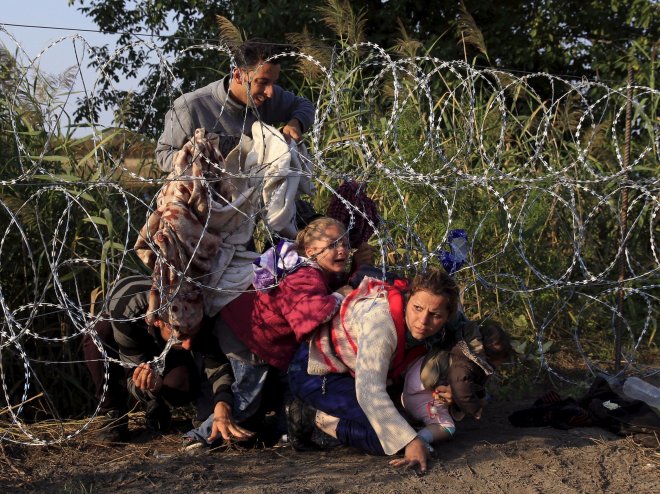
  • The casualties include refugee migrations.

_____

  • The West’s response to 9/11/01 was to declare war.
  • It began a campaign of bombing and extra-judicial assassination in Afghanistan, Iraq, Libya, Somalia, and elsewhere.

_____

  • According to a study by Lancet (one of the oldest scientific medical journals in the world), since 2003 the U.S. war in Iraq has caused more than one million deaths – again, most of them civilian.
  • Meanwhile, the U.S. has supplied weapons to Israel and Saudi Arabia for their own bombing campaigns against Muslims in Gaza and Yemen.
  • In Gaza alone (with complete U.S. support) the Israeli Defense Force fired 50,000 shells, carried out 6000 airstrikes, destroyed 3,500 buildings, killed 2250 Gazans, including 551 children.

_____

  • In wars there are always at least two sides.
  • All have the right to attack and counter-attack.
  • It is insane to be shocked when counter-attacks occur.
  • Counter-attacks often mimic attacks.
  • So if one side is perceived as attacking defenseless civilians, the other side will likely respond in kind.

_____

  • France itself is at war.
  • President Hollande is a founding member of the U.S.-led coalition that has recently dropped 175,000 bombs on Iraq and Syria killing at least 600 civilians in the process.
  • Therefore no one should be surprised when “in kind” counter-attacks occur. (To repeat: that’s the way war works.)

In view of such home truths, and recognizing that intensified bombing has proven counterproductive, instead of responding to the Paris massacre with more of the same, the U.S., France and their allies should:

  • On principle reject the atrocities of war that on both sides justly horrify everyone.
  • Institute instead a process of Truth and Reconciliation that admits and apologizes for the causal role the War in Iraq has had in the creation of ISIS.
  • Take seriously Britain’s recently published  Chilcot Report that indicted former British Prime Minister Tony Blair for cooperating with the Bush administration in misleading the world into that war.
  • Prosecute Blair, Bush, Cheney and others for the crimes the Chilcot Report describes.
  • Open western borders to the refugees inevitably produced by the U.S.-led wars over the last 15 years.
  • Spend the billions now invested in war against ISIS on rebuilding Afghanistan, Iraq, Libya, Syria, Somalia, Yemen, and Palestine.
  • In churches and other principled fora, specifically condemn all Islamophobic statements of politicians and other public figures.

Only actions like these can release the world from massacres that are the unavoidable consequences of the wars we rightly recognize as hell.

Forget Martha; Be Like Lazy Mary and Jester Jesus (Sunday Homily)

un tal

Readings for the 16th Sunday in Ordinary Time: Gn. 18: 1-10A; Ps. 15: 2-5; Col. 1: 24-28; Lk. 10: 38-42.

What do you think you’ll regret most as you lay dying? If you’re like most, it will be that you spent too much time at your day job – too much time working and not enough time socializing and enjoying life. Study after study affirms that.

Commenting on this regret, one Hospice nurse said:

“This came from every male patient that I nursed. They missed their children’s youth and their partner’s companionship. Women also spoke of this regret, but as most were from an older generation, many of the female patients had not been breadwinners. All of the men I nursed deeply regretted spending so much of their lives on the treadmill of a work existence.”

I’ll bet almost everyone reading this can relate to those words and would like to avoid final regrets about overwork.

Problem is: our culture sets overwork as an ideal. In fact, we’re taught to prize overwork. This is especially true of “American” culture where unlike our European counterparts, we spend an average of three hours per week more on the job. That adds up to something like a month more of work each year than our Europeans sisters and brothers. Most important, Americans take fewer (and shorter) vacations. The average American takes off less than six weeks a year; the average Frenchman almost 12. Swedes take the longest vacations – 16 ½ weeks per year.

Today’s gospel reading from Luke urges us to correct our tendency to overwork before it’s too late. In doing so, it directs our attention to the counter-cultural nature of Jesus’ teachings.

Yes, Jesus was extremely counter-cultural. We shouldn’t forget that. As Deepak Choprapoints out (in his The Third Jesus), the Sermon on the Mount, which captures the essence of Jesus’ wisdom, has him explicitly telling his disciples not to earn a living, save money, plan ahead or worry about the future. Of course, most of us don’t listen to Jesus when he says things like that.

And did you notice the description of the “Just Person” in today’s responsorial psalm? Man or woman, they harm no one, do not slander, speak ill of no one, and refuse to accept bribes. All of that raises no eyebrow. We yawn: none of that seems particularly counter-cultural.

But how about, “They lend not money at usury?” What about that? Yes, lending at interest is considered robbery and is forbidden in the Bible. (What if all Christians (and Jews) kept that commandment? Our world with its economy based on credit and interest, would be entirely different.)
The world would also be different – our lives would not be the same – if we acted like Mary instead of Martha.

The misdirection of traditional sermons obscures that possibility. Customarily homilists understand the story of Martha and Mary in a strictly spiritual sense. Their commentaries use the two sisters to compare the active and the contemplative lives – as though poor Martha stood for lay people having to wait on others with no time for prayer like the more otherworldly Mary. Martha’s sister “choses the better part” like a contemplative “religious” eschewing “the world of work” and spending their time pondering the spiritual teachings of Jesus and living a life rapt in prayer and contemplation.

I used to think that too – until I read Un Tal Jesus (“A Certain Jesus”) written by Maria Lopez Vigil and her brother, Jose Ignacio. (The book has been translated into English under the title Just Jesus.) The authors are Cuban and now live in Nicaragua. Maria is a former nun; Jose Ignacio, a former priest.

Together the Lopez-Vigils created a series of radio programs broadcast all over Latin America. The shows dramatized the four gospels and presented a very human Jesus – the one who emerges from recent scholarship on the historical Jesus.

In Un Tal Jesus, Jesus is black, has a winning smile, and a very down-to-earth sense of humor. (The photo at the top of this blog entry shows Jesus as depicted in the Lopez-Vigil’s book.) The human Jesus portrayed in that radio series scandalized many and inspired even more throughout the Latin world and beyond.

As the Lopez-Vigils envision it, today’s episode takes place in a Bethany tavern owned by Lazarus, the brother of Martha and Mary. It’s a place of eating, drinking and lodging for travelers. It’s a place of laughter, joking, over-eating and drunkenness. And Jesus is right there in the middle of it all.

Passover is approaching, and the inn is full of pilgrims. It’s steamy, noisy, and loud. Martha is on the job, waiting on tables and controlling the rest of the staff. Meanwhile Mary (whom scholars increasingly identify with Mary Magdalene, Jesus closest female companion) is distracted by conversation with Jesus, who is bantering with his friends.

And what are they talking about? Religion? God? Spirituality? No, they’re joking. Jesus is posing riddle after riddle. And Mary finds it completely entertaining. In part, their dialog goes like this:

Jesus: What’s as small as a mouse but it guards the house like a lion. One, two, three: Guess what it is!
Mary: Small as a rat…and…it’s a key! I guessed it, I guessed it!
Jesus: Listen to this one: It’s as small as a nut, has no feet but can climb a mountain.
Mary: Wait… a nut going up the mountain…a snail!…Ha, ha, ha, tell me another one!
Jesus: You won’t guess this one right. Listen well: It has no bones, it is never quiet, with edges sharper than scissors.
Mary: It has no bones… I don’t know…
Jesus: It’s your tongue, Mary, which never rests!

Well, Mary and Jesus might have found that sort of patter entertaining, but Martha did not. She’s in charge of the inn and is worried about her guests waiting impatiently for their food while bread is burning in the oven. So she makes her complaint to Jesus: “Stop your chatter and let my sister do her job!” It’s then that Jesus makes that remark about Mary’s choosing the better part. She’s chosen socializing and play over work.

Does that scandalize you – Jesus distancing himself from work? Well, it seems completely consistent with what I said about Jesus earlier. It coincides with his general approach to work, money, profit, saving, and anxiety about the future.

What difference would it make in our own lives if we accepted that message: socializing, community, and fun are more important than work? What difference would it make in our culture if, in a context of widespread unemployment we elected candidates advocating “spreading the work around,” spreading the money around, shortening the work week, and affording us more time with friends and family, eating, drinking, joking, and playing?

What difference would it make to us on our death beds?

What do you think?

The Peasants Are Coming: Brexit, Free Trade & Mass Migrations

Brexit & Refugees

On June 24th Great Britain shocked the world by voting to exit the European Union (Brexit). Some celebrated the succession as a left wing “Peasant Revolt” against so-called “free trade agreements.”  They were right. Europe (and the world) needs an economic revolution from below. And Brexit was a shot across the bow of corporate globalization.

Others however ascribed the Brexit to narrow right wing anti-immigrant nationalism. They were also correct. However right wing focus on immigrants as if they were the root and sum of Europe’s problems obscures potential connections of interest between the right and its revolutionary counterpart seeking lasting solutions to the problems Brexit lays bare. Those solutions must go far beyond building walls and otherwise restricting immigration. They have to address globalism’s inherent contradictions and the various causes of the largest movement of peoples in world history.

For starters, think of those unprecedented migrations in the light of globalism’s contradictions as reflected in free trade pacts in our hemisphere as compared with the European Union.

Over here, the North American Free Trade Agreement (NAFTA) and its Central American analogue (CAFTA) grant owners of capital the right to cross borders with abandon regardless of the destruction they wreak on local economies in Mexico, Central America, and elsewhere in the Global South. For instance, the dumping low-priced U.S. corn on Mexican markets has converted innumerable peasant farmers into urban workers seeking employment illegally in the United States.

The illegality results from NAFTA’s refusal to recognize that labor is just as essential as capital in the free market paradigm.  If so (and capitalist theory tells us it is), then logic dictates that the freedom of movement accorded one element, must also be granted the other.

However if labor were to enjoy the mobility of capital, the detrimental effects of globalism’s so-called “free trade” would become apparent to all. Workers from Mexico would be free to go where the money is – to the U.S. and Canada. In turn, workers in those countries would see their jobs threatened. They would rebel and reject corporate globalization by demanding the repeal of NAFTA and CAFTA.

Multi-national employers in the U.S. and Canada protect themselves from such reaction by formally pretending to stand with U.S. and Canadian workers against unrestricted immigration. Politically and with great bluster they support building walls. Actually, however, they find immigration essential because Global South workers are required, for example, to harvest tomatoes and lettuce in the United States. Immigrants also exert downward pressure on U.S. wages generally and in construction and service industries in particular. All of that is good for business. The wall-talk is just window dressing.

That’s what’s happening on this side of the pond.

By way of contrast, the granddaddy of all free trade agreements, the European Union (EU) has been less illogical than NAFTA and CAFTA. It has granted labor the same mobility as capital. So workers in the European Union are free to cross borders from economically depressed member states such as Bulgaria and Greece to where the money is in Germany and Great Britain. The results are predictable. In the context of a tight labor market induced by the Great Recession, a huge backlash has resulted against immigrants for reasons described above. Brexit was the outcome.

But the immigrant problem is far more complicated than meets the eye. Ignoring that complexity blocks necessarily nuanced responses. It also blocks union of those right and left wing concerns earlier referenced.

The fact is: not all immigrants are economic. Instead, there are really three types of immigrants taking part in today’s mass migrations. True: some contemporary refugees are economically driven. Many others however are war refugees; a third group seeks refuge from the effects of climate chaos. The legitimate interests of each of these groups dictate separate policy changes that are generally ignored in xenophobic rhetoric about building walls, and protecting national identity.

Economic immigrants are those earlier-mentioned working people who demand the same rights as big capital. Within the European Union, and as already indicated, they have been moving legally from low wage countries to higher wage venues.  In our hemisphere, workers from Mexico and Central America have intuitively followed free-trade logic. They have voted with their feet against the labor restrictions of NAFTA and CAFTA despite the trade agreements’ legal prohibitions.

For their part, war refugees are flooding the world as a result of United States’ and U.S.-supported bombing campaigns (including drones) in Syria, Iraq, Afghanistan, Libya, Somalia, Palestine, Yemen, and elsewhere. Such campaigns have demolished the refugees’ homes, and destroyed their communities and jobs. It’s no wonder then that they reluctantly seek refuge in Europe and the United States. Under international law, they have the legal right to do so. Morally speaking, those responsible for the bombings are most obliged to receive them. The culprit United States should lead the way.

Finally, refugees from climate chaos form a separate category. Many migrants from Syria, for instance, are fleeing not only U.S.-sponsored bombing raids; they are farmers whose fields have been devastated by a years-long drought. Other refugees from island nations and coastal regions find their homes swallowed by rising sea-levels caused by melting polar icecaps. As global temperatures and sea levels continue to rise, this category of refugees will soon dwarf the other two.

In light of such distinctions about free trade, the logic of globalized capitalism, and the three classes of refugees, clear remedies suggest themselves – all inspired by Brexit. In a word, the basic remedy is democracy. More specifically, required policy changes include: (1) Exiting all free trade agreements responsible for economic refugees; (2) Stopping the bombing and wars that create homeless refugees, and (3) Leaving fossil fuels in the ground while adopting mandatory regulations to prevent further warming of the planet.

Though unlikely, all of this is possible. As the Brexit vote demonstrates, there is nothing mandatory or inevitable about free trade agreements. In developing countries, they all can be replaced by what in the past was called “import substitution.” That meant industrialization by Global South economies and instituting protectionist policies to keep imports out and economic emigrants at home.

Such substitution is based three realizations: (1) that no country has ever achieved “developed” status by reliance on supplying raw materials and agricultural products to industrialized nations, (2) that such policy of protectionism and import substitution was itself responsible for the economic advancement of the United States, and (3) after World War II, it worked in Global South countries such as Costa Rica with the result of separating it from its unindustrialized neighbors as economically successful.

[Please note that if free trade agreements remain under consideration, democracy demands that their discussion involve all affected parties with equal representation and vote. Such negotiations would include environmentalists and their concerns for air, water plants and animals. They would involve workers whose jobs might be lost, and community members whose neighborhoods and cities might be devastated by mass emigration, increased pollution or by waves of immigrants. Here absolute transparency is required.  There can be no secret negotiations, top-secret documents, or one-sided elite authorship of policies that end up affecting millions of disenfranchised workers including women and children.]

If Brexit was the start of a peasant revolution, it’s time for all of us to join our brothers and sisters at the barricades across the pond, pitchforks in hand. Our enemies in this struggle are not immigrant workers victims of our wars, or those whom one-percenters call environmental extremists. They are instead the extremist negotiators of secret trade pacts, belligerent prosecutors of wars and obtuse deniers of humanly-induced climate change.

Those are the exploiters whom the Brexit vote indicates we must unite to overthrow and replace.

The Irrelevance of Religion in the Eyes of Jesus (Sunday Homily)

Good Sam Pic

Readings for 15th Sunday in Ordinary Time: DT. 30: 10-14; Ps. 69: 14, 17, 30-31, 34, 36-37; Col. 1: 15-20; Lk. 10: 25-37.

What do you think? Does God care about religion? Does She need it? Do we? Does She even care if we’re Christian, Muslim, Jew or atheist?

Today’s Gospel reading – the familiar parable of “The Good Samaritan – seems to answer “no” to all of those questions.

The tale addresses the problems of crime and violence and of proper human response. Surprisingly, the recommended response is not “religious” at all, but humanitarian. It is unadorned motherly compassion by a specifically irreligious actor.

Jesus makes that point by creating a fictional account where the hero is despicable in the eyes of his audience. He is a Samaritan. Meanwhile, the villains of the piece are religious leaders – a priest and a Levite (virulent enemies of the Goddess religions that biblical patriarchs detested). .

In Jesus’ time, Samaritans were social outcasts belonging to a group of renegade Jews who (by Jesus’ time) had been separated from the Jewish community for nearly 1000 years. They were seen as having polluted the Jewish bloodline by intermarrying with the country’s Assyrian conquerors about 700 years earlier. Female goddesses figured prominently in the religions of ancient Assyria.

As a result, Jewish priests and Levites considered Samaritans “unclean;” they were traitors, enemy-sympathizers, heretics and even atheists. They rejected Jewish understandings of the patriarchal Yahweh and the Temple worship that went along with them. For priests and Levites, Yahweh was interested in temple sacrifice and abstract law.

And yet the Good Samaritan is found to be more worthy, more pleasing in God’s eyes than the priest or Levite, who enjoyed great prestige among Jews as “men of God.”

Yes, Jesus prefers the Samaritan because his actions speak much louder than the religious orthodoxy of Israel’s holy men or than the word “Samaritan” would allow. The outcast expresses typically female compassion; so Jesus approves.

In this way, Jesus’ story calls his audience (and us!) to transcend socially prescribed categories, patriarchy, and even religion in dealing with problems of crime and violence. In fact, the crimes addressed in the parable are not primarily robbery and physical abuse. They are indifference, denial, and patriarchy’s religious hypocrisy.

The solution to such crimes along with robbery and violence is not found in religion, theology or temple sacrifices. It lies simply in compassionate action – in “being there” for victims.

As always, then, Jesus’ words invite us to reconsider our very understanding faith, and our favorite categories of “good” and “evil” — and the identity of God Herself.

Perhaps religion is not that important for followers of Jesus after all — nor to the Great Cosmic Mother..

Studying Liberation Theology in Brazil: Realizing Hitler Won WWII (Personal Reflections XVI)

Nazis Won

Last week I wrote about Paulo Freire and the friendship Peggy and I formed with him in Brazil in 1984. Paulo had a huge influence on Liberation Theology which I first met during my graduate studies in Rome (1967-’72). There I had written my doctoral dissertation on Jurgen Moltmann, the great Reformed theologian who was the doyen of the Theology of Hope. As a member of a missionary society (Society of St. Columban) I tried to connect Moltmann’s concept of “mission” with the same category in the Second Vatican Council’s  Ad Gentes.

While finishing my work on that topic (at the Academia Alfonsiana – with Bernard Haring on my committee), I heard Gustavo Gutierrez speak. At the time, Gustavo was the leading voice in the theology of liberation, which emerged to prominence following the 1968 Medeillin Conference of Latin American Bishops in Colombia. Immediately I could see the connections between the two.

I got the opportunity to explore those connections while Peggy was working on her own dissertation with Freire. I enrolled in a seminar at the Santa Maria de Asuncao seminary in San Paulo. It had me sitting at the feet of a series of liberation theologians I had by that time been reading for years. Prominent among them was Enrique Dussel; so was Chilean scripture scholar, Pablo Richard who (because of the U.S.-supported Pinochet coup) was living in exile in Costa Rica. Dussel was an Argentinian philosopher of liberation. His home had been bombed by the Argentine military during its infamous “dirty war” supported by the United States. So he was then living in exile in Mexico.

He was a dynamic lecturer, but I found him puzzling. He used terms and made references that were new to me. For instance, instead of referring to World Wars I and II, he spoke of the First and Second Inter-capitalist Wars. I had never heard that before. But the phrases caused me to do some research. And sure enough: those wars were between capitalist powers who were struggling for supremacy and to achieve a position in the world very like the one enjoyed by the United States today.

How had I missed that, I wondered? The answer, of course, was that I had learned my history in the United States which conceals such obvious facts. I did more research and eventually wrote a long essay that I published in Spanish in Pasos, the journal of the Ecumenical Research Institute in Costa Rica – a liberation theology think tank. The essay was called “How Hitler Saved Capitalism and Won the War.”

Here it is summarized in the “Easy Essay” form coined by Peter Maurin, the founder (with Dorothy Day) of the Catholic Worker newspaper:

Following Germany’s defeat

in “the First Inter-Capitalist War,”

the system was in trouble in das Vaterland.

It also foundered world-wide

after the Crash of ‘29.

So Joseph Stalin

convoked a Congress of Victory

to celebrate the death of capitalism

and the End of History —

in 1934.

Both Hitler and F.D.R.

tried to revive the corpse.

They enacted similar measures:

government funds to stimulate private sector production,

astronomically increased defense spending,

nationalization of some enterprises,

while carefully keeping most in the hands of private individuals.

To prevent workers from embracing communism,

both enacted social programs otherwise distasteful to the Ruling Class,

but necessary to preserve their system:

legalized unions, minimum wage, shortened work days, safety regulation, social                     security . . .

Roosevelt called it a “New Deal;”

Hitler’s term was “National Socialism.”

Roosevelt used worker discontent

with their jobs and bosses

to get elected four times.

Meanwhile, Hitler successfully directed worker rage

away from the Krupps and Bayers

and towards the usual scapegoats:

Jews, communists, gays, blacks, foreigners and Gypsies.

He admired the American extermination of “Indians”

and used that model of starvation and internment

to guide his own program for eliminating undesirables

by hunger and concentrated slaughter.

Hitler strictly controlled national unions,

thus relieving the worries of the German elite.

In all of this,

he received the support of mainline churches.

Pius XII even praised der Führer  as

“an indispensable bulwark against the Russians.”

Dietrich Bonhoeffer and the German “Confessing Church”

resisted Hitler’s program

of social Darwinism, patriotism and persecution of the undeserving.

Confessing faithful were critical of “religion”

which combined anti-Semitism, white supremacy, patriotism and xenophobia

with selected elements of Christianity.

They insisted on allegiance

to Jesus alone

who stood in judgment over soil, fatherland, flag and blood.

They even urged Christian patriots

to pray for their country’s defeat in war.

Bonhoeffer participated in a plot to assassinate Hitler

and explored the promise of

Christianity without “religion.”

Hitler initially enjoyed great popularity

with the powerful

outside of Germany,

in Europe and America.

He did!

Then as baseball magnate and used car saleswoman, Marge Schott, put it,

“He went too far.”

His crime, however, was not gassing Jews,

but trying to subordinate his betters in the club

of white, European, capitalist patriarchs.

He thus evoked their ire

and the “Second Inter-Capitalist War.”

Following the carnage,

the industrialists in other countries

embraced Hitlerism without Hitler.

They made sure that communists, socialists and other “partisans”

who bravely resisted German occupation

did not come to political power,

but that those who had cooperated with Nazis did.

Today, the entrepreneurial classes

still support Nazis, whenever necessary.

The “Hitlers” they championed have aliases

like D’Aubisson (El Salvador), Diem (Vietnam), Duvalier (Haiti), Franco (Spain),

Fujimori (Peru), Mobutu (Zaire), Montt (Guatemala), Noriega (Panama), Peron                         (Argentina), Pinochet (Chile), Resa Palavi (Iran), Saddam Hussein (Iraq), Somoza                     (Nicaragua), Strossner (Paraguay), Suharto (Indonesia). . . .

The list is endless.

The global elite deflect worker hostility

away from themselves

towards communists, blacks, gays, immigrants and Muslims,

towards poor women who stay at home

and middle class women who leave home to work.

Today, Christians embrace social Darwinism

while vehemently rejecting evolution.

Standing on a ground of being

underpinning the world’s most prominent culture

of religious fundamentalism,

they long for Hoover,

and coalesce

with the right.

In all of this

is forgotten the Jesus of the New Testament

who was born a homeless person

to an unwed,

teenage mother,

was an immigrant in Egypt for a while,

came from the working poor,

was accused of being a drunkard,

a friend of sex workers,

irreligious,

possessed by demons

and condemned by the state

a victim of torture

and of capital punishment.

Does this make anyone wonder about Marge Schott,

the difference between Hitler’s system

and our own,

and also about “religion”

and how to be free of it,

about false Christs . . . .

And who won that war anyway?

(Next week: more about our experience in Brazil)

Would Jesus Celebrate Independence Day?

Jesus Revolutionary

 Readings for 14th Sunday in Ordinary Time: Is. 66: 10-14c; Ps. 66: 1-7, 16, 20; Gal. 6: 14-15; Lk. 10: 1-12, 17.

Sometimes I wonder if I’m on the right path. Do you ever think that about yourself? I’m talking about wondering if your whole “take” on the world is somehow off base.

My own self-questioning has been intensified by my blogging over the last 15 months. For instance I recently wrote a piece on why I refused to celebrate the 4th of July. My thesis was that the U.S. has lost its way, turned the Constitution into a dead letter, and made its claims to democracy meaningless. We are rapidly moving, I said, in the direction of Nazi Germany. All of that is contrary to the Spirit of 1776. So there’s no point in celebrating Independence Day as if Edward Snowden and Chelsea Manning didn’t exist.

One person kind enough to comment said she lost all respect for me as a result of what I had written. Others have told me that my message is just a poor man’s left-wing version of the ideological nonsense spouted by Sean Hannity and Rush Limbaugh. Even people close to me have referred to what I write as diatribes, screeds, and rants. I hope that’s not true.

What is true is that as a theologian, I’m attempting to write “About Things That Matter” (as my blog title puts it) from a self-consciously progressive (i.e. non-conservative) perspective – or rather from a theological perspective that recognizes that following Jesus is counter-cultural and requires a “preferential option for the poor” — not the option for the rich that “America” and its right wing versions of Christianity embrace.

I adopt this position in a national context that I recognize as anti-gospel – materialistic, individualistic, extremely violent, and pleasure-oriented. Or as my meditation teacherEknath Easwaran says, our culture refuses to recognize that we are fundamentally spiritual beings united by the divine core we all share. At heart, we are 99% the same in a culture that tells us we’re 100% unique. Jesus’ values are not the American values of profit, pleasure, power, and prestige.

Instead what Yeshua held as important is centered around the Kingdom of God – a this-worldly reality that turns the values of this world on their head. The Kingdom embodies a utopian vision that prioritizes the welfare of the poor and understands that the extreme wealth Americans admire is a sure sign that those who possess it have somehow robbed others of their due.

As a possessor of extreme wealth myself (on a world-scale) each time I read the gospels – or the newspaper – I feel extreme discomfort. In other words, it’s Jesus’ Gospel that makes me think I’m on the wrong track. But it’s not the one critics have in mind when they suggest I temper my positions.

Instead, consideration of Jesus’ words and deeds convince me that I’m not radical enough. I do not yet occupy a position on the political spectrum respectful enough of the poor. I’ve forgotten that life outside God’s Kingdom (“Jerusalem”) is “Exile” in God’s eyes (as today’s first reading recalls). The liberation from slavery referenced in this morning’s responsorial psalm has lost its central place in my spirituality.

Our culture might say, that by all this I mean that I’m not far enough “left.” Be that as it may. The truth is that insofar as my daily life doesn’t reflect Jesus’ utopian values, I should feel uncomfortable.

Today’s second and third readings reinforce my discomfort. They highlight the conflict between the values of Jesus and those of “the world” – of American culture in our case. In fact, the world finds it hard to understand Jesus’ real followers at all. And why not? For all practical purposes, our culture denies the very existence and /or relevance of spirituality to everyday life – at least outside the realm of the personal.

In today’s excerpt from his Letter to Galatia, Paul says the world considers the Christian life not even worth living. That’s what Paul means when he says that in Christ he is crucified to the world (i.e. in the world’s opinion). He means that as far as the world is concerned, he as a follower of Jesus is already dead because of his rebellion against the values of Rome. Crucifixion, after all, was the form of torture and capital punishment reserved for insurgents against the Empire.

But then Paul turns that perception on its head. He writes that his accusers are wrong. In reality, it is life lived according to Roman values that is not worth living. Paul says, “As far as I’m concerned, the world has been crucified.” He means that what Rome considers life is really death – a dead end. It constitutes rebellion against God’s Kingdom, the antithesis of Rome.

In today’s Gospel selection Jesus describes the lifestyle of those committed to God’s Kingdom. He sends out 72 community organizers to work on behalf of the Kingdom giving specific instructions on how to conduct themselves. They are to travel in pairs, not as individuals. (Companionship is evidently important to Jesus.) Theirs is to be a message of peace. “Let your first words be ‘peace’ in any location you frequent,” he says. He tells his followers to travel without money, suitcase or even shoes. He urges them to live poorly moving in with hospitable families and developing deep relationships there (not moving from house to house). They are to earn their bread by curing illness and preaching the inevitability of God’s Kingdom which the world routinely rejects as unrealistic.

Jesus’ followers are to spread the word that the world can be different. God should be in charge, not Caesar. Empire is evil in God’s eyes. So peace should replace anger and violence; health should supplant sickness; shared food and drink should eliminate hunger. Those are Jesus’ Kingdom values.

And the world rejects them. Not only that, Jesus’ “lambs among wolves” imagery recognizes that the world embodies an aggressive hostility towards followers of Jesus. It would devour them – so different are its values from the Master’s.

So maybe it shouldn’t surprise any of us when we’re accused of being extreme – as communists or utopians or hippies – if we’re attempting to adopt the values of Jesus.

After all, they thought Jesus was crazy. They thought he had lost his faith. They considered him a terrorist and an insurgent.

Then in the fourth century, Rome co-opted Jesus’ message. Ever since then, we’ve tamed the Master.

As our culture would have it, Jesus would have no trouble celebrating July 4th.

Am I mistaken?

For Discussion: The Clearest Explanation of Marxism and Surplus Value I’ve Come Across

Whenever my adult children and I get together, we end up “discussing” current events such as the coming General Election, U.S. foreign policy, Black Lives Matter, or Cuba. And those discussions always lead to exchanges about alternatives to capitalism — especially socialism inspired by Karl Marx. On such occasions I end up defending those alternatives, and my dialog partners offer powerful counter-arguments.

I always come away from such events wishing I could be clearer in expressing my convictions. I’ve taught Marxism in the past. For a while, in a team-taught interdisciplinary course involving 15 Berea College faculty drawn from various disciplines (History, Philosophy, Physics, Biology, Economics . . .), I was asked to give the Karl Marx lecture to those colleagues and the entire B.C. sophomore class. The context was a course called “Religious and Historical Perspectives,” the best teaching (and learning) experience I’ve ever had.

There I wish I had been able to give something like the lecture I’ve pasted below. It’s given by Richard Wolff and it’s the clearest explanation of Marx’s theory of “surplus value” that I’ve come across.

Richard Wolff is emeritus professor of economics at the University of Massachusetts. He is a Marxist educated at Yale,Stanford and Harvard. He currently teaches at the New School in New York City. I am grateful to my good friend, John Capillo, who called him to my attention.

Please watch the video. If my children do, I know it will spark more enlightened conversation. I’m also hoping it will start discussion here among readers of this blog.

See what you think:

The Poor Know More than the Rich: Paulo Freire on What the Impoverished Can Teach Us All (Personal Reflections XV)

Freire Trust

Our world is characterized by an ongoing “conflict” (not to say “war”) waged by the rich and powerful against the poor and politically powerless. It’s all an inheritance of colonialism, which did not disappear after World War II. Instead, colonialism simply took other more sophisticated forms. As J.W. Smith puts it, the system changed from “plunder by raid” to “plunder by trade.” The enduring point is to keep the wealth and power where it’s been since the onset of the colonial era – with the plundering powers (Europe and the United States) which have systematically robbed the resources of the former colonies whose populations today (unsurprisingly) constitute the world’s poor.

One cannot be neutral in the conflict just referenced; one must take sides.  As our friend and mentor Paulo Freire put it, “Washing one’s hands of the conflict between the powerful and the powerless means to side with the powerful, not to be neutral.”

My forty-plus years of travel, teaching, and scholarship in the Global South (Brazil, Nicaragua, Costa Rica, Guatemala, Honduras, Mexico, India, Zimbabwe, South Africa, and Cuba) have taught me the truth of Paulo’s words. Not to decide is to decide – in favor of the status quo.

When sides are consciously taken with the poor and oppressed, a whole counter-narrative emerges that rarely gets a hearing in the United States whose official policy favors the rich and powerful. The counter-narrative about history, economics and politics comes from the underclasses that so concerned Paulo Freire and the liberation theologians I’ve studied with in the countries I’ve just mentioned as well as in the U.S. and Europe.

But here’s the Freirean point: the counter-narrative of the poor is more comprehensive and informed than the one typically pedaled in the United States. In fact, the U.S. story (pretending to be neutral) is actually the product of one-sided “banking” model of education that endorses oppression as normal and inevitable.

Let me explain.

Paulo Freire famously contrasted what he called the banking concept of education with “education for critical consciousness.” In the banking model, teachers make deposits of knowledge into the “accounts” of passive, unsuspecting students. What they learn is mostly irrelevant to their everyday lives. However it amounts to the “official story” which remains unquestioned and explains the given order as normal and good.

On the other hand, education for critical consciousness “problematizes” the students’ own reality and asks them to come up with solutions to real dilemmas: for example, their own hunger, its causes, and how to escape it. In the process they learn how the world works and come up with strategies to change their immediate experience.

Freire also made key distinctions about the stages of consciousness typically passed through by learners  among the world’s majority poor and oppressed. Normally, he said, students begin with the resigned attitude that “to be is to be under the oppressor.” They see no exit from their poverty and life’s circumstances. From there they pass to a second stage: “to be is to be like the oppressor.” They take the rich and powerful as their role models.  They want to be like them – rich and successful. Finally, if they persevere in the growth process, poor students arrive at a stage where they realize that “to be is to be neither oppressor nor oppressed.” In that stage they start taking active and proactive measures against their own poverty and oppression.  They work to change the world.

[BTW: Part of my quarrel with Lin Manuel Miranda’s “Hamilton” (which is where these reflections began) is that it reflects Freire’s second stage of consciousness – to be is to be like the Oppressor. In the play, African-American and Hispanic actors literally pretend to be their white oppressors; they actually celebrate the ones who enslaved and exterminated their ancestors – the ones who excoriated Native Americans in the Declaration of Independence and who wrote slavery into the U.S. Constitution.]

Towards accomplishing the task of changing the world, the poor have an epistemological privilege in their analysis of life in general. Though typically far less formally educated than the rich, their perception and analysis is characteristically more comprehensive and accurate. They might not be able to make the historical references or to employ the academic jargon; they might not use complete sentences or be grammatically correct, but simply put, the poor know more about life.

Why? Think about it for a minute.

Those of us who are rich and/or comfortable have very limited experience and awareness.  Our communities are pretty much siloed and gated. As a result, we can live without consciousness of the poor at all. Wall Street execs rarely really see them. The poor are located in different parts of town. Most even in the middle class never enter their homes or schools. The comfortable have no experience of hunger, coping with rats, imminent street crime, living on minimum wage, or cashing in Food Stamps. Even if they notice the poor occasionally, the comfortable can quickly dismiss them from their minds. If they never saw the poor again, the rich and middle class would continue their lives without much change. In sum, they have very little idea of the lived experience of the world’s majority.

That becomes more evident still by thinking of the poor outside the confines of the developed world who live on two dollars a day or less. Most in the industrialized west know nothing of such people’s languages, cultures, history, or living conditions. I’m talking about “enemies” living in Syria, Iraq, Somalia or Yemen.  Even though our governments drop bombs on such people every day, they remain only abstractions. That is, few of us know what it really means to live under threat of hellfire missiles, phosphorous bombs or drones. Similarly, we know little of the actual motives for “their terrorism.” Syria could drop off the map tomorrow and nothing for most of us would change.

None of this can be said for the poor and the victims of bombing. They have to be aware not only of their own life’s circumstances, but of the mostly white people who employ them, shape their lives, or drop bombs on their homes. The poor serve the rich in restaurants. They clean their homes. They cut their lawns. They beg from them on the streets. The police arrest, beat, torture and murder their children.

If the U.S., for example, dropped off the planet tomorrow, the lives of the poor would be drastically altered – mostly for the better. In other words, the poor and oppressed must have dual awareness. For survival’s sake, they must know what the rich minority values, how it thinks and operates. They must know more about the world than the rich and/or comfortable.

That’s why when the poor develop “critical consciousness,” (like Malcolm X or Mumia Abu Jamal) their analysis is typically more comprehensive, inclusive, credible, and full. They have vivid awareness not only of life circumstances that “make no difference” to their comfortable counterparts; they also have lived experience of life on the other side of the tracks.

However despite such comprehensive knowledge, the critically conscious poor and their representatives find little place in mainstream analysis which comes overwhelmingly from white, well-to-do, and university-educated men.

This is why I’ve learned to give scant credence to mainstream media (MSM) explanations of the world and always takes pains to understand reality from the viewpoint of the epistemologically privileged poor and oppressed – found outside the MSM. Those viewpoints are more comprehensive and informed.

Such Freirean insights are, I think, worth thinking about.

(Next week: My study of liberation theology in Brazil)

Anniversary Celebration in Wyoming: Photos

Family

I’ve been remiss lately in my blog postings. Family activities have kept me away from my computer. There have been lots of comings and goings as Peggy and I have moved to our cottage in Michigan for the summer.

The big family event was a week on the Brush Creek Guest Ranch near Saratoga, Wyoming. It was an extremely generous gift from our daughter, Maggie, and our son-in-law, Kerry – part of this year’s celebration of Peggy’s and my 40th wedding anniversary. Our whole family was there: Maggie and Kerry, Brendan (on leave from his Foreign Service assignment in Pakistan), Patrick (who’s taking a new job working for The Economist), and our four grandchildren, Eva (age 7), Oscar (5), Orlando (almost 4), and Markendeya (almost 2). Diana, the family’s au pair from Colombia was also present.

It was our first time in Wyoming – the “Wild West” as we described it to our grandkids. And at Brush Creek we did it all: skeet shooting, horseback riding, river floating, zip line and rope courses, hiking, fly fishing, paint ball skirmishes, golf, yoga, picnicking, and eating and drinking that didn’t end. A couple of evenings, we watched the NBA Finals in the ranch’s Man Cave. On Friday, country singer, John Rich (of Big & Rich), who was also vacationing at Branch Creek, sang a few songs. Everyone loved it – especially his “Save a Horse; Ride a Cowboy.”

Our dinners together were transcendent. We reminisced, ribbed each other about marriage, parenting, and being parented. Eyes were tear-filled more than once. We really love our kids and grandchildren, and (gratefully) it’s so evident that they love and respect us.

Here are some pictures from Brush Creek:

Family Again

L-R: Maggie, Brendan, Mike, Patrick, Peggy

M & P

Maggie & Kerry

Our Hosts: Maggie and Kerry

Maggie's Family

L-R: Eva, Markandeya, Maggie, Oscar, Kerry, Orlando

Lovers

Forty Years!

Jesus’ Response to Terrorism vs. Ours (Sunday Homily)

Cross

Readings for 12th Sunday in Ordinary Time: ZEC. 12:10-11; 13:1; Ps. 63: 2=6, 8-9; Gal. 3: 26-29; Lk. 9:18-24

Why are we Christians so afraid of own deaths while at the same time so indifferent to the horrors we inflict on innocent others? Our attitude stands sharply condemned in today’s Liturgy of the Word.

To begin with, think about our nationwide hysteria to the horrendous massacre in the Orlando nightclub last week. Contrast that understandable reaction with our collective yawn in the face of the American bombing of the Doctors without Borders trauma hospital in Kunduz, Afghanistan in October of last year. The attack killed at least 30 people, including 13 medical staff, 10 patients and 7 unidentified people.

And Kunduz was not an isolated incident. Orlando-gauge tragedies are a daily phenomenon under completely illegal U.S. drone and bombing campaigns that kill far more innocent civilians than so-called “combatants.”

But there are no Hands across the Continents movements for the victims of our government’s terrorism. Rather there is hardly any notice in the mainstream media or awareness by U.S. citizens – no teddy bears, shrines, candles, and love notes. Just excuses on the part of the killers.

And even Christians go along with the too-familiar process as though supporting such mayhem were not only patriotic, but in accord with our faith.

All of that reveals a near obsession with saving our own lives at the expense of others – just the opposite of what’s required of believers in today’s Gospel reading.

There Luke tells us that Jesus has just emerged from a period of solitary prayer. That experience has evidently brought the Master face-to-face with his fundamental God-identity – an identity Paul tells us in the second reading, is shared by all of us who are, the apostle reminds us, “children of God” just like Jesus. Since we exist “in Christ,” Paul implies, we can learn something from the experience of Jesus and from the attitudes he expressed in his words and actions. We should be able to see ourselves “in Christ.”

In any case, Jesus has just encountered the God within. According to the responsorial from Psalm 63, that God is not only powerful and glorious, but our ultimate source of help, support, and joy in life’s greatest difficulties. For that God each of us should be thirsting, the Psalmist says, like parched ground for water. In fact, God’s kindness is more valuable than life itself. Or as the psalmist puts it, God’s kindness is “a greater good than life.” This seems to mean that it’s more important for believers to be kind (i.e. non-violent) than to survive.

With those insights in mind, Jesus decides to share them with his disciples. So he asks a leading question about identity: “Who do the crowds say that I am?” (Jesus really wants his friends to face who they are!) The disciples have a ready response. After all, everyone is talking about Jesus. “Some say you are John the Baptist returned from the dead,” they say. “Others say you are Elijah or one of the prophets come back to life.”

“But who do you say I am?” Jesus insists.

Peter speaks for the others. “You are God’s anointed,” he says – “the Messiah.”

Jesus knows what Peter has in mind. For a Jew living under the Roman jackboot, “Messiah” could mean only one thing – the leader of The War against Rome.

So Jesus says, “Don’t call me that! I am not the Christ you imagine! No, I’m a human being like the rest of you.

“Yes, I’m as much against the Roman enemy as you are.” Like the ‘Son of Man’ in the Book of Daniel, I reject all the enemies of our people in the name of Yahweh our God. I am a patriot just like you – and the prophet Daniel. But rather than use violence to conquer our enemies, I am willing to lose my life even if it means crucifixion at the hands of Rome. They cannot kill my real Self; I will rise again and again despite the way they terrorize us all. In the final analysis the God within all of us cannot be defeated.

“And there’s more. All of you must all be prepared to follow my example – even if it means rejection by the religious establishment and a cross imposed by our foreign enemies. In fact, I tell you all, anyone who tries to save his or her life will lose it.

“Don’t you realize that by killing others, you are killing your Self? You are murdering the God within. But those who follow my example of non-violent resistance will actually save their Selves. They will preserve their in-born unity with the divine core shared by all of God’s children. Don’t be afraid to follow my example of non-violent resistance. You will emerge victorious in the end.”

That, I think, is what Jesus means in this morning’s gospel with his talk about losing life and saving it = with his words about denying self and carrying one’s cross. Suffering, terrorism, and even national enslavement are not the end of the world.

Yes, even national enslavement! The prophet Zachariah makes that point in today’s first reading. Writing at the end of the 6th century BCE, he addresses an Israel defeated and enslaved in Babylon for more than 50 years. They survived, he reminds them. And somehow they’re better off than before. They’ve been purified as if by a gushing fountain.

Of course, the attack in Orlando portends nothing like national defeat by “terrorists.” Such threats to our homeland are remote and relatively insignificant. Americans are more likely to be hit by lightning or killed in an auto accident than by a terrorist attack.

Instead, it is our country’s response to terrorism that threatens us with defeat – responses like the massacre in Kunduz and the killing of civilians in drone attacks. According to Jesus and Zachariah, accepting life’s lessons administered by a foreign enemy might even lead to national purification.

Paradoxically, however, doomed efforts to save our lives through violence will bring about the end we so fearfully seek to avoid.

As Jesus himself put it: “. . . those who want to save their life will lose it, and those who lose their life for my sake (that is, as a result of living ‘in Christ’) will save it.”

Jesus’ instruction today makes it incumbent on all of us to resist our country’s unending wars and state-sponsored terrorism.