Amoris Laetitia: Pope Francis’ Recent Publication is a Real Cliff-Hanger

Amoris Laetitia

It was like a cliff-hanger novel that had me on the edge of my seat. I’m talking about Pope Francis’ latest publication – his Apostolic Exhortation, Amoris Laetitia: On Love in the Family (AL). In it the pope purposed to gather the contributions of bishops at their extended Episcopal Synod which met over the last two years. The meetings were tasked with responding to the contemporary crises of the family and human sexuality including contraception, abortion, divorce, and same-sex marriages (AL 4).

The Exhortation read as if it were the plot of a Wild West thriller:

A backward town has been taken over by a gang of crooks, frauds and perverts. They’re well-entrenched. And the Black Hats have all the locals cowering behind locked doors. Unexpectedly however, a new sheriff shows up with his shiny star and white hat. The gangsters try to bribe him to join up with them. Sheriff Frank is clearly tempted throughout most of the book. But then in the final chapter, without warning he shows his true and familiar colors. In concluding scenes reminiscent of “OK Corral,” the sheriff utterly defeats the Black Hats calling on a secret weapon no one foresaw.

That’s roughly the tale of Pope Francis, his Vatican adversaries, the Episcopal Synod, and Amoris Laetitia.

Beforehand, observers knew that many of the Synod’s participants comprised a dark gang – patriarchal traditionalists stubbornly opposed to any changes in church doctrine. They would surely uphold moralist positions which Nancy Reagan expressed so well: “Just say No!” Reaffirm tradition and law, and expect the faithful meekly to obey.

At the same time, everyone was also aware that Pope Francis’ leanings were in the opposite direction. As new sheriff in town he had won the hearts of the world from the moment he uttered his first papal words identifying him with St. Francis of Assisi — the 13th century friar whose humble simplicity has rendered him the most beloved saint in all of Christian history.

The early chapters of Amoris Laetitia are like listening to the backroom argument between Sheriff Frank and those tempting him to cross over to their dark side. It’s a back-and-forth that has readers wondering which side the pope is really on.

The Black Hat Gang insists on doing things “the way they’ve always been done around here, Sheriff.” This means:

  • No change in the church’s position on contraception (AL 68, 80, 82, 222).
  • Same with abortion (42, 83).
  • Ditto for extra-marital sex (125)
  • And trans gender identifications (56)
  • “Marriage” between same sex partners has absolutely nothing to do with marriage as intended by God (52, 251,292).
  • The divorced and remarried are objectively living in conditions of sin (292).
  • Euthanasia and assisted suicide are strictly forbidden (48, 83).

Sheriff Frank seems confused at first. He retorts:

  • Remember, we’re all just wounded human beings prone to mistakes and recovering within the Church’s field hospital (291).
  • Poverty, immaturity and lack of education force people into apparently “sinful” choices only they can understand (201, 294, 295, 302).
  • Women in particular have a tough time in this “man’s world” (54, 156). Men need to listen to them (203).
  • And if we’re truly reject abortion and euthanasia, we must also firmly reject the death penalty (83).
  • Moreover, objectively speaking, second marriages following divorce are often more loving and healthier than first. The divorced and remarried are not living in sin (301).
  • As for same sex attractions and sexual transformations, remember we’re all male and female to some extent; it’s not simply a matter of biology (56, 286).
  • And none of us needs to answer everyone’s problem (2, 38). That’s what consciences are for (37).
  • Above all, remember square everything with the example of Jesus, his universal love and his prohibition about judging others (58, 79, and 250,296,308).

There’s much more to the argument. But you get the flavor.

What’s important is where the new sheriff comes down – how he defeats the Black Hat Gang in Amoris Laetitia’s happy ending. In short, he fires his “silver bullet” – MERCY. He makes an argument that can only be called a species of  “Situation Ethics.” In the end, he says, mercy dictates that:

  • Although the Black Hat Gang is correct that the objective demands of God’s law must be recognized as applying to everyone without exception (295),
  • Human beings only gradually integrate the law’s requirements over the course of their entire lives (295).
  • This means that circumstances such as immaturity, pace of moral development, lack of knowledge, appreciation of the law, along with a whole host of mitigating circumstances (302) often excuse subjects from the law’s requirements, at least temporarily (295).
  • In the end, conscience, love, and mercy [recognition of life’s “wonderful complications” (308)] are the most reliable guides we humans have (295).

That’s the pope’s final word on the contemporary crises of the family and human sexuality including contraception, abortion, divorce, and same-sex marriages.

That, after all, is about as much as Sheriff Frank or anyone can do for Catholics. The rest, as he says, is up to us – and the sovereignty of our consciences.


Vatican II: My Alarm Clock Rings (Personal Reflections IX)

Vatican II

These weeks I’ve been trying to trace the origins of my own awakening to the necessity and power of critical thought.  I’m doing so even though the reaction of many kind enough to read my blog might be “Who cares?” From them, I beg indulgence.

However when the “who cares” thought occurs to me, I think, “I’m writing especially for my children (Maggie, Brendan, and Patrick) who might some day care – even if not now. I’m writing for some students at Berea College (where I taught for 40 years) and whose tuning into this blog suggests they might still be interested. Same goes for the hundreds of Evangelical college and university students whom I ended up teaching in the Latin American Studies Program (LASP) in Costa Rica where I worked off and on (as “Don Mike”) for more than 20 years.

So allow me to continue.

I was saying that insofar as any “awakening” has occurred in my life, it has happened in a world that I’ve gradually discovered to be mostly the opposite of what I’ve been taught by well-meaning parents, teachers and public figures in the United States. I don’t hesitate to say that in very important ways, most of what they taught me as “right” turns out to be wrong. Most of their “truths” I’ve come to see as falsehoods. And I’m referring to some of the most important aspects of life – women (yes, I list them first on purpose!), God, religion, history, and politics.

In that context, as I attempted to show last week in the case of my English professor, Father James Griffin, I experienced many caring people (especially Sisters of St. Joseph and professors within the Society of St. Columban) who while not necessarily exemplifying critical thought in the political sphere, encouraged me to think critically about poetry, literature, and the Bible at a time when the term “critical thinking” had not yet come into vogue.

Certainly, all of them were critical in a small but important aspect of the wider sphere because they were operating within the context of the Catholic Church. In the United states of  the ‘40s,‘50s and ‘60s the Church still found itself on the defensive before a population still prejudiced against it. So while the Church was trying desperately to fit in as Super American, it did so while defending its religious beliefs against hostility directed towards “Papists.” It was important for us to root for Notre Dame on fall Saturday afternoons. It was an act of cultural resistance.

My journey towards genuine critical thinking took giant strides when after finishing my undergraduate degree in philosophy, I entered the major seminary. “The Major’s” six-year curriculum comprised the final two years of undergraduate work in philosophy and was completed by four years of post-grad theological studies culminating with my ordination to the priesthood at the age of 26 in Milton, Massachusetts. (Thereafter, as you’ll see, I was sent to Rome for five more years of work towards my doctoral degree in theology.)

Actually, I don’t remember benefiting much from my philosophy major. However (paradoxically as I show here) one of my most memorable and in some ways influential professors was Fr. Norbert Feld. He taught us metaphysics and cosmology. Turns out that way back then in the early ‘60s Norbie was a precursor of today’s right wing Republicans. He was a fan of William Buckley and The National Review. He’d endlessly ridiculed “liberals” and even (as I recall) Pope John XXIII’s social encyclical, Mater and Magister (“Mother and Teacher,” 1961).  The encyclical’s title referred to the roles of the “Holy Mother Church” in the pursuit of social justice. In that connection, I remember Fr. Feld’s reading an excerpt from Buckley’s critical National Review article called, “Mater Si, Magister No!”

In fact, Norbie’s only “philosophical” utterance that sticks with me was his observation about Rene Descartes (1596-1650) – one of the great heroes of the Scientific Revolution. Norbie said Descartes “didn’t know his head from his elbow.” That shows you what Catholics even in the ‘60s thought about the “modern world.”

Despite all of that and in some strange way, Father Feld played a role in awakening me to the importance of politics. His right wing harangues did something to convince me that Barry Goldwater deserved my first vote for president. Still even at this late stage (21 or 22) I found myself content to slumber. I didn’t really see what all the fuss was about.

Even my theological studies those last four years in the major seminary didn’t make much impact at first. They were dry as dust and for me represented just one more hurdle blocking my way to the goal I wanted more than anything else –  to become a priest.

Then Pope John called the Second Vatican Council (1962-1965) and everything changed.

Suddenly, the Eucharist was celebrated entirely in English.  The seminary chapel was remodeled with the altar facing the congregation. The tabernacle (no longer located on the “Eucharistic Table”) now found its place off to the side quite distant from the altar.  Instead of a small golden cask, it became a huge wooden treasure chest meant to resemble the Ark of the Covenant. It was designed by a Jewish artist. (I remember engaging in heated debate about its appropriateness. “How could someone who did not even share the Catholic tradition,” I argued, “make a meaningful artistic statement about the Eucharist?”

Guitars now replaced organ music. We were singing songs that sounded like the Kingston Trio or Peter Paul and Mary.

Even more importantly, we left aside those dusty theological manuals that had been the basis of our boring studies. We were now reading protestant theologians. And all of a sudden theology was interesting – even exciting.  We were also reading the works of Edward Schilebeeckx’s  (Christ the Sacrament of the Encounter with God )as well as works by Hans Kung, Ives Congar, Teilhard de Chardin and other contemporary (mostly European) theologians.

We who had been cooped up in the seminary for so long were now allowed to travel at night together to the Paulist Fathers Lecture Series in Boylston Square. There we listened to scholars like Andrew Greely and Barnabas Ahern.

Ahern’s lecture about “The Human Jesus” impressed me tremendously. It changed the way I thought about Jesus. The talk’s central image was a “what if” analogy between Jesus and Pope John XXIII. “What if by night Pope John stole out of the Vatican precincts and in disguise travelled across the Tiber into Trastevere to consort with and teach the poor there as one of them?”  Jesus did something like that, Ahern argued – using his powerful grasp of modern scripture scholarship to make the point.

I was so impressed that the next day I sat down at my Olympus typewriter and wrote out the whole talk virtually verbatim from memory. Subsequently, I used it again and again to share Ahern’s insights with congregations I served. It was the best lecture I had ever heard.

However it’s not that I was yet completely comfortable with all the new things I was hearing. Ahern’s words were one thing, but I was uncomfortable with questioning issues I had thought long since resolved — papal infallibility and even mandatory priestly celibacy. We were now having constant though informal debates about those things. I remember once writing a “learned” essay in defense of Thomas a Kempis’ The Imitation of Christ. My classmates and others thought it too medieval and out-of-date. I loved the book and defended as if it were the Bible itself

But then, even the Bible, I found out, needed thoughtful critique. My most influential professor in the Major Seminary taught me that. And the evidence shook me to my foundations. (More one that topic next week)

Face It: Donald Trump Is Right about Abortion!

Trump Abortion

Let me get this straight. Republicans in general argue that abortion is MURDER. Isn’t that so?

In fact, don’t Tea Party extremists sometimes rationalize attacking and even killing abortion providers because the latter are murderers pure and simple? Or have I been somehow misreading those pro-life posters along Interstate 75?  “ABORTION IS MURDER,” the signs announce all the way to Florida.

Yet, when Donald Trump argues that such criminality should be punished in the usual ways, the entire Republican establishment is suddenly shocked and appalled.  Of course (they’re now saying) abortion shouldn’t be treated as murder. Who could possibly make such an insensitive misogynist argument?

Say what? Am I hearing that correctly? Or is there an acoustical problem in here?  Doesn’t all of that sound suspiciously “pro-choice?”  Have Republicans suddenly found Feminist Religion?

To give my questions a finer point: Donald Trump seems merely to be drawing the logical conclusion from the continuously reiterated Republican position on abortion. Though no one (not even The Donald) is crazy enough to say it like this, the argument’s syllogism runs as follows: (1) Abortion is murder, (2).But all murders are capital crimes;  deserving capital punishment; (3) Therefore abortion should be punished by execution or life imprisonment.

Though an inevitable conclusion from the standard Republican position, such logic is scary as hell. So even crazies like Ted Cruz are running away from it.

What is the justification for the Establishment’s sudden shift?

Here’s why: the Republican Party leadership doesn’t want Donald Trump to be the GOP standard bearer next fall. He’s not electable, they think. And he’s not orthodox enough on signature Tea Party issues like well . . . abortion. (Historically, he has waffled on the topic.) So they’ll do anything to prevent his advance – even if it means fudging on one of their signature positions. They evidently hope no one will notice the hypocrisy.

However, the fact that no Republican (except for Mr. Trump) is daring or logical enough to say out loud what Republicans have insinuated all along tells us that something is drastically wrong with not with The Donald, but with the “pro-life” position itself.

In Logic the sequence is called a reductio ad absurdum – a method of proving the falsity of an argument (for instance that abortion is murder) by demonstrating that its conclusion is absurd or untenable.

In other words, when you put words to it and draw the logical conclusion, the contention of the pro-lifers that abortion is murder sounds absolutely crazy to everyone.  Few in the electorate – especially women — will support it. Case closed.

In theology, we call such agreement the “sensus fidelium.” It refers to people’s conclusions about matters of faith and morals (such as abortion) based on common sense rather than the arguments of the experts. Catholic doctrine regards such agreement as infallible.

So Mr. Trump has done it again. Until his arrival, the electorate simply hasn’t heard the absurdity of Republican positions expressed so clearly.

As with other matters (immigration, racism, free speech, torture) Donald Trump in no way deviates from standard Republican craziness. His sin (and contribution) is to expose its absolute insanity for all to see.

Thank God for Donald Trump’s logic and candor! Somehow he’s a better thinker than many of us thought.

Our Cowardly Refusal to Believe in Yeshua’s Resurrection (A Brief Sunday Homily)

Thomas

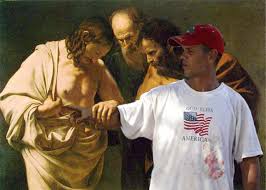
Today’s gospel relates the story of “Doubting Thomas.” The picture is familiar. The apostles have locked themselves in the Upper Room, cowering in the very place where they recently shared a Last Supper with their beloved Yeshua.

Even in that hallowed space, FEAR is the watchword of their days and nights. The apostles are afraid of the Temple authorities. They’re afraid of the Romans. In the light of Judas’ betrayal, they might even be afraid of one another.

Then suddenly, Yeshua materializes in their midst. His message: “Why all this fear?  Be at peace instead.”

Thomas, of course, is absent. When he hears the tale of the risen Master, he refuses to believe.

So Yeshua materializes once again – this time for Thomas’ benefit.  As in his first appearance, the risen one identifies himself by his wounds. (The point is crucial.) He makes the doubter probe the gashes with his hand and finger. It’s Yeshua’s reminder that his peace is based on vulnerability, not on the security of locked doors.

“My God, it is you after all!” Thomas realizes.

“Yes, it is,” Yeshua affirms.

Then he turns his attention to us.  “Blessed are you,” he says across the centuries, “who believe without the proof I’ve just offered Thomas.”

The blessing might just as well be an indictment. For the evidence shows we don’t really believe in the resurrection. (And I’m not talking about resuscitation of a corpse.) We don’t really believe in the peace Yeshua brings – new life without fear – new life based on vulnerability.

Instead, we cover ourselves in armor afraid of being hurt. In this “home of the brave” where 70.6% claim to be followers of Jesus, EVERYTHING is governed by fear. It’s as if following Jesus were not about willingness to be wounded, but about self-protection at all costs. It’s as though Jesus’ greeting to his friends were, “BE AFRAID; BE VERY AFRAID!”

That’s the gospel our politicians preach every day. And the church says “Amen.”

So to protect our pitiful way of life, we lock and bar our borders against the refugees our wars and trade policies create. From the safety of air-conditioned theaters our heroic servicemen drone wedding goers or funeral mourners 10,000 kilometers away. They do so on suspicion that the revelers and mourners might one day, possibly intend us harm. Alternatively, our naïve representatives level entire cities from a safe distance of 35,000 feet – never seeing the heads their bombs severe more gruesomely than by knife.

We’re afraid of Muslims. To protect ourselves from them and from each other, we insist on carrying guns everywhere – in our homes, schools, churches and public meetings. We pass “Stand Your Ground Laws.” We imprison one another at the highest rate on the planet. We punish and execute rather than rehabilitate and forgive. Each day we spend nearly $1 billion on “defense,” all the while claiming we have no money for health care or to relieve student debt.  Whites fear African-Americans. We empower our police to kill them with impunity — excused every time by recitation of the cowardly mantra: “I feared for my life.”

Of course, none of that has anything to do with Yeshua the Christ. In fact, it patently contradicts the Holy Spirit conferred by the Prophet in today’s narrative.

To repeat:  that Spirit is premised on willingness to be wounded. Accordingly, it would open borders, radically disarm, reduce military budgets by 60%, demilitarize the police, and eliminate capital punishment. It would embrace non-violence and prison reform.

There is only one thing that makes all of that “unrealistic:” FEAR – unwillingness to face the implications of recognizing Jesus’ wounded body.

So do we believe in resurrection or not? Are Jesus’ words a blessing or an indictment?

If the latter, what will we do this week – what will we do at the ballot box next November – to make it the former?

(Discussion follows)

Go Ahead: Blame My Crazy Thinking on Poetry! (Personal Reflections, Pt. VIII)

Golden Treasury

I skipped this “personal reflections” blog entry last week, because of a delightful visit by our four grandchildren over their spring break from Montessori School. So I was out scootering on Berea’s campus, eating ice cream, making breakfast pancakes, playing “Candyland,” and generally horsing around  for a week with Eva (age 7), Oscar (5), Orlando (3), and Markandeya (1 ½).  It was all great fun – unforgettable moments to treasure now and anticipate in the future.

It was all much more rewarding even than fashioning a blog entry, which I also love to do – though not nearly as much as being “Baba” for those four.

In the meantime, I heard from friends who could relate personally to what I had written about my best college professor, Fr. James Griffin. More than one former classmate had similar reminiscences of “Tiffer” (as we used to call him). Others with different backgrounds recalled professors like him who were  demanding, uncompromising , and (above all) eye-opening about literature, images, metaphors, similes, that (in the Tiff’s words) “capture, contain, and communicate” the reality they symbolize.

Many of us were also blessed with teachers of rhetoric who demanded short sentences confined as much as possible to subject-verb-object constraints (SVO! SVO!).

Such exchanges with friends made me realize that I could blame Fr. Griffin for the “Hamilton” fiasco I recounted at the beginning of this series.

Remember that Fr. Griffin had us wearing out our paperback Palgrave’s Golden Treasury of Poetry. We had to read and reread those metaphysical poets, keeping track of the images they used and finding new meaning in those word-pictures each time. Similarly we combed through Shakespeare, Dickens, Jane Austen and others. We learned to interact with their characters and talk about their thoughts, actions and motives as though those fictional women, children, and men were agents of flesh and blood. (I remember falling in love with Elizabeth in Pride and Prejudice and Nancy in Oliver Twist.)

Such readings had us constantly looking below the surface for hidden meanings and feeling triumphant and increasingly confident when we discovered them.

And there’s the “Hamilton” connection. My response to the play wasn’t the first time my children objected to my diving below the surface to reach some “outlandish” conclusion. For instance, I remember us arguing about my take on Tom Hanks’ “Captain Philips.” I saw it as a typical self-congratulatory “cavalry to the rescue” story that demeans indigenous people while exalting the U.S. military. (You can read my review here.)

Such “readings” of literature – and life – are guided by questions like these:

  • What’s really being said here?
  • What’s not being said?
  • What’s apparent?
  • What’s not?
  • Whose class interests are being served here – the oppressors’ or that of the oppressed?
  • What’s the ideology behind this presentation?
  • Does it support the status quo or subvert it?
  • How does this relate to history as told by Howard Zinn’s A People’s History of the United States, or by Eduardo Galeano’s The Open Veins of Latin America, or by Walter Rodney’s How Europe Underdeveloped Africa, or of Monica Sjoo’s The Great Cosmic Mother?
  • What can I learn from this about my own life?

That’s the sort of thing I began to learn from Fr. Griffin during my freshman and sophomore years at our seminary in Milton, Massachusetts. Later on, people called it “critical thinking.”  And (to be truthful), the approach sunk in only gradually over the years. I mean it’s not like I suddenly became a critical thinker as a college freshman or sophomore. On the contrary, I was mostly reluctant to challenge received wisdom. Remember I was trying to be an obedient model seminarian who followed all the rules.

(Next week: Learning to Read Even the Bible with Critical Perspective)

Did Jesus Really Rise from the Dead?

Resurrection

Readings for Easter Sunday:ACTS 10:34A, 37-43; PS 118: 1-2, 16=17, 22-23; COL 3:1-4; JN 20: 1-4.

Did Jesus really rise from the dead? Or is belief in his physical resurrection childish and equivalent to belief in the Easter Bunny or Santa Claus?

I suppose the answer to those questions depends on what you mean by “really.” Let’s look at what our tradition tells us.

Following Jesus’ death, his disciples gave up hope and went back to fishing and their other pre-Jesus pursuits. Then, according to the synoptic gospels, some women in the community reported an experience that came to be called Jesus’ “resurrection” (Mt. 28:1-10; Mk. 16: 1-8; Lk. 24:1-11). That is, the rabbi from Nazareth was somehow experienced as alive and as more intensely present among them than he was before his crucifixion.

That women were the first witnesses to the resurrection seems certain. According to Jewish law, female testimony was without value. It therefore seems unlikely that Jesus’ followers, anxious to convince others of the reality of Jesus’ resurrection, would have concocted a story dependent on women as primary witnesses. Ironically then, the story’s “incredible” origin itself lends credence to the authenticity of early belief in Jesus return to life in some way.

But what was the exact nature of the resurrection? Did it involve a resuscitated corpse? Or was it something more spiritual, psychic, metaphorical or visionary?

In Paul (the only 1st person report we have – written around 50 C.E.) the experience of resurrection is clearly visionary. Paul sees a light and hears a voice, but for him there is no embodiment of the risen Jesus. When Paul reports his experience (I Cor. 15: 3-8) he equates his vision with the resurrection manifestations to others claiming to have encountered the risen Christ. Paul writes “Last of all, as to one untimely born, he appeared also to me.”

In fact, even though Paul never met the historical Jesus, he claims that he too is an “apostle” specifically because his experience was equivalent to that of the companions of Jesus who were known by  name. This implies that the other resurrection appearances might also be accurately described as visionary rather than physical.

The earliest gospel account of a “resurrection” is found in Mark, Ch. 16. There a “young man” (not an angel) announces Jesus’ resurrection to a group of women (!) who had come to Jesus’ tomb to anoint him (16: 5-8). But there is no encounter with the risen Jesus.

In fact, Mark’s account actually ends without any narrations of resurrection appearances at all. (According to virtually all scholarly analysis, the “appearances” found in chapter 16 were added by a later editor.) In Mark’s original ending, the women are told by the young man to go back to Jerusalem and tell Peter and the others. But they fail to do so, because of their great fear (16: 8). This means that in Mark there are not only no resurrection appearances, but the resurrection itself goes unproclaimed. This makes one wonder: was Mark unacquainted with the appearance stories? Or did he (incredibly) not think them important enough to include?

Resurrection appearances finally make their own appearance in Matthew (writing about 80) and in Luke (about 85) with increasing detail. Always however there is some initial difficulty in recognizing Jesus. For instance Matthew 28:11-20 says, “Now the eleven disciples went to Galilee, to the mountain to which Jesus had directed them. And when they saw him they worshipped him; but some doubted.” So the disciples saw Jesus, but not everyone was sure they did. In Luke 24:13-53, two disciples walk seven miles with the risen Jesus without recognizing him until the three break bread together.

Even in John’s gospel (published about 90) Mary Magdalene (the woman with the most intimate relationship to Jesus) thinks she’s talking to a gardener when the risen Jesus appears to her (20: 11-18). In the same gospel, the apostle Thomas does not recognize the risen Jesus until he touches the wounds on Jesus’ body (Jn. 26-29). When Jesus appears to disciples at the Sea of Tiberius, they at first think he is a fishing kibitzer giving them instructions about where to find the most fish (Jn. 21: 4-8).

All of this raises questions about the nature of the “resurrection.” It doesn’t seem to have been resuscitation of a corpse. What then was it? Was it the community coming to realize the truth of Jesus’ words, “Whatever you do to the least of my brethren, you do to me” (Mt. 25:45) or “Wherever two or three are gathered together in my name, I am there in their midst” (Mt. 18:20)? Do the resurrection stories reveal a Lord’s Supper phenomenon where Jesus’ early followers experienced his intense presence “in the breaking of the bread” (Lk. 24:30-32)?

Some would say that this “more spiritual” interpretation of the resurrection threatens to destroy faith.

However, doesn’t such perception of threat reveal a quasi-magical understanding of faith? Does it risk limiting faith to belief in a God who operates outside the laws of nature and performs extraordinary physical feats that amaze and mystify? Doesn’t it flatten the significance of resurrection belief to simply one more “proof” of Jesus’ divinity?

But faith doesn’t seem to be principally about amazement, mystification and proof analogous to the scientific. It is about meaning.

And regardless of whether one believes in resurrection as resuscitation of a corpse or as a metaphor about the spiritual presence of God in communities serving the poor, the question must be answered, “What does resurrection mean?”

Surely it meant that Jesus’ original followers experienced a powerful continuity in their relationship Jesus even after his shameful execution. Their realm of experience had expanded. Both Jesus and his followers had entered broadened dimensions of time and space. They had crossed the threshold of another world where life was fuller and where physical and practical laws governing bodies and limiting spirits no longer applied. In other words, the resurrection was not originally about belief or dogma. It was about a realm of experience that had at the very least opened up in the context of sharing bread – in an experience of worship and prayer.

Resurrection meant that another world is possible — in the here and now! Yes, that other world was entered through baptism. But baptism meant participation in a community (another realm) where all things were held in common, and where the laws of market and “normal” society did not apply (Acts 2:44-45).

In order to talk about that realm, Jesus’ followers told exciting stories of encounters with a revivified being who possessed a spiritual body, that was difficult to recognize, needed food and drink, suddenly appeared in their midst, and which just as quickly disappeared. This body could sometimes be touched (Jn. 20:27); at others touching was forbidden (Jn. 20:17).

Resurrection and Easter represent an invitation offered each of us to enter the realm opened by the risen Lord however we understand the word “risen.” We enter that realm through a deepened life of prayer, worship, community and sharing.

We are called to live in the “other world” our faith tells us is possible – a world that is not defined by market, consumption, competition, technology, or war.

Pope Francis’ encyclical, Laudato Si’ supplies the details.

(Palm Sunday Homily) Christians Supporting Donald Trump: How Luke’s Passion Narrative Prepared the Way

Trump & Jesus

 Readings for Palm Sunday: LK 19:28-40; IS 50: 4-7, PS 22: 8-9, 12-20, 23=24, PHIL 2:6-11, LK 22: 14-23:58.

It’s puzzling to see white Evangelicals rallying around Donald Trump. He’s the presidential candidate who owns casinos and strip clubs, and who has been married three times.

His pre-candidacy positions on social issues conflict with those Evangelicals have considered sacrosanct in the recent past. As Michael Moore points out, Trump has been pro-choice, pro-gun control, and a supporter of Planned Parenthood. He’s been in favor of gay marriage, raising the minimum wage, and single payer health care. Trump has been pro-union (at least in the private sphere), and has proposed a one-time 14% tax on the accumulated wealth of the super-rich in order to retire the U.S. national debt (i.e. to enrich the banksters).

In the foreign policy sphere, Mr. Trump advocates torture beyond water boarding. His desire to “make America great again” leads him to propose intensified wars in the Middle East, building a wall across the U.S.-Mexican border, filling Guantanamo with even more prisoners, and evicting Muslims from the United States.

How is it possible for white evangelicals to support such a candidate? On the one hand, his personal life and long-standing positions on the “social issues” conflict with what such believers have deemed undebatable in the past. And on the other hand, Trump’s foreign policies conflict with the teachings and example of Jesus himself.

After all, Jesus was a poor laborer who criticized the rich in the harshest of terms. He and his family knew what it was like to be unwelcome immigrants (in Egypt). He was a victim of torture, not its administrator. Far from a champion of empire, he was executed as a terrorist and enemy of Rome.  His followers were not about accumulating wealth, but shared what they had according to ability and need.

When you think of it, all of this seems antithetical to not only to Trumpism, but to the positions of virtually all the candidates for president this election year. They’re all imperialists. All of them (except Bernie Sanders) are friends of the one-percent. They all want to increase military spending which now costs taxpayers about a billion dollars a day.

How did all of that happen?

Today’s Palm Sunday readings provide some clues. Luke’s Passion Narratives reveal a first century Christian community already depoliticizing Jesus in order to please Roman imperialists. The stories turn Jesus against his own people as though they were foreign enemies of God.

Think about the context of today’s Palm Sunday readings.

Note that Jesus and his audiences were first and foremost anti-imperialist Jews whose lives were shaped more than anything else by the Roman occupation of their homeland. As such, they weren’t waiting for a Roman-Greco “messiah” who, like the Sun God Mithra, would die and lead them to heaven. They were awaiting a Davidic messiah who would liberate them from the Romans.

So on this Palm Sunday, what do you think was on the minds of the crowds who Luke tells us lined the streets of Jerusalem to acclaim Jesus the Nazarene? Were they shouting “Hosanna! Hosanna!” (Save us! Save us!) because they thought Jesus was about to die and by his sacrificial death open the gates of heaven closed since Adam’s sin by a petulant God? Of course not. They were shouting for Jesus to save them from the Romans.

The palm branches in their hands were (since the time of the Maccabees) the symbols of resistance to empire. Those acclaiming Jesus looked to him to play a key role in the Great Rebellion everyone knew about to take place against the hated Roman occupiers.

And what do you suppose was on Jesus’ mind? He was probably intending to take part in the rebellion just mentioned. It had been plotted by the Jews’ Zealot insurgency. Jesus words at the “Last Supper” show his anticipation that the events planned for Jerusalem might cause God’s Kingdom to dawn that very weekend.

Clearly Jesus had his differences with the Zealots. They were nationalists; he was inter-nationalist who was open to gentiles. The Zealots were violent; Jesus was not.

And yet the Zealots and Jesus came together on their abhorrence of Roman presence in the Holy Land. They found common ground on the issues of debt forgiveness, non-payment of taxes to the occupiers, and of land reform. Within Jesus’ inner circle there was at least one Zealot (Simon). Indications might also implicate Peter, Judas, James, and John. And Jesus’ friends were armed when he is arrested. Whoever cut off the right ear of the high priest’s servant was used to wielding a sword – perhaps as a “sicarius” (the violent wing of the Zealots who specialized in knifing Roman soldiers).

But we’re getting ahead of our story. . . Following his triumphant entry into Jerusalem, Jesus soon found himself and his disciples inside the temple participating in what we’d call a “direct action” protest. They were demonstrating against the collaborative role the temple and its priesthood were fulfilling on behalf of the Romans.

As collaborators, the temple priests were serving a foreign god (the Roman emperor) within the temple precincts. For Jesus that delegitimized the entire system. So, as John Dominic Crossan puts it, Jesus’ direct action was not so much a “cleansing” of the temple as the symbolic destruction of an institution that had completely lost its way.

It was this demonstration that represented the immediate cause of Jesus’ arrest and execution described so poignantly in today’s long gospel reading.

Following the temple demonstration, Jesus and his disciples became “wanted” men (Lk. 19:47). At first Jesus’ popularity affords him protection from the authorities (19:47-48). The people constantly surround him eager to hear Jesus’ words denouncing their treasonous “leaders” (20:9-19), about the issue of Roman taxation (20:20-25), the destruction of the temple (21:1-6), the coming war (21:20-24) and the imminence of God’s Kingdom (21:29-33).

Eventually however, Jesus has to go underground. On Passover eve he sends out Peter and John to arrange for a safe-house to celebrate the feast I mentioned earlier. The two disciples are to locate the “upper room.” They do so by exchanging a set of secret signs and passwords with a local comrade.

Then comes Jesus’ arrest. Judas has betrayed Jesus to collect the reward on Jesus’ head – 30 pieces of silver. The arrest is followed by a series of “trials” before the Jewish Council (the Sanhedrin), before Pilate and Herod. Eventually, Jesus is brought back to Pilate. There he’s tortured, condemned and executed between two other insurgents.

Note that Luke presents Pilate in way completely at odds with what we know of Pilate as described for example by the Jewish historian Josephus. After the presentation of clear-cut evidence that the Nazarene rabbi was “stirring up the people,” and despite Jesus’ own admission to crimes against the state (claiming to be a rival king), Pilate insists three times that the carpenter is innocent of capital crime.

Such tolerance of rebellion contradicts Crossan’s insistence that Pilate had standing orders to execute anyone associated with lower class rebellion during the extremely volatile Passover festivities. In other words, there would have been no drawn-out trial.

What’s going on here? Two things.

First of all, like everyone else, Luke knew that Jesus had been crucified by the Romans. That was an inconvenient truth for Luke’s audience which around the year 85 CE (when Luke wrote) was desperately trying to reconcile with the Roman Empire which lumped the emerging Christian community with the Jews whom the Romans despised.

Luke’s account represents an attempt to create distance between Christians and Jews. So he makes up an account that exonerates Pilate (and the Romans) from guilt for Jesus’ execution. Simultaneously, he lays the burden of blame for Jesus’ execution at the doorstep of Jewish authorities.

In this way, Luke made overtures of friendship towards Rome. He wasn’t worried about the Jews, since by the year 70 the Romans had destroyed Jerusalem and its temple along with more than a million of its inhabitants. After 70 Jewish Christians no longer represented the important factor they once were. Their leadership had been decapitated with the destruction of Jerusalem.

Relatedly, Jesus’ crucifixion would have meant that Rome perceived him as a rebel against the Empire. Luke is anxious to make the case that such perception was false. Rome had nothing to fear from Christians.

I’m suggesting that such assurance was unfaithful to the Jesus of history. It domesticated the rebel who shines through even in Luke’s account when it is viewed contextually.

And so what?

Well, if you wonder why Christians can support Donald Trump . . . if you wonder why they so easily succumb to empires (Roman, Nazi, U.S.) you’ve got your answer. It all starts here – in the gospels themselves – with the great cover-up of the insurgent Jesus.

And if you wonder where the West’s and Hitler’s comfort with xenophobia in general and anti-Semitism in particular come from, you have that answer as well.

The point here is that only by recovering the obscured rebel Jesus can Christians avoid the mistake they made 80 years ago. Then instead of singing “Hosanna” to Jesus, they shouted “Heil Hitler!” to another imperialist torturer, xenophobe, and hypocrite.

The readings for Palm Sunday present us with a cautionary tale about these sad realities.

Fr. James Griffin: My Best College Professor (Personal Reflections Pt. VII)

Einstein

Last week I got a bit side tracked in my efforts to explain my growth in consciousness writing perhaps with excessive detail about the minutia of life in the minor (high school) seminary. “TMI,” my wife counselled.  So I dropped plans to share further episodes from the minor seminary.

Instead, let me get back on track this week by referring to an experience that directly helped me wake up from my culturally narrow stupor. (That, after all, is the purpose of these stories to my children.)

His name was Fr. James Griffin and he was indeed an experience.

Father Griffin was my English Professor each semester during my freshman and sophomore years in St. Columban’s College Seminary in Milton Massachusetts. He came from Ireland and was perhaps 50 years old at the time.

Father Griffin was a tough and merciless critic. He would review our papers in class, demanding that we stand up individually beside our desks while he ridiculed our errors, naiveties, and superficialities before our peers.

On one occasion, he got me on my feet for such purpose. He looked me in the eye, looked down at my paper, returned his gaze to mine, and then crumpled my essay into a ball and threw it in the wastebasket. “Sit down, Mr. Seul, he growled without comment. That was it.

Those first months as a freshman, I was terrified and dreaded English classes. I actually prayed that our professor would be sick and not show up. His health was delicate; so my petitions were often answered.

However, Father Griffin taught me how to write. “Keep your sentences short,” he demanded: subject/verb/ object – SVO. Keep that in mind.  I don’t want to read anything longer than that!”

He also gave me an appreciation of poetry, art, and classical music. He was our choir director.  He called all of us “Philistines” because he found us so uncouth and without a shred of culture. “You’re only interested in ‘shooting hoops’ (Isn’t that what you call it?)” he sneered.

Nonetheless, Father Griffin would bring his Wollensack tape recorder to choir practice and play German lieders for us.  He once sat with us through a televised concert by Pablo Casals.  His main text was Palgrave’s Golden Treasury of Poetry. By the end of my sophomore year, all of our copies were in tatters.

That’s because Father Griffin required us to read and re-read the Renaissance and Metaphysical poets keeping a journal of successive “encounters with the text” – always required to find something new. We assessed again and again the love poems of John Donne and Robert Herrick. Fr. Griffin enjoyed repeating Herrick’s lines.

WHENAS in silks my Julia goes
Then, then (methinks) how sweetly flows
That liquefaction of her clothes.
Next, when I cast mine eyes and see
That brave vibration each way free;          5
Oh how that glittering taketh me!


With the conclusion of that last line, he would invariably break out in a broad smile that revealed the pronounced gap between his two front teeth. He was great.

Yes, I came to treasure Father Griffin. He once astounded my puritanical sensibilities by talking of the love affairs of poets and artists. He remarked with a smile that they’re guided by exceptional moral standards beyond our ken. “Don’t blame them,” he advised.

Principally, Father Griffin helped me become a critical reader sensitive to images, symbols, metaphors and similes. He defined images as literary devices that “capture, contain, and communicate what they symbolize.”

I’ve since thought a great deal about that in the context of Catholic faith and what Protestants traditionally see as Catholics’ infamous devotion to “images” and our belief in the “Real Presence” of Jesus in the “Blessed Sacrament.”

Critics insist that the bread and wine of the Lord’s Supper are “just symbols.” And to a large extent they have a point.

I however would add that such images are SYMBOLS. That is, in Father Griffin’s words, they “capture, contain, and communicate what they symbolize” – viz. the Real Presence of the saints and especially of Jesus. In fact, all language about God (and life) is symbolic. Our theologies can’t get us much closer to divine reality than that.

More generally, Father Griffin taught me that words are powerful. They transform; they shift shapes, perceptions and therefore reality itself. The pen is indeed mightier than the sword. Once a new understanding has been internalized, the world can never be the same. Absolutes become relativized; certainties crumble.

With such instruction, Father Griffin prepared me for my subsequent scripture studies in the major seminary. It helped me approach biblical texts with the confidence that I could read them without excessive dependence on what the “experts” had to say. It also eventually helped me approach the text of my own life with similar self-confidence. I can unpack and understand it without undue regard for what others say.

Father Griffin was also a golfer. Once in Ireland after ordination while I attending a “Chapter” (i.e. a leadership conference) of the Society of St. Columban I played a round with him. We had a great time. And I had the chance to tell him how important he was in my own development.

He seemed surprised, but clearly appreciated that.

Later I heard that Jim was also surprised about my leaving the priesthood. He thought I’d be the least likely of all to leave the Society of St. Columban. He didn’t know, of course, that what he taught me about critical thinking played such a role in moving me out.

Thank you, Jim. I remember you every day in my prayers.

(Sunday Homily) “Thank You, Lord, for Not Making Me a Woman”

adultery

Readings for 5th Sunday of Lent: Is. 43:16-21; Ps. 126:1-6; Phil. 3: 8-14; Jn. 8: 1-11.

Three years ago, President Obama reauthorized the Violence against Women Act of 1994. This time the bill was expanded to cover lesbian, transgender and bisexual women. It also recognized the special circumstances of Native American women and of immigrants who according to government statistics are more likely to be raped and/or beaten than other women.

Some of our Catholic bishops disagreed with the legislation. In part, they said recognizing the rights of LGBT women undermined the “meaning and importance of sexual difference.” The changes, they said, might be “. . . exploited for purposes of marriage redefinition.” After all, they reasoned, “. . . marriage is the only institution that unites a man and a woman with each other and with any children born from their union.”

All of that is important because in today’s gospel, Jesus quietly decrees his own Violence against Women legislation. Better put, he literally performs (acts out) his own Violence against Women anti-legislation. His defiance of biblical law marks out a position quite different from the one taken by the bishops just mentioned.

Here’s what I mean: Jewish law punished adultery with death by stoning. That was a biblical requirement – one that many Muslims today still honor in their fundamentalist interpretation of the Bible. However the Jewish patriarchy applied that law differently to men and women. A man, they said, committed adultery only when he slept with another married woman. But if he slept with a single woman, a widow, a divorced woman, a prostitute or a slave, he remained innocent. A woman, on the other hand committed adultery if she slept with anyone other than her husband.

Of course, great injustices were committed in the name of this law. Often rumors and outright lies led to the death of innocent women. In many cases, the ones throwing the stones of execution were men who had spent their whole lives deceiving their wives.

Jesus calls attention to such hypocrisy and double standards in today’s gospel episode. All the elements of last week’s very long parable of the Prodigal Son are here. Jesus is teaching in the temple surrounded by “the people” – the same outcasts, we presume, that habitually hung on his every word.

Meanwhile, the Scribes and Pharisees are standing on the crowd’s edge wondering how to incriminate such a man? As if ordained by heaven, an answer comes to them out of the blue. A woman is hustled into the temple. She’s just been caught in flagrante – in the very act of adultery. What luck for Jesus’ opponents!

“Master,” they say, “This woman has just been caught in the act of adultery. As you know, the Bible says we should stone her. But what do you say?” Here Jesus’ enemies suspect he will incriminate himself by recommending disobedience of the Bible’s clear injunction. After all, he is the compassionate one. He is especially known for his kindness towards women – and others among his culture’s most vulnerable.

But instead of falling into their trap, Jesus simply preaches a silent parable. He first scribbles on the ground. Only subsequently does he s speak — but only 18 words, “Let the one among you who is without sin be the first to throw a stone at her.”

A wordless parable . . . . What do you suppose Jesus was scribbling on the ground? Was he writing the names of the guilty hypocrites who had cheated on their wives? Was he writing the laws the Scribes and Pharisees were violating? Some say he was simply drawing figures in the dust while considering how to reply to his opponents?

The first two possibilities seem unlikely. How would this poor country peasant from Galilee know the names of the learned and citified Scribes and Pharisees? It is even unlikely that Jesus knew how to write at all. That too was the province of the Scribes. The third possibility – that Jesus was absent-mindedly drawing figures in the dust – is probably closer to the mark.

However, it seems likely that there was more to it than that. It seems Jesus was performing some kind of symbolic action – that mimed parable I mentioned. By scribbling in the dust, he was wordlessly bringing his questioners down to earth. He was reminding them of the common origin of men and women?

Both came from the dust, Jesus seems to say without words. The creation stories in Genesis say both men and women were created from dust and in God’s image – equal in the eyes of God. “In God’s image God created them. Man and woman created he them,” says the first creation account (Genesis 1:27). By scribbling in the dust, Jesus was symbolically moving the earth under the feet of the Scribes and Pharisees. He was gently but strongly asserting that they had no ground to stand on. They were hypocrites.

Then his 18 word pronouncement offers Jesus’ own standard for judging the guilt of others. According to that standard, one may judge and execute only if he himself is without sin. This, of course, means that no one may judge and execute another. All of us are sinful.

What genius in this silent parable! As usual, Jesus outsmarts his interlocutors. They ask him an incriminating question. He refuses to answer, but instead turns their own question against them. They want to know about guilty women and the patriarchal law governing their sexuality. Instead, Jesus’ scribbling redirects the question to something more basic – the very ground his opponents are standing upon and to God’s first law regarding human beings, both men and women. Equality precedes patriarchy and its law, Jesus says without even uttering a word.

And that brings us back to our Catholic bishops and their reasons for opposing the Violence against Women Act. As you recall, they were concerned about the “meaning and importance of sexual difference.” Jesus own Violence against Women Act points in the opposite direction – towards sexual similarity and the original unity of men and women that transcends biology.

Later on St. Paul will give clearer expression to Jesus’ basic insight. In today’s epistle, he claims that his understanding of everything has changed since he began living “in Christ.” In Galatians 3: 26-28, he’ll get even more specific. He’ll say “In Christ there is neither Jew nor Greek, there is neither slave nor free, there is neither male nor female; for you are all one in Christ Jesus (Galatians 3:26-28).

Have the bishops thought about the implications of these biblical words in terms of same-sex marriage? If in Christ there are no males or females, but only persons, does that not mean that any human beings who love one another (regardless of their merely biological differences) may marry?

And finally, Jesus’ silent rearranging of “ground” along with his 18 words seem to call into question the very foundation of the bishops’ right to authoritatively pronounce on sexual matters. They, after all, are the ones who denied, covered-up, and excused sexual deviance on the part of the clergy they were responsible for overseeing – and whose overriding (public) concern has centered on sexual purity. Does that not dictate that the bishops and their priests have no ground to stand upon in the field of sexual morality? Isn’t it time for them to silently slink away along with their Scribe and Pharisee counterparts, and to replace judgmentalism with Jesus’ forgiveness and compassion?

Jesus’ silent assertion of gender equality along with the words Paul adds to Jesus’ mime direct all of us to reconsider our double standards and preconceptions about men and women. Paul’s words in Galatians are especially important. They reverse a prayer first century Jewish men would recite each morning. The prayer went, Blessed are you, Lord, for making me a Jew and not a Gentile, for making me free and not a slave, and for making me a man and not a woman.”

Certainly, Jesus was taught that prayer by his pious father, Joseph. Perhaps for most of his life, Jesus recited that prayer on a daily basis. But something must have happened to him to change his faith. We’ll never know what that “something” or someone was.

We do know however what happened to Paul; as he says this morning he entered “into Christ.” And that turned all his previous perceptions “to rubbish” – including evidently his fundamentalist understandings of biblical law like the one commanding the stoning of adulterous women or alleging the superiority of men.

After all, if Jesus thought like the Catholic bishops I mentioned, he would have thrown the first stone. He alone in that group was without sin. He would have thought, “Forgiving this woman will seem like condoning adultery. And condoning adultery might lead to abortions of the pregnancies that result. Not throwing the first stone will also lessen the authority of the Bible which clearly justifies punishing women for adultery. I’ve got to do it.”

Luckily for the woman taken in adultery (and for the rest of us), Jesus wasn’t a fundamentalist – or a Roman Catholic bishop. He was an opponent of Violence against Women.

Life in the High School Seminary and What I Learned: Personal Reflections (Pt. VI)

Vocation

A good friend of mine responded to last week’s “Personal Reflections” by observing that my studies in the minor seminary from 1954-’58 hardly sounded  like what I described as “a standard high school curriculum.” To begin with, there was all that emphasis on classical languages. And then there was the rigor and regularly of the study regime in the absence of television, newspapers, and the distractions of girls and the accompanying social life.

So on second thought, I think my friend might be right. You be the judge.

However, the point here is not to convey information about my youth. It is rather to explain the foundation for my growth in consciousness towards those “crazy ideas” my kids complain about. I’m trying to get at how I grew from American nationalism and Catholic exclusivism to what I’d call a Cosmo-centric Mysticism that centralizes a “preferential option for the poor.” Surprisingly, all of that got its start in the high school seminary I wrote about last week.

Let me say a few more things about that experience and what it taught me. A lot had to do with discipline, survival, and introduction to the spiritual life.

As far as I can recall, our days at the minor seminary in Silver Creek, New York (and throughout my seminary years with suitable variations as we got older) were structured like this:  We got up each morning at 6:30 (7:00 on Sundays). We were in chapel at 7:00 for Morning Prayer followed by Mass and time for prayers of thanksgiving afterwards. Except on special occasions, meals were taken in silence, while we all listened to one of us read from Sacred Scripture, the lives of the saints, or some inspirational book. After breakfast (8:00-8:30) we had “free time” to make our beds and get ready for class at 9:00. Mondays, Tuesdays, Thursdays and Fridays we had three classes in the morning and one in the afternoon. Wednesdays and Saturdays there was no afternoon class; it was replaced by extended recreation periods during which we engaged in organized sports or outdoor work projects.

Except on Wednesdays and Saturdays, afternoon recreation ran from 12:30 till 2:00. Afternoon class would occupy us till just before 3:00. Then we’d have supervised study hall till 4:30 followed by a half-hour of spiritual reading. (The study hall priest-supervisor would patrol the long lines of desks making sure we weren’t reading novels on the sly.) After that, there was Rosary and Vespers at 5:00, then supper at 5:30. This was followed by a period for chores and recreation till 7:00. Study hall would resume then and run till 8:30, when we’d be allowed a half hour for recreational reading of approved novels.  Night prayer began at 9:00. Lights-out came at 10:00. The Great Silence reigned from night prayer till after breakfast the following morning.

Sundays we’d have a second Mass. And then there’d be intra-mural sports in the morning and extended free time in the afternoon. That’s when we could go on hikes to a nearby Howard Johnsons or somewhere for milkshakes or sundaes. Late Sunday afternoons we had a letter-writing period from 4:00-5:00 to keep us in touch with our families (no phone calls were allowed). Sunday evenings we’d have meetings of the Literary, Scientific, and Debating Society one week and of the Catholic Students’ Mission Crusade the next. We all took turns delivering papers at those meetings and serving as club officers. On special occasions, there’d be a movie. And on really special feasts (like St. Columban’s Day) we’d perform dramatic or comic plays (which, of course, required lots of rehearsals). Most of us got used to being on stage. Much later, in the major seminary (at the age of 24 and 25), I actually had the lead roles in Agatha Christie’s “The Mousetrap,” and in “Brother Orchid.”

Of course, not everyone responded to seminary discipline in the same way. Early on I saw that there were three seminarian types. There were those who “jacked around” (That’s what we called it) as much as they could. They took everything with a grain of salt and were always in trouble with the authorities. They fooled around in study hall. They habitually broke the Great Silence.  Eventually all those Jackers got bounced.

Then there were those who were mildly serious about the whole seminary routine; most of the survivors fell into that category. Psychologically they were probably the healthiest of any of us.

Finally there were the “saints.” They never jacked around, or broke the Great Silence. They practiced “custody of the eyes,” and always kept the rules. Almost invariably they were good athletes and smart students. I quickly decided to become like them.

I was “rewarded” (although it didn’t feel like that) by being made senior of my class mid-way through the first term of my freshman year at the Creek. That meant I was the liaison between my 31 classmates and the dean and rector of the seminary. That put me in line to be the Senior of the House (student body president) during my fourth year. That sort of thing happened to me throughout my 13 years of seminary training — mostly because I was a pious, obedient rule-keeper. My guides were a behavior manual called The Young Seminarian along with Thomas a Kempis’ classic The Imitation of Christ.

It also helped that I was trying hard to be a straight-A student. However I never quite made it into that category in the high school seminary. That would come later. Intellectually, I was a late bloomer and in high school had to settle for “Second Honors,” as they called it. My status in the eyes of seminary authorities was also helped by the fact that I liked sports and was good at them. That was important as well in the seminary pecking order among my peers.

While at the Creek, I used to hear our dean, John Healey, repeat, “You can take a boy out of Silver Creek, but you can’t take Silver Creek out of a boy.” I believe he was right. So much of Silver Creek remains part of who I am.

But what exactly has remained from the unusual training I received there. How did it contribute to my crazy ideas? After all, I’ve forgotten the rules for Latin ablative absolutes and how to form the conditional tense of irregular verbs ending in ere. I can no longer even pronounce Greek texts, much less translate them.  When I look at pictures from those days gone by, I can’t, of course, remember everyone’s name.

Yet many lessons remain valid for me. They come largely from the spiritual seeds that were planted so long ago by our unquestionably caring professors. They also come from living in community with boys like me who were the first in their families to aspire to post-secondary education. My peers were the sons of policemen, firemen, delivery truck drivers, and construction workers. (I don’t remember a single one referring to parents who attended college.) I remember all of my companions as clever, high-spirited, and often comically gifted. Many of them remain good friends – among the best I’ve ever had, even though these days we rarely connect directly.

Here are a few of the lasting lessons we learned together from living together, from our professors and from The Rule. Despite appearances, none of them are intended as clichés. I treasure these learnings:

  • There is a fundamental opposition between “the world” and its values and what Jesus called “the Kingdom of God.”
  • The values of “the world” are deceptive, illusory and not worth the effort. They promise happiness as the result of pursuing power, pleasure, profit and prestige. None of those things are what life and happiness are really about.
  • Instead, life is about what I identify as “working-class values:” family, hard work, cooperation, shared common property, and hospitality as opposed getting ahead and accumulating differentiating wealth. (Later on, I’ll share the theory about this – i.e. how the poor actually know much more about life than the rich.)
  • I don’t need much to be content – and I don’t believe anyone does. Shared community, nourishing food, a roof over one’s head, decent clothes (in the major seminary we wore the same outer garments every day) and stimulating ideas (education) are enough. Simple is better than complex.
  • One’s interior life is far more important than exterior comfort. In the end, life and “salvation” are about waking up to the illusions foisted upon us by “the world” and replacing them with the simplicity of the working class values just mentioned.

Personally, it would be many years before I would realize that I learned those things in Silver Creek and later in the major seminary and novitiate. In so many ways, when I left Silver Creek I was still asleep and would remain so for many years. To a great extent I’m still shaking the drowsiness from my head.

“The World” is seductive.

(More about seminary life and its painful lessons next week)