Jesus Decides to Redeem His Wasted Life (Sunday Homily)

Jesus baptism

Readings for Feast of Baptism of the Lord: IS 42: 1-4, 6-7; PS 29: 1-4, 8-10; ACTS 10: 34-38; MT 3: 13-17. http://usccb.org/bible/readings/011214.cfm

Today is the Feast of the Baptism of the Lord. In that context, let’s think about baptism and the differences between the understandings we’ve inherited and those reflected in the practice of John the Baptist and Jesus of Nazareth. Those differences hold practical implications for our own lives as we wrestle with a faith that may have lost meaning for us, and as we struggle with the relative smallness and insignificance of our lives.

To begin with, think about traditional beliefs about baptism. If you’re like me, you may find them hard to swallow. A friend of mine, theologian Tony Equale, has recently pointed out that theology doesn’t really determine worship patterns. Instead superstitious temple and church rituals have shaped our beliefs. Practice determines belief, not the other way around.

What my friend means is that theology’s job has traditionally been to rationalize what people actually do in their efforts to tame life and achieve contact with the numinous, the mysterious, and the transcendent. They sacrifice chickens, behead bullocks, or vivisect lambs and then burn the animals’ carcasses. The smoke thus ‘feeds’ the Gods who are believed to need nourishment, placation, and cajoling in order to do the will of the people and their priests. Those congregations actually turn out to be more intelligent than the God who must be informed of their needs and what is best for their welfare. That’s superstition.

Catholic beliefs around baptism represent a case in point. Those convictions were actually formulated in the light people’s credulous practices which were informed more by ancient ideas of all-powerful angry gods than by Jesus’ radical teaching that God is Love. I mean early on, in a time of very high rates of infant mortality, popular belief came to see infant baptism as necessary to somehow save deceased children from a hell created by a threatening God.

This practice of the people rather than reflection on the words and deeds of Jesus led St. Augustine at the beginning of the 5th century to theorize that people have been born guilty – at enmity with God. Augustine thought that since children were condemned even before any personal sin on their parts, they must be born in sin. And that must be, Augustine reasoned, because they had inherited sin from their forebears and ultimately from the first human beings, Adam and Eve. Because of that “original sin,” God is justly angry with humans.

How different all this is from what happens to Jesus at the baptism which today’s liturgy of the word celebrates! (And that brings me to my point about the apparent insignificance of our little lives.) In today’s gospel, there is nothing suggesting “original sin.” Nor is Jesus presented as the incarnation of a God who needs to be mollified by sacrifice. Rather, Jesus comes as a disciple of John. (Scripture scholars tell us that John’s words about his inferiority before Jesus were inventions of the early church in a Jewish context where many still believed that John rather than Jesus was the long-awaited Messiah.)

So at the age of 30 or so, this young peasant from Nazareth presents himself for a ritual washing at the prophet’s hands in the legendary Jordan River. In Israel’s idealized past, that river had been crossed by slaves escaped from Egypt who on the river’s opposite shore found the “Promised Land” that became their national home. Eventually that crossing came to be understood as transforming a motley horde of renegade slaves into a unified nation of free people at the service of the God who had liberated them from demeaning servitude.

John’s practice of baptism in the Jordan (far from the corruption of the priests’ Temple and its endless sacrifices) summoned his Jewish contemporaries to reclaim their ancient identity that had been lost by the priests and scribes who had sold out to Roman re-enslavement of a once proud and liberated people.

John’s was a revivalist movement of Jewish reform. Those presenting themselves for baptism were expressing a desire to return to their religious roots and to alter their lives in a profound way.

Evidently, that’s why Jesus came to be baptized too. This country boy who (according to Luke’s “infancy narratives”) had begun his life with such promise is now about 30 years old. Perhaps in view of his parents’ expectations of him, his life so far seemed wasted. Perhaps he had resolved to finally make a difference. In any case, by approaching John in the Jordan’s waters, he expresses an intense need for change in his life. He wants to be John’s follower

So John performs his baptismal ritual. And the miraculous happens! As recorded in Mark’s gospel, an epiphany occurs for Jesus (MK 1: 9-13). He hears a voice. It informs him that he is a child of God. “You are my beloved son,” the voice proclaims. (Matthew’s later version of the story which we read today – evidently influenced by developing beliefs concerning Jesus’ divinity – transforms the words in Mark into a revelation for others, “This is my beloved son,” Matthew’s more exalted version reads.)

In any case, having received his call, Jesus Immediately he sets out on a vision quest to discover what those shocking words might mean. Forty days of prayer and fasting bring on the visions – of angels and devils, of temptations, dangers and possibilities (MT 4: 1-11).

In the light of his desert experience, Jesus chooses not only to follow John as the leader of a reform movement. He chooses as well to follow Moses as the liberator of an enslaved people. He has truly crossed the Jordan. So he brings his message to the captive poor. Like him, they too are children of God—God’s specially chosen people. God’s kingdom belongs to them, he says, not to their rich oppressors. They must not allow themselves to be misled by the stultifying and domesticating doctrines of the priests and scribes. Those were Jesus’ words.

But he acts upon them as well. He discovers wondrous healing powers within himself. By touch, by faith, by his friendship, he cures stinking lepers, dirty beggars, street walkers who have lost their self-respect, the deaf, the dumb, the blind and lame. Jesus eats food with the social outcasts and street people of his day, sharing nourishment the way God does – without cost or expectation of reciprocation. Jesus finds himself explaining the mysterious, transcendent and ineffable in unforgettable stories that capture the imaginations of simple people hungry for the spiritual sustenance that he offers – that he embodies.

No wonder his early followers tried to imitate Jesus by choosing John’s baptism as a sign of membership in their community and by following the Master’s example of sharing food the way God does in their re-enactment of the Lord’s Supper.

That was the understanding of baptism that the first Christians embraced. But it didn’t last long. Within a few generations (and especially after Christianity became the official religion of the Roman Empire at the end of the 4th century) the superstitions I referenced earlier had replaced the understanding and practice of Jesus and the Baptist. Soon baptism became an instrument for saving babies from original sin and hell. Soon the Lord’s Supper became the “Holy Sacrifice of the Mass” differing very little in ritual and spirit from offerings to Jupiter and Mithra.

Today’s liturgy of the word calls us beyond all of that. It summons us to follow Jesus who shows us the way to truly change our lives. Change comes by leaving behind the superstitious faith that supports empires past and present. Transformation comes when we share our food with each other and with the poor. It happens by committing ourselves to the “other world” represented by God’s Kingdom that has room for everyone, not just for the 1% served by our own churches, priests, scribes and their superstitious rituals.

Today’s liturgy of the word summons us to the banks of the Jordan to stand with Jesus and to hear God’s voice calling us from what has been so far wasted in our lives. Like Jesus, we are daughters and sons of God. We are beloved by the God of Love. Jesus’ example reminds us that It’s not too late to change our commitments and way of life.

After all (if we take our tradition literally) Jesus redeemed the insignificance of his own life in a single meaningful year – or maybe it was three. . . .

Taking Pope Francis to the Movies: “The Wolf of Wall Street” (Film Review)

Wolf of Wall Street

A friend of mine says that if a picture is worth a thousand words, a good documentary film is worth a million. I agree, and would add that a great Hollywood drama directed by someone like Martin Scorsese and starring headliners like Leonardo DiCaprio might be worth two million or more.

Consider “The Wolf of Wall Street” as a case in point. It’s worth a library of dissertations on the dead-end and destructive nature of consumerism so recently criticized by Pope Francis in his Papal Exhortation, Evangelii Gaudium – the document intended to keynote his still-emerging reign as head of the Roman Catholic Church.

The pontiff’s publication distanced the pope and his church from the destructive emptiness of lives depicted in Scorsese’s “Wolf.” Pope Francis criticized consumerism based on the obscene accumulation of wealth without concern for the poor or the common good. He condemned “structures” that encourage such behavior. He turned a disapproving eye on education intended to domesticate rather than liberate the poor.

Such features of unfettered markets find lurid depiction in Scorsese’s film. There the over-the-top excesses of the Stratton-Oakmont investment firm amount to a send-up of the American Way of Life in general. At one point the film’s main protagonist, Jordan Belfort (played brilliantly by Leonardo DiCaprio) correctly makes Scorsese’s point, “Stratton-Oakmont is America” he proclaims. By this Belfort means his firm represents a vehicle of salvation for the poor. The film’s narrative suggests contrary conclusions.

“Wolf’s” story is simple. Ne’er-do-wells and petty crooks (DiCaprio and his friends) quickly make millions in the Penny Stock Market. They then use their money to fund frenzied lives of meaningless “work” and ultimately of crime and absolute debauchery with prostitutes, drugs and liquor.

The firm’s “work” consists in selling worthless paper products – stocks (of whose content they are often totally ignorant) – to gullible clients anxious to make a quick buck.

The firm’s crimes include “pump and dump” schemes which have them artificially inflating stock prices and then selling them quickly while leaving their bilked customers holding bags-full of depreciated investments. These quick profits are then laundered and deposited in the Swiss bank accounts that Wall Street wolves have long provided themselves to escape any social obligation or criminal charges for their irresponsible depredations.

All of this eventually leads to arrests. However, as a white collar criminal, DiCaprio’s character gets treated with kid gloves. He serves a three year sentence in a minimum security “country club” prison playing tennis and getting lots of r ‘n r.

On his release, recidivist Belfort doesn’t miss a beat. He simply resumes the very career he was hawking in an infomercial the day he was arrested – as a teacher of yet more get-rich-quick aspirants. Presumably they too seek millions by mirroring Belfort’s life of parasitism, debauchery and crime. The life is attractive because of its huge short-term payoffs. And Belfort’s example shows such felonies involve little risk to their perpetrators and absolutely no responsibility to others.

Through it all DiCaprio’s gang ridicule law, ethics, the poor, and those not devious enough to take advantage of economic, political and legal structures that facilitate plunder. In fact, the poor are virtually absent from Scorsese’s three-hour long parody.

The one person who perhaps falls into that category is celebrated at one of Belfort’s lewd and rowdy “staff meetings.” She’s singled out because she was smart enough to enrich herself by joining the Stratton-Oakmont project of fraud and deceit. In so doing she landed herself on what her mentor sees as his re-creation of Ellis Island – a zone of hope and liberation for the poor. Tearfully grateful, she too now has her limousine, yacht, and vacations in the Bahamas. What more could anyone ask?

Pope Francis answers that question. So do the divorces, addictions, insecurities and instances of child abuse in Scorsese’s film. Along with Pope Francis, they show that life and happiness are not about such self-seeking. But the pope goes further than Scorsese, boldly insisting that human life is about the common good and service of the poor. To facilitate such service, he asks for (no: he demands) fundamental change in the world that makes possible the get-rich-quick schemes like those characteristic of Wall Street and embodied in Stratford-Oakmont. More specifically Pope Francis calls for:

• Rejection of the free market model of development for combating poverty. Contrary to Jordan Belfort’s vision of a new Ellis Island, Stratton-Oakmont is not the solution to world poverty, inequality or violence. Rather, according to the pope such firms with their “trickle-down” ideologies represent the root of the problems in question.

• Centralization of ethics in the business world. Though not enumerated by Francis, the principles here are simple: Don’t lie; don’t steal, don’t engage in sexual conduct harmful to others; treat others as you would like to be treated; recognize that one reaps what he or she sows. These mandates recognized in all great religious traditions are not only routinely violated by the Belfort gang; they are ridiculed and their abuses flaunted. This, according to Pope Francis is the way of the world dominated as it is by consumerism and loosely regulated markets.

• Incorporation of the viewpoints of the poor in policy discussions – instead of treating the “little people” as freaks, instruments, nobodies and fools as in the Stratton-Oakmont boardroom discussion about using “midgets” for staff entertainment.

• Recognition of “education” like that offered by Jordan Belfort for what it is – a means of tranquilizing and domesticating the marginalized and otherwise excluded.

• Reformation of legal structures that facilitate the quick capital accumulation responsible for huge gaps between the rich and the poor. Reformations suggested both by Scorsese and Pope Francis include not only tighter regulation of stock exchanges and financial markets, but elimination of instruments such as Swiss bank accounts, and laws that coddle white collar mega-criminals while placing victimless petty “criminals” of color (such as those caught possessing crack cocaine) in maximum security facilities.

These are just a few of the directions Francis calls the world to follow.

“The Wolf of Wall Street” supports his call by illustrating its need in a picture worth much more than a million words.

Celebrating the International Jesus (Epiphany Sunday Homily)

magi_02

Readings for Epiphany Sunday: Is. 60:1-6; Ps. 72: 1-2, 7-8, 10-11, 12-13; Eph. 3:2-3a, 5-6; Mt. 2: 1-12 http://www.usccb.org/bible/readings/010613.cfm

Human growth is a wonderful thing, isn’t it? Our bodies change and develop whether we like it or not. Cells replace themselves constantly giving each of us an entirely new body every seven years. Yet even though we might not be able to recognize ourselves in our baby pictures, we know there is somehow deep continuity between the infant we were and the person we saw in the mirror this morning when we were brushing our teeth.

That continuity is intimately connected with self-consciousness. It develops too. We no longer think of ourselves or of the world the way we did when we were children. Then everything seemed much simpler. We were the most important individuals in the world; the whole thing seemed to revolve around us. God was up there in heaven. We belonged to his church – the only true one that existed. Our parents loved us. The policeman was our friend. The United States was unquestionably an agent for good in the world. . . . Now we might not be so sure of any of those formerly self-evident truths.

That’s because we’ve grown intellectually and spiritually – at least to a degree. Developmental psychologists tell us that the normal growth progression is from a self-centered consciousness to an ethno-centric consciousness to a world-centric awareness and possibly to a cosmic-centered understanding of reality. The ego-centric child truly does believe the world revolves around him or her. That’s normal. Then comes the stage of ethno-centrism. Here horizons expand to include one’s God, family, school, community, race, and country. At this stage, it seems as though those elements constitute the center of the universe. (Many people get stuck at this stage. They never grow out of it. They’re even willing to kill other people to defend the superiority of the particular groups to which they belong.)

Many people however reach the stage of world-centrism. Here they realize that all of us are indeed created equal. God loves everyone – Christians, Jews, Muslims, Buddhists, Hindus, and atheists. S/he equally loves women and men, gay and straight. Ultimately, one is not American or Mexican, but a citizen of the world. That’s world-centered consciousness. And that understanding is what’s celebrated today on this feast of Epiphany.

The word epiphany means the appearance or manifestation of God. Today’s feast recalls the time when wise men from the East recognized in Jesus the long-awaited manifestation of God announced in today’s reading from the prophet Isaiah. He and today’s responsorial Psalm 72 tell us a great deal about that God. S/he’s not what ethno-centric believers expected or even wanted.

That’s why Herod “and all Jerusalem with him” were “troubled” when they unexpectedly met the travelers who were seeking the world-centric and cosmic-centered manifestation of God that Isaiah had foreseen. The God Herod and the Jerusalem establishment knew and loved favored Jews, the Hebrew language, and the Holy Land. He was pleased by Jewish customs and worship marked by animal sacrifice and lots of blood. So they were “troubled” when the foreigners came seeking the Palestinian address of a newborn king. The kings claimed that the very cosmos (the Star!) had revealed God’s Self to them even though they were not Jews. Evidently, the wise men had cosmic-centered consciousness. They realized God not only transcended themselves and their countries, but planet earth itself. All creation somehow spoke of God.

The prophet Isaiah, Psalm 72, and Paul’s letter to the Ephesians agree with the Wise Men. All of them speak of a Divine Being who is universal, not belonging to a particular nation or religion. This God is recognizable and intelligible to all nations regardless of their language or culture. The Divine One brings light to the thick darkness which causes us to limit God to privileged nations, races, and classes. The universal God brings peace and justice and champions of the poor, oppressed, lowly and afflicted. The newly manifested deity leads the rich (like the three kings) to redistribute their wealth to the poor (like Jesus and his peasant parents). This God wants all to have their fair share.

Matthew’s story says that Jesus manifested such a God. Jesus was the complete revelation of the God of peace and social justice – a world-centered, a cosmic-centered God.

Herod’s and Jerusalem’s response? Kill him! A universal God like that threatened Jerusalem’s Temple and priesthood. The Epiphany meant that such a God was not to be found there exclusively. This God would not be tied down to time or place. What then would become of priestly status, temple treasure, the Jerusalem tourism industry?

Epiphany also threatened Herod’s position. Recognizing a divinity who led the rich to transfer their treasure to the poor threatened class divisions. A God on the side of the poor would embolden the lazy and unclean to rebel against those who used religion to keep the under-classes in line and resigned to their lot in life.

No, there could only be one solution: ignore the Star’s cosmic message, present a friendly world-centered face to these stupid foreigners, derive the crucial information from them, and then kill off as many impoverished babies as possible hoping in the process to stop God’s threatening, unacceptable Self-disclosure.

Symbolically (and lamentably), Herod’s and Jerusalem’s response to the “troubling” world-centered and cosmic-consciousness of the Eastern wise men mirrors that of our culture and church. Both keep us at the stage of childish ego-centrism – or at best, at the stage of ethno-centrism, which makes us see the other and the other’s God as somehow foreign and threatening. Both culture and faith prevent our inner child from growing up. Ironically, that’s a kind of infanticide. It’s a form of psychological murder that freezes us at immature stages of consciousness and so prevents us from developing along the lines celebrated in today’s feast of Epiphany.

Epiphany calls us to wake up – to grow up and to return home as the Magi did “by another way” that was not the way of ethno-centrism, wealth, power-over or cooperation with kings, priests and empire.

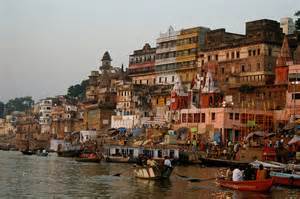
“Temple on the Ganges”: An Ugly American’s True Story

Varanasi

In holy city of Varanasi
On the banks of the Sacred Ganga
Snaking in fetid glory
Before its rooftop restaurant
There’s a hotel called
“The Temple on the Ganges”
Yoga and meditation classes there are free.

Walk up the temple’s dusty stone stairs
Our room is the first on the right
#26
A heavy steel padlock seals the door
On an isolated landing
Like a forgotten prison cell.

The room is small and cramped
Its walls shocking pink.
Two beds meld together
In its center
Leaving little room to breathe.
But the sheets are clean,
And the blankets warm against Varanasi’s smoky cold.
In front of the beds,
A Flat screen TV adorns the wall
With its cable box ridiculously tucked behind.
No chair in sight or desk.
The bathroom has an orange plastic bucket
Beneath the shower head
That sprays everything before it.
When lifted, the toilet seat flops to the ground.

Two floors above
Is the Temple’s “Rooftop Restaurant”
With square slate tables
Laid out like chessboards
On top of thick stone legs.
The lawn chairs there are dingy white plastic.

A strangely thin small-boned waiter
Wrapped in a scarf,
With a blue watch cap perched on the back of his head
Takes your orders.
A half hour later
As you shiver in the morning cold
Your pancakes finally arrive:
Smothered in orange marmalade.
The coffee is already mixed with milk.

“Where are you from?”
The waiter asks
In English heavily accented but clear
And thoughtful.
“The United States,”
We answer.
The waiter smiles,
“Ah, Amayreekah!” he says.
“Veddy Goot cahntree!”
He nods his head.
“Thank you,” we all reply.

“All of India,” he recalls
Was weeping and praying for you,
Years ago
When those terrorists destroyed your towers
In New York City –
Veddy Bad!”
He is rueful, sincere
And seems close to tears.
Again we say “thanks.”

The pancakes have not yet arrived.
So gazing at the Sacred Ganges, the waiter continues,
“Four months ago, in July and August,
During the monsoons,
A dam broke up river.
Everything you see before you
And so much of India was covered with water
For six weeks.
Many homes were destroyed!”
He points a bony finger towards the river.
“Do you see that white mark on that building over there?”
He asks.
The high water mark we see
At his direction
is perhaps three meters off the ground.
“The water was that high,” he says.
Then he adds,
“One hundred thousand people drowned in that flood –
One hundred thousand!
Perhaps you read about it in your newspapers?”

Embarrassed, we look at each other blankly.
“No,” we’re forced to confess,
“We don’t remember . . . .”

What Then Can We Do? New Year’s Resolutions in the light of Jesus’ ‘Nobodiness’ (Sunday Homily)

resolution 1

Readings for “Holy Family Sunday”: SIR 3: 2-6, 12-14; PS 123: 1-5; COL 3: 12-21; MT 2: 13-15, 19-23. http://usccb.org/bible/readings/122913.cfm

Last week, a very good friend of mine wrote an appreciative note on this blog site. He said, “I’ve been stimulated by reading your blogs. They all call us to action, but how to act?”

On the last Sunday of the year – the feast of the Holy Family – the question invites reflections on New Year’s resolutions. The feast itself and today’s liturgy of the word help us by reminding us of Jesus’ “family values.” They were those of immigrants and political refugees. In that light, please allow me to suggest a few resolutions – and to invite readers to follow suit.

Let me begin by telling you about my friend. He’s a meditator and has always shown serious concern about social justice. He’s among the first to take the part of the disadvantaged and has given the rest of us good example in terms of sharing his resources with the poor. So I felt like writing back, “Just continue doing what you’re doing.”

Continue leading quietly by good example. Keep up your work for “Habitat for Humanity,” Stay the course helping that local undocumented family pay for their home. Knock on doors at election time – as you and I have done together in the past. Keep bothering Mitch McConnell and Rand Paul (our senators in Kentucky) with those phone calls I know you already make. Should they decide to throw their hats into the ring, support the candidacies of Elizabeth Warren, Bernie Sanders, or Jill Stein.

And above all, stick to your discipline of meditation with that group of like-minded people meeting each morning at 8:00 in Union Church. In fact, meditating together for peace and social justice might well be the most powerful thing you do in terms of following the path of the Enlightened Jesus which is the intended focus of my blogs and these Sunday homilies.

All of that might not seem like a lot to those (like my friend) specifically attempting to follow Jesus. I mean all of us would like to do more – something more spectacular that would yield immediate measurable results that we and everyone else would recognize as efficacious. We’d like to save the planet, eliminate poverty, and, bring about world peace.

But we can’t. That’s because in the end, we’re nobodies, and seem discouragingly powerless in the face of the evils of capitalism and militarism recently identified by Pope Francis as the principal causes of our world’s problems. Nonetheless, though their accompanying ideologies of greed and violence run entirely counter to gospel values, they’ve somehow been adopted by “Christians” as the way of Jesus. And that in itself, I know, is discouraging.

Jesus, I believe would find it so as well. He rebelled against the organized religion of his day. But strangely (like us) he seemed unable to do much about it. For instance, today’s gospel selection from Matthew portrays Jesus and his family as quintessentially powerless – as political refugees and immigrants. How much power do people like that have to change the world?

Jesus’ powerlessness and “nobodiness” is also evident from considering the long silent years he spent with his “Holy Family,” during what tradition calls his “hidden life.” As an adult, the former political refugee seemed impotent before the evils that continue to afflict our world.

Think about it. According to received interpretations, Jesus was the full embodiment of God. Presumably, then, he had infinite power at his disposal. His world was as filled with problems as ours. There was Roman imperialism and the occupation of Palestine with its brutality, torture, rape, exploitation and oppression. There was political corruption among Jesus’ own people as the leaders of his time climbed into bed with the Romans. There was extreme poverty alongside obscene wealth. There was religious corruption. There was disease and ignorance.

And yet as far as the record is concerned, this embodiment of God did nothing – until he was 30 years old, and then only for a year or possibly 3. For 97% of his life, Jesus did absolutely nothing that we know of!

Why? Do you think it might have been because, like us, he could do nothing significant about all those problems? And even towards the end, as a young 30-something, when he did finally emerge as a more or less public figure, what did he really do?

Yes, he was an activist. He sought justice for the poor and oppressed. He spoke some inspiring words, healed a few people, and worked some miracles that his contemporaries dismissed as parlor tricks. He provoked the authorities in a temple demonstration for religious purity and social justice, was arrested, tortured and executed as an insurrectionist.

But that was pretty much it as far as his “public life” was concerned. Afterwards, the world more or less continued as it had before his arrival.

I somehow find comfort in Jesus’ “nobodiness.” It offers solace to our own little lives and their apparent lack of meaning. In the end, we’re nobodies – all of us. That’s what death makes apparent as we lose our physical form and minds and all that we worked for. We’re nobodies. Few will remember us or think of us after we’re gone. We’re born, get married, have children, buy and sell a few items, and then die. What then became of all our hopes and dreams? What does it all mean?

Perhaps Jesus’ hidden life with Mary and Joseph assures us that it’s all O.K.; it’s all good. Maybe “that’s life” – what it’s about? We’re all called to be open, faceless channels that disclose the presence of God in our very ordinary lives with their personal limitations as far as the big picture is concerned. We’re called to rise above such limitations or rather to use them to express the unbounded love of an apparently powerless God to those around us – especially to our family members who might not even understand.

We’re called to do our best and leave the rest in God’s hands. To be more specific, accepting that reality of our human condition and doing our best in 2014 might include:

• In general, identifying (as Jesus’ family did) with the interests of political refugees and immigrants.
• Stopping our habit of looking to people at the top to solve our world’s problems.
• Considering vegetarianism as a measure against cruelty to animals on factory farms.
• Growing a garden and canning food.
• And/or signing up for local subscription agriculture deliveries.
• Going solar in every way possible.
• Staying out of the “big boxes” as much as we can.
• Being ready and willing to pay higher taxes and live closer to the ground after the world economy collapses when the effects of climate chaos catch up with us.
• Lobbying for an increase in the minimum wage and to increase Social Security benefits.
• Ceasing to support and honor the U.S. military. (Given U.S. wars of aggression and world projection of imperial force, work in the military does not constitute “right livelihood.”)
• Agitating in our local faith communities for the adoption of a liberation theology perspective like that recently articulated by Pope Francis in his exhortation, “Evangelii Gaudium.”

So what do you think?

What do you consider the most powerful action we might take to advance Jesus’ (and so many others’) program of justice, healing, and peace?

Please share your suggestions below.

Vipassana Reflections (Dec. 4-15, 2013): Alur, Karnataka State, India

dhamma_paphulla_vipassana

Here are 18 little reflections on the 10 day meditation retreat I finished about a week ago. It was extremely intense — a real immersion experience both in meditation and in Indian culture. The living circumstances and diet were Spartan. No talking or even eye contact for 10 days. No cell phones or computers, newspapers or TV. We meditated for 10 hours each day using a method that will be explained below. It was one of the most unforgettable experiences of my life. I feel so privileged to have had the opportunity. India is wonderful!

I
“Arrival”

Here at last.
This is what brought me to India, I’m convinced.
But how did I get here?
Did I die?
I can’t remember doing that
Or how.
I recall saying goodbye to my loved ones – a wonderful hug from Maggie,
A goodbye kiss from Peggy . . . .
“May you find what you’re looking for,”
She whispered.
“I think you already have.”
So here I am – dead to the world.
Is this what heaven is like?
Or am I in hell or in prison?
I’m determined to find heaven here,
And wherever I land
From now on . . . .

II
“The Vipassana Community”

So many people here,
(about 80 I’d guess)
Young, old, men, women,
Tall, short, slim, heavy,
All but 5 of us brown,
All seeking God.
I am not alone.

III
“The Setting”

It’s quiet here.
Green, brown and dusty,
Run-down, like India,
And very slow.
But there’s a well-kept garden space,
In front of the Meditation Hall.
No golf course beauty though
Or slick railings, winding staircases or polished floors.
Instead there are large patches of dirt,
Stoney paths, chirping birds,
Blood-thirsty mosquitoes,
And sunshine all around.

IV
“Where I Sleep”

I sleep in one of the “Gents Dormitories,”
In bed # 22.
Fifteen cots, each two feet apart.
The beds are pieces of slate,
With a mattress on top, just 2 inches thick,
And a small hard pillow.
A piece of canvas suspended from a rod
Separates each bed.
But nothing filters
The farting, snoring, throat-clearing, belching, spitting, coughing and sneezing.
Still, we somehow manage to sleep
From 9:30 till 4:00.
Already by 3:30
Alarms go off.
Fluorescent tubes ignite.
The farting and throat-clearing begins in earnest,
And the race to the outdoor washstands.
By 4:30 we’re in the meditation hall.
Following our breathing – till 6:30.

V
“Be Happy”

“Be Happy”
That’s the mantram here.
Every notice ends with those words:
“Be Happy!”
It’s a strange, forbidden thought for me
Who fears happiness,
(I’ve been told)
Who’s blind to the happiness already bestowed
Here,
And who longs for the pains of hell.
What if I realized heaven is indeed already mine,
Surrendered to it,
Luxuriated in my body, mind and spirit,
And spurned the hell
The saints have sold me?
What then?
Would I actually see God?
Why this terror before heaven all around?

VI
“The Reason for Unhappiness – and Its Cure”

All life is suffering
Says the Buddha.
But why?
What’s the cause?
Gotama went deep inside
To find out.
It’s because of craving,
He discovered.
Senses encounter sense objects.
Attachments and aversions form.
When inevitably thwarted
Suffering results.
To overcome suffering,
Simply detach!
Become a dispassionate watcher of sensations
Pleasant and unpleasant,
Knowing that each
Is governed by
The Universal Law of Impermanence.
“This too will pass”
Is the salvific mantram.
“I am the Happiest of mortals,”
the Enlightened, Unattached Buddha insisted.

VII
“Where I Eat”

Our mess hall has red concrete floors.
We eat on narrow shelves
Each facing a dingy white wall
Whose Scotch Tape wounds
Cry out for soap or paint.
Thousands have sat here before us
Clattering teaspoons
On stainless steel plates.
Rice and dal
And a sweet thick drink
I can’t identify.
No one speaks or makes eye contact.
Afterwards
We line up to wash our cups and plates
At stone pilas.
Then one by one
We melt back into the darkness
Whence we came
Like moths seeking light.

VIII
“The Menu”

Breakfast
Upma (millet mush)
Or biryani rice
Sprouts
Idles (twice)
Pickled green peppers (available at every meal)
Chai

Lunch:
White rice
Biryani rice
Iragi balls (black millet)
Dal
Chapattis
Sliced cucumbers
2 vegetables: green beans, diced beets, squash, okra, or bitter gourd
Sauce: spinach, tomato and onion,
Buttermilk

Supper/Snack:
Fruit (one piece): watermelon, papaya, or banana
Salted and peppered “puffed rice” with peanuts and cilantro
Chai

IX
“Take Things Hard”

I love living like this
(My kids will laugh)
When I was a Columban
The motto was
“Take things hard.”
I bought into that,
I guess,
And still do.
I like the predictable daily routine,
The rock-hard bed,
Cold “showers” from a bucket,
The same meals repeated.
But time to think,
And meditate
And pray.
What more could I ask?
(Well, maybe not the cold showers.)

X
“How to Meditate”

“Narrow your focus,”
The teacher said,
“To the triangle
Whose base is your upper lip,
With its apex, the top of your nose.
Now do nothing
But breathe.
Just observe your natural breath
For 15 hours.
That’s step one.”

“Step 2 is to spend 10 hours
Focusing on sensations
In the same triangular space –
An itch, a pain, a tingling, throbbing – anything.
Work diligently, ardently, patiently.
This was the Buddha’s path
To enlightenment and liberation,”
The teacher advised.
“It can be yours as well
If you follow his technique.
Doing so, you are bound to succeed,
Bound to succeed.”

“Step 3 is to narrow focus still further.
The triangle shrinks.
Its base remains your upper lip.
But its apex becomes the bottom of your nostrils.
Focus on that mustache area.
Identify the feelings there,
And contemplate it – for 10 hours.”

Now you’re ready for Vipassana itself.
The word means “seeing things as they are,
Not as you want them to be.”
You scan your body
From head to toe
For changing sensations,
For 5 hours in the morning
And 4 in the afternoon.
The point is
To experience life’s impermanence
Where it cannot be denied
Within the framework of your own body,
And so be liberated
From cravings and aversions.
Which like all bodily sensations
Always pass.
Do that for 65 hours.

XI
“The Lotus Position”

The lotus position
Is killing me.
After 15 minutes
The fronts of my thighs
Are throbbing uncontrollably
Like waves on a rough sea
I can actually see the turbulent ripples.
And I still have 45 minutes
(Sometimes and hour and 45 minutes!)
To go!
Towards the end,
Each 60 seconds seems like an hour.
Is this what I must do
For the rest of my life
To achieve enlightenment?
“It’s not about torturing yourself,”
The teacher tells me.
“It’s about self-discipline,
And purification of mind.”
I review my life:
For 16 years I’ve gotten up each day at 4:45
For half an hour of meditation.
For 25 years
I’ve run 4 miles every morning
In cold and snow, heat and rain.
“No pain, no gain,” I’ve always believed.
Then a half hour of spiritual reading.
Three vegetarian meals
When I’d rather eat meat.
Another half hour of meditation at night.
What I need is not more pain.
What I need is the Buddha’s understanding
That the pain already here
And the abundant joy
Are both temporary
Subject to the universal law of impermanence
And destined to pass.
Don’t be attached
To either pain or pleasure.
That’s the lesson
And the purification of mind
My teacher was talking about.
But pardon me;
I’m using a chair.

XIi
“I Hate Vipassana”

It’s day four of our course.
During the last half hour of morning meditation (4:30-6:30)
Something snapped.
I felt like screaming,
“This is just bullshit!”
The chanting had started,
Making it impossible for me
To concentrate on my body scan.
All of a sudden,
I hated everything:
India, Indians, Vipassana Meditation, the chanting,
My hard bed
The food
That’s making me gag.
I don’t understand Vipassana!
Yes, I know it’s about
Facing up to life’ impermanence.
But how many times can you survey your body
For changing sensations
Without screaming about bullshit –
From sheer boredom?
It’s a good thing I still have nearly a week
To recover,
Make sense of this,
And find heaven
Here.

XIII
“I Love Vipassana”

The crisis passed
As quickly as it had come.
This morning
After 3 hours
Of fruitless, distracted, infuriating “meditation,”
A conference with our dour, laconic teacher
Helped me see. . . .
He spoke of the importance of posture
For disciplining the mind.
He asked about mine.
“No problem,” I said,
“I’m old,
I don’t do the lotus position;
I sit in a chair.”
“Hmm . . .” was his pitiless response.
Chastened,
I adopted the lotus configuration
For the next hour.
My legs absolutely throbbed.
At one point
I couldn’t tell my right from my left.
But then I saw:
The Buddha based everything,
I realized,
On what was certain,
From the experience of his own body.
Since that body perfectly mirrored
The entire universe,
And the laws of nature,
Reading it
Was better than reading a whole library of books.
So scanning the body
From crown to toe
Is like journeying among the planets,
Like a history lesson,
Like a review of my own life.
Bodily sensations
Pleasant and painful
Were like all the crises of life
Like all its joys – destined to pass.
The point is however
To awaken the body completely,
To make every single cell
Sensational.
And to do the same
With every moment of life.
“Just observe it all objectively
With perfect equanimity,
Without craving or aversion
Everything will soon pass,”
The teacher said.
“Everything is changing,
Changing
Changing.”
I can hardly wait for this afternoon’s
4 hours of “work.”

XIV
“A Meditation High”

This afternoon
December 11 , 2013
At 2:15
I had a unique experience – for me.
(My teacher would later tell me it’s quite common.)
During the last 15 minutes of meditation (1:00-2:30)
I had been sweeping through
My Vipassana survey of my body,
And had done so quickly
Perhaps 6 times in a row.
I stopped.
And all of a sudden
My entire body was tingling
From head to toe
In mild vibration.
I felt my body was filled with light.
The vibration continued for 15 minutes.
This, I believe,
Was the experience
Of the “Inner body,”
The immanence of the divine
That Eckhart Tolle describes
In The Power of Now.
My Indian teacher however
Warns
Not to treat such experiences
With any more preference
Than dryness, distraction or frustration.
All – the pleasant and the unpleasant –
Are merely sensations.
The point of Vipassana is
To treat all sensations the same:
“With perfect equanimity.”
It’s the nature
Of both pleasant
And unpleasant sensations
In meditation
And in life
To arise and then subside.
It’s fatal to crave and form attachment to the pleasant
And to fear and cultivate aversions to the unpleasant.
(Still, the experience was nice!)

XV
“Outta Gas – again!”

Today – the 7th of the course—towards the end
Of our 7th hour of meditation
(with 3 ½ to go)
I just ran out of gas.
My back ached.
I couldn’t bring myself
To scan my body even one more time,
“From the top of your head, to the tips of your toes;
From the tips of your toes
To the top of your head.”
And then those aversions kicked in again –
To meditation, Indian accents,
Endless translations into Kanada and Pali
And our teacher’s chanting
In that artificially deep voice,
With the weird tones, melodies and cadences
I don’t understand.
Then I realized
My aversions are the point.
It’s sensations like this I’m supposed to identify
And observe objectively.
Life is full of them,
And they are merely feelings – at least until I own them
(as I mistakenly have done again!),
Making them mine
And creating new “samskaras”
(Negative behavior patterns)
In the process.
“Just observe the sensations,
The teacher intoned.
View them objectively
With equanimity
And patience.
Like all sensations,
They will arise
And then disappear.
Don’t attach to them.”
Lesson learned . . .
For now.

XVI
“The Problem with Pleasure”

My teacher says that
Pleasure is good
When it’s shared with others:
A good meal with friends
A game of golf with my sons. . .
But not when it’s sought
For its own sake,
Especially in isolation
(Drinking alone,
That bowl of ice cream for a midnight snack).
Those sorts of “pleasures”
Give rise to craving
And attachment
Which the Buddha teaches are the causes of unhappiness.
I’m afraid all of that is true.
My experience shows:
Unsought pleasures
Have filled my life to overflowing.
The pleasures I’ve sought – for me –
Have been the problem:
Craving when they’re absent,
Disappointment when over.
And then there are those samskaras . . .
So give others pleasure in abundance.
And let life shower you with gifts unsought.
(It always will.)
Otherwise, live simply
Your cup will overflow
Even if nothing extraordinarily delightful
Ever happens again.

XVII
“Self-Denial”

All my life
It’s been preached to me,
“Deny yourself.”
And what a burden it’s been!
Now I see
That responding (not reacting) to impulses
Is intimately connected to
The Universal law of Impermanence
And to my anger and defensiveness.
Impulses are impulses
Whether to take that 2nd piece of cake
Or to make a smart retort.
As sensations they arise and pass away.
Recognizing self-indulgence
As a passing impulse
Helps me identify angry sensations
As impulses too –
To be recognized
And given time to pass –
In order to escape misery.

XVIII
“Conclusion”

This has been
A 10 day
100 hour Meditation
On the Universal Law of Impermanence.
(I.e. on reality’s changing nature
As events constantly rise and pass away),
On the need to face
And accept
The present moment
As it is
and not
As we would like it to be,
With equanimity and calmness.
It has been about
Eradicating (uprooting)
The causes of unhappiness
Located in the sensations
Our bodies constantly produce
As our senses meet
Sense objects.
Eradication happens when
We don’t react or become attached to such sensations,
But simply observe them
With heightened awareness –
Objectively, calmly,
Equanimously.
To accomplish that feat,
We must practice
An hour of mediation
Each morning and evening
Scanning our bodies
“from the top of our heads
To the tip of our toes”
And back,
This establishes a pattern
(Based on experience)
For facing the vicissitudes of daily life
Which is constantly
Changing,
Changing,
Changing.
Remember:
The two wings of the Vipassana bird are
Awareness and
Equanimity.

Mary’s “Virginity” and the Problem of Military Rape (Sunday Homily)

Rape

Readings for 4th Sunday in Advent: IS 7:10-14; PS 24 1-6;ROM 1: 1-7; MT 1: 18-24. http://usccb.org/bible/readings/122213.cfm

As we know, rape in the military is a huge problem. According to Amy Ziering’s award-winning film, “The Invisible War,” more than 20% of female veterans have been sexually assaulted while serving in the armed forces. In 2009 alone, more than 3200 cases were documented. But since 80% of such instances go unreported, the figure is closer to 16,000.

My question is: if U.S. soldiers are raping and otherwise sexually assaulting their colleagues with such regularity, what do you suppose they’re doing to “enemy” women? What do you suppose the figure is there?

From time immemorial, of course, rape has been used as a weapon of war. It’s a classic way of asserting power over the enemy by defiling the ones they cherish and are expected to protect. Raping their women humiliates enemy men.

Clearly, we have no trouble recognizing rape as an enemy strategy. But what about our servicemen in relation to the “ragheads” and “gooks” they’ve been taught to objectify, hate and despise?

The evidence is that it’s part of their indoctrination too. Years ago, I remember reading in our local paper of how scandalized one of our Kentucky congressmen was when he visited a military base and heard jogging servicemen chanting, “Burn, rape, pillage, kill. . . .” Note the second word in the chant. Why is it there? Is it meaningless in practice?

And then, of course, there’s the logic introduced earlier. If U.S. soldiers rape servicewomen with such abandon, what about those despised women in (most recently) Afghanistan and Iraq?

All of that is relevant to today’s liturgy of the word because of its emphasis on Jesus’ “virgin birth,” and a persistent tradition that Jesus’ conception was the result of rape by a Roman soldier. What if that tradition were true? Would that make the story less inspiring or more? I’d choose the latter – especially in the light of the questions I’ve just raised.

Let me explain simply by offering some background for today’s reading from Matthew along with a reference to the selection from Isaiah traditionally seen as a prophecy of Jesus’ virginal conception.

To get from here to there, try to understand the situation of Joseph and Mary as young marrieds in a context of imperial aggression. They’re a teenage couple; they are poor and living in an occupied country. Joseph is a jack-of-all-trades – that’s what the Greek word we translate as “carpenter” meant in first century Palestine. Like everyone from his class, he was unemployed most of the time. But he’d fix your leaking roof if you hired him. When he could, he’d harvest grapes and wheat for local landlords.

And he was probably deeply involved with the local insurgency against Roman occupation. (Nearly every impoverished patriot is in such situations.) Additionally, the only commentary we have on Joseph’s character is Matthew’s single word “just.” He was a just man. (By the way, his son, James – the one who headed the Jerusalem church following his brother’s death – was also known as “James the just.”) In the Hebrew culture of Jesus’ day, justice meant taking the side of the powerless. It appears to have been a central value Joseph passed on to his children.

As resisters, Joseph’s kind would have been considered terrorists by the Romans. In fact, the very year in which Jesus was likely born (6 BCE) Galilee’s countryside would have been crawling with Roman soldiers fighting against people like Jesus’ supposed father. The occupiers were busy laying siege to the city of Sepphoris, the capital of Galilee – a mere hour’s walk from Joseph’s village.

There the insurgency had taken a decisive stand against Rome’s puppet, King Herod. And like Americans in Iraq’s Fallujah, the Romans were determined to make an example of the city by laying it waste utterly. Before their final offensive, that involved night raids, kicking in doors, and raping young Jewish girls. To repeat, all forces of occupation – even our own today – know the drill.

In any case, according to that persistent tradition about her “virginity,” that’s where Mary came in. She was a young teenager about 12 or 14. Although (as Matthew’s gospel tells it) she eventually became Joseph’s “dream girl,” she was probably linked with him by the village matchmaker perhaps when they were both still toddlers. They had not yet begun to live together, because they were probably waiting for Mary to come officially “of age” – able to bear children.

Be that as it may, Mary suddenly finds herself pregnant out of wedlock. Can you imagine her worry? Innumerable teenage girls can relate to her panic – and disgrace. Obviously, Mary did not want to be just another of her community’s “virgins.” [That’s what (behind their hands) local matrons called unwed mothers.]

According to the story, Joseph too shared Mary’s disgrace and embarrassment. He wanted a divorce (i.e. release from his commitment to marry). And he probably demanded it with the anger and recrimination that are inevitably associated with the dreaded “d” word.

Joseph’s anger, suspicion, and thoughts about divorce may also have come from his hatred of the Romans. (And here comes that persistent tradition about Mary’s “virginity.”) It even remembers the rapist’s name. According to Celsus’ “True Doctrines” written about 178 C.E., the rapist was called “Panthera.” That was also the name of one of the Roman legions involved in that siege of Sepphoris.

Such suspicious circumstances around Jesus’ questionable conception also find some support in John’s gospel, where Jesus is called a “Samaritan” (8:48). That was a harsh term equivalent to our “bastard.” Additionally, Mark refers to Jesus simply as “Son of Mary” (6:3) – a quite unusual reference in a culture where children were identified by their father’s name.

And then (once again) even Matthew’s term “parthenos” (virgin) to refer to Mary was often connected with children of unknown paternity. Such offspring were disparagingly called “virgins’ kids.”

With all of that in mind, and if Celsus’ tradition has merit, it’s easy to understand how the thought of taking up with a girl defiled by a Roman “pig” (what Jews called the occupiers) probably turned Joseph’s stomach. No wonder he wanted a divorce.

That is, if the tradition has merit . . . . You see, we can take our pick here. (And that brings me to the point about the historical veracity of the stories around Jesus’ birth.) All of the traditions are entirely questionable as far as historical fact is concerned.

For instance, the familiar account of Jesus’ virgin birth is found only in two of the canonical gospels (Matthew and Luke). Mark and John make no mention of it. That means that they either didn’t know about the tradition, or Mark and John didn’t think it important enough to include. (By the way, if Jesus’ conception was as miraculous as we’ve always been taught, how likely is either of those alternatives?)

And then there’s that business – recounted in today’s first reading – about Isaiah’s supposed prediction of Jesus’ virginal conception. Matthew takes Isaiah’s words completely out of context.

Actually, Isaiah’s not referring to Jesus at all, but to his own time more than 500 years earlier. And the Hebrew term he uses is not the equivalent of “virgin.” That’s a mistranslation. The word the prophet employs simply means “young girl.” Isaiah’s prediction is that a “young girl” of his own time will conceive. The prophet’s words had nothing to do with Jesus or virgin birth.

The point here is we’re not dealing with “history” in the story of Jesus’ virgin birth. Instead we’re confronted with a miraculous “birth story,” – a literary genre that characterizes accounts of virtually all “Great Men” in the ancient world. Its point is that God’s Spirit entered into Jesus from the very outset – long, long before his actual birth.

In that light, historically speaking, rape is a much more likely explanation of Jesus’ conception than intervention by the Holy Spirit. Think about it. That’s simply a fact.

How then was Jesus begotten? If Joseph was his father, we understand how Jesus was so concerned with social justice. And through this pre-birth story we can hear (once again!) a summons to learn from Joseph the way Jesus and his brother James did. It’s also a reason for re-evaluating our culture’s drumbeat of indoctrination against “terrorists.” As Pope Francis has recently said, if we’re not concerned with justice for the poor, we can’t pretend to be following Jesus’ way.

If Panthera humiliated Jesus’ mother (and Joseph), and Jesus was the product of rape – and if rape is an inevitable strategy of war – then that’s an additional reason for pressuring the U.S. military to aggressively investigate and punish perpetrators of military rape. It’s also a reason for refusing to honor the U.S. military in general, for opposing war, working for peace, and appreciating Jesus’ solidarity with the poorest of the poor.

Once again, as Pope Francis would have it, If we’re not resisting war and working for peace, our observation of this Christmas season is pure theater and sham.

For Decades the U.S. Hated Nelson Mandela

NelsonMandela_Terrorist

Nelson Mandela was buried yesterday. The entire world is in mourning. President Obama joined others in eulogizing the 95 year old hero with words of deep admiration and praise.

All the adulation was richly deserved.

However, in our present context of anti-terrorist hysteria, it is important to note that Nelson Mandela and his African National Congress (ANC) party were on the U.S. terrorist Watch List until quite recently. In fact, after spending more than a quarter century in South Africa’s Robben Island, and despite Mandela’s stature as President of South Africa, it wasn’t until 2008 that Mandela and his ANC were removed from that role of infamy.

That fact coupled with Mandela’s now-heroic status shows how the term “terrorist” can be misapplied for decades to genuine freedom fighters while the U.S. opposes them in its de facto support of oppression. Martin Luther King teaches the same lesson.

The Reagan administration was largely responsible for attempting to ruin Mandela’s reputation. It called him “subversive” and “communist” all during the 1980s. Mr. Reagan insisted that Mandela and the ANC were Cuban backed enemies of the United States and its interests in South Africa. Such charges were behind the administration’s refusal to support UN and international trade sanctions and an arms embargo against the racist South African apartheid system.

Even after “Madiba” (his affectionate tribal name) received the Nobel Peace Prize (1993), the U.S. continued to treat Mandela as a pariah. However, after 9/11, it changed its reason for doing so. The State Department then stopped referring to him as a communist and called him a “terrorist” instead. In fact as late as 2005, he was required to get a special State Department waiver in order to enter the U.S. in order to visit George W. Bush.

Finally in 2008, with a big prod from the Congressional Black Caucus, Congress at last voted to remove the by then 90 year old Mandela and ANC from the U.S. government’s official list of terrorists.

All of this has been consigned to George Orwell’s Memory Hole in the upsurge of universal acclaim for South Africa’s safely dead Madiba.

The same thing happened, of course, to Martin Luther King whom the State Department, CIA, and others had labeled “communist” and “subversive” before finally honoring the martyr’s memory with a national holiday and with innumerable “Martin Luther King Boulevards” throughout the country.

In the light of such history, can our grandchildren look forward to misty eyes, holidays and street renamings after the passing of Daniel Ellsberg, Edward Snowden, Chelsea Manning, Julian Assange, Aaron Swartz, and Assata Shakur?

Stay tuned.

The Hypocrisy of Treating Jesus with “Tough Love”: Here’s a Riddle for You . . . (Sunday Homily)

the least

Readings for Third Sunday of Advent: IS 35: 1-6A, 10; PS 146: 6-10; JAS 5: 7-10; MT 11: 2-11 http://usccb.org/bible/readings/121513.cfm

Recently, Mary Shaw contributed a well-received article to the pages if OpEdNews (my favorite online news source). The article was called “American Hunger and the Christian Right.” There Ms. Shaw pointed to the irony of predominant elements within the GOP adopting as their two main goals cutting social services such as Food Stamps and eliminating labor unions while at the same time calling themselves “Christian.” In Ms, Shaw’s analysis, such inconsistency does not jibe with the personal poverty of Jesus himself, or his concern for the poor manifested in mass feedings on more than one occasion.

In the light of today’s liturgy of the word, I would go even further and argue that the GOP position flies in the face of the entire Judeo-Christian tradition expressing (as it does) God’s special concern for the poor and oppressed.

In that macro-context, the “tough love” concept of the Christian right is actually a slap in the face to Jesus himself. That’s because (once again) in today’s readings, the recipients of God’s special concern turn out to be (in Jesus’ words in our gospel reading) not only “the least,” but in their collectivity, the very Jesus whom our sisters and brothers on the right aspire to accept as their personal Lord and Savior.

The vehicle for today’s version emphasizing Jesus’ identification with the poor is a riddle. It’s found at the very end of that reading from Matthew. Matthew has Jesus posing it by saying:
1. John the Baptist is the greatest person ever born.
2. Yet the least in the Kingdom of God is greater than John.

That leaves us with the question: How can this be? How can “the least” be greater than the one identified by Jesus himself not only as the foremost prophet of the Jewish Testament, but the greatest human being who ever lived?

In the context of Matthew’s gospel, the answer is the following:
1. Jesus is the one far greater than John. (As the Baptist admitted in last week’s reading from Matthew, John was not even worthy to loosen the straps on Jesus’ sandals.)
2. But Jesus identified himself with “the least.” Recall that in his parable of the last judgment (Matthew 25), Jesus says, “Whatever you did to the least of my brethren, you did to me.”
3. Therefore the “least” as identified with “the greatest” (Jesus) is greater than John and should be treated that way – as Jesus himself.

Riddle solved. The rest of today’s liturgy adds the details as it develops the theme: recognize the least as God’s favorites – as Jesus himself – and treat them as the most important people in the world.

And who are these “least?” According to Isaiah in today’s first reading, they are the blind, deaf, lame, and mute. They are foreigners living in exile. The psalmist in today’s responsorial, widens the list by adding the oppressed, hungry, imprisoned, and immigrants. He includes single moms (widows) and their children.

In today’s gospel selection, Jesus recapitulates the list. For him “the least” (who are greater than John) include the imprisoned (like John himself sitting on Herod’s death row). They are (once again) the lame, the deaf, the mute, and lepers. They even include the dead who are raised to life by Jesus.

Do we need any more evidence to support the claim of God’s “preferential option for the poor?”

Does the Christian Right believe the teaching contained in Jesus’ riddle? Do they really advocate treating him with “tough love?”

Not when you put it that way, Jesus!

Pope Francis’ Compelling Revolutionary Vision: What Progressives Have Been Waiting for (Sunday Homily)

Pope Bergoglio

Readings for Second Sunday of Advent: IS 11: 1-10; PS 72: 1-2, 7-8, 12-13; ROM 15: 4-9; MT 3: 1-12 http://usccb.org/bible/readings/120813.cfm

Recently articles in OpEdNews (my favorite on-line news source) have been full of revolutionary themes. For instance, Chris Hedges informed us of an invisible revolution simmering and about to erupt. It will be driven, he said, by widespread discontent with wages, wealth disparities, militarism, and climate change denial.

Then in his viral BBC interview, comedian Russell Brand called for revolution stimulated by everyone’s recognition of the futility of politics as we know it. No one should vote, he said; the system is too broken to be improved at the ballot box.

On the other hand, Senator Bernie Sanders’ revolution would be based wider participation in political processes, with everyone voting. That would overcome reactionary moves that disenfranchise voters and empower moneyed interests to determine electoral outcomes against the popular will.

Calling us back to reality, Robert Becker advised that any revolution at all is highly unlikely, since no one on the left offers compelling direction or revolutionary vision.

At the time of its publication, that last remark seemed apt. No world leader capable of mobilizing millions had yet emerged.

However all of that changed two weeks ago. The compelling direction and revolutionary vision whose absence Mr. Becker correctly lamented indeed materialized in an ironically unlikely form – a pronouncement of the Roman Catholic papacy.

On Tuesday November 26th, Pope Francis published his Apostolic Exhortation, Evangelii Gaudium (The Joy of the Gospel). It represents the most articulate and detailed “vision” of a revolutionary future yet offered by anyone actually capable of producing results in the street and at the ballot box.

That is, as a member of the world’s super-elite, and virtually above reproach and easy dismissal by his fellow aristocrats, the pope’s pronouncement demands serious consideration. This is especially true on the parts of the bishops and clergy who weekly have before them captive audiences voluntarily come together to meditate upon, pray about, and attempt to internalize the gospel vision which the pope describes as focused on the poor, peace, social justice and on the structural causes of violence, war and terrorism. Moreover, these themes, the pope insists, should be driven home in homilies at Sunday Mass, since such leitmotifs represent the inescapable essence of the Judeo Christian tradition.

Today’s liturgy of the word provides a case in point. It articulates the revolutionary vision and compelling direction the pope finds throughout the Bible. It’s a utopian vision that courageously connects peace with social justice and environmental consciousness.

Consider the first selection from the prophet Isaiah. It directly links peace and social justice – for the poor and oppressed who in Isaiah’s day and our own are typically ignored. By way of contrast, Isaiah’s concept of justice consists precisely in judging the poor and oppressed fairly and not according to anti-poor prejudice – in Isaiah’s words, not by “appearance or hearsay.” (No room here for “Stop and Frisk,” or “Shop and Frisk!”)

Not only that, but according to the prophet, treating the poor justly is the key to peace between humans and with nature. It produces a utopian wonderland where all of us live in complete harmony with nature and with other human beings. In Isaiah’s poetic reality, lions, lambs, and calves play together. Leopards and goats, cows and bears, little babies and deadly snakes experience no threat from each other. Most surprising of all, even believers (Jews) and non-believers (gentiles) are at peace. (Today’s excerpt from Paul’s Letter to the Romans seconds this point. He tells his correspondents to “welcome one another” – including gentiles – i.e. those the Jewish community normally considered incapable of pleasing God.)

Today’s responsorial psalm reinforces the idea of peace flowing from justice meted out to the “least.” As Psalm 72 was sung, we all responded, “Justice shall flourish in his time, and fullness of peace forever.” And again, the justice in question has the poor as its object. The psalmist praises a God and a government (king) who “rescue the poor and afflicted when they cry out” – who “save the lives of the poor.”

In his own time, the lack of the justice celebrated in today’s first three readings infuriates Jesus’ cousin, John the Baptist. Today’s gospel reading has him excoriating the religious leaders of his day as a “brood of vipers.” Unmistakably clothed as a prophet – in garments that absolutely repudiate fashion and the pretenses of his effete opponents John reminds us of the simple lifestyle adopted by Francis I. John lambasts the Scribal Establishment which had identified with the occupation forces of Rome. As opposition high priest, John promises a religious renewal that will lead to a new Exodus – this time from the power of Rome and its religious collaborators.

As part of today’s revolutionary theme, it’s important to emphasize the Exodus dimensions of Matthew’s description of John. The Baptist is presented as preaching and baptizing specifically outside the temple and sphere of the priests. In fact, John appears in the wilderness – in the desert. For Jews, this would not only have evoked overtones of their great myth of national origin. It would also have signaled a subversive significance in John’s work. After all, the “desert” or “wilderness” was the place where contemporary resistance movements were spawned. (I imagine that if the Romans had the power, they would have “droned” John and his followers in a “signature strike.”)

Do you see what I mean about harnessing the revolutionary power of the Bible’s myth, poetry, utopian visions, and preferential option for the poor? It’s all there in Isaiah, Psalm 72, in Paul’s letter to the Romans, and in Matthew’s portrait of John. And if we look with the eyes of Pope Francis, we can find those themes every Sunday. It’s powerful stuff, I’m sure you agree. And the pope not only sees that himself, he has called 1.2 billion inhabitants of this planet to recognize it along with him and act accordingly.

The action Francis recommends is particular. It consists in combatting a form of capitalism that he describes as systematized murder. He rejects “trickle-down” theory, and demands interference in the out-workings of markets in the name of the common good. The pope calls Catholics and others of good will to recognize access to food, education, and healthcare as human rights.

And the pope does all of this without demanding sophisticated comprehension of history, economic theories, or detailed social analysis.

Instead he relies on the power of myth, poetry, God-talk, and biblical focus on a divine preferential option for the poor and Jesus’ vision of God as universal parent.

All of that is there in today’s liturgy of the word. For any with eyes to see, it’s there every Sunday to assuage our hunger for “vision” and “direction.”

It’s time for progressives to follow the lead of Pope Francis. He’s calling us to set aside our pseudo-sophistication that has intellectuals rejecting the Bible’s power to mobilize huge masses of people. That is, we must reclaim the powerful mythology of the Bible and lay aside our practical disdain for story, myth and symbol. That’s where we’ll find our missing “vision and direction.”

I find that promising, invigorating . . . and somehow ironic.