Marianne Williamson and the “Dark Psychic Forces” of Capitalism (Sunday Homily)

Readings for the 18th Sunday in Ordinary Time: ECC 1:2; 2:21-23; PS 90: 3-6; 12-14; 17; COL 3: 1-5; 9-11; MT 5:3; LK 12: 13-21

Marianne Williamson shone brightly again during the first night of the second Democratic debate. This time, with only nine minutes of exposure, she had the whole country talking.

As with her first appearance, her name was the most Google-searched among her nine debate rivals. And afterwards, the Washington Post, for instance, noted her contributions with headlines like “Marianne Williamson Had A Big Night in the Democratic Debate,” “Marianne Williamson Made the Most of Her Limited Time . . .,” “Marianne Williamson Makes the Case for Reparations in her Breakout Debate Moment,” and “I’ve Worked for Marianne Williamson. She’s No Kook.”

Additionally, “Democracy Now,” the following day gave more time than ever to Marianne’s remarks about the Flint water crisis, and about reparations, though, in the process, Intercept columnist, Mehdi Hasan felt compelled to dismiss her (without explanation) as “a little bit kooky, let’s be honest.”

Meanwhile Cody Fenwick writing for AlterNet favorably included Marianne’s comments about reparations among his “Nine Best Moments” of the primary debate. However (significantly for our focus here) his article, “Here Are 9 of the Best Moments and 7 of the Worst from the 2020 Democratic Primary Debate,” created a special category for what her campaign considers her most significant remark. Fenwick classified the following as a “Moment that Defied Category.” He wrote, “In the course of a rousing speech about the shameful government-triggered water crisis in Flint, Michigan, the author’s speech took a bizarre turn: ‘If you think any of this wonkiness is going to deal with this dark psychic force of the collectivized hatred that this president is bringing up in this country, then I’m afraid that the Democrats are going to see some very dark days.’” Without further comment, that statement concluded his article.

Thinking it somehow “bizarre,” Fenwick was evidently confused by the reference to a “dark psychic force,” even though Williamson immediately explained its meaning. She was referring to “the collectivized hatred that this president is bringing up in this country.” His confusion resulted, I think, from Williamson’s entry into unexplored debate terrain as she attempted to drive the conversation deeper than the clichés and normalized insanity that characterized many of Tuesday’s exchanges (like Steve Bullock’s disagreement with Elizabeth Warren about first use of nuclear weapons).

What “dark psychic forces” did Williamson have in mind? Judging from her books Healing the Soul of America, and The Politics of Love, they are habits of mind and spirit inculcated by a culture that tolerates, if not celebrates:

  • The collectivized hatred she specifically referenced
  • The mind-set that actually considers first (or any!) use of nuclear weapons as acceptable
  • White supremacy and white nationalism
  • American exceptionalism
  • Imperialism and neo-colonialism
  • Child abuse at our borders
  • Regime change wars
  • An all-encompassing gun culture reflected not only in law, but in our films, novels, newspapers, and magazines – and especially in military policy

That’s just the short list of the dark forces in question. But for Williamson, all of them can be synopsized in the single term “fear.” Systemically, they can be summarized in the term “capitalism” and the terror-filled interlocking systems of individualism, competition, and greed that system inspires.

And that brings us to the theme of the liturgy of the word for today’s 18th Sunday in Ordinary Time. On my reading, all of them present a light-hearted critique and rejection of the underlying spirit of capitalism. But see if they speak to you in that way. Take a look at them here.

In any case, what follows are my “translations”:

ECC 1:2; 2:21-23 (A Book of Hebrew Wisdom)
 
Accumulating property
And money
Working hard to get it
Worrying about it
Losing sleep over it . . .
Is all foolishness.
And in the end,
You can’t take it with you.
How silly to fret
About possessions!
 
PS 90: 3-6; 12-14; 17
 
So, soften your heart.
Life is short
It passes
Like the seasons
Like grass.
You might even die
In your sleep tonight.
Instead, enjoy life NOW.
Be happy and kind
And careful
In whatever you do.
That’s true prosperity.
 
 
COL 3: 1-5; 9-11
 
As St. Paul says,
Use your Christ consciousness
To look beyond
The material
To discover
True wealth –
Your invisible life
Within.
After all,
Happiness
Has nothing to do
With idolizing money
Or pleasure, or deceit.
It’s all about
Living with
The consciousness of Jesus
That all humans
(wherever they come from)
Are sisters and brothers.
 
 
MT 5:3 (Blessed are the poor in spirit)
 
In fact,
Christ’s values
Are the exact opposite
Of the world’s.
 
 
LK 12: 13-21 (Parable of the wealth-obsessed rich man who dies in his sleep)
 
So, don’t be foolish
Worrying about
Inheritance and money
You didn’t even work for.
After all,
Life’s not about
How much you have.
Instead,
Laugh with Jesus
At fools who spend
Entire lives
Focused on mammon
Only to die
Before they’ve had time
To enjoy the rich Life
God has given
To everyone
Equally.
Notice how the readings lament and make fun of lives based on greed and focus on material accumulation. Such goals produce anxiety, sleeplessness, jealousy, and frustration. They end with a completely wasted life and early death. 

As opposed to the Prosperity Gospel, this is what Jewish Wisdom Literature, the prophets, Jesus of Nazareth, and leaders like Marianne Williamson have to say about excessive material wealth. It's not the point of life. Instead, love, justice, and the inner peace and community they produce is what fullness of life is about. 

Readings like today's remind us of the gloomy and literally unspeakable (i.e. off-limits for discussion) forces that drive our culture. They are encapsulated in our economic system that emphasizes individualism, competition, violence and fear. The system is capitalism-as-we-know-it.

By bringing that up and in terms of "dark psychic forces," Williamson places herself beyond normal political discourse. To mainstream commentators, that makes her puzzling, bizarre, weird, and "kooky," even kookier than those advocating the omnicide of nuclear war.

However, to those of us seeking escape from business as usual, it made her the best candidate on last Tuesday's stage.
 
The favorable reaction to Williamson's statements there shows that increasing numbers are recognizing her truth.


Jesus’ Calls Followers to Practice What Marianne Williamson Calls a “Politics of Love”

Readings for 5th Sunday of Easter: Acts 14: 21-27; PS 145: 8-13; REV 21: 1-5A; JN 13: 31-35

The readings for this fifth Sunday of Easter centralize Jesus’ New Commandment, to “Love one another as I have loved you.” He also identifies the criterion for distinguishing his true followers from those who are not. He says, “This is how all will know that you are my disciples, if you have love for one another” – again, “as I have loved you.”

So, the question becomes how exactly did Jesus love those he interacted with? Was his love confined to the inter-personal sphere, or was it somehow political? And even if it was, is a politics of love practical? Or are we condemned to the political status quo based on fear and greed which our “Christian” culture has ironically convinced us is much more realistic than the love and compassion that Jesus seems to recommend?  

The answer to all of those questions was captured in our liturgical readings several weeks ago in Jesus’ first sermon as recorded by the evangelist called Luke. Jesus described his program in this way: “The Spirit of the Lord is on me, because he has anointed me to preach good news to the poor. He has sent me to proclaim deliverance to the captives and recovery of sight to the blind, to release the oppressed and to proclaim the year of the Lord’s favor.”

That final phrase “the year of the Lord’s favor” is key to answering the questions I just posed. It’s a reference to the Jubilee Year enshrined in Israel’s ancient tradition. That tradition, if nothing else, was highly political. As economist Michael Hudson has reminded us recently in his And Forgive Them Their Debts, Jubilee referenced a political and economic practice common not only in Israel, but throughout the ancient Middle East. It had kings and emperors (usually on the occasion of their assuming power) periodically creating a clean slate for everyone, especially the poor. During Jubilee, debts were cancelled, land was redistributed, slaves were freed, and amnesty was extended to prisoners. Jubilee prioritized the needs of the poor, not the rich. Its unfolding in Jesus’ public life involved non-violent resistance to temple authorities who had aligned themselves with Roman imperialism.

In other words, the unmistakable conclusion here is that if Christians are to love one another precisely in the way that Jesus loved them, their love must be unapologetically political and anti-imperial. They must practice a politics of love that prioritizes the needs of the poor, sick, indebted, imprisoned, and of those victimized by oppressors of all kinds.

In our own day, don’t you think that at least gestures towards the spirit of the Green New Deal as opposed to continuation of the status quo? I do.

But, you might ask, is a politics of love practical?  Or given the fallenness of the human race, isn’t it more realistic to practice our familiar politics based on fear and greed – to run the country like a business instead of like a family.  Isn’t it more sensible to appeal to self-interest, money and the bottom line?

In response, Marianne Williamson would ask, “Well, how’s that working out for you?”

In case we’ve forgotten, (and please notice the dollar figures in what follows) by prioritizing the values of fear and greed, our “leaders” have :

  • Committed to a program of perpetual war that’s costing us about $2 billion per day
  • Spent $2 trillion in just one of those wars (Iraq) while slaughtering hundreds of thousands of civilians (and perhaps more than a million) and creating ISIS in the process
  • Prevented refugees created by our wars and economic system from finding refuge in our country where all but a hand-full (Native Americans) are descended precisely from immigrants, refugees, and slaves forced by the rich to work here against their wills
  • Created a society in which 3 men own as much as the bottom 50% of the country
  • Given $2 trillion in additional tax breaks mostly to those men and their colleagues in the richest 0.1%
  • Decided to commit mass suicide by hanging on to an economic system that is destroying our planet despite our claims to love our children and grandchildren
  • Asserted proudly that, all evidence to the contrary, our system of political-economy somehow “works”

And that’s just the short list of the craziness of our culture’s commitment to fear and greed rather than to a politics of love and compassion that prioritizes (as did Jesus) the needs of the poor, education, health care, debt forgiveness, and anti-imperialism.

Clearly, we can do better than that. Clearly, it’s time to try something else.

But where, our culture asks, would the money come from to eliminate poverty and save the planet? Practically speaking, where would we find the money for a Green New Deal, for universal health care, for higher wages, for forgiving student loans, to remedy the epidemic of homelessness?

“Don’t make me laugh” says Marianne Williamson in her Politics of Love. She writes:  

“How would we pay for all that education and culture, health and safety” ask those who have no problem whatsoever paying for ill-begotten wars and tax cuts for the extremely wealthy. Such a question should be met by laughter from those who were never consulted as to how we would pay for a $2 trillion war in Iraq (which, among other things created ISIS) or a $2 trillion tax cut for the wealthiest among us (which, among other things, is already adding tour wealth inequality).”

No doubt, the Jesus of Jubilee would join in Williamson’s ironic laughter. Where will we get the money?

Please go back to the dollar figures I asked you to note above. Then allow me to count the ways. They include moving quickly to an energy economy not based on fossil fuels, and then:

  • Saving trillions when the energy-switch enables us to stop fighting and threatening wars fought for oil (think Iraq, Iran, Venezuela). Stopping those energy wars would enable us to cut the Pentagon budget in half.
  • Revoking the recent tax gifts to the rich. That too would provide trillions
  • Revising the tax code’s highest bracket to 75% annually freeing up billions in the process
  • Cutting off all subsidies to oil companies. That as well would save millions each year
  • Imposing the death penalty on Exxon and seizing its assets as a penalty for concealing and lying about its climate research. That alone would go a long way towards paying for any Green New Deal
  • Returning to workers the wages stolen by their corporate employers who for the past 40 years have kept the fruits of skyrocketing labor productivity for themselves while practically stiffing their employees.
  • Recovering from corporations like McDonalds and Amazon the cost of food stamps and other federal aid programs accessed over the years by their underpaid workers.
  • Identifying the beneficiaries of 250 years of unpaid slave labor and assessing penalties on the families and corporations involved for the wages not paid for all that forced labor. The money could be used to build respectable housing and palatial schools in black communities.
  • And here I’m probably only scratching the surface.

According to my way of looking at things, implementation of the above policies would actually pay for the Green New Deal without raising taxes on any but the super-rich whose extravagant lifestyles will remain mostly unaffected.

In any case, the point is that the politics of love highlighted in today’s readings is the only realistic way of saving our planet. And Marianne Williamson is the only presidential candidate willing courageously to say so.

Again, as Marianne puts it, (just as in the past) love is the only answer to our current problems. “It was love that abolished slavery, it was love that gave women suffrage, it was love that established civil rights, and it is love that we need now.”

(P.S. Marianne Williamson recently achieved the 65,000 unique contributions required for her to appear on the debate stage with other Democratic presidential candidates. But now that more than 20 are running, it’s necessary for her to poll at 1% in national opinion polls. She’s close to achieving that goal too, but needs financial help to get her name and identity before the public. Please help her by donating here. She only has till June 12th to reach this goal.)

France’s Yellow Vests: Their Program Should Be Our Program

As I reported recently, I spent my Christmas vacation tracking down and studying France’s “Yellow Vest” movement. In December, New York Times columnist Thomas Friedman did something similar. However, as expressed in his piece, “The End of Europe,” his conclusions mirror old threadbare thinking about social transformation. Most tellingly, while honoring the voices of the Yellow Vests as grassroots activists, Friedman’s responses exclude the very democratic input the Yellow Vests demand. Instead, he looks to government and business leaders to save what he termed “the idea of Europe.”    

My own conclusions are the reverse. I see the Yellow Vests as advocating a democratically radical, comprehensive and bottom-up approach to what distresses our world. In fact, the issues and demands of the Yellow Vests suggest proven reforms that are clearly feasible, since they’ve worked in the past. The economic and political restructurings implicit in their working-class demands could save our planet and create the other world that all progressives sense is possible. Consciously or unconsciously, the Yellow vests propose a program worthy of support by us all.    

Friedman & the Yellow Vests

According to Friedman, France represents the last barrier against the disintegration of Europe itself. Across the European Union (EU), England is committing collective suicide (because of Brexit), Germany is turning inward, and Italy (along with Greece) is in full rebellion against EU austerity measures. Meanwhile, the United States incipient withdrawal from the world increasingly leaves the continent without its traditional life insurance policy against “predatory threats from the East.” That insurance is needed now more than ever in a world where Russia is again asserting its power, and where China promises to become the center of the world.

However, Friedman says, the Yellow Vest Movement reveals that France itself is in danger of disintegration. The movement has arisen because the country’s working poor and anxious middle class have not benefitted from the liberal order of political-economy characterized by globalization, technological development, and mass migration of workers from the former Soviet Union and from France’s colonial empire. In the face of such developments, the poor have been completely marginalized, while robotics, artificial intelligence, outsourcing and competition from Chinese imports have made it increasingly difficult for middle class wage-earners to sustain accustomed life styles.

For France, all of this has been complicated by the ineptitude of its president Emmanuel Macron. On Friedman’s analysis, Macron has done the right things, but in an arrogant top-down, “let them eat cake” manner. The right things have included giving tax breaks to the rich, while imposing austerity (and job re-training programs) on workers. Austerity has meant raising taxes on diesel fuel, reducing pensions, and making it easier for employers to fire their workers.

In other words, Friedman approves of the very policies that have given rise to the “Yellow Vests” in the first place. For him, it’s just that austerity’s necessarily bitter pill wasn’t administered with the proper bedside manner.

And, according to the New York Times columnist, there is no apparent alternative. In the face of globalization, he holds that old solutions (simply cutting or raising taxes) cannot work. Instead, he vaguely calls for cities and local leaders to become “more nimble.” In his words, that means forming coalitions of business leaders, educators, and small entrepreneurs who can compete locally, regionally, nationally and globally.

That’s it. That’s Friedman’s analysis and solution.

Entirely absent from his considerations is any mention of “Yellow Vests” (i.e. working class) involvement in the solutions he finds so elusive.  That is, Friedman’s own approach, like that of Macron is entirely top-down. Like Macron he seems tone deaf to the “Yellow Vest” demand for inclusion in decision-making processes.

Necessary Changes in Consciousness

But what would such inclusion entail?

It would first of all necessitate changes in the very consciousness exhibited in the Friedman piece. These changes would include recognition of:

  • The Fundamental Failure of Capitalism: Friedman begins his article by celebrating capitalism. He writes “Ever since World War II, the liberal global order. . . has spread more freedom and prosperity around the world than at any other time in history. . .” Granted, such triumphalism might have been defensible (for those ignoring, for example, U.S. interventions in the Global South) before the dawn of the climate and immigration crises. However, today its uncritical hubris is embarrassing as the system’s train of destruction stretching back to capitalism’s dawning are seen as threatening the very continuation of human life as we know it. We can now see that capitalism has not really been successful. Quite the opposite. Persisting in lionizing the system while ignoring its run-away destruction prevents serious analysts from imagining the fundamental changes necessary to address the system’s basic failure. Apparently, it prevented Friedman from doing so.
  • Yellow Vest Criticism of Neo-liberalism: What consciously or unconsciously irks the international working class about neo-liberal globalization is the fact that the reigning economic model accords rights to capital that it steadfastly denies or severely restricts in the case of labor. It grants capital the right to cross borders wherever it will in pursuit of low wages and high profits. Meanwhile, it insists that labor, an equally important element of the capitalist equation, respect borders and/or severe restrictions on its mobility. Evidently, this is because the authors of the system (politicians, corporate boards, and lawyers) realize that freer movement of labor especially from the East or Global South would outrage constituents and consumers within industrialized countries in the developed world. The “Yellow Vests” prove that such outrage has taken hold in France and threatens to spread across the continent as workers from Europe’s former colonies extend and appropriate for themselves the logic of “free trade” heretofore acted upon only by capitalists and denied to labor. The immigration crisis is the result.

Necessary Reforms

As noted earlier, the Friedman article throws up its hands in surrender before the changes he describes as perhaps signaling the end of Europe. He writes, “Here is what’s really scary, though. I don’t think there are national solutions to this problem — simply cut taxes or raise taxes — in the way there were in the past.” So (to repeat) our author is left with the standard neo-liberal policies earlier described – trickle-down tax cuts for corporations and austerity for workers – implemented by the usual suspects with no mention of worker input.

None of that will work for the Yellow Vests. They want their voices heard. They want democracy at all levels. Such democratic ideal suggests changes far beyond the tired nostrums offered by Friedman – or perhaps even imagined by the French protestors themselves. These might include:

  • Democratized International Trade Agreements: Trade agreements like the European Union or NAFTA for that matter need to be negotiated with workers taking part. That means that the real EU question isn’t whether or not Great Britain should renegotiate its Brexit. The real issue is the reformulation of the EU Charter itself. The whole thing has to be rethought with the circle of negotiators widened to include all stakeholders. This means going beyond politicians, corporate heads, and lawyers to include trade unionists, environmentalists, indigenous peoples, educators, social workers, women, and representatives of children. In the process, each stake-holding group must have equal votes to complement their intellectual input. The same holds true for NAFTA.
  • Democracy at Work: Workers like the Yellow Vests spend most of their lives at work. Hence, their demands for democracy suggest, that any concept of self-governance must be broadened from the exercise of voting franchise every few years to include democracy at work. In its most effective form, democracy there takes the form of worker-owned cooperatives, where workers decide what to produce, where to produce it, and what to do with the profits. Enterprises of this type would never elect to pollute their neighborhoods, to pay outlandish salaries to administrators, to move their firm to a foreign country, or to lay off workers because of technological advance (all Yellow Vest complaints). Introducing such change is entirely possible. For instance, since 1985 Italy has taken steps to favor cooperative ownership. According to the country’s Marcora Law any company going out of business must extend to workers the right of first refusal in the case of a firm’s transfer of ownership.
  • Democratization of the New Technology: Democratic movements like the Yellow Vests need not be Luddite vis a vis the introduction of new technology. Instead, they might welcome any “labor saving” technologies. However, the point of such introduction would not be to down-size the labor force, but to shrink time spent on-the-job. For too long computers and artificial intelligence have been used by employers to cut labor costs and increase profits rather than to expand worker free time. By contrast, worker-friendly technological policies could make widespread job-sharing possible to eliminate unemployment. Four-hour workdays could replace present overwork. It could become possible to work only 6 months per year, or to take sabbaticals every few years without any reduction in pay.
  • A Green New Deal: Part of eliminating unemployment entails implementation of a Green New Deal (GND) to address climate chaos in ways that mirror Roosevelt’s original New Deal to combat the disastrous effects of the Great Depression. Prominent among the GND’s provisions must be the contemporary equivalent of the old Civilian Conservation Corps – this time to accomplish the environmental ends that the economy’s private sector is unwilling or unable to achieve.  
  • A Marshall Plan for the Former Colonies: To reverse the influx of immigrant workers, the former colonial powers must stop the wars and environmental policies that end up creating refugees and migrants in the first place. This means, first of all, ending their resource-wars and the failed war-on-terrorism. Secondly, however, the old colonists need to implement a New Marshall Plan in Latin America, Africa, and South Asia, where centuries-long resource-extraction policies have created the very poverty, hunger, and unemployment that has transformed the Global South from a natural paradise to a cauldron of social inequities. Besides being a remedy for the migration crisis, a grand Marshal Plan for the Global South is a matter of reparations.
  • Implementation of the NIEO: Specifically, reparations should entail something like the implementation of the New International Economic Order (NIEO) demanded by the Group of 77 within the United Nations in 1974. The New Order would grant Global South countries the power to control multinational investments within their borders. Recognizing that no country has ever achieved “development” as a mere supplier of raw materials to already industrialized countries, the order would require the latter to make large transfers of capital to the former colonies in the form of money and technology. It would also guarantee stable prices for raw materials from previously colonized nations in exchange for finished products (like tractors and computers), with the prices for the latter indexed to the established value of the raw materials.
  • Implementation of A New World Information and Communication Order (NWICO): As recognized by the UNESCO McBride Report in 1980, the former colonies need not only a new economic order, but one in which special attention is given to the international flow of information. The Global South needs a world information system that gives its inhabitants themselves the ability to portray and understand their own reality rather than being dependent on their former keepers for information about their lives, cultures and politics.     
  • Deep Cuts in Military Spending: All of this would be financed by higher taxes on the world’s 1% and by developed world cuts in military spending. Such increases and cuts would (1) recognize that the present war on terror is an utter failure, and (2) divert money now spent on attacking countries in the less developed world to constructive projects there such as rebuilding homes, schools, hospitals, power plants and water purification systems. Arguably, this would do more to combat terrorism than wars and bombing campaigns which many see as aggravating the problem of global terror. Again, this is a question of reparations.  

Conclusion

The elegance of the just-listed responses to France’s Yellow Vests and to the crisis of the neo-liberal order the protestors are rebelling against is that they are not new. In the cases of the New Deal and Marshall Plan, they enjoy a proven track record. At the same time, the prescriptions are much more detailed than the abstract cliches reflected in Thomas Friedman’s endorsements of neo-liberal austerity and “more nimble” decision-makers drawn from the professional classes.

Instead, the suggestions just listed have been with us since the 1930s (in the case of the New Deal), since the 1940s with the Marshall Plan, and since the mid’70s and early ‘80s with the proposed NIEO and NWICO. For their part, as Richard Wolff points out, worker co-ops have been hugely successful, for instance in the Mondragon Corporation in Spain and throughout the world, including France and the United States. Across the globe, worker cooperatives already employ 250 million people and in 2013 represented $3 trillion in revenue. Meanwhile, a huge body of literature from the 1960s and early ‘70s described a world in which computers and robotics would be used not to one-sidedly increase corporate profits, but to provide lives of leisure and enjoyment for ordinary people.

None of this is unrealistic, dreamy or impractical. In other words, we have the Yellow Vests to thank for helping us recall that another world is not only possible, but that we’ve already experienced it!

The Missing Faith Dimension of the Capitalism vs. Socialism Debate

Jesus Communist

Democracy Now recently reported surprising results from a new Gallup poll about evolving attitudes in this country about socialism. The poll concluded that by a 57-47% majority, U.S. Democrats currently view socialism more positively than capitalism.

Let me offer some reflections sparked by those poll results. I offer them in the light of some pushback I received over my related blog posting about the capitalism vs. socialism debate. These current reflections will emphasize the faith perspective that has not only shaped my own world vision, but that should mobilize Christians to be more sympathetic to socialist ideals.

To begin with, the Gallup poll results are themselves astounding in view of the fact that since after World War II all of us have been subjected to non-stop vilification of socialism. As economist and historian, Richard Wolff, continually observes Americans’ overcoming such programming is nothing less than breath-taking. It means that something new is afoot in our culture.

On the other hand, the Gallup results should not be that shocking. That’s because since 2016, we’ve become used to an avowed socialist, Senator Bernie Sanders of Vermont, being the most popular politician in the country.

On top of that the recent 14-point victory of another socialist, Alexandria Ocasio Cortez, grabbed everyone’s attention. Recall that Ms. Cortez defeated 10-term congressional incumbent, Joe Crowley, in her NYC race for the Bronx and Queens seat in the House of Representatives.

Socialist candidates seem to be sprouting up everywhere. They advocate a $15 an hour minimum wage, Medicare for all, and tuition free college education.

Such promises seem to be somehow awakening Americans (at least subconsciously) to the reality that at least since WWII, similar socialist programs have become quite familiar. We’ve all experienced their efficacy since Roosevelt’s New Deal. We expect the government to intervene in the market to make our lives better.

In fact, since the second Great War, there have been no real capitalist or socialist economies anywhere in the world. Instead, all we’ve experienced are mixed economies with huge elements of socialism that we’ve all taken for granted.

Put otherwise, economies across the globe (however they’ve identified themselves) have all combined the three elements of capitalism: (1) private ownership of the means of production, (2) free and open markets, and (3) unlimited earnings, with the corresponding and opposite elements of socialism: (1) public ownership of the means of production, (2) controlled markets, and (3) limited earnings. The result has been what economists everywhere call “mixed economies”: (1) some private ownership and some public ownership of the means of production (exemplified in the post office and national parks), (2) some free markets and some controlled markets (e.g. laws governing alcohol, tobacco and fire arms), and (3) earnings typically limited by progressive income taxes.

What has distinguished e.g. the mixed economy of the United States from the mixed economy, e.g. in Cuba is that the former is mixed in favor of the rich (on some version of trickle-down theory), while the latter is mixed in favor of the poor to ensure that the latter have direct and immediate access to food, housing, education and healthcare.

My article also went on to argue that the socialist elements just mentioned have enjoyed huge successes in the mixed economies across the globe – yes, even in Russia, China and the United States.

“All of that may be true,” one of my readers asked “but how can you ignore the tremendous human rights abuses that have accompanied the “accomplishments” you enumerate in Russia and China? And why do you so consistently admire socialism over capitalism which has proven so successful here at home?”

Let me answer that second question first. Afterwards, I’ll try to clarify an important point made in my recent posting’s argument about the successes I alleged in Russia and China. That point was in no way to defend the horrendous human rights abuses there any more than those associated with the successes of the U.S. economy which are similarly horrific. But we’ll get to that shortly.

In the meantime, let me lead off with a that basic point about faith that I want to centralize here. Here my admission is that more than anything, I’m coming from a believer’s perspective.

That is, without trying to persuade anyone of its truth, I admit that my Judeo-Christian faith dictates that the earth belongs to everyone. So, boundaries and borders are fictions – not part of the divine order. Moreover, for some to consume obscenely while others have little or nothing is an abomination in the eyes of God. (See Jesus’ parable about the rich man and Lazarus (LK 16:19-31).

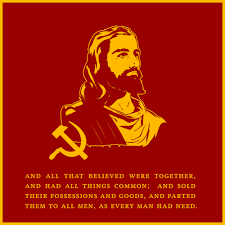
Even more to the point of the discussion at hand, it is evident that the idea of communism (or communalism) comes from the Bible itself. I’m thinking of two descriptions of life in the early Christian community that we find in the Acts of the Apostles. For instance,

Acts 2:44-45 says:

“All who believed were together and had all things in common; they would sell their possessions and goods and distribute the proceeds to all, as any had need.”

Acts 4:32–35 reads:

“All the believers were one in heart and mind. No one claimed that any of their possessions was their own, but they shared everything they had . . . And God’s grace was so powerfully at work in them all that there were no needy persons among them. For from time to time those who owned land or houses sold them, brought the money from the sales and put it at the apostles’ feet, and it was distributed to anyone who had need.”

Jesus’ identification with the poor and oppressed is also important for me. He said that whatever we do to the hungry, sick, ill-clad, thirsty, homeless, and imprisoned, we do to him. The words Matthew attributes to Jesus (in the only biblical description we have of the last judgment) are:

“The King will reply, ‘Truly I tell you, whatever you did for one of the least of these brothers and sisters of mine, you did for me.’ “Then he will say to those on his left, ‘Depart from me, you who are cursed, into the eternal fire prepared for the devil and his angels. For I was hungry, and you gave me nothing to eat, I was thirsty and you gave me nothing to drink, I was a stranger and you did not invite me in, I needed clothes and you did not clothe me, I was sick and in prison and you did not look after me.’ “They also will answer, ‘Lord, when did we see you hungry or thirsty or a stranger or needing clothes or sick or in prison, and did not help you?’ “He will reply, ‘Truly I tell you, whatever you did not do for one of the least of these, you did not do for me.’
There is much, much more to be said about this basic faith perspective. But for now, let that suffice.

Now for the second point about human rights:

• To repeat: no one can defend the obvious human rights abuses of Russia or China. They are clearly indefensible.
• In fact, they are as inexcusable as the similar abuses by the United States in countries which are or have been U.S. client states. I’m referring to Israel, Iraq, Afghanistan, Yemen, Vietnam, and countries throughout Latin America and Africa. In all the latter, it has not been unusual for freedom of press to be violated, for elections to be rigged (think Honduras just recently), for summary executions to be common, for journalists to be assassinated in large numbers, and for dissenters to be routinely imprisoned and tortured. Christians advocating social justice have been persecuted without mercy. (Recall that infamous Salvadoran right-wing slogan, “Be a patriot; kill a priest.”)
• Moreover, while we have been relatively free from such outrages on U.S. soil, the events of 9/11/01 have been used to justify restrictions of freedoms we have historically enjoyed. Here the reference is to wiretappings, e-mail confiscations, neighbors spying on neighbors, and other unconstitutional invasions of privacy that seem to violate the 4th Amendment of the Constitution. It is now even permissible for the nation’s head of state to identify the press as “the enemy of the people.”
• 9/11 has also been used to justify the clearly illegal invasion of at least one sovereign country under false pretenses (Iraq) with the resultant deaths of well over a million people (mostly civilians). Other countries have also been illegally attacked, e.g. Libya, Yemen and Somalia without due congressional authorization. 9/11 has further “justified” the establishment of “black sites” throughout the world, the “rendition” of prisoners to third countries for purposes of torture, innumerable (literally) arrests without charges and imprisonments without trial. It has even led to extrajudicial killings of U.S. citizens.

Such observations make the general point that when countries perceive themselves to be under attack, they implement policies both domestically and abroad that defenders of human rights correctly identify as repressive, cruel, criminal and even homicidal. Russia, China, and Cuba have been guilty of such policies. But so has the United States in supporting friendly regimes throughout the world and by implementing increasingly repressive policies here at home.

Now consider the pressures that led Russia, for example, to implement its own indefensible repression:

• As the most backward country in Europe, its people had suffered enormously under an extremely repressive Czarist regime. [Czarism, in fact, was the model of government that most Russians (including criminals like Stalin) had internalized.]
• Following its revolution, Russia was invaded by a vast coalition of forces (including the United States). It was forced to fight not only the invaders, but Czarist sympathizers and anti-communists within its own population.
• The country had twice been invaded by Germany through Poland and saw itself as needing a buffer from its implacable enemies to the west.
• Its people had fought heroically against German invaders and though suffering 20 million deaths and incredible infrastructure destruction, it managed to defeat the German army and largely be responsible for winning World War II.
• During the Cold War, Russia found itself under constant threat from western powers and especially from the United States, its CIA, and from NATO – as well as from internal enemies allied with the latter.

My only point in making such observations was not to defend Russia’s indefensible violations of human rights (nor China’s, nor Cuba’s); it was, rather, to make my central point about the efficiency of economies mixed in favor of the poor vs. those mixed in favor of the rich.

As shown by Russia (and even more evidently by China), economies mixed in favor of the poor develop much more quickly and efficiently than economies mixed in favor of the rich. While both Russia and China became superpowers in a very short time, the former European and U.S. colonies in Latin America, Africa, and South Asia have remained mired in colonial underdevelopment. The latter’s organizing principle of “comparative advantage” has proven ineffective in enriching them, since it locks them into positions of mere suppliers of raw materials to industrialized countries. No country has ever reached “developed” status by following such principle. In other words, Global South countries are still waiting for that wealth to “trickle down.”

So, readers shouldn’t mistake the argument made by Wolff and others. It was not to defend the indefensible. (Even Khrushchev and Gorbachev recognized and denounced the crimes of Josef Stalin.) The relevant point is about capitalism vs. socialism. It was to indicate that the vilification of socialism overlooks the achievements of that system despite (not because of) restrictions on human rights that are common to both systems in egregious ways that no humanist or follower of Jesus should be able to countenance.

My conclusion remains, then, that it is up to people of conscience (and especially people of faith) to oppose such restrictions and violations wherever we encounter them – but especially in our own system where our voices can be much more powerful than denunciations of the crimes attributable to “those others.”

Stephen King’s IT: A Halloween Parable about America and Its Orange-Haired Clown

Pennywise 2

I don’t like horror films. They’re too much like real life with its mass shootings, hurricanes, and the policies of that clown in the White House. So I demurred when friends invited me to see the film version of Stephen King’s IT.

In the end, however, I was somehow persuaded. After all, as a box office phenomenon, IT remains the highest grossing “R” rated film in history. Its subconscious cultural content, I suspected, might somehow explain that huge box office success. So I accompanied my friends to our local Miramax determined to find that content.

Before I get to that however, a word about the film itself. . . To put it succinctly, IT was quite boring. In terms of horror, it didn’t even succeed in the (otherwise quite easy) task of scaring me!

Think about the movie’s unlikely premise: a group of 7 pre-teens meet a terrifying clown who lives submerged in the sewer underworld of Derry, a small town in Maine. The kids are all outsiders; they even call their group “The Losers’ Club.” One is black, another Jewish, and the remainders a tomboy, a stutterer, a frail hypochondriac, an overweight intellectual, and a wise-cracking smart-aleck.

The Losers’ adversary appears every 27 years to maim, kill and disappear children in Derry. No one but the kids can see the motley spirit who appears all-powerful. Nonetheless, in the end, (spoiler alert) the children improbably, but only apparently kill the clown. (Readers of King’s book know Pennywise will return in 30 years or so – thus setting up the dreaded sequel.)

Oh hum!

None of this is to say that IT wasn’t terrifying. However, its truly scary characters were the story’s adults – especially the Losers’ parents. They were variously fat and lazy, sexually abusive, violent in the extreme, deceptive, authoritarian, possessive and stultifying.

What united them all was their mirror-perfect depiction of our country’s adult refusal to recognize an extreme violence threatening our own children, even when it’s staring us in the face. Nothing mobilized the adults; not disappearances, shootings, torn limbs, decapitations, bleed-outs, bullying, racism, child abuse and even a room covered with blood. They just couldn’t see any of it, and got angry when the children suggested that something was wrong.

Of course, all of this reflects our culture’s normalization of terror in a country described by that other Mr. King (Martin) as the “greatest purveyor of violence in the world.” We’re blind, for instance, to the horror of our economic system that today allows the preventable deaths of 30,000 children each day – without most of us taking any more note of the tragedy than the adults in Derry’s Maine-stream.

With the clown, we leave the terrifying adult world, and enter an ironically less threatening spirit world. But the spirit of what? The clown’s name “Pennywise” might offer a clue. (After all, Stephen King did choose to call him that?) Pennywise’s puzzling designation implies a connection between terror and money. Could he be the embodiment of an economic spirit that saves pennies, while being pound-foolish – the implied second half of the clown’s name? There’s got to be some meaning there.

In any case, and regardless of Stephen King’s intentions, our culture’s short-term focus on saving pennies (e.g. by defunding public schools, and healthcare) destroys children’s lives as surely as bites from the movie-clown’s yellowed incisors.

So, my premonitions may have been spot-on. Despite its artistic demerits, IT does hold lessons for those determined to probe its cultural context. They include:

  • Wake up!
  • Realize our pound-foolish system is destroying our children.
  • It depends on terror, fear, and violence to do so
  • Most of its older victims are in denial.
  • Younger “Losers” know better.
  • Listen to them.
  • And don’t be afraid of that violent, pennywise clown in the oversized suit.
  • Get rid of him as soon as possible.

For Lower Fares and Better Service, Nationalize Public Transportation!

Fair Skies

The airline industry is in big trouble with most of us, I’m sure you agree. I mean fares keep going up with no end in sight. You have to pay extra for any baggage you need to check. The seats keep getting smaller, and sometimes it costs you more for slightly wider accommodations even in the coach section. Meals that used to be free now come in little boxes at hefty prices. And even if you’ve paid for all of that, they still might call in the cops and evict you, bloody your nose, and knock your teeth out so that airline employees might take the seat you purchased, and more conveniently hitch a ride to their next gig.

I was reminded of all that when on my last Delta flight, I read an ad in that airline’s August edition of Sky Magazine.  It was headlined “Help Us Defend U.S. Jobs.” In part, the text complained:

“The nations of Qatar and the United Arab Emirates (UAE) are attempting to take over international aviation by funneling billions of dollars in subsidies into their state-owned airlines. U.S. airlines . . . can’t compete with the unreasonably low prices of the gulf airlines. And for every route lost, 1,500 Americans lose their jobs. Left unaddressed, the U.S. aviation industry is at risk . . . Join the fight to protect fair trade and American jobs.”

Say what? “Unreasonably low prices?” They want me to campaign against that? Hmm.

So, what’s Delta’s real problem here?  The ad says the company’s worried that it can’t compete with state-owned airlines that are less concerned with turning a profit than with serving the public – providing more of what travelers want: cheaper fares, good service, no extra charges, and free food and drinks.

How do Qatar, UAE and others do that? Simple: they funnel billions of dollars of investment (Delta misleadingly calls it “subsidies”) into the airlines they own rather than making profit maximization their be-all and end-all. Or, as it’s expressed at DELTA.COM/OURFIGHT: “Because they have large sums of money available, these . . . airlines don’t have to rely on profit.”

What’s wrong with that?

According to the Delta ad quoted above, what’s wrong is that the state-owned airlines are more successful; they’re getting bigger market shares and, Delta claims, costing Americans jobs – 1500 for each lost route. In fact, if it weren’t for the questionable protectionism of U.S. regulations, those airlines would enter our domestic market and take over there as well.

But, of course, there’s a cure for all of that too – one that will not only save those jobs, but likely get us cheaper fares and better service. It’s to follow the example of Delta’s vilified competitors: invest our tax dollars in U.S. airlines too. Nationalize them!

Don’t worry: no jobs will be lost. (It takes just as many people to run state-owned airlines as private ones.) And just watch: those fares will become “unreasonably low” in the process. Services and passenger perks might even reach the level of those gulf companies that so irritate Delta and other U.S. airlines.

Bring it on!

And, while you’re at it, how about investing “billions” of our tax dollars in state-owned railways, rather than in further bloating the defense budget? The state-owned China rail system runs bullet trains that travel at speeds over 200 mph. Meanwhile our under-funded Amtrak locomotives continue plodding along no faster than they did about 50 years ago.

Thank you, Delta, for making the point so exquisitely: when “airlines don’t have to rely on profit” consumers benefit. Air fares become “unreasonably low.”

At least as far as public transportation is concerned, socialism is far more efficient than capitalism.

Colin Kaepernick’s the Real Hero, Not Desperate U.S. Soldiers

kaepernick

Can you imagine yourself as a twenty-something – a black person sitting in the San Diego Chargers football stadium – with 70,000 angry mostly white people booing you and you alone? Can you imagine how that would feel – or what it would do to your psyche and to your feeling of being oppressed – not to mention your performance on the field?

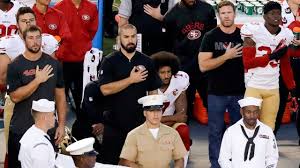
Well, that’s the position the San Francisco 49ers Colin Kaepernick was in last Thursday night. Every time he touched the ball (virtually each of his plays, since he’s the 49ers’ quarterback) he was booed mercilessly by a hostile overwhelmingly white crowd. Many of them obviously took the opportunity to scapegoat Kaepernick for their anger towards the Black Lives Matter Movement (BLM).

That’s because in the spirit of BLM, this 28 year-old bi-racial athlete has used the pre-game singing of “The Star Spangled Banner” to protest the numerous killings of unarmed black men and women by police officers over the past few years. He refuses to stand. He’s sitting it out.

As Kaepernick himself put it: “I am not going to stand up to show pride in a flag for a country that oppresses black people and people of color. To me, this is bigger than football and it would be selfish on my part to look the other way. There are bodies in the street and people getting paid leave and getting away with murder.”

Ignoring those reasons, the quarterback’s critics have somehow turned his protest into his alleged attack on the honor the military who have given their lives “defending our freedom.” So when Thursday’s Chargers-49ers contest coincided with San Diego’s 28th annual Salute to the Military, the pre-game ceremony took on added meaning. It featured a special flag ceremony that only heightened Kaepernick’s “unpatriotic” stance – and the reaction against it.

Specifically, before the game a huge flag was spread across the playing field, its borders held aloft by service men and women in Army, Navy, Marine, and Air Force uniforms. It was then that the National Anthem was sung. While everyone else stood with caps doffed and right hands over hearts, Kaepernick took a knee. He knelt while the others stood. Afterwards the boos rained down – on him and him alone.

For me, the boos called attention not simply to many white people’s opposition to BLM, but to our unthinking, unconditional support for capitalism and the U.S. military in general. The fact is that those soldiers, sailors, marines and pilots on that San Diego football field are not in any way defending our freedom. Instead they are victims of nationalistic propaganda and of a failed economic system.

Think about it: since 9/11 and well before (e.g. Korea, Vietnam, Grenada, Panama), U.S. military personnel have been simply brain-washed agents of U.S corporations defending the “right” of modern robber barons to steal resources, markets and cheap labor. General Smedley Butler said as much long ago. “War is a racket,” he charged.

The fact is that despite their good intentions, the military agents on that San Diego field do not deserve celebration any more than Hitler’s servicemen did.

Daniel Geery says it would be more fitting to celebrate conscientious objectors, deserters, and members of Iraq Vets against the War. It would be better to cheer young people who choose to actually do something productive with their lives. As he has identified them, they “serve us as nurses, doctors, teachers, construction workers, garbage men, laborers, cooks, waiters and waitresses, writers, inventors, organic farmers, architects, scientists, engineers, computer programmers, landscapers, and all those who choose to actually do something with their lives. . . Far better to be a prostitute, even, than to be a military person. You are at least hiring out to bring pleasure to others, not misery and destruction.”

Problem is, the “capitalist” economy is unable to provide enough of such jobs. So it funnels a desperate under-educated surplus workforce into the military whose commercials promise that there they can “Be all that you can be.” And the commercials are right. Under capitalism many simply can’t be more than killers for corporations. For them there is no alternative other than subscribing the neo-Cartesian principle, “I kill therefore I am.”

So subconsciously realizing capitalism’s failure to provide adequate jobs, but unable to face that music, propagandized fans express their anger by booing a scapegoat – a worker like themselves instead of the system’s managers.

Nonetheless, Kaepernick remains steadfast in his brave witness. He said, “I am not looking for approval. I have to stand up for people that are oppressed. … If they take football away, my endorsements from me, I know that I stood up for what is right.”

We should keep those words (and Colin Kaepernick’s example) in mind the next time we’re asked to stand for the National Anthem. Can we be as insightful and courageous?

Is Pope Francis a Positive Force or a Dangerous Illusion?

Francis wolf

A good friend of mine recently shared a link from the Real News Network that deserves a response. It was an interview with Chris Hedges criticizing Pope Francis for not being radical enough in his denunciation of capitalism and imperialism. The award-winning journalist gave the impression that the pope should have denounced both as such and offered alternatives.

I was surprised by Hedges’ remarks. That’s because my personal assessment is that the pope actually has done all three. He has been scathing in his denunciation of capitalism; he has denounced colonial imperialism, and has offered clear alternatives to capitalism-as-we-know-it. The pope did so during his” homecoming” trip through Latin America late last summer, during his subsequent six-day trip to the United States, and especially in his landmark encyclical, Laudato Si’ (LS).

On his Latin American tour, Pope Francis’ was quite direct in his denunciation of capitalism and imperial colonialism.

For instance, addressing the World Meeting of Popular Movements in Santa Cruz, Bolivia, Francis traced today’s global problems back to their origins in European colonialism beginning in 1492. But he also identified new forms of colonialism exercised through corporations, loan agencies, “free trade” treaties, and imposition of “austerity measures.”

Such actors and policies, he said, subordinate states to outside powers which also exercise control through misguided measures ostensibly aimed at controlling drug trafficking, political corruption, and terrorism. More subtly, external powers colonize, destroy local cultures and foster cultural uniformity through communications monopolies, which the pope described as “ideological colonialism.”

“Let us say NO to forms of colonialism old and new,” he said.

Still in Latin America, the pope went on to criticize capitalism-as-we-know-it as “an invisible thread” connecting problems of world poverty, worker exploitation, landlessness among farmers, homelessness, and destruction of the natural environment. That system imposes the mentality of profit at any price without concern for its impact on displaced peasants and workers or for its destructive effects on “Mother Earth.”

The system, he said “is by now intolerable: farm workers find it intolerable, laborers find it intolerable, communities find it intolerable, peoples find it intolerable … The earth itself – our sister, Mother Earth, as Saint Francis would say – also finds it intolerable.”

For me, all of that represents not only criticism of imperialism, but of the free market system.

Then during his visit to the United States, Pope Francis offered an extremely harsh denunciation of capitalism itself. There he in effect referred to economic system we know as “filthy,” “rotten,” and “putrid.” He called the Wall Street speculators “hypocrites.” Moreover, the pope directly confronted the members of his audience by calling the system they represented “the greatest purveyor of violence” in the world today. And he implied that  the politicians seated before him were a bunch of gangsters.

Even Chris Hedges may have missed all of that, because the polite, soft-spoken, and gentle pontiff was a gracious enough guest to say none of those things directly. He did so instead by offering Dorothy Day, Martin Luther King and Thomas Merton as embodiments of our country’s greatest values.

It was Dorothy Day who is remembered as saying, “We need to overthrow . . . this rotten, decadent, putrid industrial capitalist system which breeds such suffering in the whited sepulcher of New York.”

It was King who called the United States itself, “the greatest purveyor of violence in the world today.”

And it was Thomas Merton, the apostle of non-violence, who classified U.S. politicians and military leaders among the world’s gangsters when he said, “The world is full of great criminals with enormous power, and they are in a death struggle with each other. It is a huge gang battle . . .”

Moreover, Pope Francis did not leave his audience merely reeling from such heavy blows un-complemented by clear systemic alternatives to the filthy rotten arrangement he addressed. Instead, the pontiff called for a deep restructuring of capitalism-as-we-know-it. This would involve turning the present system’s preferential option for the rich precisely on its head, replacing it with his favorite guideline, the “preferential option for the poor.” Even more particularly, restructuring would require a central international legislative body endowed with power to override national economic practices judged to be environmentally unsound.

Both recommendations are found clearly stated in Laudato Si’ which the pope cited in his congressional address (LS 53, 173-175). Surprisingly, both have already been implemented world-wide.

To begin with, the New Deal, the Great Society and (even more so) Europe’s introduction of the welfare state already represent arrangements which forefronted the needs of the working classes and poor. The reform measures were at the very least strong gestures towards economies mixed in favor of the poor rather than of the Wall Street rich. Such reforms demonstrated that another economic order is indeed possible.

As for the world body with power to enforce environmental legislation, the World Trade Organization (WTO) already has it, though perversely in its present form. According to the provisions of the North American Free Trade Agreement (and of the proposed Trans-Pacific Partnership), multinational corporations (MNCs) now have the power to sue before the WTO and invalidate U.S. environmental protection standards if those laws can be shown to diminish a corporation’s expected profits.

What the pope is proposing is an international body that turns the WTOs mandate upside-down.  The body the pope proposes would have binding power to protect the environment from the depredations of MNCs – i.e. is to eliminate their profits if they result from environmental destruction.

So I respectfully suggest that Chris Hedges is mistaken when he says Pope Francis has pulled his punches. The pontiff has been quite specific in offering alternatives to the system he has so sharply critized. As an honored guest, he gently delivered knock-out blows clearly observable to attentive listeners.

It remains for prophets like Hedges and others to highlight and reinforce them and in this way to advance us towards the Other World Pope Francis would convince skeptics is possible.


Democracy at Work and in Play: Capitalist Rams vs. Socialist Packers

On Tuesday , Stan Kroenke, the owner of the NFL Rams franchise decided to move operations from St. Louis to Los Angeles.

The decision brought sorrow and a bitter sense of betrayal fans in St. Louis who have supported “their” football team through thick and thin. For them the penny dropped: their Rams were not theirs at all.

The obvious injustice prompted them to chant “Kroenke Sucks!” when the move was announced during a St. Louis Blues –New Jersey Devils hockey game.

The chant showed that people intuitively recognize the problem. It’s the problem of capitalism: a single owner backed by a small group of similar wealthy stockholders can override the interests of an entire local community for one reason and one reason only — MONEY!

With capitalism, it happens all the time. A small board of directors (15-20 people) can decide to override the interests of entire communities — Detroit, Youngstown, Camden New Jersey — and move operations offshore to Mexico, China, Taiwan, and who knows where else? In doing so, the private owners devastate the abandoned communities. Yet they bear no responsibility for their actions.

They simply leave. They leave without reimbursing the community for roads built to service their facilities, for tax breaks granted, for plants constructed with community subsidies, for families destroyed by loss of employment.

And, once again, it’s done for one reason and for one reason only — MONEY! It’s the logic of capitalism.

It doesn’t have to be that way.

As economist Richard Wolff has indicated, there can actually be democracy at work. Democracy at work means that if workers shared ownership of their factories, they’d never vote to offshore their jobs.

Following Wolff’s logic, there can also be democracy in play — even in the NFL.

The case of the St. Louis Rams contrasted with that of the Green Bay Packers illustrates the possibility. Unlike the NFL Rams, Packers’ owners could never vote to move their franchise. That’s because the owners are the club’s fans themselves. So moving from Green Bay (pop. 104,000) even to Los Angeles (pop. 4.8 million) is out of the question.

More specifically, according to the Packers’ 1923 Articles of Incorporation, no single person can control more than 4% of the club’s stock. So these spiritual descendants of workers — the Green Bay Meatpackers’ Union — have no one like Kroenke to deal with.

Moreover, Incorporation Articles stipulate that profit from any (unimaginable) transfer of ownership must go not to individuals but to the Green Bay Packer Foundation which benefits community education, civic affairs, health and human services and youth programs.

There are lessons in all of this:

– Democracy at work and in play is possible.

– It is preferable to capitalism’s oligarchical tyranny.

– The traditional name for such democracy is “socialism.”

– Socialism can be successful. (The Packers have won more championships than any of their capitalist competitors).

– Maybe workers should be rooting for the Packers in Saturday’s matchup with the Arizona Cardinals.

– Bernie Sanders is a socialist. Hmm . . .

George Will: Pope Francis Is UnAmerican (Sunday Homily)

George Will

Readings for the Twenty-sixth Sunday in Ordinary Time: NM 11: 25-29; PS 19:8, 10, 12-14; JAS 5: 1-6; JN 17: 17B, 17A; MK 9: 38-43, 45, 47-48

Since the pope’s arrival in the U.S. last Tuesday, it’s been all Francis all the time on television and in the newspapers. He’s charmed us all, and even somehow inveigled Republican lawmakers to applaud ending capital punishment, protecting the environment, opening borders to immigrants, and ending arms sales of all kinds.

Washington Post columnist, George Will, however is holding out. On the eve of the pontiff’s arrival, Will called the pope an over-the-top consumer, distant from the poor, flamboyant, sanctimonious, unscientific, wooly-headed, reactionary, and un-American. He isn’t smart or honest enough, Will suggested, to know that the capitalism he criticizes has pulled the masses from their poverty, extended life expectancy, and has the power to clean up the environment without burdensome regulations. Fossil fuels have saved the world. Without it we’d all be starving. The wealth is indeed trickling down.

So the pope is wrong when he speaks of “the excluded.” Capitalism-as-we-know-it is blameless and excludes no one. We need do nothing but forge ahead (like lemmings), intimated Will, an ultimate Beltway insider.

I bring all of that up because this week’s readings are about insiders and outsiders and how the Judeo-Christian tradition, like Pope Francis, stand firmly on the side of those insiders feel compelled to protect themselves against. Unlike Will, the readings say, the Jesus tradition stands against the rich, and on the side of the poor – especially children. The tradition calls us to transformation, not defense of the status quo.

In Will’s defense, however, it must be said that he stands in good company. Like him, the very disciples of Moses and Jesus were exclusivists. As they show in today’s readings, they too felt compelled to protect their privilege and turf and to turn away those they perceived as threatening interlopers.

On the other hand, both Moses and Jesus are like Pope Francis. They take a Big Tent approach to matters of the Spirit, wealth distribution and protection of the vulnerable. Both recognize the Divine Spirit of prophecy and healing wherever they are effective. Where that Spirit works, the rich are denounced as in today’s reading from the Letter of James.  Meanwhile, the poorest of the poor are defended in uncompromising terms – as happens at the end of today’s Gospel.

Consider the content of the readings themselves.

In today’s first selection from the Book of Numbers, Moses’ chief of staff, Joshua, is jealous when he hears that Eldad and Medad claimed Moses’ Spirit. They did so even though they had “missed the meeting” where that spirit was conferred. “Tell them to stop!” he demands of Moses.

“What are you talking about?” Moses replies. “They’re on our side. No one can control the gifts of God.  I wish everyone could share my spirit of resistance to oppression.” (That’s what the Spirit of Moses is in the Jewish Testament.)

Evidently, Mark has the Numbers account in mind when, in today’s Gospel reading, he structures a dialog between Jesus and his “beloved disciple,” John. (Only, John doesn’t come out very loveable in this story.) Mark parallels Joshua and John, Moses and Jesus perfectly.

John complains to Jesus that an exorcist who “does not follow us” is casting out demons in Jesus’ name. He wants Jesus to stop the fraud.

(John’s remark itself proves interesting. That is, by Mark’s account, none of Jesus’ inner circle really “follows” Jesus. Actually, they understand almost nothing of what Jesus says. They just don’t get it. They argue about who is the greatest, completely missing Jesus’ point about leadership “from below.” And they even prove themselves unequal to the task of casting out evil spirits.)

Like Joshua, John is jealous of an exclusive position and of powers that don’t really belong to him – certainly not in Jesus’ eyes.

So, like Moses, the Master replies “Let them be,” he says. “Whoever is not against us is with us.”

Other contents of today’s readings clarify the polarities Jesus refers to. According to the selection from the Letter of James the rich are against Jesus; exploited agricultural workers and little children are with him.

As a result, James predicts that the rich will soon be reduced to tears and misery. Their crime: living in the lap of luxury and pleasure while building up personal retirement funds at the expense of the defenseless field workers the landlords have underpaid.

For their crimes, the wealthy will see their gold and silver rot away. It will devour their flesh like a searing fire. They’ll end up wearing moth-eaten rags worse than those of the people they’ve exploited.

In the Gospel reading Jesus has even worse things to say about those who mistreat the absolute lowest of the low in the first-century Mediterranean hierarchy, viz. children.  As scripture scholar, Ched Myers, points out, for Jesus’ contemporaries children were victims of a “circle of contempt” within the family. They were treated as worse than slaves – as absolute non-entities.

Mark has Jesus contradict that culture in shocking terms. In fearfully poetic language he says that those who mistreat children will be treated worse than James’ exploitative rich. Jesus talks about amputated hands and feet and plucked-out eyes. His words cannot contain his rage.

In the end, George Will’s words barely contain his own rage in the face of Pope Francis embodiment of the Spirit Jesus exhibits in today’s gospel. In this the columnist mirrors would-be “followers” of Jesus — churchgoers who understand nothing of what their masters taught them. They are the rich who would have us ignore and despise the cries not only of children in general but of their own grandchildren and of their own Mother Earth.

In the end, it is they who are the over-the-top consumers, distant from the poor, flamboyant, sanctimonious, unscientific, wooly-headed, reactionary, and un-American.

George Will was more correct than he knew when he finished his screed about Pope Francis saying, “Americans cannot simultaneously honor him and celebrate their nation’s premises.”

Yes, we are called to change!