What Is Democracy For? China’s Whole-Process Democracy and the Common Good

My recent OpEdNews article, “China’s Example and the Need to Rethink Democracy Itself,” prompted an interesting response from editor-in-chief Rob Kall. He agreed that America’s inability to think beyond the next election is becoming one of our greatest national weaknesses. But he asked me to explain more fully what the Chinese call “whole-process people’s democracy.” How does it actually work? Is it merely another name for one-party rule, or does it embody a fundamentally different understanding of democracy?

Those questions deserve a careful answer because most Americans—including many progressives—know surprisingly little about China’s own explanation of its political system. We generally define democracy almost entirely by its procedures. If citizens vote, if competing parties contest elections, if freedom of speech is protected, and if power changes hands peacefully, we call a nation democratic. If those conditions are absent or limited, we usually do not.

Chinese political theory begins somewhere else.

Its proponents argue that democracy should be judged not only by how governments are chosen but also by what governments accomplish for ordinary people. The legitimacy of government lies not simply in electoral competition but in reducing poverty, expanding education, building infrastructure, protecting public health, caring for the environment, and planning for future generations. In that sense, China’s theory of “whole-process people’s democracy” is consequentialist. It asks citizens to judge government by its results.

Whether one ultimately accepts that understanding or not, it raises a larger question that reaches far beyond China.

What is democracy for?

As I reflected on Rob Kall’s question, I found myself thinking not only about Chinese political theory but also about Jesus, liberation theology, Catholic social teaching from Leo XIII to Pope Leo XIV, and even the Marxist ecological economist John Bellamy Foster. Strange as it may seem, these very different traditions converge around a remarkably similar principle. Political institutions should ultimately be judged by what they produce for human beings, especially for those who are most vulnerable.

Jesus expressed the principle with characteristic simplicity. “By their fruits you shall know them.” That sentence may be the clearest statement of consequentialist ethics ever uttered.

Jesus repeatedly judged persons and institutions by their consequences rather than by their claims. Good trees produce good fruit; bad trees produce bad fruit. In the parable of the Last Judgment, nations are evaluated not by their constitutions or political procedures but by whether they fed the hungry, welcomed the stranger, clothed the naked, visited prisoners, and cared for the sick. The decisive question is always: What happens to “the least of these” (Matthew 25: 31-46)?

Liberation theology extends precisely that biblical insight into politics and economics. Gustavo Gutiérrez famously defined theology as “critical reflection on praxis.” Orthodoxy must be tested by orthopraxis. Correct ideas alone are insufficient. A society is judged by the lives its institutions make possible, especially for the poor.

Enrique Dussel sharpened the point by distinguishing between what he called formal and material democracy. Formal democracy concerns procedures: elections, constitutions, legislatures, political parties, and legal rights. These are indispensable achievements. But they are not enough. Material democracy asks whether those institutions actually reproduce and enhance human life. Do they enable communities to flourish? Do they defend the excluded? Do they protect future generations? If they do not, procedural legitimacy alone cannot redeem them.

That distinction helps explain what Chinese theorists mean by “whole-process democracy.”

According to its proponents, democracy is not exhausted by election day. Citizens directly elect representatives at the village level, while higher-level people’s congresses are chosen through successive representative levels. Consultation continues throughout the policy process through congresses, advisory bodies, professional organizations, universities, business associations, workers’ organizations, and representatives of China’s many ethnic communities. Chinese scholars argue that democracy therefore consists not only of elections but of consultation, planning, implementation, evaluation, and revision.

Western observers frequently challenge aspects of this account, raising important questions about political pluralism, freedom of expression, and civil liberties. Those questions deserve serious discussion. Yet the Chinese model also asks a question Americans too seldom ask ourselves: What has our own democracy actually accomplished?

For decades Americans have watched infrastructure age, political polarization deepen, homelessness increase, life expectancy stagnate compared with many peer nations, and public confidence in institutions decline. Elections continue on schedule. Campaigns become ever more expensive. Every election is described as the most important in our lifetime. Yet many structural problems remain stubbornly unresolved.

One reason, I believe, lies in the nature of our political system itself.

The permanent competition between Democrats and Republicans makes sustained national planning extraordinarily difficult. Policies begun by one administration are often dismantled by the next—not necessarily because they have failed but because they belong to political opponents. The electoral calendar becomes stronger than the planning calendar.

China’s political system has evolved differently. Its supporters point to Five-Year Plans embedded within much longer strategic visions extending over decades. Whatever one thinks of particular policies, this institutional continuity makes it easier to pursue infrastructure projects, industrial strategies, poverty reduction, and technological development that require sustained public commitment.

Its advocates also note that senior leaders typically accumulate extensive administrative experience before reaching national office, usually serving at county, municipal, and provincial levels over many years. The underlying ideal is that governing capacity should be demonstrated before greater authority is entrusted.

Perhaps the greatest difference between the two systems concerns the relationship between political power and economic power.

Supporters of China’s system argue that the Communist Party’s historic responsibility is to ensure that concentrated private wealth does not capture the state. Whether contemporary China consistently fulfills that aspiration is a matter of legitimate debate. Yet the aspiration itself points toward an issue Americans can scarcely avoid.

Who governs our republic?

Increasingly, I fear it is what I have elsewhere called the “Epstein class.” By that phrase I do not mean wealthy people as such. Wealth honestly earned has enriched every civilization. I mean something more dangerous: an oligarchic class capable of converting immense private wealth into political influence, legal privilege, media power, and practical immunity from accountability. Jeffrey Epstein became, in my view, not the cause of this phenomenon but its most recognizable symbol.

Seen from this perspective, the defining political question of the twenty-first century is not capitalism versus socialism. Every major economy employs markets. The deeper question is whether markets govern society or whether society governs markets.

Here an unexpected convergence appears.

Beginning with Leo XIII’s Rerum Novarum, Catholic social teaching has consistently rejected both collectivist absolutism and laissez-faire capitalism. It has defended private property while insisting that ownership always carries social obligations. Markets are valuable instruments. They are not sovereign moral authorities. Economic life exists to serve the common good.

Pope Leo XIV develops that same tradition in Magnifica Humanitas. Reflecting on artificial intelligence, technological power, and global finance, he insists that technology, markets, and capital must remain subordinate to human dignity, ecological responsibility, and the integral flourishing of humanity. They are servants, never masters.

Remarkably, John Bellamy Foster reaches a strikingly similar conclusion from an entirely different intellectual tradition. He warns against what he calls the “fetishism” of artificial intelligence and of the market itself—the tendency to treat technological and economic forces as though they were beyond democratic control. Democratic societies, he argues, should consciously direct economic development toward ecological sustainability and human well-being rather than allowing markets alone to determine humanity’s future.

Franz Hinkelammert anticipated both arguments decades ago. He warned that modern capitalism easily transforms the market into an idol demanding endless sacrifice. Workers become expendable. Communities become disposable. Nature becomes merely another commodity. Against this idolatry, Hinkelammert proposed what he called “the criterion of life.” Every institution, every economy, every political system must finally answer one question:

Does it serve life?

Conclusion

Rob Kall asked me to explain China’s understanding of democracy.

In the end, I found myself confronting a much larger question, Viz., What is government for?

If its highest purpose is merely to organize elections, then the American model has much to teach the world. But if the purpose of government is to secure the common good, protect the vulnerable, subordinate economic power to democratic authority, preserve the earth for future generations, and enable human beings to flourish, then elections are not the end of democracy. They are only one of its instruments.

That is the challenge posed by China’s theory of whole-process democracy. Whether or not one ultimately accepts its answer, it forces us to ask whether democracy should be judged only by its procedures or also by its consequences.

Jesus had no hesitation about the answer.

He never said, “By their constitutions you shall know them.”

He never said, “By their elections you shall know them.”

He said, “By their fruits you shall know them.”

Perhaps that is the question the twenty-first century can no longer avoid. Not simply which nation is more democratic, but which political institutions consistently bear the fruits of justice, peace, sustainability, human dignity, and the common good.

Until we are willing to judge every political and economic system—including our own—by that standard, democracy will remain little more than a procedure. It will never become what it was always meant to be: a way of organizing society so that life, especially the lives of “the least of these,” may flourish.

Clarifying Economic (& Theological) Terms in the Capitalism-Socialism Debate

Readings for 25th Sunday in Ordinary Time: AM 8: 4-7; PS 113: 1-2, 4-6, 7-8; 1TM 2: 1-8; 2 COR 8:9;LK 16: 1-13

Last weekend, comedian, Bill Maher, and film-maker, Michael Moore, got into a shouting match on Maher’s show “Real Time.” Their point of contention was capitalism vs. socialism. Moore argued for socialism; Maher was against it. Their boisterousness reminded me of dinner-table arguments which (I’m ashamed to admit) I’ve been part of myself.

I bring all this up because the debate is intimately related to this morning’s liturgy of the word. Though the readings obviously pre-date the emergence of the modern system, they all criticize what has historically become “the spirit of capitalism.”  

In any case, the Maher-Moore debate is worth considering not only because it manifests the relevance of the Jesus tradition to arguments like theirs. The argument also demonstrates the counter-productivity of the squabble itself. It’s counter-productive because its terms fall into a trap congenial to the enemies of the biblical tradition. The trap frames alternatives to our present economic system in terms of “socialism” instead of in terms of social justice, mixed economy, and “preferential option for the poor.”

That’s a simple distinction I never tire of making, because (as I point out in my book, The Magic Glasses of Critical Thinking: seeing through alternative fact and fake news) it’s absolutely key to the discussions of capitalism and socialism that will inevitably characterize the election season we’ve just entered – especially following the eventual selection of any Democratic candidate. No matter who the candidate turns out to be, s/he will be predictably vilified for advocating socialism pure and simple – an economic system that simply does not exist.

Maher and Moore both missed that point. The rest of us shouldn’t. In fact, I recommend avoidance of capitalism-socialism framing altogether. I’ll explain what I mean, and then elucidate the connections with today’s readings.

To begin with, Moore’s mistake was to represent as “socialism” his advocacy of Medicare for all (Maher was against it), free college tuition, college loan-forgiveness, and the Green New Deal. In reality, those programs notwithstanding, each of them represents elements of mixed economies – the only form of economic organization that exists in our present context. And a mixed economy always has three elements (1) Some private and some public ownership of the means of production, (2) Some controlled markets and some that are free of control, and (3) earnings limited (usually by progressive income taxes).

Every economy in the world has those elements. There are no exceptions.

Mixed economies contrast with the three elements of capitalism as well as with those of socialism. Capitalism’s three points are (1) Private ownership of the means of production, (2) Free and open markets, and (3) Unlimited earnings. None of the world’s economies embodies those elements untempered by planning.

Meanwhile, socialism’s three points are (1) Public ownership of the means of production, (2) Controlled markets, and (3) Limited earnings. Like untempered capitalism, such economic arrangement exists nowhere (including in “communist” China or Cuba).     

For his part, Maher’s defense of capitalism was also a defense of mixed economy. He agreed with many of Moore’s points. So, Maher’s “capitalism” was no less mixed than Moore’s. The difference was that Maher wanted more market and less planning in economic policy.

This is not to say that all mixed economies are equal. (And this point is essential to keep in mind). The crucial question with them is “Mixed in favor of whom?” Those who mistakenly identify themselves as “capitalists” tend to advocate economies mixed in favor of the rich. They do so on the belief that wealth trickles down; a rising tide lifts all boats, etc.

Those who (equally mistakenly) identify as “socialists” want economies mixed more in favor of the working and unemployed classes. They recognize that unregulated markets respond primarily to those with the most money. Economies therefore have to be controlled to include those with limited (or no) resources.

With all of this in mind, Moore and Maher might have resolved their argument by recognizing that the choice before them is not between capitalism or socialism, but between an economy mixed in favor of the rich or one mixed in favor of the poor. And the formula for doing so might be: As much market as possible, with as much regulation as necessary (to assure a decent standard of living for everyone on the planet).   

Now, a formula like that not only avoids “the socialist trap;” it is also highly compatible with the biblical social justice tradition that’s expressed so clearly in this morning’s liturgy of the word. As I’ve translated them below, today’s selections point out the injustices inherent not only in the economies of the ancient world, but in today’s neoliberal order. Both, the readings imply, were and are rigged in favor of the rich and against the poor.  Check the readings for yourself here.

This is the way I interpret them:

 AM 8: 4-7

Money makes the rich
Exploit the poor.
It leads the wealthy
To distort religion
Manipulate currency
Put thumbs on scales
Sell shoddy products
And underpay workers.
But never doubt:
They will one day reap
Due karma.
 
PS 113: 1-2, 4-6, 7-8
 
For God will lift up
The poor
From the dirt
And “shitholes
They’re forced
To live in.
Thank God:
The lowly
Will one day
Become their own
Masters instead.
 
1 TM 2: 1-8
 
In the meantime,
Pray that the powerful
Might change their ways
For God cares
Even for them.
Pray that they
Might know God
As revealed in
The poor man
Jesus who died
For them too
Despite their bitterness
Lies and self-serving
Talking points.
 
2 COR 8:9
 
Yes, don’t forget:
God chose
Self-revelation
In the poor
Not in the rich.
Ironically,
God’s Preferential Option
For the Poor
Is the only way
To prosperity.
 
LK 16: 1-13
 
In fact,
The poor man, Jesus,
Laughed at the rich
Who can’t use a shovel
To save their lives,
But blame the beggars
Their own policies have created.
The rich are so crooked,
He joked,
That they even admire
Shrewdness in those
Who end up stealing from them!
Their own small larcenies
Grow exponentially.
So they cannot be trusted.
Restitution is therefore in order.
But don't worry
About the bankers:
Their “generous” loans
Can easily be written off
Without in the least
Impacting their
Decadent life-styles.
Their basic mistake
Is believing that
Differentiating wealth and God
Are somehow compatible.
They are not!

Don’t you agree that sentiments like those favor economies mixed in favor of the poor? (That’s the way they appear to me.) The readings imply that if mixed economies are all we have, we shouldn’t allow ourselves to fall into the trap that ensnared Moore and Maher. Instead of arguing about non-existent “capitalism” or “socialism,” we should make sure to embrace the principle “As much market as possible, but as much planning as necessary (to insure a dignified life for all).”

But to avoid pointless shouting matches, it will be necessary to carry around in our minds those clear and easily understood ideas about what capitalism and socialism are. To repeat: capitalism’s essential elements are (1) private ownership of the means of production; (2) free and open markets, and (3) unlimited earnings. Socialism’s defining points are just the opposite: (1) public ownership of the means of production; (2) controlled markets, and (3) limited earnings. Once again, those two definitions make it clear that mixed economies are all we have. 

Finally, we should be emphasizing the incompatibility between  the Judeo-Christian tradition and the spirit of capitalism as characterized in today’s readings. Excessive wealth on the one hand and God on the other are not compatible. Or, as Jesus put it, “No one can serve two masters. Either you will hate the one and love the other, or you will be devoted to the one and despise the other. You cannot serve both God and money.”

Despite our culture’s claims to the contrary, that’s the faith we “People of The Book” (Jews, Muslims, and Christians) are called to embrace.

The Missing Faith Dimension of the Capitalism vs. Socialism Debate

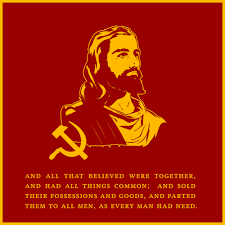
Jesus Communist

Democracy Now recently reported surprising results from a new Gallup poll about evolving attitudes in this country about socialism. The poll concluded that by a 57-47% majority, U.S. Democrats currently view socialism more positively than capitalism.

Let me offer some reflections sparked by those poll results. I offer them in the light of some pushback I received over my related blog posting about the capitalism vs. socialism debate. These current reflections will emphasize the faith perspective that has not only shaped my own world vision, but that should mobilize Christians to be more sympathetic to socialist ideals.

To begin with, the Gallup poll results are themselves astounding in view of the fact that since after World War II all of us have been subjected to non-stop vilification of socialism. As economist and historian, Richard Wolff, continually observes Americans’ overcoming such programming is nothing less than breath-taking. It means that something new is afoot in our culture.

On the other hand, the Gallup results should not be that shocking. That’s because since 2016, we’ve become used to an avowed socialist, Senator Bernie Sanders of Vermont, being the most popular politician in the country.

On top of that the recent 14-point victory of another socialist, Alexandria Ocasio Cortez, grabbed everyone’s attention. Recall that Ms. Cortez defeated 10-term congressional incumbent, Joe Crowley, in her NYC race for the Bronx and Queens seat in the House of Representatives.

Socialist candidates seem to be sprouting up everywhere. They advocate a $15 an hour minimum wage, Medicare for all, and tuition free college education.

Such promises seem to be somehow awakening Americans (at least subconsciously) to the reality that at least since WWII, similar socialist programs have become quite familiar. We’ve all experienced their efficacy since Roosevelt’s New Deal. We expect the government to intervene in the market to make our lives better.

In fact, since the second Great War, there have been no real capitalist or socialist economies anywhere in the world. Instead, all we’ve experienced are mixed economies with huge elements of socialism that we’ve all taken for granted.

Put otherwise, economies across the globe (however they’ve identified themselves) have all combined the three elements of capitalism: (1) private ownership of the means of production, (2) free and open markets, and (3) unlimited earnings, with the corresponding and opposite elements of socialism: (1) public ownership of the means of production, (2) controlled markets, and (3) limited earnings. The result has been what economists everywhere call “mixed economies”: (1) some private ownership and some public ownership of the means of production (exemplified in the post office and national parks), (2) some free markets and some controlled markets (e.g. laws governing alcohol, tobacco and fire arms), and (3) earnings typically limited by progressive income taxes.

What has distinguished e.g. the mixed economy of the United States from the mixed economy, e.g. in Cuba is that the former is mixed in favor of the rich (on some version of trickle-down theory), while the latter is mixed in favor of the poor to ensure that the latter have direct and immediate access to food, housing, education and healthcare.

My article also went on to argue that the socialist elements just mentioned have enjoyed huge successes in the mixed economies across the globe – yes, even in Russia, China and the United States.

“All of that may be true,” one of my readers asked “but how can you ignore the tremendous human rights abuses that have accompanied the “accomplishments” you enumerate in Russia and China? And why do you so consistently admire socialism over capitalism which has proven so successful here at home?”

Let me answer that second question first. Afterwards, I’ll try to clarify an important point made in my recent posting’s argument about the successes I alleged in Russia and China. That point was in no way to defend the horrendous human rights abuses there any more than those associated with the successes of the U.S. economy which are similarly horrific. But we’ll get to that shortly.

In the meantime, let me lead off with a that basic point about faith that I want to centralize here. Here my admission is that more than anything, I’m coming from a believer’s perspective.

That is, without trying to persuade anyone of its truth, I admit that my Judeo-Christian faith dictates that the earth belongs to everyone. So, boundaries and borders are fictions – not part of the divine order. Moreover, for some to consume obscenely while others have little or nothing is an abomination in the eyes of God. (See Jesus’ parable about the rich man and Lazarus (LK 16:19-31).

Even more to the point of the discussion at hand, it is evident that the idea of communism (or communalism) comes from the Bible itself. I’m thinking of two descriptions of life in the early Christian community that we find in the Acts of the Apostles. For instance,

Acts 2:44-45 says:

“All who believed were together and had all things in common; they would sell their possessions and goods and distribute the proceeds to all, as any had need.”

Acts 4:32–35 reads:

“All the believers were one in heart and mind. No one claimed that any of their possessions was their own, but they shared everything they had . . . And God’s grace was so powerfully at work in them all that there were no needy persons among them. For from time to time those who owned land or houses sold them, brought the money from the sales and put it at the apostles’ feet, and it was distributed to anyone who had need.”

Jesus’ identification with the poor and oppressed is also important for me. He said that whatever we do to the hungry, sick, ill-clad, thirsty, homeless, and imprisoned, we do to him. The words Matthew attributes to Jesus (in the only biblical description we have of the last judgment) are:

“The King will reply, ‘Truly I tell you, whatever you did for one of the least of these brothers and sisters of mine, you did for me.’ “Then he will say to those on his left, ‘Depart from me, you who are cursed, into the eternal fire prepared for the devil and his angels. For I was hungry, and you gave me nothing to eat, I was thirsty and you gave me nothing to drink, I was a stranger and you did not invite me in, I needed clothes and you did not clothe me, I was sick and in prison and you did not look after me.’ “They also will answer, ‘Lord, when did we see you hungry or thirsty or a stranger or needing clothes or sick or in prison, and did not help you?’ “He will reply, ‘Truly I tell you, whatever you did not do for one of the least of these, you did not do for me.’
There is much, much more to be said about this basic faith perspective. But for now, let that suffice.

Now for the second point about human rights:

• To repeat: no one can defend the obvious human rights abuses of Russia or China. They are clearly indefensible.
• In fact, they are as inexcusable as the similar abuses by the United States in countries which are or have been U.S. client states. I’m referring to Israel, Iraq, Afghanistan, Yemen, Vietnam, and countries throughout Latin America and Africa. In all the latter, it has not been unusual for freedom of press to be violated, for elections to be rigged (think Honduras just recently), for summary executions to be common, for journalists to be assassinated in large numbers, and for dissenters to be routinely imprisoned and tortured. Christians advocating social justice have been persecuted without mercy. (Recall that infamous Salvadoran right-wing slogan, “Be a patriot; kill a priest.”)
• Moreover, while we have been relatively free from such outrages on U.S. soil, the events of 9/11/01 have been used to justify restrictions of freedoms we have historically enjoyed. Here the reference is to wiretappings, e-mail confiscations, neighbors spying on neighbors, and other unconstitutional invasions of privacy that seem to violate the 4th Amendment of the Constitution. It is now even permissible for the nation’s head of state to identify the press as “the enemy of the people.”
• 9/11 has also been used to justify the clearly illegal invasion of at least one sovereign country under false pretenses (Iraq) with the resultant deaths of well over a million people (mostly civilians). Other countries have also been illegally attacked, e.g. Libya, Yemen and Somalia without due congressional authorization. 9/11 has further “justified” the establishment of “black sites” throughout the world, the “rendition” of prisoners to third countries for purposes of torture, innumerable (literally) arrests without charges and imprisonments without trial. It has even led to extrajudicial killings of U.S. citizens.

Such observations make the general point that when countries perceive themselves to be under attack, they implement policies both domestically and abroad that defenders of human rights correctly identify as repressive, cruel, criminal and even homicidal. Russia, China, and Cuba have been guilty of such policies. But so has the United States in supporting friendly regimes throughout the world and by implementing increasingly repressive policies here at home.

Now consider the pressures that led Russia, for example, to implement its own indefensible repression:

• As the most backward country in Europe, its people had suffered enormously under an extremely repressive Czarist regime. [Czarism, in fact, was the model of government that most Russians (including criminals like Stalin) had internalized.]
• Following its revolution, Russia was invaded by a vast coalition of forces (including the United States). It was forced to fight not only the invaders, but Czarist sympathizers and anti-communists within its own population.
• The country had twice been invaded by Germany through Poland and saw itself as needing a buffer from its implacable enemies to the west.
• Its people had fought heroically against German invaders and though suffering 20 million deaths and incredible infrastructure destruction, it managed to defeat the German army and largely be responsible for winning World War II.
• During the Cold War, Russia found itself under constant threat from western powers and especially from the United States, its CIA, and from NATO – as well as from internal enemies allied with the latter.

My only point in making such observations was not to defend Russia’s indefensible violations of human rights (nor China’s, nor Cuba’s); it was, rather, to make my central point about the efficiency of economies mixed in favor of the poor vs. those mixed in favor of the rich.

As shown by Russia (and even more evidently by China), economies mixed in favor of the poor develop much more quickly and efficiently than economies mixed in favor of the rich. While both Russia and China became superpowers in a very short time, the former European and U.S. colonies in Latin America, Africa, and South Asia have remained mired in colonial underdevelopment. The latter’s organizing principle of “comparative advantage” has proven ineffective in enriching them, since it locks them into positions of mere suppliers of raw materials to industrialized countries. No country has ever reached “developed” status by following such principle. In other words, Global South countries are still waiting for that wealth to “trickle down.”

So, readers shouldn’t mistake the argument made by Wolff and others. It was not to defend the indefensible. (Even Khrushchev and Gorbachev recognized and denounced the crimes of Josef Stalin.) The relevant point is about capitalism vs. socialism. It was to indicate that the vilification of socialism overlooks the achievements of that system despite (not because of) restrictions on human rights that are common to both systems in egregious ways that no humanist or follower of Jesus should be able to countenance.

My conclusion remains, then, that it is up to people of conscience (and especially people of faith) to oppose such restrictions and violations wherever we encounter them – but especially in our own system where our voices can be much more powerful than denunciations of the crimes attributable to “those others.”