Are You a “Had-It” Catholic? Are Retro-Priests Responsible?

Biretta.JPG

Readings for 31st Sunday in Ordinary Time: MAL 1-14B-2:2B, 8-10; PS 131:1-3; I THES 2-7B-9, 13; MT 23: 11-12

Today’s readings should make today’s retro-priests very uncomfortable.  I’m referring to members of the Catholic Clergy who long for the “good old days” before Vatican II.

In any case, both the first selection from Malachi and the third from Matthew take clergy in general to task. They’re not teaching the right things, Malachi charges. They’re too concerned with clothes and titles, says Jesus.  Meanwhile today’s second reading from Paul’s letter to his community in Thessalonia suggests remedies for such failings. Paul even gestures towards a female clergy and worker priests. See if you agree.

Begin with the prophet, Malachi. He threatens the priests in his time with a curse. Probably writing about 500 years before Jesus, the prophet says “You have turned aside from the way and caused many to falter by your instructions . . . I have therefore made you contemptible and base before all the people.”

“Contemptible?” “Base?” Pretty strong words for priests, wouldn’t you say?

Then in today’s Gospel selection, Jesus criticizes the religious leaders of his own day for attachment to distinctive religious dress and for insisting on special titles like “father.”

Reading those passages, do retro-priests feel their faces turning red?

Relative to titles and dress, I’m alluding to the fact that we still call our priests “father,” despite Jesus’ clear words. And then there’s this reversion on the part of many priests to pre-Vatican II garb. Some are now wearing dress-like cassocks again (I saw one in the airport the other day), and even birettas. (Birettas are these odd square caps with three or four peaks or horns, sometimes topped with a black tuft.)

Before Vatican II, priests used to dress like that. Now in 2017, retro-priests are doing the same. It makes you wonder what they’ve been learning in the seminary over the last 50 years.

And as for Malachi’s words about faulty instruction . . . Why are we still listening to pre-Vatican II sermons?

Just a few days ago, I was talking to a fellow parishioner about exclusion of non-Catholics receiving communion while attending Catholic Mass. My friend was defending the exclusivity. And his reasons were like something from my childhood – more than 70 years ago! It was as if the ecumenical movement had never taken place – as though Jesus were somehow contained inside the communion wafer, as though he still believed that Catholics have an inside track in “getting into heaven,” – you know: up there.

The point here is not to criticize my fellow parishioner; it’s not at all his fault. The fault lies with (in Malachi’s words) the “instruction” given by our priests – and, I guess, to our priests in the seminary.  What they’re telling us from the pulpit doesn’t nearly extend to us the benefits of inter-denominational dialog, the insights of the last 150 years of biblical study, or even the teachings of the Second Vatican Council.

What’s up with all of that?

Again, in Malachi’s words, it’s causing people to “falter,” to see the meaninglessness and irrelevance of it all, and to “turn aside” from everything churchy as contemptible and base – or at least irrelevant to their lives as thinking people. No wonder “had-it” Catholics constitute the second largest denomination in the United States.

Priests today are not even following the instruction of the pope who gives every evidence of being a had-it Catholic himself.

Remember four years ago, when Pope Francis published his Apostolic Exhortation, The Joy of the Gospel? Throughout the document, you could almost feel Francis’ frustration with the situation I’ve been describing here. Recall what he said. It’s amazing in its content. But what’s even more amazing is the failure of priests and bishops to implement its directives.

Recall that Pope Francis called explicitly for a “new chapter” in the history of the Catholic Church. Things cannot be left as they presently are, he asserted, but must include new ways of relating to God, new narratives and new paradigms (74). Changes should entail new customs and ways of doing things, with new times, schedules, and language (27). In short, Catholics must find, a new path in our world (JG 1, 25).

What part of “new” are priests and bishops not getting?  Why, has NOTHING changed? NOTHING AT ALL!

Pope Francis got more particular. Homilies, he said, have to be better prepared and delivered (135-159). (The pope devoted a whole section of his exhortation to this topic.) Women need more prominence. He referred to them as generally more sensitive than men – more intuitive, and otherwise more skilled (103, 104). In recognition that other denominations share many points of faith and practice with Catholics, there needs to be more outreach towards those communities (246).

Even more importantly, Francis called the church to be more involved in political life, joining people of all faiths and none in the struggle for social justice. He specifically identified that struggle as “a moral obligation” that is “inescapable” (220, 258). Here horizons must be widened, the pope urged, beyond simple concern for the “defense of unborn life” (213) to “each and every human right” including education, health care, and “above all” employment and a just wage (192). Catholics must completely reject war as incapable of combatting violence which is caused by “exclusion and inequality in society and between peoples” (59). Wars are caused by devotion to unfettered markets with their “trickle-down” ideologies which are homicidal (53), ineffective (54), and unjust at their roots (59).

That emphasis on social justice shows why today’s retro-priests and bishops are not merely quaint and irrelevant, but positively harmful – even deserving of that curse Malachi threatened. I say that because they’ve ignored Francis’ desperate calls for social justice – not to mention his warnings about climate change in his eco-encyclical, Laudato Si’. I might even go so far as to say that neglectful priests and bishops are responsible for the election of Donald Trump and Republicans in general, whom (because of their position on climate change)Noam Chomsky has called the most dangerous organization in the history of the world.

After all, so many Catholic voters, possibly even a majority, chose Trump who in contradiction to the pope’s exhortation:

  • Denies human-caused climate change
  • Espouses trickle-down economics
  • Opposes living wages
  • Restricts access to health care
  • Loves the military
  • Threatens to annihilate an entire nation of 25 million people

What to do about all of this?

Here is where Paul provides direction. He suggests that priests are out-of-touch.

They need to get a job. Paul brags about how he worked day and night (as a tent-maker) so he wouldn’t represent a financial burden on his people. Can you imagine priests working at McDonalds and leading the campaign for $15 dollars an hour wages — and bringing that struggle into their sermons?

Like Pope Francis with his words about women’s unique gifts, Paul’s words even suggest a female clergy. He does that by comparing his dedication to his community in terms of “a nursing mother’s care for her children.”

Worker priests? Women priests? Now those changes truly represent a new path. That “New” no one could misunderstand. No more “father.” No raised eyebrows at clergy wearing dresses and fancy hats.

“Got-it” Catholics might replace the “Had-its.”

It’d work for me!  How about you?

And how might we get from here to there? (Discussion follows.)
A Courageous Pope Francis Knows about Walking on Water: He Calls Us to Do the Same

Francis & Trump

Readings for 19th Sunday in ordinary time: I KGS 19: 9A, 11-13A; PS 85: 9-14; ROM 9: 1-5; MT 14: 22-23

In today’s Gospel, we hear Matthew’s account of Jesus walking on water – and of his invitation to Peter to follow the Master’s example. The story is relevant to Pope Francis who believes he is Peter’s successor.

The walking-on-water episode is also relevant to Catholics in general trying to figure out how to comport ourselves in this age of Donald Trump with its renewed threats of nuclear war. Should we risk criticizing the president in the name of our faith, or not? The pope’s example says we should. Speak out, it says, against pre-emptive war, narrow fundamentalism, racism, rejection of immigrants, and environmental destruction. And don’t worry: it won’t kill you. Not speaking out may.

Just last month, the pope gave that message, showing, once again, his willingness to step out of his boat and follow Jesus’ symbolic example of fearlessly confronting the monstrous threats facing our world.

In case you missed it, I’m referring to Francis’ apparent endorsement of sentiments expressed in a controversial article that appeared last month in La Civiltà Cattolica – the Vatican’s quasi-official weekly publication. The article boldly criticized American Catholics who accommodate the Gospel to Trumpism.

More specifically, the Vatican weekly accused U.S. Catholic ultraconservatives of making an alliance of “hate” with evangelical Christians in their backing of President Trump. In doing so, the article warned, they have strayed dangerously into the turbulent waters of political polarization in the United States. According to the Civiltà Cattolica writers, the conservatives’ worldview and literal understanding of the Bible is “not too far apart’’ from that of jihadists.

The Pope’s apparent endorsement of the article showed once again his willingness to confront Monsters like Donald Trump himself along with Steven Bannon, and their Catholic supporters like Paul Ryan, Cardinal Raymond Burke, Archbishop Charles Chaput of Philadelphia, and Cardinal Gerhard Muller, the German conservative appointed by Benedict XVI (and recently fired by Francis) as the church’s chief judge of doctrinal orthodoxy.

The suggestion here is that the Pope’s courageous stands over the course of his papacy represent his acceptance of Jesus’ invitation to “walk on water” – to follow the example of Jesus in confronting fearful demons that life inevitably forces us to face.

To see the connection, first consider today’s Gospel reading.

The story goes that following Jesus’ feeding of the 5000 (last week’s Gospel focus), Jesus forces the apostles to get into their boat and row to the other side. [The text says, “Jesus made (emphasis added) the disciples get into a boat and precede him to the other side.” Perhaps these experienced fishermen (as opposed to the land lubber, Jesus) saw a storm was coming and were reluctant to set sail despite Jesus’ urgings.]

In any case, a storm does come up and the apostles fear they are all about to drown. You can imagine their cries for help.

Then they see a figure walking on the water in the midst of high threatening waves. At first they think it’s a ghost. Then they realize that it’s Jesus. He’s walking on the raging waters.

Peter, ever the impetuous leader of the apostles, doubts what he sees. So he says, “Prove to me that it’s you, Jesus; let me walk on the waves just as you’re doing.” Jesus says, “Join me then over here.” So Peter gets out of the boat and, like Jesus actually walks on water for a few steps.

Then, despite the evidence, he begins to doubt. And as he does so, he starts sinking below the water line. “Save me, Lord!” he cries out again. Jesus stretches out his hand and saves Peter. Then he asks, “Where’s your faith? Why is it so weak? Why did you doubt?”

Of course, this whole story (like last week’s “Loaves and Fishes”) is one of the dramatic parables Matthew composed. If we get caught up in wondering whether we’re expected to believe that someone actually walked on water, we’ll miss the point of this powerful metaphor. It’s about Jesus’ followers doing the unexpected and irrational in the midst of the seriously threatening crises life forces upon us.

You see, Matthew’s Jewish audience shared the belief du jour that the sea was inhabited by dangerous monsters – Leviathan being the most fearful. And courageously walking on water was a poetic way of expressing what Matthew’s community believed about Jesus, viz. that he embodied the courage and power to do the completely unexpected in the midst of crisis and subdue the most threatening forces imaginable – even the most lethal they could think of, the Roman Empire.

Jesus’ invitation to Peter communicates the truth that all of us have the power to confront monsters if we’ll just find the courage to leave safety concerns behind even in the most threatening conditions, to confront life’s monsters, and join Jesus in the midst of its upheavals.

Problem is: we easily lose faith and courage. As a result, we’re overcome by life’s surging waves and by the monsters we imagine are lurking underneath.

And that brings me back to Pope Francis and the stands he has taken against the secular orthodoxy of the day that accommodates itself to an emerging neo-fascism. Since the outset of his papacy, he has demonstrated unusual courage attempting to join Jesus on the world’s dangerous waves in contradiction to expectations established by his predecessors. Remember:

  • Unlike other popes, he’s adopted a comparatively simple, unpretentious lifestyle.
  • He’s lost no opportunity to condemn neo-liberalism, growing income inequality, and capitalism itself.
  • His apostolic exhortation, “The Joy of the Gospel” (largely unheeded) called for radical change in the church, and implicitly endorsed the liberation theology his two immediate predecessors had tried to kill.
  • More specifically, he adopted liberation theology’s “preferential option for the poor” as the leitmotif of his papacy.
  • In that spirit, his famous “Who am I to judge” gave hope to the LGBTQ community.
  • In 2014, his Vatican Peace Vigil helped head off President Obama’s plans to bomb Syria.
  • The following year, he addressed the U.S. Congress where he forthrightly called for an end to capital punishment, and urged divestment from the arms industry, whose profits he described as “soaked in blood.”
  • On that same occasion, he called his audience to imitate fierce critics of capitalism and United States policy, Martin Luther King, Dorothy Day, and Thomas Merton.
  • He helped shape and gave unequivocal endorsement to the Paris Climate Accords (recently repudiated by Mr. Trump) by publishing his radical eco-encyclical, Laudato Si’, also in 2015. It arguably remains the most important public document of the 21st  century.
  • His contextual approach to family issues (pre-marital sex, abortion, sexual orientation, same sex marriage, divorce . . .) recognized the sovereignty of individual conscience. In Amoris Laetitia, he admits that moral choices in family and other matters are inevitably conditioned by age, maturity, degree of moral development, economic necessity, and, yes, ignorance and religious misinformation. As a result, no one is anyone else’s judge.

True, his papacy has daringly left safe harbor and courageously sailed into the storm. Francis clearly sees Jesus as his role model in the face of today’s unprecedented winds and waves. Indeed, Francis has gotten out of the boat to trample underfoot the beasts and monsters roiling the seas all around us.

The question is, will we follow him? The monsters we fear can be intimidating:

  • The pro-war mainstream media
  • Those politicians and churchmen I mentioned earlier
  • The relatives, neighbors, friends, and fellow parishioners who might think us too political
  • Our own attachment to our petty reputations and self-conceptions
  • The militarized police at demonstrations
  • The emerging right wing, “brown shirt” thugs who might threaten our political expression

As the crisis this week over North Korea shows, this is no time for followers of Jesus to be silent, to remain in safety inside gated communities, behind our computers, TVs, sports fanaticism, and other entertainment addictions. This is the time for us to follow the example of Jesus and Pope Francis.

Today’s dramatic parable calls us to get out of the boat and confront the demons who keep us silent and compliant.

All Catholics Should See “The Keepers”: It Will Scare the Hell Out of You (Sunday Homily)

Readings for 6th Sunday of Easter: ACTS 8: 5-8; 14-17; PS 66: 1-7; 16, 26; I PT 3: 15-18; JN 14: 15-21

I’m presently in Michigan working hard on a book I’m writing about critical thinking.

Meanwhile, my wife, Peggy, is off in Cuba teaching a class of Berea College students there. So I’ve had lots of time to invest in my project. And I’ve nearly finished another draft.

This weekend, my sister, Mary, has come to our cottage in Canadian Lakes for a very welcome visit. Unfortunately, however, the weather has been cold and rainy. So we spent some time watching a startling Netflix series. It’s called “The Keepers.” It’s a shocking account of an unsolved 1969 murder of a young Catholic nun in Baltimore.

Sister Cathy Cesnik, disappeared shortly after confronting authorities about widespread sexual abuse at the prestigious Keough High School, where she taught English. Two priests there used the confessional to identify young females who would be vulnerable to their sexual depredations. Eventually they ended up sharing their victims with school outsiders including police officials. The priests had become pimps who threatened their victims and their families with death if they revealed their abuse.

The young women were so traumatized that the priests’ threats kept them silent for years.

Finally, however, some of Sr. Cathy’s former students decided to investigate her murder.  One thing led to another, and eventually more than 50 women came forward with their shocking tales which brought to light not only cover-ups by the Baltimore archdiocese, but that implicated the Baltimore Police Department as well.

The story with its cynical use of religion to exploit innocent children led to long conversations with my sister about our Catholic backgrounds, about our own experiences in Catholic schools, about confession, and church teachings in general. We found ourselves sympathizing with those (including close friends and relatives) who have left the church as irredeemably corrupt. No wonder, we agreed, that “former Catholics” represent the second largest religious “denomination” in the country (with 22.8 million), behind members of the official Catholic Church at 68.1 million.

Yet, as human beings, those people (all of us) retain a spiritual hunger. So many former Catholics (and others) identify themselves as “spiritual, but not religious.”

Today’s liturgy of the word gives us an idea of what that identification might mean. They call us to realize the fact that the Spirit of Christ resides in everyone – and in all of creation. It’s not dependent on going to church, being a Catholic or even a Christian. Rather, it depends on simply opening our eyes and on waking up to the Spirit’s presence everywhere, despite the self-induced sleep and blindness of “the world” – and, I would add, despite the corruption of hypocritical churches.

And where does the Spirit reside? The answer is surprising. The Spirit of Christ is closer to us than our jugular vein. John the Evangelist has Jesus say as much in today’s Gospel reading. Listen to the description again for the first time.

Jesus says:

  1. I am in the Father.
  2. You are in me.
  3. I am in you.

Could anyone be clearer about it? We are all temples. Our bodies, not buildings are the churches that matter. There is nothing in Jesus’ teaching about confession, ritual, priests, doctrine. It’s simply about opening our eyes and embracing the truth that God’s Spirit is like the very air we breathe. It’s like Paul will later say in his Areopagus speech about the “Unknown God” (Acts 17:28): Everyone lives and moves and has being in God’s Spirit.

Recognizing that and acting accordingly is what spirituality (vs. religion) is about. As Jesus says in today’s Gospel, such recognition will have us keeping his commandments: to love God wholeheartedly and our neighbor as ourselves. And, of course, loving our neighbors as our self does not mean loving them as much as we love ourselves. It means loving them because they are our self – the Self that is one with God. Put more simply: All of us are one. That’s the essence of Jesus’ teaching.

Later on in Acts 17:28, Paul elaborates. He explains to Greek seekers in the Areopagus that their altar to the “Unknown God” represents an unconscious recognition of the God of Israel.

But that recognition can happen only if we become holy in the sense indicated in today’s first reading. There Philip (and later Peter and John) invoked Christ’s Spirit on Samaritans – the traditional enemies of Jews. Significantly, the apostles do so while laying hands on the Samaritans’ heads. Their action symbolically brings together the left and right sides of the brains of those they touch. The ritual shows that experiencing the Spirit calls not just for logic, but for intuition as well. The Spirit is the one who makes us whole, not simply right or left-brain dominant. “Holiness” means wholeness in that sense – integrating what we know logically and by intuition.

That’s what spirituality means!

I’m writing this at 3:00 Sunday morning. The Keepers is still haunting me and keeping me awake. I’m feeling disturbed, even angry, about the Church’s distortion of faith, God and the Spirit of Christ explained so simply in today’s readings.

Please excuse me for any lack of coherence here.  Blame it on the late hour. But don’t miss watching the film.

Trump’s Anti-Catholic Persecution: My Personal Response

trump-immigrants

Last Saturday night we had our first meeting of a house church a number of us are trying to get off the ground. Ten people showed up. At least half of them admitted being there principally to humor me – because they’re such good friends. For that I remain extremely grateful.

By their very presence and participation, those good friends helped me clarify my own calling in these troubled times. They helped me realize that these are times of anti-Catholic persecution, and that the renewed oppression calls for thoughtful response. Please allow me to explain.

To begin with, at Saturday’s meeting, there was plenty of talk about Donald Trump. Everyone spoke of a sense of foreboding and depression at the events of the preceding week – the president’s first in office. There was all that xenophobia about Mexicans described as criminals and rapists – all that talk of The Wall.

One good friend described his impression of standing on a track in the face of an onrushing train with no power to stop it.

But another invoked the term metanoia – the Greek word for repentance in the sense of complete change of mind and action. He implied that as people of faith, we have to change profoundly. We need to man-up, woman-up and act like subjects rather than as powerless objects moved about by the tweets of the Bully-in-Chief. (His words made me reconsider my own immobility and resistance to change.)

Well, we finished our discussion, broke bread and shared wine around our dining room table. Afterwards, as we ate our potluck meal, we spoke of possible action during the coming week. There was talk of boycotting Trump products and services, writing letters, making phone calls, and even traveling to Standing Rock.

Following our liturgy, I felt a sense of profound gratitude for the generosity and good will my friends had shown. (They even stayed beyond the allotted time.) All the same, I worried that our suggested actions might never touch, for example, conservatives who voted for Mr. Trump or send ripples beyond our emerging little church.

I wondered what I might do personally to change that.

In the middle of that night, around 4:00 in the morning, I awoke suddenly with a possible response. It involves confronting the fact that a new government-sponsored persecution of Catholics is breaking out in our midst.

I’m not exaggerating. I mean, if I consider attacks on predominantly Muslim countries as veiled attacks on Islam, I should also consider attacks on predominantly Catholic countries as attacks on Catholicism.

Such antagonism has long and bloody precedent. In fact, all during the 1980s the United States fought what Noam Chomsky calls “the first religious war of the 21st century. On Chomsky’s analysis, it raged against the Catholic Church in Latin America whose bishops had together dared to affirm a “preferential option for the poor” as their official position. The conflict created chaos particularly in Central America, took the lives of hundreds of thousands of Latin American Catholics. Today its aftermath remains a principal cause behind the stream of refugees entering the U.S. through Mexico.

Donald Trump’s policies against refugees represents an extension of that 1980s religious war. In its current form, it vilifies and excludes Catholics as devoid of the moral standards the Church prides itself on teaching.

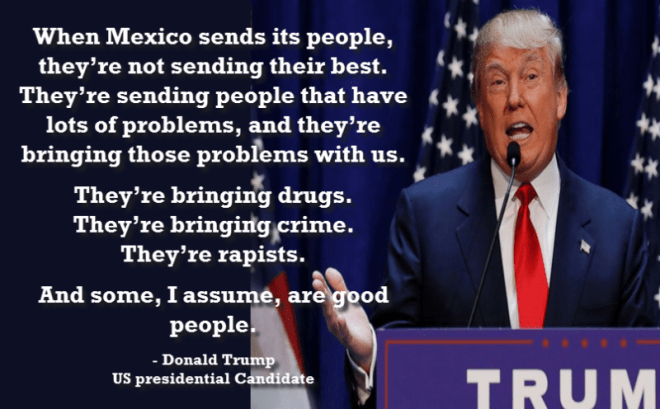
Think about it, Donald Trump has identified Mexicans and Central Americans (again, most of them Catholic) as morally deficient. The president said:

“When Mexico sends its people, they’re not sending their best. They’re not sending you. They’re not sending you. They’re sending people that have lots of problems, and they’re bringing those problems with us. They’re bringing drugs. They’re bringing crime. They’re rapists. And some, I assume, are good people.”

Here Mr. Trump identifies good Mexican Catholics among us as the exception, not the rule. The vast majority, he claims, are drug dealers, criminals, and rapists.

However, my own specifically Catholic experience gives the lie to his words. He’s demonizing my fellow parishioners –  people I consider my brothers and sisters in Christ. I know them by name: Amelia, Carlos, Ana, Isidro, Graciela, Ramon. . .  Criminals? Rapists? Drug dealers?

There are at least 100 such people in my Berea Kentucky church of 200 families. And that doesn’t even count the DACA students in our local Berea College. Under Trump, all of these people and their families stand accused not only by the president, but by those he emboldens to harass them. In other words, our fellow Catholics are in danger, so are their sources of income, their health and well-being.

Recently after church, I spoke with some of the endangered. They all agreed; they feel threatened and quite frightened. Moreover, they would appreciate more evident solidarity and support from Anglo parishioners who, in the case of our Berea church attend a separate Mass (at 9:00 a.m.) while Hispanics attend either a Spanish language Mass at 11:00, or both the 9:00 and 11:00 Masses.

How then might I respond to the plight of their Hispanic brothers and sisters in Christ? Here’s what I’m thinking: I might

  • Clearly identify in my own mind President Trump’s policies as anti-Catholic and specifically threatening to my fellow parishioners.
  • Lobby my senators and congressional representative to vote against Mr. Trump’s immigration policies.
  • Use the term “anti-Catholic” in my phone messages to those politicians.
  • Use similar language in writing to Speaker of the House, Paul Ryan, who describes himself as a “devout Catholic.”
  • Try to persuade the parish council in my local church to declare our parish a sanctuary for the refugees and immigrants among us.
  • In general, show solidarity with my fellow undocumented parishioners.
  • Begin participating in the 11:00 “Hispanic Mass” instead of the 9:00 mostly Anglo ceremony.
  • Be undeterred by my diffidence about not speaking Spanish well enough, realizing instead that my good will goes a long way towards establishing the sense of solidarity and support that our Hispanic brothers and sisters need.
  • Pair up with new friends and offer to spend time with them in conversation to help them learn English.

I suspect that actions like those, if adopted more generally, would start parish-wide conversations about Mr. Trump’s policies that affect “brothers and sisters in Christ.” They might raise the awareness of conservative parishioners – and possibly even of our church leadership. Such actions hold the promise of mobilizing many against the Trump administration’s fearful xenophobic juggernaut that, as I’ve said, is quite anti-Catholic.

I smile as Imagine what might happen across the country if Catholics responded in these ways.

Thank you, my good friends for helping me see the possibilities. Now it’s time for me to get to work.

Notes for a Home Church: Why The Church as We Know It Is Dead (Pt 2 in series of 4)

dead-church

In my last posting, I announced the first meeting of a house catholic (i.e. open to all) church. It will take place this Saturday, the day after Donald Trump’s inauguration, at 5:00 in Peggy’s and my home, 404 Jackson St.

I also mentioned that friends of mine wondered why, noting that the church as we know it is dead.

To be honest, I find their point hard to deny. As already noted, the institutional church is pretty much in extremis. If it disappeared entirely, most of our lives would be little affected. There’s good reason for that. The church has little to do with the historical Jesus, who (in contrast to the one worshipped in our churches) remains extremely relevant to this age of Donald Trump and its ushering in of fascism.

Let me explain

Jesus never intended to found a church. As James Carroll has pointed out recently in his Christ Actually, the Master was a prophetic reformer of Judaism. He remained a Jew to the end of his life. It was beyond his purview even to conceive of belonging to or persuading others to embrace a religion other than a reformed Judaism.

The same was true for his immediate followers. As shown in the Acts of the Apostles, they met in their homes to “break bread” [as was the signature practice of Jesus himself (see below)]. However, they also continued to congregate in the Temple and in local synagogues. Even Paul remained a good Jew. His work with “Gentiles” was with non-Jewish converts to Judaism. His concern was not to burden them by requiring circumcision and kosher diet of such “God-Fearers” wishing to embrace the Jesus Wing of Judaism. John Dominic Crossan and Marcus J. Borg have argued persuasively about this in The First Paul.

As I’ve indicated in my own book, The Emperor’s God, the Jewish Jesus-Community at Jerusalem was led by Jesus’ brother James the Just. Its members were effectively wiped out or driven into exile in the year 70, when the Romans utterly destroyed Jerusalem and its Temple. The resulting Jewish diaspora (refugee Christians among them) spread throughout the Roman Empire. There Christian concern for the poor drew numerous (typically impoverished) non-Jews into their orbit. Largely variant interpretations of Jesus’ identity subsequently emerged – some strictly Jewish, other gentile, some pro-Empire, others Empire-resistant.

In fact, four basic understandings of Jesus  came out of the hodgepodge: (1) Jesus was a completely human prophet like John the Baptist, (2) he was a human being who eventually became divine, (3) he was from the beginning a God who pretended to be human, and (4) Jesus was from the outset somehow fully God and fully human.

It was the latter interpretation that eventually prevailed as “orthodox.” The other three interpretations (along with additional opinions) were labeled “heretical” and suppressed, often quite violently.

In the early 4th century, the non-Jewish, “orthodox,” and pro-empire factions within Christianity rose to prominence. That was after Constantine issued his Edict of Milan in 313. It made Christianity legal in the Roman Empire. Then in 325 Constantine himself convened the Council of Nicaea. Its Nicene Creed effectively transformed Jesus into a Roman God – above history, thoroughly Roman, and no longer Jewish. As such, he was not a threat to Rome or any other regime willing to dispense rich favors on the church. By 381, under the Emperor Theodosius, Christianity had become the official religion of the Roman Empire. As the pro-empire faction of Christian leaders consolidated their power, the historical Jesus and his specifically Jewish concerns were lost forever.

Even more tragically, following the collapse of the Roman Empire in the early 5th century, the Church gradually stepped into the breach and took over its functions. Increasingly, popes resembled emperors, cardinals became “princes of the church,” bishops aspired to princely rank, and priests often fell into the role of religious hucksters hawking spiritual favors such as forgiveness of sins and “indulgences” in exchange for money.

Throughout the process, what gave priests their authority was the power the church claimed for them to “transubstantiate” bread and wine into the body and blood of Christ. Their ability to forgive sin in the sacrament of penance consolidated their influence. It rendered them indispensable for those wishing to get to heaven after death – which was for Catholics the whole point of life. Without such powers, priestly authority would have vanished.

None of that is to say that the Church sold its soul to empire entirely. Over the centuries, there were plenty of reform movements. Beginning around the 3rd century, the Desert Fathers rejected the growing worldliness of the Church. Franciscans in the 13th century followed in that tradition. Then came the great Protestant Reformation in the 16th century.

Key to the latter was the denial of priestly status or authority. Luther, Calvin, Zwingli and others undercut the priestly class by correctly recognizing that neither Jesus nor the apostles were priests. In fact, the reformers said, any special priesthood was a compete aberration for Christians. If anything, in virtue of baptism, all Christians are priests. They were empowered to forgive one another’s sins. There was no need for the sacrament of penance. Moreover, all the reformers agreed with St. Augustine who taught that belief that a priest’s words could change bread and wine into the literal body and blood of Christ was absurd and cannibalistically repugnant.

Modern biblical scholarship has proven the Reformers correct on most counts. As Garry Wills has argued in Why Priests?, outside the obscure Epistle to the Hebrews, Jesus is nowhere in the New Testament identified as a priest. Instead he is consistently portrayed as a lay person – a prophet extremely critical of priests and their work. When St. Paul lists the charisms, gifts or offices found within the Christian community, nowhere on his list of 16 separate categories does he mention “priest” – much less of a power to change bread and wine into Christ’s body and blood or to forgive sins in “confession.”

Well, if the Eucharist is not a ritual intended to miraculously render Jesus present in the host and chalice, what is it? And what is the meaning of Jesus’ words at the Last Supper: “This is my body . . . this is my blood . . . Do this in remembrance of me?”

We’ll take that up in next Tuesday’s posting – Part 3 in this series.

Starting a House Church: A Faith-Inspired Response to Trumpism (First in a series of four)

barth

Recently, I surprised friends and readers of this blog by announcing plans to “re-appropriate my priesthood” and start a house church. It would be a faith-based response, I said, to Trumpism and its planetary threat. The community, I hoped, would mobilize the spiritual power that in fact dwarfs the U.S. presidency and the president’s capacity as Commander-in-Chief of the mightiest military in the history of the world.

Some of my former priest-colleagues wondered, “Why on earth would you want to do that?”

After all, the church is for all practical purposes dead and the priesthood along with it.

And good riddance. By and large, the church remains sexist, religiously fundamentalist, and arguably the most conservative force on the face of the earth.

“And there’s more,” they said.  “Virtually no one believes in priestly powers any more. According to Catholic faith, it all hangs on two quasi-magical endowments that priests alone allegedly have to: (1) transform bread and wine into the literal body and blood of Christ, and (2) forgive mortal sins that would otherwise send their perpetrators to hell. Few who think about it take such beliefs seriously any more. The others are just coasting along in thoughtless denial. Their children however perceive the nonsense and are jumping the sinking ship in droves. That’s why if ‘former Catholics’ were an actual denomination, they would constitute the third largest church in the United States.

“Moreover, Catholics are virtually indistinguishable from Protestants (or non-believers for that matter) in their life-styles and political positions. They even practice birth control in exactly the same percentages as other Americans. It’s a similar case with divorce and same-sex relationships. And many Catholics vote Republican, despite papal social teachings on social justice, the environment, and war.

“So what’s the point of the Catholic Church with its anachronistic priesthood? It has become a mere social club – good for keeping old friendships alive, but little more. Most of its committees, sodalities, youth and men’s groups are self-serving. Do-gooders could easily find other organizations elsewhere to satisfy their passion for social change – without having to fight resistant Catholic fundamentalists in the process.”

To be frank, I find such objections persuasive.  Despite the best efforts of Pope Francis, the church seems more dead than alive. For all practical purposes, it whistles past the crises that characterize our age. The Sunday Masses I attend completely ignore the unprecedented contemporary context of threats from nuclear war, climate change, racism and sexism.

And yet, I remain firm in my intention to proceed with the house church. That’s because despite the institutional church’s having lost its way, I still find in my faith a source of spiritual strength and political resistance that for me is irreplaceable.

I intend to start a house church also because the objections just mentioned overlook the fact that Catholic Church pews also seat resisters like me. There are people whose faith has been shaped by the reforms of the Second Vatican Council. In the spirit of the conciliar document, “The Church in the Modern World,” their faith engages them not only with world events, but with one another.

For instance, in my own community, a group of more than 20 has met regularly over the past two or three decades as our church’s Peace and Social Justice Committee. Our gatherings often find us reflecting on liturgical readings. Discussions connect them with political organizing, welcoming refugees, war-resistance, the environmental crisis, and with the needs of local unemployed and impoverished families. Work with Habitat for Humanity has been a constant commitment.

I’m loathe to let such relationships and commitments go. At the same time, I’m convinced there has to be a better, more focused, more regular and consistent way of harnessing the deep faith the 20 or so of us share, especially in the face of Trumpism. To repeat: we’re in an unprecedented situation that calls for an unprecedented response.

I’m convinced that the best response is to experiment with house church Sunday liturgies that would bring our sub-community and others together on a weekly basis to reflect, pray, break bread, and plan creative acts of resistance. The liturgies will take place on Saturday evenings (i.e. on the Sabbath) and thus allow those wishing to attend Mass in our church the next morning, to do so.

In the end, my reasons for starting a house church are rooted in history and theology – in post-Vatican II understandings of church, of Eucharist, and of priesthood. A changed understanding of each – more in accord with the leadership of Pope Francis gives hope and direction.

I will try to explain what I mean in subsequent postings over the next three weeks.

Catholic Action vs. Trumpism: An Invitation to an Alternative Weekly Mass[1]

lords-supper

As indicated in earlier postings (here and here), the ascension of Donald Trump and his group of billionaire confidants to national leadership calls people of faith in general and Catholics in particular to adopt extraordinary and vigorous responses to the grave threat their ascent signifies.

This posting represents one such response. Its call is especially urgent in the light of the fact that the Trump administration and Republicans in general embody what Noam Chomsky has termed “the most dangerous organization in the history of the world.” Their unanimous climate-change denial accords them the title. In fact, they not only deny the human causality of climate chaos, they plan to proceed full speed ahead with the practices (oil and gas drilling and fracking) that our planet’s finest minds identify as its causes. The Republicans (with the Democrats not far behind) are leading us all like lemmings to the precipice of planetary destruction and the end of human life as we know it.

This is no exaggeration.  As Pope Francis has written so eloquently:

“Doomsday predictions can no longer be met with irony or disdain. We may well be           leaving to coming generations debris, desolation and filth. The pace of consumption, waste and environmental change has so stretched the planet’s capacity that our contemporary lifestyle, unsustainable as it is, can only precipitate catastrophes, such as those which even now periodically occur in different areas of the world. The effects of the present imbalance can only be reduced by our decisive action here and now. We need to reflect on our accountability before those who will have to endure the dire consequences.” (Laudato Si’ 161).

It is clear that despite Francis’ strong words, “decisive action” in the face of Trumpism’s climate-change denial and other destructive policies has no chance of issuing from the diocesan Catholic Church nor from our local Catholic community in Berea. So the invitation here is to Catholics and other people of faith to create an alternative (or, if you will, a complementary) community of faith to celebrate a house-church Mass each week. Its liturgy will be characterized by sharp awareness of the unique political context we are now entering. Each will be followed by discussions planning direct action against Trumpism in all of its forms.[2]

The Mass will be simple and prayerful. It will take place on Saturday evenings in a home (Peggy’s and mine to begin with). Together we will sing some inspiring songs, reflect on the week’s liturgical readings in the light of the Church’s rich social justice tradition, and break bread eucharistically before sharing a pot-luck supper. Each meeting will incorporate planning for specific acts of resistance.

The first convening of this alternative community will take place on Saturday, January 21st, the day after Mr. Trump’s inauguration which is scheduled for January 20th. Here are the details:

Berea’s Weekly Alternative Home-Church Mass

Place: 404 Jackson St.

Time: 5:00-7:00

The Mass:

  • Welcome (5:00)
  • Singing, opening prayers, & Liturgy of the Word (5:00-5:45)
  • Eucharist (around the dining room table) & Pot Luck (5:45-6:45)
  • Planning the week’s direct action (6:45-7:00)
  • 7:00 (promptly): Dismissal

Beginnings, no doubt, will be small and modest. But we should not be discouraged. Ideas about how to proceed more inspiringly will surely develop as all group members share their suggestions.

[1] Starting next Tuesday, I will start a 4-part series here explaining the history and theology behind home liturgies including an explanation of current theologies of the Eucharist and “Real Presence.”

[2] For those who remember: The faith community envisioned here might be thought of as a more spiritually-focused Berea Inter-Faith Task Force for Peace.

James Patterson’s “Woman of God”: Its Call to Reform the Catholic Church from Below

woman-of-god-image

James Patterson surprised me recently by publishing a book about the Catholic Church and faith. Usually, of course, Paterson deals with the world and adventures of ex-F.B.I. agent Alex Cross. There Patterson’s fiction revolves around spies, the C.I.A., terrorists, murder and general mayhem.

So I was intrigued when I came across Woman of God. I was even more surprised to find it addressing the problem of reform in the Catholic Church. In fact, the book might be seen as a parable – if we understand parable as a fictional story inviting its audience to conversion and action. The action in question is transformation of the Catholic Church independent of established church authority.

Woman of God traces the life of Brigid Fitzgerald, a not particularly religious physician, whose first assignment takes her to Africa’s Sudan. There horrendous experiences with grinding poverty, terrorist attacks, battlefield operations and dying children drive her to rediscover her long-abandoned faith.

The book is filled with prayers and mystical reflections about the unity of creation and of humankind. It also details Brigid’s series of romantic relationships and marriages that all end tragically. As a result, I sometimes thought I was reading one of those Christian romances where each and every plot turn is cloyingly related to God, faith and prayer.

But Patterson somehow pulls this one off.

With her faith deepening with every chapter, Brigid’s second marriage joins her with a progressive Catholic priest. Together they start the Jesus, Mary and Joseph (JMJ) Catholic Church. It offers an alternative to the local parish, but stubbornly continues to identify as Catholic, even over the objections and threats of the local bishop. Eventually, Brigid herself becomes a priest – ordained by a dissident prelate.

Gradually JMJ becomes a movement that spreads across the United States. So does Brigid’s fame as a married female cleric. Accordingly, she receives threats from conservative Catholics and accolades from almost everyone else. A final seal of approval comes from the pope himself, when Brigid (and her daughter) are summoned to Rome to meet the Holy Father. When he eventually dies, there is even speculation that Brigid herself might be chosen pope.

The connections between Woman of God and bottom-up reform of the Catholic Church are obvious – especially in the light of prospects that threaten the very continuity of human life on our planet. As parable, the book calls committed Catholics to actually do something by way of resistance that calls upon the Church’s long (a neglected) social justice tradition. it’s time, the story suggests, to start a JMJ church of our own.  Committed Catholics must become the change Pope Francis called for in his landmark Apostolic Exhortation, The Joy of the Gospel.

Chris Hedges’ recent article on the state of our country intimates something similar. We’re living in circumstances that parallel events in 1933 Germany, he says. As Hedges argues, all of our institutions – government, military, police, media outlets, schools and universities, churches and synagogues – have been too long silent. We’ve simply gone along with their own gradual corruption. When it’s all over, we’ll stand there scratching our heads and wondering how we could have let it all happen.

Regarding the role of churches, Hedges predicts we will ask:

“Where were the great moral and religious truth tellers? Why did they use the language of identity politics as a substitute for the language of social justice? Why did they refuse to condemn as heretics those on the Christian right, which fused the symbols of the state with those of the Christian religion? Why did they collaborate with the evil of corporate capitalism? Why did they retreat into churches and synagogues, establishing exclusive social clubs, rather than fight the injustice outside their doors? Why did they abandon the poor? Why did they replace prophetic demands for justice with cloying political correctness and personal piety?”

Chris Hedges suggests that only a deeply engaged spirituality focusing on social justice can save Catholics from repeating the “go-along-to-get-along” mistakes they committed under Nazism. We need the U.S. equivalent of Dietrich Bonhoeffer’s Confessing Church. We need a JMJ community that will make its business resistance of all forms of Trumpism in the name of Jesus’ God.

Recall what Bonhoeffer, Pastor Niemoller, Karl Barth and others did when Adolf Hitler came to power. They saw their churches silent at best, and at their worst actually cooperating with Hitler by giving him their blessings. So they started their “Confessing Church.” Originally the movement concentrated on ecclesiastical threats from Hitler. Later however those foci broadened to embrace persecuted Jews. In the face of concentration camp atrocities, its members ended up asking

“Why does the church do nothing? Why does it allow unspeakable injustice to occur? … What shall we one day answer to the question, where is thy brother Abel? The only answer that will be left to us, as well as to the Confessing Church, is the answer of Cain. (“Am I my brother’s keeper?” Genesis 4:9)

Catholics should make the Confessing Church’s question our own as Nazism has morphed into the contemporary Alt-right. In the face of its current unprecedented threat, corresponding action is required that works every day for the defeat of the neo-fascism Trumpism represents. And the Catholic Church with its unparalleled social teaching (recently expanded by Pope Francis’ Laudato Si’) offers us the guidance we need to shape the responses of a present-day Confessing Church.

Following the parabolic example of Brigid Fitzgerald and her JMJ Church, here’s what we might do:

  • Admit that in most cases, present forms of church are hopelessly disconnected from the unprecedented tragedy and threat represented by the accession to power of the Neo-Fascist Alt-Right.
  • Recognize the power of the Catholic tradition as expressed by Pope Francis as he addresses climate change, environmental destruction, income inequalities, racism, xenophobia, and interminable wars.
  • Publicly move out of our local church building.
  • Open store front JMJ Catholic churches with names such as “St. Francis’ Catholic Church of Resistance.”
  • Invite former Catholics, college students, and other disaffected church members to join.
  • Publish the invitation in local newspapers.
  • Meet in the store front for Eucharist each Sunday at the very times the local church celebrates Mass.
  • Empower faithful women in the JMJ community to preach and celebrate the Eucharist.
  • Gather in the storefront on Wednesday evenings to plan the week’s acts of resistance to Trumpism in all of its manifestations.

Certainly there will come objections from sincere Catholics. They will say:

  • We have no authority to do this.
  • It’s better to continue our reform efforts from within.
  • This will only cause division in our church.
  • The status quo really doesn’t bother me, because I use the quiet provided by Sunday Mass to facilitate my own prayer life.
  • (If, like me, you’re of a certain age) I’m too old for such radical disruption of my life.

To such objections Brigid Fitzgerald might reply:

  • As baptized Catholics, we have all the authority we need. Given the unprecedented threats we face, none of us can wait for top-down leadership to address them adequately. (This was the conclusion of the Confessing Church.)
  • Reform from within? Remember: some of us are operating in churches where announcements deemed “too political” are forbidden. Some parishes don’t even have Peace and Social Justice Committees.
  • Division in our churches? The divisions that already exists are precisely the problem. Papering over such fissures actually prevents even naming the problem of Trumpism.
  • Withdrawing into personal prayer? The times will not allow us the luxury of such pietism in the face of a threat that is truly planetary.
  • Too old? Christian faith will not allow us to identify with the physical as if we were primarily bodies with souls. Our spirits are ageless. The truth is that we are primarily ageless spirits who happen to inhabit temporary bodies. The imperative for action is no less incumbent on older people than on the young. Moreover, the JMJ movement promises to invite energetic college students (and others) to join us as leaders in our community.

This is not time for those with experience to step back and relax. Like Brigid Fitzgerald our experiences have caused us to mature. They have made us wise. That wisdom tells us that time is running out – for us personally, for our children and grandchildren, and for the planet itself. These unprecedented times call for radical response.

Thank you, James Patterson for your parable and its summons to Catholics. It remains for us to respond.

Did Jesus Justify Armed Resistance to Roman Imperialism? What about Insurgent Resistance to U.S. Imperialism? (Sunday Homily)

Jesus-Said-Video-Preview.jpg

Readings for the 20th Sunday in Ordinary Time: JER 38: 4-10; PS 40: 2-4, 18; HEB 12:1-4; L 12: 49-53

Today’s gospel excerpt presents problems for any serious homilist. That’s because it introduces us to an apparently violent Jesus. It makes one wonder; why does the Church select such problematic passages for Sunday reading? What’s a pastor to make of them?

On the other hand, perhaps it’s all providential. That is, today’s gospel might unwittingly help us understand that even the best of imperialism’s victims (perhaps even Jesus) are drawn towards reactive, revolutionary, or self-defensive violence. After all, Jesus and his audiences were impoverished victims of Roman plunder. By the standards most Christians today accept, they had the right to defend themselves “by any means necessary.”

Here’s what I mean. Without apology, today’s reading from Luke has the ‘Prince of Peace” saying, “I have come to set the earth on fire, and how I wish it were already blazing . . . Do you think that I have come to establish peace on the earth?  No, I tell you, but rather division.”

In a parallel passage, Matthew’s version is even more direct. He has Jesus saying, “Do not suppose that I have come to bring peace to the earth. I did not come to bring peace, but a sword.”

Is that provocative enough for you?

What’s going on here? What happened to “Turn the other cheek,” and “Love your enemy?”

There are two main answers to the question. One is offered by Muslim New Testament scholar, Resa Aslan, the other by Jesus researcher, John Dominic Crossan. Aslan associates the shocking words attributed to Jesus in this morning’s gospel directly with Jesus himself. Crossan connects them with the evangelists, Luke and Matthew who evidently found Jesus’ nonviolent resistance (loving enemies, turning the other cheek) too difficult to swallow for people living under the jackboot of Roman imperialism.

For his part, Aslan points out that the only God Jesus knew and the sole God he worshipped was the God of Jewish scripture. That God was a “man of war” (Exodus 15:3). He repeatedly commands the wholesale slaughter of every foreign man, woman, and child who occupies the land of the Jews. He’s the “blood-spattered God of Abraham, and Moses, and Jacob, and Joshua (Isaiah 63:3). He is the God who “shatters the heads of his enemies” and who bids his warriors to bathe their feet in their blood and leave their corpses to be eaten by dogs (Psalms 68: 21-23). This is a God every bit as violent as any the Holy Koran has to offer.

For Aslan, Jesus’ words about turning the other cheek and loving enemies pertained only to members of the Jewish community. They had nothing to do with the presence of hated foreigners occupying and laying claim to ownership of Israel, which in Jewish eyes belonged only to God. Accordingly, Jesus words about his commitment to “the sword” expressed the hatred he shared with his compatriots for the Roman occupiers.

In other words, when it came to Roman imperialists, Jesus was not a pacifist. He issued no call for nonviolence or nonresistance. Quite the opposite.

John Dominic Crossan disagrees. For him the earliest layers of tradition (even the “Q” source in Matthew and Luke) reveal a champion of non-violent resistance. In fact, the Master’s earliest instructions to his disciples tell them to travel freely from town to town. But in doing so, they are to wear no sandals, carry no backpack, and no staff. He instructs: “Take nothing for the journey–no staff, no bag, no bread, no money, no extra shirt” (LK 9:3).

Crossan finds the prohibition against carrying a staff highly significant. The staff, of course, was a walking stick. However, it was also a defensive weapon against wild animals – and robbers.

So with this proscription Jesus seems to prohibit carrying any weapon – even a purely defensive one like the staff all travelers used.

Apparently, that was too much for the evangelist, Mark. Recall that he wrote the earliest of the canonical gospels we have – during or slightly before the Great Jewish Rebellion against Rome (66-70 CE). Matthew and Luke later copied and adapted his text for their own audiences – one Jewish (in the case of Matthew), the other gentile (in the case of Luke). Mark remembers Jesus’ directions like this: “He instructed them to take nothing but a staff for the journey–no bread, no bag, no money in their belts” (MK 6:8).

Notice that Mark differs from what Crossan identifies as the earliest Jesus traditions upon which Matthew and Luke depended. Instead of prohibiting carrying a staff, Mark’s Jesus identifies the staff as the only thing Jesus’ disciples are allowed to carry. Evidently, that seemed more sensible to a pragmatic Mark than the words Jesus probably spoke. I mean, everyone needs to at least protect themselves from violent others.

Matthew and Luke prove even more pragmatic. By the time we get to them (almost two generations after Jesus’ death and fifteen or twenty years after Mark), we find their Jesus commanding that his disciples carry, not just a staff, but a sword – an offensive, lethal weapon. Matthew even portrays Jesus’ right-hand-man, Peter, actually armed with a sword the night Jesus was arrested. Jesus has to tell him: “Put away your sword. Those who live by the sword will perish by the sword” (MT 26:52). (It makes one wonder if Peter was absent the day Jesus gave instruction about turning the other cheek and loving one’s enemies. Or is Aslan correct about Jesus’ militancy?)

In other words, on Crossan’s reading, it is the gospel authors, not Jesus himself, who subscribe to belief in the blood-spattered God of the Jewish Testament. Jesus’ God was the Forgiving One who recognized no one as enemy, and who (as his later actions showed) refused to defend himself. His dying words were about forgiving his executioners.

Crossan reasons that this more pacifist Jesus is probably the authentic one, precisely because his words (and actions) contradict so radically the Jewish tradition’s violent God.

So whose words do we encounter in today’s gospel? Can we attribute them to the historical Jesus or to his disciples who found themselves unable to accept the Master’s radical non-violence?

Whatever our answer, the shocking words we encounter today remind us that even people of great faith (Mark, Matthew, Luke – or perhaps even Jesus himself) despise imperial invaders. Their arming themselves and fighting revolutionary wars (like the 66-70 Uprising) are completely understandable.

In any case, by gospel (and Koranic?) standards such rebellion is more justified than the entirely unacceptable violence of imperial invasion.

Does any of this shed light on ISIS response to U.S. Middle Eastern invasions, bombings, torture centers and dronings? As a Christian, what would be your response if foreigners did in our country what U.S. soldiers and pilots are doing in Arabia? Would you be a non-violent resister as Crossan says Jesus was? Or would you take up arms – the way violent insurgents have done in Iraq, Afghanistan, Libya, Yemen, Ethiopia, and elsewhere?

Which Jesus do you follow? Can you understand religious people who in the face of United States imperialism say: “I have come to set the earth on fire, and how I wish it were already blazing . . . Do you think that I have come to establish peace on the earth?  No, I tell you, but rather division.”

Is Pope Francis a Positive Force or a Dangerous Illusion?

Francis wolf

A good friend of mine recently shared a link from the Real News Network that deserves a response. It was an interview with Chris Hedges criticizing Pope Francis for not being radical enough in his denunciation of capitalism and imperialism. The award-winning journalist gave the impression that the pope should have denounced both as such and offered alternatives.

I was surprised by Hedges’ remarks. That’s because my personal assessment is that the pope actually has done all three. He has been scathing in his denunciation of capitalism; he has denounced colonial imperialism, and has offered clear alternatives to capitalism-as-we-know-it. The pope did so during his” homecoming” trip through Latin America late last summer, during his subsequent six-day trip to the United States, and especially in his landmark encyclical, Laudato Si’ (LS).

On his Latin American tour, Pope Francis’ was quite direct in his denunciation of capitalism and imperial colonialism.

For instance, addressing the World Meeting of Popular Movements in Santa Cruz, Bolivia, Francis traced today’s global problems back to their origins in European colonialism beginning in 1492. But he also identified new forms of colonialism exercised through corporations, loan agencies, “free trade” treaties, and imposition of “austerity measures.”

Such actors and policies, he said, subordinate states to outside powers which also exercise control through misguided measures ostensibly aimed at controlling drug trafficking, political corruption, and terrorism. More subtly, external powers colonize, destroy local cultures and foster cultural uniformity through communications monopolies, which the pope described as “ideological colonialism.”

“Let us say NO to forms of colonialism old and new,” he said.

Still in Latin America, the pope went on to criticize capitalism-as-we-know-it as “an invisible thread” connecting problems of world poverty, worker exploitation, landlessness among farmers, homelessness, and destruction of the natural environment. That system imposes the mentality of profit at any price without concern for its impact on displaced peasants and workers or for its destructive effects on “Mother Earth.”

The system, he said “is by now intolerable: farm workers find it intolerable, laborers find it intolerable, communities find it intolerable, peoples find it intolerable … The earth itself – our sister, Mother Earth, as Saint Francis would say – also finds it intolerable.”

For me, all of that represents not only criticism of imperialism, but of the free market system.

Then during his visit to the United States, Pope Francis offered an extremely harsh denunciation of capitalism itself. There he in effect referred to economic system we know as “filthy,” “rotten,” and “putrid.” He called the Wall Street speculators “hypocrites.” Moreover, the pope directly confronted the members of his audience by calling the system they represented “the greatest purveyor of violence” in the world today. And he implied that  the politicians seated before him were a bunch of gangsters.

Even Chris Hedges may have missed all of that, because the polite, soft-spoken, and gentle pontiff was a gracious enough guest to say none of those things directly. He did so instead by offering Dorothy Day, Martin Luther King and Thomas Merton as embodiments of our country’s greatest values.

It was Dorothy Day who is remembered as saying, “We need to overthrow . . . this rotten, decadent, putrid industrial capitalist system which breeds such suffering in the whited sepulcher of New York.”

It was King who called the United States itself, “the greatest purveyor of violence in the world today.”

And it was Thomas Merton, the apostle of non-violence, who classified U.S. politicians and military leaders among the world’s gangsters when he said, “The world is full of great criminals with enormous power, and they are in a death struggle with each other. It is a huge gang battle . . .”

Moreover, Pope Francis did not leave his audience merely reeling from such heavy blows un-complemented by clear systemic alternatives to the filthy rotten arrangement he addressed. Instead, the pontiff called for a deep restructuring of capitalism-as-we-know-it. This would involve turning the present system’s preferential option for the rich precisely on its head, replacing it with his favorite guideline, the “preferential option for the poor.” Even more particularly, restructuring would require a central international legislative body endowed with power to override national economic practices judged to be environmentally unsound.

Both recommendations are found clearly stated in Laudato Si’ which the pope cited in his congressional address (LS 53, 173-175). Surprisingly, both have already been implemented world-wide.

To begin with, the New Deal, the Great Society and (even more so) Europe’s introduction of the welfare state already represent arrangements which forefronted the needs of the working classes and poor. The reform measures were at the very least strong gestures towards economies mixed in favor of the poor rather than of the Wall Street rich. Such reforms demonstrated that another economic order is indeed possible.

As for the world body with power to enforce environmental legislation, the World Trade Organization (WTO) already has it, though perversely in its present form. According to the provisions of the North American Free Trade Agreement (and of the proposed Trans-Pacific Partnership), multinational corporations (MNCs) now have the power to sue before the WTO and invalidate U.S. environmental protection standards if those laws can be shown to diminish a corporation’s expected profits.

What the pope is proposing is an international body that turns the WTOs mandate upside-down.  The body the pope proposes would have binding power to protect the environment from the depredations of MNCs – i.e. is to eliminate their profits if they result from environmental destruction.

So I respectfully suggest that Chris Hedges is mistaken when he says Pope Francis has pulled his punches. The pontiff has been quite specific in offering alternatives to the system he has so sharply critized. As an honored guest, he gently delivered knock-out blows clearly observable to attentive listeners.

It remains for prophets like Hedges and others to highlight and reinforce them and in this way to advance us towards the Other World Pope Francis would convince skeptics is possible.