Was Mary Magdalene the First Pope? (Sunday Homily)

hieros gamos

Readings for the eleventh Sunday in Ordinary Time: 2SM 12:7-10, 13; PS 32: 1-2, 5, 7, 11; GAL 2: 16, 19-21; LK 7: 36-8:3

As much as we love Pope Francis, many of us have been disappointed by his consistent refusal to consider ordaining women to the Catholic priesthood. In the light of such irritating consistency, the pope would do well to reconsider today’s Gospel reading.

I say that because it offers a compelling argument not merely admitting women to the priesthood, but to the highest office in the church – the papacy itself. It does so by presenting Mary Magdalene as performing an undeniably priestly function far beyond any recorded of Yeshua’s apostles. Doing so brings to mind the Master’s supreme elevation of Mary Magdalene found in patriarchally-suppressed sources outside the canonical Gospels. There Yeshua designates Mary as superior even to Peter.

Consider the episode Luke records.

Yeshua has been invited to the house of a Pharisee for dinner. For Jews Pharisees were defenders of the father-rule system the Church and Pope Francis have made their own. But in this case, the “host” proves to be inhospitable in terms of Jewish custom. He obviously sees the carpenter from Nazareth and his uncouth fisherman friends as riff-raff. He omits giving them the traditional greeting, and doesn’t even offer them water to wash their feet. Evidently he considers the band from Nazareth unclean – dirty people who won’t even know the difference.

Then the hero of the story appears to set things right. She’s a woman whose gender relegated her to unquestionably second class status. She is Mary of Bethany (whom scholars identify with Mary Magdalene). And she does something extraordinary. She does what Nathan the prophet recalled in today’s first reading that he did for David. She anoints Yeshua as the Christos – the Christ, designating (and making) him God’s chosen one. This is the priestly act I referred to earlier.

Mary’s act is absolutely extraordinary. Remember, the term “Christos” (or Christ) itself means “anointed.” And in the gospels there is only one anointing of Yeshua the Christ. And, as we see, it occurs at the hands of Mary Magdalene, not of some male priest. In other words, the Magdalene in today’s gospel acts as prophet and priestess on a level arguably above Nathan’s role recalled in today’s reading from 2nd Samuel.

And there’s more. The Magdalene appears in public with her head uncovered and hair flowing – a condition appropriate for a woman of Yeshua’s time only in the presence of her husband. And besides anointing Yeshua, she performs what can only be described as an extremely intimate act. She continually kisses his feet with her lips and washes them with tears of love.

But how could a woman perform such an act? Why would Yeshua allow it? After all, according to Jewish law, women were not even permitted to say ritual prayers at home, much less perform religious rites of such central import as identification and anointment of the Christ.

That is, not according to Jewish law. . . However, according to universally recognized pre-patriarchal traditions, such election by a priestess was not only permitted but essential for any sacred king. There according to the rite of hieros gamos or sacred marriage, the priestess would anoint the priest-king. By virtue of her act (often consummated by ritual sex), the anointed would be flooded with power of the god. Conversely, without the power conferred by the woman, the king would remain powerless and have no knowledge of himself or of the gods. These facts would have been evident to Yeshua’s contemporaries.

Why has this history and the prophetic role of Mary Magdalene in identifying (and consecrating) the Christ been hidden from us all these years? Feminist scholars tell us that patriarchal misogyny – anti-woman sentiment – is the answer.

And negativity towards women is written all over today’s excerpt from Luke’s Gospel. There the evangelist emphasizes the sinfulness of the Magdalene as that of the other women in Yeshua’s company.

Luke describes Mary as “a sinful woman in the city,” and “a sinner.” He has Yeshua tell those seated at table that “many sins have been forgiven her,” and say to the woman, “Your sins are forgiven.” So we won’t miss the point, Luke gratuitously describes Mary Magdalene as the one “from whom seven demons had been cast out.” And finally, women in Yeshua’s company are described as formerly sick and possessed.

Nevertheless, Luke feels compelled to note what everyone in his community would have known: women like the Magdalene and Joanna and Susanna and the “many others” who followed Yeshua were financial supporters of Yeshua and “The Twelve.”

But Luke reveals no corresponding negativity towards the male leaders of the early church. He doesn’t call the apostles “free-loaders.” Neither does he parallel his description of the women as sinners by recalling that one of the 12, Peter, was identified with Satan himself by Yeshua. Nor does he recall that a key apostle, Judas, actually betrayed Yeshua or that all of the twelve but one (unlike the Master’s women followers) abandoned him in his hour of greatest need. Instead, Luke simply mentions “the twelve,” who by the evangelist’s omissions are implicitly contrasted with the “sinful” women.

Above all, Luke omits the description of Mary Magdalene which we find in the church-suppressed Gospel of Thomas. There she is described as “the apostle of apostles” – no doubt because of her key role in identifying and anointing Yeshua as the “Christos,” and because she was the one to whom the resurrected Yeshua appeared before showing himself to any of “the twelve.”

In fact the Gospel of Thomas says explicitly:

“. . . the companion of the Savior is Mary Magdalene. But Christ loved here more than all the disciples, and used to kiss her often on her mouth. The rest of the disciples were offended . . . They said to him, “Why do you love her more than all of us?’”

Here the word for “companion” is koinonos which refers to a consort of a sexual nature. Moreover in other suppressed writings, Magdalene emerges as Yeshua’s star pupil and the center of his attention. He praises her as “one whose heart is raised to the kingdom of heaven more than all thy brethren.” He predicts that she “will tower over all my disciples and over all men who shall receive the mysteries.” Additionally, following Yeshua’s ascension, it is Magdalene who comes to the fore to encourage the disheartened apostles to man-up and get on with the business of understanding and living out the teachings of the Master.

These words and the Magdalene’s functioning as prophet and priest should be extremely meaningful for contemporary women – and patriarchs blind to women’s leadership in the early church. They highlight the way at least one female disciple of extraordinary talent and charisma was not only marginalized but denigrated in the patriarchal church right from the beginning. And that denigration has continued in church circles and beyond to our very day.

Put otherwise, besides shedding light on the distant past, today’s readings expose the extreme weakness of contemporary ecclesiastical “fathers” in their exclusion of women from the priesthood and from other forms of church leadership. They also uncover the perversity of their other anti-woman pronouncements regarding topics such as contraception, abortion, and women’s rights in general.

In short today’s liturgy of the word helps us see beyond the “official story” to discern the fact that female leadership in the Christian community is nothing new. It is the males – the ones we call “father” – who are the interlopers and charlatans.

Clearly, Pope Francis, should change his mind on women’s ordination.
Ascension Sunday: What’s The Purpose of Christianity? (Sunday Homily)

Ascension

Readings for Ascension Sunday: Acts 1: 1-11; Ps. 47: 2-3, 6-9; Eph. 1: 17-23; Lk. 24: 48-53

This is Ascension Sunday. For us Catholics, it used to be “Ascension Thursday.” It was a “holy day of obligation.” That phrase meant that Catholics were obliged to attend Mass on Thursday just as they were on Sunday. To miss Mass on such a day was to commit a “mortal sin.” And that meant that if you died before “going to confession,” you would be condemned to hell for all eternity.

So until the years following the Second Vatican Council (1962-1965) Catholics would fill their churches on Ascension Thursday in the same numbers (and under the same threat) that made them come to Mass on Sundays. That’s hard to imagine today.

I suppose that difficulty is responsible for the transfer of the commemoration of Jesus’ “ascension into heaven” from Thursday to Sunday. I mean it wasn’t that the church changed its teaching about “holy days of obligation.” It didn’t. Catholics simply voted with their feet. They stopped believing that God would send them to hell for missing Mass on Ascension Thursday or the feast of the Blessed Virgin’s Assumption (August 15th), or All Saints Day (November 1st) or on any of the other “holy days.” Church once a week was about as much as the hierarchy could expect.

But even there, Catholics stopped believing that God would punish them for missing Mass on Sunday. So these days they more easily attend to other matters on Sunday too. They set up an early tee time or go for a hike in the woods. Afterwards they cut the lawn or go shopping at Wal-Mart. That kind of “servile work on Sundays” or shopping used to be forbidden “under pain of sin” as well. And once again, it isn’t church teaching that has changed. Catholics have just decided that the teachings don’t make sense anymore, and have stopped observing them.

And apparently they do so in good conscience. So you won’t find them running to confession after missing Mass or working and shopping on Sunday. In fact, that’s another way Catholics have voted with their feet. For all practical purposes, they’ve stopped believing in Confession – and largely in many of the mortal sins they were told would send them to hell – like practicing contraception or even getting a divorce.

I remember Saturday evenings when I was a kid (and later on when I was a priest). People would line up from 4:00-6:00, and then from 7:00 -9:00 to “go to Confession.” And the traffic would be steady; the lines were long. No more! In fact, I personally can’t remember the last time I went to confession. And no priests today sit in the confessional box on Saturday afternoons and evenings waiting for penitents to present themselves.

What I’m saying is that the last fifty years have witnessed a tremendous change in faith – at least among Catholics. Our old faith has gone the way of St. Christopher and St. Philomena and “limbo” all of which have been officially decertified since Vatican II.

In fact, since then the whole purpose of being a Catholic (Christianity) has become questioned at the grassroots level. More and more of our children abandon a faith that often seems fantastic, childish and out-of-touch. Was Jesus really about going to heaven and avoiding hell? Or is faith about trying to follow the “Way” of Jesus in this life with a view to making the world more habitable for and hospitable to actually living human beings?

That question is centralized in today’s liturgy of the word. There the attentive reader can discern a conflict brewing. On the one side there’s textual evidence of belief within the early church that following Jesus entails focus on justice in this world – on the kingdom. And on the other side there are the seeds of those ideas that it’s all about the promise of “heaven” with the threat of hell at least implicit. The problem is that the narrative in today’s liturgy of the word is mixed with its alternative.

According the story about following Jesus as a matter of this-worldly justice, the risen Master spent the 40 days following his resurrection instructing his disciples specifically about “the Kingdom.” For Jews that meant discourse about what the world would be like if God were king instead of Caesar. Jesus’ teaching must have been strong. I mean why else in Jesus’ final minutes with his friends, and after 40 days of instruction about the kingdom would they pose the question, “Is it now that you’ll restore the kingdom to Israel?” That’s a political and revolutionary question about driving the Romans out of the country.

Moreover Jesus doesn’t disabuse his friends of their notion as though they didn’t get his point. Instead he replies in effect, “Don’t ask about precise times; just go back to Jerusalem and wait for my Spirit to come.” That Spirit will “clothe you in justice,” he tells them. Then he takes his leave.

Presently two men clothed in white (the color of martyrdom) tell the disciples to stop looking up to heaven as if Jesus were there. He’s not to be found “up there,” they seem to say. Jesus will soon be found “down here.” There’s going to be a Second Coming. Jesus will complete the project his crucifixion cut short – restoring Israel’s kingdom. So the disciples who are Jews who think they’ve found the Messiah in Jesus return in joy to Jerusalem and (as good Jews) spend most of their time in the Temple praising God, and waiting to be “clothed in Jesus’ Spirit” of liberation from Roman rule.

The other story (which historically has swallowed up the first) emphasizes God “up there,” and our going to him after death. It’s woven into the fabric of today’s readings too. Here Jesus doesn’t finally discourse about God’s kingdom, but about “the forgiveness of sin.” After doing so, he’s lifted up into the sky. There Paul tells his readers in Ephesus, he’s enthroned at the Father’s right hand surrounded by angelic “Thrones” and “Dominions.” This Jesus has founded a “church,” – a new religion; and he is the head of the church, which is his body.

This is the story that emerged when Paul tried to make Jesus relevant to gentiles – to non-Jews who were part of the Roman Empire, and who couldn’t relate to a messiah bent on replacing Rome with a world order characterized by God’s justice for a captive people. So it gradually turned Jesus into a “salvation messiah” familiar to Romans. This messiah offered happiness beyond the grave rather than liberation from empire. It centralized a Jesus whose morality reflected the ethic of empire: “obey or be punished.” That’s the ethic we Catholics grew up with and that former and would-be believers find increasingly incredible, and increasingly irrelevant to our 21st century world.

Would all of that incredibility and irrelevance change if the world’s 2.1 billion Christians (about 1/3 of the world’s total population) adopted the this-worldly Jesus as its own instead of the Jesus “up there?” That is, would it change if Christians stopped looking up to heaven and focused instead on the historical Jesus so concerned with God’s New World Order of justice for the poor and rejection of empire?

Imagine if believers uncompromisingly opposed empire and its excesses – if what set them apart was their refusal to fight in empires wars or serve its interests. How different – and more peaceful – our world would be!

A sensitive discerning reading of today’s liturgy of the word, a sensitive and critical understanding of Jesus’ “ascension” presents us with that challenge. How should we respond?

(Discussion follows.)

Second Thoughts on Pope Francis & Family Issues

Confessional

Last week I posted a (mostly) tongue-in-cheek comment on Pope Francis’ Apostolic Exhortation, Amoris Laetitia. The document represented the pope’s reflections on the synod of bishops that met over the last two years to reformulate the Church’s teachings on marriage, sexuality and the family.

Obviously, all of those elements find themselves mired in profound crisis in the contemporary world. Given that fact, and despite the pope’s efforts to save the day in the face of the intransigence of the world’s episcopacy, the document proved to be highly disappointing.

Notwithstanding what I wrote last week, Amoris Laetitia left me wishing that the Church could bring itself to speak in plain language accessible to us all.

But no:  the encyclical was full of platitudes and written in opaque Vaticanese. It demonstrated the out-of-touchness of Church leadership, and its inability and/or unwillingness to help today’s women and men face up to their real problems in the light of a rich faith tradition perfectly capable of providing such assistance.

No wonder so many young people – so many couples – have long since dismissed the Church as irrelevant and counterproductive in terms of making sense of their lives in a globalized world!

[News flash to the Vatican: Outside of your little realm, the major problem facing couples today is not whether divorced people should be allowed to receive Holy Communion! It’s not even whether or not artificial birth control is morally acceptable. (Catholics have long since resolved that “problem;” they use contraceptives in the same percentage as everyone else.)]

Instead, think of the real problems we all face around the fraught matters Amoris Laetitia pretends to address, but which it only dances around, and in the end avoids. These problems were recently outlined by psychologist, Dr. Harriet Fraad, in an interview with economist, Richard Wolff. They include the following:

  • The introduction of the internet and easy birth control has changed the nature of dating and sexual relationships.
    • Increasingly, couples meet online instead of through family and friends.
    • It is no longer socially unacceptable for them to have sex before marriage.
    • In fact, hardly anyone waits till marriage.
    • This makes marriage less necessary and attractive as a means of achieving access to sex.
  • Divorce statistics (as well as witnessing the unhappiness of their parents) similarly discourage marriage. Fifty percent of first marriages end in divorce; 60% of second marriages and 70% of third marriages finish the same way. And after divorce women are usually left holding the bag in terms of child support.
  • Families are stressed when economic circumstances make it necessary for both parents to get jobs. That typically means women end up working a double shift – in the workplace and in the home.
  • The prospect of overwork eventual divorce leads more and more women to choose to remain single. Many become Sugar Babies to Sugar Daddies – older, well-established men who pay off their Baby’s overwhelming college loans or credit card debt.
  • Men, on the other hand, find themselves deprived of their traditional, male-defining role as bread-winners. Anger results – deflected towards guns, the military, sports addictions, evangelical religions (where women are subordinate) and pornography.
  • Children suffer the consequences of it all. They are left alone after school, when most of their problems emerge – not the least of which is obesity.
  • With all those realities in mind, marriage is increasingly viewed as an unnecessary hassle — a luxury good – accessible and desirable only for the well-to-do.
  • So young people end up postponing or rejecting it altogether.
  • They opt instead for serial cohabitations without commitment.
  • Or they become “Herbivore” men, “Dried Fish” women, or MGTOWS.

It’s not that Pope Francis doesn’t bring up many of these problems. Nor is he incapable of addressing them in ways helpful to struggling families. In fact, his three major publications (including Amoris Laetitia) provide clear principles for doing so.

  • His eco-encyclical, Laudato Si’, teaches clearly that all things are connected. The role of religion (which means “binding force”) is to make connections apparent.
  • Similarly that encyclical along with his Exhortation, “The Joy of the Gospel,” identifies capitalism-as-we-know-it as the connecting structural cause of contemporary problems. Its demands pits employers against their employees and men against women; it underpays them or deprives them of work; it requires them to work longer hours, drives both parents into double shifts, destroys families in the process, and then claims to represent “family values.”
  • And finally, in Amoris Laetitia itself the pope identifies conscience (informed by thoughtful consideration of the Christian tradition) as the most reliable guide humans have at their disposal.

Simply highlighting those principles and calling Catholics to adult dialog about their application to dating, marriage, divorce, contraception, abortion, and child-rearing would have done much more than the largely impenetrable document the Vatican actually produced.

Amoris Laetitia: Pope Francis’ Recent Publication is a Real Cliff-Hanger

Amoris Laetitia

It was like a cliff-hanger novel that had me on the edge of my seat. I’m talking about Pope Francis’ latest publication – his Apostolic Exhortation, Amoris Laetitia: On Love in the Family (AL). In it the pope purposed to gather the contributions of bishops at their extended Episcopal Synod which met over the last two years. The meetings were tasked with responding to the contemporary crises of the family and human sexuality including contraception, abortion, divorce, and same-sex marriages (AL 4).

The Exhortation read as if it were the plot of a Wild West thriller:

A backward town has been taken over by a gang of crooks, frauds and perverts. They’re well-entrenched. And the Black Hats have all the locals cowering behind locked doors. Unexpectedly however, a new sheriff shows up with his shiny star and white hat. The gangsters try to bribe him to join up with them. Sheriff Frank is clearly tempted throughout most of the book. But then in the final chapter, without warning he shows his true and familiar colors. In concluding scenes reminiscent of “OK Corral,” the sheriff utterly defeats the Black Hats calling on a secret weapon no one foresaw.

That’s roughly the tale of Pope Francis, his Vatican adversaries, the Episcopal Synod, and Amoris Laetitia.

Beforehand, observers knew that many of the Synod’s participants comprised a dark gang – patriarchal traditionalists stubbornly opposed to any changes in church doctrine. They would surely uphold moralist positions which Nancy Reagan expressed so well: “Just say No!” Reaffirm tradition and law, and expect the faithful meekly to obey.

At the same time, everyone was also aware that Pope Francis’ leanings were in the opposite direction. As new sheriff in town he had won the hearts of the world from the moment he uttered his first papal words identifying him with St. Francis of Assisi — the 13th century friar whose humble simplicity has rendered him the most beloved saint in all of Christian history.

The early chapters of Amoris Laetitia are like listening to the backroom argument between Sheriff Frank and those tempting him to cross over to their dark side. It’s a back-and-forth that has readers wondering which side the pope is really on.

The Black Hat Gang insists on doing things “the way they’ve always been done around here, Sheriff.” This means:

  • No change in the church’s position on contraception (AL 68, 80, 82, 222).
  • Same with abortion (42, 83).
  • Ditto for extra-marital sex (125)
  • And trans gender identifications (56)
  • “Marriage” between same sex partners has absolutely nothing to do with marriage as intended by God (52, 251,292).
  • The divorced and remarried are objectively living in conditions of sin (292).
  • Euthanasia and assisted suicide are strictly forbidden (48, 83).

Sheriff Frank seems confused at first. He retorts:

  • Remember, we’re all just wounded human beings prone to mistakes and recovering within the Church’s field hospital (291).
  • Poverty, immaturity and lack of education force people into apparently “sinful” choices only they can understand (201, 294, 295, 302).
  • Women in particular have a tough time in this “man’s world” (54, 156). Men need to listen to them (203).
  • And if we’re truly reject abortion and euthanasia, we must also firmly reject the death penalty (83).
  • Moreover, objectively speaking, second marriages following divorce are often more loving and healthier than first. The divorced and remarried are not living in sin (301).
  • As for same sex attractions and sexual transformations, remember we’re all male and female to some extent; it’s not simply a matter of biology (56, 286).
  • And none of us needs to answer everyone’s problem (2, 38). That’s what consciences are for (37).
  • Above all, remember square everything with the example of Jesus, his universal love and his prohibition about judging others (58, 79, and 250,296,308).

There’s much more to the argument. But you get the flavor.

What’s important is where the new sheriff comes down – how he defeats the Black Hat Gang in Amoris Laetitia’s happy ending. In short, he fires his “silver bullet” – MERCY. He makes an argument that can only be called a species of  “Situation Ethics.” In the end, he says, mercy dictates that:

  • Although the Black Hat Gang is correct that the objective demands of God’s law must be recognized as applying to everyone without exception (295),
  • Human beings only gradually integrate the law’s requirements over the course of their entire lives (295).
  • This means that circumstances such as immaturity, pace of moral development, lack of knowledge, appreciation of the law, along with a whole host of mitigating circumstances (302) often excuse subjects from the law’s requirements, at least temporarily (295).
  • In the end, conscience, love, and mercy [recognition of life’s “wonderful complications” (308)] are the most reliable guides we humans have (295).

That’s the pope’s final word on the contemporary crises of the family and human sexuality including contraception, abortion, divorce, and same-sex marriages.

That, after all, is about as much as Sheriff Frank or anyone can do for Catholics. The rest, as he says, is up to us – and the sovereignty of our consciences.

(Sunday Homily) “Thank You, Lord, for Not Making Me a Woman”

adultery

Readings for 5th Sunday of Lent: Is. 43:16-21; Ps. 126:1-6; Phil. 3: 8-14; Jn. 8: 1-11.

Three years ago, President Obama reauthorized the Violence against Women Act of 1994. This time the bill was expanded to cover lesbian, transgender and bisexual women. It also recognized the special circumstances of Native American women and of immigrants who according to government statistics are more likely to be raped and/or beaten than other women.

Some of our Catholic bishops disagreed with the legislation. In part, they said recognizing the rights of LGBT women undermined the “meaning and importance of sexual difference.” The changes, they said, might be “. . . exploited for purposes of marriage redefinition.” After all, they reasoned, “. . . marriage is the only institution that unites a man and a woman with each other and with any children born from their union.”

All of that is important because in today’s gospel, Jesus quietly decrees his own Violence against Women legislation. Better put, he literally performs (acts out) his own Violence against Women anti-legislation. His defiance of biblical law marks out a position quite different from the one taken by the bishops just mentioned.

Here’s what I mean: Jewish law punished adultery with death by stoning. That was a biblical requirement – one that many Muslims today still honor in their fundamentalist interpretation of the Bible. However the Jewish patriarchy applied that law differently to men and women. A man, they said, committed adultery only when he slept with another married woman. But if he slept with a single woman, a widow, a divorced woman, a prostitute or a slave, he remained innocent. A woman, on the other hand committed adultery if she slept with anyone other than her husband.

Of course, great injustices were committed in the name of this law. Often rumors and outright lies led to the death of innocent women. In many cases, the ones throwing the stones of execution were men who had spent their whole lives deceiving their wives.

Jesus calls attention to such hypocrisy and double standards in today’s gospel episode. All the elements of last week’s very long parable of the Prodigal Son are here. Jesus is teaching in the temple surrounded by “the people” – the same outcasts, we presume, that habitually hung on his every word.

Meanwhile, the Scribes and Pharisees are standing on the crowd’s edge wondering how to incriminate such a man? As if ordained by heaven, an answer comes to them out of the blue. A woman is hustled into the temple. She’s just been caught in flagrante – in the very act of adultery. What luck for Jesus’ opponents!

“Master,” they say, “This woman has just been caught in the act of adultery. As you know, the Bible says we should stone her. But what do you say?” Here Jesus’ enemies suspect he will incriminate himself by recommending disobedience of the Bible’s clear injunction. After all, he is the compassionate one. He is especially known for his kindness towards women – and others among his culture’s most vulnerable.

But instead of falling into their trap, Jesus simply preaches a silent parable. He first scribbles on the ground. Only subsequently does he s speak — but only 18 words, “Let the one among you who is without sin be the first to throw a stone at her.”

A wordless parable . . . . What do you suppose Jesus was scribbling on the ground? Was he writing the names of the guilty hypocrites who had cheated on their wives? Was he writing the laws the Scribes and Pharisees were violating? Some say he was simply drawing figures in the dust while considering how to reply to his opponents?

The first two possibilities seem unlikely. How would this poor country peasant from Galilee know the names of the learned and citified Scribes and Pharisees? It is even unlikely that Jesus knew how to write at all. That too was the province of the Scribes. The third possibility – that Jesus was absent-mindedly drawing figures in the dust – is probably closer to the mark.

However, it seems likely that there was more to it than that. It seems Jesus was performing some kind of symbolic action – that mimed parable I mentioned. By scribbling in the dust, he was wordlessly bringing his questioners down to earth. He was reminding them of the common origin of men and women?

Both came from the dust, Jesus seems to say without words. The creation stories in Genesis say both men and women were created from dust and in God’s image – equal in the eyes of God. “In God’s image God created them. Man and woman created he them,” says the first creation account (Genesis 1:27). By scribbling in the dust, Jesus was symbolically moving the earth under the feet of the Scribes and Pharisees. He was gently but strongly asserting that they had no ground to stand on. They were hypocrites.

Then his 18 word pronouncement offers Jesus’ own standard for judging the guilt of others. According to that standard, one may judge and execute only if he himself is without sin. This, of course, means that no one may judge and execute another. All of us are sinful.

What genius in this silent parable! As usual, Jesus outsmarts his interlocutors. They ask him an incriminating question. He refuses to answer, but instead turns their own question against them. They want to know about guilty women and the patriarchal law governing their sexuality. Instead, Jesus’ scribbling redirects the question to something more basic – the very ground his opponents are standing upon and to God’s first law regarding human beings, both men and women. Equality precedes patriarchy and its law, Jesus says without even uttering a word.

And that brings us back to our Catholic bishops and their reasons for opposing the Violence against Women Act. As you recall, they were concerned about the “meaning and importance of sexual difference.” Jesus own Violence against Women Act points in the opposite direction – towards sexual similarity and the original unity of men and women that transcends biology.

Later on St. Paul will give clearer expression to Jesus’ basic insight. In today’s epistle, he claims that his understanding of everything has changed since he began living “in Christ.” In Galatians 3: 26-28, he’ll get even more specific. He’ll say “In Christ there is neither Jew nor Greek, there is neither slave nor free, there is neither male nor female; for you are all one in Christ Jesus (Galatians 3:26-28).

Have the bishops thought about the implications of these biblical words in terms of same-sex marriage? If in Christ there are no males or females, but only persons, does that not mean that any human beings who love one another (regardless of their merely biological differences) may marry?

And finally, Jesus’ silent rearranging of “ground” along with his 18 words seem to call into question the very foundation of the bishops’ right to authoritatively pronounce on sexual matters. They, after all, are the ones who denied, covered-up, and excused sexual deviance on the part of the clergy they were responsible for overseeing – and whose overriding (public) concern has centered on sexual purity. Does that not dictate that the bishops and their priests have no ground to stand upon in the field of sexual morality? Isn’t it time for them to silently slink away along with their Scribe and Pharisee counterparts, and to replace judgmentalism with Jesus’ forgiveness and compassion?

Jesus’ silent assertion of gender equality along with the words Paul adds to Jesus’ mime direct all of us to reconsider our double standards and preconceptions about men and women. Paul’s words in Galatians are especially important. They reverse a prayer first century Jewish men would recite each morning. The prayer went, Blessed are you, Lord, for making me a Jew and not a Gentile, for making me free and not a slave, and for making me a man and not a woman.”

Certainly, Jesus was taught that prayer by his pious father, Joseph. Perhaps for most of his life, Jesus recited that prayer on a daily basis. But something must have happened to him to change his faith. We’ll never know what that “something” or someone was.

We do know however what happened to Paul; as he says this morning he entered “into Christ.” And that turned all his previous perceptions “to rubbish” – including evidently his fundamentalist understandings of biblical law like the one commanding the stoning of adulterous women or alleging the superiority of men.

After all, if Jesus thought like the Catholic bishops I mentioned, he would have thrown the first stone. He alone in that group was without sin. He would have thought, “Forgiving this woman will seem like condoning adultery. And condoning adultery might lead to abortions of the pregnancies that result. Not throwing the first stone will also lessen the authority of the Bible which clearly justifies punishing women for adultery. I’ve got to do it.”

Luckily for the woman taken in adultery (and for the rest of us), Jesus wasn’t a fundamentalist – or a Roman Catholic bishop. He was an opponent of Violence against Women.

Why Male Clerics Promote Papal Teaching on Abortion & Contraception But Not on Climate Change

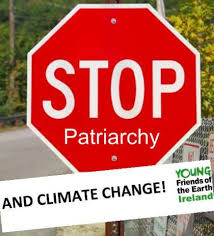
Patriarchy climate change

Why is it that under Pope John Paul II and Benedict XVI Roman Catholics heard no end of sermons about the evils of contraception and abortion? And yet today we’ve heard hardly a pulpit peep about Pope Francis’ encyclical on climate change – published fully nine months ago. On the contrary, chanceries throughout the country (including the Lexington diocese) have been scrambling to sweep Laudato Si’ under the sanctuary carpet.

Could it be that Pope Francis has touched on an issue that lays moral burdens on men, their businesses and pocketbooks, and not primarily on women? The latter, of course, bear the main burden of unwanted pregnancies. So the all-male clergy has found itself courageously outspoken in defending human life, the “personhood” of fetuses (based on medieval science), and in prohibiting contraception rationalized on a similarly grounded morality of “natural law.” So, papal pronouncements about such questions are definitive, infallible, and universally binding (on women!).

Meanwhile, Laudato Si’ challenges the patriarchal economic system of capitalism, the coal and oil industries, Wall Street, and the one percent. Good Catholic men are up to their necks in all of that. So are bishops and the clergy in general.

So, the “pro-life” hierarchy hastens to distance itself from its infallible leader. They do so even though Francis claims to defend life in ways that far surpass concerns about sperm, eggs, zygotes, fetuses, and stem cell research. He’s defending the future of the planet and the human race!

An example of such double-standard is provided by the Lexington diocese’s Discovering Laudato Si’: a Small Group Discussion Guide. It not only softens Pope Francis’ teaching about climate; it actually contradicts them. For instance:

  • Pope Francis says that the issue of human caused climate change has been settled by the vast majority of climate scientists. The diocesan guide says “The debate will probably not be resolved anytime soon.”
  • Pope Francis writes that addressing the issue is “urgent” and must be confronted “here and now.” The diocesan booklet affirms that we are not called to “rush headlong into the fray. . . We have been given time to reflect, to absorb, to be transformed.” The Church’s slow response, it says, has precedent and purpose.
  • Pope Francis spends the preponderance of his encyclical addressing the structural causes of climate chaos including the unbridled market, the effects of colonialism and neo-colonialism, and even specific issues such as carbon trading. Yet the diocesan booklet says that it is not yet time for “larger responses.” In the meantime, we are told, “Pope Francis has given us many little tasks we can begin right away.” Basically they are to reduce, recycle, reuse.
  • Pope Francis celebrates climate change activists and their organizations. He quotes approvingly from their Earth Charter, recommends boycotts, and employs the language of “climate debt” borrowed from those resisting mining operations in Latin America. Yet Discovering Laudato Si’ discourages such organizing. “Fortunately,” it says, “the Pope is not calling us to ecological crusade.” Joining movements, it adds, is worse than doing nothing.

While all this hesitancy and caution in defense of LIFE writ large? Why the endless chatter about moral obligations primarily directed at women?

Might it be that a pope has finally said something that threatens patriarchy?

As they say, if men could get pregnant, abortion would be the eighth sacrament.

What if We Imagined God as a Woman?

mother-cradling-baby

Readings for 5th Sunday in Ordinary Time: Is. 6:1-2a, 3-8; Ps. 138: 1-5, 7-8; I Cor. 15: 1-11; Lk. 5: 1-11. 

Have you ever seen Eve Ensler’s Vagina Monologues?” A few years ago that series of dramatic readings was presented at Berea College where I taught for 40 years. The readings were as provocative as the play’s title. All of them reflect the unique experience of being woman that most of us Christian males find so difficult to understand, especially after so many years of brain-washing at the hands of predominantly male clergies.

I bring that up because today’s liturgy of the word is so obviously male-centered in a very misleading way. The readings of the day suggest that God is male and that Jesus’ and Paul’s closest collaborators were exclusively men. And that in turn explains why Christian pastors of so many denominations participate so enthusiastically in what has been called a 21st century “War on Women.” It explains why the Catholic Church is so afraid of women priests.

Significantly, Ensler refers to that particular male prejudice in the prologue to her Vagina Monologues text. There she quotes Gloria Steinem who recalls:

“In the sixties, while I was doing research in the Library of Congress, I found a little known treatise about the history of religious architecture which blithely stated a thesis, as it were known by everybody, to the effect that the traditional shape of most patriarchal buildings of worship imitates the female body. Thus, there is an external entrance and another internal one, the labia majora and the labia minora; there is a vaginal central nave, which leads to the altar; there are two curved ovarian structures on either side; and finally, in the sacred center is the altar or uterus, where the great miracle takes place: men give birth.

“Though this comparison was new for me, it opened my eyes with a shock. Of course, I thought. The central ceremony of the patriarchal religions is nothing else but the ceremony in which men take control of the “yoni” power of creation by giving birth symbolically. It is no wonder that male religious leaders state so often that we human beings are born in sin … because we are born from female tummies. Only by obeying the rules of the patriarchy can we be “reborn” through men. It is no wonder that priests and pastors decked out in long vestments sprinkle our heads with a fluid that mimics the waters of birth. It is no wonder that they give us new names and promise us we will be reborn in eternal life. It is no wonder that the male priesthood attempts to keep women far removed from the altar, just as we are kept far removed from control of our own powers of reproduction. Whether symbolic or real, everything is aimed at controlling the power that resides in the female body.”

Talk about provocative! Here Ms. Steinem is claiming that creative power is focused chiefly in the female body, though men obviously have an ancillary role in the begetting of life. Because their role is so obviously secondary, a primary patriarchal purpose in organized religion, Ms. Steinem says, is for men to alienate or steal the vastly superior womanly power of life and to control it – against women themselves.

Patriarchal religion accomplishes its task by dressing men up like women. It has them sprinkling their congregations with the waters of birth introducing them to “eternal life.” This form of life is held to be more important than physical life, and male pastors claim to control it to the exclusion of women. The prerequisite for women’s access to life eternal is that they adopt the rules of the exclusively male priesthood especially those connected with female powers of reproduction centered in the woman’s body whose architecture the male priestly domain of church actually mimics.

Ms. Steinem’s analysis suggests why someone even like our beloved Pope Francis seems skittish about women priests.

After all, female priests might inspire women to recognize their inherent superiority over men in terms of centrality to the life processes (both physical and spiritual) that the patriarchy struggles so mightily to control. If women were allowed the leadership that their biology suggests, what would become of the male-centered church – of the male-centered world?

Today’s liturgy of the word tries to keep us from asking such questions. It begins with a description of God in highly masculine terms centered in the macho realm of palace and court. God is depicted as “king.” He (sic!) is “Lord.” He inspires fear and awe. He dwells in a smoke-filled room surrounded by all the trappings of power and might. Like the prophet Isaiah, those who appear before him feel small and ashamed of the very words that come from their lips.

This, of course, is the image of God we’ve been offered from the cradle. (Can you imagine how different we’d feel personally, ecclesiastically, nationally and internationally if the familiar image of God were a mother nursing her child? Would you feel any different towards such a Mother God? – Remember, it’s all just symbolism. And the image of God that’s come to dominate arises from one of the most patriarchal traditions in the history of the world.)

The male-centeredness of today’s readings continues in the selection from Paul’s first letter to Christians living in Corinth. It’s a key passage because Paul is trying to establish his identity as an “apostle,” even though he never met Jesus personally. Paul bases his claim on the fact that Jesus appeared to him just as he did to the other apostles. So he says “Remember what I preached to you:” Christ died for our sins. He was buried and raised on the third day. He appeared to the 12, then to 500 “brothers” at once, then to all of the apostles, and finally to Paul himself.

There is so much interesting in this summary of Paul’s preaching. What, for instance, happened to Jesus’ words and deeds? Paul’s gospel begins with Jesus’ death! What about Jesus’ life which revealed the character of God as compassionate and “womb like?” (See Marcus BorgMeeting Jesus again for the First Time, chapter 3.)

However, even more to the point is Paul’s omission of the fact that according to ALL of the accounts of Jesus’ resurrection appearances in the canonical gospels, Jesus’ first appearances were to women, not to men!! (Remember Jesus’ appearance to Mary Magdalene in John 20:1-18?) Using Paul’s logic, doesn’t that establish the primacy of women in the church – and in the priesthood? The Paul of First Corinthians doesn’t want to go near that question. And neither do most church officials.

And then we have today’s gospel selection from Luke. It’s the call of the first apostles. According to Luke, Peter, James, and John are the first to follow Jesus. That leaves us with the usual impression that Jesus called only men.

Omitted from our vision is the fact that according to Luke himself (8:3) there were “many women” taking an active part in the Jesus Movement. Besides Jesus’ mother Mary, we know the names of some of them: Mary Magdalene, several other Marys, Suzanne, Salome, Martha and Mary of Bethany, Joanna. . And the roles of these women weren’t confined to preparing food and washing clothes.

In the first Christian communities, men and women met and worshiped together. Both men and women preached the message of Jesus with the same authority, and both men and women presided at the celebration in remembrance of their crucified Master. Like the men, the women had representation and decision-making power in the communities as priests and bishops.

That was even true of the communities of Paul. Paul himself taught that “In Christ there is no male or female” (Galatians 3,28). With this claim he legitimized the active participation of women in the first Christian communities. Also, he makes emphatic mention of many women in his letters and lavishly praises their work. For example, he mentions by name the deaconess Phoebe (Romans 16,1), Junia (Romans 16,7), Prisca, Julia, Evodia and Sintece, all of whom he called his “collaborators” (Philippians 4,2). He also mentions Claudia, Trifena, Trifosa, Prisca, Lyida, Tiatira and Nympha of Laodicea. Of the 28 persons to whom Paul accords special praise in his letters to the early churches, 10 are women!

All of that changed in the 4th century, when Christianity lost its soul and became the official religion of the Roman Empire. Then Christianity adopted for good the courtly vision today’s first reading affirmed: macho-kings, courts, palaces, smoke-filled rooms, men dressed like women, denigration of women’s bodies, men trying desperately to affirm their superiority against all the evidence – of biology, life’s processes, Jesus’ own example, and women’s traditional roles as nourishers, healers and spiritual counselors.

Let’s talk about how women might take back those roles both in church and in politics. How do we help transform people as closed as today’s church patriarchs – or as open as Pope Francis? How do we facilitate changes in our bishops and priests? How do we let go of our own acquiescence to the misogyny of our church and culture?
(Discussion follows)

The Conversion of Pope Francis and “Why the New Pope Must Resign”

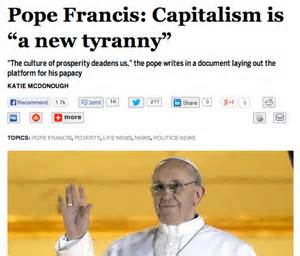
Francis Capitalism

“Why the New Pope Must Resign.” That was the title of an article I wrote just after the election of Pope Francis in 2013. In it I joined Argentina’s Horacio Verbitsky and others questioning the role of Jorge Bergoglio (aka Pope Francis) in Argentina’s “Dirty War” (1976-’83).

Since then, friends have asked me about that. “What do you think now – in the light of the fresh spirit of reform the pope has introduced – in the light of his tremendous popularity?  Surely you were mistaken in your original, hasty judgment.”

That’s the typical question and observation.

My answer has been that I’m delighted with Pope Francis and the direction his papacy has taken. Both his Apostolic Exhortation, The Joy of the Gospel, and especially his new eco-encyclical, Laudato Si’ are magnificent. Their criticisms of capitalism-as-we-know-it as the structural cause of world poverty and environmental destruction couldn’t be a clearer endorsement of a form of liberation theology that is both spiritually moving and politically engaged.

I’m glad the pope didn’t resign. Pope Francis is great.

But in response to my friends, I also add that the issue of Father Bergoglio’s involvement with the Dirty War is not resolved. Nor should it be ignored. Recalling its elements holds lessons for us – about the Roman Church’s history of supporting oppression, about whitewashed historiography, and most importantly, about the possibility of repentance and deep personal change.

Consider the first point, the Church supporting fascist oppression. It happened in Argentina during the Dirty War as it happened in Germany under Adolf Hitler.

When Bergoglio was Jesuit Provincial, he was accused of turning over to the army two of his Jesuit colleagues and former teachers, Fathers Orlando Yorio and Franz Jalics. Both had been pro-socialist clerics and members of the Third World Priests’ Movement (MSTM). Such membership was considered a capital crime by the country’s ruling junta.

Yorio and Jalics had been embroiled in a long-standing feud with their Provincial not so much about their MSTM affiliation, but about their activities in a slum community the two priests served and lived in. Bergoglio didn’t have much time for Jesuits in his province being associated with left-wing causes – nor for versions of liberation theology tainted with Marxist analysis.

Like John Paul II and his chief advisor Josef Ratzinger (later Benedict XVI), he preferred a strain of liberation theology that prioritized the poor, but apolitically without revolutionary aspirations. Bergoglio liked to call that strain the “Theology of the People.” It prioritized their reflections on the gospel, and popular devotion to images, novenas, etc. Other versions of liberation theology were too “ideological.”

After being arrested and tortured, both Yorio and Jalics accused Bergoglio of fingering them to the army.

Father Yorio died without retracting his accusation. Fr. Jalics at first didn’t want to discuss the matter, saying that he and Bergoglio had reconciled.

Beyond the case of Yorio and Jalics, there was that of Father Christian Von Wernich. He had been a police chaplain during the Dirty War. After its conclusion, during the process of national reconciliation, Von Wernich came under investigation for his direct roles in police tortures and murders.

In response, while Bergoglio was a member, the Argentine Bishops’ Conference protected Von Wernich by transferring him to Chile under an assumed name. That is, the Bishops Conference treated accusations of torture and murder in exactly the same way bishops throughout the world had often dealt with allegations of sexual abuse of children: transfer the offender and cover up the past.

So, the question becomes, was Jesuit Provincial Bergoglio, like the predominant leadership of the Argentine Catholic Church, somehow cooperative with the ruling junta?

This brings us to my second point about historiography.

In defense of the future Pope Francis (and of the church hierarchy in general), his biographer, Austen Ivereigh, offers explanations that end up sounding much like the defense of Pius XII vis-à-vis the Nazis and his failure intervene against the Holocaust. Ivereigh argues:

  1. When the military took over in 1976, Argentina (like Weimar Germany) was in a state of political and economic chaos.
  2. So virtually all segments of society welcomed the military take-over (as Germans and the German Catholic Church welcomed Adolf Hitler).
  3. The military’s brutal Dirty War was secretive about the extremity of its measures. (Fr. Bergoglio testified that it took him some time to realize what was happening.)
  4. So people like Bergoglio didn’t really know what was going on (just as Germans claim they didn’t know about the concentration camps and ovens).
  5. When he did find out (like Pius XII) Bergoglio “worked quietly” to help potential victims escape – while fulfilling his primary duty of protecting the Jesuits from suspicion, investigation and reprisals from the ruling junta.

As with Germany such reasons end up sounding like excuses that raise suspicions of cover-up and historical obscurantism. They evoke the following observations and questions:

  1. Bergoglio gives every indication of being on the same page with John Paul II and Josef Ratzinger who also largely “looked the other way” when confronted with evidence of government brutality in dealing with left-wing elements of the clergy and faithful, e.g. in Central America in general and in El Salvador and Nicaragua in particular.
  2. Bergoglio clearly shared their disdain for priests involved in politics.
  3. If (as Ivereigh suggests) Father Bergoglio was so well-connected and friendly with all factions (including government officials and military leaders on the one hand, and their opponents including MSTM members on the other) how could he not have at least suspected what was really happening?
  4. If Jalics had forgiven Bergoglio (as he originally had said) what had he forgiven?
  5. Why did Jalics apparently change his story a few days after Pope Francis’ election? On being repeatedly contacted by the media about the issue, Jalics said, “The fact is: Orlando Yorio and I were not denounced by Father Bergoglio.”
  6. Father Yorio offered no deathbed recantation of his charges against Bergoglio.

And that brings me to my final point about repentance and its significance for Catholics today.

As Ivereigh indicates, the prevailing method of dealing with such contradictions is to  reluctantly argue that Father Bergoglio perhaps did cooperate with the military – as did so many other churchmen in positions of authority during the Dirty War. However, in Bergoglio’s case, he also courageously helped many escape – at some risk to himself.

But then at some point, he underwent a kind of conversion and is now a progressive. At least at the administrative level, Bergoglio’s own testimony indicates that he experienced a profound conversion. He confesses that as a young Jesuit Provincial (he was only 36 when appointed), he was too headstrong, uncompromising and authoritarian.

Indications are, however, that the about-face went far beyond managerial style.

The exact turning point in the process remains unclear. It could have come after Bergoglio was virtually drummed out of the Jesuits by progressive elements which saw him as an impediment to the Society’s reform in the spirit of Vatican II.

Afterwards he spent two years in a kind of exile and deep introspection. Ivereigh reports that Bergoglio passed days hearing the confessions of simple shantytown poor people. He also spent hours in semi-depression, simply staring out his window. Colleagues worried that he was sick. Was it some type of breakdown?

Whatever the case, clear evidence reveals a subsequently changed man. Previously he was criticized by more liberal fellow Jesuits and others for failing to ask important questions about poverty. As they put it, “He’s great at ministering to the poor. But he never asks why they are poor.” (The criticism evoked the famous comment of Dom Helder Camara, the archbishop of Olinda and Recife in Brazil who said, “When I give food to the poor, they call me a saint. When I ask why the poor have no food, they call me a communist.”)

But as pope in Laudato Si’ Francis makes no bones about why the poor have no food, or jobs, or homes, or education. With observations worthy of the MSTM members he rejected, the pope says, all of those problems are connected by the invisible thread called deregulated capitalism. His encyclical says that poverty, environmental destruction and a whole host of other problems are caused by capitalism-as-we-know-it. (So, predictably and true to Dom Helder’s words, Rush Limbaugh and others call Pope Francis a communist.)

Evidence of radical theological change goes much further. Consider, for instance, that Francis has:

  • Surrounded himself with liberation theologian advisers concerned with history and structural analysis.
  • Rehabilitated and consulted pro-socialist theologians blacklisted by his two predecessors – most prominently among them Brazil’s Leonardo Boff.
  • Identified Marxism as similar to the teachings of the early church fathers, claimed Marxists as his friends, and referred to them as “closet Christians.”
  • Echoed Latin America’s liberation theology speaking of Christian faith as “revolutionary,” because it challenges “the tyranny of Mammon.”
  • Peppered both The Joy of the Gospel and Laudato Si’ with frequent uses of the loaded word “liberation” contrasting the deleterious effects of “liberation” of markets (from government control) with the liberation of peoples proclaimed in the Judeo-Christian tradition.
  • Has similarly made Medellin’s phrase “preferential option for the poor” the watchword of his papacy, even going so far as to identify it with “the gospel itself.”
  • Beatified the martyred Archbishop of El Salvador, Oscar Romero, who is considered the patron saint of liberation theology. (Romero did, by the way, confront the ruling military and lost his life as a result.)
  • Described the world’s dominant economic system as running “counter to the plan of Jesus.” He said the system now in place and Jesus’ hoped-for Kingdom of God have different aims.
  • Worked with the Obama administration to open doors to Cuba which for more than 50 years has struggled to construct an economic alternative to capitalism-as-we-know-it.
  • In keeping with the insights of liberation theology, the pope has turned working against capitalism-as-we-know-it into a moral issue. In Laudato Si’ he wrote: “working for just distribution of the fruits of the earth and human labor” – is a “moral obligation.” For Christians, he said, “it is a commandment.” Here the pope echoed what he said in The Joy of the Gospel where he identified the struggle for social justice and participation in political life as “a moral obligation that is “inescapable.”

All of this represents not only a personal conversion for Pope Francis, but a summons to his Church to follow in his footsteps.

What he has written in “The Joy of the Gospel” indicates that he recognizes in a Church the same crisis he underwent. It is out-of-touch and in need of a complete overhaul. “Everything must change,” he has said.

For too long, he has written, the Church has been mired in an authoritarian judgmental paradigm and in viewpoint-narrowness that has focused on important but non-essential matters foreign to the focus of Jesus’ proclamation of God’s Kingdom. So-called “pelvic issues” were of little concern to Christianity’s Great Master.

The pope implicitly calls Catholics resembling his former conservative, apolitical self to engage in the process of political, economic, and ideological change before it’s too late. Stop staring out the window at a world falling apart, he tells us. Emerge from denial and obstructionism and come to grips with climate chaos and changing the economic system that causes not only environmental destruction, but world hunger, poverty, high infant mortality, and war.

Those are statements Fathers Yorio and Jalics could fully endorse.

How to Be Pro-Life and Not Just Pro-Birth

Joan Chittister

Recently, Benedictine Sister, Joan Chittister, grabbed some headlines when she took on the hypocrisy of the “pro-life” crowd.

She wrote,

“I do not believe that just because you’re opposed to abortion, that that makes you pro-life. In fact, I think in many cases, your morality is deeply lacking if all you want is a child born but not a child fed, not a child educated, not a child housed. And why would I think that you don’t? Because you don’t want any tax money to go there. That’s not pro-life. That’s pro-birth. We need a much broader conversation on what the morality of pro-life is.”

Sister Chittister’s point is well-taken. Being truly pro-life means joining reluctant mothers in the sacrifices they routinely make to see that their children are fed, properly housed and educated. So claiming to be pro-life while campaigning against food stamps, universal health care, Head Start, and subsidized housing is disingenuous to say the least. It also seems incompatible with defunding Planned Parenthood, our nation’s largest provider of sex education – probably the most effective, non-intrusive birth control measure of all.

And it’s significant that such reminders come from a woman. Women after all are the ones who primarily bear the burden imposed by the narrow pro-birth demands made mostly by men. Women alone are capable of bringing unwanted pregnancies to term. They are the ones who usually end up raising children as single parents.

Meanwhile, it is primarily men who insist that women fulfill responsibilities men themselves cannot fulfill on the one hand, and can easily evade on the other. The men include most prominently celibate Catholic clergy and an overwhelmingly male U.S. Congress. In biblical terms they are (to use Jesus’ words) “experts in the law” who “load people down with burdens they can hardly carry” and which the “experts” themselves “will not lift one finger” to lighten (LK 11:46). It’s no wonder so many women see pro-birthers as militants in a war against women.

But it’s even worse than that. If abortion is the crime they allege, pro-birthers are criminal accessories. They are co-abortionists. This is because their anti-life policies which deny reluctant mothers sex education, good jobs, decent wages, maternity leave, free child care, programs like Head Start, and subsidized food and housing create an anti-life culture. And that in turn drives desperate women to terminate unwanted pregnancies that will effectively impoverish them.

If lawmakers and religious leaders really care about life and want fewer abortions, they need to create a pro-life culture that invites bringing pregnancies to term. Most obviously, this means that it’s unjust for women to be left holding the bag. In particular it means:

  • Recognizing that the absolute prohibition of abortion endorsed by many Christians is not universally accepted.
  • Realizing that abortion as already restricted (to the first two trimesters) by the Roe v. Wade decision is about as much restriction as possible in such a pluralistic context.
  • In that light, having Christians adopt a prophetic, persuasive approach to limiting abortions rather than a legal coercive one.
  • This means that committed Christians would themselves refuse to abort unwanted fetuses, that they would support others in following suit, and (above all) that they’d promote pro-life measures across the board including anti-poverty legislation, but also advocating war resistance, elimination of capital punishment, and strict environmental protection legislation.
  • Supporting sex education programs like those offered by Planned Parenthood.
  • Changing the patriarchal teaching of the Catholic Church about birth control.

“Laudato Si’” and Its Preferential Option for the Poor (Part Three): the Guiding Principle for Restructuring the World Economy

option for poor

This is the last installment in a three-part series on Pope Francis’ new encyclical, Laudato Si’. It attempts to place in historical perspective what might well be the most important document yet produced in the 21st century. It also tries to explain the meaning and centrality of the encyclical’s guiding principle, its “preferential option for the poor.”  This third part addresses the meaning and centrality of that option.

In his critique of capitalism-as-we-know-it (reviewed in Part Two of this series), Pope Francis called explicitly for “structural change” in the world economy.  He said, “Let us not be afraid to say it: we want change, real change, structural change.”

But what “structural change” does the pope have in mind?

Evangelii Gaudium and Laudato Si’ offer the answer. Their “preferential option for the poor” provides the guiding principle and turns the present economic order exactly on its head. This implies that if the present order is possible, so is its opposite.

That is to say that the present neo-liberal order is structured according to a “preferential option for the rich.”  Its sponsoring question is how can we make sure that the banks, corporations, and 1% prosper? Economists explain such concern by various “trickle-down theories.”  If priority is accorded the welfare of the rich, the theorists say, the wealth produced will trickle down creating a “rising tide that lifts all boats.”  [The pope rejects such theories out-of-hand as historically disproven. In “Evangelii Gaudium” he even calls them homicidal (53), ineffective (54) and unjust at their roots (59).]

By way of contrast, the pope’s “preferential option for the poor” begins at the bottom of the economic pyramid. Its sponsoring question is how can we insure that farmers have land, that workers have jobs, and that everyone is decently housed?

Laudato Si’ goes even further. It expands moral concern beyond human beings to all forms of life. It asks how we can insure the survival of the planet in the face of global warming, water and air pollution, massive extinctions, disappearance of rainforests, wasted food, waste in general, uncontrolled urbanization, rampant crime and loss of human meaning.

None of this means abandoning market dynamics altogether.

It does mean, however, controlling them according to the principle some have expressed in the words, “as much market as possible and as much planning as necessary.” This means maximizing market forces, but controlling them as necessitated by prioritization of the needs of the poor including the environment – once again by the preferential option for the poor.

In practice this entails at least the following: governments (1) intervening in the marketplace to insure the rights of all to jobs with living wages, housing, education, and health care, along with land for small farmers, (2) similarly regulating market forces to protect the global environment and all life forms from the most primitive to the highest, and (3) thereafter turning economies over to carefully monitored and controlled market forces.

Impossible you say? Not at all. To repeat: if economies can be structured according to a preferential option for the rich, they can be restructured to prioritize the needs and rights of the poor and the environment.

That’s the Global South hope and conviction Laudato Si’ embodies: another world is indeed possible.

Conclusion   

Will Laudato Si’ have its desired effect? That, of course remains to the seen. However, it undeniably has in Pope Francis a powerful proponent.

That is, despite remaining Stalinist skepticism, Pope Francis might well be the most powerful man in the world. Certainly, he is the planet’s most influential moral leader. What empower him, of course, are not the military divisions in which Josef Stalin placed confidence, but his extraordinary consciousness of the unity of all creation expressed repeatedly in his every pronouncement and especially in his recent encyclical. What sets him apart from the Obamas and Putins of the world is his equally unusual courage, compassion, charisma, and credibility.

Additionally, the pope has surpassing constituency. He heads a community of 1.2 billion followers. And this does not even count the untold millions of non-Catholics who admire him and his thought leadership.

With such support, the powerful message of Laudato Si’, and his plans to bring that message to the U.N. and U.S. Congress in September, as well as to influence the Climate Summit in Paris next September, who knows what changes will result? Who knows how he will influence the U.S. general elections in 2016?

In other words, Francis may stand on the brink of surpassing the stature of Leo XIII and John Paul II in terms of changing the world.

Defenders of the old order are already shaking in their boots.