“Widow’s Mite” or “Don’t Put That Money in the Collection Plate!”

Readings for 32nd Sunday in Ordinary Time: IKgs. 17: 10-16; Ps. 146:7-10; Heb. 9: 24-28; Mk. 12: 38-44 http://www.usccb.org/bible/readings/111112.cfm

In the election season just passed, some politicians were pushing for a “flat tax.” They called attention to the “unfairness” of a tax system which has rich people paying more than everyone else. The asked, why not tax everyone the same?  That would be fair. Today’s gospel reading says something about that idea of fairness.

_____

About a month ago, the great theologian and spiritual teacher, Matthew Fox, passed through our town in Berea, Kentucky. Matt is an ex-Dominican priest who was forced by Pope Benedict XVI to leave the Dominicans and to cease publishing. Fox’s crime, like that of more than a hundred theologians in the past twenty years, was being too energetic in teasing out the implications of the Second Vatican Council for the world we actually live in. According to Matthew Fox, the anti-Vatican II stance of present church leadership places the present pope (and the one who preceded him) in schism. It’s the duty of Catholics, Fox says, to withhold financial support from the church until popes and bishops once again embrace the official teaching of the church, which remains the doctrine of Vatican II. Today’s gospel reading also says something about that.

_____

The gospel reading just referred to is the familiar story of “The Widow’s Mite.” Jesus and his friends are visiting Jerusalem for the Passover Feast during the final week of his life. They are in the Temple. On the previous day, they had all taken part in (and perhaps led) a demonstration there against the temple priesthood and its thievery from the poor. I’m talking about Jesus’ famous “cleansing of the temple.” Soon the temple priesthood and scribal establishment will offer a reward of thirty pieces of silver for information leading to Jesus’ arrest. Judas will soon find himself seriously considering collecting that reward.

In the meantime, Jesus continues instructing his disciples on the corruption of the Temple System. In the episode before us, he takes a position, Mark says, “opposite” the temple treasury. The treasury was the place where Jews paid the tithe required by the law as interpreted by the priesthood Jesus despises. It was a “flat tax” applying the same to rich and poor.

Ever class-conscious, Mark points out that “many rich people” somehow made it clear to all that they were putting in large sums. Then a poor widow came along and furtively put in a penny. Jesus calls attention to the contrast: “large sums” vs. “two small copper coins, which are worth a penny.”

“It’s all relative,” Jesus says.  “Truly I tell you, this poor widow has put in more than all those who are contributing to the treasury. For all of them have contributed out of their abundance; but she out of her poverty has put in everything she had, all she had to live on.” Jesus then leaves the temple in disgust.

There are two ways for homilists to explain this incident in the context of today’s Liturgy of the Word. Remember, it began with a reading from I Kings and its story of the great prophet Elijah and the widow of Zarephath.

Elijah was hungry. He encountered a single mom gathering sticks to make a fire to eat her last meal with her son. They were starving, and she had only a handful of flour and a few drops of oil to make some bread before she and her son would die of hunger. The prophet asks that instead she make him some food. Obediently, she does so. And strange to say, after feeding Elijah, the widow discovers that her flour and oil never run out. She somehow has an endless supply. She and her son are saved.

Then in today’s second reading, Jesus is contrasted with the temple priesthood. The temple priests, the author of Hebrews says, were required to repeatedly offer sacrifices in the Temple year after year. In contrast, Jesus entered the heavenly “Holy of Holies” but once, offering there not the blood of bulls and lambs, but his own blood. Jesus is the true high priest.

The standard way of treating these readings would run like this: (1) The widow of Zarephath gave the Holy Man all she had to live on and was materially rewarded as a result; (2) the widow in the Temple donated to the temple priests “all she had to live on” and was rewarded with Jesus’ praise; (3) follow the examples of the widow feeding Elijah and the widow giving her “mite;” (4) donate generously to your priest (a successor of the Great High Priest in Hebrews) and you will be richly rewarded either here, in heaven, or in both places.

That’s a standard treatment we have all heard. However, it has severe problems. To begin with, it ignores the liturgical response to the Elijah story taken from Psalm 146. That excerpt from Psalms sets a back-drop for the entire Liturgy of the Word and provides a key for interpreting not only today’s readings, but the entire Bible. The psalm reminds us that the poor are God’s Chosen People. God’s concern for the poor is not with their generosity towards God but with God’s securing justice for them. As the psalm says, God gives food to the hungry, sets captives free, gives sight to the blind, protects immigrants, and sustains the children of single moms. God loves those concerned with justice for the poor, the Psalm says. God loves prophets like Elijah and Jesus. On the other hand, God thwarts the ways of the wicked – those who, like the scribes and high priests, exploit God’s favored poor.

All of that represents a “red thread” running through the entire Judeo-Christian tradition. It offers us a key for interpreting the story of Elijah as well. It changes the emphasis of the story from the widow’s generosity, to God’s provision of food for the hungry and God’s concern for the children of single mothers.

With that key in mind, we are alerted to circumstances in today’s gospel story that summon us to interpret it differently from the standard treatment.

We are reminded that the episode takes place in an elaborate context of Jesus’ assault on the temple system. In effect, the context is Jesus’ symbolic destruction of the temple itself. Yes, there was that “cleansing” I referenced. But there was also Jesus’ prediction of the deconstruction of the building itself. “Not one stone will be left here upon another; all will be thrown down” (13:1-2). Then there was that strange incident of Jesus cursing a fruitless fig tree as he was entering the temple precincts (11:12-14; 20-24).  The fig tree was the symbol of Israel. Here again Jesus pronounces a judgment on an entire system that had become corrupt and forgetful of the poor who are so central to God’s concern.

That judgment is extended in Jesus’ teaching immediately before the episode of the widow’s mite.  Again, Jesus takes a position “opposed” to the temple treasury and says, “Beware of the scribes . . . They devour widows’ houses and for the sake of appearance say long prayers.” As scripture scholar, Ched Myers points out, Jesus was probably referring to the practice of turning over to scribes the estates of deceased husbands. The surviving wives were considered incapable of administering a man’s affairs. For his troubles, the scribe-trustee was given a percentage of the estate. Understandably fraud and embezzlement were common. In this way, religion masked thievery from society’s most vulnerable.

With Jesus’ accusation ringing in their ears, a case-in-point, a poor widow, arrives on the scene. She pays her tithe – the flat tax – and leaves penniless. Jesus can take no more. He leaves the temple in disgust.

According to this second interpretation, Jesus is not praising the generosity of the widow. Instead, he is condemning the scribes, the priests, the temple and their system of flat taxation. Jesus’ words about the widow represent the culminating point in his unrelenting campaign against hypocrisy and exploitation of the poor by the religious and political leadership of his day.

We would do well to keep today’s gospel in mind when evaluating “Christian” politicians calling for a “flat tax” in the name of the “fairness” of taxing everyone at the same rate.

We would do well to keep today’s gospel in mind – and the example and words of Matthew Fox –  when the collection plate passes in front of us on Sunday or when our pre-Vatican II priest urges us to follow the example he finds in the story of the widow’s mite.
When a Prophet Visits: Matthew Fox Sweeps through Berea

Matthew Fox came through my hometown, Berea Kentucky, a few weeks ago. I’m still energized by the experience. It showed me what happens when a prophet drops by.

Matt’s the ex-Dominican theologian and spiritual teacher who was hounded out of his Order by Pope Ratzinger (aka Benedict XVI). His offense? The same as that of the 101 theologians and pastoral leaders that Fox has posted on his “Wailing Wall of Silenced, Expelled, or Banished Theologians and Pastoral Leaders under Ratzinger.” (The names appear at the end of Fox’s book The Pope’s War: Why Ratzinger’s Secret Crusade Has Imperiled the Church and How It Can Be Saved.)  The names include giants like Karl Rahner, Ivone Gebara, Edward Schillebeeckx, and my former teacher in Rome, the great moral theologian Bernard Haring.

As Matt’s more than 30 books show, he, like the others, was censured by Pope Benedict XVI for being too good a theologian and spiritual guide; he tried too hard to implement the directives of the Second Vatican Council; he was too successful in connecting the Christian Tradition to our post-modern world. All of that our ex-Hitler Youth Pope finds extremely threatening to his overriding pre-Vatican II values: order and Group Think directed from above.

My wife, Peggy, had instigated Matthew Fox’s visit to Berea College. As Director of Women’s Studies she had invited him for her “Peanut Butter and Gender” series of luncheons. Over the years, the twice-monthly event has paralleled the College’s convocation program of speakers and artists.  At “PB&G,” Matt gave a dynamite talk on men’s spirituality. Later on in the afternoon, he spoke to the entire student body wowing everyone in the process.

Of course, I attended both events. But I was even more privileged because Fox visited our home the night before. Over Manhattans he, Peggy and I compared notes, were surprised by friendships we share with others, and spoke of the dismal state the Catholic Church has reached under the “leadership” of the last two and a half popes (Ratzinger, John Paul II, and the last half of Paul VI’s term in office). Additionally, I had an hour or so in the car with Matt as I drove him to the Lexington Blue Grass Airport the morning after his visit. We spoke of Ratzinger’s 1968 “conversion” to the Catholic rendition of religious fundamentalism, and of Matt’s work with the witch, Starhawk (whom he identified with evident admiration as a “genuine liberation theologian”).

However, the highlight of the entire experience was a potluck supper at our home. Peggy had organized that too – for members of our Berea parish, St. Clare’s. The idea was for the Peace and Justice Committee and other progressives to meet with Fox and discuss how to respond to the drabness and irrelevancy of what passes for worship and Christian community in our church.

After an extraordinary potluck supper, about twenty-five of us sat in a big circle in our living room. Everyone joined in with comments, complaints, questions and concerns. Matt took it all in, responded when appropriate, and then shared his insights.

His most telling observation was to reverse the common perception shared by most in the room. That’s the opinion that progressive Vatican II Catholics have somehow been marginalized by the church. Fox turned that notion on its head. He held instead that we are the ones who are orthodox, while the last two (anti-Vatican II) popes are actually schismatic. They and their Vatican Curia are the outsiders, while we are the faithful ones adhering to the official teaching of the Catholic Church which remains the doctrine of Vatican II.

What to do about it all? Fox was helpful there as well. In fact, at the end of The Pope’s War, he lists “Twenty-Five Concrete Steps to Take Christianity into the Future.”  All of those steps were thought- provoking. However in terms of Fox’s “schism” observation, here’s the one that hit hardest for me:

“Instead of ‘Vatican III’ or a so-called lay synod that is gerrymandered by clerical curialists, let the various lay leadership groups hold national and then international gatherings among themselves – synods that are worthy of the name. Let them give marching orders to church officials instead of the other way around. Let the church officials listen to the laity for a change. Let the laity choose the theologians they wish to be their periti at such synods (if any).”

Along those lines, next month the “Call to Action” Conference will be meeting in Cincinnati. A group from our parish will be attending that convocation of progressive Catholics. Matthew Fox will speak there. I’ll be in attendance with my friends.

Expect a report in this blog.

My Wife’s First Mass

My wife, Peggy, said her first Mass last Sunday.

I remember my own “first Mass.” It was at the beginning of January in 1967. Strictly speaking, it wasn’t really my first Mass. I had been ordained a priest in the Missionary Society of St. Columban on December 22, 1966. So it was maybe my 12th Mass. But it was a Big Deal anyway – on a par with a wedding reception.

All my relatives were there – at some country club dining room in Downers Grove, Illinois just after New Year’s. There I was at the head table, the uncomfortable focus of all the attention. I was sitting there with my mom and dad and with Fr. Stier, my pastor. As I recall some Columbans were present as well.

As I said, it was a big deal – speeches and everything. Of course, I was the final speaker. I don’t remember what I said – except one phrase where I thanked my mom and dad, brother, Jim, and sisters, Rosanne and Mary for “virtually praying me through the seminary.” That was true. In retrospect, I don’t understand how I made it through all those years from the time I entered the seminary at 14 till I was ordained at 26. It’s enough to make you believe in the power of prayer – or something.

The miraculous nature of it all stands out because for all practical purposes, the training all those years was without women. Can you imagine that – during the most formative years in a person’s life? Thank God for my mother and sisters and for the summer vacations which brought me into (very guarded) contact with women. How can men become human without them?

In any case, I somehow overcame all of that too. So here I was a couple of weeks ago and after 37 years of marriage at my bride Peggy’s First Mass. No Big Deal. No head table. No speeches. Just Peggy standing there, hands extended the way we’ve all seen priests do, and leading us all in the Eucharistic Prayer that both of us had composed for the occasion. It was beautiful.

I say “no big deal” because the context is an ecumenical community of Catholics, Lutherans, Presbyterians, Baptists, and others who have taken seriously the idea of “priesthood of the faithful.” So if “the faithful” are priests, women are priests – or at least the priesthood should be open to them.  Why shouldn’t they officiate at the Eucharist in this community seeking to break free from the bondage of patriarchal church traditions?

Even Catholics in the group didn’t blink when they saw Peggy there. We’re ready for change. Despite our best efforts, most of us have become alienated both from our local church and from the Church of Rome. And it hasn’t been just one issue – not simply the patriarchy or the absence of women in church leadership positions. It wasn’t just the pedophilia crisis, not just the Vatican’s put-down of progressive sisters, or the “Republicanization” of the hierarchy, the amnesia about Vatican II, the silly liturgical language changes that no one understands (e.g. “consubstantial” has replaced “one in being”), not just the childish sermons. It’s all of that and the general irrelevance of the church whose hierarchy despite Vatican II is hundreds of years behind the post-modern curve. It’s surprising we haven’t just written it all off as b.s.  In fact, of course, many have

On the other hand, Peggy’s First Mass was a huge deal. It and our ecumenical community represent an awakening of “the faithful” and the fruition of seeds sown at the Second Vatican Council whose 50th anniversary we are about to celebrate.

The Spirit still moves and cannot be contained.

Next Wednesday: the “Table Prayer” Peggy and I composed

Oh No: Not another Sermon on Abortion!

Today’s Readings: Wis. 2:12, 17-20; Ps. 54:3-4, 5, 6 &8; Jas. 3:16-4:3; Mk. 9:30-37

When I read today’s gospel selection, I knew it would inspire preachers everywhere in this country to sermonize about abortion. After all, the reading has Jesus embracing a child and saying, “Whoever welcomes one such child in my name welcomes me.”

That scene will lead preachers to say that Jesus loved children. We all love them, they’ll add, and go on to argue that the children most in danger today are the unborn. So homilists will conclude or imply, we should vote for pro-lifers who claim to care about the unborn, and will pass laws to eliminate abortion. It follows then that we should not support those who identify themselves as “pro-choice,” since they care less about the children so close to Jesus’ heart.

Of course, the preachers in question have the best of intentions. And concern for the unborn is well and good. No doubt abortion represents a horrendous choice. It’s painful for everyone.  Virtually no one favors abortion.

However in today’s gospel, Jesus wasn’t embracing a fetus, but a real child of the kind our culture shows little concern about once they’re outside the womb. Even pro-life politicians want to cut back on programs that would help such children. That, I think, is the issue today’s gospel should be made to address. But before getting to that, and since our preachers will inevitably bring it up, let’s talk about abortion like adults.

As adults we have to admit two facts. One is that abortion cannot be eliminated, no matter what laws are passed. Trying to eliminate abortion is like trying to eradicate prostitution. Large numbers of people have always and will always seek abortion services. The rich will fly their wives, lovers or daughters to the Netherlands or Belgium or wherever safe abortion procedures are legally available. The poor will go to back-alley practitioners or they’ll take drugs or use coat hangers to do the job themselves. No, the question is not about eliminating abortion, but of reducing the number of abortions – of lessening the perceived “need” for abortion.

The second undeniable fact is that we live in a pluralistic society where people of good faith find themselves on both sides of the abortion question. And this is because they differ (most frequently on religious grounds) about the key question of when specifically personal life begins. That is, few would argue that a fetus at any stage does not represent human life and should not therefore be treated with respect. No, the real question is when does fetal life become personal? The question is when does aborting a fetus become murder?

In the thirteenth century, Thomas Aquinas and others held the position that personal life began with “ensoulment,” i.e. when God conferred a soul on the developing fetus. According to Thomas, because of the high numbers of spontaneous abortions in the early pregnancy, ensoulment could not logically happen at the moment of conception. So in his patriarchal way, he conjectured it occurred for males 40 days after conception; for females it happened 80 days after the mother’s egg was fertilized. Before those turning points, there was no question of personal life.

Of course, Aquinas’ logical position is no longer held by the Catholic Church. Its official teaching is that personal life is present from the first moment of conception. But even within the Catholic community, prominent moral theologians beg to differ. Some, for instance, would argue their case by directing attention to the way the medical profession determines the moment of death. When the brain stops emitting brain waves, “brain death” occurs. Personal life has stopped though bodily life may continue. Plugs may then be pulled even if the patient continues to breathe with artificial assistance.  If that is so, these moralists reason, no personal life exists before a fetus’ brain begins sending off detectable brain waves. That occurs only several weeks into the pregnancy.

Other people of faith have traditionally identified the beginning of specifically personal life with the moment of “quickening” (when the mother first feels her baby move), with viability outside the womb, with actual emergence from the womb, or (as with some Native Americans) with the “painting” of the emergent child to distinguish it from animals.

[By the way, no Protestant churches took an official position on the abortion question before the 1979. It was then that the Moral Majority decided to adopt abortion as the trump issue of the Republican Party. The idea was to gain partisan allegiance by tapping into racial resentment among whites, especially in the South who saw “big government” as unfairly favoring African-Americans. Accordingly, the issue of abortion was presented as another example of “big government” in a political climate where overt racism was no longer socially or politically acceptable. “Pro-life” became an acceptable substitute for anti-Black.]

Given those differences among people whose religious traditions will not be going away any time soon, the Roe v. Wade decision of 1973 probably goes about as far in restricting abortions as any law in a pluralistic U.S. can go. (Yes, Roe v. Wade does not simply legalize abortions; it restricts them significantly.) The controversial Supreme Court decision specifies that during the first trimester the mother may decide about the termination of her pregnancy without consultation. During the second trimester, she must confer with her physician. And during the final three months of pregnancy, the state recognizes its need to protect the unborn; it can accordingly forbid or otherwise condition pregnancy termination.

But aside from all that, it still must be admitted that the numbers of abortions in the United States and in the world remain unacceptably high. The question remains how to reduce those levels. Ironically, passing laws does not seem to help. For instance, abortion has been completely outlawed in many Latin American countries.  Yet those very countries lead the world in numbers of abortions performed each year. But where abortion has been legalized, as in the Netherlands and Belgium, abortion levels are the lowest in the world.

Government-sponsored social programs explain the difference. These involve provision of thorough sex education in public schools, free contraceptives, pre and post-natal care for expectant mothers, family leave arrangements and affordable child care for working parents, subsidized food grants, and a host of other child-centered programs of the very type “pro-life” politicians would like to abolish.  However, all of the programs just mentioned provide a welcoming atmosphere for children and reduce the perceived “need” for abortion.

Where would Jesus stand on all of this? We don’t know. He said not a word about abortion. But in today’s gospel he says more than a word about children. He embraces a child and says “Whoever welcomes one such child in my name welcomes me.”

Once again, in doing that Jesus is not embracing a fetus, but an actual living child about whose human status there can be no debate. Moreover, the child in question was probably of the type many opponents of abortion have little use for or sympathy with. After all today’s gospel scene takes place in Capernaum, the urban center that Jesus adopted as his home town after he was thrown out of Nazareth.

Remember that Jesus spent his time among the poor who represented his own origins.  So the child Jesus embraces was probably a smelly street kid with matted hair and a dirty face. He or she was probably not unlike the street kids found in any city today – the ones hooked on sniffing glue and who have learned to sell their bodies to dirty old men from way across town, and often from across the world.

I make all this supposition because the reason Jesus embraces the child in today’s gospel is to present his disciples with a living example of “the lowest of the low” – God’s chosen people.  In Jesus’ world, all children were at the bottom of the pecking order whose rabbinical description ended with “idiots, deaf-mutes and the young.” And among the young, street children without father or mother would indeed represent scraping the bottom of the barrel.

Embracing children like the one Jesus held doesn’t mean legally restricting abortions beyond Roe v. Wade. Neither does it mean “tough love,” nor forcing impoverished mothers to bring their children to term and then telling them “You’re on your own.” Rather, embracing poor children – truly being pro-life – means creating a welcoming atmosphere that receives children as we would receive the Jesus who identifies with them in today’s gospel. Yes, it suggests supporting those “Big Government” programs that work so well elsewhere.

Remember all of that when you hear your pastor’s sermon on abortion this Sunday.

What if the Catholic Church Responded to Its Sex Scandal the Way the NCAA Did to Theirs?


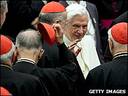
Pope Ratzinger confers with his Cardinal colleagues

Many were pleasantly surprised by the severity of the sanctions the National Collegiate Athletic Association placed on Penn State following its investigation of the Jerry Sandusky child abuse scandal. The NCAA’s measures evidenced an appropriately serious approach to unspeakable crimes.  At the same time, however, the athletic association’s aggressive sanctions contrasted sharply with the lack of appropriate response to much greater crimes on the part of Roman Catholic clergy.  It made some wonder what it might look like if the Catholic Church handled its infinitely larger scandal in a fashion similar to that of the NCAA.  

Of course, the Penn State’s board of trustees had initially tried to defuse its shameful situation by having the institution’s president resign and by firing Joe Paterno, the football program’s legendary coach. Eventually, they even removed “Joepa’s” statue that (dis)graced the entrance way to the football stadium in Happy Valley.   

But the NCAA went far beyond that – even further than most had expected.  It appointed high profile Independent Counsel, Louis Freeh, to investigate responsibility for Sandusky’s crimes and the cover-up that followed. Then in the wake of Freeh’s damning final report, it fined the University $60 million dollars – the amount the football program takes in annually. It ordered the program to vacate its winnings since 1998 (thus depriving Paterno of his legacy as the winningest coach in NCAA football history). It forbade the program to extend any football scholarships for the next four years, and released all of its current players from their ties to Penn State, making them immediately eligible to play elsewhere. The football program will be devastated for years to come.

The NCAA’s bold sanctions couldn’t be further from the response of the Roman Catholic hierarchy to its child abuse scandal. There instead the “old boy” defense of the institution and the members of its all male club kicked in just as it did at first inside Penn State’s football program when the Sandusky crimes initially came to light. At Penn State, the wagons were circled, Sandusky was mildly chided while everyone in charge from the University president and Joe Paterno on down denied any knowledge or responsibility. The attitude that “boys will be boys” threatened to carry the day.

The equivalent of that attitude and (non)response still prevails within the Holy City despite the shameful involvement of priests in raping and otherwise sexually abusing children on a worldwide scale that absolutely dwarfs anything that happened in Happy Valley. In the face of thorough investigations by independent groups (e.g. the absolutely devastating indictment published last year in Ireland) the Cardinal of New York invoked the “bad apples” defense, and protested that “only” a small portion of the clergy was tainted.

But what would it have looked like (impossibly!) if the Catholic Church had responded like the NCAA?

If it had done so:

–          Pope Ratzinger would have resigned immediately.

–          All cardinals and bishops who had covered up the scandal would have been removed from office.

–          The canonization process for John Paul II would have been terminated, because of the way he played down the sex scandal. This would be the equivalent of removing Joepa’s statue.

–          An investigation independent of the Vatican would have been launched headed by an unimpeachable figure – say the Dali Lama, perhaps joined by Sr. Pat Farrell, President of the Leadership Conference of Women Religious (LCWR) which is currently being investigated by the Vatican.

–          Upon completion of its investigation (assuming it would have reached conclusions similar to the one in Ireland), the commission would have:

  • Fined the Catholic Church $500 billion – the equivalent of one year of the R.C. church income. The money would be used world-wide to aid victims of sex abuse and to institute programs to educate clergy about human sexuality using the best insights of current sociology and psychology.
  • Removed from the list of genuine popes all those whose public crimes made them unworthy of the title “Vicars of Christ.” Here the Borgia popes come to mind, as well as Pope Pius XII for his silence about the Jewish Holocaust. (Obviously, the process of his canonization would be abruptly ended.) This would be the rough equivalent of Penn State’s vacating its football wins since 1998.
  • The exclusion of women from the priesthood would be reversed, and seminary scholarships would be extended world-wide to women desiring to receive Holy Orders.
  • Mandatory celibacy would be set aside as a requirement of the priesthood.
  • A reforming Church Council (Vatican III?) would be ordered to deal with the sex abuse and related problems – to be attended only by bishops not involved in the abuse scandal and subsequent cover-up. Their places would be taken by women elected by national bodies equivalent to the LCWR in the United States.

Of course, nothing like the results just described is remotely possible. Roman Catholic insulation from the external processes necessary to achieve such outcomes prevents that eventuality. The only external source capable of moving the church in the desired direction belongs to the Catholic faithful itself. It alone has the authority to withhold church attendance and contributions till the desired decisions of reform are taken.

Such pressure from the faithful will eventually be applied willy-nilly. That is, the faithful will either wage a purposeful campaign of withholding attendance and financial support in the light of failed church leadership. Or alternatively (and more likely) the once-faithful will be driven away from the church as the realization dawns that a college sports organization possesses sounder moral character than what pretends to be the “Mystical Body of Christ.”

SPIRITUAL STEPS AWAY FROM THE PRIESTHOOD (Pt. 4: Why I Left the Priesthood)

Last week I argued that under the last two popes, the church has proven tone-deaf to completely reasonable arguments against mandatory celibacy. As a result, the end of that requirement and its attendant disasters is as far away as ever. Equally distant seems any practical recognition by the official church of the profound spiritual conclusions inescapably drawn from the ecumenical movement and its powerful expressions over the last century and more.

Closer to our own day, read the current Pope Ratzinger’s reactionary Dominus Jesus (DJ) written in 2000 over the signature of John Paul II. It’s a clear reassertion of a pre-Vatican II vision. Discouragingly it identifies the Roman Catholic Church as representing virtually the only path to salvation. It insults Hinduism, Buddhism and Islam with criticisms about their “superstitious” content. Meanwhile, protestant churches are identified as failing to qualify as “church in the proper sense of the word.” Additionally, Dominus Jesus is totally Eurocentric, and overlooks almost completely not only the documents of Vatican II (e.g. on Revelation, Mission, Ecumenism, and the Church in the Modern World), but also theological developments that have taken place in Latin America, Africa and South Asia, where the majority of church members reside.

This is pretty much the point where I came in nearly 50 years ago, when I took my first hesitant steps towards the priesthood and membership in the Missionary Society of St. Columban. But as indicated in earlier posts, I’ve changed a great deal since then. More importantly so have the Columbans themselves, the church in general, the priesthood – and the world. There is no going back. Attempts to do so as articulated in DJ and elsewhere not only cannot work. They signal as well an irreversible crisis of the Roman Catholic Church, of the priesthood, and of groups like the Society of St. Columban. A crisis is “irreversible” when new consciousness has dawned, problems have been reframed, and old answers prove irrelevant. In the case at hand, nothing less than new forms of church, priesthood and understanding of mission are demanded by the signs of these particular times.

And what would those new forms look like? At the most basic level, they would incarnate a theology and spirituality suggested by Vatican II and its emphasis on the normative value of Sacred Scripture. That means recognizing the reality of the Divine Spirit’s universal revelation. That revelation, I’ve come to understand, is quite simple – “beyond belief,” as Elaine Pagels puts it. Here there is no room for exclusivity in terms of 4th century doctrines and dogmas. Instead, understandings of revelation must connect with personal experience founded on a deep spirituality, and nurtured by practices found in all the world’s Great Religions. Those traditions tell us that all creation is one. The world itself embodies and communicates a Revelation open to everyone. We are brothers and sisters with one another and with life forms in the rest of the universe – which means with everything that is. It’s as simple – and as profound – as that.

The simplicity, profundity and mystery of it all have haunted me since my participation in a seminar at the Atheneum Anselmianum, my second year in Rome. The topic in this very international setting had turned to enculturation – making Christian faith understandable across cultural lines. A young priest from India asked a simple question. “How do you make the uniqueness of Jesus understandable to Hindus? They, after all, believe that every human being is a God-person.” That simple question drove me to examine my faith at the deepest level. I wondered: if I were to translate my Christian faith concept for concept into something truly understandable to Indians, would it come out Hinduism? I still don’t know the answer to that question. I know it’s way more complicated than I suggest. However, my musings sent me on a Merton-like quest to understand what the East had to offer in terms of understanding God and spirituality.

Eventually, all of that brought me to a position I’ve (re?)discovered over the last fifteen years. It’s centralized the practice of daily meditation, but in a form much simpler than the Ignatian method introduced to young Columbans during our “Spiritual Year,” when we all were about 20 years of age.  Other elements include repetition of the mantram (aspirations), reading from the world’s great mystical traditions, training the senses, slowing down, practicing one-pointed attention, putting the needs of others first, and association with those who are following the same spiritual path. It’s all explained quite simply, for instance, in many books by Eknath Easwaran, but especially in his Meditation. However I’ve been drawn to this path, not on someone else’s recommendation, but because my personal experience has shown its effectiveness in terms of changes in my life and behaviour. Absent that, I’d stop the practices.

I sometimes wish that form of spirituality and spiritual formation had been the foundation of my training for the priesthood. In that case, I might still be a Columban, simply because such practice would have resulted in a radically different form of priesthood. Instead, the spiritual direction I experienced in the seminary and especially after ordination was as heteronomos as the (non)instruction offered us about celibacy. For the most part, both were formal, uninvolved and lacking in real insight for young aspirants desiring to lead genuinely spiritual lives. By no means was this the fault of the good men who tried to guide us. It’s just that the prevailing spirituality, the method of prayer and meditation, the books offered for “spiritual reading” and the spiritual practices we followed were all grossly tainted by dogmatism, formality and legalism.

Those are the very characteristics that eventually drove so many of us away from our supposed priestly calling.

Next week: Series Conclusion

Why I Left the Priesthood: Pt. 2 Intellectual Influences

I didn’t have much of an intellectual life when I was in the seminary. True, I studied hard and got good grades. I learned what I was expected to know on tests. But the intellectual curiosity just wasn’t there. Why should it have been? As Catholics we had the whole truth; there was nothing new to learn. There was no salvation outside the Church. The pope, at least, knew all the answers. There was no need to think much, except to “defend the faith.” 

Beyond that, thinking critically wasn’t much encouraged at all. In fact, from my high school seminary days till half-way through the major seminary (when I was about 23) a palpable anti-intellectualism pervaded the curriculum. For instance, I remember being taught in my first or second year as a philosophy major that Descartes “didn’t know his head from his elbow.” We never read Descartes, nor anybody of much consequence as far as “the world” was concerned, apart from snippets in the various manuals – and then only as parts of refutations. These quotes, followed quickly by rebuttal, did after all give the distinct impression that Descartes, Kant, Marx, Freud – not to mention the “Modernists” and Protestants in general – were clueless. So why be concerned about them or their writings?

In 1962, of course, things started to change, when John XXIII summoned the Second Vatican Council. I was a senior in college then. And some of our professors started encouraging us to actually read books, and to discover what was happening in the world. I resisted. I had well internalized the passivity which the seminary curriculum had encouraged in terms of not thinking for myself, at least theologically.

I had the good fortune, however, of having classmates and friends who were less gullible than me. They were excited by the prospect of the Council. After a bit of a struggle, one of them even got our library to subscribe to the National Catholic Reporter. In class and outside, others voiced criticisms of a whole host of things I considered sacred. I remember, for instance, a spirited seminary-wide discussion about the worth of continuing to regard The Imitation of Christ as a source of spiritual wisdom. I resisted that too. I remember writing something “learned” defending The Imitation’s author, Thomas a Kempis.

A series of lectures put together by the Paulist Fathers in downtown Boston was especially instrumental challenging my defensiveness. First of all it was a relief to be outside the seminary walls to attend the series. Most importantly though John L. McKenzie, Harvey Cox, Andrew Greeley and others gave powerful lectures as part of the program. Particularly memorable for me, however, was a talk by Barnabas Ahern. As a scripture scholar, he spoke of the human Jesus, and of the way the Gospels had gradually elevated the historical Jesus almost beyond recognition.

Our faith, Ahern reminded us, is that Jesus was a divine person who is fully God and fully human. We believe the first part with all our hearts, he said, but pay only lip service to the second. Ahern’s words made such profound impression on me that the next day I wrote out from memory virtually everything that he had said. His approach showed me what demythologizing in its best sense is all about. I resolved that I wanted to think and speak that way. That represented a tiny step towards adopting as my own a motto suggested to me by one of my mentors years later in Rome: “No more bullshit.”  

Eamonn O’Doherty, one of my scripture professors in the major seminary also moved me in that direction. The beginning of the Council coincided with my class’ entry into our four-year theology program in Milton. Central to it all was Eamonn’s introduction to modern scripture scholarship. Eamonn insisted on dealing exclusively with primary sources. His own notes and lectures provided the commentary. His approach was contextual. And with that I was introduced to genuine critical thinking for the first time. In Eamonn’s class (unlike Moral Theology of all places), questions were encouraged. I especially remember two colleagues (both a couple of years ahead of me) raising many questions I found interesting. Even more intriguing was the fact that they could actually ask them.

I wondered what they were reading. One of them gave me a list of three books – two by Hans Kung. Meanwhile our Liturgy professor acquainted us with Edward Schillebeeckx, and had us read Christ: the Sacrament of the Encounter with God. Soon I was delving into James Kavanaugh’s A Catholic Priest Looks at His Outdated Church. I was on my way.

I didn’t realize it then, but even before my ordination, I was starting my exit from the priesthood. I was beginning to recognize that what I was aspiring to – its rationale, its way of life, its theological justification – just couldn’t stand up to the evidence, not scriptural, nor historical nor theological.

By the time ordination came, I was secretly hoping I’d be sent to do graduate work instead of to the “foreign missions.” I wanted to know more. So I was delighted when my first appointment was to Rome and the Academia Alfonsiana to “do” Moral Theology. Evidently, my superiors planned for me to teach in the seminary following my years in Rome. (My intellectual development there however soon had them rethinking that idea.)

I knew Bernard Haring, the great Catholic moral theologian, taught at the Alfonsiana, and looked forward to studying under him. However, before beginning that three-year program, I had to get a degree in Systematic Theology. (Even after four years of theology in Milton, we had no corresponding degree to show for it.) So I enrolled in the Benedictine Atheneum Anselmianum.

Rome was still electric in the aftermath of Vatican II. After each day’s lectures at the Anselmo, I remember coming home on fire. I really admired Swiss Professor Magnus Lohrer. I can still see him smiling enthusiastically as he explained some fine point of the Council, Thomas Aquinas or Karl Barth – in Latin. Raphael Schulte wasn’t far behind in my estimation. Their excitement about theology, their engagement with the world, their scholarship shook my world and drove me to make up for all that “lost time” at Milton. I read voraciously – everything I could by Rahner, along with books by Congar, Schillebeeckx, Dewart, Cox, Tillich, Moltmann, and (later) by liberation theologians, especially Franz Hinkelammert of Costa Rica. Meal times in the Columban residence on Corso Trieste were spent in hot debate. I remember those discussions so well: liberals versus conservatives – and all the time enduring our rector’s dark scowls.

It was at this point that news started trickling in about seminary colleagues who were leaving the priesthood. The huge post-conciliar exodus from the priesthood had begun. Table talk on Corso Trieste refocused to that topic. Was the priesthood really forever? And what about celibacy? By now everyone knew that renunciation of marriage was quite late coming along as a requisite for ordination. Its imposition and defence had a lot to do with protecting church property from the heirs of priests. Besides all of that, Vatican II had changed the very ideas of priesthood and church. The priesthood of the faithful had been emphasized. And the church itself was primarily understood as a People of God, not as a top-down clerical hierarchy. Clerics were less important. So, what harm if ordained priests realized all of that and acted accordingly?

Such insights and insistent questions spilled over into the General Chapter of the Society of St. Columban, which I attended in Ireland in the early ‘70s. There I and an Irish and Australian colleague were specially elected “youth” delegates – even though all of us were over 30. Because we were such youngsters, we had voice at the Chapter, but no vote. I remember being disappointed, but not surprised at how closed older delegates tended to be to new ideas expressed not only by the three of us (who were literally “back benchers” in the Chapter hall), but to those expressed by forward-looking priests I had come to admire.

We were impatient for change, and for addressing big questions such as the purpose of missionary activity in an ecumenical world, and even priestly celibacy. Lack of serious response had an alienating effect, at least on me. Additionally, personal observation of the way my order worked, of its members’ basic fear of change, of stonewalling, machismo, and denial intensified the impression that those in charge didn’t really know what they were talking about.

But then, of course, alienation of youth was a “sign of the times” in the early ‘70s. Estrangement of young priests from church structures was part of all that.

It was also part of my story.

 Next Week: Personal Steps away from the Priesthood

Why I Left the Priesthood: Part One

At least before all the scandals hit, I had always admitted quite freely and with a certain sense of pride that I had been a priest “in a former life.” I suppose that’s because as a Catholic born before the Second Vatican Council, some positive residuals still lurked in my mind around the ideas of priesthood and church. It’s also because I still sincerely value the training, education, spiritual focus, lasting friendships, and tradition of hospitality that I inherited from my 20 years of formal association with the Society of St. Columban (the organization of priests to which I belonged). Besides, people in the contexts where I’ve worked since then –   mostly at Berea College in Central Kentucky, or in our local St. Clare’s church (where I had also served as a priest in that “former life”) – seemed to appreciate my previous incarnation. So when they’d ask me why I left the priesthood, I used to say,

I don’t think I’ve ever left the priesthood, or even could. They always told us “once a priest, always a priest;” and I think that’s true. The priesthood isn’t something “they” confer on a person. It’s an acknowledgement of an identity, a “character” that no one and no decision by me or by “them” can remove. I, and so many of my colleagues in the seminary, had a priestly character from the beginning, and ordination simply amounted to its acknowledgement and confirmation by the church. So I still think of myself as a priest. It’s true, the sacramental dimension is missing. But apart from that, as a teacher of theology and director of a Peace and Social Justice Studies program, I’m pretty much doing the same work I did before I left the canonical priesthood. I’m still a priest.

 That’s what I used to say. I don’t any longer like that answer. Its approach to the priesthood was too exceptional, setting me and my friends apart from others in a way I’ve come to see as self-serving. None of us was at all that unique. We were pretty much ordinary, working class kids, who escaped factory work (or truck driving, or delivery routes, or the policeman’s beat) to become the first in our families to get a college education. We joined a highly exclusive club that put us on a pedestal from the beginning, and gave us an exaggerated opinion of our own importance. Before we were 30 or had done really anything at all, we were among the most honoured and important people in our communities. That sort of unmerited aura and especially the accompanying expectations eventually drove me from the priesthood as I once knew it. 

Still there was truth in my statement about priestly character. There was indeed something special about me and those who came with me through the seminary. But the specialness belonged not to me or to them uniquely. What my words unwittingly expressed was an intuition about the nature of being human. The intuition is that everyone has that priestly character I was referring to. Luther, I think, (with his dependence on Augustine) was gesturing towards something like that. Though he didn’t say it as clearly as mystics like Teresa of Avila or John of the Cross – or as Hindus or Buddhists do – he was referring to the spark of the divine (the indwelling Spirit) deep within everyone. Awareness of its presence simply dawns on certain people earlier than on others. For some, it never reaches consciousness at all. It happened to dawn on me (more or less) quite early, but not in the way it has over the past decade or so. To get there I had to do a lot of growing, sometimes painful, but often delightful.  The growth was intellectual, personal, and spiritual. Each step moved me further and further from the priesthood as I imagined it for myself and experienced it in others before ordination.

(Next Monday: Intellectual Steps away from the Priesthood)

The Feast of the Body and Blood of Jesus Christ: the Last Supper wasn’t a magic show

Readings: Exodus 24:3-8; Hebrews 9:11-15; Mark 14:12-16, 22-26

Today is the feast of The Body and Blood of Jesus Christ. It used to be called “Corpus Christi.” And the Gospel reading (Mark’s account of the Last Supper) brings us into familiar territory. I mean we observed Holy Thursday just two and a half months ago. And here we are centralizing yet another account of Jesus’ final meal.

Of course, the emphasis on Holy Thursday and today is supposed to be different. On Holy Thursday the Last Supper was part of the account of Jesus’ final days. On Corpus Christi the focus is on the sacrament of the Eucharist itself, what we used to call “Holy Communion.” Today the spotlight is on the “Real Presence” of Jesus, body, blood, soul, and divinity in the “elements” which retain the appearances of bread and wine.

In the past, this was the time for sermons on “transubstantiation,” and the priestly powers conferred in ordination. Corpus Christi was an occasion for processions of the Blessed Sacrament even through town squares, for its “exposition” in “monstrances,” for solemn “benedictions” and “holy hours” of adoration.  

Historically, this feast has been a specifically Catholic affair implicitly contrasting Catholic belief with Protestants who since the Reformation denied the Catholic understanding of the Real Presence.

I won’t bore you by rehearsing the differences between Catholic “transubstantiation” and Protestant “trans-signification” and “trans-finalization.” Somehow it all seems rather quaint and beside the point, doesn’t it? I mean, who cares – except perhaps for a few brief moments on Sunday mornings between nine and ten o’clock? We have so many personal problems with our children, in our jobs, in our marriages. . . . Besides, the world is in such a dark state, who has time for such theological niceties?

And don’t even talk to me about the church; it is so problematic for most of us. How could we spend time and energy on inter-denominational disputes when we find the Mass itself increasingly meaningless? Each Sunday many of us end up struggling with the question, “Why am I still coming here?” Get real!

Well, getting real and retaining hope in the face of darkness on all fronts is actually what today’s account of the Last Supper is really about. It’s not about transubstantiation of bread and wine at all. It is we who need to be “transubstantiated” as people and specifically as Catholics. The Gospel calls us to fundamental change in our faith about Eucharist.

Consider what happened at the Last Supper and then what became of it over the years. Consider what we could make of it today.

For Jesus, this final Passover meal is wrought with anxiety to say the least. Jesus and his friends have now gone underground. After a demonstration in the Temple which turned violent, they are now being hunted. There is a price of 30 shekels of silver on Jesus’ head, and he suspects one of his inner circle is about to turn him in for the reward. The “safe house” Jesus has secured for the Passover meal has been located by a secret sign and a password.

In such dark circumstances, Jesus looks at the bread he breaks, and the action reminds him that his very body is under threat. The cup of wine he passes around becomes for him his own blood that soon could be whipped, nailed, drained and speared from his veins.

But he doesn’t lose hope. In effect amidst betrayal by a close friend, a price on his head, premonitions of his own death, and threatened failure of his entire enterprise, Jesus proposes a toast to God’s Kingdom. Despite everything he remains convinced God’s reign will soon dawn. In fact, takes a vow not to drink wine again until that happens. His fast from wine is another form of his familiar prayer, “Thy kingdom come.”  In the end, Jesus asks his disciples (come what may) to share bread and wine as he has done – with one another and across ethnic and other divisions (with Jew and gentile, woman and man, rich and poor, “clean” and “unclean”), and to do this specifically in his memory.

And that’s what the early Christians did. They broke bread in memory of Jesus, his values and the way he lived. In the early church, they called this a “love feast.” And people would come together with pot luck dishes and share with everyone. Until the 5th century women would often preside at the feast – as they usually do at meals in every home on the planet. Sometimes men would preside too. (It wasn’t until the 14th century that the Eucharistic “celebrant” had to be an ordained “priest.”)

And all would be invited, rich and poor. (In fact, one of the great attractions of early Christianity was the generosity with which Christians shared their bread with the needy.) Twice in the Book of Acts Luke describes the first Christians as leading what could only be called a “communistic” ways of life.  Acts 2:44 reads:

All who believed were together and had all things in common; they would sell their possessions and goods and distribute the proceeds to all, as any had need. Day by day, as they spent much time together in the temple, they broke bread at home and ate their food with glad and generous hearts, praising God and having the goodwill of all the people. And day by day the Lord added to their number those who were being saved.

That’s what the early Christians made of Jesus’ injunction to “Do this in memory of me.” They truly understood what later would be termed “The Real Presence:” bread is bread; wine is wine; when they are shared Jesus truly becomes present in his Holy Spirit. Early Christians understood that Jesus’ “Real Presence” could not be separated from the way he lived – at the service of the poor, the outcast, the marginalized, the hungry and thirsty.

The rub however is that the Eucharist gradually turned into something else. That business about actually doing what Jesus commanded – you know “Sell what you have; give it to the poor; and come follow me” . . .  That was too much for church leaders after they sold out to Constantine’s Empire in the 4th century. They started living like kings and needed something more comfortable. 

So they transformed the Christian “love feast” into a “Mass.” And as the middle ages progressed, the Mass turned into a magic show. Before our very eyes, bread was transformed into the body of Jesus, and wine became his blood. The priest alone had the requisite magical powers. Belief in that magic act became what the Eucharist was about.

In all of this, focus shifted from transformation of those participating in the Eucharist to transformation of the bread, which eventually became a plastic-like wafer that looks nothing like the bread whose sharing so concerned Jesus.

We could change all of that beginning right now. The Lord’s Supper doesn’t have to be the dreary “hocus pocus” it became before Vatican II and threatens to become again today under extremely conservative church leadership. Like Jesus’ last meal, the Eucharist can reassume its character as an occasion for recommitment to God’s Kingdom, even as we experience a dark night of our Catholic souls and just as human beings. If Jesus wasn’t overwhelmed by his circumstances, how can we be crushed by ours?

In fact, if we open our eyes in hope, we can see many reasons to toast God’s Kingdom despite our many problems as believers. For instance, did you know that a group of Catholics and Protestants of various denominations are forming an alternative Eucharistic congregation right here in our own community? Its intention is not to replace our attendance at Mass, but to supplement it with a celebration that can provide experience of what inspired, life-connected worship can be.

Also, this fall Fr. Matthew Fox, the fiery spiritual teacher, liturgist and theologian will be speaking at Berea College.  He has already expressed a willingness to meet with our parishioners to discuss church renewal with us. Similarly, Sr. Joan Chittister, the Benedictine nun and spiritual leader, will be a Berea College convocation speaker this fall.

Additionally, next November 9th to 11th, the National Catholic “Call to Action” campaign will be holding its annual meeting in Louisville – at the Galt House. We could send a delegation of 20 people or more (including our pastor) to get inspired by world-class speakers and by what other churches are doing to revive the spirit of Vatican II.  Please mark your calendars for that event.  

Besides all of that, this October 11th is the 50th anniversary of the convening of the Second Vatican Council. There will be observances of the occasion all over the world. We could mark the anniversary right here in our own parish with a “tent revival” with invited speakers, and with teach-ins on Vatican II. We could even pool our money to provide tuition for our pastor to update his theology in some progressive theological, liturgical or pastoral program.

All of these events have the potential to “transubstantiate” us as a community – to change us to the core as a community of faith.

So things might not be as dark as we might think. There may indeed be light at the end of this tunnel we’ve been struggling through for too long.

Jesus’ own faith in and hope for God’s Kingdom is our inspiration. If he could have faith and hope in his dreary circumstances, how can we not be hopeful? If he is for us, if we sup with him, who can stand against us? Let’s get on with it!