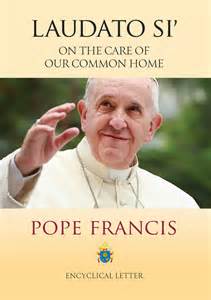
This is the first installment in a three-part series on Pope Francis’ new encyclical, Laudato Si’. It attempts to place in historical perspective what might well be the most important document yet produced in the 21st century. It also tries to explain the meaning and centrality of the encyclical’s guiding principle, its “preferential option for the poor.”
Laudato Si’ in Historical Perspective
Josef Stalin once asked of Pope Pius XII, “How many divisions does he have?” It was a dismissive rhetorical remark meant to indicate that the pope and his lofty pronouncements represented no real threat to one whose power rested on military might.
Yet even recent history shows that great popes have exercised world-changing influence that has not only toppled governments, but done its part to displace entire socio-economic systems. In the late 19th century, Leo XIII empowered Christian Democrat parties throughout Western Europe to eventually sponsor welfare state reforms. At the end of the 20th century, John Paul II played a major role in bringing down communism and the Soviet Union.
Now under the Catholic Church’s first pope from the Global South, we may be witnessing history repeating itself. Pope Francis’ new encyclical, Laudato Si’ promises to do its part to deconstruct a moribund world economic system headed by the United States.
That’s the pope’s message: capitalism-as-we-know-it is doomed. It is responsible for world poverty, climate change, and general ecocide. It must be replaced by a political-economy guided by a “preferential option for the poor.”
To get what I mean, consider a bit of history and then the Pope Francis’ criticisms of capitalism and the directions for change offered by that option.
Begin by recalling that up until its last three occupants, the papacy has been the almost exclusive province of Italians with overwhelmingly western European perspective. As a result, until 1978 and the advent of the Polish John Paul II, Catholic social teaching was directed principally towards Western Europe.
Leo XIII started the social justice ball rolling with the publication of Rerum novarum in 1891. It appeared at a time when Europe’s working class was mercilessly exploited by the continent’s still-emerging industrial system.
That worried church leadership, because exploitation caused the working class to turn away from the church and its clergy – both seen as supporting Europe’s old socio-political order in the name of anti-communism. That same exploitation turned workers precisely towards the promise offered by socialists and communists. It included decent wages, shorter working days and weeks, public education, free health care, retirement, paid vacations, etc.
Rerum novarum attempted to recapture alienated Catholics. It focused on the rights of labor and the duties of capital. Leo XIII argued that both capitalism and communism were deeply flawed; neither system was acceptable. (Critics labeled the argument an impotent “neither . . . nor-ism.”) The encyclical expanded recognition of working class issues. It supported labor unions, higher wages, and social security. It outspokenly limited the claims of private property.
These ideas were repeated in subsequent documents written by Italians. They included Pope Pius XI’s Quadragesimo anno, the Social teachings of Pope Pius XII , John XXIII’s Mater et magistra, and Pope Paul VI’s Populorum progressio.
Together these liberal social justice teachings exercised undeniably positive effects on European policies of political economy. Especially following World War II, they moved centrist Christian Democratic parties to increasingly champion the welfare state and provide an alternative to communism and socialism. As a result, Europe changed. The welfare state became a reality. Communism lost its appeal for many Catholics. And a large, prosperous middle class flourished in Europe in ways that far outstripped communist competitors.
With the long reign of John Paul II (1978-2005), the Church’s first pope from the Communist bloc, the Church’s social justice focus changed in practice to Eastern Europe. Though his Laborem exercens and Centesimus annus continued the “neither . . . nor-ism” of previous papal teaching, John Paul II’s practical project became the displacement of communism, especially in his native Poland.
That drove him to cooperate with the more explicit parallel project of the Reagan administration and the CIA under William Casey. Eventually the cooperation had its effect. The Soviet Union collapsed quite suddenly. And instead of being governed by two super-powers, the world found itself in a new uni-polar reality under the leadership of a single super power, the United States of America.
In the aftermath, it appeared to most that final victory had been achieved by capitalism which took on an increasingly unfettered form that became known as conservativism in the United States and neo-liberalism in the rest of the world.
Despite their specific criticisms of capitalism, John Paul II and Benedict XVI had contributed mightily towards the achievement of that end.
(Next installment: How Pope Francis contributes to the revived critique of capitalism-as-we-know-it)
 About Things That Matter