Pope Francis’ Encyclical: My New Book and a Lenten Program

product_thumbnail

I must apologize for my absence from the blog site over the last couple of weeks. It’s that I’ve been putting the finishing touches on a new book I’ve written about Pope Francis’ eco-encyclical, Laudato Si’, which I consider the most important public document of the present century.

The 150 page book is called Understanding Laudato Si’: A Discussion Guide. (It is featured along with a “Buy Now” button on the right hand side of my blog homepage. The price is $8.15 per copy.) The book is aimed at people of faith who’d like to start or participate in discussion groups about climate change as the moral issue Pope Francis calls it.

(By the way, an “encyclical” is a general letter to the church as a whole. It represents the highest most solemn form of papal teaching.)

Laudato Si’ is unique in that it comes from the pen of history’s first Global South pope. So it is shaped by the experience of the former colonies (Latin America, Africa, and South Asia). It is heavily influenced by colonial and neo-colonial exploitation.

More particularly, Laudato Si’ was written by a priest who comes from country victimized by the U.S.-supported “Dirty War” that the Argentinian Army waged against the pope’s homeland from 1976-1983. That war took the lives of at least 30,000 Argentinians – at least one bishop, many priests, nuns, and lay catechists along with union organizers, teachers, social workers and those suspected of supporting the democratic resistance.

No other pope has had such “Third World” experience of aggression at the hands of the United States. No other pope has been influenced directly by liberation theology – which has centralized the concept of “preferential option for the poor” that marks Francis’ papacy.

Read in that light, Laudato Si’ presents the world with understandings of climate change, economics (especially capitalism), history, theology, and church that are uniquely “Global South” rather than the European understandings that shaped the visions of Francis’ predecessors. All the other commentaries I’ve seen have overlooked those differences.

I’ve shared drafts of the book with friends. One wrote: “Your book should be in the hands of every bishop and priest and parish, as well as to the pundits we daily read and hear in the mass media.”

The great African-American feminist scholar, bell hooks, commented: “You make difficult concepts and theories accessible. The work itself embodies the spirit of inclusion you write about so eloquently. Bravo!!!”

A priest-activist working in the Appalachian region wrote:  “Congratulations, this is a winner! . . . You wrote an amazing book.  I read it and I remembered.  I thought about it and I learned.  I critiqued it, and I grew. . . Let’s see how we can spread the analysis.”

I’m hoping that my book will be used this Lent as a discussion guide in parishes throughout the United States.  It is currently under review by my own diocese of Lexington, Kentucky.

In my own parish, St. Clare’s here in Berea, we’ve made the following proposal for dealing with Pope Francis’ call to action. Perhaps readers of this blog might implement something similar in their own parishes:

Lenten Program, St. Clare Church, Berea, Kentucky (Wed. Feb. 10- Sat. Mar. 26, 2016)

The St. Clare Peace and Social Justice Committee proposes a Lenten adult education program that will centralize the Papal Encyclical, Laudato Si’. Participants in the six week program will pursue the following goals:

  • Acquaintance and familiarity with the content and historical background of Laudato Si’.
  • In the light of that encyclical:
    • Sharpening awareness of the environmental crisis itself and of capitalism’s role in that predicament, as well as the parts played by U.S. policy, Global South theology, and the Catholic Church.
    • Rethinking the elements of each person’s Catholic faith including understandings of God, Jesus, church, and salvation.
    • Re-evaluating the relationship between a reconsidered Catholic faith and the environmental crisis.
    • Identifying practical ways of coping with the environmental crisis in the personal, familial, parochial, national and global dimensions of life.

To achieve these goals, each participant will:

  1. Adopt as a Lent 2016 practice, participation in six 90 minute group sessions discussing issues raised by  Laudato Si’.
  2. Sign up in advance for program participation. (Non-obligatory “interest cards” will be found in each pew on Ash Wednesday and on the First Sunday of Lent.)
  3. Before each meeting, read and reflect on the discussion guide adopted by the group (either the one to be provided by the diocese or Rivage-Seul’s Understanding Laudato Si’: A Discussion Guide).
  4. Actively participate in the discussions.

Program Organization

Feb 14:  View the first half of “Time to Choose” followed by a disciplined discussion. (“Time to Choose is a new 90 minute film by Oscar winner, Charles Ferguson. The film makes the case that we can combat climate change; that we have the tools and the knowledge to begin doing so right now.) (Assignment: Read Discussion Guide, pages 1-30)

Feb 21: View second half of “Time to Choose.” Discuss in the light of the Discussion Guide’s summary of Laudato Si’.  (Assignment: Read Discussion Guide, pages 31-50)

Feb 28: View lecture by economist, Richard Wolff on capitalism and the environment. Discuss the pope’s approach to economy facilitated by Chapter Two of the Discussion Guide.   (Assignment: Read Discussion Guide, pages 51-82).

Mar 6: View the first half of “This Changes Everything” (a new 90 minute film by Naomi Klein based on her book by the same name). Discuss in the light of Pope Francis’ “preferential option for the poor” as explained in Discussion Guide (Assignment: Read Discussion Guide, pages 83-100)

Mar 13: View second half of “This Changes Everything” in the light of liberation theology as explained in Discussion Guide. (Assignment: Read Discussion Guide, pages 101-140).

Mar 20: Discuss the Church as Caravan and practical responses to Laudato Si’.

It’s Time to Take Action on Climate Chaos!

Bishops & Climate Change

It has been almost a month now since Pope Francis’ historic visit to the United States – almost a month since he issued his clarion call to save the planet, eliminate capital punishment, open borders to refugees, and divest from the arms industry.

And what has happened since?

Nothing at all – as far as one can see from the vantage point of the parish pew, the diocesan newspaper, or statements from the national hierarchy.

None of this is surprising. It’s the same non-response achieved by Pope Francis’ Apostolic Exhortation, “The Joy of the Gospel.” That document called literally for changing everything in the Catholic Church. But nothing at all has changed as a result.

That wasn’t, of course, the response to Pope Francis’ visit here in September. Then there was great enthusiasm for traveling to Philadelphia to demonstrate Catholic faith by showing up to see the Holy Father in person.

Even my small parish in Berea, Kentucky sent a whole busload of people Pictures were taken. Descriptions of crowd density and of the hardships of traveling so far and lodging under primitive conditions were detailed. Everyone agreed however that it was all worth it.

Apparently, taking the pope seriously about climate change, capital punishment, the refugee crisis and disarmament is not worth it.

After all, the climate change process advances unabated. Despite the pope’s warnings, Catholics presumably continue watching Fox News, listening to Rush Limbaugh, and supporting climate change deniers in the political arena.

All of this is true, even though the pope warned in Laudato Si’:

“Regrettably, many efforts to seek concrete solutions to the environmental crisis have proved ineffective, not only because of powerful opposition but also because of more general lack of interest. Obstructionist attitudes, even on the part of believers, can range from denial of the problem to indifference, nonchalant resignation or blind confidence in technical solutions.” (14)

The words are prophetic. Indifference, nonchalance, and resignation seem to be the order of the day. As for “blind confidence in technical solutions,” one has to acknowledge the problem before that can enter the picture.

The pope is no stranger to denial. It was the order of the day in the case of Argentina’s Dirty War. Many Argentinians pretended they didn’t know about the kidnappings and disappearances of their neighbors, about the army’s rampant torture program or its thousands of extra-judicial assassinations.  As Argentinians said at the time, “We did not know, what no one could deny.”

That seems to be the very definition of Catholic majority consciousness relative to the issues this pope has centralized. It’s the very definition of Know-nothing-ism and religious irrelevance.

Instead, Catholics and others need to embrace the sense of urgency the pope has articulated so well. We need:

  • Frank discussion of diocesan divestment from oil and coal companies even in a coal state like Kentucky.
  • The conversion of parish plants away from dirty energy consumers and into solar energy generators.
  • The opening of our churches to the refugees created by the endless wars our tax dollars fund unquestioningly.
  • Church-sanctioned resistance to taxes that finance those wars, arms sales to Saudi Arabia and Israel, and continued extra-judicial assassinations by U.S. drones.
  • Protests against the scandal of the executions that have missed scarcely a beat since the pope’s clear pronouncement against capital punishment.
  • Consistent connection of Sunday liturgies and readings to the overriding issue of climate chaos.

Pope Francis is right: it’s time for action and prophetic witness in the face of the greatest set of problems our planet has ever faced.

Laudato Si’: Pope Francis’ UPSETTING (But Hopeful) STORY About Our WORLD

Same Text

In my local faith community – St. Clare’s Catholic Church in Berea, Kentucky, we’re getting ready for Advent. As our seasonal project, we’re proposing a parish-wide discussion of Pope Francis’ eco-encyclical, Laudato Si’.

I’ve suggested that we purchase copies of the encyclical for each adult member of our parish, that we centralize it in a special liturgy, and that we present copies of Laudato Si’ to each recipient just as we do the Eucharist each Sunday. The presenter would say something like, “Receive the call of Pope Francis’ to reform your life and save our planet.” And the recipient would respond, “Amen.”

However, as our Peace and Social Justice Committee has discussed such possibilities, some have remarked that the pope’s encyclical is rather long and difficult to read. They’ve predicted that despite having the book in their hands, many parishioners will never get around to reading it.

What we need, my friends have said, is a comprehensive thumbnail sketch of the encyclical’s contents – with some provocative discussion questions.

So in fewer than 2000 words, here’s my stab at that. My summary contends that in Laudato Si’ Pope Francis is telling us a disturbing but hopeful story. In fact, the story’s main point (about the failure of capitalism) is told in all the papal social encyclicals since Leo XIII (1891). But this time the world is listening.

Here’s what Francis says in Laudato Si’:

  • The earth was given to humankind as a whole (93).
  • It belongs to everyone (93, 95, 158).
  • Thus the earth is primarily a Commons (164).
  • The climate itself is a common good (23).

_____

  • Though the Commons by definition cannot be privately owned, the Church has always recognized the right to private property in other spheres (93).
  • However the Church has never understood even this right as absolute or to be exercised primarily for personal gain (93).
  • Instead the right to private property has primarily been considered an administrative responsibility (95, 159).
  • As such it must always be exercised for the common good (129, 156).
  • In fact, “the first principle of the whole ethical and social order” is “the principle of the subordination of private property to the universal destination of goods, and thus the right of everyone to their use” (93).
  • So it is immoral that the earth’s resources and wealth be concentrated in the hands of a few (50, 90).

_____

  • The Judeo-Christian tradition unequivocally supports the position that the earth belongs to everyone (66, 67, 71, 76, 93, 95), that human “owners” do not have absolute dominion over possessions (67, 68, 75, 82, 83, 93, 95), that all life forms are loved by God (68, 69, 76, 77, 92, 96), and that extreme wealth inequalities are immoral (70, 71, 71, 90, 95).
  • Jesus endorsed all those beliefs by incarnating God’s presence in a poor worker as the locus of God’s presence par excellence (98, 99).
  • Additionally, the natural world itself, as the “Book of Creation,” represents a source of revelation. It too supports biblical insights that summon humans to ecological responsibility rather than to absolute dominion over nature (85, 86,87, 88).
  • Jesus supported such convictions with his teachings about the universal fatherhood of God (96), with his parables about seeds, soil, plants, flowers, harvest, birds, and weather patterns (97, 100), and with display of his own complete harmony with nature (98).
  • The work of the Church, as a community of Jesus’ followers, is “to remind everyone of the duty to care for nature,” while at the same time protecting humankind from self-destruction (79).

_____

­­­­­

  • Nonetheless at some point in history (“when the Roman Empire was seeking to impose absolute dominion”), the notion of private property became distorted (74).
  • Private property came to mean absolute ownership for personal enrichment without reference to the common good.
  • The notion of private property expanded to include the right of “owners” to do whatever they wished with “their” property including its complete destruction, without regard for “collateral damage” suffered by billions of humans and innumerable life forms excluded from the benefits of the market system (49, 67, 123).
  • Eventually common goods such as seeds, water, and life itself were turned into commodities whose ownership was “privatized” (30, 134).

_____

  • After the Industrial Revolution, the power of “owners” to alter and destroy “their” goods increased dramatically.
  • The steam engine and its successors (including today’s robots and computers) conferred power to alter and even destroy not only what owners considered their belongings, but the Commons in general (including the air, water, wetlands, mountains, non-human lifeforms, “resources” below the earth’s surface, and the climate itself).

_____

  • Free market ideology has played no small part in enabling unregulated technology’s harmful impact on the earth.
  • This ideology includes deep-seated, but often indefensible (109) convictions, for instance that:
    • Human beings enjoy absolute dominion over nature (67).
    • The world is anthropocentric: it revolves around human beings who can treat other life-forms as instruments for their benefit and pleasure (115).
    • Such beliefs are supported in the Bible (67).
    • A technological imperative demands that every advance in technology represents “progress” and therefore must be accepted as inevitable (105).
    • Might makes right and winners are entitled to “take all” (82).
    • Government regulation of the market is always undesirable, even in the face of huge income disparities (60).
    • No action should be taken on climate change in the absence of indisputable proof demonstrating the human origins of unusual climate events (186).
    • Unregulated market forces can solve all problems of environmental destruction and poverty.

______

  • The combination of technological development, market forces, and an enabling “free market” ideology has increasingly conferred on industrialized countries the ability to exploit resources world-wide.
  • As a result, for the past 200 years, these nations have incurred an “ecological debt” vis-a-vis the rest of the world (51).
  • Besides robbing their colonies of valuable resources while often enslaving their people, the industrialized countries have filled the atmosphere with two centuries of climate-changing pollution which most proximately threatens the colonies they exploited (51, 52, 170).
  • As a result, the industrialized powers owe their former colonies debt-repayment (30).
  • Such reparations must at the very least include cancellation of “Third World” debts, transfers of money and of non-polluting technology (52, 172).

_____   

  • Indigenous people have been especially attuned to such inequities and obligations on the parts of their exploiters (146, 179).
  • They have not only experienced colonialism as theft of their resources, they have identified the practices of industrialized capitalism as the rape of the one they (and St. Francis) honor as “Mother Earth” (1).
  • For their part, scientists in the industrialized world have warned humans about the unsustainability of such practices on purely scientific grounds (161).
  • True to the predictions of both indigenous shamans and secular scientists, we have now reached a crisis point (23).
  • Humans must either change their economic paradigm (based on this concept of absolute ownership) or face extinction (23, 61, 181).

_____

  • Many with vested interests in continuing to profit from the earth’s destruction have adopted “obstructionist attitudes, including denial (14, 26).
  • They are more willing to risk the earth’s destruction than to abandon the concept of absolute ownership upon which capitalism-as-we-know-it is based (60).
  • So they mistakenly claim that deregulated markets and technological development will save the day without basic changes in the consumerist lifestyle (109, 110).
  • They also propose risky “solutions” [such as Solar Radiation Management (SRM)] rather than low-tech, common sense responses to problems connected with climate chaos (14).

_____

  • The common sense solutions must on the one hand include acts on the parts of individuals such as “avoiding the use of plastic and paper, reducing water consumption, separating refuse, cooking only what can reasonably be consumed, showing care for other living beings, using public transport or carpooling, planting trees, turning off unnecessary lights. . .” and reducing the use of air conditioning (55, 212).
  • On the other hand, dealing with climate chaos requires action which national governments alone are capable of performing (38, 129).
  • These include weening national populations from dependence on fossil fuels (165) as well as investment in high-speed railways, and renewable energy sources. National governments must also strictly regulate trans-national corporate activity (38).
  • Changing paradigms even includes the submission of national governments to an international body with legislative authority to protect rainforests, oceans and endangered species, as well as to promote sustainable agriculture (53, 173, 174, 175).

(Author’s Note: By the way, if we think the United States with its proud history of independence could never submit its own legislative power to the possibility of being overridden by some international body, we should know that it already has. U.S. membership in the World Trade Organization, the provisions of the North American Free Trade Agreement (NAFTA), and those of the proposed Trans-Pacific Partnership (TPP) already allow international bodies to nullify U.S. laws such as those protecting our air and water. That is, if such national laws are ruled to interfere with the expected profits of multinational corporations, the laws can be rendered null and void, regardless of what U.S. citizens might think. In other words, there is precedent for U.S. submission to international bodies with binding authority to legislate about environmental deregulation. The pope is merely requesting that the same authority be given an international body tasked with protecting the environment rather than allowing its further degradation.)

  • In summary, the principles guiding necessary changes include the following:
    • The Principle of the Interconnectedness of All Reality: (e.g. 16, 42, 70, etc.).
    • The Principle of the Common Good: “The common good is ‘the sum of those conditions of social life which allow social groups and their individual members relatively thorough and ready access to their own fulfilment’.” Laudato Si’ identifies the common good as a “central and unifying principle of social ethics.”(156).
    • The Principle of the Subordination of Private Property: “(T)he first principle of the whole ethical and social order” is “the principle of the subordination of private property to the universal destination of goods, and thus the right of everyone to their use” (93).
    • The Principle of the Universal Destination of All Goods: (See immediately above).
    • The Principle of Preferential Option for the Poor: This principle “entails recognizing the implications of the universal destination of the world’s goods . . . {T}his option is in fact an ethical imperative essential for effectively attaining the common good” (158). In practice it means guaranteeing the rights of the world’s poor to land, housing, work, education, credit, insurance and access to markets (94).
    • The Principle of Distributive Justice: According to Pope Francis, the common good cannot be served without social peace which in turn “cannot be achieved without particular concern for distributive justice; whenever this is violated,” he observes, “violence always ensues” (156).
    • The Principle of Subsidiarity: this principle embraces decentralized solutions (144, 157, 179, 196).
    • The Principle of Transparency: Laudato Si’ states that “An assessment of environmental impact of business ventures and projects demands transparent political processes involving a free exchange of views . . . Environmental impact assessment should . . . be carried out in a way which is interdisciplinary, transparent and free of all economic or political pressure. . . A consensus should always be reached between the different stakeholders . . . The local population should have a special place at the table . . . (183).
    • The Precautionary Principle: This principle (as expressed by the Rio Declaration of 1992) states that “where there are threats of serious or irreversible damage, lack of full scientific certainty shall not be used as a pretext for postponing cost-effective measures” which prevent environmental degradation.” Laudato Si’ adds that “If objective information suggests that serious and irreversible damage may result, a project should be halted or modified, even in the absence of indisputable proof. Here the burden of proof is effectively reversed, since in such cases objective and conclusive demonstrations will have to be brought forward to demonstrate that the proposed activity will not cause serious harm to the environment or to those who inhabit it” (186).

FOR DISCUSSION

  1. How does the message of Pope Francis’ encyclical make you feel? Hopeful? Discouraged?
  2. In your opinion does the pope step outside the area of “faith and morals” by addressing issues such as climate change and its relationship to capitalism-as-we-know it?
  3. How is climate change a matter of moral concern?
  4. Is the pope correct in subordinating the rights of private property to the common good?
  5. What might that subordination mean in practice?
  6. How is climate change connected with your faith?
  7. What alternatives to capitalism-as-we-know-it can you think of?
  8. What would happen if climate-change deniers applied the pope’s Precautionary Principle to climate change?

Pope Francis Tells Kim Davis to “Stay Strong” and Nullifies His Entire U.S. Trip!

Pope & Kim

Since Pope Francis’ historic visit to the U.S., states have executed three death row inmates. The White House has promised further arms sales to Egypt and Saudi Arabia. Our military has continued daily airstrikes in Syria. It has bombed a Doctors without Borders hospital in Afghanistan. Yet another mass shooting facilitated by out-of-control arms manufacturers and their government servants has shocked us all. At the same time, preliminary work on the Keystone XL pipeline has continued unabated.

In his congressional address, the pope condemned all such actions in no uncertain terms.

Meanwhile, defying all expectations, the pontiff chose not to address specifically abortion, contraception and gay marriage. Those matters, he has said, have been over-emphasized while the essence of Jesus’ Gospel (Good News to the poor) has been correspondingly downplayed. In fact, Francis has described the Church’s pelvic concerns as “obsessions.”

Nonetheless, since the pope’s departure virtually the only lasting conversation has circled around two words spoken to Kim Davis, the county clerk from Kentucky, who has refused to issue marriage licenses to gay couples.

Apparently at the invitation of the conservative Vatican Nuncio (ambassador), Ms. Davis appeared in a reception line, had her case briefly explained to the pope, shook his hand, and heard two words: “stay strong.” Those two words have overshadowed the thousands of sentences spoken by the pope in Washington, New York, and Philadelphia.

“Stay strong” was enthusiastically embraced by the mainstream media (MSM) as if it were the most significant papal utterance between September 22nd and September 25th. Apparently, it relocated commentators on familiar, comfortable ground far from the decidedly annoying “bold cultural revolution” advocated by the gentle visitor from the Vatican.

Later while on the plane back to Rome, the pope was pointedly asked about government officials who refuse to discharge a duty if they feel it violates conscience. In keeping with church tradition, the pope replied, “Conscientious objection must enter into every juridical structure because it is a right.”

The MSM seized upon that pronouncement as a further expression of papal support for Kim Davis.

Only a few applied the pronouncement’s logic to Kim Davis herself, who has been divorced three times and married four. Following the logic of “conscientious objection,” it would be much more consistent for Christian administrators in Rowan County to refuse all of Ms. Davis’ petitions for divorce which Jesus condemned as adulterous. (He said absolutely nothing about homosexuality.)

Much less did the MSM bother to apply the pope’s words about conscientious objection to whistle blowers in general or in particular to Chelsea Manning, Edward Snowden, the work of WikiLeaks, or to military personnel refusing orders. Once again, that would have moved the discussion into decidedly uncomfortable territory. It would have been too “political.”

In the meantime, national leaders, led by the United States, largely refuse to “become strong,” much less “stay strong” on matters of capital punishment, and weapons of mass destruction.  They’ve continued our headlong plunge towards the abyss represented by climate chaos – the lion in the room that threatens to devour us all.

According to Pope Francis, it’s towards taming that lion that focus and concern should be directed — instead of towards meaningless sideshows.

Pope Urges Catholic Parishes to Take in Refugees

pope-refugees-2

I woke up this morning to a promising Washington Post headline. It read: “Pope Urges Europe’s Catholics to take in Syrian refugees.” There he goes again, I thought.

The article described how Pope Francis “has called on ‘every’ parish, religious community, monastery and sanctuary to take in one refugee family – an appeal that, if honored, would offer shelter to tens of thousands.”

Of course the vast majority of such migrants are “illegal” in the eyes of governments where the invited parishes, etc. are located.

The pope implied that Jesus’ attitude towards “the stranger” overrides such legislation. The Master’s words in MT 25:35 have him identifying with immigrants (and the hungry, naked, homeless, and imprisoned) and basing the entire final judgment on the way we treat such people. He says: “. . . I was hungry and you gave me something to eat, I was thirsty and you gave me something to drink, I was a stranger and you invited me in,”

The pope’s appeal comes at a time when immigration along with climate change is a hotly contested issue not only in Europe, but here in the United States.

Of course, the entire panoply of Republican candidates (including the six of them who claim to be “devout Catholics”) consists not only of climate change deniers, but of candidates trying to outdo one another on the issue of excluding immigrants from our borders. Catholic candidates include Jeb Bush, Chris Christie, Bobby Jindal, Rick Santorum, Marco Rubio and George Pataki. Now they specifically diverge from the Pope not just on climate change, but on immigration as well.

Just yesterday, another ardent Christian, Sarah Palin, brought climate change and immigration together in typical GOP fashion. She told CNN that refugees from Mexico not only “better be legal,” but should be made to speak “American,” rather than “Mexican.” She sides with Donald Trump’s plan to build an exclusionary wall along the border. She also aspires to be Mr. Trump’s Secretary of Energy – a position she would embrace enthusiastically “because energy is my baby – oil and gas and minerals, those things that God has dumped on this part of the Earth for mankind’s use. . .”

Of course, Pope Francis words yesterday put him on the side of immigrants and against exclusionists. He invites his flock of 1.2 billion to follow suit. He also expressly rejects Palin’s reading of God’s mind about why the Creator “dumped” gas, oil, and minerals on Earth.

According to his eco-encyclical, Laudato Si’, using the narratives of Genesis to encourage “the unbridled exploitation of nature” is an incorrect interpretation of the Bible (67). “Clearly,” the pope adds, the Bible has no place for a tyrannical anthropocentrism that would encourage the “drill, baby, drill” approach regardless of its effects on the planet (68).

But the pope’s words about welcoming immigrants struck even closer to home.  For years I’ve been wondering what it might take to awaken Catholics to the revolutionary power of the Gospel.

In my own Catholic parish, we find ourselves mired in a detached, decontextualized version of faith that ignores the world’s real problems.

Pope Francis represents the exact opposite trend. Yet despite his invitation to “change everything” issued in The Joy of the Gospel nearly two years ago, and in spite of the urgency of Laudato Si’, nothing at our local level changes.

Yesterday’s papal invitation shows us how to get off the dime. He suggests something practical for every parish to do: welcome at least one immigrant family from the detention centers on our own borders. House and feed them. Be a prophetic example to the exclusionists. Join with other (non-Catholic) churches to do the same.

The infrastructure is there: churches that are used for just a few hours each week, parish basements and halls that are similarly idle most of the time. Also, many of us have space in our own homes – or own second houses – that might similarly provide housing for Jesus presenting himself to us as an immigrant.

Our little parish of St. Clare in Berea, Kentucky has a Peace and Social Justice Committee of 20 highly committed people. We’re meeting next Sunday to plan our gala “Watch Party” on September 27th to see the Pope’s address our Congress and the U.N.

Now in the light of the pope’s invitation to open our buildings to immigrant families, we have something else to discuss and act upon.

Accepting Pope Francis’ invitation could move our parish to truly begin “changing everything.”

Can you imagine what would happen, if the families we accepted were Muslim instead of Christian?

Thank you, Pope Francis.

The Conversion of Pope Francis and “Why the New Pope Must Resign”

Francis Capitalism

“Why the New Pope Must Resign.” That was the title of an article I wrote just after the election of Pope Francis in 2013. In it I joined Argentina’s Horacio Verbitsky and others questioning the role of Jorge Bergoglio (aka Pope Francis) in Argentina’s “Dirty War” (1976-’83).

Since then, friends have asked me about that. “What do you think now – in the light of the fresh spirit of reform the pope has introduced – in the light of his tremendous popularity?  Surely you were mistaken in your original, hasty judgment.”

That’s the typical question and observation.

My answer has been that I’m delighted with Pope Francis and the direction his papacy has taken. Both his Apostolic Exhortation, The Joy of the Gospel, and especially his new eco-encyclical, Laudato Si’ are magnificent. Their criticisms of capitalism-as-we-know-it as the structural cause of world poverty and environmental destruction couldn’t be a clearer endorsement of a form of liberation theology that is both spiritually moving and politically engaged.

I’m glad the pope didn’t resign. Pope Francis is great.

But in response to my friends, I also add that the issue of Father Bergoglio’s involvement with the Dirty War is not resolved. Nor should it be ignored. Recalling its elements holds lessons for us – about the Roman Church’s history of supporting oppression, about whitewashed historiography, and most importantly, about the possibility of repentance and deep personal change.

Consider the first point, the Church supporting fascist oppression. It happened in Argentina during the Dirty War as it happened in Germany under Adolf Hitler.

When Bergoglio was Jesuit Provincial, he was accused of turning over to the army two of his Jesuit colleagues and former teachers, Fathers Orlando Yorio and Franz Jalics. Both had been pro-socialist clerics and members of the Third World Priests’ Movement (MSTM). Such membership was considered a capital crime by the country’s ruling junta.

Yorio and Jalics had been embroiled in a long-standing feud with their Provincial not so much about their MSTM affiliation, but about their activities in a slum community the two priests served and lived in. Bergoglio didn’t have much time for Jesuits in his province being associated with left-wing causes – nor for versions of liberation theology tainted with Marxist analysis.

Like John Paul II and his chief advisor Josef Ratzinger (later Benedict XVI), he preferred a strain of liberation theology that prioritized the poor, but apolitically without revolutionary aspirations. Bergoglio liked to call that strain the “Theology of the People.” It prioritized their reflections on the gospel, and popular devotion to images, novenas, etc. Other versions of liberation theology were too “ideological.”

After being arrested and tortured, both Yorio and Jalics accused Bergoglio of fingering them to the army.

Father Yorio died without retracting his accusation. Fr. Jalics at first didn’t want to discuss the matter, saying that he and Bergoglio had reconciled.

Beyond the case of Yorio and Jalics, there was that of Father Christian Von Wernich. He had been a police chaplain during the Dirty War. After its conclusion, during the process of national reconciliation, Von Wernich came under investigation for his direct roles in police tortures and murders.

In response, while Bergoglio was a member, the Argentine Bishops’ Conference protected Von Wernich by transferring him to Chile under an assumed name. That is, the Bishops Conference treated accusations of torture and murder in exactly the same way bishops throughout the world had often dealt with allegations of sexual abuse of children: transfer the offender and cover up the past.

So, the question becomes, was Jesuit Provincial Bergoglio, like the predominant leadership of the Argentine Catholic Church, somehow cooperative with the ruling junta?

This brings us to my second point about historiography.

In defense of the future Pope Francis (and of the church hierarchy in general), his biographer, Austen Ivereigh, offers explanations that end up sounding much like the defense of Pius XII vis-à-vis the Nazis and his failure intervene against the Holocaust. Ivereigh argues:

  1. When the military took over in 1976, Argentina (like Weimar Germany) was in a state of political and economic chaos.
  2. So virtually all segments of society welcomed the military take-over (as Germans and the German Catholic Church welcomed Adolf Hitler).
  3. The military’s brutal Dirty War was secretive about the extremity of its measures. (Fr. Bergoglio testified that it took him some time to realize what was happening.)
  4. So people like Bergoglio didn’t really know what was going on (just as Germans claim they didn’t know about the concentration camps and ovens).
  5. When he did find out (like Pius XII) Bergoglio “worked quietly” to help potential victims escape – while fulfilling his primary duty of protecting the Jesuits from suspicion, investigation and reprisals from the ruling junta.

As with Germany such reasons end up sounding like excuses that raise suspicions of cover-up and historical obscurantism. They evoke the following observations and questions:

  1. Bergoglio gives every indication of being on the same page with John Paul II and Josef Ratzinger who also largely “looked the other way” when confronted with evidence of government brutality in dealing with left-wing elements of the clergy and faithful, e.g. in Central America in general and in El Salvador and Nicaragua in particular.
  2. Bergoglio clearly shared their disdain for priests involved in politics.
  3. If (as Ivereigh suggests) Father Bergoglio was so well-connected and friendly with all factions (including government officials and military leaders on the one hand, and their opponents including MSTM members on the other) how could he not have at least suspected what was really happening?
  4. If Jalics had forgiven Bergoglio (as he originally had said) what had he forgiven?
  5. Why did Jalics apparently change his story a few days after Pope Francis’ election? On being repeatedly contacted by the media about the issue, Jalics said, “The fact is: Orlando Yorio and I were not denounced by Father Bergoglio.”
  6. Father Yorio offered no deathbed recantation of his charges against Bergoglio.

And that brings me to my final point about repentance and its significance for Catholics today.

As Ivereigh indicates, the prevailing method of dealing with such contradictions is to  reluctantly argue that Father Bergoglio perhaps did cooperate with the military – as did so many other churchmen in positions of authority during the Dirty War. However, in Bergoglio’s case, he also courageously helped many escape – at some risk to himself.

But then at some point, he underwent a kind of conversion and is now a progressive. At least at the administrative level, Bergoglio’s own testimony indicates that he experienced a profound conversion. He confesses that as a young Jesuit Provincial (he was only 36 when appointed), he was too headstrong, uncompromising and authoritarian.

Indications are, however, that the about-face went far beyond managerial style.

The exact turning point in the process remains unclear. It could have come after Bergoglio was virtually drummed out of the Jesuits by progressive elements which saw him as an impediment to the Society’s reform in the spirit of Vatican II.

Afterwards he spent two years in a kind of exile and deep introspection. Ivereigh reports that Bergoglio passed days hearing the confessions of simple shantytown poor people. He also spent hours in semi-depression, simply staring out his window. Colleagues worried that he was sick. Was it some type of breakdown?

Whatever the case, clear evidence reveals a subsequently changed man. Previously he was criticized by more liberal fellow Jesuits and others for failing to ask important questions about poverty. As they put it, “He’s great at ministering to the poor. But he never asks why they are poor.” (The criticism evoked the famous comment of Dom Helder Camara, the archbishop of Olinda and Recife in Brazil who said, “When I give food to the poor, they call me a saint. When I ask why the poor have no food, they call me a communist.”)

But as pope in Laudato Si’ Francis makes no bones about why the poor have no food, or jobs, or homes, or education. With observations worthy of the MSTM members he rejected, the pope says, all of those problems are connected by the invisible thread called deregulated capitalism. His encyclical says that poverty, environmental destruction and a whole host of other problems are caused by capitalism-as-we-know-it. (So, predictably and true to Dom Helder’s words, Rush Limbaugh and others call Pope Francis a communist.)

Evidence of radical theological change goes much further. Consider, for instance, that Francis has:

  • Surrounded himself with liberation theologian advisers concerned with history and structural analysis.
  • Rehabilitated and consulted pro-socialist theologians blacklisted by his two predecessors – most prominently among them Brazil’s Leonardo Boff.
  • Identified Marxism as similar to the teachings of the early church fathers, claimed Marxists as his friends, and referred to them as “closet Christians.”
  • Echoed Latin America’s liberation theology speaking of Christian faith as “revolutionary,” because it challenges “the tyranny of Mammon.”
  • Peppered both The Joy of the Gospel and Laudato Si’ with frequent uses of the loaded word “liberation” contrasting the deleterious effects of “liberation” of markets (from government control) with the liberation of peoples proclaimed in the Judeo-Christian tradition.
  • Has similarly made Medellin’s phrase “preferential option for the poor” the watchword of his papacy, even going so far as to identify it with “the gospel itself.”
  • Beatified the martyred Archbishop of El Salvador, Oscar Romero, who is considered the patron saint of liberation theology. (Romero did, by the way, confront the ruling military and lost his life as a result.)
  • Described the world’s dominant economic system as running “counter to the plan of Jesus.” He said the system now in place and Jesus’ hoped-for Kingdom of God have different aims.
  • Worked with the Obama administration to open doors to Cuba which for more than 50 years has struggled to construct an economic alternative to capitalism-as-we-know-it.
  • In keeping with the insights of liberation theology, the pope has turned working against capitalism-as-we-know-it into a moral issue. In Laudato Si’ he wrote: “working for just distribution of the fruits of the earth and human labor” – is a “moral obligation.” For Christians, he said, “it is a commandment.” Here the pope echoed what he said in The Joy of the Gospel where he identified the struggle for social justice and participation in political life as “a moral obligation that is “inescapable.”

All of this represents not only a personal conversion for Pope Francis, but a summons to his Church to follow in his footsteps.

What he has written in “The Joy of the Gospel” indicates that he recognizes in a Church the same crisis he underwent. It is out-of-touch and in need of a complete overhaul. “Everything must change,” he has said.

For too long, he has written, the Church has been mired in an authoritarian judgmental paradigm and in viewpoint-narrowness that has focused on important but non-essential matters foreign to the focus of Jesus’ proclamation of God’s Kingdom. So-called “pelvic issues” were of little concern to Christianity’s Great Master.

The pope implicitly calls Catholics resembling his former conservative, apolitical self to engage in the process of political, economic, and ideological change before it’s too late. Stop staring out the window at a world falling apart, he tells us. Emerge from denial and obstructionism and come to grips with climate chaos and changing the economic system that causes not only environmental destruction, but world hunger, poverty, high infant mortality, and war.

Those are statements Fathers Yorio and Jalics could fully endorse.

NYT Criticism of Pope Francis’ Encyclical: an Early Right Wing Response

Limbaugh

In Sunday’s New York Times, Ross Douthat offered a critique of Pope Francis’ new encyclical, “Laudato Si’.”  His piece was entitled “Pope Francis’ Call to Action Goes beyond the Environment.”

The op-ed is valuable since it offers a preview of the right-wing critiques of “Laudato Si’” (LS) that we’re likely to hear over the next few months. Let’s consider them one-by-one.

To begin with, the author is correct. Pope Francis’ encyclical does go far beyond climate change. It is brilliantly overwhelming in its breadth of scope which sees climate chaos as but one symptom indicating that the present world system is fundamentally unsustainable.

Other symptoms include deforestation and loss of wetlands (8), “water poverty” and infant mortality (28), species extinction (33), over-fishing (40), destruction of coral reefs (41), uncontrolled urbanization (44), food waste (50), the north’s “ecological debt” to the global south (51), debt crises in general (52), war (57), information manipulation (54), desertification (89), cruelty to animals (92), economic domination by unproductive financial interests (109), resource depletion (111), dangerous market-driven production of GMOs (134), secret negotiations of trade deals (135) and human anxiety, loss of purpose and of human community (110).

Additionally there are related problems of  human trafficking, organized crime, the drug trade, commerce in blood diamonds, and the fur of endangered species . . . buying and selling of organs of the poor for resale or use in experimentation. . . and the elimination of children because they are not what their parents wanted (123).

In the pope’s vision, all of these problems are interconnected. In fact, that’s the basic thesis underlying the Francis tour de force: EVERYTHING IS INTERCONNECTED (42, 117, 120, 137, etc.). At root what causes the problems are the unregulated nature of free markets, blind reliance on technological development, and excessive anthropocentrism (LS Chapter 3). Causes are rooted in “the lie” which denies that there are any limits to economic growth (106).

What are needed to combat such manifestations are radical changes in the ways humans live, produce and consume (23). Francis says we need a “bold cultural revolution” – a recovery of values and great goals that have been swept away by human “delusions of grandeur” (114).

Not surprisingly, the pope finds such values and goals embodied in the Judeo-Christian tradition, its teachings about divine ownership of creation, human stewardship of the same, and its unswerving reverence for all forms of life, from the least to the greatest (Chapter Two). All life forms, the pope teaches, from algae to human embryos and the planet itself have intrinsic worth. None of them should be treated as insensate instruments put on earth for human profit and pleasure.

On Douthat’s analysis, such reflections might be all well and good. However, they represent only one viewpoint. And this brings us to the right-wing arguments against the pope’s analysis that we can anticipate over the next months. They have to do with papal negativism, the success of the market in eliminating poverty, the Catholic approach to overpopulation, and the capacity of future technological development to solve the planet’s problems.

For starters, Douthat calls the pope’s approach “catastrophism.” The other viewpoint – evidently Douthat’s own – he terms “dynamism.”

Dynamists are far more optimistic than the pope. They believe that the market and technological advances will possibly head off what the pope sees as inevitable catastrophe especially for the world’s poor absent that earlier-mentioned bold Cultural Revolution.

Coming from his dynamic perspective, Douthat argues that (1) poverty is diminishing world-wide, (2) overpopulation (spurred by the Catholic vision of marriage and fecundity) plays an important role in the problems the pope enumerates, and (3) who knows, the pope could be wrong: technology and the market just might automatically solve the world’s problems.

On the pope’s holistic analysis, each of such conservative arguments fails miserably.

The first (that world poverty is diminishing) is questionable on two counts.

First off, Douthat’s thesis is based on a World Bank study showing that “extreme poverty” as opposed to normal poverty is diminishing. (Normal poverty is defined as an income of $2.00 per day.)

While it’s true that incomes among the world’s poorest have risen from .87 cents per day in 1981 to $1.25 in 2005, the number of people living in normal poverty has remained unchanged over that same period. Moreover, the number of humans living in the “unspeakable conditions” of normal poverty would actually have risen sharply over the same period were it not for the economic development of China, whose improvement cannot be explained by unfettered markets as championed by neo-liberal apologists.

Secondly, Douthat’s approach to poverty misses the pope’s point about including the devastation of the natural environment in definitions of poverty. Given the earlier cited list of problems addressed in the pope’s encyclical, it is impossible to argue that world poverty is diminishing. As he puts it so delicately, humans are turning the planet into a pile of filth (21). Impoverishing nature means growth in world poverty.

Douthat’s second defense of the “dynamic” vs. the “catastrophic” approach – the one about population – is similarly short-sighted. The pope addresses it head-on. In effect he admits that there are too many people in the world – but not the ones Douthat has in mind.

Douthat is thinking about the masses in the global south. By contrast, Pope Francis’ focus is on the global north – the United States and Europe. His implication is that there are indeed too many people. But they are Americans and Europeans whose ecological footprint is far more devastating than the footprint of the poor living in Latin America, Africa and South Asia. The world cannot sustain people living the lifestyle of Americans and Europeans.

The pope writes: “To blame population growth instead of extreme and selective consumerism on the part of some, is one way of refusing to face the issues. It is an attempt to legitimize the present model of distribution, where a minority believes that it has the right to consume in a way which can never be universalized, since the planet could not even contain the waste products of such consumption” (50).

Additionally, Douthat does not address the good economic reasons the world’s impoverished have for contributing to the population pressures the columnist finds so disturbing. Simply put, those reasons center around the absence of social services and benefits Americans and Europeans take for granted, but which conservatives continually rail against.

The impoverished need large families because their economies remain largely agrarian, and each additional child represents another field hand. They need children to provide additional income where jobs provide no government-mandated living wage. They need many children to insure that at least one will survive to care for them in their waning years. They need family members to replace them as income-earners where the government provides no workers’ compensation for injuries sustained on the job, or where there is no government-provided health care.

In short, Americans and Europeans have small families because of urbanization and the government “programs” representing their countries’ “social wage.” Absent income supplements like adequate minimum wages, social security, and health care, large families make complete sense. Or as Barry Commoner put it in 1976, poverty breeds overpopulation and not the other way around.

As for Douthat’s final Pollyanna expression of faith in undirected markets and technology, they are just that “Pollyanna.” Surprisingly (especially for a Republican), they represent a refusal to accept Pope Francis’ call for what GOP members claim to prize so highly – personal responsibility.

Like the interconnectedness of all reality, the call to responsibility is a recurring theme in “Laudato Si’” (e.g. 64, 67, 78, 105, 118).

Moreover, Douthat’s simplistic approach to technology fails to deal with Pope Francis’ key point that technologies are not neutral. Their development and use is largely controlled by the world’s rich and powerful. Francis writes: “We have to accept that technological products are not neutral for they create a framework . . . dictated by the interests of certain powerful groups” (107).

In effect, then, placing hopes in technological development equates with naïve surrender to the very people principally responsible for our planet’s “unprecedented situation” (17).

In the end, Ross Douthat’s loaded categories “Catastrophists” vs. “Dynamists” are misleading. More accurate classifications would be “Ecologists” vs. “Atomists.” Pope Francis is an ecologist. He sees the interrelatedness of all reality and the interrelatedness of all reality with Ultimate Reality. His approach is holistic.

Meanwhile, Douthat is an atomist. In his op-ed nothing seems to be connected.  He can’t see the relative meaninglessness of the categories “extreme poverty” contrasted with the unspeakable conditions of normal poverty. He’s oblivious to the fact that Americans and Europeans represent the planet’s true excess population. His faith in blind markets and future technological developments are slices of pie in the sky.

Pope Francis would say it is out of line with our culture’s best insights and values. It is entirely irresponsible.

(Sunday Homily) Why Listen to Pope Francis on Climate Change? He’s A Prophet in Our Midst

http://https://youtu.be/XlHb_9rJSjw

Readings for 12th Sunday in Ordinary Time: JB 38: 1, 8-11; PS 107: 23-26, 28-31; 2COR 5: 14-17; LK 7:16; MK 4: 35-41.

Thursday Pope Francis published his long-awaited encyclical on the environment and climate change. The document is called Praised Be: on the Care of Our Common Home (PB).

Today’s liturgy of the word is perfectly synchronized with the encyclical’s release. Its elements emphasize God’s sovereignty over nature, its overwhelming beauty and might, the power of Christ-Consciousness to save from nature’s fury, and the new order of God’s Kingdom proclaimed and embodied in the Master from Galilee. Moreover, in articulating today’s themes, the humble Pope Francis distinguishes himself as a “great prophet,” in whom “God has visited his people” – the refrain in today’s Alleluia Verse.

Begin by considering the readings; afterwards we’ll turn to the encyclical and to Pope Francis’ prophetic status.

In our first reading, God speaks to Job sitting on a dung hill like the “pile of filth” into which, the pope says humans are turning the earth (PB 21). Like us, Job is trying desperately to figure out why bad things are happening to his world. Significantly, the Divine One speaks out of a storm and declares God’s sovereignty over nature – its seas with its threatening waves, the sky with its dark clouds, storms with their winds, thunder and lightning.

That theme of God’s sovereignty over nature is picked up in today’s responsorial which emphasizes the fearful might of the world’s oceans. Psalm 107 calls the sea an “abyss” – a threatening black hole. It is the work of the Lord who on the one hand causes storms to arise, but on the other restores calm to the waves and brings relieved travelers back to safe haven. Again, it is God, not humans who controls nature – a major theme of Praised Be.

Then in today’s Gospel selection Jesus calms the sea when it threatens to sink the boat he and his friends are using to travel to the “other shore.”

It’s the identity of Jesus’ followers as “Other Christs” called to do what Jesus did that is emphasized in today’s reading from Second Corinthians. There the apostle identifies Jesus as the herald of a completely new reality. The old order is no longer relevant, Paul says; it has entirely passed away. It’s that reality that followers of Jesus’ Way are to embody and usher in.

All of the themes in today’s liturgy of the word find echo in Pope Francis’ encyclical. Consider them one-by-one:

  • God’s Sovereignty over nature: Here Francis bluntly states that the pervasive understanding that God gave humans power of dominion or destruction over the earth “is not a correct interpretation of the Bible” (67). According to Francis, God denies any pretense of absolute ownership: “The land shall not be sold in perpetuity, for the land is mine; with me you are but aliens and tenants.” (Leviticus 25:23).
  • Nature’s overwhelming beauty and might: The very title of the pope’s encyclical reflects this point. “Laudato Si” are the first words of a prayer composed by Francis’ namesake, the great Italian mystic, Francis of Assisi, identified by the pope as the patron of ecology (10). Of St. Francis the pope writes, “Like it happens when we fall in love with someone, every time that Francis looked at the sun, the moon, the smallest animals, his reaction was to sing, sharing in the glory of all the other creatures. . . he entered into communication with all of creation.” At the same time the Pope Francis argues that today’s climate chaos with its fearful storms, droughts, and extreme temperatures represents the earth protesting against “the violence that exists in the human heart, wounded by sin.”
  • The power of Christ-consciousness to save us from nature’s fury: St. Francis, the pope notes, was a mystic like Jesus of Nazareth (98). He had Christ-consciousness. It allowed him, like Jesus, to speak to elements that most humans understand as impersonal (98). So like Jesus speaking to the wind and waves in today’s Gospel, Francis conversed with animals and regarded the sun as his brother and the moon as his sister. Only the adoption of such sensitivity and reverence, the pope says, can restore balance to our planet (11).
  • The new reality to which we are called: “An economic and technological development that does not leave the world a better place and with an integral superior quality of life cannot be considered progress” (194). So Francis proposes a new model beyond the worship of the “free market.” Its exact shape must be worked out through a process of international dialog (180). However it necessarily includes an international body with legislative power to control excesses of production and consumption connected with unfettered capitalism.”

In providing such clear direction, Pope Francis’ encyclical solidifies his identity as a “great prophet.” As it turns out, he is the only world leader capable of turning the planet around. His power combines the exact virtues required for such a herculean task:

  • Consciousness: Pope Francis’ consciousness is unique. Virtually alone among world leaders, he sees climate change, poverty, morality and spirituality as inextricably interconnected.
  • Courage: Among his peers, Francis’ courage is unparalleled. By comparison the “leader of the free world” (not to mention climate change denialists) looks like a timid child bowing and scraping before the world’s wealthy few – indecisive about Keystone XL and arctic drilling. Moreover, the pope intends to take his message of interconnection directly to the lion’s den. He will speak not only to the United Nations, but will confront a U.S. Congress largely hostile to his position on climate chaos.
  • Credibility: As a scientist with an advanced degree in chemistry and as titular head of the Pontifical Academy of the Sciences, Francis has access to the world’s finest scientific minds. He has done his homework. He addresses not just climate change, but problems undeniably caused by human activity – “water poverty,” food waste, waste in general, overfishing, destruction of coral reefs, human trafficking, income gaps between the global north and south, the rampant elimination of innumerable species, and war.
  • Charisma: The world loves Pope Francis. No other world leader more widely admired or more capable of influencing people regardless of nationality or creed. It is interesting to see Catholic politicians like Jeb Bush, Rick Santorum, Paul Ryan, John Boehner, and Bobby Jindal speak condescendingly about a religious leader’s forays into fields “beyond his expertise” – as if they were better informed and could out-Catholic the pope. This is a battle they cannot win.
  • Constituency: Pope Francis is the leader of 1.2 billion Roman Catholics. There are more than 70 million Catholics in the United States – not to mention the millions of non-Catholics who admire the pope. Can you imagine what would happen world-wide (politically and environmentally) if even a small percentage of them took the pope’s words to heart? What if they radically changed their behavior (and voting) patterns to save the planet for future generations and prevent the poor from suffering the worst effects of industry-induced environmental degradation?

Praised Be leaves none of us off the hook. Rather the virtues just enumerated provide guidelines for each of us. As Paul’s “other Christs” and as humans in general (62) we are called to “Franciscan”:

  • Consciousness: Each of us can become expert. Just reading Praised Be will take us a long way in that direction. Do your part for the planet; read the encyclical now. It is the best, most comprehensive and accessible text available on the most important issue facing our world. (Good supplemental reading is This Changes Everything by Naomi Klein.
  • Courage and credibility: Good information breeds these qualities. Like the pope we all need to fearlessly confront our uninformed, misinforming, head-in-the-sand politicians and demand that they serve us, our planet, children and grandchildren. Enough of letting them confuse us with their obfuscations.
  • Charisma: Few in the world can claim anything like Pope Francis’ charisma. But his fearless outspoken truth-telling is contagious and can infect us all by association. We must follow his example and use our innate talents to spread the message of Praised Be.
  • Constituency: Whether Catholic or not each of us needs to join Pope Francis’ constituency. In my own parish, our Peace and Social Justice Committee plans to buy copies of his encyclical for every parishioner over the age of 16. Beginning in September (about the time of the pope’s visit to the U.S.) we’ll initiate a parish-wide study of the encyclical. We’ll gather to watch Francis’ speeches to the U.N. and our Congress. Praised Be provides a foundation for turning every Catholic Church into a peace and social justice dynamo.

Again, today’s Alleluia Verse proclaims “A great prophet has risen in our midst. God has visited his people.” Today Pope Francis is that prophet. That’s why we should listen to him and follow his example.

(Sunday Homily) Pope Francis on Climate Change: Nature Never Forgives!

Francis creation

Readings for 1st Sunday of Lent: GN 9: 8-15; PS 25: 4-9; I PT 3: 18-22; MK 1: 12-15

Pope Francis is going to be a busy man this spring. In June he’ll publish his much-anticipated encyclical on climate change. He’ll then convoke a meeting of world religious leaders to discuss the topic. Presumably, they’ll endorse the encyclical’s main points.

Then in September, the pope will travel to New York to bring the message of those leaders to the United Nations. Afterwards, he’ll head off to D.C. to do the same before the U.S. Congress.

Clearly, the pope is a man on a mission. At the age of 78, he’s evidently experiencing a sense of urgency. He has a clear spiritual and practical vision for saving the world from impending disaster brought on by unregulated industrial capitalism and by a neo-liberal world order that he has rejected out of hand on more than one occasion during his brief reign as Supreme Pontiff.

The liturgy of the word for this first Sunday of Lent highlights the pope’s concern for the environment and calls us to become visionaries like him – and especially like the young prophet, Jesus of Nazareth, as depicted in today’s Gospel.

Take this morning’s first reading. Its focus, like the pope’s, is environmental destruction. Genesis, chapter nine gives the ending of the familiar story of Noah and his Ark.  There God makes a promise (3 times in fact) to Noah, his sons, their descendants, and (significantly) to the birds and animals, that he will never again destroy “all bodily creatures” by flood waters.

The Responsorial Psalm then reminds us that we can trust God’s word, because God, in the psalmist’s words, is compassionate, loving, kind, good, upright and just.

It’s that loving God whose Spirit in today’s gospel drives Jesus out to the desert for his “Lenten Retreat” – 40 days and nights of prayer and fasting. The Spirit sends him on a vision quest intimately connected with Pope Francis’ vision for the world’s future.

Recall the circumstances of Jesus’ quest. John the Baptizer has just baptized Jesus as one of his disciples. On emerging from the waters of the Jordan, Jesus receives a startling revelation about his true identity. A voice from heaven addresses him, “You are my beloved son,” it says.

Surprised and perhaps shaken by that revelation, Jesus retreats to the desert to determine what it all might mean. As I said, it’s a vision quest. And immediately the visions come – more heavenly voices, Satan, angels, and wild beasts.

All of these elements are important. They belong to Israel’s “apocalyptic” tradition – a highly political genre promising the overthrow of the nation’s imperial oppressors. Jesus’ visions call him to continue the work of John the Baptist, who, Mark informs us, has just been arrested. Jesus’ task is to announce the proximity of “God’s Kingdom.” It’s a world where God is king instead of Caesar. It’s a world like the one promised in the Book of Genesis.  There human beings live in complete harmony with their Heavenly Father/Mother, with one another, with animals, birds, fish, and plants.

That’s the vision Pope Francis will evoke in his upcoming encyclical. If his past statements are any guide, he’ll remind us that God may have promised not to destroy the earth by flood. But Mother Nature has given no such guarantee.

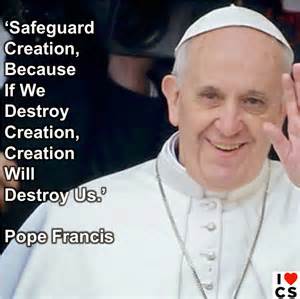
A month ago, on his flight to Manila, the pontiff told reporters, “God always forgives, we sometimes forgive, but when nature — creation — is mistreated, she never forgives!”

This Lent we would do well to ponder those words and to implement changes in our own spiritual, political and economic visions to prevent a disaster completely reminiscent of Noah’s familiar story.

What Lenten changes do you think most appropriate – for us as individuals and for our country?

Discussion follows

(Sunday Homily) Pope Francis’ Prophetic Warning on Climate Change: Repent or Else; the Time Is Short

Pope-in-Philippines

Readings for 2nd Sunday in Ordinary Time: JON 3: 1-5, 10; PS 25: 4-9; I COR 7: 29-31; MK 1: 4-20; http://usccb.org/bible/readings/012515.cfm

Last week, Pope Francis offered a preview of his eagerly anticipated encyclical on climate change – to be published next June or July. While visiting the Philippines, the country most devastated by climate chaos, it wasn’t that the pope merely joined the chorus of scientists, environmental activists, and those who heed them. He went much further, promising to transform the issue of climate change from a debate topic trivialized on Fox News into a matter of “faith and morals” (The phrase used by Catholics to define the area within which the pope has overriding authority.)

In doing so, Francis follows the traditions of prophets like Jonah and Jesus – each centralized in today’s liturgy of the word. Both prophets called for repentance (change of thought and action). However, the repentance they summoned pales in comparison to what the pope evidently has in mind.

Yes, the pope is a contemporary prophet. At this moment in history, he is arguably the most powerful ever in terms of his consciousness, courage, credibility and constituency. He literally embodies our best hope for “saving the world.” So it’s incumbent on progressives to heed, highlight and support his efforts.

With that in mind, consider today’s readings about prophetic warnings and how to respond.

The first recalls the message of the Bible’s fictional character Jonah. He’s a reluctant ethnocentric prophet forced by God to call Israel’s mortal enemy, Nineveh, to repentance. “Forty days more and Nineveh shall be destroyed” Jonah proclaimed with some delight.

Ultimately though, Jonah’s ethno-centricity is frustrated when against his desires, the Ninevites quickly and unexpectedly take his message to heart, change their ways, and God repents “of the evil he had planned.” In this way, the Divine One showed God’s character as depicted in today’s responsorial. There the psalmist says that (unlike Jonah) God is compassionate, loving, kind, good, and upright. God guides humble sinners on the path of truth – i.e. reality as it is, not as humans would like it to be.

Jesus’ proclamation was similar to Jonah’s, but without that prophet’s nationalist limitations. As depicted in today’s gospel reading, Jesus’ basic message was a call to profound change: “This is the time of fulfillment,” he said. “The Kingdom of God is at hand. Repent and believe in the gospel.” That notion of fulfillment and the nearness of God’s Kingdom introduces a profound element of hope to complement Jesus’ summons to repentance.

Like the Ninevites in the Jonah story, Peter and Andrew, James and John take Jesus’ words to heart profoundly altering their lives. They leave their former employment as fishermen abandoning their nets, their fathers’ boats and hired men. They follow instead a penniless itinerant preacher and community organizer, adopting his life of complete dependence on others for daily sustenance.

In today’s second reading, Paul shows that the early church embraced Jesus’ message. “Time is running out,” Paul warns. It’s time to prioritize the Kingdom even before family, emotional ups and downs, attachment to property — and to the world as it is. Paul is uncompromising in his perception of the profundity of change “repentance” calls for.

However the apostle’s perception is nothing like the lack of compromise called for by the historically unprecedented crisis of climate change. And this brings me back to Pope Francis and the promise of his prophetic consciousness, courage, credibility, and constituency.

Begin with Francis’ consciousness. He alone among our elected thought “leaders” recognizes contemporary historical patterns – the links between climate change, capitalism, its neo-liberal order, corporate power, income inequality, poverty, colonialism, and a host of other problems (including absence of universal education and health care). For Francis, climate change is not merely one issue among many. It is the frame which makes evident the solutions to those other issues.

More than this, the pope has the uncommon courage to identify without equivocation the cause of such problems – neo-liberal capitalism. He says what politicians like President Obama and other heads of state (with the exception of Raul Castro of Cuba) find impossible to say. Their dependence for survival on billionaires and plutocrats render them impotent before the ideologies of unfettered markets and their “trickle-down” theories. By contrast Pope Francis terms the latter homicidal (53), ineffective (54) and unjust at their roots (59). (Parenthetical numbers refer to sections of “The Joy of the Gospel.”)

Additionally while speaking the unspeakable, the pope enjoys tremendous credibility. With the exception of neo-liberalism’s intractable apologists, the world loves and embraces the man. His efforts to distance himself from the traditional luxurious papal lifestyle, his honesty in responding to difficult questions, his humility and genuine love for the poor make him our century’s most credible moral leader.

And finally, there’s the pope’s constituency. Unlike prophets before him (including Jesus of Nazareth) sheer numbers give Pope Francis unprecedented power to change the world. Jonah’s potential respondents to his calls for repentance were only inhabitants of the city of Nineveh. In today’s gospel reading Jesus’ respondents were four simple fishermen: Peter, Andrew, James and John. Eventually, only a minority of poor Palestinian peasants took to heart Jesus’ words. By contrast, and in virtue of his office, this pope’s constituency is trans-national and world-wide. There are 1.2 billion Catholics on the planet the pope calls “Mother” and “Sister.”

Evidently Francis’ plan is to use his credibility to courageously spread his consciousness and widen his constituency. He plans to do so in five steps. He will (1) publish an encyclical (the most authoritative form of communication at his disposal), (2) convoke an ecumenical meeting of world religious leaders, (3) presumably secure from them a statement paralleling his encyclical’s conclusions, (4) present that statement in his speech to the United Nations in September, and (5) attempt in doing all of that to influence the conclusions of this year’s Climate Summit in Paris two months later.

That’s prophetic activism unparalleled in the recent history of the papacy.

And what specifically is entailed in the repentance necessary to save our Mother? Of course, to share the pope’s vision, we await details in the forthcoming encyclical. However, today’s liturgy of the word points us in the general direction. In the meantime, secular prophets like Naomi Klein fill in the challenging details.

General directions include (as Paul says in today’s second reading) transcending emotions like fear-inspired denial. They include willingness to cut family ties (i.e. narrow nationalism), re-examining our career paths, attachments to property and neo-liberal dreams of unlimited consumption and getting rich.

Specific repentance is more radical than any of our politicians dare articulate. According to Klein, author of This Changes Everything, that’s because our planet has reached “decade zero.” Denialists have led us to squander the leeway we had twenty-five years ago. If we don’t decisively alter within the next ten years our path of production and consumption, the planet’s temperature is bound to rise 4 to 6 degrees Celsius. However, according to climate scientists, any rise beyond 2 degrees will make disastrous climate change irreversible. And that will result in disastrous droughts, water shortages, typhoons, flooding, wildfires, and crop losses with whole cities under water and Islands swallowed by the sea.

To avoid such disasters, required repentance includes:

  • Rejecting the neo-liberal myth that has shaped our world over the last 35 years.
  • Replacing it (the pope will say) with the biblical vision of the Kingdom (proclaimed by Jesus in today’s gospel reading). God’s Kingdom is characterized not by competition and privatization, but by cooperation, sharing, prioritizing the needs of the poor and respecting the earth as commons.
  • Setting aside neo-liberalism’s fetish about regulation, and setting bold national policies guided by clear goals, a strictly imposed time table, and severe penalties for non-compliance.
  • Implementing corresponding policies to cut annual emissions in the industrialized world by 8- 10%.
  • Recognizing that exchange of myths means rejection of market-driven models of untargeted economic growth.
  • Redesigning our cities and redistributing population to eliminate long commutes between home and work.
  • Investing massively in light rail and other means of public transportation so that commuters might travel efficiently and free of cost.
  • Similarly subsidizing renewable sources of energy – solar, wind, geothermal, and biomass.
  • Turning the roof of every available building into an energy plant.
  • Respecting the rights of indigenous people under whose lands so much carbon deposit remains.
  • Eliminating by law, controlling by strong regulation or penalizing by heavy taxation industries that are wasteful and/or destructive of the planet such as arms manufacturers, the fast-food industry, GMO firms, and middle-man industries like health insurance.
  • Dealing with climate impact and damage according to “the polluter pays” principle. This recognizes that the 500 million richest people on the planet are responsible for 50% of the world’s pollution and that the U.S. military is by some estimates the largest single consumer of petroleum in the world.
  • According to “the polluter pays” principle, withdrawing from foreign wars, cutting the military budget by at least 25% and making the rich 1% pay their fair share of taxes.
  • Tolerating as necessary increased taxes on everyone, except the poor.
  • Drastically reducing the amount of energy each of us consumes.

You get the idea. The agenda necessary to save our planet from “the evil Nature has planned” is challenging indeed. But it contains that surprising element of hope Jesus signaled when he termed “repentance” as “good news” and “fulfillment.”

After all, our destructive way of life is anything but fulfilling. On the other side of the repentance just described is a cleaner, healthier, less stressful life with full employment, more leisure, greater equality, and harmony with one another and our world.

That’s the vision behind the pope’s courageous prophetic work. It deserves our undivided attention and support.