The Conversion of Pope Francis and “Why the New Pope Must Resign”

Francis Capitalism

“Why the New Pope Must Resign.” That was the title of an article I wrote just after the election of Pope Francis in 2013. In it I joined Argentina’s Horacio Verbitsky and others questioning the role of Jorge Bergoglio (aka Pope Francis) in Argentina’s “Dirty War” (1976-’83).

Since then, friends have asked me about that. “What do you think now – in the light of the fresh spirit of reform the pope has introduced – in the light of his tremendous popularity?  Surely you were mistaken in your original, hasty judgment.”

That’s the typical question and observation.

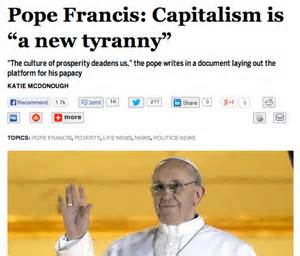
My answer has been that I’m delighted with Pope Francis and the direction his papacy has taken. Both his Apostolic Exhortation, The Joy of the Gospel, and especially his new eco-encyclical, Laudato Si’ are magnificent. Their criticisms of capitalism-as-we-know-it as the structural cause of world poverty and environmental destruction couldn’t be a clearer endorsement of a form of liberation theology that is both spiritually moving and politically engaged.

I’m glad the pope didn’t resign. Pope Francis is great.

But in response to my friends, I also add that the issue of Father Bergoglio’s involvement with the Dirty War is not resolved. Nor should it be ignored. Recalling its elements holds lessons for us – about the Roman Church’s history of supporting oppression, about whitewashed historiography, and most importantly, about the possibility of repentance and deep personal change.

Consider the first point, the Church supporting fascist oppression. It happened in Argentina during the Dirty War as it happened in Germany under Adolf Hitler.

When Bergoglio was Jesuit Provincial, he was accused of turning over to the army two of his Jesuit colleagues and former teachers, Fathers Orlando Yorio and Franz Jalics. Both had been pro-socialist clerics and members of the Third World Priests’ Movement (MSTM). Such membership was considered a capital crime by the country’s ruling junta.

Yorio and Jalics had been embroiled in a long-standing feud with their Provincial not so much about their MSTM affiliation, but about their activities in a slum community the two priests served and lived in. Bergoglio didn’t have much time for Jesuits in his province being associated with left-wing causes – nor for versions of liberation theology tainted with Marxist analysis.

Like John Paul II and his chief advisor Josef Ratzinger (later Benedict XVI), he preferred a strain of liberation theology that prioritized the poor, but apolitically without revolutionary aspirations. Bergoglio liked to call that strain the “Theology of the People.” It prioritized their reflections on the gospel, and popular devotion to images, novenas, etc. Other versions of liberation theology were too “ideological.”

After being arrested and tortured, both Yorio and Jalics accused Bergoglio of fingering them to the army.

Father Yorio died without retracting his accusation. Fr. Jalics at first didn’t want to discuss the matter, saying that he and Bergoglio had reconciled.

Beyond the case of Yorio and Jalics, there was that of Father Christian Von Wernich. He had been a police chaplain during the Dirty War. After its conclusion, during the process of national reconciliation, Von Wernich came under investigation for his direct roles in police tortures and murders.

In response, while Bergoglio was a member, the Argentine Bishops’ Conference protected Von Wernich by transferring him to Chile under an assumed name. That is, the Bishops Conference treated accusations of torture and murder in exactly the same way bishops throughout the world had often dealt with allegations of sexual abuse of children: transfer the offender and cover up the past.

So, the question becomes, was Jesuit Provincial Bergoglio, like the predominant leadership of the Argentine Catholic Church, somehow cooperative with the ruling junta?

This brings us to my second point about historiography.

In defense of the future Pope Francis (and of the church hierarchy in general), his biographer, Austen Ivereigh, offers explanations that end up sounding much like the defense of Pius XII vis-à-vis the Nazis and his failure intervene against the Holocaust. Ivereigh argues:

  1. When the military took over in 1976, Argentina (like Weimar Germany) was in a state of political and economic chaos.
  2. So virtually all segments of society welcomed the military take-over (as Germans and the German Catholic Church welcomed Adolf Hitler).
  3. The military’s brutal Dirty War was secretive about the extremity of its measures. (Fr. Bergoglio testified that it took him some time to realize what was happening.)
  4. So people like Bergoglio didn’t really know what was going on (just as Germans claim they didn’t know about the concentration camps and ovens).
  5. When he did find out (like Pius XII) Bergoglio “worked quietly” to help potential victims escape – while fulfilling his primary duty of protecting the Jesuits from suspicion, investigation and reprisals from the ruling junta.

As with Germany such reasons end up sounding like excuses that raise suspicions of cover-up and historical obscurantism. They evoke the following observations and questions:

  1. Bergoglio gives every indication of being on the same page with John Paul II and Josef Ratzinger who also largely “looked the other way” when confronted with evidence of government brutality in dealing with left-wing elements of the clergy and faithful, e.g. in Central America in general and in El Salvador and Nicaragua in particular.
  2. Bergoglio clearly shared their disdain for priests involved in politics.
  3. If (as Ivereigh suggests) Father Bergoglio was so well-connected and friendly with all factions (including government officials and military leaders on the one hand, and their opponents including MSTM members on the other) how could he not have at least suspected what was really happening?
  4. If Jalics had forgiven Bergoglio (as he originally had said) what had he forgiven?
  5. Why did Jalics apparently change his story a few days after Pope Francis’ election? On being repeatedly contacted by the media about the issue, Jalics said, “The fact is: Orlando Yorio and I were not denounced by Father Bergoglio.”
  6. Father Yorio offered no deathbed recantation of his charges against Bergoglio.

And that brings me to my final point about repentance and its significance for Catholics today.

As Ivereigh indicates, the prevailing method of dealing with such contradictions is to  reluctantly argue that Father Bergoglio perhaps did cooperate with the military – as did so many other churchmen in positions of authority during the Dirty War. However, in Bergoglio’s case, he also courageously helped many escape – at some risk to himself.

But then at some point, he underwent a kind of conversion and is now a progressive. At least at the administrative level, Bergoglio’s own testimony indicates that he experienced a profound conversion. He confesses that as a young Jesuit Provincial (he was only 36 when appointed), he was too headstrong, uncompromising and authoritarian.

Indications are, however, that the about-face went far beyond managerial style.

The exact turning point in the process remains unclear. It could have come after Bergoglio was virtually drummed out of the Jesuits by progressive elements which saw him as an impediment to the Society’s reform in the spirit of Vatican II.

Afterwards he spent two years in a kind of exile and deep introspection. Ivereigh reports that Bergoglio passed days hearing the confessions of simple shantytown poor people. He also spent hours in semi-depression, simply staring out his window. Colleagues worried that he was sick. Was it some type of breakdown?

Whatever the case, clear evidence reveals a subsequently changed man. Previously he was criticized by more liberal fellow Jesuits and others for failing to ask important questions about poverty. As they put it, “He’s great at ministering to the poor. But he never asks why they are poor.” (The criticism evoked the famous comment of Dom Helder Camara, the archbishop of Olinda and Recife in Brazil who said, “When I give food to the poor, they call me a saint. When I ask why the poor have no food, they call me a communist.”)

But as pope in Laudato Si’ Francis makes no bones about why the poor have no food, or jobs, or homes, or education. With observations worthy of the MSTM members he rejected, the pope says, all of those problems are connected by the invisible thread called deregulated capitalism. His encyclical says that poverty, environmental destruction and a whole host of other problems are caused by capitalism-as-we-know-it. (So, predictably and true to Dom Helder’s words, Rush Limbaugh and others call Pope Francis a communist.)

Evidence of radical theological change goes much further. Consider, for instance, that Francis has:

  • Surrounded himself with liberation theologian advisers concerned with history and structural analysis.
  • Rehabilitated and consulted pro-socialist theologians blacklisted by his two predecessors – most prominently among them Brazil’s Leonardo Boff.
  • Identified Marxism as similar to the teachings of the early church fathers, claimed Marxists as his friends, and referred to them as “closet Christians.”
  • Echoed Latin America’s liberation theology speaking of Christian faith as “revolutionary,” because it challenges “the tyranny of Mammon.”
  • Peppered both The Joy of the Gospel and Laudato Si’ with frequent uses of the loaded word “liberation” contrasting the deleterious effects of “liberation” of markets (from government control) with the liberation of peoples proclaimed in the Judeo-Christian tradition.
  • Has similarly made Medellin’s phrase “preferential option for the poor” the watchword of his papacy, even going so far as to identify it with “the gospel itself.”
  • Beatified the martyred Archbishop of El Salvador, Oscar Romero, who is considered the patron saint of liberation theology. (Romero did, by the way, confront the ruling military and lost his life as a result.)
  • Described the world’s dominant economic system as running “counter to the plan of Jesus.” He said the system now in place and Jesus’ hoped-for Kingdom of God have different aims.
  • Worked with the Obama administration to open doors to Cuba which for more than 50 years has struggled to construct an economic alternative to capitalism-as-we-know-it.
  • In keeping with the insights of liberation theology, the pope has turned working against capitalism-as-we-know-it into a moral issue. In Laudato Si’ he wrote: “working for just distribution of the fruits of the earth and human labor” – is a “moral obligation.” For Christians, he said, “it is a commandment.” Here the pope echoed what he said in The Joy of the Gospel where he identified the struggle for social justice and participation in political life as “a moral obligation that is “inescapable.”

All of this represents not only a personal conversion for Pope Francis, but a summons to his Church to follow in his footsteps.

What he has written in “The Joy of the Gospel” indicates that he recognizes in a Church the same crisis he underwent. It is out-of-touch and in need of a complete overhaul. “Everything must change,” he has said.

For too long, he has written, the Church has been mired in an authoritarian judgmental paradigm and in viewpoint-narrowness that has focused on important but non-essential matters foreign to the focus of Jesus’ proclamation of God’s Kingdom. So-called “pelvic issues” were of little concern to Christianity’s Great Master.

The pope implicitly calls Catholics resembling his former conservative, apolitical self to engage in the process of political, economic, and ideological change before it’s too late. Stop staring out the window at a world falling apart, he tells us. Emerge from denial and obstructionism and come to grips with climate chaos and changing the economic system that causes not only environmental destruction, but world hunger, poverty, high infant mortality, and war.

Those are statements Fathers Yorio and Jalics could fully endorse.

Off to Cuba: Won’t Be Blogging till End of May

cubaembargo

All of us are stoked. Peggy and I and 14 Berea College students are leaving for three weeks in Cuba beginning on Monday (May 5th). We’ll return on the 25th. So I probably won’t be writing here till then.

Last Wednesday night, Thursday evening, as well as Friday morning and afternoon, Dr. Cliff Durand — the co-founder of the Center for Global Justice in San Miguel de Allende, Mexico — helped us all understand what we’re getting into. Cliff has been leading delegations to Cuba for the last 25 years. He’s an honorary member of the faculty at the University of Havana.

Here are some of the salient ideas he shared:

1. One cannot understand Cuba’s revolution without understanding neo-colonialism. Neo-colonialism refers to the dynamics of control whereby “former” colonies continue to be governed by their colonial masters even after “independence.” The control remains because the now-liberated colony continues its economic relationships with its “mother country.” Of necessity, these relationships foster a dependency similar to that which characterized the original colonial relationship.

2. In other words, former colonies find it impossible to break free from domination by their colonial masters unless they also break free from the capitalist system which of necessity has local governors placing the interests of their international partners ahead of their own citizens. Put otherwise, there is an indissoluble link between revolution, independence, and capitalism’s alternative, socialism.

3. Cuba is the first country in the world to engage in a revolution as a neo-colonial state. Although after 1902 it had freed itself from the domination of Spain, it did so only to become an economic appendage of the United States. Dependency and control by the United States was the form neo-colonialism took in Cuba.

4. The Cuban Revolution of 1959, led by a trained lawyer (Fidel Castro) and a medical doctor (Che Guevara) opened the way to a new experiment in human dignity and social justice. The experiment’s adoption of socialism promised to free Cuba from the dependency international capitalism uniformly imposed on former colonies.

5. Cuba has proven resilient in the face of a 50 year economic embargo imposed by its former neo-colonial “mother country”–the United States. The economic support of the former Soviet Union made it possible for Cubans to enjoy a “middle class” way of life that made Cuba the envy of the Third World.

6. Though characterized in the U.S. as “subsidies,” the Soviet contributions to the Cuban economy were seen in Cuba as “fair trade.” Economic relationships indexed the prices of Cuban raw materials (sugar, tobacco, nickel . . .) to those of the finished products (tractors, refrigerators, spare parts . . .). In fact, this represented an implementation of the New International Economic Order (NIEO) petitioned in 1973 by the entire former colonial world in reparation for the exploitation experienced under colonialism. (Nations of the Global South also demanded transfer of capital and technology — also provided by the USSR to Cuba.)

7. Cuban Democracy: Cuba has a parliamentary system with no political parties, which are seen as divisive. The Communist party is not an electoral organization; it sponsors no candidates. Rather it is the depository of the ideals of the Cuban revolution. In the Cuban form of democracy, elections are held at the municipal, provincial and national levels. At the national level, “Mass Organizations” (five federations of (1) workers, (2) women, (3) small farmers, (4) students, and (5) Committees for the Defense of the Revolution) nominate candidates. (Mass organizations are like 5 political parties sharing commitment to cooperation rather than competition.) All the organizations enjoy equal representation in the Cuban parliament. Forty-seven percent of the delegates there are women. The National Assembly (parliament) elects a Council of State, which then elects a president and vice-president. According to frequent independent polls, well over 80% of the Cuban population supports this system.

8. The Cuban Revolution has passed through five identifiable stages:

o 1960s Revolutionary Fervor: Here the revolutionary government implemented land reform, nationalization of industries and virtually the entire Cuban economy. The U.S. economic embargo (specifically intended to produce hunger, sickness, and social chaos) necessitated alliance with the Soviet Union. During this early period moral incentives worked to unite the people in a common social project. Che and Fidel enjoyed great trust on the part of Cubans.

o 1970s Adoption of Soviet-Style Central Planning: Here Cuba followed the example of the Soviet Union, the only model of socialism available. More specifically, it adopted the agricultural methods of the Green Revolution with its heavy dependence on chemical pesticides and fertilizers. The entire agricultural system was organized into state farms. (This was later admitted to have been a major mistake).

o 1985 Rectification: In the face of excessive bureaucracy and inefficiencies, the entire Cuban population participated in a national dialog to suggest remedies. The process was interrupted by the collapse of the Soviet Union. Overnight Cuba lost 80% of its trading partners. A decade-long period mirroring the experiences of the world’s “Great Depression” (1929-’45) set in for Cuba.

o 1990s “Special Period”: Contrary to the experience following the collapse of socialism throughout Eastern Europe, and despite the extreme hardships of its Great Depression, Cuba did not experience an uprising aimed at regime change. Neither did the government eliminate social programs to deal with the crisis. Instead it strengthened its social safety net and set a goal of “equal distribution of scarcity. “ In the face of extreme impoverishment, the government introduced reforms including:

§ First moving to a dollarization of the Cuban economy and then to the establishment of a convertible currency (CUC)

§ Opening the country to foreign investment

§ Opening itself to trade on the world market

__________

§ Meanwhile ordinary Cubans coped by increasingly living off remittances from relatives the United States.

§ Stealing from government sources and selling the stolen goods on the black market.

§ Engaging in jineterismo (prostitution) – which had been eliminated by the Revolution.

__________

§ U.S. response to the Cuban crisis was its attempt to intensify its catastrophe by aggravating scarcities to induce desperation on the part of ordinary people. The Torricelli and Helms-Burton Acts sought to punish U.S. trading partners for any commerce with Cuba. These responses transformed the Trade Embargo of 1961 into a virtual blockade of Cuba.

o 2007- 2022 Renovation of Socialism: In this process of nation-wide and on-going consultation, more than 163,000 meetings involving 9 million participants (in a population of 11 million) have produced millions of proposals which have been reduced to 313 policy guidelines aimed at reduction of state payrolls, increasing opportunities for self-employment, and rooting out corruption.

o The most important reform is the establishment of urban co-operatives in 2012. With this new economic structure, the emphasis in decision making changed from a “top down” model to one of local participation. Co-operatives get their start-up money from Cuban banks, contributions of members, and remittances. The co-ops must:

o Have at least 3 members with each member having one vote

o Be self-governing independent of the state

o Respond to market dynamics

o Do business with state and private entities

In summary, Dr. Durand observed that socialism is not as good as capitalism at producing consumer goods that inflate gross national product statistics. However, socialism is far better at producing social goods shared by all (not primarily by the wealthy). These social benefits include extended life spans, low infant mortality, universal health care, free education from pre-school through the university, and happiness in general (as measured in identical polls taken in Cuba and the United States).

As you can see, Dr. Durand’s presentations were informative, stimulating and challenging. We’re all looking forward to finding out more during our coming three week trip to Cuba.

I’ll report back at the end of May.

Critical Thinking: Where I’m Coming From

[This is the fifth blog entry in a series on critical thinking which lays out ten guidelines for critical thought. My previous entries addressed the first rule of critical thought, “Think Systemically.” That rule holds that we can’t really remove our culture’s blinders unless (without prejudice) we’re clear about the meaning of the key systemic terms: capitalism, Marxism, socialism, communism, mixed economy, and fascism. Today’s blog post begins explaining my second rule for critical thought, “Expect Challenge: Questioning the ‘Ruling Group Mind’” I open the topic with an autobiographical explanation of why I approach critical thought the way I do.]

Let me tell you where I’m coming from when it comes to critical thinking.

I am a field researcher whose travels have been inspired by concerns about Peace and Justice Studies – a program which I helped found and direct at Berea College in Kentucky. My research “digs” began in Rome where many years ago I spent half a decade doing graduate work, and where I first encountered Third World colleagues who raised deep questions about my own perceptions of reality.

Subsequently, my pursuit of intellectual archeology took me all over Europe – most notably to Soviet Poland – and then to Brazil, Nicaragua, Guatemala, Honduras, Mexico, Zimbabwe, India, Palestine-Israel, and Cuba. Over the years, I’ve taught as well in a Latin American Studies Program in Costa Rica, where I’ve also worked with a think tank, the Ecumenical Research Institute (DEI), in San Jose.

In all those places I’ve found that developing world thinkers are far ahead of would-be progressives in the United States. Third World scholars know all about colonialism, neo-colonialism, the CIA and its coups, as well as its support of dictators and right-wing counter revolutions around the world.

In the Third World, university students also know about the IMF and its disastrous Structural Adjustment Policies – terms which often raise nothing more than quizzical looks from U.S. audiences. So there’s no need in most Third World settings to argue about the pros and cons of corporate globalization and its effects on the world’s majority. For them the argument was long ago settled.

None of that is true in the United States. Here higher education largely ignores the Third World, where most people live. Most college classes overlook its rich traditions, indigenous scholarship, and progressive thinking. (I even once had a well-meaning colleague respond to similar observations on my part by admitting, “I didn’t know there were any Third World scholars.”) In the United States, the so-called “developing world” is seen as a center of self-induced misery, population problems, food-shortages, and inexplicable revolutions and genocides. Alternatively, the Third World is seen as the undeserving recipient of largesse on the part of the United States understood as the Santa Claus of the world

In the light of history and political realism, I’ve concluded that clearing up such misunderstandings should be Job #1 for post-secondary educators concerned with critical thinking. Doing so entails questioning the unquestionable and broadening students’ horizons to embrace what most thinkers in the Third World recognize as simply given.

To begin with, critical thinking must question the “of course” convictions that belong to American culture – to any culture. As noted earlier, Plato referred to such unquestioned beliefs with the Greek word, doxa. Its power is conveyed by his familiar “Allegory of the Cave.” There the human condition is portrayed in terms of prisoners chained in a cavern where their only experience of reality (including themselves) is conveyed by shadows produced by their manipulative captors.

Plato’s allegory finds its counterpart in American culture, including the prevailing system of education. Typically what happens in the classroom predisposes students to accept what John McMurtry of the University of Guelph (in Canada) calls “Ruling Group Mind” which is largely set by the parameters of generally admissible political opinion. Within such confines, the United States is seen as the best country in the world. Its overriding concern is with democracy, peace, justice and human rights. Its wars are fought in the interests of peace. God is on its side. “Of course!” we all agree.

Such naiveté is revealed in the second episode of the HBO series, “Newsroom.” Its highlight had lead actor, Jeff Daniels, delivering a speech about our country that has been viewed widely on the web. As a news anchorman of the stature and credibility of Walter Cronkite, Daniels’ character is badgered into answering a question posed by a bright American college student: “What makes America the greatest country in the world?” Here’s how he answered.

Daniels’ answer captures the realism of what I consider a major goal of critical thinking.

(Next week: Unveiling the uniquely narrow U.S. spectrum of debate)

Critical Thinking: Mixed Economies Are All We Have

Mixed Economy

[This is the fourth blog entry in a series on critical thinking which lays out ten guidelines for critical thought. My previous two entries addressed the first rule of critical thought, “Think Systemically.” That rule holds that we can’t really remove our culture’s blinders unless (without prejudice) we’re clear about the meaning of the key systemic terms: capitalism, Marxism, socialism, communism, mixed economy, and fascism. So having already dealt with capitalism, the last installment tried to explain Marxism, socialism and communism in fewer than 1000 words. This week’s episode finishes Rule One by explaining mixed economy and fascism in just three points each. Next time we’ll move on to the second rule of critical thinking, “Expect Challenge.”]

MIXED ECONOMY

Following the Great Depression of the 1930s, the world as a whole has moved away from attempts to implement either pure capitalism or pure socialism. Instead, the trend virtually everywhere has been towards selecting the best elements from each system in a “mixed economy.” As the phrase implies, this involves (1) some private ownership of the means of production and some public ownership, (2) some free and open markets and some controlled markets, and (3) earnings typically limited by a progressive income tax.

Of course what we have in the United States is a highly mixed economy. The U.S. government is, after all, the largest land owner in the nation. Drug, alcohol, food, and medical care markets (and many others) are highly regulated. Following World War II, Americans earning more than $400,000 were taxed at a rate of 91%. Currently, the top income tax bracket is 34%. None of that would be possible under pure free market capitalism.

Similarly, countries claiming to be “socialist” (like Venezuela) or “communist” (like Cuba) have mixed economies. Private enterprise is a key part of both.

Does this mean that the economic systems of the United States and Cuba for example are the same? Not at all. True, both economies are “mixed.” But they differ in terms of whom they are mixed in favor of. The United States economy is mixed in favor of the wealthy and corporations. This is illustrated by consideration of the recipients of recent government bailouts – basically large corporations and Wall Street firms rather than middle or lower class people. The theory at work here is “trickle down.” That is, it is believed that if the wealthy prosper, they won’t hide their money under their mattresses. Instead they’ll invest. Investment will create jobs. Everyone will benefit. So mixing an economy in favor of the wealthy is not sinister; it’s done for the benefit of all.

Cuba, for instance, has a different approach. Its theoreticians observe that historically the wealth hasn’t trickled down – at least not to people living in the Third World (the former colonies). So, (the theory goes) the economy must be mixed directly in favor of the poor majority. The government must adopt a proactive posture and interfere directly in the market to make sure that everyone has free education (even through the university level), free health care, and retirement pensions. Food is subsidized to ensure that everyone eats. And the government is the employer of last resort to provide dignified employment for everyone, so that Cubans are not simply on the dole.

In summary, then, all we have in the world are “mixed economies.” Today, most of them are mixed in favor of the wealthy (once again, on the “trickle-down” theory). Some, like Cuba’s, prioritize the needs of the poor.

FASCISM

What about fascism then? Today the word is thrown around on all sides, and seems to mean “people I disagree with,” or “mean people,” or “those who force their will on the rest of us.” There’s talk of Islamo-fascists. President George W. Bush was accused of being a fascist. Recently President Obama has been similarly labeled.
None of those really capture the essence of fascism. Benito Mussolini, who claimed fascism as a badge of honor in the 1930s (along with Adolph Hitler in Germany, Antonio Salazar in Portugal, and Francisco Franco in Spain), called fascism “corporatism.” By that he meant an alliance between government and large business concerns or corporations.

In terms of Rule One of Critical Thinking, then, we might understand fascism as “capitalism in crisis” or “police state capitalism.” That is fascism is the form capitalism has historically taken in situations of extreme crisis, as occurred in the 1930s following the Great Stock Market Crash of 1929.

More accurately however (in the light of our previous section on mixed economies), we might call fascism police state economy mixed in favor of the wealthy. Fascists are always anti-socialist and anti-communist.

The three elements of fascism then include: (1) A police state (2) enforcing an economy mixed in favor of large corporations, (3) characterized by extreme anti-socialism and anti-communism, and by scapegoating “socialists,” “communists” and minorities (like Jews, blacks, gypsies, homosexuals . . .) for society’s problems.

HUMAN RIGHTS

Both economies mixed in favor of the rich and those mixed in favor of the poor claim to respect human rights. They also blame their opponents for not following suit. The truth is, however, that both types of economies both respect and disrespect human rights. That is, despite claims to the contrary, no system of political-economy has shown consistent respect for all human rights. Instead all systems prioritize them according to what they consider the most basic. This means that capitalism respects some human rights more than others. So does socialism.

Capitalism puts at the top of its list the rights to private property, the right to enter binding contracts and have them fulfilled, as well as the right to maximize earnings. These rights even belong to corporations which under capitalism are considered persons.

On the other hand, capitalism’s tendency is to deny the legitimacy of specifically human rights as recognized, for example, by the U.N. Declaration of Human Rights. For this reason, the United States has never ratified key protocols implementing the Declaration, or other key documents asserting rights beyond the corporate. Moreover, if capitalism’s prioritized rights are threatened, all others are subject to disregard, including the rights to free elections, speech, press, assembly, religion, and freedom from torture. Historical references in the blog entries which follow this one will support that observation.

Similarly, socialism heads its own list with the rights to food, shelter, clothing, healthcare and education. In the name of those rights, socialism relativizes rights to private ownership and the rights to enter binding contracts, and to maximize earnings. If the rights socialism considers basic are threatened, history has shown that it too, like capitalism, will disregard all others.

CONCLUSION

What’s the “take-away” from all of this? Simply this: capitalism is both a simple and complicated system; so is socialism. Both can be summarized quite simply, as can mixed economies, Marxism, communism, and fascism. Capitalism respects some human rights, while disregarding others. The same can be said of socialism and systems that call themselves “communist.”

Critical thinkers should remember those simple summaries and truths about human rights. Doing so will help cut through many of the misunderstandings and distortions that characterize discussion of today’s key issues.

The Boston Marathon Bombing: Our Wake-Up Call

Pakistan Drone Victims

Last Tuesday I shocked some of my blog readers by observing that the carnage of the Boston Marathon bombing paled in comparison with the mayhem the U.S. inflicts daily on anyone who happens to be near designated enemies in places like Afghanistan, Iraq, Pakistan, Syria, Yemen, Libya and elsewhere. My observations were dismissed by some as “incredibly insensitive” and as the “garbage” comments of an armchair philosopher unacquainted with the brutality of “those Jihadists.” One former army chaplain accused me of having a screw loose somewhere.

Be that as it may, I was in reality simply trying to highlight the double standard most of us have internalized concerning our own victimhood when tragedy strikes close to home. We wring our hands and ask “Why us?” Meanwhile we exhibit little compassion for those our country’s policies punish with the equivalents of Boston Marathon bombings virtually every day. Our media regularly ignore those tragedies and so insult our country’s victims with the mainstream media’s (and our) own brand of incredible insensitivity.

The implication of ignoring the suffering of the victims of U.S. policy is that “American” lives and children are more valuable than the lives and offspring of “those others.” We seem convinced that our “holy wars” are somehow different from their jihads. Any fool, we imply (and sometimes state) would see that we are good and they are evil. We are, after all, the exceptional, indispensable nation.

That conviction of American exceptionalism seems impervious to fact and memory. It allows U.S. perpetrators of human rights abuses such as wars of aggression, death squads, drone killings, torture, imprisonment-without-charge, voter suppression, and incarceration of whistle-blowers to pontificate about those same human rights violations when they occur in other countries.

Consider the following:

• The Obama administration is currently withholding its recognition of the results of last week’s election of Nicolas Maduro as president of Venezuela. Maduro was the personal choice of U.S. bête noir, Hugo Chavez. Standing alone in its refusal to recognize his electoral victory (except for the arch-conservative Spanish administration) and despite assurances of international election observers and the Venezuelan National Election Commission, the United States solemnly insists that Venezuelans deserve a complete recount of every single vote.

Apparently, the Obama folks have forgotten the 2000 election of George W. Bush when its country’s own government refused to perform a recount, even though the eventual loser had verifiably received more votes than the winner. That victor was finally selected not by popular vote but by the Supreme Court dominated by his cronies.

In the light of such irregularities, not to mention gerrymandering, legalized vote-buying sanctioned by “Citizens United,” voter suppression of minorities, and refusal to set up the paper trail the Venezuelan system has so firmly established, wouldn’t you think our government would recognize that it’s lost all moral ground to lecture others about or adjudicate “free and fair” elections? No – not when inconvenient truths can be successfully flushed down George Orwell’s memory hole. Despite evidence to the contrary, Americans are still convinced their election system is the world’s gold standard. Go figure.

• The week before last Beyonce and Jay-Z decided to celebrate their 5th wedding anniversary in Cuba. Their decision drew immediate response from Miami expatriates of Cuba who descried the couple’s implied support for such an egregious violator of human rights as Cuba.

Apparently, the objectors had forgotten that the U.S. has a higher percentage of its population in prison than Cuba or any other nation in the world for that matter. Additionally, the “Americans” maintain a world-wide system of secret jails for political prisoners. Practically all of the 166 incarcerated in Guantanamo Bay, Cuba are currently on hunger strike protesting their inhuman treatment there. The “American” torture and even murder of its political prisoners is better documented than any alleged mistreatment of prisoners in Cuba or anywhere else you might care to name.

And yet, U.S. patriots somehow feel free to lecture Cuba about respect for human rights. Can you say “denial;” can you say “1984” or “memory hole?” Once again, despite overwhelming evidence to the contrary, Americans are still convinced that the United States is somehow the world’s leading defender and observer of human rights.

• Last week the Obama administration’s press secretary, Jay Carney sanctimoniously justified (with a straight face) the refusal of visas to 18 Russian citizens. The banned individuals were all linked to the case of Sergei Magnitsky, a whistle-blower lawyer who had exposed widespread corruption and theft of national resources by high officials in the Russian government. Magnitsky had died in prison while awaiting trial. His death sparked congressional passage of the “Magnitsky Act” to protect whistle-blowers – in Russia.

Carney intoned,

“This administration is committed to working with the Congress to advance universally recognized human rights worldwide, and we will use the tools in the Magnitsky Act and other available legal authorities to ensure that persons responsible for the maltreatment and death of Mr. Magnitsky are barred from traveling to the United States and doing business here.”

Apparently, Carney wants us to forget the fact that untold (literally) numbers of incarcerated individuals have died in U.S. political prisons – many of them directly under torture. He wants us to forget that the Obama administration has virtually transformed whistle-blowing (i.e. the exposure of government and military crimes) from an act of virtue to a felony.

More specifically, Carney’s consigned to the memory hole the fact that the Obama administration has indicted more whistle-blowers than all previous administrations combined. In doing so he has criminalized the prophetic act of speaking truth to power. This is best illustrated in the case of Bradley Manning, the U.S. Army whistle-blower who obeyed his conscience and Army regulations by going public with the war crimes he observed. His reward? Imprisonment without charge, torture, and a possible life sentence. Here again we’re expected to believe that the United States respects “universally recognized human rights worldwide.” We really respect them universally only in places like Russia.

You see, it’s not just that official hand-wringing over the Boston Marathon Bombing highlights U.S. hypocrisy concerning the injuries and deaths of the innocent people it’s responsible for killing; it’s that such hypocrisy has become a way of life. It has blinded U.S. citizens to the fact that their country is not at all exceptional except in its disregard for universal human rights and international law.

It’s time for “Americans” to realize that their country long ago lost any moral ground they once believed it occupied. It’s time for politicians to observe humble and repentant silence about human rights, election validity, and whistle-blowers.

As it turns out, the Marathon Bombing is only a faint “retail” reflection of the wholesale mayhem the United States routinely wreaks in every corner of the planet. Cuba is a paragon of virtue compared to the U.S. Nicolas Maduro owns far more legitimacy than did George Bush who committed those war crimes Bradley Manning has been punished for exposing.

The Marathon Bombing was a wake-up call.