Fire from Heaven: “Collateral Murder,” Bradley Manning and Edward Snowden (Sunday Homily)

Readings for 13th Sunday in ordinary time: I Kg. 19:16B, 19-21; Ps. 16: 1-2, 5, 7-11; Gal. 5:1, 13-19; Lk. 9: 51-62. http://usccb.org/bible/readings/063013.cfm

The film clip you have just seen has been dubbed “Collateral Murder.” It chronicles a series of attacks by the U.S. Army in Baghdad on July 12, 2007. The attacks directed 30 mm cannon fire at a group of nine to eleven mostly unarmed men – apart from one who carried an AK-47 and another who was holding a grenade launcher. Two in the group were war correspondents for Reuters News Service. Their cameras were mistaken for weapons. After the attack took place, Iraqi civilians arrived on the scene and attempted to aid the wounded. They too were killed. Children in the van which their father stopped to help were also shot. The film was taken by a camera mounted on the gun sights of two AH-64 Apache helicopters.

In 2007, Reuters requested the footage of the airstrikes under the Freedom of Information Act. Their request was denied. Instead the military reported that the shooters in the film had come under attack and were following strict Rules of Engagement.

However in April of 2010, U.S. Army Private, Bradley Manning, released the footage (along with other revealing documents) to the internet whistle-blower website, WikiLeaks. Manning said he wanted to expose crimes whose details routinely crossed his desk as a U.S. Army Intelligence officer. His intention was to bring those specifics to the attention of the American people, and stimulate debate about U.S. military policy and tactics. He judged that policy and its implementation to be largely immoral and contrary to international law. This was true, he said, especially in the criminal war in Iraq which the U.S. entered on false pretenses against a nation that represented no threat to its well-being. Manning found especially shocking the cavalier chatter of those he saw as murderers. Manning’s action also implied that Iraqi citizens had the right to arm themselves against such aggressors brutally invading their sovereign country without provocation.

For his trouble, Private Manning was arrested in July 2010 and held in solitary confinement for more than a year in the Marine Corps Brig in Quantico, Virginia. His treatment there was described as “torture” by more than one international human rights agency. In February of 2013, Manning pleaded guilty to 10 of the 22 charges against him. He is currently being tried for alleged crimes that could bring a sentence of life imprisonment and even the death penalty.

I bring those details up this morning because inflicting death from the skies seems particularly relevant to our readings about Elijah and Jesus. There the concept of “fire from heaven” is associated with Elijah, invoked by James and John, and rejected by the non-violent Jesus. The readings raise questions about Christians’ routine support for wars – especially illegal ones – and about our attitudes towards prophetic disturbers of our peace such as Bradley Manning and (most recently) Edward Snowden. Snowden, of course, is the CIA employee who recently leaked details of mass surveillance programs directed against ordinary citizens like you and me. The programs appear to violate Fourth Amendment protections against unreasonable search and seizure.

You see, all of them – Elijah, Jesus, Manning, and Snowden have been judged by the State to be trouble-makers. In fact, Elijah was specifically called “the troubler of Israel” by King Ahab (I Kg. 18:17). In retort Elijah replied as perhaps Pvt. Manning would to President Obama. The prophet said in effect, “Now there’s a case of the pot calling the kettle black. You, dear King (or Mr. President), are the real trouble-maker. I am merely pointing that out.”

It was later on, when Ahab’s successor, his son Ahaziah, sent soldiers to arrest Elijah, that the prophet called down fire from heaven to kill the fifty arresting officers. Elijah was a fierce man.

That’s the way James and John wanted Jesus to be. It was the way they imagined God to be – fierce, vengeful, and blood-thirsty. It’s the way unquestioning supporters of “our troops” appear to picture God today. But Jesus refused to reprise Elijah’s vengeance. He rejected the prophet’s violent conception of God.

Instead, the divine as embodied in and described by Jesus is more reminiscent of the Yahweh who appears in today’s responsorial Psalm 16. There God is described as the protective refuge of the afflicted, the one who holds human destiny in his loving hands, the God who shows the way to fullness of life and lasting joy. Jesus’ God was not a war God. Instead, the divine for Jesus evoked self-sacrifice in the face of attack.

All of this means that the cost of discipleship for the followers of Jesus is high – especially when speaking truth to political power as both Elijah and Jesus made a habit of doing.

Jesus says as much in this morning’s gospel. Discipleship, he insists, requires adopting Jesus’ own posture of non-violent resistance which rejected the “fire from heaven” approach of Elijah, James and John. It entails being decisive, leaving home and family, crossing borders, and in the end not having anywhere to rest one’s head. Once we put our hands to that plow, Jesus says, there must be no turning back.

Regardless of their spiritual motivation, that in fact is the price being paid today by Bradley Manning and Edward Snowden as they oppose tyranny in the spirit of Elijah, but especially of the non-violent Jesus.

To put it in terms of Paul’s Letter to Galatia, both Manning and Snowden are living “according to the Spirit.” They are engaged in non-violent resistance to acts of deceit and murder. They are serving Truth and opposing “the father of lies.”

God is truth. Or as Gandhi put it, “Truth is God.” Living according to God’s truth means resisting “flesh,” which was Paul’s term for the way of the world that Jesus found so offensive. To repeat, that is what Pvt. Manning and Edward Snowden are doing. And they are paying the price Jesus said was inevitable in this morning’s gospel. They are homeless and hunted by the same kind of arrogant powers that were mobilized against Elijah and Jesus.

Few of us have the courage of a Manning or Snowden. At the very least, however, they deserve our support against those who would turn our world into the Surveillance State so presciently described in George Orwell’s 1984. Manning and Snowden have put their hand to the plow, and for them there is no turning back.

Recently in my travels I saw a sign in the airport reading, “If you see something, say something.” I thought, “Yeah, unless the one you’re reporting is your boss, the President or the head of the CIA, or other officials engaged in mayhem like that portrayed in ‘Collateral Murder’.” Then if you “say something” you’ll be called a terrorist, traitor and thief.

Tellers of truth like Elijah, Jesus, Bradley Manning and Ed Snowden saw what is true, reported it, and suffered the consequences which are always the lot of prophets. They opposed fire from the sky. They all live(d) according to the Spirit and rejected business as usual (“flesh”).

Thank God for all of them! My God give us the courage to support them and follow their examples!

Are 50% of Us Cowards in the Face of Terrorism? (Sunday Homily)

Fear

Readings for 12th Sunday in Ordinary Time: Zec. 12:10-11; 13:1; Ps. 63: 2=6, 8-9; Gal. 3: 26-29; Lk. 9:18-24. http://new.usccb.org/bible/readings/062313.cfm

Recently Colonel Lawrence Wilkerson called you and me cowards. He said at least 50% of us fall into that category. We’re scared out of our wits, he says.

Wilkerson is the former chief of staff to Colin Powell when Powell served as U.S. Secretary of State. (The Colonel campaigned for Barack Obama in 2007.)

Wilkerson was talking about our compliance with the “War on Terror” in general and our acceptance of most anything our government and its “spineless leaders” decide to do – always justified by ”9/11.” Everything is permitted, we’re told, because our overseers are keeping us safe. We should trust them.

That’s nonsense, Wilkerson charged.

The Colonel was referring to support for the wars in Iraq and Afghanistan, as well as drone operations, torture and detainee abuse. He was talking about widespread invasions of privacy like those exposed last week by Edward Snowden – the whistleblower who revealed that the government is eavesdropping on our phone calls and e-mails on a daily basis.

Most of us are persuaded that all of those measures are necessary to “save” us from terrorists who are supposedly lurking behind every crime, threatened plot and alleged conspiracy.

Here are Wilkerson’s actual words. Consider them in the light of today’s liturgical readings:

Did you hear that? Wilkerson is pointing out that relatively few people have lost their lives to terrorists in our “homeland.” In fact, far more have been killed in auto accidents. (And, I might add, infinitely more find themselves threatened by global warming.) We do virtually nothing about climate change. We don’t outlaw automobiles or super highways. Yet we spend billions each day to defeat an essentially invincible “enemy” responsible for a comparatively few casualties.

Terrorism cannot be defeated, Wilkerson reminds us. The best we can do is minimize its occurrence. In fact, it is preferable to have active terrorists on the loose and plotting against the United States than to violate international law by keeping the innocent in prison.

Nonetheless, efforts to defeat terrorists are not only depleting our national treasury; they are turning the U.S. into a Third World country. We’re pouring money down the rat hole of weapons and war while our infrastructure and social programs decay and vanish. In a word, counter-terror initiatives are fundamentally changing the traditions the U.S. claims to stand for. In effect, by trying to save our lives, we are losing what makes life meaningful.

Today’s liturgy of the word addresses such folly. It helps us face the question: are we cowards like half of our compatriots or courageous like Jesus and Zachariah? Are we prepared to face the extremely remote possibility of death at the hands of terrorists rather than resort to the unending violence of an eternal unwinnable war against a relatively insignificant threat?

Consider that question in the light of this morning’s gospel.

Luke tells us that Jesus has just emerged from a period of solitary prayer. That experience has evidently brought the Master face-to-face with his fundamental God-identity – an identity Paul tells us in the second reading, is shared by all of us who are, the apostle reminds us, “children of God” just like Jesus. Since we exist “in Christ,” Paul implies, we can learn something from the experience of Jesus and from the attitudes he expressed in his words and actions. We should be able to see ourselves “in Christ.”

In any case, our Lord has just encountered the God within. According to the responsorial from Psalm 63, that God is not only powerful and glorious, but our ultimate source of help, support, and joy in life’s greatest difficulties. For that God each of us should be thirsting, the Psalmist says, like parched ground for water. In fact, God’s kindness is more valuable than life itself. Or as the psalmist puts it, God’s kindness is “a greater good than life.” This seems to mean that it’s more important for believers to be kind (i.e. non-violent) than to survive.

With those insights in mind, Jesus decides to share them with his disciples. So he asks a leading question about identity: “Who do the crowds say that I am?” (Jesus really wants his friends to face who they are!) The disciples have a ready response. Everyone is talking about Jesus. “Some say you are John the Baptist returned from the dead,” they say. “Others say you are Elijah or one of the prophets come back to life.”

“But who do you say I am?” Jesus insists.

Peter speaks for the others. “You are God’s anointed,” he says – “the Messiah.”

Jesus knows what Peter has in mind. For a Jew living under the Roman jackboot, “Messiah” could mean only one thing – the leader of The War against Rome.

So Jesus says, “Don’t call me that! I am not the Christ you imagine! No, I’m a human being like the rest of you.

“Yes, I’m as much against the Roman enemy as you are.” Like the ‘Son of Man’ in the Book of Daniel, I reject all the enemies of our people in the name of Yahweh our God. I am a patriot just like you – and the prophet Daniel. But rather than use violence to conquer our enemies, I am willing to lose my life even if it means crucifixion at the hands of Rome. They cannot kill my real Self; I will rise again and again despite the way they terrorize us all. In the final analysis the God within all of us cannot be defeated.

“And there’s more. All of you must all be prepared to follow my example – even if it means rejection by the religious establishment and a cross imposed by our foreign enemies. In fact, I tell you all, anyone who tries to save his or her life will lose it.

“Don’t you realize that by killing others, you are killing your Self? You are murdering the God within. But those who follow my example of non-violent resistance will actually save their Selves. They will preserve their in-born unity with the divine core shared by all of God’s children. Don’t be afraid to follow my example of non-violent resistance. You will emerge victorious in the end.”

That, I think, is what Jesus means in this morning’s gospel with his talk about losing life and saving it, with his words about denying self and carrying one’s cross. Suffering, terrorism, and even national enslavement are not the end of the world.

Yes, even national enslavement! The prophet Zachariah makes that point in today’s first reading. Writing at the end of the 6th century BCE, he addresses an Israel defeated and enslaved in Babylon for more than 50 years. They survived, he reminds them. And somehow they’re better off than before. They’ve been purified as if by a gushing fountain.

Of course, Colonel Wilkerson’s point about terrorism is that nothing like national defeat is threatened by “terrorists.” Once again, terrorists’ threats to our homeland are remote and relatively insignificant.

Instead, it is our country’s response to terrorism – our efforts to “save ourselves” – that threatens us with defeat. According to Jesus and Zachariah, accepting life’s lessons administered by a foreign enemy might even lead to national purification.

Paradoxically, however, doomed efforts to save our lives through violence will bring about the end we so fearfully seek to avoid.

As Jesus himself put it: “. . . those who want to save their life will lose it, and those who lose their life for my sake (that is, as a result of living ‘in Christ’) will save it.”

That sort of insight and the courage to follow Jesus can only come from the kind of deep prayer which Jesus exemplified in Luke this morning. They come as well from the meaningful sharing of bread and wine at the heart of today’s liturgy.

Please pray with me that our cowardice might be overcome by Jesus’ courage, by prayer and the Eucharist we share.

Move Over, Pope FrancIs, and Bring on FrancEs I!! (Fathers’ Day Sunday Homily)

Anointing

Readings for the 11th Sunday in Ordinary Time:2 SM 12:7-10, 13; Ps. 32: 1-2, 5, 7, 11; Gal. 2: 16, 19-21; Lk. 7:36-8:3. http://www.usccb.org/bible/readings/061613.cfm

Today is Father’s Day. So, happy Father’s Day to all of us who merit the title “father.”

However, I must observe that despite the male focus which our culture gives this June 16th, today’s readings end up being quite critical of men and patriarchy. They reveal the misogyny of western culture and of the Christian tradition right from the beginning. Unwittingly, they also make a strong case for female leadership in the church even to the point of suggesting female leadership for the entire enterprise. Sorry, dads!

Start with the first reading. There Nathan condemns the great father-figure, David for his own male chauvinism and for his disregard of all the gifts the prophet says he himself gave David in God’s name.

Nathan recalls that as prophet he himself anointed David king over both Israel and Judah. Nathan rescued David from his rival, Saul. The prophet gave him the Lord’s dwelling and a harem to live with David in his palace. All these including David’s many wives, Nathan says, were gifts from God. (So much for Yahweh’s “traditional family values” allegedly favoring domestic arrangements with one father and one mother.)

And what was David’s response to all the favors conferred by Nathan? Adultery and murder. He used his power as king to steal the wife of one of his generals, Uriah the Hittite. Then in effect, he “rendered” Uriah to the Ammonites to have him killed, while preserving his own “deniability” for the crime. But neither Yahweh nor Nathan was fooled.

Of course, the woman’s in question was the famous Bathsheba who eventually gave birth to King Solomon, who ended up succeeding David as King of Israel instead of David’s eldest son, Adonijah.

In fact the section of 2nd Samuel in which this episode is found is referred to as “the succession narratives,” because it answers the question “why is it that Solomon is sitting on the throne instead of David’s eldest living son, Adonijah?”

Solomon is on the throne, the story says, because of David’s theft of Bathsheba and killing of Uriah, and the curse of Nathan which resulted: “The sword will never depart from your house.” That is, all of David’s sons, but Solomon were condemned to die violent deaths. According to this tradition, God’s sole “blessing” for the eventually penitent king is limited to the boon that he himself will not be killed. Father-rule – the patriarchy – does not come out well in this first reading.

Neither is today’s gospel selection kind to patriarchy. Jesus has been invited to the house of a Pharisee for dinner. For Jews Pharisees were defenders of the father-rule system But in this case, the “host” proves to be an inhospitable man in terms of Jewish custom. He obviously sees the carpenter from Nazareth and his uncouth fisherman friends as riff-raff. He omits giving them the traditional greeting, and doesn’t even offer them water to wash their feet. Evidently he considers the band from Nazareth unclean – dirty people who won’t even know the difference.

Then the hero of the story appears to set things right. She’s a woman whose gender relegated her to unquestionably second class status. She is Mary of Bethany (whom scholars identify with Mary Magdalene). And she does something extraordinary. She does what Nathan the prophet recalled in today’s first reading that he did for David. She anoints Jesus as the Christos – the Christ, designating (and making) him God’s chosen one.

This is extraordinary, since the term “Christos” (or Christ) itself means “anointed.” And in the gospels there is only one anointing of Jesus the Christ. And it occurs at the hands of Mary Magdalene, not of some male priest. In other words, the Magdalene in today’s gospel acts as prophet and priestess on a level arguably above Nathan’s role recalled in the reading from 2nd Samuel.

And there’s more. The Magdalene appears in public with her head uncovered and hair flowing – a condition appropriate for a woman of Jesus’ time only in the presence of her husband. And besides anointing Jesus, she performs what can only be described as an extremely intimate act. She continually kisses his feet with her lips and washes them with tears of love.

But how could a woman perform such an act? Why would Jesus allow it? After all, according to Jewish law, women were not even permitted to say ritual prayers at home, much less perform religious rites of such central import as identification and anointment of the Christ.

That is, not according to Jewish law. However, according to “pagan” law such election by a priestess was not only permitted but essential for any sacred king. There according to the rite of hieros gamos or sacred marriage, the priestess would anoint the priest-king and by virtue of her act (often consummated by ritual sex), the anointed would be flooded with power of the god. Conversely, without the power conferred by the woman, the king would remain powerless and have no knowledge of himself or of the gods. These facts would have been evident to Jesus’ contemporaries.

Why has this history and the prophetic role of Mary Magdalene in identifying (and consecrating) the Christ been hidden from us all these years? Feminist scholars tell us that patriarchal misogyny – anti-woman sentiment – is the answer.

And negativity towards women is written all over today’s excerpt from Luke’s gospel. There the evangelist emphasizes the sinfulness of the Magdalene as that of the other women in Jesus’ company.

Luke describes Mary as “a sinful woman in the city,” and “a sinner.” He has Jesus tell those seated at table that “many sins have been forgiven her,” and say to the woman, “Your sins are forgiven.” So we won’t miss the point, Luke gratuitously describes Mary Magdalene as the one “from whom seven demons had been cast out.” And finally, women in Jesus’ company are described as formerly sick and possessed.

Nevertheless, Luke feels compelled to note what everyone in his community knew: women like the Magdalene and Joanna and Susanna and the “many others” who followed Jesus were his financial supporters of Jesus and “the twelve.”

But Luke doesn’t call the apostles “free-loaders.” Neither does he parallel his description of the women as sinners by recalling that one of the 12, Peter, was identified with Satan himself by Jesus. Nor does he recall that a key apostle, Judas, actually betrayed Jesus or that all of the twelve but one (unlike the Master’s women followers) abandoned him in his hour of greatest need. Instead, Luke simply mentions “the twelve,” who by the evangelist’s omissions are implicitly contrasted with the “sinful” women.

Above all, Luke omits the description of Mary Magdalene which we find in the church-suppressed Gospel of Thomas. There she is described as “the apostle of apostles” – no doubt because of her key role in identifying and anointing Jesus as the “Christos,” and because she was the one to whom the resurrected Jesus appeared before showing himself to any of “the twelve.”

In fact the Gospel of Thomas describes says:

“. . . the companion of the Savior is Mary Magdalene. But Christ loved here more than all the disciples, and used to kiss her often on her mouth. The rest of the disciples were offended . . . They said to him, “Why do you love her more than all of us?'”

Here the word for “companion” is koinonos which refers to a consort of a sexual nature. Moreover in other suppressed writings, Magdalene emerges as Jesus’ star pupil and the center of his attention. He praises her as “one whose heart is raised to the kingdom of heaven more than all thy brethren.” He predicts that she “will tower over all my disciples and over all men who shall receive the mysteries.” Additionally, following Jesus’ ascension, it is Magdalene who comes to the fore to encourage the disheartened apostles to man-up and get on with the business of understanding and living out the teachings of Jesus.

These words and the Magdalene’s functioning as prophet and priest should be extremely meaningful for contemporary women – and us patriarchs so fond of “Father’s Day. They highlight the way at least one female disciple of extraordinary talent and charisma was not only marginalized but denigrated in the church right from the beginning. And that denigration has continued in church circles and beyond to our very day.

Put otherwise, besides shedding light on the distant past, today’s readings expose the extreme weakness of contemporary ecclesiastical “fathers” in their exclusion of women from the priesthood and from other forms of church leadership. They also uncover the perversity of their other anti-woman pronouncements regarding topics such as contraception, abortion, and women’s rights in general.

In short today’s readings help us see beyond the “official story” to discern the fact that female leadership in the Christian community is nothing new. It is the males – the ones we call “father” – who are the interlopers and charlatans.

Mover over, Francis; bring on Pope FrancEs I!

“The Walking Dead” R Us (Sunday Homily)

The-Walking-Dead

Have you been following the cable TV series “The Walking Dead?” It’s already in its fifth season, and at one point at least, it was the most-watched dramatic telecast series in basic cable history. I see the show as connected with today’s readings about widows, dead children, and how to bring the dead back to life.

In the TV series, sheriff’s deputy, Rick Grimes, awakens from a coma to find a changed world. The apocalypse has happened. Normal life has broken down completely, and the world is dominated by zombies. They are flesh-eaters or “biters.”

So Grimes becomes a “walker” (i.e. a survivor as opposed to a zombie) as he sets out to find his family. Along the way he encounters many other like himself. Those encounters and the flight from the zombies, whose bite is infectious, constitute the premise of each show’s episode.

Many reviewers have attributed the popularity of “The Walking Dead” to its reflection of life in our 21st century. They see our own world largely populated by people who if not walking dead themselves, are at least asleep on their feet.

And it’s worse than that. Today’s walking dead, they say, actually live off the flesh of others. That’s because what we call “life” depends on economic and military systems that cause the hunger-related deaths of people in far off countries as well as the destruction of Mother Earth.

That is, we’re dependent on those who supply us with cheap food, housing and clothes, while the commodities’ producers themselves are paid insufficiently to keep body and soul together. The result is that 21,000 children under five die each day from diarrhea and other absolutely preventable causes. In a sense, according to these critics, when we eat cheap food, we are actually eating those children.

And yet, most of us are totally unaware. As zombies we don’t think about the children whose lives we devour. Our vacant eyes see only the superficial – as though dollar signs had taken the place of our eye-balls. We’re taught to value only what those dollar signs see and measure. Dollar signs can’t penetrate below surface appearances. They isolate us from fellow-felling.

We are the walking dead. Think about that the next time you watch the series.

Can the Walking Dead process be reversed? Today’s liturgy of the word suggests that it can if we follow the examples of Elijah, Paul and Jesus.

Elijah, you recall, was the great prophet of Israel who lived during the 9th Century BCE. In today’s reading from the First Book of Kings, Elijah has found refuge in the home of a widow. The widow’s child, who is young enough to be sitting in her lap, dies from unexplained causes – probably associated with hunger.

The widow immediately blames the prophet. She evidently thought that giving refuge to a “man of God” would protect her from misfortune. She complains, “Why have you done this to me, O man of God.”

Apparently stung by the widow’s complaint, Elijah uses a strange ritual to restore life to her child. Three times he stretches himself on top of her little son while praying, “Let breath return to this child.” Suddenly the widow’s son starts breathing again, and Elijah restores him to his mother.

What was the meaning of his ritual? Was Elijah somehow identifying with the dead toddler? Was he doing something like mouth-to-mouth resuscitation?

Hold those questions.

We encounter another widow and her son in today’s reading from Luke. It has Jesus meeting a funeral procession. The crowd is accompanying a widow who has lost her only son. Unlike the case confronted by Elijah, this son is older – Jesus calls him “young man.”

And Luke takes time to mention that the crowd following the coffin was large. Might it have been one of those “demonstration funerals,” we’re used to seeing in Palestine, Iraq, and Afghanistan? I mean where victims of occupation armies use the occasion to express anti-imperial rage. Remember, Jesus’ Palestine was occupied by Rome. And Nain (where this miracle took place) was in the Galilee, a hotbed of anti-Roman insurgency.

I raise the question because in revolutionary settings like Jesus’, occupation forces (like the ones created by the U.S. in Iraq and Afghanistan) routinely identify young men of military age as legitimate targets for the occupiers. The foreign troops kill such men in what our government calls “signature strikes.” I mean this particular widow’s son might well have been killed by Rome. In that hypothesis, Jesus’ restoration of life to the fallen insurgent would have had great political import in terms of Jesus’ relation to the resistance.

In any case, Jesus’ act certainly had important social meaning in the context of Israel’s patriarchy. The mother after all is a widow. And in her male-dominated society, she’s left entirely without means of support. No wonder she is crying.

Jesus is touched by the woman’s tears. Luke says he was filled with compassion for the widow. “Do not weep,” he says. And he touches the coffin. Then Jesus addresses the corpse, “Young man, I tell you arise.” Immediately, Luke tells us, the young man sat up and “began to speak.”

What do you suppose were his first words? Maybe he shouted the Aramaic equivalent of “Viva la revolucion!” or “God is Great!” We’re only told what the people in the funeral procession said, “A great prophet has arisen in our midst. God has visited his people!”

Paul recalls his own visit from God in today’s second reading. And in Paul’s case, there is no doubt that his visit was associated with rejection of empire. Paul had worked for Rome, he reminds his readers. Or more accurately, he worked for the Sanhedrin, the Jewish court that cooperated hand in glove with Palestine’s occupiers.

The Sanhedrin had used Paul to hunt down Jesus’ followers. The court wanted them dead for the same reason they and Palestine’s occupiers had wanted Jesus dead – because both they and Jesus were seen as part of the Jewish resistance to Rome. So Paul was hunting down his fellow-Jews and turning them over to the Sanhedrin. In other words, Paul was a widow-maker. He was a killer of the sons belonging to the widows he made.

Then came Paul’s famous conversion on the road to Damascus. He had a vision and heard Jesus’ voice asking, “Why are you persecuting me?” Those words told him that Jesus and the widows Paul was making, as well as the widows’ sons he was killing, were identical. There was a Jesus-presence in all of them, Paul realized.

What do these readings mean for us today?

I’m suggesting that they yield principles for us as we seek escape from the zombie consciousness that prevents us from seeing our own cannibalism and widow-making as walking dead shuffling through those aisles in Kroger and Wal-Mart.

Do we wish to return to the land of the living? Elijah says, identify with those 21 thousand children our eating habits devour each day. Stretch yourselves over their dead bodies, the prophet suggests. Breathe life back into them. Identify with the children is the Elijah principle.

Do we want to walk the path of Jesus rather than the one dictated by our culture? Let compassion be your guide, Jesus suggests. Compassion for widows and orphans was Jesus’ guiding principle as it was for all the great biblical prophets.

And that includes compassion for our widowed Mother Earth. The patriarchy has abandoned her. She has been left to fend for herself and she watches her offspring die. I mean, species after species is disappearing at the hands of the same economic and military systems that kill those 21,000 toddlers each day. Our widowed Mother Earth needs our compassion too. Jesus’ example calls us to action impelled by that sentiment.

And what action might that be?

Paul’s conversion supplies an answer this morning. Stop cooperating with empire, it tells us. Eat lower on the food chain. Stop shopping in the big boxes. Resist the wars empire depends on to keep those boxes filled. Stop honoring the military and encouraging sons and daughters to “sacrifice” themselves on behalf of the corporations that require war and widow-making to retain and increase market shares.

In summary, today’s readings call us away from business as usual. They tell us that we don’t have to be zombies. They ask us all to leave behind our lives of lethargy and sleep. The readings invite us to imitate Elijah and his identification with a dead child. They ask us to be like Jesus in his compassion for a suffering single mom. Paul tells us to dis-identify with empire. The readings urge us to become “Walkers” on the Jesus path of compassion.

“You Lose; You Lose; You Lose; You Lose, and then You Win”: The Difference between Knowledge and Wisdom (Sunday Homily)

motherjones_gr

Readings for Trinity Sunday: Prv. 8: 22-31; Ps. 8: 4-9; Rom. 5: 1-5; Jn. 16: 12-15. http://www.usccb.org/bible/readings/052613.cfm

As I was preparing this week’s homily, I thought I would focus on a piece of good news for people of faith. For me, that would be a change of pace, because the pages of our newspapers are daily filled with such bad news. At last, I thought, there was something good to report – and related to this morning’s liturgy of the word and its surprisingly indigenous and tribal themes about Wisdom, the Great Spirit and their manifestations in God’s creation. Unfortunately my piece of good news did not stand up to history’s harshness to indigenous people and to the rest of us who are not rich and powerful.

I’m referring to the recent conviction of Guatemala’s ex-president, Rios Montt on charges of genocide. As a frequent visitor to Guatemala along with my students, I’ve followed closely efforts by Guatemala’s Mayan population to bring Montt to justice.

General Efrain Rios Montt was the U.S.-supported dictator who took power by a coup d’état in 1982. On May 10th (just a couple of weeks ago) he was held responsible for the deaths of more than 1700 Guatemalan Mayans in a 40 year-long war that killed more than 200,000 “Indians,” and disappeared more than 30,000 others.

It was the first time a modern head of state has been convicted of genocide in his own country. The octogenarian president, who had been trained at Washington’s Kennedy School, was a vocal born-again Christian, and supported by President Reagan and the Washington establishment was sentenced to more than 80 years in prison.

Montt’s conviction represented a huge victory for Guatemalan priests, religious, catechists who served Guatemala’s poor. Thousands of them had been butchered by the brutal Guatemalan military. It was a victory for peasants, workers, union leaders, social workers, teachers, students and others without public power. They had been working on this case for more than two decades despite threats and violence coming from the Guatemalan oligarchy and the U.S.-trained military that supports it. Above all, Montt’s conviction was a victory for Guatemalan Mayans whose various tribes compose 70% of the country’s population.

I was going to say that the Montt conviction showed that the Forces of Life and Justice coupled with hard work and dedication of ordinary people can achieve miracles even in the face of seemingly insurmountable odds. I intended to point out how the patient indigenous understanding of the unity of all creation, the long arc of history, and the Great Spirit’s powerful Wisdom finally received improbable confirmation.

But then last Tuesday, Guatemala’s Supreme Court overturned the lower court’s decision on a technicality. As a result, the 86 year old genocide is (at least for the moment) a free man.

The reversal raises the question about the direction of history, who’s really in charge, and what forces (good or evil) will ultimately triumph. An answer to that question, I think, is implied in today’s readings, which, as I said reflect a peculiarly indigenous, tribal point of view about the direction of history and its Sovereign.

That shouldn’t surprise us because the Jewish Testament is a tribal document, isn’t it? Jesus himself was a tribal person – not a product of bourgeois society like us. Once again, according to tribal beliefs the world over, the earth and its history ultimately belong to God. The planet has been given as gift to earthly creatures and to humans as a trust. If it “belongs” to anyone, it belongs to ordinary people – to the poor and not to those whose only claim to ownership resides in their bank accounts.

Today’s liturgy of the word celebrates that viewpoint in terms of the Wisdom of Jesus and his Holy Spirit. In effect, the readings tell us not to worry whether good or evil will triumph in history. From time’s beginning that issue has already been settled, because in the long run God’s Wisdom is in charge not only of human history, but of the entire cosmos. Far from asking us to worry, God’s Wisdom requires us to know one thing only – what every tribal person knows.

You see, wisdom is different from knowledge. Knowledge is the intellectual grasp of data and so-called “reality.” The knowledgeable person knows many things. And that knowledge often tells us that the world is hopeless; the cards are stacked against ordinary people – like the Mayans of Guatemala – and their thirst for justice and hope. The powerful have insured the maintenance of the status quo, for instance by retaining power to annul unfavorable court rulings.

The tribal wise people on the other hand need to know one thing only. In theological terms, they know (and act on the knowledge) that the Lord is present in every human being and in all of the earth and that in the big scheme of things, God’s Wisdom will triumph. Hinduism’s Shveshvatara Upanishad puts it this way: “Know that the Lord is enshrined in your heart always. Indeed there is nothing more to know in life. Meditate and realize the presence of God in all the universe.”

The first reading from the Book of Proverbs seconds that insight from the Upanishads. Proverbs portrays Wisdom as God’s guiding principle for the creation of the entire universe. Wisdom is embedded in the very laws of creation. The author pictures it as playing before God as the Creator pours God’s Self into the earth, its oceans, skies, and mountains – and into the human race.

Today’s responsorial psalm also agrees. It praises wise human beings. In God’s creative order, they are almost angels. They are crowned with honor and glory, the psalmist says; they rule the earth. This is because they realize (as the Mayan indigenous of Guatemala do) that they are sisters and brothers with the beasts of the field, the birds of the air, and with the creatures of the deep.

In the Beatitudes, Jesus said something similar; he saw the wise as “gentle” (meek); he promised that they would have the earth for their possession. They are princesses and princes, kings and queens in disguise whatever their earthly social status and wherever they find themselves.

Finally, the Gospel reading from John concurs with the understanding of the wise which sees them as single-minded – as knowing only that one necessary thing (God’s presence in each and every creature). John says that the wise who (like Jesus) know that one thing, ultimately receive everything from God, the origin of all things good and wise. So John has Jesus again tell his friends not to worry about anything – not even about remembering the many things he might tell them.

Instead, they should rely on God’s Spirit of Truth who will remind them of the one thing necessary. That Spirit will remind them that Jesus, the Gentle and Incomparable One embodied conscious awareness of God’s presence in everything. Consequently (like all the gentle) he has been given everything that belongs to God. “Everything that the Father has is mine,” says the crucified and apparently defeated one.

Living in accord with Jesus’ spirit of conscious unity with God brings peace even in the face of ostensible failure. That’s what Paul says in today’s second reading. Even though we might be otherwise afflicted, those very afflictions will strengthen our character, Paul writes. The love which Jesus’ Spirit pours into our hearts will produce great hope when those around us are mired in and depressed by their despair.

Can you imagine the despair of the Mayans during the genocide – and now by the reversal of the Montt decision? Can you imagine their temptations to discouragement before the overwhelming odds they face in pursuing God’s justice against the brutal killers of their relatives and friends?

The message of today’s readings: Don’t be discouraged. Instead be mindful of God’s Wisdom. It is present in your heart and in the very fabric of the cosmos. Despite appearances to the contrary, and despite the best-laid plans of the powerful, the Forces of Life and Justice will prevail in the end.

Or as the great community and labor organizer, Mother Jones said “You lose; you lose; you lose; you lose, and then you win.”

That final, improbable victory of God’s wisdom and justice is what’s promised in our readings today.

Gil Rosenberg’s Anniversary, Jesus’ Pentecost (Sunday Homily)

Gil

Readings for Pentecost Sunday:Acts 2: 1-11; Ps. 104: 1, 24, 29-30, 31, 34; I Cor. 12: 3B-7, 12-13; Jn. 20: 19-23. http://www.usccb.org/bible/readings/051913-pentecost-mass-during-day.cfm

A couple of weeks ago Peggy and I were blessed to attend an extraordinarily powerful spiritual gathering. It was at the home of June Widman, a friend of ours in Berea, Kentucky who lost her husband, Gil Rosenberg, in a tragic car accident one year earlier (See my “In Memoriam” blog entry for Gil under the “Personal” button just below this blog site’s masthead). Our friend’s daughter and son (Jessie and Greg), some co-workers and friends like us were all present at this commemoration potluck. There were about 20 of us in all.

Before eating we gathered in a circle. The “priest” among us – a former Mercy Sister who has a real gift for this sort of thing – started us off reminding us of why we were there and of how quickly (and painfully) the intervening year had passed. There were some readings – most moving for me “Death” by Pablo Neruda, read in both English and Spanish. A recorded musical selection followed.

And then people began sharing memories of Gil – an extraordinarily beloved member of our church community in Berea. (His funeral had been attended by an overflow crowd rarely seen in our Catholic church – and this for a man who was himself Jewish, though a faithful attendee at weekly Mass along with June and their children.) Gil was smart, quick-witted, and very funny. A teacher at a local community college, he was also a soccer and basketball coach for many of our children. Everyone loved him.

And that’s what we talked about. But more than that, Gil’s friends told stories of how they continued to experience his presence during the past year. People told of actual “conversations” they had with him (mostly humorous) as they faced problems or were taking themselves too seriously. They told how memories of Gil’s quirky wisdom helped them muddle through otherwise overwhelming circumstances. It was entirely inspiring.

The whole experience made me think of that first Pentecost experienced by Jesus’ followers after his resurrection. What happened then stemmed from an attempt on their part to keep Jesus’ memory alive. That’s what June and the rest of us were going for in relation to Gil as well. And like June’s gathering (and like Gil himself), Pentecost blended Jewish and Christian elements. “Pentecost,” of course, was originally a Jewish feast. It was celebrated fifty days after Passover.

Whereas Passover celebrated the Exodus from Egypt, Pentecost (seven weeks later) commemorated the giving of God’s Law at Mt. Sinai. Also called “the Feast of Weeks,” Pentecost was a harvest festival like our Thanksgiving. And like the Passover, the feast drew Jews from all over the world to Jerusalem and its Temple. The evangelist, Luke, takes time to make this point. He lists Parthians, Medes, and Elamites, inhabitants of Mesopotamia, Judea and Cappadocia, Pontus and Asia, Phrygia and Pamphylia, Egypt and the districts of Libya near Cyrene. He refers to travelers from Rome, both Jews and converts to Judaism, Cretans and Arabs.

Because of the events recorded in today’s readings, Christians have come to consider Pentecost the “birthday of the Church.”

I used to think of Pentecost as taking place among Jesus’ disciples (the 11 apostles and about 110 others, they say, including many women) who had stayed in Jerusalem following Jesus’ death and resurrection simply awaiting the coming of the Holy Spirit. However, now that seems unlikely.

Jesus’ followers and inner circle were poor working people. They needed to earn their daily bread. Even John 21:3ff indicates that following the tragic (and later hopeful) events in Jerusalem, several of them returned to Galilee to resume their labor as fishermen.

Then as the feast of Pentecost approached, they must have decided to return to Jerusalem along with all those other pilgrims I mentioned. No doubt they wanted to re-experience “on location” their final hours with Jesus, even returning to the “Upper Room” to do what June and the rest of us did a couple of weeks ago in commemorating Gil on the anniversary of his death. Surely they wanted to break bread together as Jesus had told them to do – but there in the Upper Room. That would make it truly special.

So they returned to Jerusalem at some risk to their own safety. Luke tells us that they kept the doors locked because they were afraid of the same powers that had arrested, tortured and executed Jesus. After all, Jesus’ disciples had been responsible for circulating the rumor that their Teacher was not really dead. They told their friends that he somehow survived the Roman’s attempts to eliminate him. He was alive.

Evidently, word of that “resurrection” had gotten back to officials of the Sanhedrin – the Jewish court whose members were collaborators with the Romans, working with them hand in glove. The Jewish sell-outs well remembered how the carpenter from Nazareth had “stirred up the people” (Lk. 23:5) with his message about God’s revolutionary “Kingdom.” They especially recalled how just before his execution, he had entered Jerusalem to popular acclaim and led that notorious demonstration in the Temple.

As a result of all that, the people took Jesus for their messiah, which meant he was the enemy of Rome and collaborators like the Sanhedrin members. If word got out that “He lives!” the trouble could well start all over again during the Pentecost feast. So the Sanhedrin mobilized its brutal police to hunt down the members of Jesus’ Galilean terrorist gang and solve the Jesus problem once and for all.

Despite such threat, Jesus’ followers gathered in the Upper Room (or perhaps, some scholars say, it was even in the Temple). There in that place so full of memories, they must have recalled the Master’s words and deeds, and how he continued to influence them even in his apparent absence. I’ll bet their stories were just as dear and humorous as June’s friends’ recollections of Gil.

Then suddenly (in John’s version of the Pentecost event) Jesus is standing there in their midst. He tells them not to worry about the police. “Peace be with you,” he says twice. Jesus shows his friends his pierced hands and wounded rib cage. Don’t be worried, he implies, they can kill you and torture you, but like me, you will not really die.

Then Jesus breathes on them all, and they receive his own Spirit – of forgiveness and discrimination in the sense of discernment. His spirit, Jesus promises, will instruct them about forgiveness — and about what they should never overlook. He tells them to continue his work despite any threats from Rome and its collaborators.

Luke’s version of the same event is recorded in the familiar story from Acts which we heard in today’s first reading. Luke calls on imagery from Exodus – wind and fire – to describe the transforming event of Pentecost. Instead of Jesus appearing personally to bestow his Spirit, Luke says the Spirit came in the form of a mighty wind. It was like the wind that dried up the Sea of Reeds in the Exodus. The Spirit came in the form of “tongues of fire” like the pillar of fire that led the Israelites during the dark nights that followed the initial euphoria of liberation from Egypt.

In both cases (John and Luke), the result of receiving Jesus’ Spirit is the same. The disciples are literally encouraged. Their fear entirely disappears. Doors are unlocked. Jesus’ friends are suddenly are out in the street. And everyone can understand the import of their words: Jesus lives! Everyone can understand because Jesus’ message (as always) is about the Kingdom of God. No matter where people come from, famished stomachs speak the same language of hunger. Calloused hands speak the same eloquent “sign language.” Mothers weep the same tears for their sons tortured and victimized by empire.

According to Jesus’ Spirit, it’s the Romans and their collaborators, not Jesus’ followers, who have reason to fear. Their days are numbered. God’s kingdom is at hand. Once again, Jesus lives! The old order is about to be overturned. The first will be last; the last, first. The rich will be poor; the poor, rich. Those laughing now will find themselves in tears; those in mourning will at last find joy.

In their sheer numbers of converts (3000 says Luke that very first day) the crowds from all over the Jewish world protect Jesus’ friends from the Sanhedrin police. We can picture the lawmen on the edges of the crowd rendered powerless by the crowd’s solidarity.

And what’s to be learned from that first Pentecost experience? Could it be that we must keep Jesus’ memory alive – as the prophetic preacher of God’s Kingdom in the here and now, not in the sky somewhere after death? (Shouldn’t that be the purpose of our weekly gatherings for worship and the Lord’s Supper?) Is the lesson of today’s feast that believers must insist on speaking in language that anyone can understand – the language of the working classes, the hungry, and of mothers in mourning? Is it that a measure of the truth of our beliefs is the degree of threat we feel from empire and its collaborators as a result of the beliefs we fearlessly profess? Is it that followers of Jesus should refuse to accept division but unite instead with a solidarity that protects us from the same forces of empire and its collaborators that threatened Jesus’ first followers?

The truth is that there’s much to learn from Pentecost. June’s and her children’s devotion to Gil Rosenberg along with his friends’ recollections and experiences of Gil’s “real presence” remind us of the nature and purpose of that first Pentecost gathering. It was not only to recall what Jesus said and did in terms of resistance to Rome and its oppression on a macro-level. For us it can also be about creating Kingdom in our personal lives and with our families as Gil himself did. Besides bringing gifts of forgiveness, the Holy Spirit was the basis of Gil’s humor, non-conformity, attention to the needs of the exploited, and refusal to take himself (or others) too seriously.

If we open ourselves wide, we too can receive all of those gifts. The Spirit can make us fierce advocates of God’s Kingdom. It can help us overcome our very selves, along with our fears of the Empire, its police and religious collaborators.

Ascension Sunday: What’s Christianity for Anyway? (Sunday Homily)

People attend the funeral mass for Cardinal Aloysius Ambrozic at St. Michael's Catholic Cathedral

Readings for Ascension Sunday: Acts 1: 1-11; Ps. 47: 2-3, 6-9; Eph. 1: 17-23; Lk. 24: 48-53 http://www.usccb.org/bible/readings/050913-ascension.cfm

This is Ascension Sunday. For us Catholics, it used to be “Ascension Thursday.” It was a “holy day of obligation.” That phrase meant that Catholics were obliged to attend Mass on Thursday just as they were on Sunday. To miss Mass on such a day was to commit a “mortal sin.” And that meant that if you died before “going to confession,” you would be condemned to hell for all eternity.

So until the years following the Second Vatican Council (1962-1965) Catholics would fill their churches on Ascension Thursday in the same numbers (and under the same threat) that made them come to Mass on Sundays. That’s hard to imagine today.

I suppose that difficulty is responsible for the transfer of the commemoration of Jesus’ “ascension into heaven” from Thursday to Sunday. I mean it wasn’t that the church changed its teaching about “holy days of obligation.” It didn’t. Catholics simply voted with their feet. They stopped believing that God would send them to hell for missing Mass on Ascension Thursday or the feast of the Blessed Virgin’s Assumption (August 15th), or All Saints Day (November 1st) or on any of the other “holy days.” Church once a week was about as much as the hierarchy could expect.

But even there, Catholics stopped believing that God would punish them for missing Mass on Sunday. So these days they more easily attend to other matters on Sunday too. They set up an early tee time or go for a hike in the woods. Afterwards they cut the lawn or go shopping at Wal-Mart. That kind of “servile work on Sundays” or shopping used to be forbidden “under pain of sin” as well. And once again, it isn’t church teaching that has changed. Catholics have just decided that the teachings don’t make sense anymore, and have stopped observing them.

And apparently they do so in good conscience. So you won’t find them running to confession after missing Mass or working and shopping on Sunday. In fact, that’s another way Catholics have voted with their feet. For all practical purposes, they’ve stopped believing in Confession – and largely in many of the mortal sins they were told would send them to hell – like practicing contraception or even getting a divorce.

I remember Saturday evenings when I was a kid (and later on when I was a priest). People would line up from 4:00-6:00, and then from 7:00 -9:00 to “go to Confession.” And the traffic would be steady; the lines were long. No more! In fact, I personally can’t remember the last time I went to confession. And no priests today sit in the confessional box on Saturday afternoons and evenings waiting for penitents to present themselves.

What I’m saying is that the last fifty years have witnessed a tremendous change in faith – at least among Catholics. Our old faith has gone the way of St. Christopher and St. Philomena and “limbo” all of which have been officially decertified since Vatican II.

In fact, since then the whole purpose of being a Catholic (Christianity) has become questioned at the grassroots level. More and more of our children abandon a faith that often seems fantastic, childish and out-of-touch. Was Jesus really about going to heaven and avoiding hell? Or is faith about trying to follow the “Way” of Jesus in this life with a view to making the world more habitable for and hospitable to actually living human beings?

That question is centralized in today’s liturgy of the word. There the attentive reader can discern a conflict brewing. On the one side there’s textual evidence of belief within the early church that following Jesus entails focus on justice in this world – on the kingdom. And on the other side there are the seeds of those ideas that it’s all about the promise of “heaven” with the threat of hell at least implicit. The problem is that the narrative in today’s liturgy of the word mixes each view with its alternative.

According to the story about following Jesus as a matter of this-worldly justice, the risen Master spent the 40 days following his resurrection instructing his disciples specifically about “the Kingdom.” For Jews that meant discourse about what the world would be like if God were king instead of Caesar. Jesus’ teaching must have been strong. I mean why else in Jesus’ final minutes with his friends, and after 40 days of instruction about the kingdom would they pose the question, “Is it now that you’ll restore the kingdom to Israel?” That’s a political and revolutionary question about driving the Romans out of the country.

Moreover Jesus doesn’t disabuse his friends of their notion as though they didn’t get his point. Instead he replies in effect, “Don’t ask about precise times; just go back to Jerusalem and wait for my Spirit to come.” That Spirit will “clothe you in justice,” he tells them. Then he takes his leave.

Presently two men clothed in white (the color of martyrdom) tell the disciples to stop looking up to heaven as if Jesus were there. He’s not to be found “up there,” they seem to say. Jesus will soon be found “down here.” There’s going to be a Second Coming. Jesus will complete the project his crucifixion cut short – restoring Israel’s kingdom. So the disciples who are Jews who think they’ve found the Messiah in Jesus return in joy to Jerusalem and (as good Jews) spend most of their time in the Temple praising God, and waiting to be “clothed in Jesus’ Spirit” of liberation from Roman rule.

The other story (which historically has swallowed up the first) emphasizes God “up there,” and our going to him after death. It’s woven into the fabric of today’s readings too. Here Jesus doesn’t finally discourse about God’s kingdom, but about “the forgiveness of sin.” After doing so, he’s lifted up into the sky. There Paul tells his readers in Ephesus, he’s enthroned at the Father’s right hand surrounded by angelic “Thrones” and “Dominions.” This Jesus has founded a “church,” – a new religion; and he is the head of the church, which is his body.

This is the story that emerged when Paul tried to make Jesus relevant to gentiles – to non-Jews who were part of the Roman Empire, and who couldn’t relate to a messiah bent on replacing Rome with a world order characterized by God’s justice for a captive people. So it gradually turned Jesus into a “salvation messiah” familiar to Romans. This messiah offered happiness beyond the grave rather than liberation from empire. It centralized a Jesus whose morality reflected the ethic of empire: “obey or be punished.” That’s the ethic we Catholics grew up with, that sent some of us to weekly “confession,” and that former and would-be believers find increasingly incredible, and increasingly irrelevant to our 21st century world.

Would all of that incredibility and irrelevance change if the world’s 2.1 billion Christians (about 1/3 of the world’s total population) adopted the this-worldly Jesus as its own instead of the Jesus “up there?” That is, would it change if Christians stopped looking up to heaven and focused instead on the historical Jesus so concerned with God’s New World Order of justice for the poor and rejection of empire?

Imagine if believers uncompromisingly opposed empire and its excesses – if what set them apart was their refusal to fight in empires wars or serve its interests. How different – and more peaceful – our world would be!

A sensitive discerning reading of today’s liturgy of the word, a sensitive and critical understanding of Jesus’ “ascension” presents us with that challenge. How should we respond?

(Discussion follows.)

Pope Francis, Summon a Council: It’s Our Tradition!

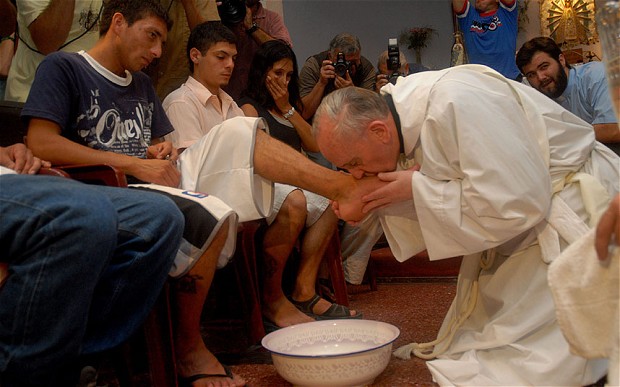
Francis I

Readings for 6th Sunday after Easter: Acts 15:1-2, 22-29; Ps. 57: 2-3, 5, 6, 8; Rev. 21: 10-14; 22-23; Jn. 14: 23-29. http://www.usccb.org/bible/readings/050513.cfm

Last year was the 50th anniversary of the convocation of the Second Vatican Council. The Catholic Church is still reeling from that earth-shaking event. Conservatives often consider it a huge mistake. They want to return to the Latin Mass, to women’s head-coverings in church, to weekly confessions and communion placed by the priest on the communicant’s outstretched tongue.

Liberals too are disappointed by Vatican II. It didn’t nearly go far enough, they say. It should have eliminated priestly celibacy and the all-male clergy. The church should have divested itself of the Vatican Bank, sold its art treasures and given the proceeds to the poor. The Council’s teaching on collegiality should have decentralized church bureaucracy and made lay-leadership more prominent. The prohibition of contraception should have been changed.

Into which of those camps do you fall? As a church member, do you consider yourself conservative or liberal? Today’s liturgy of the word provokes the question. It reveals a church which at its very beginning surrendered itself to extreme liberalism – or should I say to the “radicalism” of Jesus’ Spirit?

Think about those terms for a minute in the light of today’s readings. Think about what “conservative” and “liberal” mean for us as individuals and community members in our faith tradition. Think of the Holy Spirit as “radical” – something believers are rooted in.

According to every great tradition (Christian or otherwise), the spiritual life – human life itself – is about change, about transformation. Change is the point. We are called to grow. Growth involves transformation. At the biological level, we’re told that all of our cells change every seven years. That means that at my stage in life, I’ve already gone through more than ten bodies! If I tried to keep my body from changing, I would die.

At the personal, psychic and intellectual levels we’re called to change as well. As St. Paul puts it, when we were children, it was appropriate to think, speak and act as children (I Cor. 13:11). But as adults, we’re called to something more. If we don’t change, we can never become who we’re meant to be.

Even institutions must change to survive. That’s true in the realm of politics, economics, and religion. Jesus’ followers found no exemption from this rule of life – of evolution; as community members they had to change or die. In other words, at the end of the day, strategies of conservatism are doomed for Christians as well as for everyone else.

It’s easy to sympathize with conservatives however. I spent much of my life in that category. As such, my concern was simply to preserve what is essential. I saw liberals as being too free with the unchangeable. Like other conservatives I accused them of throwing out the baby with the bath water.

Nonetheless, in today’s liturgy of the word, we get an idea of how difficult it is to determine which is which –baby or bath water. That is, in our readings, we are faced an example of a key conflict between religious conservatives and liberals within the first century infant church. Paul, Barnabas, Silas and Barsabas lead the liberal wing. Peter and Jesus’ brother, James are the leaders of the conservatives.

Paul and his friends come from the gentile world. Their concern is to make Jesus both understandable and acceptable to non-Jews. For their audience, circumcision and dietary restrictions (like not eating pork) represent great obstacles to accepting Jesus’ “Way.”

On the other hand, Peter and Jesus’ brother, James, are Jews through and through. They remember the importance of full observance of the law within the Jewish tradition. They recalled for instance that during the second century Seleucid persecution of the Jews under Antiochus IV Epiphanes, many Jews gave their lives rather than eat forbidden foods. Faced with Paul and his colleagues, the conservative faction wondered: were those lives sacrificed in vain? And besides, circumcision was the identifying mark of Jewish manhood. What good follower of the biblical God set that all-important commandment aside?

The issue is so serious that it provoked a meeting of church leaders – what scholars call the “Council of Jerusalem.” Like Vatican II (1962-’65) it called together church leadership to discuss burning issues of the day and to make changes that responded effectively to what Gaudium et Spes called the “signs of the times.”

Today’s gospel reading implies that leaders could come together with confidence because of Jesus’ promise that his Holy Spirit would continue teaching the church even after he is gone. The Spirit would remind the church of what Jesus himself taught – and more besides.

According to today’s readings, it was the “more besides” that the Jerusalem conservatives were resisting. They didn’t deny, of course, that Jesus himself was a religious liberal. (It was Jesus’ liberalism that angered the Scribes and high priests.) Jesus frequently placed love and compassion above God’s most important commandment, the Sabbath law; he associated with the “unclean;” he even befriended and worked miracles for gentiles. Jesus was never bound by the letter of the law as were his conservative opponents.

At the same time however, Jesus was Jewish to the end. He had no intention of founding a new religion. He was a Jewish reformer. No one could deny that. Jesus didn’t revoke the Law. He simply gave it an enlightened, more humane, more liberal interpretation. He himself had been circumcised!

It was with these understandings that the Council of Jerusalem convened. And according to Luke, the author of Acts, it was a battle royal. Luke says the meeting (like Vatican II) was filled with “dissension and debate.”

What we find in today’s first reading is the final decree of the Council of Jerusalem. Concerning circumcision, it says “never mind.” As for dietary restrictions, fagedaboutit. The Council was concerned with not placing unbearable burdens on converts. In other words, it couldn’t have been more liberal. It could not have been less conservative.

The Council of Jerusalem is reputed to have happened no more than 30 years after the death of Jesus. But by the time John of Patmos writes his book of Revelation at the end of the first century, look where his church had come. His vision of the “New Jerusalem” which we read about in today’s second reading doesn’t even have a temple. Jerusalem without a temple?! The city is founded not on the 12 patriarchs of Israel, but on the 12 apostles. How liberal is that!?

I suppose what I’m saying is that Christians shouldn’t be afraid of change. It’s our tradition – right from the beginning. In fact, in today’s gospel, John has Jesus say specifically that we should not be agitated or fearful. Rather, our hearts should be filled with peace because of our reliance on the Holy Spirit. John’s Jesus teaches that the Spirit’s presence guarantees the community is moving in the right direction, even when the Spirit’s teachings shock and scandalize – as long as it’s moving towards Jesus’ compassion, love, and ease of burden. The guarantee remains even when the Spirit’s guidance seems to dilute what many consider essential – like circumcision, dietary laws and the Jerusalem Temple.

What “essentials” is the church being called to set aside today? Priestly celibacy? An all-male priesthood? Prohibition of contraception? Are any of these really essential?

The question is as unnerving for the church as it is for us as individuals. But the answer is always the same: “Don’t be afraid or agitated; the Holy Spirit guides.”

Think about it: at the personal level, after ten changes of body and innumerable psychic growth spurts and changes of mind, what remains that allows me to identify with that child they tell me I was in my baby pictures? The bath water has been thrown out virtually every day. But somehow I’m able to say “I” remain. Who is that “I?”

Once again, today’s gospel leads us to believe that the answer is the indwelling Holy Spirit herself who continually leads us into the new and unforeseen – but without that “fear or agitation.” That unifying, enlightened Spirit is the same in me as She is in you.

The bottom line: today’s readings teach that there is no future in timid conservatism. Instead we are called to extreme liberalism. And that liberalism actually translates to Jesus-like radicalism (or going to the root of things). The Holy Spirit is that root.

And so we can pray with confidence: “Holy Spirit, in the present crisis of your church, inspire Francis I to call us together once again. Convene a Council. Surprise us. Shock us one more time. Wake us up! Move us towards compassion, love and ease of burden as you did the Jerusalem Council. We believe that under your guidance, we can never go wrong!

Drones, the Marathon Bombing And Today’s Liturgy of the Word (Sunday Homily)

I got into trouble with a lot of people over the last week or ten days. It all goes back to the Boston Marathon bombing on April 15th. The very next morning I found myself writing a blog entry that drew fire from friends who go back with me nearly sixty years, and even from my family members. I had written that the Marathon Bombing paled in comparison with the havoc and destruction the United States’ drone policy creates in the world virtually every day.

For instance, last week in the Senate hearing on that policy, a young Yemeni activist, Farea Al-Muslimi, gave testimony about the destruction in his village brought about by a drone attack that had occurred a few weeks earlier. [Do yourself a favor and see the video of his testimony (above); it went viral last week.] Women and children were killed by the drone apparently intended to eliminate a single person who might easily have been apprehended by local police. Instead, the missile launching killed indiscriminately. In the resulting carnage, the young man said, you couldn’t distinguish the bodies of women and children from their animals which had also been killed in the raid. The human victims had to be buried with their animals as though there were no difference between them.

According to the young activist, drones hovering over villages like his own, ready to release their deadly cargo are a form of terrorism. They have for Yemenis become the new face of the United States, and have caused great anger and hatred towards our country. Drones are what Yemenis now think of when they hear “America.” They represent a highly effective recruiting tool for what Americans understand as “terrorists.”

This means that in the activist’s own village, the drones accomplished in an instant what the propaganda of Islamic jihadists had been unable to do after years of effort.

It was this sort of testimony that I had in mind when I wrote the morning after the Marathon bombing. I was also inspired by the kind of faith-consciousness communicated by the readings in this morning’s liturgy of the word. Those readings call us to embrace an awareness of the unity of the entire human race. All are our sisters and brothers, the readings emphasize; Yeminis are as important to God as we are. Put otherwise, all four readings call us beyond the nationalism that makes us so sensitive to violence directed towards our own people, while ignoring or down-playing much greater terror our country directs towards those we consider “foreign” or “other.”

In fact, today’s liturgy of the word might well be considered a hymn of praise to the God of Love who cherishes everyone and everything equally. The first reading from the Acts of the Apostles highlights the expansion of the understanding of God’s Chosen People. Paul and Barnabas extend the concept from the Jews to non-Jews – i.e. to gentiles. God’s people are found not merely in Israel, but in strange sounding places like Lystra, Pisidia, Pamphylia, Perga, Attalia, and Antioch.

The author of the Book of Revelation concurs with Paul’s interpretation. In his utopian vision of the “end of time,” John of Patmos hears a loud voice proclaiming, “God’s dwelling is with the human race.” Did you hear that? God’s People are found not just in Israel (or in “America”), but are co-extensive with the entire human race. People of all nations constitute God’s Chosen, John says. In other words, God considers everyone God’s beloved simply in virtue of their being human.

However, John “loud voice” also suggests that God is especially partial to the poor and oppressed. God wishes that tearful people stop crying. God’s kingdom is an entirely new dispensation without premature death, mourning, wailing, or pain. The suggestion here is an understanding of God’s chosen people as those within the human race who suffer the most. (As a nation, Americans, it seems, are not in that category.)

Does this mean that in our assessment of world events, the suffering should be given greater attention than the well-off?

Moreover, God’s love extends beyond humans to all of physical creation. The responsorial psalm describes God as generous, merciful, slow to anger, exceedingly kind, and good to all. That “all” includes everything God has made. In the psalmist’s words, God is “compassionate to all his works.”

Finally, today’s brief gospel reading suggests that the vocation of Christians is to mirror God’s universal love specifically as reflected in Yeshua ben Joseph – who accepted his own death at the hands of the violent rather than defend himself or take the lives of others .

Yeshua’s followers, John the evangelist suggests, must be willing to love in the same way Jesus loved. We must be ready to give our lives for “the least of our brothers and sisters” – to die ourselves before taking the lives of poor Yemenis, Pakistanis, Afghanis, Iraqis, Somalis . . . . (That’s what the words of the gospel seem to propose!)

But there’s a warning with all this talk of God’s universal love. Nationalism is strong. Criticizing it evokes energetic resistance. This is the thrust of Paul’s words in today’s first reading when he says that “It is necessary to undergo many hardships to enter the Kingdom of God.” Evidently some within the emerging Christian community wanted to stick with the old narrow notion of “God’s People” limiting it to a single nation. They thought of the community of Yeshua as a reformed wing of Judaism. As the reading from Acts tells us, they resisted Paul’s more expansive reinterpretation, sometimes violently.

Something similar can happen today when the suffering of “those others” are equated or even prioritized over the suffering of our compatriots.

Nonetheless, today’s readings remind us that in God’s eyes there are no “others.” If they are human, if they are part of God’s creation, they are God’s children every bit as important as “Americans.” Their suffering (especially when it originates from our hands) should be prioritized over our own.

That’s where I was coming from last week.

Saving Jesus from Paul and John (Sunday Homily)

rebel_jesus2

Readings for the 4th Sunday after Easter: Acts 13:14; Ps. 100: 1-2, 3-5; Rev. 7:9, 14B-17; Jn. 10: 27-30. http://www.usccb.org/bible/readings/042113.cfm

As I’ve been reporting here, a group of about 25 people met weekly during Lent for an intensely rewarding study of “The Historical Jesus.” The group included members of our local Catholic church in Berea, Kentucky along with an equal number from our Ecumenical Table in nearby Richmond. In the aftermath of that experience, I find it impossible to read selections like those in today’s liturgy of the word without making connections with our little seminar.

For instance, today’s readings remind me that would-be followers of Jesus might more accurately call ourselves “Paulists” rather than “Christians.” That observation is sparked by the tension between Paul and “the Jews” in this morning’s selection from Acts. The tension reminds us that our belief system has been shaped more by Paul of Tarsus than by Jesus of Nazareth who was himself a Jew. The same holds true for the gospel selection from John the Evangelist with its emphasis on Jesus’ divinity (“I and the Father are one”). As a result of the influence of Paul and John, our faith tends to be other-worldly and de-politicized. Our Jesus tends to be one-dimensionally divine rather than the enlightened very human rabbi who graced the Palestinian landscape 2000 years ago. Let me explain.

To begin with it’s important to point out that we know more about Paul than we do about the historical Jesus. And we know more about the historical Jesus than did the rabbi from Tarsus. The reasons why are simple. On the one hand, most of the Christian Testament is written by or heavily influenced by Paul. The New Testament, then, is more Pauline than Christian.

On the other, Paul never met the historical Jesus and shows almost no knowledge of Jesus’ words and deeds in his epistles. Meanwhile, scholarship based on manuscript discoveries at Nag Hammadi in Upper Egypt in 1945 and at the Dead Sea in 1947 (the famous Dead Sea Scrolls) has yielded unprecedented knowledge of the historical Jesus. That means we know more about the rabbi from Nazareth than did Paul.

Think about the Pauline nature of the faith we’ve inherited. There are 27 books in the “New Testament.” Thirteen of those 27 are letters written by Paul. Then there’s the “Acts of the Apostles” which really is a travelogue about the mission and adventures of Paul written by Paul’s companion, Luke the evangelist. Luke also wrote his own Gospel, which, of course, was heavily influenced by his mentor. Finally, as the earliest entries in the New Testament, Paul’s epistles (written from about 50 to 64 CE) evidently exercised great influence on the other evangelists Mark, Matthew and John who wrote much later.

That means that nearly half of the New Testament (13 of 27 entries) is comprised of letters attributed to Paul. Fifty-five percent (15 of 27 entries) was written by Paul or Luke. And more than 66% (18 of 27 entries) was arguably more influenced by Paul than by Jesus.

I say “more influenced by Paul than by Jesus” because what we have in Paul’s letters, the Acts of the Apostles and in the gospels themselves are proclamations about Jesus rather than the proclamation of Jesus. Remember, Jesus’ proclamation was about the Kingdom of God, “Repent, the Kingdom of God is at hand.” In contrast, the New Testament’s proclamations about Jesus are “Jesus is Lord.”

The differences between these two “gospels” are enormous and they are, as I indicated, illustrated in today’s readings on this fourth Sunday after Easter. Today’s selection from John’s Gospel (written about 70 years after the crucifixion of the Enlightened Yeshua) has Jesus discoursing about himself. He speaks of himself as a “shepherd” leading his sheep and about offering them “eternal life.” He concludes by claiming to be God’s Son equal to the Father. “I and the Father are one,” he says. (The historical Jesus could never have made such statements without being stoned by his fiercely monotheistic Jewish audience.)

However, Jesus’ discourse as reported in John’s gospel is completely coherent with the gospel of Paul. Paul, I repeat, never met the historical Jesus. In fact, as we all know, before his famous conversion on the road to Damascus, he was a persecutor of Christians. He pursued them on behalf of the Sanhedrin, the Jewish high court, which worked hand-in-glove with the Romans.

The Romans were hunting down Christians for the same reason they arrested and executed Jesus – because he was perceived as the Jewish Messiah whose overriding responsibility was the overthrow the Roman occupation of Palestine. With good reason, the Romans considered Jesus’ followers to be subversives.

In other words, the Romans, their Sanhedrin collaborators, and their point-man, Saulous (Paul’s name before his conversion) were cooperating in a counter-revolutionary program that targeted Jesus’ nationalistic followers.
Those followers had actually lived with Jesus. They were Jews primarily – members of a Jerusalem community gathered around Jesus’ brother, James, the apostles, and Jesus’ “inner circle” of followers including many women and numbering perhaps 120 people or more. Together they constituted a group of reformed Jews. Many of them had been eye-witnesses of Jesus’ deeds and followers of his teachings.

Those teachings centralized a new understanding of “the Law” which Yeshuaists called “the Way.” It emphasized love and forgiveness over fear, punishment and a purity code that divided people into “clean” and “unclean.” It emphasized justice for the poor and oppressed and freedom from foreign domination. The Jerusalem community of The Way recognized Jesus as the True Prophet predicted in their scriptures – a wonder-working Messiah and liberator who would usher in an era reminiscent of the Exodus from Egypt under the great rebel Moses. This Jewish messiah was human (the Son of Man) not a divine Son of God.

Paul, as I said, had never met the Son of Man. His writings show neither knowledge of Jesus’ deeds nor of specific teachings which were so important to the Jewish Yeshuaist community. Instead, Paul preached a kind of mythological Jesus who was entirely recognizable to the gentile audiences which interested him. Paul’s Jesus was born, crucified, risen and ascended to heaven. Evidently, Paul considered nothing between Jesus’ birth and death worth reporting.

For Paul’s gentile audience, any wonder-working “messiah” had to be a divine incarnation like the gods Romans and Egyptians worshipped — Mithra, Isis, Osiris, the Great Mother God. These “dying and rising gods” descended from heaven, lived for a while on earth, died, and then rose from the dead. Typically, they offered “eternal life” beyond the grave to believers who ate sacred meals together sharing the gods’ body and blood in the form of bread and wine. These are the terms Paul used to explain Jesus to his gentile audiences.

As reformed Jews, the Jerusalem community along with most unreformed (non-Yeshuaist) Jews had trouble with such explanations which offended their strictly monotheistic beliefs. How could Jesus be uniquely “one with the Father?” That sounded like two Gods and was entirely offensive and unacceptable.

Moreover, Paul’s version of the gospel seemed to remove the Kingdom of God to an other-worldly heaven. It left the Romans in charge of Palestine ruled by a god (the Roman emperor) who was a rival of Yahweh, who, for good Jews, alone was God and who alone was the legitimate ruler of the Palestinian homeland. Such a gospel along with Paul’s background of cooperation with the Romans made all Jews (Yeshuaist and orthodox) deeply suspect of Paul. They remained adamant in their hope of the “Second Coming” of Jesus who would finally defeat the Romans and introduce God’s Reign to replace Caesar’s.

We pick up the tension between Paul’s message aimed at gentiles and the anti-imperial faith of Jews (including Yeshuaists) in today’s readings. In the selection from Acts, Paul proclaims his version of Jesus. And “the Jews” respond as expected. To them Paul’s (and John’s) understanding of Jesus as God’s only Son, his understanding of salvation as “eternal life” rather than messianic liberation from foreign domination was completely blasphemous. So Paul and Barnabas end up “shaking the dust” of Antioch’s streets from their feet against “the Jews.”

Eventually, Paul’s gospel (with the deeply engrained seeds of anti-Semitism) ends up triumphing completely. This is because the base of the Jerusalem Yeshuaist community (the inner circle referenced earlier) was completely destroyed during the Jewish war with Rome (64-73). In the absence of strong Yeshuaist leadership, the way was thus opened for the triumph of a divine Jesus proclaiming himself (rather than God’s Kingdom) and offering an other-worldly “eternal life” rather than a new revolutionary social order characterized by love, forgiveness, justice, and room for everyone.

That other-worldly “Christianity” was finally canonized by Constantine in the fourth century (325 at Nicaea). Afterwards, in his zeal for uniformity of belief, the emperor and his church accomplices ordered the destruction of documents reflecting anything other than the Pauline and Johannine understandings of Jesus. The rest is history. The historical Jesus was lost. We’ve been worshipping a Roman Mithra instead of a prophetic Enlightened Jewish Jesus ever since.

Luckily disobedient monks ignored Constantine’s order to destroy manuscripts reflecting understandings of Jesus other than Paul’s. That happened at the Dead Sea and at Nag Hammadi.

Thank God for their crime! At this late date it has directed our focus away from the Gospel about Jesus to the Gospel of Jesus. It calls us to work not for an after-life heaven, but for God’s Kingdom in the here and now.