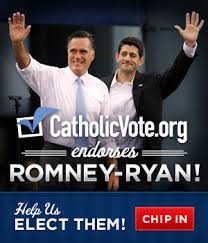
The November Elections, Pope Francis, and the Catholic Vote

romneyryan

On September 6th, the Washington Post published a report called “White Catholics Struggle to Get on Board the Trump Train.” The article’s assumption was that obviously Caucasian Catholics are expected to vote Republican. However, the report noted, some are having second thoughts in the light of the Trump candidacy – presumably because of his waffling on the issue of abortion.

Unexplainably, the Post article completely ignored the overall progressive thrust of Pope Francis’ teaching and the un-Republican influence it might be having on Catholic voters. Instead, it bolstered its “of course” assumption about Catholics voting Republican by puzzling over the fact that four years ago Catholics who attended Mass at least once a month favored Mitt Romney by 38 points. This year, Donald Trump’s lead among such Catholics has shrunk to 17 points..

True, the WaPo article did suggest that Pope Francis might have something to do with the trends it described. After all, Francis had explicitly intimated that Mr. Trump was unchristian for intending to build a wall along the U.S.-Mexican border. Followers of Jesus, Francis said, build bridges, not walls. In response Trump dismissed the pope as “very political.”

However, the Post completely ignored the issues of climate change, a world economy based on arms manufacture, capital punishment, and world-wide income disparities – Pope Francis’ signature issues that he himself highlighted in his speech last year to the U.S. Congress.

The Post carried on as if that speech and the pope’s landmark encyclical on climate change had never occurred. It was as though the Church were still mired in the reactionary era of John Paul II and Benedict XVI, when Catholics seemed obsessed with one issue alone: abortion without connecting it (as Francis has done) to problems of poverty, war, environmental destruction, and an overwhelmingly punitive “justice” system.

So how should Catholics vote who are tuned into Pope Francis’ more comprehensive moral concerns? According to the pope’s eco-encyclical, his Apostolic Exhortation, The Joy of the Gospel, and his address to the U.S. Congress, Catholics should vote:

  • Against climate change deniers and for those who share the pope’s climate concerns.
  • Against champions of dirty fossil fuels and in favor of those supporting alternative, renewable energy sources.
  • Against those who would exclude refugees from finding shelter in the United States and in favor of those advocating sanctuary.
  • Against those who favor arms sales abroad and in favor of proponents of divestment from the arms industry.
  • Against champions of capital punishment and in favor of those calling for its abolition.
  • Against those proposing tax cuts for the wealthy and in favor of increased redistributive taxes on their incomes.
  • Against those whose answers to global terrorism are war, bombing, and drone assassinations, and in favor of those who offer legal and diplomatic solutions to the problem of national security.
  • Against those who are selective in their “pro-life” advocacy, and for those who connect respect for life not just with abortion, but with providing care for unwanted children brought to term, with clean energy, environmental protection, universal health care, investment in public education, and opposition to capital punishment and war.

In the run-up to the elections, these are the issues Catholics should quiz Ms. Clinton and Mr. Trump about – as well as candidates for other public offices.
Our Dinner with Amy Goodman

Amy Goodman

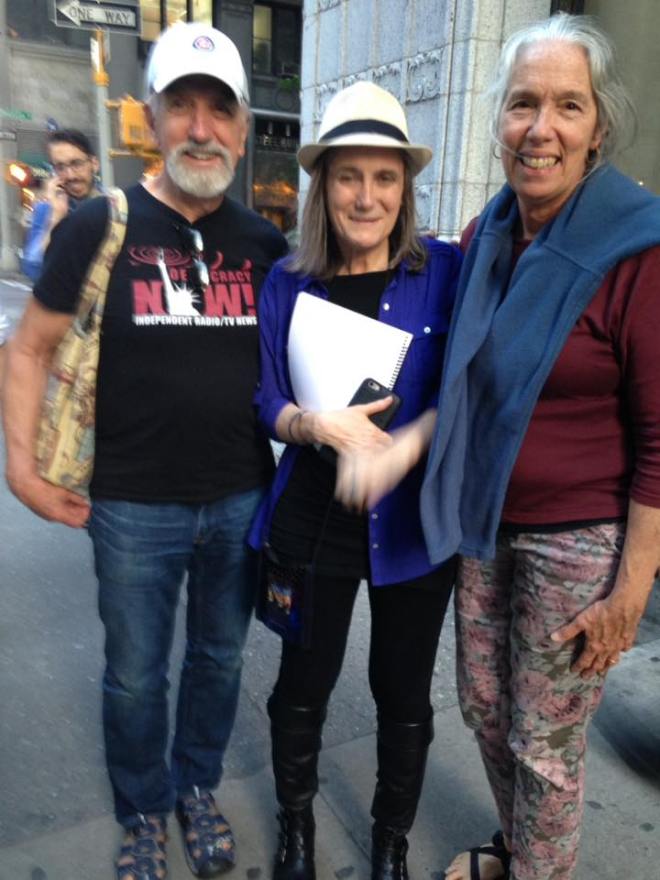
A week ago today, Peggy and I had dinner with Amy Goodman, the host of “Democracy Now: the War and Peace Report” (DN).  The program airs each Monday through Friday on radio and TV stations across the country. I watch it every morning in its podcast version that can be accessed at any hour at http://www.democracynow.org/

The dinner was a Christmas present from my daughter, Maggie who (with her husband, Kerry) had given DN a substantial contribution.

[The gift came with a black Democracy Now tee shirt (which I wore to our dinner) and two coffee cups showing the program’s logo. The meal portion of the gift was for me and a companion of my choice. Naturally, it was Peggy. Still another of the gift’s components was attendance at one of the show’s morning productions (which we’ll take advantage of sometime in the future).]

There were four of us in Thursday’s dinner party. Amy brought along her factotum, Edith Penty, whose presence was absolutely delightful. We ate at the Hangawi Korean restaurant on 32nd street between Fifth and Madison Avenue. There we shared “The Emperor’s Tasting Menu” that featured starters, appetizers, entrees and dessert –   acorn noodle salad with avocado fritters, dumplings in pine nut and pineapple sauce, tofu with sesame leaves and seaweed sauce, and dessert.

As the meal unfolded we all shared our biographies.

Amy is a New Yorker raised in Bay Shore. She is the daughter of an ophthalmologist father and a mother who taught literature and Women’s Studies. Her family is Jewish Orthodox. Her maternal grandfather was an Orthodox Rabbi.  She studied Hebrew and Torah from kindergarten through high school. Amy graduated from Radcliffe College in 1984, with a degree in anthropology.

From her stories about participation in demonstrations, vigils, and campaigns, it’s clear that Amy Goodman has always been an activist. For some years she worked in an organic bakery that eventually supplied buns for Arby’s restaurants. Journalism has always been in her family’s blood. (Her brother published a family newspaper before reaching his teenage years.) She founded Democracy Now in 1996; this is its 20th anniversary year. Throughout Amy’s account of her life, there wasn’t a trace of self-promotion. On the contrary, both Peggy and I were impressed with her interest in our stories, and with her unassuming presence.

In all the four of us spent about two hours together. And of course conversation went far beyond autobiographies. Inevitably we discussed Trump, Bernie and Hillary.

The most interesting insight came when Amy shared the fact that the Obamas and Clintons can’t stand one another. Obama made Hillary his Secretary of State following the principle: Stay close to your friends, and even closer to your enemies. One of the first questions asked in any Obama or Clinton vetting process is: “What do you think about Hillary?” “What do you think about Barrack?” Hiring decisions are made accordingly.

Towards the end of our time together, Amy left the table for a moment. Soon afterwards waiters came to our table with ice cream and small cakes and a candle. Amy had informed them that Peggy and I are celebrating our 40th wedding anniversary. That’s the kind of thoughtful person Amy Goodman is.

As we left Hangwai, a young African American man caught sight of my Democracy Now tee shirt. He said to me: “Love your tee shirt. I watch that program every day. Love that too!” I pointed ahead of us to Amy who was deep in conversation with Peggy. I said, “That’s Amy Goodman right there.” He couldn’t believe it. Soon we were all taking pictures with the celebrity. It was a moment that topped the evening off just perfectly.

If Democracy Now isn’t part of your daily news-gathering routine, it should be.  Unlike other newscasts, it centralizes stories from the grassroots. So it often interviews victims of police violence, representatives of NGOs (non-governmental organizations), political dissidents, and community organizers. Noam Chomsky, Glen Greenwald, Naomi Klein, Bill McKibben, Medea Benjamin, Cornel West, Lori Wallach, Richard Wolff, Tariq Ali, and many other thought-leaders and journalists are among the program’s frequent guests.

“Democracy Now” covers the Black Lives Matter Movement along with the Boycott, Divest, and Sanction campaign against the Israeli apartheid system – whose proponents are almost never interviewed in the mainstream media.

If you watch Democracy Now, you know details of the recent coup in Brazil, its predecessor in Honduras, and current attempts at still another in Venezuela. You know about Michael Brown, Eric Garner and Tamir Rice. But you also are familiar with police killings of Sandra Bland, Tanisha Anderson, and Miriam Cary.

None of the stories is reduced to sound bites. Interviewees like Noam Chomsky are sometimes given an entire hour (without commercial interruption) to analyze a whole host of world and national issues. An hour-long broadcast was devoted recently to Daniel Berrigan, the Jesuit peace activist who died last month.

Peggy and I are so grateful to Maggie and Kerry for making possible such a memorable evening — and of course, to Amy Goodman for spending so much time with us and for being the huge inspiration she is

Pope Francis, “Evangelii Gaudium,” and the Catholic Vote

catholicvote

For the last 30 years the religious right (both Protestant and Catholic) has been telling us that Christian values should influence the way we vote. What will they say now that Pope Francis has called 1.2 billion Roman Catholics to move beyond obsessions with sex – abortion, contraception, and same-sex marriage?

How will they respond to his demands in his recent Pastoral Exhortation (Evangelii Gaudium) to centralize instead issues of poverty and the huge income gaps between the haves and have-nots? How will they answer the pope’s call to recognize the futility of directing billions towards a doomed “War on Terrorism” rather than correcting the structural injustices that cause such violence in the first place? What about his suggestion that those billions would be better invested in meeting human rights to food, health and education? (Yes, they are human rights according to the pope!)

All of that puts the Republicans and their fellow-travelers on the spot. After all, they have been the voting booth beneficiaries of obsession with sexual issues. They are the champion privatization, deregulated markets, and huge tax breaks for the rich. They oppose universal health care, investing money in public education, increasing the minimum wage, supporting labor unions, Food Stamp programs, and even Social Security financed by workers’ own savings. Republicans are the “tough on terrorism” bunch who (unlike the pope) attribute such violence to “hatred of our freedom,” rather than to blowback for the injustices of global capitalism.

According to the pope, such right-wing attitudes represent the very causes not only of world hunger and poverty, but of violence and terrorism. Only by interfering in the out-workings of the free market – by regulation (such as Glass-Steagal or the Tobin Tax), redirecting defense spending towards social programs (such as Medicare, Medicaid, Food Stamps), by increasing the minimum wage, and taxing the rich, – can such problems be solved.

In other words, it’s not possible this time to say “Oh, yes, we all know that good Catholics are expected to give generously to their favorite charities.” That’s not sufficient, Pope Francis asserts. No, the pope has faulted not lack of charitable giving, but the free enterprise system itself for causing the problems of global poverty and hunger as well as those of terrorism and war.

For years at election time, both the political and religious right has inundated us with directions about voting based on what the pope has identified as sexual obsessions.

It will be most interesting to observe any change in tone or direction in the upcoming general election.

Will we now be directed towards voting Democratic – for Hillary? Or will our Christian “leaders” be even more heedful of Pope Francis’ direction and urge voting instead for consumer protectionist Elizabeth Warren, for Socialist Bernie Sanders – or the Green Party candidate?

In red state Kentucky, we anxiously await direction from Mr. McConnell and Lexington’s Bishop Gainer.