This is Chapter 17 of my novel The Pope, His Chamberlain, the Jinetera, and Fidel: a novel about Cuba, Prostitution and the Catholic Church. For previous chapters, just scroll down.
This is Chapter 17 of my novel The Pope, His Chamberlain, the Jinetera, and Fidel: a novel about Cuba, Prostitution and the Catholic Church. For previous chapters, just scroll down.

This is Chapter 16 in my novel, The Pope, His Chamberlain, the Jinetera, and Fidel: a novel about Cuba, prostitution, and the Catholic Church.
For previous chapters, just scroll down.

This is Chapter Seven of my novel, The Pope, His Chamberlain, the Jinetera, and Fidel: a novel about Cuba, prostitution and the Catholic Church
(Scroll down for previous chapters.)
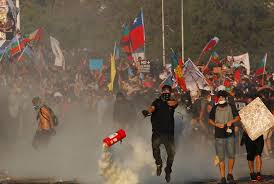
This is one of the chapters with firm grounding in reality. The pope’s nightmare is based on the report of what happened during his 1987 trip to Chile. In their biography (His Holiness: John Paul and the hidden history of our time) Carl Bernstein and Marco Politi described the papal Mass in the national soccer stadium as follows:
Pinochet staged a massive intervention using armored cars, jeeps, policemen with nightsticks and shields, water cannons, and tear gas to combat 700 demonstrators shouting slogans against the dictatorship and throwing stones at police stationed o the edge of the park. The demonstrators, who belonged to the extreme left-wing party Mir and to organizations of young dissidents allied with the Chilean Communist Party, were a tiny fraction of the 700,000 worshipers present at the mass. But the general wanted to make a point. Police charged demonstrators who were burning tires to shield themselves and crashed through the crowd of the faithful. Beneath the altar where the pope was celebrating mass, soldiers in jeeps cut circular swaths. Journalists, pilgrims, and priests who tried to block them were run over and injured. The tear gas fumes even reached the altar, where John Paul II, his eyes red and his throat burning, skipped whole sections of his homily on reconciliation, while his personal physician gave him water and salt to fight off the poisonous air.
“Love is stronger than hate!” shouoted John Paul II, while around him thousands of fear-stricken spectators cried out, “Save the pope!” Six hundred people were injured. All the political parties, including the socialists and Communists, denounced the actions of the security forces, calling their response a provocation. Cardinal Fresno and the president of the Chilean bishops conference, however, issued a communique identifying the police as the chief victims and blaming the demonstrators. It said the demonstrators had tried to prevent those in attendance from expressing their beliefs and had offended the pope. “We protest against this incredible assault, which meant blows and wounds to carabineros, papal guards, journalists, priests, and the faithful.” Not a word was said about police brutality, which had been witnessed by the entire international press corps.
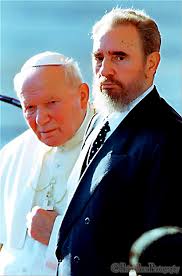
Today, I begin a recording of a novel I wrote more than 20 years ago. At my current age of 81, I just want to get the book out in the public in some form while I still can. The novel is called The Pope, His Chamberlain, The Jinetera & Fidel.
It’s a fictional story about Pope John Paul II’s actual 1997 trip to Cuba. I repeat: it’s a fictional story. So, don’t go accusing the sainted pope of the moral failing I place at the story’s center.
On the other hand, the tale was inspired by my own actual first journey to Cuba in the summer of 1996. It reflects what I learned there during a two-week stay under the auspices of the Greater Cincinnati Council of World Affairs – again, the first of many sojourns for me in the adopted home of Che Guevara and Assata Shakur. I’ve visited Cuba more than a dozen times since.
I originally wrote the book as a virtual vehicle for taking my friends and students to Cuba — to expose them to what I experienced during the 1990s “special period” there — and to clear up common misperceptions about life on the island. It was during the ’90s that U.S. sanctions coupled with the fall of the Soviet Union (and Cuba’s loss in the process of 85% of its trading partners) made life nearly unbearable for the Cuban people.
Today, something similar is transpiring for Cubans. The COVID-19 pandemic along with intensified U.S. sanctions have once again brought the tiny nation to its knees. (Hence the protests we’ve all heard so much about.) So, Cuba today is very similar to the Cuba of the last century’s final decade which is the novel’s setting.
The book’s relevance also stems from its indirect exposition of liberation theology, which I consider the most important theological development of the last 1500 years. Pope John Paul II was its foremost opponent. I’d like readers to come away with a better understanding of that theology and social movements it inspired.
Here’s my bottom line: though largely fictional, the descriptions I’ve portrayed here are true in that many of them reflect my own experience. In the introductions to relevant chapters, I’ll emphasize those non-fictional details.
In any case, I hope that you’ll enjoy to some degree what I’ll read here – a chapter more or less each day for the next month or so.
So, get ready. Here it is: the opening of The Pope, His Chamberlain, the Jinetera, and Fidel.
(By the way, as a work still in progress, the book begs for suggestions about improving or changing it. So feel free to offer advice.)
![Ordination[1]](https://mikerivageseul.com/wp-content/uploads/2015/04/ordination1.jpg)
I’m so appalled at the prospect of a Donald Trump presidency and the threats it poses to everyone and everything I care about: the environment and climate chaos, avoidance of nuclear war, victims of torture and false imprisonment, Muslims, drone attacks, wealth disparities, women’s reproductive rights, people of color, the LGBT community, our public school system, the right to privacy, human rights in general, labor unions – my children and my grandchildren.
In fact, as I’ve written recently, a Trump presidency portends the dawning of a Fourth Reich, where the victims of incineration will be not only Jews, but all of us, as the White House teems with climate change deniers whose policies threaten all species and the continuity of human life itself.
So the question is, what can we do about it? What talent does each of us have to respond to Trumpism? As parents and grandparents, teachers, writers, counsellors, school board officials, musicians, public speakers, church members, and public citizens, what does each of us have to offer these unprecedentedly dangerous times.
My own answer is my priesthood.
Only gradually and reluctantly have I come to that conclusion. After all, 40 years ago I exited the Catholic priesthood, got married and raised a family of three outstanding children. I remained active in my local church. And as a professor at Berea College and associate of Costa Rica’s Ecumenical Research Institute (DEI), I continued my role as a theologian with a doctoral degree from Rome’s Academia Alfonsiana. For years I taught in a Latin American Studies Program that took students to Nicaragua, Guatemala, and Cuba. In those capacities, I wrote books and articles and offered courses connected with liberation theology. However, I resigned myself to my role as lay person – a member of the church’s “loyal opposition.”
And the opposition was absolutely called for. Over the years I’ve found myself dismayed as two consecutive regressive popes (John Paul II and Benedict XV) waged a vicious campaign against liberation theology and systematically removed from the hierarchy and Catholic seminaries progressives and theologians like me. The result over the two generations has been the production of a largely reactionary Catholic clergy who long for the good old days before the Second Vatican Council (1962-’65).
So as a lay person, I’ve often found myself sitting passively in my pew while rebelling internally against the reintroduction into the Catholic liturgy Latinisms and even Latin itself. I’ve listened uncomfortably to well-intentioned priests offer ill-prepared pious platitudes in their homilies rather than reflections connected with the historical Jesus and his relationship to the problems that householders like me face in our private and public lives. And, to speak truly, I was blaming them unfairly. After all, how could they possibly offer what their retrenched seminary training prevented them from receiving?
Still, it struck me as ironic that hundreds of people in my parish come together for about 2 hours each Sunday to reflect on their most dearly held (Gospel) values, but come away having barely tapped into the unlimited power for changing their personal lives and the world itself that those values supply. What a waste, I thought – not only for the parishioners directly involved, but for the world.
Then came a breath of fresh air reminiscent of Pope John XXIII’s famous “opening of windows” more than 50 years ago. Argentina’s Jorge Bergoglio became Pope Francis – a man intent on recovering the spirit of Vatican II. Deeply influenced by the liberation theology his predecessors had warred against, he published “The Joy of the Gospel” (J.G.) and then his eco-encyclical, Laudato Si’ (L.S.). Both publications were bolstered by unprecedentedly honest and refreshing public statements. (Who can forget his question about homosexuality: “Who am I to judge?”) Francis not only called the church to profound reform; he called the world itself to a “bold cultural revolution.”
As for church reform, Francis called for a “new chapter” in the history of the Catholic Church and for the Church to embark on a “new path” (J.G. 1, 25) on which things cannot be left as they presently are (25). He called for new ways of relating to God, for new narratives and new paradigms (74). He wanted new customs, ways of doing things, new times, schedules, and language (27) — with emphasis on better prepared and delivered homilies (135-159).
Despite (lamentably) continuing to exclude women from the priesthood, the pope ordered the church to expand their roles in church life. He recognized women as generally more sensitive, intuitive, and otherwise skilled than men (103, 104).
Clearly, then, the pope was speaking (as he said) not primarily to pastors and bishops, but to everyone (33). Decisions about change, he said, should be guided by the principle of decentralization (16, 32). They should be made at the parish level, because parishes are more flexible than Rome or the local chancery, and more sensitive to the specific needs of local people (28). The inventiveness of local communities should not be restrained, he said, but limited only by the openness and creativity of the pastor and local community (28). Such decisions should be respected by local bishops (31).
As for connecting the gospel with world issues, Pope Francis identified the struggle for social justice as “a moral obligation” that is “inescapable” (220, 258). He saw “each and every human right” (including education, health care, and “above all” employment and a just wage) as intimately connected with “defense of unborn life” (192, 213). He also completely rejected war as incapable of combatting violence caused by “exclusion and inequality in society and between peoples” (59). Pope Francis rejected unfettered markets and the “trickle down” ideologies as homicidal (53), ineffective (54), and unjust at their roots (59).
In Laudato Si’ the pope issued an urgent call to the Church and the world to address issues connected with human-caused climate chaos. In this the entire encyclical (see my book, Understanding Laudato Si’: a Discussion Guide) might be seen as a complete rejection of Trumpism and of the entire Republican Party’s denial of that problem.
So, once again: what to do about it?
Experience shows that the anti-Vatican II clergy resistant to Pope Francis remains incapable of responding either to the latter’s Apostolic Exhortation (J.G.) or to his eco-encyclical (L.S.). Much less has it demonstrated a willingness to address the issues of political-economy, racism, sexism, homophobia, xenophobia, war, torture, etc. raised by the emergence of Trumpism. (Once again, it is wrong to blame the clergy for this. Their training has made effective response impossible.)
So I’ve decided to do something about it myself. I’ve decided to reactivate my priesthood.
Honestly, I have to admit that the process of doing so began about 5 years ago following my retirement after 40 years of teaching at Berea College. It was then that I set goals for myself. One of them was an ill-formed, vague resolve to “reclaim my priesthood.”
As a preliminary step, I started a blog. Its center piece was the publication of a “Sunday Homily” each week. The reflections tried to connect world events, personal, and family problems with each Sunday’s liturgical readings.
Eventually, my homilies were picked up by OpEdNews – a completely secular progressive news source run by a Jewish editor. Over the years, I’ve published more than 200 such homilies covering Catholic lectionary readings for all three liturgical cycles. The result has been the creation of a kind of cyber community of readers that averages 1600 views of each reflection every week.
Now, in view of the crisis of Trumpism, I’ve decided that my contribution to resistance will be to translate that cyber community into a real-time assembly of faith. It will actually attempt do something to implement Pope Francis’ summons to church reform, and address in particular issues connected with climate chaos.
What I’m proposing is not a Protestant or even an ecumenical gathering. Rather my call is to an alternative Catholic “parish” in my town. Of course, this is not unusual; most towns of any size have more than one Catholic parish. Though specifically Catholic, all people will be welcome – Catholics, Protestants, atheists . . . In particular, “drop-outs” from our local community of faith are encouraged to join.
I imagine the gathering will be very simple – nothing of a show or performance. Rather, people will gather in my home (to begin with). We’ll sing or chant for a while, read the week’s liturgical selections, and share reflections. Afterwards we’ll gather at the dining room table for a brief Eucharistic breaking of bread followed immediately by a pot-luck meal. The week’s meeting will conclude with a planning session outlining activities for the coming week to resist the inroads of Trumpism.
All of this reminds me of the activities of Dietrich Bonhoeffer’s “Confessing Church” in the 1930s when Lutherans and others decided they had to do something to resist Hitler’s fascism. What I’m proposing here is an analogue, where people of faith call on their tradition to confront fascism’s re-emergence.
I’m convinced that only resistance fortified by deep faith can effectively combat that reincarnation. And even if only two or three join me in this proposal, I’m determined to go through with it. After all Jesus did say: “Wherever two or three are gathered in my name, I am there in their midst” (MT 18:20).
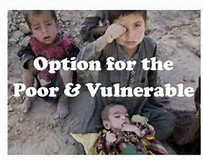
This is the last installment in a three-part series on Pope Francis’ new encyclical, Laudato Si’. It attempts to place in historical perspective what might well be the most important document yet produced in the 21st century. It also tries to explain the meaning and centrality of the encyclical’s guiding principle, its “preferential option for the poor.” This third part addresses the meaning and centrality of that option.
In his critique of capitalism-as-we-know-it (reviewed in Part Two of this series), Pope Francis called explicitly for “structural change” in the world economy. He said, “Let us not be afraid to say it: we want change, real change, structural change.”
But what “structural change” does the pope have in mind?
Evangelii Gaudium and Laudato Si’ offer the answer. Their “preferential option for the poor” provides the guiding principle and turns the present economic order exactly on its head. This implies that if the present order is possible, so is its opposite.
That is to say that the present neo-liberal order is structured according to a “preferential option for the rich.” Its sponsoring question is how can we make sure that the banks, corporations, and 1% prosper? Economists explain such concern by various “trickle-down theories.” If priority is accorded the welfare of the rich, the theorists say, the wealth produced will trickle down creating a “rising tide that lifts all boats.” [The pope rejects such theories out-of-hand as historically disproven. In “Evangelii Gaudium” he even calls them homicidal (53), ineffective (54) and unjust at their roots (59).]
By way of contrast, the pope’s “preferential option for the poor” begins at the bottom of the economic pyramid. Its sponsoring question is how can we insure that farmers have land, that workers have jobs, and that everyone is decently housed?
Laudato Si’ goes even further. It expands moral concern beyond human beings to all forms of life. It asks how we can insure the survival of the planet in the face of global warming, water and air pollution, massive extinctions, disappearance of rainforests, wasted food, waste in general, uncontrolled urbanization, rampant crime and loss of human meaning.
None of this means abandoning market dynamics altogether.
It does mean, however, controlling them according to the principle some have expressed in the words, “as much market as possible and as much planning as necessary.” This means maximizing market forces, but controlling them as necessitated by prioritization of the needs of the poor including the environment – once again by the preferential option for the poor.
In practice this entails at least the following: governments (1) intervening in the marketplace to insure the rights of all to jobs with living wages, housing, education, and health care, along with land for small farmers, (2) similarly regulating market forces to protect the global environment and all life forms from the most primitive to the highest, and (3) thereafter turning economies over to carefully monitored and controlled market forces.
Impossible you say? Not at all. To repeat: if economies can be structured according to a preferential option for the rich, they can be restructured to prioritize the needs and rights of the poor and the environment.
That’s the Global South hope and conviction Laudato Si’ embodies: another world is indeed possible.
Conclusion
Will Laudato Si’ have its desired effect? That, of course remains to the seen. However, it undeniably has in Pope Francis a powerful proponent.
That is, despite remaining Stalinist skepticism, Pope Francis might well be the most powerful man in the world. Certainly, he is the planet’s most influential moral leader. What empower him, of course, are not the military divisions in which Josef Stalin placed confidence, but his extraordinary consciousness of the unity of all creation expressed repeatedly in his every pronouncement and especially in his recent encyclical. What sets him apart from the Obamas and Putins of the world is his equally unusual courage, compassion, charisma, and credibility.
Additionally, the pope has surpassing constituency. He heads a community of 1.2 billion followers. And this does not even count the untold millions of non-Catholics who admire him and his thought leadership.
With such support, the powerful message of Laudato Si’, and his plans to bring that message to the U.N. and U.S. Congress in September, as well as to influence the Climate Summit in Paris next September, who knows what changes will result? Who knows how he will influence the U.S. general elections in 2016?
In other words, Francis may stand on the brink of surpassing the stature of Leo XIII and John Paul II in terms of changing the world.
Defenders of the old order are already shaking in their boots.
This is the first installment in a three-part series on Pope Francis’ new encyclical, Laudato Si’. It attempts to place in historical perspective what might well be the most important document yet produced in the 21st century. It also tries to explain the meaning and centrality of the encyclical’s guiding principle, its “preferential option for the poor.”
Laudato Si’ in Historical Perspective
Josef Stalin once asked of Pope Pius XII, “How many divisions does he have?” It was a dismissive rhetorical remark meant to indicate that the pope and his lofty pronouncements represented no real threat to one whose power rested on military might.
Yet even recent history shows that great popes have exercised world-changing influence that has not only toppled governments, but done its part to displace entire socio-economic systems. In the late 19th century, Leo XIII empowered Christian Democrat parties throughout Western Europe to eventually sponsor welfare state reforms. At the end of the 20th century, John Paul II played a major role in bringing down communism and the Soviet Union.
Now under the Catholic Church’s first pope from the Global South, we may be witnessing history repeating itself. Pope Francis’ new encyclical, Laudato Si’ promises to do its part to deconstruct a moribund world economic system headed by the United States.
That’s the pope’s message: capitalism-as-we-know-it is doomed. It is responsible for world poverty, climate change, and general ecocide. It must be replaced by a political-economy guided by a “preferential option for the poor.”
To get what I mean, consider a bit of history and then the Pope Francis’ criticisms of capitalism and the directions for change offered by that option.
Begin by recalling that up until its last three occupants, the papacy has been the almost exclusive province of Italians with overwhelmingly western European perspective. As a result, until 1978 and the advent of the Polish John Paul II, Catholic social teaching was directed principally towards Western Europe.
Leo XIII started the social justice ball rolling with the publication of Rerum novarum in 1891. It appeared at a time when Europe’s working class was mercilessly exploited by the continent’s still-emerging industrial system.
That worried church leadership, because exploitation caused the working class to turn away from the church and its clergy – both seen as supporting Europe’s old socio-political order in the name of anti-communism. That same exploitation turned workers precisely towards the promise offered by socialists and communists. It included decent wages, shorter working days and weeks, public education, free health care, retirement, paid vacations, etc.
Rerum novarum attempted to recapture alienated Catholics. It focused on the rights of labor and the duties of capital. Leo XIII argued that both capitalism and communism were deeply flawed; neither system was acceptable. (Critics labeled the argument an impotent “neither . . . nor-ism.”) The encyclical expanded recognition of working class issues. It supported labor unions, higher wages, and social security. It outspokenly limited the claims of private property.
These ideas were repeated in subsequent documents written by Italians. They included Pope Pius XI’s Quadragesimo anno, the Social teachings of Pope Pius XII , John XXIII’s Mater et magistra, and Pope Paul VI’s Populorum progressio.
Together these liberal social justice teachings exercised undeniably positive effects on European policies of political economy. Especially following World War II, they moved centrist Christian Democratic parties to increasingly champion the welfare state and provide an alternative to communism and socialism. As a result, Europe changed. The welfare state became a reality. Communism lost its appeal for many Catholics. And a large, prosperous middle class flourished in Europe in ways that far outstripped communist competitors.
With the long reign of John Paul II (1978-2005), the Church’s first pope from the Communist bloc, the Church’s social justice focus changed in practice to Eastern Europe. Though his Laborem exercens and Centesimus annus continued the “neither . . . nor-ism” of previous papal teaching, John Paul II’s practical project became the displacement of communism, especially in his native Poland.
That drove him to cooperate with the more explicit parallel project of the Reagan administration and the CIA under William Casey. Eventually the cooperation had its effect. The Soviet Union collapsed quite suddenly. And instead of being governed by two super-powers, the world found itself in a new uni-polar reality under the leadership of a single super power, the United States of America.
In the aftermath, it appeared to most that final victory had been achieved by capitalism which took on an increasingly unfettered form that became known as conservativism in the United States and neo-liberalism in the rest of the world.
Despite their specific criticisms of capitalism, John Paul II and Benedict XVI had contributed mightily towards the achievement of that end.
(Next installment: How Pope Francis contributes to the revived critique of capitalism-as-we-know-it)
Readings for the Fifth Sunday of Lent: EZ 37: 12-14; PS 130: 1-8; ROM 8:8-11; JN 11: 1-45 http://usccb.org/bible/readings/040614.cfm
A few weeks ago, Fortune Magazine identified Pope Francis as first among the World’s “Fifty Best Leaders.” President Obama did not even make the list. Bono and President Clinton were among the top ten.
Whatever the magazine’s reasons for selecting the pope, it’s clear that the “Francis Effect,” is real. Seventy-seven percent of Catholics say they have increased their church donations since the new pope took office. Francis has brought the Catholic Church back from the dead. More importantly, he has returned to life the Jesus of the gospels whom conservatives have long since hijacked and buried – the very one our world’s poor majority needs as never before.
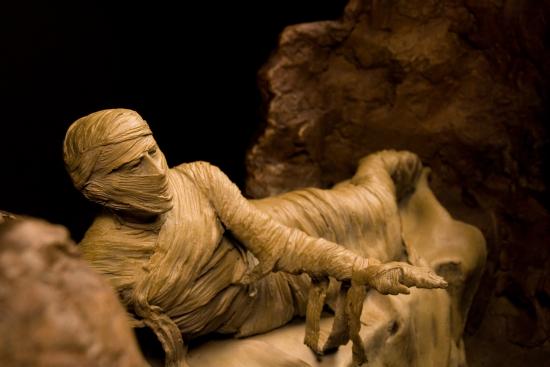
That’s relevant this fifth Sunday of Lent where our readings have Ezekiel coining the highly political metaphor of God’s “raising the dead” to refer to Israel’s impending liberation from its own despair during its Babylonian Captivity. Ezekiel’s metaphor reappears in today’s gospel reading where John the evangelist’s presents his familiar parable about Jesus raising Lazarus from the grave where Jesus’ friend lay moldering for more than three days.
Consider the hopelessness of Ezekiel’s Israel. His sixth century was the saddest of times – the era of his nation’s Great Exile. The Hebrews had been defeated and humiliated by Babylon (modern day Iraq). Its leaders and a large portion of its populace had been abducted to that enemy state. The exiles felt as if they had been slaughtered culturally. They were far from home, controlled by foreign masters, and apparently abandoned by God.
But the prophet Ezekiel did not share his people’s general despair. So in an effort to regenerate hope, he coined the idea of resurrection. Ezekiel loved that concept. [Recall his Vision of Dry Bones (EZ 7: 1-14).] For Ezekiel resurrection was a political metaphor that promised a new vital future despite appearances to the contrary. Israel, he said, would be liberated from Babylon, return home and experience rebirth. They would come back to life.
In his Apostolic Exhortation, The Joy of the Gospel (JG), Pope Francis embraces not only Ezekiel’s spirit, but that of Jesus raising Lazarus from the dead. To repeat, he actually revivifies Jesus and the Gospel. The pope does so by rescuing them both from conservative forces whose version of Christianity has held center stage for the last 35 years. It’s the version, the pope strongly implies, that has metaphorically killed the Jesus of the Gospels, who proclaimed the imminent arrival of God’s Kingdom which belongs to the poor, not to the rich whom the conservatives prioritize.
Like Ezekiel, Jesus made his proclamation when all appearances indicated that Israel was dead. It was entirely under the heel of Roman jackboots and there seemed no escape. Yet Jesus described a horizon of hope that enlivened the spirits of the poor who were crushed by the Romans and by their rich Jewish collaborators who headed the temple establishment.
In such dire straits, Jesus proclaimed a new future where everything would be turned upside down. He said audacious things. In God’s realm, he insisted, the poor would be in charge. The last would be first, and the first would be last. The rich would be poor and the poor would be well–fed and prosperous. The powerless and gentle would have the earth for their possession. Jesus’ unemployed and famished audiences couldn’t hear enough of that!
So he elaborated. He told parable after parable – all about the kingdom and its unstoppable power. It was like leaven in bread – unseen but universally active and transforming. It was like the mustard seed – a weed that sprouted up everywhere impervious to eradication efforts. It was like a precious pearl discovered in the ash bin – like a coin a poor woman loses and then rediscovers. His metaphors, similes and parables were powerful.
To repeat, Pope Francis strongly implies that socio-economic conservatism has murdered the Jesus I’ve just described. It has done so by its “preferential option for the rich.” It embraces free-market capitalism, trickle-down theory, and cut-backs in health care, education, and anti-poverty programs. Conservatives complement such horrors with huge tax-breaks for the country’s 1%. All of this is was chillingly represented last week by “devout Catholic,” Paul Ryan whose budget promised to sock it to the poor and middle class, while enriching military industrialists along with his affluent friends.
The Joy of the Gospel makes it clear that no one can support policies like Ryan’s and claim at the same time to be a follower of Jesus.
In other words, Ryan and the pope are on completely different pages. While conservatives have buried the Gospel Jesus, Pope Francis calls him back to life. He stands before Jesus’ grave and shouts “Come Forth!” Even Fortune Magazine recognizes the resulting miracle.
Consider the Pope’s anti-conservative incantation that brings Jesus back to life. It runs like this:
• Wealth does not belong to the rich, but to the world’s poor (JG 57, 184).
• But the world economy as now structured concentrates wealth among an ever-shrinking minority of the rich (56).
• Wealth must therefore be redistributed (189, 204,215).
• Such redistribution must take place by government intervention in the free market, which (in contradiction to failed “trickle-down” theory) cannot by itself eliminate poverty (54).
• The rich who are unwilling to redistribute wealth to its true owners (the poor) are thieves (57, 189).
• More than that, they are murderers, since the world economy as presently configured is homicidal (58).
• This is a question of being pro-life (213).
• Favoring life certainly includes concern for the unborn (213).
• But “. . . defense of the unborn is closely linked to the defense of each and every other human right” (213).
• Human rights include the right to food and shelter, education, health care, employment , and a just wage (191, 192)
• Respecting human rights involves renunciation of war and preparation for war (60).
• It also connects with environmental stewardship – defense of soil, insects, birds, fish, and the seas (215).
And so the tomb opens. And a Jesus who has been buried more than three decades stumbles out. And in doing so, he renews the faith of so many of us who had given up on the church.
Our faith is renewed because we recognize in Francis’ Jesus the embodiment of one of life’s fundamental truths: utopian visions of the good and true and beautiful can never be killed, even though they might appear lifeless and be pronounced dead by those who once loved them.
What should we do as a result of encountering the Jesus Francis has resurrected?
• Be bold in appropriating the vision of Pope Francis that is not at all idiosyncratic within the Catholic tradition. In fact, it represents the authentic teaching of the Catholic Church from Leo XIII to Vatican II and was even articulated by John Paul II and Benedict XVI.
• Accordingly and courageously incorporate into progressive political discourse the language and powerful ideas of the Judeo-Christian tradition. It can move people today just as it did in the times of Ezekiel and Jesus.
• Join Francis in refusing to cede the field of religion to the reactionary forces of neo-liberal conservatism.
• Expose that conservatism for the destructive fraud it is.
• More particularly, expose Paul Ryan and other Bible thumping Republicans as the heretics they are as they defend the interests of the rich and starve the poor in the name of the Gospel.
• Insist that our pastors get on board with Pope Francis in universalizing his pro-life vision to foreground issues of hunger, war and peace, capital punishment, full employment, universal health care, affordable housing, environmental protection. . . .
Francis reminds us that united with our neighbors, we too, the People of God, possess the power to raise the dead.
So as we stand before the grave of God, the church, and Jesus, let’s echo the pope’s cry: “Jesus, come forth!”
Readings for the feast of “Our Lord Jesus Christ, King of the Universe”: 2 SM 5: 1-3, PS 122: 1-5; COL 1: 12-20; LK 23: 35-43. http://usccb.org/bible/readings/112413.cfm
Today the Catholic Church celebrates the feast of “Our Lord Jesus Christ, King of the Universe.” The contrast between the feast’s grandiose title and the readings prescribed for the occasion illustrate a basic reason behind the irrelevance of the church (and Jesus) to the post-modern world. It’s irrelevant to the social and economic transformations necessary to redeem the church’s overwhelmingly Third World membership from globalized oppression.
The contrast I’m referring to involves the great makeover of Jesus of Nazareth changing him from the leader of an anti-imperial revolutionary movement into a pillar of the exploitative status quo.
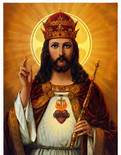
Let me put it this way: through 4th century sleight of hand, the Jesus who sided with the poor and those oppressed by empire – the one who promised a new heaven and earth belonging to the simple and poor, and who was executed as a terrorist by Rome – was made to switch sides. He was co-opted and domesticated – kicked upstairs into the royal class. He became not only a patron of the Roman Empire, but a “king” complete with crown, purple robes, scepter and fawning courtiers.
Following that transformation, kings and popes (now themselves transformed into gaudy temporal rulers) claimed to govern by divine right on behalf of Jesus as his representatives and vicars. In this way, the poor and oppressed (who then and now constitute the world’s majority) lost their paradigmatic leader, example and advocate. Jesus became instead a key part of the apparatus oppressing them.
Reza Aslan’s recent best-seller, Zealot, attempts to rescue the revolutionary historical Jesus from the distortions of the royal classes just mentioned. Aslan connects his salvage project specifically with today’s account of Jesus’ crucifixion in Luke, Chapter 23. In doing so, the author pays particular attention to Jesus’ cross, to the Roman inscription identifying Jesus as “King of the Jews,” and to the dialog between Jesus and the two “thieves” presented as sharing his fate.
According to Aslan, all three – cross, inscription and dialog – mark Jesus as a dangerous revolutionary “terrorist” rather than a domesticated upholder of the given order. That terrorist remains as threatening to today’s dominant empire, the U.S.A., as he was to imperial Rome. So he continues to be erased from history and by “feasts” like today that mask his true identity.
Take the cross first. It was the mode of execution reserved primarily for insurrectionists against the Roman occupation of Palestine. The fact that Jesus was crucified indicates that the Romans believed him to be a revolutionary terrorist. How could it have been otherwise, Aslan asks? After all, Jesus was widely considered the “messiah” – i.e. as the one, like David in today’s first reading, expected to lead “The War” against Israel’s oppressors.
Moreover, he proclaimed the “Kingdom of God,” a highly politicized metaphor which could only be understood as an alternative to Roman rule. It would return Israel, Jesus himself promised, to Yahweh’s governance and accord primacy to the poor and marginalized. The Romans drew logical conclusions. Put otherwise, the Roman cross itself provides bloody testimony to the radical threat the empire saw personified in Jesus.
That threat was made specific in the inscription the Romans placed over the head of the crucified Jesus. It read, “King of the Jews.”
Typically, those words are interpreted as a cruel joke by the Roman procurator, Pontius Pilate – as if he were simply poking fun at those who saw Jesus as the worthy successor of Israel’s beloved King David.
However, according to Reza Aslan, nothing humorous was intended by the inscription. Instead it was a titulus. Every victim of crucifixion had one – a statement of the reason for his execution. The motive for Jesus’ crucifixion was the same as for the many others among his contemporaries who were executed for the same crime: aspiring to replace Roman rule with home rule – with an Israel governed by Jews instead of Romans. The titulus on Jesus’ cross, along with the cross itself identify him as the antithesis of what he eventually became, a Roman tool.
And then there are those two thieves. Aslan says they weren’t “thieves” at all. That’s a mistranslation, he points out. A better translation of the Greek word, lestai , would be “bandits” – the common designation in the first century for insurrectionists. And there probably weren’t just two others crucified the day Jesus was assassinated. There may have been a dozen or more.
And, no, the whole world wasn’t watching either. As scripture scholar John Dominic Crossan observes, Jesus would have represented hardly a blip on the screen of Pontius Pilate. And Jews would have averted their eyes from the spectacle depicted in this morning’s gospel. They wouldn’t want to see “one more good Jew” suffering the fate of so many heroic patriots.
In this context the dialog between Jesus and two of the terrorists crucified with him takes on great significance. Actually, it documents the beginning of the process I described of changing Jesus’ image from insurrectionist to depoliticized teacher.
Think about it. Luke’s account of Jesus’ words and deeds was first penned about the year 85 or 90 – 20 years or so after the Roman-Jewish War (66-70 C.E.). By then the Romans had utterly defeated the Jews, destroyed Jerusalem and its temple as well as slaughtered the city’s population including practically all of the eyewitnesses of Jesus’ messianic campaign. Virtually the only Christians left standing were foreigners – gentiles living in population centers like Rome, Alexandria and Antioch. Few of these had any understanding of or sympathy for Judaism much less for Jewish politics and its liberation movements.
Besides that, in the war’s aftermath, both Jews and Christians sought to distance themselves from the socio-political expectations that had brought on the disaster of the Jewish War. So Judaism tried to transform itself from a Temple-centered religion to one focused on the local synagogue and rabbinic teaching – both overwhelmingly concerned with simply preserving the culture and identity of a people in diaspora.
For their part, Christians became anxious to show the Roman world that it had nothing to fear from their membership.
One way of doing that was to distance the dying Jesus from the Jewish insurgents and their terrorist actions against their oppressors. So in Luke’s death-bed dialog among three crucified revolutionaries, one of the terrorists admits that Jesus is “under the same sentence” as he and his comrade in arms. Given what Aslan said about crucifixion, that fact was undeniable. All three had been sentenced as insurrectionists.
But now comes the distancing between Jesus and Israel’s liberation movements. Luke has the “good thief” (read good terrorist) say, “. . . indeed we have been condemned justly, for the sentence we received corresponds to our crimes, but this man has done nothing criminal.”
In other words, Luke (writing for a post-war Roman audience) dismisses insurrection as “criminal,” and removes Jesus from association with such crime – a fact endorsed, Luke asserts, by insiders like the honest lestai crucified with Jesus. Luke’s message to Rome: the killing of Jesus was a terrible mistake; he meant no harm to Rome. And neither do we, his followers.
Loss of the radical revolutionary Jesus is not a trivial matter in terms of Christianity relevance to a world ruled by a nation that styles itself as Rome’s worthy successor. Like its ancient archetype, the U.S. (and a majority of first-world Christians) found the historical Jesus so threatening, that it determined that Jesus’ followers deserved the same fate as their crucified Master. For this we have the evidence of the war that the U.S. fought against liberation theology when it first emerged following the conclusion of the Second Vatican Council (1963-65).
Liberation theology committed the unforgiveable sin represented by this homily. It was guilty of connecting the Jesus of history described by scholars like Aslan to post-colonial independence movements and struggles against the neo-colonialism spearheaded by the U.S. and its oligarchical clients in the Third World.
In that struggle Pope John Paul II and his henchman, Josef Ratzinger, threw in their lot with a neo-imperial Ronald Reagan. It was deja-vu all over again: Reagan as Pilate and J.P.II and Ratzinger as the temple priesthood. It was the deja-vu of the church melding its interests with Rome towards the end of the 4th century.
More specifically, the two reactionary popes looked the other way and actively supported Reagan’s policies that assassinated hundreds of thousands of Christians (200,000 in Guatemala alone!) who found the radical Jesus threateningly relevant to their struggles in Latin America, Africa, and South Asia.
To balance liberation theology’s threat, Reagan patronized Evangelical Christians who eventually morphed into the Tea Party. It finds Aslan’s understanding of Jesus anathema. Meanwhile, John Paul II and Ratzinger “cleaned house,” eliminating every single progressive bishop from the hierarchy and transforming seminaries into hot houses to nurture a pre-Vatican II reactionary clergy.
Recently Pope Francis delivered a long-winded, very general and content-less speech to the National Council of Bishops in Brazil. That group used to head a church that was a hot-bed of liberation theology I’ve been describing here. The term was never mentioned in the new pope’s remarks. Instead, he presented John Paul II and Pope Ratzinger as champions of Vatican II.
He’ll have to do better than that to fulfill his aspiration towards making the church relevant to the poor he professes to care so much about.
He’ll have to confess the Church’s sins against liberation theology and revive the cult of the historical Jesus – instead of the depoliticized imperial “King of the Universe” today’s feast calls to mind.
 About Things That Matter