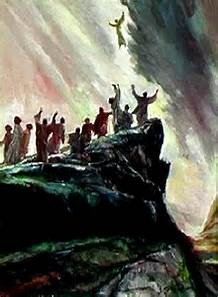
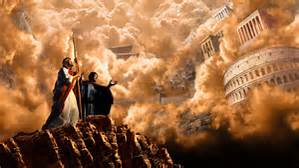
The Ten Commandments: God’s and The Donald’s (Sunday Homily)

trump-commandments
Readings for 6th Sunday in Ordinary Time: SIR 15: 15-20; PS 119: 1-2, 4-5, 17-18, 33-34; I Cor 2: 6-10; MT 5: 17-37.
The emphasis in today’s liturgy of the word is on the wonders of God’s law. “Keep the commandments; no one has a license to sin,” the first reading from Sirach intones. “Walk blamelessly in God’s law; observe its decrees; delight in its wonder,” sings the psalmist in today’s responsorial. And then in the Gospel reading Jesus presents himself as the defender of even the least of the commandments. Break the least, he says, and you’ll be least in God’s Kingdom.
On hearing all of this, I couldn’t but squirm on behalf of Christian Trump supporters who respect what they consider God’s Word. After all, The Donald seems to live by his own rules. And those guidelines don’t seem to have much to do with the Bible’s Ten and the delight, joy, and fulfillment today’s readings suggest infallibly result from observance of the Decalogue. Or as comedian, Bill Maher put it during the campaign season, “It’s hard to bring up the Ten Commandments when your candidate has spent most his life breaking all of them.”
On the other hand, Richard Dawkins, a sworn enemy of Christianity has formulated his own Ten Commandments. Ironically, Dawkins’ rules are more in harmony with today’s delight-full estimation of God’s Law. In fact, they seem more worthy of Christian support than the one’s Mr. Trump apparently lives by.
So just for fun, in the light of today’s readings, let’s contrast the two sets of commandments, and see what we can learn. It might be that Dawkins’ natural law commandments are more promising in terms of Nature’s delight, joy and peace than what we hear implicitly proclaimed by casino king Donald Trump and his Christian followers.

Begin with Mr. Trump. Here’s how humorist Neel Ingram compared the Bible’s Ten Commandments with what seems to be their Trumpian counterparts. (Ingram hosts a website called Chewing The Fat With God). Using Trump’s own words, Ingram writes:

Commandment 1: You shall have no other gods before Me.

Commandment 1 (Trump Edition): I won the popular vote… I’m really smart. I have the best words. Best words. Believe me.

=-=-=-=-=-=-=-=

Commandment 2: You shall not make for yourself a carved image of Me.

Commandment 2 (Trump Edition): You shall not publish unflattering photos. Giant portraits are okay if they’re of Me. For Me.

=-=-=-=-=-=-=-=

Commandment 3: You shall not take the name of the Lord your God in vain.

Commandment 3 (Trump Edition): You shall not mock me, the ratings machine, Donald J. Trump, or I will declare you boring and unfunny. Bigly.

=-=-=-=-=-=-=-=

Commandment 4: Remember the Sabbath day, to keep it holy.

Commandment 4 (Trump Edition): I proclaim a National Day of Patriotic Devotion in my honor. A great day. Best day.

=-=-=-=-=-=-=-=

Commandment 5: Honor your father and your mother.

Commandment 5 (Trump Edition): My parents… great people… truly great… great, unbelievable parents. I’m a really good father. My children really like me — love me — a lot.

=-=-=-=-=-=-=-=

Commandment 6: You shall not murder.

Commandment 6 (Trump Edition): Murder is a terrible crime. Don’t murder. Murder’s not good. Bad!

=-=-=-=-=-=-=-=

Commandment 7: You shall not commit adultery.

Commandment 7 (Trump Edition): Adultery — I don’t think it should be done. Don’t screw around unless she’s hot as sh*t and you think you’ll get away with it.

=-=-=-=-=-=-=-=

Commandment 8: You shall not steal.

Commandment 8 (Trump Edition): Don’t steal. Do a deal. My whole life I’ve been greedy, greedy, greedy. I’ve grabbed all the money I could get. I’m so greedy.

=-=-=-=-=-=-=-=

Commandment 9: You shall not bear false witness against your neighbor.

Commandment 9 (Trump Edition): False witnesses are like fake news. Media can’t be trusted. Serious bias — big problem! Sad.

=-=-=-=-=-=-=-=

Commandment 10: You shall not covet anything that is your neighbor’s.

Commandment 10 (Trump Edition): Don’t covet. I’m really rich. When you’re really rich there’s nothing to covet. Except p*ssy. When you’re a star you can do anything. Grab them by the p*ssy. It’s amazing. Terrific.

=-=-=-=-=-=-=-=

Mr. Trump’s outrageous profanity aside, now take a look at what today’s readings have to say about God’s law. All of them (and especially Jesus’ words) suggest that “God’s Law” has nothing to do with Mr. Trump’s guiding principles. Neither is it written in stone. Instead, God’s commandments are enshrined deep in the human heart. And human happiness is impossible without observing that law which in its essence is no different from nature’s law.

That’s the line Richard Dawkins takes. Beginning with The Golden Rule, he lists his Ten Commandments in the following words:

  1. Do not do to others what you would not want them to do to you
    2. In all things, strive to cause no harm
    3. Treat your fellow human beings, your fellow living things, and the world in general with love, honesty, faithfulness and respect.
    4. Do not overlook evil or shrink from administering justice, but always be ready to forgive wrongdoing freely admitted and honestly regretted.
    5. Live life with a sense of joy and wonder
    6. Always seek to be learning something new
    7. Test all things; always check your ideas against the facts, and be ready to discard even a cherished belief if it does not conform to them.
    8. Never seek to censor or cut yourself off from dissent; always respect the right of others to disagree with you.
    9. Form independent opinions on the basis of your own reason and experience; do not allow yourself to be led blindly by others.
    10. Question everything

Dawkins also has something to say about that fraught area of sexuality which evidently so concerns D.T. and his Christian friends. But whereas The Donald emphasizes power and exploitation while his friends emphasize prohibition and suppression, Mr. Dawkins’ commandments stress the joy and freedom centralized in today’s readings. Dawkins writes:

  1. Enjoy your own sexual life (as long as it does not harm to others), and let others enjoy their sexual lives in private according to their own inclinations which in any case are none of your business.
    2. Don’t discriminate against or oppress anyone because of their sex, race or (insofar as possible) species.
    3. Don’t indoctrinate your children. Teach them to think for themselves, how to weigh evidence, and how to disagree with you.
    4. Respect the future beyond the temporal limits of your own life.

Now those laws are “delightful,” wouldn’t you agree? They seem to make sense because they reflect human nature and nature’s laws. Their observance could bring the world together rather than tearing it apart on the basis of supposedly revealed religious dogmas.

That’s what Roman Catholic (but suspended) theologian, Hans Kung thinks. He says that such a “global ethic” is necessary to finally end the armed conflicts that characterize our age. Towards that end, Kung has articulated four principles: (1) International peace is impossible without peace between religions; (2) there can be no inter-religious peace without inter-religious dialog; (3) there can be no inter-religious dialog without agreement about a global ethic, and (4) our world cannot survive without such an ethic that is universally accepted.

The United Nations seconds Dr. Kung. It boils down his desired global ethic to just four basic “commandments”: (1) Don’t kill; (2) Don’t rape; (3) Don’t lie, and (4) Don’t steal.

Could it be that Christians have more to learn about God’s law from an atheist than from the authoritarian so many Christians and Christian pastors evidently support?

In any case, while the latter promises eternal conflict, the former holds hope of dialog, mutual understanding, and cessation of hostilities.

The choice is ours: Trump’s self-serving law or God’s law written in our hearts.

Would Jesus Celebrate Independence Day?

Jesus Revolutionary

 Readings for 14th Sunday in Ordinary Time: Is. 66: 10-14c; Ps. 66: 1-7, 16, 20; Gal. 6: 14-15; Lk. 10: 1-12, 17.

Sometimes I wonder if I’m on the right path. Do you ever think that about yourself? I’m talking about wondering if your whole “take” on the world is somehow off base.

My own self-questioning has been intensified by my blogging over the last 15 months. For instance I recently wrote a piece on why I refused to celebrate the 4th of July. My thesis was that the U.S. has lost its way, turned the Constitution into a dead letter, and made its claims to democracy meaningless. We are rapidly moving, I said, in the direction of Nazi Germany. All of that is contrary to the Spirit of 1776. So there’s no point in celebrating Independence Day as if Edward Snowden and Chelsea Manning didn’t exist.

One person kind enough to comment said she lost all respect for me as a result of what I had written. Others have told me that my message is just a poor man’s left-wing version of the ideological nonsense spouted by Sean Hannity and Rush Limbaugh. Even people close to me have referred to what I write as diatribes, screeds, and rants. I hope that’s not true.

What is true is that as a theologian, I’m attempting to write “About Things That Matter” (as my blog title puts it) from a self-consciously progressive (i.e. non-conservative) perspective – or rather from a theological perspective that recognizes that following Jesus is counter-cultural and requires a “preferential option for the poor” — not the option for the rich that “America” and its right wing versions of Christianity embrace.

I adopt this position in a national context that I recognize as anti-gospel – materialistic, individualistic, extremely violent, and pleasure-oriented. Or as my meditation teacherEknath Easwaran says, our culture refuses to recognize that we are fundamentally spiritual beings united by the divine core we all share. At heart, we are 99% the same in a culture that tells us we’re 100% unique. Jesus’ values are not the American values of profit, pleasure, power, and prestige.

Instead what Yeshua held as important is centered around the Kingdom of God – a this-worldly reality that turns the values of this world on their head. The Kingdom embodies a utopian vision that prioritizes the welfare of the poor and understands that the extreme wealth Americans admire is a sure sign that those who possess it have somehow robbed others of their due.

As a possessor of extreme wealth myself (on a world-scale) each time I read the gospels – or the newspaper – I feel extreme discomfort. In other words, it’s Jesus’ Gospel that makes me think I’m on the wrong track. But it’s not the one critics have in mind when they suggest I temper my positions.

Instead, consideration of Jesus’ words and deeds convince me that I’m not radical enough. I do not yet occupy a position on the political spectrum respectful enough of the poor. I’ve forgotten that life outside God’s Kingdom (“Jerusalem”) is “Exile” in God’s eyes (as today’s first reading recalls). The liberation from slavery referenced in this morning’s responsorial psalm has lost its central place in my spirituality.

Our culture might say, that by all this I mean that I’m not far enough “left.” Be that as it may. The truth is that insofar as my daily life doesn’t reflect Jesus’ utopian values, I should feel uncomfortable.

Today’s second and third readings reinforce my discomfort. They highlight the conflict between the values of Jesus and those of “the world” – of American culture in our case. In fact, the world finds it hard to understand Jesus’ real followers at all. And why not? For all practical purposes, our culture denies the very existence and /or relevance of spirituality to everyday life – at least outside the realm of the personal.

In today’s excerpt from his Letter to Galatia, Paul says the world considers the Christian life not even worth living. That’s what Paul means when he says that in Christ he is crucified to the world (i.e. in the world’s opinion). He means that as far as the world is concerned, he as a follower of Jesus is already dead because of his rebellion against the values of Rome. Crucifixion, after all, was the form of torture and capital punishment reserved for insurgents against the Empire.

But then Paul turns that perception on its head. He writes that his accusers are wrong. In reality, it is life lived according to Roman values that is not worth living. Paul says, “As far as I’m concerned, the world has been crucified.” He means that what Rome considers life is really death – a dead end. It constitutes rebellion against God’s Kingdom, the antithesis of Rome.

In today’s Gospel selection Jesus describes the lifestyle of those committed to God’s Kingdom. He sends out 72 community organizers to work on behalf of the Kingdom giving specific instructions on how to conduct themselves. They are to travel in pairs, not as individuals. (Companionship is evidently important to Jesus.) Theirs is to be a message of peace. “Let your first words be ‘peace’ in any location you frequent,” he says. He tells his followers to travel without money, suitcase or even shoes. He urges them to live poorly moving in with hospitable families and developing deep relationships there (not moving from house to house). They are to earn their bread by curing illness and preaching the inevitability of God’s Kingdom which the world routinely rejects as unrealistic.

Jesus’ followers are to spread the word that the world can be different. God should be in charge, not Caesar. Empire is evil in God’s eyes. So peace should replace anger and violence; health should supplant sickness; shared food and drink should eliminate hunger. Those are Jesus’ Kingdom values.

And the world rejects them. Not only that, Jesus’ “lambs among wolves” imagery recognizes that the world embodies an aggressive hostility towards followers of Jesus. It would devour them – so different are its values from the Master’s.

So maybe it shouldn’t surprise any of us when we’re accused of being extreme – as communists or utopians or hippies – if we’re attempting to adopt the values of Jesus.

After all, they thought Jesus was crazy. They thought he had lost his faith. They considered him a terrorist and an insurgent.

Then in the fourth century, Rome co-opted Jesus’ message. Ever since then, we’ve tamed the Master.

As our culture would have it, Jesus would have no trouble celebrating July 4th.

Am I mistaken?

Pope Francis, Donald Trump and the Revelation of Pentecost (Sunday Homily)

Trump & Frank

Readings for Pentecost Sunday: ACTS 5: 2-11; PS 104: 1, 24, 29-31, 34; 1COR 12: 3B-7, 12-13; JN 20: 19-23.

So who do you think is more outspoken, Donald Trump or Pope Francis? Which one should followers of Jesus listen to?

That question was sharpened a few weeks ago, when Pope Francis implied that Donald Trump is not a Christian. Responding to a reporter’s question, the pontiff lit up the internet when he said about Trump, “Anyone, whoever he is, who only wants to build walls and not bridges is not a Christian.” Francis added, “Vote, don’t vote, I won’t meddle. But I simply say, if he says those things, this man is not a Christian.”

The pope’s comment came at the end of Francis’ six-day trip to Mexico. There he celebrated Mass with 300,000 faithful in attendance near the Mexican-U.S. border. He used the occasion to decry the “human tragedy” of worldwide migrations of people fleeing violence, war and the effects of climate change. The pope’s analysis, of course, conflicts with Mr. Trump’s who sees immigrants as rapists, drug-dealers, and terrorists.

Francis’ comments drew a quick response from The Donald. He called the pope’s charges outrageous and accused him of being a pawn of the Mexican government.

While Francis’ words were surprising and the response predictable, both provide occasion for a Pentecost reflection on what it means to be a baptized and confirmed Christian in a world awash with refugees from U.S. bombings and the effects of neo-liberal overconsumption.

That’s because the emphasis in today’s readings is precisely on internationalism. The Kingdom of God, the readings tell us, has no borders. It is open to everyone regardless of nationality, race, occupation or gender. Moreover, the Kingdom of God is a matter of this world – of the Body of Christ.  It is not about some disembodied reality up in the sky.

That twofold message starts with today’s opening reading from the Acts of the Apostles with all those strange identity references that readers usually stumble over. Jews, we are told who were present on that first Pentecost were “Parthians, Medes, and Elamites, inhabitants of Mesopotamia, Judea and Cappadocia, Pontus and Asia, Phrygia and Pamphylia, Egypt and the districts of Libya near Cyrene, as well as travelers from Rome, both Jews and converts to Judaism, Cretans and Arabs.”

Then in today’s second reading, Paul goes even further. God’s Kingdom, he says, isn’t just for Jews. In fact in God’s eyes national distinctions, economic status, and gender identity have been erased for those who accept the Gift of God’s Spirit. Paul writes: “For in one Spirit we were all baptized into one body, whether Jews or Greeks, slaves or free persons, and we were all given to drink of one Spirit.” Elsewhere (Galatians 3:28) he puts it even more directly: “There is neither Jew nor Gentile, neither slave nor free, nor is there male and female, for you are all one in Christ Jesus.”

Paul’s message was a consistent theme in the life of Jesus. He healed and forgave, loved and taught Jews, Gentiles, Samaritans, street walkers, lepers, tax collectors, and even on occasion members of the Roman occupying forces.

Notice too Paul’s words about “body” insert the reception of Jesus’ Spirit into the earthly realm of real life and politics. True, Paul speaks of “spiritual gifts,” but he even more emphatically insists that those gifts must be “manifest” in “service” meant to “benefit” others. We are members of Christ’s “Body,” Paul tells us. That is, we are all somehow living “in Christ” – in God, we might say. The question is, do we recognize that reality or not?

In today’s Gospel, Jesus reminds us more specifically where in the world we encounter his embodied spirit. It happens first of all in the community of peacemakers. Jesus’ first words after his resurrection are about peace. “Peace be with you,” he says.  Then he immediately shows his pierced hands and side to his friends. In doing so he seems to remind his followers that he will forever be found in the victims of war and imperialism. That includes refugees from imperialist wars and excess consumption as well as in victims of torture and capital punishment like Jesus himself.

Is such understanding of Pentecost too political? Donald Trump might think so. Pope Francis does not. Francis himself has pointed out that Aristotle was correct in saying that human beings are political animals. So to be branded “political” is to have one’s humanity recognized. The pope said he is proud to be branded political.

So would-be followers of Jesus are presented with a choice on this particular Pentecost.  Are we to follow Pope Francis or Donald Trump? The choice is ours.

More accurately, do we recognize that we are living not “in America,” but “in Christ?”  Do we recognize (as John Oxenham put it more than 100 years ago) that

1 In Christ there is no east or west,
in him no south or north,
but one great fellowship of love
throughout the whole wide earth.

2 In Christ shall true hearts everywhere
their high communion find;
his service is the golden cord
close-binding humankind.

3 Join hands, disciples of the faith,
whate’er your race may be.
All children of the living God
are surely kin to me.

Ascension Sunday: What’s The Purpose of Christianity? (Sunday Homily)

Ascension

Readings for Ascension Sunday: Acts 1: 1-11; Ps. 47: 2-3, 6-9; Eph. 1: 17-23; Lk. 24: 48-53

This is Ascension Sunday. For us Catholics, it used to be “Ascension Thursday.” It was a “holy day of obligation.” That phrase meant that Catholics were obliged to attend Mass on Thursday just as they were on Sunday. To miss Mass on such a day was to commit a “mortal sin.” And that meant that if you died before “going to confession,” you would be condemned to hell for all eternity.

So until the years following the Second Vatican Council (1962-1965) Catholics would fill their churches on Ascension Thursday in the same numbers (and under the same threat) that made them come to Mass on Sundays. That’s hard to imagine today.

I suppose that difficulty is responsible for the transfer of the commemoration of Jesus’ “ascension into heaven” from Thursday to Sunday. I mean it wasn’t that the church changed its teaching about “holy days of obligation.” It didn’t. Catholics simply voted with their feet. They stopped believing that God would send them to hell for missing Mass on Ascension Thursday or the feast of the Blessed Virgin’s Assumption (August 15th), or All Saints Day (November 1st) or on any of the other “holy days.” Church once a week was about as much as the hierarchy could expect.

But even there, Catholics stopped believing that God would punish them for missing Mass on Sunday. So these days they more easily attend to other matters on Sunday too. They set up an early tee time or go for a hike in the woods. Afterwards they cut the lawn or go shopping at Wal-Mart. That kind of “servile work on Sundays” or shopping used to be forbidden “under pain of sin” as well. And once again, it isn’t church teaching that has changed. Catholics have just decided that the teachings don’t make sense anymore, and have stopped observing them.

And apparently they do so in good conscience. So you won’t find them running to confession after missing Mass or working and shopping on Sunday. In fact, that’s another way Catholics have voted with their feet. For all practical purposes, they’ve stopped believing in Confession – and largely in many of the mortal sins they were told would send them to hell – like practicing contraception or even getting a divorce.

I remember Saturday evenings when I was a kid (and later on when I was a priest). People would line up from 4:00-6:00, and then from 7:00 -9:00 to “go to Confession.” And the traffic would be steady; the lines were long. No more! In fact, I personally can’t remember the last time I went to confession. And no priests today sit in the confessional box on Saturday afternoons and evenings waiting for penitents to present themselves.

What I’m saying is that the last fifty years have witnessed a tremendous change in faith – at least among Catholics. Our old faith has gone the way of St. Christopher and St. Philomena and “limbo” all of which have been officially decertified since Vatican II.

In fact, since then the whole purpose of being a Catholic (Christianity) has become questioned at the grassroots level. More and more of our children abandon a faith that often seems fantastic, childish and out-of-touch. Was Jesus really about going to heaven and avoiding hell? Or is faith about trying to follow the “Way” of Jesus in this life with a view to making the world more habitable for and hospitable to actually living human beings?

That question is centralized in today’s liturgy of the word. There the attentive reader can discern a conflict brewing. On the one side there’s textual evidence of belief within the early church that following Jesus entails focus on justice in this world – on the kingdom. And on the other side there are the seeds of those ideas that it’s all about the promise of “heaven” with the threat of hell at least implicit. The problem is that the narrative in today’s liturgy of the word is mixed with its alternative.

According the story about following Jesus as a matter of this-worldly justice, the risen Master spent the 40 days following his resurrection instructing his disciples specifically about “the Kingdom.” For Jews that meant discourse about what the world would be like if God were king instead of Caesar. Jesus’ teaching must have been strong. I mean why else in Jesus’ final minutes with his friends, and after 40 days of instruction about the kingdom would they pose the question, “Is it now that you’ll restore the kingdom to Israel?” That’s a political and revolutionary question about driving the Romans out of the country.

Moreover Jesus doesn’t disabuse his friends of their notion as though they didn’t get his point. Instead he replies in effect, “Don’t ask about precise times; just go back to Jerusalem and wait for my Spirit to come.” That Spirit will “clothe you in justice,” he tells them. Then he takes his leave.

Presently two men clothed in white (the color of martyrdom) tell the disciples to stop looking up to heaven as if Jesus were there. He’s not to be found “up there,” they seem to say. Jesus will soon be found “down here.” There’s going to be a Second Coming. Jesus will complete the project his crucifixion cut short – restoring Israel’s kingdom. So the disciples who are Jews who think they’ve found the Messiah in Jesus return in joy to Jerusalem and (as good Jews) spend most of their time in the Temple praising God, and waiting to be “clothed in Jesus’ Spirit” of liberation from Roman rule.

The other story (which historically has swallowed up the first) emphasizes God “up there,” and our going to him after death. It’s woven into the fabric of today’s readings too. Here Jesus doesn’t finally discourse about God’s kingdom, but about “the forgiveness of sin.” After doing so, he’s lifted up into the sky. There Paul tells his readers in Ephesus, he’s enthroned at the Father’s right hand surrounded by angelic “Thrones” and “Dominions.” This Jesus has founded a “church,” – a new religion; and he is the head of the church, which is his body.

This is the story that emerged when Paul tried to make Jesus relevant to gentiles – to non-Jews who were part of the Roman Empire, and who couldn’t relate to a messiah bent on replacing Rome with a world order characterized by God’s justice for a captive people. So it gradually turned Jesus into a “salvation messiah” familiar to Romans. This messiah offered happiness beyond the grave rather than liberation from empire. It centralized a Jesus whose morality reflected the ethic of empire: “obey or be punished.” That’s the ethic we Catholics grew up with and that former and would-be believers find increasingly incredible, and increasingly irrelevant to our 21st century world.

Would all of that incredibility and irrelevance change if the world’s 2.1 billion Christians (about 1/3 of the world’s total population) adopted the this-worldly Jesus as its own instead of the Jesus “up there?” That is, would it change if Christians stopped looking up to heaven and focused instead on the historical Jesus so concerned with God’s New World Order of justice for the poor and rejection of empire?

Imagine if believers uncompromisingly opposed empire and its excesses – if what set them apart was their refusal to fight in empires wars or serve its interests. How different – and more peaceful – our world would be!

A sensitive discerning reading of today’s liturgy of the word, a sensitive and critical understanding of Jesus’ “ascension” presents us with that challenge. How should we respond?

(Discussion follows.)

(Sunday Homily) Angry White Christians, Donald Trump and the Parable of the Prodigal Son

Trump I'm a Christian

Readings for 4th Sunday of Lent: Jos. 5:9A, 10-12; Ps. 34:2-7; 2 Cor. 5: 17-21; Lk. 15: 1-3, 11-32

The rise of Donald Trump has a lot of people worried. Jerry Falwell Jr. and Pat Robertson however are not among them. Rev. Falwell, the president of Liberty University, has called Mr. Trump “one of the greatest visionaries of our time.” Pat Robertson, the founder and chairman of the Christian Broadcasting Network, finds the billionaire universally inspirational.

As New York Times columnist, Peter Wehner, has pointed out, such endorsements are surprising. After all, Mr. Trump seems to be the antithesis of what Evangelicals claim to endorse. If they hated Bill Clinton for his lack of moral probity, they have in Donald Trump a Bill Clinton in spades. Trump’s been married three times, owns gambling casinos and strip clubs, and hasn’t consistently darkened the door of a church for many years – although he does claim to have “eaten my little cracker,” and “drunk my little wine” in liturgical context more than once in the recent past. Moreover, he has supported what Evangelicals call “partial-birth abortion.” Besides, his personal character seems boastful, self-centered and ruthless. None of those qualities seems particularly Christ-like.

What’s up with all that?

Wehner explains it in terms of scapegoating. White evangelicals, he says, “feel increasingly powerless, beaten down, aggrieved and under attack.” They’ve been left out of any “recovery” since the Great Recession of ’07. And demographics seem to be against them. They sense that whites are falling into minority status – a feeling only aggravated by eight years of having an African-American in the White House. They need an Alpha Male like Trump to “take our country back” from “those people” regardless of their champion’s moral deficits.

Despite such rationalizations, the whole dynamic smacks of a certain hypocrisy fueled by resentment – jealousy stemming from loss of status before others seen as less deserving.

This morning’s gospel “Parable of the Prodigal Son” addresses resentment of that kind. It is one of the most beautiful and well-known stories in World Literature. However, standard readings of the parable domesticate it. They turn the parable into an allegory and in so doing rob it of the cutting edge which connects with today’s Angry White Christians. Please think about that with me.

Standard readings of “The Prodigal Son” make it a thinly veiled allegory about God and us. God is the father in the story, non-judgmental, full of compassion, willing to overlook faults and sins. Meanwhile, each of us is the wayward son who temporarily wanders away from home only to return after realizing the emptiness of life without God. The older brother represents the few who have never wandered, but who are judgmental towards those who have.

Such reading never fails to touch our hearts and fill us with hope, since the story presents such a loving image of God so different from the threatening Judge of traditional Christian preaching. And besides, since most of us identify with the prodigal rather than with the older brother, we’re drawn to the image of a God who seems more loving towards the sinner than towards the saint.

Though beautiful and inspiring, such allegorical reading distorts Jesus’ message, because it makes us comfortable rather than shaking us up. At least that’s what modern scripture scholarship tells us. Those studies remind us that Jesus’ stories were parables not allegories. Allegories, of course, are general tales in which each character stands for something else.

Parables on the other hand are very particular rather than general stories about the human condition. Parables are addressed to particular people – to make them uncomfortable with their preconceptions and cause them to think more deeply about the central focus of Jesus’ teaching, the Kingdom of God. In the gospels, Jesus’ parables are usually aimed at his opponents who ask him questions with an eye to trapping or discrediting him. Jesus’ parables turn the tables on his opponents and call them to repentance.

That’s the case with the “Parable of the Prodigal Son.” It contrasts two very particular historical groups absolutely central to the teaching career of Jesus of Nazareth. On the one hand, there is Jesus’ inner circle, “tax collectors and sinners.” These included sex workers, lepers, beggars, poor peasants, fishermen, shepherds, day-laborers, insurgents, and non-Jews, all of whom were especially receptive to Jesus’ teaching. On the other there are the Pharisees and Scribes. They along with the rabbis and temple priesthood were responsible for safeguarding the purity of the Jewish religion. They were Jesus’ antagonists.

Today’s gospel tells us that the sinners were “coming near to Jesus and listening to him.” For their part the Pharisees and Scribes stood afar and were observing Jesus’ interaction with the unwashed and shaking their heads in disapproval. They were “grumbling,” the gospel says, and saying, “This fellow welcomes sinners and eats with them.” That’s a key point in the reading – Jesus was eating with the hungry, poor, and unclean.

The gospel goes on, “So he told them this parable” – the parable of the prodigal son. In other words, the parable was addressed to the Pharisees and Scribes. And the story not about God and humans in general. It’s simply about a father and two sons and the way things work in the Kingdom of God, which (to repeat) was consistently the focus of Jesus’ preaching.

According to Jesus, that New Order will be a Great Party to which everyone is invited. The party will go on and on. There will be laughter, singing and dancing and the wine will never run out. The “fatted calf” will be slaughtered and there will be an overabundance of food. That’s the future willed by the one Jesus called “Father.”

Jesus was anticipating that order by practicing the table fellowship with sinners and outcasts referenced at the beginning of today’s reading. At the kingdom’s banquet, the sinners gathered around Jesus in this morning’s gospel will be the first to accept the invitation. And though the Scribes and Pharisees are invited as well, they freely choose to exclude themselves. Like the older brother, they are “angry and refuse to go in.”

What I’m saying is that the lesson of today’s gospel (read as a parable rather than an allegory) is: Join the Party! Anticipate the New Order of the Kingdom in the here and now. Follow Jesus’ example, sit down with the unwashed, poor and despised. After all, the kingdom of God belongs to them – and to anyone (even the priests, scribes, rabbis, Pharisees, and any of us) who can overcome our reluctance to descend to Jesus’ level and to that of the kind of people he counted as his special friends.

What can that possible mean for us in the age of Angry White Christians? If we keep Jesus’ original meaning in mind, we’ll see “the Prodigal Son” as a call to change attitudes towards those belittled and feared by Mr. Trump’s followers — Muslims, Mexicans, immigrants in general, Black Lives Matters protestors, the families of terrorists the billionaire would “go after,” and those he would torture by means worse than water-boarding.

That’s a hard message for most middle-to-upper class white people to hear. Like the culture of the professionally religious of Jesus’ day, ours despises those with whom Jesus ate and drank. In fact, it teaches us to dislike people resembling Jesus himself. Our culture sees those in Jesus’ class as lazy, dishonest, and undeserving. That’s the vision exploited by politicians like Donald Trump.

So today’s parable should make us squirm just as Jesus’ original words must have embarrassed the scribes and Pharisees. They should make would-be Christian supporters of Donald Trump squirm as well. Being a follower of Jesus has nothing to do with resentment, jealousy or exclusion. Quite the opposite.

But Jesus’ parable shouldn’t just embarrass. His words should be hopeful too. Like the father in the parable, he’s telling angry whites, his self-righteous sons and daughters, “We’re having a party. Why don’t you join us? Come in and share what you have, adopt God’s political program which creates a world with room for everyone – even the ‘undeserving’.”

In other words, it’s not God who excludes us from the Kingdom’s feast. It’s our own prejudice and choice.

It’s following politicians like Donald Trump rather than Jesus of Nazareth.

Give Up Devil-Worship for Lent:Reject U.S. Imperialism

Temptation

Readings for First Sunday of Lent: Dt. 26: 4-10; Ps. 91: 1-2; 10-15; Rom. 10: 8-13; Lk. 4: 1-13.

Today is the first Sunday of Lent. Lent is a time of renewal – of getting back to basics – to asking questions about what we really believe and what God we truly worship. Today’s liturgy of the word helps us to do both. Deuteronomy 26 directs us to the authentic faith of Jesus – in the God who liberates the enslaved. Today’s reading from Luke’s Gospel calls us to worship that God rather than devil – the evil one that our culture and church (!) have been worshipping for centuries – ever since they first embraced imperialism in the 4th century C.E. Let me explain.

Start with that reading from Deuteronomy 26. It’s a key text if we want to understand the God in whom Jesus placed his faith. Jesus, remember, was a Jew, not a Christian. And Deuteronomy 26 provides us with the creedal statement that the Jewish Jesus accepted as did all Jews of his time. I mean, for them, Deuteronomy 26 functioned much like our Nicene Creed does for us each Sunday. It was a reminder of their basic belief. As such, it can be summarized in the passage’s seven points:

  1. Our father (Abraham) was a wandering Aramean (a Syrian).
    2. “Abraham” (i.e. his descendents) went down into Egypt.
    3. There we became a great people.
    4. But the Egyptians enslaved us.
    5. We cried out to our God, Yahweh, who raised up the rebel prophet, Moses.
    6. He led us out of Egypt, across the sea, through the desert, and to this land “flowing with milk and honey.”
    7. This land is our gift from Yahweh; Thanks be to God!

That’s it! That was the faith that Jesus, the Jewish prophet, inherited from his ancestors. It was a tribal faith centered on the ownership of a God-given piece of land (Palestine) which (despite its dryness and desert character) the descendents of Jacob saw as rich and productive (flowing with milk and honey).

Notice that this Jewish faith had nothing to do with an afterlife, heaven or hell. (In fact, belief in the afterlife was a very late development among the Jews; it didn’t emerge even for debate until about 200 years before Jesus’ birth.) Instead, as among all hunter-gatherers, herds people and agriculturalists, Jewish faith was centered on land. Obviously then, it had little tolerance for colonial military forces like the Assyrians, Babylonians, Persians, Greeks or Romans all of whom at various times occupied Palestine. Colonialism and foreign occupation contradicted Jewish faith in a fundamental way. It was intolerable.

That was true for Jesus too. As a prophet, his fundamental proclamation was not about himself or about a new religion. Much less was it about the after-life or “going to heaven.” Instead, Jesus proclaimed the “Kingdom of God.” That phrase referred to what the world would be like without empire – if Yahweh were king instead of Rome’s Caesar. In other words, “Kingdom of God” was a political image among a people unable and unwilling to distinguish between politics and religion.

In God’s Kingdom, everything would be reversed and guiding principles would be changed. The first would be last; the last would be first. The rich would weep, and the poor would laugh. Prostitutes and tax collectors would enter the Kingdom, while the priests and “holy people” – all of them collaborators with Rome – would find themselves excluded. The world would belong not to the powerful, but to the “meek,” i.e. to the gentle, humble and non-violent. It would be governed not by force and “power over” but by compassion and gift (i.e. sharing).

The creedal account of Deuteronomy 26 sets the stage for today’s gospel narrative about Jesus’ temptations in the desert. (And it’s here that the devil-worship connected with empire enters the picture. Listen closely.) In a context of Roman occupation, Luke’s account raises the question of whom to worship. The choice he presents is stark: one can worship the devil the author of empire or Yahweh, the opponent of imperial power of all types.

That clear choice becomes apparent in Luke’s version of Jesus’ second temptation. From a high vantage point, the devil shows Jesus all the kingdoms of the earth. Then he says,

“I shall give to you all this power and glory;
for it has been handed over to me,
and I may give it to whomever I wish.
All this will be yours, if you worship me.”

Notice what’s happening here. The devil shows Jesus an empire infinitely larger than Rome’s – “all the kingdoms of the world.” Such empire, the devil claims, belongs to him: “It has been handed over to me.” This means that those who exercise imperial power do so because the devil has chosen to share his possession with them: “I may give it to whomever I wish.” The implication here is that Rome (and whoever exercises empire) is the devil’s agent. Finally, the tempter underlines what all of this means: devil-worship is the single prerequisite for empire’s possession and exercise: “All this will be yours, if you worship me.”

But Jesus responds,
“It is written:
You shall worship the Lord, your God,
and him alone shall you serve.”

Here Jesus quotes the Mosaic tradition summarized in Deuteronomy 26 to insist that empire and worship of Yahweh are incompatible. Put otherwise, at the beginning of his public life, Jesus declares his anti-imperial position in the strongest possible (i.e. scriptural) terms.

Now fast forward to the 4th century – 381 CE to be exact. In 313 Constantine’s Edict of Milan had removed from Christianity the stigma of being a forbidden cult. From 313 on, it was legal. By 325 Constantine had become so involved in the life of the Christian church that he himself convoked the Council of Nicaea to determine the identity of Jesus. Who was Jesus after all – merely a man, or was he a God pretending to be a man, or perhaps a man who became a God? Was he equal to Yahweh or subordinate to him? If he was God, did he have to defecate and urinate? These were the questions.

However, my point is that by the early 4th century the emperor had a strong hand in determining the content of Christian theology. And as time passed, the imperial hand grew more influential by the day. In fact, by 381 under the emperor Theodosius Christianity had become not just legal, but the official religion of the Roman Empire. As such its job was to attest that God (not the devil) had given empire to Rome in exchange for worshipping him (not the devil)!

Do you get my point here? It’s the claim that in the 4th century, Rome presented church fathers with the same temptation that Jesus experienced in the desert. But whereas Jesus had refused empire as diabolical, the prevailing faction of 4th century church leadership embraced it as a gift from God. In so doing they also said “yes” to the devil worship as the necessary prerequisite to aspirations to control “all the kingdoms of the world.” Christians have been worshipping the devil ever since, while calling him “God.”

No, today’s readings insist: all the kingdoms of the world belong only to God. They are God’s Kingdom to be governed not by “power over,” not by dominion and taking, but by love and gift which leave people like the liberated daughters and sons of Abraham free to live in control of their own God-given piece of earth. Or in the words of Jesus, the earth is meant to belong to those “meek” I mentioned – the gentle, humble, and non-violent.

All of this has implications for us as would-be followers of Jesus and as citizens of a country whose “leaders” (supported by their “Christian” counterparts) increasingly embrace empire as the inevitable and fitting destiny of the United States.

In fact, in 2003, then vice-president, Dick Cheney sent out a Christmas card on which was inscribed the words, “And if a sparrow cannot fall to the ground without His notice, is it probable that an empire can rise without His aid?” Cheney’s implication was that the United States is God’s new chosen people. Empire as practiced by the United States represents God’s will.

Instead, today’s Liturgy of the Word tells us the opposite. Empires arise only with the devil’s aid.

Does this mean that faithful followers of Jesus must pray for the defeat of the United States in its imperial conquests? Must we discourage our sons and daughters from joining the military?
(Discussion follows)

Marx and Jesus: The Trouble with Prophets

 00-art-young-jesus-wanted-poster-he-stirreth-up-the-people-1913

Readings for 4th Sunday in Ordinary Time: Jer. 1: 4-5, 17-19; Ps. 71: 1-6, 15-17; I Cor. 12: 31-13; Lk. 4: 21-30

I remember when my ideas about prophecy changed – when I really began to understand the term’s implications. I was a graduate student in Rome – already a priest – and completing my doctoral studies at the Academia Alfonsiana on the Via Merulana there in the “Holy City.” I was taking a class in I’ve forgotten what. But my professor (a German Redemptorist as I recall) got my attention during one of his lectures by referring to Karl Marx as “the last of the great Jewish prophets.” That was in 1970 at the height of the Cold War, and I had been reading Marx and about the then-flourishing Marxist-Christian dialog. I realized that my professor was right.

Marx of course was a Jew like Jesus, and Jeremiah who are centralized in today’s liturgy of the word. Like them, Marx was totally absorbed by questions of social justice for the poor and exploited. He was pretty much penniless, like most prophets, and spent his time thinking, writing, speaking, and organizing workers against exploitive employers. He was also highly critical of organized religion and its idols.

Marx’s insight (shared with the biblical prophets) was to realize that both Judaism and Christianity worshipped idols more often than the God of Israel. And by that he meant “gods” who not only justified an oppressive status quo, but who anesthetized the workers and unemployed to the fact that they were indeed oppressed by the capitalist system. Marx called such idols “the gods of heaven.”

We’re all familiar with what he meant. These idols are worshipped each Sunday – usually from 11:00 to 12:00 in what a theologian friend of mine used to call the “be kind to God hour.” You can encounter the “gods of heaven” any day at any hour on Cable television’s Channel 3 or in most Catholic Churches any Sunday morning. “God” there is concerned with correct worship, with bows, genuflections, and with correct terms such as “consubstantial,” “chalice,” “with thy spirit,” “under my roof” and so on. The stories or mythology upholding such idols have to do with “Jesus as your personal savior,” with “going to heaven,” and with avoiding hell.

Marx was also critical of what he called the “gods of earth.” They’re what people worship all those days and hours when they’re not in church. They include Capitalism, “America,” Nationalism, National Defense, Homeland Security, the Military, Money, and Profit. The issues of this God focus on sexuality: contraception, abortion, and same-sex marriage. This God is a War God – always on the side of “America.” He’s celebrated in songs like “The Battle Hymn of the Republic” and “Proud to Be an American.” He is the protector of “religious freedom” understood as privileging Christianity over other faiths while preserving tax exemptions worth billions each year. He blesses the bishops’ “Fortnight for Freedom” concerned as it is with protecting such benefits.

Marx’s prophetic work made him extremely popular with working classes. It was not uncommon for a worker to request that he be buried with a copy of “The Communist Manifesto” placed on his chest.

At the same time, Marx was vilified as the devil himself by factory owners, businessmen, bankers, and the professors and politicians representing their interests. Defenseless against such “education,” most of us have accepted such defamation of this last of the great Jewish prophets.

You see, that’s the trouble with prophets like Marx, Jesus and Jeremiah. They have to take on the “powers and principalities” of their cultures. They must swim against the torrential stream of public opinion.

In today’s first reading, Jeremiah is informed of his lot. But he must “man-up,” he’s told. He must steel himself to confront the “whole land,” along with kings and princes, priests and people. All of these, he’s warned, will fight against him. Nevertheless, God will make of Jeremiah a ‘fortified city,” a “pillar of iron,” and a “wall of brass.”

I suppose God followed through on those promises. But that didn’t prevent Jeremiah from being imprisoned, tortured, and left for dead.

Of course, the same thing happened to Jesus from the beginning to the end of his public ministry. He was vilified, demonized (literally!) and defamed.

That process begins for Jesus in today’s selection from Chapter 4 of Luke’s gospel. As we saw last week, he returns to his hometown of Nazareth and criticizes his neighbors’ narrow nationalism. In today’s episode his neighbors try to kill him. Later on, of course, Jesus goes more public. Like Jeremiah, he takes on his nation’s priests and scribes, princes and king. Ultimately his words and deeds threaten the Roman Empire itself which classifies him as a terrorist. Together those powers and principalities (national and international) not only defame Jesus the way Jeremiah and Marx were defamed; they actually kill him just as so many prophets have been killed from John the Baptist and Paul to Martin Luther King and Gandhi.

All of them – Jesus, Jeremiah, Gandhi, King, Paul and Marx – followed the same “prophetic script” whose inevitable directive prescribes that no prophet is accepted in her or his native place. It’s easy to see why. It’s because their “native place” bears the brunt of their prophetic words.

Meanwhile, it’s easier for outsiders to recognize prophets. The “outsiders” who concerned Jesus were the uneducated, poor, and unclean. However, even those seem to turn against him this morning. It’s unlikely that there were any rich or powerful resident in Nazareth – a place scripture scholar Ched Myers describes as “Nowheresville.”

Few of us are rich and powerful. Yet we’ve been schooled by those entities to reject prophets who speak in our name and defend our interests – those belonging to our “native land” to use the words of this morning’s gospel. It’s as though we’re looking at reality in that “darkened mirror” Paul wrote about in today’s excerpt from his letter to Corinth. The darkened mirror not only turns things backward, but it’s smudged with the fingerprints and dirt of ignorant and/or perverse propagandists.

The trouble – the trouble with prophets – is that most of us have bought into all that anti-prophet propaganda. So we hate Karl Marx without realizing that he’s on our side and speaks for us. We honor the Martin Luther King who has been reduced to a “dreamer,” but not the MLK who described the United States as the most violent and destructive country in the world. We don’t remember the King who was slandered as a communist and encouraged to commit suicide by the FBI and the COINTELPRO program.

We’re willing to stand by while Wikileaks journalist Julian Assange is persecuted by the governments of Great Britain and the United States. We presume that Chelsea Manning is guilty of treason because our government, (despite its record of lies and heinous crimes) says so. We wonder what all the fuss is about Aaron Swartz and Edward Snowden.

These are the prophets of our time who, like Jesus, do not find a sympathetic hearing in their native place. It might be time to embrace them as our own and see what difference that makes in the way we look at the world and our country. The examples of Jeremiah, Jesus, and Paul — and the hopes of the world’s poor and victims of U.S. wars — beg us to do so.

(Sunday Homily) Doubting Thomas: Our Twin (Jesus’ Twin!) in Denial

doubting thomas

Readings for 1st Sunday after Easter: Acts 5:12-16; Ps. 118: 2-4, 13-15, 22-24; Rev. 1: 9-11A, 12-13, 17-19; Jn. 20: 19-31.

The picture painted in today’s gospel story should be familiar to all of us. I say that not only because we have heard it again and again, but because it’s our story. It’s about a man in denial, the original doubting Thomas. Thomas’ nickname was “the twin.”

Whatever that meant originally, Thomas is undoubtedly our fraternal double in that he depicts our condition as would-be followers of Yeshua. Like Thomas we live in practical denial concerning the reality of Yeshua’s resurrection – about the possibility of a radically transformed life. Recall our twin’s story. Pray that it can be ours as well.

The disciples are there in the Upper Room where they had so recently broken bread with Yeshua the night before he died.  And they are all afraid. John says they are afraid of “the Jews.” However it seems they fear death more than anything else. They dread it because they are convinced that death spells the end of everything they hold dear – their ego-selves, families, friends, culture, and their small pleasures. Besides that, they are afraid of the pain that will accompany arrest – the isolation cells, the beatings, torture, the unending pain, and the final blow that will bring it all to a close. Surely they were questioning their stupidity in following that failed radical from Galilee.

So they lock the doors, huddle together and turn in on themselves.

Nevertheless, the very fears of the disciples and recent experience make them rehearse the events of their past few days. They recall the details: how Yeshua so bravely faced up to death and refused to divulge their names even after undergoing “the third degree” – beatings followed by the dreaded thorn crown, and finally by crucifixion. All the while, he remained silent refusing to name the names his Roman interrogators were looking for. He died protecting his friends. Yeshua was brave and loyal.

His students are overwhelmingly grateful for such a Teacher. . . .

Then suddenly, the tortured one materializes there in their midst. Locks and fears were powerless to keep him out. They all see him. They speak with him. He addresses their fears directly. “Peace be with you,” he repeats three times. Yeshua eats with them just as he had the previous week. Suddenly his friends realize that death was not the end for the Teacher. He makes them understand that it is not the end for them either – nor for anyone else who risks life and limb for the kingdom of God. No doubt everyone present is overwhelmed with relief and intense joy.

“Too bad Thomas is missing this,” they must have said to one another.

Later on, Thomas arrives – our fraternal double in unfaith. His absence remains unexplained. Something had evidently called him away when the others evoked Jesus’ presence by their prayer, recollections, and sharing of bread and wine. Like us he hasn’t met the risen Lord.

“Jesus is alive,” they tell the Twin. “He’s alive in the realm of God. He took us all with him to that space for just a moment, and it was wonderful. Too bad you missed it, Thomas. None of the rules of this world apply where Yeshua took us. It was just like it was before he died. Don’t you remember? Yeshua brought us to a realm full of life and joy. Fear no longer seems as reasonable as it once did. He was here with us!”

However, Thomas remains unmoved. Like so many of us, he’s is a literalist, a downer. He’s an empiricist looking for the certainty of physical proof. Thomas is also a fatalist; he evidently believes that what you see is what you get. And for him there has been no indication that life can be any different from what his senses have always told him. Life is tragic. Death is stronger than life; it ends everything. And that means that Yeshua is gone forever. Who could be so naïve as to deny that?

Our twin in unfaith protests, “In the absence of physical proof to the contrary, I simply cannot bring myself to share your faith that another life is possible. And make no mistake: Yeshua’s enemies haven’t yet completed their bloody work. They’re after us too.”

Can’t you see Thomas glancing nervously behind him? “Are you sure those doors are locked?”

Then lightning strikes again. Yeshua suddenly materializes a second time in the same place. Locks and bolts, fear and terror – death itself – again prove powerless before him.

Yeshua is smiling. “Thomas, I missed you,” he says. “Look at my wounds. It’s me!”

Thomas’ face is bright red. Everyone’s looking at him. “My God, it is you,” he blurts out. “I’m so sorry I doubted.”

“Don’t worry about it,” Yeshua assures. “You’re only human, and I know what that’s like, believe me. I too knew overwhelming doubt. Faith is hard. On death row, my senses told me that my Abba had abandoned me too. I almost gave up hope. It’s like I’m your twin.

“But then I decided to surrender. And I’m happy I did. My heart goes out to you, Thomas. My heart goes out to all doubters. I’ve been there.

“However, it’s those who can commit themselves to God’s promised future in the absence of physical proof that truly amaze and delight me. Imagine trusting life’s goodness and an unseen future with room for everyone when all the evidence tells you you’re wrong! Imagine trusting my word that much, when I almost caved in myself? That’s what I really admire!

“My prayer for you, Thomas, and for everyone else is that you’ll someday experience the joy that kind of faith brings.

Working for God’s Kingdom – for fullness of life for everyone – even in the face of contrary evidence – that’s what faith is all about. May it be yours.”

May it be ours!

(Sunday Homily) “Citizenfour”: Keeping God’s Law through Civil Disobedience

Citizenfour

Readings for 5th Sunday of Lent: JER 31: 31-34; PS 51: 3-4, 12-15; JN 12: 20-33 http://usccb.org/bible/readings/032215-fifth-sunday-lent.cfm

I saw “Citizenfour” today. You can see it too. For your own good, please do. The film is live-streamed free here:  https://thoughtmaybe.com/citizenfour/

“Citizenfour” won this year’s Academy Award for best documentary. Its director is Laura Poitras. The film is about whistleblower, Edward Snowden – the 31 year old CIA employee who two years ago leaked classified information from the National Security Agency (NSA).

The information revealed “America’s” massive world-wide spy system that Snowden saw as absolutely eviscerating U.S. constitutional protections against “unreasonable search and seizure.”

In case you’ve forgotten, the 4th Amendment of the Constitution reads as follows:

“The right of the people to be secure in their persons, houses, papers, and effects, against unreasonable searches and seizures, shall not be violated, and no warrants shall issue, but upon probable cause, supported by oath or affirmation, and particularly describing the place to be searched, and the persons or things to be seized.”

In contradiction to those words, Snowden’s revelations show that indeed “Big Brother” is watching us at all times. We are under constant surveillance. None of our e-mails or phone calls is secure.  Telephones normally found in hotel rooms are routinely used as listening devices. All of our e-mail searches are monitored and recorded.

This means that citizens expressing disapproval of government policies are easily identified. So are our constitutionally protected efforts to organize against such policies. All of us are subject to blackmail and prosecution based on stories manufactured from “metadata” and texts gathered by our watchers.

Knowing full well that he would be hunted down and prosecuted (and possibly executed) for his leaks, Edward Snowden shared his information with Laura Poitras and with Guardian reporter, Glen Greenwald. Snowden fled to Russia where he was given temporary political asylum. “Citizenfour” is the upshot.

Of course, Snowden’s opponents say his revelations have endangered national security and that he is guilty of treasonous acts of espionage. In response, the former CIA contractor says the whole matter of government secrecy and surveillance needs full debate. So do extra-judicial killings in the world-wide drone assassination program. Security, Snowden implies, is less important than freedom, privacy, and the lives of innocents arbitrarily killed on mere suspicion of possibly one day harming U.S. citizens. Then there are those disturbing words in the Fourth Amendment. . . .

All of that made me think about today’s liturgy of the word. It’s all about obeying conscience rather than the written law. It’s all about another 30 something law-breaker who rejected absolute security in favor of opposing the authorities of his time.  Think about the readings one-by-one.

The first (from the prophet Jeremiah) reminds us that God’s law is not primarily found on tablets of stone. It is inscribed on our hearts. Without invoking “God,” that’s the law Edward Snowden claims to follow – a law much higher than the 1917 Espionage Act invoked against him.

According to today’s responsorial psalm, a heart shaped by God’s law is good and merciful; it is compassionate, forgiving, and guilt-free. Laura Poitras’ film shows Snowden exhibiting all of those qualities. There is not a trace of self-seeking in any of his actions or statements – only concern for others victimized by the state.

It is that heart sensitive to God’s internal law that Jesus manifested. But, like Ed Snowden, it took him great pain to get to that place. Today’s second reading specifically mentions Jesus’ “loud cries and tears,” his anguished prayers and supplications.

Finally, today’s selection from the Gospel of John reiterates the call to follow Jesus, even as Snowden has without any specific reference to Jesus.  Our reading has the Master say that “serving” him means walking the way of the cross. In other words, we must learn his same lessons about rejection that always follows hard upon adoption of Jesus’ counter-cultural “Way.”

A seed has to die before it can bear fruit, Jesus explains. That’s our Teacher’s metaphor about exchanging what the world calls “life,” for what John’s gospel calls “eternal life.”

As in contemporary “America,” the world’s utopian ideal enshrines perfect security – saving our lives at all costs, even if it means wholesale killing of others, even if it means surrendering the God-given freedom that makes us specifically human.

By contrast, Jesus’ Way enshrines compassion, service and forgiveness, even if it costs us our lives.

Ironically, Jesus explains, if we expend our resources on saving our lives, we will lose them. But if we reject security as our guiding principle, we’ll gain access to “eternal life” – access to God’s Kingdom, where God is King, not Caesar.

Mysteriously, today’s final reading instructs us against loving our lives. It actually says we should hate our life in this world. Edward Snowden shows what that injunction means. His courageous example calls us to oppose Big Brother, and to support Snowden’s own return to the United States – as a hero.

Be sure to see “Citizenfour.” It exemplifies today’s readings. It’s about opposing the values of “the world,” and about losing one’s life in favor of life’s fullness. It provides an example of a young man following the Law of God inscribed deep in our hearts. That’s our vocation.

(Sunday Homily) A Wife-Husband Lenten Discipline: A Course in Miracles

ACIM 2

Readings for the 4th Sunday of Lent: 2 CHR 36: 14-16, 19-28; PS 137: 1-6; EPH 2: 4-10; JN 3: 14-21; http://usccb.org/bible/readings/031515-fourth-sunday-lent.cfm

This year for Valentine’s Day, my bride of nearly 40 years, Peggy, gave me a wonderful gift. Or I should say, she gave us a wonderful gift. She enrolled us in a live-streaming seminar led by Marianne Williamson, the great spiritual teacher, peace activist, and author of many books, including Return to Love, which both Peggy and I had read with great profit several years ago.

What Williamson presented turns out to be intimately connected with today’s liturgy of the word.  It presents us with a rich catechism of some of the most-powerful images and metaphors belonging to the Judeo-Christian tradition. They include a whole list of choices humans (and married couples) must make between:  (1) exile and liberation, (2) Babylon and Jerusalem, (3) death and life, (4) worldly values and Christ’s values, and (5) works without faith or works with faith. In their esoteric senses, keeping those choices in mind proves helpful in pursuing our Lenten disciplines, especially as they affect our most intimate relationships.

You see, Marianne Williamson is a student and teacher of religious metaphor like the ones I just referenced. As a Jewish counselor and teacher, she honors all those biblical memes. And yet, her main spiritual reference point isn’t the Tanakh, but A Course in Miracles (ACIM). That’s an esoteric spiritual classic based on a series of “revelations” received by Helen Schucman, a research psychologist and one-time aggressive atheist.  Over a period of seven years she took dictation from the Spirit of Jesus about how to experience all of life as a Miracle – as an unending series of joyful wonders.

That whole idea might be off-putting to some. As a matter of fact, that’s what I experienced when I first picked up ACIM, maybe thirty years ago. Some have described it as New Age psychobabble. I’m afraid I jumped to that conclusion.  I also found its entire premise somehow disconcerting – I mean: actual dictation from Jesus?  It just wasn’t my cup of tea. And I still have some reservations.

Yet, the book’s basic claim resonated with me. That claim is that at their summits, all the world’s great spiritual traditions converge in the basic mystical realization that ALL LIFE IS ONE. In our depths, our real Self is divine. There is very little difference between us humans. In a real sense, both you and I are one.

More than that, we share unity with the trees, mountains, rivers, oceans, animals, and insects.  Only the misplaced importance we give to our individual egoic selves prevents us from recognizing that mystical insight. That’s a truth I’ve encountered not only in the Christian mystics like John of the Cross and Theresa of Avila, but also in my study of Buddhism and Hinduism. It’s also something that accords with my own experience over the last 18 years of committed meditation twice a day. The meditation teacher I follow, Eknath Easwaran, would find very little strange in A Course in Miracles.

In any case, Williamson’s teachings from ACIM, as well as her interactions with her audience of about 50 couples were astounding. She was incredibly fluent, funny, self-disclosing, and honest in her presentations. She was also unbelievably wise and helpful in dealing with the problems audience-participants presented during question and answer periods that often turned into full-blown counseling sessions. These had couples generously divulging problems of achieving intimacy, of heartbreaking infidelity, inability to communicate, and basic misunderstandings between women and men – yin and yang.

And then there was Williamson’s unflinching insistence on prayer and meditation. To begin with, she held that there can be no spiritual growth for anyone without putting God first and without the daily practice of meditation.  From a leftist peace activist, I found that refreshing and challenging.

According to Williamson, anyone interested in personal or couple transformation needs to meditate every day. Ideally, couples should do it together every morning. But even more impressive to me was Williamson’s ability to pray herself. She concluded most interactions with couples by inviting them to pray with her. And it all seemed perfectly natural and invariably quite beautiful.

In fact, Peggy and I were so impressed, and our conversations following Williamson’s sessions were so helpful that we resolved to work through A Course on Miracles as our Lenten discipline. And that’s what we’ve been doing since the Ash Wednesday which followed so closely this year’s Valentine’s Day.

In connection with this morning’s liturgy of the word, here’s what we discovered:

  • Most of us married people are living in exile – in Babylon like the Jews in the 6th century BCE described in today’s first reading.
  • Perhaps without even realizing it, we long for “Jerusalem,” – for return to our true home, the “container” of love, safety, trust and intimacy we embraced on our wedding day.
  • But like the exiles in today’s responsorial psalm, many of us have stopped singing the love songs that came so naturally then. We’ve hung up our harps and refuse to sing to our intimate partner.
  • Too often we’ve become like the walking dead – rejecting the precious fullness of life together that’s available for the asking.
  • As Paul puts it in today’s second reading, our lives together have become “works without faith.” Work in our lives has replaced faith – in God and in each other.
  • With our loss of faith, the superficial values of the world (rejected by Jesus in today’s gospel selection) have replaced his Kingdom values of unconditional acceptance, service and forgiveness.

Forgive me if all of that sounds bromidic and hackneyed.  This Lent Peggy and I are finding that Marianne Williamson’s advice about praying and studying together brings them to life.  We’ve come to realize she’s right.

For us, there’s just no other way.