Domesticating Laudato Si’: Our Milk Toast Diocesan Study Guide

Science-vs-BS

This week (Just in time for Lent) the Lexington Catholic diocese published a study guide for Laudato Si’, Pope Francis’ outspoken encyclical on the problems resulting from climate change. The guide called Discovering Laudato Si: A Small Group Study Guide.

Following two introductions – one to the social teachings of the church, the other to the booklet itself – Discovering Laudato Si’ consists of eight two-page chapters and a “Final Reflection.”  In each “chapter,” one page is devoted to excerpts from the pope’s encyclical. The second page lays out three or four questions related to the chapter’s selections.

That plan is indeed helpful for small group discussions in the parish settings for which it is intended. It means participants can avoid homework. They can actually read an assigned chapter during the relevant meeting itself.

That seems, perhaps, a positive contribution.

The booklet’s liabilities however overwhelm that modest asset. That’s because Discovering Laudato Si’ does exactly what Pope Francis refused to do in his authoritative letter to the entire church. The diocesan guide bends over backward attempting not to offend.

In his encyclical, the pope might well have said “The topic of climate change is controversial. Some see it as caused by humans and threatening to the very existence of the human race. Others say that climate variability is cyclical and natural, and can be remedied by human technology. Of course, such matters are too complex for non-experts and even for the Church to decide. So while the experts are resolving that “big picture,” let’s be practical. Let’s all take a deep breath, slow down, and avoid environmental crusades. Let’s determine the ‘small tasks’ that little people can do to mitigate the environmental damage our lifestyles may be causing. Let’s reduce, reuse, and recycle. You see, environmental crusading might offend those with opposite opinions. And remember, Christians must be nice. On these matters, the faithful should ‘bend to the pastor’s direction’.”

The pope avoided all of that. But it’s the actual argument the diocesan discussion guide makes!

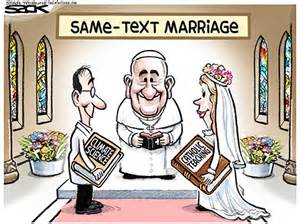
True: it lets the pope’s encyclical speak for itself on the first page of each chapter. But the question page often subtly retracts what the pope’s overall document says. For instance, the questions at the end of Chapter One create a false equivalency between the 97% of scientists who recognize that climate change is caused by humans, and the 3% who deny human causality. “This debate will not be resolved anytime soon,” the study guide sagely observes!

The pope however did nothing of the kind. He was not concerned with possible offense to the 3%. Instead, he called for “a bold cultural revolution” (114). He denounced capitalism-as-we-know-it (190). He called for “radical change” (171). He identified climate deniers as “obstructionists” (14) He demanded “reparations” (wealth redistribution) for global south countries wounded by the climate crimes committed by their rich colonizers (30, 51, 52). He suggested a form of world governance (53, 173-‘75}

All of these are “big picture” items that the diocesan guide recommends we leave to the experts. In fact they are the very stuff of elections, political campaigns – and wars. For that reason, Francis’ document has evoked the wrath of Rush Limbaugh and the entire Republican establishment.

Limbaugh said, “Pope Francis attacked unfettered capitalism as ‘a new tyranny’ and beseeched global leaders to fight poverty and growing inequality . . . Francis went further than previous comments criticizing the global economic system, attacking the ‘idolatry of money’ . . . This is just pure Marxism coming out of the mouth of the pope.”

Why did the pope avoid the milk toast approach of the Lexington diocese?  It’s because he knows that we’re on a train that is speeding 200 mph down a track and headed for a precipice just a mile away.

In the face of such impending calamity telling people of faith to take our time, be “deliberate,” avoid “rash actions,” “ecological crusades,” and “headlong rush into the fray,” is misleading in a real and tragic sense of the word.

Pope Francis’ Encyclical: My New Book and a Lenten Program

product_thumbnail

I must apologize for my absence from the blog site over the last couple of weeks. It’s that I’ve been putting the finishing touches on a new book I’ve written about Pope Francis’ eco-encyclical, Laudato Si’, which I consider the most important public document of the present century.

The 150 page book is called Understanding Laudato Si’: A Discussion Guide. (It is featured along with a “Buy Now” button on the right hand side of my blog homepage. The price is $8.15 per copy.) The book is aimed at people of faith who’d like to start or participate in discussion groups about climate change as the moral issue Pope Francis calls it.

(By the way, an “encyclical” is a general letter to the church as a whole. It represents the highest most solemn form of papal teaching.)

Laudato Si’ is unique in that it comes from the pen of history’s first Global South pope. So it is shaped by the experience of the former colonies (Latin America, Africa, and South Asia). It is heavily influenced by colonial and neo-colonial exploitation.

More particularly, Laudato Si’ was written by a priest who comes from country victimized by the U.S.-supported “Dirty War” that the Argentinian Army waged against the pope’s homeland from 1976-1983. That war took the lives of at least 30,000 Argentinians – at least one bishop, many priests, nuns, and lay catechists along with union organizers, teachers, social workers and those suspected of supporting the democratic resistance.

No other pope has had such “Third World” experience of aggression at the hands of the United States. No other pope has been influenced directly by liberation theology – which has centralized the concept of “preferential option for the poor” that marks Francis’ papacy.

Read in that light, Laudato Si’ presents the world with understandings of climate change, economics (especially capitalism), history, theology, and church that are uniquely “Global South” rather than the European understandings that shaped the visions of Francis’ predecessors. All the other commentaries I’ve seen have overlooked those differences.

I’ve shared drafts of the book with friends. One wrote: “Your book should be in the hands of every bishop and priest and parish, as well as to the pundits we daily read and hear in the mass media.”

The great African-American feminist scholar, bell hooks, commented: “You make difficult concepts and theories accessible. The work itself embodies the spirit of inclusion you write about so eloquently. Bravo!!!”

A priest-activist working in the Appalachian region wrote:  “Congratulations, this is a winner! . . . You wrote an amazing book.  I read it and I remembered.  I thought about it and I learned.  I critiqued it, and I grew. . . Let’s see how we can spread the analysis.”

I’m hoping that my book will be used this Lent as a discussion guide in parishes throughout the United States.  It is currently under review by my own diocese of Lexington, Kentucky.

In my own parish, St. Clare’s here in Berea, we’ve made the following proposal for dealing with Pope Francis’ call to action. Perhaps readers of this blog might implement something similar in their own parishes:

Lenten Program, St. Clare Church, Berea, Kentucky (Wed. Feb. 10- Sat. Mar. 26, 2016)

The St. Clare Peace and Social Justice Committee proposes a Lenten adult education program that will centralize the Papal Encyclical, Laudato Si’. Participants in the six week program will pursue the following goals:

  • Acquaintance and familiarity with the content and historical background of Laudato Si’.
  • In the light of that encyclical:
    • Sharpening awareness of the environmental crisis itself and of capitalism’s role in that predicament, as well as the parts played by U.S. policy, Global South theology, and the Catholic Church.
    • Rethinking the elements of each person’s Catholic faith including understandings of God, Jesus, church, and salvation.
    • Re-evaluating the relationship between a reconsidered Catholic faith and the environmental crisis.
    • Identifying practical ways of coping with the environmental crisis in the personal, familial, parochial, national and global dimensions of life.

To achieve these goals, each participant will:

  1. Adopt as a Lent 2016 practice, participation in six 90 minute group sessions discussing issues raised by  Laudato Si’.
  2. Sign up in advance for program participation. (Non-obligatory “interest cards” will be found in each pew on Ash Wednesday and on the First Sunday of Lent.)
  3. Before each meeting, read and reflect on the discussion guide adopted by the group (either the one to be provided by the diocese or Rivage-Seul’s Understanding Laudato Si’: A Discussion Guide).
  4. Actively participate in the discussions.

Program Organization

Feb 14:  View the first half of “Time to Choose” followed by a disciplined discussion. (“Time to Choose is a new 90 minute film by Oscar winner, Charles Ferguson. The film makes the case that we can combat climate change; that we have the tools and the knowledge to begin doing so right now.) (Assignment: Read Discussion Guide, pages 1-30)

Feb 21: View second half of “Time to Choose.” Discuss in the light of the Discussion Guide’s summary of Laudato Si’.  (Assignment: Read Discussion Guide, pages 31-50)

Feb 28: View lecture by economist, Richard Wolff on capitalism and the environment. Discuss the pope’s approach to economy facilitated by Chapter Two of the Discussion Guide.   (Assignment: Read Discussion Guide, pages 51-82).

Mar 6: View the first half of “This Changes Everything” (a new 90 minute film by Naomi Klein based on her book by the same name). Discuss in the light of Pope Francis’ “preferential option for the poor” as explained in Discussion Guide (Assignment: Read Discussion Guide, pages 83-100)

Mar 13: View second half of “This Changes Everything” in the light of liberation theology as explained in Discussion Guide. (Assignment: Read Discussion Guide, pages 101-140).

Mar 20: Discuss the Church as Caravan and practical responses to Laudato Si’.

Pope Francis on Misplaced Safety Concerns: Where’s the Caution on Climate Change?

pope-refugees-2

The chances of a U.S. citizen being killed by a terrorist are slimmer than being struck by lightning. That remains true even after the Paris massacre of last November 13th.  In fact, according to The Economist, the chances of dying at the hands of terrorists are actually one in twenty million. So you’re far more likely to die from a car accident, airplane crash, post-surgery complications, or from gun violence than from terrorism.

Meanwhile, the likelihood of millions dying from the effects of climate change is about 97 in 100. That figure refers to the percentage of climate scientists who tell us that human inaction on the climate front will result in disastrous, planet-wide catastrophe.  (By the way, 97% is about the same percentage as medical researchers who say that smoking causes cancer.)

And yet, in the wake of the recent Paris massacre, politicians call for absolute caution about the acceptance of refugees while siding with the 3% of scientists denying human responsibility for climate change.

On the refugee question, Governor Robert Bentley of Alabama put it this way, “If there’s even the slightest risk that they’re not the kind of people that we wish them to be,” we must exclude Iraqi and Syrian refugees from our state.

And Bentley is not alone. At least 31 governors (almost all of them Republican) have expressed similar determination to prevent refugees from entering their states. Governor Greg Abbot of Texas said, “I will not roll the dice and take the risk on allowing a few refugees in simply to expose Texans to that danger” of some refugee committing a terrorist act. “Better safe than sorry,” adds Republican Speaker of the House, Paul Ryan, who describes himself as “a devout Catholic.”

The Catholic reference is important, because the position of Pope Francis is exactly the reverse of the Republicans’ who overwhelmingly identify themselves as fervent Christians. The pope has called for opening doors to refugees from Syria and Iraq.  He has reminded believers that Jesus himself was a refugee from state violence and that his mother experienced the same terror suffered by Iraqis, Syrians, Somalians and others.

Meanwhile, in his landmark encyclical on climate change, Pope Francis urged extreme caution about climate change. There he quotes the 1992 Rio Declaration on the climate crisis:

“. . . (W)here there are threats of serious or irreversible damage, lack of full scientific certainty shall not be used as a pretext for postponing cost-effective measures” (186).

So who’s right, Paul Ryan and his Republican colleagues or Pope Francis?

That is, given the 1 in 20 million chance of being killed by a terrorist on the one hand, and the near certainty of millions dying from human-induced climate change on the other, is the pertinent popular phrase Ryan’s “Better safe than sorry?  Or is it “Penny wise and pound foolish?”

Perhaps it is both.

Think about that for a minute.

Encouraging Signs that Capitalism is on Its Last Legs

End of Capitalism

Last week President Obama rejected the Keystone XL pipeline. His announcement caused huge celebration in the anti-fossil fuel resistance movement.  The victory made it clear that we’re living in revolutionary times. Powerful movements for social justice are springing up everywhere, not only on the climate change front, but more generally nationally and internationally.

Even more importantly, there is a red thread running through it all. The changes (and there are many as we’ll see) all represent the impending collapse of capitalism. We are likely standing on the brink of a transformation world-wide that parallels the fall of the Soviet Union a quarter century ago.

To begin with, think about what’s happening with the climate movement. Environmental activists are on a surprising roll in terms of their recent successes.

These include:

  • The September 2014 Great Climate March in New York City which brought out 400,000 people.
  • The subsequent rapid spread of the fossil fuel divestment movement.
  • The recent TransCanada Corporation’s decision to temporarily suspend the XL Pipeline project even before President’s Obama’s announcement.
  • The unexpected election of Justin Trudeau as Canadian Prime Minister on a platform highlighting commitment to Canada’s First Nations who are key players in the movement to keep fossil fuels in the ground.
  • Shell Oil’s abandonment of its arctic drilling plans.
  • The expose of ExxonMobil’s cover-up of its own 1980s research identifying fossil fuel combustion as a major cause of global warming. (Despite its findings the company spent millions over a 27 year period promoting climate change denial.)
  • The prospect of a lawsuit against ExxonMobil for adopting that “cigarette strategy.”
  • Widespread outrage following the release of the Transpacific Partnership text which accords multinational corporations the power to override local environmental protection standards because they might impede corporate profit.
  • The resultant promise of huge demonstrations and citizen lobbying efforts against the treaty.
  • Pope Francis’ eco-encyclical, Laudato Si’, legitimizing the positions of environmental activists previously called “extremists” for expressing the same ideas.
  • Next month’s Climate Conference in Paris which promises to yield further victories.

As Naomi Klein has pointed out, such changes – such widespread resistance throughout what she calls “Blockadia” – change everything. They signal a growing awareness that an economy based on fossil fuel consumption just cannot continue.

And that’s not all. Other mobilizations of people dissatisfied with the socio-economic status quo are sweeping our own nation and creating new socio-political configurations. Here I’m thinking of:

  • The success of the Occupy Movement in coining the “One Percent” watchword and making economic disparity a key political campaign issue.
  • The unexpected phenomenon of the Bernie Sanders presidential candidacy. (After more than 50 years of subjecting Americans to the most intense anti-socialist propaganda, who would have thought that a self-identified socialist could gain such a following?)
  • The mobilization of the Black Lives Matter campaign as a 21st century resurrection of the Civil Rights Movement.
  • The spread of the movement to campuses like Yale and the University of Missouri where students of color forced the resignation of Mizzou’s president and chancellor.
  • The invasion of our country (and of Europe) with refugees from the U.S.-led and/or supported wars in Syria, Afghanistan, Iraq, Somalia, Yemen, and elsewhere. (In fact, refugees represent the most powerful and effective anti-war marchers in the history of our planet.)
  • The invasion of the U.S. with refugees from Mexico and Central America demonstrating the failure of the War on Drugs which has torn that country and region apart.
  • Ditto for immigrants manufactured by the disastrous North American Free Trade Agreement and its Central American counterpart (CAFTA).

Yes, the chickens of Orwellian wars and of neo-liberal economic policies are coming home to roost with a vengeance.  It is now possible to speak openly (as Pope Francis has done) about the failures of unfettered capitalism. It not only destroys the environment. It creates massive wealth disparities and unemployment especially in communities of color. Government cut-backs in public services (including police training) wreak havoc everywhere. As a result people are out in the streets. They’re stopping traffic. Students are walking out of class. Even the Mizzou football team and its coach went on strike.

Finally, think about what’s happening internationally:

  • On June 17 th 2014, 133 of the world’s 196 countries met and declared their intention to “destroy the New World Order” championed by Western Empire.
  • Russia has risen from the ashes and is confronting the Empire on all fronts.
  • Vladimir Putin has emerged as the world’s most effective international leader and practitioner of diplomacy aimed at and independence from U.S. Empire.
  • Russia and China are both returning to their socialist roots often advancing policies far more humane than their western counterparts.
  • Despite recent setbacks, Greece has threatened the neo-liberal order in the heart of the European Union. SYRIZA’s original anti-austerity message has spread to Italy, Spain, and France.
  • Latin America has broken free of the shackles of the Monroe Doctrine. Cuba, Venezuela, Ecuador, Bolivia, Nicaragua, Chile, Argentina, Uruguay and Brazil are all forging their own paths while cooperating with and supporting one another. All are moving closer to Russia and China.
  • The BRICS countries (Brazil, Russia, India, China, and South Africa) representing at least half the planet’s population, are trading with each other in their own currencies now making themselves immune from western sanctions.
  • World-wide computer news sites have largely replaced a corporate-controlled mainstream media (MSM). People have awakened to the fact that the MSM can’t be trusted. In Latin America, Russia, China, and Iran, the new media are not even “alternative” any longer. Their mission is exposing the crimes of the West, its Empire and client states. Their message couldn’t be more straight-forward: No more war, torture, rape or genocide.

Economist, Richard Wolff, is fond of saying that when social change happens, it often comes quickly. He says that for decades it might seem that nothing happens. Then in a matter of days, decades happen. That’s the Soviet Union story of a little over 25 years ago.

We’re now in one of those periods where pent-up frustration and zeal for change is being released with hurricane force. It’s a good time to be alive – and to get on the band wagon.

Re-Firement: Five Years On . . .

Cincinnatus_in_retirement

Just this morning I had a conversation about retirement with a neighbor who is a very good friend of mine. “How’s retirement going for you?” he asked. “A lot better,” I answered.

And It has.

Fact is: up until recently, I’ve had a hard time finding my legs in this new phase of my life. With my family not exactly on board with my decision to leave teaching, I’ve experienced some discomfort and second-guessing on my part.

And then too there’s the element that since retiring (five years ago), I haven’t really left the classroom. I taught in a Latin American Studies Program in Costa Rica for several semesters. And then I did some filling-in for a couple of terms at Berea College on behalf of a colleague who had fallen ill. Last year at this time I taught a course there called “Poverty and Social Justice.” (And that was nice, since it brought my number of years teaching at Berea to exactly 40.)

The bottom line is that since my retirement, I’ve been out of the saddle for only two semesters – other than my time spent traveling.

And the traveling has been extensive. I’ve been all over the map – to Mexico (two summers), Cuba (three weeks), India (five months), South Africa (six months), and Italy (twice for three weeks at a time) – and then those months in Costa Rica I mentioned.

It was in South Africa that I started my blog. And that’s been fun – hundreds of entries published. A hundred and twenty-nine of them have appeared in OpEdNews – an alternative on-line news source I recommend to everyone.  And over the past year or so some of those pieces have crept into the Lexington Herald-Leader about every four to six weeks.

In India I discovered yoga, weight lifting and Vipassana meditation. (See my reflections on Vipassana here.)  Yes, I had been meditating twice a day since 1998.  But the method I learned in India challenged so much of what I had been doing – moved it to a deeper level. And that started me on the road to rethinking everything about the spirituality and theology I’ve developed over my 75 years of life.

The works of Ken Wilber, A Course in Miracles, Marianne Williamson, and Neale Donald Walsch’s Conversations with God have all played a part in that. Walsch’s three-volume work has been especially influential; I’m finishing its close reading for the second time. In many ways it has turned my world upside down.  It has surprised me at some turns, confirmed what I’ve long believed at others, and simply evoked my denial-reflex at still others. In every case Conversations with God has caused me to wrestle with questions I thought long since resolved. Very exciting!

My latest project has been writing a study-guide for Pope Francis’ new encyclical. The 150 page book will be ready for distribution in about two weeks. That’s exciting for me since my approach to Laudato Si’ is to understand it in the context of Latin American history and liberation theology. Laudato Si’ is terrific, as is Evangelii Gaudium. Francis is asking us, I’m arguing, to re-think not only climate change, but capitalism, American history, theology, and understandings of church.

Everything I’ve just mentioned has led me to become more comfortable with retirement. At times lately I find myself thinking that life for me has turned more interesting, engaging and productive than ever before in its new stage.

And I don’t think that’s true only for me.  I mean: what about you? Don’t you think that these are especially exciting, extraordinarily creative, and unusually challenging times? As I see them, they are nearly as exciting and promising as the 1960s, which I was so blessed to live through.

There’s something going on in the world. The positive forces of evolution are aligning on one side and becoming not only more vociferous, but are finding more receptive audiences everywhere. And by the same token, the less-evolved opponents of those positive forces are engaged in a death-struggle they are bound eventually to lose.

More about that next time . . .

It’s Time to Take Action on Climate Chaos!

Bishops & Climate Change

It has been almost a month now since Pope Francis’ historic visit to the United States – almost a month since he issued his clarion call to save the planet, eliminate capital punishment, open borders to refugees, and divest from the arms industry.

And what has happened since?

Nothing at all – as far as one can see from the vantage point of the parish pew, the diocesan newspaper, or statements from the national hierarchy.

None of this is surprising. It’s the same non-response achieved by Pope Francis’ Apostolic Exhortation, “The Joy of the Gospel.” That document called literally for changing everything in the Catholic Church. But nothing at all has changed as a result.

That wasn’t, of course, the response to Pope Francis’ visit here in September. Then there was great enthusiasm for traveling to Philadelphia to demonstrate Catholic faith by showing up to see the Holy Father in person.

Even my small parish in Berea, Kentucky sent a whole busload of people Pictures were taken. Descriptions of crowd density and of the hardships of traveling so far and lodging under primitive conditions were detailed. Everyone agreed however that it was all worth it.

Apparently, taking the pope seriously about climate change, capital punishment, the refugee crisis and disarmament is not worth it.

After all, the climate change process advances unabated. Despite the pope’s warnings, Catholics presumably continue watching Fox News, listening to Rush Limbaugh, and supporting climate change deniers in the political arena.

All of this is true, even though the pope warned in Laudato Si’:

“Regrettably, many efforts to seek concrete solutions to the environmental crisis have proved ineffective, not only because of powerful opposition but also because of more general lack of interest. Obstructionist attitudes, even on the part of believers, can range from denial of the problem to indifference, nonchalant resignation or blind confidence in technical solutions.” (14)

The words are prophetic. Indifference, nonchalance, and resignation seem to be the order of the day. As for “blind confidence in technical solutions,” one has to acknowledge the problem before that can enter the picture.

The pope is no stranger to denial. It was the order of the day in the case of Argentina’s Dirty War. Many Argentinians pretended they didn’t know about the kidnappings and disappearances of their neighbors, about the army’s rampant torture program or its thousands of extra-judicial assassinations.  As Argentinians said at the time, “We did not know, what no one could deny.”

That seems to be the very definition of Catholic majority consciousness relative to the issues this pope has centralized. It’s the very definition of Know-nothing-ism and religious irrelevance.

Instead, Catholics and others need to embrace the sense of urgency the pope has articulated so well. We need:

  • Frank discussion of diocesan divestment from oil and coal companies even in a coal state like Kentucky.
  • The conversion of parish plants away from dirty energy consumers and into solar energy generators.
  • The opening of our churches to the refugees created by the endless wars our tax dollars fund unquestioningly.
  • Church-sanctioned resistance to taxes that finance those wars, arms sales to Saudi Arabia and Israel, and continued extra-judicial assassinations by U.S. drones.
  • Protests against the scandal of the executions that have missed scarcely a beat since the pope’s clear pronouncement against capital punishment.
  • Consistent connection of Sunday liturgies and readings to the overriding issue of climate chaos.

Pope Francis is right: it’s time for action and prophetic witness in the face of the greatest set of problems our planet has ever faced.

Laudato Si’: Pope Francis’ UPSETTING (But Hopeful) STORY About Our WORLD

Same Text

In my local faith community – St. Clare’s Catholic Church in Berea, Kentucky, we’re getting ready for Advent. As our seasonal project, we’re proposing a parish-wide discussion of Pope Francis’ eco-encyclical, Laudato Si’.

I’ve suggested that we purchase copies of the encyclical for each adult member of our parish, that we centralize it in a special liturgy, and that we present copies of Laudato Si’ to each recipient just as we do the Eucharist each Sunday. The presenter would say something like, “Receive the call of Pope Francis’ to reform your life and save our planet.” And the recipient would respond, “Amen.”

However, as our Peace and Social Justice Committee has discussed such possibilities, some have remarked that the pope’s encyclical is rather long and difficult to read. They’ve predicted that despite having the book in their hands, many parishioners will never get around to reading it.

What we need, my friends have said, is a comprehensive thumbnail sketch of the encyclical’s contents – with some provocative discussion questions.

So in fewer than 2000 words, here’s my stab at that. My summary contends that in Laudato Si’ Pope Francis is telling us a disturbing but hopeful story. In fact, the story’s main point (about the failure of capitalism) is told in all the papal social encyclicals since Leo XIII (1891). But this time the world is listening.

Here’s what Francis says in Laudato Si’:

  • The earth was given to humankind as a whole (93).
  • It belongs to everyone (93, 95, 158).
  • Thus the earth is primarily a Commons (164).
  • The climate itself is a common good (23).

_____

  • Though the Commons by definition cannot be privately owned, the Church has always recognized the right to private property in other spheres (93).
  • However the Church has never understood even this right as absolute or to be exercised primarily for personal gain (93).
  • Instead the right to private property has primarily been considered an administrative responsibility (95, 159).
  • As such it must always be exercised for the common good (129, 156).
  • In fact, “the first principle of the whole ethical and social order” is “the principle of the subordination of private property to the universal destination of goods, and thus the right of everyone to their use” (93).
  • So it is immoral that the earth’s resources and wealth be concentrated in the hands of a few (50, 90).

_____

  • The Judeo-Christian tradition unequivocally supports the position that the earth belongs to everyone (66, 67, 71, 76, 93, 95), that human “owners” do not have absolute dominion over possessions (67, 68, 75, 82, 83, 93, 95), that all life forms are loved by God (68, 69, 76, 77, 92, 96), and that extreme wealth inequalities are immoral (70, 71, 71, 90, 95).
  • Jesus endorsed all those beliefs by incarnating God’s presence in a poor worker as the locus of God’s presence par excellence (98, 99).
  • Additionally, the natural world itself, as the “Book of Creation,” represents a source of revelation. It too supports biblical insights that summon humans to ecological responsibility rather than to absolute dominion over nature (85, 86,87, 88).
  • Jesus supported such convictions with his teachings about the universal fatherhood of God (96), with his parables about seeds, soil, plants, flowers, harvest, birds, and weather patterns (97, 100), and with display of his own complete harmony with nature (98).
  • The work of the Church, as a community of Jesus’ followers, is “to remind everyone of the duty to care for nature,” while at the same time protecting humankind from self-destruction (79).

_____

­­­­­

  • Nonetheless at some point in history (“when the Roman Empire was seeking to impose absolute dominion”), the notion of private property became distorted (74).
  • Private property came to mean absolute ownership for personal enrichment without reference to the common good.
  • The notion of private property expanded to include the right of “owners” to do whatever they wished with “their” property including its complete destruction, without regard for “collateral damage” suffered by billions of humans and innumerable life forms excluded from the benefits of the market system (49, 67, 123).
  • Eventually common goods such as seeds, water, and life itself were turned into commodities whose ownership was “privatized” (30, 134).

_____

  • After the Industrial Revolution, the power of “owners” to alter and destroy “their” goods increased dramatically.
  • The steam engine and its successors (including today’s robots and computers) conferred power to alter and even destroy not only what owners considered their belongings, but the Commons in general (including the air, water, wetlands, mountains, non-human lifeforms, “resources” below the earth’s surface, and the climate itself).

_____

  • Free market ideology has played no small part in enabling unregulated technology’s harmful impact on the earth.
  • This ideology includes deep-seated, but often indefensible (109) convictions, for instance that:
    • Human beings enjoy absolute dominion over nature (67).
    • The world is anthropocentric: it revolves around human beings who can treat other life-forms as instruments for their benefit and pleasure (115).
    • Such beliefs are supported in the Bible (67).
    • A technological imperative demands that every advance in technology represents “progress” and therefore must be accepted as inevitable (105).
    • Might makes right and winners are entitled to “take all” (82).
    • Government regulation of the market is always undesirable, even in the face of huge income disparities (60).
    • No action should be taken on climate change in the absence of indisputable proof demonstrating the human origins of unusual climate events (186).
    • Unregulated market forces can solve all problems of environmental destruction and poverty.

______

  • The combination of technological development, market forces, and an enabling “free market” ideology has increasingly conferred on industrialized countries the ability to exploit resources world-wide.
  • As a result, for the past 200 years, these nations have incurred an “ecological debt” vis-a-vis the rest of the world (51).
  • Besides robbing their colonies of valuable resources while often enslaving their people, the industrialized countries have filled the atmosphere with two centuries of climate-changing pollution which most proximately threatens the colonies they exploited (51, 52, 170).
  • As a result, the industrialized powers owe their former colonies debt-repayment (30).
  • Such reparations must at the very least include cancellation of “Third World” debts, transfers of money and of non-polluting technology (52, 172).

_____   

  • Indigenous people have been especially attuned to such inequities and obligations on the parts of their exploiters (146, 179).
  • They have not only experienced colonialism as theft of their resources, they have identified the practices of industrialized capitalism as the rape of the one they (and St. Francis) honor as “Mother Earth” (1).
  • For their part, scientists in the industrialized world have warned humans about the unsustainability of such practices on purely scientific grounds (161).
  • True to the predictions of both indigenous shamans and secular scientists, we have now reached a crisis point (23).
  • Humans must either change their economic paradigm (based on this concept of absolute ownership) or face extinction (23, 61, 181).

_____

  • Many with vested interests in continuing to profit from the earth’s destruction have adopted “obstructionist attitudes, including denial (14, 26).
  • They are more willing to risk the earth’s destruction than to abandon the concept of absolute ownership upon which capitalism-as-we-know-it is based (60).
  • So they mistakenly claim that deregulated markets and technological development will save the day without basic changes in the consumerist lifestyle (109, 110).
  • They also propose risky “solutions” [such as Solar Radiation Management (SRM)] rather than low-tech, common sense responses to problems connected with climate chaos (14).

_____

  • The common sense solutions must on the one hand include acts on the parts of individuals such as “avoiding the use of plastic and paper, reducing water consumption, separating refuse, cooking only what can reasonably be consumed, showing care for other living beings, using public transport or carpooling, planting trees, turning off unnecessary lights. . .” and reducing the use of air conditioning (55, 212).
  • On the other hand, dealing with climate chaos requires action which national governments alone are capable of performing (38, 129).
  • These include weening national populations from dependence on fossil fuels (165) as well as investment in high-speed railways, and renewable energy sources. National governments must also strictly regulate trans-national corporate activity (38).
  • Changing paradigms even includes the submission of national governments to an international body with legislative authority to protect rainforests, oceans and endangered species, as well as to promote sustainable agriculture (53, 173, 174, 175).

(Author’s Note: By the way, if we think the United States with its proud history of independence could never submit its own legislative power to the possibility of being overridden by some international body, we should know that it already has. U.S. membership in the World Trade Organization, the provisions of the North American Free Trade Agreement (NAFTA), and those of the proposed Trans-Pacific Partnership (TPP) already allow international bodies to nullify U.S. laws such as those protecting our air and water. That is, if such national laws are ruled to interfere with the expected profits of multinational corporations, the laws can be rendered null and void, regardless of what U.S. citizens might think. In other words, there is precedent for U.S. submission to international bodies with binding authority to legislate about environmental deregulation. The pope is merely requesting that the same authority be given an international body tasked with protecting the environment rather than allowing its further degradation.)

  • In summary, the principles guiding necessary changes include the following:
    • The Principle of the Interconnectedness of All Reality: (e.g. 16, 42, 70, etc.).
    • The Principle of the Common Good: “The common good is ‘the sum of those conditions of social life which allow social groups and their individual members relatively thorough and ready access to their own fulfilment’.” Laudato Si’ identifies the common good as a “central and unifying principle of social ethics.”(156).
    • The Principle of the Subordination of Private Property: “(T)he first principle of the whole ethical and social order” is “the principle of the subordination of private property to the universal destination of goods, and thus the right of everyone to their use” (93).
    • The Principle of the Universal Destination of All Goods: (See immediately above).
    • The Principle of Preferential Option for the Poor: This principle “entails recognizing the implications of the universal destination of the world’s goods . . . {T}his option is in fact an ethical imperative essential for effectively attaining the common good” (158). In practice it means guaranteeing the rights of the world’s poor to land, housing, work, education, credit, insurance and access to markets (94).
    • The Principle of Distributive Justice: According to Pope Francis, the common good cannot be served without social peace which in turn “cannot be achieved without particular concern for distributive justice; whenever this is violated,” he observes, “violence always ensues” (156).
    • The Principle of Subsidiarity: this principle embraces decentralized solutions (144, 157, 179, 196).
    • The Principle of Transparency: Laudato Si’ states that “An assessment of environmental impact of business ventures and projects demands transparent political processes involving a free exchange of views . . . Environmental impact assessment should . . . be carried out in a way which is interdisciplinary, transparent and free of all economic or political pressure. . . A consensus should always be reached between the different stakeholders . . . The local population should have a special place at the table . . . (183).
    • The Precautionary Principle: This principle (as expressed by the Rio Declaration of 1992) states that “where there are threats of serious or irreversible damage, lack of full scientific certainty shall not be used as a pretext for postponing cost-effective measures” which prevent environmental degradation.” Laudato Si’ adds that “If objective information suggests that serious and irreversible damage may result, a project should be halted or modified, even in the absence of indisputable proof. Here the burden of proof is effectively reversed, since in such cases objective and conclusive demonstrations will have to be brought forward to demonstrate that the proposed activity will not cause serious harm to the environment or to those who inhabit it” (186).

FOR DISCUSSION

  1. How does the message of Pope Francis’ encyclical make you feel? Hopeful? Discouraged?
  2. In your opinion does the pope step outside the area of “faith and morals” by addressing issues such as climate change and its relationship to capitalism-as-we-know it?
  3. How is climate change a matter of moral concern?
  4. Is the pope correct in subordinating the rights of private property to the common good?
  5. What might that subordination mean in practice?
  6. How is climate change connected with your faith?
  7. What alternatives to capitalism-as-we-know-it can you think of?
  8. What would happen if climate-change deniers applied the pope’s Precautionary Principle to climate change?

Pope Francis Criticizes Capitalism as a “Putrid, Rotten System”

filthy system

In a recent interview, Chris Hedges criticized Pope Francis for not being radical enough in his criticism of capitalism. He said that in the end, the pope was merely advocating charity and not real systemic change.

Hedges is an award-winning journalist, activist, author, and Presbyterian minister. He is one of our culture’s most courageous writers and prophetic critics. He is always worth listening to. So I was surprised by his remarks.

The interview gave the impression that the pope not only should have been stronger in his criticism of capitalism; he should have denounced it as such, and offered some alternative.

My personal response is that the pope actually has done all three – during his six-day trip to the United States, and especially in his landmark encyclical, Laudato Si’. During his visit here, he offered an extremely harsh denunciation capitalism. He scathingly criticized its “American” embodiment as violent and a form of gangsterism. And finally, in Laudato Si’, he offered a workable alternative.

Think about the pope’s criticism of capitalism-as-we-know-it.

Begin by understanding that it is historically short-sighted to argue that something called “capitalism” actually exists and needs reformation. The system has long since been reformed. In the midst of the Great Depression, it became clear to everyone that capitalism in its pure form (private ownership of the means of production, free and open markets, and unlimited earnings) was simply not workable.

So under the influence of John Maynard Keynes and others, the New Deal in the U.S. and the more extensive welfare states of Europe incorporated elements of socialism (public ownership of the means of production, controlled markets, and limited earnings). In other words, economies became mixed (some private ownership and some public, some controlled markets and some free, and earnings limited by progressive income tax).

The problem is that the new mixed economy was blended in favor of the rich. The theory was “trickle-down.” If the rich prospered, the rising tide of their prosperity would lift all boats.

Another problem surfaced with the Reagan and Thatcher counter-revolutions during the 1980s. Reagan called the New Deal a “fifty-year mistake.” So he focused on eliminating or shrinking the elements of socialism that had crept into economies everywhere since the emergence of the welfare state. It’s that counter-reformation that Pope Francis has criticized in polite terms as the excrement of evil personified.

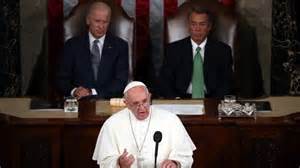
He elaborated his point during his address to the U.S. Congress on September 24th when he referred to economic system we know as “filthy,” “rotten,” and “putrid.” He called the Wall Street speculators “hypocrites.” Moreover, the pope directly confronted the members of his audience by calling the system they represented “the greatest purveyor of violence” in the world today. And he called the politicians seated before him a bunch of gangsters.

Yes he did.

Of course the polite, soft-spoken, and gentle pontiff was a gracious enough guest to do none of those things directly. He did so instead by offering Dorothy Day, Martin Luther King and Thomas Merton as embodiments of our country’s greatest values.

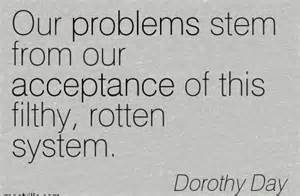
It was Dorothy Day who is remembered as saying, “We need to overthrow . . . this rotten, decadent, putrid industrial capitalist system which breeds such suffering in the whited sepulcher of New York.”

It was King who called the United States itself, “the greatest purveyor of violence in the world today.”

And it was Thomas Merton, the apostle of non-violence, who classified U.S. politicians and military leaders among the world’s gangsters when he said, “The world is full of great criminals with enormous power, and they are in a death struggle with each other. It is a huge gang battle . . .”

Moreover, Pope Francis did not leave his audience merely reeling from such heavy blows un-complemented by clear systemic alternatives to the filthy rotten arrangement he addressed. Instead, the pontiff called for a deep restructuring of capitalism-as-we-know-it. This would involve turning the present system’s preferential option for the rich precisely on its head, replacing it with his favorite guideline, the “preferential option for the poor.” Even more particularly, restructuring would require a central international legislative body endowed with power to override national economic practices judged to be environmentally unsound.

Both recommendations are found in Laudato Si’ which the pope cited in his congressional address. Both have already been implemented world-wide.

To begin with, the New Deal, the Great Society and (even more so) Europe’s introduction of the welfare state already represent arrangements which forefronted the needs of the working classes and poor. The reform measures were at the very least strong gestures towards economies mixed in favor of the poor rather than of the Wall Street rich. Such reforms demonstrated that another economic order is indeed possible.

As for the world body with power to enforce environmental legislation, the World Trade Organization (WTO) already has it, though perversely in its present form. According to the provisions of the North American Free Trade Agreement (and of the proposed Trans-Pacific Partnership), multinational corporations (MNCs) now have the power to sue before the WTO and invalidate U.S. environmental protection standards if those laws can be shown to diminish a corporation’s expected profits.

What the pope is proposing is an international body that turns the WTOs mandate upside-down.  The body the pope proposes would have binding power to protect the environment from the depredations of MNCs – i.e. is to eliminate their profits if they result from environmental destruction.

So I respectfully suggest that Chris Hedges is mistaken when he says Pope Francis pulled punches in his address before the U.S. Congress. And the pontiff has offered an alternative. As an honored guest, he gently delivered knock-out blows clearly observable to attentive listeners.

It remains for prophets like Hedges and others to highlight and reinforce them and in this way to advance us towards the Other World Pope Francis would convince skeptics is possible.

The Pope’s Address to Congress: First Impressions

Pope Congress 2

It was a fabulous speech by the world’s leading spiritual and thought-leader, who has just produced our century’s most important public document, Laudato Si’, the papal encyclical on the environment.

Pope Francis addressed not just the dignitaries in the Senate chambers, but all of us – parents struggling to support families, social activists, the elderly and the young.

The pope emphasized communitarian values: dialog, the common good, solidarity, cooperation, sharing, and the Golden Rule.

He held up for emulation four counter-cultural heroes he understood as embodying the most admirable of “American” values. They weren’t Rockefeller, Reagan, Jobs, or even FDR. Instead they were:

  1. Abraham Lincoln: the champion of liberty for the oppressed
  2. Martin Luther King: the advocate of pluralism and non-exclusion
  3. Dorothy Day: the apostle of social justice and the rights of the poor
  4. Thomas Merton: the Cistercian monk who embodied openness to God and the capacity for inter-faith dialog.

Of course, Lincoln and King were victims of assassination for championing the rights of African Americans.

Day and Merton vigorously resisted what Dorothy Day called “this filthy, rotten system.” (As is well-known, she was also an unwed mother whose first pregnancy ended in abortion.)

Following the examples of The Four, the pope called for the end of:

  • Fundamentalisms of every kind – including economic fundamentalisms
  • Political polarizations that prevent opposing parties from dialog and cooperation
  • Exclusion of immigrants by a nation of immigrant descendants
  • Capital punishment and its replacement by programs of rehabilitation
  • The global arms trade and arms sales in general along with the wars and violence they stimulate
  • Violent conflict and its replacement by difficult but essentially diplomatic process of dialog
  • The human roots of climate chaos and the related problems of poverty
  • Unlimited and directionless development of technology

Throughout this gentle but radical speech, the audience seemed to be waiting for the other shoe to drop – i.e. for the pope to mollify his conservative critics by addressing their favorite “religious issues” contraception, abortion, gay marriage. But the shoe never hit the floor.

At two points the pope about to untie his footwear. In mid-speech, he stated that we must protect and defend human life at every stage of its development. This lured his audience into a standing ovation.

However, the illustration of his point was not abortion, but capital punishment. Punishment for crime, Francis said, must never exclude hope and rehabilitation. We must end the death penalty, he asserted, since every life is sacred.

Then towards the end of his address, Francis spoke of his anticipated presence at this weekend’s Philadelphia Conference on the family. Families, he said, are threatened as never before, both from within and without.

But then, instead of addressing gay marriage, the pope spoke of the “most vulnerable” in this context – not the unborn, but “the young” threatened by violence, abuse and despair. Many of them hesitate to even start families, he lamented – some because of their own lack of possibilities. Others demur because they have too many possibilities. “Their problems are our problems,” the pope said. We must address them and solve their underlying causes.

It was a masterful speech. It continually lured conservatives into standing ovations for issues they constantly oppose: the end of the capital punishment, protection of the environment, openness to immigrants, the end of arms sales of all kinds. The address summoned legislators to their real responsibility – pursuing the common good, the chief aim, the pope said, of all politics.

The pope’s basic message was be daring and courageous – like the counter-cultural activists, Lincoln, King, Day, Merton, and (I would add) Pope Francis!

Pope Urges Catholic Parishes to Take in Refugees

pope-refugees-2

I woke up this morning to a promising Washington Post headline. It read: “Pope Urges Europe’s Catholics to take in Syrian refugees.” There he goes again, I thought.

The article described how Pope Francis “has called on ‘every’ parish, religious community, monastery and sanctuary to take in one refugee family – an appeal that, if honored, would offer shelter to tens of thousands.”

Of course the vast majority of such migrants are “illegal” in the eyes of governments where the invited parishes, etc. are located.

The pope implied that Jesus’ attitude towards “the stranger” overrides such legislation. The Master’s words in MT 25:35 have him identifying with immigrants (and the hungry, naked, homeless, and imprisoned) and basing the entire final judgment on the way we treat such people. He says: “. . . I was hungry and you gave me something to eat, I was thirsty and you gave me something to drink, I was a stranger and you invited me in,”

The pope’s appeal comes at a time when immigration along with climate change is a hotly contested issue not only in Europe, but here in the United States.

Of course, the entire panoply of Republican candidates (including the six of them who claim to be “devout Catholics”) consists not only of climate change deniers, but of candidates trying to outdo one another on the issue of excluding immigrants from our borders. Catholic candidates include Jeb Bush, Chris Christie, Bobby Jindal, Rick Santorum, Marco Rubio and George Pataki. Now they specifically diverge from the Pope not just on climate change, but on immigration as well.

Just yesterday, another ardent Christian, Sarah Palin, brought climate change and immigration together in typical GOP fashion. She told CNN that refugees from Mexico not only “better be legal,” but should be made to speak “American,” rather than “Mexican.” She sides with Donald Trump’s plan to build an exclusionary wall along the border. She also aspires to be Mr. Trump’s Secretary of Energy – a position she would embrace enthusiastically “because energy is my baby – oil and gas and minerals, those things that God has dumped on this part of the Earth for mankind’s use. . .”

Of course, Pope Francis words yesterday put him on the side of immigrants and against exclusionists. He invites his flock of 1.2 billion to follow suit. He also expressly rejects Palin’s reading of God’s mind about why the Creator “dumped” gas, oil, and minerals on Earth.

According to his eco-encyclical, Laudato Si’, using the narratives of Genesis to encourage “the unbridled exploitation of nature” is an incorrect interpretation of the Bible (67). “Clearly,” the pope adds, the Bible has no place for a tyrannical anthropocentrism that would encourage the “drill, baby, drill” approach regardless of its effects on the planet (68).

But the pope’s words about welcoming immigrants struck even closer to home.  For years I’ve been wondering what it might take to awaken Catholics to the revolutionary power of the Gospel.

In my own Catholic parish, we find ourselves mired in a detached, decontextualized version of faith that ignores the world’s real problems.

Pope Francis represents the exact opposite trend. Yet despite his invitation to “change everything” issued in The Joy of the Gospel nearly two years ago, and in spite of the urgency of Laudato Si’, nothing at our local level changes.

Yesterday’s papal invitation shows us how to get off the dime. He suggests something practical for every parish to do: welcome at least one immigrant family from the detention centers on our own borders. House and feed them. Be a prophetic example to the exclusionists. Join with other (non-Catholic) churches to do the same.

The infrastructure is there: churches that are used for just a few hours each week, parish basements and halls that are similarly idle most of the time. Also, many of us have space in our own homes – or own second houses – that might similarly provide housing for Jesus presenting himself to us as an immigrant.

Our little parish of St. Clare in Berea, Kentucky has a Peace and Social Justice Committee of 20 highly committed people. We’re meeting next Sunday to plan our gala “Watch Party” on September 27th to see the Pope’s address our Congress and the U.N.

Now in the light of the pope’s invitation to open our buildings to immigrant families, we have something else to discuss and act upon.

Accepting Pope Francis’ invitation could move our parish to truly begin “changing everything.”

Can you imagine what would happen, if the families we accepted were Muslim instead of Christian?

Thank you, Pope Francis.