“Laudato Si’” and Its Preferential Option for the Poor (Part Three): the Guiding Principle for Restructuring the World Economy

option for poor

This is the last installment in a three-part series on Pope Francis’ new encyclical, Laudato Si’. It attempts to place in historical perspective what might well be the most important document yet produced in the 21st century. It also tries to explain the meaning and centrality of the encyclical’s guiding principle, its “preferential option for the poor.”  This third part addresses the meaning and centrality of that option.

In his critique of capitalism-as-we-know-it (reviewed in Part Two of this series), Pope Francis called explicitly for “structural change” in the world economy.  He said, “Let us not be afraid to say it: we want change, real change, structural change.”

But what “structural change” does the pope have in mind?

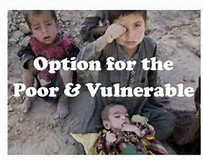
Evangelii Gaudium and Laudato Si’ offer the answer. Their “preferential option for the poor” provides the guiding principle and turns the present economic order exactly on its head. This implies that if the present order is possible, so is its opposite.

That is to say that the present neo-liberal order is structured according to a “preferential option for the rich.”  Its sponsoring question is how can we make sure that the banks, corporations, and 1% prosper? Economists explain such concern by various “trickle-down theories.”  If priority is accorded the welfare of the rich, the theorists say, the wealth produced will trickle down creating a “rising tide that lifts all boats.”  [The pope rejects such theories out-of-hand as historically disproven. In “Evangelii Gaudium” he even calls them homicidal (53), ineffective (54) and unjust at their roots (59).]

By way of contrast, the pope’s “preferential option for the poor” begins at the bottom of the economic pyramid. Its sponsoring question is how can we insure that farmers have land, that workers have jobs, and that everyone is decently housed?

Laudato Si’ goes even further. It expands moral concern beyond human beings to all forms of life. It asks how we can insure the survival of the planet in the face of global warming, water and air pollution, massive extinctions, disappearance of rainforests, wasted food, waste in general, uncontrolled urbanization, rampant crime and loss of human meaning.

None of this means abandoning market dynamics altogether.

It does mean, however, controlling them according to the principle some have expressed in the words, “as much market as possible and as much planning as necessary.” This means maximizing market forces, but controlling them as necessitated by prioritization of the needs of the poor including the environment – once again by the preferential option for the poor.

In practice this entails at least the following: governments (1) intervening in the marketplace to insure the rights of all to jobs with living wages, housing, education, and health care, along with land for small farmers, (2) similarly regulating market forces to protect the global environment and all life forms from the most primitive to the highest, and (3) thereafter turning economies over to carefully monitored and controlled market forces.

Impossible you say? Not at all. To repeat: if economies can be structured according to a preferential option for the rich, they can be restructured to prioritize the needs and rights of the poor and the environment.

That’s the Global South hope and conviction Laudato Si’ embodies: another world is indeed possible.

Conclusion   

Will Laudato Si’ have its desired effect? That, of course remains to the seen. However, it undeniably has in Pope Francis a powerful proponent.

That is, despite remaining Stalinist skepticism, Pope Francis might well be the most powerful man in the world. Certainly, he is the planet’s most influential moral leader. What empower him, of course, are not the military divisions in which Josef Stalin placed confidence, but his extraordinary consciousness of the unity of all creation expressed repeatedly in his every pronouncement and especially in his recent encyclical. What sets him apart from the Obamas and Putins of the world is his equally unusual courage, compassion, charisma, and credibility.

Additionally, the pope has surpassing constituency. He heads a community of 1.2 billion followers. And this does not even count the untold millions of non-Catholics who admire him and his thought leadership.

With such support, the powerful message of Laudato Si’, and his plans to bring that message to the U.N. and U.S. Congress in September, as well as to influence the Climate Summit in Paris next September, who knows what changes will result? Who knows how he will influence the U.S. general elections in 2016?

In other words, Francis may stand on the brink of surpassing the stature of Leo XIII and John Paul II in terms of changing the world.

Defenders of the old order are already shaking in their boots.

“Laudato Si’” and Its Preferential Option for the Poor (Part Two): Pope Francis’ Critique of Capitalism

Dung of Devil

This is the second installment in a three-part series on Pope Francis’ new encyclical, Laudato Si’. Overall, the series attempts to place in historical perspective what might well be the most important document yet produced in the 21st century. It also tries to explain the meaning and centrality of the encyclical’s guiding principle, its “preferential option for the poor.”  This second part addresses Pope Francis’ critique of capitalism-as-we-know-it.

Pope Francis’ Critique of Capitalism

The first entry in this series on Laudato Si contextualized the significance of its author’s origins in the Global South. It argued that till Francis, Catholic social teaching had largely focused on Western and Eastern Europe. The social pronouncements of Italian popes were largely concerned with the problems of Western Europe and the threatened loss of the working class to the allures of socialism and communism. Beginning with Leo XIII’s Rerum novarum, the Italians set the stage for the introduction of Europe’s extensive welfare state.

With the election of a Polish and subsequently of a German pope, papal focus shifted to Eastern Europe and the dethroning of communism there. Pope John Paul II and his right hand man, Josef Ratzinger (later to become Benedict XVI) cooperated with the Reagan administration (and specifically with the CIA’s William Casey) in facilitating the collapse of the Soviet Union.

With that demise achieved, it appeared to most that capitalism had won a definitive victory. Corporate globalization stood virtually unchallenged.

However, all of this changed with the ascent of Argentina’s Jorge Bergoglio to the papal throne in 2013. As the first pope from Latin America, Pope Francis has repeatedly called capitalism’s “final victory” into question. No longer focusing on Europe (western or eastern), he shifted focus to the Global South, to the poverty colonialism and unfettered capitalism had caused there.

He focused on connections between deregulated markets and the rape of the Earth Mother indigenous Catholics of the Andes called Pachamama. Without apology, he espoused a “preferential option for the poor,” and spoke clearly about the rejection of the neoliberal globalized order lionized by the corporate elite.

Such sentiments were nowhere more clearly expressed than in the speeches delivered by Pope Francis during his summer “homecoming” trip to Latin America. In written form, they were evident in his landmark encyclical on the environment, Laudato Si’ and in his Apostolic Exhortation, Evangelii Gaudium.

Addressing the World Meeting of Popular Movements in Santa Cruz, Bolivia, Francis traced today’s global problems back to their origins in European colonialism beginning in 1492. But he also identified new forms of colonialism exercised through corporations, loan agencies, “free trade” treaties, and imposition of “austerity measures.”

Such actors and policies subordinate states to outside powers which also exercise control through misguided policies ostensibly aimed at controlling drug trafficking, political corruption, and terrorism. More subtly, external powers colonize, destroy local cultures and foster cultural uniformity through communications monopolies, which the pope described as “ideological colonialism.”

“Let us say NO to forms of colonialism old and new,” he said.

The pope was completely outspoken. He went on to criticize capitalism-as-we-know-it as “an invisible thread” connecting problems of world poverty, worker exploitation, landlessness among farmers, homelessness, and destruction of the natural environment. That system imposes the mentality of profit at any price without concern for its impact on displaced peasants and workers or for its destructive effects on “Mother Earth.”

This is indeed capitalism-as-we-know-it.

The system, he said “is by now intolerable: farm workers find it intolerable, laborers find it intolerable, communities find it intolerable, peoples find it intolerable … The earth itself – our sister, Mother Earth, as Saint Francis would say – also finds it intolerable.”

Though some have criticized the pope for stepping outside his area of competence, his condemnation of the reigning economic system is specifically biblical, theological, and moral.

Like the prophets of the Jewish Testament, he identifies “the existing system” with idolatry, the most serious of biblical sins. In his strongest condemnation yet, Francis quoted the 4th century sage, Basil of Caesarea, calling today’s capitalism “the dung of the devil” – i.e. the excrement of evil personified. Stronger language can hardly be imagined.

Theologically, Francis echoed Latin America’s liberation theology speaking Christian faith as “revolutionary,” because it challenges “the tyranny of Mammon.” The existing system, the pope said, “runs counter to the plan of Jesus.” He said the system now in place and Jesus’ hoped-for Kingdom of God have different aims.

Morally, then, the pope called working against capitalism-as-we-know-it – “working for just distribution of the fruits of the earth and human labor” – a “moral obligation.” For Christians, he said, “it is a commandment.” Here the pope echoed what he said in “Evangelii Gaudium,” where he identified the struggle for social justice and participation in political life as “a moral obligation that is “inescapable.”

(Next installment: the “other world” Francis sees as possible)

(Sunday Homily) Why Listen to Pope Francis on Climate Change? He’s A Prophet in Our Midst

http://https://youtu.be/XlHb_9rJSjw

Readings for 12th Sunday in Ordinary Time: JB 38: 1, 8-11; PS 107: 23-26, 28-31; 2COR 5: 14-17; LK 7:16; MK 4: 35-41.

Thursday Pope Francis published his long-awaited encyclical on the environment and climate change. The document is called Praised Be: on the Care of Our Common Home (PB).

Today’s liturgy of the word is perfectly synchronized with the encyclical’s release. Its elements emphasize God’s sovereignty over nature, its overwhelming beauty and might, the power of Christ-Consciousness to save from nature’s fury, and the new order of God’s Kingdom proclaimed and embodied in the Master from Galilee. Moreover, in articulating today’s themes, the humble Pope Francis distinguishes himself as a “great prophet,” in whom “God has visited his people” – the refrain in today’s Alleluia Verse.

Begin by considering the readings; afterwards we’ll turn to the encyclical and to Pope Francis’ prophetic status.

In our first reading, God speaks to Job sitting on a dung hill like the “pile of filth” into which, the pope says humans are turning the earth (PB 21). Like us, Job is trying desperately to figure out why bad things are happening to his world. Significantly, the Divine One speaks out of a storm and declares God’s sovereignty over nature – its seas with its threatening waves, the sky with its dark clouds, storms with their winds, thunder and lightning.

That theme of God’s sovereignty over nature is picked up in today’s responsorial which emphasizes the fearful might of the world’s oceans. Psalm 107 calls the sea an “abyss” – a threatening black hole. It is the work of the Lord who on the one hand causes storms to arise, but on the other restores calm to the waves and brings relieved travelers back to safe haven. Again, it is God, not humans who controls nature – a major theme of Praised Be.

Then in today’s Gospel selection Jesus calms the sea when it threatens to sink the boat he and his friends are using to travel to the “other shore.”

It’s the identity of Jesus’ followers as “Other Christs” called to do what Jesus did that is emphasized in today’s reading from Second Corinthians. There the apostle identifies Jesus as the herald of a completely new reality. The old order is no longer relevant, Paul says; it has entirely passed away. It’s that reality that followers of Jesus’ Way are to embody and usher in.

All of the themes in today’s liturgy of the word find echo in Pope Francis’ encyclical. Consider them one-by-one:

  • God’s Sovereignty over nature: Here Francis bluntly states that the pervasive understanding that God gave humans power of dominion or destruction over the earth “is not a correct interpretation of the Bible” (67). According to Francis, God denies any pretense of absolute ownership: “The land shall not be sold in perpetuity, for the land is mine; with me you are but aliens and tenants.” (Leviticus 25:23).
  • Nature’s overwhelming beauty and might: The very title of the pope’s encyclical reflects this point. “Laudato Si” are the first words of a prayer composed by Francis’ namesake, the great Italian mystic, Francis of Assisi, identified by the pope as the patron of ecology (10). Of St. Francis the pope writes, “Like it happens when we fall in love with someone, every time that Francis looked at the sun, the moon, the smallest animals, his reaction was to sing, sharing in the glory of all the other creatures. . . he entered into communication with all of creation.” At the same time the Pope Francis argues that today’s climate chaos with its fearful storms, droughts, and extreme temperatures represents the earth protesting against “the violence that exists in the human heart, wounded by sin.”
  • The power of Christ-consciousness to save us from nature’s fury: St. Francis, the pope notes, was a mystic like Jesus of Nazareth (98). He had Christ-consciousness. It allowed him, like Jesus, to speak to elements that most humans understand as impersonal (98). So like Jesus speaking to the wind and waves in today’s Gospel, Francis conversed with animals and regarded the sun as his brother and the moon as his sister. Only the adoption of such sensitivity and reverence, the pope says, can restore balance to our planet (11).
  • The new reality to which we are called: “An economic and technological development that does not leave the world a better place and with an integral superior quality of life cannot be considered progress” (194). So Francis proposes a new model beyond the worship of the “free market.” Its exact shape must be worked out through a process of international dialog (180). However it necessarily includes an international body with legislative power to control excesses of production and consumption connected with unfettered capitalism.”

In providing such clear direction, Pope Francis’ encyclical solidifies his identity as a “great prophet.” As it turns out, he is the only world leader capable of turning the planet around. His power combines the exact virtues required for such a herculean task:

  • Consciousness: Pope Francis’ consciousness is unique. Virtually alone among world leaders, he sees climate change, poverty, morality and spirituality as inextricably interconnected.
  • Courage: Among his peers, Francis’ courage is unparalleled. By comparison the “leader of the free world” (not to mention climate change denialists) looks like a timid child bowing and scraping before the world’s wealthy few – indecisive about Keystone XL and arctic drilling. Moreover, the pope intends to take his message of interconnection directly to the lion’s den. He will speak not only to the United Nations, but will confront a U.S. Congress largely hostile to his position on climate chaos.
  • Credibility: As a scientist with an advanced degree in chemistry and as titular head of the Pontifical Academy of the Sciences, Francis has access to the world’s finest scientific minds. He has done his homework. He addresses not just climate change, but problems undeniably caused by human activity – “water poverty,” food waste, waste in general, overfishing, destruction of coral reefs, human trafficking, income gaps between the global north and south, the rampant elimination of innumerable species, and war.
  • Charisma: The world loves Pope Francis. No other world leader more widely admired or more capable of influencing people regardless of nationality or creed. It is interesting to see Catholic politicians like Jeb Bush, Rick Santorum, Paul Ryan, John Boehner, and Bobby Jindal speak condescendingly about a religious leader’s forays into fields “beyond his expertise” – as if they were better informed and could out-Catholic the pope. This is a battle they cannot win.
  • Constituency: Pope Francis is the leader of 1.2 billion Roman Catholics. There are more than 70 million Catholics in the United States – not to mention the millions of non-Catholics who admire the pope. Can you imagine what would happen world-wide (politically and environmentally) if even a small percentage of them took the pope’s words to heart? What if they radically changed their behavior (and voting) patterns to save the planet for future generations and prevent the poor from suffering the worst effects of industry-induced environmental degradation?

Praised Be leaves none of us off the hook. Rather the virtues just enumerated provide guidelines for each of us. As Paul’s “other Christs” and as humans in general (62) we are called to “Franciscan”:

  • Consciousness: Each of us can become expert. Just reading Praised Be will take us a long way in that direction. Do your part for the planet; read the encyclical now. It is the best, most comprehensive and accessible text available on the most important issue facing our world. (Good supplemental reading is This Changes Everything by Naomi Klein.
  • Courage and credibility: Good information breeds these qualities. Like the pope we all need to fearlessly confront our uninformed, misinforming, head-in-the-sand politicians and demand that they serve us, our planet, children and grandchildren. Enough of letting them confuse us with their obfuscations.
  • Charisma: Few in the world can claim anything like Pope Francis’ charisma. But his fearless outspoken truth-telling is contagious and can infect us all by association. We must follow his example and use our innate talents to spread the message of Praised Be.
  • Constituency: Whether Catholic or not each of us needs to join Pope Francis’ constituency. In my own parish, our Peace and Social Justice Committee plans to buy copies of his encyclical for every parishioner over the age of 16. Beginning in September (about the time of the pope’s visit to the U.S.) we’ll initiate a parish-wide study of the encyclical. We’ll gather to watch Francis’ speeches to the U.N. and our Congress. Praised Be provides a foundation for turning every Catholic Church into a peace and social justice dynamo.

Again, today’s Alleluia Verse proclaims “A great prophet has risen in our midst. God has visited his people.” Today Pope Francis is that prophet. That’s why we should listen to him and follow his example.